Sample Category Title
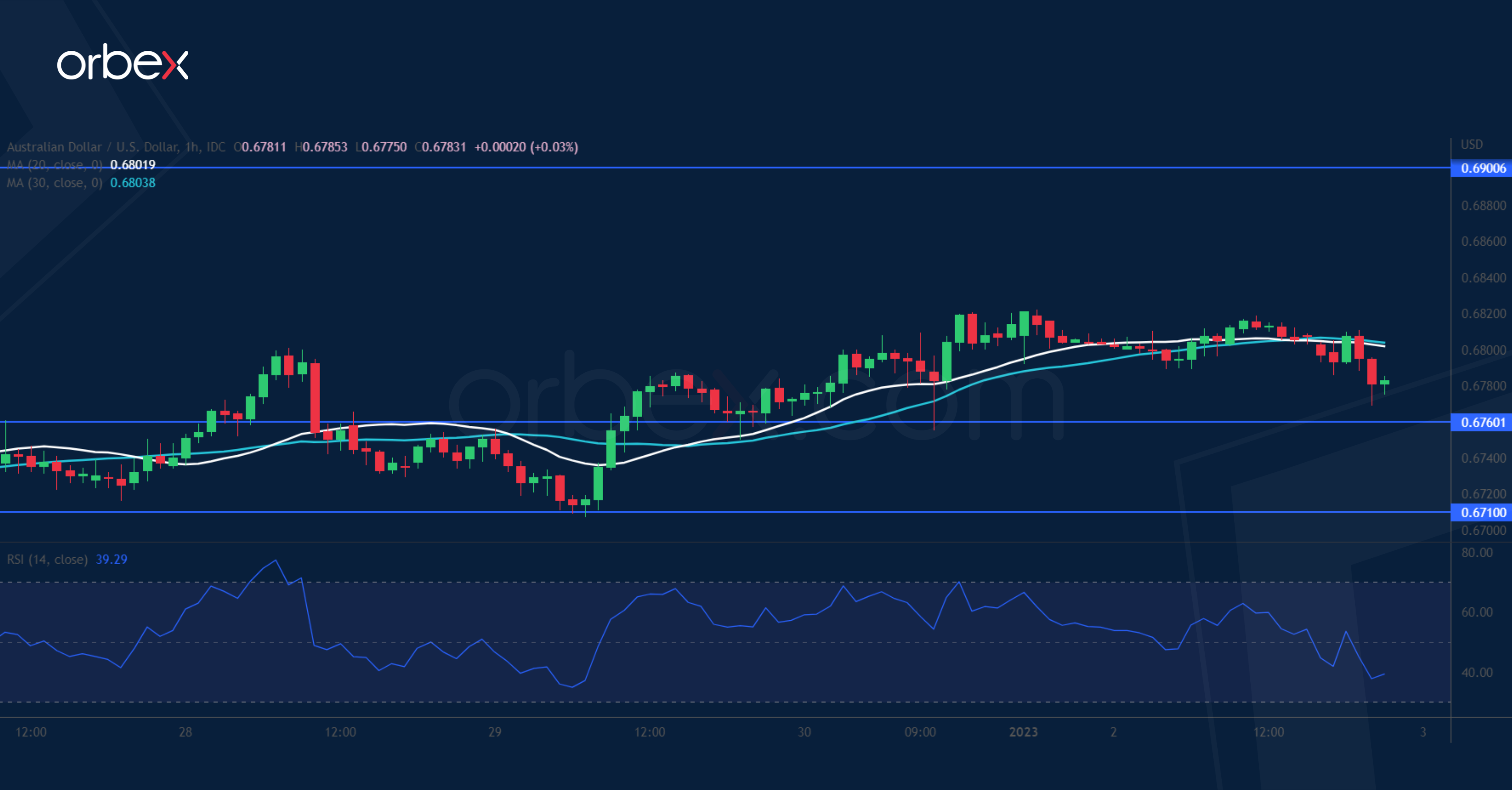
AUD/USD Recoups Losses
The Australian dollar edges higher as traders shun safe haven assets like the greenback. The pair has clawed back a big chunk of its losses from the liquidation in mid-December. The bulls have shifted their focus to the previous peak at 0.6900. A bullish breakout would extend the aussie’s recovery in the medium-term. In the meantime, they may consolidate their holding above 0.6800 with 0.6760 as the closest support. That would attract more buying interest. 0.6710 is a second layer of defence in case of further hesitation.
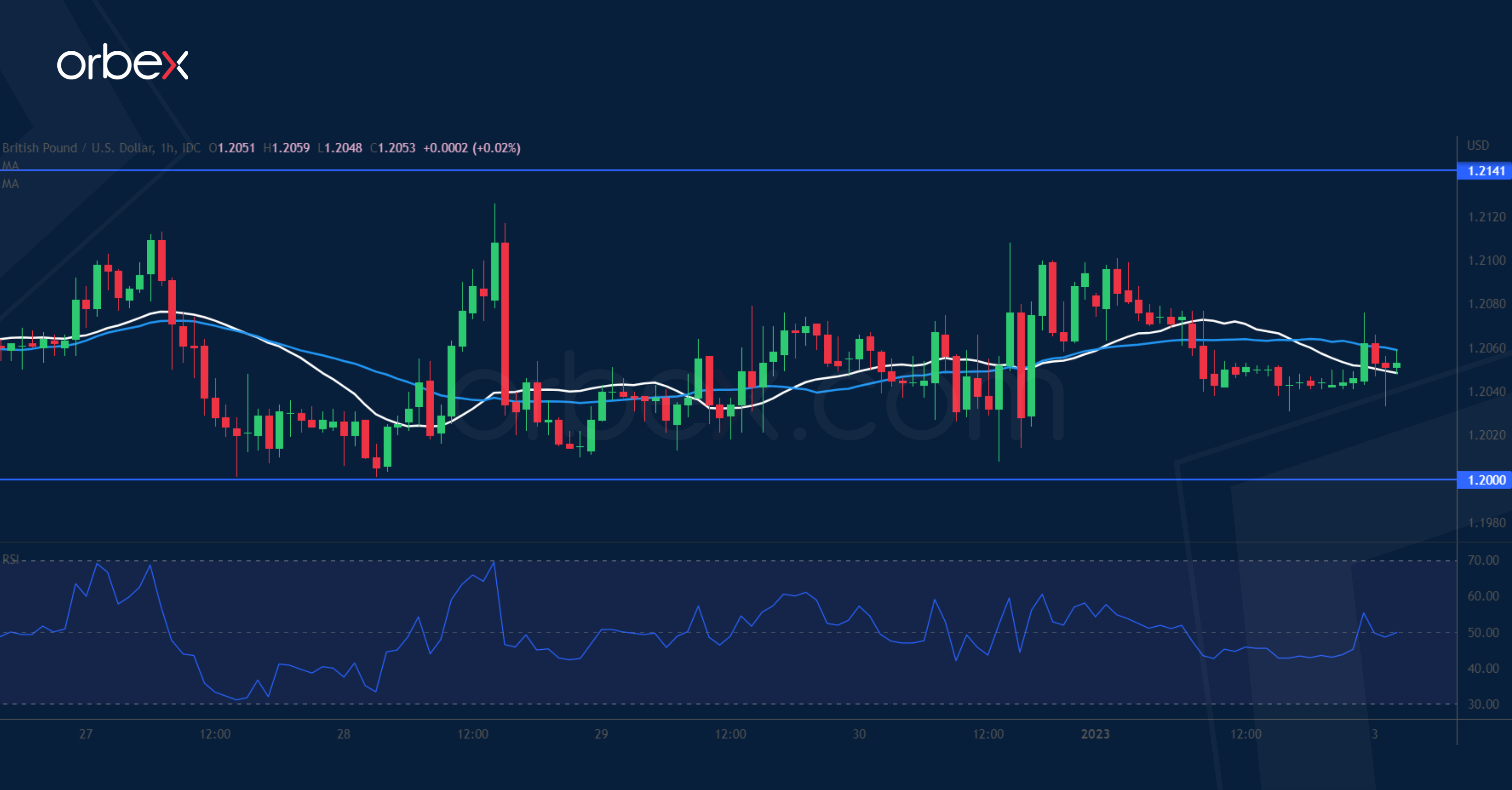
GBP/USD Seeks Support
The pound underperforms as market participants remain worried about the UK’s economy in 2023. The pair continues to drift lower due to buyers taking profit after a two-month long rally and new sellers getting into the game. The psychological level of 1.2000 sits at the origin of last December’s rally and the sideways action is a sign of little buying. Though the price would remain depressed as long as it is under 1.2140, sentiment may only turn around if the bulls reclaim 1.2280. 1.1900 is a critical level to keep Sterling afloat.
Room for Correction in EMU/German Yields to Go Still Somewhat Further
Markets
With Japanese, UK and US markets still closed, EMU markets took a constructive start to the new year. Last week, the post-ECB bond sell-off propelled German yields to close 2022 at cycle peak levels across all maturities. The 10-y testing/briefly surpassing the psychological barrier of 2.50% apparently was a good enough reason for investors to take a more cautious approach awaiting key data evidence in the US (ISMs, payrolls, Fed Minutes) and EMU (CPI) later this week. The Dutch (February) gas contract dropping below levels last seen before the start of the Ukraine war, raised hope that the negative supply shock of exceptionally high energy prices might gradually turn less aggressive. The EMU December CPI estimate on Friday serves as a first reality check. Admittedly, oil keeps a modest upward path ($85.9 p/b). Even so, the German curve bull flattened with yields easing between 5.5 bps (2-y) and 14.5 bps (30-y). Contrary to what often happened of late, the bond rally this time was mainly driven by a decline in inflation expectations rather recessionary fears. This supported European equities with most major indices gaining 1.0%+ (EuroStoxx50 +1.65%). With other major markets still closed, moves in the major FX cross rates stayed modest, despite the repositioning on the EMU yield markets. After opening near 1.07, EUR/USD closed modestly lower at 1.0667. EUR/GBP held near the 0.8867/77 resistance/recent top, but we await the reopening of UK markets today to drawn any conclusions on sterling momentum.
This morning, Asian markets are starting the day mixed. Hong Kong gains about 1.65%. The CSI 300 only shows a marginal gain as the China Caixin manufacturing PMI dropped further below the 50 mark (to 49.4), confirming even more negative readings in the official PMI’s published on Saturday. The Australian S&P/ASX 200 cedes 1.31%. The yen still outperforms. USD/JPY (129.75) dropped below the 130.58/41 key support area (Japanese market is still closed). EUR/USD (1.067) trades little changed. Treasury futures also suggest a correction in US yields at the open.
Today, we look out whether US (and UK) markets will join yesterday’s positive start in Europe, but the reopening comes amid an almost empty UK and US calendar. In Europe, preliminary German December inflation data are expected to confirm the gradual easing that started last month, with the HICP expected at -0.8% M/M bringing the y/y measure to 10.2% (from 11.3%). French HICP shows somewhat of a different dynamic and is expected to rise 0.4% M/M and 7.3% Y/Y (from 7.1%). With the ECB keeping a close eye on the risk of potential second round effects/wage inflation, German labour market data also deserve some attention. In a day-to-day perspective, we see room for the correction in EMU/German yields to go still somewhat further even as the ECB probably gives more weight to (still stubbornly high) core inflation rather than to an energy-driven decline in the headline. EUR/USD recently held a tight range just below the 1.0735 post-ECB peak. A break/ further USD losses, probably need soft US data (ISM’s tomorrow/Friday; payrolls on Friday).
News Headlines
A CoreLogic report showed that Australian house prices dropped by 1.1% in December, taking values 5.3% lower over the 2022 calendar year. The re-acceleration in the downtrend was driven by a worsening in the monthly decline rate across Melbourne, Sydney, Adelaide, Darwin and Canberra. The yearly price drop was the first one since 2018 and the largest one since 2008 (6.4% fall). Prices are now 8.2% lower than the peak in early May. CoreLogic’s research director Lawless pointed to the RBA’s record-breaking tightening pace as the key reason for the cooling housing market. The central bank lifted policy rates by 300 bps from May through December with more to come.
German December Inflation and Unemployment: Good News for the ECB Expected
Through at least the early part of this year, the ECB is expected to go against the trend of most other major central banks. The BOE and Fed are expected to continue to slow the pace of rate hikes as inflation comes down, the economy comes under increased pressure, or (which is a likely scenario) both.
Meanwhile, the ECB is expected to continue to hike rates at a relatively aggressive pace. That rates might rise at the same ratio as the Fed's did last year might be a bit of a stretch, though. The ECB has a different set of challenges, setting monetary policy for a series of countries with disparate fiscal policy. That might constrain the ECB's final rate.
Where things are going
The ECB was the last of the major central banks to start hiking, which means there is more "headroom" for it to continue to tighten. It is still 200bps behind the Fed, for example. Given that the US is the only other economy that is comparable in size, and that both economies are each other's largest trading partner, it's an important comparison. Not just for the EURUSD.
The Euro was weakened substantially last year as the ECB hesitated to tighten and inflation moved above its peers. A large portion of that inflation was driven by an extraordinary event: the high prices in energy from the war in Ukraine. The hope is that winter will be less harsh than expected, leading to less demand for energy, and prices can come down. This would mean that inflation would start coming down, independent of the ECB's policy.
There might be a problem
The main counter to this, naturally, is that no one can predict the weather. But there is another issue which isn't garnering as much headlines: the "sticky-ness" of core inflation. "Sticky" is a growing concept in talking about inflation, referring to how CPI rates are not coming down as fast as hoped. They are "sticking" to the ceiling, as it were.
This was the case with the results from Spain's prelim December CPI, released on Friday. Headline inflation came down, as expected; but core inflation remained elevated. At the end of the day, the ECB cares most about core rates, since that doesn't take into account the volatility of things like energy. But, if energy prices remain high, eventually they seep through to the rest of the economy, making a challenging situation for the central bank. This could mean that interest rates might go up more than currently expected, and the normally dovish and conservative ECB might have to take measures similar to what the Fed has done last year, and substantially propel the Euro.
What data to look out for
Tomorrow we get the release of Germany's latest inflation figures. The market can move around quite a bit as each German state reports, and sets up expectations for the main number. Overall, annual German December CPI is expected to decline sharply to 9.0% from 10.0% prior.
Annual German Harmonized inflation is expected to slow, but not as dramatically, dropping to 10.7% from 11.3% prior. Meanwhile, German unemployment for December is expected to remain steady at 5.6%, after adding 15K jobs, slightly less than the 17K added in November.
Tougher than 2022?
I know, all we hope is to leave the horrible 2022 behind, and lick our wounds this year, but the New Year started with the IMF Chief Georgieva warning that the global economy faces ‘a tough year, tougher than the year we leave behind’. Great.
The IMF expects a third of the world economy to be in recession this year, as the US, the EU and China are slowing. Good news for the US is that the Americans could avoid recession, but the bad news for the Europeans is that, the EU will hardly be as lucky; half of the union will be in recession this year, according to the IMF.
China will also be facing a ‘tough year’ - even the sudden U-turn from the Covid zero policy won’t be enough to boost growth, as the incredibly disastrous management of both pandemic, and the exit from pandemic measures cause hundreds of millions of infections at the same time, and millions of death… and you can see the ravage in economic data. China’s Caixin manufacturing PMI fell the most in 3 months, from 49.4 to 49 in December. It was slightly better than the expectations, but it was the fifth straight month of drop in Chinese factory activity. Output, new orders, and export sales all declined. Employment dropped for the 9th month, and there was no sign of a rebound.
Elsewhere, the German PMI data pointed at a faster than expected contraction in manufacturing activity in December, while the European manufacturing PMI came in at 47.8, in line with expectations.
We will have more PMI data today, but don’t expect to see anything brilliant.
This being said, trading in European markets was rather optimistic on the first trading day of the year, as European nat gas futures eased on mild weather.
The DAX gained 1%, and held ground near the 14000 psychological mark, which also coincides with the 50-DMA, and the minor 23.6% Fibonacci retracement on September to December rally, while the French CAC 40 jumped nearly 2% for a reason I don’t really know.
Activity in European futures hints at a bearish start on Tuesday, while the US futures are in the positive at the tie of writing.
In the FX
The US dollar index kicked off the year on a subdued note, letting the dollar-yen tip a toe below the 130 mark. The EURUSD however, couldn’t build on gains above the 1.07 mark, while Cable remained steady-ish a touch above its 200-DMA, which stands near 1.2030 level.
Gold jumped to $1843 per ounce despite the positive pressure on the yields recently, while oil remained offered into the 50-DMA, which stands a touch below the $81 per barrel mark.
This week’s news and events
The first week of the year will be marked with a couple of important data and events, which will start giving some justifiable direction to market moves after weeks of slow trading.
First, the FOMC minutes on Wednesday will likely confirm, again, the Federal Reserve’s (Fed) tough stance to fight inflation.
But more importantly, Friday’s jobs data will give an insight on whether the Fed is being successful fighting inflation.
Besides, the FOMC minutes and the US jobs data, the OPEC meets this week.
US crude is struggling to take over the 50-DMA resistance, as the slowing China story – despite the reopening, and the mild winter in Europe weigh on the bulls’ appetite to boost the price rally.
But the oil bulls may have not said their last word yet. The limited oil supply, OPEC’s willingness to keep oil prices sustained to fill in the coffers, the switching demand from gas to oil, the Americans who sold 180 million of their strategic petroleum reserves last year, but who will also need to refill them as soon as possible – and possibly around $70-80pb levels, and the slow green transition, all hint that the downside in oil will likely remain limited.
How limited? Levels around $75-76 could give support to price pullbacks for a potential rise toward the $88pb level.
German Inflation in Focus
Market movers today
Today, focus will be on December inflation data from Germany. Due to fiscal measures, German and euro area inflation will be in for a rollercoaster ride in the coming months, adding to the difficulties for markets and the ECB to accurately assess the true inflation pressures. German headline CPI faces some significant downside risks in December due to households having received a government-backed discount on their energy bills. The statistical treatment of this discount is a bit uncertain but it seems this could be treated as an implicit fall in consumer energy prices. As a result, German HICP energy inflation could fall sharply in December, and headline inflation could drop below the 10% mark. However, the price decline will then revert sharply in January/February, before the gas price brake takes full effect in March and the decrease in energy inflation repeats.
In Europe, a lot of focus remains on energy markets, where developments over the winter have been less negative than feared. European gas prices continued to fall yesterday and the benchmark 1-month future reached its lowest level since February 21. Alternative sources (LNG mostly) for Russian gas have allowed Europe to accumulate larger-than-expected reserves while milder than usual temperatures have led to lower-than expected withdrawals.
The 60 second overview
Positive risk appetite. While US and UK investors were out on holiday yesterday the first trading session of the year start with positive risk sentiment, with broader European indices higher. At the same time European yields declined and reversed much of the sell-off recorded ahead of new years.
European final PMI manufacturing released yesterday from euro area countries all landed in sub 50 range, with the most dire print from Spain at 46.4.
China: December activity and supply chains takes a hit. The official PMI for December dropped further to 47.0 from 48.0 in November, and overnight the private Caixin PMI manufacturing printed at 49.0. The former is a very low level in a historical perspective and highlights the negative effect of the covid chaos on the economy, while the Caixin printed in the sub-50 territory for the fifth month in a row.
Credit: While US and UK investors were out on holiday yesterday, the EUR primary market reopened following the Christmas break with two covered bonds priced, along with an SSA deal. For the covered bonds, there is renewed issuance in slightly longer maturities, following the very short tenors seen in Q4. Looking ahead, the pipeline is building with another two covered bonds and a dual-tranche senior non-preferred transaction mandated yesterday.
FI: European rates recorded a strong performance on the first trading day of the year, while US and UK still out for holidays. 10y Bunds ended 13bp lower at 2.43% with spreads broadly unchanged to the rest of the EGBs. Focus today turns to the German inflation print which faces some significant downside risks in December due to households having received a government-backed discount on their energy bills.
FX: Muted traded among thin liquidity yesterday as US, among others, was closed. USD/JPY closed below 130 for a seven-month low. AUD and NZD strengthen on reports that 'peak covid' might soon be hit in China. Mostly sideways in Scandies in thin trading.
Nordics: The December manufacturing PMI was flat at 45.9. The details show a slight improvement in new orders both exports and domestic. Employment rose slightly from still "positive" levels (>50). On the price front, things are easing: delivery times hit the lowest since 2009 and price expectations continue to drop. Hence, an overall positive reading from a Riksbank perspective.
USD/JPY Daily Outlook
Daily Pivots: (S1) 130.50; (P) 130.79; (R1) 130.96; More...
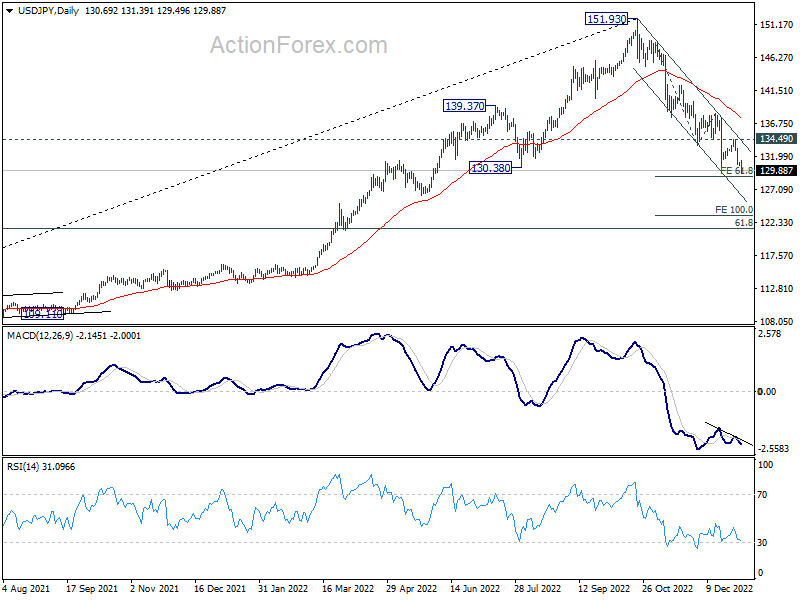
USD/JPY's decline from 161.93 resumed by breaking through 130.55 support and intraday bias is back on the downside. Next target is 61.8% projection of 148.44 to 133.61 from 138.16 at 128.99. Firm break there could trigger downside acceleration to 100% projection at 123.33. For now, outlook will remain bearish as long as 134.49 support holds, in case of recovery.
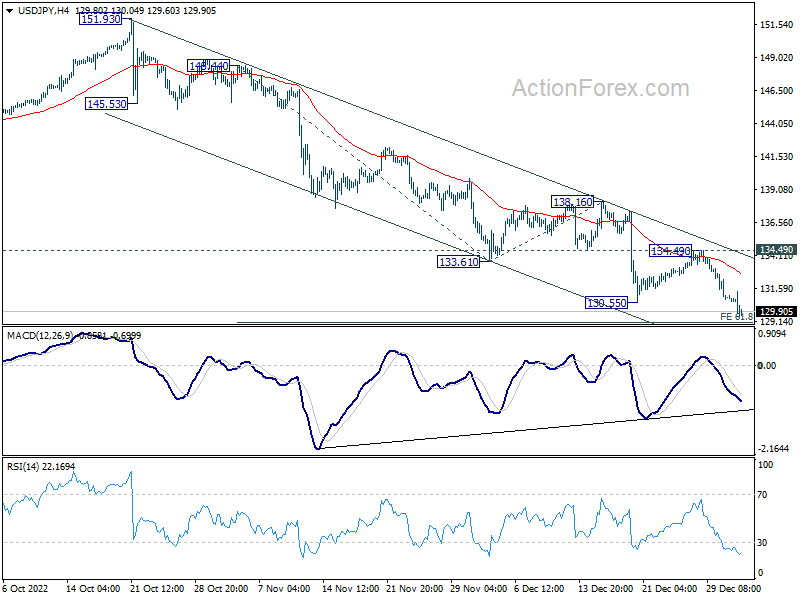
In the bigger picture, a medium term top was in place at 151.93. Sustained trading below 55 week EMA (now at 131.65) would raise the chance of bearish trend reversal. Deeper fall would be seen to 61.8% retracement of 102.58 to 151.93 at 121.43. This will now remain the favored case as long as 55 day EMA (now at 137.54) holds.
USD/CHF Daily Outlook
Daily Pivots: (S1) 0.9213; (P) 0.9238; (R1) 0.9272; More...
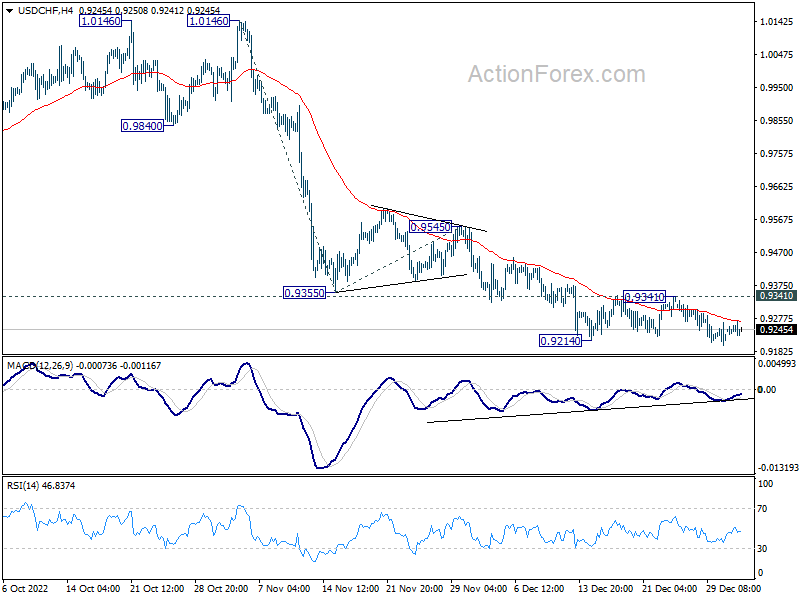
USD/CHF is losing some downside momentum as seen in 4 hour MACD. But further decline is expected as long as 0.9341 resistance holds. Current fall from 1.0146 should target 61.8% projection of 1.0146 to 0.9355 from 0.9545 at 0.9056. However, break of 0.9341 will indicate short term bottoming and turn bias back to the upside for rebound.
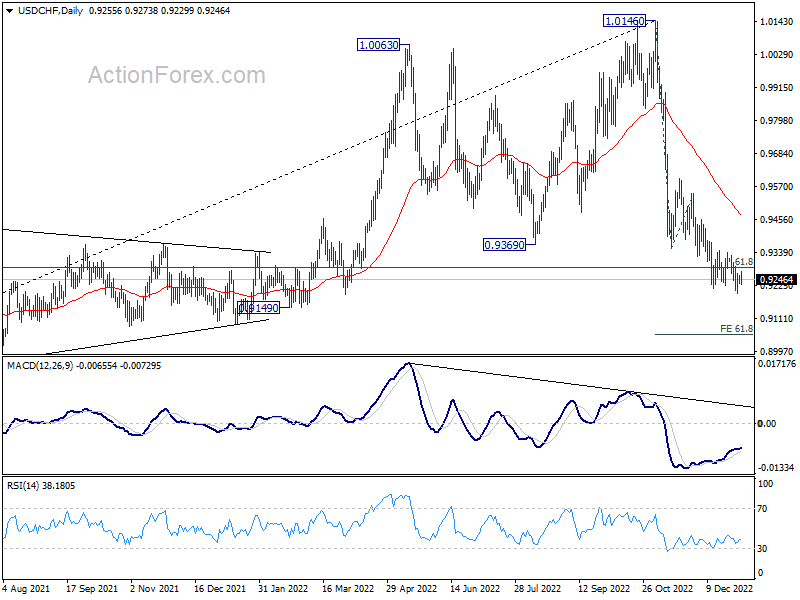
In the bigger picture, rise from 0.8756 (2021 low) has completed at 1.0146, well ahead of 1.0342 long term resistance (2016 high). Based on current downside momentum, fall from 1.0146 might be a medium term down trend itself. Sustained break of 61.8% retracement of 0.8756 to 1.0146 at 0.9287 will pave the way to 0.8756. In any case, risk will stay on the downside as long as 0.9545 resistance holds.
GBP/USD Daily Outlook
Daily Pivots: (S1) 1.2016; (P) 1.2065; (R1) 1.2096; More...
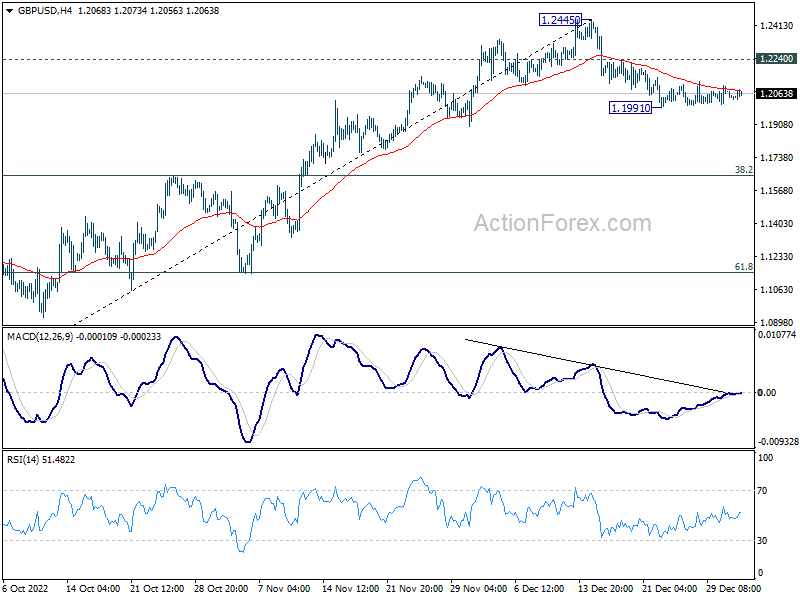
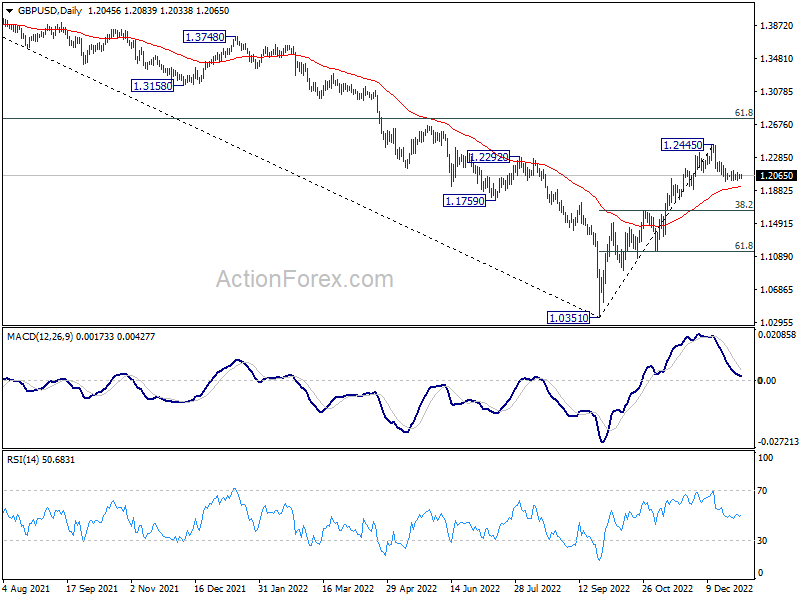
Intraday bias in GBP/USD stays neutral for the moment as sideway trading continues. On the downside, break of 1.1991 will resume the fall from 1.2445 to 55 day EMA (now at 1.1925). Firm break there will target 38.2% retracement of 1.0351 to 1.2445 at 1.1645. On the upside, break of 1.2240 minor resistance will turn bias back to the upside for retesting 1.2445 instead.
In the bigger picture, rise from 1.0351 medium term bottom is at least correcting whole down trend from 1.4248 (2021 high). Further rise is expected as long as 1.1644 resistance turned support holds. Next target is 61.8% retracement of 1.4248 to 1.0351 at 1.2759. Sustained break there will pave the way back to 1.4248. This will remain the favored case as long as 55 day EMA (now at 1.1916) holds.
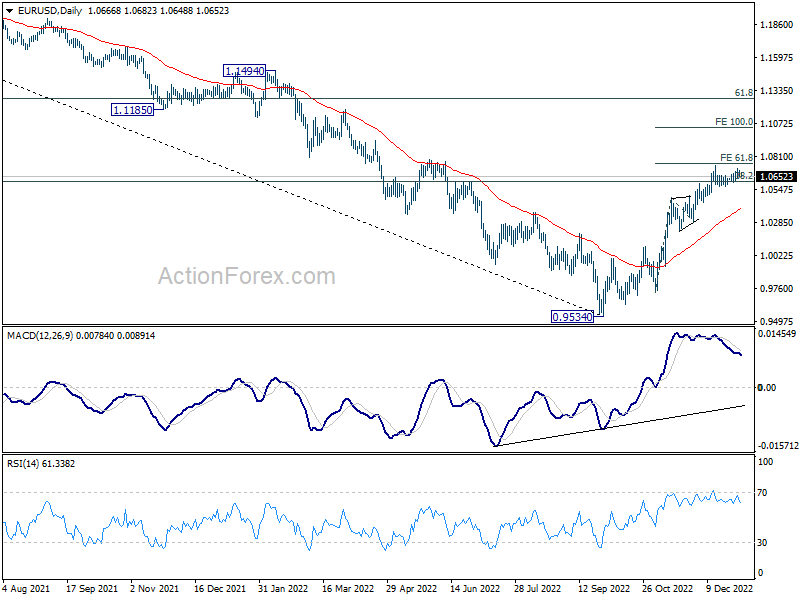
EUR/USD Daily Outlook
Daily Pivots: (S1) 1.0613; (P) 1.0704; (R1) 1.0757; More...
Range trading continues in EUR/USD and intraday bias remains neutral for the moment. Further rally is expected as long as 1.0481 resistance turned support holds. Firm break of 61.8% projection of 0.9729 to 1.0481 from 1.0289 at 1.0754 will pave the way to 100% projection at 1.1041. However, firm break of 1.0481 will confirm short term topping and bring deeper fall to 1.0289 support.
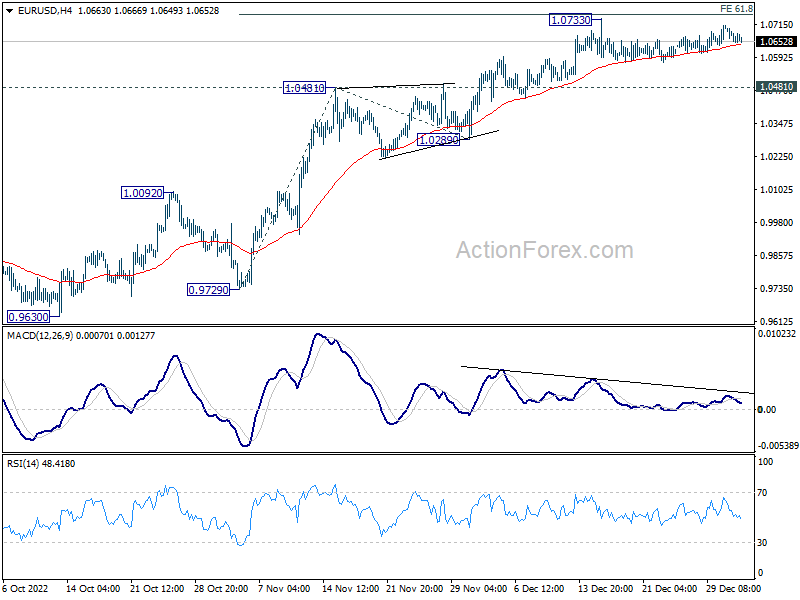
In the bigger picture, focus stays on 38.2% retracement of 1.2348 (2021 high) to 0.9534 at 1.0609. Rejection by 1.0609 will suggest that price actions from 0.9534 medium term bottom are developing into a corrective pattern. Thus, medium bearishness is retained for another fall through 0.9534 at a later stage. However, sustained break of 1.0609 will raise the chance of trend reversal and target 61.8% retracement at 1.1273.