Sample Category Title
(FED) Federal Reserve Issues FOMC Statement
Recent indicators point to modest growth in spending and production. Job gains have been robust in recent months, and the unemployment rate has remained low. Inflation remains elevated, reflecting supply and demand imbalances related to the pandemic, higher food and energy prices, and broader price pressures.
Russia's war against Ukraine is causing tremendous human and economic hardship. The war and related events are contributing to upward pressure on inflation and are weighing on global economic activity. The Committee is highly attentive to inflation risks.
The Committee seeks to achieve maximum employment and inflation at the rate of 2 percent over the longer run. In support of these goals, the Committee decided to raise the target range for the federal funds rate to 4-1/4 to 4-1/2 percent. The Committee anticipates that ongoing increases in the target range will be appropriate in order to attain a stance of monetary policy that is sufficiently restrictive to return inflation to 2 percent over time. In determining the pace of future increases in the target range, the Committee will take into account the cumulative tightening of monetary policy, the lags with which monetary policy affects economic activity and inflation, and economic and financial developments. In addition, the Committee will continue reducing its holdings of Treasury securities and agency debt and agency mortgage-backed securities, as described in the Plans for Reducing the Size of the Federal Reserve's Balance Sheet that were issued in May. The Committee is strongly committed to returning inflation to its 2 percent objective.
In assessing the appropriate stance of monetary policy, the Committee will continue to monitor the implications of incoming information for the economic outlook. The Committee would be prepared to adjust the stance of monetary policy as appropriate if risks emerge that could impede the attainment of the Committee's goals. The Committee's assessments will take into account a wide range of information, including readings on public health, labor market conditions, inflation pressures and inflation expectations, and financial and international developments.
Voting for the monetary policy action were Jerome H. Powell, Chair; John C. Williams, Vice Chair; Michael S. Barr; Michelle W. Bowman; Lael Brainard; James Bullard; Susan M. Collins; Lisa D. Cook; Esther L. George; Philip N. Jefferson; Loretta J. Mester; and Christopher J. Waller.
NZDJPY Wave Analysis
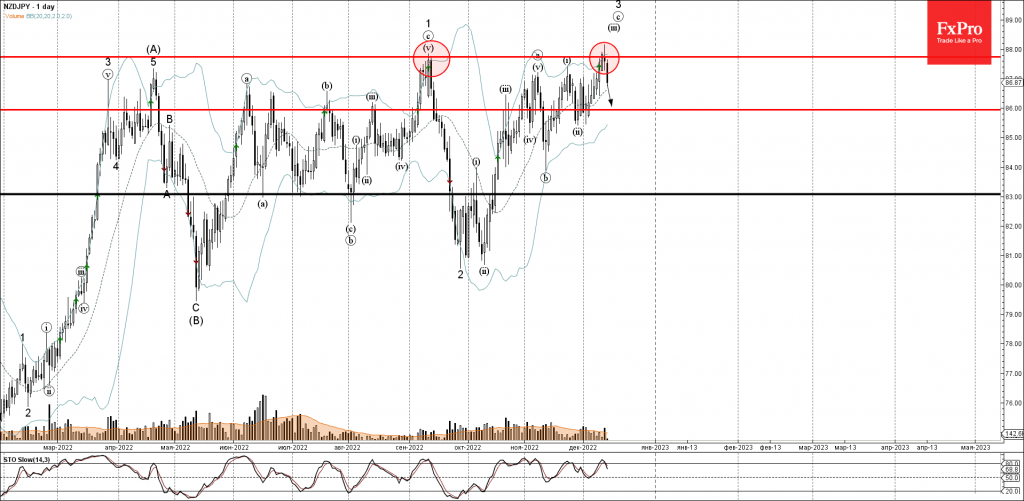
- NZDJPY reversed from resistance level 87.73
- Likely to fall to support level 86.00
NZDJPY recently reversed down from the major resistance level 87.73 (which stopped the previous sharp uptrend in September), intersecting with the upper daily Bollinger Band.
The downward reversal from the resistance level 87.73 stopped the earlier short-term impulse waves (iii) and 3, which belong to the higher order impulse wave (C) from May.
Given the bearish NZD sentiment seen today, NZDJPY can be expected to fall further toward the next support level 86.00.
Dow Jones Wave Analysis
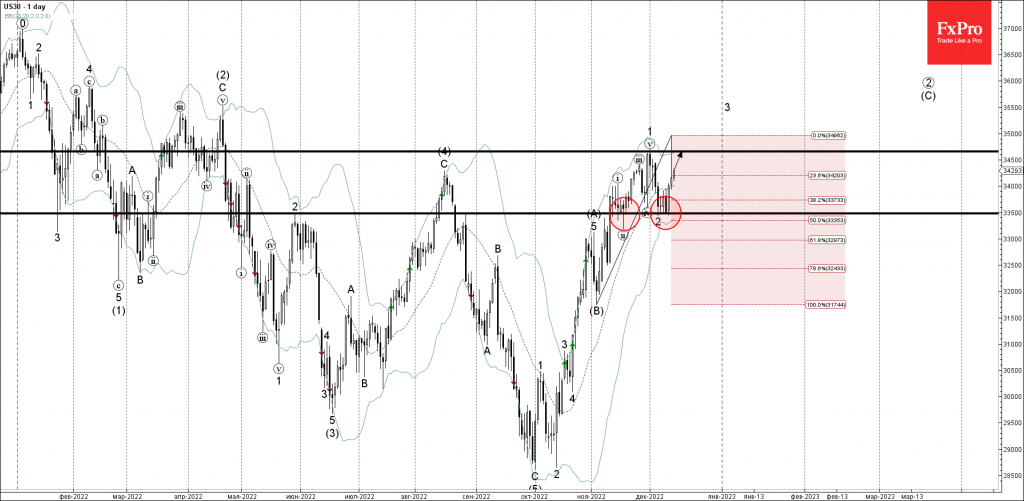
- Dow Jones reversed from support level 33500.00
- Likely to rise to resistance level 34660.
Dow Jones continues to rise inside the short-term impulse wave 3, which started earlier from the key support level 33500.00 (which has been reversing the price from the start of November), standing near the lower daily Bollinger Band and the 50% Fibonacci correction of the upward impulse from November.
The upward reversal from the support level 33500.00 created the daily Bullish Engulfing reversal candlesticks pattern – forming the 5th consecutive candle near this support level.
Dow Jones can be expected to rise further toward the next resistance level 34660.00 (which stopped the previous short-term impulse wave 1).
Sunset Market Commentary
Markets
Core bonds took a breather after surging on a slightly slower-than-expected US CPI yesterday. US yields still drop a few bps at the front end of the curve but are trading flat further out. USTs outperformed Bunds. German yields gapped lower at the open but immediately headed north with news of the country planning to issue a record amount of bonds next year (see below) triggering an upleg in the process. News agency Reuters, citing sources, reported that tomorrow’s ECB new forecasts will put inflation “comfortably above 2.0% in 2024” and just above it in 2025. Rather than the actual numbers (which haven’t been exactly accurate lately anyway), it would have a strong signaling function. The news had no direct market/yield impact but helped sustain the ongoing move. Some momentum got lost in afternoon trading though, leading to yield changes currently between -3 bps (2y) to +4.5 bps (30y). The US dollar loses a few ticks as investors bide their time ahead of the Fed. EUR/USD holds north of 1.0611. UK CPI also eased a tad more than anticipated but unlike in the US, this (potentially) declining trend has only just started and has yet to prove itself. This results in sterling trading virtually unchanged and a mixed performance of the UK curve with the front outperforming going into the BoE meeting tomorrow.
All eyes are now turned to the Fed policy decision. The US central bank is poised to slow the tightening pace from (4x) 75 bps to 50 bps. That will bring the policy rate to 4.25/4.50%. The real market information lies in the new economic projections. These will probably entail another upward revision to the inflation forecasts. PCE inflation was seen in September at 5.4% this year, 2.8% next year and 2.3% in 2024 before returning to the 2% target in 2025. Although economic indicators in most cases held up relatively well lately, we wouldn’t be surprised to see some downward adjustments to the growth forecasts. This is because we expect the Fed to have raised the terminal policy rate to 5% and perhaps even more, in line with recent guidance from chair Powell and others. Critically, both the median rate projections (dot plot) and Powell will emphasize that this higher policy rate is here to stay for longer. In a sense, markets have brought this upon themselves. Because of the recent sharp repositioning, financial conditions have eased materially, thus undoing part of the Fed’s efforts. We anticipate a strong pushback against the 50 bps rate cuts being priced in for the second half of next year – which in our view is unjustified and have never been consistent with Fed talk.
News Headlines
According to the issuance plan released by the German Finanzagentur, the German government in 2023 intends to issue a record amount of federal securities for a total of around €539 billion. €274 billion of that amount will be raised on the capital market in auctions of conventional federal securities and further €242 billion will be issued on the money market. In addition, €15 to €17 billion will be raised via green federal securities and €6 to €8 billion via inflation-linked securities. The Finanzagentur sees € 325.1 bln of redemptions next year. The previous record issuance was set in 2020 at €483 bln due to funding of measures related to the corona crisis.
Inflation in Sweden remained elevated in November. Headline rose 1.0% M/M pushing the Y/Y measure to a new cycle peak of 11.5% Y/Y (0.2% and 10.9% in October). CPIF inflation (with a fixed interest rate), the reference for the Riksbank’s monetary policy, reaccelerated to 0.7% M/M and 9.5% Y/Y (from 9.3%). Core CPIF inflation excluding energy rose 0.2% M/M to be up 8.0% Y/Y. Despite higher yearly readings for all measures, the outcome was marginally softer than expected. In its November monetary policy report, the Riksbank forecasted CPIF inflation to slow to an average of 5.7% next year from 7.6% this year, with inflation expected to return to 2.0% in 2024. In this scenario, the Riksbank guided that the policy rate (currently 2.5%) will probably have to be raised to ‘be just below 3.0%’. Today’s data only confirm that the RB’s intentions remain soft given persistent elevated inflation. Even so, the reaction on Swedish interest rate markets was very limited. EUR/SEK trades little changed near EUR/SEK 10.87.
Aussie Calm ahead of Fed, Jobs Data
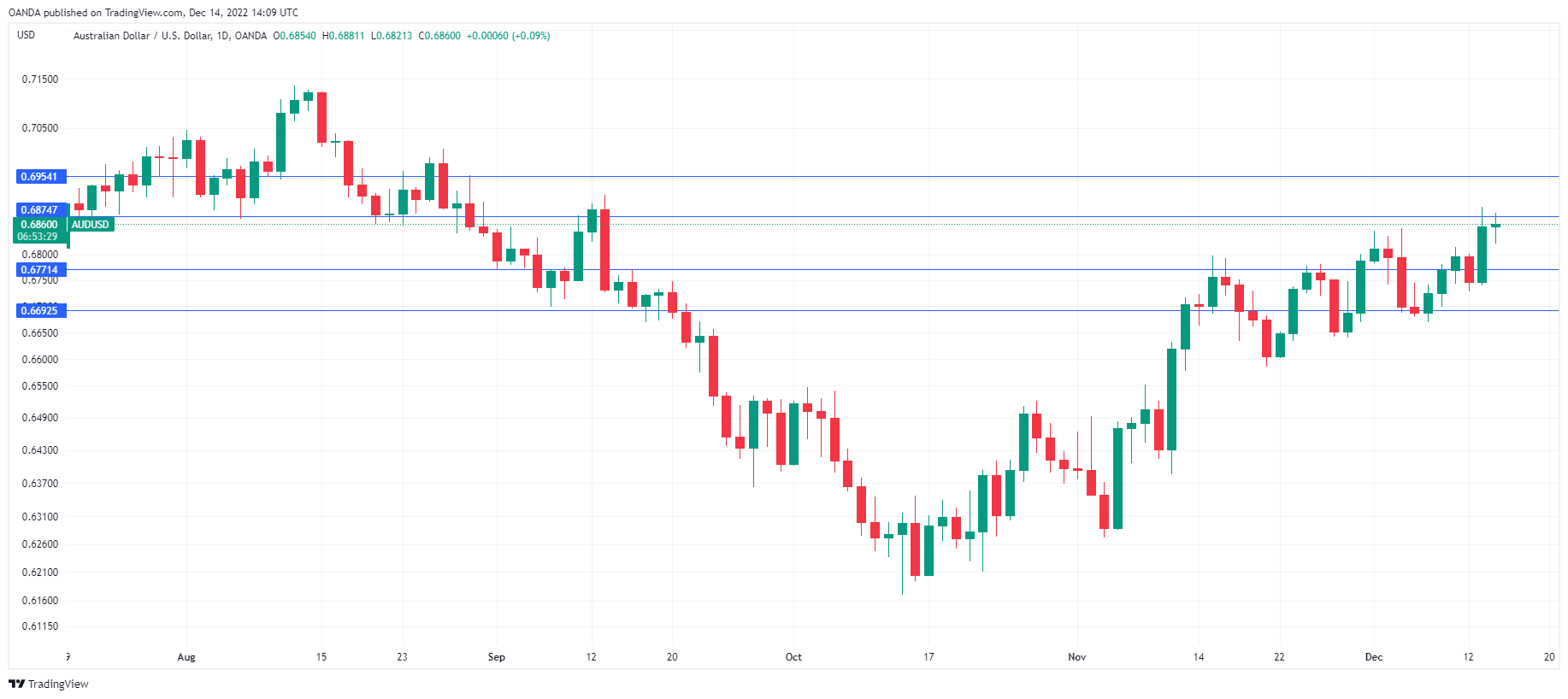
The Australian dollar has posted slight gains on Wednesday. In North American trade, AUD/USD is trading at 0.6865, up 0.16%. We can expect stronger movement from the pair later today, with the Fed rate announcement and the Australian employment report for November.
Australian employment expected to slow
Australia’s labour market has remained resilient, a key factor in the Reserve Bank of Australia being able to deliver steep rate hikes in the tough battle to contain inflation. The economy is expected to add 15,000 jobs in the November release, down from 32,000 a month earlier. The unemployment rate is expected to remain at an ultra-low 3.4%.
With inflation still not under control, the RBA continues to raise rates, although it has now delivered three straight hikes of 25 basis points, bringing the cash rate to 3.10%. There is growing speculation that the RBA could wind up its current rate cycle early in 2023. The next meeting is not until February, with the most likely scenario being another 25 bp increase.
Markets eye Fed rate hike
A record year of tightening from the Federal Reserve is expected to end with a 50-basis point hike at today’s final meeting of 2022. The timing is interesting, as the meeting comes just one day after Tuesday’s US inflation report, which saw CPI fall to 7.1%, down from 7.7% and below the forecast of 7.3%. The declines in the most recent inflation reports are good news for the Fed, but at the same time, inflation remains more than three times the Fed’s target of 2%. The markets will be looking for hints regarding Fed plans for early 2023 – will the rate statement send a hawkish message, or will the Fed acknowledge that the current tightening cycle has largely done the job?
AUD/USD Technical
- AUD/USD is testing resistance at 0.6875. Above, there is resistance at 0.6954
- There is support at 0.6772 and 0.6693
BoE Set for Another Rate Hike, But Divisions May Widen
The Bank of England will step into the spotlight during the post-FOMC session on Thursday at 10:00 GMT in a relatively busy week of central bank meetings and data releases. Investors expect a downshift to a half-point rate increase, though the UK’s messy economic outlook could cause wider divisions within the rate-setting committee, creating extra volatility for the pound.
What's next after a triple rate hike?
The Bank of England (BoE) delivered a triple rate hike in November, its largest single increase since 1989 and the eighth in a row, as inflation grew at a double-digit rate and was more than five times higher than its 2.0% target. Although growth in consumer prices pulled a bit lower in November, it will remain problematic. According to the central bank’s projections, inflation may slightly overshoot its target in two years if rates stand at 3.0%. Hence, although the impact of past rate increases has yet to come through, the tightening phase will continue.
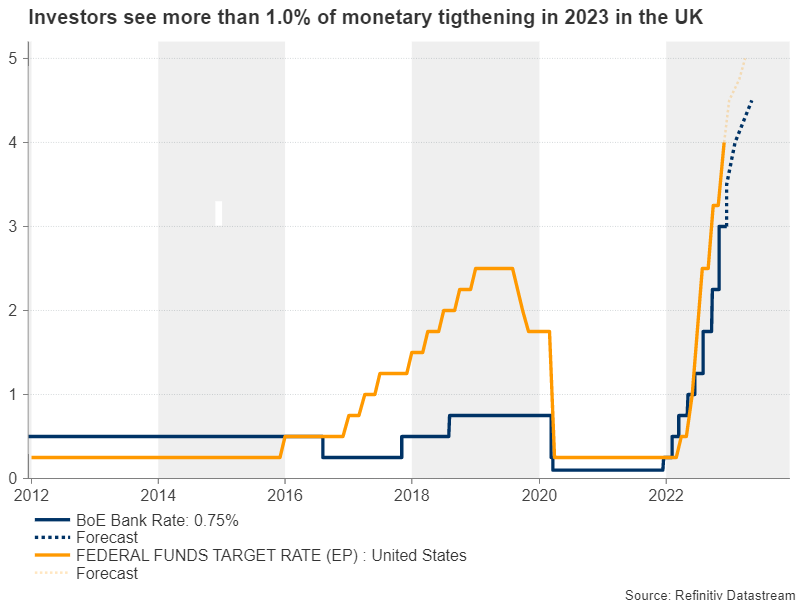
The next question that jumps to mind is how fast and how far policy tightening will go in an uncertain economic and geopolitical environment. Global signs of peaking inflation, slowing jobs growth and concerns about an imminent recession made the Fed and other major central banks intent on cooling the pace of rate increases this month while remaining steadfast in their price stability goal. Although the BoE’s communication has been relatively less clear, policymakers acknowledged in November that substantial progress has been made in reducing stimulus, signaling a potential pivot to smaller rate increases. They also played down a rate peak at 5.25% next year, claiming that markets are ahead of the central bank’s plans.
Debate over rate guidance may deepen
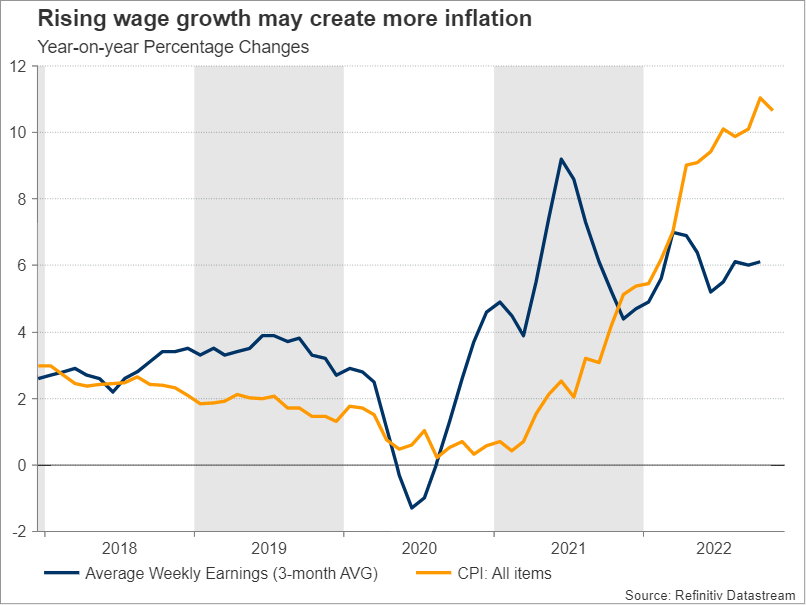
Investors are currently providing a probability of 72% for a softer 50bps rate hike to 3.5% on Thursday, with the remaining 28% assigned for a second 75bps rate hike. The final decision, however, might not be straightforward, with investors speculating a three-way or even a four-way split within the rate-setting committee. On the one hand, a second 75bps rate hike cannot be ruled out as rising wages increase the risk of a new inflation wave. December could prove to be the worst month of labor strikes for higher payments in more than a decade amid the cost-of-living crisis. Energy subsidies, which will extend to the first quarter of 2023, could also support consumption, delaying any price declines.
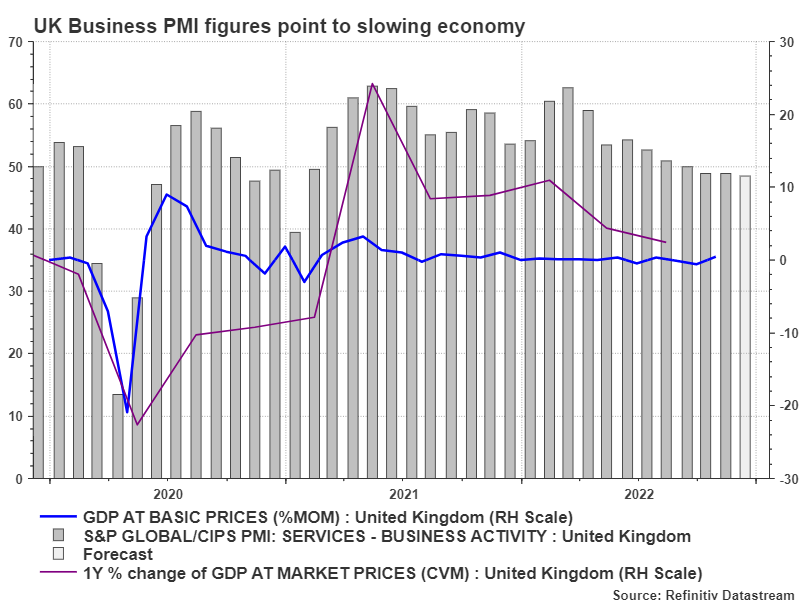
On the other hand, some doves could vote for a 25bps rate increase or no changes at all due to fears that past rate increases could backfire next year, potentially causing negative economic shocks in the fragile UK economy. During his Autumn statement, the new Chancellor admitted that the economy is already in recession, with the confirmation expected at the start of next year, when the October-December GDP data come out. Note that the three-month GDP average to October revealed a slight contraction of 0.3%. Friday’s preliminary PMI figures for December could lay out fresh evidence for the final quarter of 2022, with estimates pointing to a slight deterioration after November’s soft pickup.
GBP/USD
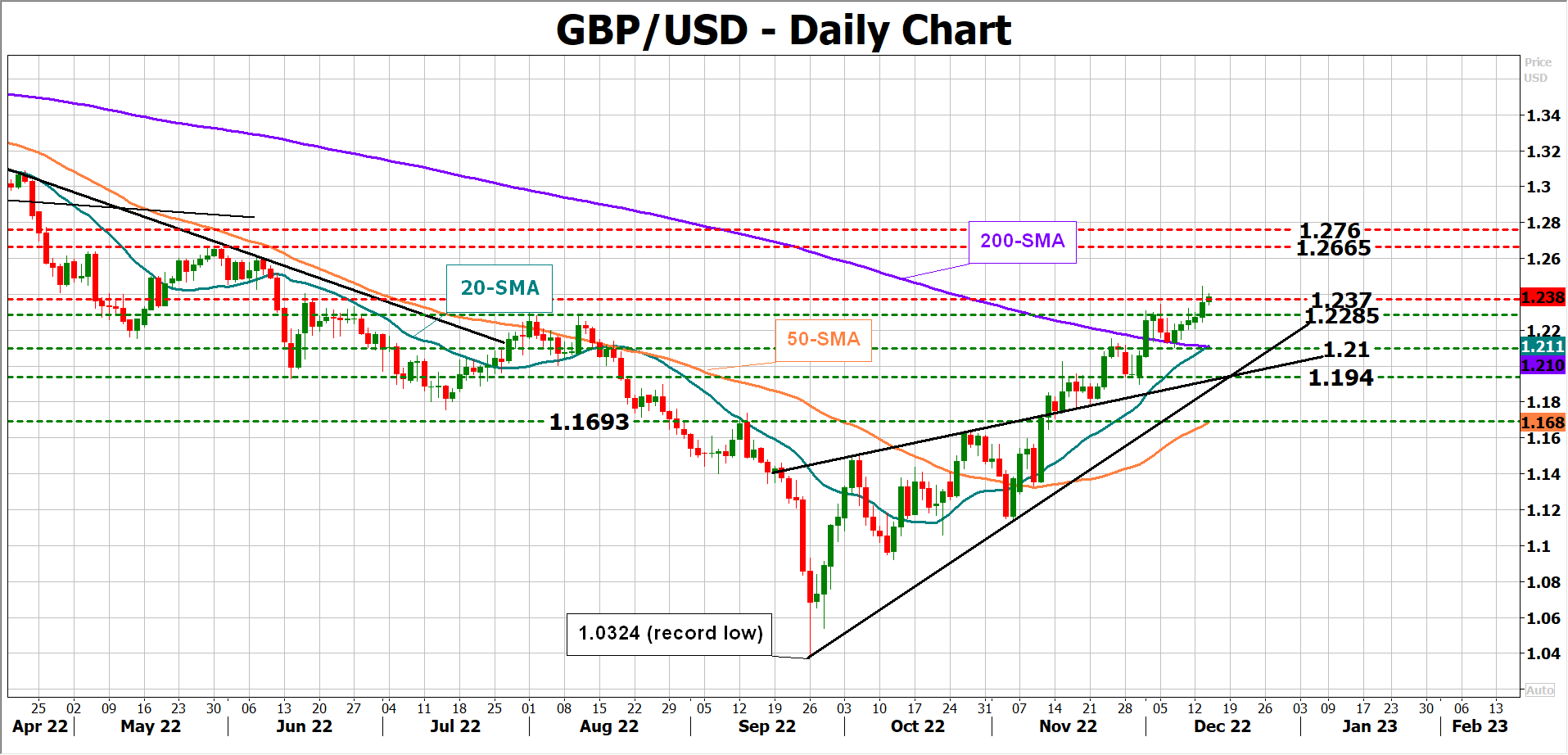
As regards the impact on the pound, there won't be any new projections or a press conference following the rate announcement. Hence, the policy statement might be vital in navigating the currency during the post-FOMC session. Should the board view a potential recession as part of its price stability mission, leaving the door open for additional aggressive rate increases in 2023, pound/dollar might advance towards May’s high of 1.2665. Note that the pair is currently testing the key 50-weekly moving average (SMA) at 1.2370, which was a key bearish pivot territory a year ago. The FOMC rate decision could also be critical in determining whether this is a make-or-break point for the pair.
Alternatively, a hawkish Fed and a cautious rate hike by BoE could be a toxic cocktail for pound/dollar. In this case, the 1.2285 constraining zone will be closely watched ahead of the 20- and 200-day SMAs at 1.2100. Even lower, the pair may stabilize around 1.1940.
ECB Rate Decision, How Sure is 50bps Hike?
The consensus among economists is that the ECB will hike by another 50bps. But there is this unusual situation where the ECB has its rate decision right after the Fed (and members will be meeting at the same time as the BOE). As the US is the largest trade partner, it's understandable that the ECB will consider what the Fed does when it decides policy.
The main driver of the EURUSD, naturally, is the interest rate spread between the Euro and the Dollar. But not just the interest rate, the inflation rate has to be taken into account, because it's an important factor for investors. Particularly now with interest rates so high, and varied across geographies.
What's the real return on investment?
Currently, the ECB's interest rate is 2.0% and the Fed is double that at 4.0%. But we have to factor in inflation. Here we don't use core inflation, even though that's the preferred measure by central banks. Investors care how much their money is actually worth, taking into account as many factors as possible.
November inflation in the Eurozone was reported at 10% (preliminary, but the final usually doesn't vary much); while in the US it was at 7.1%. So, there is a 2.0% (or 200 basis point) spread in favor of the dollar, given the interest rates. But, on top of that, there is a 2.8% difference in inflation. Meaning that holding Euro debt will lead you to a bigger loss than holding dollar debt. Hence, the strong preference for the dollar.
It's about the future, too
But, investors aren't investing in the past; they want to know where things will be in the future. If the central bank is aggressively raising rates, then it means they will bring inflation down. That's what the Fed has been doing lately, and inflation in the US is trending downward. But the ECB has been much slower to raise rates, so inflation has been trending higher, with only November's figure (as yet unconfirmed) turning the trend.
The thing is, since the Fed has already pushed rates higher, there is less hiking in the future for the dollar. While the ECB still has over 200bps to catch up, meaning they could keep hiking for longer. Particularly if we consider that inflation is higher now, than the peak for the cycle in the US. Meaning that the Euro could be undervalued for now, and if the Fed signals that it will start slowing rates, while the ECB signals that it will keep aggressively tightening, the EURUSD could catch some tailwinds.
There are other factors
Europe has managed to reduce energy consumption by around 20%. Energy being the largest driver of inflation in the shared economy. So far, industrial production hasn't faltered, leaving the Euro Area with a still positive GDP, and expectations that Q4 will also show growth. This gives the ECB more room to keep hiking, unlike other central banks.
That's why there is a chance of a surprise 75bps hike from the ECB, which could narrow the interest rate gap and give the EURUSD a push. On the other hand, if the ECB matches the Fed's 50bps, there is also a good change that Lagarde will be quite hawkish, which could also support the Euro. Dovish commentary from the ECB at this point would be quite a surprise for the markets.
EUR/USD Mid-Day Outlook
Daily Pivots: (S1) 1.0549; (P) 1.0612; (R1) 1.0695; More...
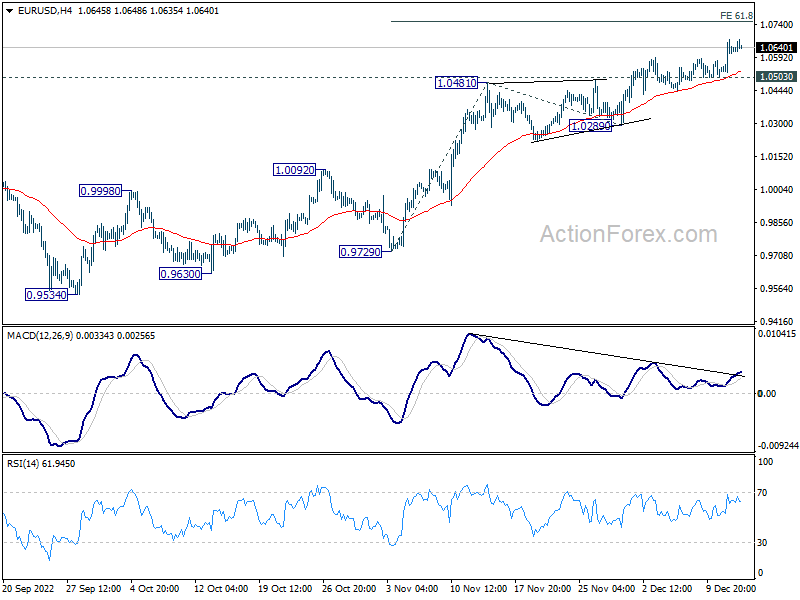
EUR/USD's rise is still in progress and intraday bias remains on the upside. Current rally from 0.9534 should target 61.8% projection of 0.9729 to 1.0481 from 1.0289 at 1.0754. Firm break there could prompt upside acceleration to 100% projection at 1.1041. On the downside, however, break of 1.0503 support will indicate short term topping, and turn bias to the downside for 1.0289 support instead.
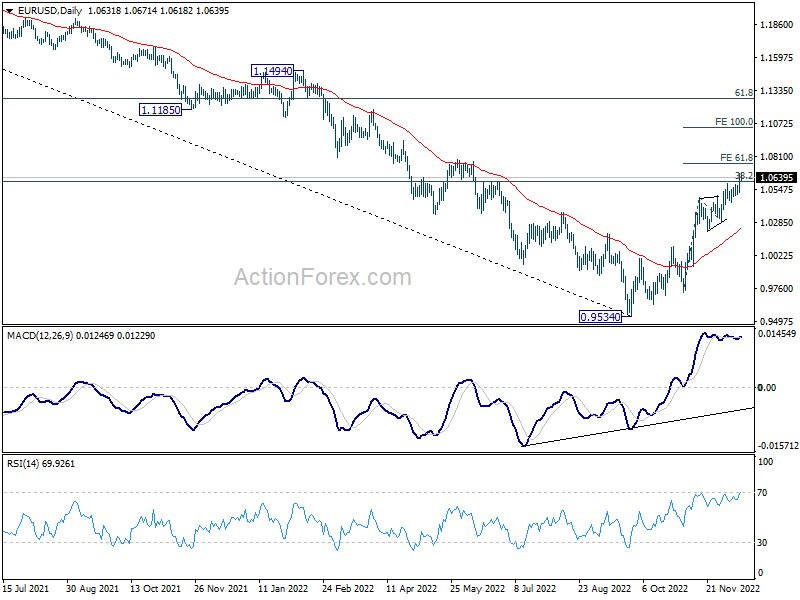
In the bigger picture, focus stays on 38.2% retracement of 1.2348 (2021 high) to 0.9534 at 1.0609. Rejection by 1.0609 will suggest that price actions from 0.9534 medium term bottom are developing into a corrective pattern. Thus, medium bearishness is retained for another fall through 0.9534 at a later stage. However, sustained break of 1.0609 will raise the chance of trend reversal and target 61.8% retracement at 1.1273.
GBP/USD Mid-Day Outlook
Daily Pivots: (S1) 1.2262; (P) 1.2353; (R1) 1.2457; More...
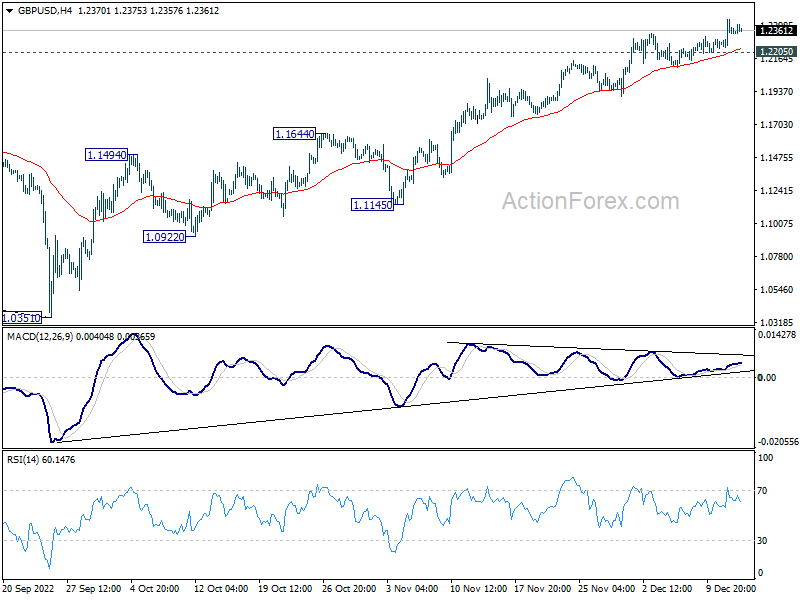
GBP/USD's rally is still in progress and intraday bias stays on the upside. Current rise from 1.0351 is targeting 1.2759 medium term fibonacci level next. However, on the downside, break of 1.2205 will indicate short term topping, and turn bias back to the downside for deeper pull back.
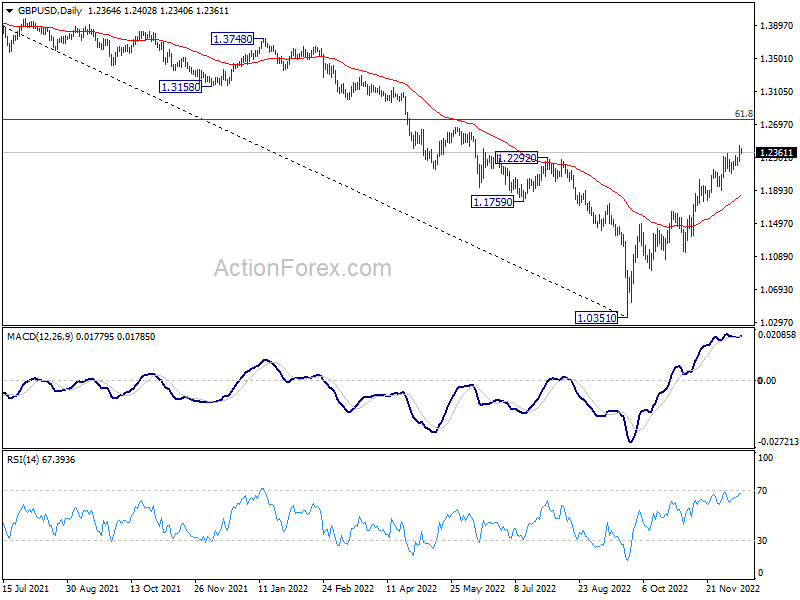
In the bigger picture, rise from 1.0351 medium term bottom is at least correcting whole down trend from 1.4248 (2021 high). Further rise is expected as long as 1.1644 resistance turned support holds. Next target is 61.8% retracement of 1.4248 to 1.0351 at 1.2759. Sustained break there will pave the way back to 1.4248.
USD/JPY Mid-Day Outlook
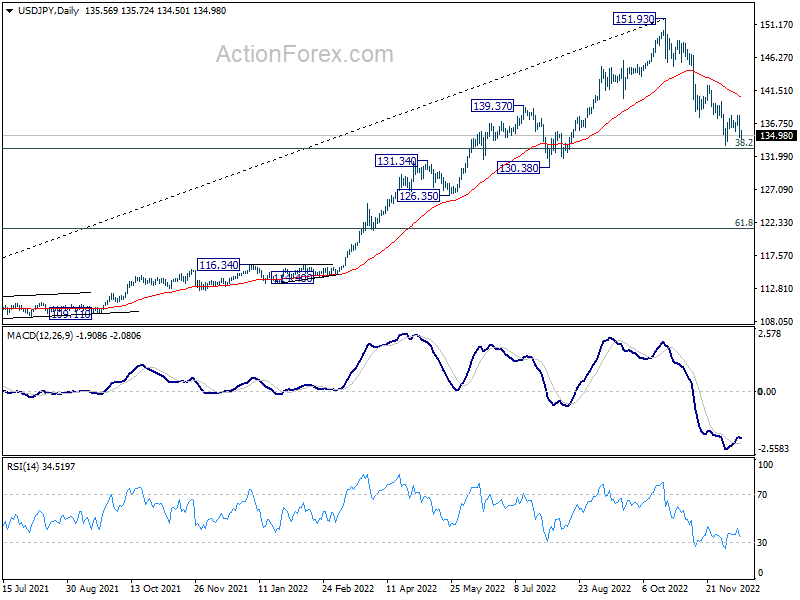
Daily Pivots: (S1) 134.18; (P) 136.08; (R1) 137.48; More...
Outlook is USD/JPY remains unchanged and intraday bias is mildly on the downside for retesting 133.61 support and then 133.07 medium term fibonacci level. On the upside, however, break of 137.95 will turn bias back to the upside for stronger rebound to 142.24 resistance instead.
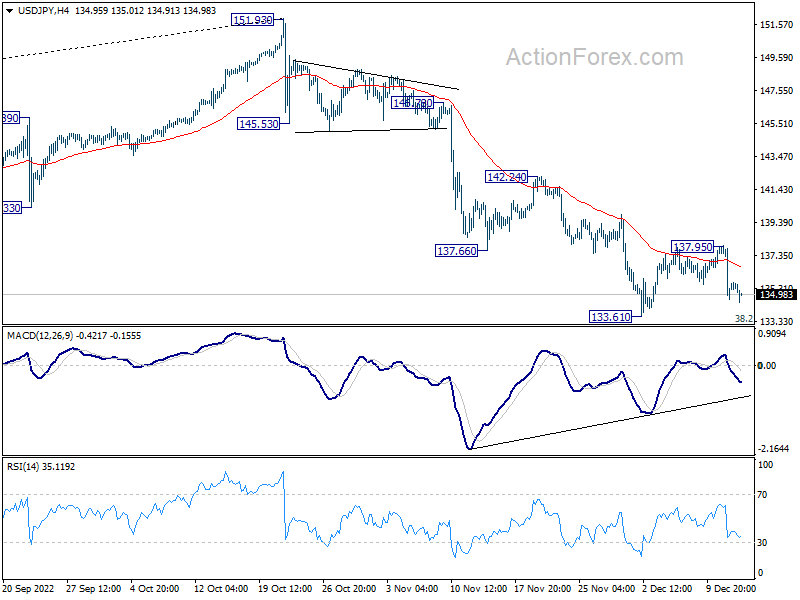
In the bigger picture, price actions from 151.93 medium term could be just a corrective pattern to up trend from 102.58 (2021 low). Strong support from 38.2% retracement of 102.58 to 151.93 at 133.07 and 55 week EMA (now at 131.71) will set the range for such corrective pattern. However, sustained break of 55 week EMA will pave the way to 61.8% retracement at 121.43.