Sample Category Title
GBP/USD Mid-Day Outlook
Daily Pivots: (S1) 1.2262; (P) 1.2353; (R1) 1.2457; More...
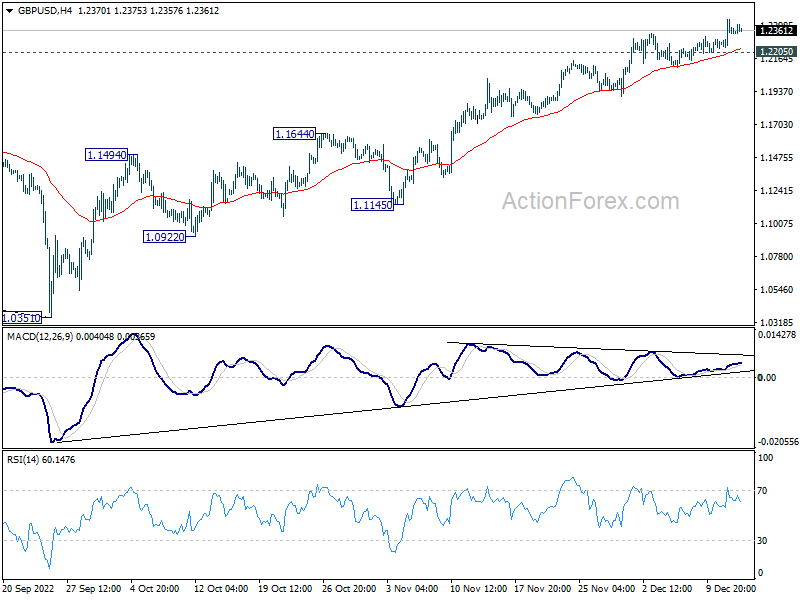
GBP/USD's rally is still in progress and intraday bias stays on the upside. Current rise from 1.0351 is targeting 1.2759 medium term fibonacci level next. However, on the downside, break of 1.2205 will indicate short term topping, and turn bias back to the downside for deeper pull back.
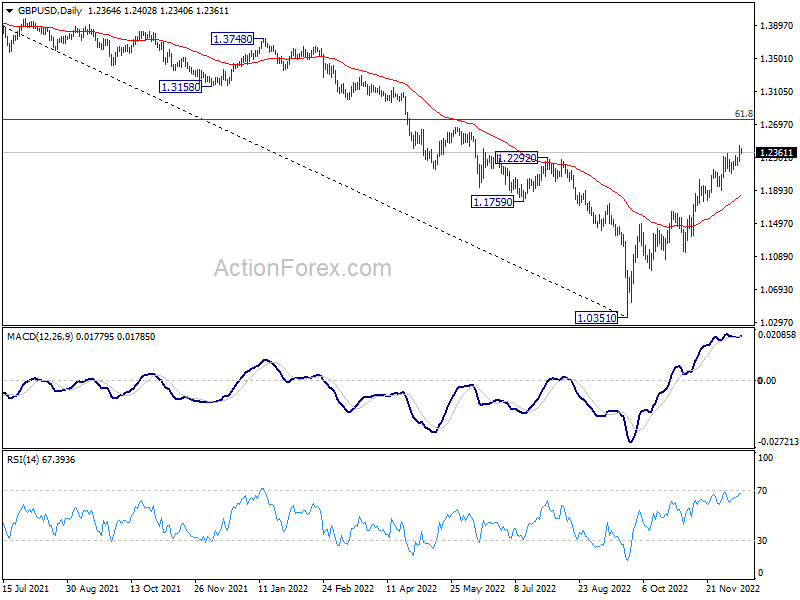
In the bigger picture, rise from 1.0351 medium term bottom is at least correcting whole down trend from 1.4248 (2021 high). Further rise is expected as long as 1.1644 resistance turned support holds. Next target is 61.8% retracement of 1.4248 to 1.0351 at 1.2759. Sustained break there will pave the way back to 1.4248.
USD/JPY Mid-Day Outlook
Daily Pivots: (S1) 134.18; (P) 136.08; (R1) 137.48; More...
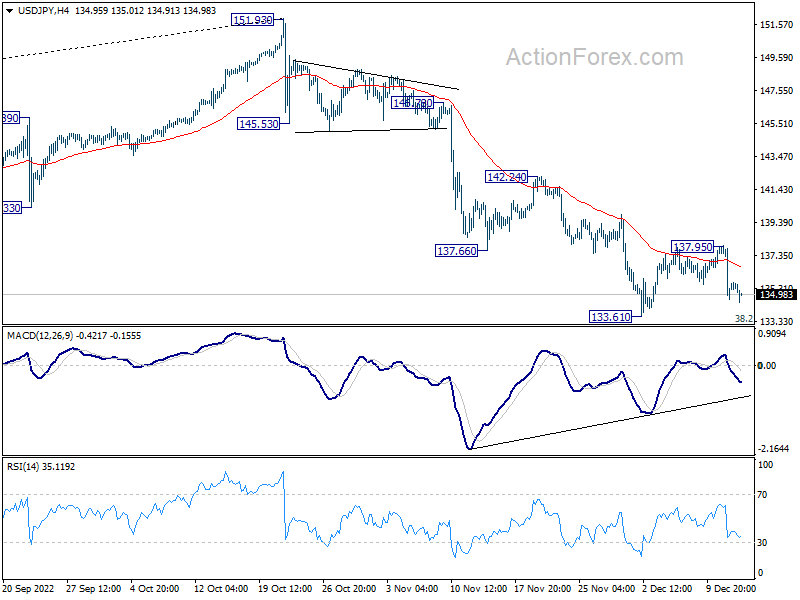
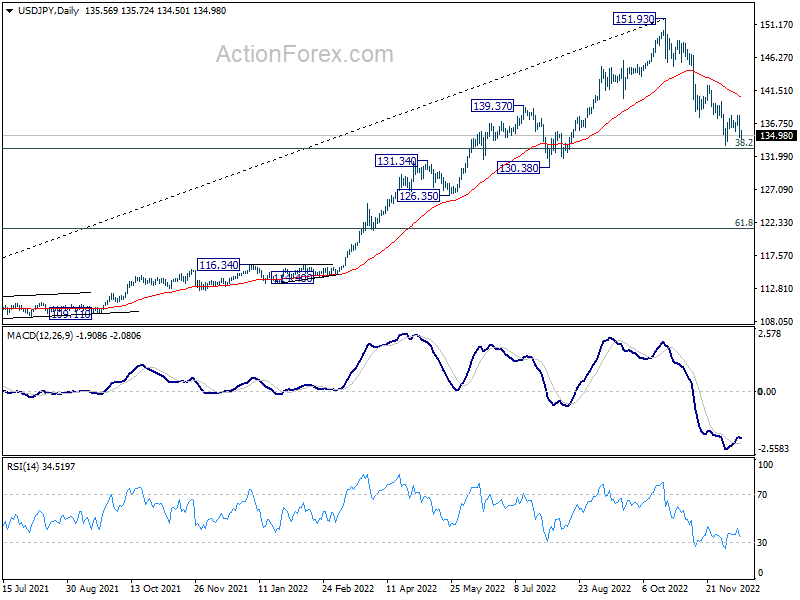
Outlook is USD/JPY remains unchanged and intraday bias is mildly on the downside for retesting 133.61 support and then 133.07 medium term fibonacci level. On the upside, however, break of 137.95 will turn bias back to the upside for stronger rebound to 142.24 resistance instead.
In the bigger picture, price actions from 151.93 medium term could be just a corrective pattern to up trend from 102.58 (2021 low). Strong support from 38.2% retracement of 102.58 to 151.93 at 133.07 and 55 week EMA (now at 131.71) will set the range for such corrective pattern. However, sustained break of 55 week EMA will pave the way to 61.8% retracement at 121.43.
USD/CHF Mid-Day Outlook
Daily Pivots: (S1) 0.9220; (P) 0.9297; (R1) 0.9363; More...
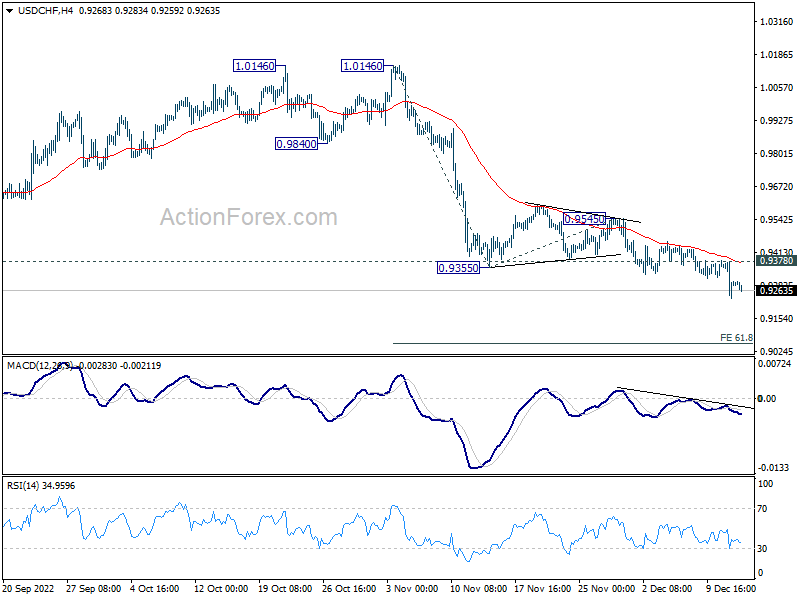
USD/CHF's decline from 1.0146 is in progress and intraday bias stays on the downside. Next target is 61.8% projection of 1.0146 to 0.9355 from 0.9545 at 0.9056. However, break of 0.9378 resistance will indicate short term bottoming and turn bias back to the upside for 0.9545 resistance instead.
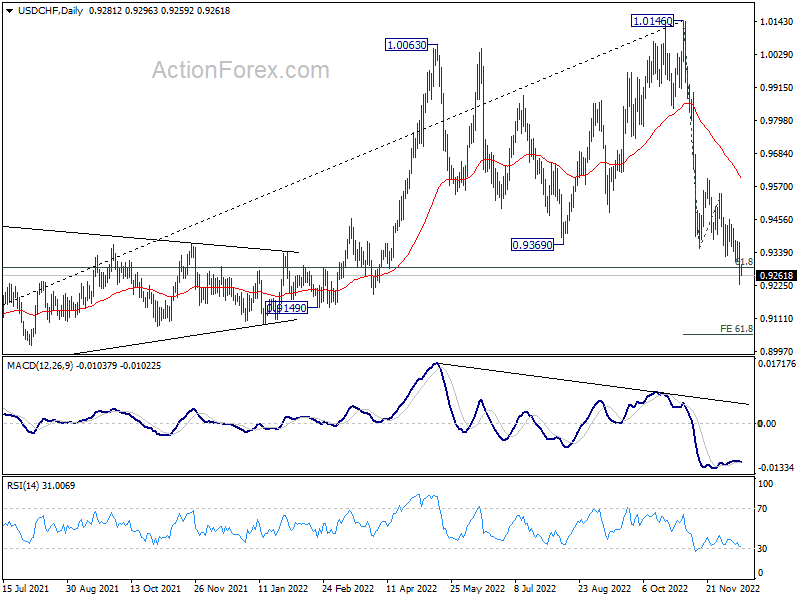
In the bigger picture, rise from 0.8756 (2021 low) has completed at 1.0146, well ahead of 1.0342 long term resistance (2016 high). Based on current downside momentum, fall from 1.0146 might be a medium term down trend itself. Sustained break of 61.8% retracement of 0.8756 to 1.0146 at 0.9287 will pave the way to 0.8756. In any case, risk will stay on the downside as long as 0.9545 resistance holds.
Dollar Soft ahead of Fed, Yen Rising
Dollar stays generally weak today but selling pressure is so far limited. Markets are looking forward to FOMC's rate hike as well as new economic projections. Yen is currently the strongest one for the day, followed by Aussie and Swiss Franc. New Zealand Dollar is the weakest, followed by Canadian and Sterling. Much volatility is expected in the next 24 hours with SNB, BoE and ECB featured tomorrow.
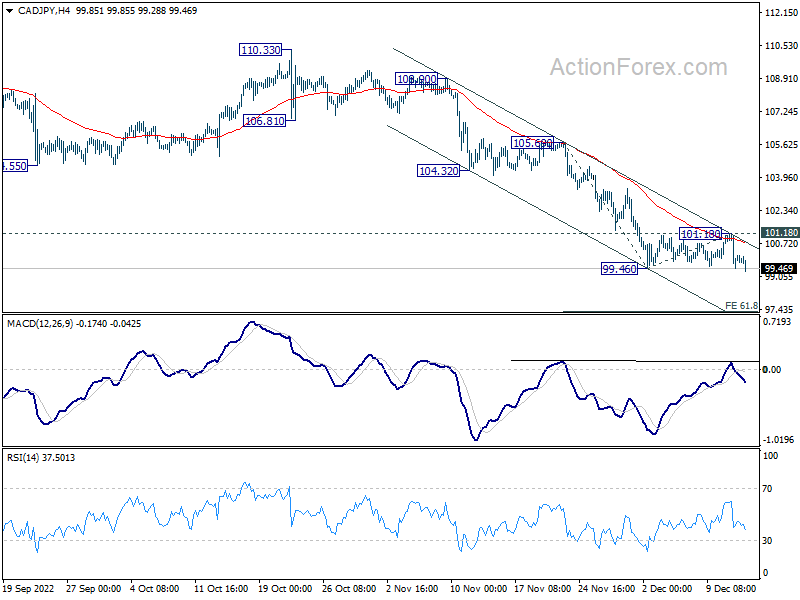
Technically, CAD/JPY finally breaks out to the downside as consolidation from 99.46 completed at 101.18. Near term outlook remains clearly bearish with rejection from 4 hour 55 EMA and near term falling channel. Further decline is now expected to 61.8% projection of 105.69 to 99.46 from 101.18 at 97.32.
In Europe, at the time of writing, FTSE is down -0.19%. DAX is down -0.57%. CAC is down -0.38%. Germany 10-year yield is up 0.040 at 1.963. Earlier in Asia, Nikkei rose 0.72%. Hong Kong HSI rose 0.39%. China Shanghai SSE rose 0.01%. Singapore Strait Times rose 0.22%. Japan 10-year JGB yield rose 0.0031 to 0.258.
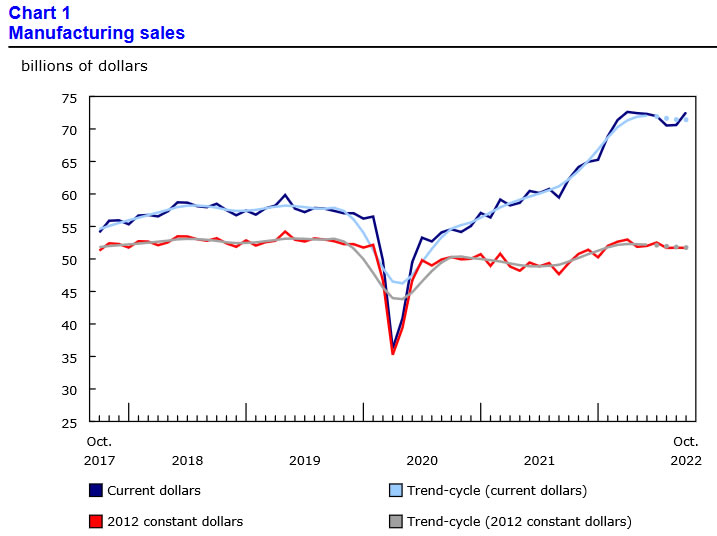
Canada manufacturing sales rose 2.8% mom in Oct, driven by higher prices
Canada manufacturing sales rose 2.8% mom to CAD 72.6B in October, above expectation of 1.9% mom.
Sales increased in 12 of 21 industries, led by the petroleum and coal (+12.7%), food (+2.9%), chemical (+4.9%) and miscellaneous manufacturing (+13.3%) industries. Meanwhile, motor vehicles (-3.2%) and machinery (-1.7%) posted the largest monthly declines.
But Statistics Canada also noted: "Sales in constant dollars were unchanged in October, indicating that the entire increase in current dollar sales was driven by higher prices as the Industrial Product Price Index rose 2.4% in October. "
Eurozone industrial production down -2.0% mom in Oct, EU down -1.9% mom
Eurozone industrial production dropped -2.0% mom in October, worse than expectation of -1.4% mom. Production of energy fell by -3.9%, durable consumer goods by -1.9%, intermediate goods by -1.3% and capital goods by -0.6%, while production of non-durable consumer goods rose by 0.3%.
EU industrial production dropped -1.9% mom. Among Member States for which data are available, the largest monthly decreases were registered in Ireland (-10.7%), Luxembourg (-4.4%) and Czechia (-3.7%). Increases were observed in Slovakia (+1.3%), Lithuania (+1.1%), Greece (+0.5%) and Austria (+0.2%).
Ifo: Germany economy to contract in Q4 and Q1
Ifo said the German economy is "suffering from huge supply shocks". Price press is "not expected to ease until 2024, and then only slowly". Overall inflation is expected to fall from 7.8% in 2022 to 6.4% in 2023. However, core inflation is expected to rise from 4.8% to 5.8% next year.
Ifo also said Germany GDP is forecast to grow 1.8% in 2022, contract slightly by -0.1% in 2023, and back at 1.6% in 2024. Economy output to expected to fall by -0.3% qoq and -0.4% qoq in the two quarters of the 2022-23 winter half-year (i.e. Q4 and Q1). Thus, Germany will be technically in a recession. But starting in spring 2023, the economy is expected recovery and growth at stronger rates in the second half .
UK CPI slowed to 10.7% yoy in Nov, core CPI down to 6.3% yoy
UK CPI rose 0.4% mom in November, below expectation of 0.6% mom. In the 12 months to November, CPI slowed from 11.1% yoy to 10.7% yoy, below expectation of 10.9% yoy. Core CPI also slowed from 6.5% yoy to 6.3% yoy, below expectation of 6.5% yoy.
ONS said: "The easing in the annual inflation rate in November 2022 reflected, principally, price changes in the transport division, particularly for motor fuels and second-hand cars. There were also downward effects from tobacco, accommodation services, clothing and footwear, and games, toys and hobbies. The largest, partially offsetting, upward effect came from price rises for alcohol in restaurants, cafes and pubs."
Japan Tankan manufacturing mood deteriorated, but non-manufacturing upbeat
Japan Tankan Large Manufacturing Index dropped from 8 to 7 in Q4, above expectation of 6. Sentiment has been deteriorating for the fourth straight quarter, and hit the lowest level since Q1 2021. Large Manufacturing Outlook dropped from 9 to 6, matched expectations.
On the other hand, Large Non-Manufacturing Index rose from 14 to 19, above expectation of 17. That's the highest level since Q4 2019. Large Non-Manufacturing Outlook was unchanged at 11, below expectation of 16.
Large all industry capex dropped from 21.5% to 19.2%, above expectation of 18.4%.
Regarding inflation, 1-year ahead general prices expectations for all industries rose from 2.6% to 2.7%. 3-year ahead expectations rose from 2.1% to 2.2%. 5-year ahead expectations was unchanged at 2.0%.
RBNZ Hawkesby: We've seen very little impact of higher interest rates so far
RBNZ Deputy Governor Christian Hawkesby said in a speech that "we still think we have more work to do" to bring down inflation.
"We've seen very little impact of higher interest rates so far, outside of falling house prices and a cooling of the construction pipeline," he added.
"As inflation expectations have been rising, we also think that neutral interest rates have drifted higher, meaning that the OCR needs to be higher than otherwise before monetary policy is really restricting the demand side of the economy," he said.
Hawkesby pointed to November projections that the OCR would peak around 5.50%. But he noted, "25 years as an economist has taught me that the only certainty is that our forecasts won't be exactly right. There are always shocks and unexpected developments that will evolve the story."
USD/CHF Mid-Day Outlook
Daily Pivots: (S1) 0.9220; (P) 0.9297; (R1) 0.9363; More...
USD/CHF's decline from 1.0146 is in progress and intraday bias stays on the downside. Next target is 61.8% projection of 1.0146 to 0.9355 from 0.9545 at 0.9056. However, break of 0.9378 resistance will indicate short term bottoming and turn bias back to the upside for 0.9545 resistance instead.
In the bigger picture, rise from 0.8756 (2021 low) has completed at 1.0146, well ahead of 1.0342 long term resistance (2016 high). Based on current downside momentum, fall from 1.0146 might be a medium term down trend itself. Sustained break of 61.8% retracement of 0.8756 to 1.0146 at 0.9287 will pave the way to 0.8756. In any case, risk will stay on the downside as long as 0.9545 resistance holds.
Economic Indicators Update
| GMT | Ccy | Events | Actual | Forecast | Previous | Revised |
|---|---|---|---|---|---|---|
| 21:45 | NZD | Current Account (NZD) Q3 | -10.21B | -10.20B | -5.22B | -5.42B |
| 23:50 | JPY | Tankan Large Manufacturing Index Q4 | 7 | 6 | 8 | |
| 23:50 | JPY | Tankan Large Manufacturing Outlook Q4 | 6 | 6 | 9 | |
| 23:50 | JPY | Tankan Non - Manufacturing Index Q4 | 19 | 17 | 14 | |
| 23:50 | JPY | Tankan Non - Manufacturing Outlook Q4 | 11 | 16 | 11 | |
| 23:50 | JPY | Tankan Large All Industry Capex Q4 | 19.20% | 18.40% | 21.50% | |
| 23:50 | JPY | Machinery Orders M/M Oct | 5.40% | -1.00% | -4.60% | |
| 04:30 | JPY | Industrial Production M/M Oct F | -3.20% | -2.60% | -2.60% | |
| 07:00 | GBP | CPI M/M Nov | 0.40% | 0.60% | 2.00% | |
| 07:00 | GBP | CPI Y/Y Nov | 10.70% | 10.90% | 11.10% | |
| 07:00 | GBP | Core CPI Y/Y Nov | 6.30% | 6.50% | 6.50% | |
| 07:00 | GBP | RPI M/M Nov | 0.60% | 1.50% | 2.50% | |
| 07:00 | GBP | RPI Y/Y Nov | 14.00% | 14.30% | 14.20% | |
| 07:30 | CHF | Producer and Import Prices M/M Nov | -0.50% | 0.40% | 0.00% | |
| 07:30 | CHF | Producer and Import Prices Y/Y Nov | 3.80% | 4.80% | 4.90% | |
| 10:00 | EUR | Eurozone Industrial Production M/M Oct | -2.00% | -1.40% | 0.90% | 0.80% |
| 13:30 | CAD | Manufacturing Sales M/M Oct | 2.80% | 1.90% | 0.00% | |
| 13:30 | USD | Import Price Index M/M Nov | -0.60% | -0.50% | -0.20% | |
| 15:30 | USD | Crude Oil Inventories | -3.4M | -5.2M | ||
| 19:00 | USD | Fed Interest Rate Decision | 4.50% | 4.00% | ||
| 19:30 | USD | FOMC Press Conference |
Canada manufacturing sales rose 2.8% mom in Oct, driven by higher prices
Canada manufacturing sales rose 2.8% mom to CAD 72.6B in October, above expectation of 1.9% mom.
Sales increased in 12 of 21 industries, led by the petroleum and coal (+12.7%), food (+2.9%), chemical (+4.9%) and miscellaneous manufacturing (+13.3%) industries. Meanwhile, motor vehicles (-3.2%) and machinery (-1.7%) posted the largest monthly declines.
But Statistics Canada also noted: "Sales in constant dollars were unchanged in October, indicating that the entire increase in current dollar sales was driven by higher prices as the Industrial Product Price Index rose 2.4% in October."
NZD/USD Awaits Fed, GDP
Federal Reserve expected to hike by 50 bp
All eyes are on the Federal Reserve, which winds up its policy meeting later today. Policy makers are expected to raise rates by 50 basis points at this final meeting of 2022, with an outside chance of a more aggressive 75 basis point hike. This year has set a record for tightening, but despite that, the Fed stills finds itself in an uphill battle to convince the markets that it remains in a hawkish mode. The dramatic inflation report on Tuesday was softer than expected at 7.1%, once again raising risk appetite and sending the US dollar sharply lower.
Any drop in inflation is welcome news for the Fed, but let’s not forget that inflation is still more than three times the Fed target of 2%. The Fed has reiterated that it is committed to curbing inflation and has not given any indications of winding up the current tightening cycle, stating that it expects the terminal rate to be “somewhat higher” than anticipated in September. Despite this, speculation is growing that the Fed might deliver one more rate hike in February, perhaps by 25 bp, and then call it quits.
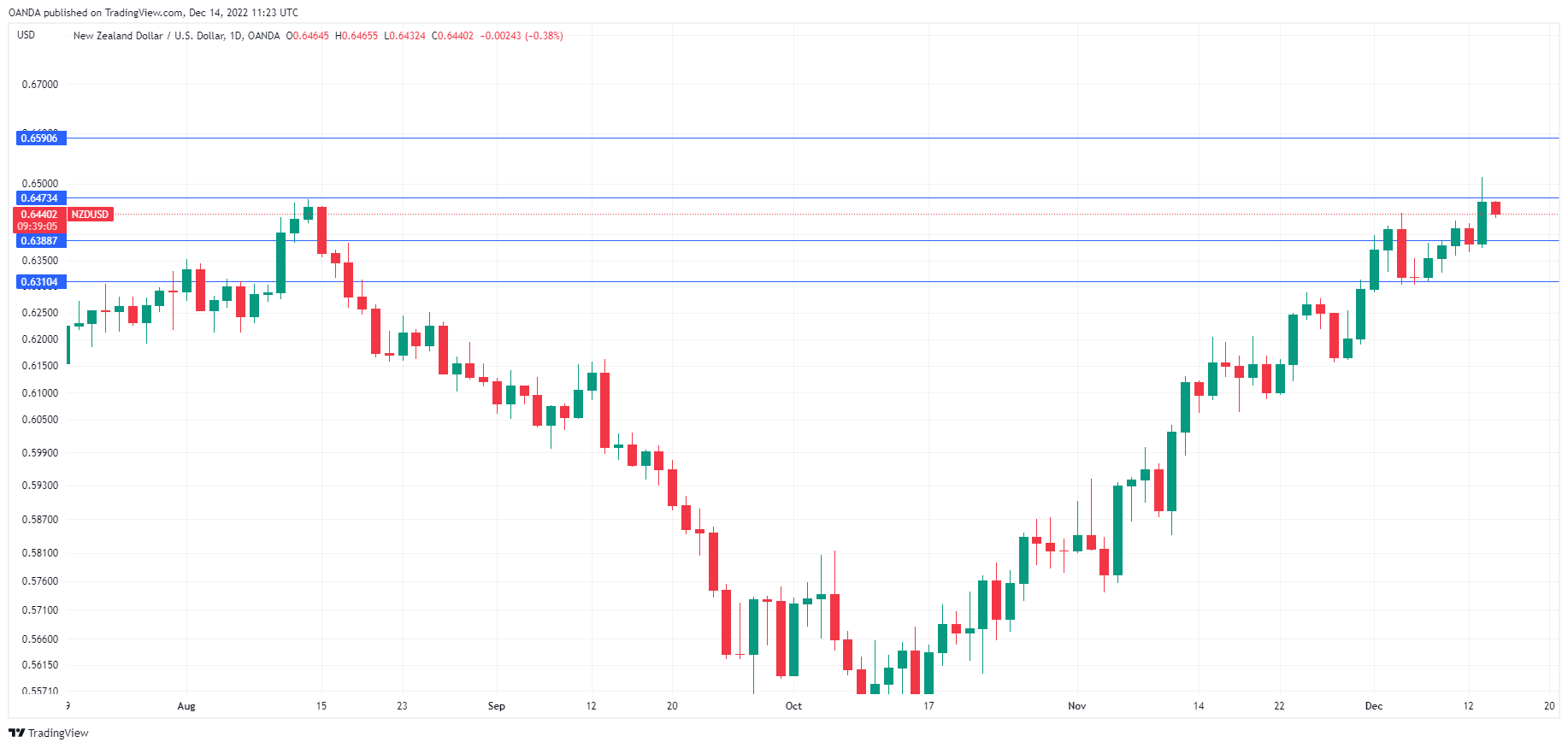
New Zealand releases fourth-quarter GDP later today, and the markets are bracing for a weak gain of 0.8% q/q. This follows the 1.2% gain in Q3, as the economy was boosted by the booming tourist trade as the border reopened. The New Zealand dollar has recovered nicely, gaining about 400 points against the US dollar since October 1st. The Reserve Bank of New Zealand will be on a long break, as the next policy meeting is not until February 22nd. We could see some volatility from NZD/USD in today’s North American session, with the Fed rate announcement and the New Zealand GDP release.
NZD/USD Technical
- 0.6472 is a weak resistance line. Above, there is resistance at 0.6591
- There is support at 0.6388 and 0.6311
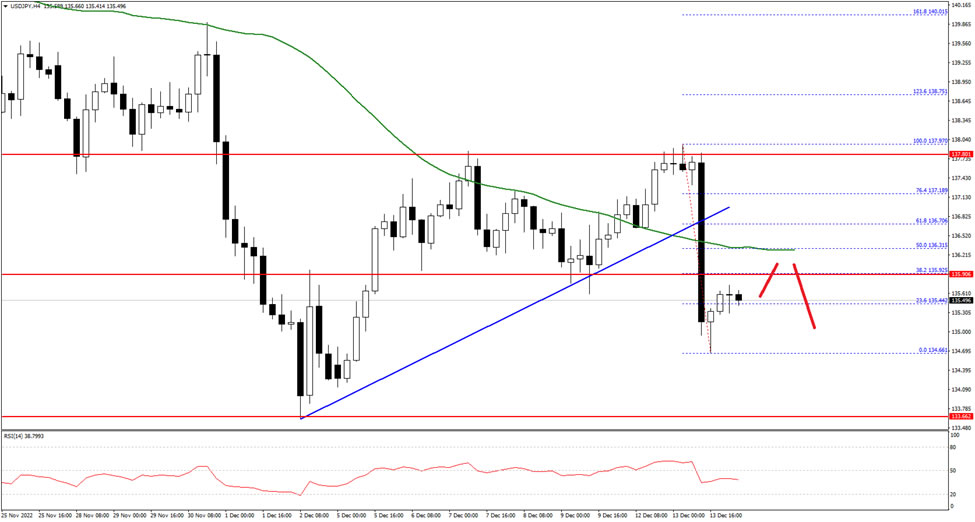
USD/JPY Air Started a Fresh Decline from 140.00
The US Dollar started a fresh decline from the 140.00 resistance zone against the Japanese Yen. The USD/JPY pair traded below the 138.00 level to move into a bearish zone.
Recently, the pair traded as low as 134.66 and is currently consolidating losses below the 50 hourly simple moving average. An immediate resistance on the upside is near the 135.92 level.
The next major resistance is near the 136.30 zone and the 50 hourly simple moving average. A clear break above the 136.30 resistance could push the price towards 137.00 on FXOpen. The next major resistance is near the 137.50 level.
On the downside, an initial support is near the 135.00 zone. The next major support sits near the 134.50 level, below which there is a risk of more downsides towards the 133.80 level.
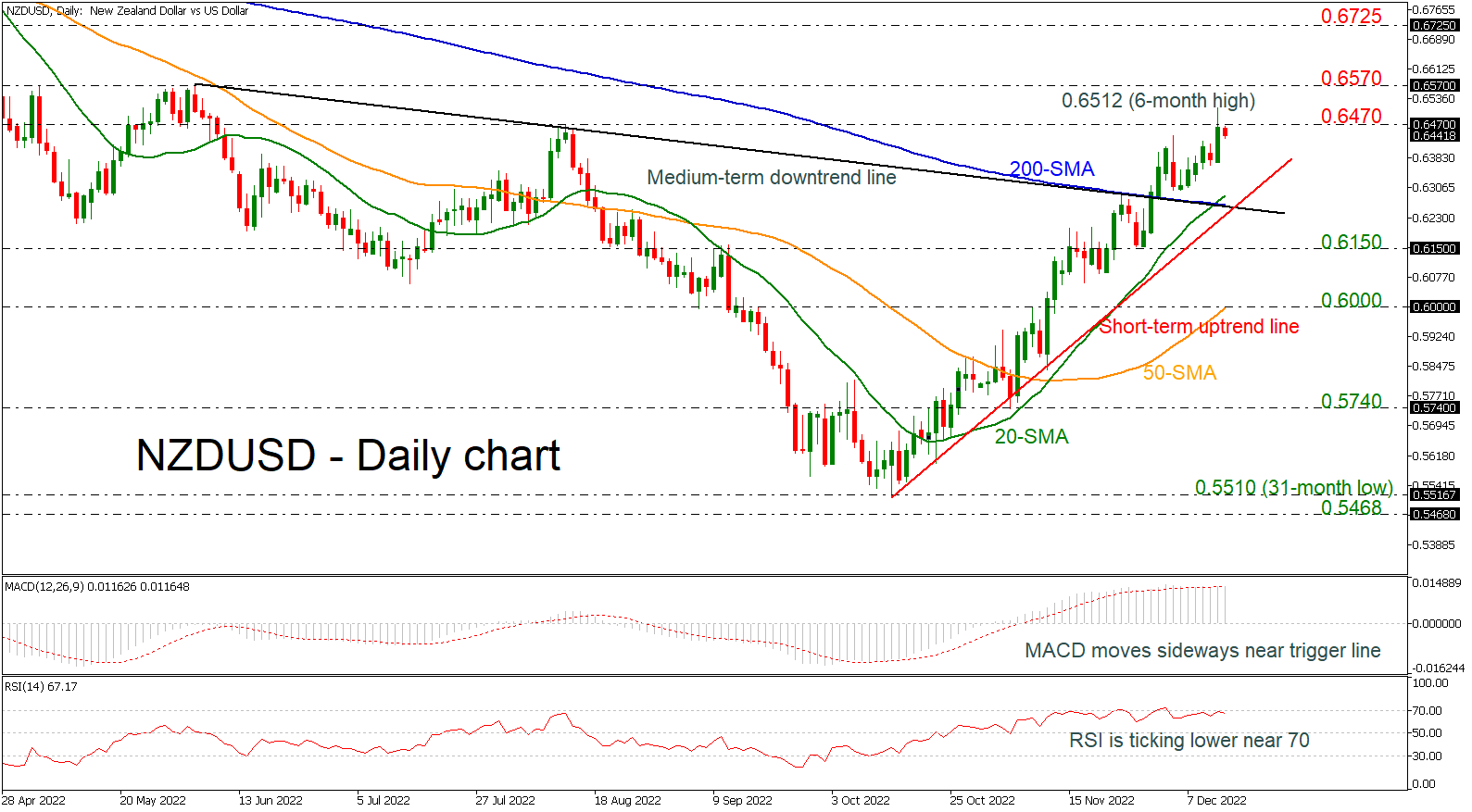
NZDUSD Eases after the Rally to 6-Month High
NZDUSD continued the impressive rally that started after the bounce off the 31-month low of 0.5510 during yesterday’s session, surging towards a new six-month peak of 0.6512. The pair penetrated the medium-term downtrend line to the upside in the preceding sessions, creating a steep short-term ascending trend line.
However, the MACD oscillator is moving sideways mirroring the downside retracement from the aforementioned high and today’s negative reaction, while the RSI is pointing slightly down near the overbought region.
In the event of a downside reversal, the golden cross within the 20- and the 200-day simple moving averages (SMA) at 0.6270 may ease the selling pressure ahead of the uptrend line at 0.6230. Failure to rebound off the latter, could take the pair to the 0.6150 support and the 50-day SMA, which coincides with the 0.6000 key level into view.
Alternatively, a continuation of the buying interest could open the way for a test of the 0.6570 barrier, achieved on June 3. Even higher, the 200-weekly SMA at 0.6625 may halt the positive movements.
All in all, NZDUSD is in a bullish territory in the short- and medium-term timeframes and only a drop beneath the 200-day SMA may switch the outlook back to bearish.
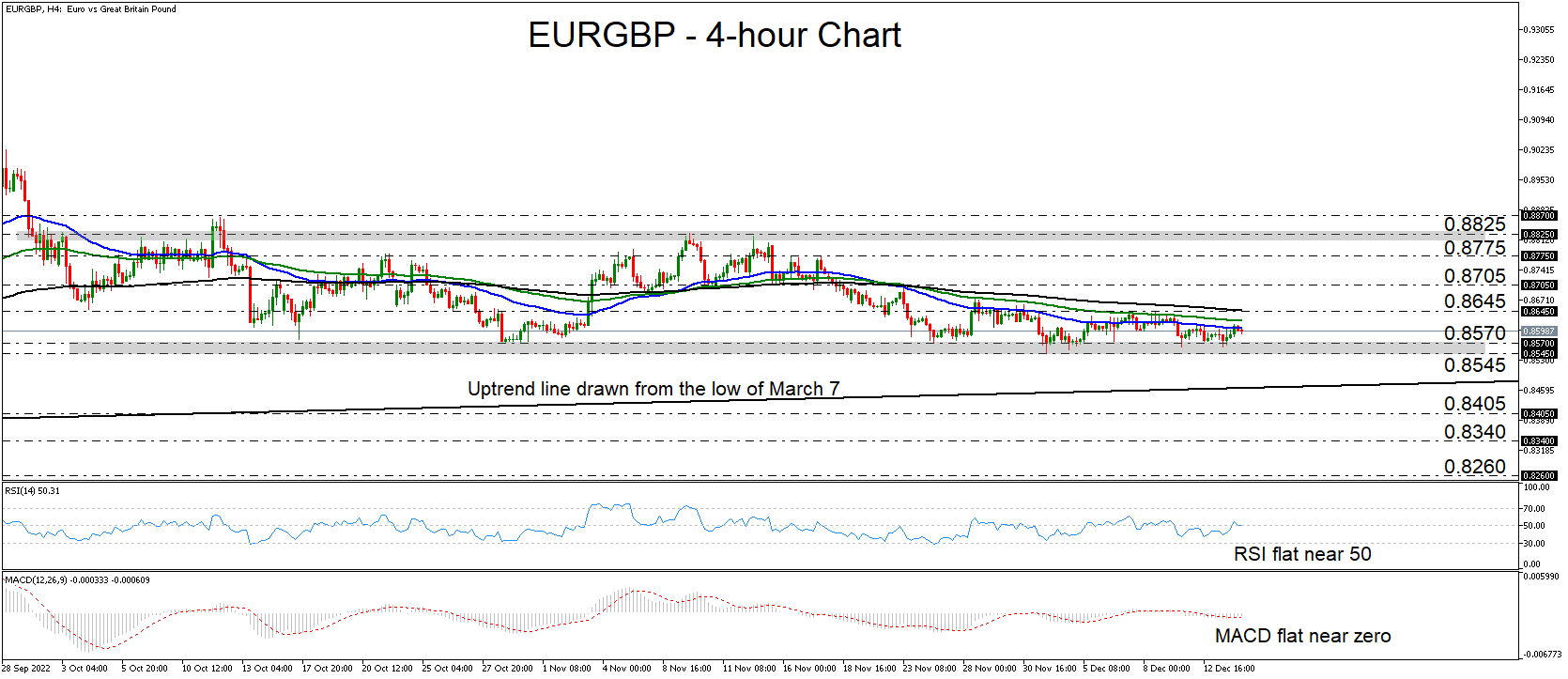
EURGBP Trades in a Sideways Manner
EURGBP has been trading in a quiet mode since Friday, hovering slightly above the 0.8545/70 zone, which has been providing strong support since September. That area is also acting as the lower bound of a sideways range the pair has been trading in since early October, with the upper bound being at 0.8825. This, combined with the fact that all three of the plotted moving averages point sideways, paints a neutral picture for now.
Adding to the trendless narrative are both the RSI and the MACD. The former is lying near its equilibrium 50 barrier, while the latter is running near both its zero and trigger lines, pointing sideways.
Given that in the bigger picture the pair is trading above an uptrend line taken from the low of March 7, the chances of a rebound – even within the aforementioned range – may be larger than the chances of a drop lower. A break above the crossroads of the 0.8645 barrier and the 200-period exponential moving average (EMA) may confirm the notion and allow advances towards 0.8705 or 0.8775, marked by the highs of November 23 and 17 respectively.
Should the bears reclaim control and take the pair below the longer-term uptrend line, a break below 0.8405 may be needed to signal that the outlook has notably darkened. Such a dip could initially pave the way towards the low of August 2 at 0.8340, the break of which could carry extensions towards the 0.8260 territory, near the low of April 14.
Putting everything together, EURGBP has been trading in a sideways manner since October, but in the bigger picture it holds above an uptrend line taken from back in March. Thus, this adds to the chances of a rebound soon, even within the short-term range.
Pound Shrugs as UK Inflation Dips
There was good news on the UK inflation front, as the November data pointed to a drop in inflation. CPI fell to 10.7% y/y, down from 11.1% in October and below the consensus of 10.9%. Core CPI eased to 6.3% y/y, down from 6.5% a month earlier, which was also the consensus. Even with the welcome drop in inflation, it still remains in double digits and is more than five times the Bank of England’s target of 2%.
The British pound is almost unchanged today, despite the drop in inflation. This is in sharp contrast to the reaction on Tuesday to the drop in US inflation, which fell to 7.3% and was softer than expected. The US dollar was about 1% lower against the majors, as once again a soft inflation report raised hopes that the end of the Fed’s tightening cycle is not far off.
All eyes on Federal Reserve
The Fed will announce the benchmark rate later today, after Tuesday’s dramatic CPI report. Inflation fell to 7.1%, down from 7.7% and below the consensus of 7.3%. This hasn’t changed the pricing of an 80% likelihood that the Fed will deliver a 50-basis point hike. The markets will be listening carefully to the tone of Jerome Powell’s rate statement and follow-up remarks, hoping for clues about the next meeting in February. There is a strong chance that the Fed will hike by 25 bp in February and then end the current rate-hike cycle at a terminal rate of 4.75%, on the lower side of the 4.75% to 5.25% range that is considered most likely.
BoE rate decision next
The BoE meets on Thursday and is expected to deliver a 50-basis point hike, which would raise the benchmark rate to 3.50%. This week’s employment and inflation numbers were within market expectations, and a stronger pound has also helped lower the need for a more aggressive 75-bp move. We could see some disagreement among MPC members in today’s vote, which could shed some light on where the BoE goes from here.
Thursday’s rate decision is the final one of the year, with the next meeting not until February 2nd. The most likely scenarios are for a hike of either 25 or 50 points. There is speculation that the February meeting could mark the end of the current tightening cycle, but I am sceptical unless inflation has fallen dramatically by then.
GBP/USD Technical
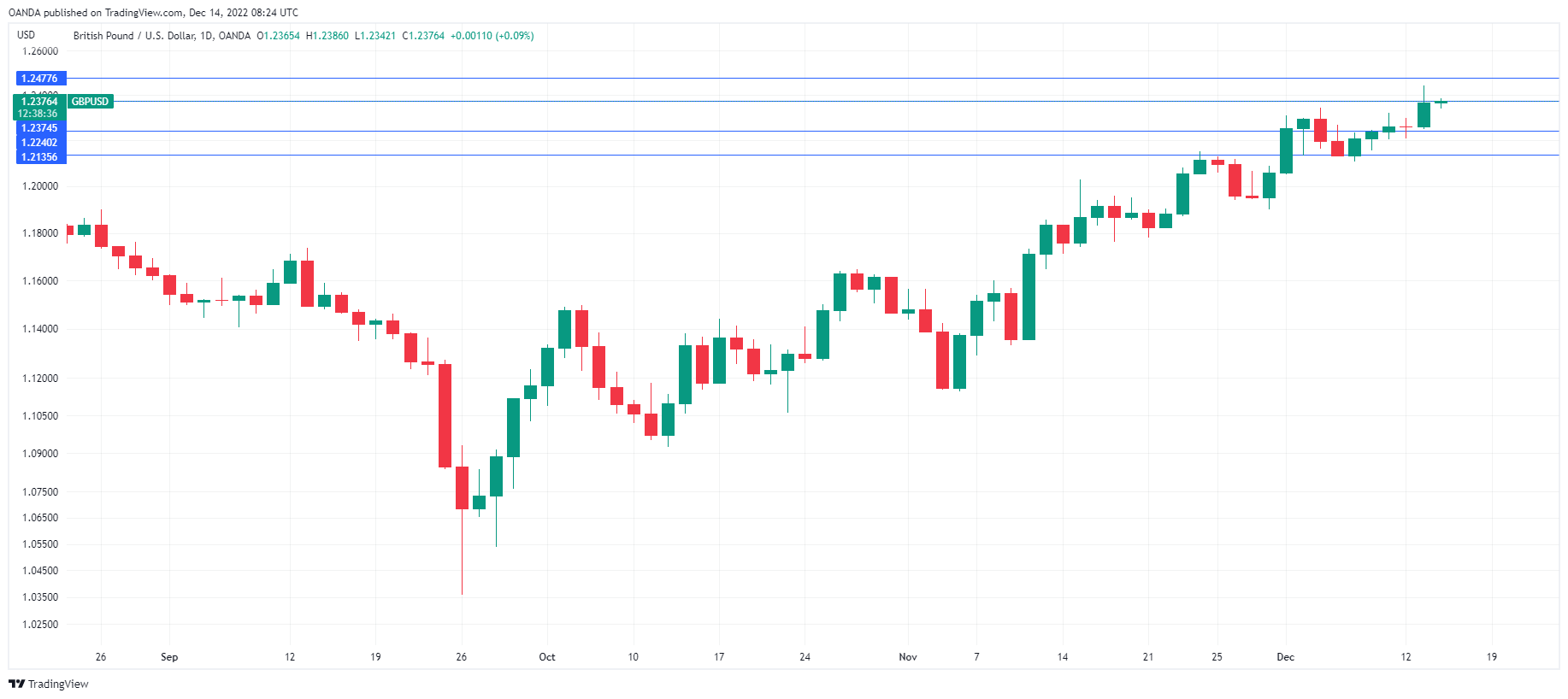
- 1.2240 and 1.2136 are the next support levels
- GBP/USD is testing resistance at 1.2374. Next, there is resistance at 1.2478