Sample Category Title
China’s Easing COVID-19 Curbs and Recession Fears Continue to Dominate Markets
Market movers today
Apart from the industrial production data from Denmark, data calendar is empty for today. Industrial production in Denmark has impressed throughout 2022, and has so far not shown any persistent signs of weakness. Nevertheless, many companies are beginning to report a downturn, with the latest business confidence figures clearly showing industry in retreat in Q4 22. We also expect that manufacturing will be increasingly affected by the slowdown.
ECB's Lagarde, de Cos and Villeroy are scheduled to speak.
The 60 second overview
Market sentiment: Easing pandemic curbs and global recession fears continue to drive the markets. Stocks in Hong Kong are rallying after media reports that mask-wearing requirements would be removed. Elsewhere in Asia sentiment is more wary and European stock futures are on red while the euro is slightly weaker against the dollar. We maintain our call for a weaker EUR/USD next year in the context of diverging paths of recovery from the upcoming recession and Europe's long-term energy pains.
Bank of Canada: Yesterday Bank of Canada hiked policy rates by 50bp in a decision widely anticipated with both markets and analysts split between 25bp and 50bp. Meanwhile, the sentence "Looking ahead, Governing Council will be considering whether the policy interest rate needs to rise further to bring supply and demand back into balance and return inflation to target" clearly indicated that Bank of Canada is contemplating whether the peak in policy rates has now been reached. Also prior to this meeting we pencilled in this 50bp to be the last hike in the cycle; we maintain that call. This was an interim meeting with little other news than the regular press statement. The next Bank of Canada monetary policy decision is in late January next year. The initial rally in CAD FX and rise in CAD rates was quick to reverse as markets digested the fairly soft forward guidance. The drop in oil only contributed to the reversal.
Russia: In a televised address yesterday, Russian president Vladimir Putin acknowledged for the first time that his war is likely to become a long one. He also said that the risk of nuclear war was growing, contradicting comments released yesterday by German Chancellor Olaf Scholz who said that the risk of Putin resorting to nuclear weapons had decreased due to international pressure. Putin denied his government would be planning additional mobilization (but note: he also denied they were planning a mobilization just one week before they announced the partial mobilization on September 21st). Putin continues to claim their operation has achieved "significant result". Same time on the ground, in a further showcase of their tactical superiority and capabilities, Ukraine has been able to strike Russian military bases deep in Russian territory using drones. Winter is likely to play for Russia's benefit though, as Kyiv's Mayor Vitali Klitschko told yesterday that the city could be left without central heating at a time when temperatures fall as low as -15 Celsius. Also yesterday, the EU announced a ninth round of sanctions against Russia, including restrictions on access to drones, chemicals and technologies used for military purposes.
China sanctions: The Netherlands is said to be contemplating similar sanctions for chipmakers in China as those imposed by the US. Outside the US and in line with Japan, Netherlands is one of the largest suppliers of machinery and know-how needed to make advanced semi-conductors.
FI: Since the start of the week, volatility in euro rates markets has been relatively low compared to recent months as we await the major central bank meetings next week. Yesterday, rates traded in a tight range with 10y German Bunds ending 1bp lower on the day at 1.77% amid minor peripheral spread tightening. Bank of Canada raised its policy rate by 50bp, and the associated statement sent signals that this may have been the final rate hike from BoC for now. European rates recorded a minor reaction on the news, while Canadian swap rates ended just 5bp lower across most maturities.
FX: Relatively steady FX markets yesterday where bond yields and oil price dropped further. EUR/USD traded close to 1.05 and USD/JPY around 136. In Scandies, EUR/SEK traded around the 10.90 level and EUR/NOK around the 10.50 level.
Credit: Credit markets were fairly stable on Wednesday but tilted slightly to the bearish side. iTraxx main widened 0.2bp to close at 91.4bp, while iTraxx Xover widened 0.9bp to close at 465.8bp. Primary markets saw decent activity and even allowed high yield issuers such as Iliad (BB) and Intrum (BB/Ba3), among others, to print at decent spreads.
Equities, Oil Fall, Bonds Gain on Recession Fears
Stocks fell for a fifth day, but the sovereign bonds gained, a hint that the market catalyzer shifted from the hawkish Federal Reserve (Fed) pricing – where stocks and bonds fall at the same time, to recession fears, where stocks remain under pressure, while investors seek refuge in safer sovereign assets.
The latest data showed that around $5 billion flowed into US bond ETFs over the past week. Ishares 7–10-year Treasury bond ETF is up by more than 7% since the October dip, up by 3% since the beginning of December and should recover further as investors are expected to return to bonds before they return, sustainably to equities.
The S&P 500’s latest bear market rally is weakening by the day. The index gave back another, though a slim 0.20% yesterday, and closed near its 100-DMA.
The US 10-year yield slipped below its own 100-DMA for the first time since August – when investors were pricing recession fears remember – although at that time recession fears fed into softer Fed expectations and boosted the stock valuations. Today, it’s not the case. The recession fears only increase worries about the future health of the economy, as Fed expectations remain relatively hawkish.
The falling yields kept the US dollar under pressure below the critical 200-DMA, which stands at 105.75.
The EURUSD hovers around the 1.05 mark following the dollar’s waltz, while Cable is holding on to its gains above the 200-DMA, near 1.2125, but remains perfectly at the mercy of the next move from the greenback.
Oil’s dive
One big move of the day is oil. The barrel of American crude slipped below the $73 floor and fell to $71.70 on the back of rising recession fears.
The fact that the Europeans revised their Q3 GDP higher, that Germany revealed a weaker-than-expected contraction in industrial production, that the Chinese continue relaxing Covid measures, and that the Chinese central bank promised to keep financial conditions soft enough to boost economic growth – and reverse the economic disaster, did nothing to improve the mood. The latest news and data remained fully in the shadow of a sharp 8.7% fall in Chinese exports in November released yesterday. The US crude oil inventories fell more than 5 mio barrels last week, but the gasoline inventories rose more than 5 mio barrels, making the data difficult to give direction.
But note that we have started seeing a structural change in the oil markets. Crude price curve was in backwardation up until a month ago. But over the past weeks we started seeing the front-end of the price curve falling and even going back to contango. That means that immediate demand for oil is weakening due to recession fears, and that we may not see a soft landing in the US economy, even less in the world economy next year. The latter could further weigh on crude prices, and we could see the price of a barrel slip below $70 before the year-end.
The ‘only’ good news
The softening US dollar gives other pairs space to breathe. This is perhaps why we see the European companies posting mild losses. The German Dax index lost only about 2% since it peaked early December, whereas the S&P500 lost the double that amount, a bit more than 4%.
And if the softer dollar helped some majors like euro and sterling keep their head above water, the USDCAD advanced to 1.37 yesterday, even after the Bank of Canada (BoC) decided to go ahead with a 50bp hike, instead of 25bp, but didn’t say that there will be more rate hikes – an absence which has been interpreted as ‘maybe there will be no more hikes’.
Of course, the sharp drop in oil prices does impact Loonie negatively as there is a clear positive correlation between oil prices and the Canadian dollar. Therefore, if crude oil continues its journey south, there is little to prevent the USDCAD to advance past the 1.38 level. The only thing that could slow down the Loonie’s fall, is the dollar’s global depreciation. Otherwise, the year-end outlook for the Loonie looks rather bearish.
If all this is not depressing enough
Russian President Vladimir Putin said that the nuclear threat is rising and didn’t say he wouldn’t use a nuclear weapon to defend itself, giving a fresh boost to geopolitical tensions.
Gold may have benefited from rising safe haven flows – although the US dollar remains the ultimate safe haven if you fear a further escalation of military tensions with Russia.
What also made gold and silver shine yesterday – besides from the softer US dollar - was news that China increased its bullion reserves for the first time in three years, in an effort to diversify away from the US dollar. The price of an ounce rebounded to $1790. In this short run, gold bulls will likely see further resistance above the 200-DMA, and the $1800 psychological resistance. But the weakening US dollar outlook strengthens appetite for gold in the medium run. There is potential for around $100 rise to $1880, May peak.
EUR/JPY Daily Outlook
Daily Pivots: (S1) 142.93; (P) 143.75; (R1) 144.34; More....
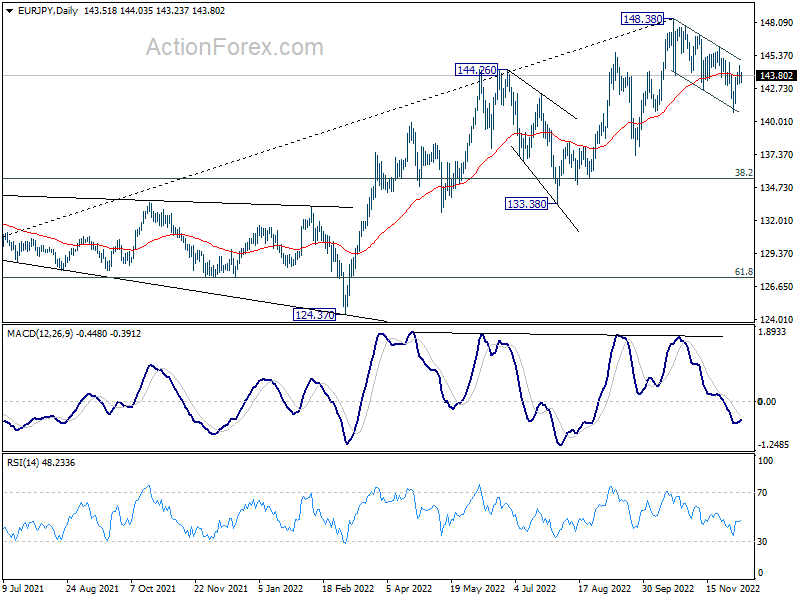
Range trading continues in EUR/JPY and intraday bias remains neutral first. Further decline could be seen as long as 146.12 resistance holds. Break of 140.75 will resume the fall from 148.38. However, break of 146.12 resistance will indicate that correction from 148.38 has completed. Bias will be back on the upside for retesting 148.38.
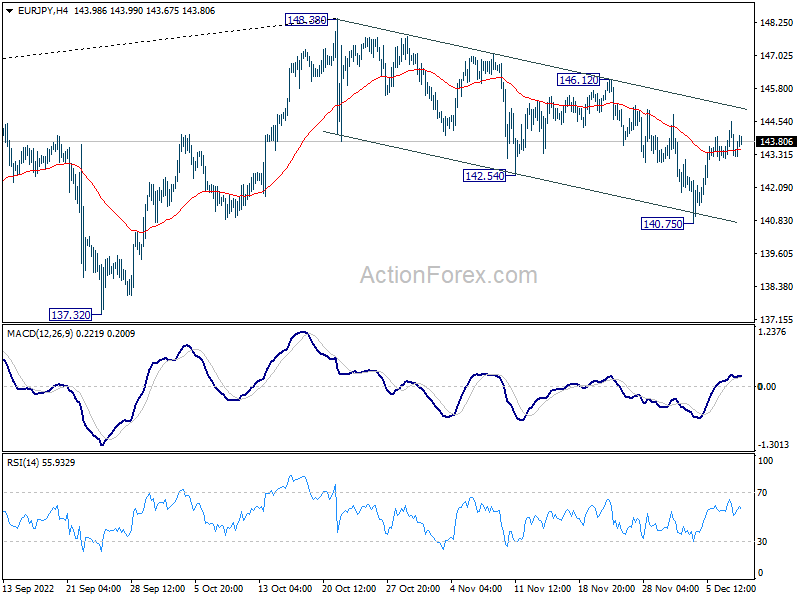
In the bigger picture, considering bearish divergence condition in weekly MACD, 148.38 could be a medium term top already. Fall from there is probably correcting whole up trend from 114.42 (2020 low). Deeper decline would be seen to 55 week EMA (now at 137.37), or further to 38.2% retracement of 114.42 to 148.38 at 135.40 before completion.
GBP/JPY Daily Outlook
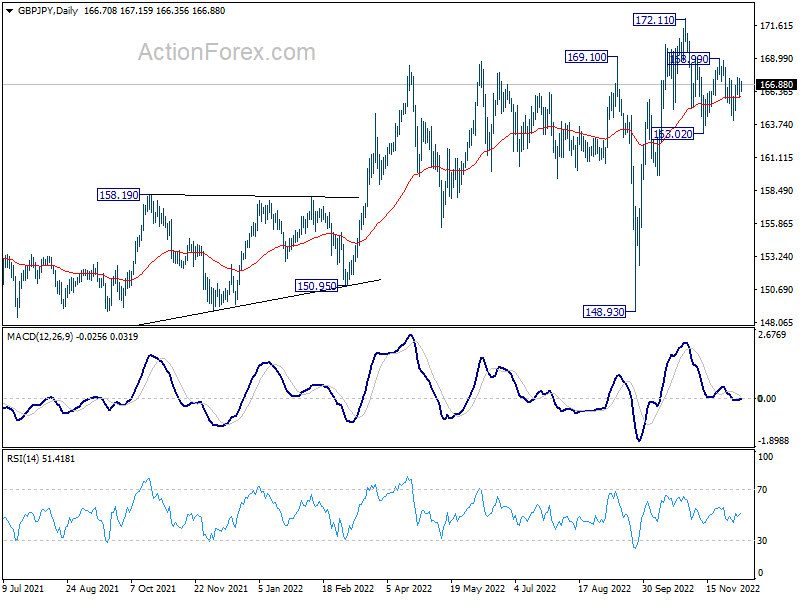
Daily Pivots: (S1) 166.03; (P) 166.73; (R1) 167.49; More...
Range trading continues in GBP/JPY and intraday bias remains neutral. On the downside, break of 164.02 should resume the whole fall from 172.11 through 163.02 support. Nevertheless, on the upside, break of 168.99 resistance will bring stronger rebound to retest 172.11 high instead.
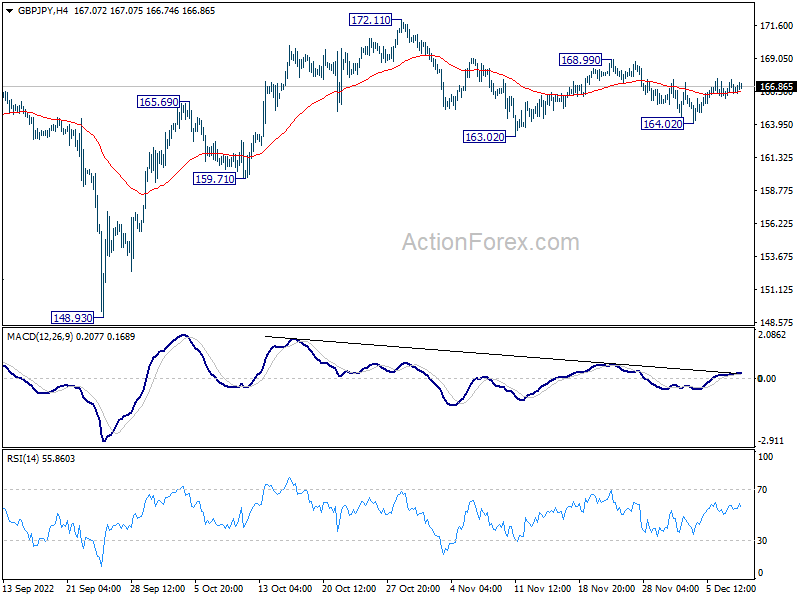
In the bigger picture, medium term upside momentum has been diminishing as seen in bearish divergence condition in weekly MACD. Sustained break of 55 week EMA (now at 160.66) will argue that it's already correcting whole up trend from 123.94 (2020 low). Nevertheless, before that, such up trend could still extend through 172.11 high.
EUR/GBP Daily Outlook
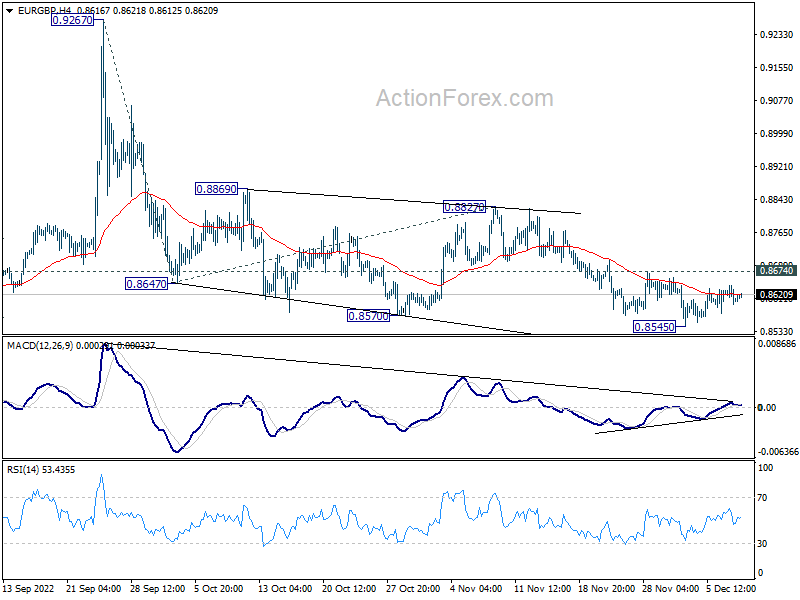
Daily Pivots: (S1) 0.8587; (P) 0.8615; (R1) 0.8632; More...
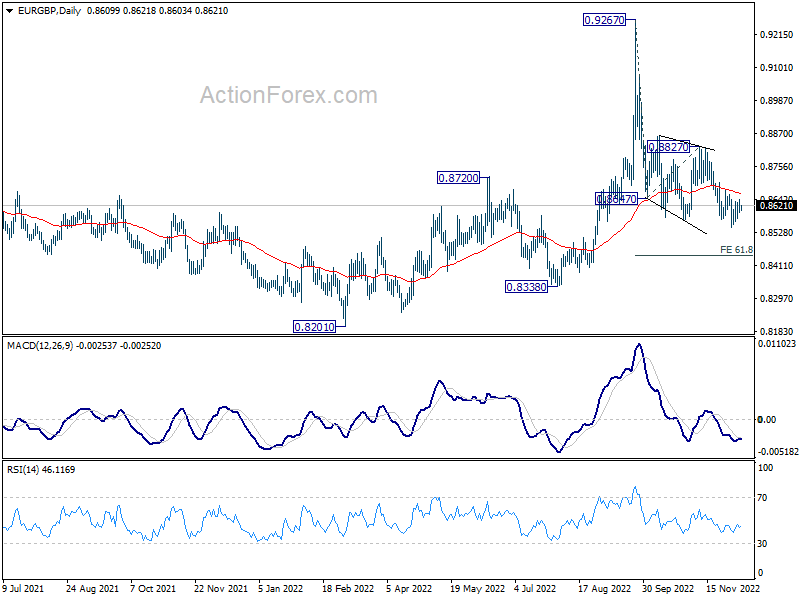
Intraday bias in EUR/GBP is neutral for the moment but further decline remains in favor with 0.8674 resistance intact. Current fall from 0.9267 should target 61.8% projection of 0.9267 to 0.8647 from 0.8827 at 0.8444 next. On the upside, above 0.8674 minor resistance will indicate short term bottoming, and bring stronger rebound back to 0.8827 instead.
In the bigger picture, current development suggests that fall from 0.9267 is a down leg inside long term range pattern. Deeper fall could be seen towards 0.8201/8338 support zone. But strong support should be seen there to bring reversal. Nevertheless, firm break of 0.8827 resistance will turn favor to the case that such decline is merely a correction in the up trend from 0.8201. That is, further rally would be seen at a later stage through 0.9267.
EUR/AUD Daily Outlook
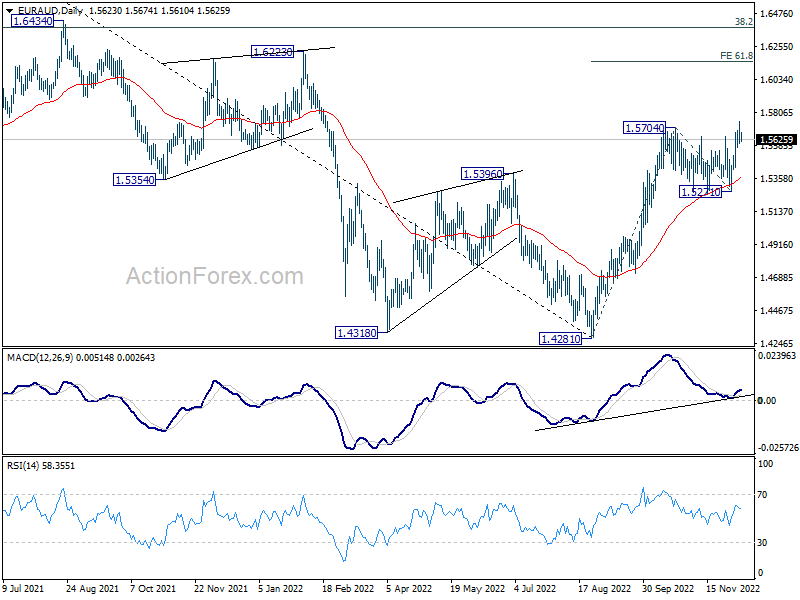
Daily Pivots: (S1) 1.5567; (P) 1.5658; (R1) 1.5718; More...
Intraday bias sin EUR/AUD is turned neutral first as it quickly lost momentum after breaching 1.5704. But for now, near term outlook will remain bullish as long as 1.5271 support holds, in case of retreat. Break of 1.5747 will resume larger rally to 61.8% projection of 1.4281 to 1.5704 from 1.5271 at 1.6150.
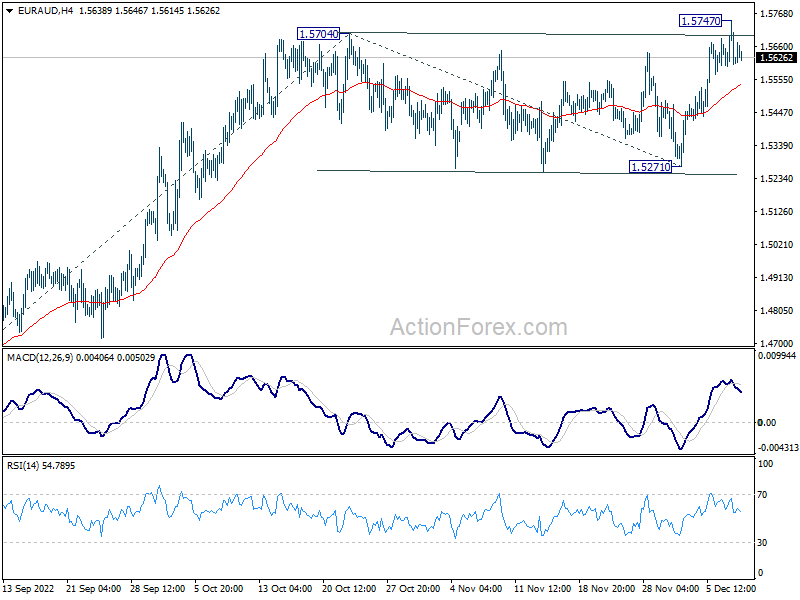
In the bigger picture, a medium term bottom should be in place at 1.4281, on bullish convergence condition in daily MACD. Further rise would be seen back to 1.6434 key resistance next. Break of 1.5271 support is needed to indicate reversal. Otherwise, further rally will remain in favor.
EUR/CHF Daily Outlook
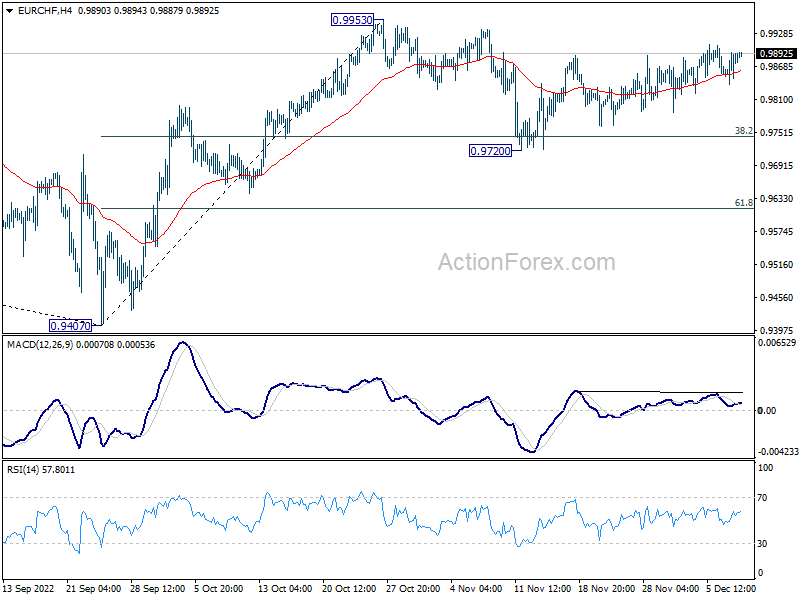
Daily Pivots: (S1) 0.9851; (P) 0.9873; (R1) 0.9908; More....
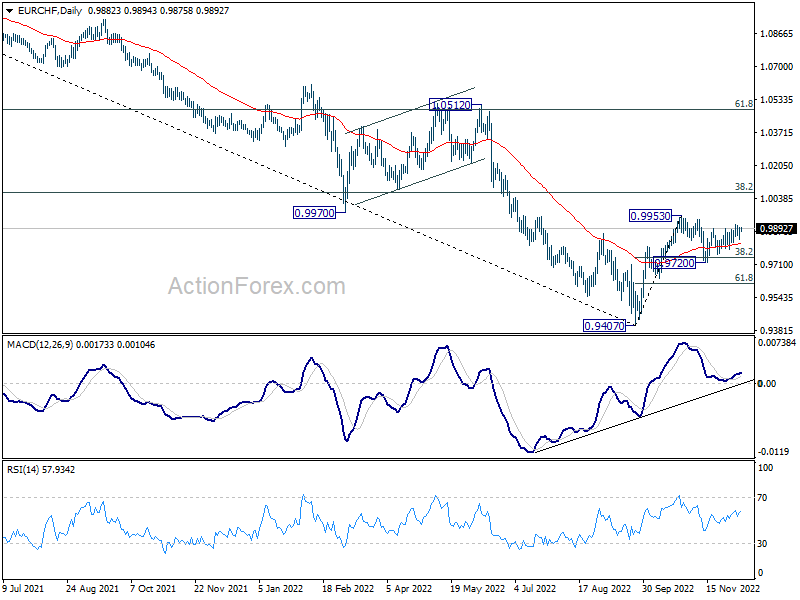
EUR/CHF's consolidation form 0.9953 is extending and intraday bias stays neutral. On the upside, firm break of 0.9953 resistance will resume larger rally from 0.9407 to 1.0072 fibonacci level. However, break of 0.9720 will extend the decline from 0.9953 to 61.8% retracement of 0.8407 to 0.9953 at 0.9616.
In the bigger picture, prior rejection by 0.9970 support turned resistance retains medium term bearishness. That is, while 0.9407 is a medium term bottom, price actions from there would develope into a corrective pattern rather than a reversal. Down trend resumption through 0.9407 is mildly favored at a later stage. This will remain the favored case now, as long 38.2% retracement of 1.1149 to 0.9407 at 1.0072 holds.
USD/CAD Daily Outlook
Daily Pivots: (S1) 1.3595; (P) 1.3648; (R1) 1.3705; More....
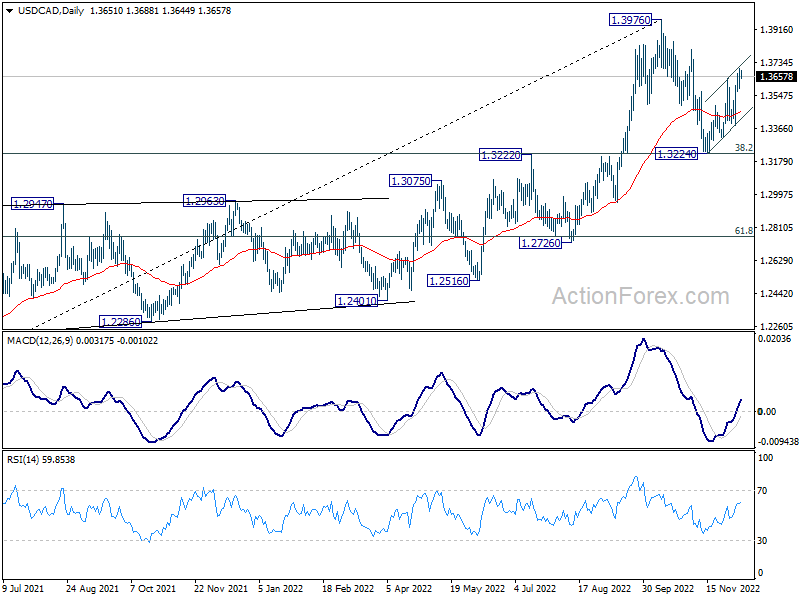
USD/CAD is losing some upside momentum as seen in 4 hour MACD. But further rally is still in favor. Correction from 1.3976 could have completed with three waves down to 1.3224. Further rise should be seen to 1.3807 resistance first, and then 1.3976. For now, this will remain the favored case as long as 1.3383 support holds, in case of retreat.
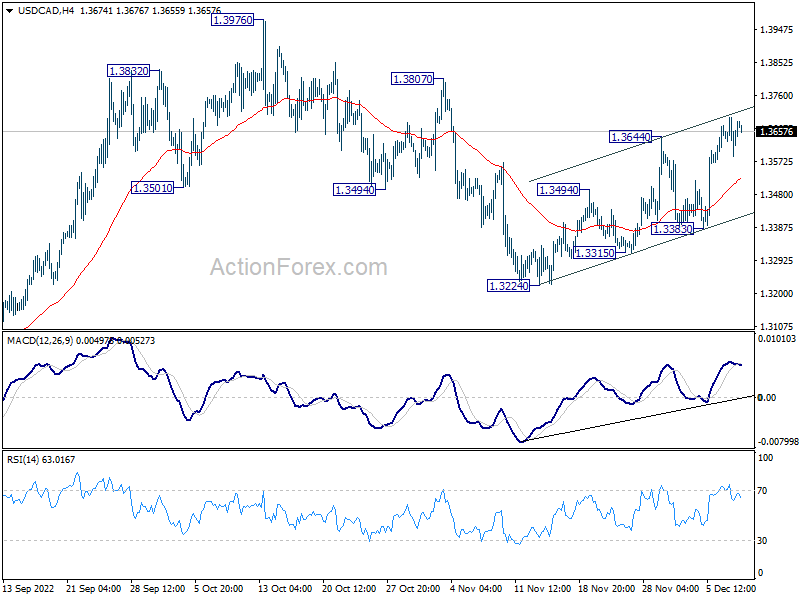
In the bigger picture, as long as 1.3222 cluster support (38.2% retracement of 1.2005 to 1.3976 at 1.3223) holds, larger up trend from 1.2005 (2021 low) is still expected to resume through 1.3976 high at a later stage. However, firm break of 1.3222/3 will indicate that the trend might have reversed. Deeper fall would be seen to next cluster support at 1.2726 (61.8% retracement at 1.2758).
AUD/USD Daily Report
Daily Pivots: (S1) 0.6682; (P) 0.6712; (R1) 0.6755; More...
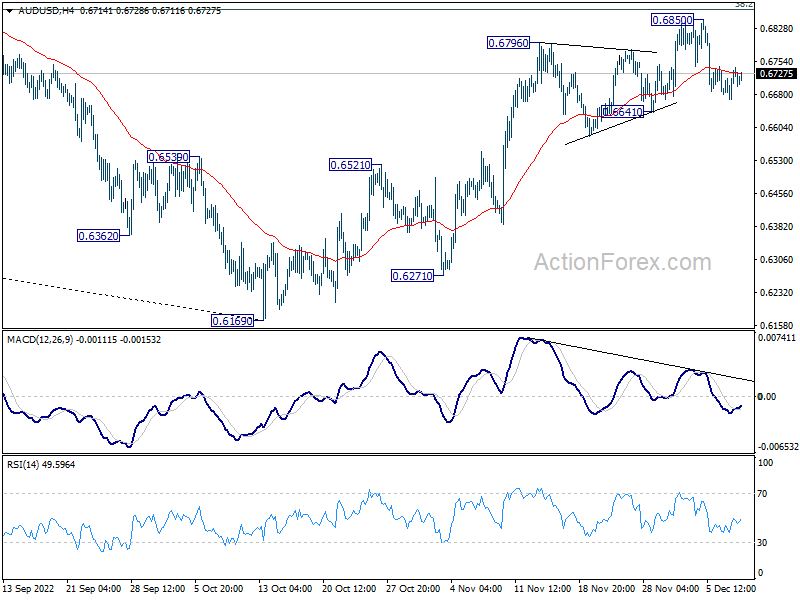
AUD/USD remains bounded in range below 0.6850 and intraday bias stays neutral first. Considering bearish divergence condition in 4 hour MACD, break of 0.6641 support should indicate short term topping, following rejection by 0.6871 fibonacci level. Intraday bias will be back on the downside for 0.6521 resistance turned support first.
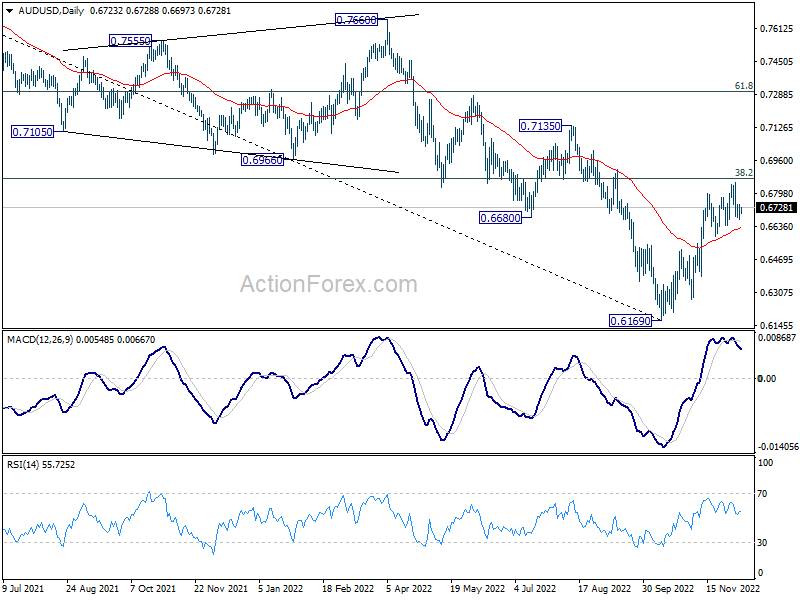
In the bigger picture, a medium term bottom is in place at 0.6160 already. But it's too early to call for trend reversal. Nevertheless, even as a corrective move, rise from 0.6169 should target 38.2% retracement of 0.8006 to 0.6169 at 0.6871. Sustained trading above 55 week EMA (now at 0.6922) will raise the chance of the start of a bullish up trend. However, rejection by 0.6781 or 55 week EMA, followed by 0.6521 resistance turned support and retain medium term bearishness.
USD/JPY Daily Outlook
Daily Pivots: (S1) 135.93; (P) 136.89; (R1) 137.57; More...
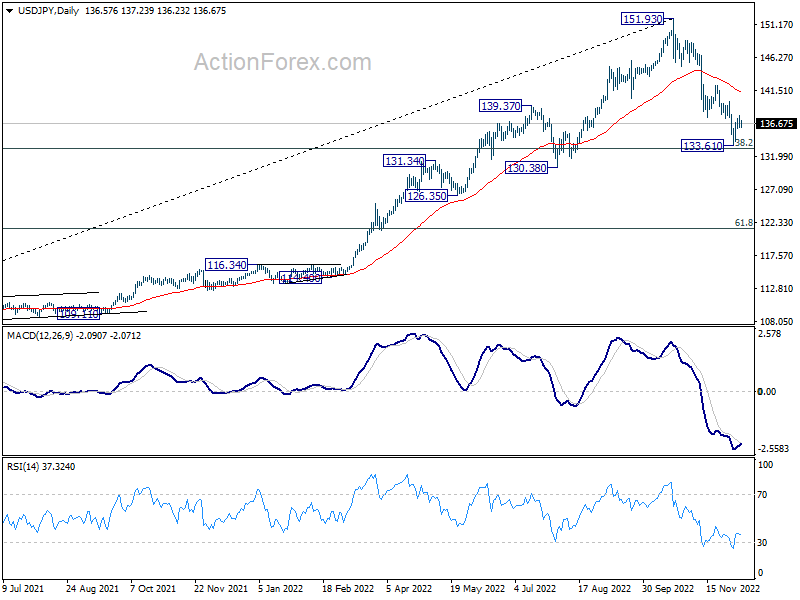
With 135.95 minor support intact, USD/JPY's rise from 133.61 short term bottom is in progress, and should target 55 day EMA (now at 141.20). However, break of 135.95 minor support will turn bias back to the downside for retesting 133.61 low instead.
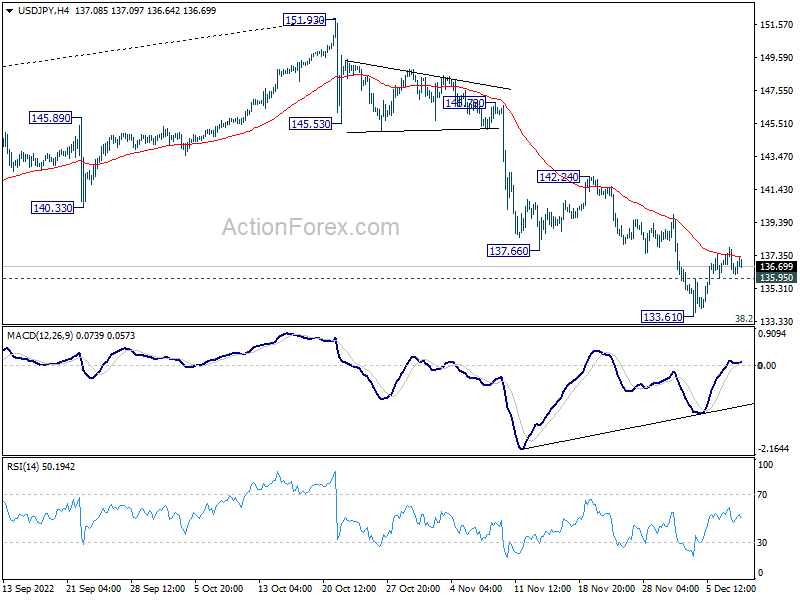
In the bigger picture, a medium term top should be formed at 151.93. Fall from there is correcting larger up trend from 102.58. It's too early to call for bearish trend reversal. But even as a corrective move, such decline should target 38.2% retracement of 102.58 to 151.93 at 133.07, or further to 55 week EMA (now at 131.33). Some support should be seen around this zone to bring rebound. However, sustained break of 55 week EMA will pave the way to 61.8% retracement at 121.43.