

Sample Category Title
EUR/USD: Bulls to Hold Grip While Rising 10DMA Protects the Downside
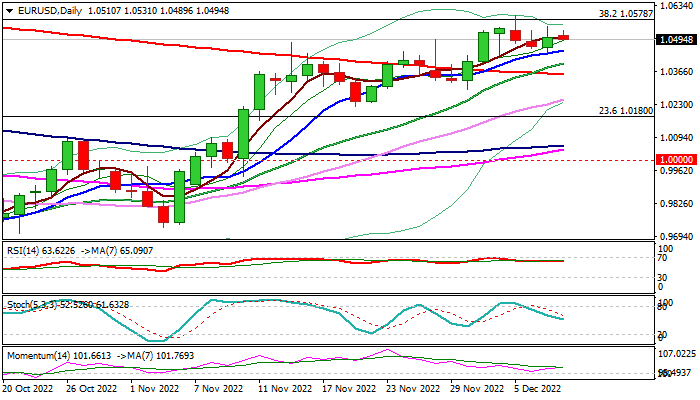
The Euro remains constructive above solid supports at 1.0448/52 (10DMA / Fibo 38.2% of 1.0222/1.0594 upleg) which contained pullback after larger bulls failed to break pivotal Fibo barrier at 1.0578 (Fibo 38.2% of larger 1.2266/0.9535 downtrend).
Daily studies remain in bullish setup and support the action, however, bullish weekly close with minimum requirement on close above Monday’s high (1.0550) is needed to confirm bear-trap under 1.0452 Fibo support and additionally support near-term action.
On the other hand, overbought weekly studies warn that bulls may lose traction, with bearish weekly close to signal bull-trap above 1.0578 Fibo barrier and increase risk of deeper pullback, which would look for confirmation on sustained break of 10DMA.
Res: 1.0550; 1.0578; 1.0608; 1.0700.
Sup: 1.0448; 1.0397; 1.0353; 1.0290.
WTI Oil Futures Hit Yearly Lows; Bias Negative
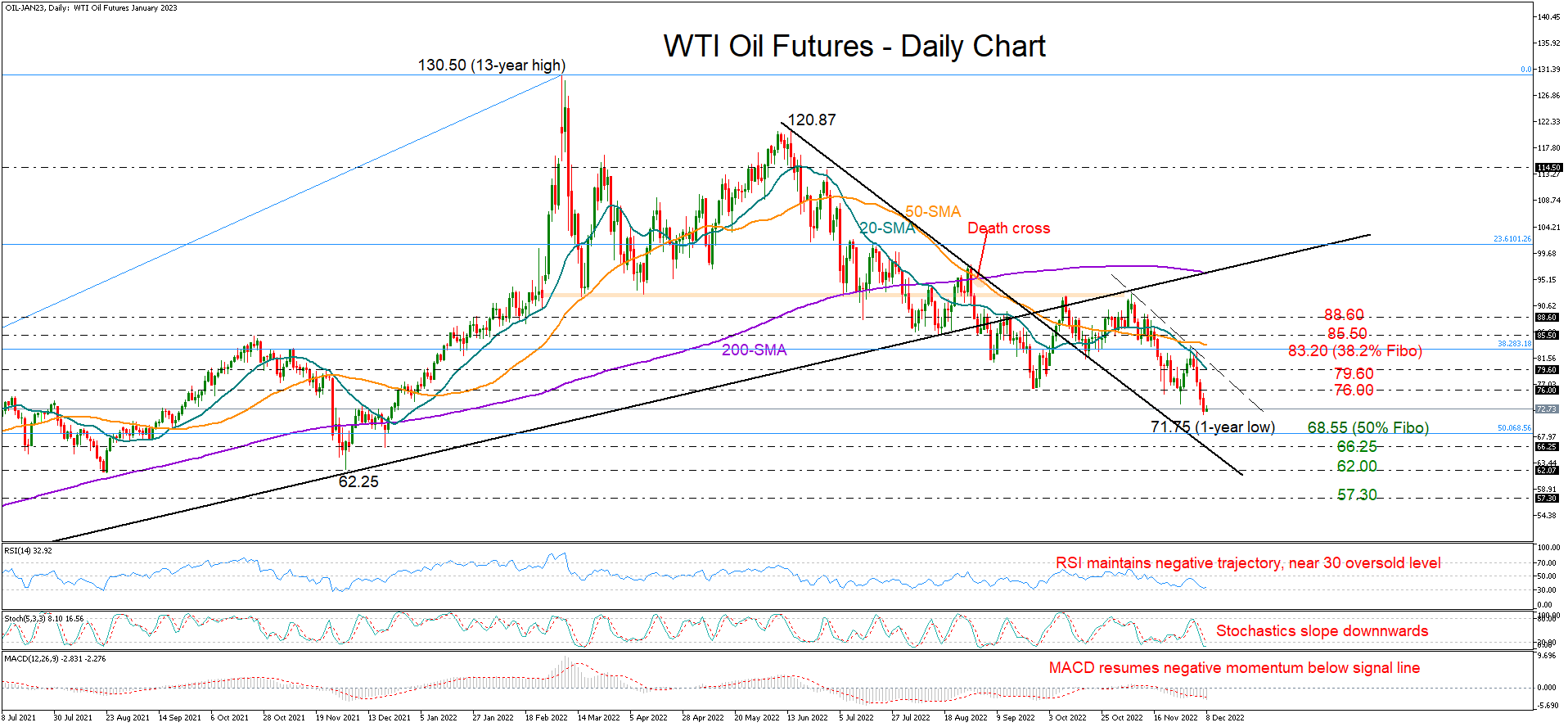
WTI oil futures entered the red zone following the rejection near the 20-day simple moving average (SMA), stretching their 2022 downtrend to a new yearly low of 71.75 on Wednesday. The 38.2% Fibonacci retracement of the 2020-2021 upleg proved to be a tough obstacle too near 83.20.
The four-day bearish streak could see a continuation, as the RSI and the stochastics have yet to confirm oversold conditions. Adding to the discouraging signals is the MACD, which has resumed its negative momentum below its red signal line.
An extension lower would bring the 50% Fibonacci of 68.55 under examination, while slightly beneath that, the 66.25 level has been frequently tested since March 2021 and might be another important area to watch. Note that the resistance-turned-support line is also positioned here. Hence, if sellers claim that barricade, the decline may get another leg to 62.00 and then to 57.30.
If the bullish scenario unfolds, the price may face initial limitations near the 76.00 level before heading for the 20-day SMA, currently around 79.60. A decisive close above the 38.2% Fibonacci of 83.20 could strengthen bullish engagement up to 88.60, unless the 85.50 barrier blocks the way higher.
In brief, the depreciation in WTI oil futures seems to have some room to go. The next pivot point could occur near 68.55
A Bit Flat
Equity markets look a little flat on Thursday, perhaps a sign that we've entered into a waiting period ahead of some major data releases and central bank meetings.
This month was always effectively split into two dominant weeks, the first of the month which included the jobs report that proved extremely impactful. And then next week when we get a flurry of interest rate decisions and some big data releases. This week was always going to be the void in the middle and that's how it's largely played out, with the ripple effects from Friday's jobs data continuing to dictate sentiment.
Of course, developments in China have a big role to play, although as we're seeing once again, Covid-related moves are almost exclusively impacting stocks in domestic markets. We can see that again overnight, with reports of looser mask and isolation requirements in Hong Kong lifting the Hang Seng and making it the clear outperformer in the region, while most other indices tread water.
There is, of course, US PPI to come tomorrow which could give investors a welcome boost ahead of the main event next week. That said, while probably indicating lower price pressures in the pipeline, it doesn't alleviate the concerns thrown up by the jobs report last week of strong wage growth and the threat of entrenched inflation. So it will be interesting to see how investors react to the PPI report, coming so close to next weeks CPI release and Fed decision.
A floor in oil prices?
Oil prices remain under pressure as traders continue to price in a slower global economy next year and the prospect of deeper recessions. China's efforts to reduce restrictions are probably preventing a much steeper decline in the oil price, although this won't be without disruption as Covid spreads like wildfire throughout the country after such a long period of zero-Covid measures.
Then there's also the pledge by the White House to restock the SPR once oil falls to around $70 a barrel, only a couple of dollars below where it is now, which could in theory put even a temporary floor under the price considering how much it's been drawn down this year.
Gold awaiting the Fed meeting
Gold appears to be steadying ahead of the inflation data from the US and, of course, the Fed meeting next week. The jobs report was a setback and one that could stand in the way of another break higher before the Fed meeting. The inflation data tomorrow and on Wednesday could given the yellow metal a boost but it's the fear of entrenched inflation that could nudge the terminal rate higher. Investors will want to hear what the Fed has to say on the nasty wages surprise last week.
No making up for lost time
With risk appetite not improved, bitcoin continues to trade below $17,000 and await upcoming data. The headlines haven't been favourable recently although the FTX fallout has cooled somewhat. Unfortunately for bitcoin, the timing means it never participated in the last risk rebound and there isn't much appetite to make up for lost time.
AUDUSD Holds a Bullish Bias Near the 20-day SMA
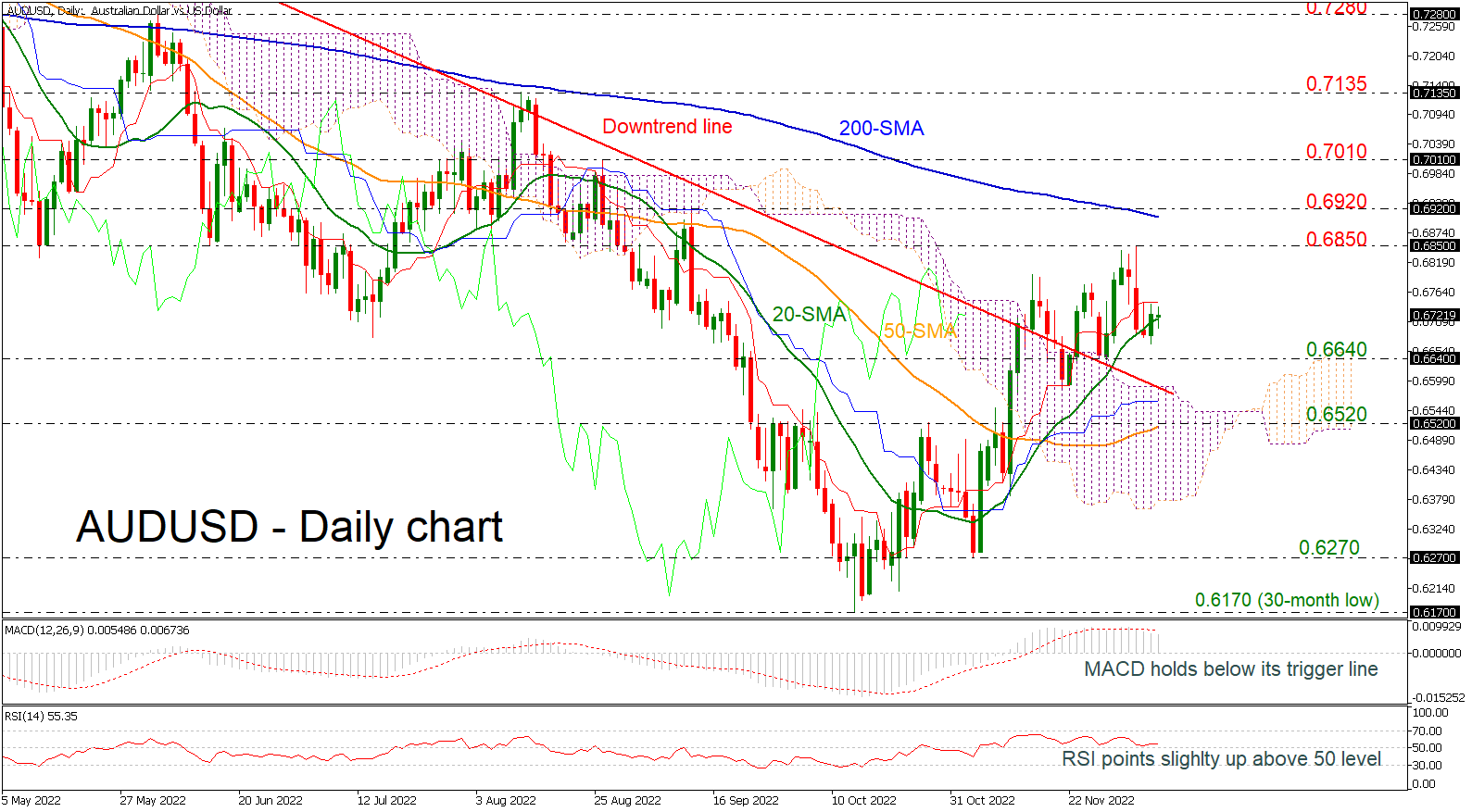
AUDUSD has gained little the last couple of sessions, managing to hold above the 20-day simple moving average (SMA) and re-enter the 0.6700 area, with the technical indicators feeding prospects for a possible positive short-term trading. The RSI holds above the 50 level, while the MACD continues to move in bullish territory but below its trigger line. Also, in Ichimoku indicators, the red Tenkan-sen line keeps standing above the blue Kijun-sen line.
A failure to move higher than the 0.6850 resistance could be a challenge ahead of the 200-day SMA near 0.6900. Above that, the 0.6920 resistance could next come in focus before the bulls shift the long-term outlook to positive as well, testing the 0.7010 peak.
Alternatively, if the 20-day SMA proves easy to get through, the spotlight will turn to the 0.6640 support ahead of the upper boundary of the Ichimoku cloud at 0.6586. Any moves lower could meet the 0.6520 barrier, which overlaps with the 50-day SMA before traders hit the 0.6270 bottom.
In the medium-term picture, AUDUSD has turned bullish after violating the downtrend starting from the 0.7660 peak. Should the market continue the upward pattern, the outlook may turn brighter. A run above the 200-day SMA would turn the outlook strongly bullish.
WTI Oil: Trading Near New 2022 Low, Pressured by Demand Concerns
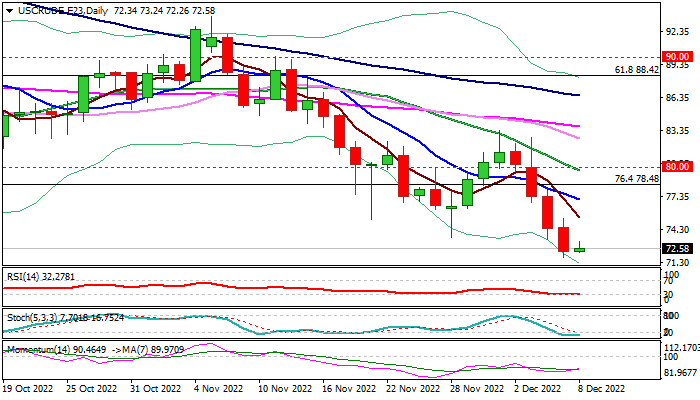
WTI oil price is consolidating above new 2022 low ($71.74) hit on Wednesday, following sharp four-day fall.
Growing concerns that economic slowdown would further weaken demand and increased production in the US, continue to pressure oil prices, with the latest break of previous low at $73.57 (Nov 28) signaling bearish continuation of the downtrend from a double-top and a lower platform at $93.60/72 (Oct 10 / Nov 7).
Bears cracked support at $72.49 (200MMA), which guards psychological support at $70, with stronger acceleration to threaten of extension towards $64.97 (200WMA).
Oversold daily studies suggest bears may take a breather for consolidation, with under falling 10DMA ($77.06) and broken Fibo 76.4% ($78.48) offering solid resistances which should cap upticks and keep bears intact.
EUR/USD: A Complex Bullish Correction is Close to its End
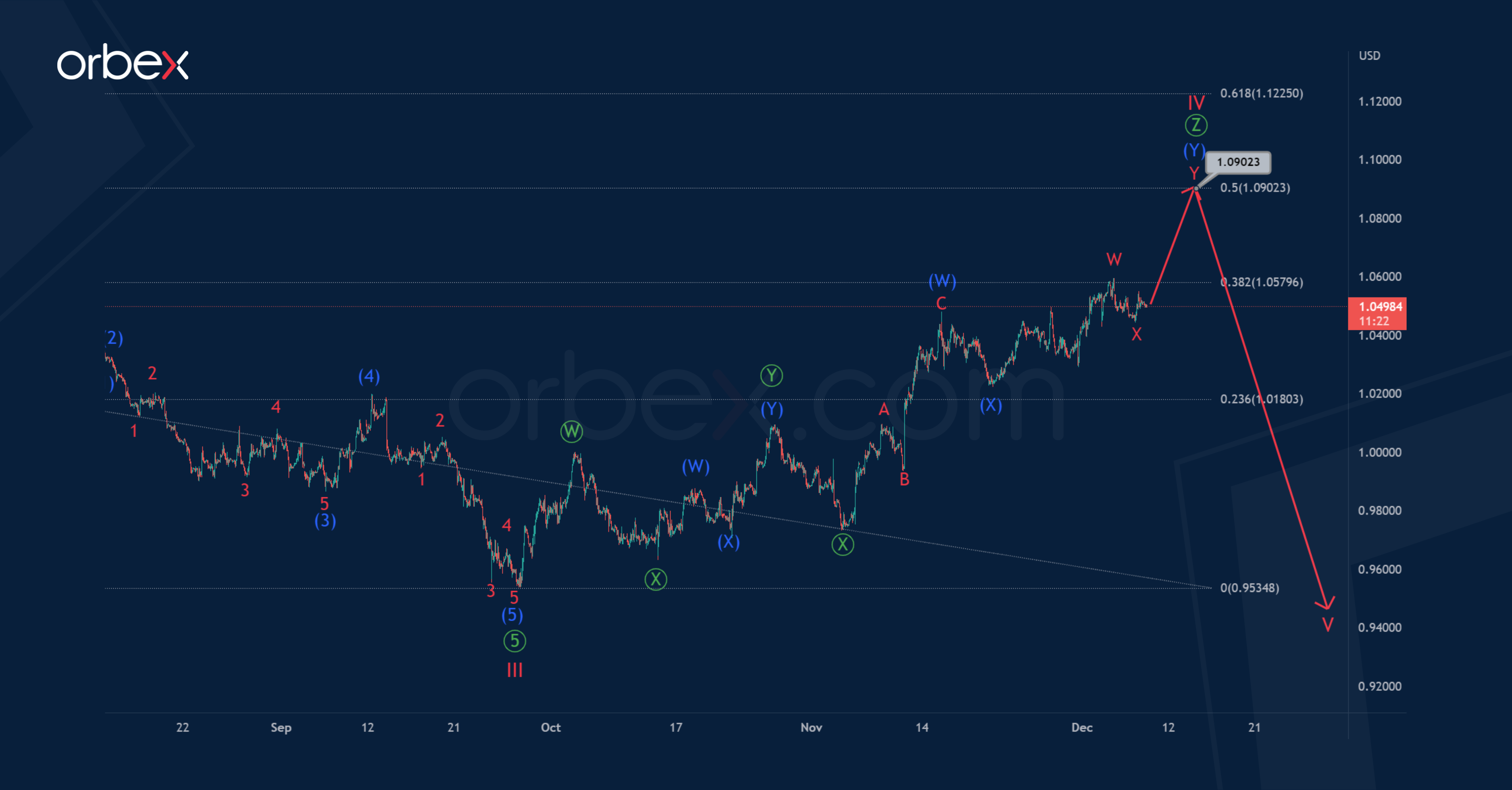
In the long term, the EURUSD currency is expected to form a bearish cycle impulse, which consists of five main sub-waves I-II-III-IV-V.
Most likely, the cycle impulse sub-wave III was fully completed, after which the formation of a bullish correction IV began. This correction is similar to a triple zigzag consisting of primary sub- waves.
The primary sub-waves look complete. The development of the last sub-wave is expected in the near future. It may form a double zigzag pattern (W)-(X)-(Y) near 1.0902. At that level, correction IV will be at 50% of impulse III.
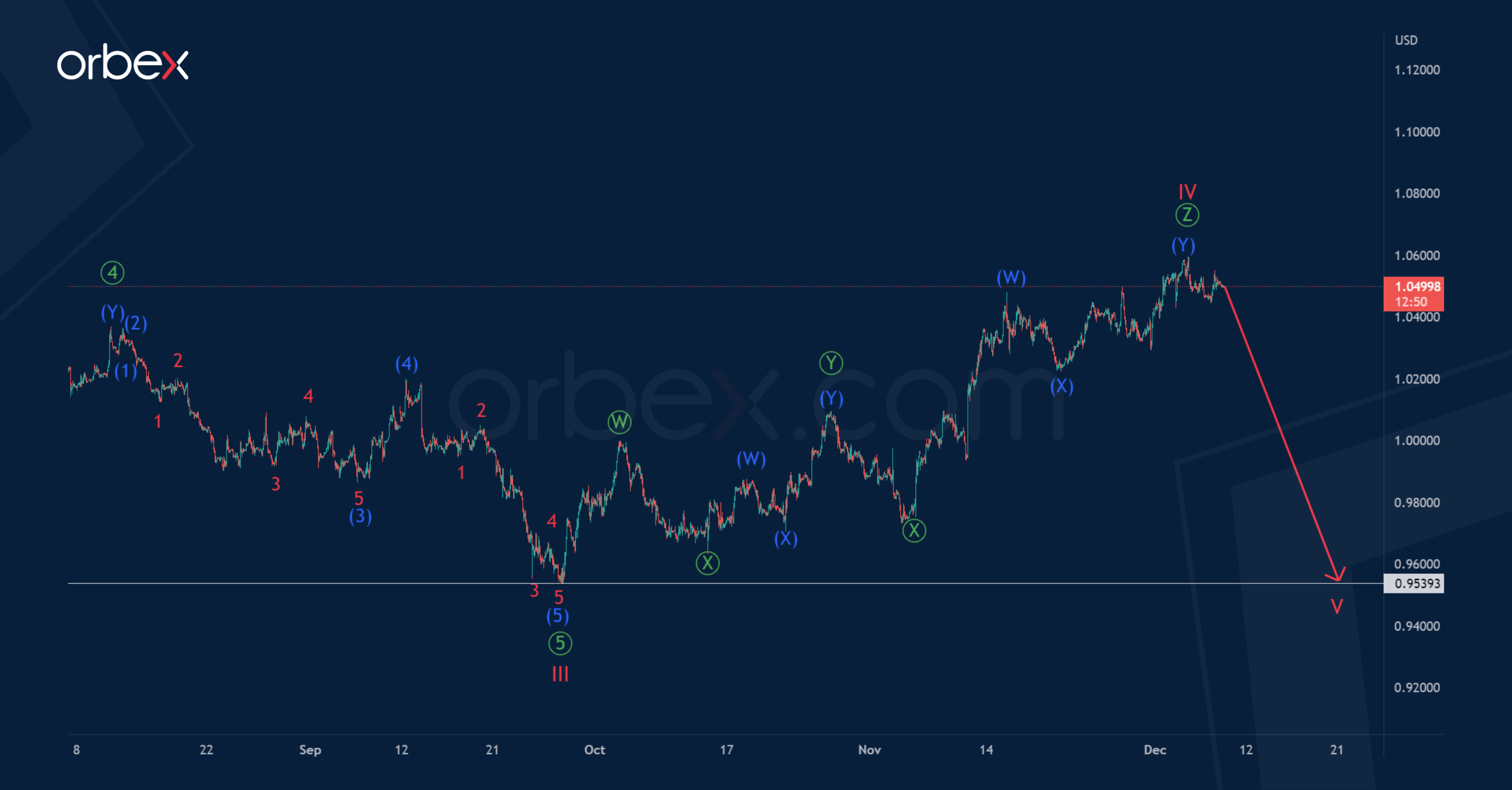
According to the alternative scenario, cycle correction IV has been fully completed.
In the last section of the chart, we can notice the development of the initial part of the cycle wave V, which takes the form of a primary impulse or an ending diagonal.
It is assumed that the bears can re-go to the minimum of 0.953, at which a large impulse wave III was completed.
Perhaps we will continue to observe the main currency pair further.
US Oil Sees Limited Bounce
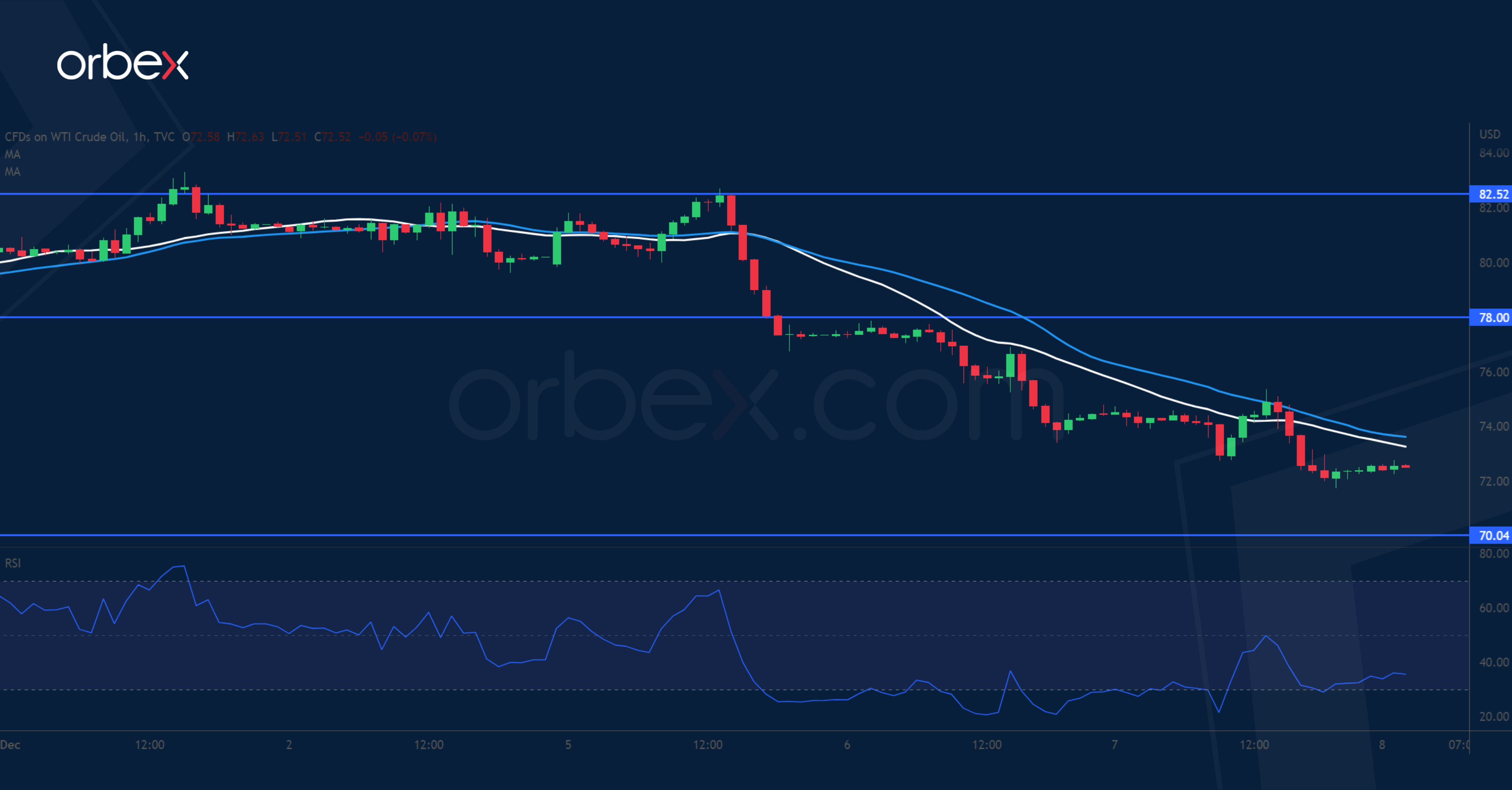
WTI crude dips on an unexpected rise of US fuel stocks. A close below the previous low of 73.70 shows that the path of least resistance remains down. More traders may look to sell into strength as the commodity struggles to claw back losses. The RSI’s oversold condition may cause a limited rebound. Offers could be expected around the former support of 78.00. 82.50 is a major cap that is likely to keep the price under. A new round of selling would send the price to a 12-month low and at the psychological level of 70.00.
USD/CAD Tests Resistance
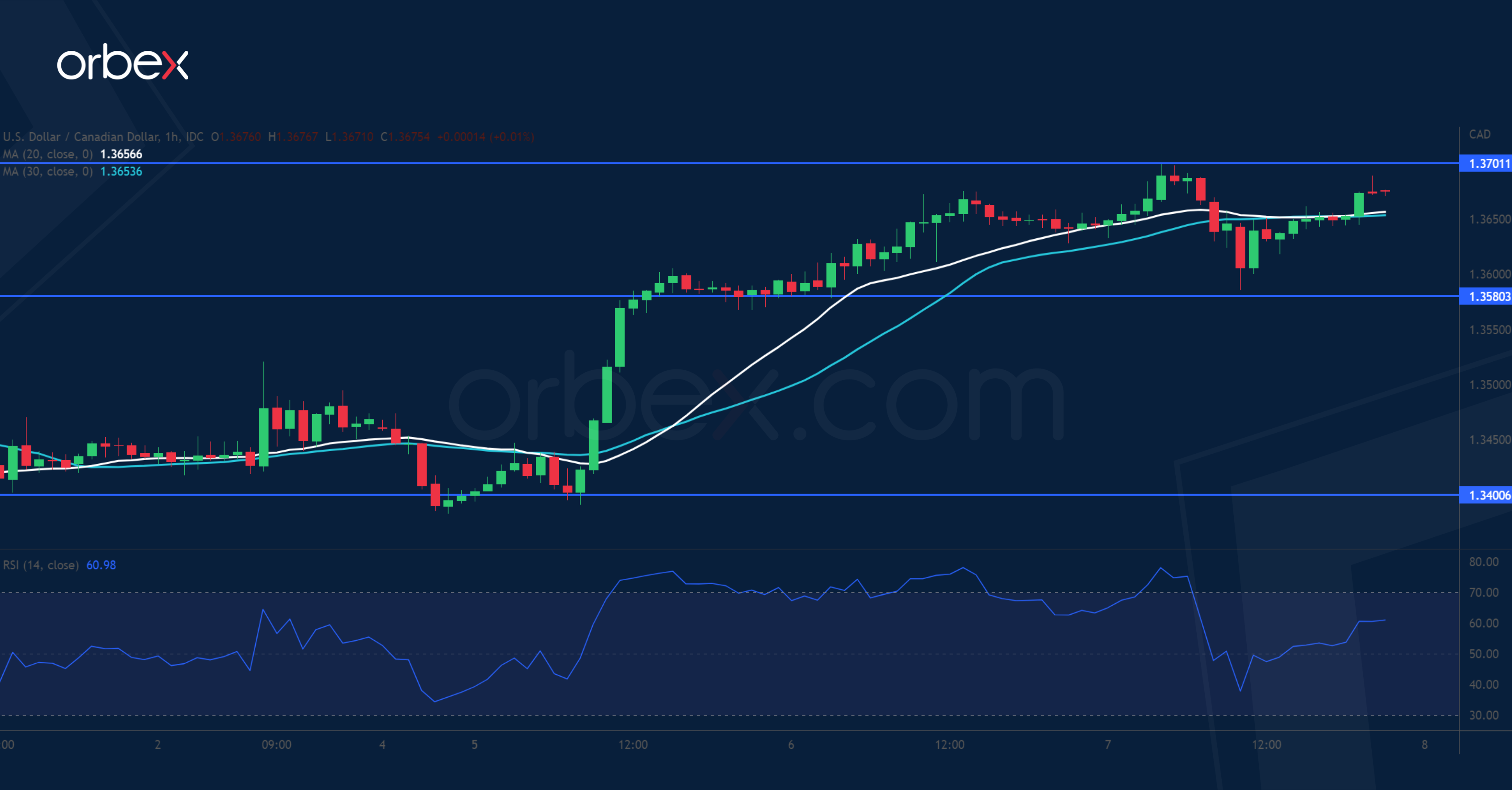
The Canadian dollar struggles as the lack of forward guidance by the BoC hints at slower tightening. A break above the previous peak at 1.3640 has put the bears on the defensive. The RSI’s multiple entries in the overbought area showed exhaustion and led to a pullback as the price tested the support-turned-resistance of 1.3700. A breakout could pave the way for a bullish continuation above the November high of 1.3800. On the downside, 1.3580 is the closest support and 1.3400 a critical level to keep the recovery intact.
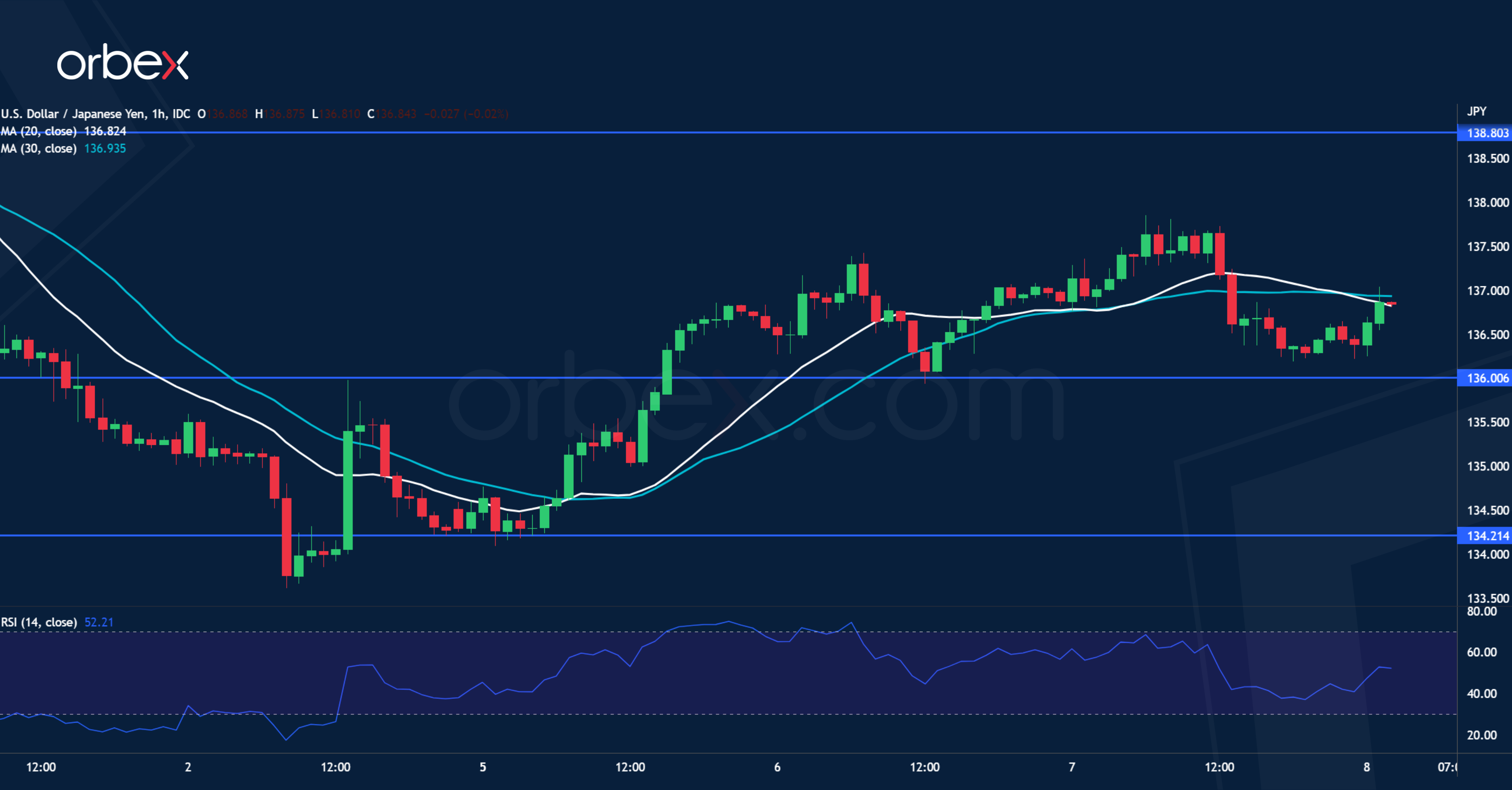
USD/JPY Recoups Some Losses
The Japanese yen rallies over better-than-expected GDP in Q3. The pair has found solid support at 134.20 near August’s lows. The latest rally is likely to be driven by sellers’ profit-taking, which means that it would be too soon to talk about a full-fledged recovery. 138.80 on the 20-day moving average is the first obstacle, and the bulls will need to clear the daily resistance at 141.50 before they could turn sentiment around. 136.00 is the first level to gauge the strength of buying interest in case of a pullback.
Markets and Fed are on Collision Course
Markets
A third consecutive session of low trading volumes saw US Treasuries jump significantly higher. After a calm European trading session, the final figure of third quarter unit labor costs (I kid you not) lightened the fuse. The figure was downwardly revised from 3.5% Q/Q to 2.4% Q/Q and seen as evidence that second-round inflation effects aren’t at play. This suggests that the Fed won’t be as aggressive against inflation as it says it will be, instead leaving scope not to slam the brakes against the background of a looming recession. It’s the markets’ narrative/hope since mid-October and the wager going into the final Fed meeting of the year is only growing. We still think that markets and the Fed are on collision course. Don’t fight the Fed, they say. The intraday Treasury rally accelerated as the US 10-yr yield fell below 3.5% support (previous cycle peak in June) while the Bank of Canada hinted at a potential pause in its tightening cycle after a 50 bps rate hike to 4.25% (see below). US yield eventually lost 11 to 13 bps across the curve on a daily basis. The US 10-yr yield tested 50% retracement on the August/October move higher (3.42%) which coincides with an incoming downward trend line, connecting end-October, mid-November and early-December sell-off lows. The German yield curve turned less inverse with daily yield changes fluctuating between -5.5 bps (2-yr) and +1.6 bps (30-yr). The German 10-yr yield tested the October low at 1.77% with 50% retracement on the August/October move higher still some way off at 1.61%. US stock markets closed a third consecutive day with losses, though they were very limited this time. The S&P 500 manages to hold above first support in the low 3900-area. The trade-weighted dollar lost interest rate support and ground with DXY sliding from 105.50 to 105. EUR/USD closed at 1.0506 from an open at 1.0467.
Today’s eco calendar is again extremely thin with only US weekly jobless claims. With the Fed already in blackout period ahead of the FOMC, it leaves scope for more sentiment-driven trading. Final ECB speeches ahead of their purdah come from the Lady herself and her lieutenants de Cos and Villeroy. We don’t think that they’ll alter market expectations about a 50 bps ECB rate hike next week.
News Headlines
The Bank of Canada raised its policy rate by 50 bps to 4.25%. Analysts and markets were split between a 25 bps and a 50 bps rate hike going into the meeting. Quantitative tightening also continues. CPI inflation at 6.9% shows that Canadian citizens still face large price increases. Q3 growth was also stronger than expected and the economy continues to operate in excess demand. Unemployment stays near historic lows. Even so, the BoC sees signs that inflation might ease and takes a more neutral stance on further policy steps. Growth in Canada will probably come to a stall at the end of this year and in the first half of next year. Three-month rates of change in core inflation have come down, an early indicator that price pressures may be easing. In this context, the BoC will be considering whether the policy rate needs to rise further to bring supply and demand back into balance and return inflation to target. Canadian 2-y yield initially jumped more than 10 bps intraday, but in line with the broader trend closed marginally lower at 3.78%. The loonie after a brief uptick also closed little changed at USD/CAD 1.365.
The National bank of Poland as widely expected left its policy rate unchanged at 6.75%. Polish inflation decreased in Y/Y terms in November to 17.4% mainly due to lower energy and fuel prices, but there is still pass-through of higher commodity prices into consumer prices. Enterprises also rise prices to cover higher operating costs. As global and Polish growth is expected to slow substantially, the hitherto significant monetary policy tightening by NBP is expected to support a decline in inflation towards the NBP inflation target even as inflation will stay high in the short term. The NBP repeats that an appreciation of the zloty in line with fundamentals would accelerated the decrease in inflation. The NBP remains prepared to intervene in the FX market. The zloty yesterday closed little changed at EUR/PLN 4.69. Markets see room first a first rate cut toward the end of 2023.