

Sample Category Title
The End of the Bear-Market Rally?
Equity markets are struggling again on Wednesday, with the latest Chinese trade data highlighting the challenges facing the global economy going into 2023.
It would appear the recovery in stocks - bear-market rally, or otherwise - has run out of steam, and investors are left wondering whether what follows next is another test of the lows or simply a correction of that impressive two-month surge.
The difficulty investors have now is balancing the coming end of the tightening cycle with a potential global recession next year amid heavily discounted valuations. There's clearly an urge to take advantage of the latter without any real foresight into how bad the decline is going to be, which is what makes it tricky. And also why some are referring to the move since October as a bear-market rally.
A terrible trade report
That confusion is oddly encapsulated by what we're seeing in China right now, even if the moving parts are a little different. Of course, China is not immune to the global growth outlook, quite the opposite in fact, but the Covid evolution is very much unique to it.
On the one hand, investors are keen to celebrate the move away from zero-Covid with new relaxation measures being announced on an almost daily basis. On the other, the economic data has been pretty dreadful and the trade data overnight captures both its domestic struggles and the global decline.
Imports and exports continued to decline rapidly last month and that's not a trend that's likely to improve greatly in the months ahead. Sure, a relaxation of Covid curbs could stimulate more local demand but even that is clouded by the impact of a global slowdown, even recession, and how smoothly China is able to remove restrictions without overwhelming the health service. It's easy to forget how challenging that was for other countries. Next year is going to be far from straight forward and the concerning numbers in the trade data may capture that better than the optimism over the end of zero-Covid.
An end to the RBI tightening cycle?
There may be some more relief in India, where the central bank raised rates by 35 basis points to 6.25% in what may be the final action in its tightening campaign. A lot can change between now and February but there's every chance that inflation will ease early next year, enabling the MPC to move to a holding stance, and not put any further strain on the economy.
Will $70 be a floor in oil?
There's been a lot to absorb for oil traders over the last week, some of which have created more questions than answers. The trade data from China was obviously another blow as it pointed to weakening global demand, as has become the norm from manufacturing and trade data around the world recently.
But at the same time, the country is finally navigating away from zero-Covid, a policy that's often this year been a counter-force against the slow re-introduction of OPEC+ crude and the war in Ukraine. Now, with the balance in the market seemingly tilted towards oversupply, the reopening of China could prove supportive of the crude price.
Ultimately, the movements in oil markets depend on multiple moving parts which is why we're seeing so much volatility but the trend has been negative for a number of weeks. The question is how much weaker it will get before OPEC+ steps in once more. Of course, the Biden administration has indicated it could start purchasing crude for the SPR when the price falls to $70 a barrel which could provide at least a temporary floor.
An eye on PPI
Gold traders clearly already have an eye on Friday's US PPI report after the jobs report setback. While a good PPI number won't heal all wounds, it could provide further evidence that inflation is cooling and allow for a less hawkish Fed next week.
The yellow metal peaked around $1,810 last week and is now consolidating in the $1,760-1,780 range. There's clearly still plenty of bullish appetite there but there will be setbacks along the way, as we're seeing now. The PPI could potentially be another. A break below $1,760 could see a bigger correction, with the next big level of support coming around $1,730 which has been very significant in recent months.
In need of an improvement in risk appetite
Deteriorating risk appetite is the last thing bitcoin needed right now, having missed out on the inflation relief rally amid the FTX fallout. It's broken back below $17,000 but remains broadly around the levels it traded around for the last week or so. Risk appetite probably needs to improve significantly for bitcoin to break higher from here and so many will be hoping for a favourable PPI number on Friday and some less hawkish commentary from the Fed next week. And, of course, no further terrible news either on the FTX front or related to it.
EUR/USD Mid-Day Outlook
Daily Pivots: (S1) 1.0440; (P) 1.0486; (R1) 1.0514; More...
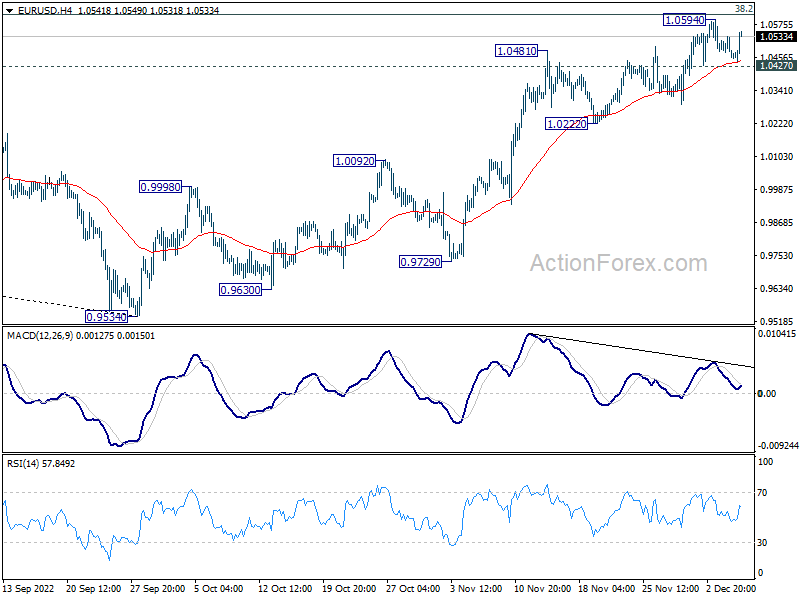
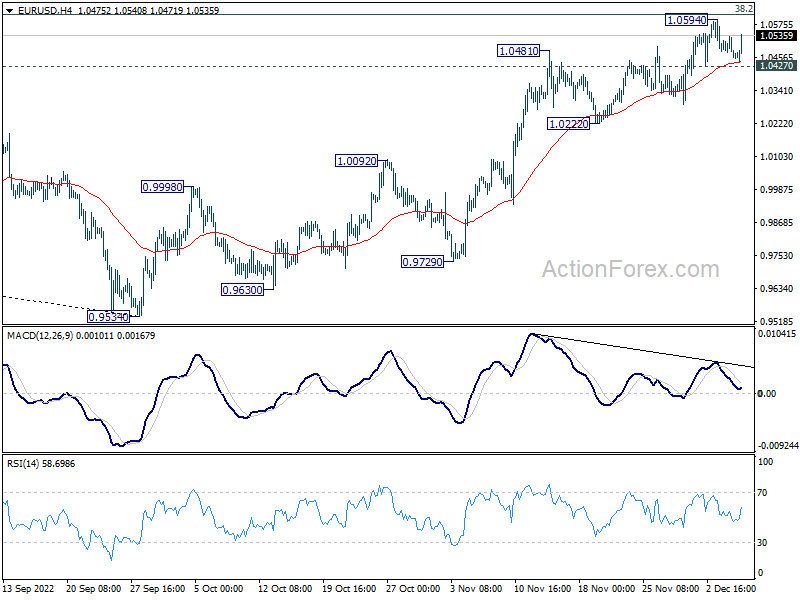
Intraday bias in EUR/USD remains on neutral and outlook is unchanged. Considering bearish divergence condition in 4 hour MACD, break of 1.0427 minor support will indicate short term topping at 1.0594, after rejection by 1.0609 fibonacci level. Intraday bias will be turned back to the downside for 1.0222 support and possibly below. Nevertheless, firm break of 1.0594 will resume larger rise from 0.9534.
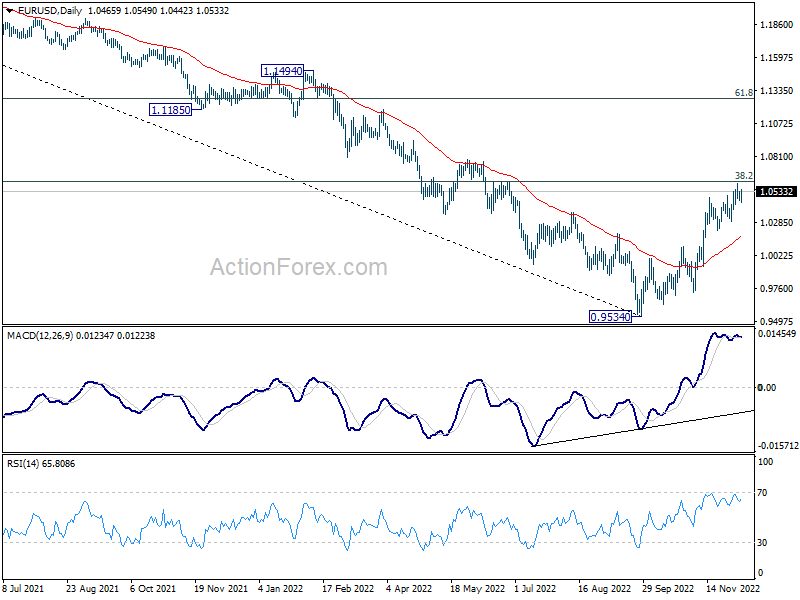
In the bigger picture, a medium term bottom was in place at 0.9534, on bullish convergence condition in daily MACD. Even as a corrective rise, rally from 0.9534 should target 38.2% retracement of 1.2348 (2021 high) to 0.9534 at 1.0609. Sustained trading above 55 week EMA (now at 1.0566) will raise the chance of trend reversal and target 61.8% retracement at 1.1273. However, rejection by 1.0609 will retain medium term bearishness for down trend resumption at a later stage.
GBP/USD Mid-Day Outlook
Daily Pivots: (S1) 1.2084; (P) 1.2177; (R1) 1.2225; More...
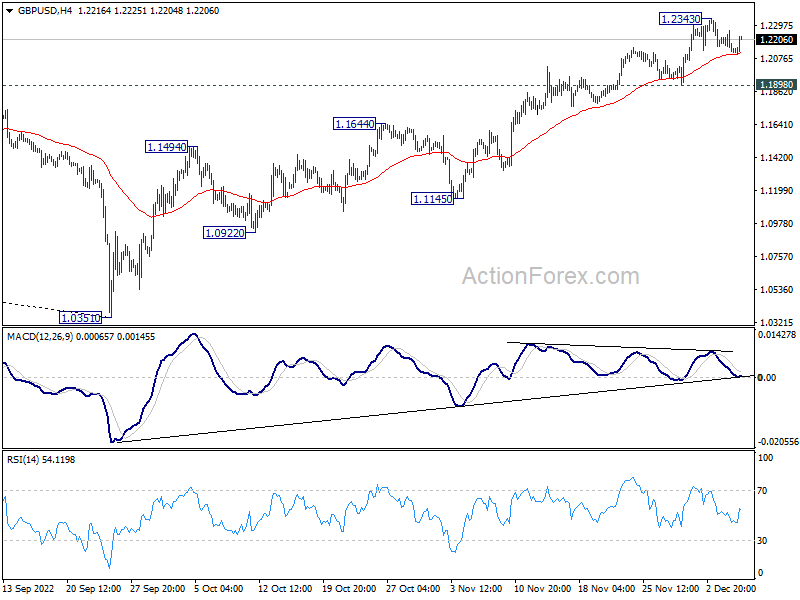
Intraday bias in GBP/USD stays neutral and further rally is expected as long as 1.1898 support holds. Above 1.2343 will resume the rise from 1.0351 and target 1.2759 medium term fibonacci level next. However, firm break of 1.1898 support will confirm short term topping and turn bias back to the downside.
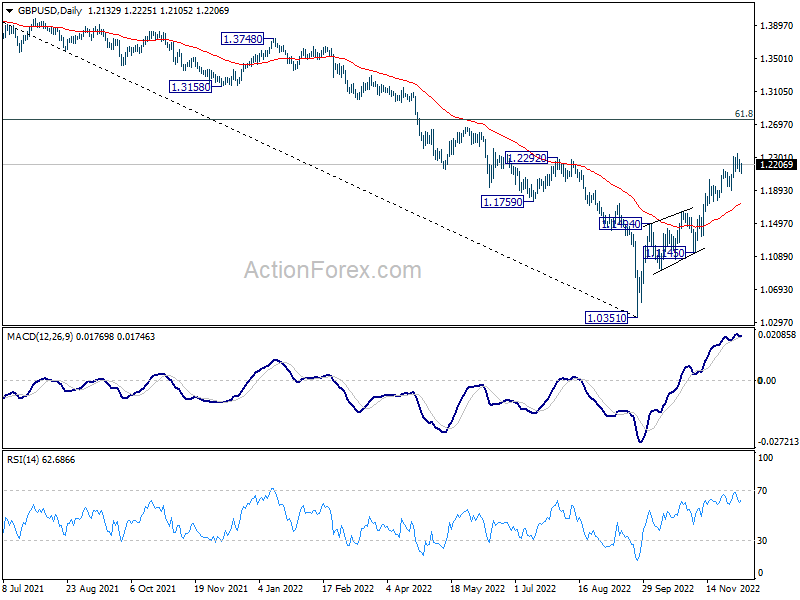
In the bigger picture, rise from 1.0351 medium term bottom is at least correcting whole down trend from 1.4248 (2021 high). Further rise is expected as long as 1.1644 resistance turned support holds. Next target is 61.8% retracement of 1.4248 to 1.0351 at 1.2759. Sustained break there will pave the way back to 1.4248.
USD/CHF Mid-Day Outlook
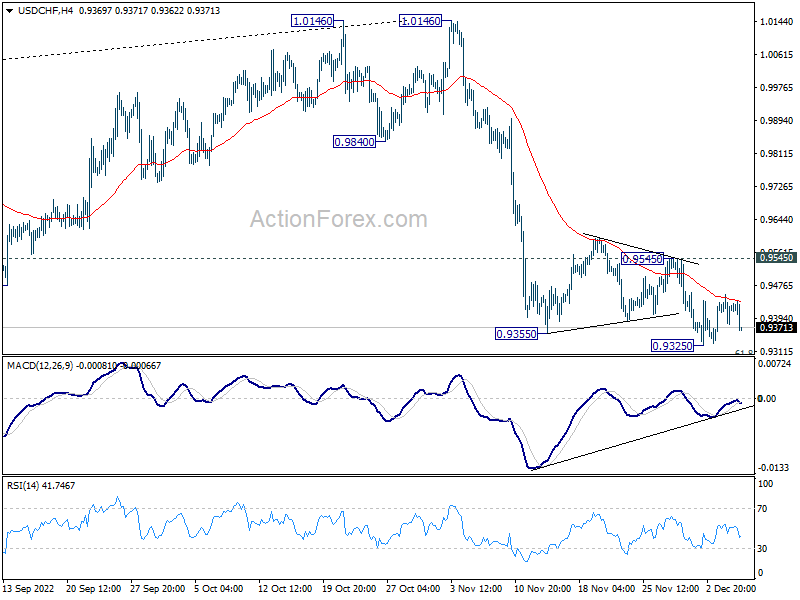
Daily Pivots: (S1) 0.9383; (P) 0.9419; (R1) 0.9458; More...
Intraday bias in USD/CHF stays neutral and outlook is unchanged. Considering bullish convergence condition in 4 hour MACD, break of 0.9545 will indicate short term bottoming at 0.9325. Intraday bias will be back on the upside for 55 day EMA (now at 0.9652). On the downside, below 0.9325 will resume the near term decline and target 0.9287 fibonacci level.
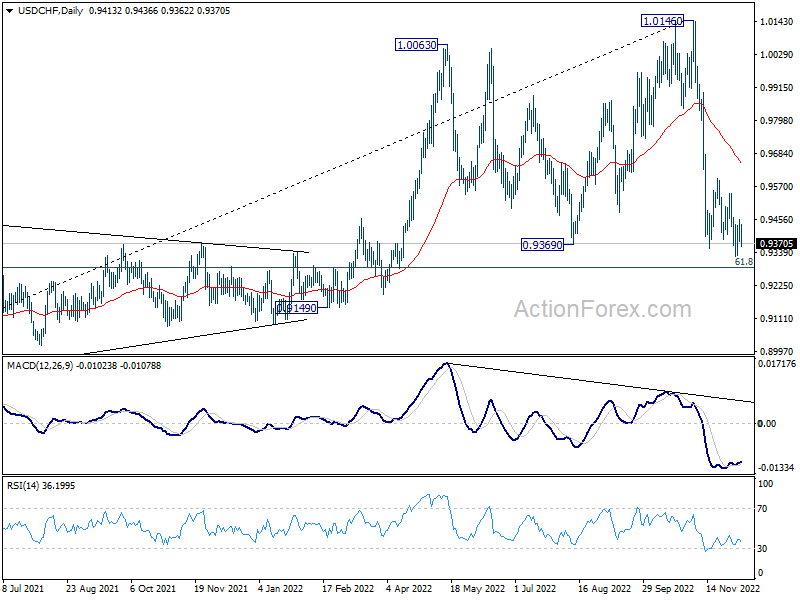
In the bigger picture, rise from 0.8756 (2021 low) has completed at 1.0146, well ahead of 1.0342 long term resistance (2016 high). Based on current downside momentum, fall from 1.0146 might be a medium term down trend itself. Break of 61.8% retracement of 0.8756 to 1.0146 at 0.9287 will pave the way to 0.8756. In any case, risk will stay on the downside as long as 55 day EMA (now at 0.9690) holds.
USD/JPY Mid-Day Outlook
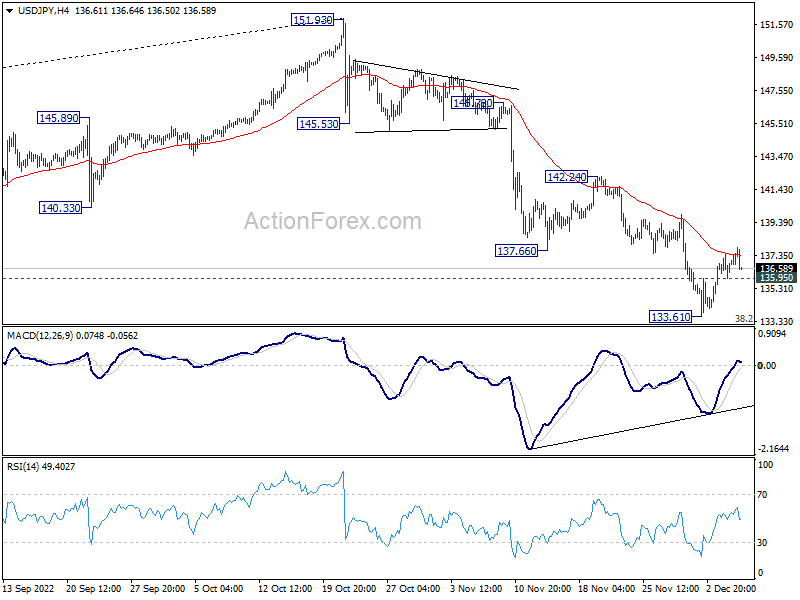
Daily Pivots: (S1) 136.20; (P) 136.81; (R1) 137.66; More...
Intraday bias in USD/JPY stays mildly on the upside at this point. Rebound from 133.61 short term bottom should target 55 day EMA (now at 141.41). However, break of 135.95 minor support will turn bias back to the downside for retesting 133.61 low instead.
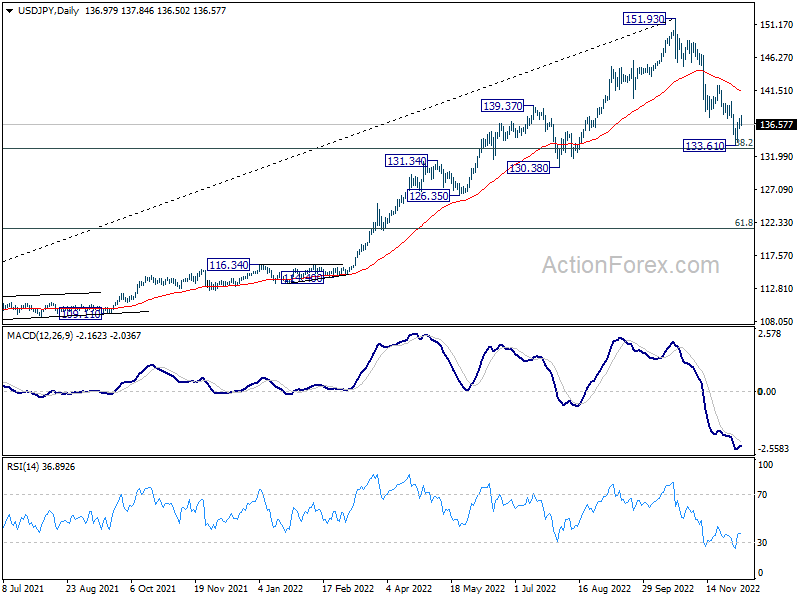
In the bigger picture, a medium term top should be formed at 151.93. Fall from there is correcting larger up trend from 102.58. It's too early to call for bearish trend reversal. But even as a corrective move, such decline should target 38.2% retracement of 102.58 to 151.93 at 133.07, or further to 55 week EMA (now at 131.33). Some support should be seen around this zone to bring rebound. However, sustained break of 55 week EMA will pave the way to 61.8% retracement at 121.43.
The Fed: What Happens After the Fed Reaches the Terminal Rate
Yesterday, several major CEOs gave interviews to financial media in the context of a couple of major investor conferences. Their comments left a sour note for the markets, and tech stocks led a move lower in US equities which fed over into the Asian and European stocks. Aside from the less than optimistic outlook, it underscored a brewing debate about the Fed. The results of that debate could be the difference between a mild (or no) recession, and an economic "hurricane".
First, the disappointing news
What captured most of the attention were comments from Walmart's CEO and the CEO of JPMorgan. The latter has been quite a bit more outspoken about worries of a pending recession. In fact, the "economic hurricane" phrasing was his invention. The issue is that several CEOs echoed a sentiment: that consumer demand was slowing.
Walmart was seeing a trend where consumers were being more conservative in their buying habits, focusing on household essentials and holding back from things like electronics. This dovetailed with the CEO of Union Pacific, who said that shipping volumes were down.
Still good, but for how long?
Jamie Dimon, as the CEO of one of the largest consumer banks in the US, would have some insight into how his customers were spending their money. He pointed to spending this year being 10% higher than last year. Which sounds good, but inflation has to be factored into that. He also pointed out that savings that people had accumulated during the pandemic and thanks to the stimulus were running out, and that might mean further credit crunch in the first half of next year.
This is where the discrepancy starts to show: What will the Fed do. For now, the Fed is raising rates to stave off inflation, and are expected to level out at around 5.0%. This makes borrowing costs significantly higher, which would make buying things with credit cards, or taking out loans, much more difficult.
History won't repeat itself?
In the past, the Fed has hiked rates right up until there was an economic downturn, and then quickly cut in order to support the economy. Particularly to support the jobs market, which is their second mandate. But Dimon is warning this might not be the case this time, as inflation remains elevated, the Fed might be much more concerned with restoring monetary stability. This would make the recession harder, since there wouldn't be the sudden influx of cheaper credit that happened with previous recessions.
The relative strength in the jobs market contributes to that view. Even if the economy slips into contraction, with over 10 million job openings, it could be some time before the unemployment rate starts to tick up. Unemployment is a lagging indicator, and that lag might be even more extended this time around. Which could mean that the more rosy expectations of a quick "pivot" by the Fed next year might not play out.
EUR/AUD Mid-Day Outlook
Daily Pivots: (S1) 1.5586; (P) 1.5638; (R1) 1.5701; More...
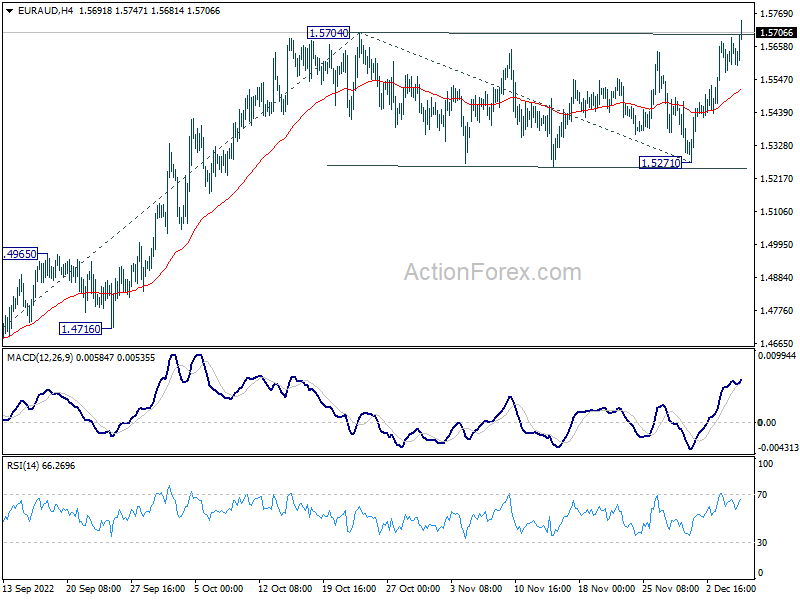
EUR/AUD's break of 1.5704 resistance indicates resumption of whole rise from 1.4281. Intraday bias is back on the upside. Next target is 61.8% projection of 1.4281 to 1.5704 from 1.5271 at 1.6150. For now, near term outlook will remain bullish as long as 1.5271 support holds, in case of retreat.
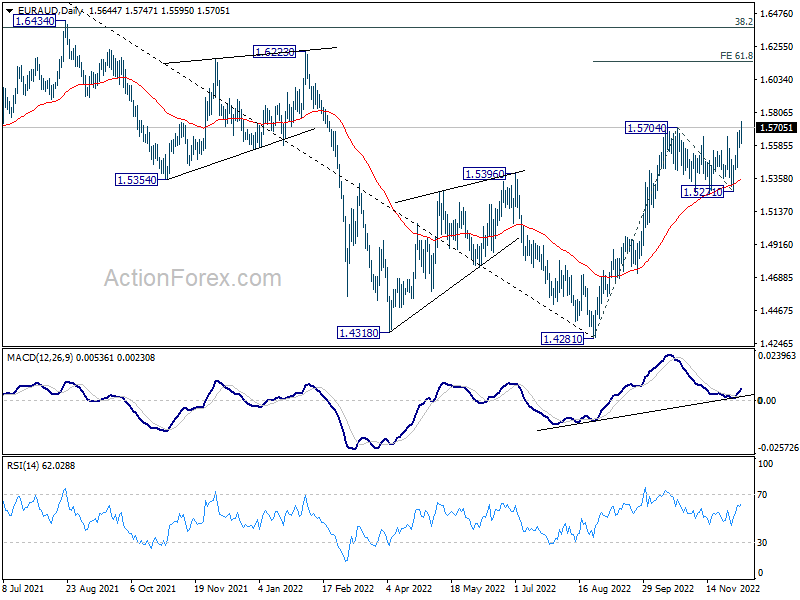
In the bigger picture, a medium term bottom should be in place at 1.4281, on bullish convergence condition in daily MACD. Further rise would be seen back to 1.6434 key resistance next. Break of 1.5271 support is needed to indicate reversal. Otherwise, further rally will remain in favor.
Euro Rises But Capped in Range Against Dollar
Euro and, to a lesser extent, Sterling, are picking up some buying today but both are stuck in range against the greenback. There is no clear unified theme in the markets. Canadian and Australian Dollar are weak, but New Zealand Dollar is strong. Swiss Franc is trailing other Europeans higher but Yen is heading down, with Dollar.
Technically, to confirm Euro's strength, EUR/USD will need to break through 1.0594 resistance to resume recent rally from 0.9534 at least. More ideally, EUR/CHF will also have to break through 0.9953 resistance to resume the rise from 0.9407. Otherwise, we'll stay skeptical about the underlying momentum.
In Europe, at the time of writing, FTSE is up 0.09%. DAX is down -0.32%. CAC is down-0.35%. Germany 10-year yield is down -0.0032 at 1.800. Earlier in Asia, Nikkei dropped -0.72%. Hong Kong HSI dropped -3.22%. China Shanghai SSE dropped -0.40%. Singapore Strait Times dropped -0.83%. Japan 10-year JGB yield rose 0.0022 to 0.255.
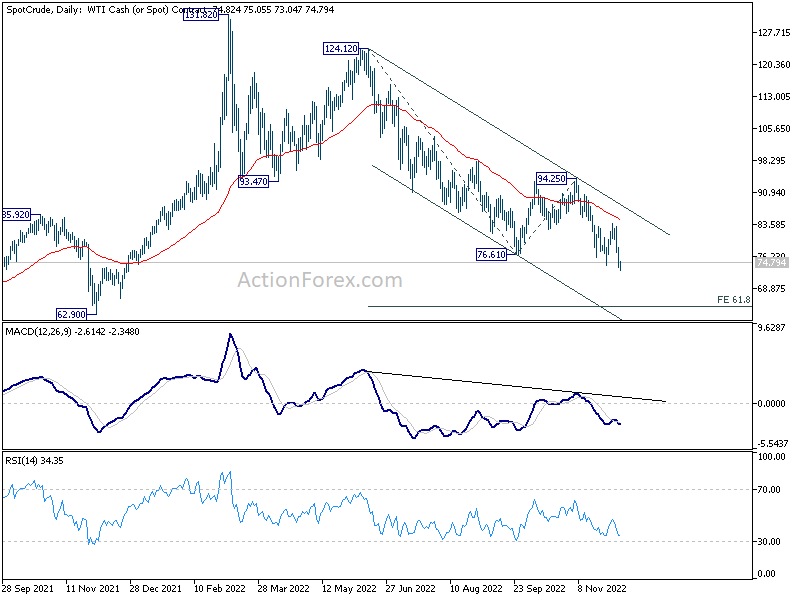
WTI oil hits new 2022 low as down trend resumes
WTI oil crude oil extends recent decline and hit the lowest level for the year. Today's move is part of the selloff in reaction to OPEC+ decision to stick with their existing pace of production cut, rather then raising it. Overall risk sentiment is not helping while China's easing of pandemic restrictions is largely ignore.
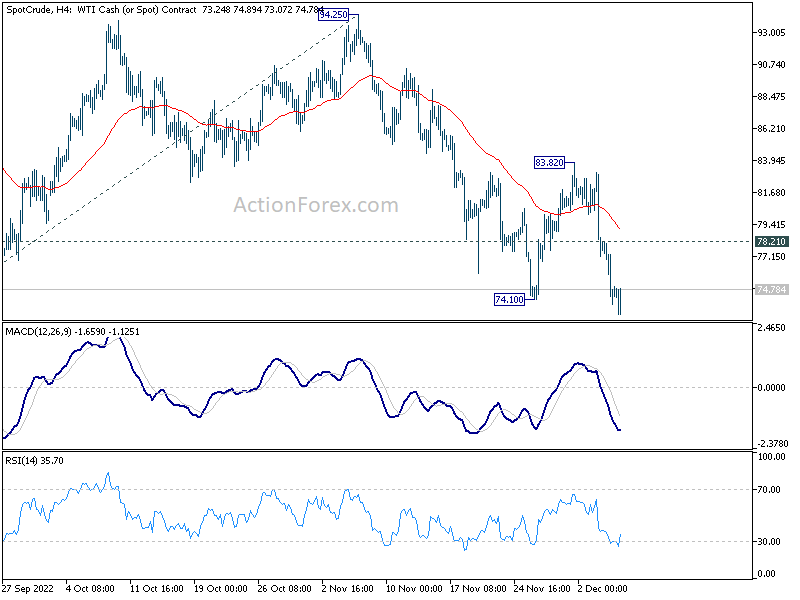
With 74.10 support broke, WTI is resuming whole down trend from 131.82. Further decline is now expected as long as 78.21 minor support holds. Next target is 61.8% projection of 124.12 to 76.61. from 94.25 at 64.88. Break of 78.21 will delay the bearish case, but risk will stays on the downside with 83.82 resistance intact.
BoJ Nakamura: Inflation not accompanied by wage increases yet
BoJ board member Toyoaki Nakamura said, "recent price rises aren't accompanied by wage increases yet". He added that Japan is far from the situation where wage inflation spiral becomes a concern. The central bank needs to continue with ultra-loose monetary policy for the time being.
"Tightening monetary policy at a time when demand continues to remain lower than supply would put huge pressure on corporate and household activity," he warned.
He expects inflation to slow next year as energy and food price rises fade.
Australia AiG services fell to 45.6, deepening contraction
Australia AiG Performance of Services dropped -2.1 pts to 45.6 in November, signaling contraction for a third month. Sales rose 1.5 to 42.8. Employment dropped -6.1 to 47.8. New orders dropped -4.8 to 49.7. Input prices dropped -3.6 to 74.0. Selling prices rose 2.2 to 64.4. Average wages rose 3.8 to 68.6.
Innes Willox, Chief Executive of the national employer association Ai Group, said: "The deteriorating economic outlook is clearly weighing on Australia's services sector. The Australian PSI indicated a deepening contraction in the services sector, with three months of declining results. Steep falls in indicators for employment and new orders in November reveal weakening demand for services, while ongoing labour shortages continue to constrain the supply side."
Australia GDP grew 0.6% qoq in Q3, terms of trade deteriorated
Australia GDP grew 0.6% qoq in Q3, below expectation of 0.7% qoq. Household spending rose 1.1%, contributing 0.6% to GDP. Compensation of employees increased 3.2%, the strongest rise since December quarter 2006. Net trade detracted -0.2% from GDP, with a 2.7% increase in exports offset by a 3.9% rise in imports. The terms of trade fell -6.6%, the largest fall since June quarter 2009, as import prices increased and export prices fell.
AUD/NZD extending decline, targets 1.0437
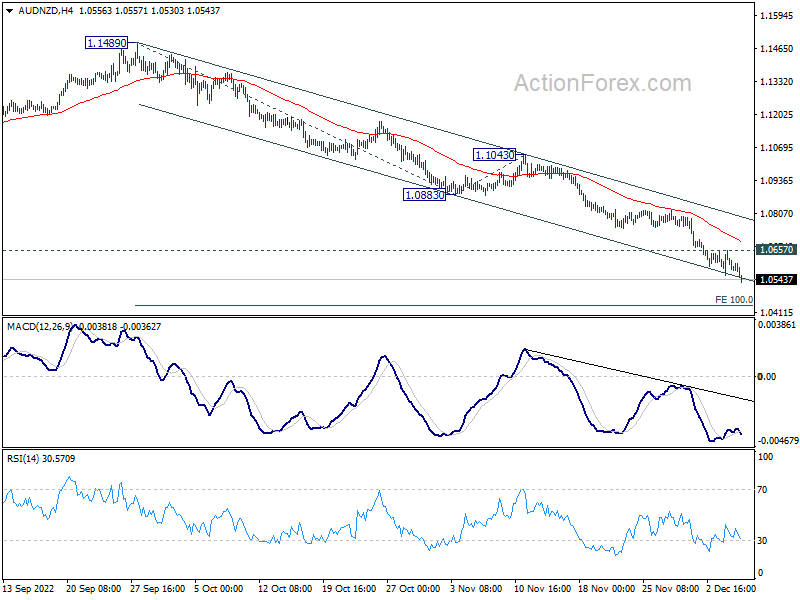
New Zealand Dollar is clearly overwhelming its Australia counter part recently. AUD/NZD's decline continues on expectation of diverging central bank policy paths, even though tightening is expected to in the early part of next year. While RBNZ's terminal rate might be 5.50%, 4.00% looks a bit stretch for RBA based on current outlook.
As for AUD/NZD, further decline is expected as long as 1.0657 minor resistance holds. Next near term target is 100% projection of 1.1489 to 1.0883 from 1.1043 at 1.0437. Such development could retrain Aussie's rebound elsewhere.
EUR/AUD Mid-Day Outlook
Daily Pivots: (S1) 1.5586; (P) 1.5638; (R1) 1.5701; More...
EUR/AUD's break of 1.5704 resistance indicates resumption of whole rise from 1.4281. Intraday bias is back on the upside. Next target is 61.8% projection of 1.4281 to 1.5704 from 1.5271 at 1.6150. For now, near term outlook will remain bullish as long as 1.5271 support holds, in case of retreat.
In the bigger picture, a medium term bottom should be in place at 1.4281, on bullish convergence condition in daily MACD. Further rise would be seen back to 1.6434 key resistance next. Break of 1.5271 support is needed to indicate reversal. Otherwise, further rally will remain in favor.
Economic Indicators Update
| GMT | Ccy | Events | Actual | Forecast | Previous | Revised |
|---|---|---|---|---|---|---|
| 21:30 | AUD | AiG Performance of Services Index Nov | 45.6 | 47.7 | ||
| 00:30 | AUD | GDP Q/Q Q3 | 0.60% | 0.70% | 0.90% | |
| 03:00 | CNY | Trade Balance (USD) Nov | 69.8B | 79.1B | 85.2B | |
| 03:00 | CNY | Exports (USD) Y/Y Nov | -8.70% | -3.50% | -0.30% | |
| 03:00 | CNY | Imports (USD) Y/Y Nov | -10.60% | -6.00% | -0.70% | |
| 03:00 | CNY | Trade Balance (CNY) Nov | 494B | 580B | 587B | |
| 03:00 | CNY | Exports (CNY) Y/Y Nov | 0.90% | 7% | ||
| 03:00 | CNY | Imports (CNY) Y/Y Nov | -1.10% | 4.10% | 6.80% | |
| 05:00 | JPY | Leading Economic Index Oct P | 99 | 96.6 | 97.5 | |
| 06:45 | CHF | Unemployment Rate Nov | 2.00% | 2.10% | 2.10% | |
| 07:00 | EUR | Germany Industrial Production M/M Oct | -0.10% | -0.60% | 0.60% | |
| 07:45 | EUR | France Trade Balance (EUR) Oct | -12.2B | -15.9B | -17.5B | -17.2B |
| 08:00 | CHF | Foreign Currency Reserves (CHF) Nov | 790B | 817B | ||
| 09:00 | EUR | Italy Retail Sales M/M Oct | -0.40% | 0.10% | 0.50% | |
| 10:00 | EUR | Eurozone GDP Q/Q Q3 F | 0.30% | 0.20% | 0.20% | |
| 10:00 | EUR | Eurozone Employment Change Q/Q Q3 F | 0.30% | 0.20% | 0.20% | |
| 13:30 | USD | Nonfarm Productivity Q3 | 0.80% | 0.30% | 0.30% | |
| 13:30 | USD | Unit Labor Costs Q3 | 2.40% | 3.50% | 3.50% | |
| 15:00 | CAD | BoC Interest Rate Decision | 4.25% | 3.75% | ||
| 15:30 | USD | Crude Oil Inventories | -3.5M | -12.6M |
AUD/NZD extending decline, targets 1.0437
New Zealand Dollar is clearly overwhelming its Australia counter part recently. AUD/NZD's decline continues on expectation of diverging central bank policy paths, even though tightening is expected to in the early part of next year. While RBNZ's terminal rate might be 5.50%, 4.00% looks a bit stretch for RBA based on current outlook.
As for AUD/NZD, further decline is expected as long as 1.0657 minor resistance holds. Next near term target is 100% projection of 1.1489 to 1.0883 from 1.1043 at 1.0437. Such development could retrain Aussie's rebound elsewhere.
WTI oil hits new 2022 low as down trend resumes
WTI oil crude oil extends recent decline and hit the lowest level for the year. Today's move is part of the selloff in reaction to OPEC+ decision to stick with their existing pace of production cut, rather then raising it. Overall risk sentiment is not helping while China's easing of pandemic restrictions is largely ignore.
With 74.10 support broke, WTI is resuming whole down trend from 131.82. Further decline is now expected as long as 78.21 minor support holds. Next target is 61.8% projection of 124.12 to 76.61. from 94.25 at 64.88. Break of 78.21 will delay the bearish case, but risk will stays on the downside with 83.82 resistance intact.