

Sample Category Title
ECB Herodotou: There will be another hike or hikes
ECB Governing Council member Constantinos Herodotou said, "We are very near the neutral rate. There will be I think another hike or hikes."
"There are a number of variables that may give some comfort and should there be an economic impact, it won't be.. a hard landing" he said, pointing to fiscal support and the robust jobs market.
EURJPY Takes a Swift Upturn, But Risks Remain
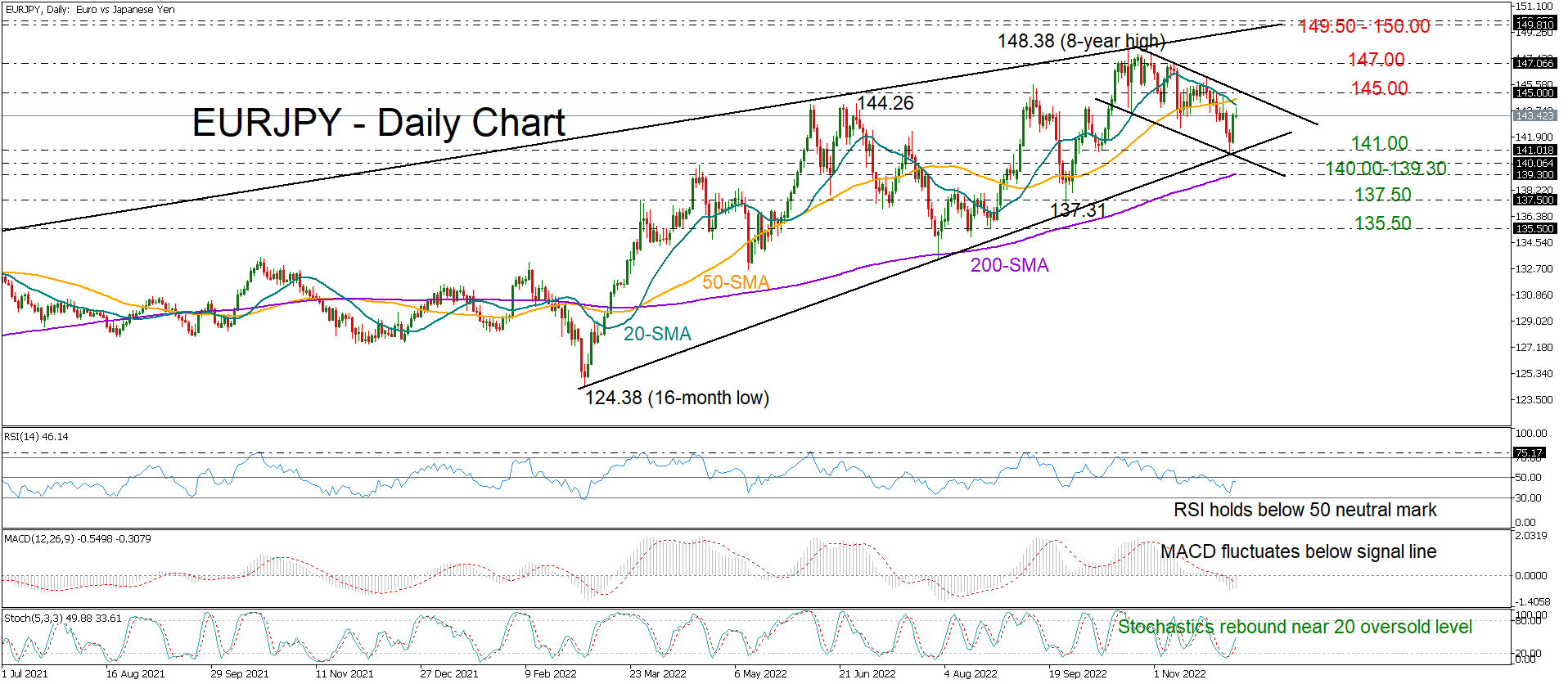
EURJPY drifted higher after stepping on the key support trendline that comes from the March lows at 140.75.
Despite the swift upturn in the price, the RSI could not exit the bearish territory, while the MACD was unable to climb above its red signal line, both mirroring some persisting skepticism in the market.
In the short-term picture, the pair has been trading within a downward-sloping channel since the peak at an eight-year high of 148.38. Hence, for buying interest to grow, the price will need to overcome its 20- and 50-day simple moving averages (SMAs) and exit the bearish tube above 145.00. If efforts prove successful, the door will open for the 147.00 resistance. Another move higher could trigger a rally towards the crucial long-term resistance line that joins all the highs from August 2020, currently seen within the 149.50-150.00 region.
Should selling tendencies resurface, the spotlight will fall again on the ascending trendline around 141.00. Failure to pivot here may confirm an extension towards the channel's lower boundary seen near 140.00 and the 200-day SMA, while a steeper decline could reach the 137.50 constraining zone. If the bearish wave worsens, the next rebound could take place around 135.50.
In brief, the latest quick bounce in EURJPY could not switch the bias to the positive side. For that to happen, the price will need to advance above 145.00.
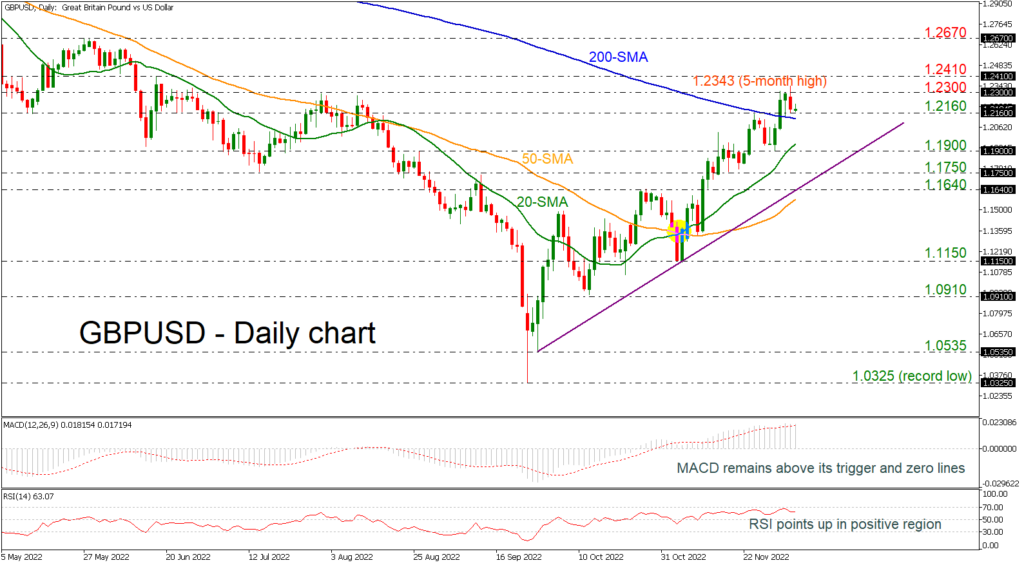
GBPUSD Declines from 5-Month High, But Outlook is Still Bullish
GBPUSD retreated from the fresh five-month high of 1.2343 that was posted on Monday, returning back near the previous support at 1.2160 around the 200-day simple moving average (SMA). In the short-term the bias turned bullish, and more increases may switch the broader outlook to positive as well.
From a technical perspective, the MACD oscillator is still gaining momentum above its trigger and zero lines, while the RSI is holding above the neutral threshold of 50 but it seems to lose some steam. The 20- and 40-day SMAs are sloping upwards confirming the recent move.
In case the pair changes its short-term direction to the downside, the bears will probably challenge the 200-day SMA at 1.2115. A break lower, could last until the 20-day SMA, which stands slightly above the 1.1900 mark. Further down, the area around the near-term uptrend line and the 1.1750 barrier could be another potential obstacle for downward movements. Any moves beneath the diagonal line may endorse the previous bearish tendency.
Alternatively, additional advances may drive the price towards the 1.2300 psychological level and yesterday’s peak at 1.2343. Above the latter, the 1.2410 resistance, taken from the high on June 16 could be another level in focus before resting near the 1.2670 obstacle.
Turning to the medium-term picture, the pair switched to positive mode after the rally above the 200-day SMA. Any moves beneath the SMAs and the uptrend line may open the door for the bears to take the upper hand again.
XAUUSD: Middle Leg Of The Correction Pattern Nears Completion Level!
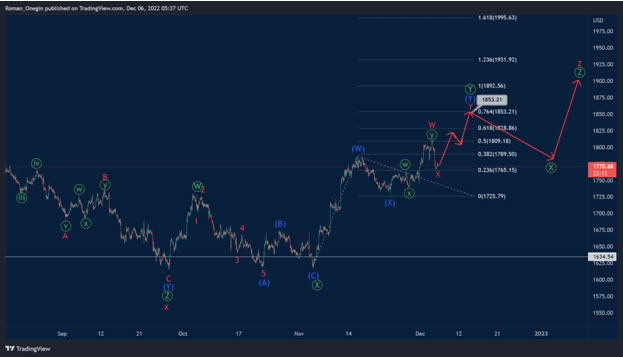
XAUUSD seems to be forming a large correction pattern taking the form of a cycle triple zigzag.
The 1-hour timeframe shows the final part of the completed cycle intervening wave x, which is a triple zigzag Ⓦ-Ⓧ-Ⓨ-Ⓧ-Ⓩ.
There is a possibility that the cycle wave z also takes the form of a primary triple zigzag Ⓦ-Ⓧ-Ⓨ-Ⓧ-Ⓩ, and now the price is in the second actionary wave Ⓨ.
It is assumed that the primary wave Ⓨ may end in the form of an intermediate double combination (W)-(X)-(Y) near 1853.21. At that level, wave Ⓨ will be at 76.4% of wave Ⓦ.
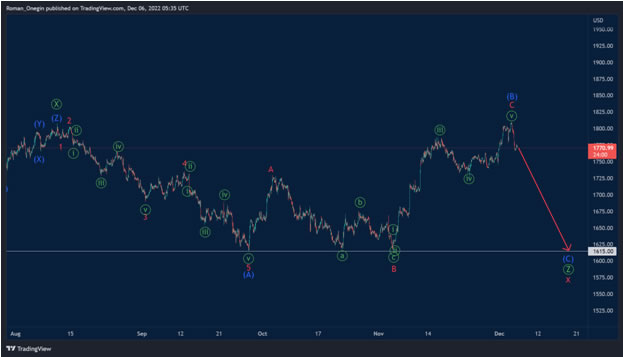
Let's consider an alternative option, where the downward movement of the pair in the cycle wave x will continue. The final primary wave is under development. It may take the form of an intermediate zigzag (A)-(B)-(C).
Thus, a downward movement of XAUUSD is expected in the near future.
The final of the correction pattern zigzag (A)-(B)-(C) is possible at 1615.00. That is, near the minimum marked by the intermediate impulse wave (A).
Sentiment Hit by Rekindled Fed Hike Bets
Asian shares were under attack on Tuesday, following the negative cues from Wall Street overnight as unexpectedly strong US data revived expectations of the Fed raising rates more than expected.
European futures are pointing to a mixed open this morning amid the shaky sentiment and lack of risk appetite. This overall market caution could trickle back down to US indices, empowering US equity bears ahead of a light week of data for financial markets. In the currency universe, the dollar pushed higher, dragging most G10 currencies lower while gold tumbled back below $1780. Oil bears seem to be in control as investors juggle the impact of the new EU sanctions, the OPEC+ meeting over the weekend, and the strong US economic data.
Overnight, the Reserve Bank of Australia (RBA) raised its key interest rate by 25 basis points as widely expected. Given how the central bank left the door open to further hikes down the road, this has offered some support to the Australian dollar. However, signs of easing inflationary pressures may raise hopes that prices have peaked. Back in October, inflation cooled to 6.9% compared to 7.3% year-on-year in September. With the central bank potentially adopting a less aggressive approach towards rates as the tightening cycle approaches an end, this could eventually hit the Australian dollar.
Dollar receives a lifeline?
Over the past few weeks, the dollar has been bruised and battered by expectations around the Federal Reserve adopting a less aggressive approach towards interest rate hikes. It has depreciated against every single G10 currency since the start of the fourth quarter as long dollar positioning eased and the DXY index shifted in favour of the bears. However, buying sentiment towards the world’s reserve currency received a slight boost yesterday after the ISM services PMI data surprised to the upside, further fuelling bets that the Fed could keep its foot on the rate rise pedal. While the central bank is widely expected to hike interest rates by 50bps next week, continued strength in the labour markets and signs of inflation regaining momentum could lead to a higher peak or “terminal” rate than anticipated.
Looking at the technicals, the DXY is trading below the 200-day SMA and 105.50 resistance level. A breakout above this point could encourage more upside towards 107.00 and 107.85, respectively.
Currency spotlight – USD/CAD
USDCAD is edging higher ahead of the Bank of Canada’s final rate decision for 2022 on Wednesday, which analysts expect to conclude with a 25bp rate hike. However, money markets price in a 68% chance of a 50bp move after better-than-expected Q3 GDP and the tight labour market.
Looking at the technical picture, the USDCAD remains fairly neutral on the daily charts with support found at 1.3390 and resistance at 1.3620. A breakout could be on the horizon with the BoC meeting acting as the directional catalyst.
Commodity spotlight – Gold
Gold crumbled yesterday, cutting through key levels like a hot knife through butter thanks to a stronger dollar, renewed Fed hike bets, and the easing of China’s Covid zero policies.
The precious metal fell roughly 1.6% and has found itself back within the November range. Support can be found at $1735 and resistance at $1785. Given how bears seem to be in a position of power, prices could test the lower part of the range soon. Below this level, a decline toward $1700 could be on the cards.
GER 40 Tests Major Resistance
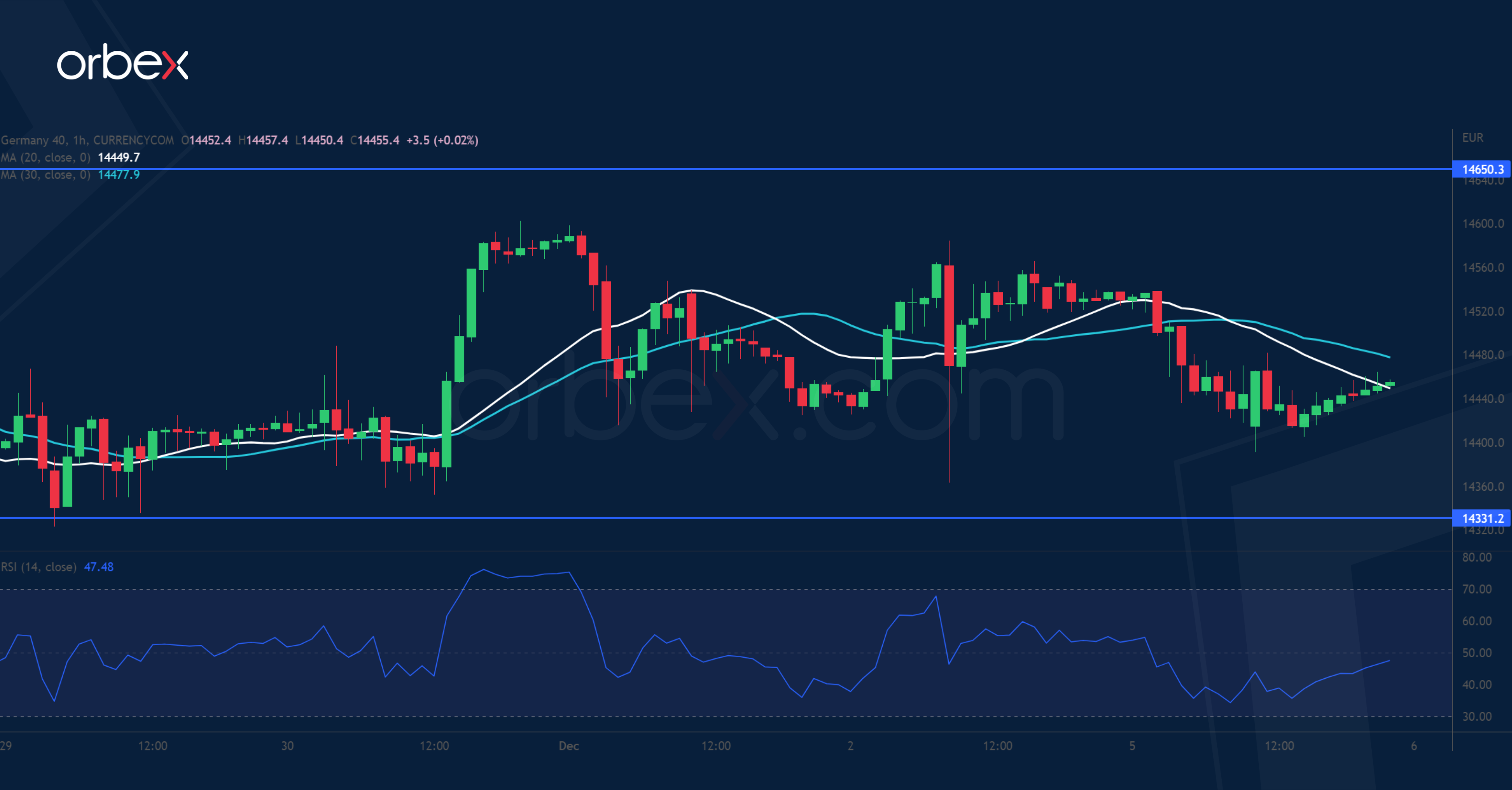
Equities hesitate as robust US economic activity fans fears of more rate hikes. The Dax 40 is testing last June’s peak of 14650, a liquidation point from a botched rebound last summer. This is a major ceiling which means that index is at a crossroads between a bullish recovery and a bearish reversal. A breakout could pave the way for a rally towards 15500, reinforcing hopes of a continuation of the uptrend. An overbought RSI on the daily chart shows exhaustion and 14330 on the 20-day moving average is the first support.
XAU/USD Struggles for Support
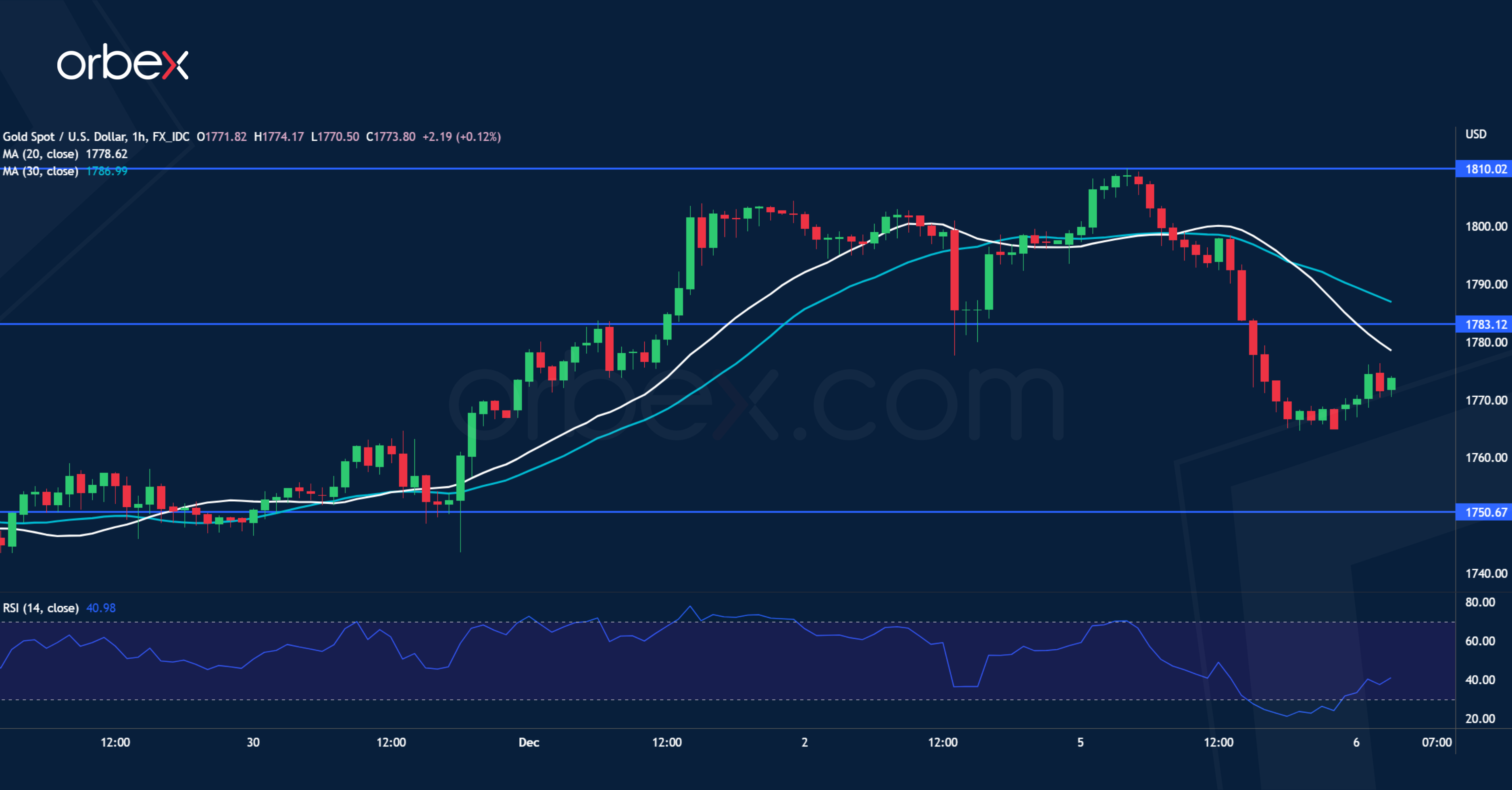
Gold fell back after strong US economic data boosted the dollar. A tentative close above last summer’s peak of 1803 is a sign of improved sentiment. This has put the bears on the defensive and eased the downward pressure in the medium-term. However, the price needs to consolidate its range after a break above the previous high of 1783. The rally would remain intact as long as bullion stays above the floor at 1750. A bounce would need to lift offers at 14650 then 1810 before the precious metal could regain traction.
GBP/USD Pulls Back
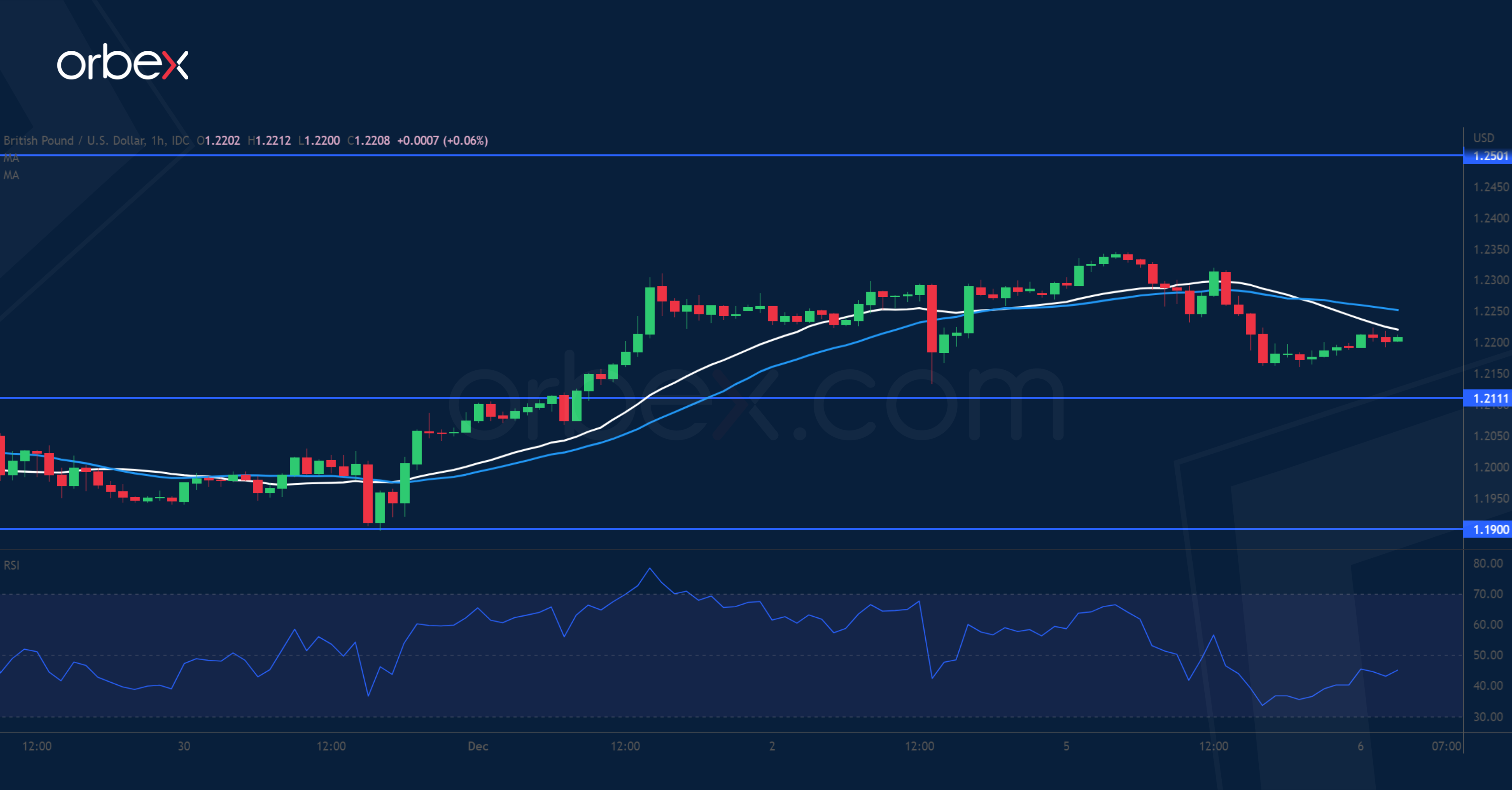
The US dollar held its ground after service PMI remained resilient. The pair is striving to hold onto its gains after breaking above August’s high of 1.2300. As more bears cover their positions, they may switch sides and help push towards 1.2600. The RSI’s overbought condition on the hourly chart has temporarily limited the upside and intraday buyers’ profit-taking could offer Sterling some breathing room. 1.2110 over the top of the previous range is the first support and 1.1900 on the 20-day moving average is a critical level.
ECB Lane reasonably confidence EZ close to peak inflation
ECB Chief Economist Philip Lane said in an interview, "I would be reasonably confident in saying that it is likely we are close to peak inflation". But it's still uncertain whether inflation has peaked or it will arrive at the start of 2023. He didn't rule out some extra inflation early next year. But, "once we are past the initial months of 2023, later on in 2023 – in the spring or summer – we should see a sizeable drop in the inflation rate." Still, the journey back to 2% will "take time".
"We need to recognise that the interest rate decisions we have already made will help to reduce the inflation rate next year and the year after that," he said. "We do expect that more rate increases will be necessary, but a lot has been done already, so we will have to ensure we have a good understanding of the inflation outlook, and the risk factors when setting the interest rate on a meeting-by-meeting basis."
Lane also said, "QT should essentially be a background programme". That is, policymakers will ensure QT makes its contribution to policy normalization in "a way that reinforces the primary instrument, which is setting rates".
Dollar Caught a Break Thanks to Yield Support and Risk-off Setting
Markets
“All” it took for US investors to digest Friday’s strong payrolls was a weekend of time, another eye-opening WSJ article and a strong US non-manufacturing ISM. Recall that the initial post-payrolls move (higher yields, stronger dollar, weaker stocks) was surprisingly undone by last week’s US closing bell. The trading week yesterday still started with some positive Asian vibes related to looser Chinese Covid-moves, but morphed to a very neutral setting in Europe and eventually a risk-off climate in the US. The WSJ emphasized that the biggest Fed policy mistake would be letting its guard down when it comes to inflation, with next week’s “dot plot” likely to show a policy rate peak of 5.25% compared with 4.75% in September and 5% discounted by money markets. Shifting from 75 bps rate hikes to 50 bps increments means that policy rates will stay at their peak for longer, unlike the 50 bps of rate cuts priced in by the end of 2023. The November US services ISM unexpectedly bounced from 54.4 to 56.5 (vs 53.5 expected). The Holiday Season clearly left its mark. Details showed a significant rise in business activity, from 55.7 to 64.7. New orders grew at a similar pace (56 from 56.5), but export orders contracted much faster (38.4 from 47.7). Employment switched sides again from the neutral 50, rising from 49.1 to 51.5 with price pressure still alleviated (70 from 70.7). Fed Chair Powell last week noted that core services may be the most important category for understanding the future evolution of core inflation. Supplier deliveries slowed further with the ISM noting increased capacity and shorter lead times which resulted in a continued improvement in supply chain and logistics performance.
US Treasuries finally made their U-turn, significantly underperforming German Bunds. US yields rose by 3.7 bps (30-yr) to 14.1 bps (3-yr) with the curve turning more inverse. Technically, the US 10-yr yield bounced off 3.5% support (previous cycle high back in June). Changes on the German curve varied between -1 bp (30-yr) and +2 bps (5-yr). The German 10-yr yield bounced off the October low at 1.77%. US stock markets started on the backfoot and continued losing ground throughout the session to eventually lose 1.5% (Dow) to 2% (Nasdaq). The dollar caught a break thanks to the yield support and the risk-off setting, with EUR/USD closing at 1.0491 from an 1.0532 open and after almost touching 1.06 early in the session. The trade-weighted greenback recovered from an intraday low just north of 104 to currently 105.45. USD/JPY rose from 134 to 137 with rising (real) rates beating risk sentiment. EUR/GBP moved away from 0.8569/67 support in a technical move, to currently meet the 0.86 big figure. Today’s eco calendar only contains US trade data. Chinese stocks take the upper hand again this morning on the back of further loosening of Covid-restrictions, but weren’t the best guideline for Europe/US of late. A slightly more hawkish Australian central bank (see below) could be more sign of the times.
News Headlines
The Reserve bank of Australia raised its policy rate by 25 bps to 3.1%, as expected, bringing the cumulative amount of tightening to 3.0% since the start of the cycle in May. The central bank expects to increase interest rates further over the period ahead, but said it is not on a pre-set course. Inflation at 6.9% in October is still too high and is forecast to peak around 8% over the December quarter, but is expected to decline next year. The economy continues to grow solidly, but growth is expected to slow to about 1.5% in 2023 and 2024. At 3.4% the unemployment rate is at the lowest since 1974. However, with quite some tightening already done, the RBA indicates that monetary policy operates with a lag and that the effect of interest rate increases is yet to be felt. The path to achieving the needed decline in inflation and achieving a soft landing for the economy remains a narrow one. The 2-y Australian government bond yield rose 9 bps (to 3.07%). The Aussie dollar this morning gains modestly (AUD/USD 0.6735), but is unable to reverse yesterday’s USD driven decline.
Bloomberg cites sources that the EU and the US are weighing a new approach to implement their climate agenda by raising new tariffs on Chinese steel and aluminum as part of a plan to reduce carbon emission and overcapacity in the sector. However, according the report an agreement is unlikely before late next year.