Sample Category Title
GBP/USD Mid-Day Outlook
Daily Pivots: (S1) 1.2187; (P) 1.2243; (R1) 1.2352; More...
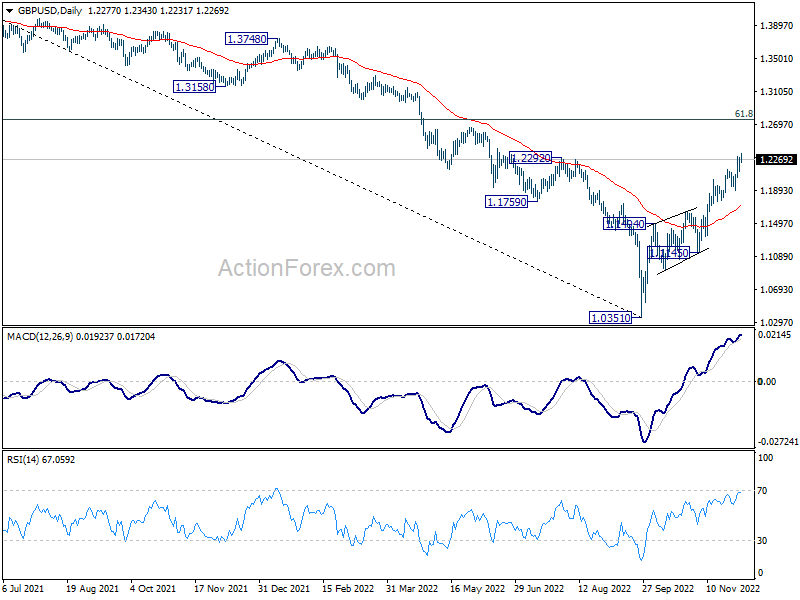
GBP/USD is losing some upside momentum as seen in 4 hour MACD. But further rally is expected as long as 1.1898 support holds. Rise from 1.0351 should target 1.2759 medium term fibonacci level next. However, firm break of 1.1898 support will confirm short term topping and turn bias back to the downside.
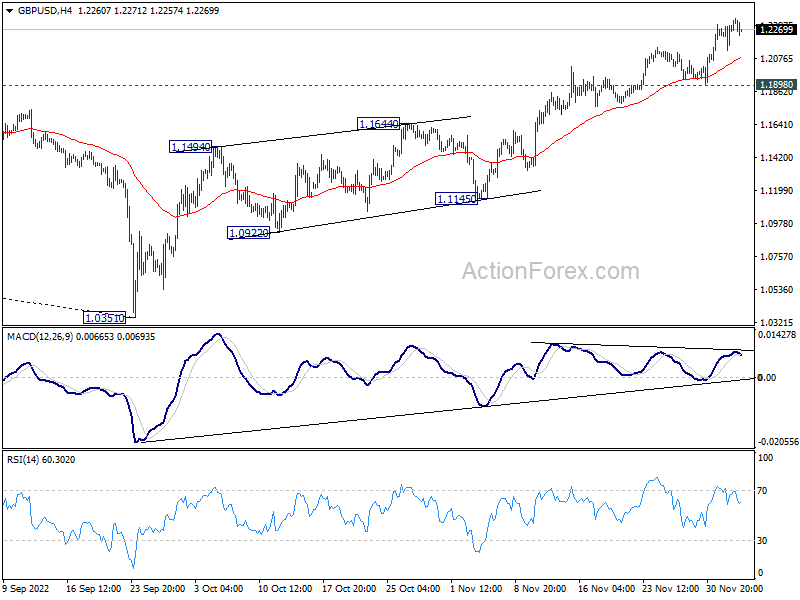
In the bigger picture, rise from 1.0351 medium term bottom is at least correcting whole down trend from 1.4248 (2021 high). Further rise is expected as long as 1.1644 resistance turned support holds. Next target is 61.8% retracement of 1.4248 to 1.0351 at 1.2759. Sustained break there will pave the way back to 1.4248.
EUR/USD Mid-Day Outlook
Daily Pivots: (S1) 1.0466; (P) 1.0505; (R1) 1.0583; More...
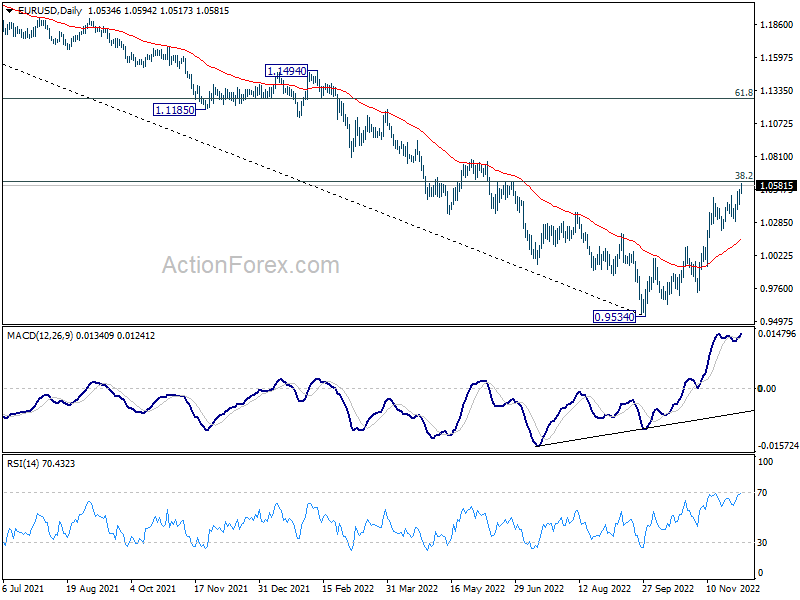
Intraday bias in EUR/USD stays on the upside for the moment with focus on 1.0609 fibonacci level. Sustained break there will carry larger bullish implication and target next level at 1.1273. However, break of 1.0427 minor support will indicate rejection by 1.1273, and turn bias back to the downside for 1.0222 support and possibly below.
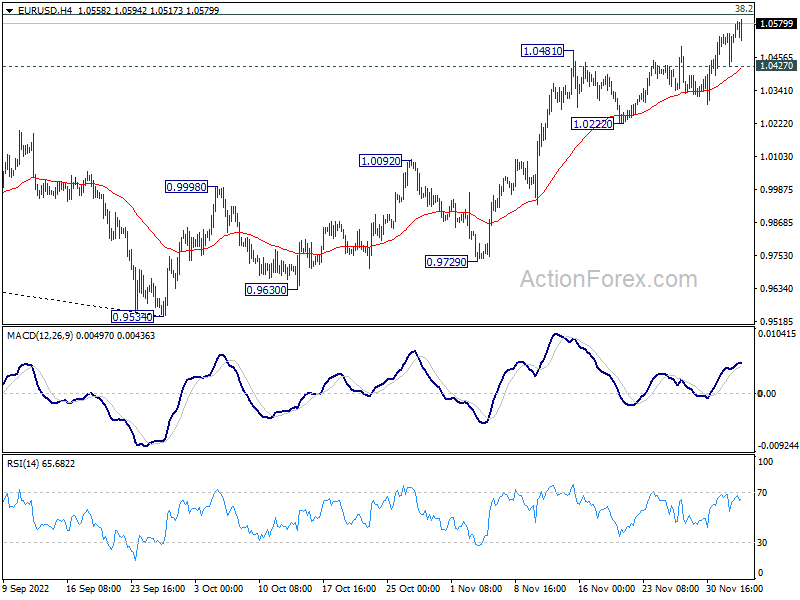
In the bigger picture, a medium term bottom was in place at 0.9534, on bullish convergence condition in daily MACD. Even as a corrective rise, rally from 0.9534 should target 38.2% retracement of 1.2348 (2021 high) to 0.9534 at 1.0609. Sustained trading above 55 week EMA (now at 1.0566) will raise the chance of trend reversal and target 61.8% retracement at 1.1273. However, rejection by 1.0609 will retain medium term bearishness for down trend resumption at a later stage.
Euro Rises as Investor Sentiment Improves, Dollar and Yen Down
Euro rises broadly today as supported by improvement in investor sentiment, but Sterling and Swiss Franc are lagging behind. Canadian Dollar also follows oil price high, as China appears to be moving further towards reopening. Australian Dollar is also firm. But Yen and Dollar are on the weaker side on positive market sentiment.
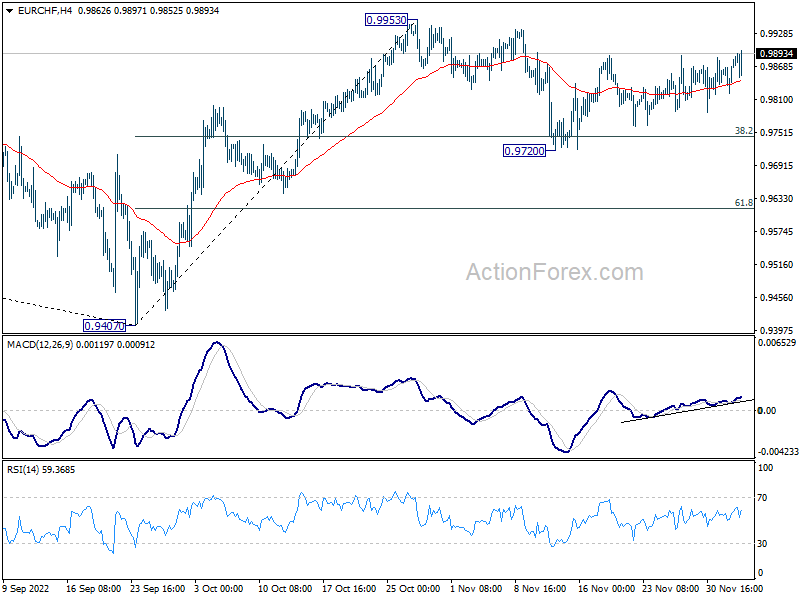
Technically, while Euro does strengthen, the momentum is not too convincing yet. For now, EUR/CHF's rise from 0.9720 still looks more like a corrective move, as the second leg of the pattern from 0.9953. The cross will need to take out 0.9953 resistance decisively to confirm the underlying bullishness in Euro.
In Europe, at the time of writing, FTSE is up 0.30%. DAX is down -0.51%. CAC is down -0.57%. Germany 10-year yield is down -0.001 at 1.853. Earlier in Asia, Nikkei rose 0.15%. Hong Kong HSI rose 4.51%. China Shanghai SSE rose 1.76%. Singapore Strait Times rose 0.26%. Japan 10-year JGB yield rose 0.0064 to 0.258.
ECB Makhlouf: Premature to be talking about end-point for policy rates
ECB Governing Council member Gabriel Makhlouf said, "To continue on our path to bring inflation back to our 2% target, I see a 50 basis-point increase in interest rates as the minimum needed at our December meeting."
"We have to be open to policy rates moving into restrictive territory for a period," the Irish central-bank chief said. "It is premature to be talking about the end-point for policy rates amid the prevailing levels of uncertainty."
"The justification for the expansion of the balance sheet – too low inflation and the risk of deflation – has ended, and it is time to look at reducing its size," he said.
Eurozone Sentix investor confidence rose to -21, recession ends before it's begun
Eurozone Sentix Investor Confidence rose from -30.9 to -21.0 in December, highest since June. Current Situation Index rose from -29.5 to -20.0. Expectations Index rose from -32.3 to -22.0, highest since March.
Sentix said: "The latest sentix economic data improve again and surprisingly significantly. Investors are spreading hope that thanks to mild winter weather, sufficient gas in storage and a possible peak in inflation data, the economic downturn has also passed its zenith.
"Internationally, there are also more moderate tones from the US Federal Reserve, which is holding out the prospect of "only" 50 basis points of interest rate increases in December. And in China, the protests finally seem to point to an end to the restrictive Corona measures.
"So will the recession end before it has really begun?"
Eurozone PMI composite finalized at 47.8, downturn remains only modest
Eurozone PMI Services was finalized at 48.5 in November, down from October's 48.6. That's also a 21-month low. PMI Composite was finalized at 47.8, up from prior month's 47.3. Looking at some member countries, Ireland PMI Composite France dropped to 48.8 and 48.7 respectively, both 21-month low. Germany (46.3), Italy (48.9), and Spain (49.6) were at 3-month high.
Chris Williamson, Chief Business Economist at S&P Global Market Intelligence said: "A fifth consecutive monthly falling output signalled by the PMI adds to the likelihood that the eurozone is sliding into recession. However, at present the downturn remains only modest, with an easing in the overall rate of contraction in November means so far the region looks set to see GDP contract by a mere 0.2%."
Eurozone retail sales dropped -1.8% mom in Oct, EU down -1.7% mom
Eurozone retail sales volume dropped -1.8% mom in October, worse than expectation of -1.6% mom. The volume of retail trade decreased by -2.1% for non-food products and by -1.5% for food, drinks and tobacco, while it grew by 0.3% for automotive fuels.
EU retail sales volume dropped -1.7% mom. Among Member States for which data are available, the largest monthly decreases in the total retail trade volume were registered in Austria (-4.6%), Croatia (-4.0%) and Belgium (-3.3%). Increases were observed in Luxembourg (+2.6%), Cyprus, Malta and Portugal (all +0.5%) and Spain (+0.4%).
UK PMI services finalized at 48.8, economic contraction rate held steady
UK PMI services was finalized at 48.8 in November, unchanged from October's reading, lowest since January 2021, and second second consecutive month of contraction. PMI Composite was finalized at 48.2, unchanged from prior month, and the fourth successive month of contraction.
Chris Williamson, Chief Business Economist at S&P Global Market Intelligence: "A further economic contraction signalled by the PMI surveys hints at a growing recession risk for the UK. A change of government and its new economic policies may have helped arrested some of the financial market volatility after September's 'mini-budget' but the economic picture remains stubbornly unchanged. "
The overall rate of economic contraction has held steady compared to October, indicative of GDP falling at a quarterly rate of 0.4%. As such, this is the toughest spell the UK economy has faced since the global financial crisis excluding only the height of the pandemic.
China Caixin PMI services dropped to 46.7, third month of contraction
China Caixin PMI Services dropped from 48.4 to 46.7 in November, below expectation of 48.8. PMI Composite dropped from 48.3 to 47.0, signalling a third successive monthly contraction in business activity. The rate of decline was the strongest since May.
Wang Zhe, Senior Economist at Caixin Insight Group said: "Manufacturing and services activity contracted in varying degrees, with the services sector hit harder by Covid outbreaks.... The prolonged pandemic has battered the economy. While the third wave has led to a softened slowdown on both supply and demand than the previous ones, there has been significant pain in the job market."
EUR/USD Mid-Day Outlook
Daily Pivots: (S1) 1.0466; (P) 1.0505; (R1) 1.0583; More...
Intraday bias in EUR/USD stays on the upside for the moment with focus on 1.0609 fibonacci level. Sustained break there will carry larger bullish implication and target next level at 1.1273. However, break of 1.0427 minor support will indicate rejection by 1.1273, and turn bias back to the downside for 1.0222 support and possibly below.
In the bigger picture, a medium term bottom was in place at 0.9534, on bullish convergence condition in daily MACD. Even as a corrective rise, rally from 0.9534 should target 38.2% retracement of 1.2348 (2021 high) to 0.9534 at 1.0609. Sustained trading above 55 week EMA (now at 1.0566) will raise the chance of trend reversal and target 61.8% retracement at 1.1273. However, rejection by 1.0609 will retain medium term bearishness for down trend resumption at a later stage.
Economic Indicators Update
| GMT | Ccy | Events | Actual | Forecast | Previous | Revised |
|---|---|---|---|---|---|---|
| 21:30 | AUD | AiG Performance of Construction Index Nov | 48.2 | 43.3 | ||
| 00:00 | AUD | TD Securities Inflation M/M Nov | 1.00% | 0.40% | ||
| 00:30 | AUD | Company Gross Operating Profits Q/Q Q3 | -12.40% | -1.50% | 7.60% | 7.80% |
| 01:45 | CNY | Caixin Services PMI Nov | 46.7 | 48.8 | 48.4 | |
| 08:45 | EUR | Italy Services PMI Nov | 49.5 | 47.6 | 46.4 | |
| 08:50 | EUR | France Services PMI Nov F | 49.3 | 49.4 | 49.4 | |
| 08:55 | EUR | Germany Services PMI Nov F | 46.1 | 46.4 | 46.4 | |
| 09:00 | EUR | Eurozone Services PMI Nov F | 48.5 | 48.6 | 48.6 | |
| 09:30 | EUR | Eurozone Sentix Investor Confidence Dec | -21 | -27.1 | -30.9 | |
| 09:30 | GBP | Services PMI Nov F | 48.8 | 48.8 | 48.8 | |
| 10:00 | EUR | Eurozone Retail Sales M/M Oct | -1.80% | -1.60% | 0.40% | 0.80% |
| 13:30 | CAD | Building Permits M/M Oct | -1.40% | -2.00% | -17.50% | |
| 14:45 | USD | Services PMI Nov F | 46.1 | 46.1 | ||
| 15:00 | USD | ISM Services PMI Nov | 53.5 | 54.4 | ||
| 15:00 | USD | Factory Orders M/M Oct | 0.00% | 0.30% |
Gold Faces August’s Resistance; Still Supported
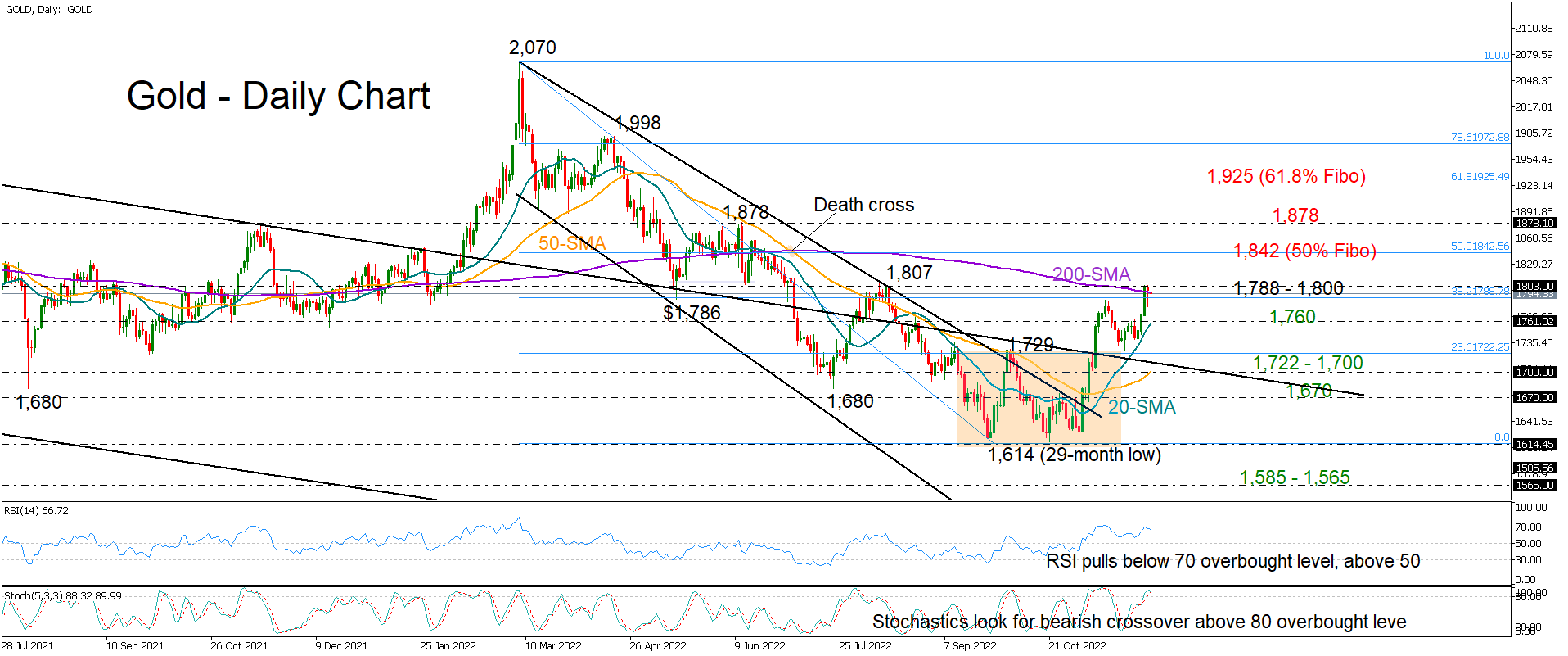
Gold sustained a muted tone during Monday’s early European trading hours, consolidating its latest spike around the August resistance territory and the 1,800 level despite inching to a new high of 1,809.
Overbought signals become more evident as the RSI weakens below 70, while the stochastics look for a bearish crossover above 80. Yet, sellers may not take action, unless the 38.2% Fibonacci retracement of the 2,070–1,614 downleg at 1,788, which was a key barrier to downside movements during previous months, proves fragile. Should the price drop below that base, the 20-day simple moving average (SMA) may immediately add a strong footing around 1,760. Failure to pivot here could clear the way towards the key 1,722–1,700 zone, marked by the 23.6% Fibonacci and the 50-day SMA. Note that the key descending constraining line drawn from the 2,079 record high is positioned in the same area.
In the event of the bulls extending the recovery above the 200-day SMA, the 50% Fibonacci of 1,842 could be the next destination. Breaching that wall, the rally may speed up towards June’s resistance of 1,878, while higher, the focus will turn to the 61.8% Fibonacci of 1,925.
All in all, gold traders are currently displaying some hesitancy as the price is struggling to overcome the August bar of 1,800. A successful move above that barricade could bolster buying appetite.
A Nervy Start to the Week
What could have been a really positive week for equity markets is off to a much more nervy start, with stocks in Europe treading water and US futures slightly lower.
The inflation report on Friday was red hot once more, extinguishing any hope that investors could hop aboard the Fed pivot train and ride stock markets higher into year-end. Perhaps it's not quite so dramatic but it was a real setback, something we should be used to by now.
The wages component was the killer blow. That was not just a beat, it obliterated expectations and came in double the forecasted number. It may be a blip, but it's a huge one and it will almost certainly take more than one much cooler report in January to comfort those that still fear inflation becoming entrenched.
That's ultimately where we're now up to in the inflation story. Many accept that base effects and lower energy prices will drive the headline inflation figure much lower next year, among other things, while a slower economy - maybe recession - will eventually hit demand and contribute to the decline. But what the Fed fears now is fighting entrenched inflation and these wage numbers won't make for comfortable reading.
An economic victory for China amid gloomy PMIs
Chinese stocks were the clear outperformer overnight as authorities continued to work towards a softening of the country's zero-Covid stance with the end goal seemingly being the end of it altogether. It's thought that it will be downgraded to category B management as early as next month with officials claiming it's less threatening than previous strains, a huge move away from the rhetoric and approach of the last few years.
This came as the Caixin services PMI slipped to 46.7, much lower than anticipated. That said, I'm not sure anyone will be shocked given the record Covid surge, but the more targeted - albeit seemingly confused - approach being taken has ensured less disruption, as evidenced by how much better the PMI has performed compared with earlier this year.
And it's not just China that's seeing surveys underperforming and, in many cases, putting in sub-50 readings. Europe is either already in recession or heading for it and the surveys highlight just how pessimistic firms are despite the winter getting off to a warmer start.
Japan is among the few recording a growth reading, although having slipped from 53.2 in October to 50.3 last month, you have to wonder for how long. Input prices are punishing firms, with some now raising prices in order to pass those higher costs on. That won't help activity or convince the BoJ to declare victory, as higher energy and food costs are also hitting domestic demand. The one major outlier is India where the services PMI accelerated higher to 56.4 buoyed by domestic and external demand. An impressive feat in this global environment.
Oil higher as China looks to ease Covid restrictions
Oil prices are higher on Monday, rallying 2%, after the G7 imposed a $60 price cap on Russian oil and OPEC+ announced no new output cuts. Both bring a degree of uncertainty, with the details of the cap and the impact on Russian sales still unclear.
From the OPEC+ perspective, it can't be easy to make reliable forecasts against that backdrop and the constantly evolving Covid situation in China, which currently looks far more promising from a demand perspective. The decision to leave output unchanged was probably the right one for now and there's nothing to stop the group from coming together again before the next scheduled meeting should the situation warrant it.
A major setback
It goes without saying that the jobs report on Friday was a big setback for gold as it leaves huge uncertainty around where the terminal rate will land. Of course, we should be used to bumps in the road by now, having experienced many already this year. There's no reason why the path back to 2% should be any smoother.
But the yellow metal did recover those jobs report losses and even hit a new four-month high today. Perhaps the big difference now is momentum. It's run into strong resistance around those August highs around $1,810 and simply doesn't have the momentum it would have had the report been cooler. We're now more than four weeks into the recovery rally in gold and a corrective move of some kind may be on the cards.
Silence is bliss
Bitcoin continues to enjoy a mild relief rally and has even moved above $17,000 to trade at its highest level in almost a month. It's probably too early to celebrate yet though as these are very cautious gains that could be quickly and easily wiped out by more negative headlines related to FTX. Silence is currently bliss for the crypto community.
EUR/USD: Bulls Face Headwinds at Key Fibo Barrier
The Euro is trading near five-month high on Monday and cracked pivotal Fibo barrier at 1.0578 (38.2% of 1.2266/0.6535 downtrend), but quick pullback indicates that bulls face headwinds.
Last Friday’s Hanging Man candle was initial warning that bulls may run out of steam, with overbought daily studies and weakening bullish momentum, adding to the notion.
Failure to register a daily close above 1.0578 barrier, would contribute to negative signals, though more evidence would be needed to verify.
Rising 10DMA offers solid support at 1.0420 and break here would generate initial signal of correction and expose more significant supports at 1.0363 (200DMA) and 1.0290 (Nov 30 trough), violation of which would weaken near-term structure, as falling thick weekly cloud also weighs.
Near-term bias is expected to remain with bulls while the action holds above 10DMA and point to consolidation before bulls resume, however, only sustained break of 1.0578 Fibo barrier would signal that bulls are on track to extend larger rally.
Res: 1.0578; 1.0608; 1.0700; 1.0786.
Sup: 1.0519; 1.0420; 1.0363; 1.0290.
Australian Dollar Calm ahead of RBA
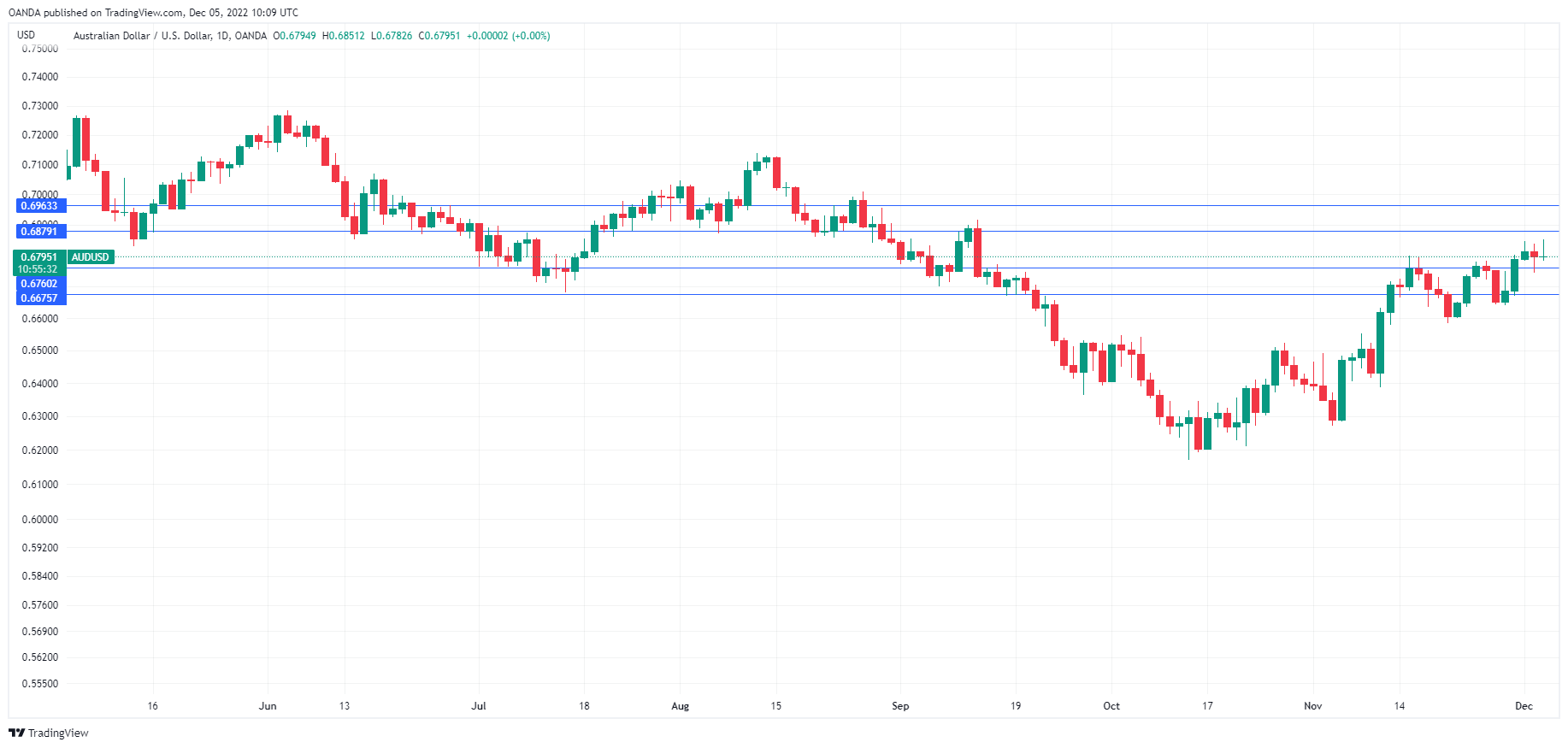
The Australian dollar has posted slight gains at the start of the trading week. AUD/USD is trading at 0.6801, up 0.10%.
RBA likely to deliver 25-bp hike
The Reserve Bank of Australia meets on Tuesday and is expected to hike by 25 bp for a third straight time. This would bring the cash rate to 3.10%. There is a chance that the RBA could take a pause and not raise rates, although the case for a modest 25 bp seems stronger. Inflation remains the RBA’s number one priority, and the Bank’s steep rate-tightening cycle is showing results, with CPI falling to 6.9% in October, down from 7.4% a month earlier. Still, it is premature to say that inflation has definitely peaked, and consumer inflation expectations measures have been mixed.
The RBA’s rate policy has been a bumpy road, which led to Governor Lowe to issue an apology about rate policy last week. Lowe said that it was regrettable that people listened to the RBA saying it wouldn’t raise rates before 2024 but then delivered seven oversized rate hikes in 2022. Many Australians took out mortgages based on the RBA assurance but are now getting squeezed by huge mortgage payments.
The week ended with the US employment report, which was stronger than expected. The economy created 263,000 jobs in November, slightly lower than the October reading of 284,000 and stronger than the consensus of 200,000. Wage growth also outperformed, as the reading of 5.1% y/y was up from 4.9% and beat the forecast of 4.6%. The labor market continues to show a surprising resiliency and the increase in wage growth will drive inflationary pressure. The solid employment numbers haven’t changed the likelihood of a 50-bp hike in December (80% according to CME FedWatch), but should serve as a reminder to the markets that the Fed’s tightening cycle could continue into 2023.
AUD/USD Technical
- AUD/USD faces resistance at 0.6878 and 0.6962
- There is support at 0.6760 and 0.6676
EUR Decided to Sky-Rocket
On Monday, the market major has reached 1.0580. It must be realized, that this is not because the euro is strong but because the dollar is weak. Investors are undermining the USD, treading on statistics and upcoming decisions of the US Federal Reserve System.
The labour market in the US remains vigorous. In November, the unemployment rate remained at 3.7%, and the NFP grew by 263 thousand instead of 200 thousand forecast. Average hourly wage increased by 5.1% y/y upon growing by 4.6% in October.
All this makes the employment picture quite stable and gives us an idea that the US business withstands the growing expenses on crediting quite efficiently. The wage fund has expanded, which hinders the market idea about the interest rate growing by 50 base points in December.
With all this background, the USD is really unstable, which is obvious in the quotes.
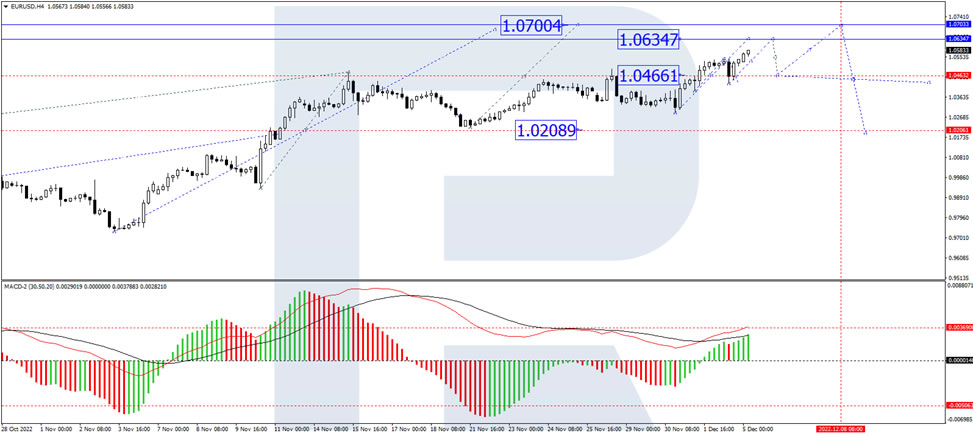
On H4, the currency pair has formed a consolidation range around 1.0466. Today the market is trying to break it upwards. The structure of growth is expected to extend to 1.0634, and after it is reached, a link of correction to 1.0464 is not excluded, followed by growth to 1.0703. Technically, this scenario is confirmed by the MACD: its line is directed strictly upwards, which suggests further growth.
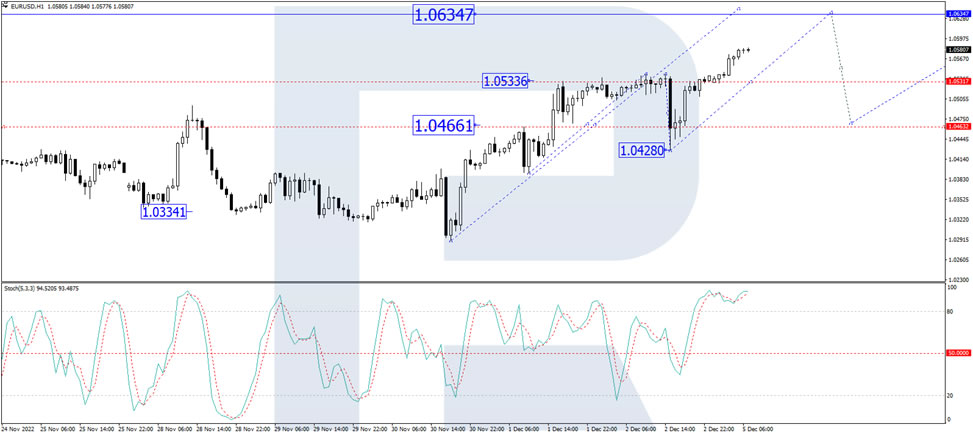
On H1, the pair has completed an impulse of growth to 1.0531. Today the market has formed a consolidation range around it, and with an escape upwards, it extends the structure of growth to 1.0634. Technically, the scenario is confirmed by the Stochastic oscillator. Its signal line is above 80 and shows no evidence of decline as yet.
Gold Price Currently Consolidating Gains Near $1,810
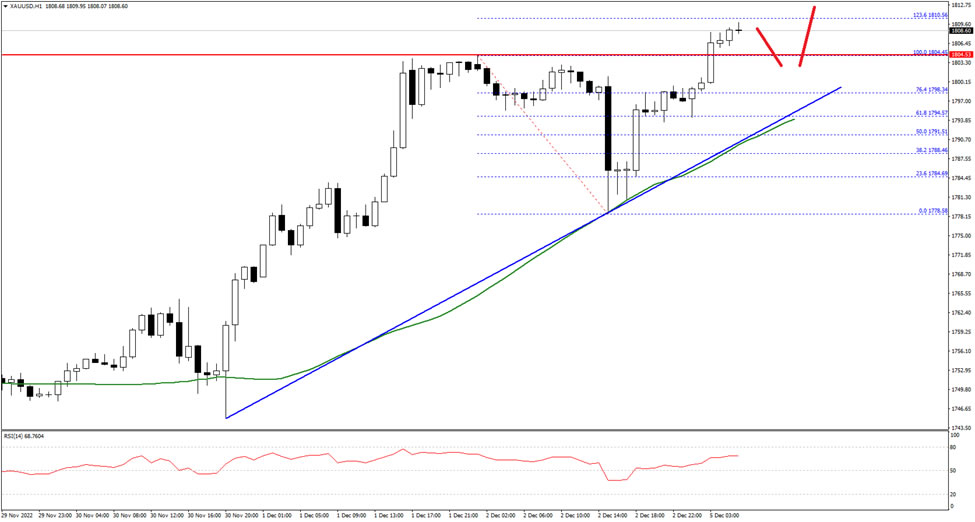
Gold price started a fresh increase from the $1,740 support zone against the US Dollar. The price gained pace above the $1,780 resistance to move into a positive zone.
The pair even climbed above the $1,800 resistance and settled well above the 50 hourly simple moving average. It traded as high as $1,810 and is currently consolidating gains. On the downside, the price is holding the $1,805 support zone.
The next major support is near the $1,798 level and a connecting bullish trend line on the hourly chart, below which the price might decline towards the $1,790 support level in the near term. Any more losses might call for a test of $1,780 on FXOpen.
On the upside, the first major resistance is near the $1,810 level. The next main resistance could be near the $1,818 level, above which the price could start a steady increase towards the $1,825 level.
Can the BoC Meeting Deliver Any Surprises?
The Bank of Canada is about to announce another rate hike on December 7. The market expects a 25bps rate increase despite the upside surprise in the Q3 GDP and the tight labour market. Chances of a bigger rate hike appear slim, but such an announcement could have a sizable impact on the loonie.
BoC defied market pricing at the October meeting
The BoC holds its eighth and final interest rate setting meeting for 2022, a week ahead of the Fed and ECB meetings on December 14 and 15, respectively. The rate decision will be announced at 15:00 GMT with the press conference by Governor Macklem coming at 16:00 GMT.
In October, the BoC defied market pricing that it was leaning towards a 75bps move and hiked by 50bps, taking the overnight rate to 3.75% - the highest level since 2008. Both the interest rate statement and Macklem’s comments at the press conference were hawkish, keeping the door open for further (potentially sizeable) hikes. However, the Canadian dollar was spooked from the projections that the economy could stall over the next few quarters, raising concerns over potentially similar economic comments from other central banks.
Data and hawkish rhetoric justify 25bps rate hike
Since the October meeting, data releases have been on the positive side. GDP growth surprised on the upside in the third quarter with 2.9% quarter-on-quarter annualized rate, while the latest inflation print showed signs of stabilization at arguably very elevated levels. Meanwhile, labour market data came in stronger than anticipated for October, but the September retail sales painted a bleaker picture.
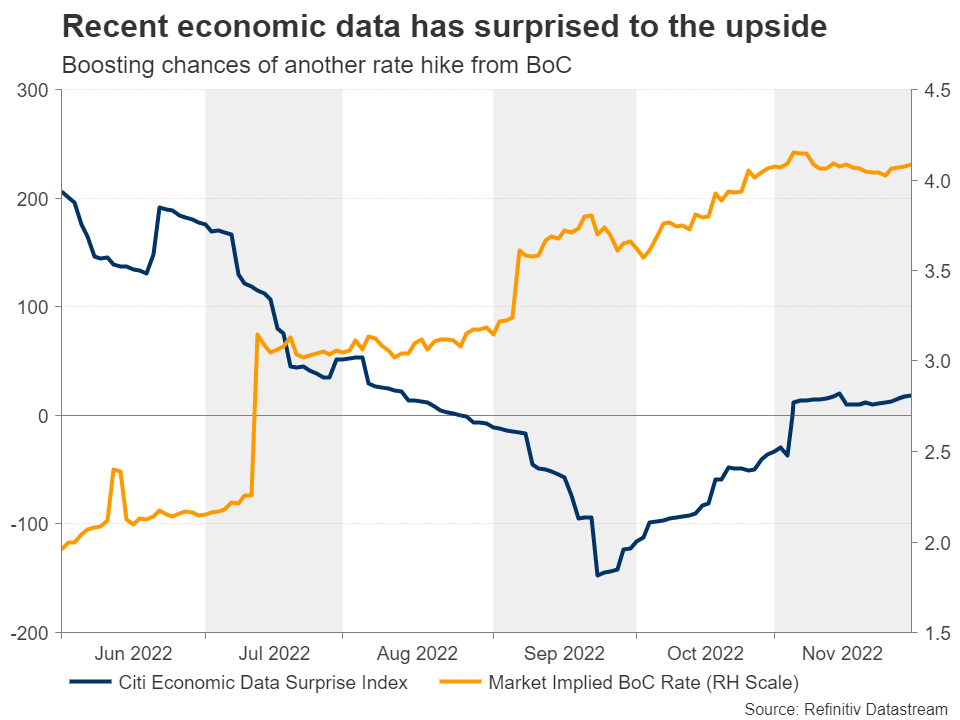
Similarly, the top two BoC officials, Governor Macklem and Senior Deputy Governor Rogers, have been on the wires reiterating their hawkish intentions. While the market appears convinced that another rate hike will be announced, the focus has been on the size of future hikes and the terminal rate. Macklem has been outspoken about getting closer to the end of the hiking cycle, but it clearly depends on the inflation trajectory and the moves from the other major central banks, especially the Fed.
Following the November 30 speech by Fed Chairman Powell, and particularly his signal for less aggressive rate hikes going forward, the market pricing is leaning towards a 25bps rate hike to 4%. A significant probability, currently above 80%, is attached to such an outcome, with the rest pointing towards a bigger 50bps move. A 25bps move could send a strong message that the BoC is closing in on its terminal overnight rate. The immediate impact on dollar/loonie is unlikely to be massive, but as the market digests the announcement and its possible implications on other central banks, the reaction could be more sizeable.
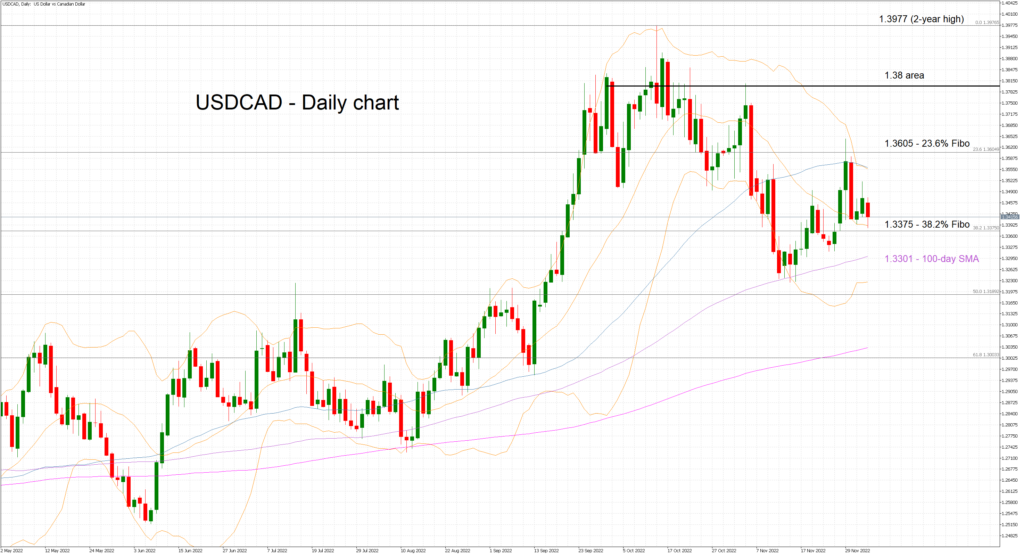
A more sizable rate hike, for example 50bps, coupled with a stronger hawkish commentary at the press conference would open the door for appreciation of the loonie against the dollar. Loonie bulls would eye the 38.2% Fibonacci retracement level of the April 5 – October 13 uptrend of 1.3375, and eventually the 100-day simple moving average at 1.3295. If loonie bears take the reins, the 1.3605, which is the 23.6% Fibonacci level, should be the first resistance level, followed by the 1.38 area.