Sample Category Title
USD/CHF Remains Under Pressure
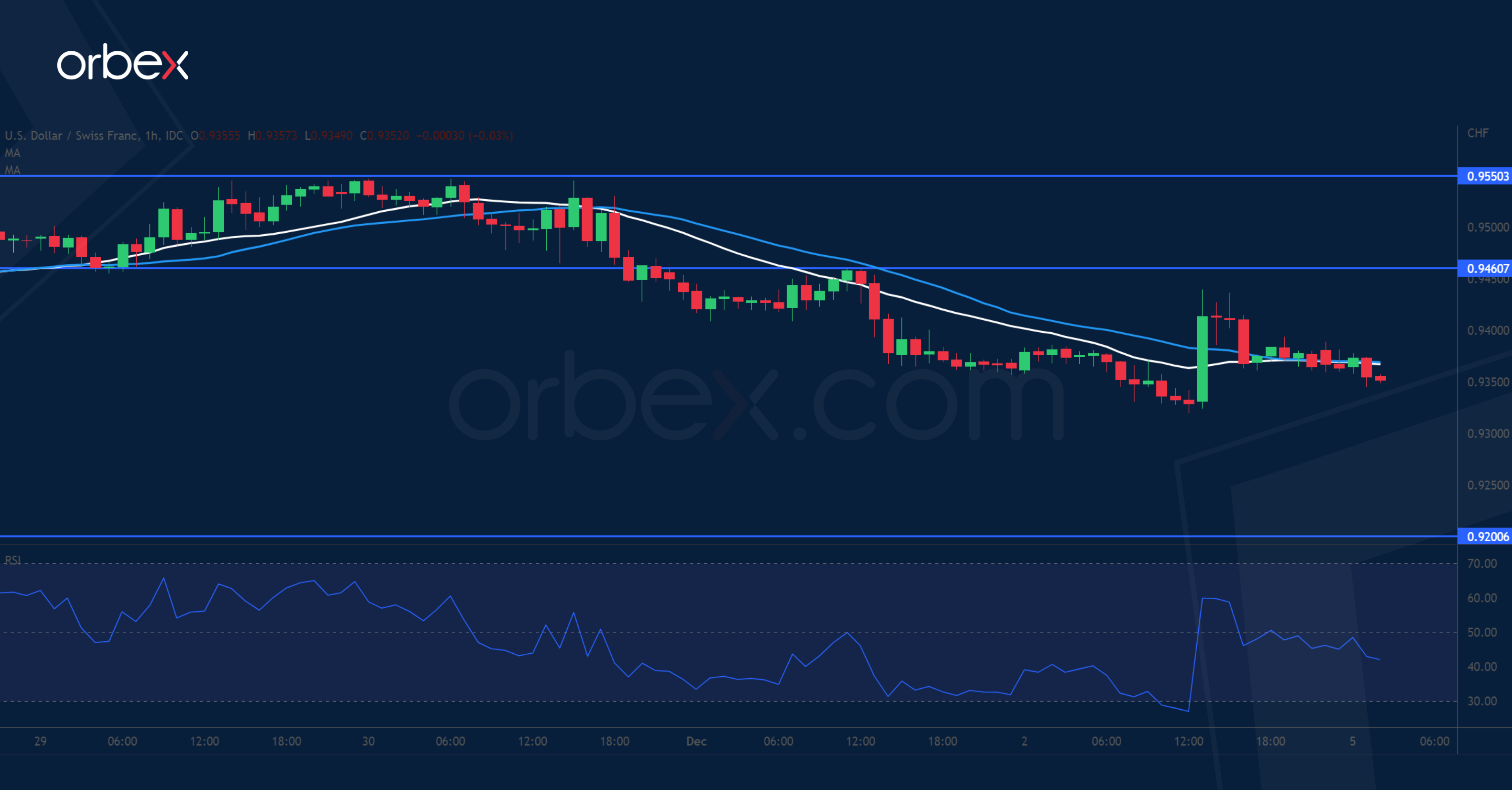
The US dollar jumped over strong wage growth in November. A drop below the recent low of 0.9370 further weighed on sentiment by invalidating the double bottom between August and November. As the latest buyers are forced to bail out, the directional bias remains down. The pair is setting sail for last April’s low of 0.9200. The RSI’s oversold condition led to a bounce which might be capped by strong selling interest. 0.9460 is the first hurdle and the bulls will need to clear 0.9550 before they could press for a recovery.
GBP/JPY Daily Outlook
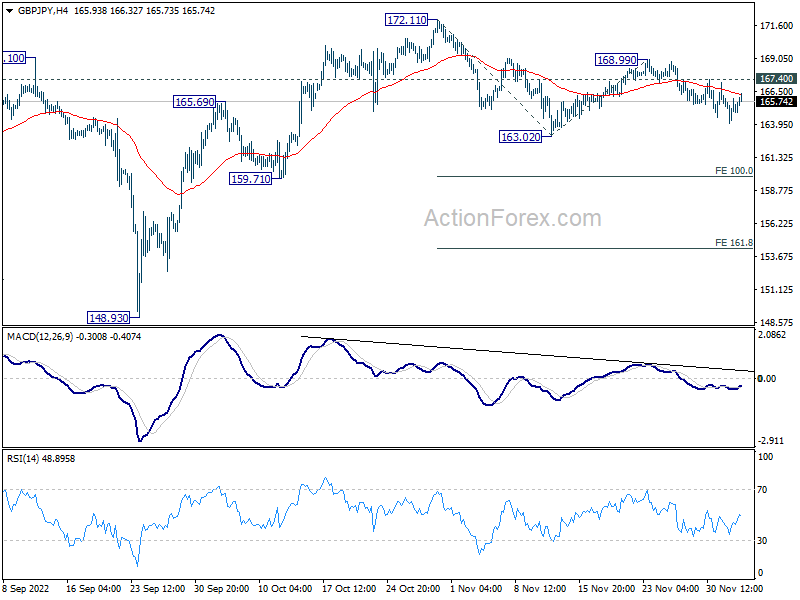
Daily Pivots: (S1) 164.10; (P) 165.04; (R1) 166.05; More...
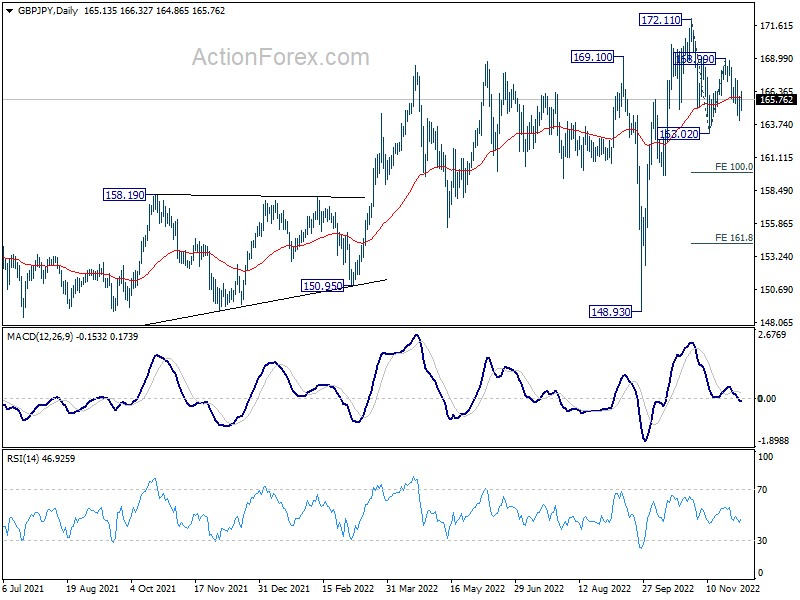
Intraday bias in GBP/JPY is turned neutral with current recovery, but further decline is still expected as long as 167.40 resistance intact. Decisive break of 163.02 will resume the whole fall from 172.11, and target 100% projection of 172.11 to 163.02 from 168.99 at 159.90.
In the bigger picture, medium term upside momentum has been diminishing as seen in bearish divergence condition in weekly MACD. Sustained break of 55 week EMA (now at 160.66) will argue that it's already correcting whole up trend from 123.94 (2020 low). Nevertheless, before that, such up trend could still extend through 172.11 high.
EUR/JPY Daily Outlook
Daily Pivots: (S1) 140.75; (P) 141.61; (R1) 142.46; More....
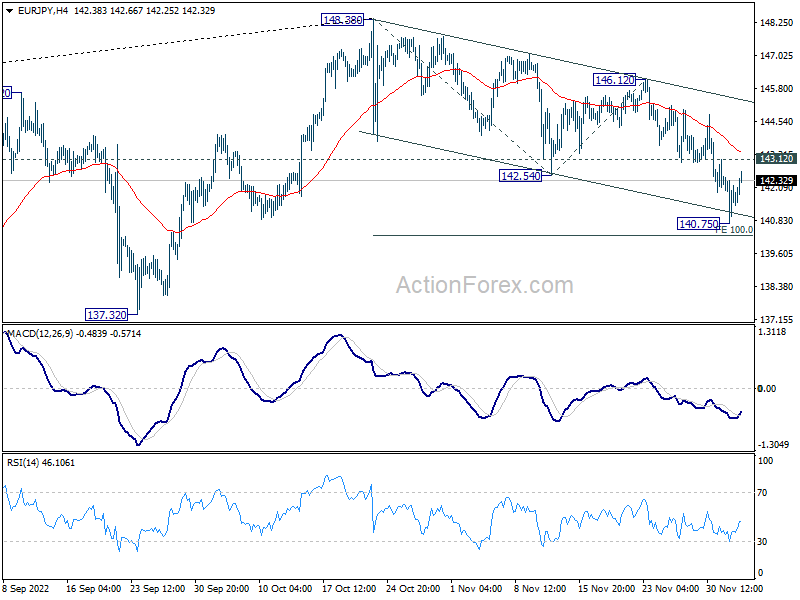
Intraday bias in EUR/JPY is turned neutral with today's recovery. But further decline is expected as long as 146.12 resistance holds. Break of 140.75 will resume the fall from 148.38 to 100% projection of 148.38 to 142.54 from 146.12 at 140.28. Firm break there could prompt downside acceleration to 161.8% projection at 136.67 next.
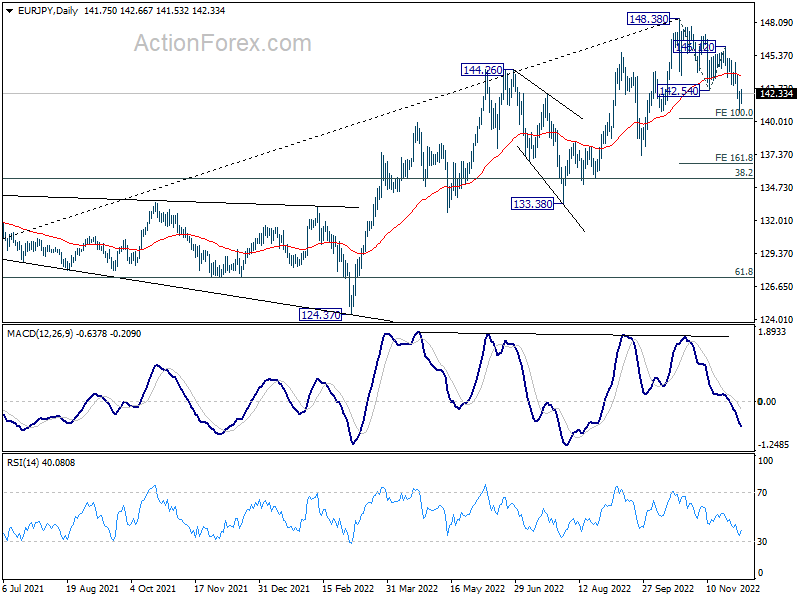
In the bigger picture, considering bearish divergence condition in weekly MACD, 148.38 could be a medium term top already. Fall from there is probably correcting whole up trend from 114.42 (2020 low). Deeper decline would be seen to 55 week EMA (now at 137.37), or further to 38.2% retracement of 114.42 to 148.38 at 135.40 before completion.
EUR/GBP Daily Outlook
Daily Pivots: (S1) 0.8552; (P) 0.8581; (R1) 0.8605; More...
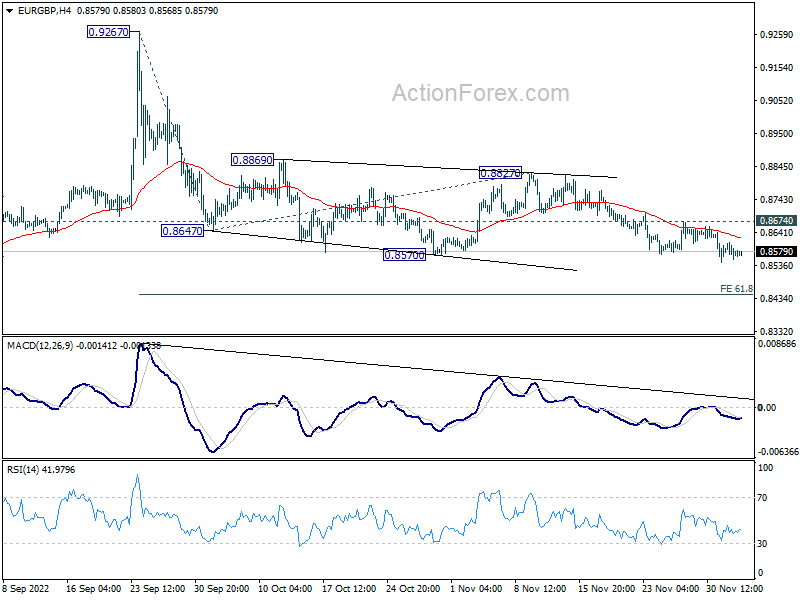
Intraday bias in EUR/GBP remains mildly on the downside at this point. Current decline from 0.9267 should target 61.8% projection of 0.9267 to 0.8647 from 0.8827 at 0.8444 next. On the upside, above 0.8674 minor resistance will turn intraday bias neutral first. But further decline will remain in favor as long as 0.8827 resistance holds.
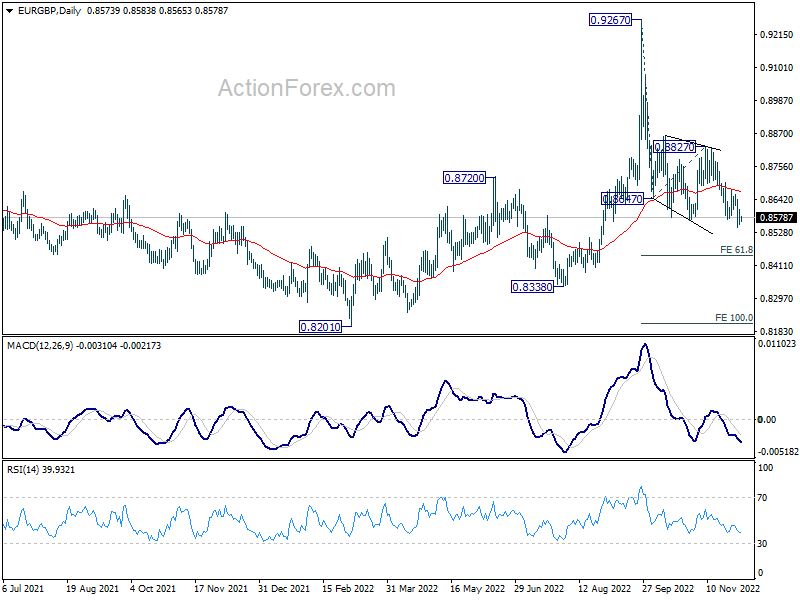
In the bigger picture, current development suggests that fall from 0.9267 is a down leg inside long term range pattern. Deeper fall could be seen towards 0.8201/8338 support zone. But strong support should be seen there to bring reversal. Nevertheless, firm break of 0.8827 resistance will turn favor to the case that such decline is merely a correction in the up trend from 0.8201. That is, further rally would be seen at a later stage through 0.9267.
EUR/AUD Daily Outlook
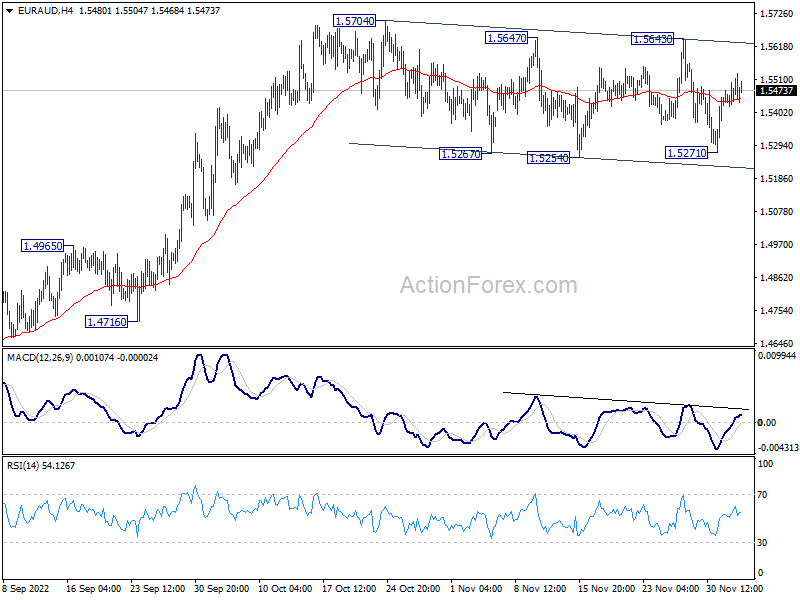
Daily Pivots: (S1) 1.5454; (P) 1.5485; (R1) 1.5547; More...
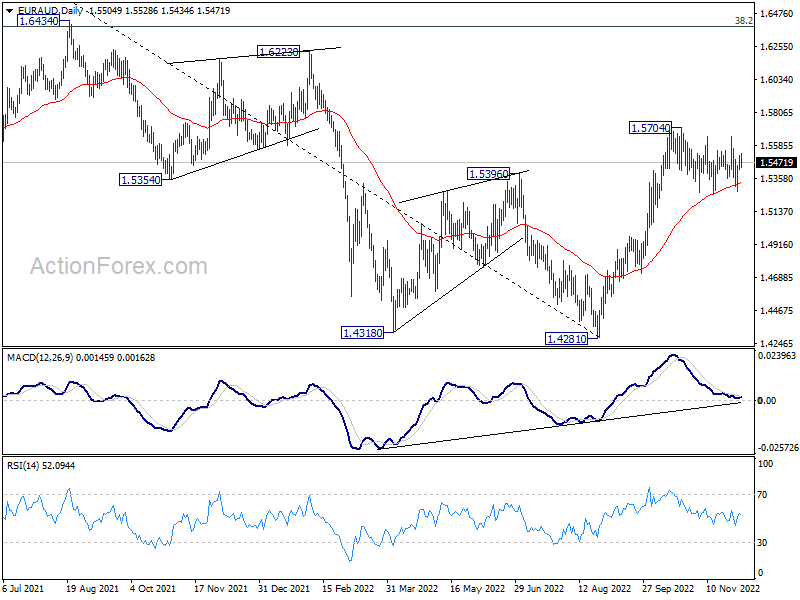
EUR/AUD is still bounded in sideway consolidation from 1.5704 and intraday bias remains neutral. In case of another fall, downside should be contained by 55 day EMA (now at 1.5332) to bring rebound. On the upside, decisive break of 1.5704 will resume larger rise from 1.4281. However, sustained trading below 55 day EMA will bring deeper correction towards 1.4965 resistance turned support.
In the bigger picture, a medium term bottom should be in place at 1.4281, on bullish convergence condition in daily MACD. Further rise would be seen back to 1.6434 key resistance next. Break of 1.4965 resistance turned support is needed to indicate reversal. Otherwise, further rally will remain in favor.
EUR/CHF Daily Outlook
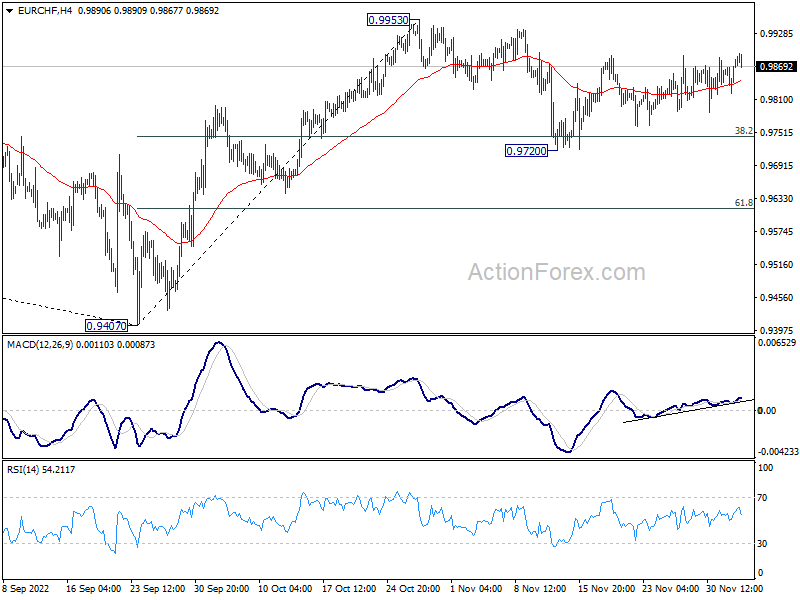
Daily Pivots: (S1) 0.9838; (P) 0.9861; (R1) 0.9899; More....
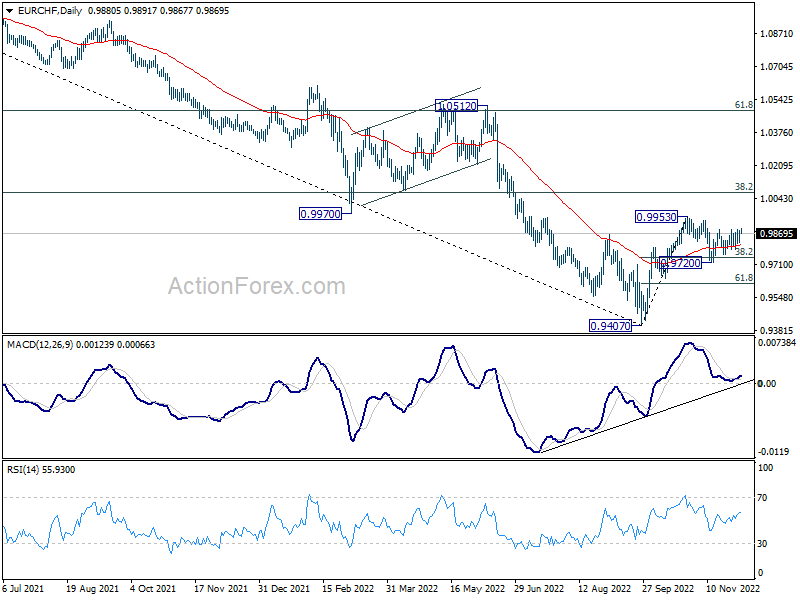
EUR/CHF is still bounded in sideway consolidation form 0.9953 and intraday bias stays neutral. On the upside, firm break of 0.9953 resistance will resume larger rally from 0.9407 to 1.0072 fibonacci level. However, break of 0.9720 will extend the decline from 0.9953 to 61.8% retracement of 0.8407 to 0.9953 at 0.9616.
In the bigger picture, prior rejection by 0.9970 support turned resistance retains medium term bearishness. That is, while 0.9407 is a medium term bottom, price actions from there would develope into a corrective pattern rather than a reversal. Down trend resumption through 0.9407 is mildly favored at a later stage. This will remain the favored case now, as long 38.2% retracement of 1.1149 to 0.9407 at 1.0072 holds.
This Morning’s Risk Vibe is Related to Looser Chinese Covid-rules
Market
The reaction to Friday’s strong payrolls report is telling. Net job growth beat consensus at 263k with average hourly earnings growth accelerating to 0.6% M/M and 5.1% Y/Y. The unemployment rate stabilized at 3.7%, though a lower participation rate helped. The payrolls confirm the still red hot US labour market and seemed to serve as the perfect excuse to stop current corrections on bond/FX/stock markets going into the final Fed policy meeting of the year. In a first reaction, this all played out: the dollar firmed, the US yield curve turned more inverse with Treasuries falling and main US indices opening almost 2% lower. Strange enough, these Pavlov-moves didn’t gain traction. On the contrary, by the end of US dealings, most of them were almost completely erased. It all suggests strong market comfort regarding a Fed policy moderation, especially since last Wednesday’s speech by FOMC Chair Powell. This tide probably won’t change until that December 14 Fed meeting, with the only big data point remaining being next Tuesday’s November CPI readings. While the Fed will shrink the magnitude of its rate hike from 75 bps to 50 bps, markets remain very complacent about Fed speak about a higher peak policy rate peak and vowing against rate cuts in 2023. Perhaps the new FOMC dot plot might open some eyes.
US yield changes eventually ranged between +4.2 bps (2-yr) and -5.1 bps (30-yr). The US 10-yr yield is currently testing the June top at 3.5% with 50% retracement on the Aug/Oct move higher luring at 3.42%. Changes on the German curve varied between +8.6 bps (2-yr) and -2.9 bps (30-yr) by the European closing bell, but these don’t (completely) take into account the US market-reversal. The German 10-yr yield is at risk of losing 1.77%/1.82% support at the open this morning (October low/38% retracement on Aug/Oct move higher). The trade-weighted dollar spiked from 104.50 to 105.50 after payrolls, before returning this gain and sliding towards 104 this morning in a positive Asian risk climate. EUR/USD went from 1.0540 towards 1.0430 and currently changes hands near 1.0575. Next technical marks are 1.0747 (62% retracement on this year’s slide) and 1.0806 (March low). Main US stock markets closed unchanged.
This morning’s risk vibe is related to looser Chinese Covid-rules with Shanghai for example scrapping PCF testing requirements to enter outdoor public venues. Measures will continue to be optimized and adjusted. Local stock markets gain up to 4% for Hong Kong while the Chinese yuan surges below USD/CNY 7 for the first time since September as CNY strength meets USD weakness. Today’s eco calendar contains US non-manufacturing ISM, but we don’t think it will be of any relevance.
News Headline
S&P changed the outlook on the French AA rating from stable to negative as it sees rising risks to the country’s public finances and the resulting reduction in fiscal space. France already has a large general government debt which faces implementation risk associated with the country’s structural reform agenda, an economic slowdown and the ECB’s monetary tightening. S&P could lower the rating if general government debt to GDP doesn’t decline over the 2023-25 period. It reduced the 2023 growth outlook to 0.2% from 1.7% while 2023 the budget deficit is expected at 5.4% of GDP. With the deficit expected to average 4.9% in 2023-25 period, government debt is expected to rise to 112% of GDP. At the same time, Moody’s kept the outlook on its French Aa2 rating unchanged at stable as the agency sees the risks to France’s credit profile as balanced. It assesses France as a wealthy and diversified economy. The country has strong debt affordability in spite of an elevated debt level, according to Moody’s.
The Confederation of British Industry (CBI) substantially downgraded its forecast of the UK economy. CBI now expects the economy to contract 0.4% next year due to high inflation and as companies scale back investments. CBI also doesn’t expect activity (GDP) to return to a pre-Covid level before mid-2024. Unemployment is expected to rise to 5.0% end 2023/early 2024. Inflation is only expected to ease slowly. Inflation printed at 11.1% in October this year. CBI expects average price growth of 6.7% next year and 2.9% in 2024. Business investment at the end of 2024 is still seen 9% below its pre-pandemic level and output per worker 2% lower.
Investors Refuse to Price in a Fed Rate Above 5%
US stocks fell on Friday, after the latest data showed that Americans got more jobs in November, and more importantly they got a better pay. Wages grew by 0.6% over the month, which was the biggest monthly gain, and the double of what was penciled on by analysts.
Of course, the news was great for the American workers, but much less so for the Federal Reserve (Fed), who is dreaming of a softer US labour market, and weak wages so that people could just STOP spending in hope that inflation would fall.
But nope, it’s just another month of strong US jobs data which certainly got Mr Powell to scratch his head.
Investors just… don’t want to price Fed rate at 5%
More, and better paid jobs fueled US inflation expectations, boosted the Fed hawks, and brought forward the idea that the Fed could be attracted by another, a fifth 75bp hike in the December meeting,
US equities fell and the dollar gained.
But then, the S&P500, which gapped lower at the open closed the session almost flat, and the US dollar index gave back all post-jobs gains to close the week where it was before data, and even came lower in Asia this morning.
Why?
Probably because investors priced in the fact that the Fed won’t increase its rates by 75bp this month. It will probably increase them by more in the first half of next year. But that information doesn’t go through for some reason, and the pricing for the Fed’s terminal rate is still below 5%.
So be careful, even though the rally in equities looks like it could continue, and the weakness in the US dollar is what could mark the last weeks of a chaotic trading year, we will certainly see these forces reverse in the first weeks of January, if not before.
S&P 500 at crossroads
The S&P500 closed what was normally supposed to be a week of losses with gains. The index added more than 1% last week, and closed the week right at the top of the year-to-date descending channel, and above its 200-DMA.
The RSI index doesn’t point at overbought conditions, the MACD index is slightly positive, and the volatility index slipped below 19, low volatility being a sign of improving risk appetite, and potentially sustainable gains.
Is there a possibility for this rally to extend despite all the red flags? Yes! There is, though, with the risk of Jerome Powell sounding like at the Jackson Hole speech back in summer – which had destroyed the market mood in a couple of minutes.
The next big data is due next week, on Tuesday, a day before the FOMC decision. Until then, investors could give themselves the luxury to dream about a dovish future.
The freefalling dollar
Until then, we could see the US dollar lose more field against most majors, if we are lucky enough. The EURUSD for example gained more than 10% since the end of September, as Cable gained nearly 20% since the Liz Truss dip.
As such, the US dollar rebound seems a bit aggressive, especially knowing that the market has been refusing to price in a terminal rate for the Fed above 5%.
So, there is a risk that we don’t see a one-sided dollar selloff when the Fed remains sufficiently hawkish – and when the market pricing will have to match the Fed talk at some point.
But the latest dollar selloff is a hint that the US dollar has certainly peaked this year, and next year will be, despite some Fed hawkishness, and some rebounds, a year of softening for the greenback and recovery for other currencies.
OPEC doesn’t cut output
The weekend was rather eventless, as OPEC decided to maintain its daily output restriction unchanged at 2mio barrels per day at Sunday’s meeting, which could be seen as a negative development for the bulls.
But there are two price-supportive developments that could limit losses below the $80pb.
First, Europeans finally agreed on the Russian oil price cap at $60pb, that Russia refused – hinting that the Russians could reduce their oil output in the coming months, which would than reduce the global supply and push prices higher.
Second, China is easing Covid measures. The Chinese reopening could counter the global recession odds and support oil prices.
In US crude, strong resistance is seen at $85pb, 50-DMA.
Russian Oil Price Cap Now in Place
Market movers today
This week will be quiet in terms of key data releases as markets await the final ECB and Fed meetings of the year on 14 and 15 December.
In euro area, October retail sales will be released today, but focus will mostly remain on final ECB comments ahead of the blackout period starting on Thursday.
Following Friday's strong US jobs report, today we will get the ISM services index. It will be interesting to see if private consumption has truly cracked in November after PMIs signalled clearly weakening growth earlier.
Later in the week, we have the Reserve Bank of Australia meeting on Tuesday, where we expect a 25bp hike.
The 60 second overview
US job report: The US jobs report on Friday was quite strong with 263k jobs created in November compared to 200k expected and a revised 284k in October. Wage growth also edged higher once again rising 0.6% m/m or 5.1% y/y. That said, the less important household survey was weaker. Hence, the unemployment rate was unchanged 3.7%. We also note that the participation rate declined even further indicating a growing labour shortage as reflected in the higher wage growth. Employment gains were broad-based across sectors, so overall a strong report that underlines that the Fed has more work to do. Hence, the verdict is still out whether the Fed will hike 50bp or 75bp next week though the recent Powell comments do point towards 'a small' 50bp hike. The market is pricing some 55bp hike next week.
Initially, yields and the USD dollar rose on the numbers though the moves reversed as the markets took its direction from the somewhat weaker household survey.
Oil market: During the weekend the EU and later G7 presented its USD 60 a barrel price cap on Russian oil. The ceiling indicates the maximum price that shipping companies that want insurance or financing in the EU or Great Britain are allowed to pay for Russian oil. The ceiling came into effect by midnight at the same time as it became prohibited to import seaborne Russian oil into the EU. The ceiling therefore concerns Russian oil to third countries such as China, India and Turkey. The cap remains significantly above what much of Russian oil is sold for today underlining that the G7 was not ready to introduce a cap that could significantly hamper Russian oil export. As expected, OPEC+ kept production quotas unchanged at the meeting yesterday. We should expect a volatile week in global oil markets as the impact of the price cap is evaluated. But the oil market will probably quickly return its' focus to the demand side with focus on a possible Chinese reopening and the important policy meetings next week being the main drivers. Brent initially opened up 1.5 USD higher this morning but hA eased somewhat now.
China: Media reports that testing requirements have been eased in Shanghai, which is seen as yet another sign that China is moving towards an easing of its zero-Covid policy. If these changes are seen in other Chinese cities it should boost market optimism this week.
ECB: Yesterday, French ECB member Villeroy said he favours a 50bp hike when the ECB meets next week.
Equities: Performance briefly reversed on Friday as yields surged on the jobs report, bringing equities lower and high multiple stocks too. Yet, within moments S&P recouped its losses to -0.1% as yields dropped back and suddenly tech underperformed just mildly. Similarly, Nordic quality (NIBE, Atlas) even outperformed banks on Friday. So, good week for stocks overall. Nasdaq is up 4% within a week and MSCI Nordics 1.5%. Our preferred sectors real estate, communications and healthcare have beat the index superiorly.
FI: The stronger than expected US labour market report on Friday supported the expectations for a continued tightening of US monetary policy. The initial reaction to the labour market report was a solid sell-off in the global bond markets. However, the sell-off was short-lived and US Treasuries ended lower at the end of the day.
FX: Brief bounce in broad USD on Friday on the back of the US jobs report that sent EUR/USD temporarily down to 1.04 and USD/JPY close to 136. Oil market took the news of EU agreeing to price cap on Russian oil exports with relative calm.
Credit: A relatively quiet day both on the primary and secondary sides concluded the week. ITraxx main was unchanged at 88bp while Xover was unchanged at 443bp.
Nordic macro
Sweden: The Riksbank is publishing the minutes from the monetary policy meeting where markets will look for signs of a possible pivot towards smaller repo rate increases going forward. Swedish service PMI numbers likely to reach new lows after last month's slight uptick.
EUR/USD Daily Outlook
Daily Pivots: (S1) 1.0466; (P) 1.0505; (R1) 1.0583; More...
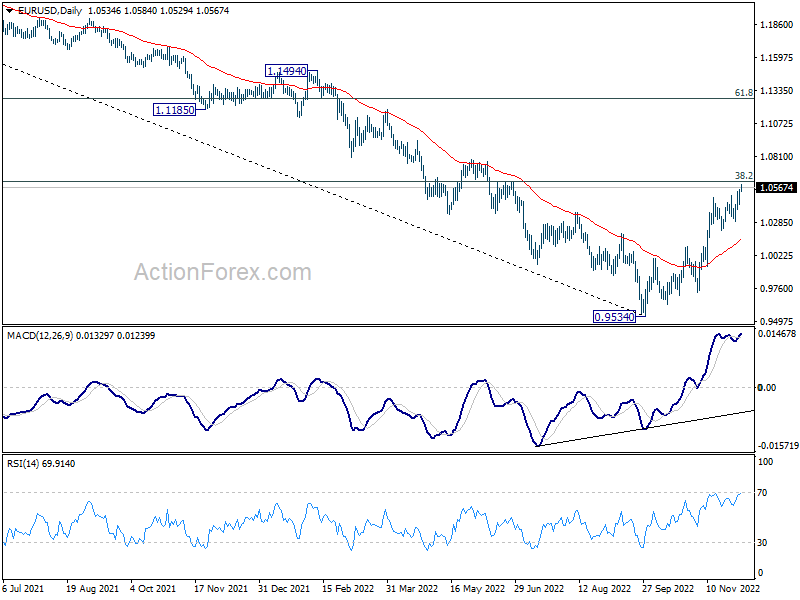
Intraday bias in EUR/USD remains on the upside at this point. Rise from 0.9534 should target 1.0609 fibonacci level. Further rally is expected as long as 1.0289 support holds, in case of retreat. However, firm break of 1.0289 support will confirm short term topping and bring deeper decline back to 1.0092 resistance turned support.
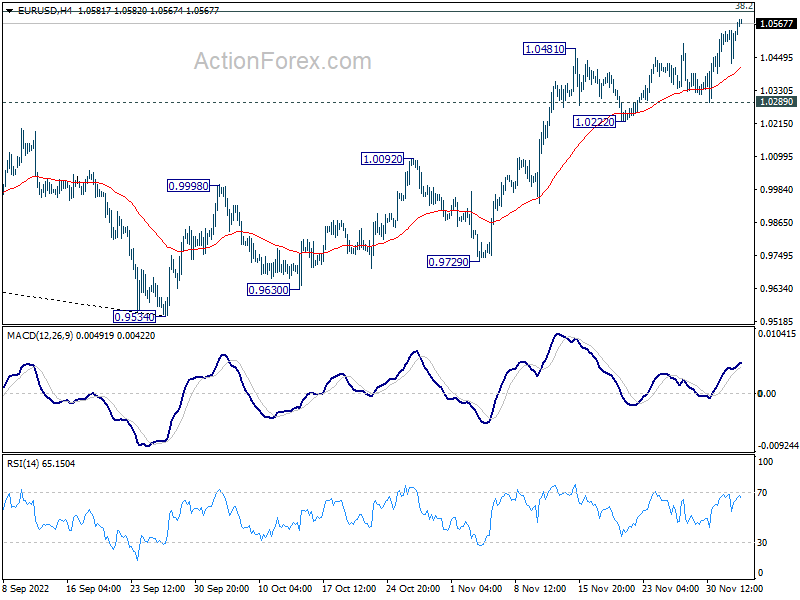
In the bigger picture, a medium term bottom was in place at 0.9534, on bullish convergence condition in daily MACD. Even as a corrective rise, rally from 0.9534 should target 38.2% retracement of 1.2348 (2021 high) to 0.9534 at 1.0609. Sustained trading above 55 week EMA (now at 1.0566) will raise the chance of trend reversal and target 61.8% retracement at 1.1273. However, rejection by 1.0609 will retain medium term bearishness for down trend resumption at a later stage.