Sample Category Title
US NFP and How the Market Could React
Tomorrow has the all-important release of US labor market numbers. But the Fed's Powell kind of already robbed the thunder from the release during his speech at the Brookings Institute yesterday. He basically implied that the Fed would start slowing down its tightening at the next meeting. Naturally the market jumped and the dollar weakened in response. Now the question is whether there will be follow-through on the optimism with the jobs numbers.
November's NFP is expected to come in lighter compared to the prior month, but it should be noted that the data has been markedly outperforming expectations lately. Taken in context of the latest BLS report showing that the labor market remained tight, the consensus for what to expect out of NFP has drifted up, slightly. A week ago, analysts were forecasting 200K jobs added, but that has now moved up to 210K jobs, compared to 261K in October.
The trends remain favorable
Prior to covid, a 210K jobs report would be considered relatively good. But referring back to the BLS report that came out yesterday, there are some worrying signs. As mentioned, in October there were 261K jobs created, but 353K jobs went off the market. Meaning that companies are closing down job offers faster than people are being hired. The largest drop in job offers occurred in state and local governments, followed by manufacturing. Combined, that represented the bulk of the reduction in job openings.
For now, the market remains tight, mostly because the extraordinarily large gap between job openings and jobseekers that occurred from the pandemic is still there. There were 6.1 million people looking for work last month, but there were 10.3 million jobs for them. Despite this mismatch, wages have failed to keep up with inflation. Current expectations are that average hourly earnings will slow to 0.3% from 0.4% reported in October.
Putting the pieces together
The Fed's main worry though this cycle has been that higher inflation combined with an extremely tight labor market would lead to a wage-price spiral. However, that hasn't happened, giving the Fed plenty of space to raise rates to combat inflation. Recently, inflation has been starting to come down, from a combination of higher borrowing costs and worries about an impending recession.
The prolonged loss of purchasing power among American workers as their salaries fail to keep up with prices would be expected to lead to demand destruction. Which would also contribute to reducing inflation, as Americans see their pocketbooks being pinched and refuse to pay higher prices. As retailers across the country report rising inventories and some are suspending buying new inventory for the start of next year, the natural expectation is that the economy will slow down. Which in turn also contributes to lower inflation.
The unemployment rate is expected to remain steady at 3.7%, and so is the participation rate. This is reflected in the BLS data showing the number of people quitting to find better pay far outweighed the number of people being fired.
Fed Bowman: Appropriate to slow tightening pace, but terminal rate would be slightly higher
Fed Governor Michelle Bowman said she expect ongoing increase in rates at coming meeting. But, it will be "appropriate" to slow the pace of tightening. That will allow policymakers to full assess the impact of their actions.
Also, "we're still seeing extremely high levels of core and CPI inflation," she said. "Until I see our actions actually having some impact that would lower the rate of inflation, I think my expectation would be a slightly higher" terminal rate than projected back in September.
Sunset Market Commentary
Markets
Yesterday’s (perceived) soft speech of Fed chair Powell (slowing the pace of rate hikes to 50 bps in December) at that time triggered a sharp rally both on US bond and equity markets (Nasdaq +4.41%). Today’s reaction in Asian and Europe was much more modest/diffuse. Gains on Asian markets were mostly limited to about 1.0%, even as comments from Chinese officials suggested a less strict anti-Covid approach going forward. European equities are also lagging far behind yesterday’s US gains (0.5%-1.0%). At the same time, European yields made another substantial step lower, and at some point even went a good way to matching yesterday’s moves in the US even as the ECB still lags far behind the US in its normalization process. We didn’t see much of an EMU specific driver, except for weak October German retail sales (-2.8% M/M and -6.6% Y/Y). Whatever the reason, German yields are ceding between 9/12 bps across the curve. Money markets lowered expectations for the peak ECB policy rate to 2.75%. This afternoon, US investors/data didn’t change the course of events. Challenger job cuts jumped sharply in November (77K, mainly due to cost cutting (30k)). US October personal income (0.7%, M/M) and spending ( 0.8%) were strong while the price deflators (headline 0.3 % M/M 6.0% Y/Y; core 0.2% M/M, 5.0% Y/Y ) marginally softer than expected. Weekly jobless claims eased from 241k to 225k, but continuing claims rose from 1551k to 1608k. The data thus painted a mixed picture, but in current environment, this is enough for bond markets to continue to err to the soft side. Despite yesterday’s sharp sell-off , US yields only gain 2 bps for the 2/5 year sector. The 30-y even cedes 1 bp in volatile trading. US and European bond yields for now also ignore a second consecutive day of higher oil prices (Brent $88.4 p/b compared to a low just north of $80 earlier this week). Whatever, current positioning still might change later today with the key US manufacturing ISM to be released after the publication of this report. Markets will be keen to see whether the ISM joins last week’s sharp decline in the US PMI’s.
Earlier, we described today’s moves as a bit diffuse and this also applies to FX markets. It’s not clear whether we should label today’s equity gains as risk-on or disappointing. Whatever the assessment, the dollar extends its decline with some cross rates event breaking relevant support levels. DXY dropped below the 105.30 area (currently 105.05). The decline in USD/JPY is even more striking. Opening north of 138 this morning, the pair already filled bids below 136. Despite today’s sharp decline in European yields EUR/USD is attacking the 1.05 big figure. Sterling even outperforms the euro with EUR/GBP (0.8575) on its way for a new test of the key 0.8560 area.
News Headlines
Swiss inflation rose 3% y/y in November, unchanged from October as the monthly dynamic flatlined at 0%. Core inflation accelerated slightly from 1.8% to 1.9%. The EU harmonized figure came in at 2.9%, also matching the month before. It’s the tenth month in a row that inflation surpassed the Swiss National Bank’s 2% target. It strengthens the case for the SNB to lift policy rates from the current 0.5% level at their last policy meeting of the year on December 15 by at least 50 bps. Vice president Schlegel earlier this week already hinted at that, saying inflation is still too high for them. That said, it is still far below the 10% on the EMU level, thanks in part to the strong Swiss franc which dampens import prices. Today the currency loses a tad vs the euro though. EUR/CHF advances from 0.984 to 0.987.
South African president Ramaphosa’s fate hangs in the balance. An advisory panel created by parliament found grounds for lawmakers to consider impeaching Ramaphosa over an alleged robbery cover-up at his game farm and potential violations of the constitution. Several senior officials within his African National Congress party have joined the opposition in calling for him to resign. According to people familiar, Ramaphosa is weighing this option. The incumbent president was widely popular within the ANC and the people before the scandal, allowing him to set in motion a range of reforms addressing corruption, the liberalization of the power sector and private sector infrastructure investments. It’s unclear who from the ANC would succeed him and even if someone is found, risks are that much of the reform agenda will be put on hold. Markets acknowledge the risk. A sell-off wave rolls over South African assets, including the rand. The currency gets a serious beating with USD/ZAR skyrocketing from 17.2 to almost 18 before paring losses to 17.73 currently.
GBP/USD: Sterling Extends Advance as Risk Sentiment Improves Further
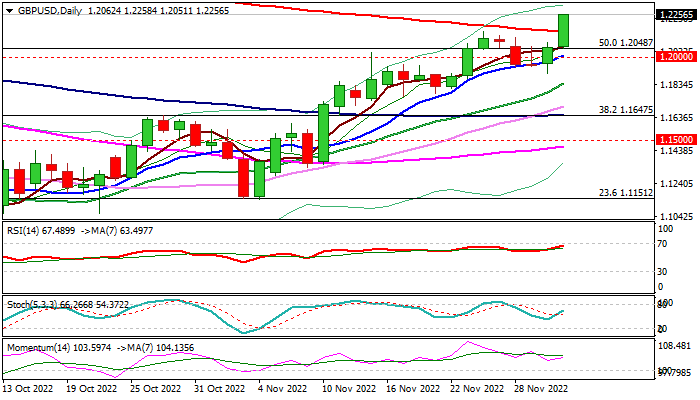
Cable accelerated gains on Thursday, lifted by renewed risk sentiment, following comments from Fed Powell on Wednesday, which deflated dollar on less hawkish than expected stance, while solid US data on Thursday further boosted risk appetite.
Traders eye of US ISM manufacturing PMI (Nov f/c 49.8 vs Oct 50.2) which should contribute to positive tone on release above forecast, as well as Friday’s release of the US Nov labor report.
Fresh advance pushed the price to the highest level since Aug 8 and generated bullish signal on lift above falling 200DMA (1.2153), which also indicates continuation of larger uptrend from Sep 26 spike low at 1.0348.
Bulls pressure immediate barriers at 1.2293/76 (Aug 1,10 tops which formed a lower platform), break of which would unmask key Fibo barrier at 1.2449 (Fibo 61.8% of 1.3748/1.0348).
Today’s close above broken 200DMA to confirm strong bullish stance.
Res: 1.2273; 1.2296; 1.2332; 1.2400.
Sup: 1.2153; 1.2100; 1.2048; 1.2000.
US ISM manufacturing dropped to 49 in Nov, first contraction in 29 months
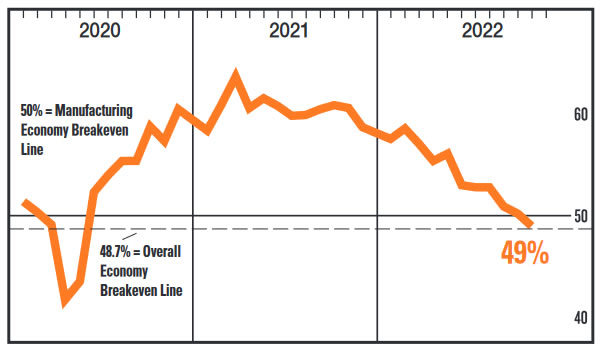
US ISM Manufacturing PMI dropped from 50.2 to 49.0 in November, worse than expectation of 50.5 That's also the first contraction reading in 29 months since May 2020. Looking at some details, new orders dropped form 49.2 to 47.2. Production dropped from 52.3. to 51.5 Employment dropped from 50.0 to 48.4. Prices dropped from 46.6. to 43.0.
ISM said: "The past relationship between the Manufacturing PMI and the overall economy indicates that the Manufacturing PMI for November (49 percent) corresponds to a 0.1-percent increase in real gross domestic product (GDP) on an annualized basis."
US: Income Beats Estimate, Spending Strong at 0.8% on the Month
Personal income advanced 0.7% month-on-month (m/m) in October, above market expectations for a more modest gain of 0.4% m/m. Compensation of employees, which gained a solid 0.5% m/m, was behind the strong headline income reading. Government social benefits was another strong contributor with growth of 1.6% m/m that reflected one-time refundable tax credits issued by states.
Controlling for inflation and taxes, real personal disposable income was up a healthy 0.4% m/m in October.
Personal consumption accelerated from October, rising by 0.8% m/m - on par with the consensus forecast.
In real terms, spending was up 0.5%, with goods taking the lead. Spending on goods rose 1.1% m/m, led by a 2.7% gain in durables, while nondurable goods was up 0.3%. Services spending added 0.2% on the month, with growth supported by spending on health care, food services and accommodations, as well as housing and utilities.
The personal saving rate fell for the fourth month in a row from an already weak 2.4% (revised down from 3.1%) to 2.3% on the month. This is 5.3 percentage points below the 7.5% pre-pandemic average.
Inflation as measured in the personal consumption deflator eased to 6.0 % from 6.1% year-over-year, while core PCE inflation (excluding food & energy) softened to 5.0% (from 5.1%).
Key Implications
While the strong upswing in goods spending was largely priced into the consensus estimate after the retail sales report, spending on services remained a wild card. The moderate gain and positive revisions to previous months lifted the health care category to almost one percentage point above its pre-pandemic level. The only two categories that remain below their pre-pandemic levels are transportation (-3.0%) and recreation (-3.4%). Robust growth in October puts us on track for a notable upgrade in our forecast for real consumer spending in the final quarter of 2022: we now expect it to come in at roughly 3% (annualized).
Starting next year, we expect consumers to tighten their purse strings. First, a full year of dwindling purchasing power will make consumers more selective once the holiday season is over. Second, high interest rates and tighter credit conditions will make borrowing less palatable, limiting spending financed by credit. Finally, consumers' pandemic savings build up has halved over the past year, and is on track to be exhausted by the end of next year should this trend continue. This suggests that real consumption growth will soften to a below-trend growth next year, making a case for the Fed to moderate "the pace of rate increases as soon as the December meeting".
USD/JPY Mid-Day Outlook
Daily Pivots: (S1) 137.19; (P) 138.55; (R1) 139.44; More...
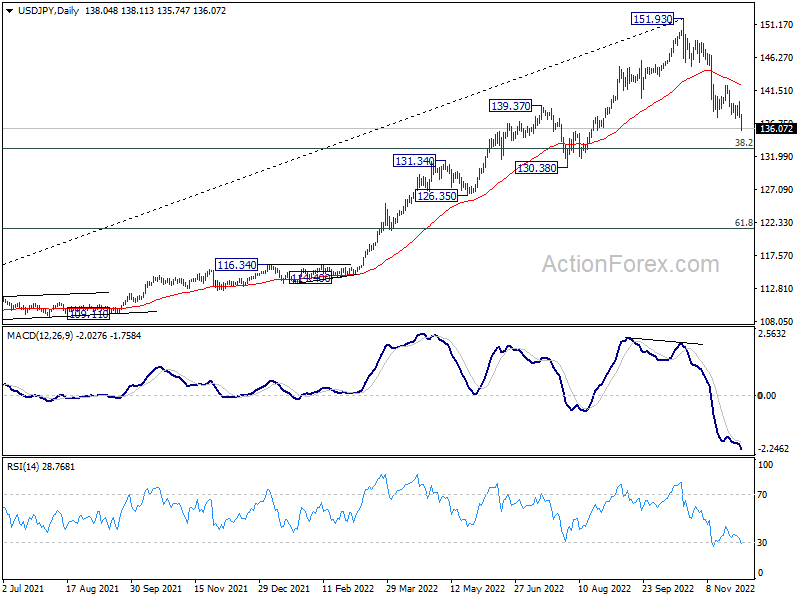
Intraday bias in USD/JPY stays on the downside at this point. Current decline from 151.93 should target 133.07 medium term fibonacci level next. On the upside, break of 139.88 resistance is needed to indicate short term bottoming. Otherwise, further fall will remain in favor in case of recovery.
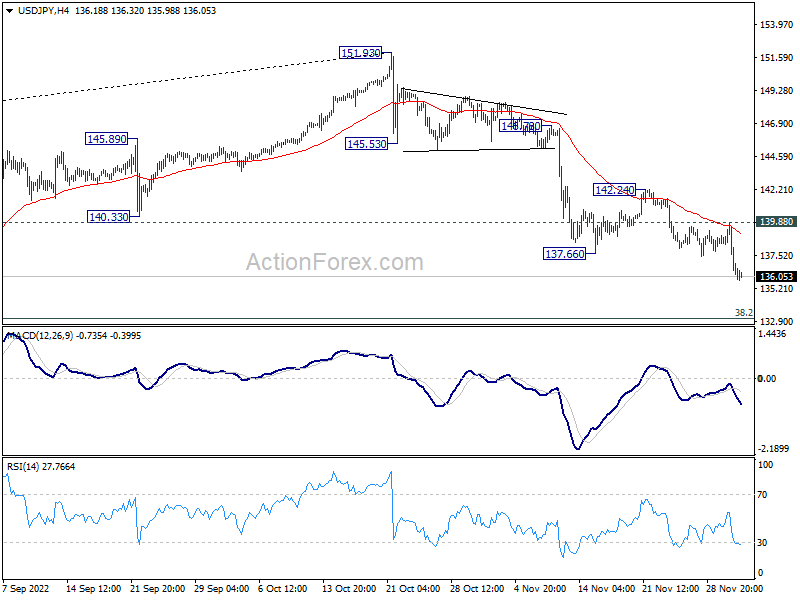
In the bigger picture, a medium term top should be formed at 151.93. Fall from there is correcting larger up trend from 102.58. It's too early to call for bearish trend reversal. But even as a corrective move, such decline should target 38.2% retracement of 102.58 to 151.93 at 133.07, or further to 55 week EMA (now at 131.51).
USD/CHF Mid-Day Outlook
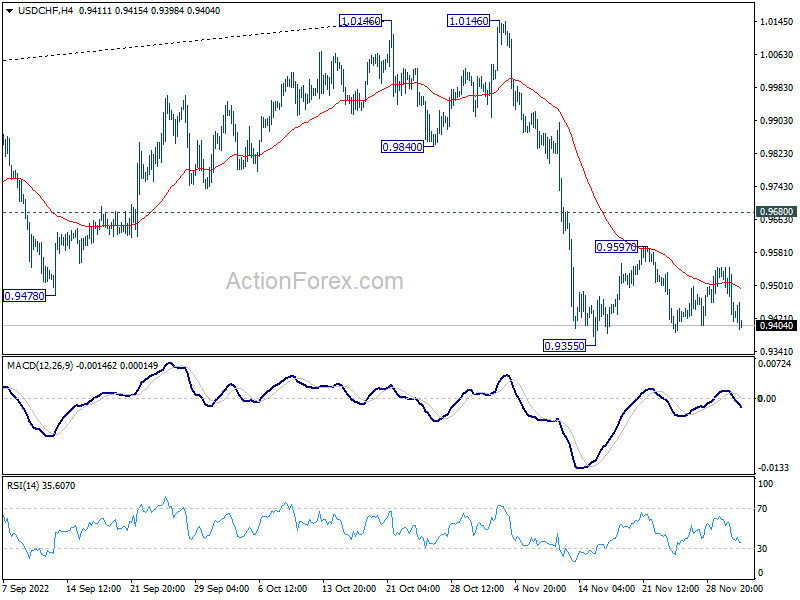
Daily Pivots: (S1) 0.9409; (P) 0.9478; (R1) 0.9525; More...
USD/CHF is still bounded in consolidation from 0.9355 and intraday bias remains neutral. Near term outlook will remain bearish as long as 0.9680 minor resistance holds, in case of another recovery. On the downside, firm break of 0.9355 will resume the decline from 1.0146 to 0.9287 fibonacci level.
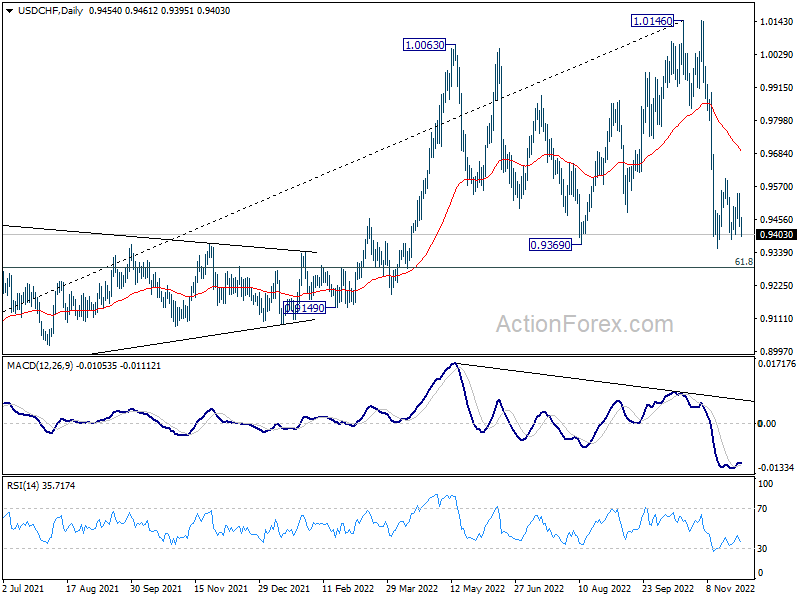
In the bigger picture, rise from 0.8756 (2021 low) has completed at 1.0146, well ahead of 1.0342 long term resistance (2016 high). Based on current downside momentum, fall from 1.0146 might be a medium term down trend itself. Break of 61.8% retracement of 0.8756 to 1.0146 at 0.9287 will pave the way to 0.8756. In any case, risk will stay on the downside as long as 55 day EMA (now at 0.9726) holds.
EUR/USD Mid-Day Outlook
Daily Pivots: (S1) 1.0323; (P) 1.0376; (R1) 1.0462; More...
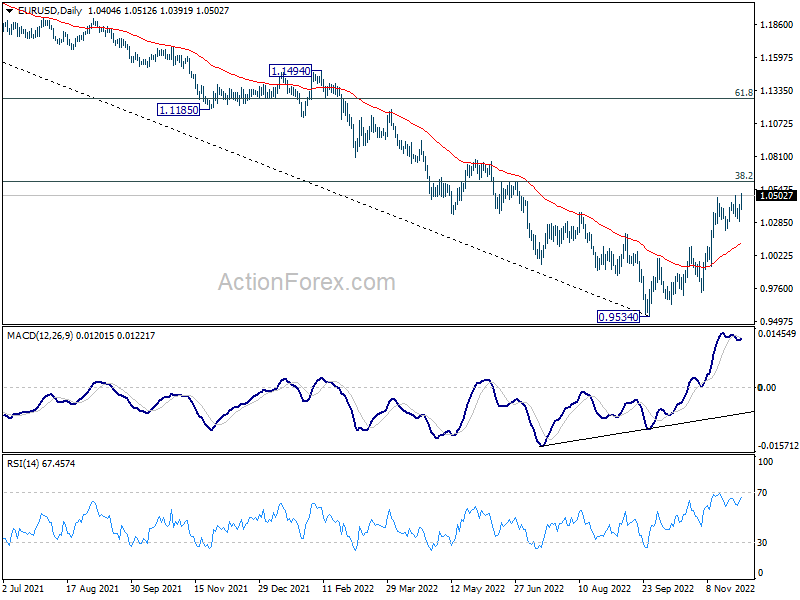
EUR/USD's rally resumed by breaking through 1.0496 and intraday bias is back on the upside. Next target is 1.0609 fibonacci level. On the downside, break of 1.0289 support is needed to indicate short term topping. Otherwise, further rally will remain in favor in case of retreat.
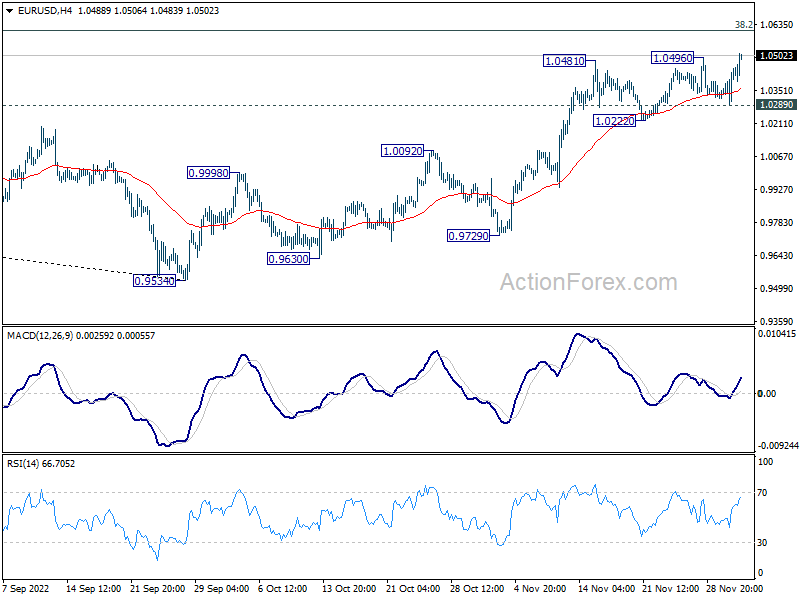
In the bigger picture, a medium term bottom was in place at 0.9534, on bullish convergence condition in daily MACD. Even as a corrective rise, rally from 0.9534 should target 38.2% retracement of 1.2348 (2021 high) to 0.9534 at 1.0609. Sustained trading above 55 week EMA (now at 1.0566) will raise the chance of trend reversal and target 61.8% retracement at 1.1273. This will now remain the favored case as long as 1.0092 resistance turned support holds.
GBP/USD Mid-Day Outlook
Daily Pivots: (S1) 1.1944; (P) 1.2015; (R1) 1.2130; More...
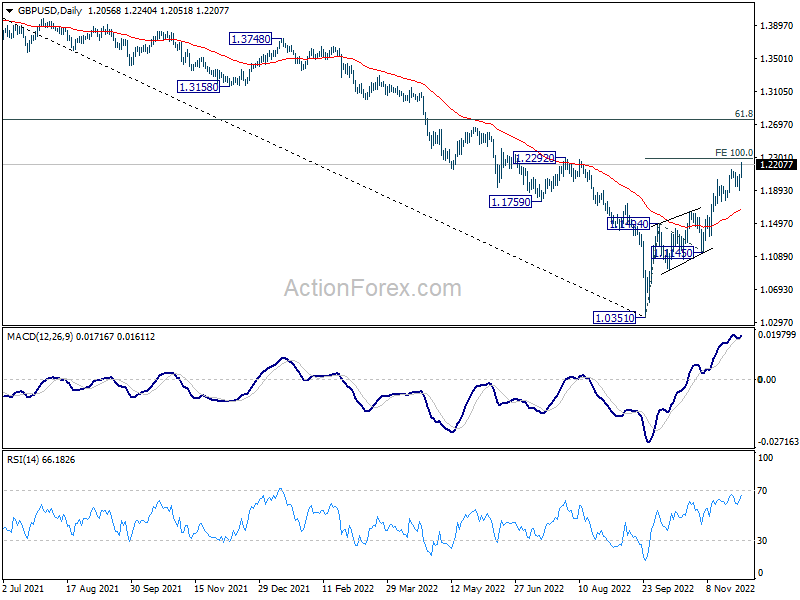
GBP/USD's rally resumed by breaking 1.2152 and intraday bias is back on the upside. Current rise from 1.0351 should target 100% projection of 1.0351 to 1.1494 from 1.1145 at 1.2288 first. Sustained break there will pave the way to 1.2759 medium term fibonacci level. On the downside, break of 1.1898 minor support is needed to indicate short term topping, otherwise, further rally will remain in favor in case of retreat.
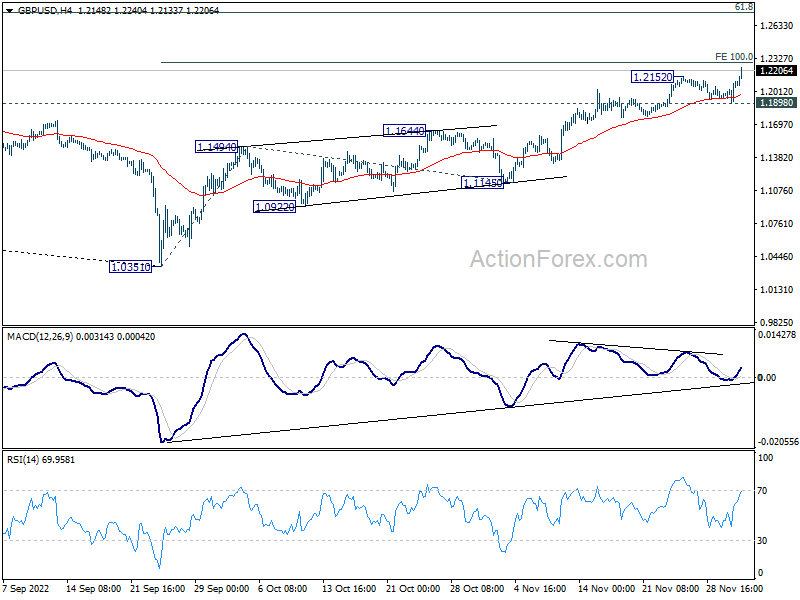
In the bigger picture, rise from 1.0351 medium term bottom is at least correcting whole down trend from 1.4248 (2021 high). Further rise is expected as long as 1.1145 support holds. Next target is 61.8% retracement of 1.4248 to 1.0351 at 1.2759. Sustained break there will pave the way back to 1.4248.