Sample Category Title
EUR/CHF Daily Outlook
Daily Pivots: (S1) 0.9794; (P) 0.9833; (R1) 0.9878; More....
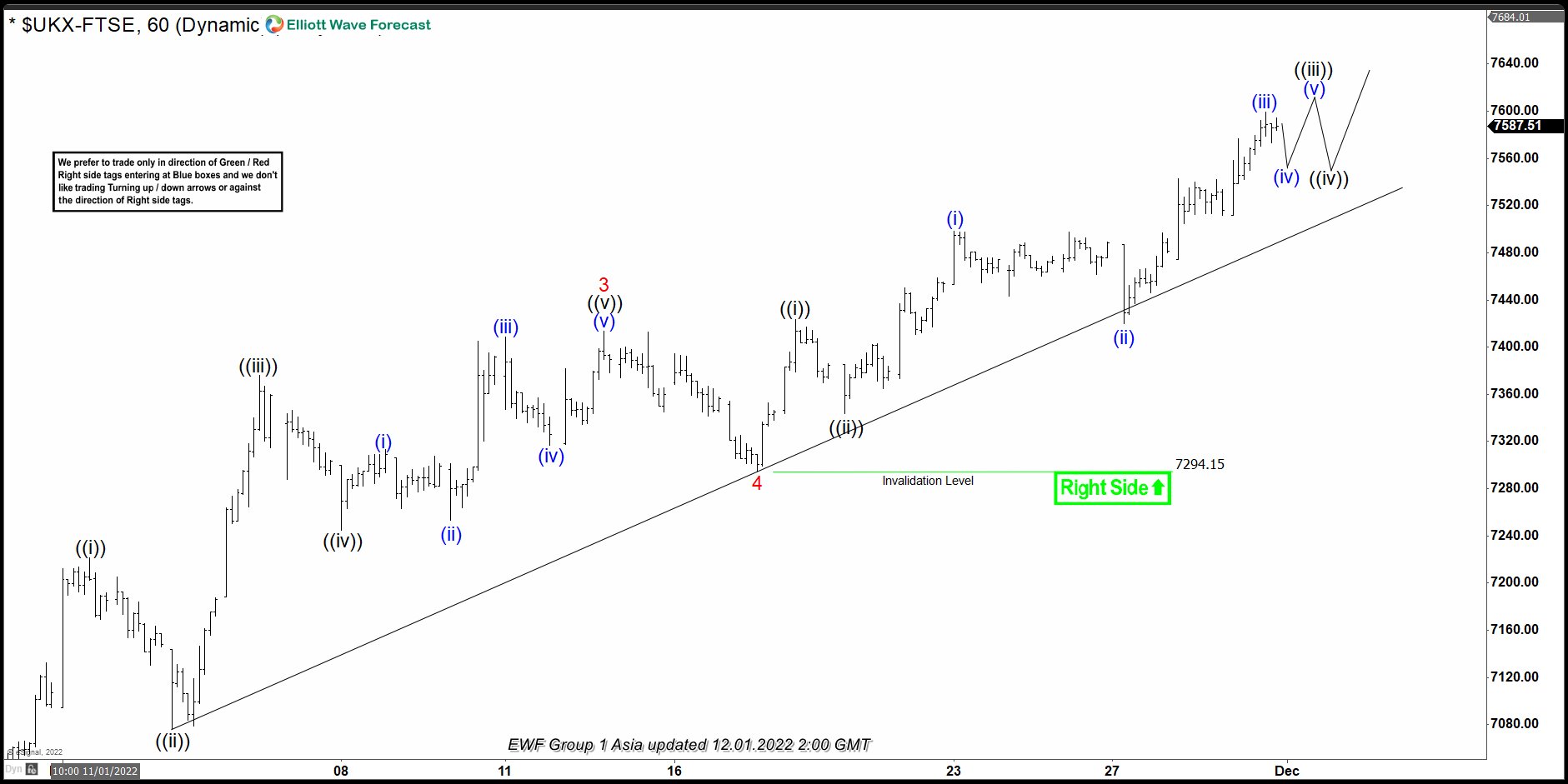
Range trading continues in EUR/CHF and intraday bias remains neutral. On the upside, firm break of 0.9953 resistance will resume larger rally from 0.9407 to 1.0072 fibonacci level. However, break of 0.9720 will extend the decline from 0.9953 to 61.8% retracement of 0.8407 to 0.9953 at 0.9616.
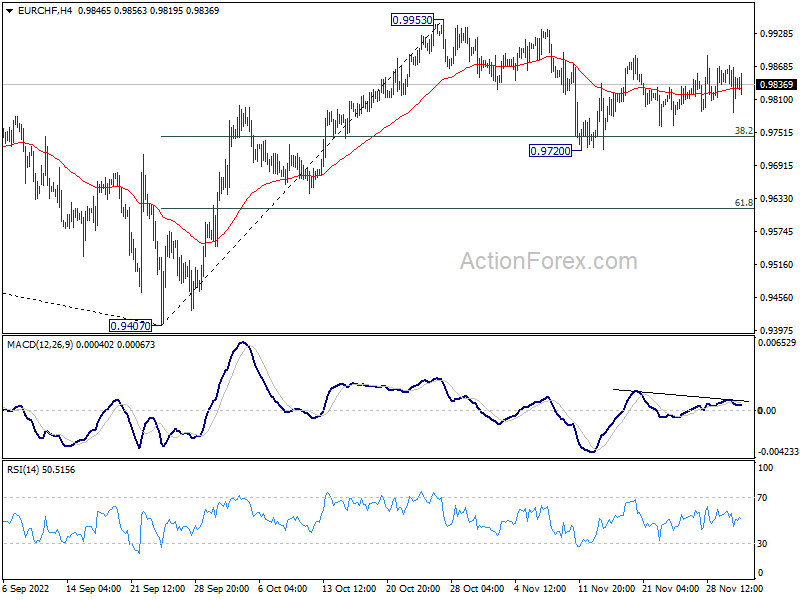
In the bigger picture, rejection by 0.9970 support turned resistance retains medium term bearishness. That is, while 0.9407 is a medium term bottom, price actions from there would develope into a corrective pattern rather than a reversal. Down trend resumption through 0.9407 is mildly favored at a later stage. This will remain the favored case now, as long 38.2% retracement of 1.1149 to 0.9407 at 1.0072 holds.
Elliott Wave View: FTSE Looking to End 5 Waves
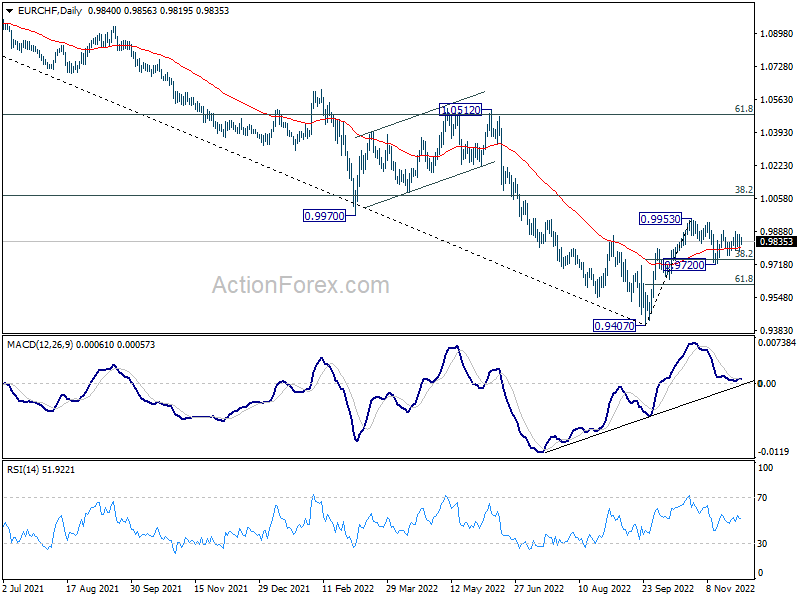
Short term Elliott Wave View in FTSE suggests the rally from 10.13.2022 low is unfolding as a 5 waves impulse Elliott Wave structure. Up from 10.13.2022 low, wave 1 ended at 7093.05 and pullback in wave 2 ended at 6997.54. Index then resumed higher in wave 3 towards 7413.82 while pullback in wave 4 ended at 7294.15.
Wave 5 is currently in progress with internal subdivision as another 5 waves impulse in lesser degree. Up from wave 4, wave ((i)) ended at 7423.51 and pullback in wave ((ii)) ended at 7343.37. Up from there, Index formed a nest with wave (i) ended at 7498.34 and wave (ii) ended at 7420. Index then resume higher in wave (iii) which is proposed complete at 7599.27. Expect a small pullback in wave (iv) followed by more upside in wave (v) to complete wave ((iii)). Index should then pullback in wave ((iv)) before 1 more push higher to end wave ((v)) of 5. The Index should show a momentum divergence at the end of wave ((v)) of 5. The 5 waves higher should end cycle from 10.13.2022 low after which a larger 3 waves pullback should happen.
FTSE 60 Minutes Elliott Wave Chart
UK 100 Breaks Major Resistance
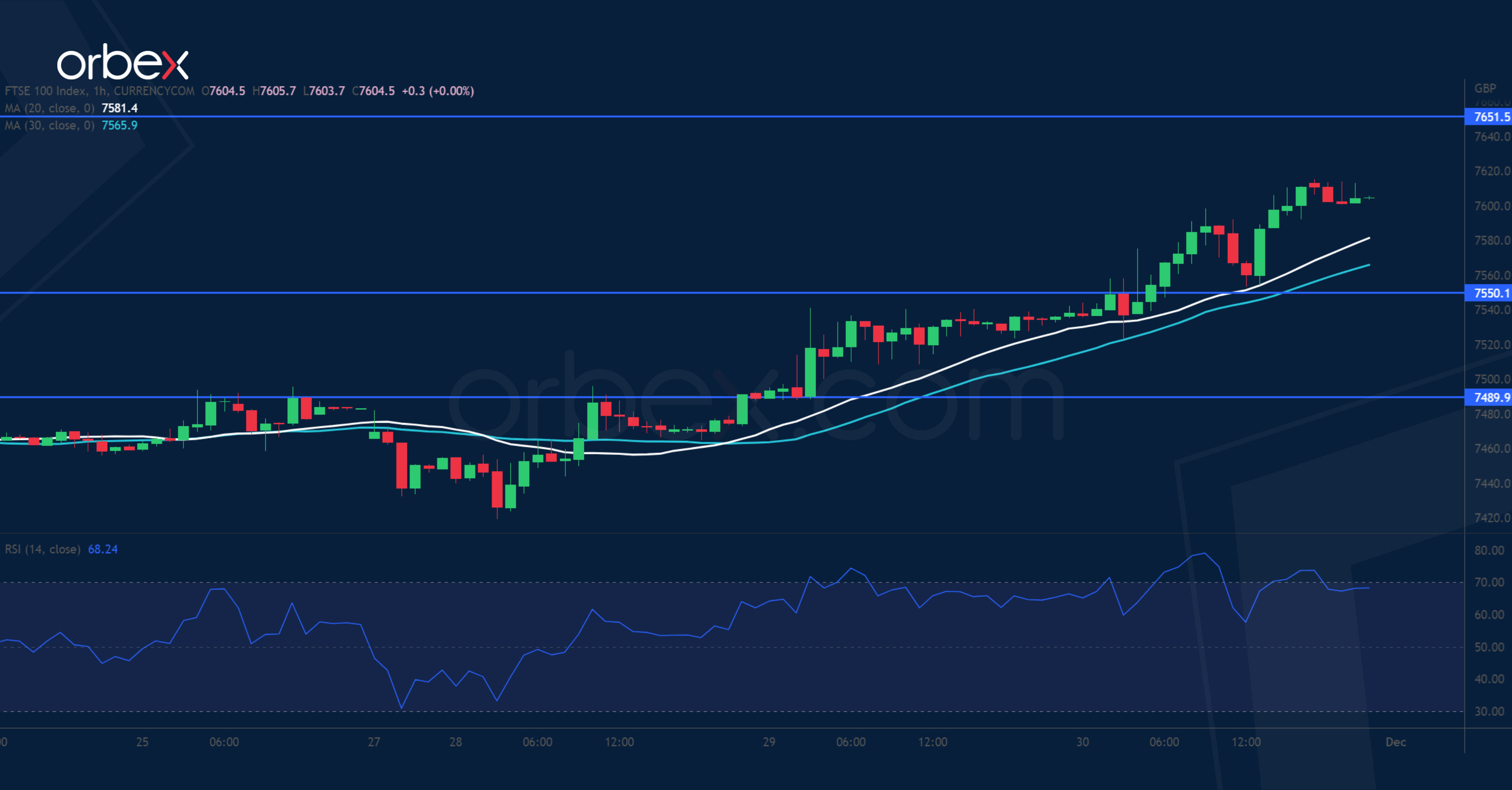
Equities take off as investors price in lower peak US funds rates. The FTSE 100 broke above last August’s high of 7575, which may lay the foundation for an extension in the weeks to come. On the daily chart, the triple top around 7650 is sellers’ last stronghold and a breakout would be significant after a near nine-month long consolidation. The bears may look to switch sides and offer support for a bullish continuation. As the RSI ventures into overbought territory, 7550 is the first level to expect follow-up interests in case of a pullback.
US Oil Tests Resistance
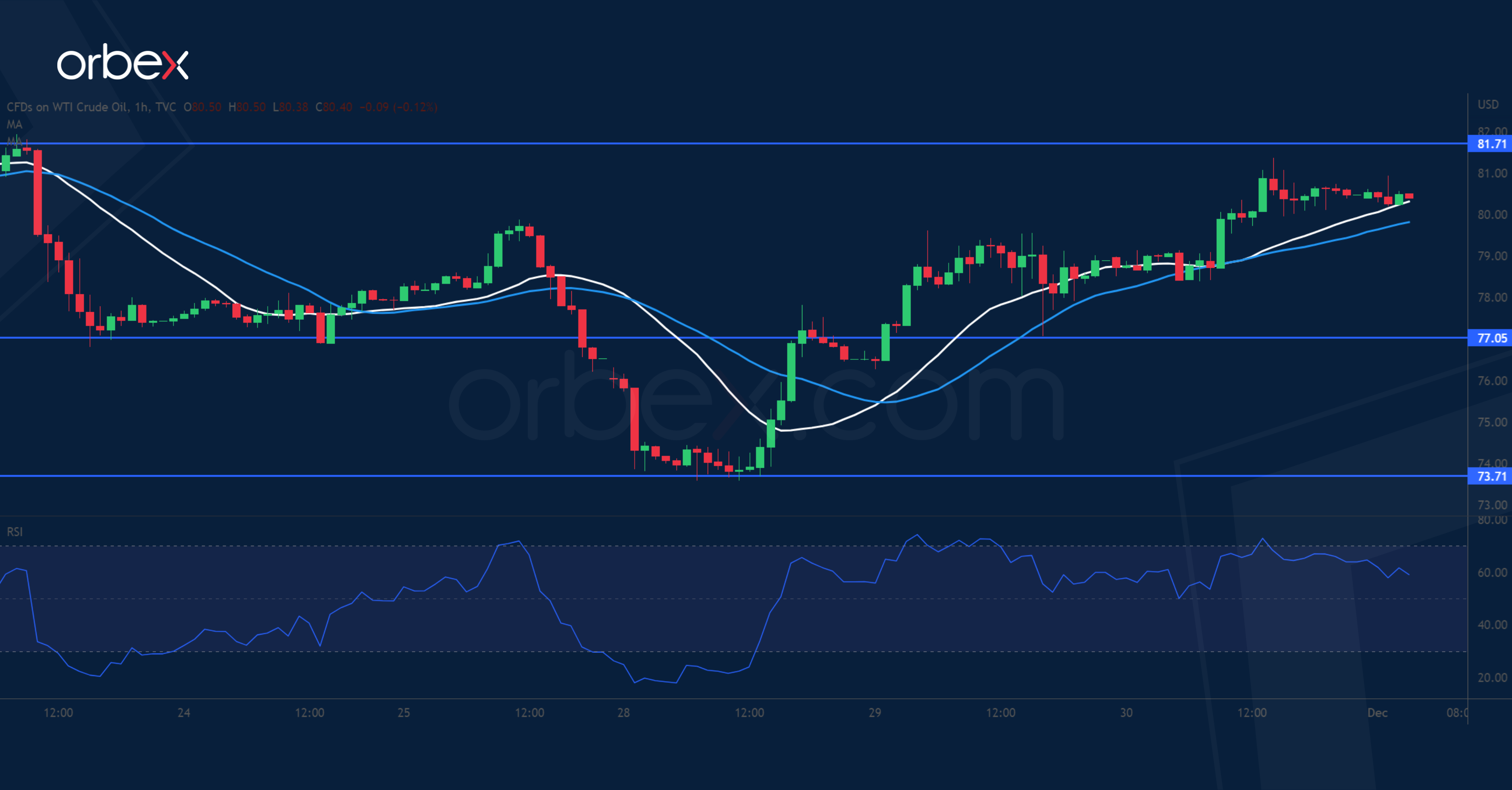
Oil prices find support from a large drawdown in US inventories. Sentiment remains cautious at best after WTI broke below September’s low of 76.60. The RSI’s repeatedly oversold condition attracted some bargain hunters. 81.70 from a previously faded rebound is the first key resistance. Then the area of confluence at 84.50, a support-turned-resistance which coincides with the 30-day moving average, may see offers from medium-term bears. A drop below 77.00 could renew the selling pressure.
EUR/USD Regains Traction
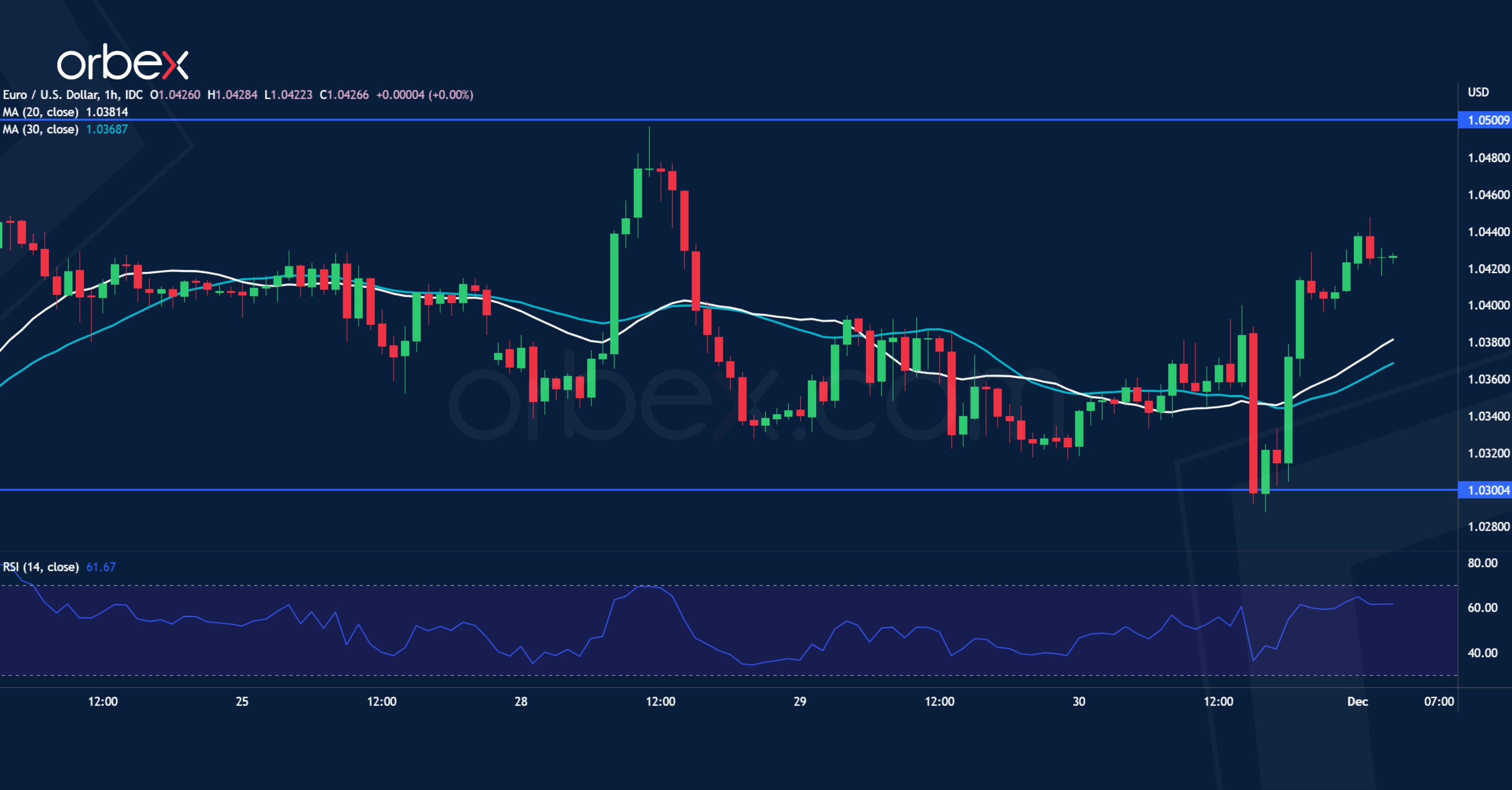
The US dollar plunged after Fed Chairman Powell signalled a slowdown in rate hikes. A close above the recent high of 1.0450 was an encouraging sign that the optimism is still prevailing. But the psychological level of 1.0500 has caused some profit-taking, weighing on the rebound. After a bounce off 1.0300 and above 1.0390, a retest of 1.0500 and a bullish breakout would carry the single currency to its 5-month high (1.0600) against the US dollar. Further down, 1.0220 near the 30-day moving average is a critical floor.
Markets Saw Powell’s Speech as Softer than Expected
Markets
Yesterday, EMU November headline CPI eased more than expected from 10.6% to 10.0%, but didn’t came as a surprise after member states’ data published on Wednesday. Core inflation holding stubbornly high at 5.0% even caused a temporary rebound in German/EUM yields (about 5.0 bps), but the gains were largely reversed at the close (German 2-y +2.3 bps, 30-y unchanged). Early in US dealings, US yields held a tentative upward bias going into Fed Powell’s speech even as ADP job growth (127k from 239k) eased more than expected. However, markets saw Powell’s speech as softer than expected. Inflation is still too high, but as policy tightening works with a lag, it is appropriate to reduce the pace of rate hikes in December (to 50 bps). At the same time, he stated that ‘the timing of that moderation is far less significant than the questions of how much further we will need to raise rates to control inflation, and the length of time it will be necessary to hold policy at a restrictive level.’ The Fed chair also repeated that the ultimate level of rates will likely be somewhat higher than indicated in the September dots. However, a balanced assessment on the progress the Fed Chair sees in at least some inflation components apparently caused markets to concluded that ‘somewhat higher’ doesn’t by definition mean a policy rate above 5.0%. This evidently is subject to interpretation/sentiment. Even so, US yields nosedived between 18.7 bps (5-y) and 6.6 bps (30-y). The 10-y US real yield tumbled almost 25 bps! This easing evidently didn’t pass unnoticed in other markets. US equities rose 2.18% (Dow) to 4.41% (Nasdaq). The dollar more than reversed early gains with DXY closing at 105.95 (intraday top north of 107). EUR/USD closed near 1.04. Sterling slightly outperformed the euro with EUR/GBP closing at 0.8630.
This morning, the risk-on continues in Asia, even as they don’t match WS. Still markets are supported as a Chinese official indicate that Covid policy is entering a new (less strict) phase. Regional indices mostly are gaining between 0.5% and 1.5%. US yields rebound marginally. The dollar eases further (EUR/USD 1.044; USD/JPY 136.4). The yuan extends is rebound (USD/CNY 7.06). Later today, the focus will be on the US data, with the October PCE deflators, the manufacturing ISM and, to a lesser extent, the weekly jobless claims. The core PCE deflator is expected to ease slightly (0.3% M/M -5.0 % Y/Y from 0.5% M/M and 5.1%). The Manufacturing ISM might be at least as important as markets will be eager to learn on the slowdown after last week sharp decline in the PMI. The headline ISM is expected to drop below the 50 (49.7 from 50.2). In a longer term perspective, market probably have discounted enough relative softness, but the trend stays strong. For the US 10-y yield (3.61%) 3.55% is a next support. In Europe, assuming the ECB raises the policy rate to 3.0% (+), how much value does this leave in a 1.90% 10-y Bund yield? The ST USD momentum also stays negative, with EUR/USD (1.045) nearing 1.05, with 1.0615 next resistance.
News Headlines
The London School of Economics in a study found that Brexit has added about £210 pounds, or 6%, to food bills for an average UK household. These additional costs arise from so-called non-tariff barriers that arose when the UK swapped a deep trade relationship with little to no hurdles for one that includes customs checks, rule-of-origin requirements and sanitary measures. The study finds that businesses importing from the EU have passed 50 to almost 90% of those extra charges to the UK consumer. Higher food prices mean an increase in the overall cost of living between 0.7% and 1.1%. Bank of England chief economist Huw Pill in a speech yesterday said the task of getting inflation back to the 2% target is complicated by Brexit. It puts upward pressure on prices through three channels: changes to migration, reduced competition and lower trade intensity.
Polish inflation unexpectedly eased in November, decelerating from 17.9% y/y to 17.4%, missing an 18% consensus estimate, according to data from the Polish Statistics Office. Food (22.3% y/y) and energy prices (36.8% y/y) are still the major driving forces. Monthly dynamics slowed from 1.8% to 0.7%. The numbers settle what little is left of the market debate whether the National Bank of Poland should resume tightening. It paused the hiking cycle at 6.75% since October even as inflation rose further. The Polish swap curve became less inverse after the CPI release. Yields fell up to 23 bps at the front end while losing 14 bps at longer tenors. The Polish zloty whipsawed but ended the day marginally stronger. EUR/PLN closed at 4.67, the weakest (strongest for the zloty) level since mid-August.
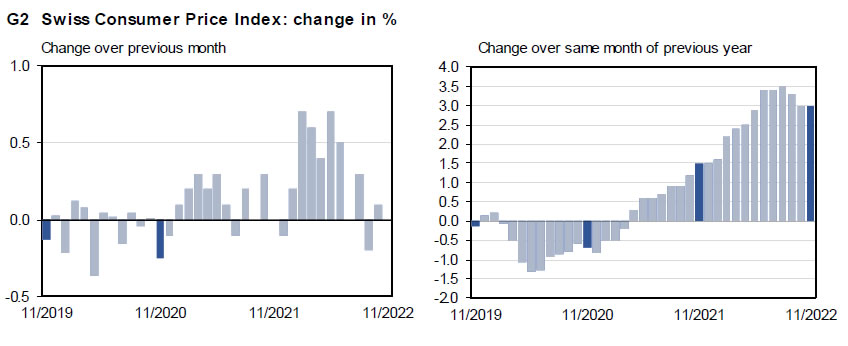
Swiss CPI unchanged at 3.0% yoy in Nov
Swiss CPI was unchanged at 3.0% yoy in November, above expectation of 2.6% yoy. Core CPI (excluding fresh and seasonal products, energy and fuel) rose from 1.8% yoy to 1.9% yoy. Domestic product inflation rose from 1.7% yoy to 1.7% yoy. But Imported product inflation slowed from 6.9% yoy to 6.3% yoy.
FSO said: "The stability of the index compared with the previous month is the result of opposing trends that offset each other overall. Prices for housing rentals, gas and fuels increased, as did those for foreign and Swiss red wine. In contrast, prices for heating oil, fruiting vegetables and hotel accommodation decreased."
Also released, retail sales dropped -2.5% yoy in October, worse than expectation of 3.3% yoy rise.
Investors ‘Really’ Want to See the Fed Half-Dove
Oops investors did it again. They did not listen well to what Jerome Powell said yesterday.
Powell said that the Federal Reserve (Fed) will slow down the pace of rate hikes from next month, while insisting that the borrowing costs will keep rising, and remain high for some time until the Fed is sure the battle against inflation is won.
And more importantly, Powell said, smaller increases are less important than how much further to go and for how long.
In summary, Powell warned investors that the terminal Fed rate will be higher, and it will stay there longer.
But all investors heard was ‘the Fed will hike by 50bp next month and bla bla bla…’
The US 2-year yield slipped by almost 3.70% to below its 50-DMA, and the 10-year yield fell by a similar size, to 3.60% for the first time since the end of September.
The probability of a 50bp hike from the next FOMC meeting rose from 67.5% to above 78%, the US dollar index fell to test the 200-DMA yet again, and equities rallied.
The S&P500 soared 3% past its 200-DMA and hit the year-to-date descending channel top at 3080, and Nasdaq rallied more than 4.50% to close the day above its 100-DMA, and above the 12’000 psychological mark.
Powell, himself, probably didn’t understand what went wrong in that speech.
Recession pricing will not be as sweet
Visibly, stock investors are looking past what Powell says, they price the fact that a recession is coming.
Indeed, the spread between the US 3-month and 10-year yield further widened yesterday, which is read as a sure sign that the US will step into recession next year, and that apparently spurs the Fed doves.
And if the recession pricing looks sweet now - because it softens the Fed expectations - the real recession pricing will likely bring along fresh waves of sharp market selloffs and that is something that the market should be ready to shoulder.
In the FX
The US dollar’s depreciation is being cheered across the market. The data released yesterday in the US was mixed, and investors didn’t know what to do about them until Jerome Powell came in the picture, and triggered a weird euphoria.
Quickly, the third quarter GDP was revised to 2.9%. That was higher than the expectations, which makes the recession odds even weirder, by the way.
The job openings fell. That’s good news for the Fed, but they fall at a snail pace, so I don’t know if we can talk about tightening labour conditions.
But the ADP report printed 127’000 new private job additions, and that was happily less than 200’000 expected by analysts.
As a result, in all the data released yesterday, including Powell’s speech, the ADP report was the only piece of news that could justify a more dovish Fed. The rest did not. But again, optimism was clearly there.
The EURUSD pushed above the 200-DMA on the back of a broadly softer US dollar and flirted with 1.0450 in Asia. Plus, the preliminary inflation report revealed yesterday showed a faster-than-expected slowdown in Eurozone inflation. The flash CPI estimate fell to 10%, versus 10.4% expected by analysts and 10.6% printed a month earlier. Softer energy prices, and the weaker dollar have certainly played an important role in slowing European inflation, but inflation remains 5 times the ECB’s 2% policy target.
So it’s hard to bet on slower rate hikes from the ECB just because inflation fell to 10% one month. Therefore, the ECB will highly likely hike by another 50bp at December, as the Fed, but the picture for ECB is a bit more depressing than for the Fed. There is obviously a war going on, on the continent, the energy prices were up by 35% over the past year, which is less than the 42% rise last month, but it is still A LOT. And upside risks prevail as the European nat gas futures are on the rise again, due to cold weather and restricted output. Plus, the food price inflation in Europe continued to rise last month from 13.1% to 13.6%. It’s worse than the 12.4% rise in British food prices. To say, it’s really bad.
Else, the dollar-yen fell to 136.50, and the pair is headed toward its own 200-DMA in the continuation of the downside correction, thanks to a broadly softer US dollar. And if Japan doesn’t need to spend its FX reserves to strengthen the back of the yen, they could well use it to increase the defense spending, without increasing taxes and without cutting spending.
Oil up despite higher recession odds
American crude rallied past the $81pb yesterday as US crude oil inventories fell by 12.6 million barrels last week, well above the 3.2 million barrel draw expected by analysts. It is because exports ran hot, and refineries hit their highest capacity since August 2019.
The expectation that OPEC+ will maintain, and maybe further cut output at Sunday’s meeting also boosts oil appetite.
But be careful with the rising recession odds, because investors have been cutting their net speculative positions despite the supply concerns, and that’s probably going to limit the topside into $85pb mark, where stands the 50-DMA.
Risk Rallies on Powell
Market movers today
The main release today will be ISM manufacturing for November this afternoon. It is expected to drop below 50 from 50.2 to 49.7. Focus will also be on the price and employment components. US also releases personal spending and PCE inflation.
German retail sales will be out this morning. It has been trending lower since February but is quite volatile on a monthly basis.
Euro unemployment is expected to be unchanged at 6.6%, which is low in a historical perspective and illustrating a still tight labour market despite a slowing economy.
In the Nordics we get manufacturing PMIs in both Sweden and Norway where the details will be scrutinised. For Sweden we expect to see continued weak orders, improvement in supply chains and receding price pressures. The Norwegian PMI surprised by climbing to 53.1 in October after trending down since before the summer. Further weak global growth but a solid upturn in oil-related industries suggest a mixed picture, but the PMI is most likely to drop back towards 50. For both the Swedish and Norwegian releases the employment components have held up well so far and it will be important to look for signs if this is changing.
The 60 second overview
Fed chair Powell-speech: following four consecutive hikes in the Fed fund's target rate this year Fed Chair Jerome Powell yesterday indicated that the forthcoming December hike will be of a smaller size of 50bp. Powell once again referred to the importance of risk management in setting Fed policy. Meanwhile, while this rhetoric previously has been used in the context of the risk of not tightening enough it was now used in the context of the risk of overtightening. Fed's confidence in bringing inflation down seems to have risen and Powell expressed guarded optimism on the prospects for a soft landing of the US economy.
Markets rally: Financial conditions eased considerably on the speech with equities rallying, yields declining, real rates falling sharply, credit spreads tightening and the USD weakening. Also commodities took the news positively with oil, industrial metals and precious metals all moving higher Overnight the big Asian equity indices have also followed their US counterparts into green territory - albeit not quite as much as the duration sensitive US indices.
Our take: Powell's speech clearly challenges our near-term call for a 75bp hike to the Fed funds target in December. Meanwhile, we also highlight that Powell expressed that policy rates are likely to be higher than assumed in September when the median Fed dot showed 4.6% for next year. In our view, that supports the narrative that it is still far too early to speculate in an actual Fed pivot - understood as the timing of Fed rate cuts. Instead a slower pace of rate hikes now only extends the hiking cycle further into 2023.
Powell emphasised that the length of time that monetary policy will be kept at restrictive territory is far more important than the near-term incremental pace of hikes. We share the same view. In that light we think the sharp rally in risk only lengthens this period and shows that it is still too early to declare victory in the fight against high inflation which also historically has proven a quite persistent phenomenon.
Equities: Bad news is bad news but investors do not get it yet. US equities rallied yesterday, as Powell guided for a 50bp hike instead of 75bp, a moment after dreadful macro data. A 50bp hike was already consensus but nonetheless S&P shot up 3% and Nasdaq 5%. Risk on with all sectors higher (including industrials despite the plunging PMI!) but tech, communications and consumer discretionary up 4-5%. Now, we expect this equity rally to reverse soon. Remember, we recommend to add more growth/quality stocks to leverage on rallies like yesterday without taking earnings risk.
FI: Powell's remarks were well received by the US Treasury market. 10Y Treasuries rallied some 15bp, while 5Y Treasuries rallied 18bp. The US curve 2-10Y steepened a few bps, but it is still significantly inverted as seemingly the risk of recession is seen to be much higher than expected by the Federal Reserve.
FX: The impact in FX markets of Powell's speech was clear with the USD weakening and risk sensitive currencies rallying. EUR/USD moved back above the 1.04 level while USD/JPY has hit new lows close to 136.
Credit: European credit markets had a relatively calm day prior to Powell with iTraxx main widening 1bp to 92bp while Xover was unchanged at 459bp. As we approach end of year we expect activity levels to decline somewhat in the coming weeks.
EUR/USD Daily Outlook
Daily Pivots: (S1) 1.0323; (P) 1.0376; (R1) 1.0462; More...
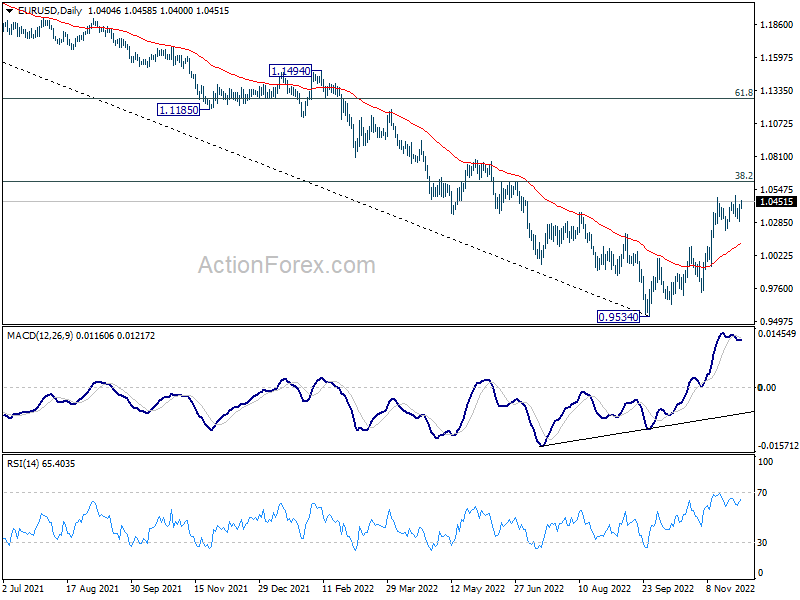
EUR/USD is still bounded in range below 1.0496 and intraday bias stays neutral first. Further rally is expected as long as 1.0222 support holds. Break of 1.0496 will resume the rise from 0.9534 to 1.0609 fibonacci level. However, firm break of 1.0222 will turn bias back to the downside for 1.0092 resistance turned support.
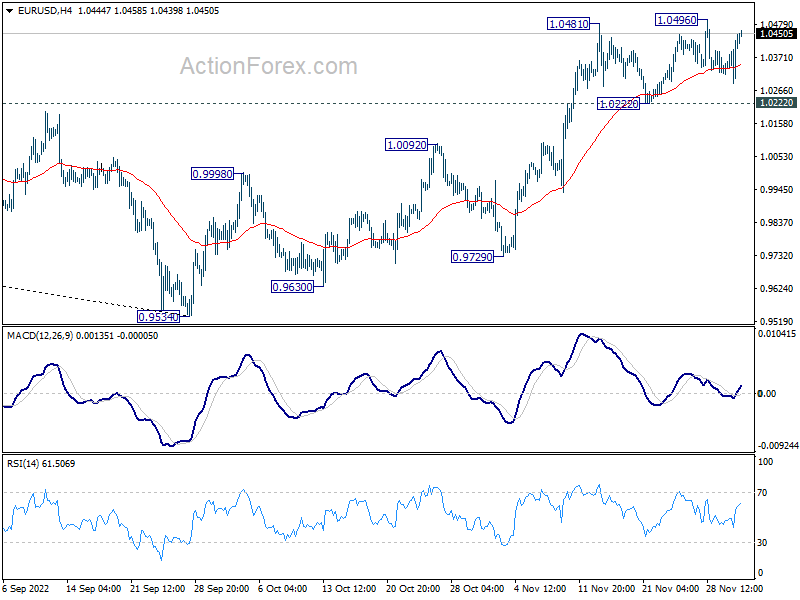
In the bigger picture, a medium term bottom was in place at 0.9534, on bullish convergence condition in daily MACD. Even as a corrective rise, rally from 0.9534 should target 38.2% retracement of 1.2348 (2021 high) to 0.9534 at 1.0609. Sustained trading above 55 week EMA (now at 1.0566) will raise the chance of trend reversal and target 61.8% retracement at 1.1273. This will now remain the favored case as long as 1.0092 resistance turned support holds.