

Sample Category Title
AUD/NZD extending decline after RBNZ
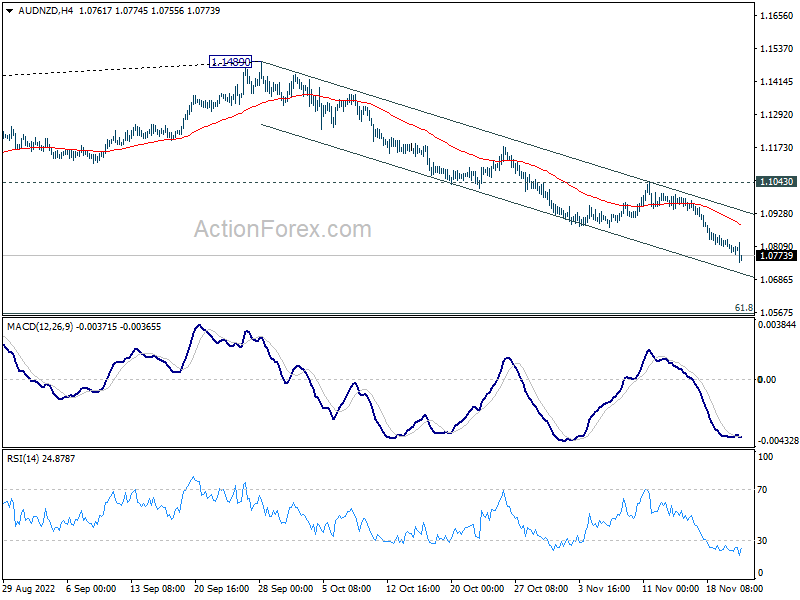
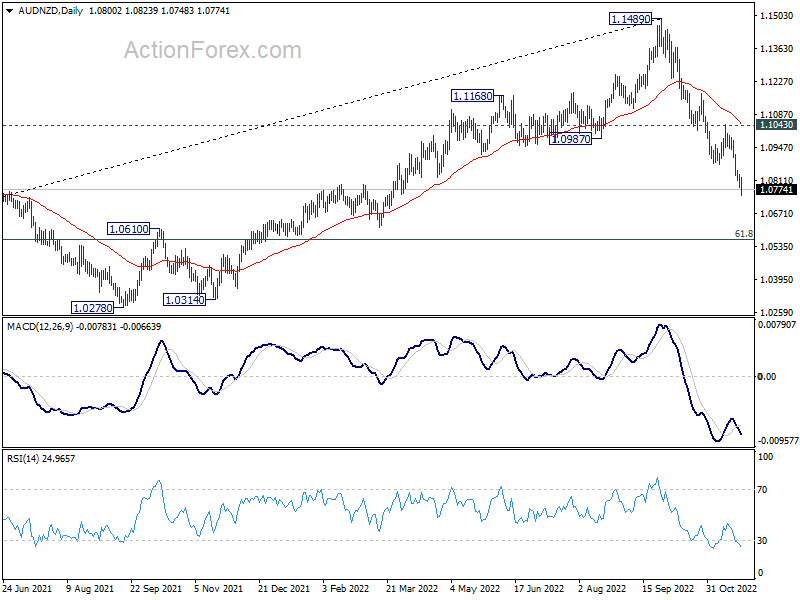
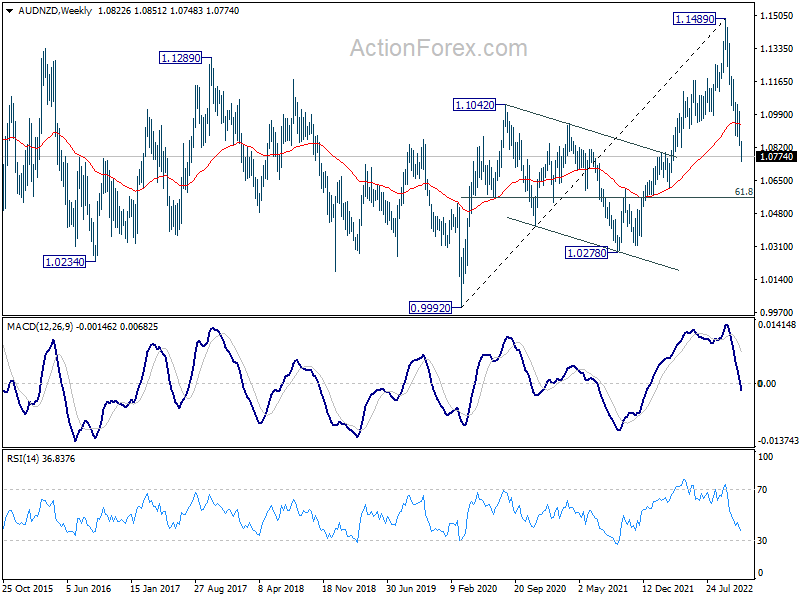
AUD/NZD is extending the decline from 1.1489 after RBNZ's rate hike today. For the near term, outlook will stay bearish as long as 1.1043 resistance holds, even in case of recovery.
In the bigger picture, whole up trend from 0.9992 (2020 low) should have completed with three waves up to 1.1489. Current down side momentum argues that fall from 1.1489 is an impulsive move. But at this point, it's viewed as a leg inside the long term sideway pattern that started in 2015. Even in such case, AUD/NZD would try to hit 61.8% retracement of 0.9992 to 1.1489 at 1.0560 before forming a bottoming.
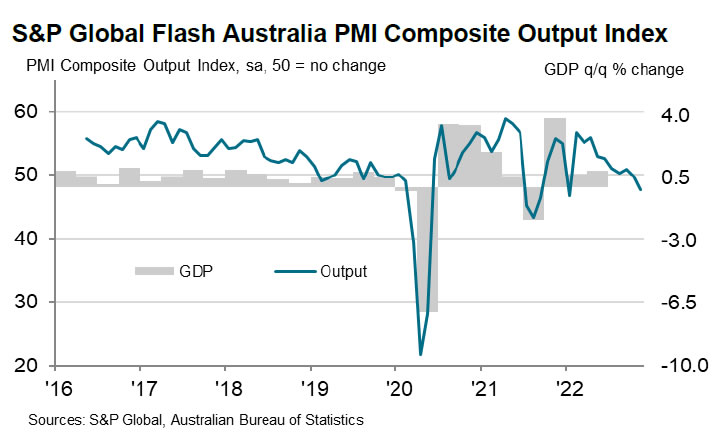
Australia PMI composite dropped to 47.7, deteriorating demand and worsening price pressures
Australia PMI Manufacturing dropped from 52.7 to 51.5 in November, a 29-month low. PMI Services dropped from 49.3 to 47.2, a 10-month low. PMI Composite also dropped from 49.8 to 47.7, a 10-month low.
Jingyi Pan, Economics Associate Director at S&P Global Market Intelligence said:
"The latest S&P Global Flash Australia Composite PMI data revealed that the private sector economy further contracted midway into the fourth quarter, faced with deteriorating demand conditions. In particular, the service sector continued to be affected by higher interest rates and capacity constraints, leading to a sharper fall in business activity.
"That said, with price inflation further climbing in November, the pressure remains on the central bank to keep tightening monetary policy to rein in prices. This is also amid indications of solid employment growth from the PMI data.
"The mix of deteriorating demand and worsening price pressures does not bode well for the near-term outlook, and this has also been reinforced by the decline in private sector confidence in November."
RBNZ hikes 75bps to 4.25%, tightening not finished
RBNZ raises the Official Cash Rate by a record 75bps to 4.25% as widely expected. The central bank maintained that "monetary conditions needed to continue to tighten further, so as to be confident there is sufficient restraint on spending to bring inflation back within its 1-3 percent per annum target range."
During the meeting, increases of 50, 75 and 100bps were considered. But members agreed that "a larger increase in the OCR was appropriate, given the resilience of domestic spending, and the higher and more persistent actual and expected inflation outcomes."
But on the "balances of risks", a 75bps hike was "appropriate at this meeting". Members highlights that "the cumulative tightening of monetary conditions delivered to date continues to pass through to the economy via the lagged transmission to effective retail interest rates."
In the new forecasts, annual inflation is projected to rise further to 7.5% in Q4 and Q1, then stay above 5% throughout 2023. Inflation would then slowly drop back to 2.9% in Q3, 2024. Quarterly GDP is projected to contract from Q2 2023 to Q1 2024, turn flat in Q2 and Q3 2024, before returning to slight growth. OCR will continue to rise and peak at 5.5% in Q3 2023, before turning down in second half of 2024.
(RBNZ) Higher interest rates necessary
The Committee agreed that the OCR needs to reach a higher level, and sooner than previously indicated, to ensure inflation returns to within its target range over the medium term. Core consumer price inflation is too high, employment is beyond its maximum sustainable level, and near-term inflation expectations have risen.
Global consumer price inflation is broad based and remains heightened. Food and energy prices, and persistent core inflation, have combined to create very high headline inflation in many countries. Central banks are tightening monetary conditions in an effort to slow spending and reduce inflation pressure. The ongoing slowdown in global growth will affect New Zealand through both financial and trade channels, and impact on people's confidence due to uncertainty.
In New Zealand, household spending remains resilient, especially considering the rise in debt servicing costs, the fall in house prices, and low levels of consumer confidence. Employment levels are high, and income growth and household savings are supporting spending. The rebound in tourism is also supporting domestic demand.
The productive capacity of the economy is being constrained by broad-based labour shortages, and wage pressures are evident. Aggregate demand continues to outstrip New Zealand's capacity to supply goods and services, with a range of indicators continuing to signify broad-based inflation pressure.
Committee members agreed that monetary conditions needed to continue to tighten further, so as to be confident there is sufficient restraint on spending to bring inflation back within its 1-3 percent per annum target range. The Committee remains resolute in achieving the Monetary Policy Remit.
First Impressions: RBNZ Monetary Policy Statement November 2022
The Reserve Bank raised the Official Cash Rate by a record 75 basis points to 4.25% and signalled more to come, with its forecasts suggesting that a recession will be needed to rein in inflation.
RBNZ Monetary Policy Statement, November 2022
- The Reserve Bank has increased the Official Cash Rate by 75 basis points to 4.25%. The size of the move was generally expected by economists and financial markets.
- The big surprise was in the projected OCR track. The RBNZ expects the OCR will need to rise to a peak of 5.5% next year (compared to a 4.1% peak in its August forecasts).
- The RBNZ sees inflation as deeply embedded in the New Zealand economy. It now believes that a recession will be needed to bring inflation back within the 1-3% target range in the coming years.
- Even then, it has substantially upgraded its inflation forecasts compared to August, and is not expecting inflation to drop below 3% until the second half of 2024.
- The Monetary Policy Committee also discussed the possibility of a 100 basis point increase today, but settled on a 75 point increase, noting the lagged effects of past interest rate hikes.
- Our current forecast is for a 5% peak in the OCR by early next year. In our view this remains sufficient to bring inflation under control, with borrowers about to encounter substantially higher retail interest rates in the coming months.
- However, the risk is clearly for a higher peak in the near term, given the RBNZ’s inclinations.
RBNZ media release
Higher interest rates necessary
The Monetary Policy Committee today increased the Official Cash Rate (OCR) from 3.5 percent to 4.25 percent.
The Committee agreed that the OCR needs to reach a higher level, and sooner than previously indicated, to ensure inflation returns to within its target range over the medium-term. Core consumer price inflation is too high, employment is beyond its maximum sustainable level, and near-term inflation expectations have risen.
Global consumer price inflation is broad based and remains heightened. Food and energy prices, and persistent core inflation, have combined to create very high headline inflation in many countries. Central banks are tightening monetary conditions in an effort to slow spending and reduce inflation pressure. The ongoing slowdown in global growth will affect New Zealand through both financial and trade channels, and impact on people’s confidence due to uncertainty.
In New Zealand, household spending remains resilient, especially considering the rise in debt servicing costs, the fall in house prices, and low levels of consumer confidence. Employment levels are high, and income growth and household savings are supporting spending. The rebound in tourism is also supporting domestic demand.
The productive capacity of the economy is being constrained by broad-based labour shortages, and wage pressures are evident. Aggregate demand continues to outstrip New Zealand’s capacity to supply goods and services, with a range of indicators continuing to signify broad-based inflation pressure.
Committee members agreed that monetary conditions needed to continue to tighten further, so as to be confident there is sufficient restraint on spending to bring inflation back within its 1-3 percent per annum target range. The Committee remains resolute in achieving the Monetary Policy Remit.
Gold Price Dips But Key Support Intact, Oil Recovers
Key Highlights
- Gold price started a downside correction from the $1,786 level.
- It traded below a short-term rising channel with support at $1,775 on the 4-hours chart.
- Crude oil price tested the $76.50 zone before it recovered.
- The US Manufacturing PMI could drop to 49.8 in Nov 2022 (Preliminary).
Gold Price Technical Analysis
Gold price formed a base above the $1,650 level against the US Dollar. The price started a steady increase above the $1,700 and $1,740 levels.
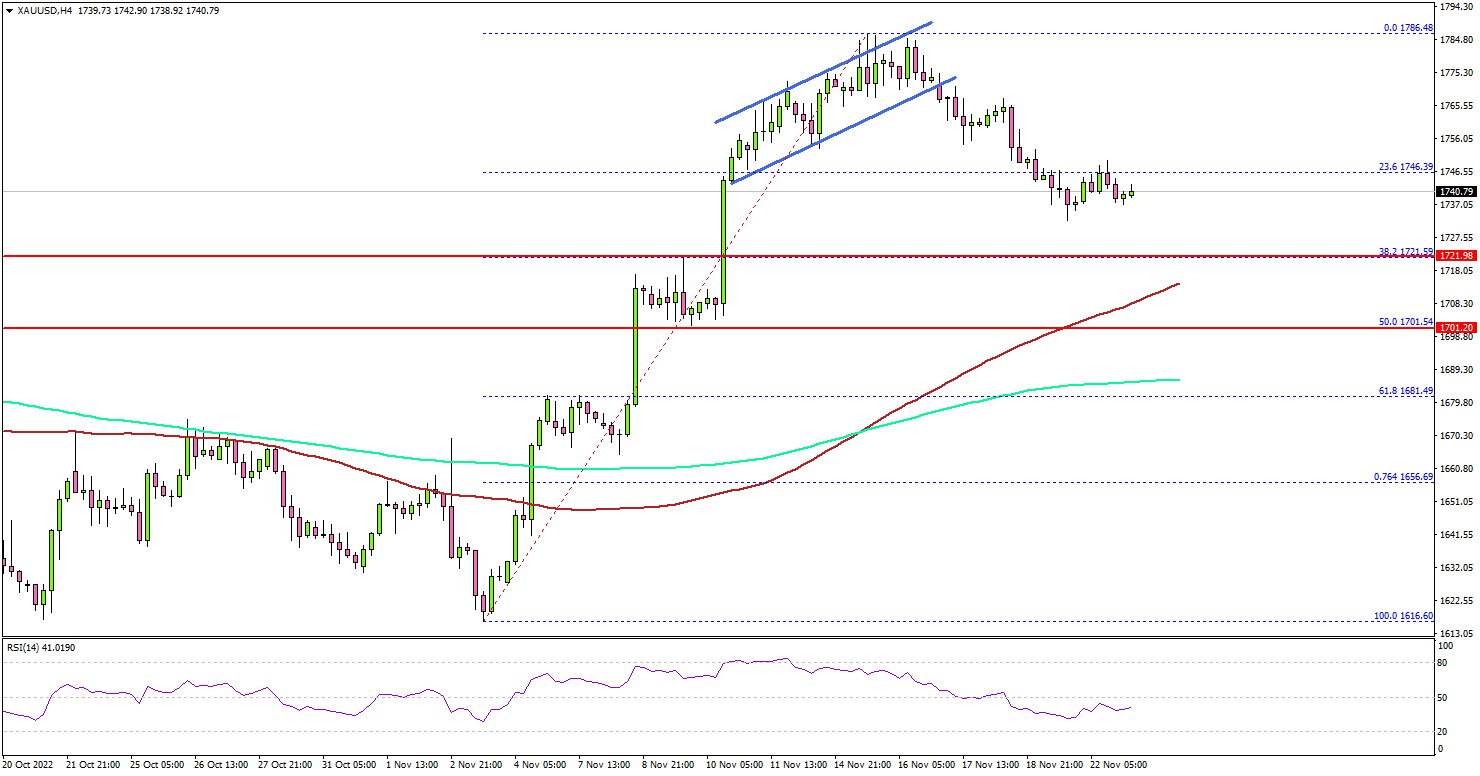
The 4-hours chart of XAU/USD indicates that the price gained pace above the $1,750 resistance zone. The price even moved above the $1,775 level and traded as high as $1,786. Recently, there was a downside correction below the $1,775 level.
The price traded below a short-term rising channel with support at $1,775 on the same chart. It even dropped below the 23.6% Fib retracement level of the upward move from the $1,616 swing low to $1,786 high.
On the downside, an initial support is near the $1,725 level. The next major support is near the $1,710 level or the 100 simple moving average (red, 4-hours).
The main support is near $1,700 or the 50% Fib retracement level of the upward move from the $1,616 swing low to $1,786 high, below which gold price might struggle to stay above the 200 simple moving average (green, 4-hours).
On the upside, the price might face sellers near the $1,765 level. The next major resistance is near the $1,775 level. Any more gains might send the price towards the $1,786 resistance level, above which gold price might revisit the $1,800 resistance.
Looking at crude oil price, there was a sharp decline towards the $76.50 support zone, where the bulls took a strong stand.
Economic Releases to Watch Today
- Germany’s Manufacturing PMI for Nov 2022 (Preliminary) - Forecast 45.0, versus 45.1 previous.
- Germany’s Services PMI for Nov 2022 (Preliminary) - Forecast 46.2, versus 46.5 previous.
- Euro Zone Manufacturing PMI for Nov 2022 (Preliminary) – Forecast 46.0, versus 46.4 previous.
- Euro Zone Services PMI for Nov 2022 (Preliminary) – Forecast 48.0, versus 48.6 previous.
- UK Manufacturing PMI for Nov 2022 (Preliminary) – Forecast 45.8, versus 46.2 previous.
- UK Services PMI for Nov 2022 (Preliminary) – Forecast 48.0, versus 48.8 previous.
- US Manufacturing PMI for Nov 2022 (Preliminary) – Forecast 49.8, versus 50.4 previous.
- US Services PMI for Nov 2022 (Preliminary) – Forecast 47.7, versus 47.8 previous.
- US Initial Jobless Claims - Forecast 224K, versus 222K previous.
- US New Home Sales for Oct 2022 (MoM) – Forecast -3.8%, versus -10.9% previous.
CHFJPY Wave Analysis
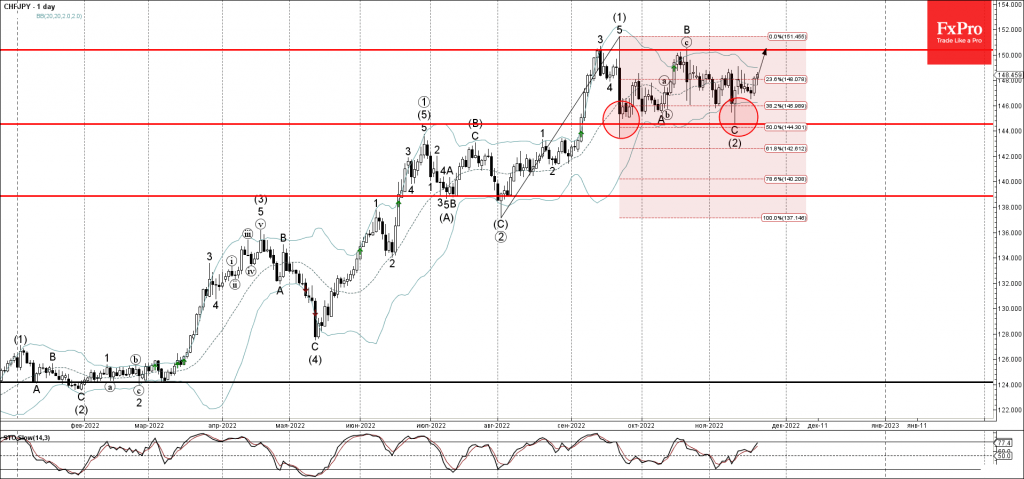
- CHFJPY reversed from support level 144.50
- Likely to rise to resistance level 150.00
CHFJPY recently reversed up from the key support level 144.50 (which stopped the price in September), standing near the lower daily Bollinger Band and the 50% Fibonacci correction of the upward impulse (1) from August.
The upward reversal from the support level 144.50 started the active medium-term impulse wave (3).
Given the clear daily uptrend, CHFJPY can be expected to rise further toward the next resistance level 150.00 (which has been reversing the price from September).
ECB Simkus: 50bps a must for Dec, 75 also possible
ECB Governing Council member Gediminas Simkus said, "it's clear that 50 basis points is a must" for December meeting. He added, "because we still see very strong inflation pressures and we need to dampen them as soon as possible to prevent a de-anchoring of inflation expectations." Yet, "75 is also possible."
ECB will also discussing shrinking the assets purchased with the stimulus program, also known as quantitative tightening. "The sooner we start quantitative tightening, the better," he said. "But in smaller steps, so that it can run somewhere in the background."
Sunset Market Commentary
Markets
The OECD published its biannual economic outlook today. The recap paints a grim outlook: “The global economy is facing significant challenges. Growth has lost momentum, high inflation has broadened out across countries and products, and is proving persistent. Risks are skewed to the downside. Energy supply shortages could push prices higher. Interest rates increases, necessary to curb inflation, heighten financial vulnerabilities. Russia’s war in Ukraine is increasing the risks of debt distress in low income countries and food insecurity.” World GDP forecasts are downgraded to 3.1% Y/Y this year, 2.2% in 2023 and 2.7% in 2024. The UK is forecast to suffer most amongst G7-nations the next two years with forecasts of respectively -0.4% in 2023 and 0.2% in 2024. Germany is the only other in this group expected to shrink next year (by 0.3%) before rebounding 1.5% in 2024. Inflation will remain high in 2023, but moderate because of tighter monetary policy and decelerating growth. For OECD nations we’re talking about 9.4% average inflation this year, 6.6% in 2023 and 5.1% in 2024. None of the major economies apart from Japan are forecast to have average inflation below 2% in 2024. OECD interim chief economist Santos Pereira stressed after the OECD publication that controlling inflation has to be the top priority otherwise we might end up with a wage-price spiral like we had in the 70s or we end up with a situation that inflation becomes so entrenched that the pain needed to control it will be even greater. Risk of overshooting are certainly less than risks of inaction. Finally he added that fiscal policy should work hand-in-hand with monetary policy to help control inflation.
The OECD outlook didn’t interrupt otherwise dull trading. An empty eco calendar on both sides of the Atlantic can’t provide guidance with volumes again thin in this shortened US trading week. Risk sentiment on European bourses improved from yesterday, with main indices gaining marginally. Core bonds gain some ground with US yields 0.5 bps (30-yr) to 3.5 bps (3-yr) lower. German Bunds underperform with yields 1 to 2 bps higher across the curve. The front end marginally underperforms, perhaps with the hawkish ECB Holzmann comments still at play. He favoured a 75 bps rate hike in December, but that’s the minority view for now. EUR/USD trades with a very small upward bias to currently change hands around 1.0270. Sterling outperforms slightly with EUR/GBP currently seen around 0.8640 in a technical move after losing the recent lows.
News Headlines
Belgian consumer confidence recovered in November. But at -22 (from -27), the indicator remains at levels comparable to those seen in the aftermath of the pandemic. Households were less pessimistic in their expectations regarding the general economic situation in Belgium (from -42 to -32), although they are slightly more concerned about the labour market outlook (from 36 to 38). Belgian consumers are slightly more upbeat with respect to their financial situation as expectations for 12 months ahead improved from -17 to -10. Saving intentions have strengthened but not nearly enough to make up for the steep declines seen in the past two months (from -11 to -7).
The Hungarian central bank (MNB) kept its base rate steady at 13% today. The decision was widely expected as the central bank repeatedly said, today too, that it considers 13% a high enough level to manage fundamental inflation risks. Instead, it has resorted to emergency measures including one-day deposit tenders carrying 18%, to sooth those in the market who disagreed. The MNB said these ad hoc tools have improved financial market stability and tightened conditions. Interbank liquidity will be further reduced, enhancing the current policy stance, via a two-month deposit tender and FX swap tenders providing euro liquidity. New MNB forecasts pencil in 3-4% growth for this year, 0.5-1.5% the next and 3.5-4.5% for 2024. Easing external inflationary pressures, the global growth slowdown and shrinking domestic demand should lead to a turnaround in inflation from 2023. Price growth this year may average between 13.5-14.5% and should return to the tolerance band (3%+1 ppt) in 2024H1. The forint trades virtually unchanged. EUR/HUF slightly eases to 407.86. Hungarian swap yields decline between 15-30 bps but the bulk of the move already occurred before the MNB decision.