Sample Category Title
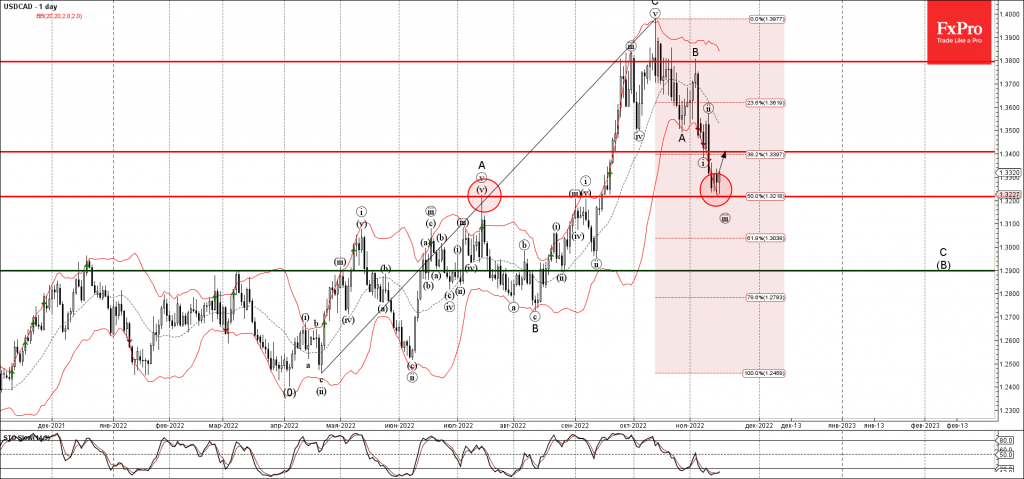
USDCAD Wave Analysis
- USDCAD reversed from support level 1.3215
- Likely to fall to resistance level 1.3400
USDCAD recently reversed up from the key support level 1.3215 (previous monthly high from the start of July), lower daily Bollinger Band, intersecting with the 38.2% Fibonacci correction of the downward impulse from October.
The upward reversal from the support level 1.3215 stopped the earlier short-term impulse wave (iii) of the higher impulse waves C and (B).
Given the clear daily uptrend and the oversold daily Stochastic, USDCAD can be expected to rise further toward the next resistance level 1.3400 (former low of wave (i) from the start of November).
Fed Daly: 4.75% – 5.25% is reasonable for policy rate end-point
San Francisco Fed President Mary Daly told CNBC that "consumers are preparing for slower economy, that's a good start." She added that Fed wants to see "economy slow" to "get inflation down", and "slower inflation, labor market are encouraging ".
She also said "pausing" the tightening cycle is "not part of the discussion" right now. The focus is on "level of rates". She added, "I still think 5% is reasonable" as an "ending place for rates". Also, "a range of 4.75% - 5.25% is reasonable for policy rate end-point."
BoE Bailey: We see some evidence of supply chain shock coming off
BoE Governor Andrew Bailey said in a Treasury Committee hearing, "The economy was hit by a huge shock in terms of the pandemic. What we've had since then is a series of supply shocks, which have reduced the supply capacity of the economy relative to demand. There was a supply chain shock in the recovery from Covid. We see some evidence of that shock coming off."
Bailey added that the job market remains "tight". But, "employers have now begun to say that they are seeing some reduction and competition for hiring," he added. "As yesterday's labor market statistics demonstrated, it's still a very tight labor market."
Deputy Governor Ben Broadbent said, recession in the UK "could quite easily turn out to be a little bit shorter or a little bit longer. "There's a lot of uncertainty, including about the length. We could well be in another quarter of contraction right now."
MPC member Swati Dhingra warned, "There is a risk of overtightening. There's already about a fairly sizable chunk of the previous rate rises that have got to take effect in terms of what they do to GDP."
Dhingra also noted, "it's undeniable" that "we're seeing a much, much bigger slowdown in trade in the UK compared to the rest of the world" and "we're definitely performing below trend in terms of the exports numbers in terms of the inputs, even probably a bit bigger than that."
Silver is One Step Ahead of Gold
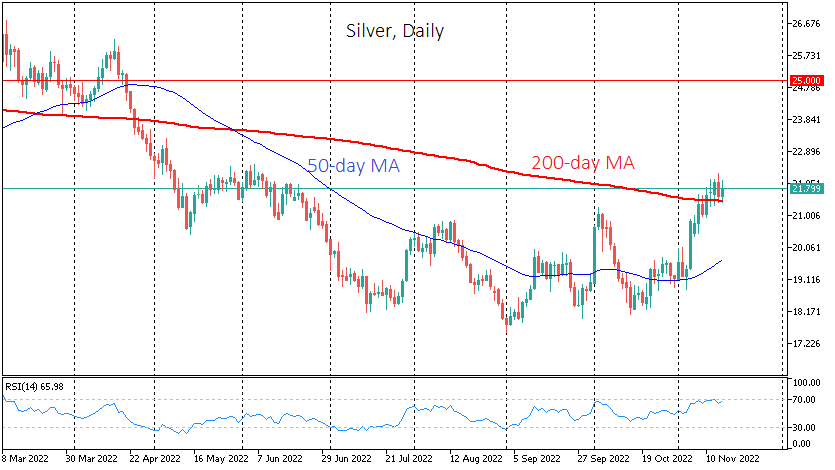
Silver is testing the $22 per ounce mark today and crossed it briefly yesterday. Although Gold marks the fifth consecutive session of back-to-back gains, Silver may have been one step ahead in this market cycle.
In early November, the price of Silver pushed up from the 50-day moving average, which had worked as a support for a week and a half before, as the metal was bought off intraday on dips under this line.
Further, while the S&P500 and stock markets, in general, were recovering from the not-so-dovish Fed comments, Silver rallied more than 7% on solid NFP data, leaving the other precious metals behind. This was a clear game-changer event for this market.
By rising in the following days, the price has reached its 200-day moving average, which Gold, S&P500 and EURUSD have yet to do. Since late last week, Silver has been gaining support on declines towards this line, confirming a change in the long-term trend.
Silver has already lingered near $22 in May and June, digesting the April collapse. There have also been repeated reversals in this area late last year and early this year. There might likely be some shake-out of market participants and partial profit-taking again.
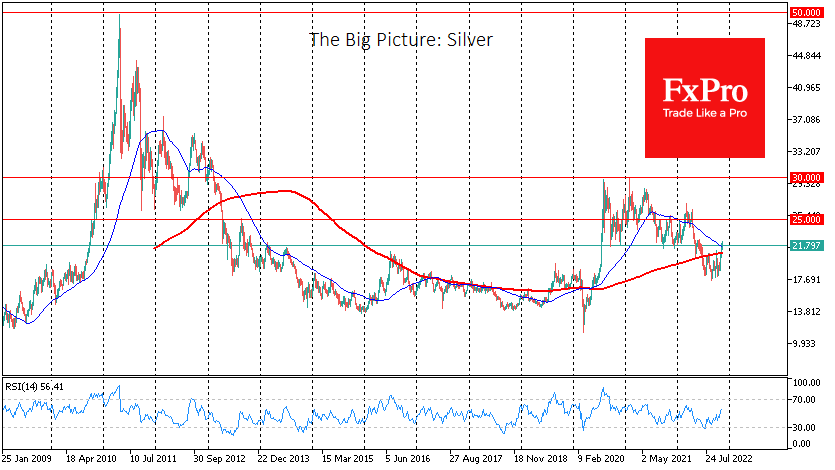
The strong price momentum at the start of November and an even more impressive 9% rise in early October point to a demand, which might turn the market around. This bullish reversal is probably happening in Gold, but it is a more liquid and thus “noisy” instrument.
If we are correct, and after the local shake-out, silver goes further up, it could immediately target levels above $25, near the local peaks of March and April. If the strengthening does not fail again, the price may rise to $30 by August 2023.
It will be premature to talk about the possibility of reaching the highs of 2012 ($35) or 2011 ($50), but targets near $25 by the end of the year and $30 eight months later look achievable.
US: Retail Sales Off to a Good Start to the Quarter
Retail sales rose by 1.3% m/m in October, above the consensus forecast of a 1.0% gain. September data remained flat.
Sales at autos & parts dealers rose by 1.3% m/m erasing September's losses. Excluding autos, sales were up 1.3% m/m.
Gasoline station receipts rebounded from a three-month decline, rising 4.1% m/m. Sales at building materials and garden equipment stores were up 1.4% m/m.
Retail sales in the "control group," which excludes the most volatile categories (autos, gas stations and building materials) and are used in estimating personal consumption expenditures (PCE), rose a healthy 0.7% m/m – double what was expected.
- Within the group, the biggest contributors to growth were sales at non-store retailers (+1.2% m/m) and restaurants (+1.4%m/m) – the only barometers for the services sector in today's reading. Sales were solid at food & beverage stores (+1.4% m/m) and health stores (+0.5% m/m).
- Categories that reported losses in October were sporting goods & music stores (-0.3% m/m) and department stores (-0.2% m/m). Sales at apparel stores were flat on the month, after an upwardly revised gain of 1.0% in September.
Key Implications
A strong start to the quarter was broad-based with a little extra push from sales at gas stations, which reflect price gains. Meanwhile, growth in auto sales was primed by stronger production that helped increase dealers' inventories. In addition, auto sales got a boost from replacements after hurricane Ian, which is estimated to have destroyed between 30,000 and 70,000 cars. We should see demand moderation in future months, but with today's growth real durables goods consumption is forecast to finish the year with decent gains helping lift real PCE growth to 1.7% (annualized) in Q4 – an above trend clip.
Today's report also kicks off the holiday shopping season, pushing sales up in October. According to the National Retail Federation’s annual forecast, holiday spending is expected to be healthy but grow at roughly half the pace of last year – namely, 6-8%. With year-on-year inflation at 7.7%, real holiday sales are poised to move sideways or, at best, gain moderately. So retailers in categories with overbuilt inventories and stagnant sales (department stores, furniture & electronics, building materials) will need to discount their merchandise to appeal to consumers looking to maintain purchasing power.
Canada: Higher Prices at the Pump Keep Inflation Elevated in October
Consumer price inflation held steady in October, at 6.9% year-on-year (y/y), down from 6.9% in September.
Higher gasoline prices in October were a key culprit keeping inflation elevated. Prices at the pump surged 9.2% in October, after three months of decline, and are up 17.8% versus a year ago.
Food inflation did ease very slightly, with prices up 10.1% y/y in October, down from 10.3% in September. Food purchased from stores was up 11% y/y.
The signals from various core inflation measures were mixed. CPI ex-food and energy was 5.3% higher versus a year ago, a tick lower than 5.4% in September. However, the average of the three Bank of Canada core inflation metrics remained unchanged (after rounding) at 5.4% y/y. Perhaps more importantly, the two measures that the BoC has indicated provided a more timely gauge of underlying inflation through the pandemic - CPI-trim and CPI-median, both picked up a tick to 5.3% y/y and 4.8% y/y respectively.
Shelter inflation accelerated in October, up 6.9% y/y, versus 6.8% in September, despite a cooling in homeowners replacement costs (+6.9% y/y from 7.7% y/y in September). Upward pressure came from higher mortgage interest costs (+11.4% y/y) – which saw the highest increase since 1991 – and rents (+4.7% y/y versus 4.2% in September).
Key Implications
Today's inflation report underscores the need for the Bank of Canada to keep the pressure on interest rates to help bring down inflation. October's CPI report is one of two key remaining data releases before the Bank of Canada's next rate decision in three weeks, and it certainly ticks the box for another 50 basis point increase.
The other key piece of data will be the November jobs report in a couple of weeks. As outlined in our recent report on job vacancies Canada's labour market remains very tight. Even if we see a weak report, it is unlikely to move the needle enough on the job market to move the BoC off its tightening bias.
US Consumer Remains Strong
Equity markets in Europe are back in the red on Wednesday, while the US looks largely unchanged around the open on Wall Street.
Reports of missile strikes in Poland on Tuesday naturally caused a shudder in the markets. The prospect of a sudden and unexpected escalation in the war in Ukraine, particularly involving a NATO state, doesn't bear thinking about but we were almost forced to and under the circumstance, the reaction was fairly modest.
It could have been much worse but investors appear to have come to the view that it was a situation that would be quickly de-escalated which is what occurred despite initial reports not looking good.
More strong Retail Sales data
US retail sales data will be a minor concern for investors as they continue to cross their fingers for a full Fed pivot next month. In an ideal world, the Fed could bring inflation back to target without causing much damage to the economy, while maintaining a strong labour market and healthy spending. But we don't live in an ideal world and it's unlikely that will be the case. So as long as we continue to see firm figures on employment and spending, the risk of high and stubborn inflation will remain. This won't provide the comfort the Fed wants in order to slow the pace of tightening and draw it to a close earlier than envisaged.
The news doesn't get any better for the UK
UK inflation hit a 41-year high last month as higher energy prices led to the CPI data exceeding expectations, as well as the BoE forecast for its peak. At 11.1%, the data implies a considerable squeeze on real incomes, with the pace far exceeding wages, which were confirmed to have risen 6% in the three months to September, yesterday (5.7% excluding bonuses).
The only upside is that this is expected to be as high as it gets. Of course, just as important is how quickly it's going to fall and the latest surprise to the upside isn't going to fill people with optimism. But with the cost-of-living crisis tipping the economy into recession, interest rates rising and the government about to enact a severe fiscal tightening, it's hard to imagine high inflation being sustainable for long.
With that in mind, I expect Bank of England Governor Andrew Bailey and his colleagues to continue to push back against the prospect of rates rising much further, as they did after the last meeting when highlighted the trajectory for growth and inflation under market-based expectations for interest rates. Today's surprise will be another blow for the central bank but I doubt it drastically changes its outlook.
Oil steadies after strikes in Poland
Oil prices are softer on Wednesday after a brief bout of volatility late Tuesday following reports of missile strikes in Poland. That unsurprisingly jolted financial markets, sending oil prices higher initially, but that quickly settled and crude prices are now back where they were before.
It goes without saying that any significant escalation in the war in Ukraine will likely add a substantial risk premium to oil prices, with Russia being a major producer and exporter, as well as one of the leaders in the OPEC+ alliance. A strike on a NATO member is an extreme example of that and could send oil markets into a frenzy. Thankfully, worst fears haven't been realised but investigations are still taking place which will keep oil traders on edge.
Gold battling resistance
Gold is struggling to take the next step higher after struggling around $1,780 once again today. That's not overly surprising considering this was a major level of support from January to July, at which point it gave way in style losing almost 4% in less than 48 hours.
What's encouraging is that it's not showing signs of easing up. Pullbacks have been minimal and pressure remains to the upside. A break of $1,780 could be the catalyst for another spike and ease any doubts about the sustainability of the rally in the process. Assuming both US inflation releases haven't done that already.
Is there a bullish case for cryptos?
Crypto HODLers may be relieved to see bitcoin finding its feet in recent days but I'm not sure they'll be feeling particularly comfortable with the situation. The headlines remain a concern and the price chart doesn't inspire confidence. In the near-term, it's hard to construct a bullish case for cryptos given the sheer amount of uncertainty in the space in the aftermath of the FTX debacle. That doesn't mean we can't see a recovery but it would certianly be the more surprising outcome at this stage.
Sunset Market Commentary
Markets
NATO chief Stoltenberg said that yesterday’s missile explosion on Polish territory was probably caused by Ukrainian air defenses. An unfortunate accident, nevertheless sparked by the Russian attack against Kiev etc yesterday. By immediately taking the angle out of a potential explosive situation, both parties clearly wanted to avoid an unnecessary escalation in the conflict. Russia kept an extremely low profile attitude over the past 12 hours. From a market point of view, it put EUR/USD back on the recovery track following yesterday’s intraday, 2 big figure, meltdown. EUR/USD marched from an opening around 1.0350 toward and intraday high near 1.0435. The move stalled with Bank of France governor Villeroy de Galhau saying that jumbo ECB rate hikes will not become a new habit. If it were up to him, rates will likely reach about 2% in December, suggesting that the ECB will slowdown its tightening pace in sync with the Fed from 75 bps to 50 bps. While this seems granted for the Fed, we think the case for a 75 bps rate hike in Europe remains more than alive given the relative starting base and the fact that inflation is still setting new cycle highs on a monthly basis. EUR/USD eventually returned below the 1.04 big figure after October US retail sales beat consensus. Both headline and core sales rose by 1.3% M/M with the retail sales control group – proxy for consumption in GDP calculations -- increased by 0.7% M/M (vs 0.3% expected) with the September number upwardly revised from 0.4% to 0.6%. Resilient retail sales keep the Fed in tightening mode, even if they slowdown the pace. It’s all about the peak level and about how long rates will remain restrictive, as Chair Powell indicates. Retail sales forced a spike lower in US Treasuries, with the front end of the curve underperforming. Daily US yield changes range between +0.7 bps (2-yr) and -5.1 bps (30-yr). German Bunds outperform with the curve bull flattening. Yields fall 6 bps at the front end and 10-12 bps from the 5-yr sector on. European bourses correct 0.5% to 1% today after their breath-taking comeback of late.
Sterling lost marginally ground against the euro with EUR/GBP trading above 0.8750. The move came after multi-decade high inflation failed to lift BoE rate hike bets. Inflation accelerated by 2% M/M to 11.1% Y/Y with core CPI stabilizing at 6.5% Y/Y. Tomorrow could be the big day for UK investors with the new government presenting its long term Budget plans.
News Headlines
The ECB in its biannual Financial Stability Review warned that risks to the financial system are rising due to a toxic cocktail of slowing economic activity, inflation, rising financing costs and lower liquidity. The cost-of-living squeeze is weighing on consumer spending as well as their ability to service debts while Europe’s worsening growth prospects threaten corporate profits. This may lead to bankruptcies and greater volatility in financial markets. The ECB said the turmoil in the UK gilt market and the earlier cash crunch that hit European energy traders is testament to the system becoming increasingly vulnerable to such sharp market moves. The report also flagged potential dangers to public finances with governments borrowing a way out of the energy crisis by an estimated 1.4% of EMU GDP. With respect to property markets, the central bank spotted signs that real-estate expansion of recent could come to an end as overvaluation and mortgage rates stand at the highest levels in more than five years.
Canadian inflation as expected stabilized at 6.9% y/y in October. The largest contributor was shelter, adding 2.06 ppts to the yearly figure. The monthly dynamic accelerated from 0.1% to 0.7% m/m on the account of the gasoline category (0.39 ppts contribution). The three different core gauges either stabilized or increased marginally compared to the September figure, bringing their average from 5.37% to 5.43%. Inflation may not have risen in October, but it did show to be very persistent. This leaves the BoC no room yet to pause the tightening cycle. Combined with the stellar labour market report two weeks ago, the central bank is set to deliver another hike at the December 7 meeting. Money markets are currently split between a 25 and 50 bps rate hike. The loonie barely budged today with strong US retail sales published at the same time keeping USD/CAD balanced at around 1.327.
USD/JPY Mid-Day Outlook
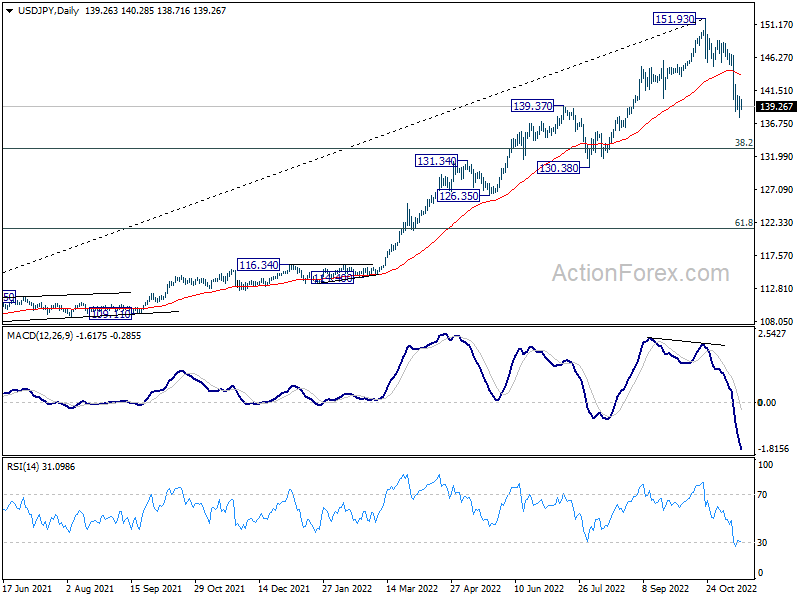
Daily Pivots: (S1) 137.80; (P) 139.20; (R1) 140.73; More...
Intraday bias in USD/JPY stays neutral for consolidation above 137.66 temporary low. Stronger rise cannot be ruled out, but upside should be limited below 145.16 support turned resistance. Break of 137.66 will resume the decline from 151.93, to 133.07 fibonacci level, as a correction to the larger up trend.
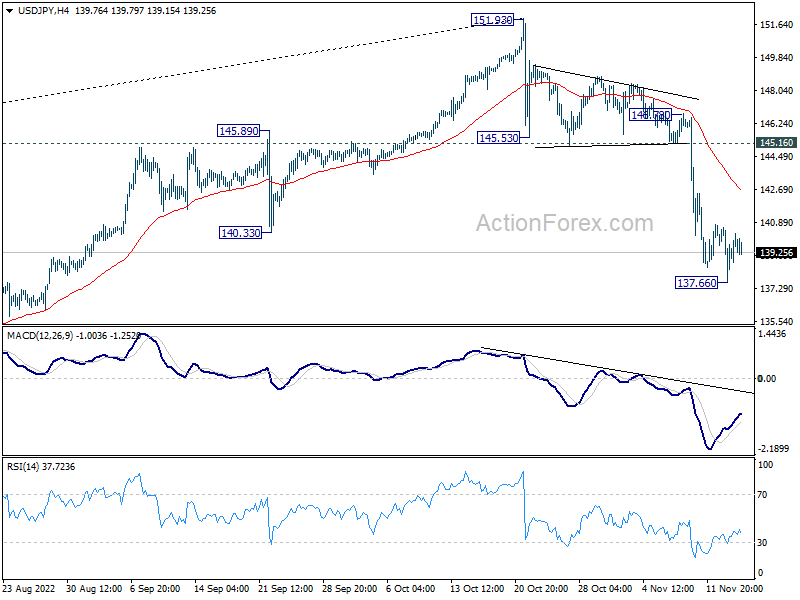
In the bigger picture, a medium term top should be formed at 151.93. Fall from there is correcting larger up trend from 102.58. It's too early to call for bearish trend reversal. But even as a corrective move, such decline should target 38.2% retracement of 102.58 to 151.93 at 133.07, or further to 55 week EMA (now at 130.58).