

Sample Category Title
USD/CHF Daily Outlook
Daily Pivots: (S1) 0.9399; (P) 0.9434; (R1) 0.9483; More...
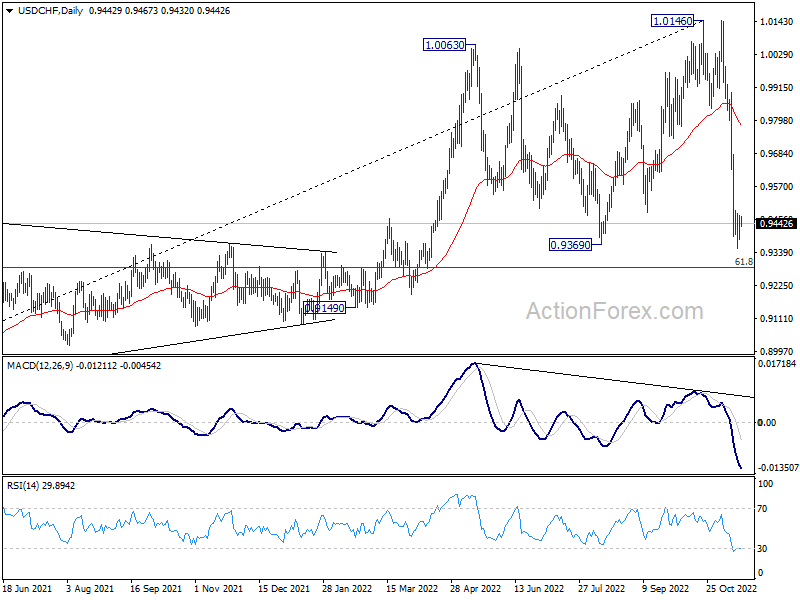
USD/CHF is staying in consolidation above 0.9355 and intraday bias remains neutral. Upside of recovery should be limited below 0.9680 minor resistance to bring another decline. Below 0.9355 will resume the fall from 1.0146 to 0.9287 fibonacci level.
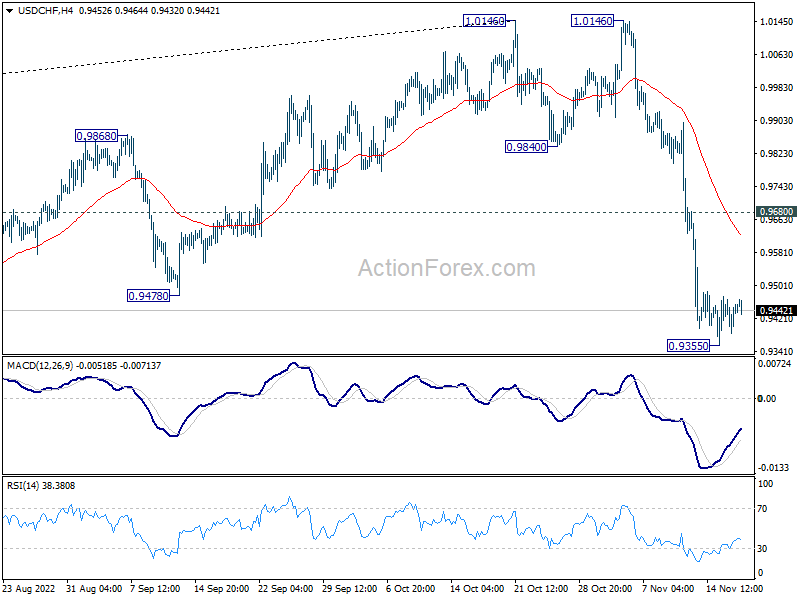
In the bigger picture, rise from 0.8756 (2021 low) has completed at 1.0146, well ahead of 1.0342 long term resistance (2016 high). Based on current downside momentum, fall from 1.0146 might be a medium term down trend itself. Break of 61.8% retracement of 0.8756 to 1.0146 at 0.9287 will pave the way to 0.8756. In any case, risk will stay on the downside as long as 55 day EMA (now at 0.9793) holds.
USD/JPY Daily Outlook
Daily Pivots: (S1) 138.74; (P) 139.52; (R1) 140.30; More...
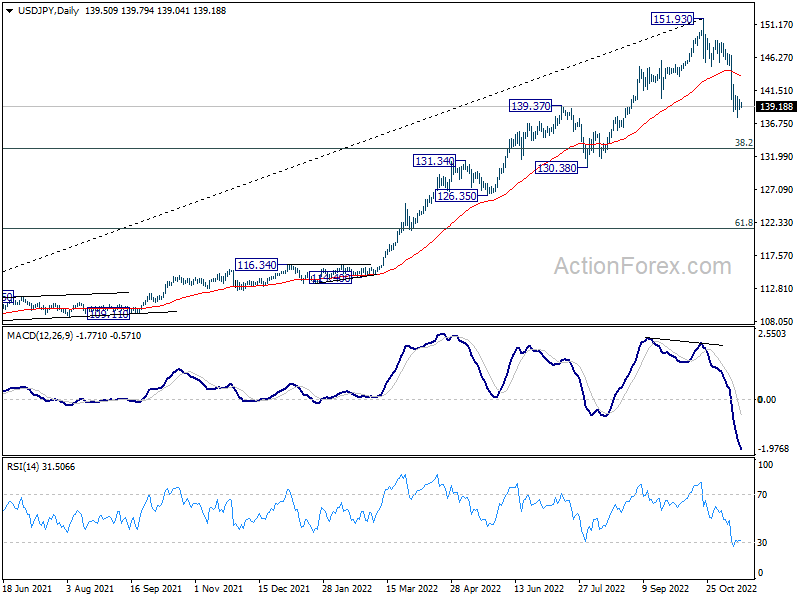
USD/JPY is staying in consolidation above 137.66 temporary low and intraday bias remains neutral. Stronger rise cannot be ruled out, but upside should be limited below 145.16 support turned resistance. Break of 137.66 will resume the decline from 151.93, to 133.07 fibonacci level, as a correction to the larger up trend.
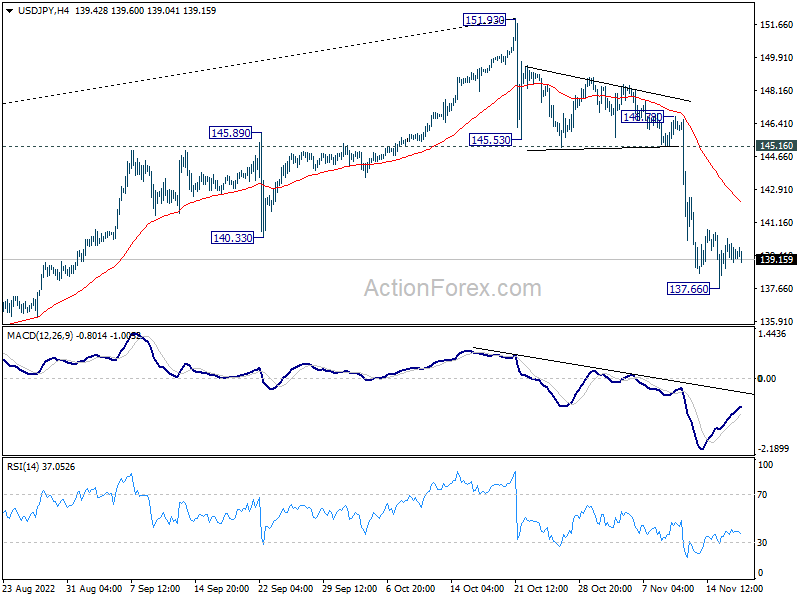
In the bigger picture, a medium term top should be formed at 151.93. Fall from there is correcting larger up trend from 102.58. It's too early to call for bearish trend reversal. But even as a corrective move, such decline should target 38.2% retracement of 102.58 to 151.93 at 133.07, or further to 55 week EMA (now at 130.58).
USD/CAD Daily Outlook
Daily Pivots: (S1) 1.3255; (P) 1.3301; (R1) 1.3374; More....
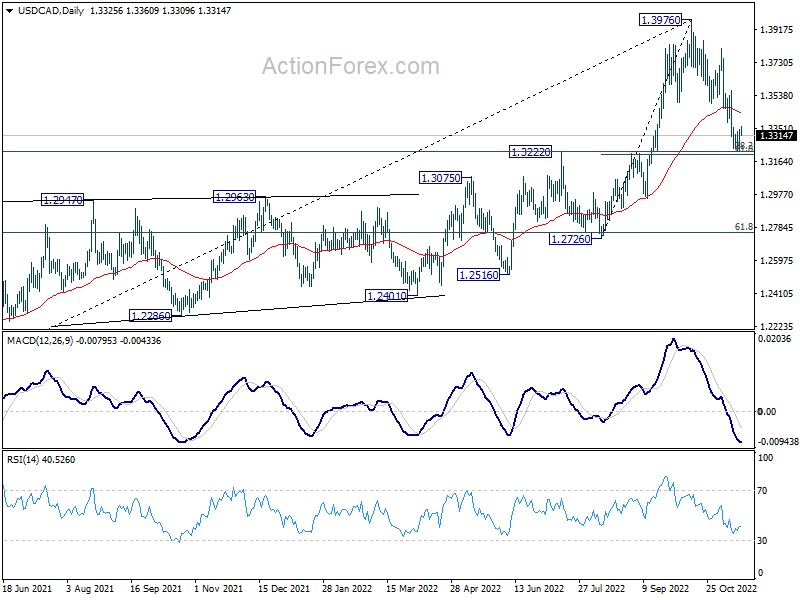
Intraday bias in USD/CAD stays neutral for at this point. Strong support could be seen from 1.3207 cluster support (61.8% retracement of 1.2726 to 1.3976 at 1.3204) to bring rebound. Break of 1.3494 support turned resistance will turn bias back to the upside. However, sustained break of 1.3204/7 will carry larger bearish implication and target 1.2952 support next.
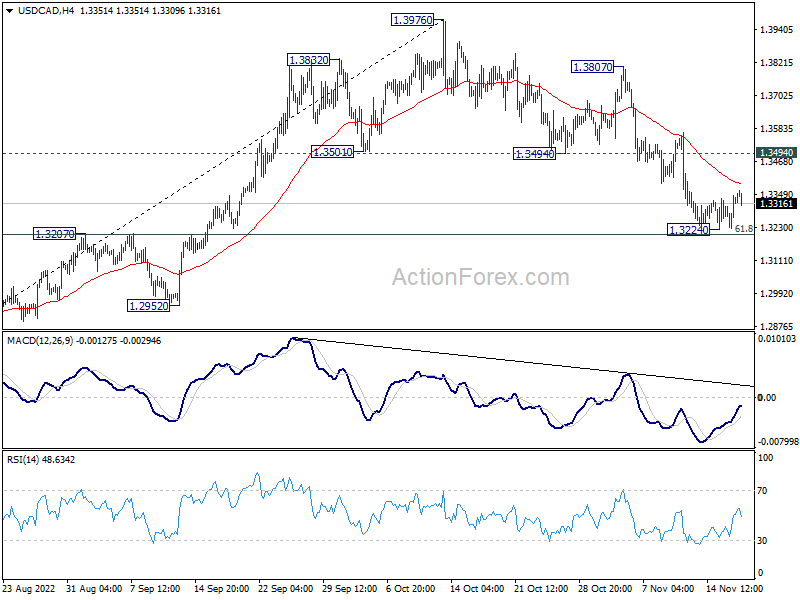
In the bigger picture, as long as 1.3222 cluster support (38.2% retracement of 1.2005 to 1.3976 at 1.3223) holds, larger up trend from 1.2005 (2021 low) is still expected to resume through 1.3976 high at a later stage. . However, firm break of 1.3222/3 will indicate that the trend might have reversed. Deeper fall would be seen to next cluster support at 1.2726 (61.8% retracement at 1.2758).
XAGUSD: How High Can the Exchange Rate Rise?
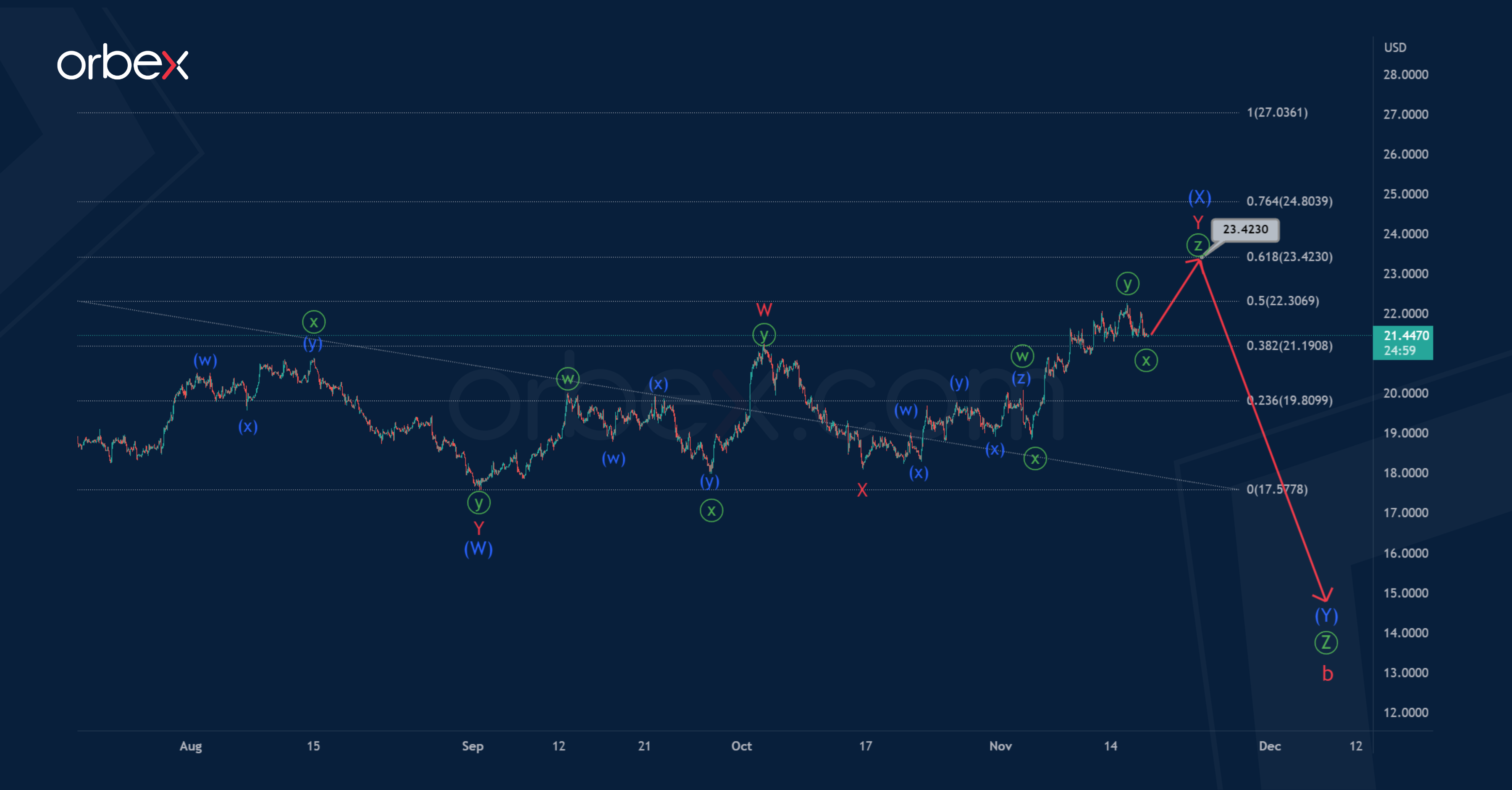
A closer look at the 1H timeframe shows the marking of a large corrective wave b, which is part of the global zigzag. Correction b most likely takes the form of a triple zigzag Ⓦ-Ⓧ-Ⓨ-Ⓧ-Ⓩ. The first four primary waves are completed, and the last wave is still under construction.
It is assumed that the primary wave Ⓩ will be a double zigzag of the intermediate degree (W)-(X)-(Y). After the end of the actionary wave (W), the price began an upward movement in the intervening wave (X). Like wave (W), intervening wave (X) can end in the form of a minor double zigzag W-X-Y.
The end of the bullish trend is expected near 22.420. At that level, wave (X) will be at 61.8% of wave (W).
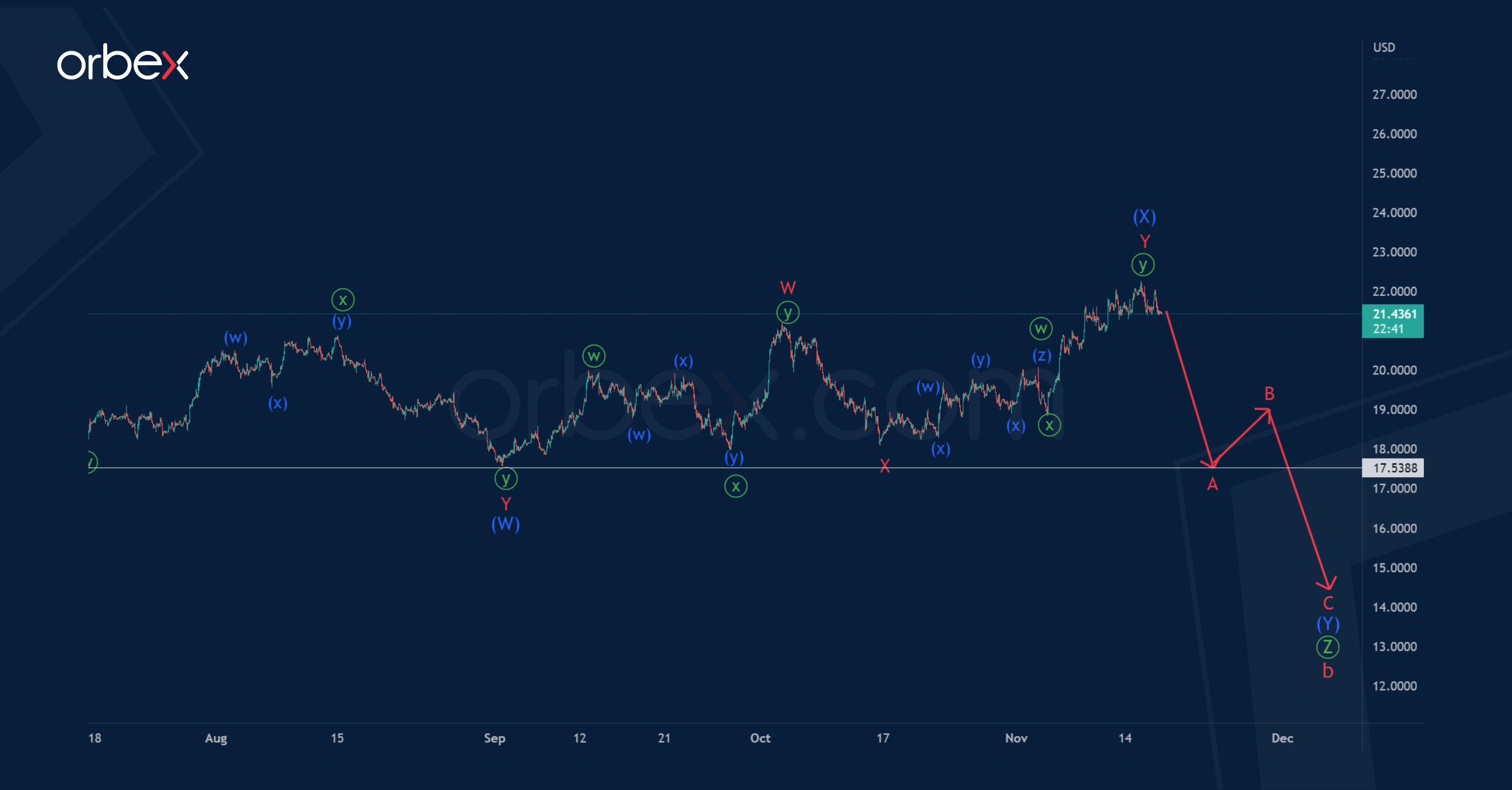
An alternative markup scenario assumes that the XAGUSD currency pair has completed the construction of an ascending intervening wave (X) of the intermediate degree. As in the main version, it has the form of a double zigzag W-X-Y, only already fully completed.
Thus, in the next coming trading days, we can expect a drop in the value of XAGUSD and the formation of a bearish actionary wave (Y). Perhaps this wave will have a standard zigzag shape A-B-C, as shown in the chart.
The first target, where the bears are aimed, is located at the previous minimum of 17.538, which was marked by the actionary intermediate wave (W).
US Oil Falls Lower
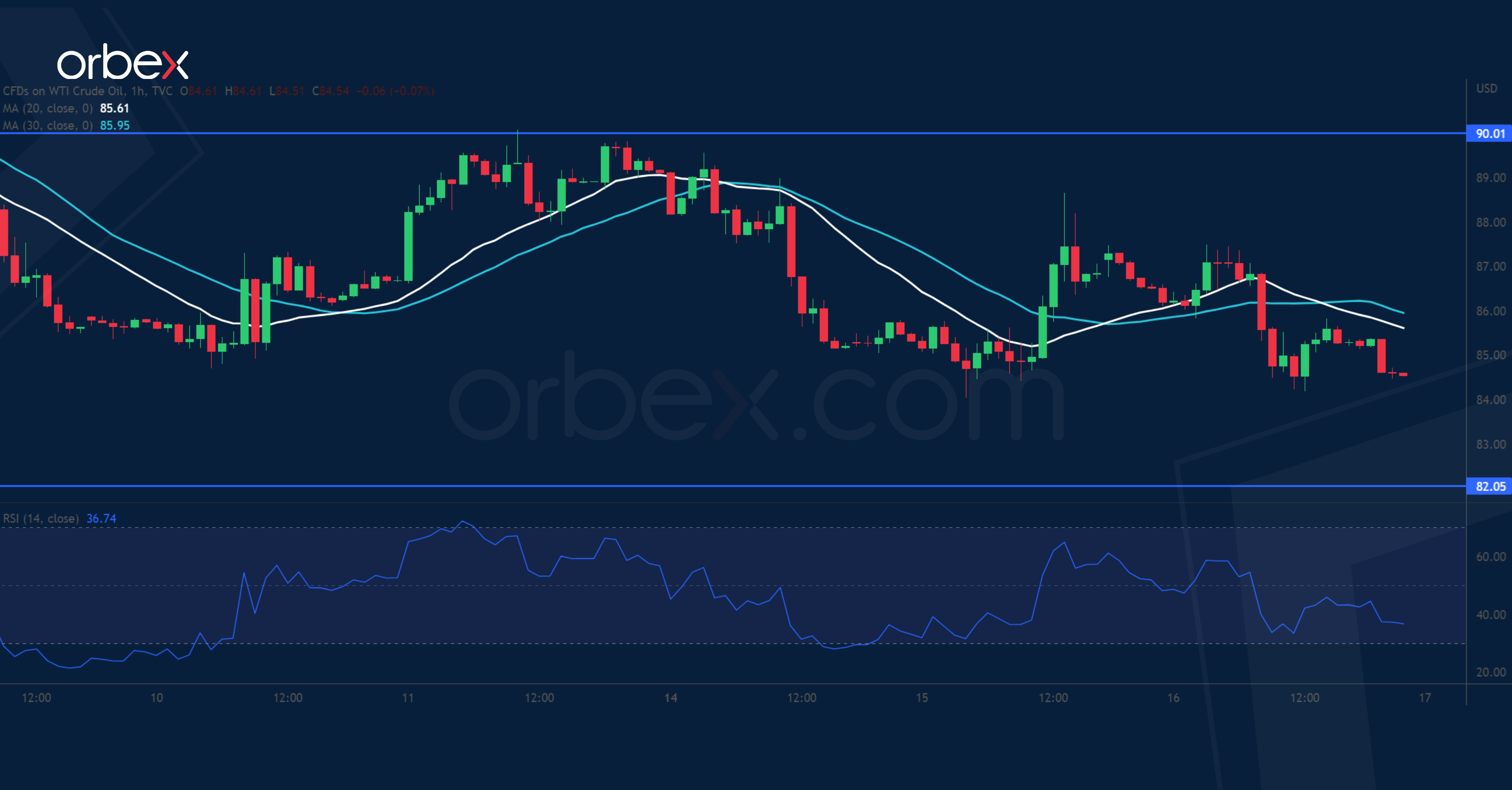
WTI crude remains feeble amid rising COVID-19 cases in China. The price is in a horizontal consolidation between 82.00 and 93.50, but the downward pressure is still omnipresent following a double top at the upper band. Two consecutive falls below 88.00 and 85.00 have put the bulls on the defensive. As the latest rebound stalled at the psychological level of 90.00, the commodity could be vulnerable to a new round of sell-off. A drop below 82.00 might attract momentum sellers and push the price towards 77.00.
USDCAD Attempts to Rebound
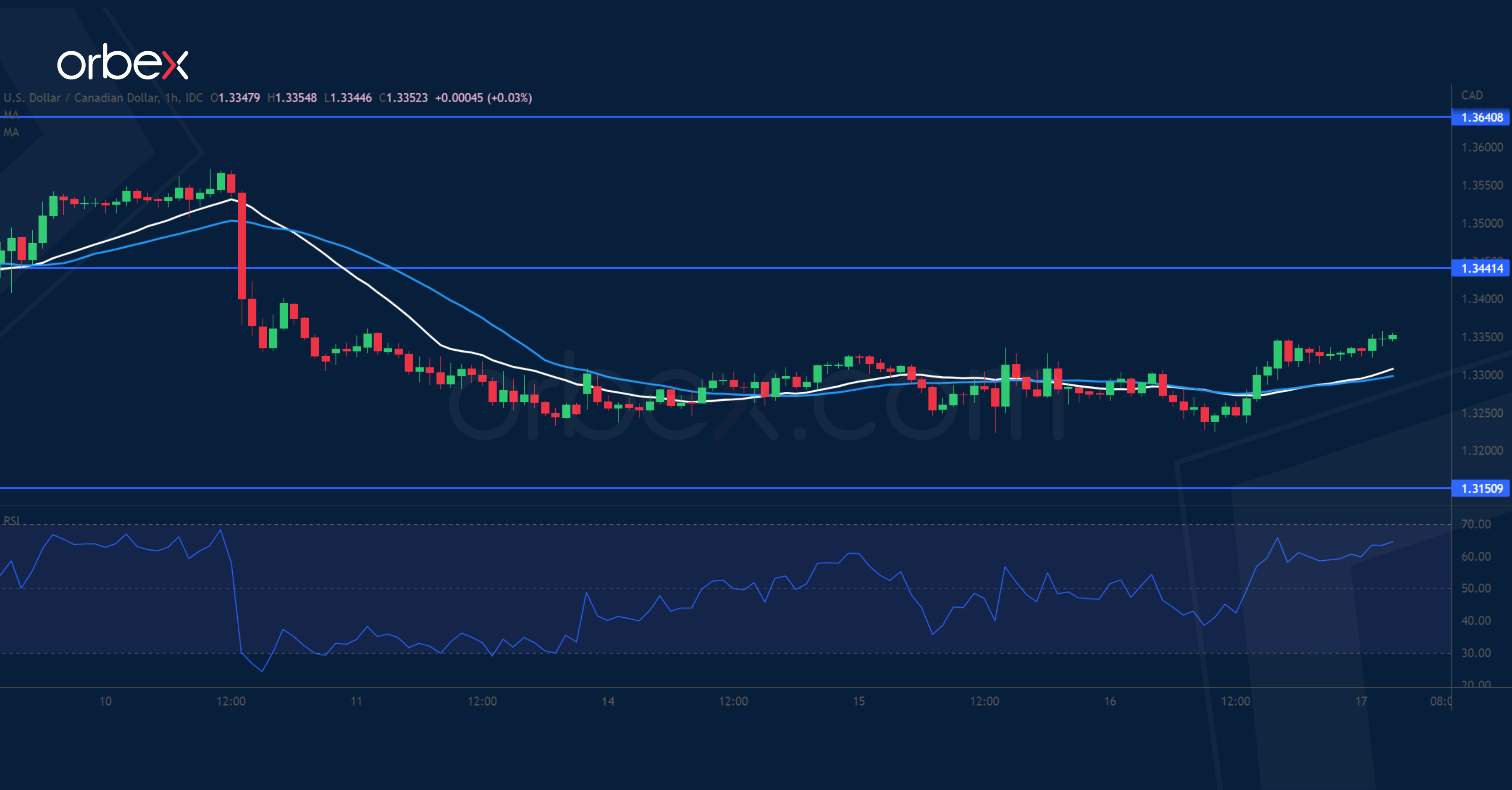
The Canadian dollar slid as October’s inflation fell short of expectations. A dip below 1.3240 indicates a lack of demand for the US counterpart. The greenback may continue to lose ground as traders stay on the sidelines for fear of catching a falling knife. 1.3150 is the immediate level to see whether it could trigger a buy-the-dips behaviour. Failing that, the psychological level of 1.3000 would be on the line. For those looking to buy, 1.3440 is the first hurdle to clear and the pair may only regain a foothold once above 1.3640.
GBPUSD Keeps High Ground
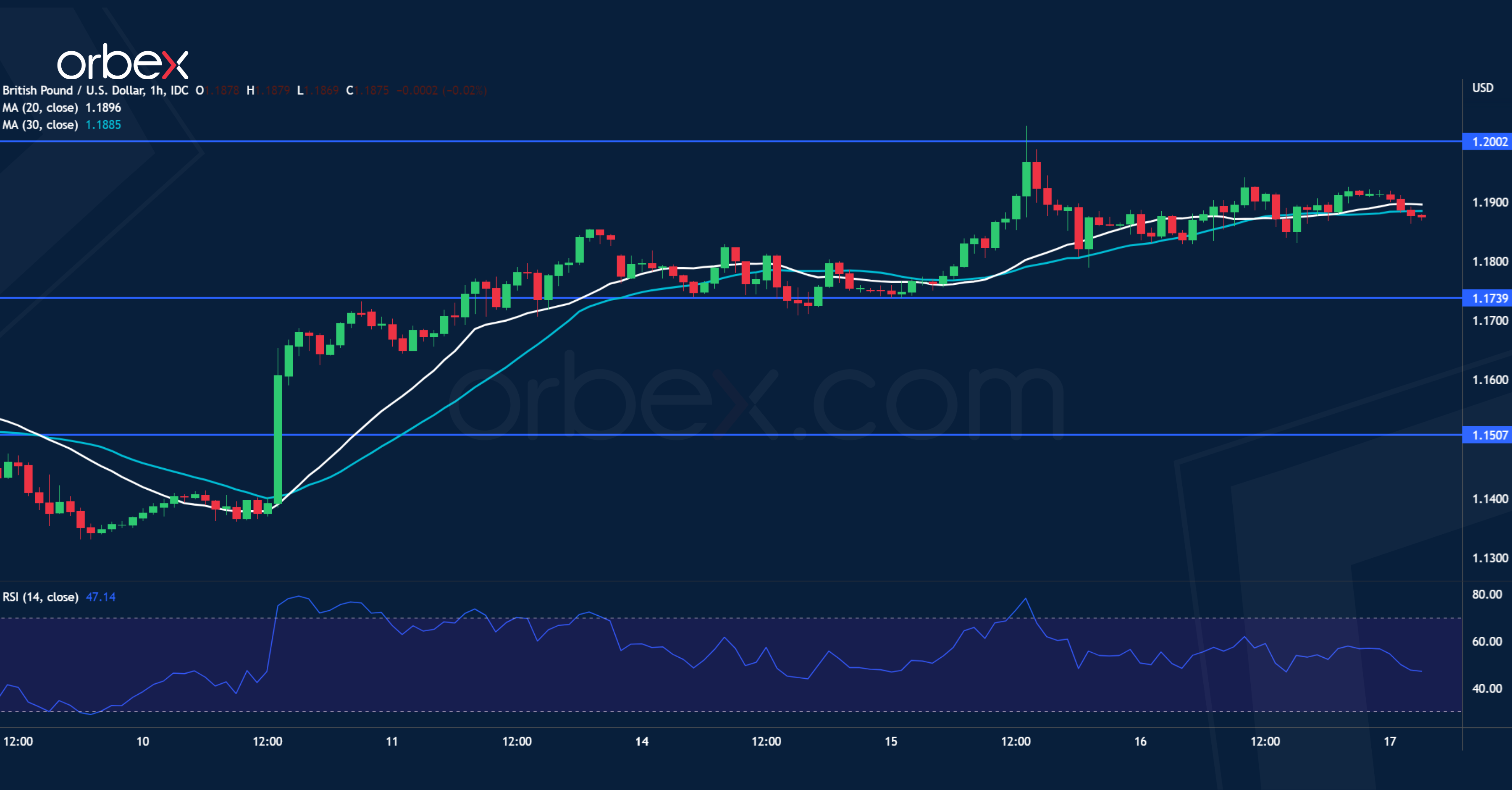
Sterling rallies as red hot inflation in the UK calls for more interest rate hikes by the BoE. A break above September’s high of 1.1740 has prompted some bears to cover their positions, easing the downward pressure from the daily chart’s perspective. A brief pause above this resistance-turned-support suggests that there is still juice in the recovery. August’s double top at 1.2250 would be next should the rebound pick up speed past 1.2000. 1.1500 near the origin of a bullish breakout is a key demand zone.
There’s a Lack of momentum within ECB to Push for Another 75 bps Hike in Dec
Markets
EUR/USD didn’t revisit Tuesday’s high yesterday as an early attempt to regain traction was blocked by stronger US retail sales and by ECB comments. The pair eventually closed below 1.04 and is trading there still. Initial optimism came from NATO and international comments suggesting that the missile on Polish territory was an unfortunate accident from Ukrainian air defense systems, nevertheless sparked by Russian missile attacks against the country. Better US retail sales were later erased by an unexpectedly steep drop in US homebuilder sentiment (see below). Dovish comments of Bank of France Villeroy were later echoed in a more general Bloomberg article. People close to the matter suggested that there’s a lack of momentum at the moment within the ECB to push for another 75 bps rate hike in December. Everything seems to be boiling down to the November inflation figure which will be released on Nov 30. It is extremely relevant both as an indicator of price pressure and as a number to feed into quarterly forecasts. Another upward surprise seems necessary to keep the 75 bps hiking pace going. Reasons to slow it down to 50 bps include mounting recession risks, the arrival at a neutral deposit rate of 2% and the near start of the balance sheet reduction via partly halting APP redemptions.
Core bonds extended their good run of late with US yields ceding up to 12.2 bps at the very long end of the curve and rising by 1.6 bps at the front end. US yields lost necklines of double top formations at tenors from 3y onwards earlier this week. The US 10-yr yield drop below 3.9% took it in no time to 3.7% currently with strong support arriving at 3.64% (38% retracement on August/October upleg) and 3.5% (previous cycle high in June). The final target of the double top formation stands in the same zone (3.47%). We believe this is the maximum potential of the current correction lower in US yields. Afterwards, we stick with more sideways action ahead of the mid-December policy meetings by central banks with new real upward yield potential only arriving early January, after the traditional low-volume Christmas period. The German yield curve bull flattened with yields 7.3 bps (2-yr) to 11.5 bps (30-yr) lower. The German 10-yr yield closed just below 2%. First support stands at 1.95% (end of October low) with 38% retracement on the August/October rise at 1.82% and the October low of 1.77% the key levels to watch. The forward view is similar as for US Treasuries. Today’s eco calendar contains more US housing data, Philly Fed Business Outlook and weekly jobless claims. UK Chancellor Hunt in his Autumn Statement will present long-term Budget plans. Speeches by central bank governors remain wildcards.
News Headlines
The Australian labour market posted an unexpectedly strong performance in October. Employment growth rose by 32.200, compared to a modest decline of 3;800 in September. Markets only expected a rise of about 15 000. The rise was fully driven by a 47.100 jump in full employment. Total hours worked rose a strong 2.3%. The unemployment rate eased from 3.5% to 3.4%, a cycle low and the lowest level since 1974. The participation rate was unchanged at 66.5%. Yesterday, Australian Q3 wage growth data also surprised on the upside off expectations at 1.0% Q/Q and 3.1% Y/Y. A persistent strong labour market questions speculation of late that the Reserve Bank of Australia might be nearing the end of its rate hike cycle . The RBA recently indicated that already quite some tightening has been put in place that takes to filter through into the economy. Even after today’s data markets still only see about a 75% chance of an additional 25 bps rate hike at the early December RBA meeting. The 2-y Government bond yield temporary rebounded but still trades about 6 bps lower in a daily perspective. The Aussie dollar doesn’t profit, trading near AUD/USD 0.6720.
The NAHB index in sentiment among US homebuilders yesterday showed a larger than expected deterioration declining from 38 to 33. The index reached the lowest levels since mid-2012, disregarding the bottom at the start of the corona crisis in 2020. According the tot NAHB statement, “higher interest rates have significantly weakened demand for new homes as buyer traffic is becoming increasingly scarce”. The decline was visible both in the subseries for current and future single family home sales as well as in expected buyers traffic.
How Austere?
Better-than-expected US retail sales didn’t please investors yesterday, as it fueled, again, inflation expectations. Higher inflation expectations fueled the hawkish Federal Reserve (Fed) expectations. And hawkish Fed expectations fueled recession worries – without however Fed being there to disperse cheap money.
US indices gave back gains yesterday. The S&P500 slid 0.83% and Nasdaq fell 1.54%.
Sour earnings from Target, which highlighted that nice-to-have stuff like clothes and electronics didn’t sell well in the latest quarter, because of rising prices, didn’t help lift the investor mood.
JP Morgan economists said they expect the US to enter a mild recession next year because of the rising rates and the tightening monetary conditions. And again, because recession will be triggered by higher rates and QT, the Fed won’t be a shoulder to cry on for investors.
Prospect of slower global economy, along with the de-escalation of geopolitical tensions on news that the rockets that hit Poland this week were from the Ukrainian defense, and probably landed in Poland by accident, pulled oil prices lower yesterday.
The barrel of American crude slid below $85 despite a more-than-5-mio decline in US crude inventories. The price is below the summer triangle, and sitting near the bottom of the long-term ascending trendline. While slower global growth, and recession are arguments that could push oil prices under the bus, oil bulls still have the tight supply, uncooperative OPEC for lower prices, and the Chinese reopening jokers in their hands. Therefore, further weakness into the $80/82 should meet a solid dip-buying interest.
Ugly news for Brits?
Inflation in Britain rose past the 11% mark last month. The Office of National Statistics said that inflation would have been nearly 14% if government actions to limit the energy bills hadn’t been there.
But the government won’t continue spending money to make things easier for Brits moving forward. Today, the much-expected budget announcement will finally hit the fan.
And it won’t be pretty.
The UK braces for ‘austerity in steroids’ wrote Bloomberg, reminding that Sunak government must fill in a £55 billion hole by increasing taxes and cutting spending.
For investors, though, austerity means a more stable budget, less negative pressure on the sovereign bonds, and an ideally stronger British pound.
Cable consolidates near the 1.19 mark this morning. Maybe we won’t see a kneejerk positive reaction right away, because politicians tend to overpromise and underdeliver. But in all cases, we are confident that the budget announcement under Sunak won’t trigger the same chaos as under Liz Truss.
Sunak Speaks
Market movers today
In the UK, we look forward to the Chancellor's Autumn Statement today, where PM Sunak's government will spell out its fiscal plans. It is widely expected to include tax increases across the board to fill up the hole of approximately GBP 50bn in the UK's public finances.
Euro area inflation surprised again to the upside in October and the final release today will provide details on the drivers.
US housing starts will probably bring more evidence that the housing market continued to cool in October. A range of Fed speakers will also be on the wires.
Norges Bank (NB) will release the results of its Q4 expectations survey. For NB to continue to signal a trade-off between inflation and growth, wage and price expectations need to be anchored. We believe it is too soon to expect a meaningful drop in inflation expectations, but wage expectations (for next year) could well level off, giving some support to NB's narrative.
The 60 second overview
US: Votes from the US midterm election have been counted and the Republican party won majority in the House of Representatives by a slim margin.
Macro: US retail sales rose 1.3% in October and much more than expected by analysts. Higher gasoline prices explain some of the rise in consumer retail spending, but sales were broad based. It also means that the drop in CPI hardly reflects a drop in US demand.
Oil: The Druhba oil pipeline was up and running again yesterday after a power outage due Russian missile strikes on Tuesday halted flows. Quiet has returned to oil prices after the brief spike.
FI: Global bond yields continue to decline from the long end of the curve. 10Y US Treasuries fell 9bp, while 10Y Bunds fell 11bp and we are again below 2% in the Bund. We also saw a widening of the German ASW-spreads after a long period where the ASW-spreads have tightened.
FX: Relatively quiet day yesterday, as soon as the geopolitics were taken care of. EUR/USD rally potentially losing steam and consolidating around 1.04 for now, while Scandies have traded on the back foot in recent sessions. Brent oil 1.5% lower since start of the week and US equities in red yesterday. PLN regain its previous losses, with EUR/PLN back at 4.70, as there was no further escalation yesterday.
Credit: Credit markets took a breather from a long streak of gains, with iTraxx Xover widening almost 14bp while Main widened 3bp.
Nordic macro
Norges Bank (NB) will release the results of its Q4 expectations survey. For NB to continue signal a trade-off between inflation and growth, wage and price expectations need to be anchored. We believe it is too soon to expect a meaningful drop in inflation expectations, but wage expectations (for next year) could well level off, giving some support to NB's narrative.