Sample Category Title
USDCHF Wave Analysis
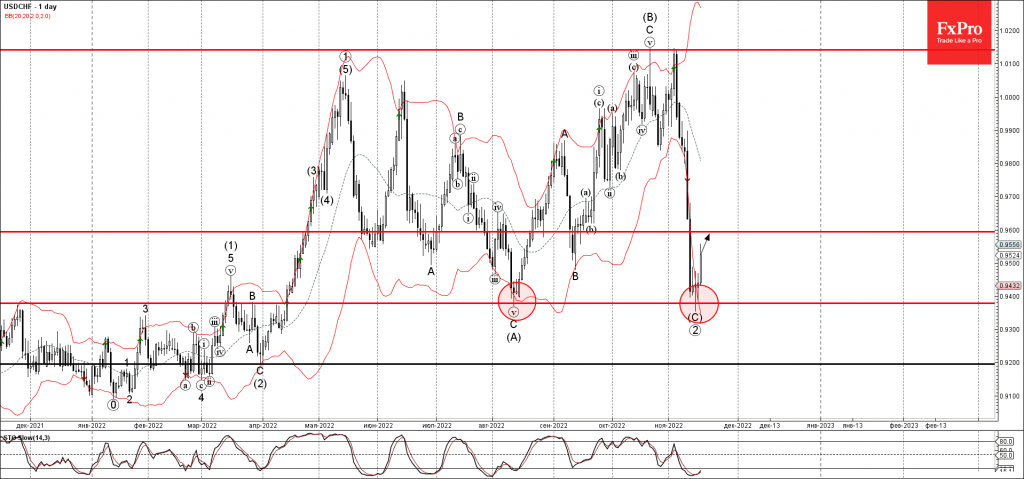
- USDCHF reversed from support level 0.9400
- Likely to rise to resistance level 0.9600
USDCHF currency pair recently reversed up from the key support level 0.9400 (previous multi-month low from August, which stopped wave (A)) standing below the lower daily Bollinger Band.
The upward reversal from the support level 0.9400 stopped the earlier medium-term impulse wave (C).
G20: What Did the Leaders Decide?
The G20 summit took place in Bali, Indonesia, on November 2022. Industrialized and developing countries of the G20 account for 80% of global economic activity and two-thirds of the world's population. The leaders of the 17 met in Indonesia to discuss all the hot topics of the world.
The summit's official themes were financial stability, health care, sustainable energy, and digital transformation. However, tensions over Russia's invasion of Ukraine took center stage and complicated host Indonesia's efforts to reach a consensus on these topics.
The condemnation of the Russian-Ukrainian conflict
Initially, the summit was supposed to be devoted to finding ways to restore the global economy after the Covid-19 pandemic. However, Russia's aggression against Ukraine changed priorities.
Many G20 members see the war in Ukraine as a factor holding back global economic growth, increasing inflation, disrupting supply chains, enhancing energy and food security, and raising risks to financial stability. Besides, the leaders of the G20 countries discussed the threat of using nuclear weapons due to the Russian invasion. The final communiqué said: "The use or threat of use of nuclear weapons is unacceptable."
However, Saudi Arabia, India, Brazil, and China refrained from condemning Russia. Furthermore, Indonesian President Joko Widodo called on Western leaders to soften the rhetoric against the Russian Federation at the G20 summit.
Biden and Xi’s meeting highlights
After a nearly three-year absence from the world stage, Chinese leader Xi Jinping embarked on face-to-face meetings with Western leaders in Bali to restore China's global influence. The meeting with Joe Biden was crucial.
China's relations with the US and its allies have deteriorated to varying degrees in recent years due to rising geopolitical tensions, disputes over trade, the origins of the Covid-19 pandemic, and Beijing's growing partnership with Moscow despite Russia's war on Ukraine.
After a three-hour meeting on Monday with US President Joe Biden, Xi held talks with the leaders of four America’s allies - Australia, France, the Netherlands, and South Korea.
Macron wants more power
Many believe that French President Emmanuel Macron used the G20 summit to renew France's strategic ambitions in the Asia-Pacific region. He met with regional heavyweights, including Chinese President Xi Jinping and Indian Prime Minister Narendra Modi, as part of the summit.
Above all, he hopes for "recognition" of France's ambitions and influence at the Asia-Pacific Economic Cooperation summit Thursday and Friday in Bangkok, where France will be the first European country invited.
Emmanuel Macron is making this vast territory, stretching from East Africa to Western America's coast, a strategic priority, where France has a lot of land and maritime areas. This enormous maritime space means France is interested in environmental and fisheries issues and the fight against ocean-related human trafficking.
Yen’s reaction to G20
The news that emerged on the G20 caught the attention of USDJPY traders as the yen jumped against the USD to a new high since 1998, the day before the summit started, raising expectations for Japanese intervention. Attention at the meeting turned to the first reading of Japan's third-quarter (Q3) Gross Domestic Product (GDP) and US retail sales for October, amid hopes of easing divergence between the policies of the Fed and the Bank of Japan.
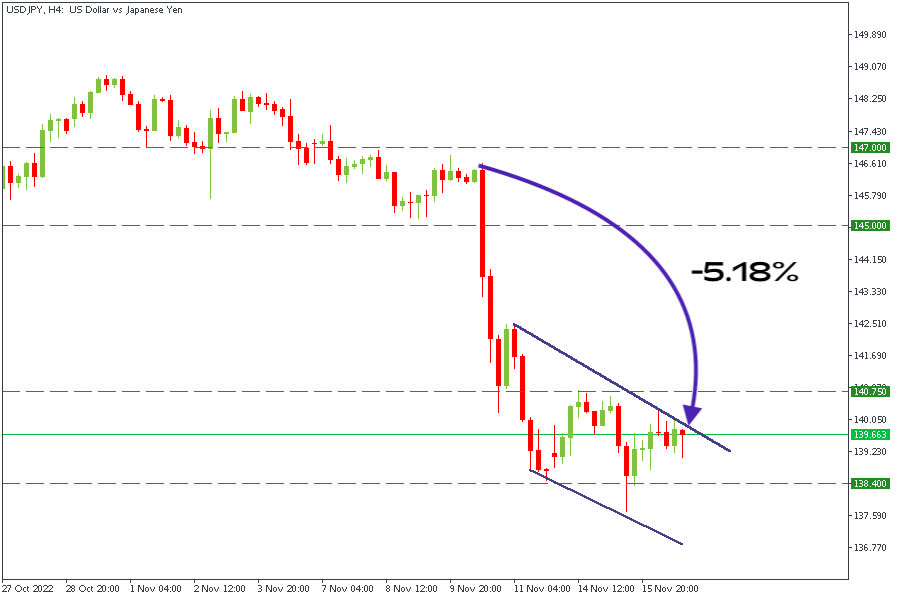
USDJPY has lost more than 5% in the last week. Now the price is consolidating between 140.750 and 138.400.
Conclusion
In general, this year’s summit showed that even if the world’s leaders have different opinions about certain topics, such things as world peace and wealth are priorities for everybody.
Pound Takes a Dive, Retail Sales Next
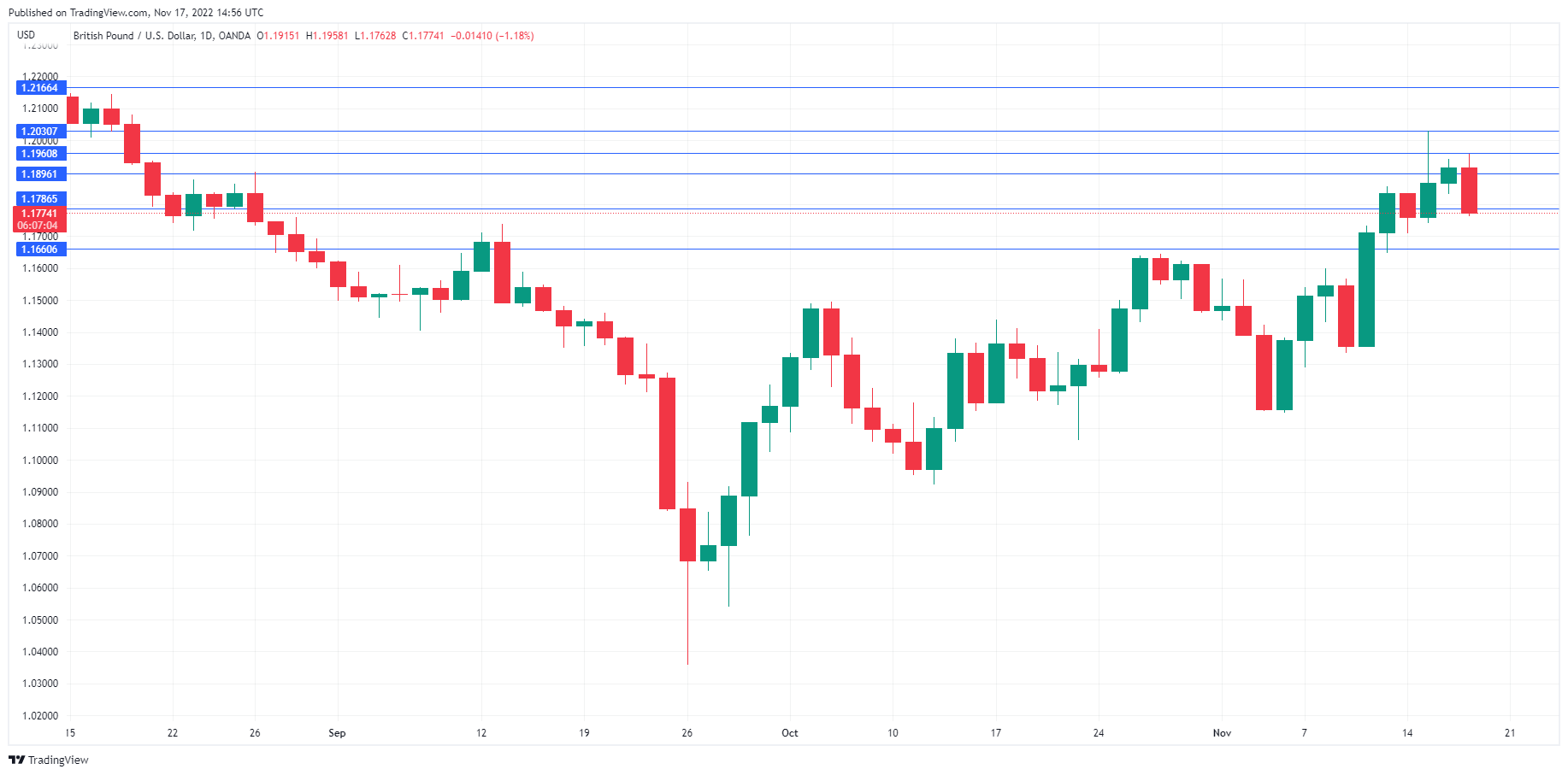
The British pound is sharply lower on Thursday as the US dollar has rebounded against the major currencies. In the North American session, GBP/USD is trading at 1.1787, down 1.07%. We continue to see sharp swings from the pound in November.
Autumn Statement emphasizes austerity
Jeremy Hunt’s Autumn Statement was much more in keeping with the difficult economic times than the ill-fated mini-budget back in September, which set off a financial crisis and emergency intervention from the Bank of England. The Finance Minister’s budget outlined major spending cuts and tax hikes and Hunt stated that the government and the BoE were working in “lockstep”. The fiscal austerity in the new budget is a step in the right direction, but the pound nevertheless has taken a tumble today.
The Office for Budget Responsibility (OBR) forecast indicated that the UK is currently in a recession, which will see unemployment jump from 3.5% to 4.9%. The BoE’s outlook is even worse, with unemployment forecast to hit 6.5% and negative growth expected in the second half of this year, throughout 2023 and into the first half of 2024. GDP declined by 0.2% in the third quarter, and the headwinds look formidable for the UK economy and the British pound.
The investor euphoria which sent the stock markets rallying after the soft inflation report has taken a pause, and the US dollar has rebounded. Fed policy members sought to dispel any thoughts of a Fed pivot, reminding the markets that the Fed was planning to raise rates higher than they had anticipated. The hawkish Fed speak may or may not have convinced investors to settle down, but a strong US retail sales report clearly did the job.
The headline and core releases both posted strong gains of 1.3%, dampening sentiment that the Fed was turning dovish. US consumers continue to spend despite inflation and rising rates, an indication that the Fed can continue to raise rates and probably avoid a deep recession. Interest rates are expected to peak at 5% or slightly higher, which means that the Fed is highly likely to continue tightening into next year.
GBP/USD Technical
- There is resistance at 1.1961 and 1.2030
- GBP/USD has broken below support at 1.1896 and 1.1786. Below, there is support at 1.1660
Will Japan’s CPI Inflation Help the Yen’s Recovery?
Japan will update its CPI inflation data on Thursday at 23:30 GMT, with investors projecting a bold acceleration in the pace of price increases. Although the Bank of Japan (BoJ) keeps sticking stubbornly to its ultra-easy policy, recent comments disclosed willingness for a hawkish change. If the data intensifies the debate for an earlier exit, the rally in the yen could gain another leg.
Yen's outlook is still fragile
It was a devastating year for the yen as the ultra-easy monetary policy in Japan forced investors to seek higher interest rates elsewhere to compensate for high inflation. The BoJ’s multi-billion-dollar FX intervention proved ineffective in stopping the yen from melting until a shift in Fed rate expectations came to the rescue - for free. Specifically, growing speculation that the Fed may use less aggressive rate increases to bring down inflation next year boosted the currency by more than 5% against the US dollar last week, making investors wonder whether the bad times for the yen have passed.
The problem now is that if the BoJ keeps defending its accommodative policy settings amid an uncertain global growth outlook, the yen could easily fall again on hard times. Speaking at a news conference last week, the BoJ chief Haruhiko Kuroda argued that there are signs of peaking inflation in the economy, telegraphing that a hawkish reversal is unnecessary.
A tweak in policy expected, but eyes on wage growth
However, the latest summary of opinions showed that policymakers are now more open to the possibility of a policy normalization. Surprisingly, Kuroda himself backed the scenario of a flexible yield curve control in the future earlier this month, though only if inflation returns sustainably to the 2.0% target. However, unlike his counterparts in other advanced economies, he claimed solid wage increases might be a prerequisite for price stability.
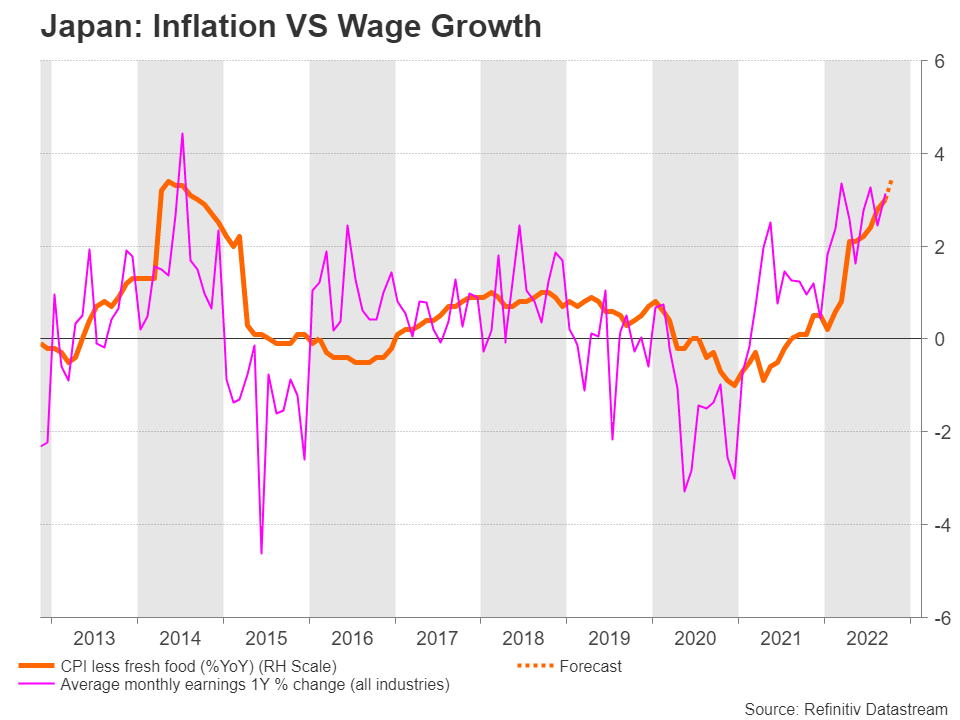
Hence, wage negotiations in March, which involve talks between blue-chip firms and labor unions, could be vital before the central bank reviews any stimulus reduction plans. Note that Kuroda will not seek a reappointment when his term ends in April. Therefore, that could be a good timing for his predecessor to pilot monetary policy into the tightening era, especially if Rego, Japan’s largest labor organization, gets a green light for its 5% pay increase proposal.
CPI inflation
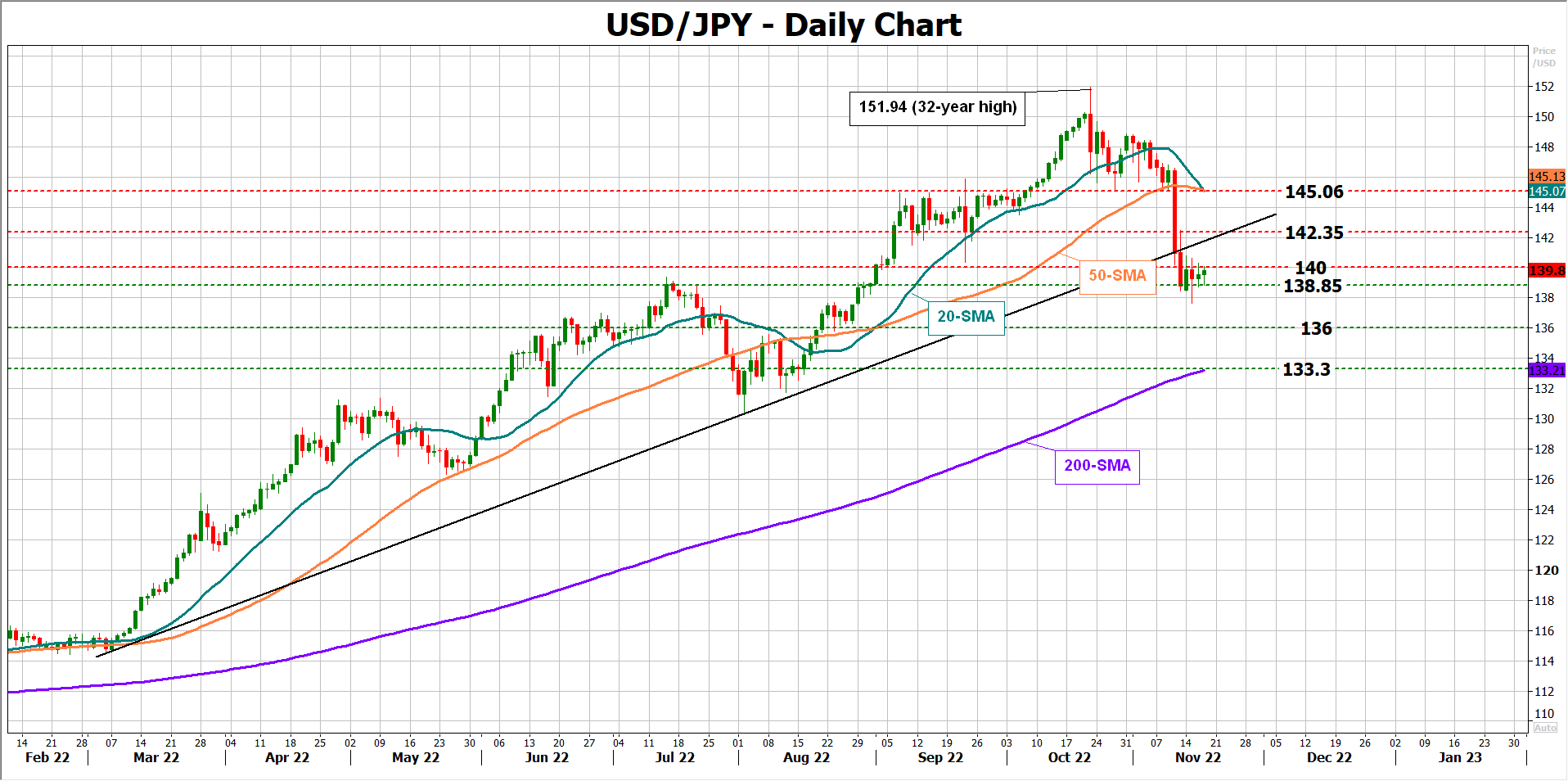
Still, some government officials have claimed that structural changes in wages can take a long time, and the central bank should not wait that long to exit stimulus. Another spike in the core CPI inflation, which is expected to have unlocked a new forty-year high at 3.5% y/y in October from 3.0% previously, may urge the need for an earlier policy shift. In this case, dollar/yen could breach the 138.85 base and slide towards 136.00. Even lower, the door will open for the 200-day simple moving average (SMA) and the 134.00 number. With the US dollar barely finding any fresh bullish catalysts these days, the yen could easily steal further ground.
Alternatively, a US-like downside surprise in the CPI would endorse Kuroda’s accommodative strategy as inflation is not that far above the BoJ’s 2.0% target. Consequently, dollar/yen could crawl back above the 140.00 level with scope to meet the 142.35 bar. A durable move above the latter may next pause near the 20- and 50-day SMAs at 145.00.
Sunset Market Commentary
Markets
It was D-day in the UK today: Finance Minister Hunt presented the delayed Autumn Statement. The budget fell under close scrutiny by financial markets after the Truss/Kwarteng tandem unsettled them big time with their massive unfunded spending and tax cuts. Hunt’s budget was a near 50-50 mix of tax increases and spending cuts. He is seeking £55bn by a.o. lowering the threshold at which the top 45% income tax rate is levied while the other income tax thresholds and those for national insurance and inheritance tax were frozen for an extra two years. Hunt also raised the windfall tax on oil and gas companies and introduced a new 45% tax on electricity generators. These measures will raise the overall tax burden to the highest since WWII. Public spending will grow but slower than the economy and departmental budgets will have real-term spending cuts. There are supportive measures as well. There’s a one-year extension beyond April of the cap on energy bills but at £3000 instead of the previous £2500. To address the squeeze on households, the government hands out cost-of-living payments next year between £150-900. Hunt raised the national living wage by a record 9.7% and kept the triple lock in place, meaning welfare and pension payments will both increase in line with inflation. The aim of his program is to tackle inflation, get the debt ratio falling and have borrowing below 3% of GDP over time, Hunt said. The supportive measures meanwhile are expected to lead to a shallower downturn and targeted investments in energy, infrastructure and innovation should lift long-term growth. The Office of Budget Responsibility ran the numbers and projects GDP next year at -1.4%, a sharp revision from March (+1.8%) before picking up in 2024 again by 1.3% vs 2.1% seen in March. Unemployment could peak at just below 5% in two years’ time. Inflation would fall from 9.7% this year to 7.4% in 2023 (+3.3 ppts) and a mere 0.6% in 2024 (-0.9 ppts). The debt ratio will peak at 97.6% in FY 2025-26 and 2026-27 and the budget deficit would go from 2.5% FY 2023-24 to between 0.2-0.5% in the four years thereafter. UK assets traded volatile during Hunt’s budget presentation as markets try to gauge the impact. Daily changes in UK yields currently vary between +6 bps (30y) to +14 bps (2y), flattening the curve. BoE expectations have slightly been revised upwards but the terminal rate stays about the same at 4.5%. Sterling loses, allowing EUR/GBP to rebound from 0.8721 support to 0.876 currently. GBP/USD loses more than a percent to 1.178 amid broad dollar strength.
The greenback was already a bit better in shape today after the recent sell-off before Fed’s Bullard give a little push in the back extra. He said rates needed to be raised further, adding that current tightening only has had a limited effect on observed inflation. According to the monetary Taylor rule, 5% is the bare minimum. Bullard is just the most recent one in a series of Fed governors clearly pushing back against the hefty market repricing. EUR/USD dips to 1.032 after meeting resistance from the 1.04 big figure and the 200MdA. DXY climbs from an intraday low at 106.1 to 107. Core bonds pared some of their gains over the previous days with USTs underperforming in the wake of Bullard’s comments. US yields rise 8.1-8.5 bps in the 2y-10y bucket. German yields add 1.6 bps (30y) to 4.5 bps (5y) with the 10y trying to settle north of 2% again. Equities drop a little over 1% in Europe and the US.
News Headlines
Bloomberg cites people close to negotiations between the EU and Hungary. They suggest that the EC won’t issue its verdict on Hungary’s investment and reform proposals at the planned November 22 EC meeting. That leaves little time before the final gathering on December 6 to evaluate the proposals. Budapest sent those to end a rule-of-law dispute and unfreeze recovery funds related to the pandemic. Without EC approval by the end of the year, Hungary loses 70% of the pre-allocated funds (€4.1bn). The EC currently prioritizes an aid plan for Ukraine (€18bn) and a proposal for a minimum corporate tax rate. Both dossiers are being held hostage by… Hungary. The forint loses more ground today with EUR/HUF testing previous support (now resistance) at EUR/HUF 416.
Ukrainian infrastructure minister Kubrakov said that the initiative for safe transportation of agricultural products across the Black Sea has been extended for another 120 days. The deal between Ukraine and Russia is overlooked by the UN and by Turkey and also known as the grain export agreement. The initial deal took effect on August 1 and helped alleviating the global food (price) crisis. Ukraine is still pushing for a one-year extension and to include ports in the Mykolayiv region in addition to ports in the Odesa province.
WTI Oil Futures Retreat Below 50-day SMA
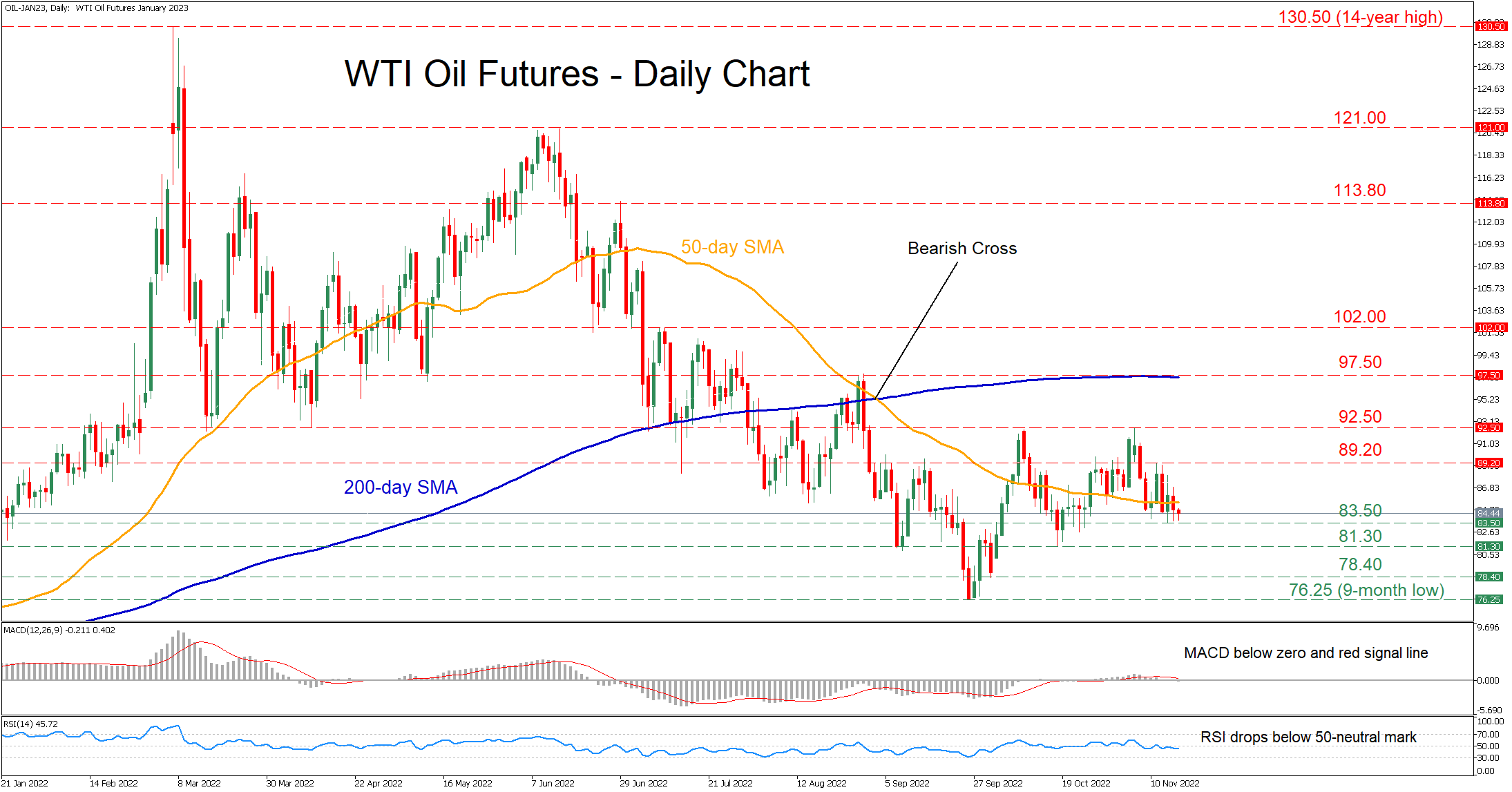
WTI oil futures (January delivery) have been stuck in a downtrend since mid-June when the price failed to surpass the 121.00 mark. Although the commodity managed to regain some ground after bouncing at the nine-month low of 76.25, the price has dropped again below its 50-day simple moving average (SMA).
The momentum indicators currently suggest that bearish forces are strengthening. Specifically, the RSI has dived beneath the 50-neutral mark, while the MACD histogram is retreating below both zero and its red signal line.
If selling pressures persist, the recent support of 83.50 could act as the first line of defense. Should that floor collapse, the bears could then aim for 81.30 before the spotlight turns to 78.40. A violation of the latter may trigger a retreat towards the nine-month low of 76.25.
On the flipside, if buyers regain control, oil futures might ascend towards the recent resistance of 89.20. Piercing through this region, the November high of 92.50 could come under examination. Conquering this barricade, further advances could then stall at the 97.50 region, which overlaps with the 200-day SMA.
Overall, WTI oil futures appear to be losing ground as negative momentum intensifies. For that bearish sentiment to alter, the price needs to initially cross above the 50-day SMA.
ETHUSD Rangebound after Decline Pauses
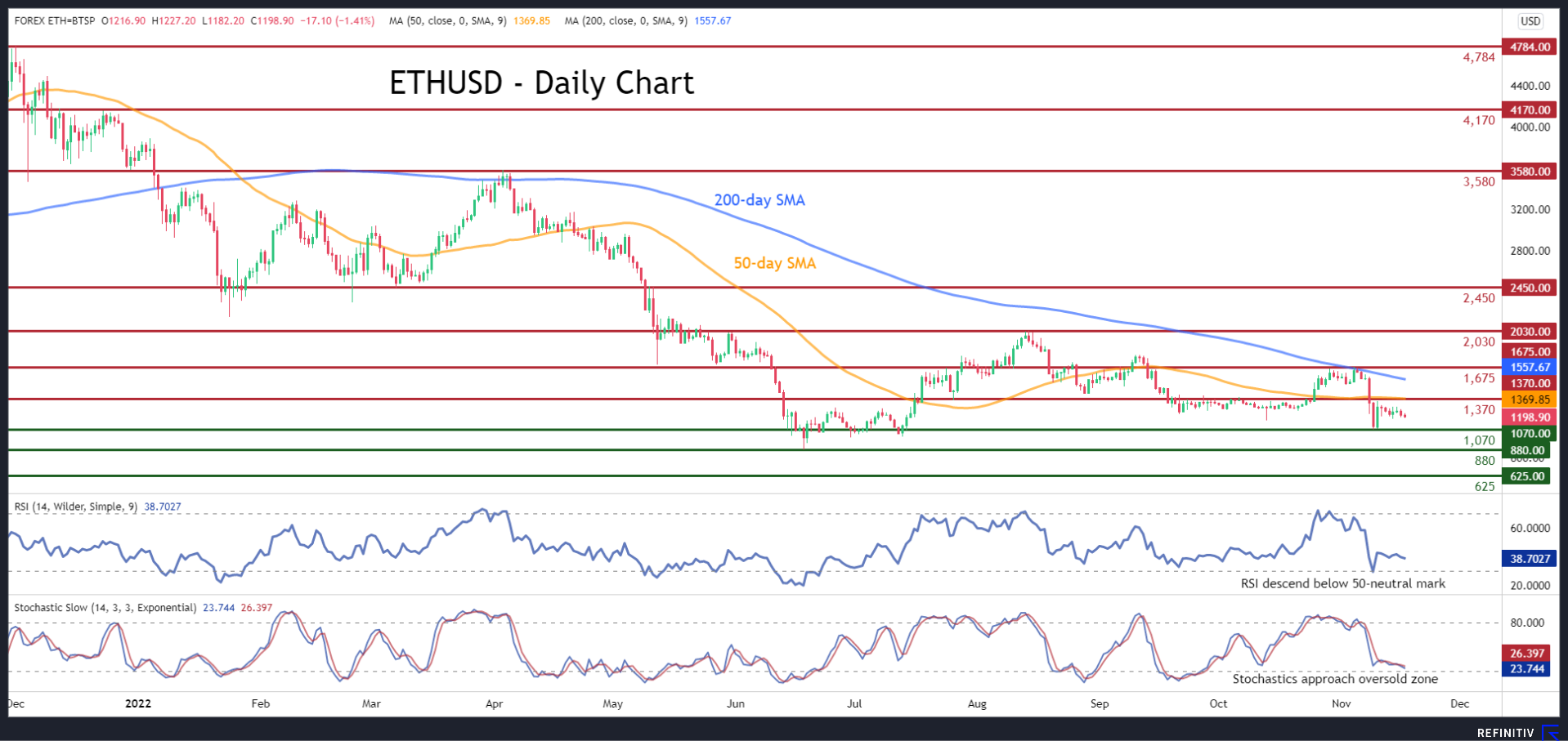
ETHUSD (Ethereum) has experienced a sharp decline in the short term, with the price hitting a fresh four-month low of 1,070. However, the cryptocurrency managed to recover some ground and has been trading sideways in the last few daily sessions.
The momentum indicators currently reflect that near-term risks remain tilted to the downside. Specifically, the RSI is declining beneath its 50-neutral mark, while the stochastic oscillator is descending near its 20-oversold region.
Should sellers push the price lower, immediate support could be met at the recent low of 1,070. If that floor collapses, Ethereum could test the 2022 low of 880. Failing to halt there, the price could decline to form fresh multi-month lows, where the December 2020 resistance of 625 may provide downside protection.
On the flipside, bullish actions could propel the price towards the 50-day simple moving average (SMA), currently at 1,370. Piercing this threshold, the bulls could aim for the recent peak of 1,675 before the spotlight turns to the trend reversal point of 2,030. Even higher, further advances might come to a halt at the 2,450 support territory, which could now act as resistance.
Overall, ETHUSD appears to be in a consolidation mode after it encountered tough support. Hence, a break above or below its tight range is likely to be followed by a significant move towards the same direction.
Stalled Rebound
The risk rebound in the markets has stalled and equity markets are down around 1% on Thursday following quite a good run over the last month.
The day we've all been waiting for
The Autumn Statement has been a long time coming after the disastrous mini-budget almost two months ago. The UK's fiscal credibility was in the gutter, the pound was crushed and borrowing costs soared. Since then, a lot has changed and today's budget highlighted just how much that is the case.
Fully regaining credibility won't be easy but markets appear far happier now than they were back in September. The pound is lower on the day but only marginally so and the bulk of the announcements will have been priced in as they were leaked in recent days. Borrowing costs are slightly higher on the day and Bank Rate is expected to peak around 4.5%, still very high but far from the levels reached in September.
All in all, the government may be pleased with how today has gone but time will tell whether the public agrees as everyone pours over what was quite an extensive budget. It's not just the markets that needed convincing today after all, with a little over two years until the next election and a significant deficit still to overcome in the polls.
US data reinforces Fed position on rates despite weak housing
The latest US economic data represented a continuation of what we've seen for months. A housing market suffering under the pressure of higher interest rates and a labour market that is incredibly resilient to them. While the former may be a concern for the central bank as it further raises rates in the months ahead, the latter remains the reason why many at the Fed support such moves as it increases the possibility of inflation remaining stubborn on the way back down.
Oil slips amid easing geopolitical risk and China woes
Oil prices are slipping as we move through the week, with easing geopolitical risk and Chinese demand weighing. Prices spiked earlier in the week after missiles landed in Poland, risking a dramatic escalation in the war in Ukraine. Thankfully, those fears have abated and the situation de-escalated which has seen oil gains unwound.
China remains a downside risk for oil in the near term, despite its recent relaxation of certain Covid curbs. A surge in cases in major cities, mass testing, and restrictions will hit economic activity despite recent measures which will weigh on demand in the world's second-largest economy. Still, Brent remains within its $90-$100 range for now and OPEC+ may continue to ensure that largely remains the case.
Gold stalls but the future may be looking bright
We're seeing more risk aversion in the markets today after a strong rebound in recent weeks. Gold has performed well in this period, particularly in the aftermath of the Fed decision and jobs report and then after the inflation data. The PPI numbers further supported the view that inflation is easing and could be sustained which saw gold rally towards $1,780 where it stalled.
It is now paring gains for a second day, off around 1%, but still holding onto the bulk of the gains of recent weeks. If the data continues to improve on the inflation side, we could see gold build on recent gains as the dollar eases and yields are pared back. That's a big "if" after what we've seen this year but the data we've seen in recent weeks has been very promising.
Risks remain tilted to the downside
The ripple effects of the FTX debacle continue to flow through the crypto industry revealing other vulnerabilities and weighing heavily on prices even amid a broader financial market risk rebound. Bitcoin is trading relatively flat today around $16,500 but the risks remain skewed to the downside amid immense uncertainty.
EUR/USD Mid-Day Outlook
Daily Pivots: (S1) 1.0338; (P) 1.0388; (R1) 1.0445; More...
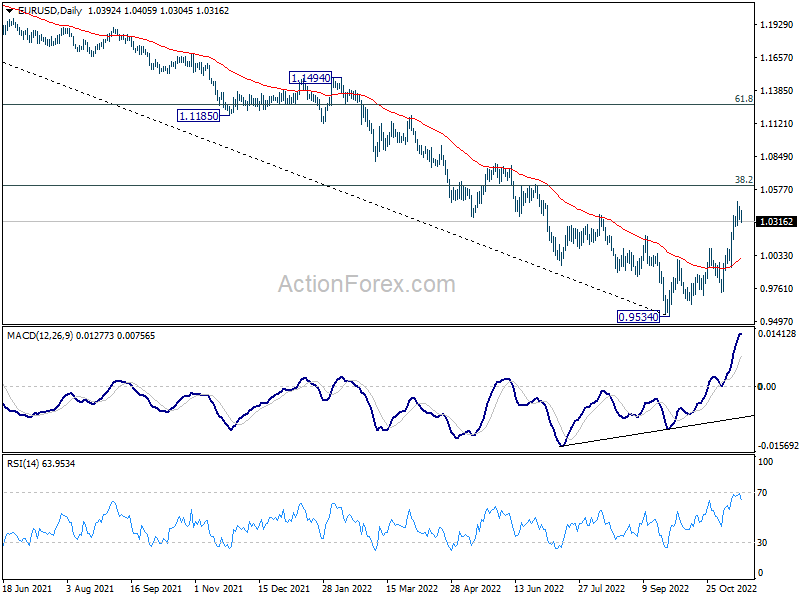
EUR/USD dips lower as consolidation from 1.0481 continues and intraday bias stays neutral. Downside of retreat should be contained by 1.0092 resistance turned support to bring another rally. Break of 1.0481 will resume the rise from 0.9534 and target 1.0609 fibonacci level.
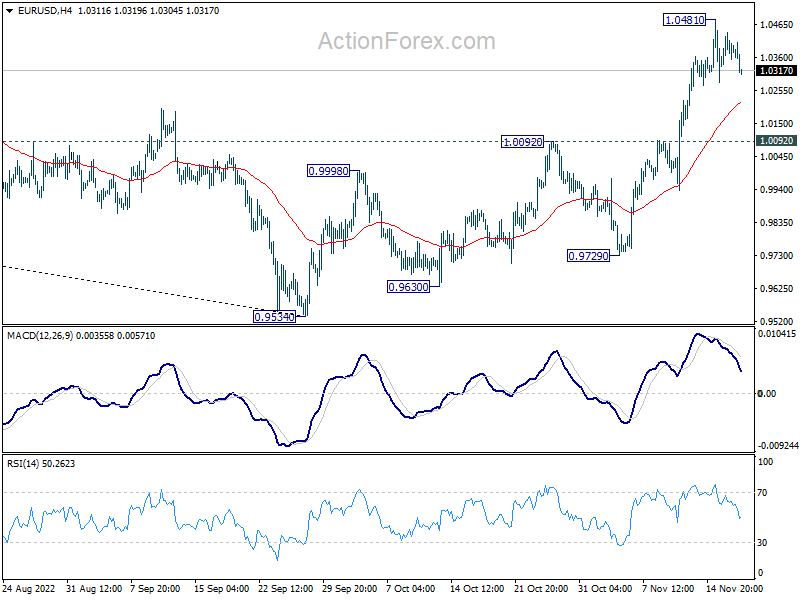
In the bigger picture, a medium term bottom was in place at 0.9534, on bullish convergence condition in daily MACD. Even as a corrective rise, rally from 0.9534 should target 38.2% retracement of 1.2348 (2021 high) to 0.9534 at 1.0609. Sustained trading above 55 week EMA (now at 1.0566) will raise the chance of trend reversal and target 61.8% retracement at 1.1273. This will now remain the favored case as long as 1.0092 resistance turned support holds.