Sample Category Title
Inflation Has Reached Japan
Market movers today
A quiet day on the data front gives markets plenty of time to focus on central bank comments from various ECB speakers (Lagarde, Nagel and Knot) and Fed's Collins during the day.
In Norway, we expect mainland GDP to have risen 0.4% q/q in Q3, higher than Norges Bank expected in its monetary policy report in September. But as leading indicators have weakened considerably, we think this will be regarded as 'yesterday's news' anyway.
The 60 second overview
US: St. Louis Fed President James Bullard has raised his own estimate for how high Fed needs to raise interest rate. He now sees a rate of 5-5.25% as a minimum level compared to 4.75-5% in the past.
Japan: Inflation has also come to Japan. CPI inflation ex fresh food rose to 3.6% y/y in October, which was the highest level in 40 years in October.
Oil: Brent dropped to USD90/bbl - the lowest in about a month. Demand worries and US selling of SPR are probably main reasons for the drop, which comes only weeks before EU's embargo on Russian oil imports are set to begin.
Equities: A hawkish Fed speech and inflationary data brought equities lower yesterday. The negative correlation between yields and equities returned, with the US 10y adding 10bp but S&P -0.3%. Sector performance was scattered without direction between cyclicals and styles. US futures are unchanged this morning.
FI: It was a rather uneventful session yesterday with European rates mostly range trading and 10y German Bunds ended 2bp higher on the day at 2.02%. The little volatility should be seen in light of the overnight ECB sources story suggesting a slowdown of rate hikes at the December meeting. In the afternoon, we saw a small parallel move higher in the trading range on the back of spillover from the UK's Hunt comments and projections not showing a decline debt to GDP trend until 2025/2026.
FX: Continued Scandi weakness with EUR/SEK trading around 11.00 for the first time in almost a month at the same time as EUR/NOK is testing 10.50 from the downside. EUR/USD consolidating between 1.03-1.04. The antipodean currencies strengthened against the USD over the night. USD/JPY stable at 140.
Credit: For the second day in a row credit markets were slightly weak, with iTraxx Xover widening 9bp and Main 2bp.
Nordic macro
After a revision of historical figures, we have upgraded our forecast for Norwegian mainland GDP to 0.4% q/q in Q3, among other things because consumption growth came out stronger than anticipated. That would be a fair deal higher than Norges Bank expected in its monetary policy report in September, but as leading indicators have weakened considerably, we think this will be regarded as 'yesterday's news' anyway.
Cliff Notes: A Fine Balancing Act
Key insights from the week that was.
Critical data for Australia’s economy was received this week; elsewhere though, it was the mindset and actions of policy makers that filled the headlines.
Of the data received this week, Australia’s October labour force survey was most significant. Against the market’s expectation for a 15k increase in employment, 32k jobs were instead created in the month. This was despite activity being restricted by holidays and sick leave as well as the floods, with participation edging down 0.02ppts from 65.55% to 65.53%. As a result of these two outcomes, the unemployment rate declined to 3.4% in October, its lowest level since November 1974. Westpac expects a further marginal decline in the unemployment rate to 3.3% in coming months before employment growth slows below population growth and the unemployment rate begins to trend higher. Note, immigration’s revival has already been seen, growth in the working age population lifting from 0.6%yr last December to 1.2%yr in October. Highlighting the continued need for further labour force gains though, growth in hours worked remains ahead of population growth, and underemployment is also near record lows.
It is not surprising then that wage growth in the private sector showed strength in Q3 2022. Underlying the 1.0% gain in the headline Wage Price Index was not only the largest minimum wage/award increase in more than a decade, but also a notable lift in individual bargaining agreements. Hence, private sector wages posted its largest quarterly gain since September 2010, up 1.2% in Q3 to be 3.4% higher than a year ago. Additionally, nearly half of the jobs in the private sector reported an increase in compensation; and of those that did, the average increase was a stellar 4.3% in the quarter. We expect the tightness in the labour market to continue flowing through to strong wage increase over next year, with the headline measure to rise from 3.6%yr in 2022 to 4.5%yr in 2023.
Meanwhile, steady progress in the recovery of overseas travel was evident in the October overseas arrivals and departures release, but it is clear that the pace is slowing. Since the June/July holidays, the seasonally adjusted three-month average growth rate for arrivals has declined from 18.8% in August to 6.2% in October; and for departures, it has fallen from 12.6% to 2.9%. The December/January period will see a strong boost to travel, but the recent easing in travel flows raises questions around the extent to which momentum can be sustained in 2023. The visa detail however remains constructive, with net arrivals of students and temporary workers tracking average monthly gains well above pre-pandemic levels – at around 20k/month and 10k/month respectively. This should, in time, go some way towards alleviating the critical labour undersupply problems Australia currently faces.
The November meeting minutes of the RBA were also received this week. While still highlighting the inflation challenge before Australia, the tone of these minutes was more dovish at the margin, their view on the interest rate outlook moderated to the Board “expects to increase interest rates further over the period ahead” in November from “likely to require further increases in interest rates over the period ahead” in October. Clearly, having raised interest rates aggressively through 2022 and with uncertain lags between policy announcement and effect, the RBA Board seem to increasingly be of the view that the risks to activity as well as inflation need to be monitored, and also believe that “acting consistently” will “support confidence in the monetary policy framework among financial market participants and the community more broadly”. While Westpac continues to believe the RBA will need to raise the cash rate to a peak of 3.85%, this is likely to only occur in 25bp increments, with 3.85% reached in May 2023.
Jumping to the US. This week’s data was decidedly mixed, with October retail sales ahead of expectations (1.3% for headline and 0.7% for the control group, albeit with part of the strength due to price movements) but the PPI, industrial production and housing data weaker. The focus of market participants was instead the run of Fedspeak delivered through the week. While there was some variation across speakers, the take home point from their messaging was that policy needs to remain restrictive for some time and that we have not yet seen this cycle’s peak for the fed funds rate. Arguably this cautious attitude towards the outlook is being evinced because we are yet to see a succession of weaker CPI prints and as the labour market is still historically tight. Until slack increases, the FOMC want to keep financial conditions tight; that requires the market to remain focused on upside risks for inflation and policy. It is unlikely to be a coincidence that this tone was struck just after the US 10 year yield breached the 4.0% level to the downside.
Over in the UK, overnight the Sunak Government delivered a Fiscal Update that stood in stark contrast to its predecessor. The Government’s fiscal package involves £55bn of fiscal tightening over the next five years, comprised of £30bn in spending cuts and £25bn of tax hikes, the latter the largest tax increase in three decades. The budget’s major profiles were of little surprise to markets though given a broad outline had already been circulating in the media over recent weeks. The OBR’s assessment does however emphasise the stark fiscal outlook, with the tax burden set to reach 37.1% of GDP (a post-war record) and net debt to peak at 97.6% of GDP in 2025/26 before easing modestly upon the improvement of economic conditions. Indeed, the economy is expected to remain in recession through to 2024 as historic inflation pressures see UK households face the largest fall in real wages in six decades, declining 7% into 2023/24. Overall, the budget was welcomed as a more appropriate fiscal stance given the high-inflation environment, but risks to the activity outlook are firmly to the downside, raising the possibility of a deeper and more sustained period of negative and/or below-trend growth should inflation pressures persist longer than expected.
Whereas the US and UK’s growth prospects into 2023 are weak to very weak, China’s momentum looks to be strengthening. In our view, the market was right to discount the weaker-than-expected October activity data – with retail sales hit by lockdown uncertainty in the month and total fixed asset investment resilient despite even weaker conditions for housing – given the significant increase in support for the economy announced at the weekend.
As we highlighted this week, these changes make clear that authorities are now seeking a return to growth for the housing sector and, more importantly, that China is embarking on a progressive domestic re-opening of their economy, with large-scale lockdowns to be avoided from now on. That guidance on the latter comes as case loads reach new highs in many regions signals authorities’ intent to seek to live with the virus. It is critical however that these measures restore confidence across the economy. Without that, the robust growth we are forecasting cannot eventuate (3.5% for 2022 and 6.0% in 2023; year-average). While secondary to a domestic re-opening, the market will also continue to assess geopolitical uncertainties and their impact on trade. Meetings held at this week’s G20 were constructive, but there needs to be follow through if trade relations with the West are to improve. In the meantime, China is likely to continue investing into expanding their Asian markets which have shown considerable promise of late.
Elliott Wave View: SPX Is Looking To Finish A Cycle Towards A Blue Box
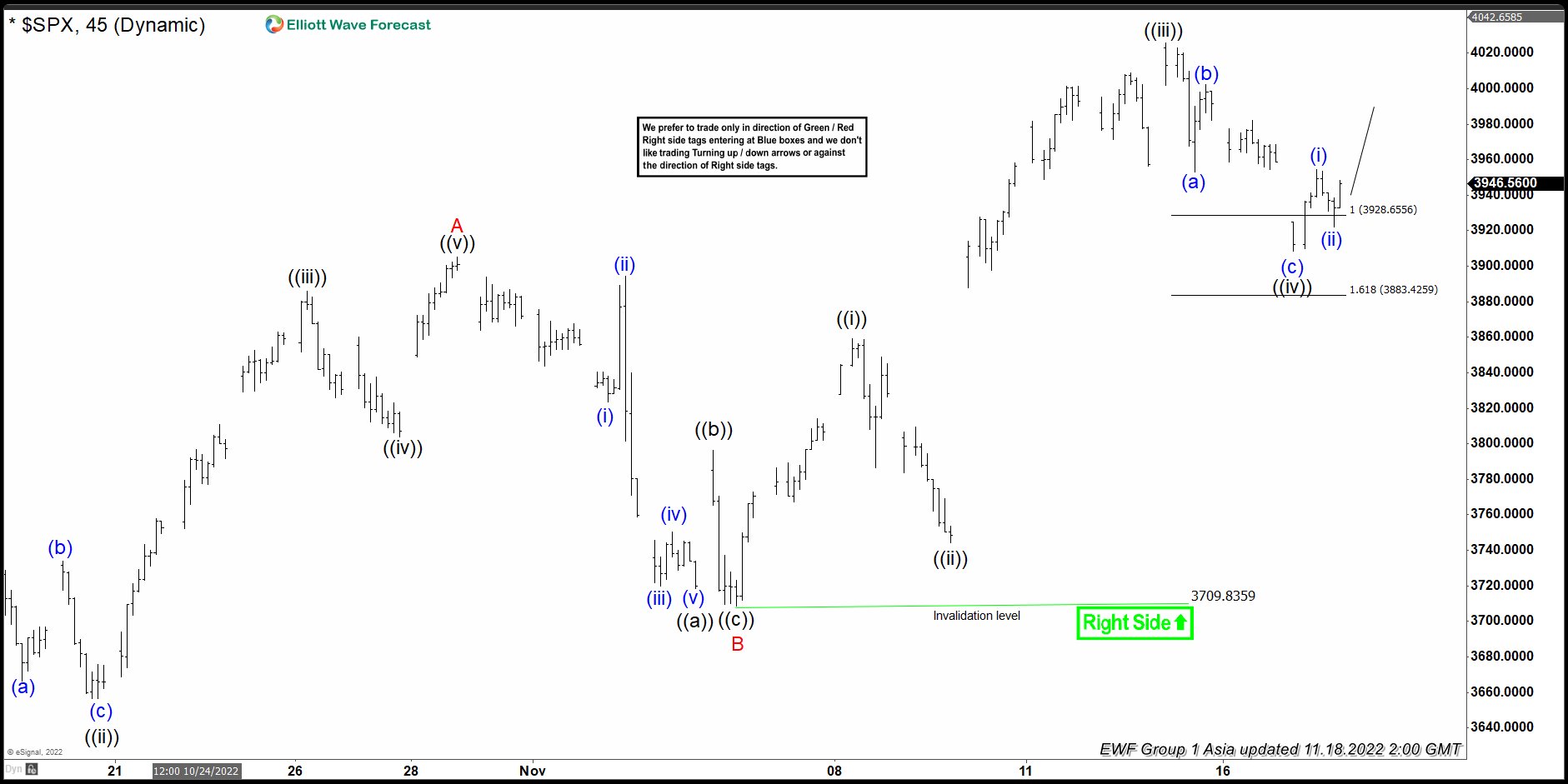
Short term Elliott Wave View in SP500 (SPX) shows an incomplete bearish sequence from 1.04.2022 high favoring further downside. Short term, rally from 10.13.2022 low is unfolding as a zigzag Elliott Wave structure. Up from 10.13.2022 low, wave A ended at 3905.64 and pullback in wave B ended at 3709.83. Wave C higher is in progress as a 5 waves impulse structure before the Index turns lower again.
Up from wave B, wave ((i)) ended at 3859.84 and pullback in wave ((ii)) ended at 3743.57. Index then rallies again in wave ((iii)) towards 4025.94. Internal subdivision of wave ((iv)) takes the form of an zigzag correction. Down from wave ((iii)), wave (a) ended at 3951.95 and rally in wave (b) ended at 4002.79. Wave (c) finished at 3908.16 and also wave ((iv)). Rally as wave ((v)) has started and as far as pivot at 3908.16 low stays intact, expect the Index to extend higher 1 more leg. Potential target is a 100% – 161.8% Fibonacci extension from 10.13.2022 low which comes at 4080.43 – 4312.02 area.
SPX 45 Minutes Elliott Wave Chart
https://www.youtube.com/watch?v=kt9ZKZPM02o
USD/CAD Daily Outlook
Daily Pivots: (S1) 1.3288; (P) 1.3344; (R1) 1.3384; More....
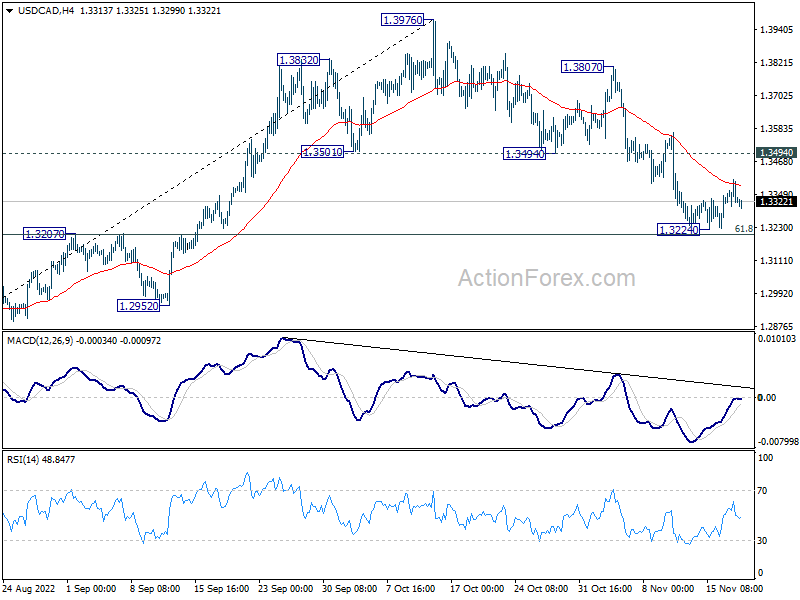
Intraday bias in USD/CAD remains neutral for the moment. On the upside, break of 1.3494 support turned resistance will argue that fall from 1.3976 has completed with three waves down to 1.3224. Further rally would then be seen back to 1.3807 resistance first. However, sustained trading below 1.3207 cluster support (61.8% retracement of 1.2726 to 1.3976 at 1.3204) will carry larger bearish implication and target 1.2952 support next.
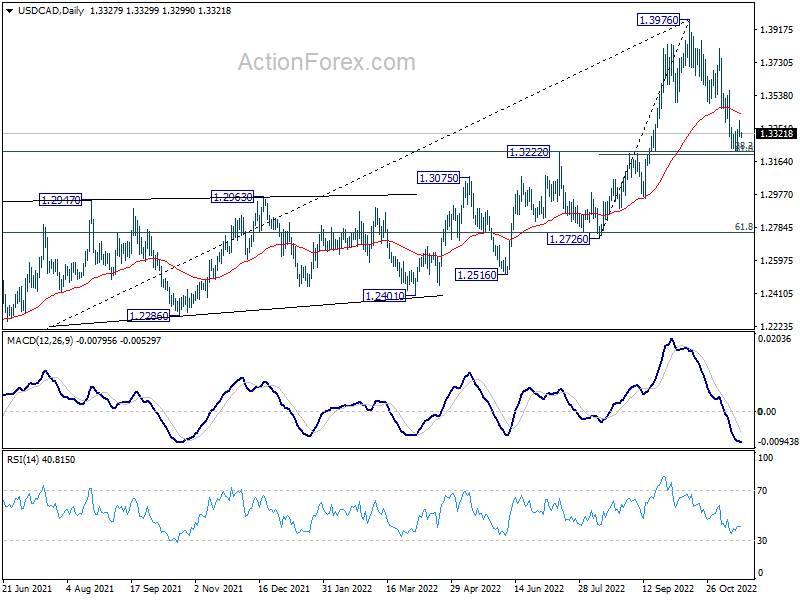
In the bigger picture, as long as 1.3222 cluster support (38.2% retracement of 1.2005 to 1.3976 at 1.3223) holds, larger up trend from 1.2005 (2021 low) is still expected to resume through 1.3976 high at a later stage. . However, firm break of 1.3222/3 will indicate that the trend might have reversed. Deeper fall would be seen to next cluster support at 1.2726 (61.8% retracement at 1.2758).
Dollar Softens after Short-Lived Recovery, Consolidations Continue
The forex markets continue to stay in consolidative mode in Asian session. Dollar's recovery attempt overnight was rather short-lived. Sterling also regains some ground after initial reaction to the UK government's new budget. Yen is also soft despite strong CPI data from Japan. Overall, New Zealand Dollar is the strongest for the week so far, followed by Sterling and then Euro. Swiss Franc is the worst followed by Yen, and then Canadian.
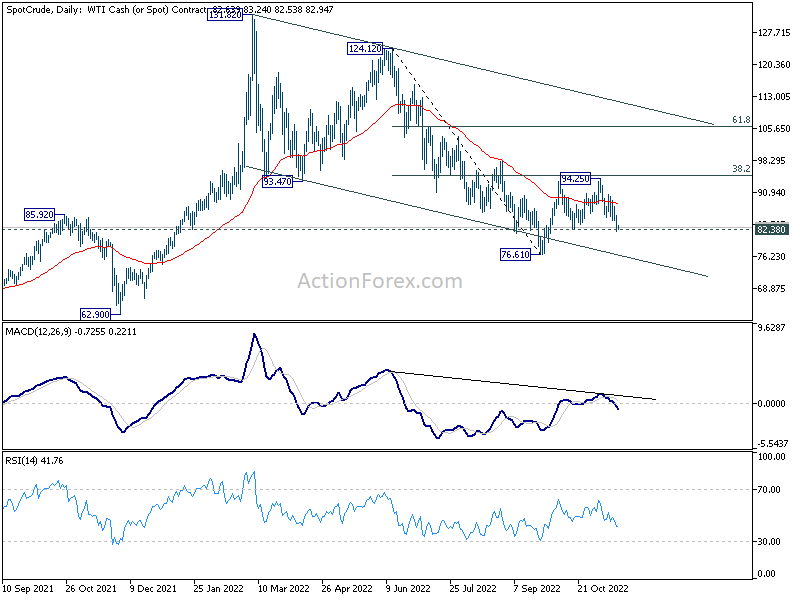
Technically, WTI oil's breach of 82.38 support raises the chance that corrective recovery from 76.61 has completed with three waves up to 94.25. That came after rejection by 38.2% retracement of 124.12 to 76.61. Sustained trading below 82.38 will affirm the case of down trend resumption through 76.61 low. If happens, that could put extra pressure on Canadian Dollar, in particular against other commodity currencies.
In Asia, at the time of writing, Nikkei is down -0.13%. Hong Kong HSI is up 0.31%. China Shanghai SSE is down -0.05%. Singapore Strait Times is down -0.48%. Japan 10-year JGB yield is down -0.0029 at 0.246. Overnight, DOW dropped -0.02%. S&P 500 dropped -0.31%. NASDAQ dropped -0.35%. 10-year yield rose 0.083 to 3.775.
Fed Kashkari: We cannot be overly persuaded by one month's data
Minneapolis Fed President Neel Kashkari said yesterday, "I need to be convinced that inflation has at least stopped climbing, that we're not falling further behind the curve, before I would advocate stopping the progression of future rate hikes," adding, "we're not there yet."
Kashkari acknowledged that October CPI data provided "some evidence that inflation is at least plateauing." Yet, "we cannot be overly persuaded by one month's data."
"It's an open question of how far we are going to have to go with interest rates to bring that demand down in the balance," he said.
SNB Maechler sees risk of more persistent inflation
SNB board member Andrea Maechler said yesterday, "our mandate is to bring down inflation and we will use the tools we have to do so... If we see our inflation forecast above 2 percent, we will continue to raise rates."
"Inflation started with shocks but it's no longer just shock-driven," Maechler said. "We see inflation as having the risk of being more persistent."
"It's very important that we maintain the focus on implementing the policies to reach price stability in a consistent and sustainable way."
Regarding Swiss Franc exchange rate, she said the appreciation "has been actually helping us keep our inflation much lower than in some of our neighboring countries."
Yet, she added, "We're willing - if the exchange rate were to rise too rapidly, too high - to use intervention to buy foreign exchange... We're also willing, if the exchange rate were to become too weak, to sell exchange rate but we're not yet ready to reduce our balance sheet as a policy in itself. This is not the right time."
Japan CPI core hits 40-yr high, BoJ Kuroda rules out rate hike
Japan headline CPI rose from 3.0% to 3.7% yoy in October, above expectation of 2.7% yoy. CPI core (all item ex-fresh food) rose from 3.0% to 3.6% yoy, above expectation of 3.5% yoy. That's the highest level in 40 years since 1982. CPI core-core (all item ex-fresh food and energy) rose from 1.8% yoy to 2.5% yoy, above expectation of 1.9% yoy.
BoJ Governor Haruhiko Kuroda said that core inflation was rising "quite a bit" but he expects it to slow back to below 2% in the next fiscal year.
"Raising interest rates now could delay Japan's economic recovery," Kuroda told the parliament. "I'm not saying the BOJ cannot raise rates indefinitely. I'm saying that it's inappropriate to raise rates now, in light of current economic and price developments."
"It's difficult to sustainably achieve our 2% inflation target unless nominal wages rise steadily," Kuroda said. "We'll continue with our monetary easing to support the economy and achieve our 2% inflation target in a sustained, stable fashion backed by wage growth.
Looking ahead
UK retail sales is the only feature in European session. Canada will release IPPI and RMPI later in the day, while US will release existing home sales.
USD/CAD Daily Outlook
Daily Pivots: (S1) 1.3288; (P) 1.3344; (R1) 1.3384; More....
Intraday bias in USD/CAD remains neutral for the moment. On the upside, break of 1.3494 support turned resistance will argue that fall from 1.3976 has completed with three waves down to 1.3224. Further rally would then be seen back to 1.3807 resistance first. However, sustained trading below 1.3207 cluster support (61.8% retracement of 1.2726 to 1.3976 at 1.3204) will carry larger bearish implication and target 1.2952 support next.
In the bigger picture, as long as 1.3222 cluster support (38.2% retracement of 1.2005 to 1.3976 at 1.3223) holds, larger up trend from 1.2005 (2021 low) is still expected to resume through 1.3976 high at a later stage. . However, firm break of 1.3222/3 will indicate that the trend might have reversed. Deeper fall would be seen to next cluster support at 1.2726 (61.8% retracement at 1.2758).
Economic Indicators Update
| GMT | Ccy | Events | Actual | Forecast | Previous | Revised |
|---|---|---|---|---|---|---|
| 23:30 | JPY | National CPI Core Y/Y Oct | 3.60% | 3.50% | 3.00% | |
| 00:01 | GBP | GfK Consumer Confidence | -44 | -46 | -47 | |
| 07:00 | GBP | Retail Sales M/M Oct | 0.30% | -1.40% | ||
| 07:00 | GBP | Retail Sales Y/Y Oct | -6.50% | -6.90% | ||
| 07:00 | GBP | Retail Sales ex-Fuel M/M Oct | 0.60% | -1.50% | ||
| 07:00 | GBP | Retail Sales ex-Fuel Y/Y Oct | -6.70% | -6.20% | ||
| 13:30 | CAD | Industrial Product Price M/M Oct | 0.20% | 0.10% | ||
| 13:30 | CAD | Raw Material Price Index Oct | -1.00% | -3.20% | ||
| 15:00 | USD | Existing Home Sales Oct | 4.36M | 4.71M |
Japan CPI core hits 40-yr high, BoJ Kuroda rules out rate hike
Japan headline CPI rose from 3.0% to 3.7% yoy in October, above expectation of 2.7% yoy. CPI core (all item ex-fresh food) rose from 3.0% to 3.6% yoy, above expectation of 3.5% yoy. That's the highest level in 40 years since 1982. CPI core-core (all item ex-fresh food and energy) rose from 1.8% yoy to 2.5% yoy, above expectation of 1.9% yoy.
BoJ Governor Haruhiko Kuroda said that core inflation was rising "quite a bit" but he expects it to slow back to below 2% in the next fiscal year.
"Raising interest rates now could delay Japan's economic recovery," Kuroda told the parliament. "I'm not saying the BOJ cannot raise rates indefinitely. I'm saying that it's inappropriate to raise rates now, in light of current economic and price developments."
"It's difficult to sustainably achieve our 2% inflation target unless nominal wages rise steadily," Kuroda said. "We'll continue with our monetary easing to support the economy and achieve our 2% inflation target in a sustained, stable fashion backed by wage growth.
SNB Maechler sees risk of more persistent inflation
SNB board member Andrea Maechler said yesterday, "our mandate is to bring down inflation and we will use the tools we have to do so... If we see our inflation forecast above 2 percent, we will continue to raise rates."
"Inflation started with shocks but it's no longer just shock-driven," Maechler said. "We see inflation as having the risk of being more persistent."
"It's very important that we maintain the focus on implementing the policies to reach price stability in a consistent and sustainable way."
Regarding Swiss Franc exchange rate, she said the appreciation "has been actually helping us keep our inflation much lower than in some of our neighboring countries."
Yet, she added, "We're willing - if the exchange rate were to rise too rapidly, too high - to use intervention to buy foreign exchange... We're also willing, if the exchange rate were to become too weak, to sell exchange rate but we're not yet ready to reduce our balance sheet as a policy in itself. This is not the right time."
Fed Kashkari: We cannot be overly persuaded by one month’s data
Minneapolis Fed President Neel Kashkari said yesterday, "I need to be convinced that inflation has at least stopped climbing, that we're not falling further behind the curve, before I would advocate stopping the progression of future rate hikes," adding, "we're not there yet."
Kashkari acknowledged that October CPI data provided "some evidence that inflation is at least plateauing." Yet, "we cannot be overly persuaded by one month's data."
"It's an open question of how far we are going to have to go with interest rates to bring that demand down in the balance," he said.
USD/JPY Could Recover But This Resistance Is Key
Key Highlights
- USD/JPY declined heavily after it broke the 145.50 support zone.
- A major bearish trend line is forming with resistance near 143.80 on the 4-hours chart.
- EUR/USD and GBP/USD started a downside correction.
- Oil price might dive if there is a close below $82.65.
USD/JPY Technical Analysis
The US Dollar started a major decline from well above the 148.00 level against the Japanese Yen. USD/JPY declined below the 146.50 and 145.50 support levels.
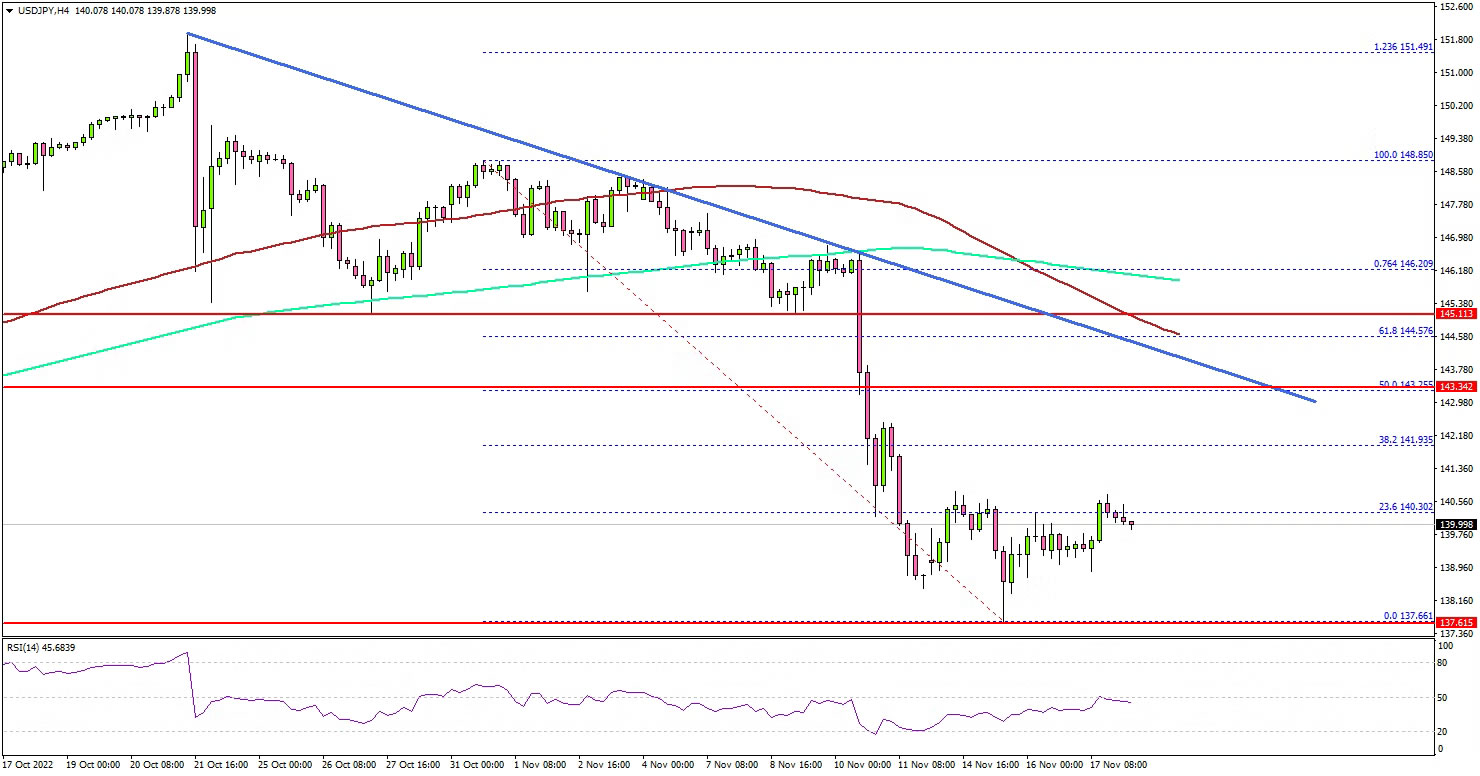
Looking at the 4-hours chart, the pair gained bearish momentum below the 143.80 level, the 100 simple moving average (red, 4-hours) plus the 200 simple moving average (green, 4-hours).
The bears even pushed the pair below the 140.00 level. It traded as low as 137.66 and is currently correcting losses. There was a minor increase above the 140.00 level. The pair climbed above the 23.6% Fib retracement level of the downward move from the 148.85 swing high to 137.66 low.
On the upside, an immediate resistance is near 141.50 level. The next major resistance may perhaps be near 142.00. Any more gains could set the pace for a move towards the 143.80 resistance zone.
There is also a major bearish trend line forming with resistance near 143.80 on the same chart, above which it could even test 145.00.
An initial support is near the 139.20 level. The next major support is near the 138.80 zone. The main support sits at 138.00. A close below the 138.00 level might start another strong decline. In the stated case, USD/JPY could decline towards the 135.00 support.
Looking at oil price, there was a downside extension below the $85.50 level and there is a risk of more losses in the near term.
Economic Releases
- UK Retail Sales for Oct 2022 (YoY) - Forecast -6.5%, versus -6.9% previous.
- UK Retail Sales for Oct 2022 (MoM) - Forecast 0%, versus -1.4% previous.
- US Existing Home Sales for Oct 2022 (MoM) - Forecast -0.1%, versus -1.5% previous.
Platinum Wave Analysis
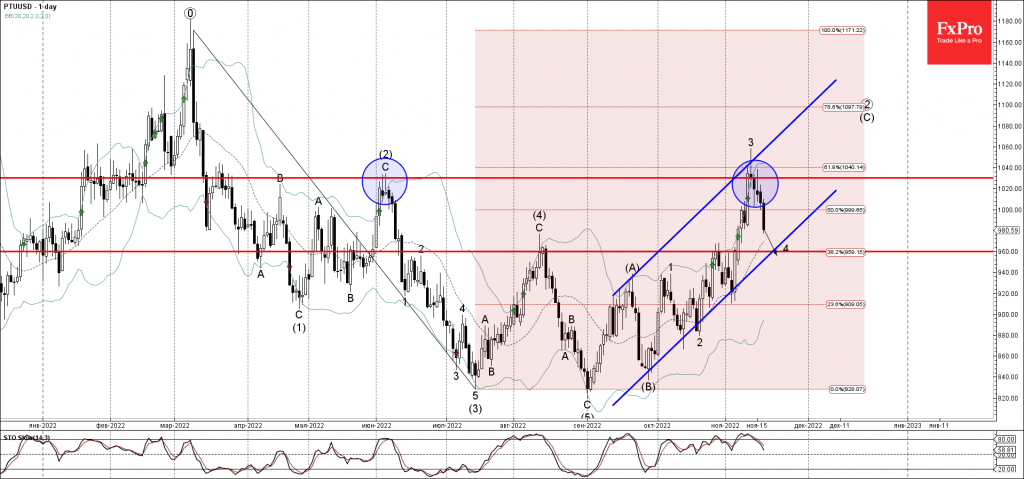
- Platinum reversed from resistance level 1030.00
- Likely to fall to support level 960.00
Platinum recently reversed down from the key resistance level 1030.00 (previous multi-month high from June) intersecting with the upper daily Bollinger Band and the resistance trendline of the daily up channel from September.
The downward reversal from the resistance level 1030.00 started the active short-term corrective wave 4.
Platinum can be expected to fall further toward the next support level 960.00 (target price for the completion of the active wave 4).