

Sample Category Title
EUR/AUD Daily Outlook
Daily Pivots: (S1) 1.5413; (P) 1.5482; (R1) 1.5563; More...
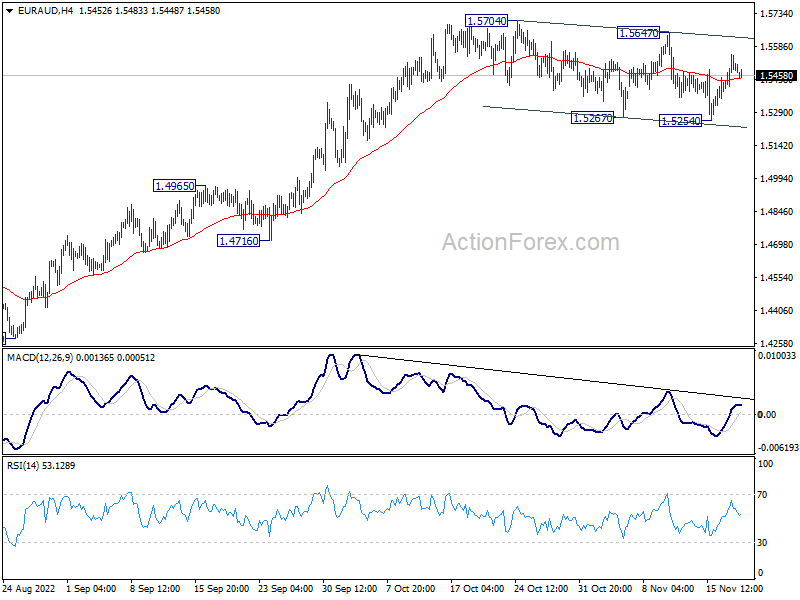
EUR/AUD is extending the corrective pattern from 1.5704 and intraday bias stays neutral. If case of another fall, downside should be contained by 55 day EMA (now at 1.5265) to bring rebound. On the upside, break of 1.5704 will resume larger rise from 1.4281. However, sustained trading below 55 day EMA will bring deeper correction towards 1.4965 resistance turned support.
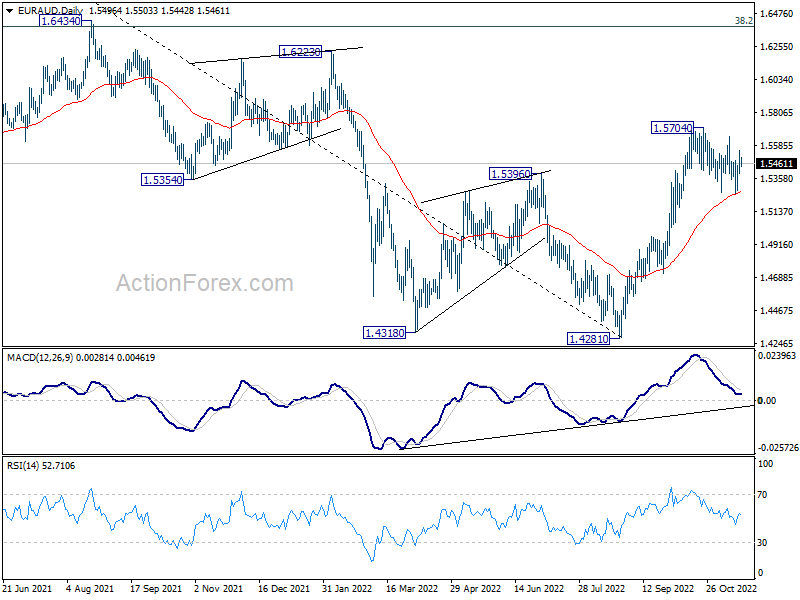
In the bigger picture, a medium term bottom should be in place at 1.4281, on bullish convergence condition in daily MACD. Further rise would be seen back to 1.6434 key resistance next. Break of 1.4965 resistance turned support is needed to indicate reversal. Otherwise, further rally will remain in favor.
EUR/CHF Daily Outlook
Daily Pivots: (S1) 0.9828; (P) 0.9850; (R1) 0.9891; More....
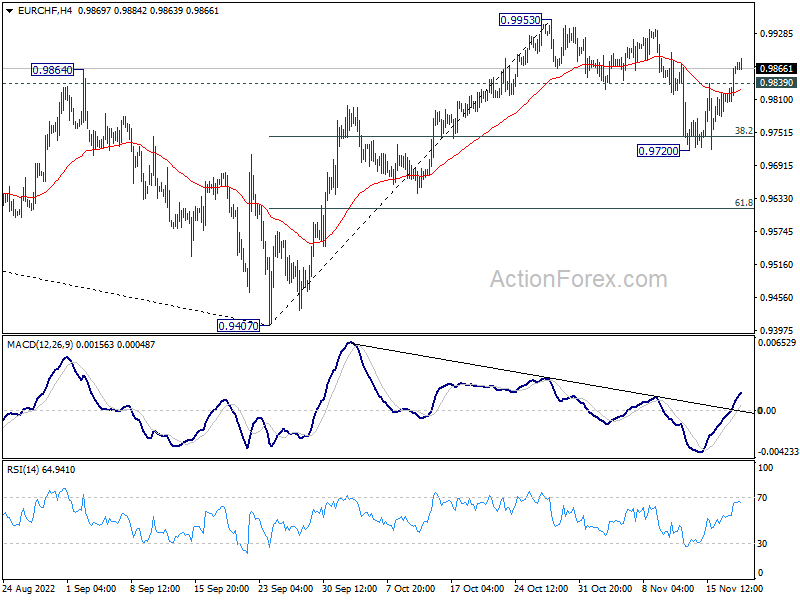
EUR/CHF's break of 0.9839 minor resistance suggests that correction from 0.9953 has completed with three waves down to 0.9720. Intraday bias is back on the upside for retesting 0.9953 resistance first. Decisive break there will resume the rally from 0.9407 to 1.0072 fibonacci level.
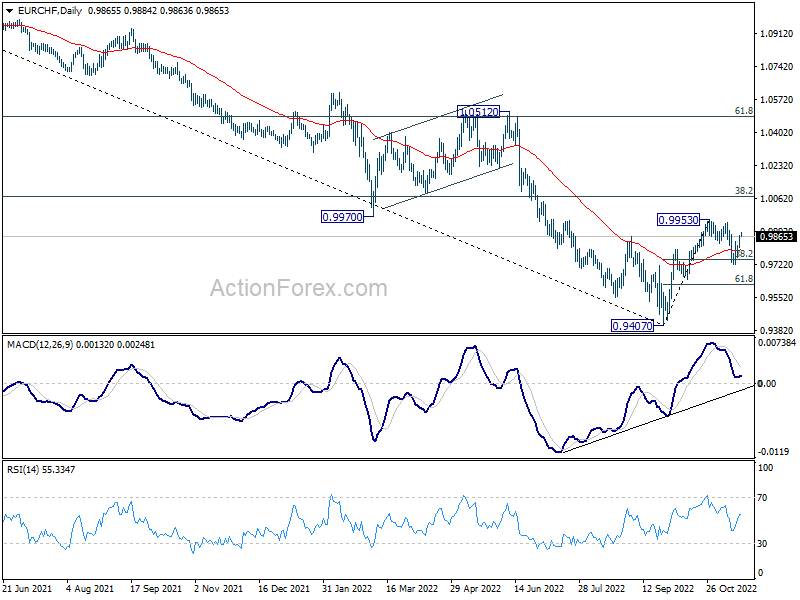
In the bigger picture, rejection by 0.9970 support turned resistance retains medium term bearishness. That is, while 0.9407 is a medium term bottom, price actions from there would develope into a corrective pattern rather than a reversal. That is, down trend resumption through 0.9407 is favored at a later stage. This will remain the favored case now, as long 38.2% retracement of 1.1149 to 0.9407 at 1.0072 holds.
EUR/USD Daily Outlook
Daily Pivots: (S1) 1.0311; (P) 1.0359; (R1) 1.0412; More...
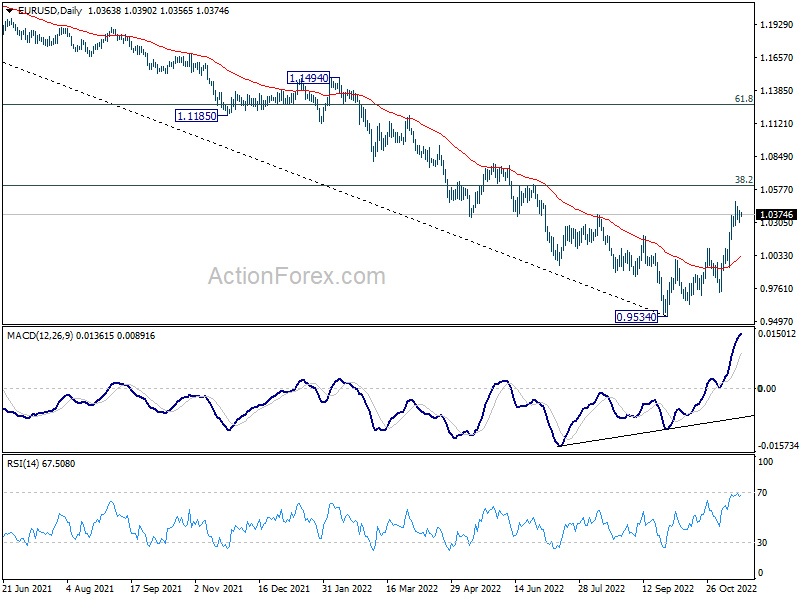
Intraday bias in EUR/USD remains neutral as consolidation from 1.0481 is in progress. Downside of retreat should be contained by 1.0092 resistance turned support to bring another rally. On the upside, break of 1.0481 will resume the rise from 0.9534 and target 1.0609 fibonacci level.
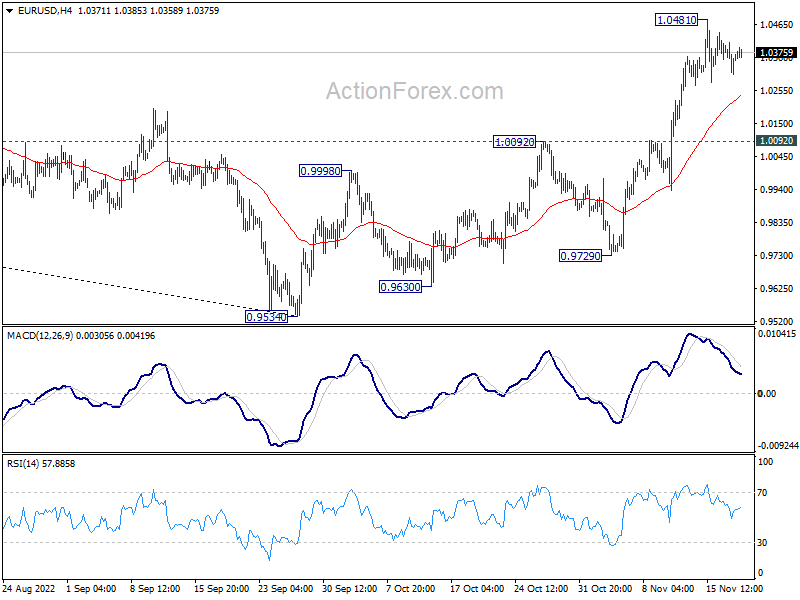
In the bigger picture, a medium term bottom was in place at 0.9534, on bullish convergence condition in daily MACD. Even as a corrective rise, rally from 0.9534 should target 38.2% retracement of 1.2348 (2021 high) to 0.9534 at 1.0609. Sustained trading above 55 week EMA (now at 1.0566) will raise the chance of trend reversal and target 61.8% retracement at 1.1273. This will now remain the favored case as long as 1.0092 resistance turned support holds.
GBP/USD Daily Outlook
Daily Pivots: (S1) 1.1766; (P) 1.1862; (R1) 1.1961; More...
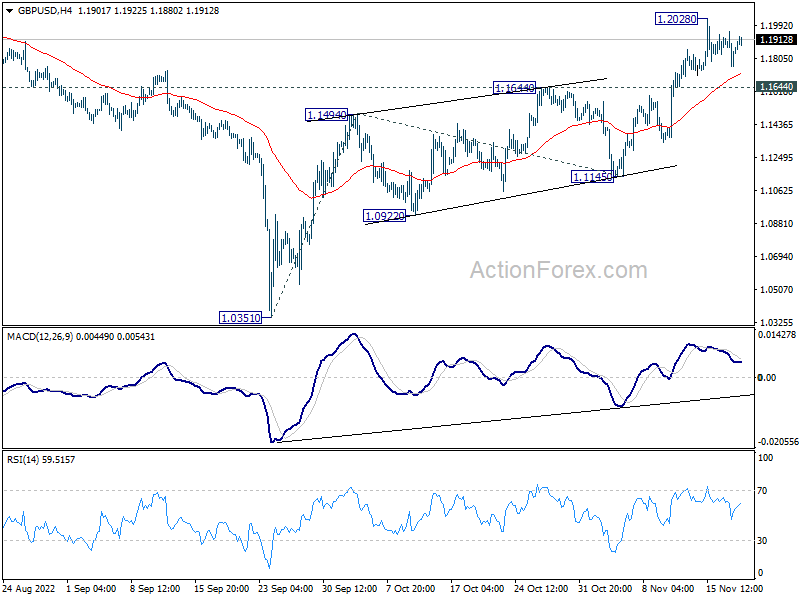
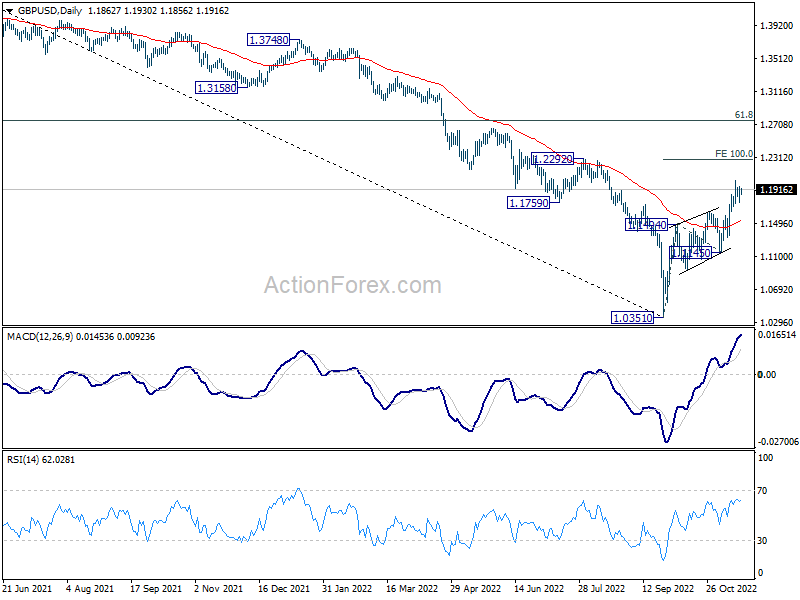
Intraday bias in GBP/USD remains neutral as consolidation from 1.2028 is extending. Further rise is expected as long as 1.1644 resistance turned support holds. On the upside, break of 1.2028 will resume whole rise from 1.0351 to 100% projection of 1.0351 to 1.1494 from 1.1145 at 1.2288. However, sustained break of 1.1644 will bring deeper fall to 1.1145 support instead.
In the bigger picture, rise from 1.0351 medium term bottom is at least correcting whole down trend from 1.4248 (2021 high). Further rise is expected as long as 1.1145 support holds. Next target is 61.8% retracement of 1.4248 to 1.0351 at 1.2759.
USD/CHF Daily Outlook
Daily Pivots: (S1) 0.9452; (P) 0.9504; (R1) 0.9575; More...
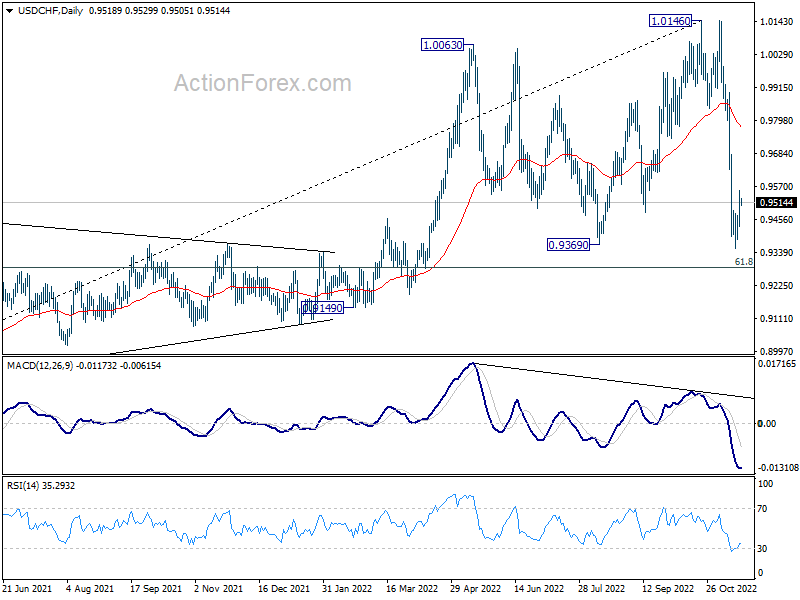
Intraday bias in USD/CHF stays neutral as recovery from 0.9355 is in progress. Upside of recovery should be limited below 0.9680 minor resistance to bring another decline. On the downside, break of 0.9355 will resume the fall from 1.0146 to 0.9287 fibonacci level.
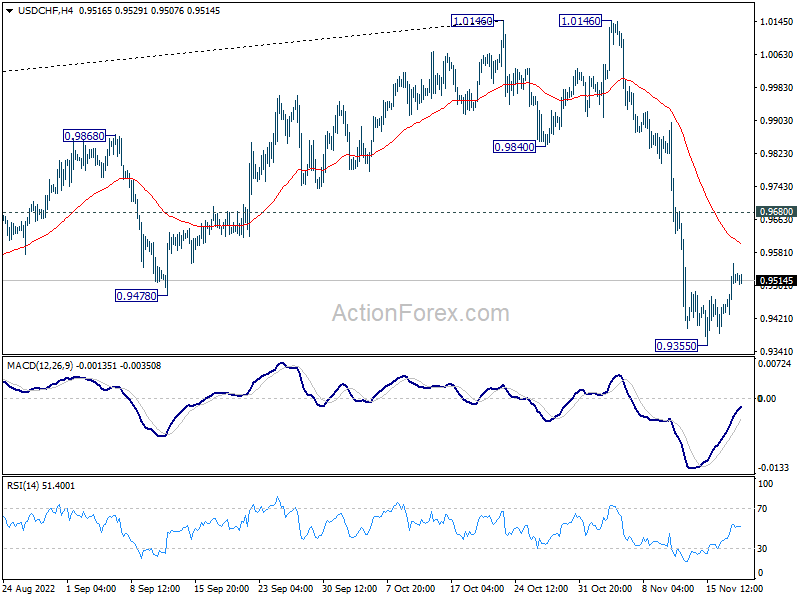
In the bigger picture, rise from 0.8756 (2021 low) has completed at 1.0146, well ahead of 1.0342 long term resistance (2016 high). Based on current downside momentum, fall from 1.0146 might be a medium term down trend itself. Break of 61.8% retracement of 0.8756 to 1.0146 at 0.9287 will pave the way to 0.8756. In any case, risk will stay on the downside as long as 55 day EMA (now at 0.9793) holds.
USD/JPY Daily Outlook
Daily Pivots: (S1) 139.15; (P) 139.95; (R1) 141.01; More...
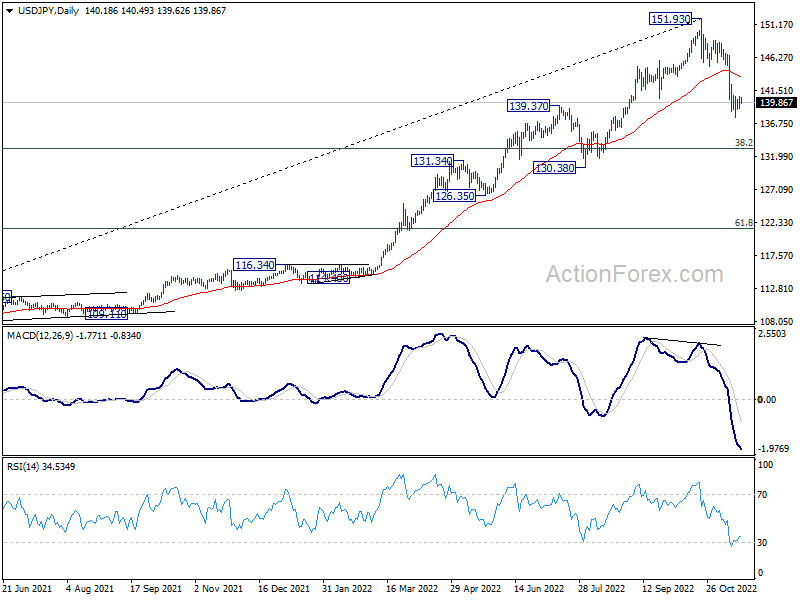
USD/JPY is staying in consolidation above 137.66 temporary low and intraday bias stays neutral at this point. Stronger rise cannot be ruled out, but upside should be limited below 145.16 support turned resistance. Break of 137.66 will resume the decline from 151.93, to 133.07 fibonacci level, as a correction to the larger up trend.
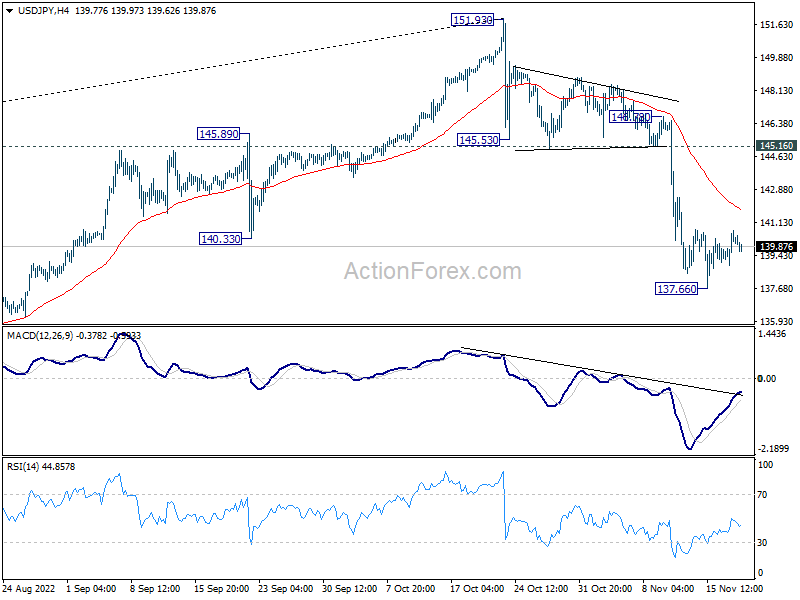
In the bigger picture, a medium term top should be formed at 151.93. Fall from there is correcting larger up trend from 102.58. It's too early to call for bearish trend reversal. But even as a corrective move, such decline should target 38.2% retracement of 102.58 to 151.93 at 133.07, or further to 55 week EMA (now at 130.58).
AUD/USD Daily Report
Daily Pivots: (S1) 0.6634; (P) 0.6693; (R1) 0.6750; More...
Intraday bias in AUD/USD remains neutral for consolidation below 0.6796. Further rally is expected as long as 0.6521 resistance turned support holds. On the upside, break of 0.6796 will resume the rise from 0.6169 to 0.6871 fibonacci level.
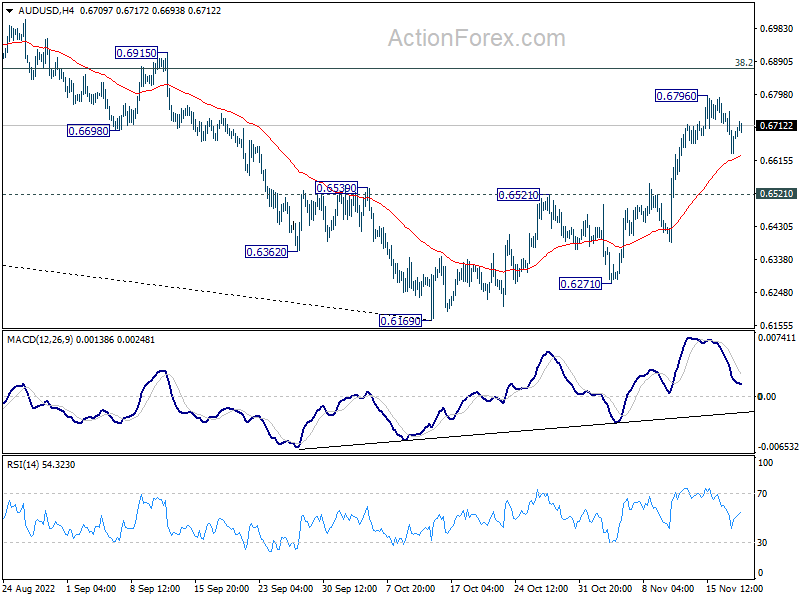
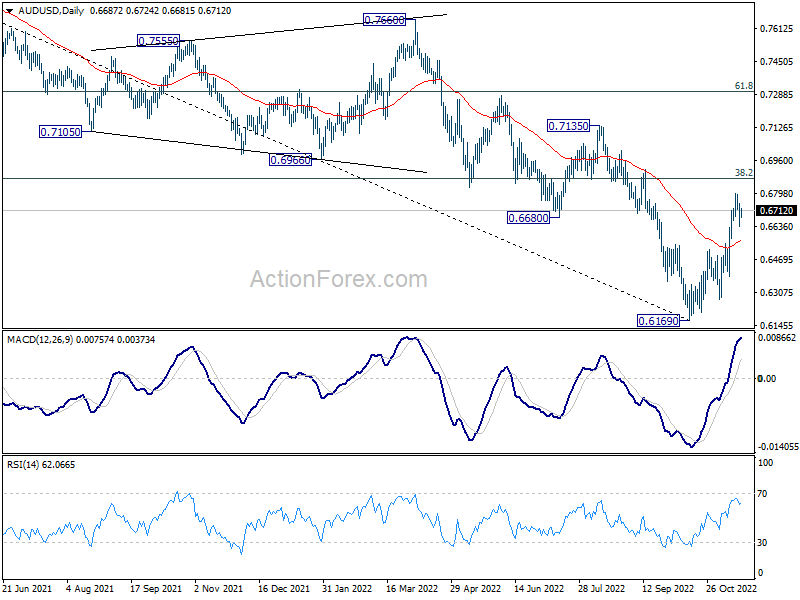
In the bigger picture, the break of 0.6680 support turned resistance confirms medium term bottoming at 0.6169. It's too early to call for trend reversal. But even as a corrective move, rise from 0.6169 should target 38.2% retracement of 0.8006 to 0.6169 at 0.6871. Sustained trading above 55 week EMA (now at 0.6934) will raise the chance of the start of a bullish up trend. This week now remain the favored case as long as 0.6521 resistance turned support holds.
Pound Fell But Closed Off Intraday Lows
Markets
The UK announced a £55bn fiscal consolidation effort, consisting of £30bn in spending cuts (mainly going in effect from FY 2025/26) and £25bn in tax raises which brings the overall tax burden to a postwar record. UK finance minister Hunt’s Autumn Statement was aimed at tackling inflation and restoring investor confidence by bringing Britain on a sustainable path of debt reduction. He nevertheless also announced some supportive measures including household handouts and an extension to the energy price cap beyond April to address the cost-of-living squeeze and targeted investments to lift long-term growth. The OBR estimates that the UK economy will drop 1.4% next year and inflation would still amount to 7.4%. The pound fell but closed off intraday lows. EUR/GBP finished slightly higher at 0.873. Cable eased to 1.186 from a 1.196 intraday high. Gilt yield rose especially on the front end of the curve. Hunt said the UK is already in a recession but his plan would make it shallower thanks to the supportive measures. The fact that spending cuts don’t kick in straight away, probably also spurred the move. Changes ranged between 4 bps (30y) and 12.3 bps (2y). Core bond yields elsewhere also gained with US Treasuries underperforming Bunds. That’s despite a further easing in housing data and a steep drop in the Philly Fed business indicator but it followed comments from Fed’s Bullard. He said in his view rates should be at least 5-5.25%, adding that he hasn’t yet seen a lot of impact on inflation from earlier tightening. Kashkari (Minneapolis) later joined the growing Fed pushback against recent market repricing by downplaying the relevance of one month’s inflation data. He also said that the overwhelming feedback from local contacts is that there is still a lot of demand and not enough workers to meet that. US yields rose 3.6 bps (30y) to 9.7 bps (2y) on a daily basis. German yields advanced 2.4-3.6 bps in the 2y-10y segment. The dollar strengthened overall but was not able to retain all intraday gains. EUR/USD bounced of resistance near the 1.04 area towards the 1.03 zone before closing at 1.036. The trade-weighted greenback only eked out a slight net gain from 106.33 to 106.69.
Asian bourses follow WS’s choppy performance yesterday. Indices trade mixed but daily swings are limited to around 0.50% in both ways. Japanese inflation hit its fastest clip in 40 years (see below) but BoJ governor Kuroda already said that current inflation situation isn’t sustainable. The Japanese yen reacted muted with USD/JPY stabilizing just below 140. The US dollar eases slightly. US yields give up a little over 1 bp.
Today’s economic calendar concludes the UK update with October retail sales. They came in slightly below consensus at 0.6% m/m (-6.1%) for headline sales and 0.3% m/m (-6.7%) for sales ex auto fuel. The immediate market impact is limited and in any case contained to UK soil. EUR/GBP wanders in the low 0.87 area. Lacking drivers, we expect muted, sideways trading on other markets - core bonds and FX/dollar - going into the weekend. We look out whether weekly lows in the dollar and core bond yields hold. Speeches by ECB governors including Lagarde, Nagel and Knot are worth mentioning though. They serve as a wildcard, as does the amount of ECB TLTRO repayments.
News Headlines
British consumer confidence as measured by market research firm GFK improved modestly this month but remains at a very low level compared to historic standards. The headline index improved in November to -44 from -47 after setting an all-time low at -49 in September. The subcategories personal finances (over the previous and the next 12 months), economic situation (also both for the previous and the next 12 months), climate for major purchases and savings intentions al improved, albeit modestly. GFK indicated that the improvement was due to relief amongst UK consumers after the exit of PM Truss after her government’s plans triggered elevated financial uncertainty.
Inflation in Japan accelerated more than expected in October. The closely watched core measure excluding fresh food rose from 3.0% in September to 3.6% in October, reaching the highest levels since early 1982. It was the seventh consecutive month for this price measure to surpass the 2% BoJ inflation target. The headline index also jumped from 3.0% to 3.7%. The core index excluding food and energy jumped from 1.8% to 2.5% Y/Y, an indication that price pressures are becoming more broad-based. Price rises are also mitigated by government measures. Even so, the report probably won’t change the BoJ ultra-easy policy as it expects core inflation to return well below 2.0% next year and in 2024.
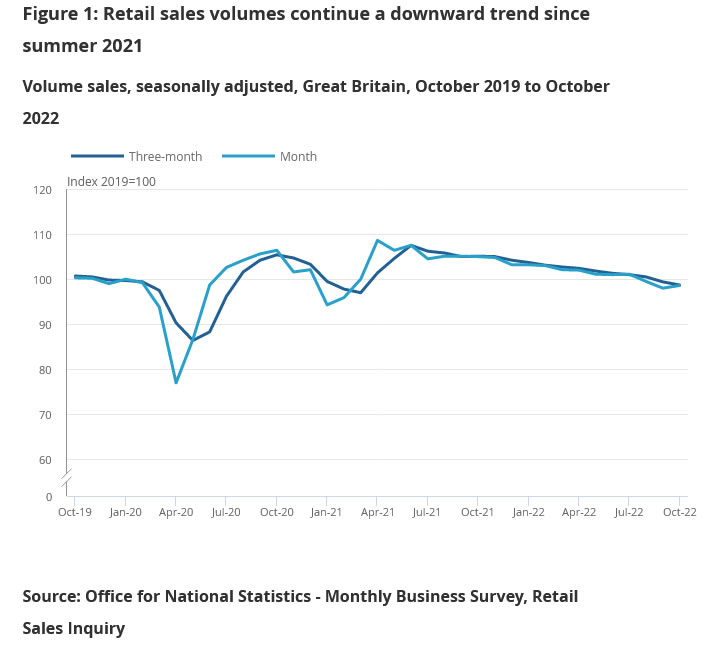
UK retail sales volume up 0.6% mom in Oct, sales value up 1.8% mom
UK retail sales volumes rose 0.6% mom in October, above expectation of 0.3% mom. Ex-fuel sales volume was up 0.3% mom, below expectation of 0.6% mom.
In the three months period to October, comparing with the previous three months, sales volume was down -2.4% while ex-fuel sales volume was also down -2.4%, continuing the down trend started since summer 2021.
In value term, headline sales was up 1.8% mom while ex-fuel sales was up 1.0% mom. Comparing the three month periods, headline sales value was down -0.7% while ex-fuel sales value was down -0.1%.
Hawks Are Back
Inflation in Japan soared to the highest levels in more than 30 years, to 3.7% in October, up from 3% printed a month earlier. It was expected, maybe slightly higher than expected, and came as another proof that the Bank of Japan (BoJ) is making the same mistake of ignoring the rising inflation as did the Federal Reserve (Fed) last year.
High inflation print sure revived the BoJ hawks, and the calls for a policy rate hike, and kept the dollar-yen below the 140 level, but it’s unsure whether the BoJ will give up on its ultra-soft policy stance. Therefore, if the US dollar picks up momentum, which will certainly be the case, the USDJPY could easily rebound back above its 50-DMA, which stands near 145.
And the reason I think the US dollar will recover is because most Fed members remain relatively hawkish regarding the Fed’s policy tightening.
In this context, US stocks slid another day as more Fed members threw more hawkish comments into the mix, to dampen the investor mood, although some better-than-expected earnings from retailers pulled the S&P500 higher to the close.
The latest man to kill the market joy was St Louis Fed President, Mr. Bullard, who said that the rates should raise at least until the 5-5.25% range, while showing a chart that plotted rates between 5-7%. Maybe that was a mistake, maybe not! Other than him, Neel Kashkari also said that he wants to see inflation stop climbing, and that we are not there yet.
We are not there yet, is what the market is also pricing through US dollar options. Although the dollar index lost up to 8% since the end of September peak, it hit, and rebounded from a long-term trendline and option traders are building topside structure over the one-month tenor that covers the next US inflation report and the Fed’s next policy meeting in December. So traders see the dollar gain ground on potentially stronger inflation data in the next release, and a certainly hawkish Fed statement, accompanying the 50bp hike that’s priced at 80% as of today.
So, the ambiance in the stock markets is not as cheery as it was at the end of last week. The S&P500 started the day in a bad mood but recovered relatively well to close the session only 0.30% lower. A couple of encouraging earnings from retailers may have helped lift sentiment.
Moving forward, we could expect the downside correction on index level to deepen. The first bearish target for the S&P500 stands at 3855 level, which is the major 38.2% retracement on the latest rebound. That level should distinguish between the continuation of the actual bear market rally, and a bearish reversal for some more pain.
Higher taxes, windfall taxes, no spending cut, a gloomy growth forecast, but unharmed gilt & GBP
The autumn budget announcement in Britain was… reasonable. The British government said it will borrow £170 billion instead of £185 billion expected. That, along with higher taxes helped boosting appetite in British sovereign bonds. The 10-year gilt yield tested the 3% mark to the downside for the first time since September, and could further ease given that the BoE also softened its policy stance lately on unideal economic conditions.
Now, one thing that was less expected was the spending cuts, or the lack thereof. Jeremy Hunt said yesterday that they won’t cut spending until the next general election. But the increase of the energy price cap which will have dramatic consequences for families, and their budget. A British family with two children, for example, will see its energy bill tripled.
From the economic lenses, both the U-turn on spending cuts, and higher energy bills will boost inflation, and that could be negative for the pound, if the Bank of England doesn’t compensate with higher interest rate hikes. And the BoE said last time that it won’t go crazy hawkish to avoid a complete economic meltdown in the UK.
And indeed, what was really scary for sterling traders yesterday was the gloomy growth forecast. Jeremy Hunt said that the UK is already in recession – stating the obvious. But he also said that growth will fall 1.4% next year, versus a 1.8% expansion printed previously, and recession will last over a year, while the BoE will probably be raising rates to fight inflation during this period. Even though it will probably be raising less than what it should to really fight inflation.
The outlook for pound sterling remains bearish, but because Cable selloff derailed sometime around April this year, and fell free with Liz Truss, the pair could further recover some of its losses. At 1.30, Cable will still be in the negative trend building since mid-2021.