

Sample Category Title
EUR/CHF Weekly Outlook
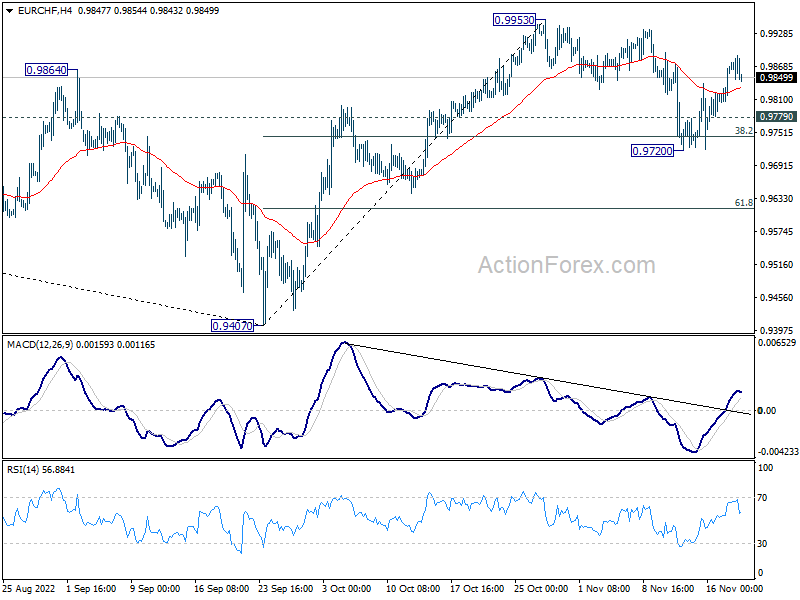
EUR/CHF's recovery last week suggests that pull back from 0.9953 has completed at 0.9720, after drawing support from 38.2% retracement of 0.9407 to 0.9953 0.9744. Initial bias is mildly on the upside this week for retesting 0.9953. Firm break there will resume the rally from 0.9407 to 1.0072 fibonacci level. However, break of 0.9779 will likely resume the fall from 0.9953 through 0.9720.
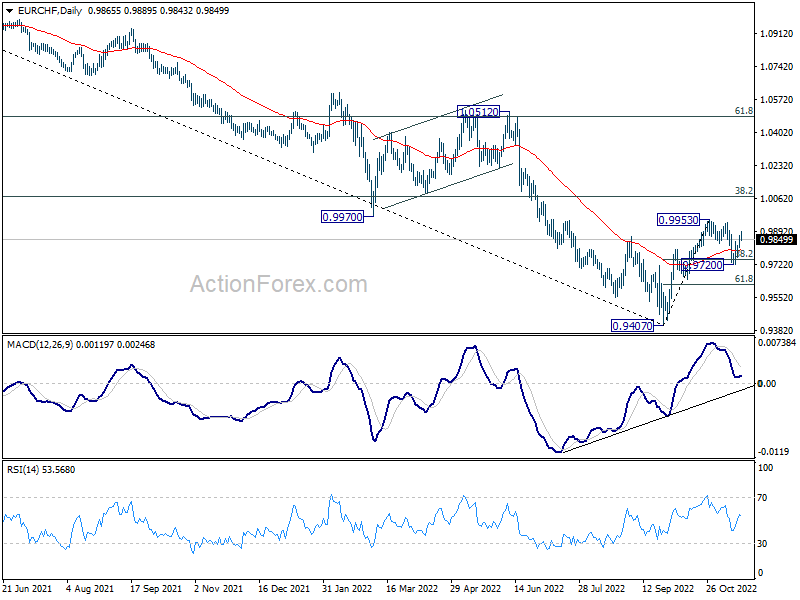
In the bigger picture, rejection by 0.9970 support turned resistance retains medium term bearishness. That is, while 0.9407 is a medium term bottom, price actions from there would develope into a corrective pattern rather than a reversal. Down trend resumption through 0.9407 is mildly favored at a later stage. This will remain the favored case now, as long 38.2% retracement of 1.1149 to 0.9407 at 1.0072 holds.
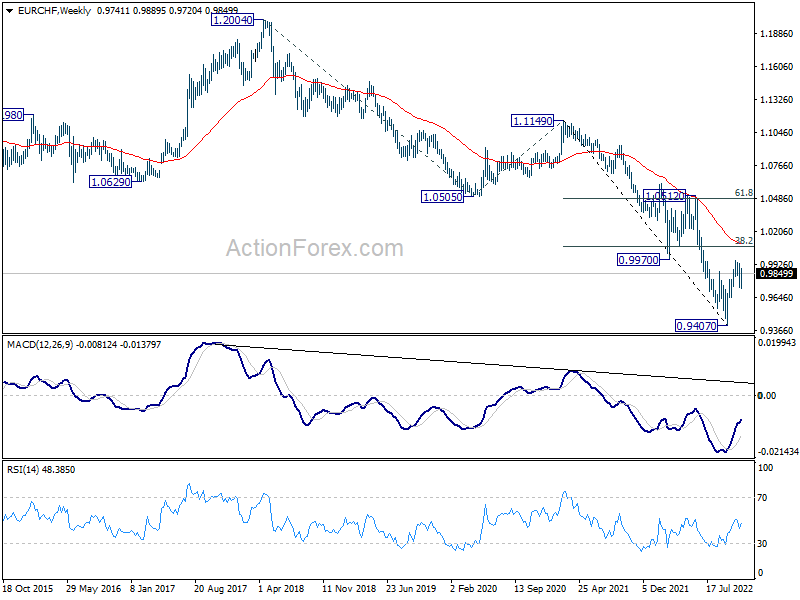
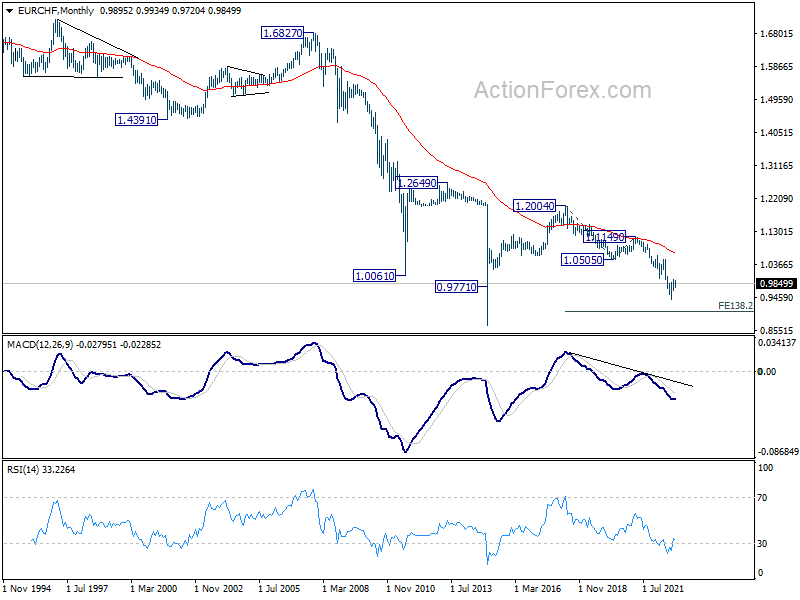
In the long term picture, capped well below 55 month EMA, EUR/CHF is seen as extending the multi-decade down trend. There is no prospect of a bullish reversal until firm break of 1.0505 support turned resistance (2020 low). In case of resumption, next target is 138.2% projection of 1.2004 to 1.0505 to 1.1149 at 0.9033.
Summary 11/21 – 11/25
Monday, Nov 21, 2022
| GMT | Ccy | Events | Consensus | Previous |
|---|---|---|---|---|
| 07:00 | EUR | Germany PPI M/M Oct | 0.90% | 2.30% |
| 07:00 | EUR | Germany PPI Y/Y Oct | 41.50% | 45.80% |
| 21:45 | NZD | Trade Balance (NZD) Oct | -1615M |
| GMT | Ccy | Events | |
|---|---|---|---|
| 07:00 | EUR | Germany PPI M/M Oct | |
| Forecast: 0.90% | Previous: 2.30% | ||
| 07:00 | EUR | Germany PPI Y/Y Oct | |
| Forecast: 41.50% | Previous: 45.80% | ||
| 21:45 | NZD | Trade Balance (NZD) Oct | |
| Forecast: | Previous: -1615M | ||
Tuesday, Nov 22, 2022
| GMT | Ccy | Events | Consensus | Previous |
|---|---|---|---|---|
| 07:00 | GBP | Public Sector Net Borrowing (GBP) Oct | 19.2B | |
| 09:00 | EUR | Eurozone Current Account (EUR) Sep | -20.3B | -26.3B |
| 13:30 | CAD | New Housing Price Index M/M Oct | 0.20% | -0.10% |
| 13:30 | CAD | Retail Sales M/M Sep | 1.10% | 0.70% |
| 13:30 | CAD | Retail Sales ex Autos M/M Sep | 1.00% | 0.70% |
| 15:00 | EUR | Eurozone Consumer Confidence Nov P | -26 | -28 |
| 22:00 | AUD | Manufacturing PMI Nov P | 52.7 | |
| 22:00 | AUD | Services PMI Nov P | 49.3 |
| GMT | Ccy | Events | |
|---|---|---|---|
| 07:00 | GBP | Public Sector Net Borrowing (GBP) Oct | |
| Forecast: | Previous: 19.2B | ||
| 09:00 | EUR | Eurozone Current Account (EUR) Sep | |
| Forecast: -20.3B | Previous: -26.3B | ||
| 13:30 | CAD | New Housing Price Index M/M Oct | |
| Forecast: 0.20% | Previous: -0.10% | ||
| 13:30 | CAD | Retail Sales M/M Sep | |
| Forecast: 1.10% | Previous: 0.70% | ||
| 13:30 | CAD | Retail Sales ex Autos M/M Sep | |
| Forecast: 1.00% | Previous: 0.70% | ||
| 15:00 | EUR | Eurozone Consumer Confidence Nov P | |
| Forecast: -26 | Previous: -28 | ||
| 22:00 | AUD | Manufacturing PMI Nov P | |
| Forecast: | Previous: 52.7 | ||
| 22:00 | AUD | Services PMI Nov P | |
| Forecast: | Previous: 49.3 | ||
Wednesday, Nov 23, 2022
| GMT | Ccy | Events | Consensus | Previous |
|---|---|---|---|---|
| 01:00 | NZD | RBNZ Rate Decision | 4.25% | 3.50% |
| 08:15 | EUR | France Manufacturing PMI Nov P | 47.0 | 47.2 |
| 08:15 | EUR | France Services PMI Nov P | 50.6 | 51.7 |
| 08:30 | EUR | Germany Manufacturing PMI Nov P | 45.2 | 45.1 |
| 08:30 | EUR | Germany Services PMI Nov P | 46.4 | 46.5 |
| 09:00 | EUR | Eurozone Manufacturing PMI Nov P | 46.5 | 46.4 |
| 09:00 | EUR | Eurozone Services PMI Nov P | 48.4 | 48.6 |
| 09:30 | GBP | Manufacturing PMI Nov P | 45.6 | 46.2 |
| 09:30 | GBP | Services PMI Nov P | 48.0 | 48.8 |
| 13:30 | USD | Initial Jobless Claims (Nov 18) | 224K | 222K |
| 13:30 | USD | Durable Goods Orders Oct | 0.40% | 0.40% |
| 13:30 | USD | Durable Goods Orders ex Transportation Oct | 0.10% | -0.50% |
| 14:45 | USD | Manufacturing PMI Nov P | 49.8 | 50.4 |
| 14:45 | USD | Services PMI Nov P | 47.7 | 47.8 |
| 15:00 | USD | Michigan Consumer Sentiment Nov F | 54.7 | 54.7 |
| 15:00 | USD | New Home Sales Oct | 575K | 603K |
| 15:30 | USD | Crude Oil Inventories | -5.4M | |
| 17:00 | USD | Natural Gas Storage | 64B |
| GMT | Ccy | Events | |
|---|---|---|---|
| 01:00 | NZD | RBNZ Rate Decision | |
| Forecast: 4.25% | Previous: 3.50% | ||
| 08:15 | EUR | France Manufacturing PMI Nov P | |
| Forecast: 47.0 | Previous: 47.2 | ||
| 08:15 | EUR | France Services PMI Nov P | |
| Forecast: 50.6 | Previous: 51.7 | ||
| 08:30 | EUR | Germany Manufacturing PMI Nov P | |
| Forecast: 45.2 | Previous: 45.1 | ||
| 08:30 | EUR | Germany Services PMI Nov P | |
| Forecast: 46.4 | Previous: 46.5 | ||
| 09:00 | EUR | Eurozone Manufacturing PMI Nov P | |
| Forecast: 46.5 | Previous: 46.4 | ||
| 09:00 | EUR | Eurozone Services PMI Nov P | |
| Forecast: 48.4 | Previous: 48.6 | ||
| 09:30 | GBP | Manufacturing PMI Nov P | |
| Forecast: 45.6 | Previous: 46.2 | ||
| 09:30 | GBP | Services PMI Nov P | |
| Forecast: 48.0 | Previous: 48.8 | ||
| 13:30 | USD | Initial Jobless Claims (Nov 18) | |
| Forecast: 224K | Previous: 222K | ||
| 13:30 | USD | Durable Goods Orders Oct | |
| Forecast: 0.40% | Previous: 0.40% | ||
| 13:30 | USD | Durable Goods Orders ex Transportation Oct | |
| Forecast: 0.10% | Previous: -0.50% | ||
| 14:45 | USD | Manufacturing PMI Nov P | |
| Forecast: 49.8 | Previous: 50.4 | ||
| 14:45 | USD | Services PMI Nov P | |
| Forecast: 47.7 | Previous: 47.8 | ||
| 15:00 | USD | Michigan Consumer Sentiment Nov F | |
| Forecast: 54.7 | Previous: 54.7 | ||
| 15:00 | USD | New Home Sales Oct | |
| Forecast: 575K | Previous: 603K | ||
| 15:30 | USD | Crude Oil Inventories | |
| Forecast: | Previous: -5.4M | ||
| 17:00 | USD | Natural Gas Storage | |
| Forecast: | Previous: 64B | ||
Thursday, Nov 24, 2022
| GMT | Ccy | Events | Consensus | Previous |
|---|---|---|---|---|
| 00:30 | JPY | Manufacturing PMI Nov P | 50.7 | 50.7 |
| 09:00 | EUR | Germany IFO Business Climate Nov | 85 | 84.3 |
| 09:00 | EUR | Germany IFO Current Assessment Nov | 93.6 | 94.1 |
| 09:00 | EUR | Germany IFO Expectations Nov | 77 | 75.6 |
| 12:30 | EUR | ECB Monetary Policy Meeting Accounts | ||
| 21:45 | NZD | Retail Sales Q/Q Q3 | -3.40% | -2.30% |
| 21:45 | NZD | Retail Sales ex Autos Q/Q Q3 | -3.30% | -1.60% |
| 23:30 | JPY | Tokyo CPI Core Y/Y Nov | 2.10% | 2.20% |
| GMT | Ccy | Events | |
|---|---|---|---|
| 00:30 | JPY | Manufacturing PMI Nov P | |
| Forecast: 50.7 | Previous: 50.7 | ||
| 09:00 | EUR | Germany IFO Business Climate Nov | |
| Forecast: 85 | Previous: 84.3 | ||
| 09:00 | EUR | Germany IFO Current Assessment Nov | |
| Forecast: 93.6 | Previous: 94.1 | ||
| 09:00 | EUR | Germany IFO Expectations Nov | |
| Forecast: 77 | Previous: 75.6 | ||
| 12:30 | EUR | ECB Monetary Policy Meeting Accounts | |
| Forecast: | Previous: | ||
| 21:45 | NZD | Retail Sales Q/Q Q3 | |
| Forecast: -3.40% | Previous: -2.30% | ||
| 21:45 | NZD | Retail Sales ex Autos Q/Q Q3 | |
| Forecast: -3.30% | Previous: -1.60% | ||
| 23:30 | JPY | Tokyo CPI Core Y/Y Nov | |
| Forecast: 2.10% | Previous: 2.20% | ||
Friday, Nov 25, 2022
| GMT | Ccy | Events | Consensus | Previous |
|---|---|---|---|---|
| 07:00 | EUR | Germany Gfk Consumer Confidence Dec | -45.3 | -41.9 |
| 07:00 | EUR | Germany GDP Q/Q Q3 F | 0.30% | 0.30% |
| GMT | Ccy | Events | |
|---|---|---|---|
| 07:00 | EUR | Germany Gfk Consumer Confidence Dec | |
| Forecast: -45.3 | Previous: -41.9 | ||
| 07:00 | EUR | Germany GDP Q/Q Q3 F | |
| Forecast: 0.30% | Previous: 0.30% | ||
Weekly Economic & Financial Commentary: Economic Resilience Continues to Challenge the Fed
Summary
United States: Even with Encouraging Inflation Developments, Economic Resilience Continues to Challenge the Fed
- In line with last week's CPI performance, the headline PPI increased 0.2% sequentially, two-tenths below expectations. The resiliency of the U.S. consumer was also on display, as total retail sales increased a stronger-than-expected 1.3% in October, boosted, in part, by a 1.3% jump in motor vehicles & parts and a 4.1% rise at gasoline stations. Weakness continued in the housing market, which is clearly in recession.
- Next week: Durable Goods Orders (Wed), New Home Sales (Wed)
International: What's Going On with Global Inflation?
- This week, October CPI data were released for the U.K., Canada and Japan, highlighting diverging paths for inflation in each economy. In the U.K., headline CPI inflation rose to 11.1% year-over-year, with the electricity, gas and other fuels category up nearly 90% compared to last year. Meanwhile, headline inflation in Canada has receded from a recent peak, coming in at 6.9%, but underlying price pressures continue to intensify. Last, Japan's inflation is much more contained compared to the U.K. and Canada, although prices are elevated by recent historical standards. Headline inflation quickened to 3.7% in October.
- Next week: Australia PMIs (Wed), Eurozone PMIs (Wed), U.K. PMIs (Wed)
Interest Rate Watch: Yield Curve Inversion Deepens
- Various points of the Treasury yield curve have inverted this year amid the Federal Reserve's aggressive policy tightening cycle. The spread between the yield on the two-year Treasury and the 10-year Treasury notes first turned negative in the spring and has become even more inverted in recent months, reaching a new low of -68 bps at the close on Thursday of this week.
Topic of the Week: The Economics of the 2022 World Cup
- What is expected to be the most viewed sporting event in world history is back, as 32 nations compete in Qatar starting on Sunday for the 2022 FIFA World Cup. We take a look at the economics of Qatar as well as our own predictions for the tournament.
The Weekly Bottom Line: Consumer Resilience on a Timer
U.S. Highlights
- Results from the midterm elections showed the Democrats maintained control of the Senate but lost their majority in the House of Representatives.
- U.S. housing data continue to slide in October, with housing starts down 4.1% m/m to 1.4 million units, while existing home sales fell 5.9% m/m to 4.3 million.
- Retail sales surprised to the upside in October, rising by 1.3% m/m. Gains were relatively broad based and suggest the U.S. consumer remains on a firm footing. Real consumer spending is set to accelerate to 3% in Q4.
Canadian Highlights
- Canadian consumer price inflation held steady at 6.9% year-on-year (y/y) in October, as CPI excluding food and energy decelerated slightly to 5.3% y/y (from 5.4% y/y previously).
- Rising gasoline prices and mortgage interest costs were major contributors to inflation in October, though food prices saw an encouraging deceleration.
- Housing sales saw a surprise bounce on the month, though prices continued to decline across the country. Housing starts also declined, though remain at elevated levels.
U.S. - Consumer Resilience on a Timer
After a week of ballot counting, results from the midterm elections showed that the Democrats maintained control of the Senate but lost their majority in the House of Representatives. With the Republican’s now having narrow control of the House, we have returned to a divided Congress, limiting prospects of new legislation over the next two years.
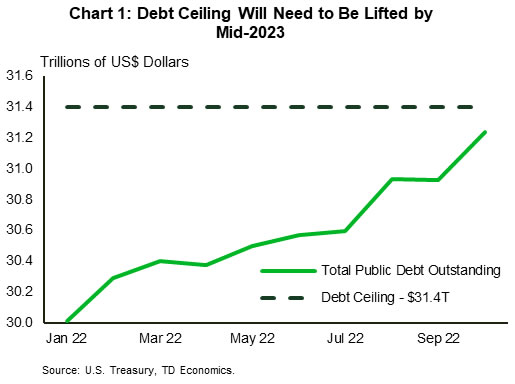
A partisan Congress raises the odds of another government shutdown or debt-ceiling showdown at some point next year (Chart 1). We could get a firsthand glimpse of what’s to come as early as next month when the current ‘continuing resolution’ funding government spending expires on December 16th. At a minimum, Congress will need to negotiate another short-term patch to keep the federal government open. The other challenge that will come up in the coming months is the need to raise the debt-ceiling. Fortunately, the U.S. Treasury is estimated to have enough wiggle room in its existing cash holdings to fund the government through at least mid-2023.
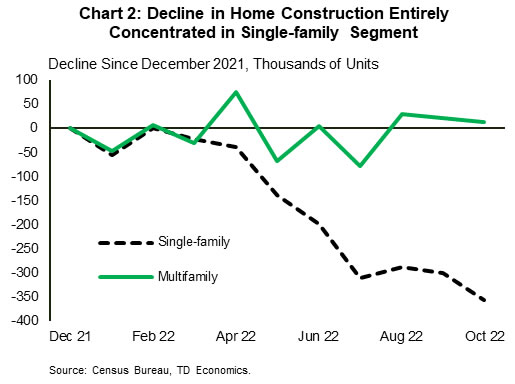
Looking to this week’s economic data, the impact of higher interest rates continued to tighten its grip on the housing sector. New home construction fell 4.2% m/m to 1.4 million units in October and is now down 19.4% since the beginning of the year. While the pullback continues to be concentrated across the single-family segment, the recent plateauing in multifamily permits suggests it too has peaked (Chart 2). Things look even more dire in the resale market. Mortgage rates reached 7.2% in October, and sales fell by another 5.9% m/m to 4.3 million and are now (outside of the pandemic lockdown period) at the lowest level since 2011. Inventory has remained tight so far and so the impact to prices has been small, with the median home price down just 3.5% from its peak. Because most homeowners hold mortgages originated at rates lower than today’s prevailing rate, listings are unlikely to spike like during the last housing crisis. As a result, the market will remain undersupplied for some time, limiting the downside pressure on prices.
In stark contrast to the housing sector, the U.S. consumer continued to show considerable staying power in October. Retail sales came in much better than expected, rising by 1.3% m/m. Indeed, some of the strength in October was already telegraphed earlier in the month when new vehicle sales jumped 10% m/m to 14.9 million units. However, even after stripping out autos, sales at gasoline stations, and building materials, the ‘control’ measure still rose by a healthy 0.8% m/m.
After incorporating the October retail sales data, our current tracking for Q4 GDP sits at 2.2%, with consumer spending expected to expand by 3%. This is an acceleration from Q3 and underscores the degree of resilience we’re still seeing from the U.S. consumer. However, it would be a stretch to believe that the rapid adjustment in interest rates won’t eventually take a toll. Let’s not forget, the Fed still has ‘a ways to go’ before even reaching its terminal rate. Moreover, it can take anywhere from 12-18 months to feel the full effect of higher interest rates. By this logic, we expect a broader demand adjustment to begin early next year, with growth expected to fall to a stall-speed in 2023.
Canada – Gasoline Prices Keep Inflation Burning
It was a busy week for Canadian economic data. With inflation showing more persistence in October's Consumer Price Index (CPI) data, Canadian yields rose across the curve on expectations that the Bank of Canada (BoC) will have to raise rates even more than previously thought. Adding to this was the release of housing data, which showed a surprise uptick in overall real estate sales activity even though prices continued to fall. Housing starts also declined, though remain at elevated levels.
Wednesday's release of the Canadian Consumer Price Index was the main event this week. As expected, the headline index reaccelerated by 0.6% month-on-month (m/m), from 0.4% m/m in September and effectively no price change in August. October's gain was largely attributed to the 9.2% m/m rise in gasoline prices, which caused CPI in year-on-year (y/y) terms to hold steady at 6.9%. Though the November tracking of gasoline prices indicates that this surge has abated, it goes to show how sensitive Canadian inflation is to externally driven products like gasoline.
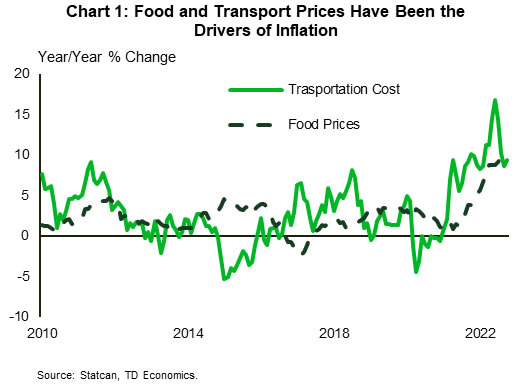
Food prices have also been a key source of inflation this year, and consumers got a bit of relief in October as prices decelerated to a 0.4% m/m gain. That is less than half the nearly 1% monthly average price increase that Canadian's have had to eat over the last eight months! Though this is moving in the right direction, the overall food basket remains elevated, up 10.1% over the last year (Chart 1).
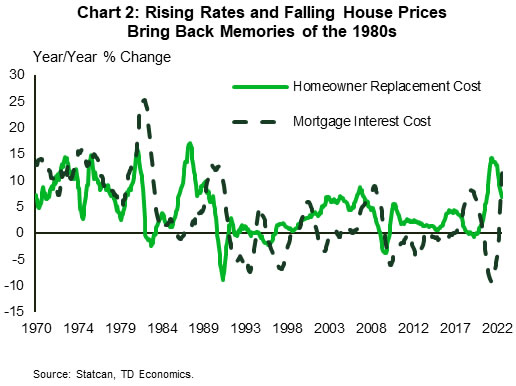
The other major category in focus was the rising price of shelter, which showed a large 0.8% m/m increase, translating to 10.8% y/y. Given the BoC's aggressive rate hikes over 2022, mortgage interest costs have risen over 11% y/y and are set to surge further as homeowners renew their mortgages at higher rates in the coming months (Chart 2). The drop in house prices (homeowners' replacement costs to be specific) has provided some offset . This previous source of inflationary pressure is likely to be deflationary over 2023. This trend was apparent in the recently released housing sales data. Though house sales increased for the first time in eight months (+1.3% m/m), the average house price dropped 0.6% m/m and is now down over 9% y/y.
The acceleration in overall inflation was a setback, but there are underlying trends in place that should cause inflation to decelerate in the coming months. Slowing global demand is expected to put further downward pressure on energy prices and rapidly declining shipping costs, the main drivers of high food and fuel inflation over the last year (assuming no new shock) should contribute to lower inflation in the coming months. The wildcard here is housing. There are significant lags from the impact of interest rate changes into CPI. With the BoC set to raise rates to 4% or higher in the coming months, it not only needs to assess the impact on economic growth, it is also needs to consider how its actions may continue to push shelter inflation even higher.
Early Cracks Form in Canadian Household Spending
Canadian retail sales likely fell by 0.5% in September, in line with an advance estimate from Statistics Canada a month ago. Retail sales have remained very strong and most of the expected September decline may have been from lower gasoline prices rather than a drop in the volume of purchases.
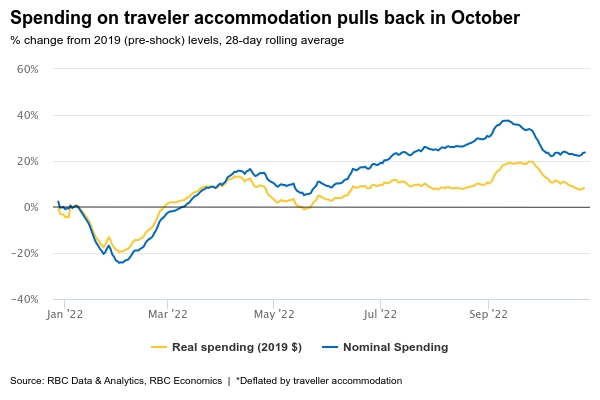
But our own tracking of credit and debit card transactions is pointing to a plateauing in overall household spending, including services not covered in StatCan’s monthly retail sales data. New vehicle purchases ticked higher in September and October as the supply of vehicles improved. But spending on furniture has lost steam as housing markets cool. And spending on some travel and hospitality services—like traveler accommodation—appears to have flagged in October following a summer surge.
We expect discretionary purchases to slow more substantially as rising debt servicing costs and inflation cut further into household purchasing power. But that turning point isn’t likely to show up in September data. That’s largely due to job markets, which have remained very strong. We anticipate next week’s SEPH labour market survey to show another tick lower in job vacancies. The number of job openings will continue to moderate through the rest of the year but for now, demand for workers is still easily outpacing available supply and wage growth has strengthened.
Week ahead data watch:
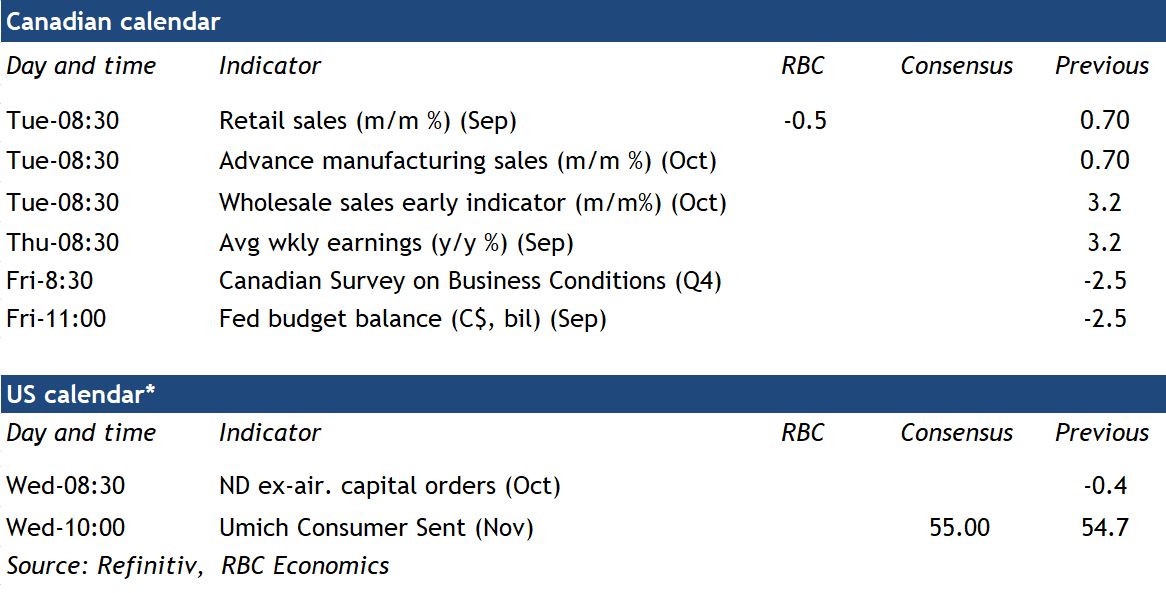
Wage growth from the SEPH data will be closely-watched given earlier data from the monthly Labour Force Survey that showed accelerating wage growth in September and October.
We expect the advance estimate of October Canadian manufacturing sales to remain relatively firm. The outlook for the manufacturing sector has dimmed as business surveys—including the Canadian Manufacturing PMI and the CFIB’s business barometer—point to a deteriorating outlook. But, for now, hiring demand in the sector continues to outpace supply. Manufacturing hours worked rose 0.7% from September in October.
Week Ahead – Fed Minutes, RBNZ Decision, and Business Surveys on Tap
Another busy week is coming up for FX markets, featuring the minutes of the latest FOMC meeting and a rate decision in New Zealand that investors are split on. Most importantly, business surveys from the major economies will reveal whether US inflationary pressures continue to cool off and whether Europe is already in recession.
Dollar loses its shine
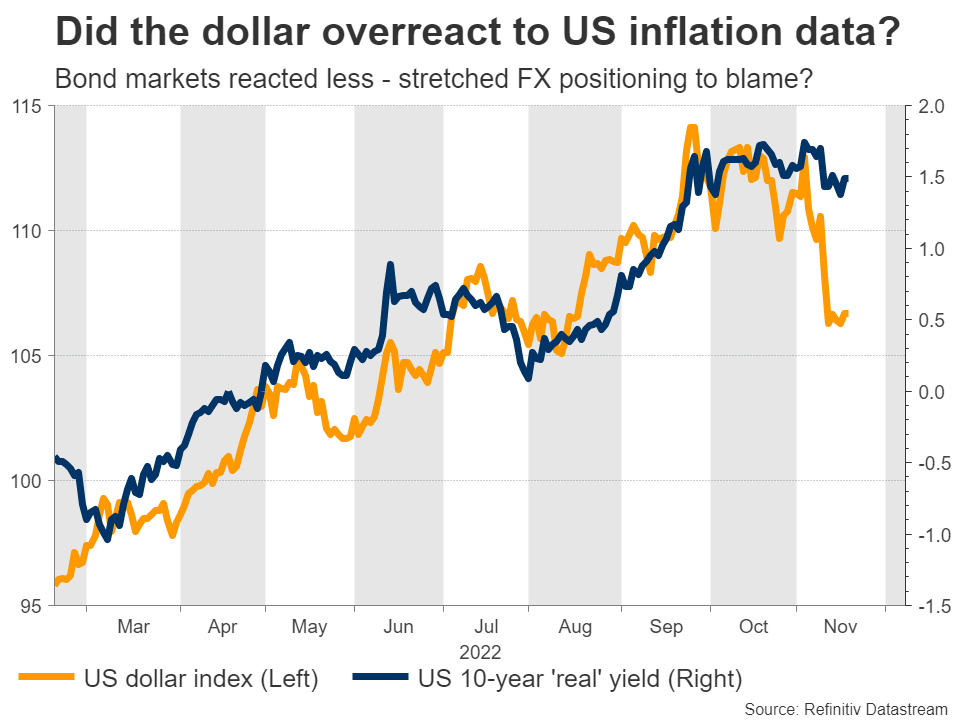
Signs that US inflation is finally simmering down dealt a heavy blow to the US dollar lately, as traders unwound bets that the Fed will raise rates beyond 5%. Admittedly though, the sharp FX moves seem like an overreaction, driven by one-sided positioning in ‘long dollar’ bets.
In a nutshell, the story around the Fed hasn’t changed enough to warrant such dramatic moves. The dollar is trading as if the war against inflation is about to end, but Fed pricing and US yields suggest this was only a minor victory. Inflation is still running at nearly four times its target, the labor market is in good shape, and consumption hasn’t slowed yet.
In other words, it’s still premature to be trading a Fed pivot. While inflation has likely peaked, there’s no telling how quickly it will come down. Fed officials have been adamant that even when they stop raising rates, they’ll keep them high until they are certain inflation has been crushed.
Markets will get an update on how inflationary pressures and the broader US economy are evolving on Wednesday, with the S&P Global business surveys for November. In recent months, the story has been that inflationary forces are retreating but mostly because demand is collapsing.
Later on Wednesday, the minutes of the latest FOMC meeting are out. They are outdated, as this meeting took place before the bombshell inflation report and we’ve heard from almost every FOMC official since then, but markets always find a way to react to this release. The overall message will likely be one of ‘determination’, which could give the dollar a small boost.
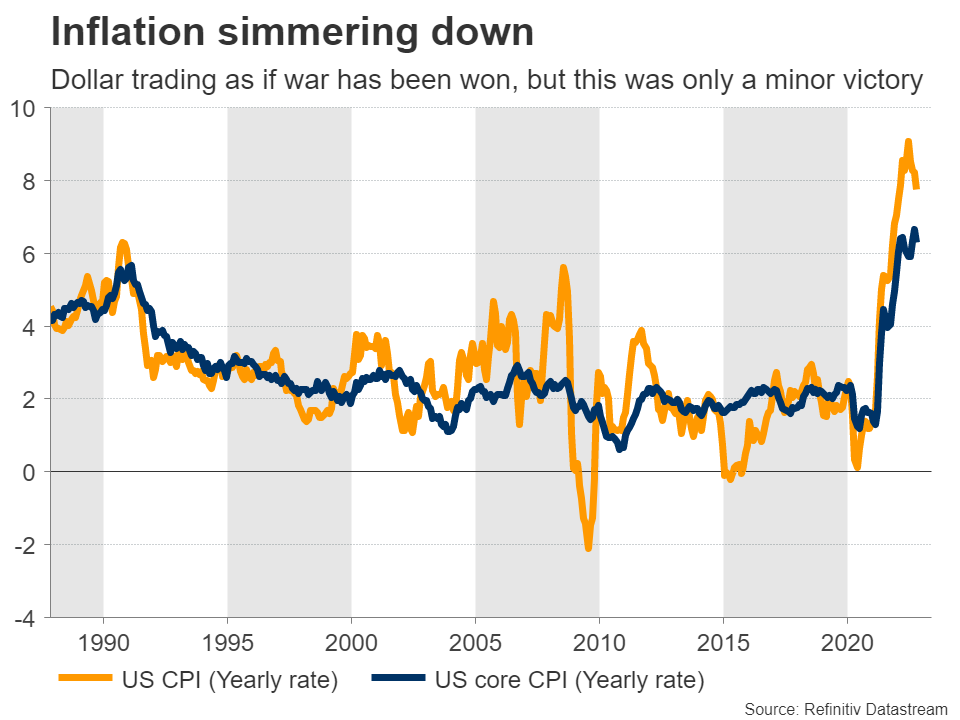
Overall, the dollar is at a crossroads. Most of the elements that fueled this stunning rally over the last two years seem to be losing their kick, with inflation cooling off and the Fed shifting into lower gear, yet it’s still too early to call for a proper trend reversal.
Even though the narrative around other major currencies has improved somewhat lately, for instance with European energy prices declining sharply, most foreign economies are likely to fall into recession long before America does. Hence, while the dollar rally is likely in its last chapters, it might have one ‘last hurrah’ left.
RBNZ - A split affair
Over in New Zealand, the Reserve Bank will wrap up its meeting early on Wednesday. Market participants are currently split on whether rates will be raised by 50 or 75 basis points. It is priced almost as a coin toss, leaning slightly towards the smaller move.
Investors think the RBNZ might play it cautious because it hasn’t raised rates by 75 bps so far and other central banks have slowed down their tightening pace lately, for instance in neighboring Australia. However, that might be a miscalculation this time.
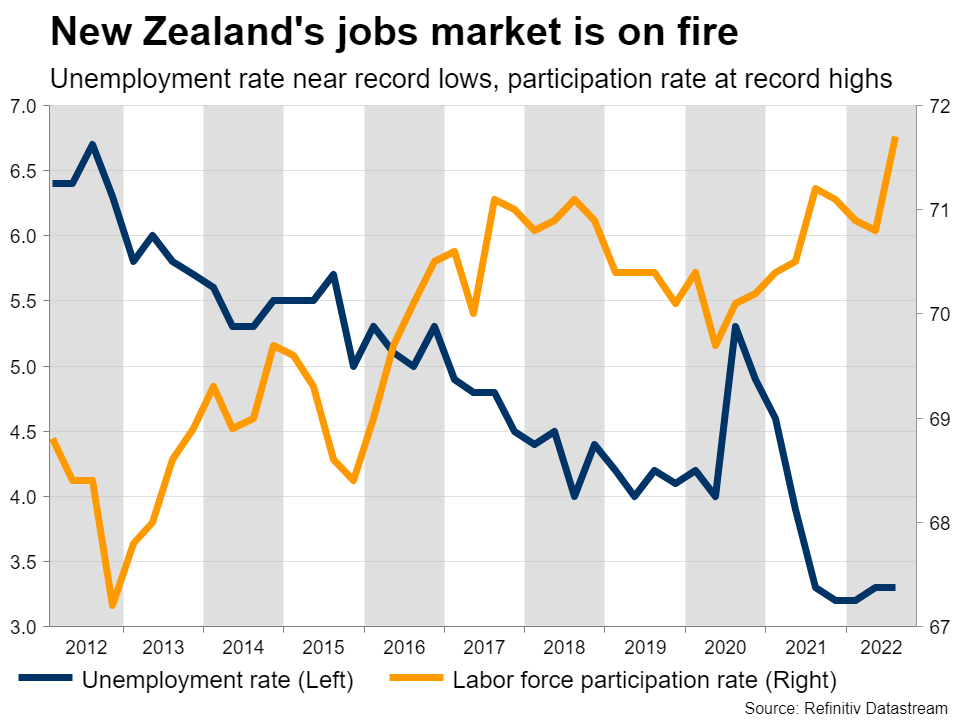
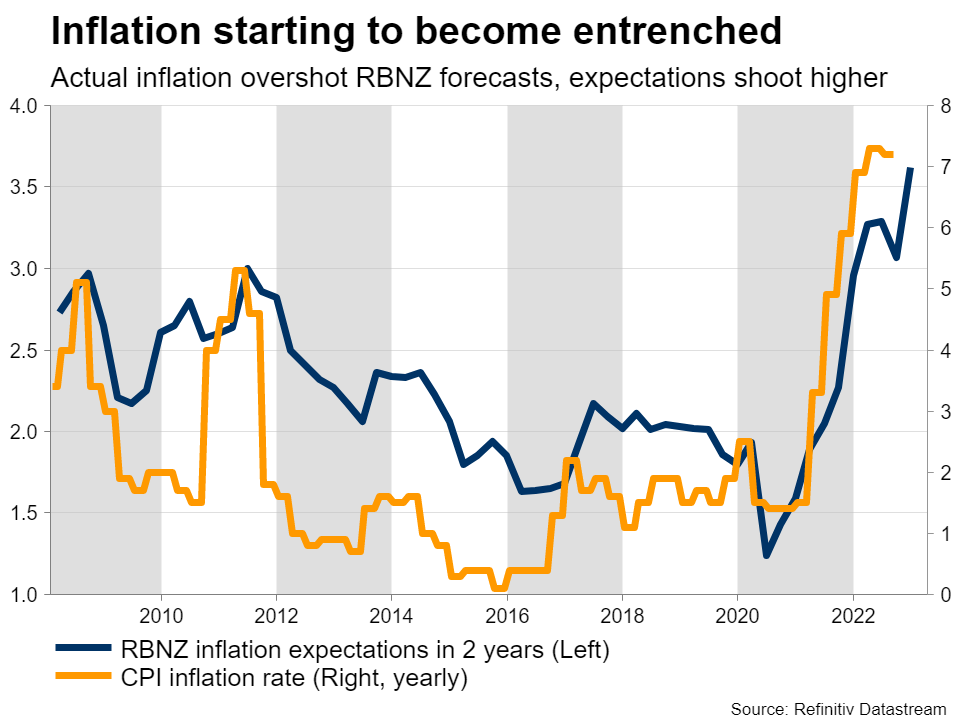
Since the RBNZ last met, a string of powerful data releases suggested the economy is running much hotter than policymakers anticipated. For starters, inflation far exceeded the central bank’s forecasts during the third quarter, while the jobs market went gangbusters, with the unemployment rate holding near record lows even as labor force participation hit new all-time highs.
Most importantly, the RBNZ’s own 2-year inflation expectations metric shot higher, indicating that inflationary pressures are becoming entrenched. This was further reaffirmed by an acceleration in wage growth. Of course, there are risks too. House prices have fallen more than 10% from last year, while the sharp slowdown in China is a huge threat for exports.
Still, the balance of evidence points to a 75 bps move as the most prudent option, an outcome that could temporarily boost the kiwi. If it’s a 50 bps move instead, it will likely be accompanied by ultra-hawkish commentary, limiting the currency’s losses.
Eurozone and British PMIs
In the Eurozone and United Kingdom, all eyes will be on the latest PMI business surveys on Wednesday. Forecasts point to another decline in these indices, which would add credence to concerns that both economies are either already in recession or heading directly for one.
With inflation running at double digits, markets are still leaning towards a 75bps rate hike from the ECB next month, despite clear signs that growth is crumbling. In fact, the latest forecasts from the European Commission suggest the economy will begin to contract this quarter already.
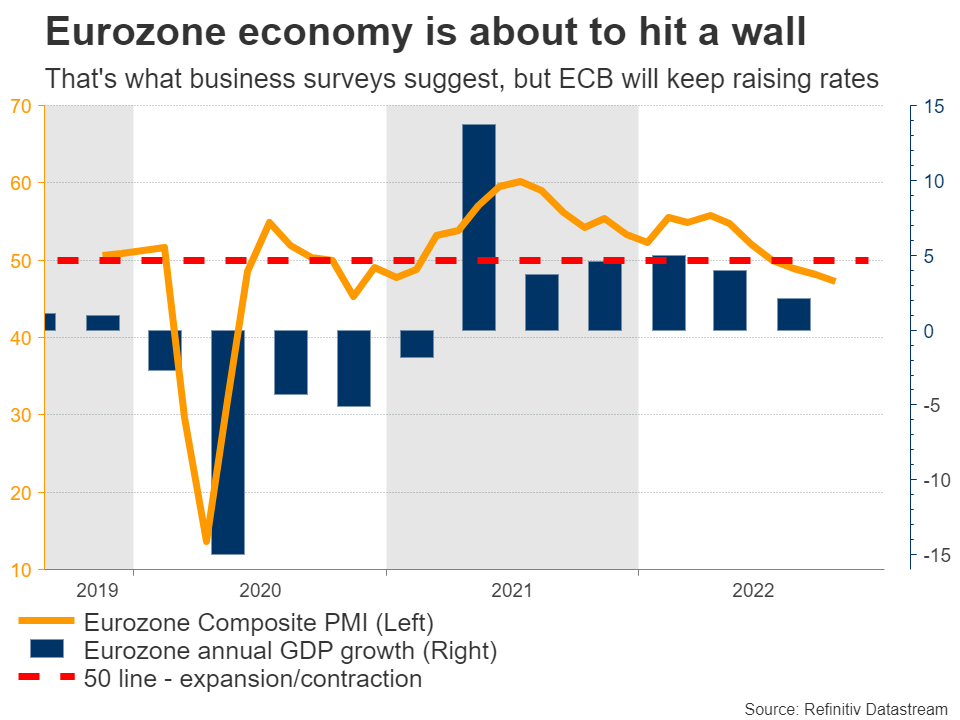
On the bright side, the sharp decline in energy prices suggests this recession won’t be as brutal as initially feared, which is encouraging for the euro, but not a game changer. A sustainable rally would require signs of improving growth or good news from Ukraine, neither of which is on the table for now.
As for sterling, the outlook is even darker. Both the government and Bank of England expect a prolonged recession, which the latest austerity budget will likely deepen.
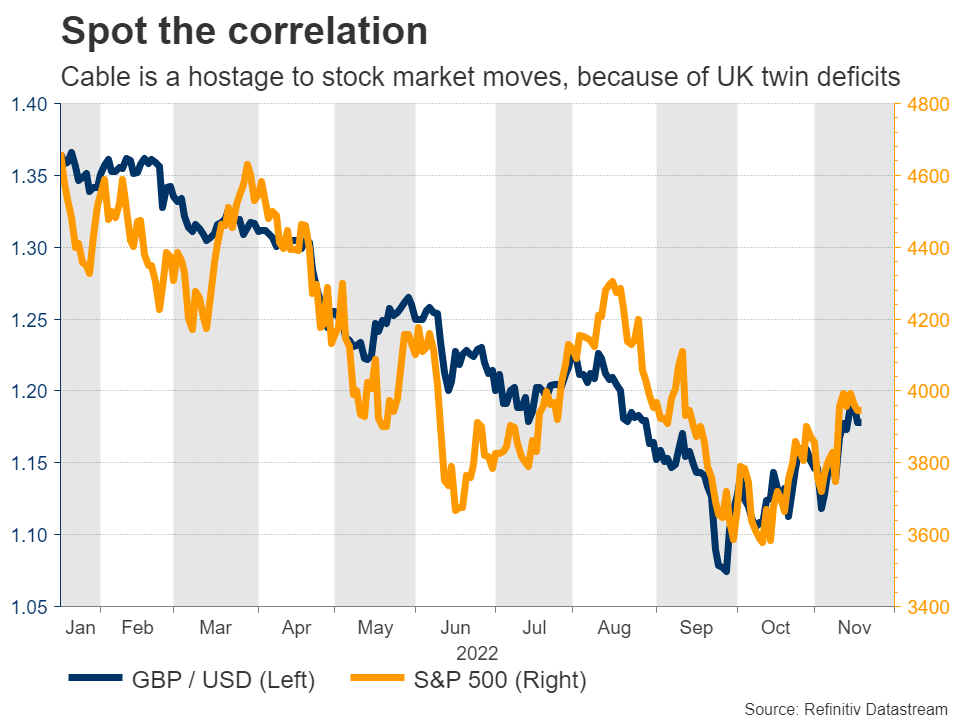
Meanwhile, the nation’s twin deficits are still massive and require funding, leaving the pound exposed to global risk sentiment. That’s a toxic cocktail, as equity valuations remain stretched and earnings estimates are still overly optimistic.
Finally in Japan, the forward-looking Tokyo CPIs are out on Friday, and will be crucial in helping investors decide whether the Bank of Japan will adjust policy next month.
Weekly Focus – Markets Turn More Cautious after the CPI Rally
After the rally driven by the low US CPI print, markets have traded more cautiously this week. US October retail sales growth surprised to the upside, signalling that the low inflation print did not necessarily reflect easing demand, as Fed would have hoped for. We continue to see near-term balance of inflation risks tilted to the upside, and expect the market optimism to turn out only temporary; in our latest FX Forecast Update - USD sell-off to prove temporary, 14 November, we maintain our 12M EUR/USD forecast at 0.93.
Geopolitics were on the agenda in the first G20 meeting after Russia's invasion to Ukraine. Joe Biden and Xi Jinping met for first time face-to-face after Biden became the president, and despite the past years' tensions, the leaders struck a more constructive tone, emphasizing that neither party wants to enter a new cold war and that communications lines would be reopened. That being said, we think that especially the Taiwan issue and the recent US tech restrictions will maintain tensions elevated; see our earlier paper: Research US-China: Long-term tensions are here to stay no matter the election result, 5 October.
While the Democratic Party ended up performing better than expected in the US midterm elections, and managing to maintain the control of senate, republicans did narrowly clinch the control of house this week, ensuring a divided congress. For markets, the result is a positive (although broadly expected) outcome, as the divided congress is less likely to be able to pass potentially inflationary deficit spending measures. Markets will next focus on how the congress will be able to raise the US debt ceiling, which is expected to be hit early next year. So far, republicans' key demands for supporting the debt ceiling raise have been related to spending cuts to social security and Medicare, which would have limited impact on the broader economy, but which could be difficult for the democratic senate to pass.
Europe will also focus on the continuation of US support to Ukraine, and while we do not expect an abrupt end to the support measures, the republican control of the house could mean that 'America first' style cost-cutting will be increasingly on the agenda as the recession looms. More broadly, while the war has so far united western nations to support a common ally, we see rising risks of US-EU relations turning sour going forward, see Euro macro notes - Transatlantic ties are in for a chill, 16 November.
Next week, focus turns back towards the economic growth outlook, as November Flash PMIs are released on Wednesday. We expect the Euro Area figures to provide further evidence of contraction in the Q4 as inflation is weighing on demand and companies' order books, while we still foresee modest growth in the US economy. FOMC and ECB minutes will also be released on Wednesday and Thursday respectively, and while markets' focus remains on more forward-looking data, we will keep an eye out for any hints of the expected hiking pace in December (50 or 75bp) as well as ECB's view on the QT timeline.
In China, focus remains on the rising Covid-cases and on any signs of potentially changing tolerance for the spread of the virus. We will also focus on any potential new easing measures after the October growth figures once again surprised to the downside this week. On the central bank front, we expect 75bp hikes by both the Riksbank on Thursday (see more below) and the Reserve Bank of New Zealand on Wednesday.
Week Ahead – Central Banks Remain Hawkish
Wall Street’s shortened trading week will be jam-packed with the FOMC minutes, more Fed speak, the flash PMIs and the final look at the University of Michigan’s inflation expectations.
One of the key events of the trading week will be the Fed’s minutes from the November policy meeting. Financial markets will want to know if the Fed still believes that the cost of taking too little action to bring down inflation likely outweighed the cost of taking too much action. The Fed is expected to downshift to a half-point rate-hiking pace in December, but that rate-hiking cycle could last longer if pricing pressures become more entrenched.
US stock and bond markets will be closed Thursday for Thanksgiving Day and will close early on Friday. Traders will pay close attention to Black Friday shopping data, which will give the latest pulse on the health of the US consumer.
EU
The highlight next week may well be the monetary policy accounts, although, with a steady stream of central bank commentary since the last meeting and a raft of economic data, it’s hard to say just how impactful they’ll ultimately be.
The flash PMIs may tell a more interesting story of an economy heading for recession, while appearances from various policymakers – including President Christine Lagarde on Sunday – could fill in any gaps that haven’t already been filled.
It’s hard to get too excited about next week’s PMI data and central bank speak following the assessment from the OBR on the economic outlook, taking into consideration the latest fiscal squeeze. The UK is heading for its largest squeeze on living standards in six decades – a 7.1% decline – as interest rates continue to increase, taxes rise and the cost-of-living crisis intensifies.
The only question that remains is how soon the BoE can pause its tightening among all of these other pressures. It alluded to the fact that markets are pricing in too much at the last meeting but at this moment, another 150 basis points are still priced in.
Russia
Another quiet week on the economic data side, with PPI numbers the only notable releases. The focus remains on its invasion of Ukraine and how it handles recent losses in Kherson.
Next week is action-packed, with inflation data being released on Wednesday ahead of the latest SARB rate decision a day later. While the headline CPI is expected to ease slightly to 7.4%, from 7.5%, core is seen rising from 4.7% to 4.9%, meaning both remain far too high. The SARB inflation target is 3-6%.
That is expected to push the SARB to hike interest rates again next week by 75 basis points, taking the repo rate to 7%.
Turkey
The CBRT is expected to cut interest rates by another 150 basis points next week despite soaring inflation and a desperately weak currency. The latter has been managed with capital controls over the last couple of years and the new reserve-management system appears to be stabilizing it at record lows despite continued easing. The hope for President Erdogan is this can be carefully managed into next year’s election to at least give the impression of stability amid a potential deceleration in official inflation.
Switzerland
No significant economic data or releases next week.
The central bank continues to drive home the message that FX intervention could occur on either side. An inter-meeting rate hike can also not be ruled out.
China
The focus stays on China’s Covid situation. China’s Covid cases are near record highs and that is threatening to delay any looser rules. Expectations are now for China to reopen sometime after March.
Investors widely expect Chinese commercial banks to keep both the 1-year and 5-year Loan Prime Rate (LPR) unchanged at 3.65% and 4.30% respectively. The PBOC might be delaying rate cuts until next quarter as they are concerned about yuan weakness.
India
It is expected to be a quiet week for India.
Australia & New Zealand
This week is mostly about New Zealand as the RBNZ is expected to deliver its sixth straight half-point rate hike. Hot inflation and wage data are expected to prevent the central bank from downshifting to a slower pace of tightening. Investors hoping for the bank to pause tightening in February might be surprised if the policymakers are worried that inflation isn’t falling quickly enough.
The lone release for Australia will be the preliminary PMI readings. Last month the service sector fell into contraction territory while manufacturing activity continues to soften.
A busy week filled with Japanese data, including preliminary PMI data for the services and manufacturing sectors in November and core CPI data for the Tokyo region in November. Inflation in Japan has hit a four-decade high and that is complicating what the BOJ wants to do. Some economists are expecting Tokyo’s core inflation to slow for the first time since January but that is hardly the overall consensus.
Singapore
The October inflation report is expected to show pricing pressures eased from 7.5% to 7.0%. The final Q3 Q/Q GDP reading is expected to be revised a tick lower to 1.4%.
Economic Calendar
Saturday, Nov. 19
Economic Events
- The APEC Economic Leaders’ Meeting concludes
- Fed’s Bostic speaks at the Southern Economic Association annual meeting in Florida
Sunday, Nov. 20
Events
- World Cup begins with Qatar hosting Ecuador
- ECBs Lagarde participates in formal dinner of European Roundtable for Industry
Monday, Nov. 21
Economic Data/Events
- US Chicago Fed national activity index
- China loan prime rates
- Germany producer prices
- New Zealand credit card spending
- Sweden home prices, industry capacity utilization
- Taiwan export orders, current account balance
- Thailand GDP
- The Bank of Japan announces the outright purchase amount of Japanese government securities
- Ukraine President Zelenskiy speaks at NATO Parliamentary Assembly’s annual session
- ECB’s Holzmann and Simkus speak at the Conference on European Economic Integration hosted by Austria’s central bank
- Bank of Portugal Governor Centeno speaks at the CNN Portugal Summit
- Bundesbank President Nagel speaks at an evening event of the ICFW Frankfurt business journalists’ club
Tuesday, Nov. 22
Economic Data/Events
- US Richmond Fed manufacturing index
- Canada retail sales
- Euro area consumer confidence
- Mexico retail sales, Banamex survey of economists
- New Zealand trade
- South Africa leading indicator
- Turkey consumer confidence
- South African President Cyril Ramaphosa is on a state visit to the UK
- The OECD releases its latest Economic Outlook
- German Chancellor Scholz speaks at the SZ-Wirtschaftsgipfel conference in Berlin
- ECB’s Holzmann speaks at the presentation of the Austrian National Bank’s financial stability report
- Fed’s Mester gives speech on wages and inflation
- Fed’s Bullard participates in a policy panel at the Central Bank of Chile’s annual conference
- RBA’s Lowe speaks at the annual CEDA dinner
Wednesday, Nov. 23
Economic Data/Events
- FOMC minutes of November meeting
- US MBA mortgage applications, durable goods, initial jobless claims, preliminary PMIs, University of Michigan sentiment, new home sales
- European Flash PMIs: France, Germany, UK
- New Zealand central bank (RBNZ) rate decision: Expected to raise rates by 75bps to 4.25%
- Australia PMIs
- Mexico international reserves
- Russia industrial production, monthly PPI, weekly CPI
- Singapore CPI, GDP
- South Africa CPI
- Thailand trade balance
- EIA crude oil inventory report
- German Chancellor Olaf Scholz addresses the Bundestag on the country’s 2023 budget
- ECB’s de Guindos speaks at the Encuentro del Sector Financiero in Madrid
Thursday, Nov. 24
Economic Data/Events
- US stocks and bond markets closed for Thanksgiving holiday
- Canada small business optimism
- France business, manufacturing confidence
- Germany IFO business climate
- Japan PMIs, department store sales, leading index, machine tool orders
- Russia gold and foreign-exchange reserves
- Sweden central bank (Riksbank) rate decision: Expected to raise rates by 75bps to 2.50%
- Turkey central bank (CBRT) rate decision: Expected to cut rates by 150bp to 9.00%
- South Africa central bank (SARB) rate decision: Expected to raise rates by 75bps to 7.00%
- Turkey real sector confidence
- South Africa PPI
- Mexico publishes monetary policy minutes
- ECB publishes accounts of its October policy meeting
- EU energy ministers hold an emergency meeting in Brussels
- ECB’s Schnabel speaks at the Bank of England Watchers’ Conference
Friday, Nov. 25
Economic Data/Events
- US stock and bond markets close early
- Retailers hope for a strong Black Friday performance
- France Consumer confidence
- Spain PPI
- Sweden PPI
- Germany GDP
- Japan Tokyo CPI, PPI services
- Mexico GDP, current account balance
- New Zealand consumer confidence index, retail sales ex-inflation
- Singapore industrial production
- Thailand foreign reserves, forward contracts
Sovereign Rating Updates
- Switzerland (Moody’s)
- Turkey (Moody’s)
- Poland (DBRS)
Sunset Market Commentary
Markets
Yesterday, Fed’s Bullard pushed back on recent ‘dovish’ market pricing as he said it is necessary for the Fed policy rate to be raised at least to at least 5.00/5.25%. ECB’s Lagarde in a speech in Frankfurt today wasn’t as concrete as was the Saint Louis Fed president. However, in some way she also reconfirmed the ECB prioritizing inflation over growth. Other ECB members gave a similar assessment (Knot, Nagel). According to Lagarde, rates will have to be raised further and simply removing policy accommodation might not be enough to bring inflation back down to target. A sharp slowdown/recession on its own also won’t do the job. The ECB president also mentioned several structural factors (deglobalization, change in supply patterns, energy transition) that might complicate an easy fix of the supply/demand balance, holding the risk of higher costs/inflation. Interest rates remain the preferred instrument to address inflation, but the ECB also has to reduce excess liquidity/balance sheet. Key principles of reducing bond holdings will be set out at the December policy meeting. As was the case for interest rate policy, Lagarde again didn’t give specific levels/amounts. European interest rates drifted higher during Lagarde’s speech, but this move was undone later. A rather low amount of TLTRO repayments after the ECB changed conditions of cheap funding added to the reversal. The ECB announced it next week expects a repayment of € 296 bln of LT funding. Estimates were diffuse but most saw a potential for a € 500/600 bln repayment. Especially short-term Bunds outperformed after the TLTRO announcement. The 2-year German yield currently even declines 4 bps. The spread of swaps over Bunds widens (less collateral than expected will be freed). Further out (5-y +) German yields also reversed the earlier rise to currently trade 2 bps lower. US yields also tried to cautiously extend yesterday’s rebound, but the move was aborted early in US dealings. US yields currently are trading mixed (2-y +1.5bps; 30-y -1.5 bps). Despite recent, more hawkish CB speak, equities are performing well with the EuroStoxx 50 gaining 1.2%. US indices open about 0.5% higher. The oil price continues this week’s sharp setback, with Brent smashing below $ 90 p/b ($ 86.25 currently).
Moves in the major USD cross rates are limited. DXY is holding a tight 106.40/80 range. EUR/USD is changing hands near 1.0360, unchanged from yesterday’s close. USD/JPY struggles not to lose the 140 handle (currently 139.8). Sterling slightly outperforms. This morning, GFK UK consumer confidence improved slightly and (nominal) retail sales (+0.6% M/M) grew modestly after two difficult months. EUR/GBP neared the 0.8690 short-term support, but a break didn’t occur.
News Headlines
The Norwegian economy grew a strong 0.8% q/q in the previous quarter of this year. This followed an upwardly revised 1.2% in Q2 and surpassed expectations of 0.4%. All components but government consumption (-0.1% q/q) contributed. Household consumption grew by 0.5% q/q, flanked by gross fixed capital formation (0.4% q/q). Exports grew at 5.7% almost double as much as imports did (2.9%). Factoring in the oil sector, Norwegian GDP growth even amounted to 1.5% q/q thanks to boosted petroleum activities (7.6% q/q). The Norwegian krone barely budged with EUR/NOK stabilizing at 10.49.
Germany’s largest union secured a benchmark 5.2% pay increase for a little less than 4 million employees in the automotive, metal and electrical sector in the Baden-Württemberg region. The rise next June would be followed by a 3.3% increase in May 2024. Additionally, a lump sum payment of €1500 will be given in each of the next two years. The pact is likely to be repeated across the sector in other parts of the country. It comes as German inflation hit 11.6% in October, suggesting that stellar price increases are not yet fully reflected in wage demands, reducing the risk of a vicious and hard-to-control wage-price spiral. The ECB forecasted that wage growth will increase from 4% this year to 4.8% next year.
Fed Collins: Latest data not reduced my sense of what sufficiently restrictive may mean
Boston Fed President Susan Collins "restoring price stability remains the current imperative and it is clear that there is more work to do."
"I expect this will require additional increases in the federal funds rate, followed by a period of holding rates at a sufficiently restrictive level for some time," she said.
"The latest data have not reduced my sense of what sufficiently restrictive may mean, nor my resolve," she added.
Nevertheless, "there is a pathway to reestablishing price stability with a labor market slowdown that entails only a modest rise in the unemployment rate."
"At the Fed we are committed to returning inflation to the 2 percent target in a reasonable amount of time. Only when inflation is low and stable can the economy in general — and the labor market in particular — work well for all Americans," Collins said.