Sample Category Title
USD/JPY Gains Traction as BOJ Sticks to Ultra-loose Monetary Policy
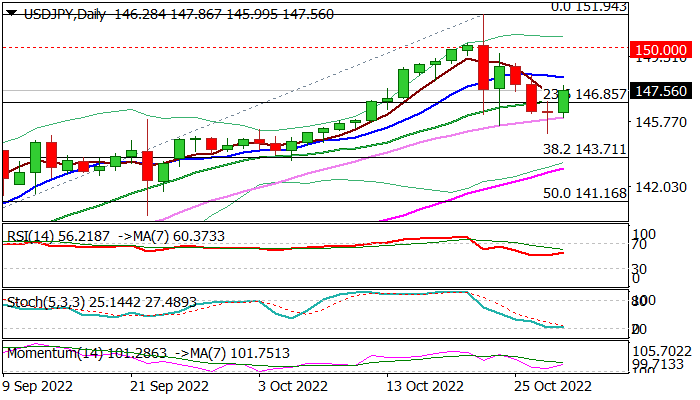
The jumped vs yen on Friday after BoJ left its ultra-loose monetary policy unchanged, retracing 38.2% of post-intervention pullback from 32-year high at 151.94, which found footstep at 145.10 on Thursday.
Doji morning star reversal pattern is forming on daily chart, but will require confirmation on sustained break above 147.21 pivot of 151.94/145.10 pullback.
Daily techs support the action as bullish momentum is rising and Tenkan-sen / Kijun-sen remain in bullish configuration, with potential bear-trap under 30 DMA to add to positive signals.
Close above Fibo barrier at 147.21 to generate initial signal, while extension above 10DMA (148.30) would strengthen near-term structure and open way towards psychological 150 barrier.
Fresh bulls see today’s close above rising 20DMA (147.05) as a minimum requirement to remain in play.
Res: 147.86; 148.30; 148.52; 149.33.
Sup: 147.05; 146.85; 146.02; 145.10.
Canadian Dollar Slips ahead of GDP
The Canadian dollar is lower today. In the European session, USD/CAD is trading at 1.3617, up 0.39%.
Markets eye Canada’s GDP
The week wraps up with Canada’s GDP for August. The economy is expected to have expanded by 0.1%, which would be unchanged from July. The economy is likely heading into a recession, and Finance Minister Chrystia Freeland stated recently that the coming months would be a “challenging economic time.”
The government’s key priority is curbing high inflation, which has eased slightly. In September, inflation fell to 6.9%, down from 7.0% in August. Still, this was higher than the consensus of 6.7%, as soaring food prices kept inflation from falling further. The good news is that inflation appears to have peaked from the June level of 8.1%, which marked a 40-year high. The bad news is that core inflation was unchanged at 5.3% in September, a sign that inflation remains sticky, despite the Bank of Canada’s aggressive rate-hiking cycle.
High inflation pushed the BoC to deliver another oversize rate on Wednesday, but the 0.50% hike was considered dovish, as the consensus stood at 0.75%. The cash rate is now at 3.75%, its highest level since 2008. Although inflation is far from being beaten, Canada’s economy is clearly slowing down as a result of the steep increase in rates, and the BoC is easing up on the rate pedal just a bit, in the hopes of guiding the economy to a soft landing and avoiding a recession. High rates are weighing on households and businesses and the BoC is concerned that further oversize rates may pose a risk to financial stability.
The US releases Personal Income and Spending data later today as well as the Fed’s preferred inflation indicator, the Core PCE Price Index. The index is expected to rise to 5.2%, up from 4.9%, but I don’t expect today’s numbers to change the Fed’s plan to raise rates by 0.75% next week.
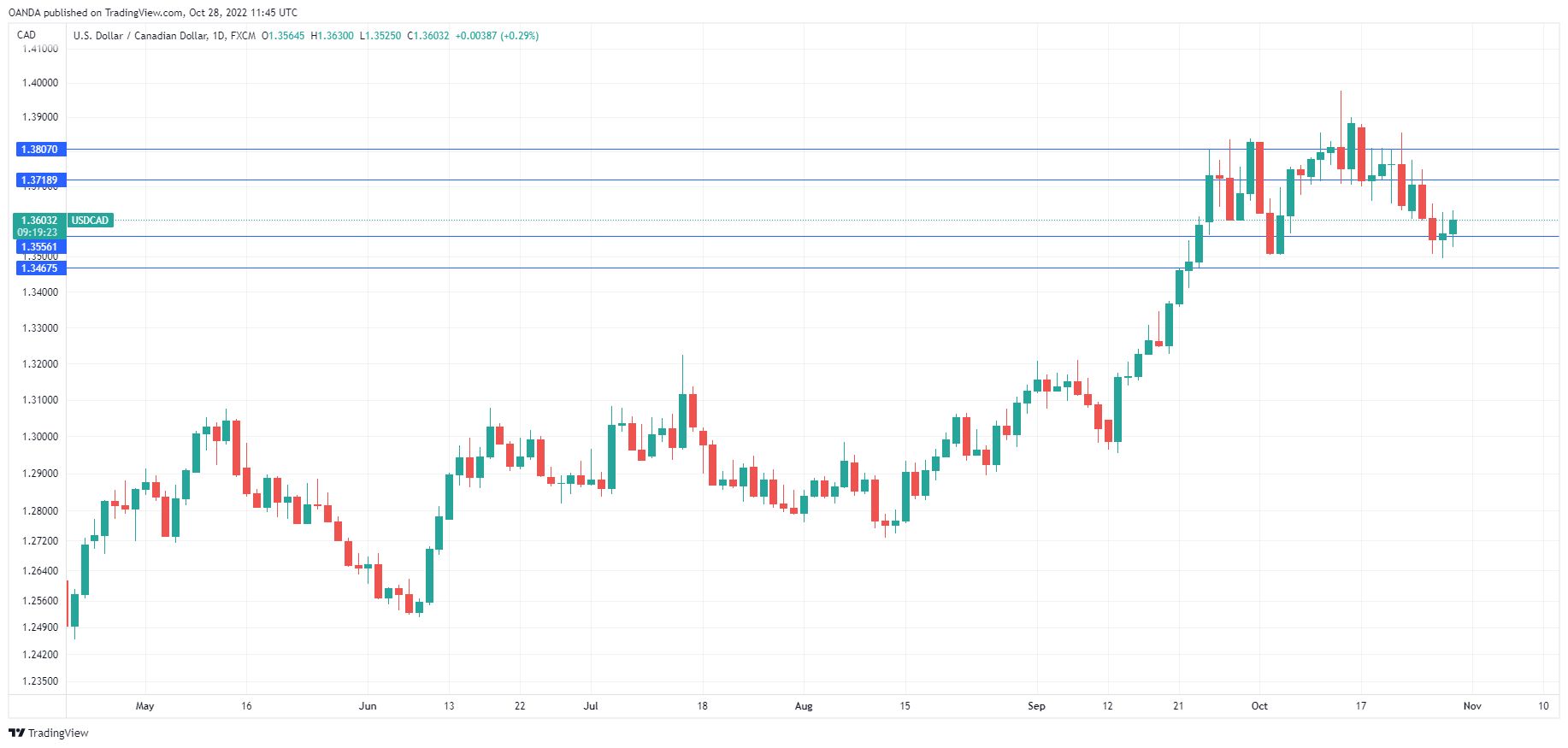
USD/CAD Technical
- There is support at 1.3656 1.3467
- 1.3718 and 1.3807 are resistance lines
GBPJPY Consolidates after Posting a 6½-year High
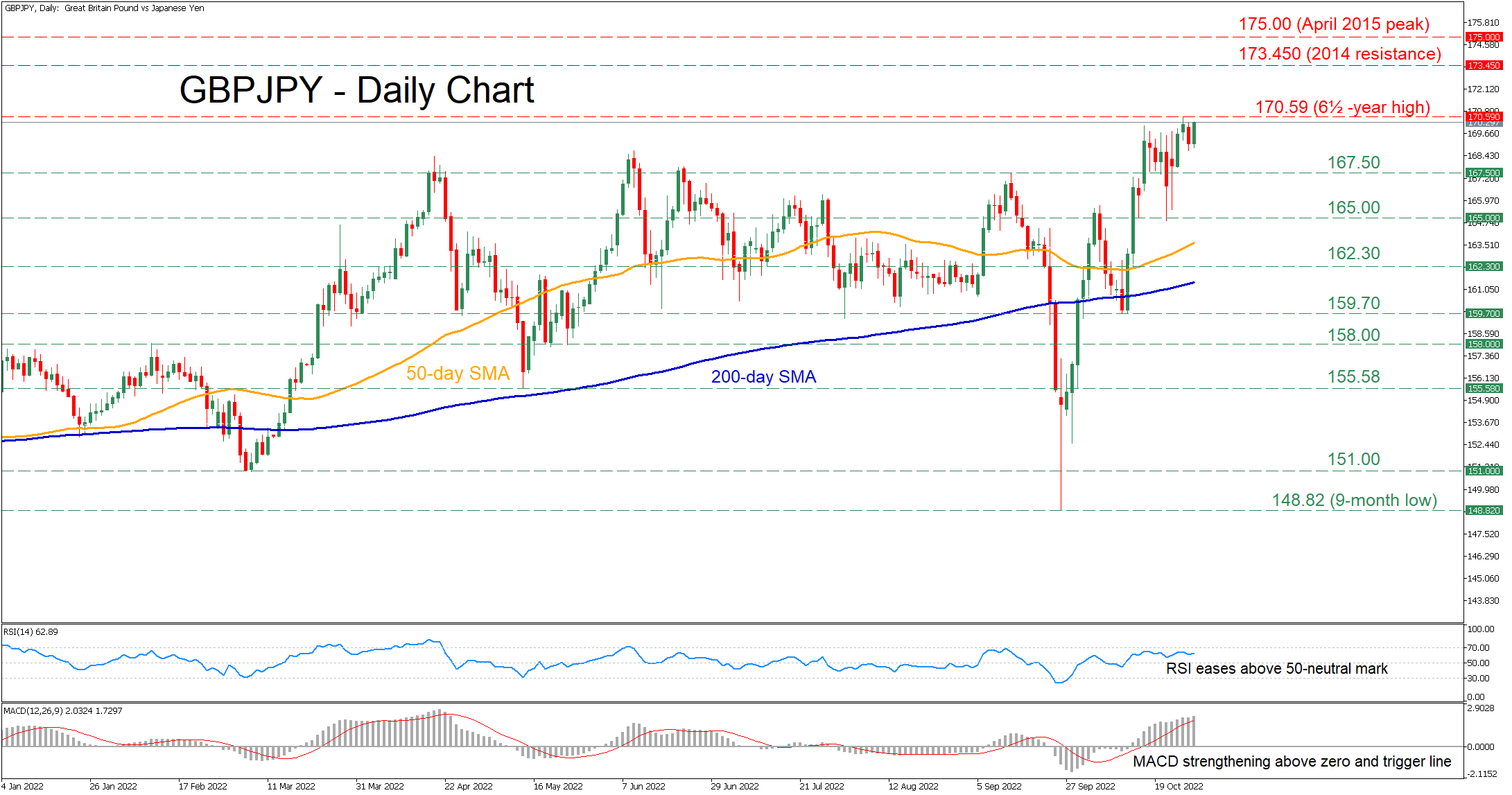
GBPJPY has experienced significant moves in the short term, with the price losing around 11% before recovering back to form a fresh 6½-year high of 170.59. In the last couple of sessions, the pair has been trading sideways, but a break to the upside seems to be a matter of time as positive momentum is strengthening.
The short-term oscillators currently endorse a positive near-term bias. Specifically, the RSI is hovering above its 50-neutral mark, while the MACD histogram is strengthening above its red signal line in the positive territory.
Should the buying interest intensify, the pair could challenge the 6½-year peak of 170.59. Conquering this barricade, the price would edge higher to form fresh multi-year highs, where the crucial 2014 resistance region of 173.50 could curb further advances. Even higher, the spotlight may turn to the April 2015 peak of 175.00.
To the downside, if the positive momentum wanes and the price drifts lower, the recent support of 167.50 might act as the first line of defence. Sliding beneath that floor, the bears could aim for 165.00 before the 162.30 hurdle comes under examination. A break below the latter may set the stage for the October low of 159.70.
Overall, GBPJPY has been trading within a tight range after its latest advance paused, but near-term risks remain tilted to the upside. Therefore, a close above its latest multi-year peak is needed to verify the continuation of the uptrend.
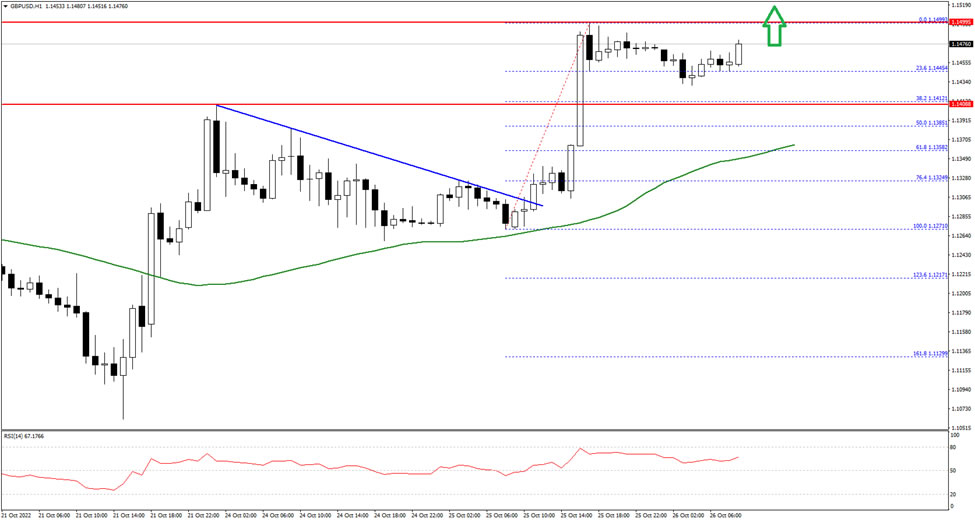
EUR/USD Pair is Consolidating Losses Near 0.9990
The Euro struggled to clear the 1.0080 and 1.0100 resistance levels against the US Dollar. The EUR/USD pair reacted to the downside and declined below the 1.0040 support.
There was close below the 1.0000 level and the 50 hourly simple moving average. The pair is now consolidating losses near the 0.9990 zone. An immediate resistance on the upside is near 1.0025 and the 50 hourly simple moving average. The first major resistance is near the 1.0040 level.
A break above the 1.0040 resistance level could start a decent upward move. In the stated case, it could even surpass 1.0080 on FXOpen.
Conversely, the pair might start another decline below 0.9960. The next key support is near 0.9920, below the pair could decline towards the 0.9860 level. Any more losses might send the pair towards the 0.9820 level.
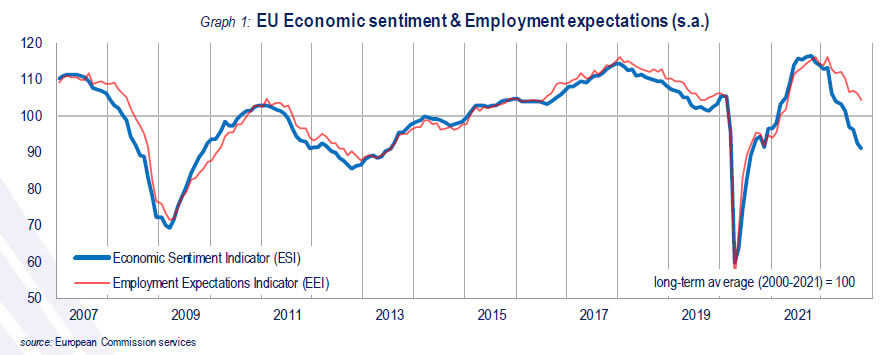
Eurozone economic sentiment dropped to 92.5, EU down to 90.9
Eurozone Economic Sentiment Indicator fell from 93.6 to 92.5 in October. Industrial confidence dropped form -0.3 to -1.2. Services confidence dropped from 4.4 to 1.8. Consumer confidence improved from -28.8 to -27.6. Retail trade confidence rose from -8.4 to -6.9. Construction confidence rose from 1.8 to 2.6. Employment Expectations Indicator dropped from 106.6 to 104.9.
EU Economic Sentiment Indicator dropped from 92.4 to 90.9. Amongst the largest EU economies, the ESI fell in Germany (-1.0) and Italy (-0.9), while it remained essentially unchanged in the Netherlands (-0.3) and France (0.0) and improved in Poland (+0.4) and Spain (+1.4).
USDCAD Extends Retreat after Hitting 29-month High
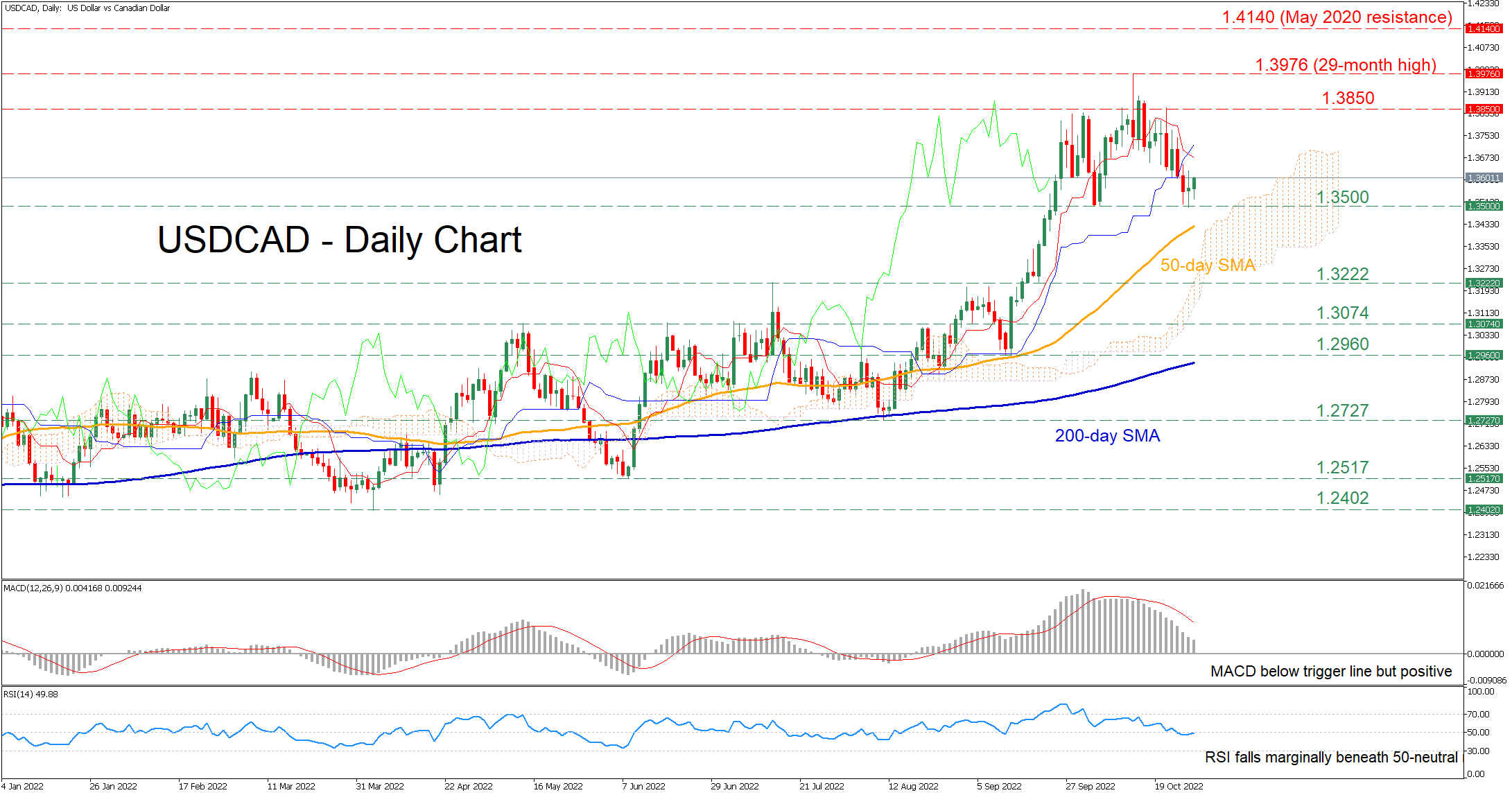
USDCAD has been in a steep uptrend since mid-September when the price managed to forcefully cross above the 1.3222 region. Although the pair recently spiked higher to a fresh 29-month high, it quickly lost some ground, hinting that its latest rally could be overstretched.
The momentum indicators currently suggest that bullish forces are waning. Specifically, the RSI has fallen marginally below its 50-neutral mark, while the MACD histogram has dived beneath its red signal line but remains in the positive territory. Nevertheless, the price action remains above the Ichimoku cloud, endorsing that the short-term picture has not turned bearish yet.
Should the negative momentum strengthen, the pair could extend its recent decline and encounter initial support at the double-bottom region of 1.3500. Sliding beneath that floor, the bears might aim for the crucial July peak of 1.3222 before the attention shifts to 1.3074. Even lower, the September low of 1.2960 could appear on the radar.
Alternatively, if buyers re-emerge and push the price higher, the 1.3850 hurdle may act as the first line of defence. Crossing above the latter, the 29-month high of 1.3976 could provide further upside protection. Should that barricade fail, the price could ascend to form fresh multi-year peaks, where the May 2020 resistance of 1.4140 may curb any advances.
Overall, even though bullish pressures appear to be subsiding, USDCAD’s uptrend remains intact. Nevertheless, a dive beneath the 1.3500 floor could be the starting point of a moderate downside correction.
Yen Dips after BoJ Holds the Course
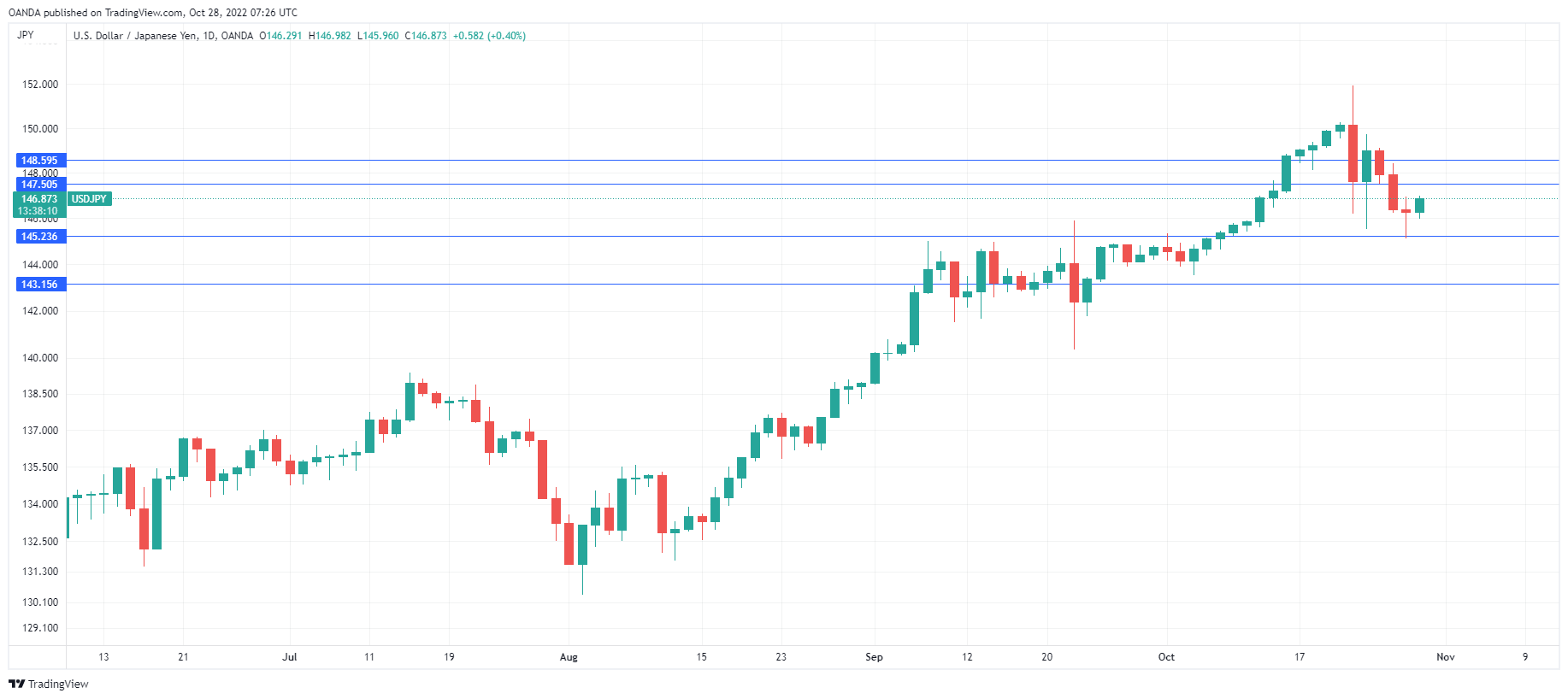
USD/JPY is in positive territory today. In the European session, the yen is trading at 146.94, up 0.47%.
BoJ maintains policy
All eyes were on the Bank of Japan, which wrapped up a crucial 2-day policy meeting on Friday. The meeting came just days after Japan’s Ministry of Finance (MOF) intervened in the currency markets after the yen had fallen close to the 152 line, a new 32-year low. Finance Minister Shunichi Suzuki would not confirm that the MOF had intervened for the second time in two months, but issued a blunt warning, declaring that the government was “facing off with speculators via markets.”
This set the stage for today’s BOJ meeting. In the end, it was business as usual, as the Bank maintained ultra-low interest rates and kept its dovish guidance. The BoJ remains an outlier with its loose policy, as most other major central banks are tightening in order to curb inflation. What was noteworthy was that the central bank revised upwards its inflation forecast for fiscal 2023. Headline inflation was raised to 1.6%, up from 1.4% in July, and core inflation to 2.9%, up from 2.3% in July, with the BoJ warning that risks were skewed to the upside. The Bank also lowered its growth forecast for fiscal 2022 and 2023.
Inflation has pushed above the BoJ’s target of 2%, but BOJ Governor Kuroda has insisted that he will not consider tightening policy until it is clear that inflation is sustainable. There was a hint from the Bank that this may not be so far off, as today’s BOJ quarterly report, noted that rising inflation is expected to “lead to sustained price rises accompanied by wage gains”.
The yen has paid the price for the BoJ’s ultra-loose policy, tumbling some 20% against the dollar this year. With the BoJ making it clear that it won’t be throwing any lifelines to the yen, the currency will be under pressure from the widening US/Japan rate differential, unless the MoF continues to intervene in the currency markets.
USD/JPY Technical
- USD/JPY faces resistance at 147.50 and 148.59
- There is support at 145.23 and 143.14
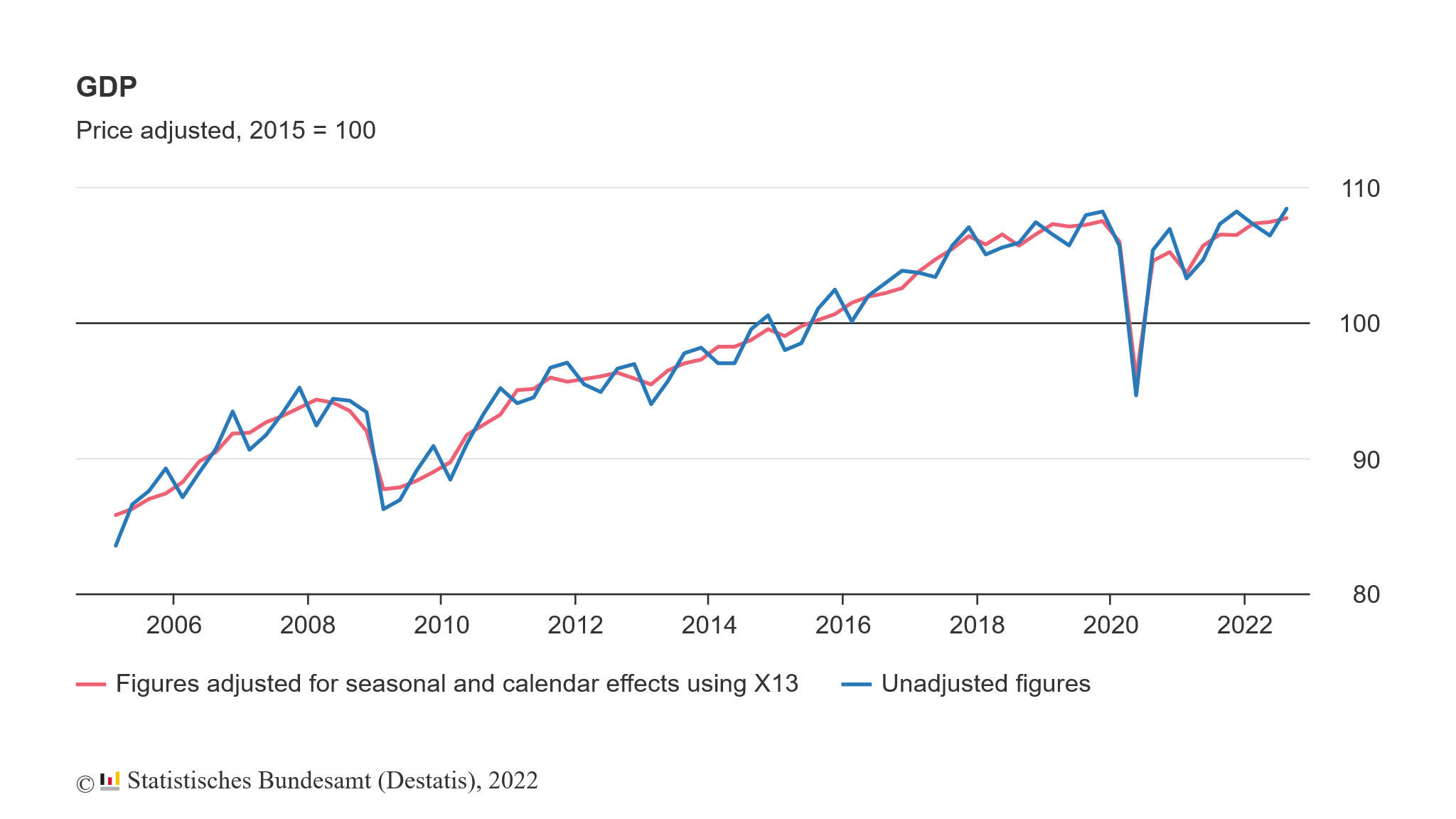
Germany GDP grew 0.3% qoq in Q3, avoided contraction
Germany GDP grew 0.3% qoq in Q3, much better than expectation of -0.2% qoq contraction. The economy finally exceeded pre-pandemic level in Q4 2019 for the first time.
Destatis said, "The German economy managed to hold its ground despite difficult framework conditions of the global economy, with the continuing Covid-19 pandemic, supply chain interruptions, rising prices and the war in Ukraine. The economic performance in the third quarter of 2022 was mainly based on private consumption expenditure."
GBP/JPY Daily Outlook
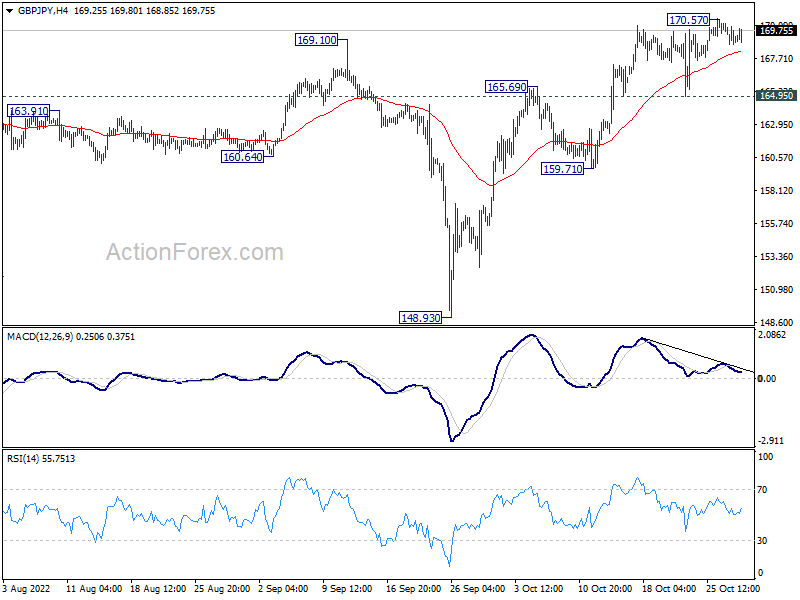
Daily Pivots: (S1) 168.53; (P) 169.39; (R1) 170.05; More...
Intraday bias in GBP/JPY stays neutral for the moment, but further rally is expected with 164.95 support intact. On the upside, firm break of 170.57 will confirm larger up trend resumption. However, break of 164.95 minor support will turn bias back to the downside for 159.71 support instead.
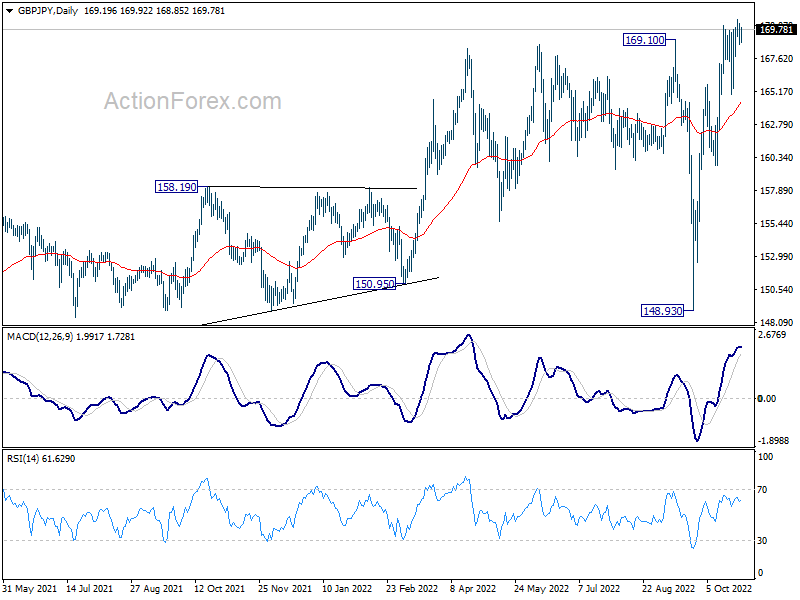
In the bigger picture, current development suggests that up trend from 123.94 (2020 low) is still in progress. Sustained break of 61.8% retracement of 195.86 (2015 high) to 122.75 (2016 low) at 167.93 will pave the way to retest 195.86 high. This will now remain the favored case as long as 148.93 support holds.
EUR/JPY Daily Outlook
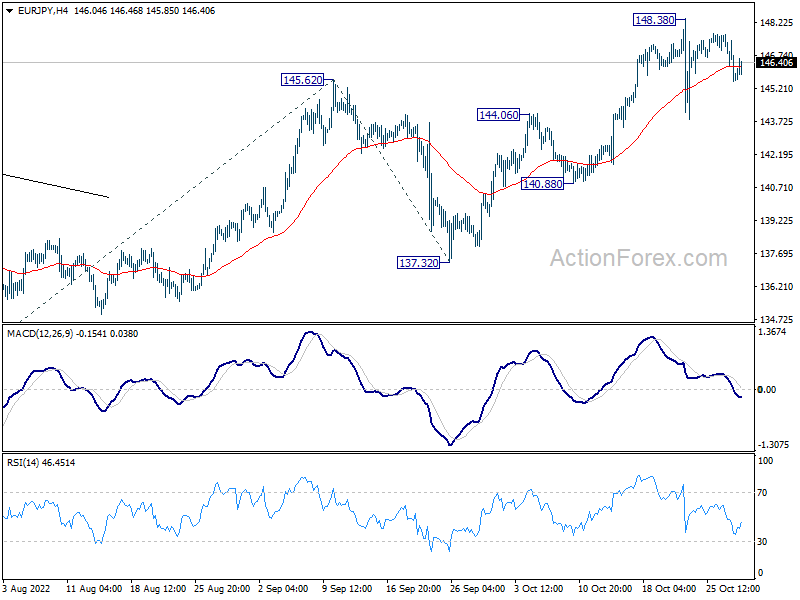
Daily Pivots: (S1) 144.96; (P) 146.33; (R1) 147.10; More....
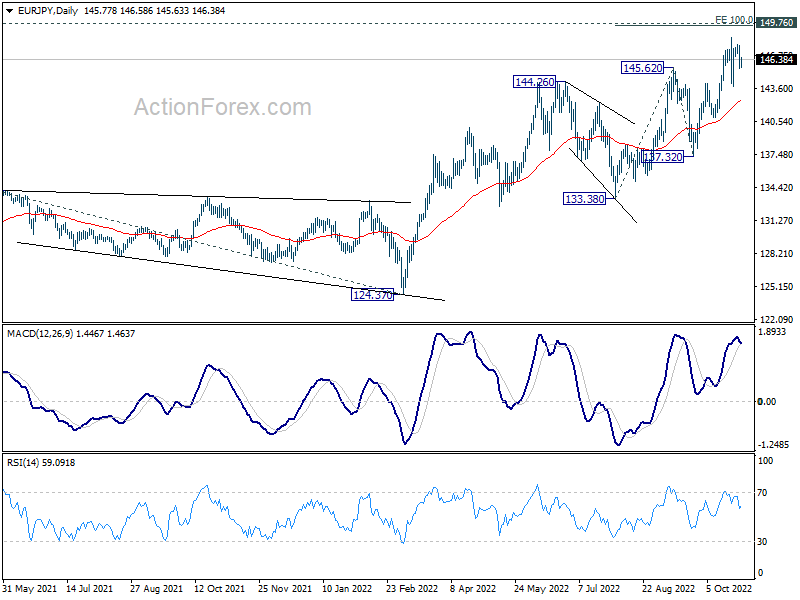
EUR/JPY's consolidation from 148.38 is extending and intraday bias remains neutral. Deeper retreat could be seen but downside should be contained by 140.88/144.06 support zone to bring another rally. Break of 148.38 will resume larger up trend to 100% projection of 133.38 to 145.62 from 137.32 at 149.56, which is close to 149.76 long term resistance.
In the bigger picture, the up trend from 114.42 (2020 low) is still in progress for 149.76 (2014 high). Decisive break there will pave the way to 161.8% projection of 114.42 to 134.11 from 124.37 at 156.22. This will now remain the favored case as long as 137.32 support holds.