Sample Category Title
US CPI Release Will Determine Dollar’s Trend
It is definitely inflation day today. China, Germany, and Italy have released their consumer inflation data, while the US will release theirs before the New York session begins. Historically, inflation data has rarely deviated from expectations without triggering a market reaction, but in recent months the release of data from the USA has the potential to set trends.
China is showing the world that this year’s inflation problem is not theirs. The Chinese data release was surprised by its weakness. CPI accelerated from 2.5% y/y in June to 2.7% in July vs 2.9% expected. The producer price index slowed from 6.1% to 4.2% (4.9% anticipated).
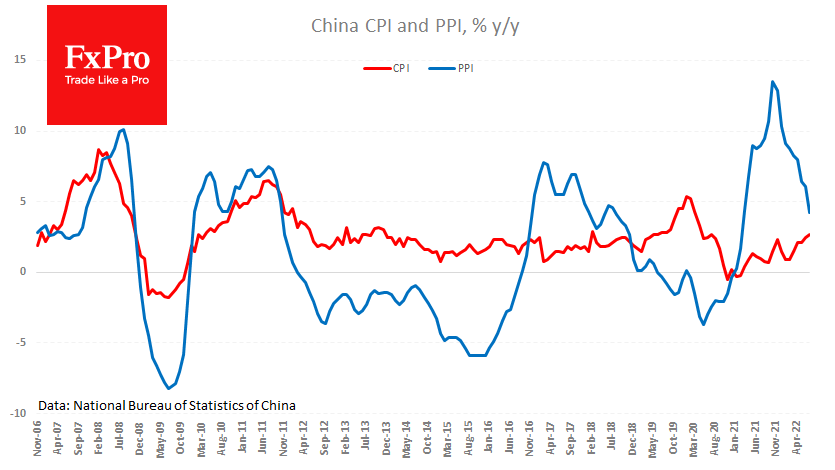
It may take up to three quarters before producer prices end their pro-inflationary push. Nevertheless, the second world economy is not contributing to global inflation.
By comparison, Japan’s Domestic Corporate Goods Price, also out today, showed a slowdown to 8.6% y/y from 9.4% a month earlier and a peak of 9.7% in February – a very gradual cooling.
Germany confirmed preliminary estimates for July inflation at 7.5% y/y for CPI and 8.5% for Harmonised CPI. The latter continues accelerating, putting additional pressure on the ECB to tighten policy.
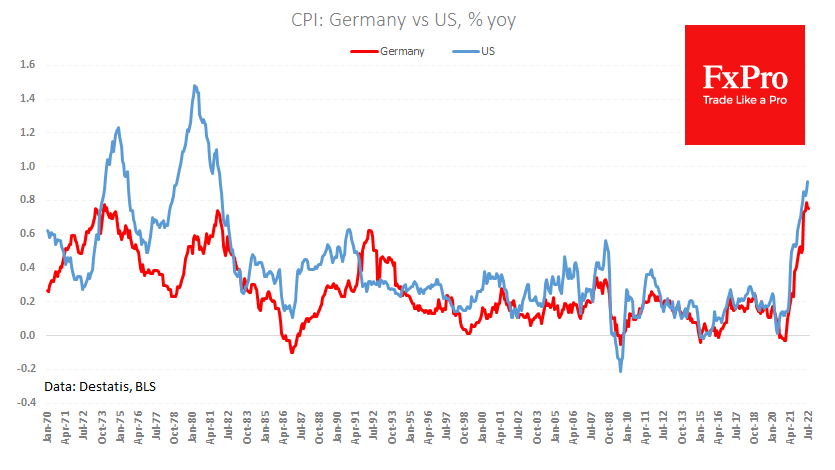
From the data from the USA, it is expected that consumer inflation has passed its peak. Prices are assumed to have risen by 0.2% last month, which is the historical norm, and the year-over-year rate has slowed from 9.1% to 8.7%. In the previous 11 months, US data has methodically exceeded expectations, pulling the Fed’s increasingly hawkish approach.
We must be prepared that the investors will scrutinise how fact correlates with expectations. If prices for July are down or unchanged, it could return the markets to bullishness as it spurs speculation that the Fed may not need to step on the brake pedal so sharply.
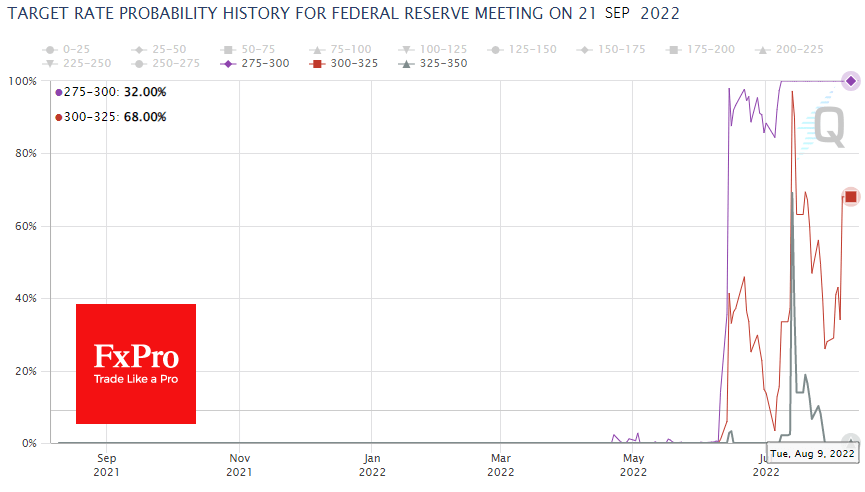
Fed rate futures continue to lay down a 68% chance of a 75-point hike in September. A sharp change in this sentiment in the debt markets could set all other related sectors in motion. Thus, if expectations soften, pressure on the dollar would increase. Conversely, a further increase in the chance of a 75-point tightening would return strength to the dollar bulls and stock market bears.
Yen Drifting as US Inflation Looms
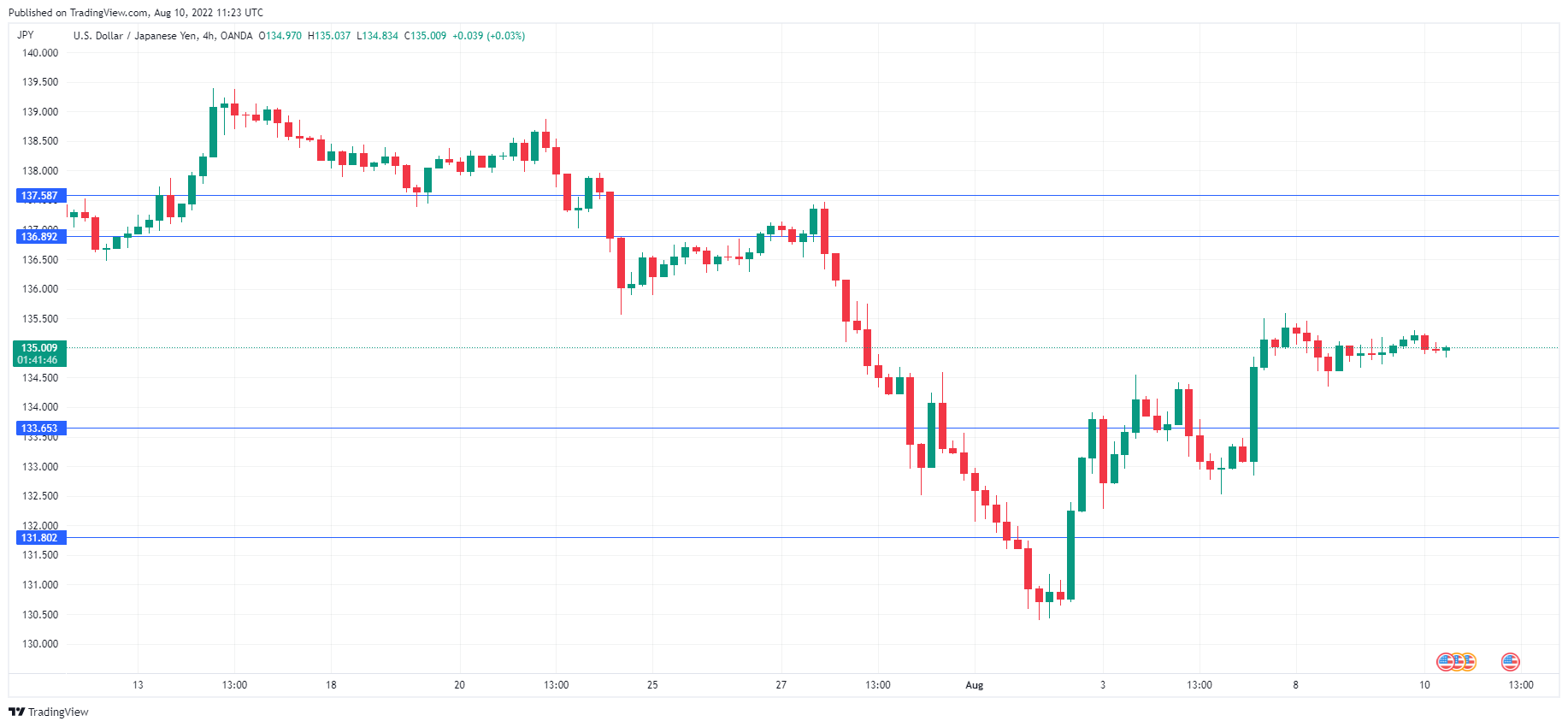
USD/JPY continues to show little movement this week, in sharp contrast to Friday, when the pair jumped a massive 1.55%. In the European session, USD/JPY is trading at 135.02 down 0.09%.
The yen had shown some strength against the dollar recently, but took a tumble after the stunning US nonfarm payroll report on Friday. The gain of 528 thousand more was more than double the estimate of 250 thousand, and the dollar responded with sharp gains against the majors.
All eyes on US inflation
Inflation has been rising in the US and hit 9.1% in June. The July inflation report will be released later today, and the release could have a strong impact on the direction of the US dollar. Headline CPI is expected to fall to 8.7%, down from 9.1%. If the reading does drop to around 8.7%, the markets may start thinking “peak” when it comes to inflation, and the dollar could lose ground. Conversely, if inflation stays around 9% or moves higher, it should be a catalyst for the dollar, as the Fed will have to consider a 75 or even a 100 basis point increase in September. After the inflation release, we’ll hear from Fed members Evans and Kashkari, and it will be interesting to hear their remarks on the heels of today’s inflation release.
Last week, the Fed sent out the message that its rate-tightening cycle is not about to end, as the inflation fight is far from over. The spectacular nonfarm payrolls release pointed to continued strong wage growth and the participation rate dropping a notch, from 62.2% to 61.1%. These numbers point to a tighter labour market and stronger inflationary pressures. If today’s inflation report confirms that inflation is still accelerating, I would expect to hear hawkish remarks from Fed officials, which would likely give the US dollar a boost.
USD/JPY Technical
- USD/JPY is putting pressure on resistance at 134.40, which was tested on Wednesday. 136.30 is the next resistance line
- There is support at 133.65 and 131.80
Aussie Remains Calm ahead of US
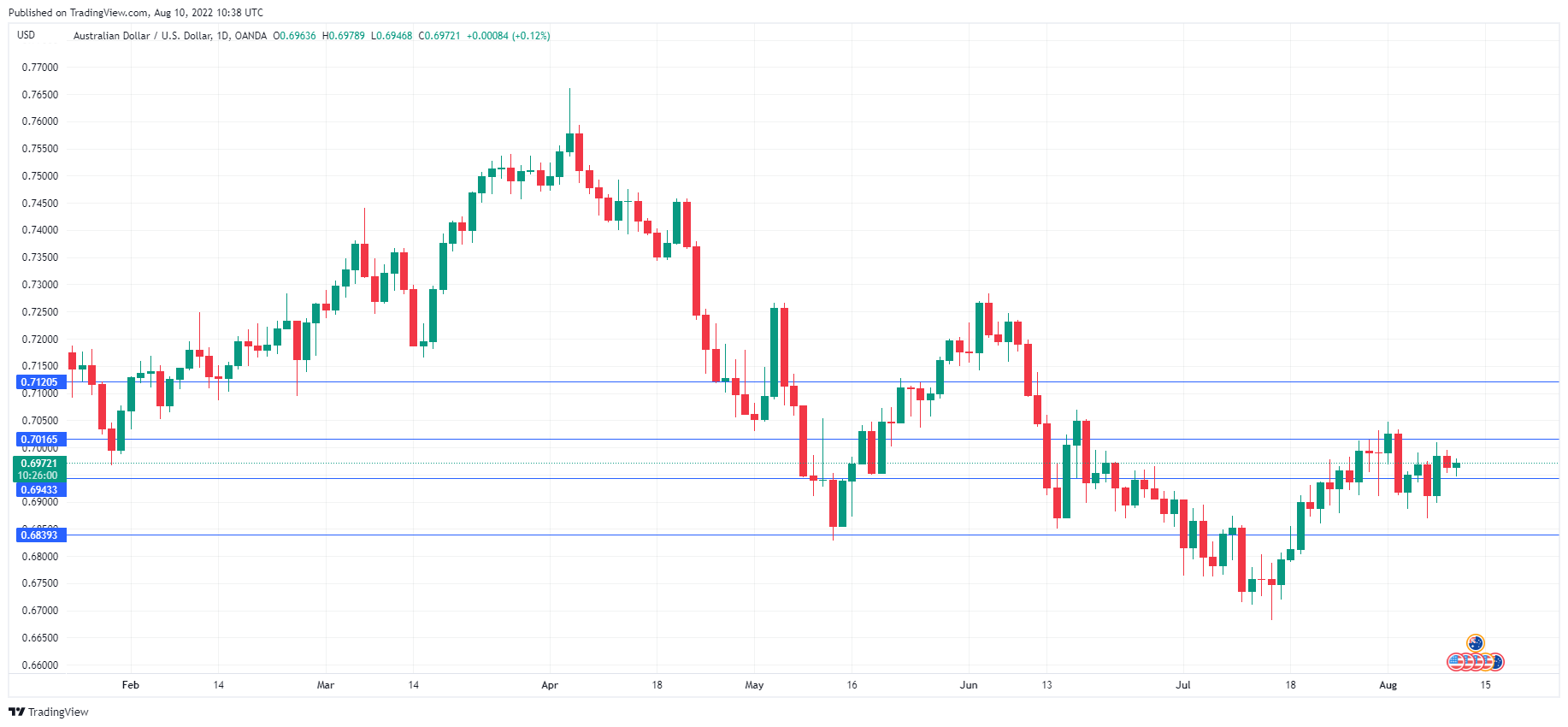
The Australian dollar has posted slight gains today. AUD/USD is trading at 0.6974 in the European session, up 0.15%.
Will US inflation report shake up currency markets?
The economic calendar is light this week, with very few tier-1 events scheduled. One key event that has everyone’s attention is the US inflation report for July, which will be published later today. The inflation release could be a catalyst for a US dollar recovery, in what has been a protracted retreat for the greenback against the majors. Inflation has been rising in the US and hit 9.1% in June. Headline CPI is expected to fall to 8.7%, down from 9.1%. If the release is higher than expected, it could provide a boost for the dollar, as the Fed will be debating between a 75 or 100 basis point rise at the September meeting. On the flip side, if inflation does fall around 8.7% or lower, the dollar would find itself under pressure as the Fed could consider getting away with a 50bp increase.
The RBA will also hold a meeting in September, and key data between now, particularly inflation and employment reports, and then will go a long way in determining the size of the rate hike. Confidence indicators are also useful economic barometers, and Tuesday’s numbers were mixed. Westpac Consumer Sentiment for August posted a second straight decline of 3%. Consumer confidence has dropped for nine consecutive months, as the cost of living crisis and higher mortgage rates have taken their toll. There was better news from the NAB Business Confidence index for July, which jumped to 7, up from 2 points. Business Conditions climbed to 20, up from 13 prior. The index pointed to broad-based strength in business conditions, despite the global slowdown and weaker domestic activity due to higher rates. As well, purchase and labour costs and retail prices rose, which points to inflation continuing to accelerate.
AUD/USD Technical
- There is weak resistance at 0.7016, followed by resistance at 0.7120
- 0.6943 has switched to support. Below, there is support at 0.6839
European Drought: Possible Forex Implications?
Earlier today, a somewhat worrying report came out that a key point in the Rhine river would likely become impassable on Friday. It takes several days for the water to flow down the length of the river, which allows for fairly accurate predictions of water flow in advance. Which helps mitigate potential impacts, as alternative transportation routes can be planned.
The problem which could have implications for the markets, is that the reason goods are shipped by river is that it's cheaper. Alternatives such as trucks and even trains are significantly more expensive, which could increase costs for industries along the river. That includes energy, with a substantial amount of fuel for power plants transported along the Rhine.
How much are we talking about?
Before the pandemic, transportation along the Rhine totaled 152.8M tons. For comparison, German truck cargo transportation in the same period was 3.2B tons. Transportation along the route had already reduced because of lower water levels. Additionally, so far, it's only one sector of the river that is expected to become impassible. Albeit, it's an important point, half-way between Frankfurt and Dusseldorf. However, transportation from Dusseldorf north to ports in The Netherlands remains possible.
But, of course, the Rhine isn't the only river affected. Earlier in the year, the Po valley in Italy was facing drought conditions threatening that led to an emergency declaration. The valley accounts for over 40% of Italy's key grain crops, including rice. Food prices have been falling since Russia and Ukraine agreed to allow grain shipments, and so far there hasn't been any interruption.
Things are happening
Initially, the French government sought to curb power production in several French nuclear reactors because of the lower river flows. Certain types of nuclear reactors use water from rivers for cooling, which raises the temperature in the river. That can have problems for wildlife. But a couple of days ago, the French government revised its assessment, and will allow nuclear power plants to continue to operate.
Norway is also facing drought conditions, which is a problem for a country that relies over 90% on hydropower. It was reported yesterday that in response the country was working on plans to ration energy exports to UK and Europe in the winter, if conditions didn't improve.
Any positivity in the outlook?
This comes after a year of low wind conditions, which are key to pushing water-laden air from the sea over land to produce precipitation. It's also vital to turn the increasing number of wind turbines. The lack of wind is what caused a glut in energy production last year, pushing up demand for and prices of natural gas. The war in Ukraine and subsequent sanctions exacerbated the situation, being one of the larger contributors to price increases not just in Europe, but across the world.
Climate conditions compressing alternative energy production in Europe makes the area more vulnerable to reductions in fossil fuel supplies from Russia. Yesterday, Russia said it would stop shipping oil through the Druzhba pipeline over payment issues. The pipeline is just one of the smaller of several that connect to Europe.
Potential market reaction
The worry? High temperatures across Europe have coincided with another year of low wind speeds. Electricity generation in August from wind is following a similar pattern as last year, suggesting further increased demand for fuels.
With the ECB hesitant to raise rates, the upside pressure from energy and transportation costs could further pressure the Euro to the downside as inflation picks up. Climate conditions could be an important factor in forex for the remainder of the year.
GBP/JPY Daily Outlook
Daily Pivots: (S1) 162.65; (P) 163.17; (R1) 163.70; More...
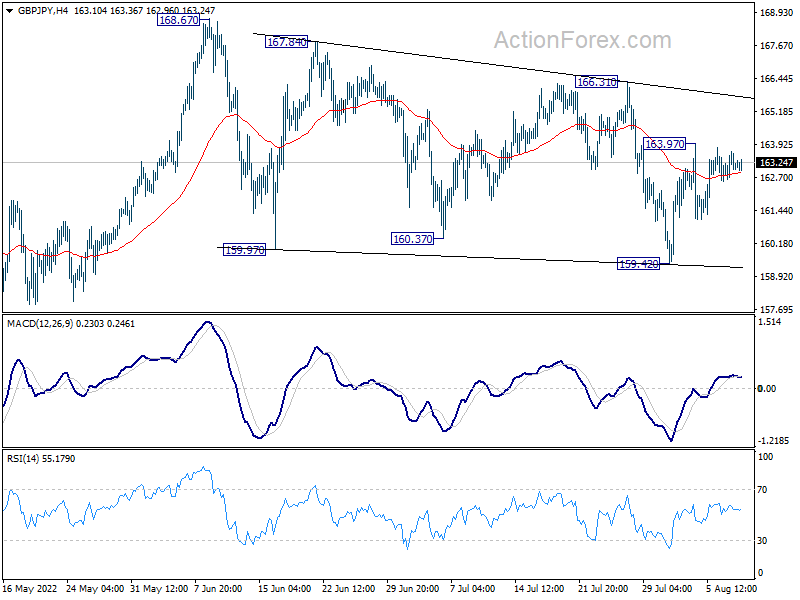
Intraday bias in GBP/JPY stays neutral for the moment. Consolidation from pattern from 168.67 could extend further. On the upside, above 163.97 will turn bias to the upside, and resume the rebound to 166.31 resistance. Break there will be the first sign of up trend resumption. On the downside, break of 159.42 will extend the correction towards 155.57 support.
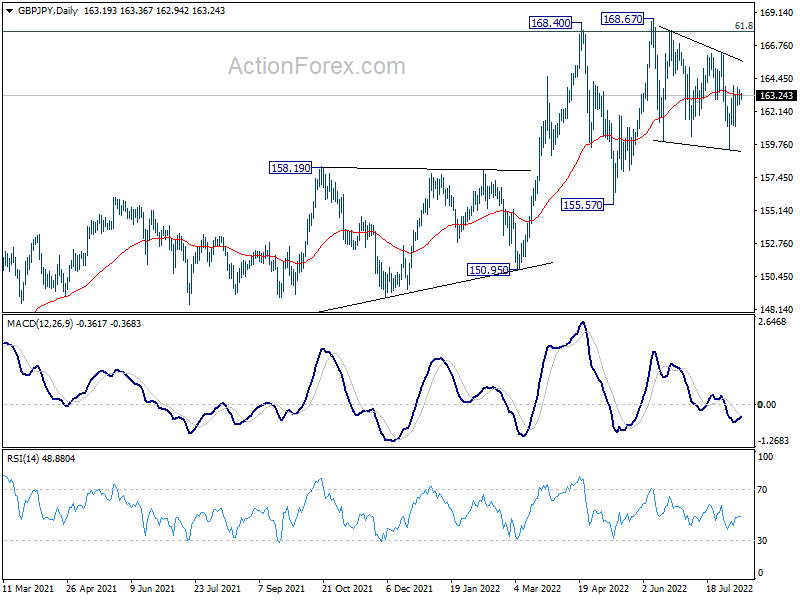
In the bigger picture, up trend from 123.94 (2020 low) is still in progress. Sustained break of 61.8% retracement of 195.86 (2015 high) to 122.75 (2016 low) at 167.93 will be a long term bullish signal, and could pave the way back to 195.86 high. This will remain the favored case as long as 155.57 support holds, even in case of deep pull back.
EUR/JPY Daily Outlook
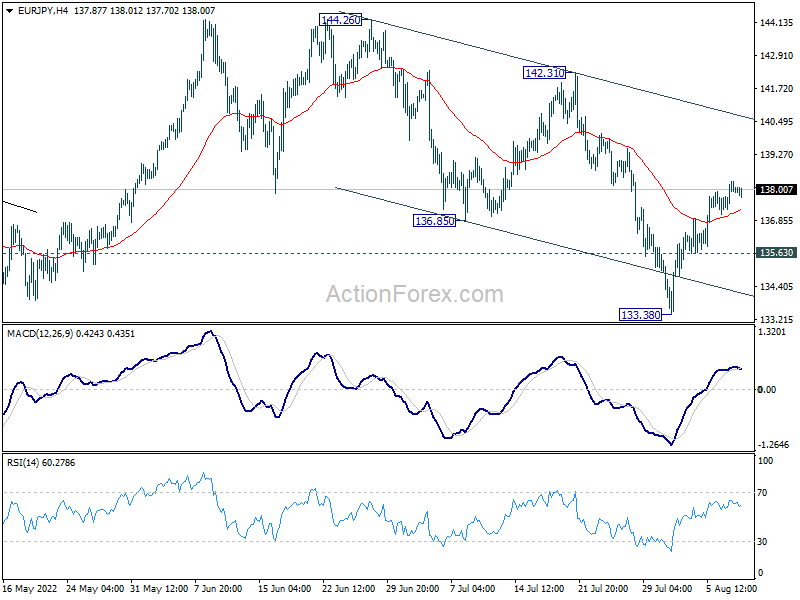
Daily Pivots: (S1) 137.44; (P) 137.87; (R1) 138.48; More....
Intraday bias in EUR/JPY remains on the upside as rebound from 133.38 is still in progress. Sustained trading above 55 day EMA (now at 138.44) will suggest that whole correction from 144.26 has completed. Further rally would then be seen back to retest 144.26 high. However, break of 135.63 will turn bias back to the downside for 133.38 low instead.
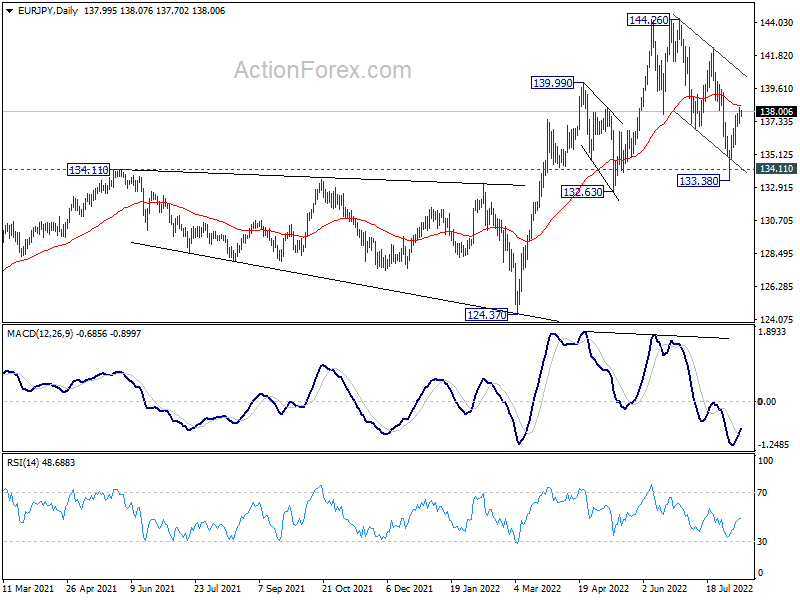
In the bigger picture, up trend from 114.42 (2020 low) is seen as the third leg of the pattern from 109.30 (2016 low). Further rally is in favor as long as 134.11 resistance turned support holds, even in case of deep pull back. Next target is 149.76 (2015 high). However, sustained break of 134.11 will be a sign of medium term bearish reversal and turn focus to 124.37 support for confirmation.
EUR/GBP Daily Outlook
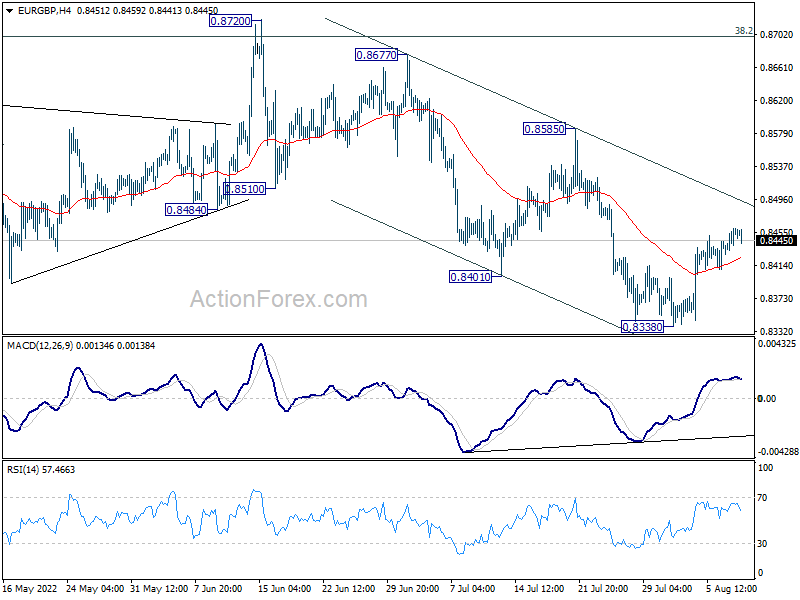
Daily Pivots: (S1) 0.8437; (P) 0.8450; (R1) 0.8471; More...
Outlook in EUR/GBP stays bearish as long as 0.8585 resistance holds, even stronger recovery cannot be ruled out. On the downside, break of 0.8338 will resume the decline from 0.8720 to retest 0.8201 low.
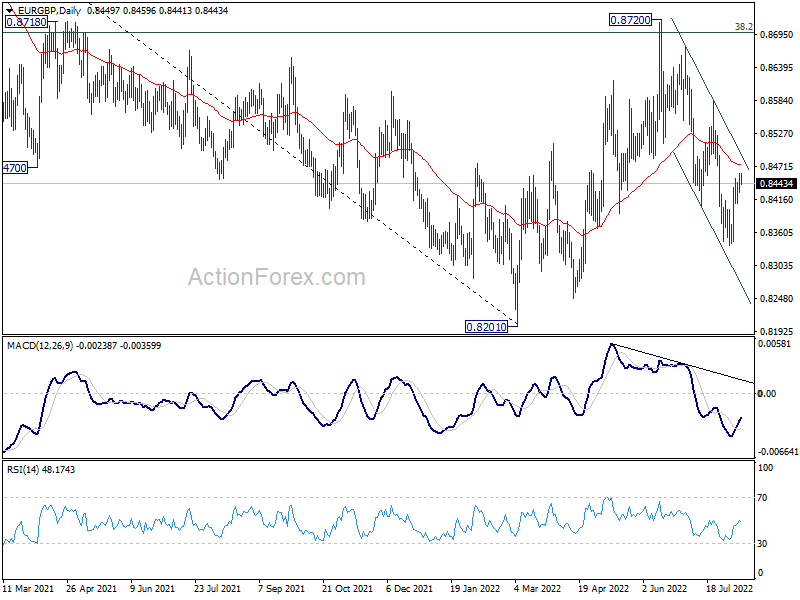
In the bigger picture, current development suggests rejection by 38.2% retracement of 0.9499 to 0.8201 at 0.8697. Medium term bearishness is maintained. Break of 0.8201 will resume larger down trend from 0.9499 (2020 high). Nevertheless, sustained break of 0.8697 will affirm the case that rise from 0.8201 is a medium term up trend itself.
EUR/AUD Daily Outlook
Daily Pivots: (S1) 1.4603; (P) 1.4646; (R1) 1.4712; More...
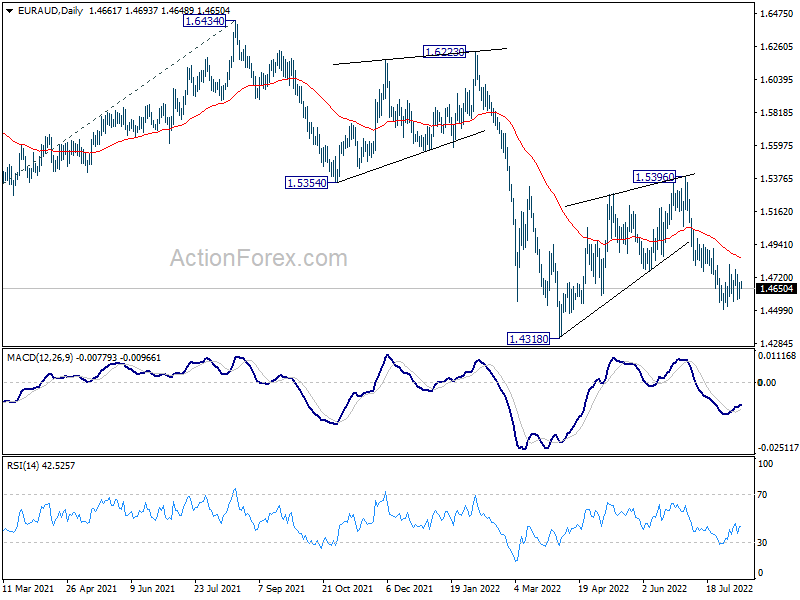
Intraday bias in EUR/AU stays neutral as sideway trading continues. While stronger recovery cannot be ruled out, upside should be limited below 1.4910 resistance to bring fall resumption. On the downside, break the 1.4508 will resume the decline from 1.5396 to retest 1.4318 low. However, firm break of 1.4910 will dampen this bearish view and bring stronger rally.
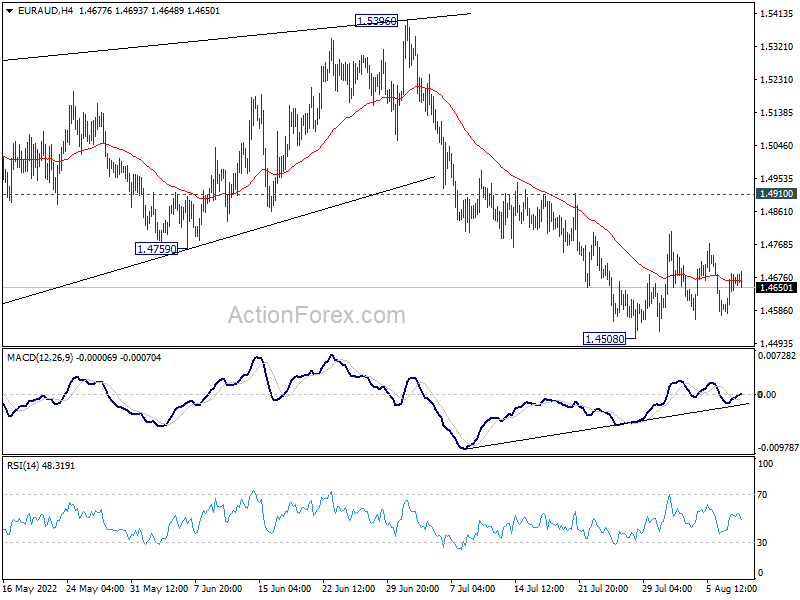
In the bigger picture, down trend from 1.9799 is still in progress. Break of 1.4318 low will target 61.8% projection of 1.9799 to 1.5250 from 1.6434 at 1.3623, which is close to 1.3624 long term support (2017 low). This will remain the favored case now as long as 1.5396 resistance holds.
EUR/CHF Daily Outlook
Daily Pivots: (S1) 0.9724; (P) 0.9745; (R1) 0.9764; More....
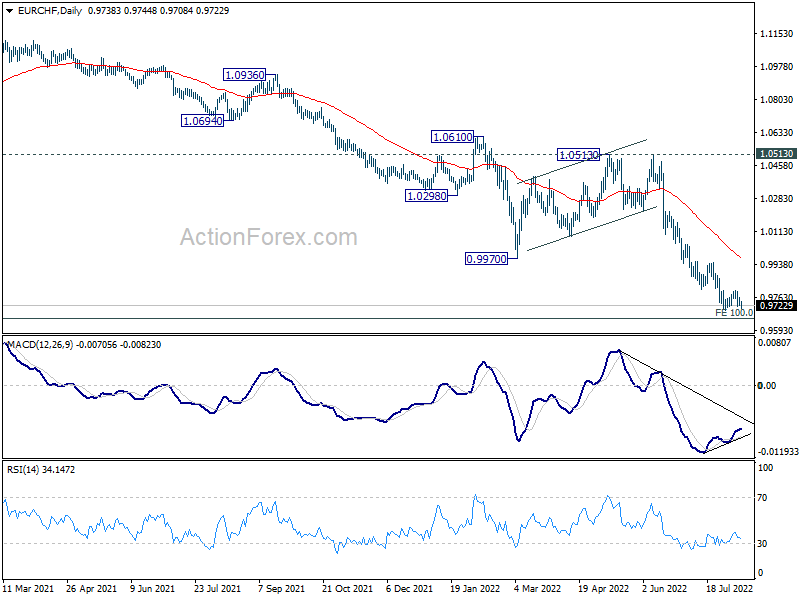
Range trading continues in EUR/CHF and intraday bias remains neutral. On the downside, firm break of 0.9697 will resume larger down trend to 0.9650 long term projection level. Strong support could be seen there to bring rebound. On the upside, break of 0.9799 minor resistance will turn bias to the upside for stronger rise to 0.9948 resistance. However, firm break of 0.9650 will target 100% projection of 1.1149 to 0.9970 from 1.0513 at 0.9334.
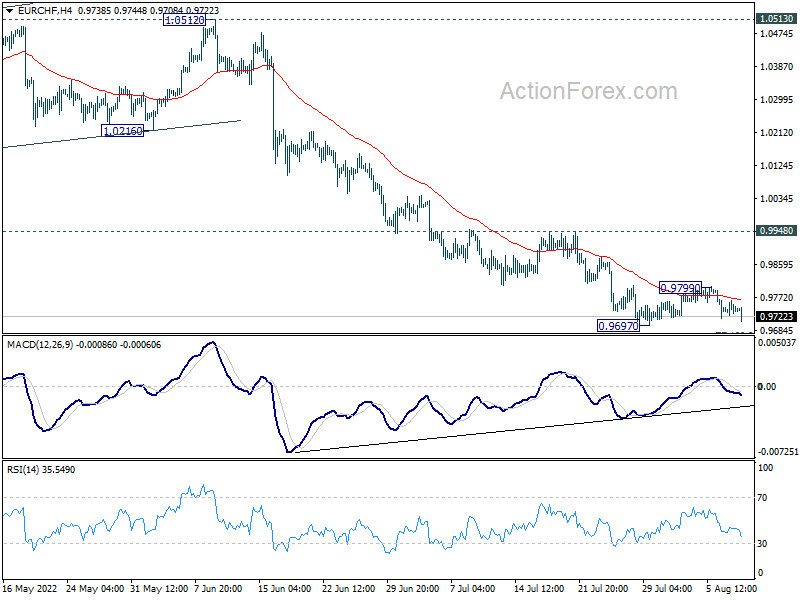
In the bigger picture, long term down trend from 1.2004 (2018 high) is expected to target 100% projection of 1.2004 to 1.0505 to 1.1149 at 0.9650. Firm break there will target 138.2% projection at 0.9033. On the upside, break of 1.0513 resistance is needed to indicate medium term bottoming. Otherwise, outlook will stay bearish in case of strong rebound.
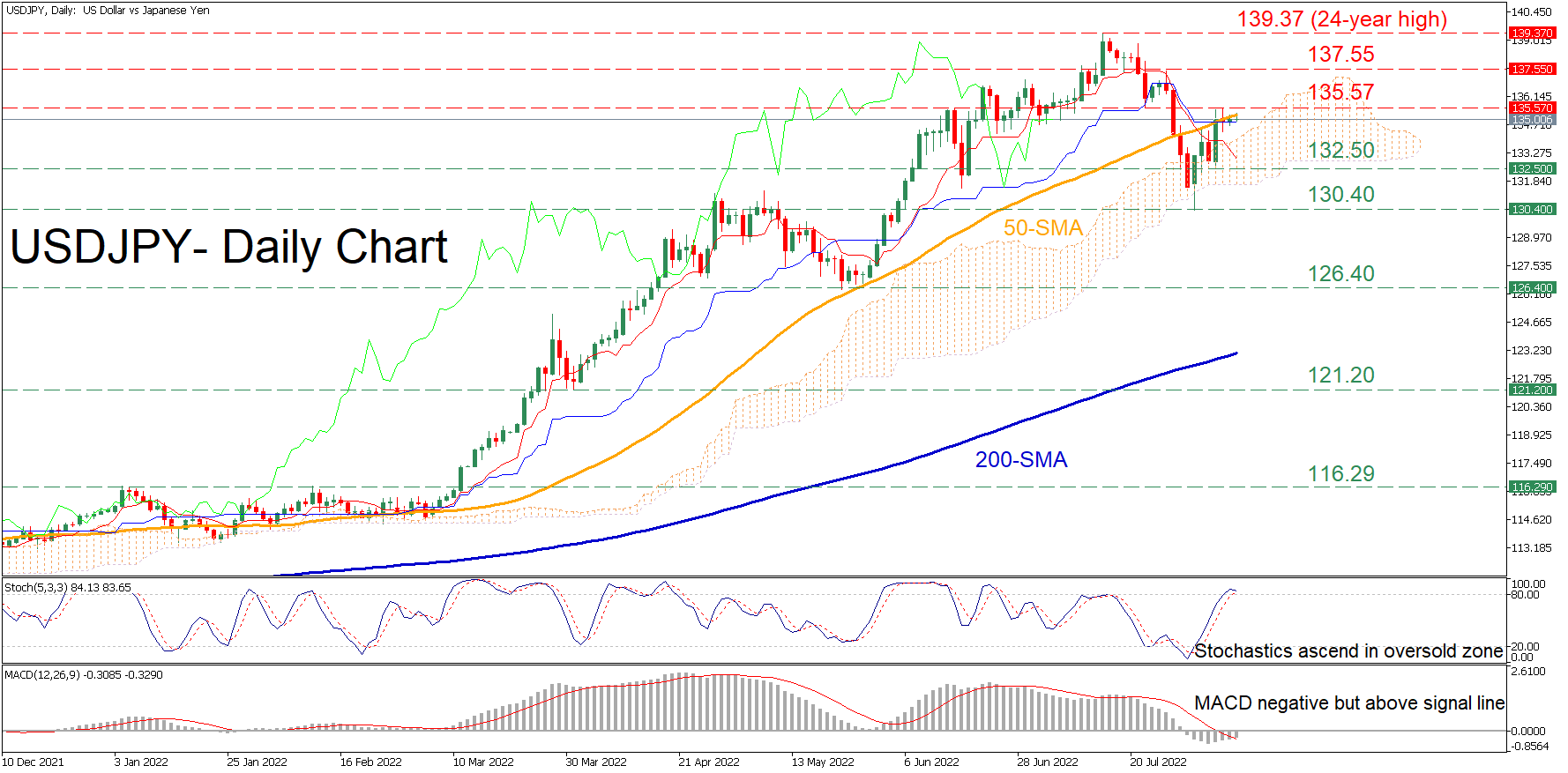
USDJPY Resumes Rebound but 50-day SMA Caps Advance
USDJPY has been gaining some ground in the short-term after its latest decline came to a halt at the 130.40 region. However, the recent price recovery has been repeatedly held down by the ascending 50-day simple moving average (SMA).
The momentum indicators suggest that near-term risks are tilted to the upside. Specifically, the stochastic oscillator is flatlining in its 80-overbought area, while the MACD histogram has jumped above its red signal line but remains in negative territory.
Should positive momentum strengthen and the price crosses above its 50-day SMA, initial resistance could be met at the recent peak of 135.57. Conquering this barricade, the bulls could then aim for the 137.55 barrier. An upside violation of the latter could set the stage for the 24-year high of 139.37.
Alternatively, if selling pressures arise, the pair could descend to challenge the 132.50 hurdle. Sliding beneath that floor, the recent low of 130.40 might be the next support zone for the price. Any further declines may then stall at the May low of 126.40 before the spotlight turns to 121.20.
Overall, USDJPY’s short-term picture appears to be constantly improving but the 50-day SMA has proved to be a tough resistance barrier for the bulls. Nevertheless, a drop beneath the 130.40 floor could shift the technical picture back to negative.