

Sample Category Title
Yield Curve Inversion and Recession Risks, Dollar the Worst Performer of the Week
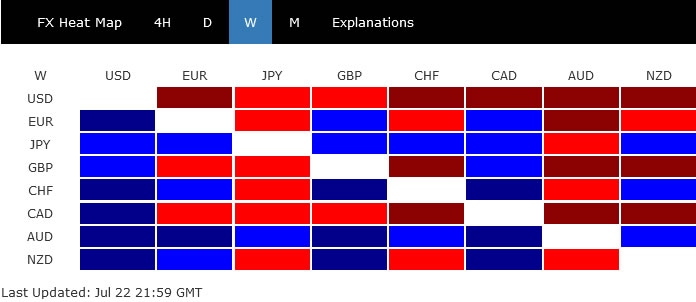
Dollar ended as the worst performing one last week. Selloff somewhat intensified on Friday after poor PMIs indicated that the US economy was already in contraction. Deep fall in benchmark treasury yields dragged down the greenback while traders were betting on a lower terminal rate in Fed's tightening cycle. Canadian Dollar was the second weakest, followed by Sterling.
Euro received just very brief lift from the larger than pre-committed rate hike by ECB and ended mixed. Even Swiss Franc was stronger, as Eurozone PMIs also raised recession risks. But Yen jumped towards the end of the week, in particular against Dollar, on falling yields. But Aussie managed to secure to first place.
Yield curve inversion and Fed to be the focuses
Yield curve inversion in the US has been a topic in the past few weeks. It will certain come back into spotlight again this week, after Friday's steep fall in 10-year yield to close at 2.783, comparing to 2-year yield at 2.991.
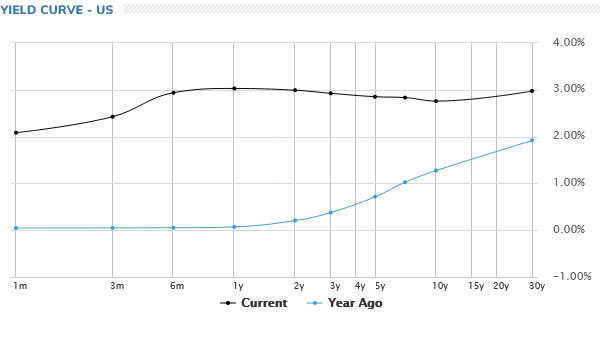
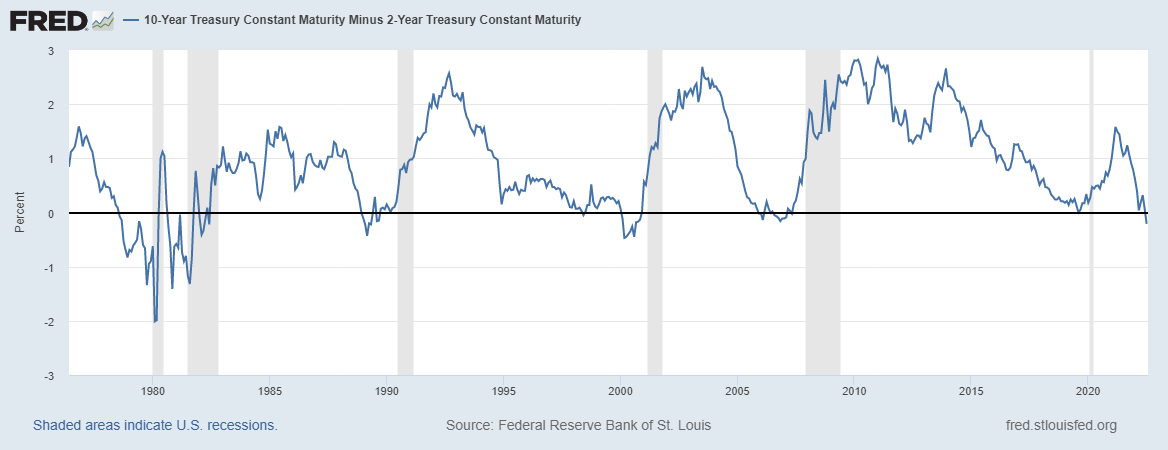
When it comes to the predictive power of recession, there are always three parameters to consider. It's which part of the yield curve, the depth, and then the duration of the inversion.
As for the depth of the inversion of the 2-year to 10-year yield, it now surpassed that during 2006, prior to the global financial crisis in 2008-9. In terms of duration, 3 weeks are considered a little short, but there is no sign of improvement.
Some economists believed that the curve of 3-month to 10-year yield is the most recession predictor. With 3-month yield currently at 2.425%, this part of the curve remains pretty safe.
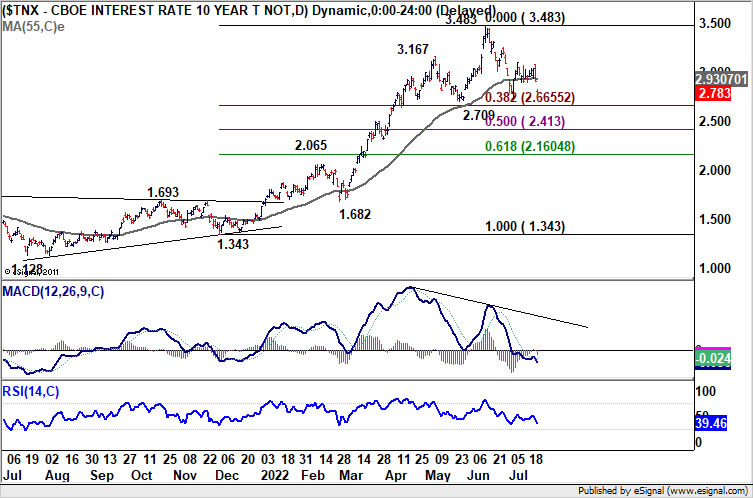
Technically, strong support is still expected around 2.709 in 10-year yield, and 38.2% retracement of 1.343 to 3.483 at 2.665 to act as the floor of the consolidation from 3.483 high. However, strong break of 2.665/709 could send 10-year yield further lower to 50% retracement at 2.413. That will, at least, flatten the 3-month to 10-year curve. Further fall to 61.8% retracement at 2.160 should definitely seal the deal of inversion, and recession, possibly a relatively prolonged one.
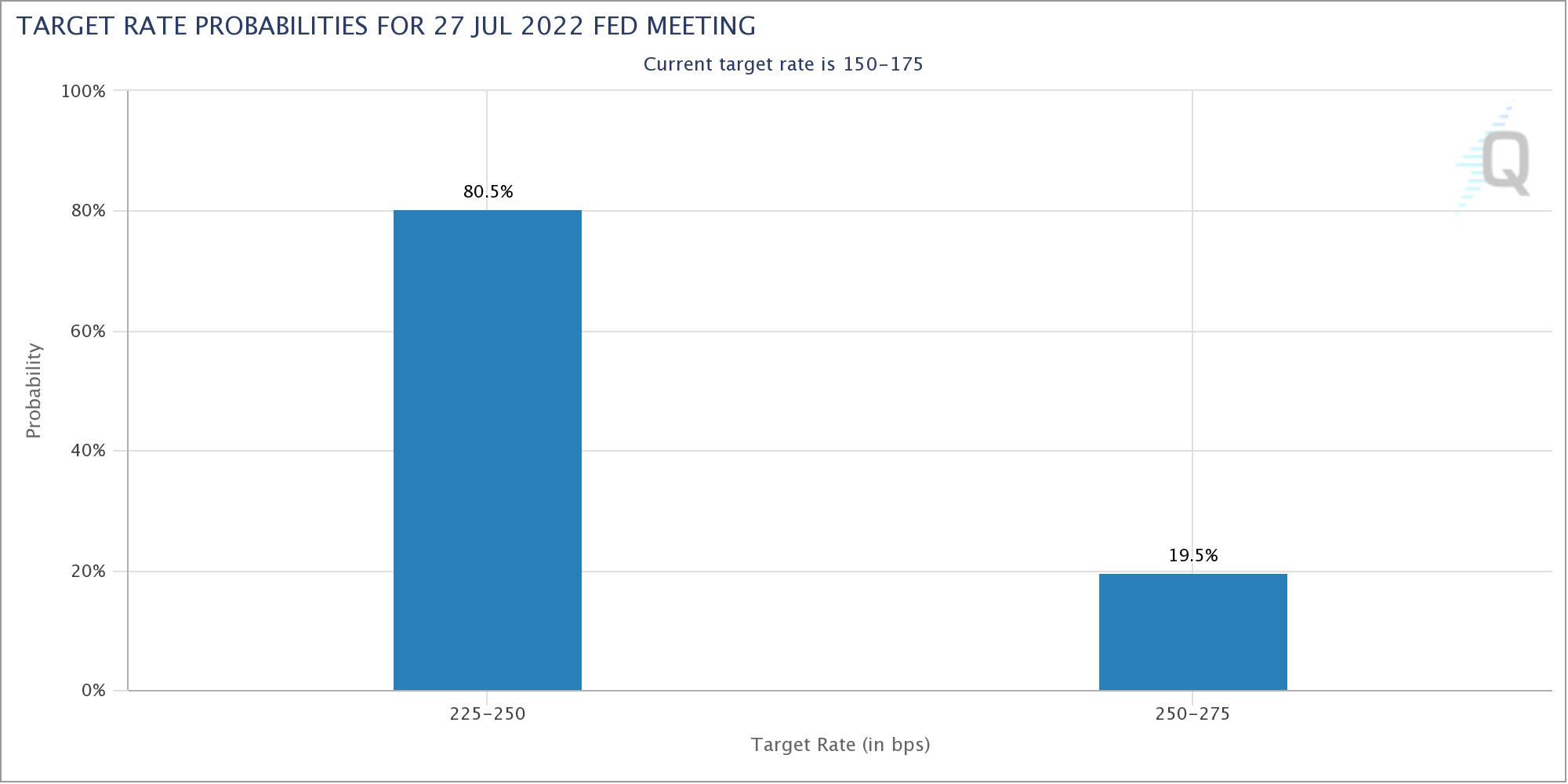
As for Fed, markets are now pricing 80.5% chance of another 75bps hike on July 27 this week. There is little chance of an upside surprise there, after the very poor US PMI data last week, which was already indicative of -1% annualized GDP contraction. The question now is Fed Chair Jerome Powell's view on recession risks, as well as any indication on a slowdown in tightening pace from September and onwards.
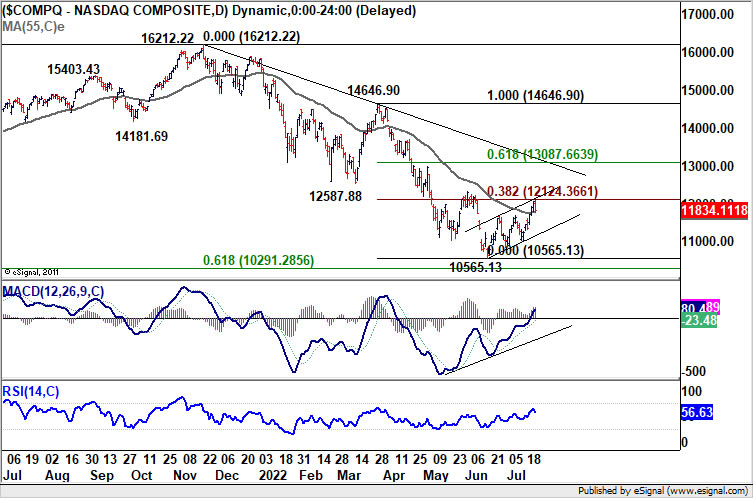
NASDAQ rebound lacks buying, vulnerable to another fall
The rebound in US stocks was rather disappointing last week. NASDAQ clearly struggled to find enough buying to push through 38.2% retracement of 14646.90 to 10565.1 at 12124.36, with coincides with near term channel resistance. Rejection by this channel will keep the rebound from 10565.13 corrective, which maintains bearishness in the index. Sustained trading below 55 day EMA (now at 11776.15) could set the stage for at least another fall to retest 10565.13, or 61.8% retracement of 6631.42 to 16212.22 at 10291.28. Such development could come if recession worries intensify.
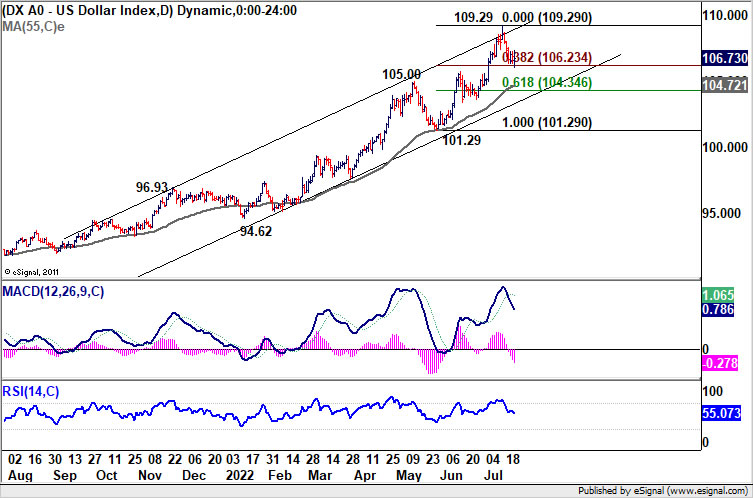
Dollar index drawing support from first fibonacci level
Dollar index's decline last week should have confirmed short term topping at 109.29. That came as the greenback was dragged down by falling US benchmark yields. Additionally, traders were probably already pricing in a lower terminal rate in the current tightening cycle of Fed.
Initial support was found at 38.2% retracement at 101.29 to 109.29 at 106.23. Stabilization at the current level should help set the range of a relatively brief near term consolidation. However, should 10-year yield break through above mentioned 2.66/70 support zone, it's highly likely that DXY will follow and target 55 day EMA (now at 104.72), which is inside 101.29/105.00 support zone. Such development, if happens, could mean that Dollar index has already started a medium term correction, which could last much longer and extend deeper.
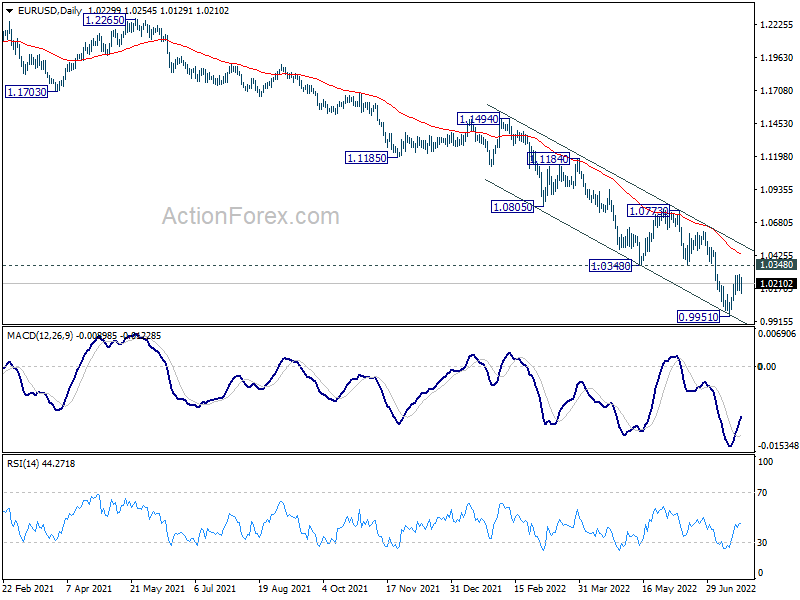
EUR/USD, USD/JPY and Gold
EUR/USD struggled to extend the rebound from 0.9951 last week, despite ECB's surprised 50bps rate hike. Yet, retreat from 1.0227 was shallow, keep more upside in favor. The key resistance is 1.0348 support turned resistance. Firm break there will raise the chance of medium term bottoming at 0.9951, after defending parity, and put channel resistance at 1.0514 in focus. Such development could come if 10-year yield break through the above mentioned 2.66/70 support zone, or with any downbeat warning from Fed Powell.
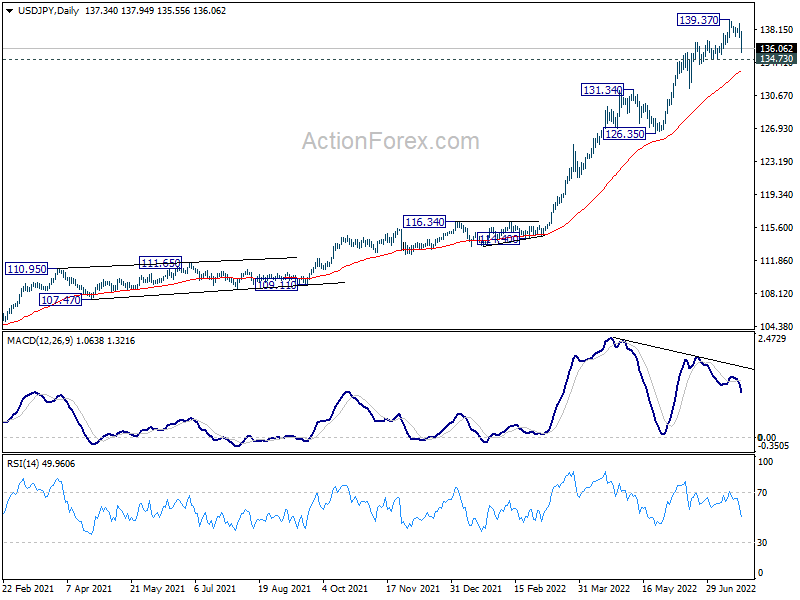
At this same time, while it's still early to conclude, the risk of a deeper medium term correction in USD/JPY is growing. Bearish divergence condition in daily MACD is already a bad sign for the pair. Break of 134.73 support would likely send USD/JPY through 55 day EMA (now at 133.37) into 126.35/131.34 support zone. Such development could come as Yen responds more than Dollar to the next risk-off selling in stocks, as well as deeper pull back in benchmark yields.
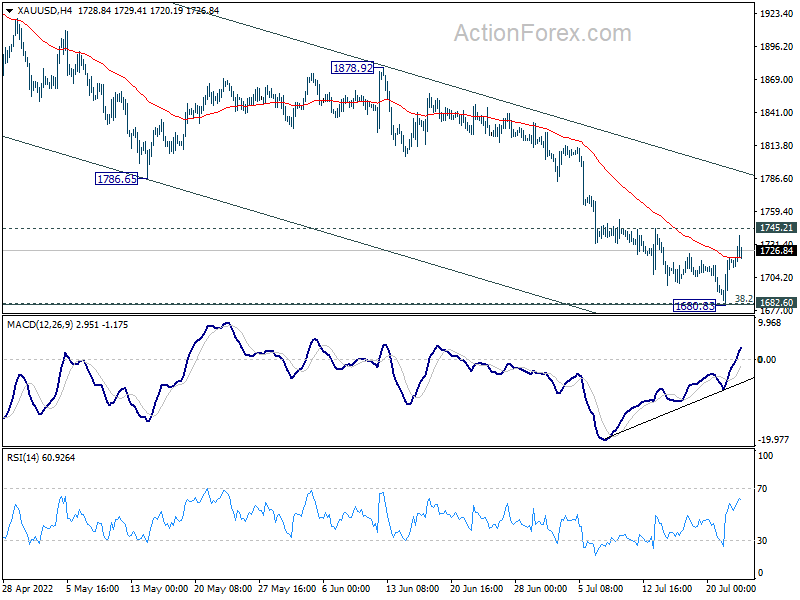
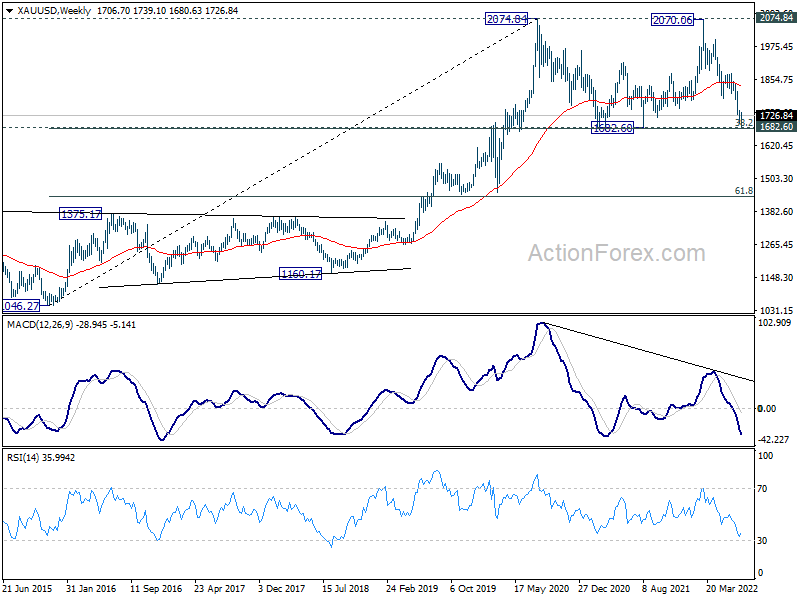
Gold is another one to look at for gauging the odds for deeper selloff in Dollar. While dipping further to 1680.83, Gold quickly recovered to close at 1726.84. It's mentioned a couple of times that fall from 2070.06 is seen as the third leg of the consolidation pattern from 2074.84. Strong support is expected at 1682.60, with 38.2% retracement of 1046.27 to 2074.84 at 1681.92, to complete the pattern. Break of 1745.21 minor resistance will now be a sign of short term bottoming and bring stronger rise back to 1786.65/1878.92 resistance zone.
EUR/CHF Weekly Outlook
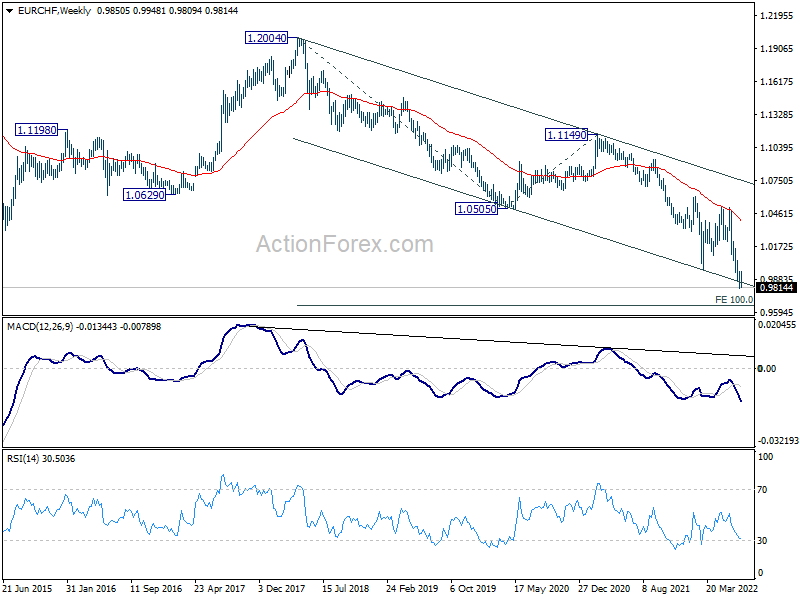
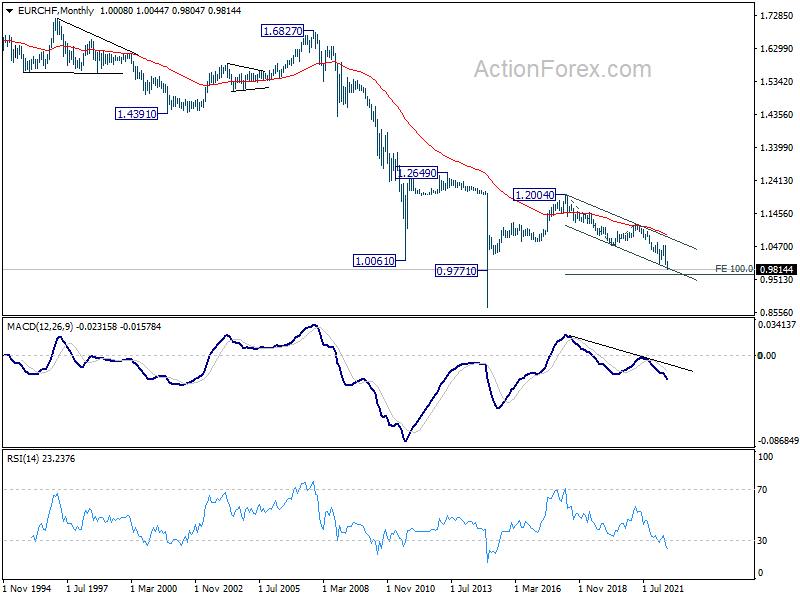
EUR/CHF's recovery was capped by 0.9953 minor resistance last week, but stayed above 0.9804 low. Initial bias remains neutral this week and further fall is expected. On the downside, break of 0.9804 will resume larger down trend. Next target is 0.9650 long term projection level. On the upside, however, break of 0.9953 minor resistance will suggest short term bottoming, and bring stronger rebound to 55 day EMA (now at 1.0097).
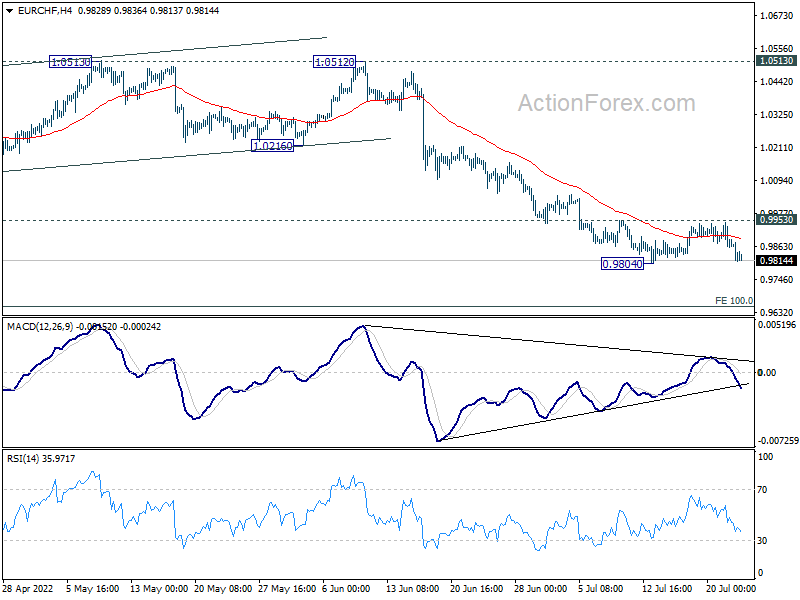
In the bigger picture,long term down trend from 1.2004 (2018 high) is expected to target 100% projection of 1.2004 to 1.0505 to 1.1149 at 0.9650. On the upside, break of 1.0513 resistance is needed to indicate medium term bottoming. Otherwise, outlook will stay bearish in case of strong rebound.
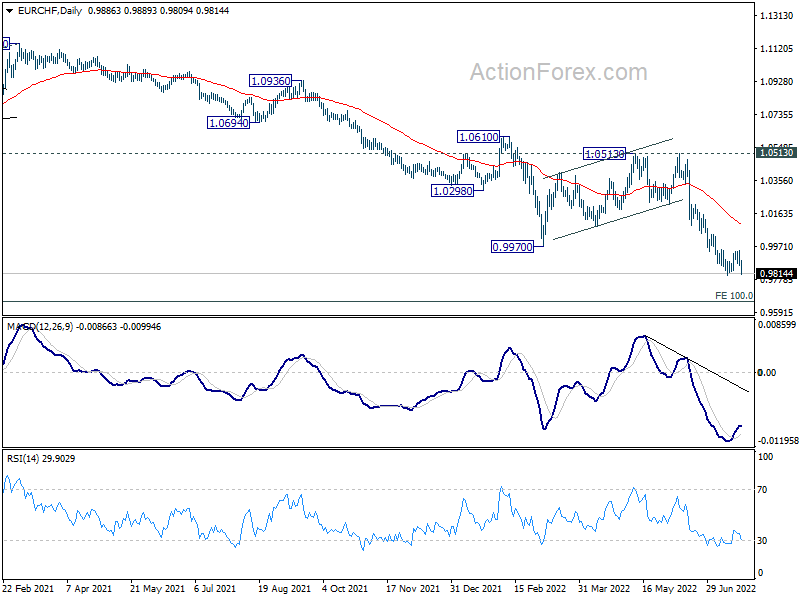
In the long term picture, capped below 55 month EMA, EUR/CHF is seen as extending the multi-decade down trend. There is no prospect of a bullish reversal until some sustained trading above the 55 month EMA (now at 1.0808).
Summary 7/25 – 7/29
Monday, Jul 25, 2022
[php_everywhere instance="1"]
Tuesday, Jul 26, 2022
[php_everywhere instance="2"]
Wednesday, Jul 27, 2022
[php_everywhere instance="3"]
Thursday, Jul 28, 2022
[php_everywhere instance="4"]
Friday, Jul 29, 2022
[php_everywhere instance="5"]
Forward Guidance: GDP Growth Slowing as Capacity Constraints Bind
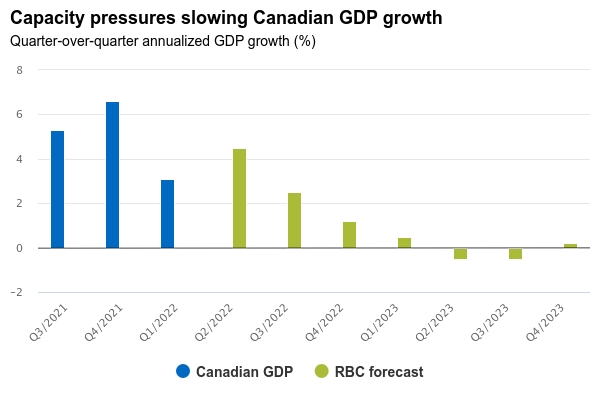
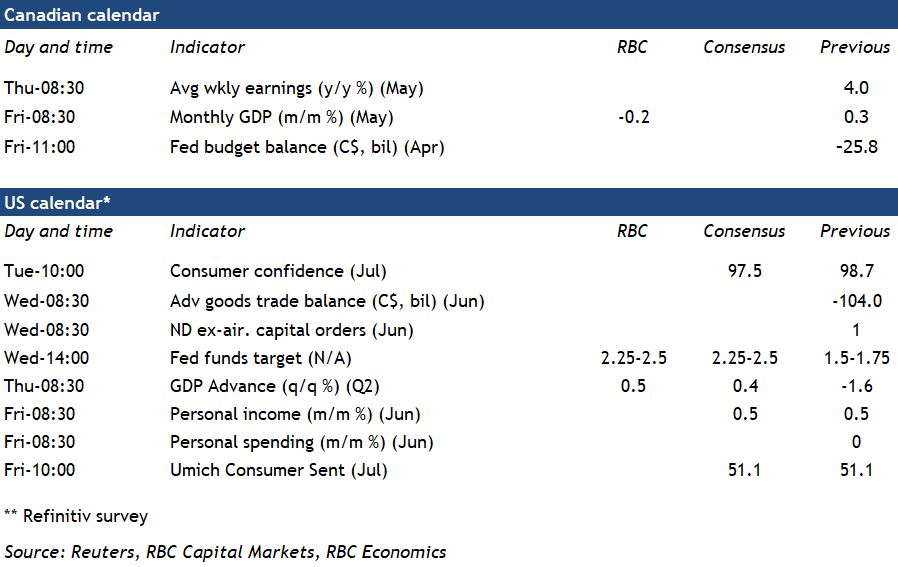
Canadian GDP likely declined in May – in line with the 0.2% drop in Statistics Canada’s preliminary estimate a month ago. We do not expect another drop in June. Auto production bounced back after another round of factory shutdowns in May. Activity in the oil & gas sector has increased on higher global energy prices. And economy-wide hours worked jumped by 1.3% after declining in each of April and May.
There is still substantial momentum in labour markets with demand for staff outstripping the supply of available unemployed workers. And near-term momentum in consumer spending still looks strong with spending on travel and hospitality services recovering from the pandemic. But the pace of growth is clearly slowing as the economy bumps up against long-run production capacity limits, and housing markets have already shifted substantially into reverse. Home resales are down 27% since March and prices starting to decline.
The U.S. has hit capacity constraints earlier than Canada with GDP already declining outright in Q1 of this year and our own tracking calls for little change in next week’s estimate for Q2. Labour market data has been stronger – hours worked rose almost 3% (annualized rate) in Q2. And industrial production jumped over 6%. But wages have continued to surge as acute labour shortages intensify, feeding further domestic price pressures. Against that backdrop, the U.S. Federal Reserve is more focused on cooling demand to address inflation than growth risks. We look for the Fed to hike the fed funds target range by another 75 basis points (to 2.25% to 2.50%) next week.
Week ahead data watch:
- Canada average weekly earnings are expected to trend higher in May after a 0.2% increase in April. The latest Canadian Survey of Consumer Expectations indicated that Canadians continue to anticipate modest wage growth over the next 12-months
- US consumer spending likely jumped higher in June – although largely due to higher prices. Personal incomes also likely rose with both hours worked and hourly wages rising in June
Weekly Economic & Financial Commentary: The FOMC to Deliver Another Jumbo 75 bps Hike
Summary
United States: Housing Slump Underscores Rising Risk of Recession
- Higher mortgage rates continue to drag on housing activity. The NAHB Housing Market Index plunged 12 points to 55 in July. June brought a 5.6% drop in existing home sales as well as a 2.0% decline in housing starts. Initial jobless claims rose to 251K during the week of July 16. The Leading Economic Index (LEI) slipped 0.8% in June, the fourth straight monthly drop.
- Next week: Durable Goods (Wed.), Q2 U.S. GDP (Thurs.), Personal Income & Spending (Fri.)
International: ECB Exits Negative Interest Rates
- The ECB delivered a larger-than-expected 50 bps Deposit Rate increase, exiting its negative interest rate policy and taking the Deposit Rate to 0.00%. The other key policy interest rates were also lifted by 50 bps, taking the refinancing rate to 0.50% and the marginal lending rate to 0.75%.
- Next week: Japan (Tokyo) Inflation (Thurs.), Central Bank of Colombia (Fri.), Eurozone Q2 GDP (Fri.)
Interest Rate Watch: The FOMC to Deliver Another Jumbo 75 bps Hike
- The blistering June CPI report raised the chance that the FOMC could deliver a 100 bps hike at next Wednesday's meeting. However, with data since then showing the economy continues to cool and notable hawks signaling a smaller increase should be adequate, we look for the FOMC to hike a still head-turning 75 bps.
Credit Market Insights: Stronger Dollar Spells Potential Trouble for Emerging Market Debt
- Over the course of 2022, but particularly during the past few months, the U.S. dollar has broadly strengthened. Local currency depreciation could mean potential trouble for governments that have a sizable percentage of their sovereign debt denominated in U.S. dollars. As vulnerable countries struggle with potential repayment issues, economic growth across the emerging and developing world could slow sharply, while the probability of default could spike across the entire spectrum.
Topic of the Week: Power Struggle: European Heat Waves Strain an Energy-Starved Continent
- The second heat wave of this summer swept through Europe this week, extending as far north as the U.K. and causing wildfires in France, Spain, Portugal and Italy. The intensity of the heat wave, with temperatures reaching a record high of 104°F in the U.K., has upended life and further strained a continent already dealing with an energy crisis.
Week Ahead – Bring on the Fed
Focus on the US next week
Europe took centre stage last week as leaders waited nervously to see if gas would start flowing through Nord Stream 1 again following scheduled maintenance (it did) and the ECB raised its deposit rate to 0%, ending eight years of negative rates. Next week the focus switches back to the US which has a big interest rate decision of its own and a number of major earnings reports.
The Fed is expected to raise interest rates by 75 basis points, although it may be tempted to follow the Bank of Canada in hiking by a full percentage point and show the world it means business. This is happening against the backdrop of mounting recession fears which makes next week’s earnings reports all the more important.
Elsewhere it’s a little quieter on the central bank front which is hardly surprising considering how many we heard from late last week. There’s always the possibility of an inter-meeting decision if a central bank deems it necessary. Many have taken that option over the last couple of years and the SNB is no stranger to surprising the markets. If not, there’s no shortage of economic data which traders will no doubt be scrutinizing for inflation clues.
US
This week is all about the Fed. On Wednesday, the Fed will have to decide how high they want to raise interest rates this time. The consensus estimate is for a 75 basis point increase, but some are expecting the Fed to slow the pace of tightening to a half-point increase, while a couple of economists think an aggressive full-point increase is justified and on the table.
On Thursday, we will find out if the US fell into a technical recession. The first look at Q2 GDP is expected to show a modest expansion of 0.9%, an improvement from the -1.6% reading from the prior quarter. The Bloomberg GDP estimate range from 55 economists ranges between -0.6% and 1.2%.
This is also a massive week for earnings. Tuesday will contain quarterly updates from GM, GE, UPS and 3M. Apple and Amazon both report after the close on Thursday. A lot of traders still believe any stock market rebounds are bear market rallies as the Fed will remain committed to fighting inflation for the rest of the year. If corporate America starts showing more troubles with the jobs market, that could make some investors reassess how aggressive the Fed will be going forward.
EU
In a strange way, the inflation data next week has lost a little something following the ECB’s decision to hike by 50 basis points on Thursday. That decision was taken on the assumption that price pressures are building faster than anticipated and more widespread. It would probably take a shocking number to drastically change expectations. And coming six weeks ahead of the next meeting, a lot can change. That said, in a week of big data points – unemployment, GDP, Ifo – it remains the standout.
Russian gas started flowing along Nord Stream 1 as planned on Thursday, albeit only at 40% as it was before the maintenance began. While a relief, it’s clear that Europe’s energy situation is going to remain extremely challenging in the months ahead given the tendency for flows to be reduced for various reasons.
UK
A quiet week ahead of the Bank of England meeting the week after, at which the MPC is expected to accelerate its tightening with a 50 basis point hike.
Russia
The CBR cut rates again on Friday and much more than expected, bringing the key rate down from 9.5% – where it was before the invasion – to 8%. The rouble remains more than 20% stronger against the dollar despite the rate cuts and more are likely to follow. CBR Governor Nabiullina expects the economy to contract less sharply this year than previously thought but for the downturn to be more prolonged. Unemployment and industrial output figures will be released next week.
South Africa
The SARB accelerated its tightening with a 75 basis point hike, bringing the repo rate to 5.5% as it prepares for a prolonged period of above-target inflation. PPI is the only economic release of note next week.
Turkey
The CBRT opted to continue to bury its head in the sand at its July meeting, leaving the repo rate unchanged at 14% while blaming everything else for eye-watering inflation, which now stands at 78.62%.
The quarterly inflation report will make for interesting reading on Thursday. Enough to change their direction? Almost certainly not although there must come a point when the experiment will need to end.
Switzerland
The SNB is expected to raise interest rates a further 50 basis points when it next meets, with some suggesting it may be higher after inflation hit a 29-year high earlier this month. The central bank does love a surprise though so we can’t discount the possibility of an inter-meeting announcement.
Retail sales on Friday is the only release of note next week.
China
It is a quiet week for data in China, with just industrial profits on Wednesday, as world markets remain laser-focused on the US FOMC decision later that day.
China sentiment will be driven by political developments at home, notably the ongoing mortgage payment strike by apartment buyers, this is putting more financial pressure on developers. More stress in this sector will weigh heavily on the Shanghai Composite (lots of banks) and the Hang Seng (lots of developers).
Covid-19 cases are rising in China once again and the ever-present risk is that centres like Shanghai or Beijing could face partial shutdowns again. Potentially a major negative for local and regional equity markets.
India
No significant data in the week ahead. Foreign investors have continued to sell out of Sensex holdings heavily, weighing on the rupee. USD/INR remains near record highs as the current account deteriorates due to high energy prices and domestic export restrictions. The RBI appears to be intervening to cap USD/IDR near 80.00, but a 1.0% FOMC hike this week may see the RBI fold. The RBI may well be considering another unscheduled rate hike, which could be negative for equities.
Australia
The Australian dollar remains at the mercy of international investor sentiment flows which have been positive for the past week. It could drop suddenly if investor sentiment swings south.
Australia releases inflation data on Wednesday which should generate short-term volatility. A high print could have markets scrambling to price in more aggressive RBA tightening, which may be positive for AUD and negative for local equities.
New Zealand
New Zealand releases business and consumer sentiment this week. There is substantial downside risk as cost-of-living and weakening property prices bite. A potential negative for local equities.
The New Zealand dollar remains at the mercy of international investor sentiment flows.
Japan
Japan has a heavy data week ahead but Friday’s consumer confidence, industrial production and retail sales are the most important. All three could show a gentle recovery which may be positive for local equities, although the Nikkei 225 is mostly correlated to the Nasdaq at the moment.
USD/JPY has fallen below 138.00 on lower US yields. If US yields fall again into the early part of next week, USD/JPY is in danger of a large downward correction to wash out USD/JPY longs. Conversely, a hawkish FOMC decision next week could see the USD/JPY uptrend resume as the rate differential widens.
Singapore
Singapore releases industrial production on Monday, but Friday’s PPI and import/export prices is likely to be more important. With the MAS already tightening this month, and October’s policy meeting looming, high data prints could see markets’ position for another hike in October, a potential negative for local equities.
Economic Calendar
Sunday, July 24
Economic Events
- Russian Foreign Minister Lavrov will begin his trip across Africa
Monday, July 25
Economic Data/Events:
- Germany IFO business climate
- Singapore CPI
- Taiwan industrial production
- A key debate between the UK’s final Conservative Party leadership candidates, Rishi Sunak and Liz Truss
Tuesday, July 26
Economic Data/Events
- US new home sales, Conf. Board consumer confidence
- Fed begins 2-day policy meeting
- Key earnings from Alphabet, GM, GE, UPS and 3M
- Mexico international reserves
- Singapore industrial production
- Bank of Japan releases minutes from its June meeting
- The IMF releases its world economic outlook update
- EU energy ministers expected to have an emergency meeting
Wednesday, July 27
Economic Data/Events
- FOMC decision: Fed expected to raise rates by 75 basis points
- US wholesale inventories, durable goods
- Australia CPI
- China industrial profits
- Mexico trade
- Russia industrial production, unemployment
- Thailand trade
- EIA Crude Oil Inventory Report
Thursday, July 28
Economic Data/Events
- US Q2 Advance GDP Q/Q: +0.9%e v -1.6% prior; initial jobless claims
- Mexico unemployment
- Australia retail sales
- Eurozone economic confidence, consumer confidence
- Germany CPI
- Hungary one-week deposit rate
- After the close, Apple and Amazon report earnings
Friday, July 29
Economic Data/Events
- US consumer income, University of Michigan consumer sentiment
- Eurozone CPI and GDP
- France CPI and GDP
- Poland CPI
- Czech Republic GDP
- Germany GDP
- Italy GDP
- Mexico GDP
- Japan industrial production
- German unemployment
- Japan unemployment, Tokyo CPI, retail sales
Sovereign Rating Updates
- Norway (Fitch)
- Finland (Moody’s)
- Austria (DBRS)
The Weekly Bottom Line: 8.1 and Silver Linings
U.S. Highlights
- June’s housing data showed another decline in activity as the effects of higher mortgage rates and stretched affordability impact the market.
- A strong labor market and tight inventories will support housing construction and limit the downside risks.
- Despite the slowdown in the housing market the Fed will keep up its fight against inflation with another 75-basis point hike next week.
Canadian Highlights
- Inflation hit a 40-year high this week, coming in at 8.1% in June. That said, it undershot consensus and monthly CPI growth slowed markedly, with cooling across most major categories.
- Still, the sky-high inflation rate will keep the Bank hiking aggressively, with a 75 bps move priced in for September.
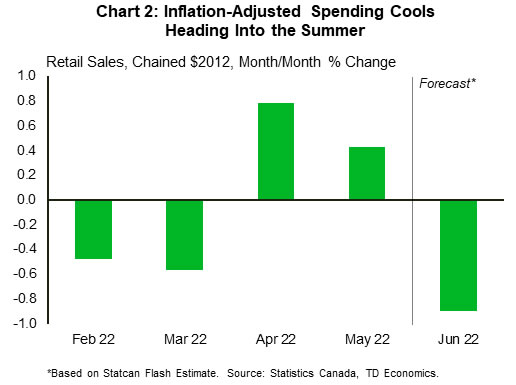
- Real retail spending increased in May but likely fell in June, suggesting softer goods spending momentum entering Q3.
U.S. - Softening Housing Market Won’t Deter Fed
This week’s housing data showed that the market continued to slow meaningfully through June. Yet, as inflation continues to linger at multi-decade highs the Fed will keep up the fight against rising prices by raising rates another 75-basis points (bps) next week. Fortunately for the housing market a strong labor market and tight inventories will support construction and limit the possibility of a rapid deterioration of conditions.
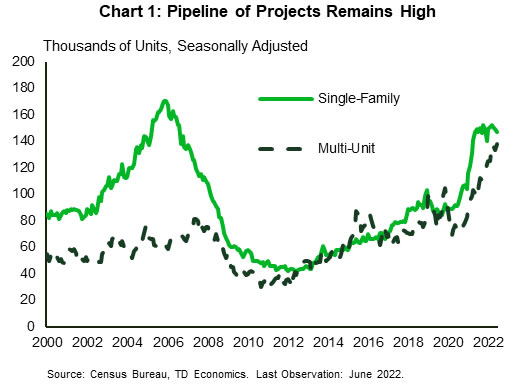
On Tuesday the Census Bureau released June data on national housing starts. Overall, starts pulled back 32k units to 1,559k (annualized) in June, touching their lowest reading since last September. However, the entirety of the decline was attributable to weakness in the single-detached segment (-86k) as multifamily construction rose another 54k. The multifamily starts registered 577k units, and apart from April’s 632k and January 2020’s 601k, this is the strongest reading since the late 1980s. Permitting activity pulled back as well, falling 10k to 1,685k (annualized). Again, the multifamily segment showed ongoing strength, with permits rising 74k, while the single-family segment pulled back 84k.
Looking forward, there still looks to be healthy support for construction in the coming months. The pipeline of projects (as measured by units authorized but not started), is at a multi-decade high with a near even split between multi-unit and single-family structures waiting to get shovels in the ground (Chart 1). As raw materials prices come down, and supply chain issues gradually fade, the opportunity for more projects to get underway increases.
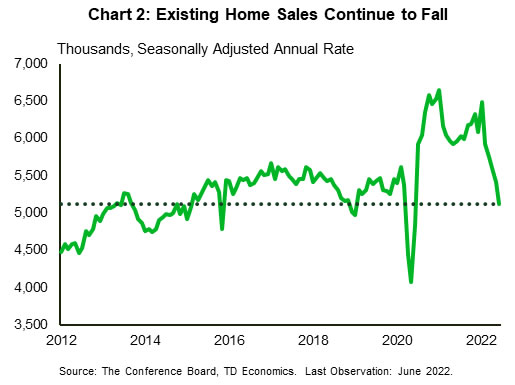
Indeed, more construction will be needed as this week’s existing home sales data showed there was roughly 3.0 months’ worth of inventory in the market – still below what is a balanced market. That said, amid falling affordability sales are slowing markedly. June’s existing home sales data reflect just that as sales fell to 5.1 million units (annualized) – the lowest reading since June 2020 (Chart 2). The slowdown in sales activity helped push the seasonally adjusted median sales price down 0.2% on a month-over-month basis. However, affordability continues to be stretched, particularly for the single-family segment. Combined with elevated mortgage rates this should continue to cool housing sales in the coming months.
Given the exuberance in the housing market over the past two years, the Fed’s mandate to fight inflation, and the strains on affordability, the slowdown in the housing market was expected. Indeed, residential investment is likely to contract well into 2023. That said, the moderation is simply helping bring the economy back to a pre-pandemic composition.
Despite the slowdown in the housing market the Fed will keep up its fight against inflation with another 75-basis point hike next week. The unemployment rate is still holding at 3.6%, while last week’s CPI print showed inflation hit 9% year-over-year in June. A strong labor market and inflation far from target means policymakers will continue working hard to keep inflation expectations anchored and bring down the pace of price gains.
Canada - 8.1 and Silver Linings
This week's hotly anticipated CPI report revealed yet another multi-decade high for inflation in June. At 8.1%, inflation touched its fastest pace since 1983, with significant year-on-year accelerations recorded in clothing and footwear prices (as they continue their climb back to pre-pandemic levels) and transportation (thanks to gasoline, and a bump in new vehicle prices linked to the roll out of new models). The latter saw further support from surging airline fares while the travel bug also boosted annual price growth in recreation services. Meanwhile, measures of core inflation remained elevated, with the average of the Bank of Canada's three measures sitting at 5%.
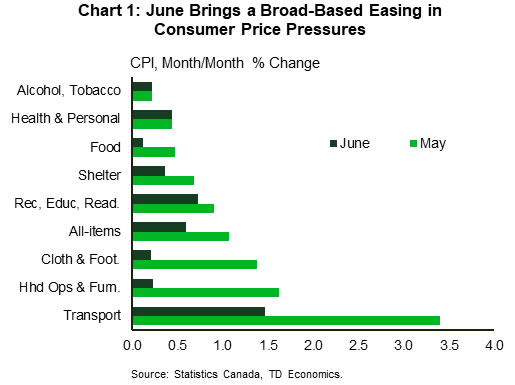
Although an 8.1% inflation print is clearly nothing to cheer about as it will keep pressure on the pocketbooks of Canadians, oddly enough, it could have been worse. Indeed, June's print was south of consensus, which was expecting an 8.4% gain. However, what was especially eye-catching was the steep deceleration in month-on-month CPI growth to an (admittedly still-hot) 0.6% rate. Monthly slowdowns were seen in 6 of 8 major industries (Chart 1), with particularly notable easings recorded in transportation (on less of an impulse from gasoline prices) and household operations and furnishings. The hits kept coming however, as growth in shelter prices eased, while we also saw a second straight significant slowdown in monthly food inflation. Looking ahead to July, we should see some further improvement, as gasoline prices have tumbled 13% from their early June highs.
While the Bank of Canada will no doubt be heartened by these trends, they know that their battle to wrestle inflation back down to target is far from over. Indeed, in an interview this week, Governor Macklem acknowledged the likelihood that inflation would sport a 7-handle for the rest of the year, with our own forecast looking for something similar. As such, policymakers will be keeping monetary policy on an aggressive path, with market pricing heavily skewed towards a 75 bps move in September.
Both our own and the Bank of Canada's forecast anticipates a slowdown in consumer spending moving forward, as elevated inflation and rising borrowing costs bite. We, like the Bank, also expect a continued rebalancing away from goods spending and towards services. This morning's retail sales report played into these themes to some degree. While it's true that inflation-adjusted retail spending was firm in May (all but guaranteeing a strong second quarter print), the flash estimate for nominal spending in June was modest. And, with goods inflation rising sharply in June, the implication is that sales volumes declined that month (Chart 2). Absent timelier data on services spending, we can't be 100% certain that the "rebalancing" part of our forecast remained on track. However, the weaker June flash data points to weaker goods spending momentum heading into the summer.
Week Ahead – Fed to Raise Rates, Italy in Political Turmoil
All eyes will be on the Federal Reserve meeting next week. A triple-barreled rate increase is essentially locked in, so traders will put more emphasis on Powell’s commentary and the upcoming GDP report that will reveal whether America is in a technical recession. Over in Europe, there’s another round of inflation data coming up, although the euro might care more about the unfolding political crisis in Italy.
Summer Fed hike
There has been a tremendous shift in global markets recently. Inflation worries have taken a back seat, replaced by concerns around economic growth. While incoming data has been resilient, business surveys increasingly suggest demand is losing power as consumers tighten their belts.
This has been mirrored in commodity prices, with everything from metals to food to energy cooling off. And with shipping costs declining as supply disruptions finally ease, inflation expectations have started to roll over. Market participants are essentially saying the inflation problem will be cured, but mainly because demand will suffer.
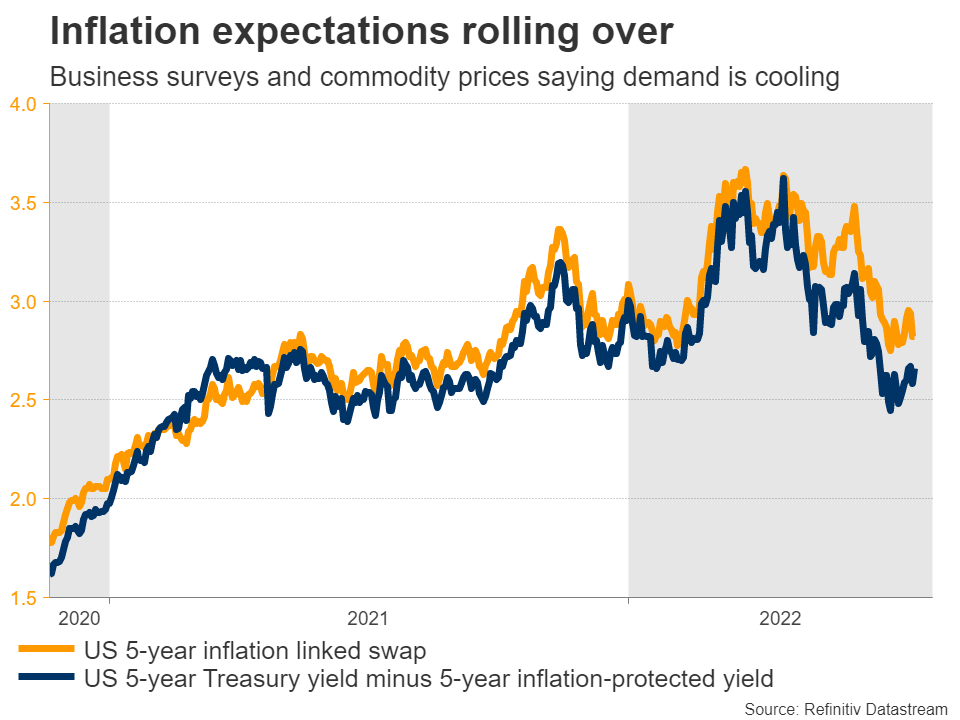
In this light, the Fed decision on Wednesday will be crucial. A rate increase of 75 basis points is already fully priced into money markets, with a chance of around 15% for an even bigger 100bps move. Admittedly though, that doesn’t seem very realistic as even arch-hawks like Waller did not support such an aggressive move.
With the data pulse weakening and investors screaming that inflation is about to lose its punch, there’s no real reason to strike so hard. And since this is one of the smaller meetings without new economic forecasts, the focus will be entirely on Chairman Powell’s press conference. The burning question is what would it take for the Fed to slow down - would a downturn be enough?
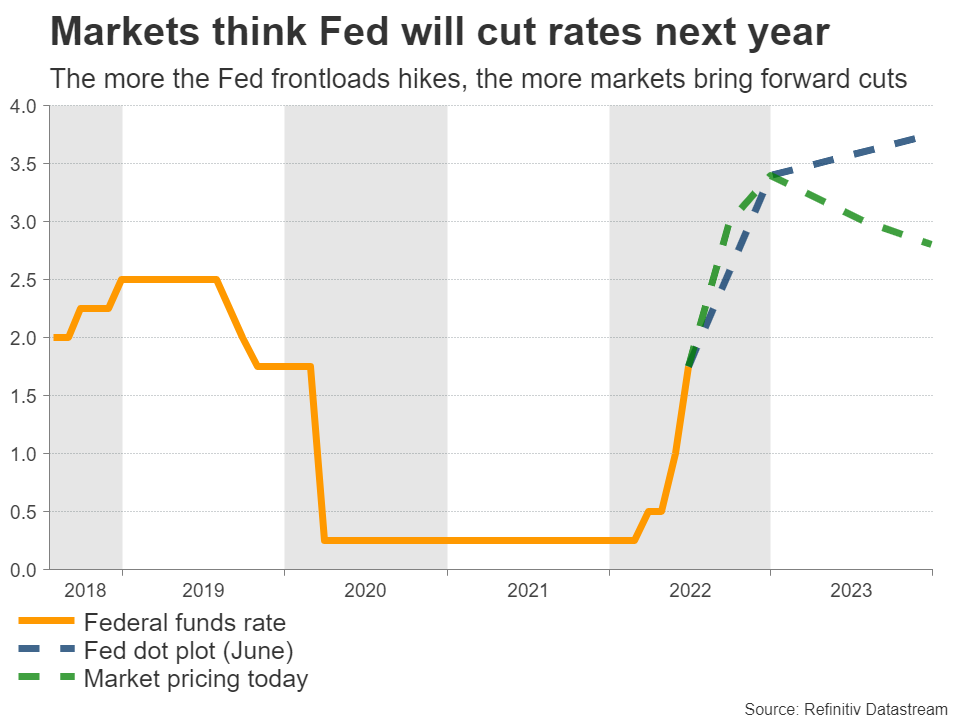
We’ll find out whether the economy is already in recession on Thursday, when the preliminary GDP numbers for Q2 are released. The economy contracted last quarter and another negative print would meet the definition of a technical recession. Wall Street economists expect a positive number, while in contrast, the Atlanta Fed GDPNow model points to a 1.6% decline.
As for the dollar, it has gone on a rampage lately, obliterating every other major currency. The greenback finds itself in a unique position, able to benefit both from nerves around a global recession and from concerns that rampant inflation could keep the Fed on its warpath. It has been the ultimate all-weather currency and this dynamic is unlikely to change until the growth outlook for the rest of the world improves.
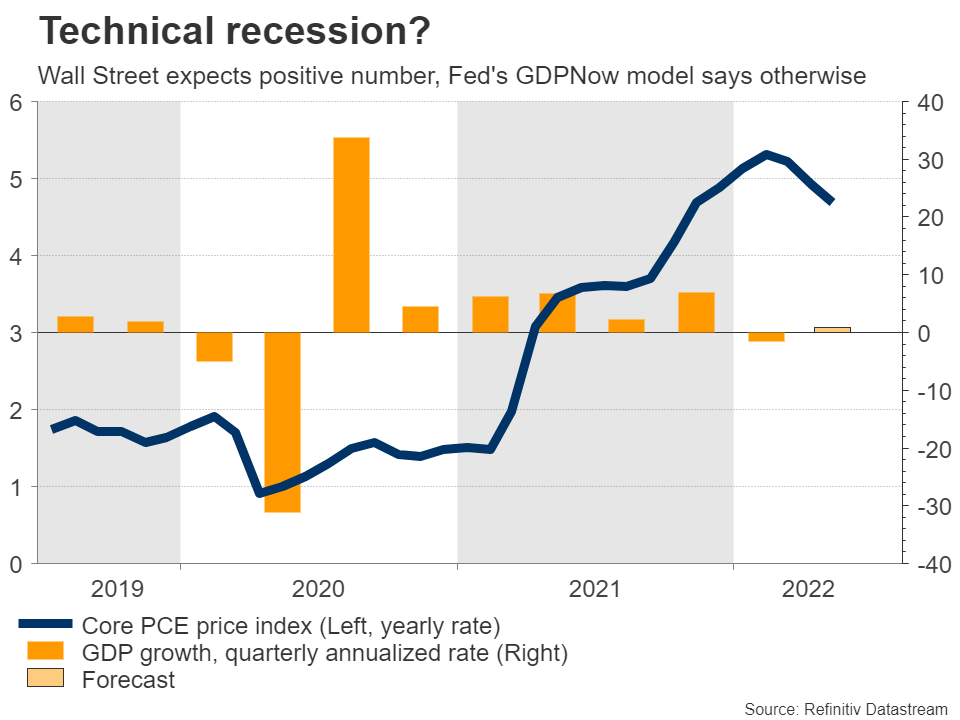
There’s also a flurry of data releases scheduled for Friday, including the core PCE price index.
Euro on shaky legs
Across the Atlantic ocean, the Eurozone’s inflation stats for July will hit the markets on Friday, alongside the first estimate of GDP for Q2. The European Central Bank raised interest rates by more than expected this week, and still the euro could not muster enough strength to rally.
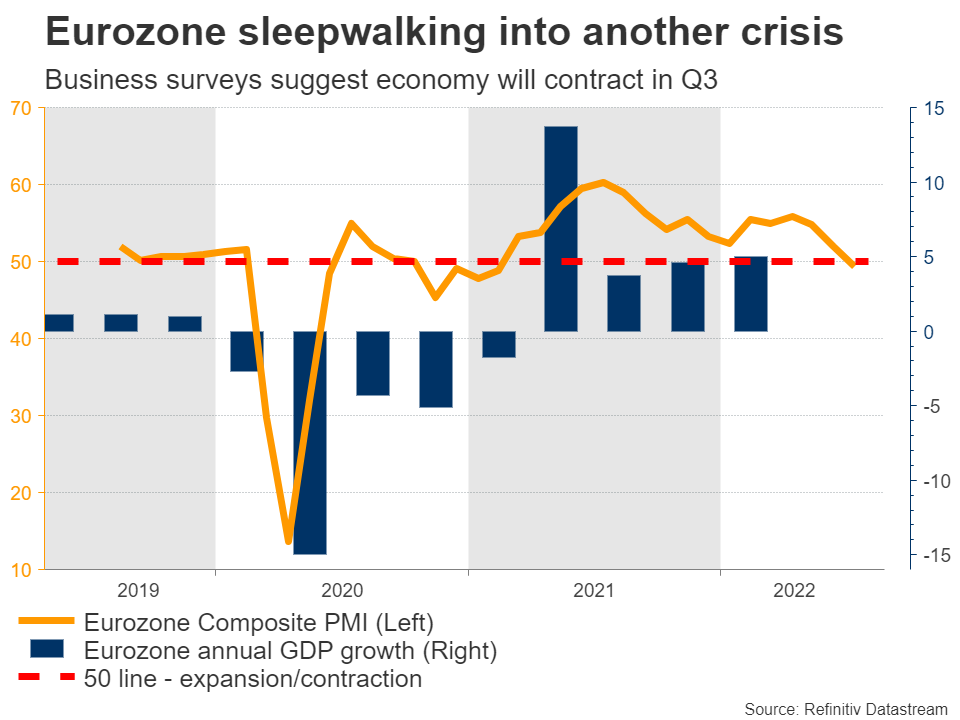
The euro’s nightmare keeps getting worse as the energy crisis has put the squeeze on consumers and higher borrowing costs will only add to recessionary risks. Traders have started to sense that Europe will be at the epicenter of any global recession, and the latest business surveys unfortunately confirm that.
New business orders have been falling for three months now and the rate of loss has accelerated lately, which suggests the Eurozone economy is likely to contract in the third quarter. On top of everything, political risks are back on the menu with a leadership crisis brewing in Italy.
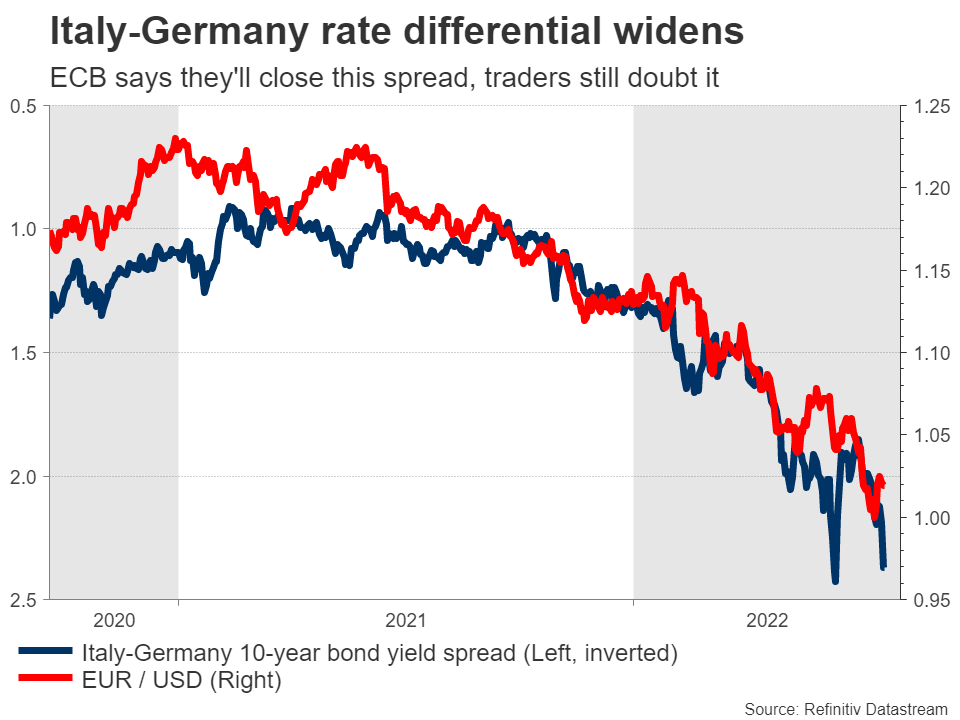
Mario Draghi’s government has collapsed and the nation is headed for early elections in September. Opinion polls suggest a coalition of Eurosceptic far-right forces will be victorious, which could reignite fears around a sovereign debt crisis in an economy where public debt is running at 150% of GDP, testing the power of the ECB’s new anti-fragmentation tool.
Yen awaits key data
The Bank of Japan kept its foot heavy on the gas this week, in contrast to every other major central bank. With core inflation still muted, Governor Kuroda played down the prospect of any tightening, even going as far as saying that raising rates a little wouldn’t stop the yen’s weakness.
It would certainly help though. The two culprits behind the yen’s collapse have been widening interest rate differentials because of the BoJ’s refusal to adjust policy and the loss of Japan’s trade surplus because of soaring energy prices. Hence, those factors need to change before the yen finds a bottom. Alternatively, if foreign central banks stop raising rates, that could also do the trick.
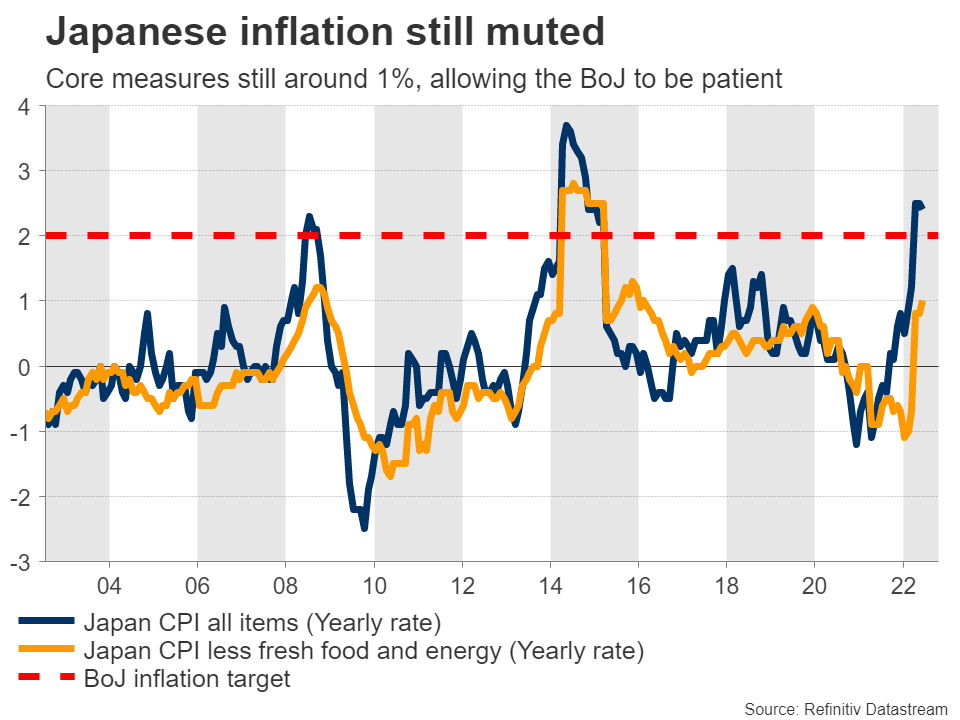
Despite all the rhetoric, the BoJ seems to be headed for a pivot, perhaps in September. Kuroda was trying a shock-and-awe therapy to lift inflation expectations in Japan and kickstart the economy, but devaluing the yen any further won’t help. An extremely weak currency is counterproductive if you import more than you export.
The inflation data for Tokyo that are due out on Friday will be a key piece of this puzzle, alongside the latest jobs report and retail sales.
Finally, Australia’s inflation numbers for Q2 will also be released on Wednesday.
GBP/USD: Cable Remains Entrenched Within a Range and Awaiting Fresh Direction Signal
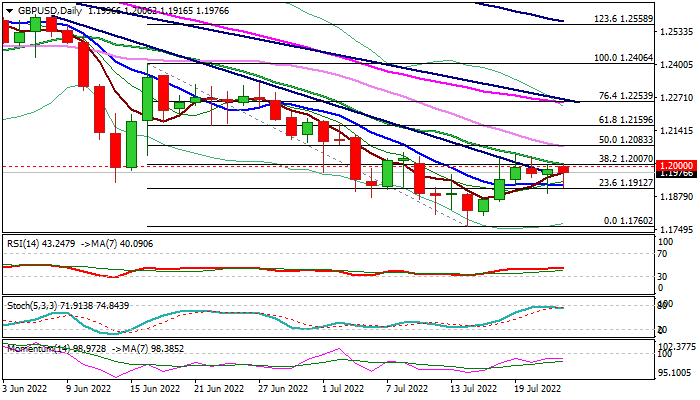
Cable extends directionless mode into fourth straight day, trading between 10DMA (1.1923) which offers solid support and strong barriers at 1.20 zone (psychological / falling 20DMA / Fibo 38.2% of 1.2406/1.1760 bear-leg.
Pound benefited from stronger than expected UK PMI data, but remains weighed by weaker Euro on downbeat EU PMI’s and also by a new legal procedure the European commission launched against Britain over some rules governing post-Brexit trading arrangements for Northern Ireland.
Technical studies on daily chart remain bearishly aligned and maintain pressure, with weekly close below 1.20 barrier to add to negative signals, though only sustained break below 10DMA would confirm recovery stall and shift near-term focus lower.
Res: 1.2000; 1.2007; 1.2045; 1.2083.
Sup: 1.1923; 1.1890; 1.1861; 1.1804.
EUR/USD: Euro Eyes Direction Signals from Fed
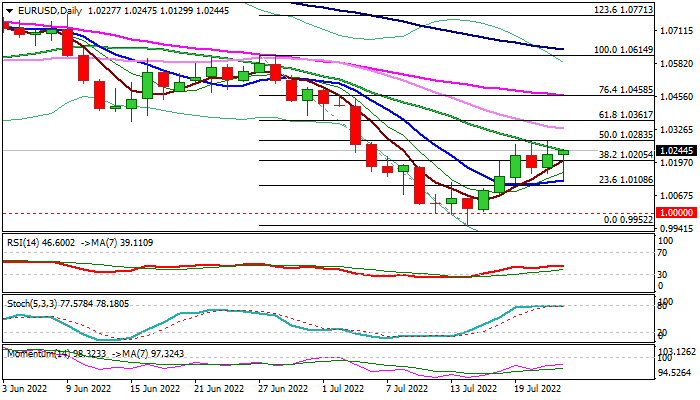
The Euro recovers from today’s drop, with minor impact from weak EU PMI numbers that add to concerns about contraction in the third quarter but lacking direction for the third quarter.
The single currency also failed to benefit more from ECB’s 0.5% rate hike (vs 0.25% forecast), though the ECB’s action keep the Euro inflated and preventing deeper fall for now, despite concerns about economic slowdown and darkened outlook.
Near-term action is moving between daily Tenkan-sen (1.0115) and Kijun-sen (1.0283) which mark pivotal points and break of either would signal fresh direction.
Traders await Fed’s decision next week, with initial euphoria about a jumbo 1% hike being cooled by some policymakers, keeping in play expected 0.75% that may disappoint those who expected more hawkish stance and possibly negatively influence the dollar.
Technical studies are mainly bearish, though formation of bullish engulfing pattern on weekly chart may offer fresh support to Euro
Res: 1.0283; 1.0330; 1.0361; 1.0400.
Sup: 1.0205; 1.0153; 1.0115; 1.0078.
Canada: Retail Sales Surge in May Lifted by Higher Prices
Retail sales rose by a hefty 2.2% month-over-month (m/m) in May, ahead of Statistics Canada's preliminary estimate for a 1.6% gain. Prices played an outsized role, as a result, the upturn was much softer in inflation-adjusted terms, with the monthly volume of sales up just 0.4% on the month.
Statistics Canada's flash estimate for June points to a modest 0.3% increase.
Sales were up in every province, with notable gains in Quebec (+3.4%), Manitoba (+4.9%), Nova Scotia (+2.0%), and New Brunswick (+2.9%). Gains were more moderate in Ontario (+1.9%), Alberta (+1.9%), Saskatchewan (+0.9%), and British Columbia (+1.3%).
The headline in May was boosted by higher sales at gasoline stations and motor vehicle and parts dealers. Receipts at gasoline stations surged 9.2% m/m on the back of much higher gas prices. Adjusted for the price effect, gasoline sales actually fell by 2.2% in volume terms. Sales at motor vehicle and parts dealers rose by 3.3% on the month, increasing for the first time since January.
Core sales, which exclude autos and gasoline, rose for the fifth consecutive month, but increased more modestly than the headline (+0.6% m/m).
- Sales rose at food and beverage stores (+1.9), health & personal care stores (+1.6%), and clothing & accessories stores (+1.3%). Sales of clothes & accessories were up 81.3% from the year ago as consumers resumed pre-pandemic lifestyles and looked to upgrade their wardrobes. Sales were also higher at general merchandise stores (+1.4%), but fell at miscellaneous store retailers (-6.7%).
- Sales pulled back in the housing-related categories, such as building materials & garden equipment (-1.7%) and furniture & home furnishings (-0.4%). Sales of electronics & appliances were flat on the month.
- E-commerce sales eased by 2.9% in May, and were down 23.5% compared to a year-ago as consumers returned to in-person shopping.
Key Implications
Retail sales advanced at a strong pace in May. But all that glitters is not gold. Much of the gain in May is due to higher prices, particularly at the pump, and a recovery in auto sales following three months of decline. While overall sales increased in volume terms, at 0.4% m/m, the gain was relatively modest. As we dig deeper, a number of categories, such as gasoline, clothing and sporting goods, actually saw sales fall in inflation-adjusted terms.
With inflation running at a multi-decade high, higher prices have been giving a lift to nominal retail sales figures. As such, it's becoming increasingly important to look at spending in real or inflation-adjusted terms. While in nominal terms retail sales are up 14% from a year ago, the volume of sales is up just 5.8%.
Oil and other commodity prices have eased in recent weeks, and the recent CPI data revealed that monthly increases in inflation are moderating. Still, inflation is expected to remain elevated on a year-over-year basis through 2022. This means that the Bank of Canada will continue taking policy rate higher when it meets again in September.
We expect that the overall consumer spending will hold up reasonably well through the summer months, as strong spending on experiences offsets reduced spending on physical goods. However, we expect that consumer spending will slow in late 2022 and into 2023, as higher interest rates alongside slowing labour and housing markets will lead consumers to tighten the purse strings.