

Sample Category Title
EUR/GBP Daily Outlook
Daily Pivots: (S1) 0.8485; (P) 0.8535; (R1) 0.8576; More...
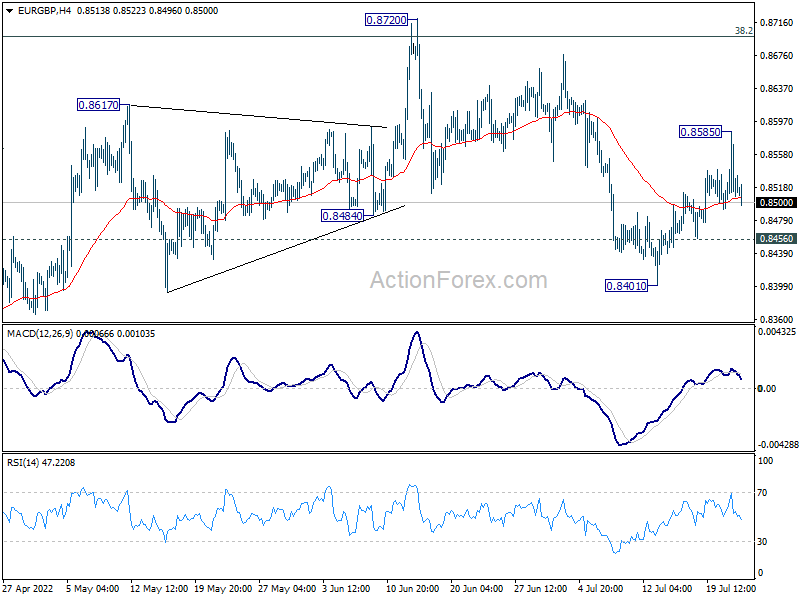
EUR/GBP retreated after hitting 0.8585 and intraday bias is turned neutral again. Further rise will remain mildly in favor as long as 0.8456 minor support holds. Above 0.8585 will target a retest on 0.8720 resistance. However, break of 0.8456 should resume the fall from 0.8720 through 0.8401.
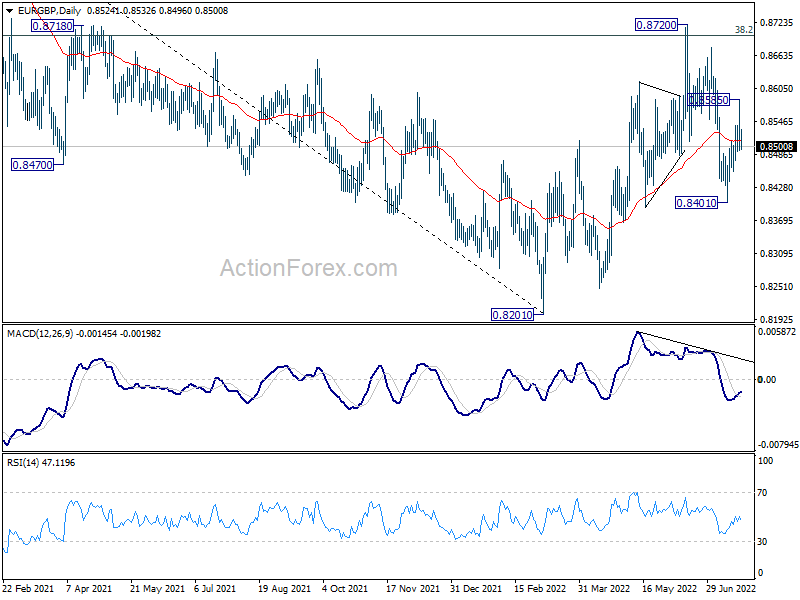
In the bigger picture, attention remains on 38.2% retracement of 0.9499 to 0.8201 at 0.8697. Sustained break there will affirm the case that rise from 0.8201 is a medium term up trend itself. Further rally would then be seen to 61.8% retracement at 0.9003. However, rejection by 0.8697 will confirm medium term bearishness for another fall through 0.8201.
EUR/AUD Daily Outlook
Daily Pivots: (S1) 1.4691; (P) 1.4801; (R1) 1.4858; More...
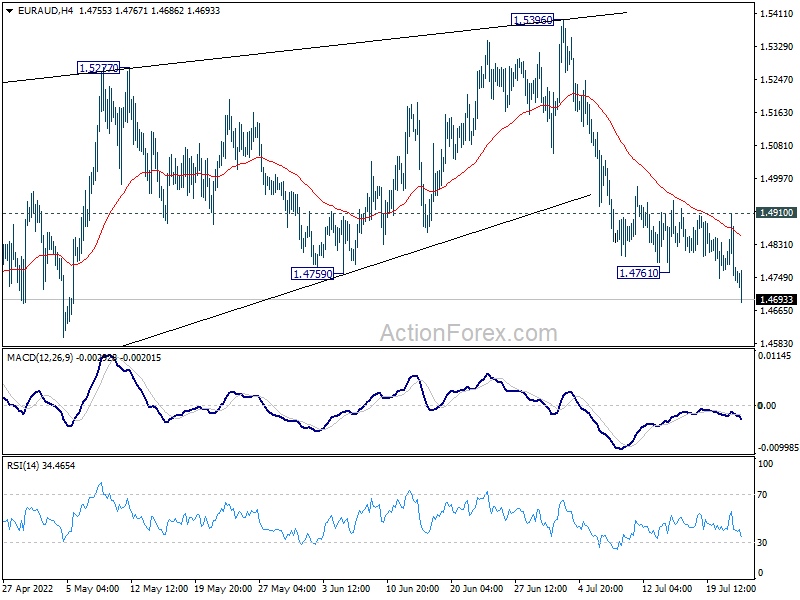
EUR/AUD's fall from 1.5396 resumes and hits as low as 1.4686 so far. Corrective rise form 1.4318 should have completed at 1.5396, after rejection by 1.5354 support turned resistance. Intraday bias is back on the downside for retesting 1.418 low. On the upside, above 1.4910 minor resistance will turn intraday bias neutral first.
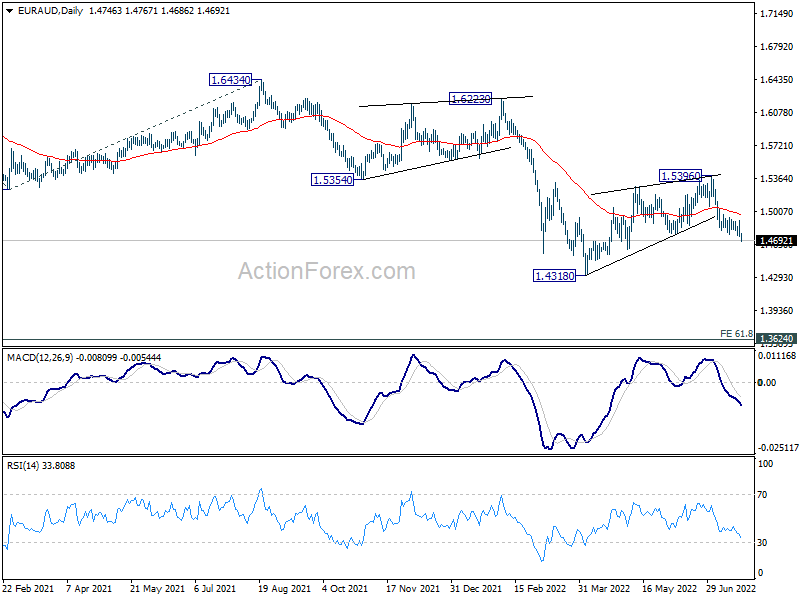
In the bigger picture, rejection by 1.5354 support turned resistance, as well as 55 week EMA (now at 1.5378), maintain medium term bearishness. That is, larger down trend from 1.9799 is not completed yet. Break of 1.4318 low will target 61.8% projection of 1.9799 to 1.5250 from 1.6434 at 1.3623, which is close to 1.3624 long term support (2017 low). This will remain the favored case now as long as 1.5396 resistance holds.
EUR/CHF Daily Outlook
Daily Pivots: (S1) 0.9849; (P) 0.9900; (R1) 0.9936; More....
Intraday bias in EUR/CHF stays neutral at this point and outlook stays bearish with 0.9953 minor resistance intact. Firm break of 0.9084 low will resume larger down trend. next target is 0.9650 long term projection level. On the upside, however, break of 0.9953 minor resistance will suggest short term bottoming at 0.9804, on bullish convergence condition in 4 hour MACD. Intraday bias will be back on the upside for 55 day EMA (now at 1.0108).
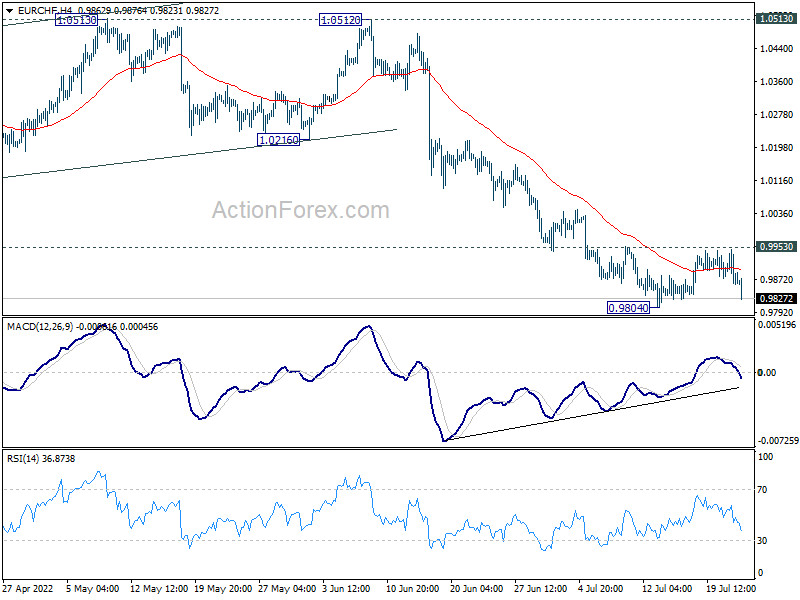
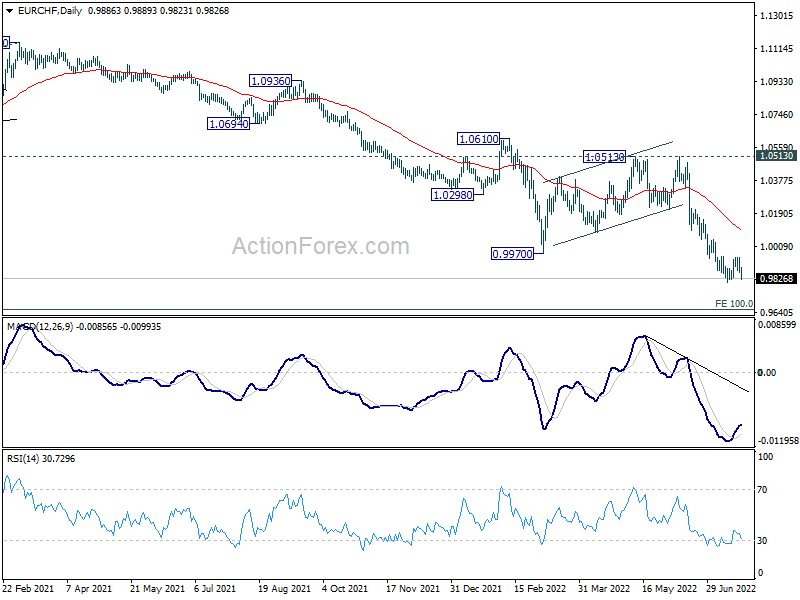
In the bigger picture,long term down trend from 1.2004 (2018 high) is expected to target 100% projection of 1.2004 to 1.0505 to 1.1149 at 0.9650. On the upside, break of 1.0513 resistance is needed to indicate medium term bottoming. Otherwise, outlook will stay bearish in case of strong rebound.
USD/CAD Daily Outlook
Daily Pivots: (S1) 1.2838; (P) 1.2887; (R1) 1.2915; More...
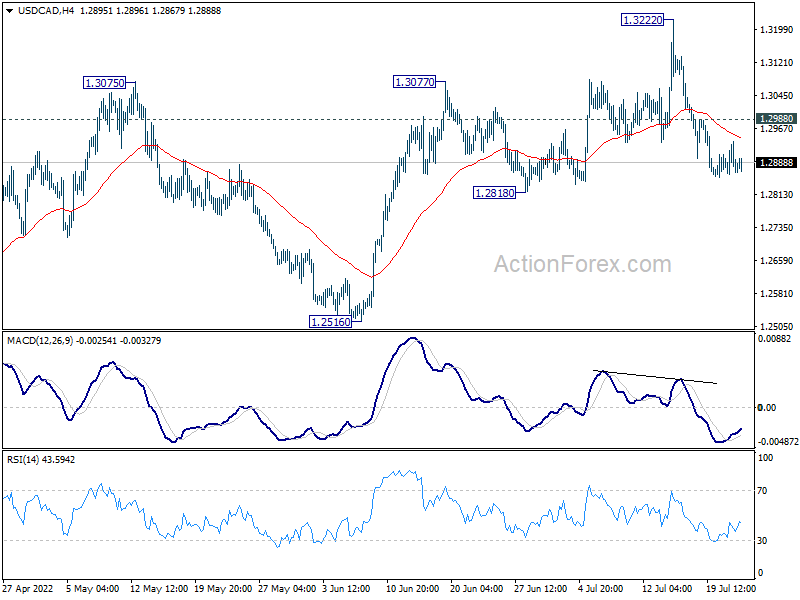
USD/CAD is losing some downside momentum as seen in 4 hour MACD. But further decline is expected with 1.2988 minor resistance intact. On the downside, break of 1.2818 support will bring deeper fall back to 1.2516 key support. On the upside, above 1.2988 minor resistance will turn bias back to the upside for retesting 1.3222 instead.
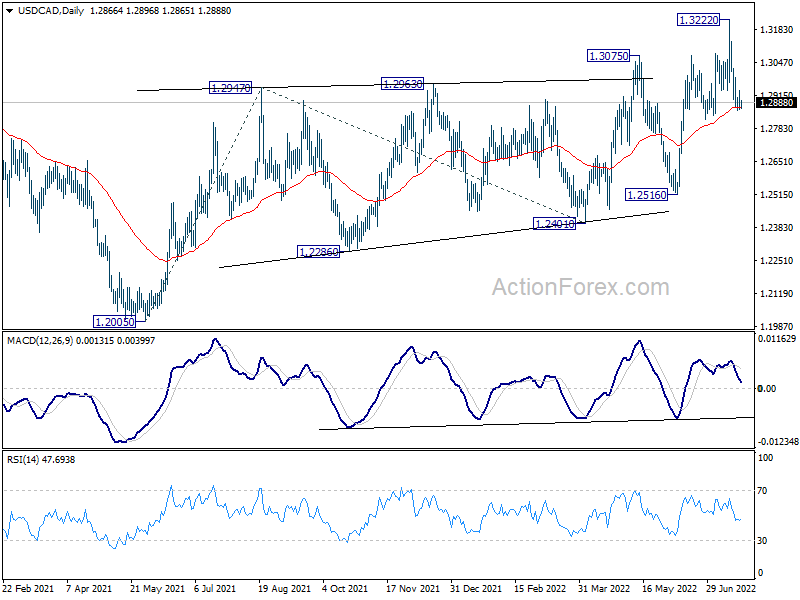
In the bigger picture, down trend from 1.4667 (2020 high) should have completed at 1.2005, after defending 1.2061 long term cluster support. Rise from there should target 61.8% retracement of 1.4667 to 1.2005 (2021 low) at 1.3650. This will remain the favored case now as long as 1.2516 support holds.
AUD/USD Daily Report
Daily Pivots: (S1) 0.6884; (P) 0.6910; (R1) 0.6962; More...
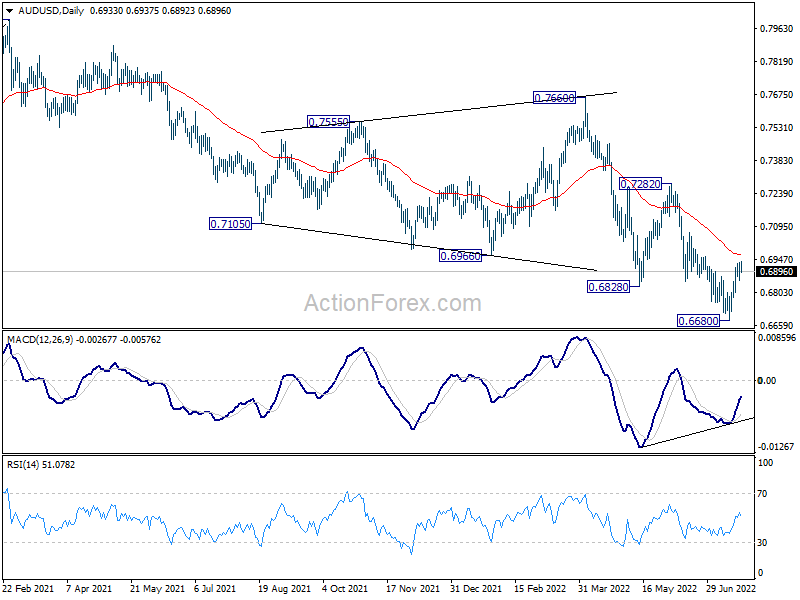
AUD/USD retreated quickly after edging higher to 0.6937. Intraday bias remains neutral first. On the upside, above 0.6937 will resume the rebound from 0.6680 to 55 day EMA (now at 0.6967). Sustained break there will target 0.7282 structural resistance next. On the downside, however, below 0.6801 minor support will turn bias back to the downside for retesting 0.6680 low instead.
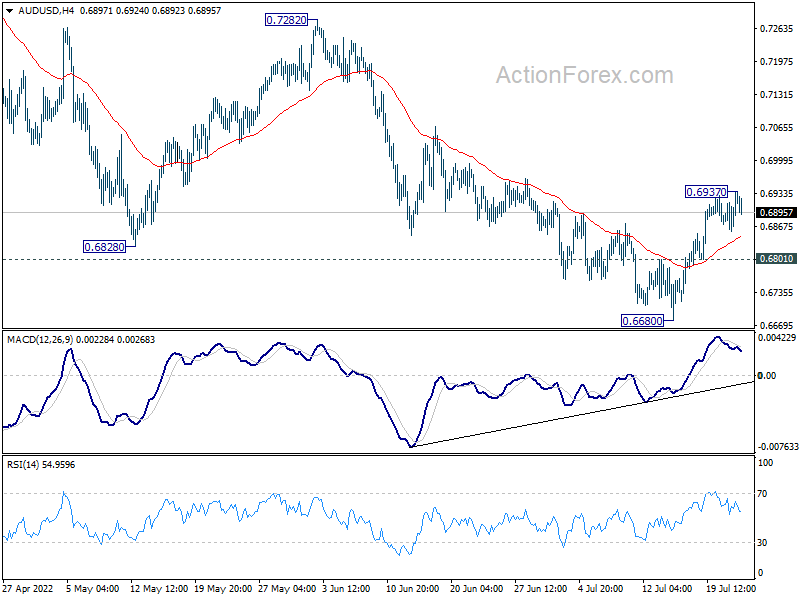
In the bigger picture, price actions from 0.8006 could still be a corrective pattern to rise from 0.5506 (2020 low). But current downside acceleration is raising the chance that it's a bearish impulsive move. In either case, outlook will remain bearish as long as 0.7282 resistance holds. Next target is 61.8% retracement of 0.5506 to 0.8006 at 0.6461.
USD/JPY Daily Outlook
Daily Pivots: (S1) 136.81; (P) 137.84; (R1) 138.39; More...
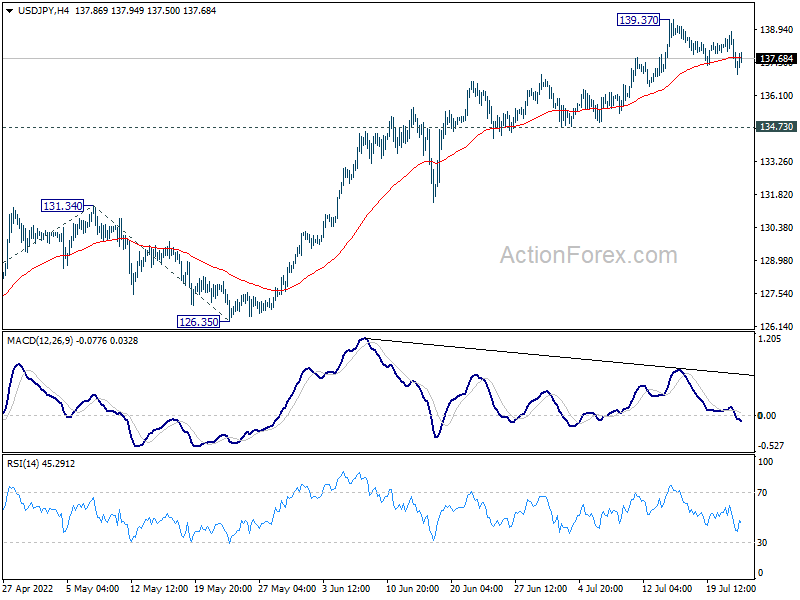
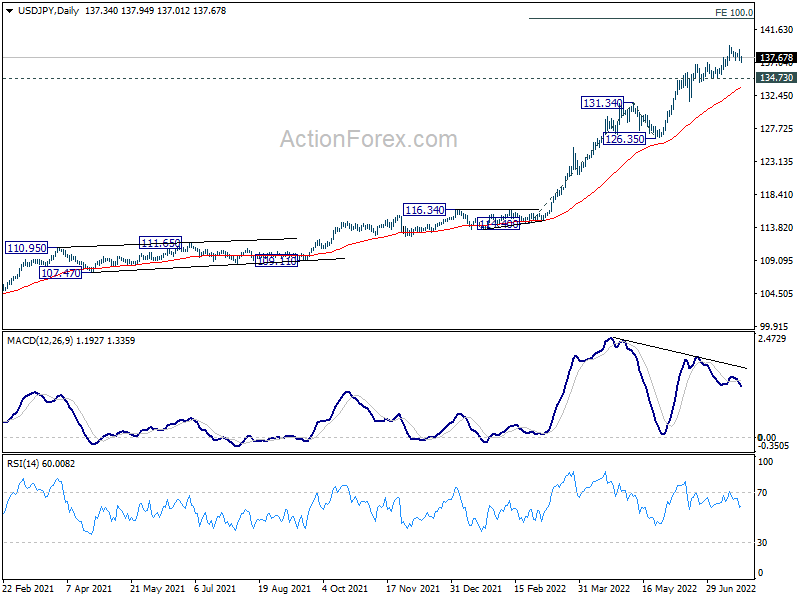
USD/JPY's correction from 139.37 is still in progress and intraday bias remains neutral first. Downside of retreat should be contained by 134.73 support. On the upside, break of 139.37 will resume larger up trend to 100% projection of 114.40 to 131.34 from 126.35 at 143.29.
In the bigger picture, current rally is seen as part of the long term up trend from 75.56 (2011 low). Next target is 100% projection of 75.56 (2011 low) to 125.85 (2015 high) from 98.97 at 149.26, which is close to 147.68 (1998 high). This will remain the favored case as long as 126.35 support holds.
USD/CHF Daily Outlook
Daily Pivots: (S1) 0.9641; (P) 0.9690; (R1) 0.9716; More...
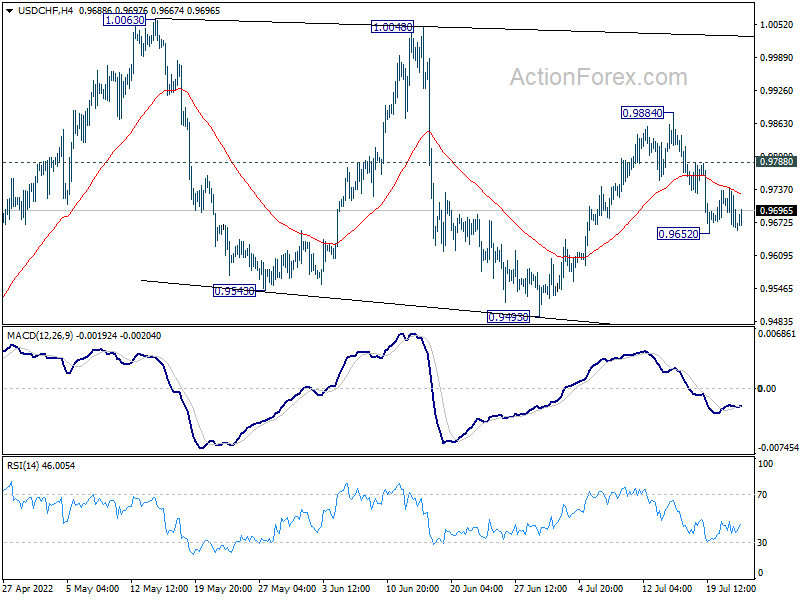
Intraday bias in USD/CHF stays neutral at this point. Fall from 0.9884 is seen as a falling leg of the consolidation from 1.0063. Below 0.9652 will target 0.9493 support. On the upside, though, above 0.9788 minor resistance will turn bias back to the upside for 0.9884 resistance.
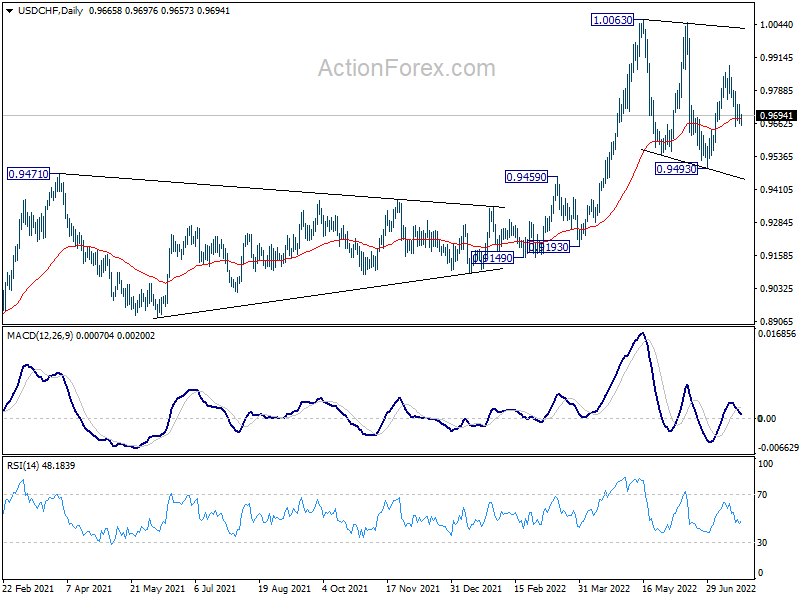
In the bigger picture, medium term up trend from 0.8756 (2021 low) is still in progress. Next target is 1.0342 (2016 high). Sustained break there will resume long term up trend from 0.7065 (2011 low). This will remain the favored case as long as 0.9471 resistance turned support holds.
GBP/USD Daily Outlook
Daily Pivots: (S1) 1.1926; (P) 1.1965; (R1) 1.2040; More...
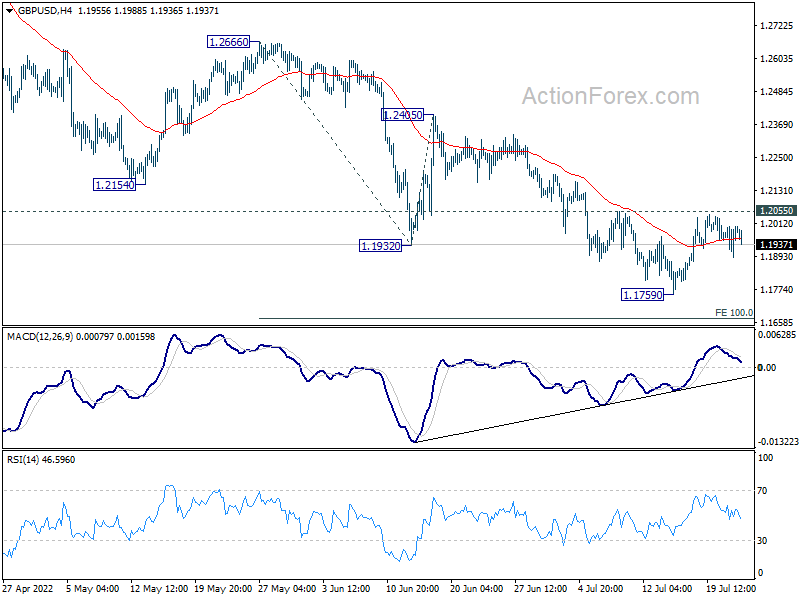
Intraday bias in GBP/USD stays neutral as range trading continues. On the downside, break of 1.1759 low will resume larger down trend. Next target is 100% projection of 1.2666 to 1.1932 from 1.2405 at 1.1671. On the upside, firm break of 1.2055 minor resistance will confirm short term bottoming at 1.1759. Bias will be turned back to the upside for 1.2405 resistance next.
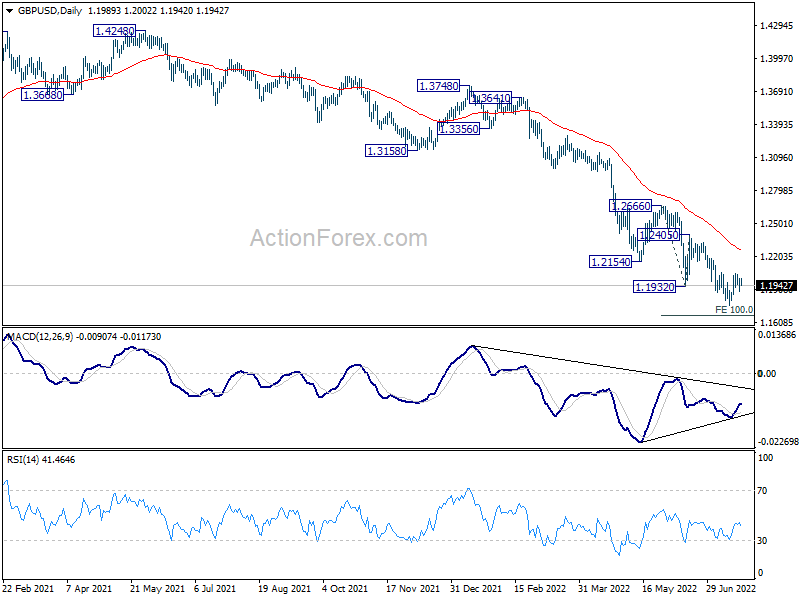
In the bigger picture, fall from 1.4248 (2018 high) could be a leg inside the pattern from 1.1409 (2020 low), or resuming the longer term down trend. Deeper decline is expected as long as 1.2666 resistance holds. Next target is 1.1409 low. However, firm break of 1.2666 will bring stronger rise back to 55 week EMA (now at 1.3065).
Cliff Notes: Inflation Still of Paramount Concern as Risks to Activity Build
Key insights from the week that was.
In Australia and abroad, it was a quiet week for data, keeping the focus on monetary policy.
At home, the July RBA minutes and speeches by RBA Governor Lowe and Deputy Governor Bullock made clear there is more work to do to contain inflation and related risks. The minutes of the July meeting showed little debate over the choice between a 25bp or 50bp hike, with the latter seen as appropriate given “the level of interest rates was still very low for an economy with a tight labour market and facing a period of higher inflation”. “Members [also] agreed that the outlook for domestic economic activity had [only] eased a little.” Consumption is to be carefully monitored given the sharp drop in consumer confidence in recent months, but the strength of the labour market; accumulated savings; and the still–elevated level of the savings rate give cause for a sanguine baseline view for near–term spending. The strong financial position of Australian households was further elaborated on by Deputy Governor Bullock in her speech.
The July minutes also noted that “the current level of the cash rate is well below the lower range of estimates for the nominal neutral rate” albeit without giving clarity on what level was seen as neutral. Governor Lowe subsequently provided further detail, outlining in his speech that “most approaches [to modelling neutral] suggest that the neutral real rate for Australia is at least positive” and so, assuming inflation averages 2.5%yr over time, “the neutral nominal rate is at least 2½ per cent”.
Following the above RBA comments and last week’s labour force survey, Chief Economist Bill Evans today unveiled revisions to our forecasts for 2022–2024. With the RBA perceiving neutral as “at least” 2.5%, the labour market historically tight and inflation risks material, we now forecast 50bp increases in August and September to be followed by 25bp increases each month until February 2023 to a peak cash rate of 3.35%. While this course will, in time, bring inflation back to target, there will also be a significant cost for growth and the labour market. In 2023 and 2024, GDP growth is now forecast to be 1.0% and 2.0% (previously 2.0% and 2.5%) while the unemployment rate is projected to rise by 2ppts to around 5.0% end–2024. Rate cuts in 2024 should subsequently stabilise the economy and also the housing market, the latter after a circa 16% peak–to–trough decline through 2022 and 2023.
Further emphasising a need for careful monitoring of inflation pressures in the antipodes, New Zealand’s Q2 CPI came in ahead of expectations at 1.7%/7.3%yr as a result of supply–side factors and tight domestic capacity. While our New Zealand team expect Q2 to prove the peak period for CPI inflation, they do not expect to see annual inflation back within the RBNZ’s target range until the middle of 2023 – at the earliest. However, with the RBNZ’s tightening cycle already well advanced, much of the inflation seen to date coming from offshore, and early signs that the domestic economy is cooling, our New Zealand team continue to believe a 50bp hike in August followed by two additional 25bp increases will close out this tightening cycle at 3.50% in November. That said, ahead of the August meeting, it will be important to monitor the next round of labour market outcomes to assess upside risks emanating from domestic factors.
Australia’s Q2 CPI report is due next week; a headline outcome similar to that seen in New Zealand is anticipated.
The long–awaited July ECB meeting also delivered a hawkish surprise this week, with the Governing Council deciding to lift all of their key rates by 50bps after previously telegraphing a 25bp first move. Underlying this decision were concerns around the inflation outlook (headline 8.6%yr; core 3.7%yr) and inflation expectations despite the latter presently being well anchored. As with many central banks across the developed world, the ECB’s front–loaded start to this tightening cycle is a clear indication of their commitment to return inflation back to their medium–term target of 2%.
The economic impact of the ECB’s rate hike is expected to be cushioned by the introduction of a new tool to manage fragmentation risks. The Transmission Protection Instrument (TPI) will provide unrestricted support through purchasing government debt securities in markets where uneven monetary policy transmission is present, with some room to consider corporate debt if need be. Until its activation, the ECB will continue to employ ongoing reinvestments of proceeds from maturing securities in a flexible manner across Euro Area rate markets.
On the broader outlook, the ECB seemed quite sanguine given the strength of the labour market and the reopening; however, they acknowledged considerable uncertainty clouds the outlook. Russia’s invasion of Ukraine hit confidence hard and materially weakened growth prospects, while tighter lending standards already look to be impacting households and businesses. Still, the inflation challenge remains the clear focus; hence we still expect the ECB to raise the main refinancing rate by 50bp in September and to a year–end peak of 1.50%.
Turning then to the US. While profit reporting season provided many positive surprises for the market this week, economic updates disappointed yet again. Existing home sales fell over 5% in June as affordability and market supply continued to restrict activity; and housing starts fell another 3% after a near 12% fall in May. Received last Friday, though retail sales marginally beat expectations in June, adjusted for inflation, activity in the sector fell again, increasing the odds of a second consecutive quarter of negative GDP growth in Q2. As we continue to emphasise, the key risk for the US is not a technical recession but rather a prolonged period of stagnation, impacting activity and employment outcomes into the medium–term. Increasingly this risk is set to weigh on US term interest rates and the dollar; if a further deterioration in conditions is seen in coming months, either or both of the last two hikes we forecast for the FOMC this cycle could also come up for renewed debate.
Finally to China. Late last week we received Q2 GDP and the final partial data for June. While the market received the large negative outcome for Q2 GDP it was anticipating, the key partial data was constructive on growth prospects into year end and for 2023. Notably, despite the heavy burden of COVID–zero restrictions through Q2, nominal fixed asset investment growth sustained above 6% year–to–date throughout Q2. The trade surplus also continued to print successive highs during the quarter as exports grew strongly and imports growth slipped. Heading into Q3, retail also looks to have momentum, annual growth having recovered from –11% in April, when COVID–zero policies were in full effect, to +3% by June. The Q2 GDP outcome likely rules out authorities’ 5.5% growth ambition being achieved on a year–average basis in 2022, but it can still be seen through the year to December as long as the economy is able to rebound without restriction during the second half. A similar annual gain through 2023 would see year–average growth for 2023 at 7.0% after a 3.5% gain in 2022.
ECB’s TPI isn’t ‘That’ Straightforward, and Snap Earnings Could Reverse Appetite in US Big Tech
The European Central Bank (ECB) rose its three policy rates by 50bp at yesterday’s monetary policy meeting, versus 25bp expected by analysts. But the ECB decision wasn’t a big surprise given that many investors were expecting to see the ECB to come up with a bigger rate hike after the EURUSD fell below parity last week.
Euro below parity against the US dollar makes things even more complicated for the ECB’s fight against inflation, and shifts the ECB’s rhetoric from Mario Draghi’s ‘whatever it takes’ to something like ‘whatever… we can’. Even Mario Draghi’s resignation, the dissolution of the Italian government and the spike in the Italian yields didn’t change the ECB’s decision. We saw a determined ECB to tame inflation down to the 2% policy target.
One of the major highlights of yesterday’s ECB decision was the anti-fragmentation tool, TPI, transmission protection instrument. The name is fancy but what it could do to help the ECB is unsure for now, as the eligibility to the TPI sounds complicated - so complicated in fact that during her press conference yesterday, Christine Lagarde repeated ‘no, no it’s not that complicated’ several times when she answered questions.
In… simple, there is a set of fiscal and macro conditions that will determine whether a euro zone country is eligible to the TPI program. However, the neediest economies may not be eligible due to fiscal and macroeconomic restrictions.
The complicated TPI tool is perhaps why the euro and the European stocks gave back the early gains yesterday. The EURUSD flirted with 1.0280 mark but is back below the 1.02 this morning. Investors will likely give the ECB the benefit of doubt, but the euro will remain under a meaningful negative pressure until we see the higher ECB rates translate into lower inflation.
With the ECB shifting to rate-tightening phase, we have no more than Switzerland and Japan left in the negative rate territory. The Swiss National Bank (SNB) already surprised the market with a 50bp hike in its last meeting and pledged to do more, but the Bank of Japan (BoJ) maintained its policy unchanged yesterday, and said it has ‘absolutely no plan’ to raise the interest rates. Happily, the US dollar was softer yesterday, so that the USDJPY remained capped around the 138 level. Yet, the divergence between a more hawkish shift worldwide, and the insistently dovish BoJ should continue playing against the yen in the medium run.
Summer vacation for the US stocks?
The US dollar was softer yesterday, and the barrel of American crude slipped again below the $100 mark. The idea that lower energy prices will ease the inflationary pressures gave an additional boost to the US stocks, even though the US jobless claims climbed to the highest levels since last November. If the jobless claims data is volatile, it’s also an early sign that a labour market shift could happen. Especially, when the data is combined to the latest news of jobs cuts.
After Apple earlier this week, Microsoft announced it will slow hiring in its security software unit and Azure cloud business in the foreseeable future. 7-Eleven also said it will cut around 880 jobs, and Snap announced it will slow its rate of hiring ‘substantially’, as well. Therefore, the next jobs figures may not be as enchanting as the latest ones. But for now, the US stocks extend recovery. The S&P500 gained 1% for the third straight day, as Nasdaq jumped 1.36%. The stronger-than-expected earnings from Netflix and Tesla helped improving the market mood this week. Tesla, for example, jumped near 10% posterior to earnings announcement.
Snap, however, hasn’t been that lucky, as its share price dived more than 26% in the afterhours trading after the company missed estimates on a major slowdown in the ad industry due to economic jitters. The Snap results came as a warning for other Big Tech names that rely on ad revenue. Therefore, FAANG stocks, which recovered to an almost 2-month high yesterday, may not extend gains to the weekly close as the latest Snap results could reverse appetite for at least a couple of them, including Google and Meta before the closing bell.