

Sample Category Title
GBP/USD Mid-Day Outlook
Daily Pivots: (S1) 1.1942; (P) 1.1990; (R1) 1.2027; More...
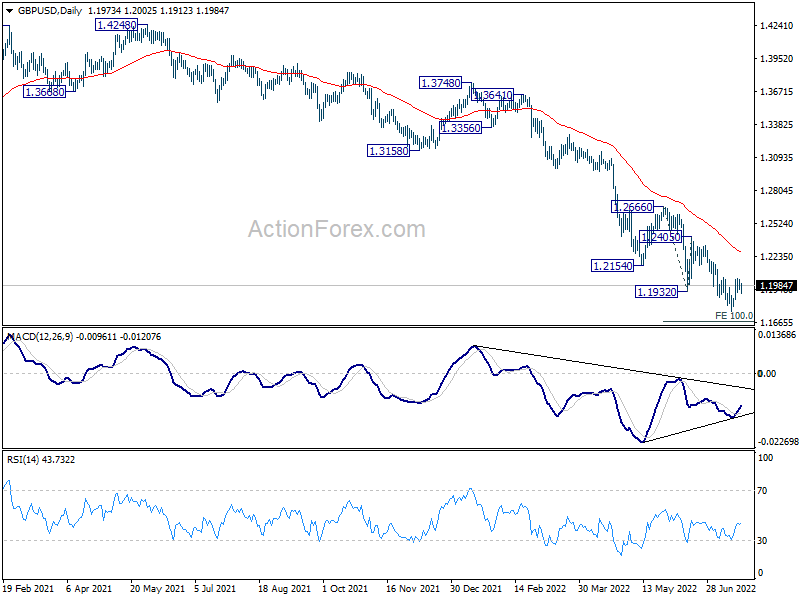
Range trading continues in GBP/USD and intraday bias remains neutral first. Focus remains on 1.2055 minor resistance. Firm break there will confirm short term bottoming at 1.1759. Bias will be turned back to the upside for 1.2405 resistance next. On the downside, below 1.1759 will resume larger down trend to 100% projection of 1.2666 to 1.1932 from 1.2405 at 1.1671.
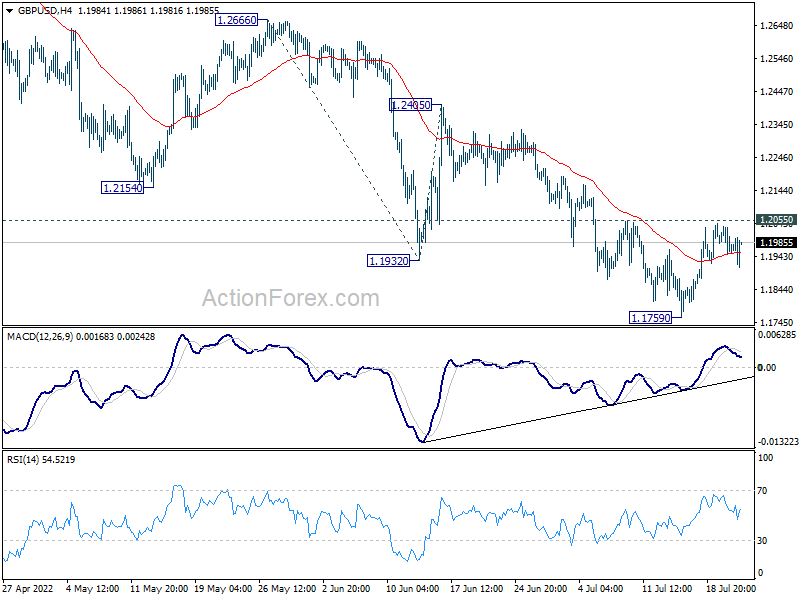
In the bigger picture, fall from 1.4248 (2018 high) could be a leg inside the pattern from 1.1409 (2020 low), or resuming the longer term down trend. Deeper decline is expected as long as 1.2666 resistance holds. Next target is 1.1409 low. However, firm break of 1.2666 will bring stronger rise back to 55 week EMA (now at 1.3065).
EUR/JPY Mid-Day Outlook
Daily Pivots: (S1) 140.15; (P) 141.04; (R1) 141.65; More....
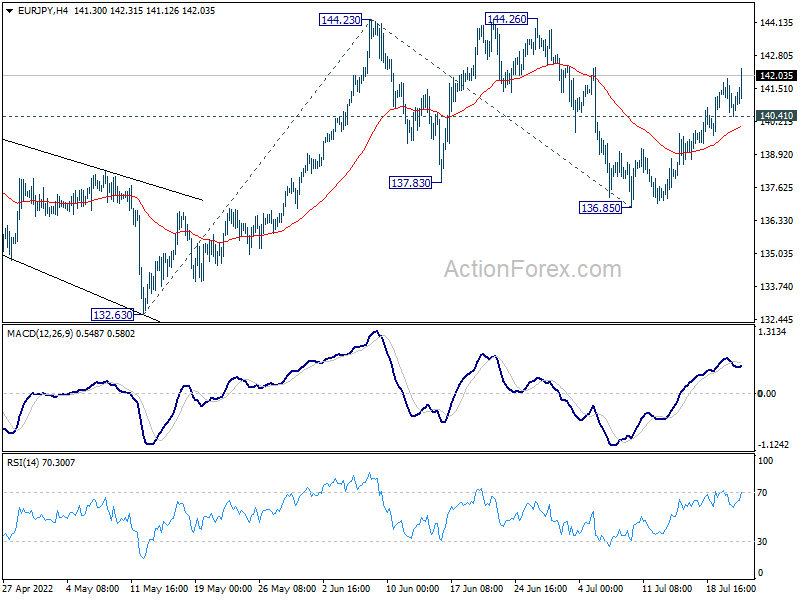
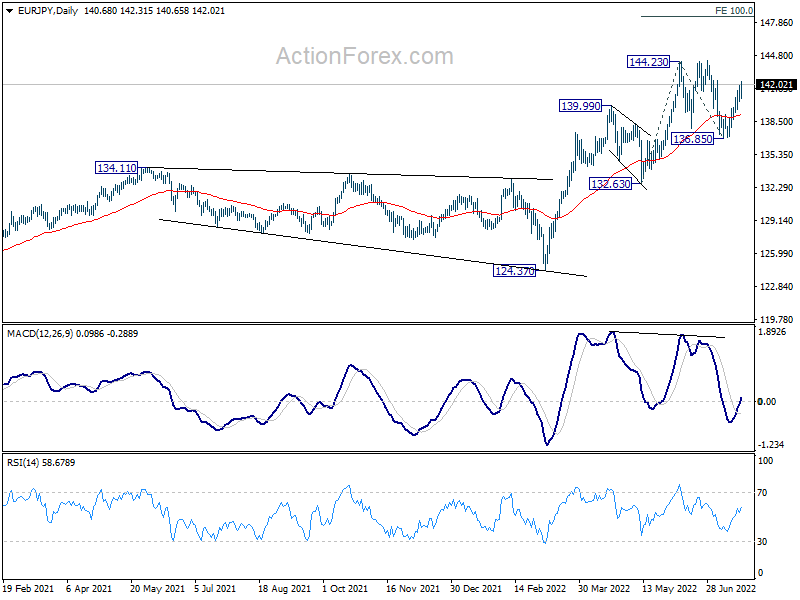
EUR/JPY's rally resumes after brief retreat and intraday bias stays on the upside. As noted before, consolidation pattern from 144.23 should have completed with three waves to 136.85. Further rally should be seen to retest 144.26 resistance first. Firm break there will resume larger up trend. Next target is 100% projection of 132.63 to 144.34 from 136.85 at 148.45. On the downside, below 140.41 minor support will dampen the bullish case and turn bias neutral first.
In the bigger picture, up trend from 114.42 (2020 low) is seen as the third leg of the pattern from 109.30 (2016 low). Further rally is in favor as long as 134.11 resistance turned support holds, even in case of deep pull back. Firm break of 139.78 will target 149.76 (2015 high). However, sustained break of 134.11 will be a sign of medium term bearish reversal and turn focus to 124.37 support for confirmation.
USD/JPY Mid-Day Outlook
Daily Pivots: (S1) 138.00; (P) 138.18; (R1) 138.47; More...
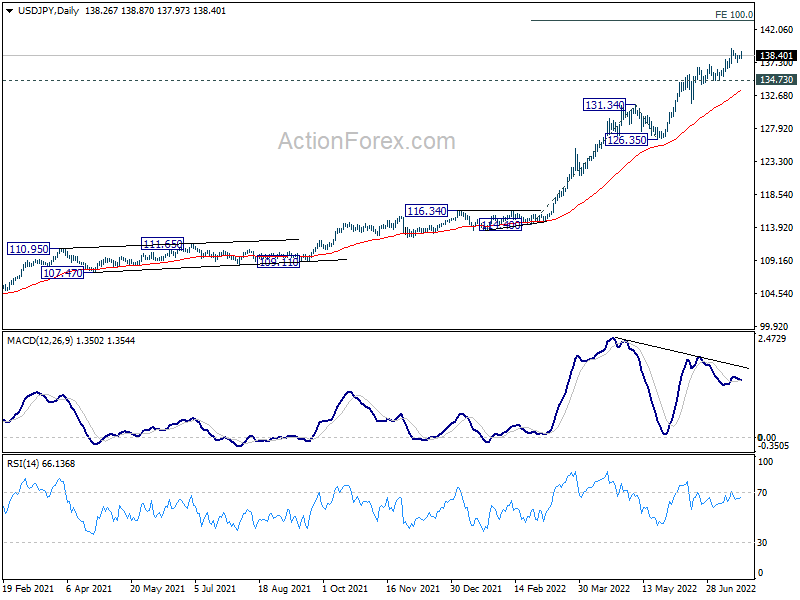
Intraday bias in USD/JPY remains neutral as consolidation from 139.37 is extending. Downside of retreat should be contained by 134.73 support. On the upside, break of 139.37 will resume larger up trend to 100% projection of 114.40 to 131.34 from 126.35 at 143.29.
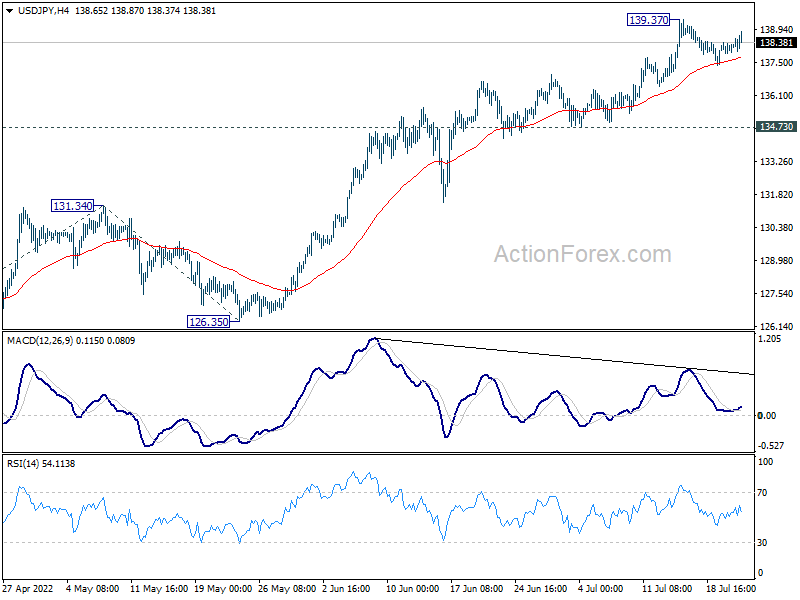
In the bigger picture, current rally is seen as part of the long term up trend from 75.56 (2011 low). Next target is 100% projection of 75.56 (2011 low) to 125.85 (2015 high) from 98.97 at 149.26, which is close to 147.68 (1998 high). This will remain the favored case as long as 126.35 support holds.
EUR/GBP Mid-Day Outlook
Daily Pivots: (S1) 0.8481; (P) 0.8510; (R1) 0.8528; More...
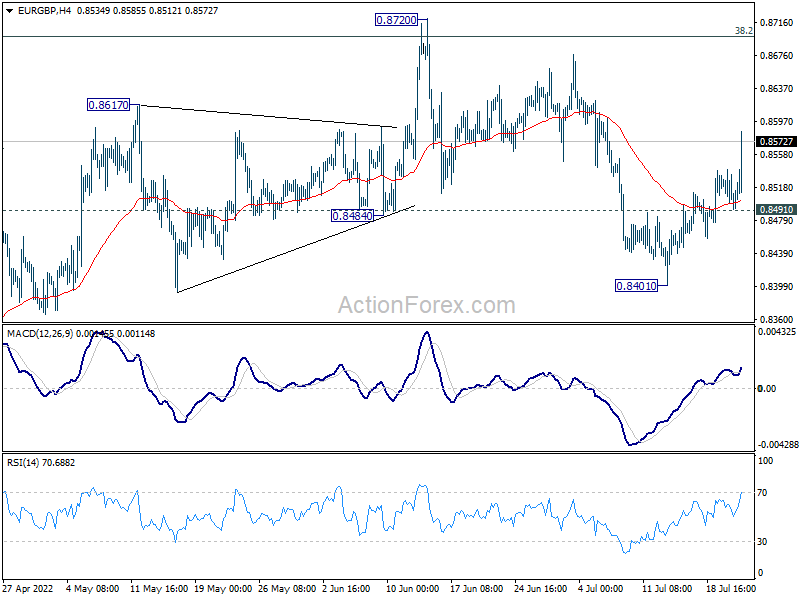
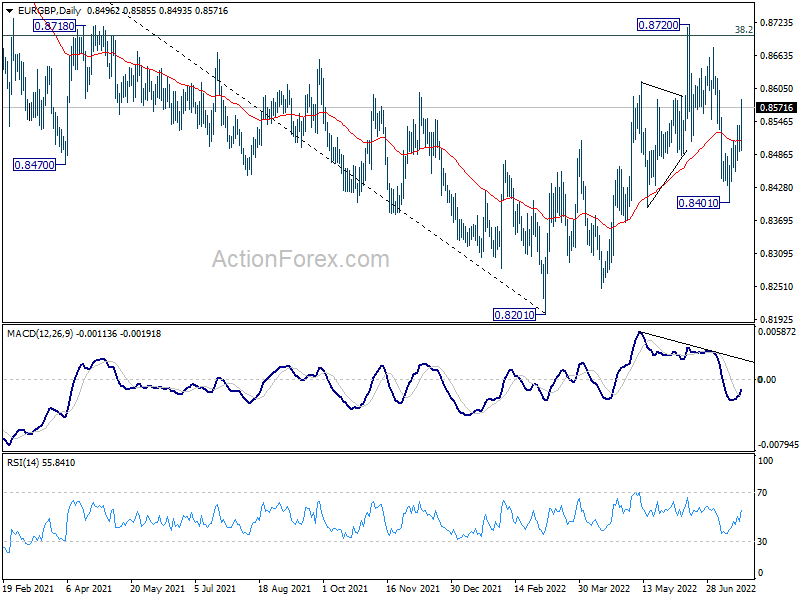
EUR/GBP's break of 0.8552 minor resistance argues that corrective fall from 0.8720 has completed at 0.8401. The development also revived near term bullishness. Intraday bias is back on the upside for retesting 0.8720 resistance first. Firm break there will resume larger rally from 0.8201. On the downside, below 0.8491 minor support will bring retest of 0.8401 support instead.
In the bigger picture, attention remains on 38.2% retracement of 0.9499 to 0.8201 at 0.8697. Sustained break there will affirm the case that rise from 0.8201 is a medium term up trend itself. Further rally would then be seen to 61.8% retracement at 0.9003. However, rejection by 0.8697 will confirm medium term bearishness for another fall through 0.8201.
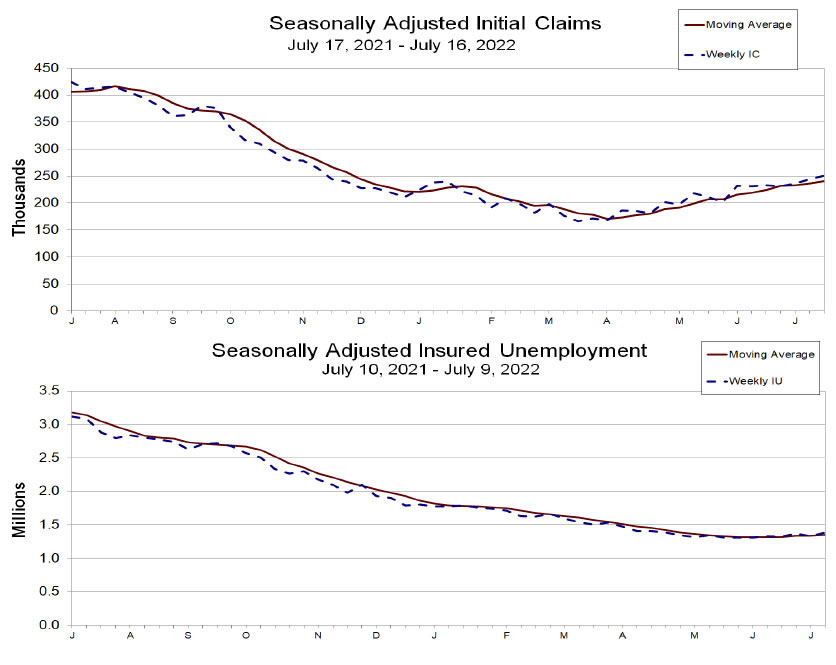
US initial jobless claims rose to 251k, continuing claims rose to 1.384m
US initial jobless claims rose 7k to 251k in the week ending July 16, above expectation of 240k. Four-week moving average of initial claims rose 4.5k to 240.5k.
Continuing claims rose 51k to 1384k in the week ending July 9. Four-week moving average of continuing claims rose 13k to 1353k.
ECB hikes 50bps, frontloading exit from negative deposit rate
ECB announced to raise the three key interest rates by 50bps today. The main refinancing operations and the interest rates on the marginal lending facility and the deposit facility will be increased to 0.50%, 0.75% and 0.00% respectively, with effect from 27 July 2022.
The "larger first step" in policy normalization was based on the "updated assessment of inflation risks and the reinforced support provided by the TPI for the effective transmission of monetary policy." The "frontloading" of exit from negative deposit rate " allows the Governing Council to make a transition to a meeting-by-meeting approach to interest rate decisions." Future policy path will continue to be "data-dependent".
Also, the Governing Council approved the Transmission Protection Instrument (TPI), to "ensure that the monetary policy stance is transmitted smoothly across all euro area countries".
(ECB) Monetary policy decisions
Today, in line with the Governing Council's strong commitment to its price stability mandate, the Governing Council took further key steps to make sure inflation returns to its 2% target over the medium term. The Governing Council decided to raise the three key ECB interest rates by 50 basis points and approved the Transmission Protection Instrument (TPI).
The Governing Council judged that it is appropriate to take a larger first step on its policy rate normalisation path than signalled at its previous meeting. This decision is based on the Governing Council's updated assessment of inflation risks and the reinforced support provided by the TPI for the effective transmission of monetary policy. It will support the return of inflation to the Governing Council's medium-term target by strengthening the anchoring of inflation expectations and by ensuring that demand conditions adjust to deliver its inflation target in the medium term.
At the Governing Council's upcoming meetings, further normalisation of interest rates will be appropriate. The frontloading today of the exit from negative interest rates allows the Governing Council to make a transition to a meeting-by-meeting approach to interest rate decisions. The Governing Council's future policy rate path will continue to be data-dependent and will help to deliver on its 2% inflation target over the medium term. In the context of its policy normalisation, the Governing Council will evaluate options for remunerating excess liquidity holdings.
The Governing Council assessed that the establishment of the TPI is necessary to support the effective transmission of monetary policy. In particular, as the Governing Council continues normalising monetary policy, the TPI will ensure that the monetary policy stance is transmitted smoothly across all euro area countries. The singleness of the Governing Council's monetary policy is a precondition for the ECB to be able to deliver on its price stability mandate.
The TPI will be an addition to the Governing Council's toolkit and can be activated to counter unwarranted, disorderly market dynamics that pose a serious threat to the transmission of monetary policy across the euro area. The scale of TPI purchases depends on the severity of the risks facing policy transmission. Purchases are not restricted ex ante. By safeguarding the transmission mechanism, the TPI will allow the Governing Council to more effectively deliver on its price stability mandate.
In any event, the flexibility in reinvestments of redemptions coming due in the pandemic emergency purchase programme (PEPP) portfolio remains the first line of defence to counter risks to the transmission mechanism related to the pandemic.
The details of the TPI are described in a separate press release to be published at 15:45 CET.
Key ECB interest rates
The Governing Council decided to raise the three key ECB interest rates by 50 basis points. Accordingly, the interest rate on the main refinancing operations and the interest rates on the marginal lending facility and the deposit facility will be increased to 0.50%, 0.75% and 0.00% respectively, with effect from 27 July 2022.
At the Governing Council's upcoming meetings, further normalisation of interest rates will be appropriate. The frontloading today of the exit from negative interest rates allows the Governing Council to make a transition to a meeting-by-meeting approach to interest rate decisions. The Governing Council's future policy rate path will continue to be data-dependent and will help to deliver on its 2% inflation target over the medium term.
Asset purchase programme (APP) and pandemic emergency purchase programme (PEPP)
The Governing Council intends to continue reinvesting, in full, the principal payments from maturing securities purchased under the APP for an extended period of time past the date when it starts raising the key ECB interest rates and, in any case, for as long as necessary to maintain ample liquidity conditions and an appropriate monetary policy stance.
As concerns the PEPP, the Governing Council intends to reinvest the principal payments from maturing securities purchased under the programme until at least the end of 2024. In any case, the future roll-off of the PEPP portfolio will be managed to avoid interference with the appropriate monetary policy stance.
Redemptions coming due in the PEPP portfolio are being reinvested flexibly, with a view to countering risks to the transmission mechanism related to the pandemic.
Refinancing operations
The Governing Council will continue to monitor bank funding conditions and ensure that the maturing of operations under the third series of targeted longer-term refinancing operations (TLTRO III) does not hamper the smooth transmission of its monetary policy. The Governing Council will also regularly assess how targeted lending operations are contributing to its monetary policy stance.
***
The Governing Council stands ready to adjust all of its instruments within its mandate to ensure that inflation stabilises at its 2% target over the medium term. The Governing Council's new TPI will safeguard the smooth transmission of its monetary policy stance throughout the euro area.
The President of the ECB will comment on the considerations underlying these decisions at a press conference starting at 14:45 CET today.
Only US Policymakers Can Stop the Dollar’s Growth
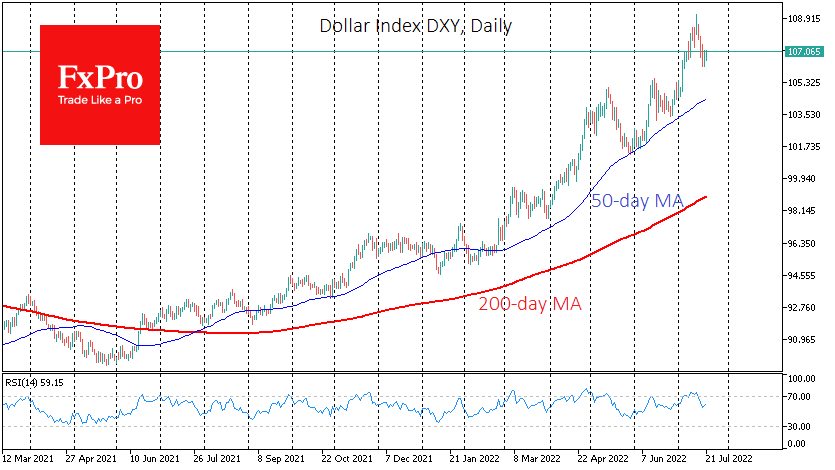
The differences between the actions of monetary authorities in various developed countries are becoming increasingly apparent. Until we see real work by the governments and central banks of the USA, Japan, or the Eurozone to change the trend, it is hardly prudent to bet on a peak in the USD.
In our view, governments’ ability to service their debts is an unspoken and indirect reason for this divergence. In the first instance, this depends on the level of the debt burden, and a more comprehensive set of measures also includes international investor confidence and the ability to raise money from the markets at an acceptable interest rate for the government.
From that point of view, the procrastination by the ECB, which is not expected to raise its rate until later Thursday, is understandable. Probably by as much as 50 points at once. For the ECB, it may look like a decisive move, but it is desperately lagging behind market conditions and the actions of its colleagues. Much of this has to do with questions about whether debt-ridden Italy and Greece can hold their own.
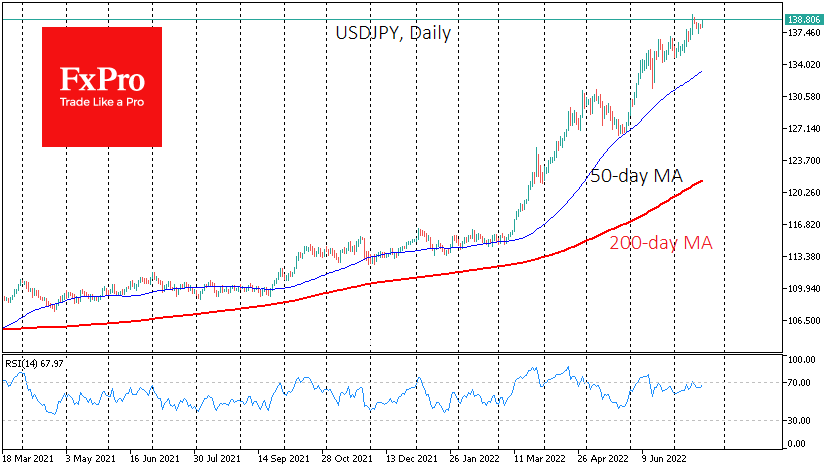
In Japan today, the central bank left Thursday’s rate unchanged at -0.1% and promised to increase QE if necessary. The debt-ridden Rising Sun Country cannot raise rates to protect against rising import prices., which has direct and obvious consequences for the currency. Since the start of 2021, the yen has lost 35% against the Dollar, about double the loss of the euro.
To investors and traders, the current euro and yen exchange rates may seem low after updating 20-year lows, but that is a dangerous approach. Rebalancing global monetary or currency policy is necessary to reverse the Dollar’s rising trend.
The ECB and the Bank of Japan allow a market devaluation of their currencies, ostentatiously delaying their policy tightening. Since they are significant reserve currencies, devaluation is proceeding smoothly despite economic problems and gloomy prospects due to dependence on energy imports.
Japan’s authorities appear to be only concerned about the pace of the yen’s decline, not its direction. The euro region’s monetary and financial authorities have made no discernible comments to defend the euro. Only the US authorities can stop the Dollar’s rise in such circumstances.
Right now, the appreciation against peers is working to lower inflation and cool the economy, as is the policy of the Fed. Furthermore, the current situation is working on the Dollar’s credibility, which has been shaken in 2020.
In our view, in the coming months, the Dollar’s rise will only be interrupted by occasional technical pullbacks. Only the US authorities can stop this trend. The Treasury could suddenly become alarmed by the appreciation of the Dollar. The Fed could also quickly reduce the rate hikes or talk about easing plans once it is convinced that inflation has turned around. But so far, we are not at that point.
Euro Flat Ahead of ECB Rate Move
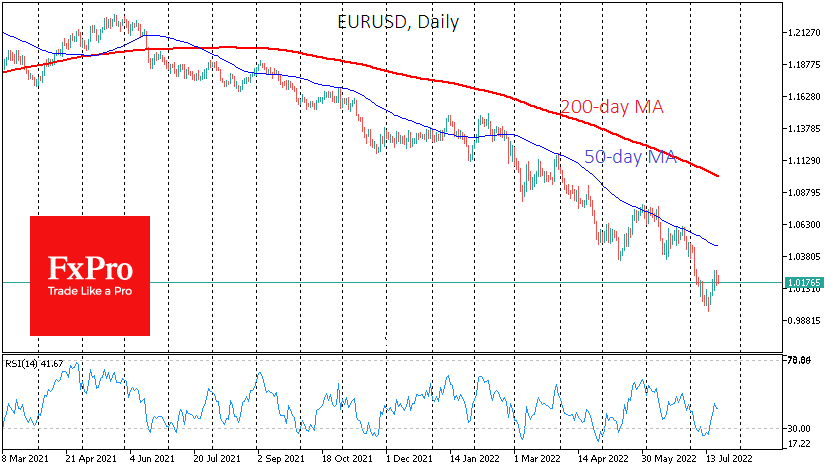
The euro is unchanged today, as EUR/USD is trading at 1.0180 in the European session.
Today’s economic calendar is very light, but there are a slew of developments today which could have an impact on the movement of the euro. The ECB will commence its rate-tightening cycle, the Nord Stream 1 pipeline has been reactivated, and Italian Prime Minister Draghi has just tendered his resignation. With so much happening, it seems fitting that the markets have no idea which way to turn and this has left the euro directionless, for now. This could be the calm before the storm as we may see some sharp volatility from the euro before today’s session is over.
How high will ECB lift off?
Today’s ECB meeting will be a milestone, as the central bank is expected to raise interest rates for the first time since 2011. Adding to the anticipation, the size of the rate hike is going down to the wire – will the ECB opt for a modest 25bp move, or come out with guns ablaze and deliver a sizeable 50bp increase? The ECB could go either way and how the markets react to the decision will be interesting. A 25bp move could be met with a shrug from the euro, while a 50bp hike would likely boost the ailing currency, which broke below parity last week.
The ECB also plans to wrap up its QE programme on July 1st, but at the same time, the ECB is introducing a new bond-buying scheme which it is calling an anti-fragmentation tool, which is meant to maintain government bond spreads between eurozone members and protect Italy and other weak members from speculators. This points to the ECB still retaining a somewhat accommodative monetary stance, even as it reluctantly raises interest rates due to soaring inflation.
Speaking of Italy, the political turmoil has deepened in the eurozone’s third largest economy as Prime Minister Draghi announced his resignation earlier today. A snap election will likely take place in September, and the political instability in the meantime will only add to investors’ concerns about the eurozone, which could spell trouble for the euro.
Finally, it’s Nord Stream Day, as gas is again flowing through the pipeline from Russia to Germany. According to a report from Russian gas giant Gazprom, the pipeline is running at 30% capacity. That’s obviously on the low side, but should be enough to stave off panic about an energy shortage this winter. The European Commission announced on Wednesday that it was urging EU members to reduce their gas needs by some 15% by March 31st in response to Moscow’s hints that it might not reopen the pipeline. I strongly doubt that we have heard the last concerning the crisis over Nord Stream, whose company motto is ironically, “secure gas supply for Europe”.
EUR/USD Technical
- EUR/USD tested support at 1.0197 in the European session. The next support level is 1.0075
- There is resistance at 1.0307 and 1.0429