Sample Category Title
AUD/USD: Key Supports Under Pressure as Aussie Remains Weighed by Soured Risk Sentiment
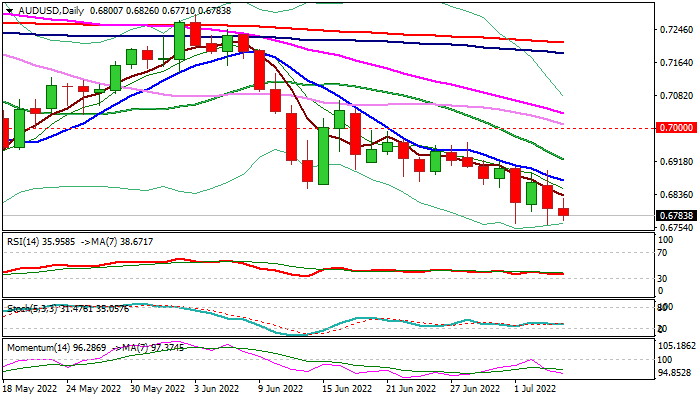
The AUDUSD remains in red and pressuring key supports at 0.6761/58 (new two-year low, posted yesterday / 50% retracement of 0.5509/0.8007 rally).
Soured risk sentiment on growing recession fears that boosted demand for safe-haven dollar, keep the Aussie dollar in defensive mode.
Bearish daily techs (rising negative momentum, south-heading indicators, MA’s in bearish setup) add to negative outlook.
Violation of 0.6761/58 pivots is likely to spark fresh bearish acceleration on negative signal and triggering stops parked below, with possible extension towards 0.6463 (Fibo 61.8% / monthly cloud base).
Near-term action should remain below falling 10DMA (0.6870) which tracks the downtrend since June 9, to keep bears intact.
Res: 0.6832; 0.6850; 0.6870; 0.6922
Sup: 0.6758; 0.6647; 0.6601; 0.6547
US: The Services Sector Continued to Grow in June, Albeit at a Slower Pace
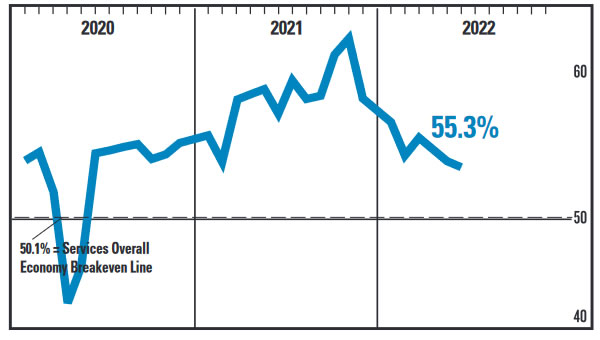
The ISM Services Index continued to grow but at slower pace, shedding 0.6 percentage points (ppts) in June with a reading of 55.3, which is higher than the 54 expected by the consensus estimate. Combined with an increase in the manufacturing reading, the ISM composite moved to 55.0 from 55.9 in May.
Business activity rose by 1.6 ppts to 56.1, while new orders declined by 2 ppts to 55.6.
Supply bottlenecks continue to create challenges. The supplier deliveries index gained 0.6 ppts to 61.9, while the backlog of orders sub-index rose by 8.5 ppts to 60.5.
Inventories contracted by 3.5 ppts from 51 in May, while inventory sentiment remained in contractionary territory with a reading of 46.2 – gaining 1.7 ppts.
Employment activity moved back in the contractionary territory losing 2.8 ppts to reach 47.4.
The prices paid component eased for the second consecutive month in June, dropping 2 ppts to 80.1 percent from 82.1 in May.
All 18 industries expanded in June.
Key Implications
The ISM services index continued to lose momentum in June, but remained in expansionary territory for the 25th consecutive month. The composition of the index makes an interesting story. Demand remained healthy with solid gains in business activity, a healthy level of new orders, and inventories too low for the level of demand. But the services sector continues to struggle with a mismatch between supply and demand, unlike the manufacturing sector where supplier delivery times normalized in June.
The employment sub-index disappointed in June. In the past six months, it has been zig-zagging in and out of contractionary territory and is unlikely to serve as a good precursor of the upcoming employment report. Indeed, the contraction is not indicative of a decline in demand for labor as managers expressed their frustration with comments like " unable to fill positions with qualified applicants".
All in all, despite the deceleration in June, the services sector remains solidly in expansionary territory, suggesting there is still some gas left in the consumption tank of the U.S. economy.
NZ Dollar Extends Losses ahead of RBNZ Report
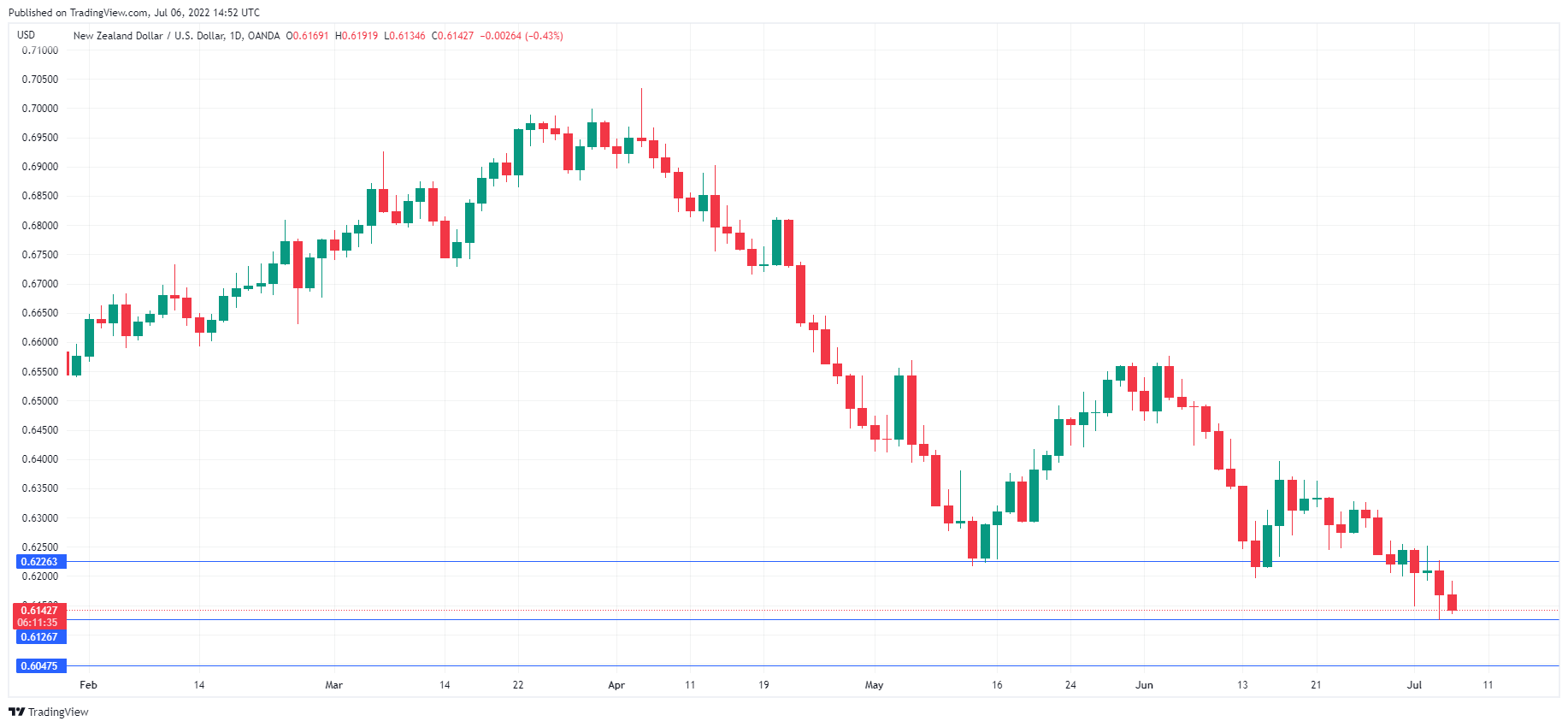
The New Zealand dollar continues to lose ground on Wednesday and is trading at 0.6139, down 0.49%. NZD/USD touched a low of 0.6124 on Tuesday, its lowest level since May 2020. The US dollar has pummelled the New Zealand currency, with NZD/USD sliding 370 points since June 1st.
RBNZ Statement of Intent next
The Reserve Bank of New Zealand has not been shy about raising rates, and the aggressive rate-hike cycle is set to continue. The RBNZ meets next Wednesday, and the markets have priced in a 50bp increase, which would bring the cash rate to 2.50%. With a peak in inflation nowhere in sight, the RBNZ can be expected to remain hawkish until inflation is contained. Interest rates could hit 3% in August and rise as high as 4% if inflation does not ease lower.
The RBNZ will release a Statement of Intent on Tuesday and should be treated as a market-mover. The report will outline the central bank’s objectives over the next three years, and investors will be looking for insights regarding upcoming rate moves.
Confidence indicators have been heading southward, raising concerns about the health of the economy. The NIEZR Business Confidence index fell ever deeper into negative territory on Monday, with a reading of -65 for Q2. Business confidence is currently at its lowest level since Q1 2020, at the start of the corona pandemic. Economic activity has been curtailed due to the acceleration of Covid cases, and businesses continue to struggle with cost pressures and higher interest rates. This follows last week’s ANZ Business Confidence in June, which fell to -62.6, down from -55.6 in May, marking a 12th straight decline and a near-record low.
Consumers are also feeling the bite of the cost of living crisis, as food and petrol prices have soared. Higher interest rates have meant higher borrowing costs and mortgage rates, leaving consumers with less disposable income and less confidence about their economic situation. The Westpac Consumer Confidence fell sharply to 78.7 in Q1, down from 92.1 in Q4 2021.
NZD/USD Technical
- NZD/USD has weak support at 0.6126, followed by 0.6047
- There is resistance at 0.6226 and 0.6305
US ISM services ticked down to 55.3, on decline in new orders and employment
US ISM Services PMI dropped from 55.9 to 55.3 in June but beat expectation of 54.5. Looking at some details, business activity/production rose 1.6 to 56.1. New orders dropped -2.0 to 55.6. Employment dropped -2.8 to 47.4. Supplier deliveries rose 0.6 to 61.9. Prices dropped -2.0 to 80.1.
ISM said: "The slight slowdown in services sector growth was due to a decline in new orders and employment.... Logistical challenges, a restricted labor pool, material shortages, inflation, the coronavirus pandemic and the war in Ukraine continue to negatively impact the services sector."
Sunset Market Commentary
Markets
There’s no letting-up in the euro sell-off. Yesterday’s steep decline met with follow-through losses today, even as risk sentiment, for example on equities, turned for the better. The likes of the EuroStoxx50 are adding 2% though most indices are off intraday highs. Stocks in the US open with gains of 0.5%. In a way, the euro is even performing worse than yesterday since it’s losing against every G10 peer whereas on Tuesday the common currency still held the upper hand against Scandinavian currencies. The move originated from EUR/JPY, which fell through the 139 support zone (neckline double top formation) and shortly thereafter gave up on 137.85 (June correction low). EUR/USD is losing another 1% to trade around 1.017 and thus confirming Tuesday’s break. The pair is developing further lower in the downward trend channel with parity the first technical support zone. Same story for the Swiss franc. EUR/CHF is deepening losses to 0.989. Sterling shrugs at the political turmoil after two key ministers and a series of junior officials resigned yesterday. It didn’t even budge on reports that Tories are discussing to change the bylaws in order to have another leadership ballot. After the vote of no-confidence end June, the Tory party under the current rules cannot call for another one until next year. Instead, sterling even started to strengthen during a speech by the new minister of Finance Zahawi. In an echo to his predecessor Sunak, he said it is important to have fiscal discipline and his priority is to bear down on inflation. The latter also goes for the Bank of England. Chief economist Pill and deputy governor Cunliffe both expressed willingness to act more forcefully against inflation and said a 50 bps hike is on the table as soon as next month. Both previously expressed doubts for such a move. EUR/GBP for a third time (‘s a charm?) in less than a week dips below the upward sloping trend channel. It is currently trading in the 0.856 area. Central European currencies get whacked too, being at least as vulnerable to the energy crunch and its economic implications as the rest of Europe. The Hungarian forint extends a dramatic slide to EUR/HUF 415! The zloty touched EUR/PLN 4.80 before paring some losses to 4.78 at the time of writing.
The hefty repositioning on bond markets continued as well. Markets price out central bank action, believing they will start prioritizing growth, especially next year. Bunds again outperform US Treasuries with yield changes ranging from -3 bps (10y) to -12.6 bps (5y). The 10y yield quickly reversed an initial bump at the open and is currently testing critical support at around 1.15% extensively. US yields lose between 1.3 and 3 bps. The 10y yield over there is just a few bps away from similarly important support at 2.72%. Tonight’s hawkish Fed meeting minutes may be interesting to dive into but we doubt they will reroute market focus from growth currently back to inflation. Oil prices fail to recover from a sudden and sharp drop yesterday. Brent (-0.7%) dips to $102/barrel.
News Headlines
The Romanian central bank accelerated its tightening cycle again with a larger-than-expected 100 bps rate hike today, from 3.75% to 4.75%. They started in October last year with three 25 bps moves, followed by two 50 bps hikes in February and April and 75 bps in May. Romanian annual inflation rose faster than forecast in Q2, to 14.49% Y/Y in May. Core inflation hit 9.1% Y/Y. Q1 GDP was stronger than forecast at 6.5% annually, but high-frequency indicators point to a quasi-standstill of economic activity in Q2. The NBR closely monitors developments in the domestic and international environment and will continue to use the tools at its disposal to achieve the fundamental objective of price stability in the medium term (2.5% +-1 ppt).
The Belgian treaty of enterprises (Verbond van Belgische Ondernemingen) published its bi-annual economic dashboard. They signal out spiraling costs as the number one problem for companies. Belgian inflation exceeds 9% implying that wage costs will rise by around 11% (5 ppts more than neighboring countries) because of the automatic wage indexation system. Economic growth is expected to grind to a halt next year because of decreasing investments and a negative contribution of net exports. An upward wage-price spiral even risks triggering a recession in 2023.
Euro Tumbles Below 1.02
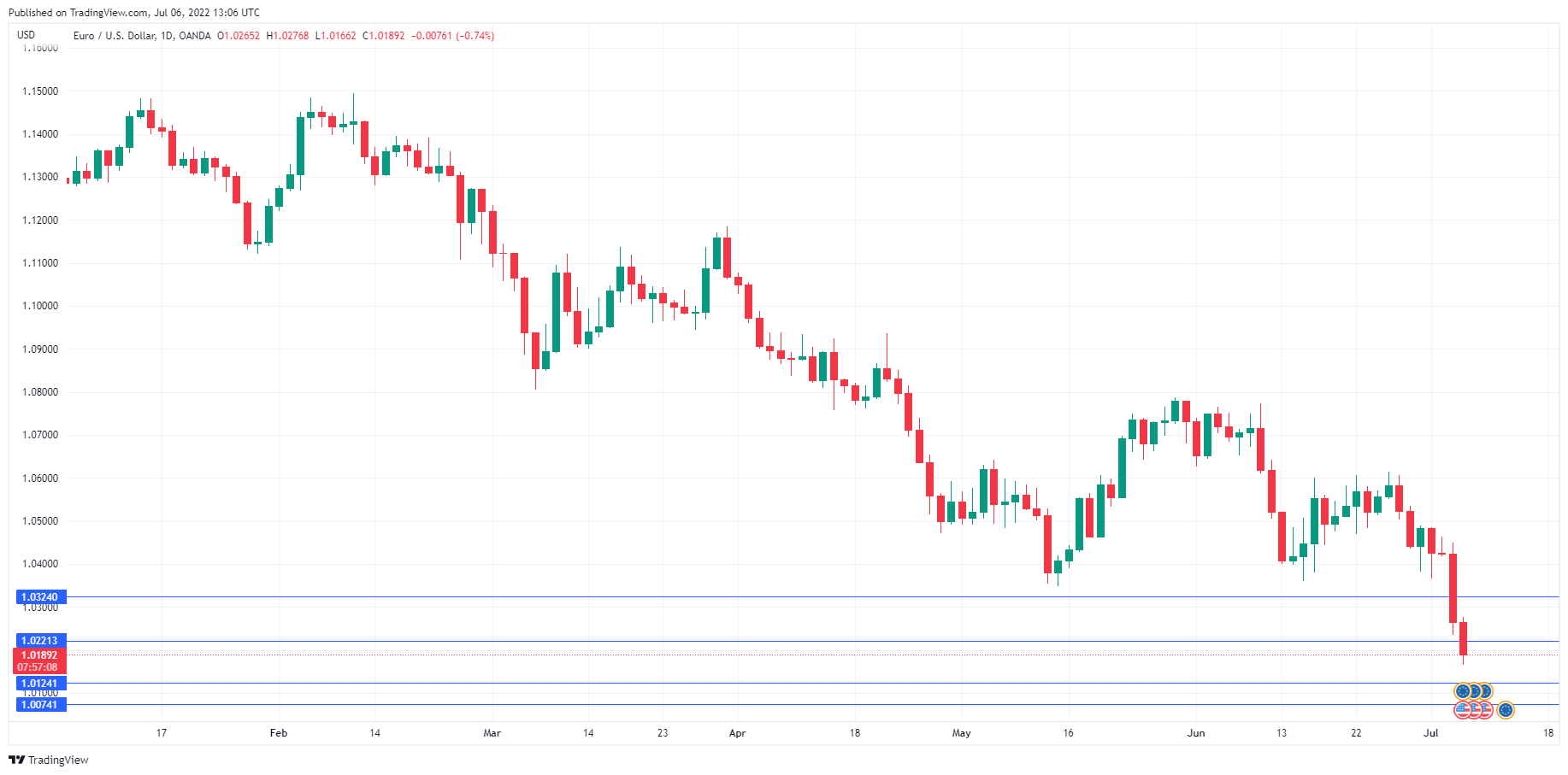
The month of July has been an unmitigated disaster for the euro – with only three trading sessions in the books, EUR/USD has declined a staggering 2.73%. Earlier in the day, the euro dropped to 1.0186, its lowest level since December 2002. The euro appears headed for parity with the US dollar, a psychologically significant level.
The economic outlook in the eurozone is not an encouraging one. Inflation surged to 8.1% in May, surpassing the April record of 7.4%. A peak in inflation remains elusive, and the ECB is way behind the inflation curve – the central bank hasn’t raised interest rates yet, which are in negative territory. Even so, a lukewarm eurozone economy means that raising rates poses the risk of a recession. The energy situation has been deteriorating, as sanctions against Russia have led to counter moves in which Moscow has reduced its gas exports to Europe, which could result in an energy shortage this winter. If Russia reduces oil or gas exports to Europe, prices will soar and this could cause a severe economic downturn.
A strike by Norwegian oil and gas workers on Tuesday threatened to exacerbate the situation. The Norwegian government has stepped in and ended the strike, but investors remain nervous as the eurozone’s energy situation could become precarious.
Today’s data out of the eurozone showed some improvement but did little to raise risk sentiment. Germany’s Factory Orders rose 0.1% in May, up from -1.6% in April but still a negligible gain. It was a similar story for eurozone retail sales, which came in at 0.2% in May after a -1.4% read in April. On Thursday, Germany releases Industrial Production for May, which is expected to slow to 0.7%, down from 0.4%.
EUR/USD Technical
- EUR/USD faces resistance at 1.0124. Below, there is support at 1.0075
- There is resistance at 1.0221 and 1.0324
USD/JPY Outlook: Larger Bulls Likely to Resume after Extended Consolidation
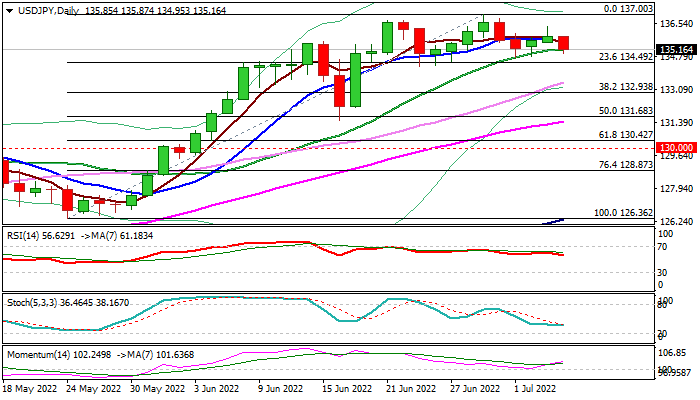
The USDJPY extends range trading into third consecutive week, as Doji candles in past two weeks signal strong indecision.
Repeated weekly upside rejection points to strong headwinds that bulls face, but the downside was so far well protected by Fibo support at 134.49 (23.6% of 126.36/137.00) where a higher base is forming.
The dollar remains well supported against the basket of its major counterparts, by risk aversion on strong migration into safety, due to darkening global economic outlook, suggesting that larger bulls are likely to resume after extended consolidation.
The near-term price action needs to hold above 134.49 to keep bias with bulls for fresh push towards new 24-year high at 137.00, violation of which would signal resumption of steep uptrend from 102.59 (Jan 2021 trough) towards targets at 139.92/140.00 (Sep 1998 high/psychological).
Only sustained break of 134.49 base would put bulls on hold and risk deeper correction.
Res: 135.87; 136.36; 136.70; 137.00.
Sup: 134.74; 134.49; 133.43; 132.93.
EUR/USD: Euro Falls Further after Break of Critical Supports, Eyes Targets at 1.0069/00
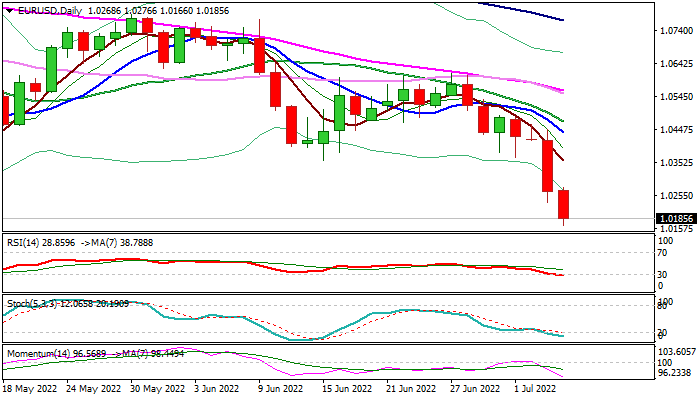
The Euro extends steep fall, sparked by strong risk aversion on growing recession worries and boosted by a break of critical technical supports that signaled a continuation of larger downtrend from 2008 peak (1.6039).
Fresh weakness pushed the price to new lowest levels since 2002, with increasingly negative fundamentals offsetting signals from oversold daily studies, though price adjustment can be expected in coming sessions, mainly to offer better selling opportunities for final push towards targets at 1.0069/1.0000 (Fibo 76.4% of 0.8225/1.6039 / psychological support).
Res: 1.0235; 1.0276; 1.0298; 1.0340.
Sup: 1.0166; 1.0100; 1.0069; 1.0100.
USD/JPY Mid-Day Outlook
Daily Pivots: (S1) 135.48; (P) 135.92; (R1) 136.31; More...
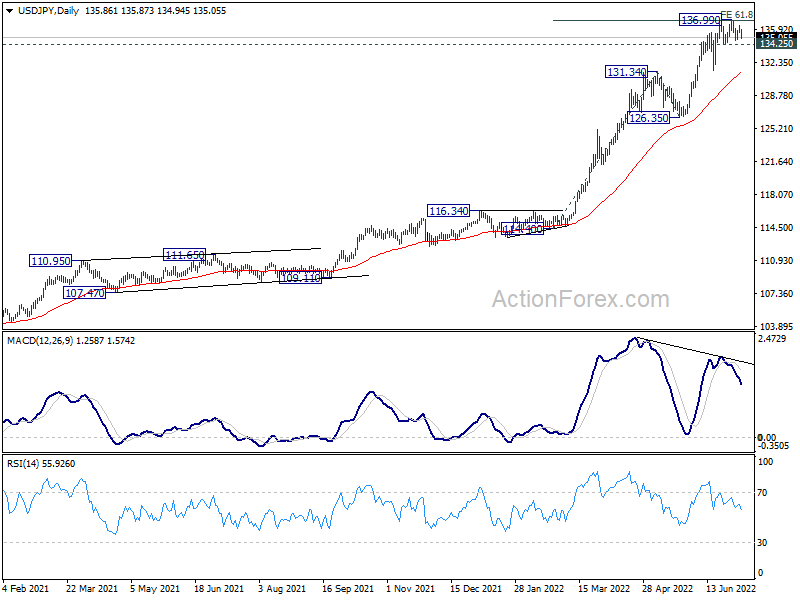
Range trading continues in USD/JPY and intraday bias remains neutral. On the downside, break of 134.25 support will confirm short term topping at 136.99. Considering bearish divergence condition in daily MACD, 136.99 might be a medium term top too. Intraday bias will be back on the downside for 131.34 support resistance turned support. Nevertheless, firm break of 136.99 will resume larger up trend to 100% projection of 114.40 to 131.34 from 126.35 at 143.29.
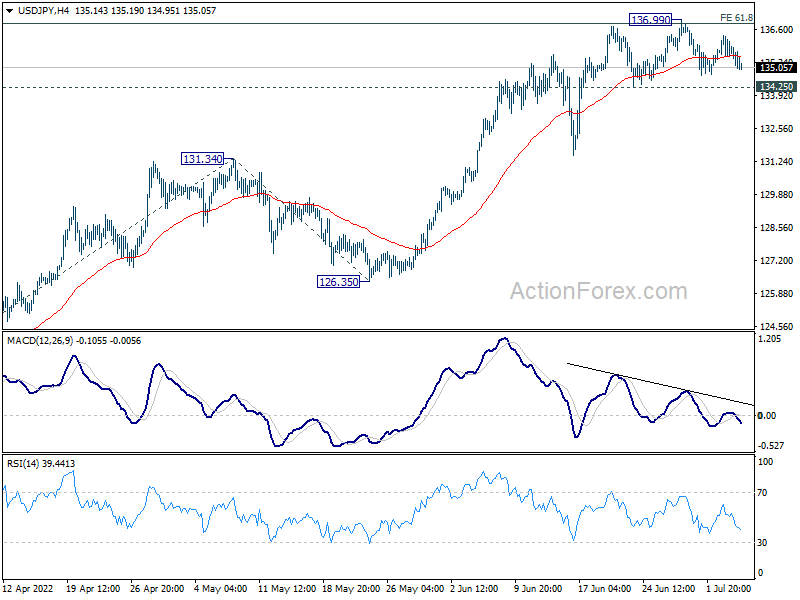
In the bigger picture, current rally is seen as part of the long term up trend from 75.56 (2011 low). Next target is 100% projection of 75.56 (2011 low) to 125.85 (2015 high) from 98.97 at 149.26, which is close to 147.68 (1998 high). This will remain the favored case as long as 126.35 support holds.
USD/CHF Mid-Day Outlook
Daily Pivots: (S1) 0.9618; (P) 0.9662; (R1) 0.9730; More...
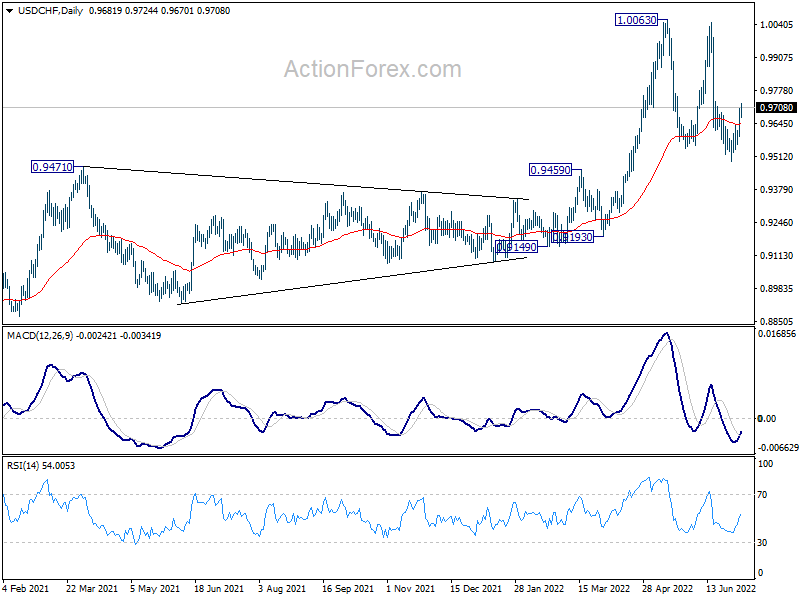
Immediate focus is now on 0.9731 resistance in USD/CHF. Firm break there will argue that the consolidation from 1.0063 has completed and bring stronger rally back to retest 1.0063 high. However, another fall below 0.9493 will dampen this view and target 0.9459 resistance turned support.
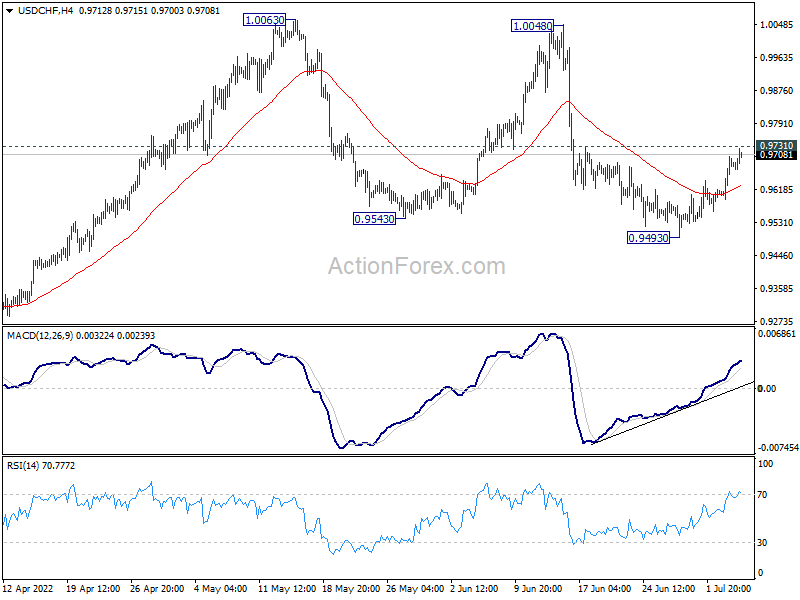
In the bigger picture, down trend from 1.0342 (2016 high) should have completed with three waves down to 0.8756 (2021 low) already. Rise from 0.8756 is likely a medium term up trend of its own. Next target is 1.0237/0342 resistance zone. This will remain the favored case as long as 0.9471 resistance turned support holds. However, sustained break of 0.9471 will extend long term range trading with another falling leg.