

Sample Category Title
WTI Oil Futures Trade with Bearish Bias as Trendline Breached
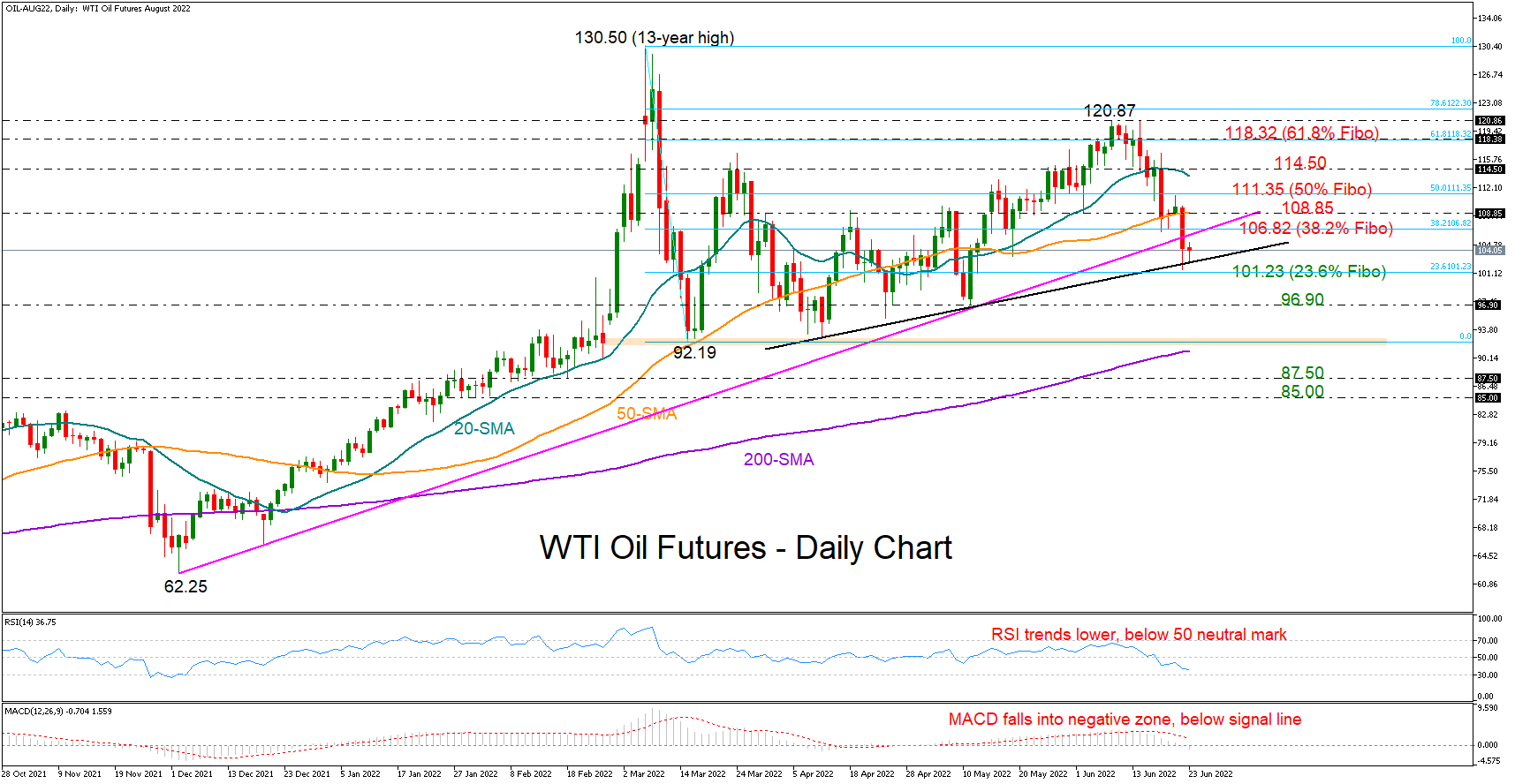
WTI oil futures (August delivery) lost almost 5% on Wednesday, tumbling to a six-week low of $101.53 before closing the day off its lows.
The bearish action breached the support trendline, which joined the lows from December’s bottom of $62.25, sending a warning signal that selling tendencies may escalate in the coming sessions. The clear negative trend in the RSI and the MACD, which have dipped back in the bearish area, is backing this narrative too.
That said, there is another shorter-term ascending trendline from April, which is still valid at $102.43, while the 23.6% Fibonacci retracement of the $130.50 – $92.19 downfall at 101.23 is adding extra importance to the region. Hence, sellers may wait for a decisive close below those obstacles before they aggressively squeeze the price towards the previous trough of $96.90. Then, all eyes will turn to the bottom of the three-month-old range area at $92.19. Notably, the 200-day simple moving average (SMA) is approaching the same territory. However, if it proves fragile, the decline could stretch towards the crucial constraining zone of $87.50 – $85.00.
Shifting to the upside, the price will need to crawl above the $108.85 – $111.35 region to retest the 20-day SMA and the $114.50 constraining zone. Higher, the $118.32 mark could reinforce some consolidation before the door opens for June’s high of $120.87.
Summarizing, WTI oil futures may remain under pressure in the short-term. A significant move below $101.23 could to set the stage for another sharp decline towards $96.90.
Daily Technical Analysis
EUR/USD
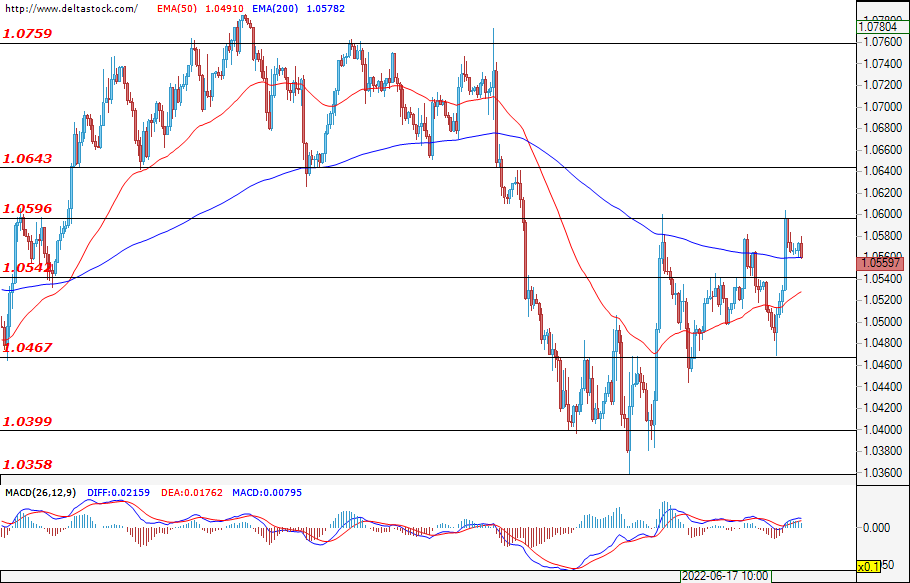
Following the unsuccessful test of the support level at 1.0460, the bulls entered the market and we witnessed an impulsive upward movement that was limited at the psychological level at 1.0600. If the EUR/USD manages to breach this level, then it would further rise towards the next key resistance at 1.0643. In case the resistance at 1.0600 withholds the bullish pressure, then the most likely scenario would be for the pair to continue trading in the range of 1.0540 – 1.1060. The most important news for investors today is the initial jobless claims data (12:30 GMT), which may lead to higher volatility.
USD/JPY
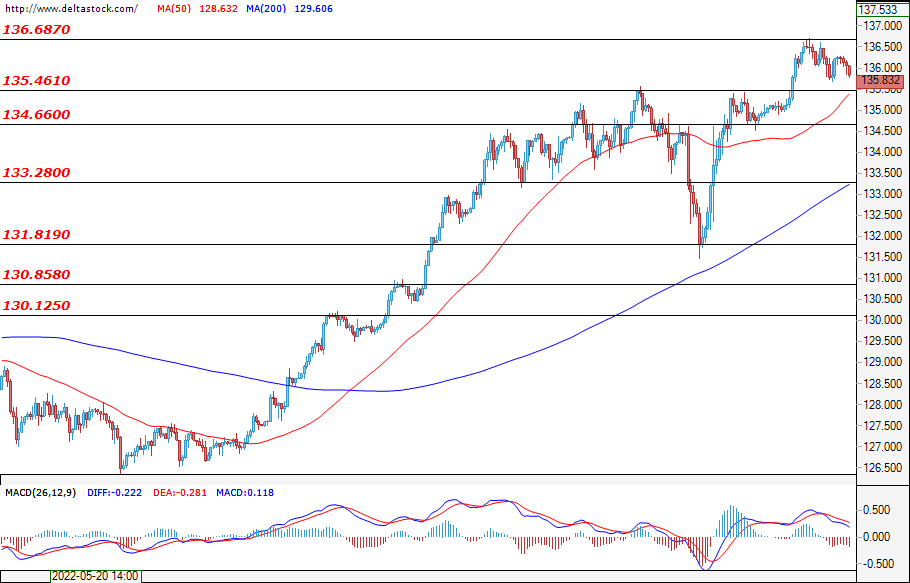
The resistance level at 136.70 managed to limit the upward movement of the currency pair and the expectations for today's trading session are for the USD/JPY to enter in a corrective phase and target the support at 134.66.
GBP/USD
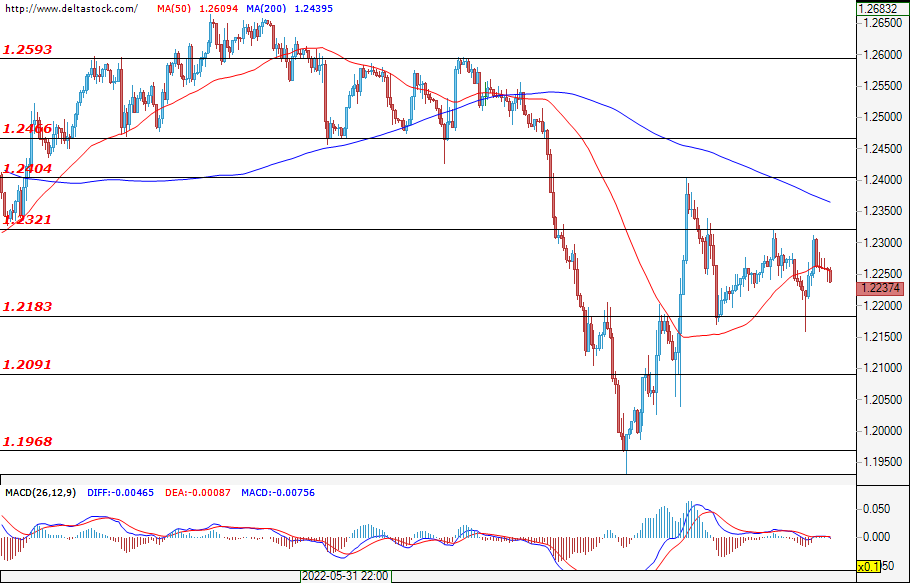
During yesterday's trading session, the currency pair continued to trade in the range of 1.2320 – 1.2180, and in the early hours of today’s trading, it is headed towards a test of the support level at 1.2180. In case of a successful breach of this support, the pair would most probably head towards the next key one at 1.2010. If the bulls re-enter the market and manage to violate the resistance at 1.2320, then an upward movement towards the next one at 1.2400 is highly possible.
EUGERMANY40
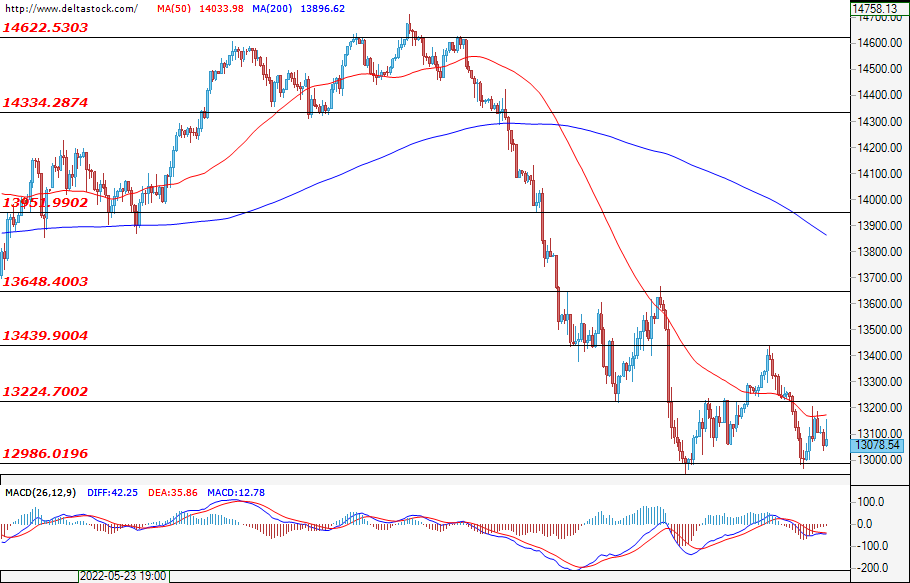
During the previous trading session, the German index managed to stay above the psychological level at 13000, and at the time of writing, it is traded in the range of 13000 – 13220. The forecasts for today's trading session are for the bulls to attack the resistance at 13224, and a successful breach of this level may lead to an increase in the price towards the resistance at 13440. A possible decline below 13000 could deepen the sell-offs towards the next support at 12470.
US30
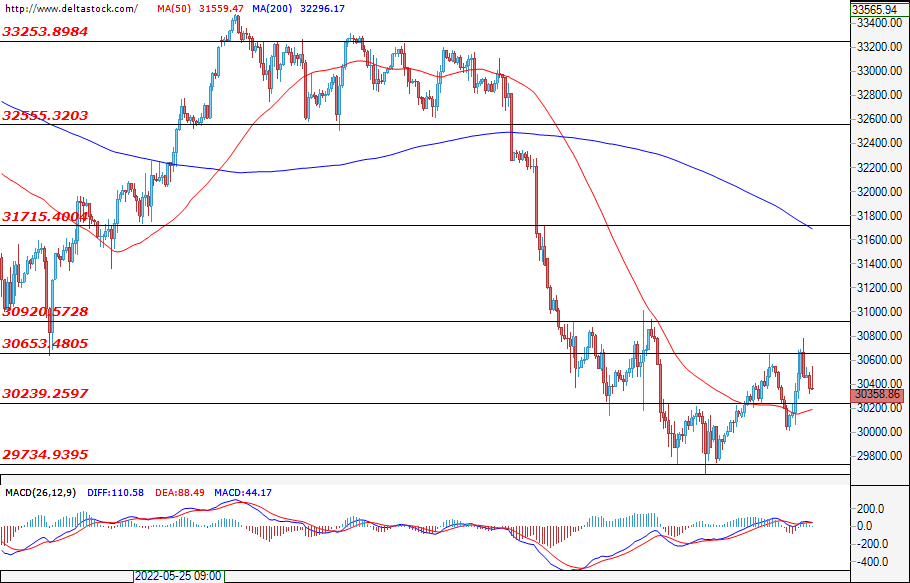
Yesterday, the bulls could not gain enough momentum to violate the resistance at 30650 and the expectations for today’s session are for the bears to try and take control over the market in order to lead the price towards another test of the critical support at 29734. In case the bulls re-enter the market, then their target would be the resistance at 30920.
USDCAD Forms Head and Shoulders after Strong Canada Inflation Fata
American stocks wavered on Wednesday as Jerome Powell testified before a Senate committee. In the statement, Jerome Powell warned that the battle to fight inflation could lead to higher interest rates and even a recession. He also said that the bank will continue hiking until it sees clear proof that inflation is slowing. His remarks underscored the challenging situation that the Fed finds itself in as it seeks to fight inflation which has surged to the highest point in over 40 years. Still, there are concerns about whether higher interest rates alone will lower inflation since it has been caused by supply and demand imbalances.
The Canadian dollar strengthened slightly against the US dollar after the latest strong consumer inflation data. According to Statistics Canada, the headline consumer price index rose from 6.8% to a multi-decade high of 7.7% in May. It rose from 0.6% in April to 1.4% in May. Excluding the volatile food and energy prices, the country’s inflation rose from 5.7% to 6.1%. These figures will also put more pressure on Bank of Canada, which has continued tightening. They came a day after the same agency published strong retail sales numbers.
The economic calendar will have some important data today. Markit will publish flash manufacturing and services PMIs from several countries. The data will provide a gauge of how these companies performed this month. Meanwhile, Jerome Powell will continue testifying in Congress. Historically, the second day of testimony does not cause significant market action. The Energy Information Agency will publish the latest inventories numbers. The data will come as the US moves to remove the Federal gas task, a move that analysts believe will not have an impact on oil prices. The rail strike in the UK will enter the third day as negotiations go on.
EURUSD
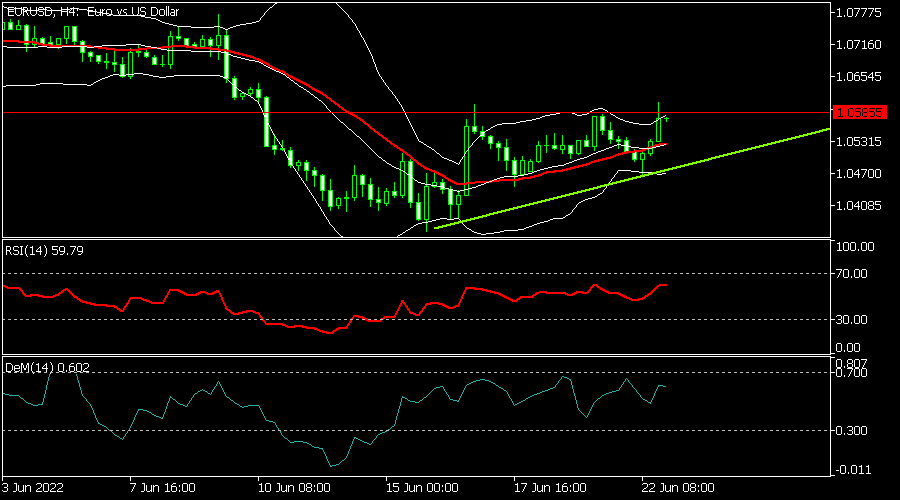
The EURUSD pair bounced back as Jerome Powell testified in Congress. It rose to a high of 1.0590, which was the highest point since Friday last week. It moved above the ascending green trendline and the 25-day moving average. It is also along the upper side of Bollinger Bands while the Relative Strength Index (RSI) has continued rising. Therefore, the upward trend will likely continue in the coming days.
USDCHF
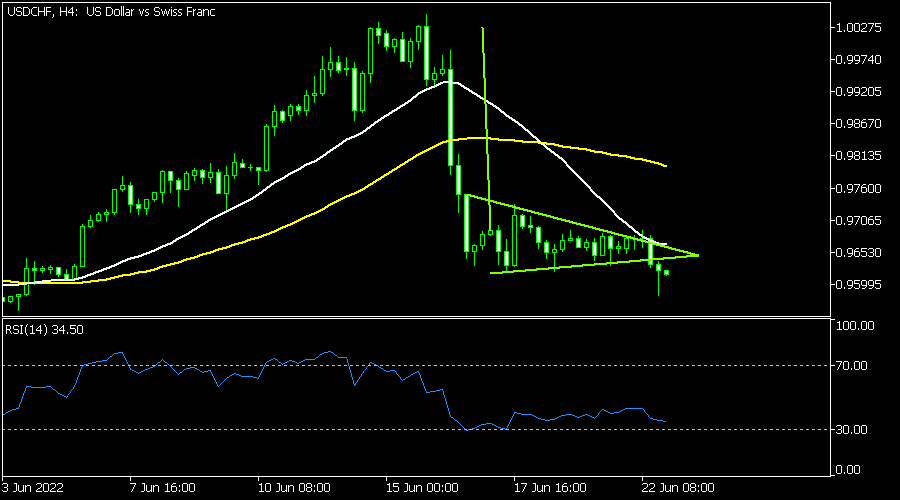
The USDCHF made a bearish breakout after the hawkish statement by the SNB governor. The pair dropped to a low of 0.9570, which was the lowest level since June 6. It moved below the lower side of the bearish pennant pattern and the short and longer moving averages. The Relative Strength Index has moved close to the oversold level. Therefore, the pair will likely continue falling today.
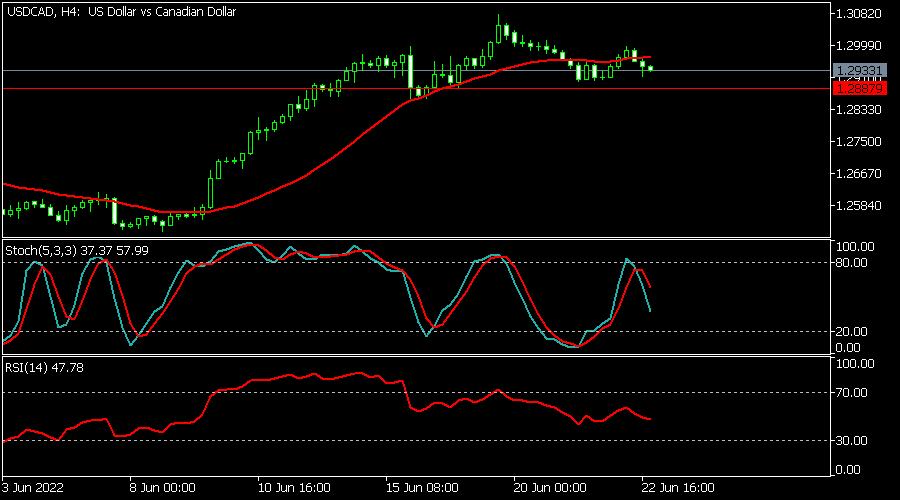
USDCAD
The USDCAD pair tilted lower after strong Canadian inflation data. It dropped to a low of 1.2931, which is lower than this month’s high of 1.3080. It has formed a head and shoulders pattern and moved below the 25-day moving averages. At the same time, the RSI has formed a bearish divergence pattern while the Stochastic Oscillator has moved below the overbought level. The next key support to watch will be at 1.2887.
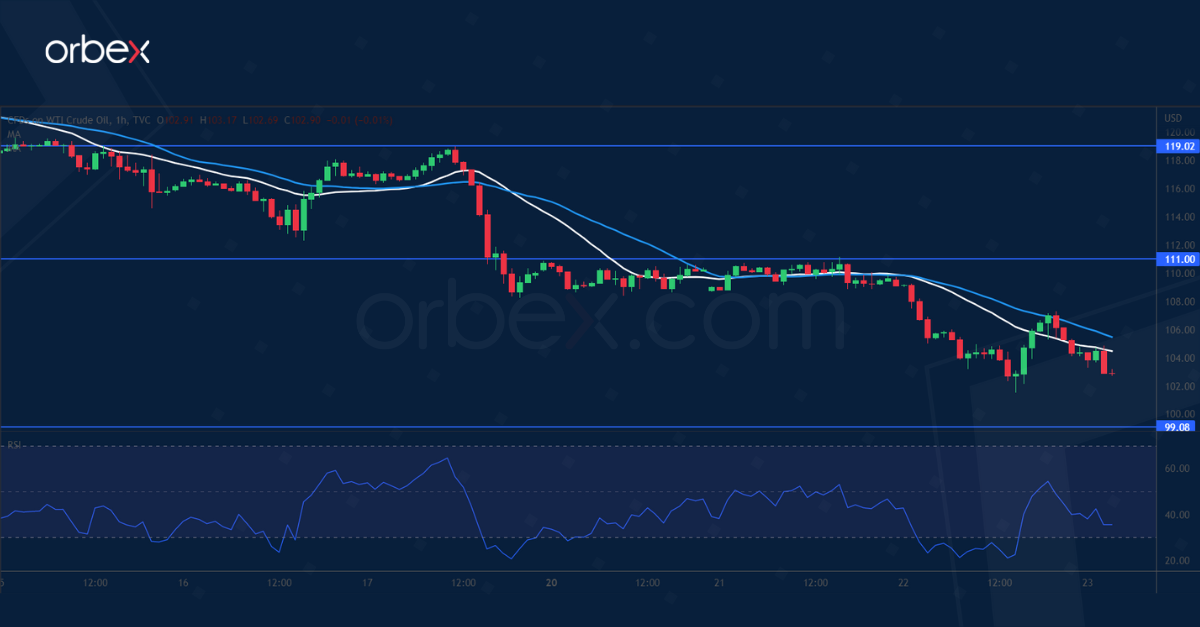
US Oil Nears Critical Support
WTI crude remains under pressure over fears of recession. A fall below the daily support at 109.00 triggered a new round of liquidation. After a clean cut through the 30-day moving average, the demand area between May’s lows (99.00) and the psychological level of 100.00 is critical in keeping the price afloat in the medium-term. The RSI’s triple dip into the oversold zone caused a rebound as the bears’ profit-taking met the bulls’ buying the dip. 111.00 is the first obstacle to remove before the commodity could bounce back.
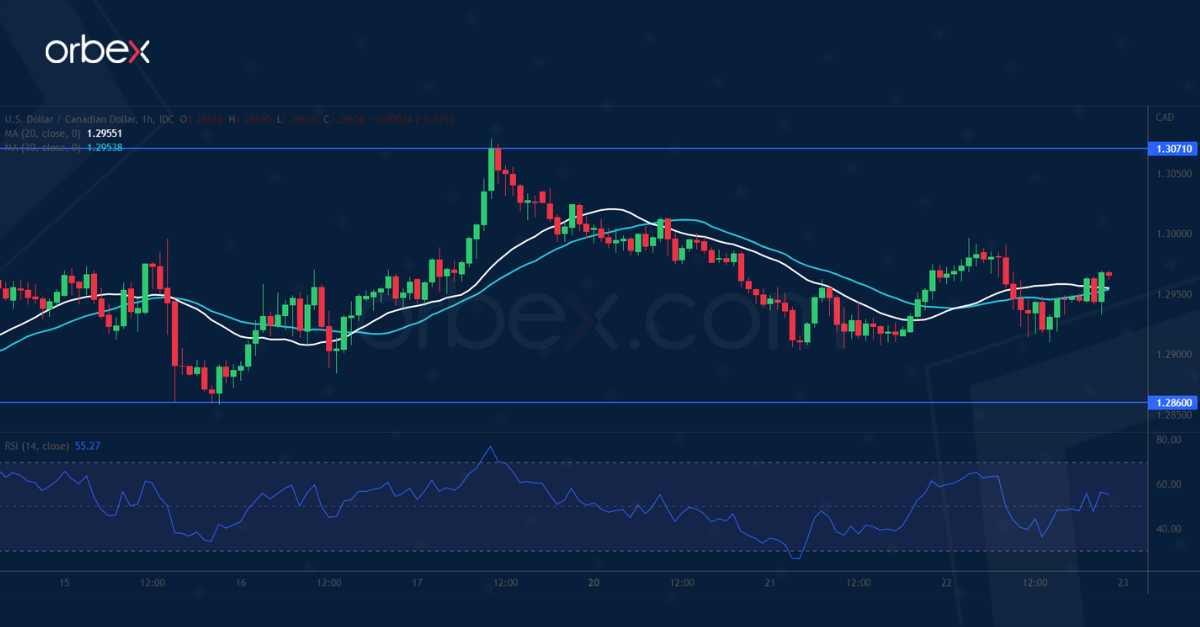
USD/CAD Tests Support
The Canadian dollar bounced higher after May’s CPI exceeded expectations. The greenback is struggling to consolidate its gains after a tentative break above last month’s peak at 1.3070. The bulls have bought the pullback around 1.2860. A rally above 1.3070 would trigger a runaway rally as selling interests become scarce, paving the way for a recovery above 1.3300. However, a bearish breakout would dent the mood in the short-term and force leveraged buyers to bail out. Then 1.2700 would be the next support.
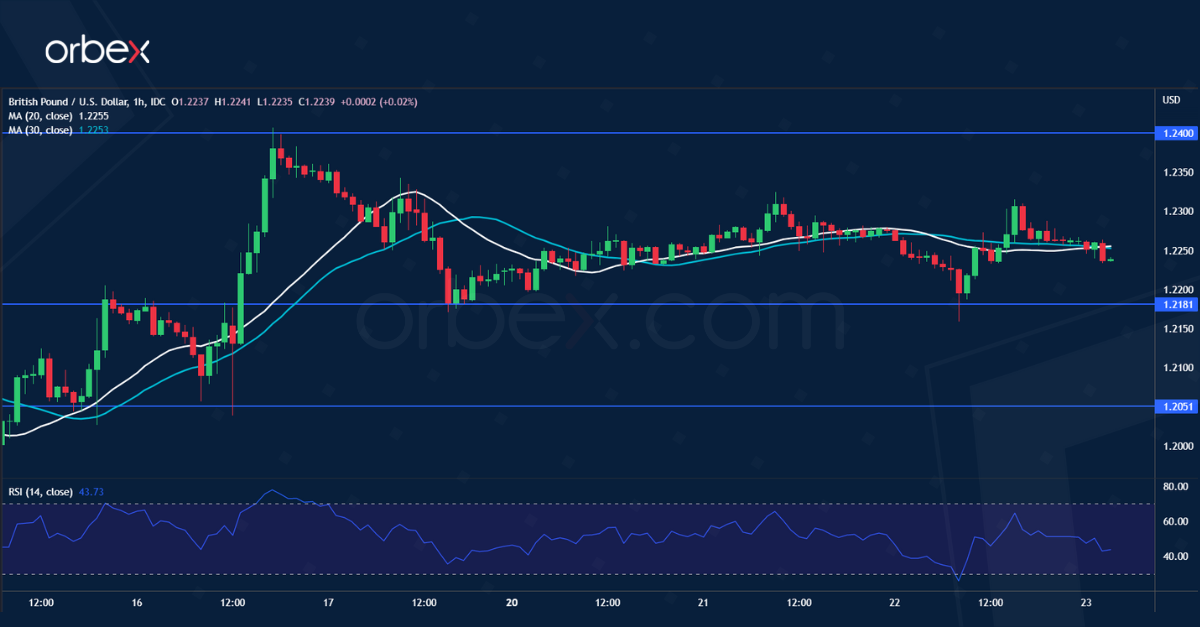
GBP/USD Consolidates Gains
Sterling edged higher after the UK’s CPI accelerated to 9.1% in May. A previous surge above 1.2200 prompted sellers to trim their positions, reducing the downward pressure. The former supply zone has turned into a demand one (1.2180) where buyers would look to hold onto their gains. A close above 1.2400 may bring the pound to June’s high at 1.2600, a major resistance on the daily chart. 1.2050 is an important support to keep the rebound valid. Otherwise, the pair would resume its bearish course.
Fed Chair Powell Did Little to Alleviate Recession Concerns
Markets
It was outright risk-off yesterday. The inflation scare traded for recession fears – a pattern we’ve observed before. Fed chair Powell did little to alleviate these concerns. In his testimony before Congress he reiterated a strong commitment to fight inflation but added that a recession as a result is “certainly a possibility”. The data remain the needle in the compass for future hikes. The Fed needs to see a significant slowdown in inflation before easing the pace of tightening, effectively rubberstamping a 75 bps hike in July. Fed’s Evans later confirmed that “75 is a very reasonable place to have a discussion” and he thinks that by the end of the year the Fed will be doing 25s. Harker said he would like to see rates above 3% but he doesn’t think the Fed has to accelerate rapidly beyond that level. The Philly Fed president said it is important to gauge the effects of quantitative tightening first. Both Evans and Harker were basically narrating the Fed’s dot plot as well as confirming market expectations.
Market expectations for future rate hikes were thus unchanged even as US yield curves tanked up to 14 bps at the front end of the curve. The US 10y yield lost intermediate support at 3.20% (May interim cycle high). European swap yields shed between 9 (2y) and 13.3 bps (10y). European equities slumped 2.5% but capped losses to less than 1% eventually with sentiment improving gradually. US stocks recovered nearly all opening losses.
UST outperformance combined with equities leaving intraday lows behind, helped EUR/USD a bit higher. The pair tested 1.06 but closed at 1.057, up from 1.053. The Swiss franc strengthened further (EUR/CHF 1.016) after SNB president Jordan repeated it may need to hike rates again after the shocker 50 bps last week. Sterling traded in the defense. Quickening inflation and more forceful BoE action hangs in the balance with dire growth prospects. EUR/GBP jumped north of 0.86 while UK Gilts outperformed peers (yields down 17 bps in the 2y/5y). The Japanese yen staged a minor comeback that stretches into current Asian dealings. USD/JPY still trades above 135 though.
Moves in other currencies muted this morning. Core bonds catch a breather after yesterday’s surge higher. We think their downside remains better protected as long as growth is the dominating market theme. This may well be the case with PMI business confidence scheduled for release today. Beneath the still-solid headline figure expected at 54 for the euro zone, we’ll look for signs of easing of momentum in subseries including new orders or production. It may be tricky for the euro to sustain this week’s cautious upward trend in such circumstances. Powell’s testimony continues today with an appearance before the House. The EU meanwhile holds a summit in Brussels.
News Headlines
The Czech National Bank raised its policy rate yesterday by 125 bps, from 5.75% to 7%. They took the decision with 5 members in favour while 2 argued for unchanged rates. One of them will be CNB president at the next, August, meeting. Three of the 5 members who voted in favour of the significant rate hike will leave the CNB by then, suggesting scope for a potential pause or at least a significant deceleration in the tightening cycle. Czech money markets discount a policy rate peak at 7.5% in the near term. The Bank Board assessed the risks and uncertainties of the spring forecast as being markedly inflationary. In particular, higher price growth at home and abroad is having an inflationary effect. This is mainly due to a sharp rise in energy and commodity prices. Upside risks include a weaker CZK FX rate, the threat of inflation expectations becoming unanchored from the CNB’s 2% inflation target and the possibility of a less restrictive fiscal policy this year and next. The Board decided to keep its strategy of FX interventions to avoid an unwanted CZK weakening, unchanged. EUR/CZK in the wake of the decision held near 24.75 which over the past days popped up as an area where the CNB is active with its intervention regime. Czech swap yields fell by 32 bps (2-yr) to 40 bps (30-yr) yesterday as the statement no longer mentions the need to tighten further at coming meetings. This guidance is replaced by data dependence. The general market climate added to the drop in yields as well.
‘Very Challenging’, Indeed
Market optimism couldn’t survive to Jerome Powell’s testimony yesterday, as he said that a recession is possible, and that calling a soft landing is ‘very challenging’ under the current circumstances.
More worryingly, Powell mentioned another risk: the risk of the Federal Reserve (Fed) not managing to restore price stability and allowing inflation to get entrenched in the economy.
Major US indices closed the session slightly in the negative. The S&P500 lost 0.13% and Nasdaq slid 0.15%. The US 10-year yield eased however, as a sign that Powell’s testimony was already mostly factored in. The US dollar index eased.
Powell will testify today, as well, but most of the negative pricing is certainly done by now.
Finally falling?
The barrel of American crude extended losses below $103 yesterday, as Powell’s speech pointed at a possible recession. The next important test for the oil bears is the $100 level. Many investors don’t expect a downturn in oil prices below this level, pointing at a tight global supply, and the resilient demand. Joe Biden’s 3-month gas tax relief could only increase demand and have no material impact for the overall market trend.
Other commodities suffer, as well, as the recession fear takes a toll on demand prospects and bring investors to liquidate their long positions in preparation of a further downside correction. iShares Diversified Commodity index fell below the 100-DMA for the first time this year, and deeper decline is possible, given the risks of tighter monetary policies to the global economy.
In this respect, the British FTSE index, which has a high concentration of oil and mining stocks, could lose its ytd advance versus its US peers.
Powell Uses the “R-word”
Federal Reserve Chairman Jerome Powell’s semi-annual testimony on Capitol Hill was the centre of attention overnight. Mr Powell finally dispensed with soft landings, describing them as challenging, and instead said that a recession is “certainly a possibility.” That should have been enough to spark a somewhat counterintuitive risk sentiment rally as Fed hiking expectations were dialled back, but instead, we got a mixed response as Mr Powell asserted, quite forcefully, that soaring inflation had to be brought back to earth.
That left markets in somewhat of a no man’s land. US equities were clearly dying for any excuse to hit the buy button, such is their genetically pre-programmed disposition. But while Mr Powell was talking recession possibilities and being “nimble” from FOMC meeting to FOMC meeting, the reality that a recession probably isn’t great for stocks tempered animal spirits. US yields flopped overnight on the recession words, notably at the long end, which is a bit of a concern, given the market's infatuation with inverse yield curves. The fall in yields was enough to stop the rot in equities, leaving them roughly unchanged, but the US Dollar fell slightly versus the Euro and Yen.
The Bank of Japan would have been breathing a sigh of relief as lower US yields took USD/JPY back below 136.00, but in the Asian EM space, regional currencies generally weakened. Notably the Korean Won, with a high beta to the health of the US economy, had a tough day at the office. Notably, the Australian and New Zealand Dollar, both global sentiment indicators like the Won, both finished the day lower as well.
Gold, of course, did nothing, while in the crypto space, Bitcoin had another almost unchanged day, hovering once again, just above $20,000.00. Depending on your point of view, Bitcoin is tracing out a major bottom in prices before the new dawn, or it is consolidating a dead cat bounce before heading lower. To help readers understand my point of view, here is a story from Thailand overnight. Basically a chap in Bangkok robbed a gold store to cover his crypto losses. I’m humming “Ironic” by Alanis Morissette.
We have another day of Powell testimony on the Hill this evening, so stand by for more intraday choppiness and analysis paralysis of his every word. In Asia, we have a busy day ahead. South Korean PPI YoY for May held steady at 9.70%, although the MoM number fell to 0.50%. Australian Manufacturing and Services Flash PMIs for June were steady at 55.8 and 52.6 respectively. Japan Jibun Bank June Flash Manufacturing PMI edged lower to 52.7, but the Services PMI rose from 52.6 to 54.2, quite the surprise. I am putting that down to a gradual reopening of borders and government stimulus.
Taiwan’s Industrial Production and Retail Sales come out late today, at 1600SGT, and will likely be lost in the noise of the S&P Manufacturing and Services PMI releases from France, Germany, and the Eurozone. Both numbers should hold steady, or increase slightly, from April, due to the knock-on effects of China’s covid-zero reopening. Singapore’s Core and headline Inflation for May are expected to increase slightly to 5.50% and 5.5% YoY respectively. That won’t be enough to tip the MAS’ hand for an out-of-sequence tightening announcement, especially with recession fears rising among key export markets.
Of most interest will be the monetary policy decisions out of the Philippines and Indonesia today. Both the Philippines Peso and Indonesian Rupiah have been under the cosh lately. The Bangko Sentral ng Pilipinas (BSP) has already indicated a 0.25% hike, with the incoming governor stating he isn’t a fan of large hikes. Bank Indonesia (BI) is murkier. Core inflation remains comfortably within the BI’s target range, but with USD/IDR approaching 15,000.00, BI may spring a surprise on markets and hike by 0.25%. Both central banks will likely be forced to hike at each policy meeting going forward now to offset currency pressures.
European and US S&P PMIs aside, the calendar is pretty light this evening. Powell’s testimony aside, Initial Jobless Claims could be interesting is the weekly number jumps sharply higher tonight. That will reinforce recession fears although frankly, I would need to see the monthly JOLTS number plummet from 11.50 jobs to confirm that. US API Crude Inventories leapt higher to 5.60 million barrels overnight, quite a surprise. More surprising is that oil didn’t move lower because of it, having plummeted in Asia. If tonight’s official US Crude Inventory data shows a huge increase as well, instead of the forecast modest drawdown, we could see some more short-term pressure on prices, especially WTI.
Asian equities are very mixed today
Wall Street had an inconclusive session overnight with the major indexes closing barely changed after being sandwiched by Powell’s recession comments on one side and falling US yields on the other. The S&P 500 eased 0.13% lower, the Nasdaq slipped just 0.15%, while the Dow Jones was down just 0.18%. With a slow news day post-Powell, US index futures have continued their modest pullback. S&P 500 futures are 0.25% lower, Nasdaq futures are unchanged, and Dow futures are 0.25% lower.
With little to pick from the bones of the overnight session, Asian markets have gone their own way today. Japan’s Nikkei 225 is unchanged, but both South Korea and Taipei are sharply lower again and seem to be becoming a proxy in Asia for the health of the US economy, having a high beta to that region. The Kospi is down by 0.55%, while Taipei is sharply lower by 1.10%.
In Mainland China, sentiment appears to have been boosted by hopes that Ant Financial will soon be given the regulatory all-clear, and President Xi reiterating his commitment to this year’s growth targets. That sees the Shanghai Composite and CSI 300 adding 0.55% today, while Hong Kong’s Hang Seng is 0.95% higher.
In regional markets, Singapore has gained 0.55%, while Kuala Lumpur is just 0.10% higher. Jakarta has retreated by 0.75% ahead of today's BI policy meeting, with Manila losing 1.10% ahead of the BSP policy meeting. Bangkok is just 0.10% higher. Australian markets have booked modest gains after a steady Wall Street session. The All Ordinaries are 0.05% higher, while the ASX 200 has risen by 0.30%.
As expected, the music stopped for European equities overnight, which endured a torrid session. A lack of direction from the US and Asian markets is likely to spur a soft opening once again from Europe as its energy security, inflation and growth problems reassert themselves.
Currency markets continue their sideways trading
With the notable exception of the Japanese Yen once again, currency markets in the DM space continued to range trade. The overnight move lower by US yields after Powell’s recession remarks saw the US Dollar most falling versus the G-20 space, the notable exception being the Australasian sentiment currencies. The dollar index finished 0.23% lower at 104.18, edging lower to 104.14 in Asia. The dollar index has support at 1.0350 with resistance now distant at 1.0570.
EUR/USD rose just 0.32% to 1.0570 overnight, an intraday rally fading ahead of 1.0600 once again. It is unchanged in slow Asian trading. It has initial resistance at 1.0600, with challenging resistance at 1.0650. Support is at 1.0450 and 1.0400. Sterling is almost unchanged over the past 24 hours at 1.2250 in Asia. GBP/USD has initial resistance at 1.2360 and 1.2400, with support at 1.2200 and then 1.1950.
USD/JPY fell 0.32% to 136.22 overnight as US yields moved lower. In Asia, the selloff continues, USD/JPY falling another 0.53% to 135.50 today, helped along by a 0.91% yield at the just-announced 20-year JGB auction. I don’t rule out some nasty downside corrections, but they are likely to be short-lived in the current environment. Only a sharp fall in US yields is likely to stop the USD/JPY rally. Notably, a move by US 10 years back below 3.0%. USD/JPY has support at 135.00 and 134.50, with resistance at 136.65 and 138.00.
AUD/USD and NZD/USD both fell on US recession comments overnight, and both remain default ways to express sentiment by global currency traders. Overnight, AUD/USD fell 0.67% to 0.6925, losing another 0.57% to 0.6885 in Asia. NZD/USD slumped 0.72% to 0.6288 yesterday, losing another 0.50% to 0.6255 this morning. While supports at 0.6850 and 0.6200 hold respectively, further gains to 0.7150 and 0.6450 cannot be ruled out, but that prospect is looking increasingly remote as recession noise rises globally. The risks have skewed towards another sizeable move lower.
Asian currencies took no solace from US weakness in the G-20 space overnight, with their export-driven economies having a far greater correlation to slowdowns in major export markets. i.e., The US and Europe. The THB, SGD, IDR, PHP, and KRW were the worst performers, with USD/KRW notably, climbing over 1300.00 overnight, trading at 1301.70 this morning. That may raise the ire of the Bank of Korea and I expect to see them a likely a few other regional central banks selling a few US Dollars this week. In particular, the Won seems to be becoming a regional substitute, like the Aussie and Kiwi, for investors to express risk sentiment. With another round of Powell testimony tonight, any more retreats by US yields are going to be offset by recession comments by the big man, leaving Asian currencies under pressure. Hikes by BSP and BI, with hawkish outlooks, could relieve near-term pressures on the PHP and IDR.
Oil prices edge lower in Asia
Oil prices tumbled in Asia yesterday morning but managed to recover some of their losses throughout the rest of the day. Nevertheless, oil still recorded a substantial loss for the session. Brent crude finished 4.0% lower at $110.00 a barrel, while WTI finished 4.75% lower at 104.40 a barrel, with the Brent premium over WTI widening substantially. In Asia, oil prices have started moving lower once again, Brent crude and WTI losing 1.10% to $108.90 and $103.20 a barrel respectively.
Looking at the respective futures curves, both Brent and WTI are still heavily in backwardation, suggesting that prompt oil supplies remain as tight as ever, even as prices across the curves fall. Increasing recession fears appear to be prompting a culling of heavy speculative long positioning in both contracts, even as in the real world, energy tightness is as real as ever. WTI's underperformance can be laid at Powell’s overnight comments, President Biden calling for a suspension of federal fuel taxes, and the surprise jump to 5.6 million barrels by the overnight US API Crude Inventories.
Still, even the US API number didn’t provoke a heavy negative response. Part of this could be that the US issue isn’t enough crude, it is enough crude refining capacity, which is running at an unsustainable 96.0% across the country already. If the official US Crude Inventory number jumps like the API one tonight, WTI may come under more sustained selling pressure than Brent crude, though.
The technical picture is interesting. Brent crude tested its 100-day moving average at $108.45, and the 2022 support line at $107.30 overnight but managed to bounce back to $110.00 a barrel. It may only be a reprieve though as oil prices start moving lower in Asia once again. A daily close under $107.30 implies a deeper move potentially reaching $100.00 initially.
WTI’s technical picture is much softer, having closed below its 2022 support line at $106.30, and its 100-DMA at $105.50 a barrel overnight. Failure of its overnight low at $101.50 could trigger a capitulation by speculative longs that moves WTI under $100.00 a barrel, although I suspect a lot of the damage has already been done.
How well oil performs tonight likely relies on how many times Jerome Powell says recession, and what the headline and gasoline stocks numbers are from the US Crude Inventories data set. I still can’t get past the heavy backwardation in both Brent and WTI futures contracts, which imply tight supplies in physical markets, something that makes complete sense when you look at its drivers around the world. Although I have never subscribed to the panic-mongering predictions of $150.00 and $200.00 a barrel of oil, I remain sceptical as to whether this is a structural turn in oil prices or just a culling of massive speculative positioning. As such, I believe for now, that oil will behave much like inflation, topping out as the year goes on, but not really falling by that much. A $100.00 to $120.00 a barrel medium-term range seems as sensible an outlook as ever.
Gold range continues
There isn’t much to say with gold, a slightly softer US Dollar saw gold edge higher by 0.26% to $1838.00, while Asia has seen it drift 0.26% lower to $1833.00 an ounce, leaving gold in its usual nil-all draw. Admittedly, gold did trade in a $22.00 range overnight, but it is telling that it failed ahead of $1850.00 and finished almost unchanged once again. Until we get a material directional move by the US Dollar, it seems unlikely that gold will sail out of the equatorial doldrums.
Gold has resistance at $1860.00 and $1880.00, the latter appearing an insurmountable obstacle for now. Support is at $1805.00 and then $1780.00 an ounce. Failure of the latter sets in motion a much deeper correction, potentially reaching $1700.00 an ounce. On the topside, I would need to see a couple of daily closes above $1900.00 to get excited about a reinvigorated rally.
Recession Fears Dominate
Market movers today
Today's key event in the Scandis is the Norges Bank meeting. Everything points to a further increase in interest rates, so the question is simply how aggressive Norges Bank will be, as most important data have surprised to the upside (higher oil prices, higher global interest rates, higher core inflation and weaker NOK). Our call is that Norges Bank will raise its policy rate by 25bp and open the door to a further hike in August but without referring to this as "most likely". We expect the policy rate path in the monetary policy report to signal about a 50/50 chance of a further three hikes this year after the June meeting, and slightly more than four more next year.
We receive preliminary PMIs for the euro area (including country-specific indices for Germany and France), the UK and the US during the day. Numbers are likely to show that growth is slowing but that price pressures remain high.
US initial jobless claims have climbed slightly higher since the end of March, although they remain at low levels. As labour demand remains extremely strong, we do not yet consider this a sign of US weakness. Also keep in mind that labour market indicators are usually lagging the business cycle, so it is probably not here we should look for recession signs initially.
Fed Chair Jerome Powell testifies before the House Financial Services Panel today. We do not expect this to be a market mover as such, not least since the two-day testimony started yesterday.
The 60 second overview
Powell and recession fears: Fed Chairman Powell acknowledged yesterday testifying before the Senate Banking Committee, that there is a clear risk that the quick tightening of US monetary policy could tip the US economy into recession and that the narrative of a 'soft landing' will be 'very challenging'. Powell was quite outspoken that the Fed cannot fail the task of getting back to 2%. This is probably the most explicit warning from Powell that the current tightening cycle could end in tears. The market continues to price a high probability of a 75bp hike by the Fed July 27.
Bonds: The global bond market rallied strongly on the renewed recession fears, which pushed global yield curves lower. However, it was noteworthy that the curve 2s10s in UST actually bull-steepened a few bp despite the recession fears. The rally in 2Y UST yields reflects that the market is now pricing in more than 50bp of Fed rate cuts in 2023/24 after the expected close to 200bp tightening in H2 this year.
Commodities: The fear of recession has weighed on oil this week and yesterday WTI dropped below USD 102 a barrel for the first time since early May with prices down close to 20 USD a barrel in just two weeks. WTO is trading marginally higher this morning at USD 103.4 a barrel. Brent is trading at USD 109 a barrel. The lower energy prices would be supportive for the global consumer ahead of 'driving season' on the Northern hemisphere, where demand for gasoline is at a seasonal peak. The price drop has probably arrived a bit too late to materially impact June inflation prints as June prices in most countries have been collected now by the various statistical offices. In respect of energy inflation note that European natural gas prices are up 60% since June 7th as Russia continues to restrict gas flows to the European continent through Nord Stream 1 pipeline by more than 50%. Growth sensitive copper also came under renewed pressure yesterday and is now trading at a 15 month low.
Equities: Global equities lower yesterday but both European and US markets ending above day lows. Despite the drop in equities, the implied vol measured by VIX ticked a bit lower yesterday. Interesting to see the shift from stagflation fear into more classic recession fear playing out yesterday. This risk of recession taking both oil and metals prices lower, leading to massive underperformance in energy and materials sector yesterday. As we argue the peak stagflation fear is behind us and recession fear has taken over, the energy and materials sectors will no longer act as a hedge. In case of recession, we argue both energy and materials will be among the worst performers. In US yesterday Dow -0.2%, S&P500 -0.1%, Nasdaq -0.2% and Russell 2000 -0.2%. Sentiment in Asia slightly positive this morning while European and US futures are lower.
FI: The increasing recession fear was the predominant theme yesterday with Bunds ending 13bp lower in a bullish flattener move. With ECB cap on fragmentation, BTPs seem to have found a bid with BTPs-Bund spread tightening 2bp yesterday up until the 10y point, however the longer end of the BTPs underperformed peers (and Buxl) somewhat. Powell's testimony was mainly a repetition of hikes communication last week, such as a decision meeting by meeting on rate hike size and will continue until they see compelling evidence that inflation is moving down.
FX: In Scandi markets, today's Norges Bank meeting will take centre stage and our base case is for a triple disappointment in terms of market pricing. For EUR/USD, markets will be more interested in how fast manufacturing PMIs are coming down than the mere fact they likely drop further from still-high levels.
Credit: After a couple of positive days the European Credit markets turned slightly sour with iTraxx main widening 3bp to 110bp and Xover widening by 9bp to 547bp.
Nordic macro
Today we expect Norges Bank to hike policy rates for the fourth time in this cycle by 25bp. We expect NB to stick to its 'gradual' strategy but also open the door to an August hike. We expect a forward guidance signal of close to a 50/50 split between August and September as the timing for the next 25bp hike but still with verbal guidance towards September. We expect the top point of the rate path to fall in the 2.50-2.75% range by end-2023 and that the subsequent inversion will prove steeper than in the March Monetary Policy Report leaving a close to unchanged end-point of around 2.3% in Q4 2025. The steeper inversion reflects a much worse employment-inflation trade-off than expected in the last monetary policy report. If this call proves right it would be a disappointment to markets and lead to lower short-end rates. Admittedly, the balance of risk to our call is skewed towards a more aggressive NB.