Sample Category Title
Fed Harker not ready to make a final decision on the next hike
Philadelphia Fed's Harker said he's "not ready to make a final decision" on the next rate hike yet.
"If we start to see demand soften — and we are seeing some signs that demand is starting to soften in certain sectors of the economy. And if it's softening quicker than I anticipate, then it may be appropriate to go with a 50," he added. "If it's not, then it's probably appropriate to go with the 75. But let's see how the data turns out in the next few weeks."
"I think we've been very clear that we need to move to a restrictive stance," he said. "How we get there is dependent on the data. So we can't be that precise, [with] what we're going to be doing in September or December right now. I mean, the data will dictate that."
Fed Powell: Ongoing rate increases will be appropriate
In the prepared remarks for his semi annual testimony to Congress, Fed chair Jerome Powell said, "over coming months, we will be looking for compelling evidence that inflation is moving down".
"We anticipate that ongoing rate increases will be appropriate; the pace of those changes will continue to depend on the incoming data and the evolving outlook for the economy", he added. The decisions will be made "meeting by meeting.
Sunset Market Commentary
Markets
Here we go again. It has been a reliable roadmap over the past few months: the inflation scare dominates in the run-up to actual price data releases and central bank meetings at which policymakers sound more hawkish each time. When both events took place, markets start pondering what an aggressive tightening cycle will mean for growth. Recession concerns then take over and result in some sharp moves similar to the ones we’re seeing today. Core bond yields tumble with Bunds outperforming Treasuries. German yields shed 11.7 bps (2y) to 16.1 bps (10y) in a flattening move. The US curve bull steepens with changes ranging from -13 bps (2y, 3y) to -9 bps (30y). Nowhere in the advanced economies is growth this much of a concern than it is for the UK. Momentum already fell considerably on the British island according to recent data. On risk-off days like these, Gilts tend to outperform peers for this reason. UK yields drop a mammoth 20 bps at the front-end (2y, 5y) as markets contemplate the aggressive BoE tightening approach currently discounted (3 x 50 bps, 1 x 25 bps for the remainder of the year). This is taking place even as UK price data this morning showed headline inflation accelerating to 9.1% y/y. Core inflation eased a tad to 5.9% but remains at historically high levels. Producer price inflation isn’t showing any signs of abating soon. Yields further down the curve lose 16/17 bps too (30y/10y). Commodity markets were under strain as well today. Brent oil slips more than 6% to $107.5 per barrel. Stocks already erase part of (US) or more then (Europe) yesterday’s gains. The EuroStoxx50 (-1.85%) is flirting with the previous YtD closing low. Wall Street opens with losses of <1%.
The Japanese yen takes the lead on currency markets. USD/JPY (135.81, down from 136.57) forfeits some of yesterday’s gains that brought it to a 24-year high. The Swiss franc comes in second. EUR/CHF eases to 1.015. The euro and dollar are more or less on par with the former even having a small advantage over the greenback. EUR/USD left behind an intraday low at 1.047 to trade in the 1.055 area – slightly up from 1.053. EUR/GBP continues to flirt with the 0.86 area within a tight trading range. That’s actually not that bad from sterling’s point of view given the significant Gilt outperformance. The Czech koruna eases towards EUR/CZK 24.74 following the Czech National Bank decision to raise rates by no less than 125 bps to 7%. The supersized move was at least partially expected and it may well mark the end of the tightening cycle. The next time the CNB meets it will be I na very different, more dovish, composition. The CZK downleg has a smell of being capped by FX interventions though. News HeadlinesInflation in South Africa in May jumped more than expected. Headline inflation was reported at 0.7% M/M and 6.5% y/y (was 5.9% in April). Core CPI (ex. food, non-alcoholic beverages, fuel and energy) also rose further to 4.1% Y/Y from 3.9% Y/Y in April. The headline figure was the highest since January 2017. The SARB targets inflation to stay between 3.0% and 6.0%. The SARB since the start of the hiking cycle in November last year raised the policy rate 3 times by 0.25% but stepped up the pace with a 50 bps hike last month. Higher inflation in South Africa, central bankers in core major economies raising rates faster than expected and a weakening of the rand raises speculation that the SARB also might have to consider 75 bps hikes later this year. USD/ZAR trades stable just below 16.According to the monthly consumer survey of the National Bank of Belgium, consumer confidence in June rose for the third consecutive month to -11 from -13. Even so, the confidence indicator is still below its long-term average. The indicator only reversed one third of the sharp drop in May over the previous three months. Consumers became more positive on their assessment of the economic situation in Belgium (-31 from -35) and are positive about their savings (7 from 4). The assessment on their financial situation only improved marginally (-8 from -9). Consumers downwardly revised their assessment on the job market (unemployment indicator from 10 to 12).
XAU/USD: Rises on Growing Uncertainty But Bulls Look for More Evidence to be Validated
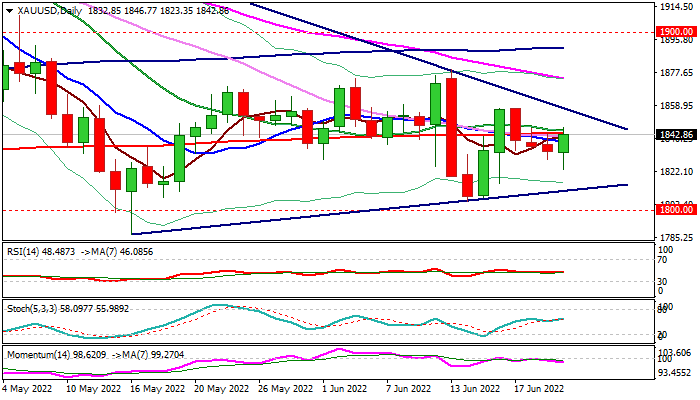
Spot gold edged higher on Wednesday after three days in red, boosted by risk aversion on lower stocks, political uncertainty and fears of recession, as raging inflation hurts economies while major central banks raise interest rates to curb rising prices that risks economic growth slowdown.
Traders are still cautious in taking positions but turn focus on safe-haven metal, due to a variety of factors which signal that migration into safety would be a possible preferred scenario.
Fresh advance probes through strong barrier at $1842/43 (50% retracement of $1879/$1809 bear-leg / 200DMA), close above which would improve near-term structure and shift focus towards pivotal levels at $1850 (Fibo 61.8%) and 1857 (Jun 16/17 double-top).
Despite positive initial signals, caution is still required as momentum remains negative on daily chart and falling thick daily cloud continues to weigh on near-term action .
Watch reaction on 200DMA for initial signal, with failure to break higher to keep the structure fragile and keep last week’s low ($1805) at risk, while sustained break higher would require confirmation on lift above $1857.
Res: 1850; 1857; 1861; 1874.
Sup: 1833; 1823; 1815; 1805.
Don’t Get Too Excited by Bear-Market Rallies
European stock markets are falling heavily again on Wednesday, reminding us all once more why we shouldn't get excited by the bear-market rallies.
There's a desperation to add substance to the, often sizeable, rallies that pop up in equity markets despite little or no rationale behind them and today is once again a lesson in why we shouldn't bother. In much the same way that "if it seems too good to be true, it probably is", if stocks are rallying for seemingly no reason, there probably isn't one. So it won't last.
On Friday I noted that triple witching days should be taken with a pinch of salt; that probably extends to the day or two after as markets readjust. And that's in normal times which this most certainly is not. Another reason not to get carried away by the trade at the start of the week, which also occurred over a US bank holiday; another possible red flag.
Last week, investors had to contend with an avalanche of monetary tightening, some expected, some certainly not. That's not so easy to just brush off, particularly in the run-up to Jerome Powell's two-day testimony in Congress. The "R" word is likely to come up a lot today and the Chairman will have a tough time dodging it, especially with mid-terms in five months. Naturally, he'll do his best to remain apolitical but I'm not sure investors will be able to ignore so much recession chat.
BoE may be slightly encouraged by inflation data
The UK public can't ignore the reality of recession either. A summer of discontent is coming as the cost-of-living crisis rears its head in the form of strike action. Day two of travel disruption begins tomorrow amid more failed negotiations earlier this week. With Brexit now behind us (ish) and mask mandates a thing of the past, it's only natural that we Brits have found the next thing to argue about this summer. How exciting.
Inflation is unfortunately a very real and significant problem though, as evidenced by the May CPI data this morning. The BoE may be slightly encouraged by the core reading which fell a little faster than expected. Energy and food continue to drive the headline reading which the central bank can't ignore but today's data may encourage them to continue on the gradual tightening path against expectations of super-sized hikes.
Are we seeing a recession being priced into oil markets?
Is oil prices getting whacked the clearest sign yet of recession fears spreading across financial markets? With equity markets, it's been a death by a thousand cuts, as inflation panic has morphed into tightening and growth fears and finally the reality of a recession. Oil market dynamics mean crude has rallied throughout this as demand has been strong and supply insufficient. Is all of that about to change?
There's been a clear shift over the last week and as far as I'm aware, there hasn't been a miraculous oil discovery that solves all of the supply issues. But there's been a far greater acceptance that a recession may be unavoidable if central banks are going to get control of inflation again. WTI is falling rapidly back towards $100 where it could see strong support.
Gold the outlier
It seems everything is making moves at the moment, everything except gold that is. The yellow metal is trading around a very familiar level - $1,840 - and showing little indication of deviating from here in any significant way. Perhaps Powell can spur it back to life. If not, the $1,800-1,870 range remains intact, as it has broadly speaking for the last six weeks.
Cryptos dotcom moment?
Bitcoin is clinging onto $20,000 for dear life, the fear being that the loss of it again could see it spiral out of control. The market environment remains very unfavourable, as have the headlines of late. I don't expect either to improve which could make life very uncomfortable in the short term.
One interesting story that has grabbed my attention today is BoE Deputy Governor Jon Cunliffe suggesting that this could be cryptos dotcom crash. The sink or swim moment which unearths the Amazon and eBays of the crypto space and rids it of the many that only exist to be the get-rich-quick vehicles many pray they will be. Crumbling prices aside, this could be a big moment for cryptocurrencies.
USDJPY May Find a Ceiling as High as 150
The Japanese yen leads in losses against the dollar amongst the G10 currencies. And so far, there are indications that the USDJPY’s rising trend will only be interrupted by technical corrections in the coming weeks or months.
The main fundamental driver for the USDJPY is the substantial divergence in the US and Japanese monetary policy. The former has raised its key rate by 150 points in the last three meetings and started selling assets off the Fed balance sheet. The latter has maintained its crisis rhetoric, promising to continue with QE and increasing bond purchases to keep 10-year yields close to 0.25%.
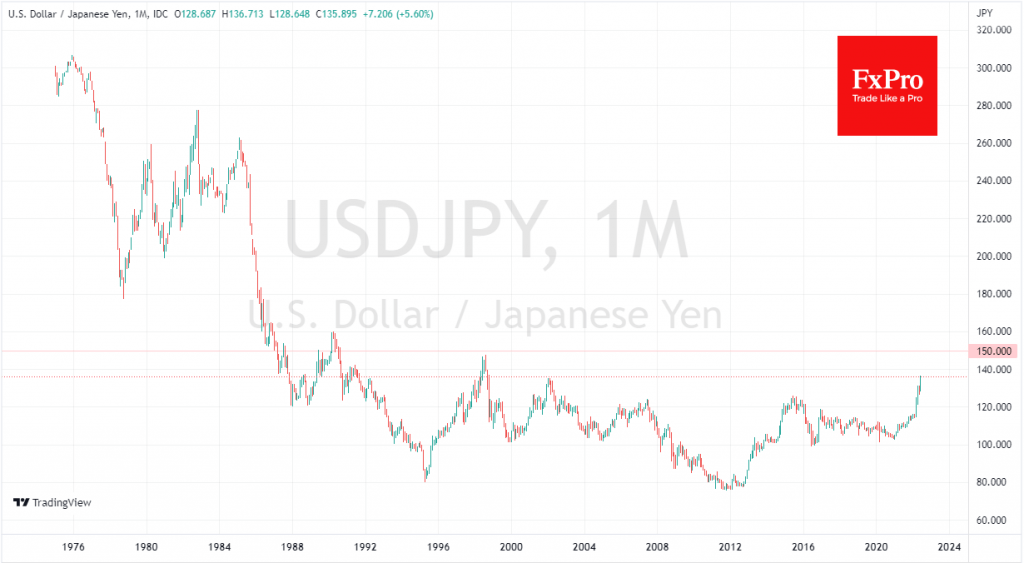
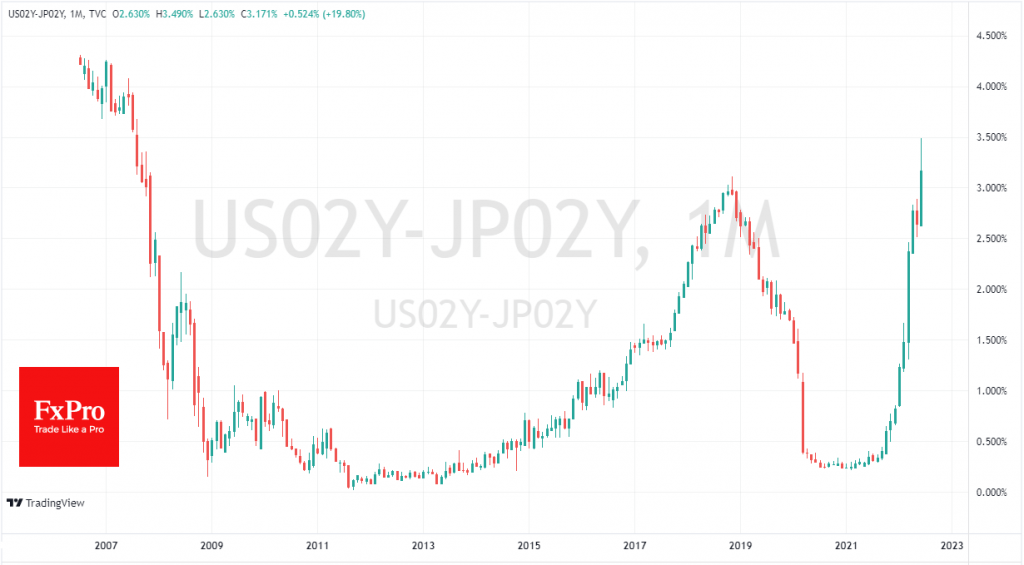
The currency market is not only wagering on the present but is actively putting expectations into prices. From this perspective, the USDJPY exchange rate results from an overlay of the key rate expectations, which are best reflected in 2-year bond yields. The spread started rising steadily in early 2021, at the same time as USDJPY began to rise.
The spread between the US and Japanese 2-year yields exceeded 3% this month, reaching 3.5%, the highest since 2007, although it was only 0.25% at the beginning of last year. Approaching a spread of 3% has not stopped the Fed from tightening, nor the Japanese rhetoric, so it makes sense to tune in to a return to pre-World Financial Crisis norms, i.e., above 4.3% versus 3.2% now, leaving the potential for around a third of the movement that already passed.
If these correlations between the USDJPY and US-JP 2-year yield spreads remain in place, we could see the dollar continue to rise to 150 yen, last seen in 1990 and twice as high as the historic lows of 2011.
Suppose the Japanese monetary authorities and the Ministry of Finance manage to steer the yen through such a devaluation, preserving confidence in the financial system. In that case, this could revive the economy by raising export competitiveness, potentially returning the Land of the Rising Sun to export-oriented status.
The Mercury Rises on Canadian Inflation in May
Consumer price inflation heated up in May, rising to 7.7% year-on-year (y/y), up from 6.8% in April. That was the fastest pace since January 1983, and higher than forecasters, including ourselves, were expecting.
Gasoline prices were a key driver, with prices at the pump up 12% month/month, and 48% y/y. For energy prices as a whole, May saw the biggest one-month increase since 2003.
Food price pressures were steady, up an elevated 8.8% y/y in May. Costs at grocery stores were up even further, up 9.7% y/y. Statistics Canada cited that Canadians report being the most affected by rising food prices.
Shelter inflation also remained steady, up a rapid 7.4% y/y, matching April's pace. Homeowners' replacement cost rose to a lesser extent in May (+11.1% y/y), as prices for new homes showed signs of cooling.
Services prices as a whole were up 5.2% y/y in May, a step up from 4.6% in April. Not surprisingly as Canadians start travelling again, inflation surged from traveller accommodation (+40.2% y/y).
Seasonally adjusted, month-on-month prices were up 1.1% following a 0.7% gain in April. That is the fastest increase since the introduction of the series in 1992, with the acceleration largely driven by energy prices. All items excluding food and energy were up 0.6% m/m in May, matching April's pace.
Statistics Canada started including used vehicle prices in the CPI for the first time in May, which rose 2.2%, but did not impact the headline tally. Statcan said headline CPI would have been the same without the introduction of used vehicle prices.
All three of the Bank of Canada's core inflation metrics edged higher in May. CPI-trim rose 0.2 percentage points (pp) to 5.4%, CPI-common by 0.4 pp to 3.9%, and CPI-median by 0.3 pp to 4.9%.
Key Implications
A generation of Canadians is experiencing high inflation for the first time. If you aren't over 40, you have never lived through inflation like this, and unfortunately, we are not expecting much of a reprieve going forward. Inflation is expected to remain elevated through 2022 as outlined in our recent forecast. On the shelter side, we are likely to see a continuation of rent price increases alongside rising mortgage interest costs. This will be balanced against the impact of declining house prices.
All of this re-enforces the view that the Bank of Canada will hike by 75 basis points (bps) on July 13th, following in the Fed's footsteps.
USD/JPY Mid-Day Outlook
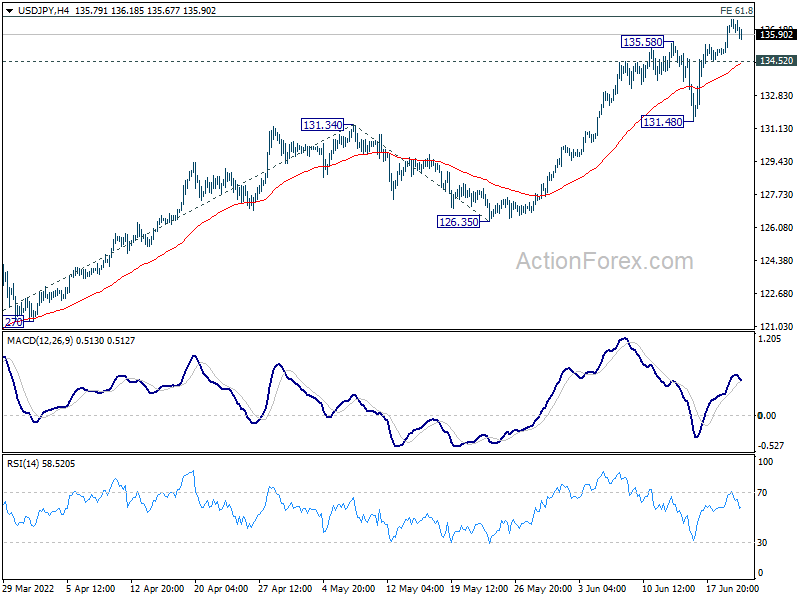
Daily Pivots: (S1) 135.50; (P) 136.10; (R1) 137.28; More...
No change in USD/JPY's outlook as further rally is expected. On the upside, break of 61.8% projection of 114.40 to 131.34 from 126.35 at 136.81 will target 100% projection at 143.29. On the downside, below 134.52 minor support will turn intraday bias neutral first. But outlook will remain bullish as long as 131.48 support holds.
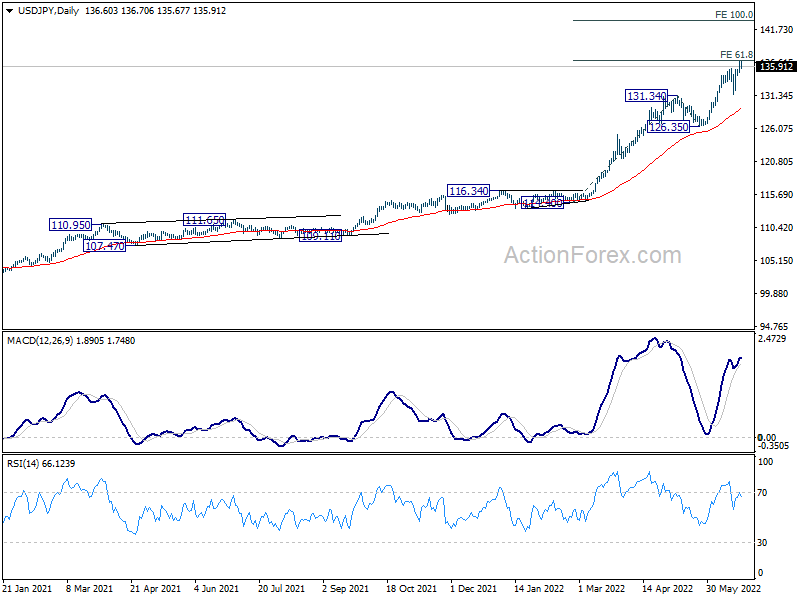
In the bigger picture, current rally is seen as part of the long term up trend from 75.56 (2011 low). Next target is 100% projection of 75.56 (2011 low) to 125.85 (2015 high) from 98.97 at 149.26, which is close to 147.68 (1998 high). This will remain the favored case as long as 126.35 support holds.
USD/CHF Mid-Day Outlook
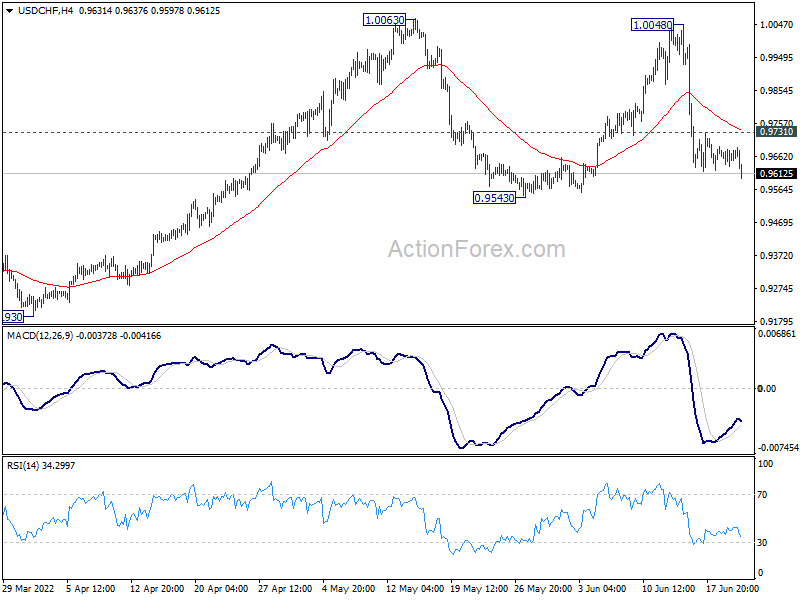
Daily Pivots: (S1) 0.9634; (P) 0.9659; (R1) 0.9686; More...
USD/CHF's fall from 1.0048 resumes today and deeper decline could be seen. But it's seen as the third leg of the corrective pattern from 1.0063. Strong support should be seen at around 0.9543 to contain downside to bring rebound. On the upside, above 0.9731 minor resistance will turn bias back to the upside for retesting 1.0063 resistance.
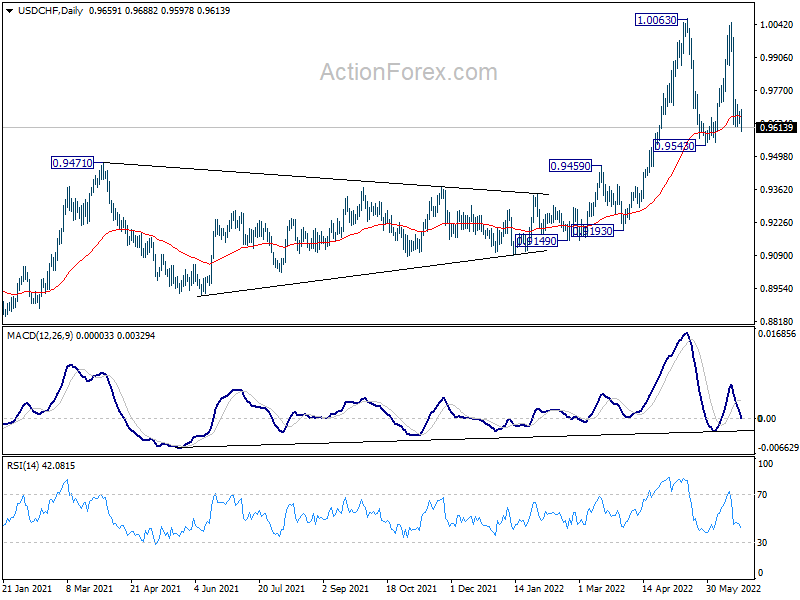
In the bigger picture, down trend from 1.0342 (2016 high) should have completed with three waves down to 0.8756 (2021 low) already. Rise from 0.8756 is likely a medium term up trend of its own. Next target is 1.0237/0342 resistance zone. This will remain the favored case as long as 0.9471 resistance turned support holds. However, sustained break of 0.9471 will extend long term range trading with another falling leg.
EUR/USD Mid-Day Outlook
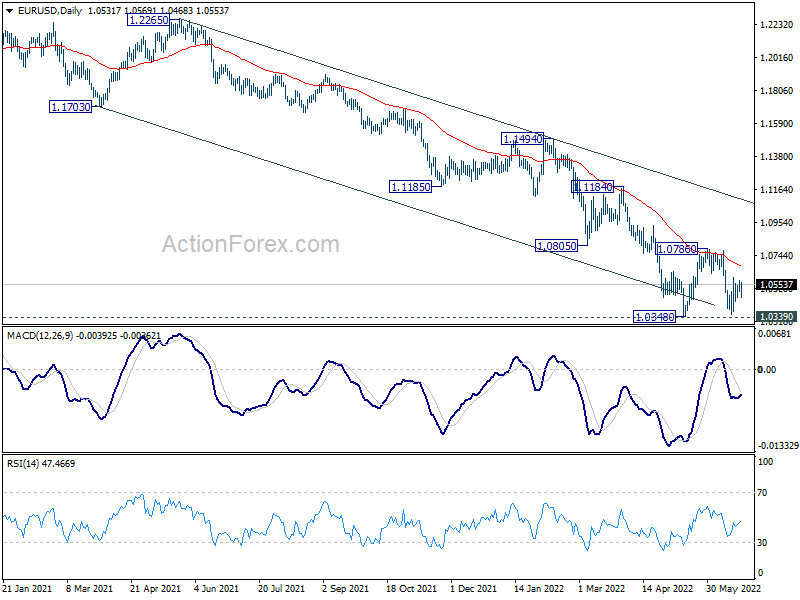
Daily Pivots: (S1) 1.0502; (P) 1.0542 (R1) 1.0576; More...
Intraday bias in EUR/USD remains neutral as range trading continues. Further fall is in favor with 1.0786 resistance intact. On the downside, sustained break of 1.0339/48 will resume larger down trend. Next target is long term projection level at 1.0090.
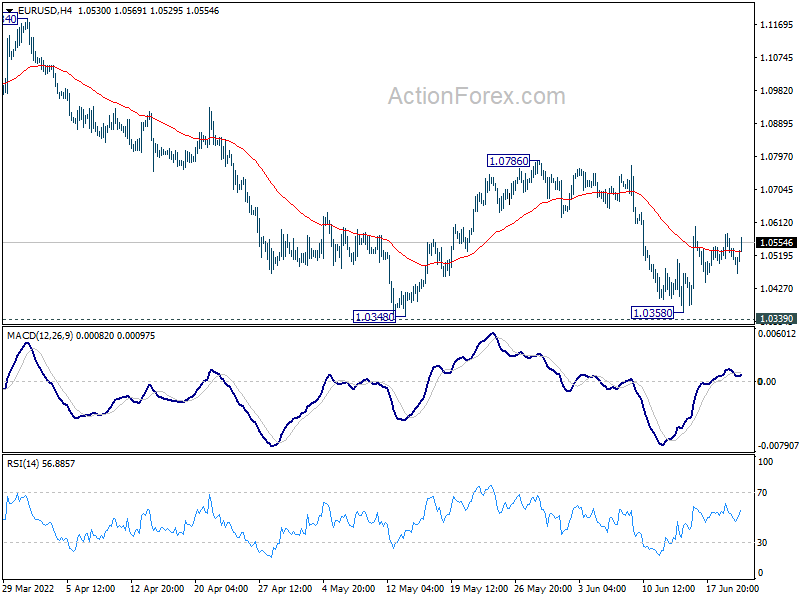
In the bigger picture, focus stays on 1.0339 long term support (2017 low). Decisive break there will resume whole down trend from 1.6039 (2008 high). Next target is 61.8% projection of 1.3993 to 1.0339 from 1.2348 at 1.0090. However, firm break of 1.0805 support turned resistance will delay this bearish case, and bring stronger rebound first.