

Sample Category Title
GBP/USD Mid-Day Outlook
Daily Pivots: (S1) 1.2241; (P) 1.2282; (R1) 1.2323; More...
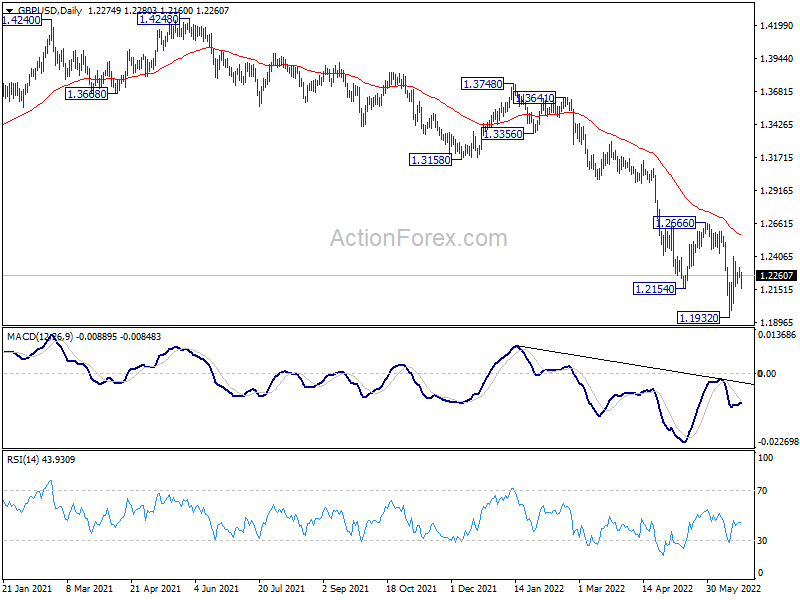
Intraday bias in GBP/USD remains neutral and outlook is unchanged. Outlook stays bearish as long as 1.2666 resistance holds. On the downside, break of 1.1932 will resume larger down trend from 1.4248. However, firm break of 1.2666 will suggest medium term bottoming and bring stronger rebound back towards 1.3158 support turned resistance.
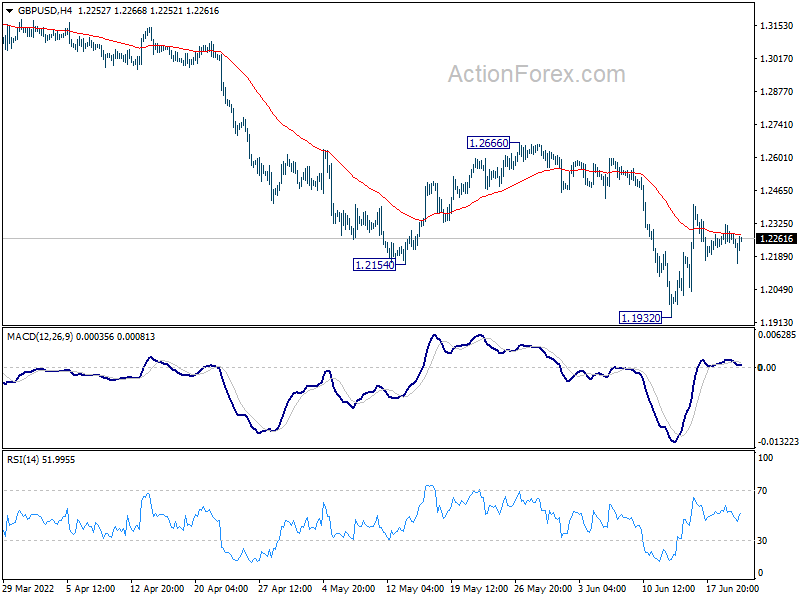
In the bigger picture, fall from 1.4248 (2018 high) could be a leg inside the pattern from 1.1409 (2020 low), or resuming the longer term down trend. Deeper decline is expected as long as 1.2666 resistance holds. Next target is 1.1409 low. However, firm break of 1.2666 will bring stronger rise back to 55 week EMA (now at 1.3175).
CAD and GBP Shrug Strong CPI, USD Awaits Powell
Risk aversion seems to back in indecisive markets today, with major European indexes and US futures trading down. Yen and Swiss Franc are trading mildly higher, followed by Dollar. Sterling and Canadian receive little support from strong consumer inflation reading. But Aussie and Kiwi are the worse performers while Euro is mixed. Focus will turn to Fed Chair Jerome Powell's testimony.
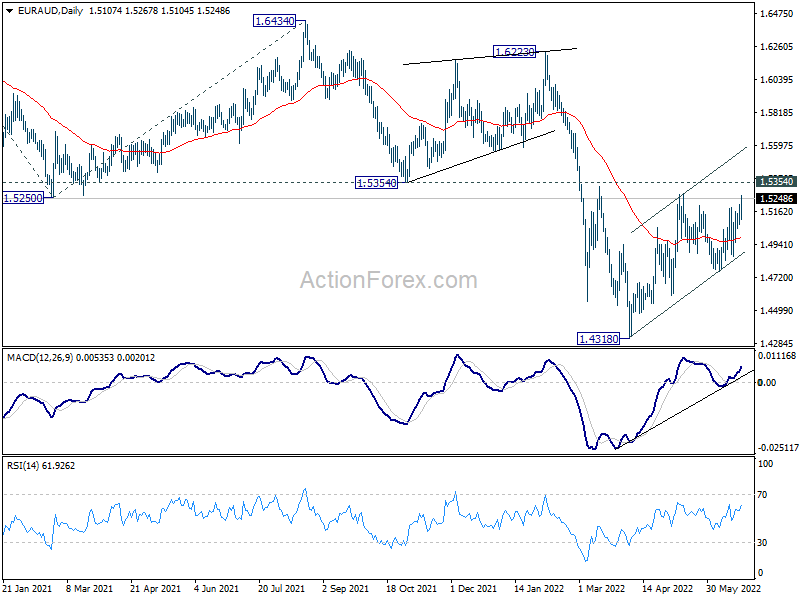
Technically, Aussie bears seem to be making some progresses. EUR/AUD is now pressing 1.5277 resistance and break will put 1.5354 support turned resistance in focus. Sustained break there will be a sign of larger bullish reversal and could prompt further buying. At the same time, AUD/USD might extend lower to take on 0.6828 low. Firm break there will also resume larger down trend to 0.6756/60 cluster support.
In Europe, at the time of writing, FTSE is down -1.31%. DAX is down -2.02%. CAC is down -1.84%. Germany 10-year yield is down -0.167 at 1.609. Earlier in Asia, Nikkei dropped -0.37%. Hong Kong HSI dropped -2.56%. China Shanghai SSE dropped -1.20%. Singapore Strait Times dropped -0.78%. Japan 10-year JGB yield rose 0.0049 to 0.241.
Canada CPI rose to 7.7% yoy in May, highest since 1983
Canada CPI accelerated from 7.7% yoy to 6.8% yoy in May, above expectation of 7.5% yoy. That's the highest reading since January 1983. The monthly rise 1.4% mom was the fastest since introduction of the series in 1992. Excluding gasoline, CPI rose 6.3% yoy, up from April's 5.8% yoy.
CPI common rose from 3.5% yoy to 3.9% yoy, above expectation of 3.4% yoy. CPI median rose from 4.6% yoy to 4.9% yoy, above expectation of 4.7% yoy. CPI trimmed rose from 5.2% yoy to 5.4% yoy, matched expectations.
ECB de Guindos: Fragmentation instruments should not interfere with monetary policy approach
ECB Vice-President Luis de Guindos said today "fragmentation is a significant worry." The central bank is " speeding up process to ready a tool against fragmentation," but the governing council has "still not discussed the details yet".
But he emphasized, "fragmentation instruments should not interfere with the overall monetary policy approach, which should be focused on fighting inflation." Also, the new tool should be different to previous PEPP, APP or OMT programs as "circumstances are not the same.
UK CPI rose to 9.1% yoy in May, another 40-yr high
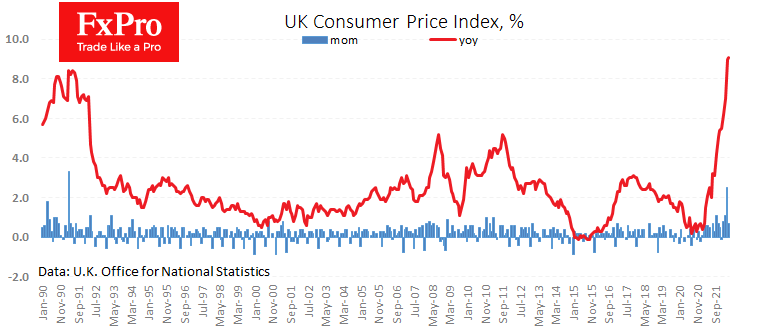
UK CPI accelerated further from 9.0% yoy to 9.1% yoy in May, matched expectations. That's another record high since the series began in 1997. Also, based on indicate model, it's the highest since around 1982, which was at nearly 11% yoy. CPI core, on the other hand, slowed from 6.2% yoy to 5.9% yoy, below expectation of 6.0% yoy.
ONS said: "Rising prices for food and non-alcoholic beverages, compared with falls a year ago, resulted in the largest upward contribution to the change in both the CPIH and CPI 12-month inflation rates between April and May 2022 (0.17 percentage points for CPIH). The largest offsetting downward contributions to change in the rates were from recreation and culture (0.10 percentage points for CPIH) and clothing and footwear (0.08 percentage points for CPIH).
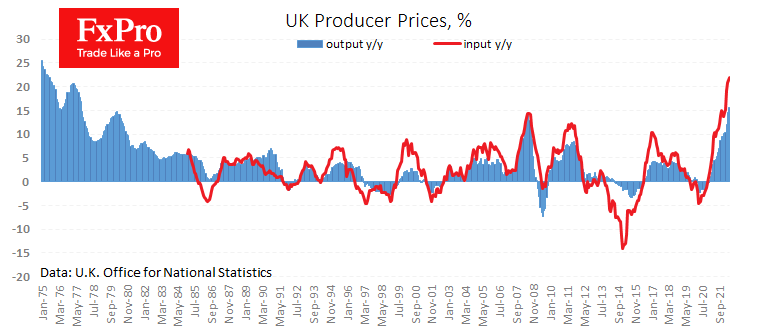
Also released PPI input came in at 2.1% mom, 22.1% yoy in May. PPI output was at 1.6% mom, 15.7% yoy. PPI output core was at 1.50% mom, 14.8% yoy.
BoJ firm on maintaining ultra-loose monetary policy
In the minutes of April 27-28 meeting of BoJ indicated that while the board was concerned with fluctuation in Yen's exchanger rate, it remained firm on the stance to continue with ultra-loose monetary policy.
One board member noted that Japan's economy was "still on its way to recovery". As a "commodity importer", the rise in commodity prices would "lead to an outflow of income from Japan and thus exert downward pressure on the economy." Hence, it's "necessary" to "continue with the current powerful monetary easing and thereby firmly support the economy."
Another member noted that "the challenge of monetary policy in Japan was not to curb inflation, as in the case of the United States and Europe, but to overcome inflation that was still too low". A different member commented that," with the addition of Russia's invasion of Ukraine to the existing downside risks to the economy, the situation had further changed significantly; against this backdrop, it was not appropriate for the Bank to make any big changes to its monetary policy stance."
Regarding Yen's depreciation, "a few members said excessive fluctuations in the foreign exchange market over a short period of time, such as those observed recently, would raise uncertainties about the future and make it more difficult for firms to formulate their business plans".
Some member noted, "it was necessary for the Bank to clearly communicate to the public that the aim of monetary policy conduct was to fulfill its mandate of achieving price stability, rather than to control foreign exchange rates."
Australia Westpac leading index dropped to 0.58 in May
Australia Westpac leading index dropped form 1.09% to 0.58% in May, still indicating above trend growth for 2022. Westpac said, "the components of the Index are indicating an important emerging theme around Australia's growth prospects – a significant shock to consumer confidence."
On RBA policy, Westpac expects the central bank to hike a further 50bps in July. It assessed that at 1.35% after the hike, interest rate is still below the neutral setting. Given the tight labor market and rising inflation, further monetary tightening can be expected through 2022.
New Zealand goods exports rose 18% yoy in May, imports rose 24% yoy
New Zealand goods exports rose 18% yoy or NZD 1.1B to NZD 7.0B in May. Goods imports rose 24% yoy or NZD 1.3B to NZD 6.7B. Monthly trade surplus narrowed from NZD 440m to NZD 263m, smaller than expectation of NZD 580m.
Exports to all top destinations rose except to China: China (down -3.8%), Australia (up 49%), US (up 18%), EU (up 23%), Japan (up 0.7%).
Imports from most partners rose except from the US: China (up 25%), EU (up 12%), Australia (up 18%), US (down -5.5%), Japan (up 41%).
GBP/USD Mid-Day Outlook
Daily Pivots: (S1) 1.2241; (P) 1.2282; (R1) 1.2323; More...
Intraday bias in GBP/USD remains neutral and outlook is unchanged. Outlook stays bearish as long as 1.2666 resistance holds. On the downside, break of 1.1932 will resume larger down trend from 1.4248. However, firm break of 1.2666 will suggest medium term bottoming and bring stronger rebound back towards 1.3158 support turned resistance.
In the bigger picture, fall from 1.4248 (2018 high) could be a leg inside the pattern from 1.1409 (2020 low), or resuming the longer term down trend. Deeper decline is expected as long as 1.2666 resistance holds. Next target is 1.1409 low. However, firm break of 1.2666 will bring stronger rise back to 55 week EMA (now at 1.3175).
Economic Indicators Update
| GMT | Ccy | Events | Actual | Forecast | Previous | Revised |
|---|---|---|---|---|---|---|
| 22:45 | NZD | Trade Balance (NZD) May | 263M | 580M | 584M | 440M |
| 23:50 | JPY | BoJ Meeting Minutes | ||||
| 00:30 | AUD | Westpac Leading Index M/M May | -0.10% | -0.10% | ||
| 06:00 | GBP | CPI M/M May | 0.70% | 1.90% | 2.50% | |
| 06:00 | GBP | CPI Y/Y May | 9.10% | 9.10% | 9.00% | |
| 06:00 | GBP | Core CPI Y/Y May | 5.90% | 6.00% | 6.20% | |
| 06:00 | GBP | RPI M/M May | 0.70% | 0.40% | 3.40% | |
| 06:00 | GBP | RPI Y/Y May | 11.70% | 11.30% | 11.10% | |
| 06:00 | GBP | PPI Input M/M May | 2.10% | 0.70% | 1.10% | 2.70% |
| 06:00 | GBP | PPI Input Y/Y May | 22.10% | 19.90% | 18.60% | 20.90% |
| 06:00 | GBP | PPI Output M/M May | 1.60% | 1.80% | 2.30% | 2.80% |
| 06:00 | GBP | PPI Output Y/Y May | 15.70% | 14.70% | 14.00% | 14.70% |
| 06:00 | GBP | PPI Core Output M/M May | 1.50% | 2.00% | 1.60% | 12.20% |
| 06:00 | GBP | PPI Core Output Y/Y May | 14.80% | 13.70% | 13.00% | 13.90% |
| 12:30 | CAD | CPI M/M May | 1.40% | 0.90% | 0.60% | |
| 12:30 | CAD | CPI Y/Y May | 7.70% | 7.50% | 6.80% | |
| 12:30 | CAD | CPI Common Y/Y May | 3.90% | 3.40% | 3.20% | 3.50% |
| 12:30 | CAD | CPI Median Y/Y May | 4.90% | 4.70% | 4.40% | 4.60% |
| 12:30 | CAD | CPI Trimmed Y/Y May | 5.40% | 5.40% | 5.10% | 5.20% |
| 14:00 | EUR | Eurozone Consumer Confidence Jun P | -20 | -21 |
Canada CPI rose to 7.7% yoy in May, highest since 1983
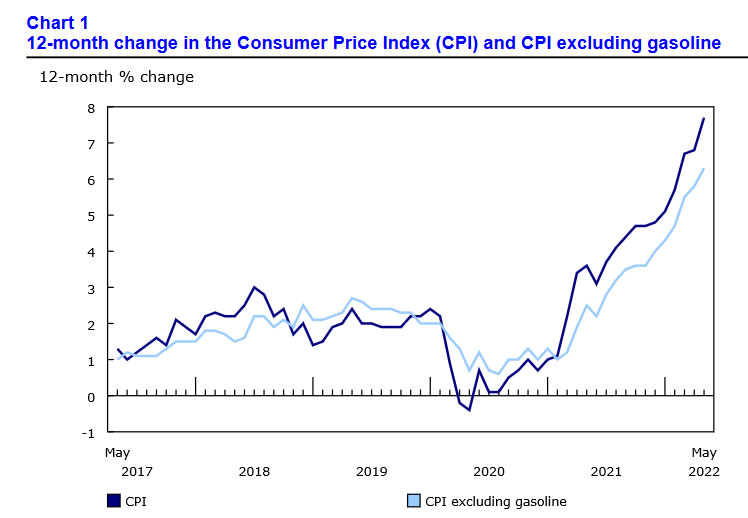
Canada CPI accelerated from 7.7% yoy to 6.8% yoy in May, above expectation of 7.5% yoy. That's the highest reading since January 1983. The monthly rise 1.4% mom was the fastest since introduction of the series in 1992. Excluding gasoline, CPI rose 6.3% yoy, up from April's 5.8% yoy.
CPI common rose from 3.5% yoy to 3.9% yoy, above expectation of 3.4% yoy. CPI median rose from 4.6% yoy to 4.9% yoy, above expectation of 4.7% yoy. CPI trimmed rose from 5.2% yoy to 5.4% yoy, matched expectations.
British Pound Yawns as CPI Matches Estimate
UK inflation nudged higher in May, as was expected. The headline release rose to 9.1% YoY, up slightly from the 9.0% gain in April. On a monthly basis, CPI nudged higher to 0.7%, up from 0.6% in April.
UK inflation nudges higher
The fact that UK inflation accelerated and an inflation peak remains elusive is not positive news. Still, the 9.1% reading matched the estimate and the market reaction has been muted. The ball is in the court of the Bank of England, but the trouble is that Bailey & Co. appear to have raised the white flag in response to the inflation onslaught. The BoE is projecting that inflation will peak above 11%(!) later in 2022, which is cold comfort for Britons who are grappling with a serious cost of living crisis. Inflation expectations are rising, and if these become unanchored, it will be a mammoth task for the government and the BoE to get expectations back into the box. There is a wave of discontent among workers and this week’s paralysing rail strike could be just the start of major labour unrest. Consumer confidence is understandably down, and if this translates into less consumer spending, the economic woes will only compound.
With no US releases today, investors will be directing their full attention at what Fed Chair Powell has to say on Capitol Hill. The markets will be looking for clues on the direction of monetary policy and the tone of Powell’s testimony will be doubly important to jittery markets which are becoming more concerned about a recession by the day. Powell’s appearance could shake up the currency markets, which are having a quiet day.
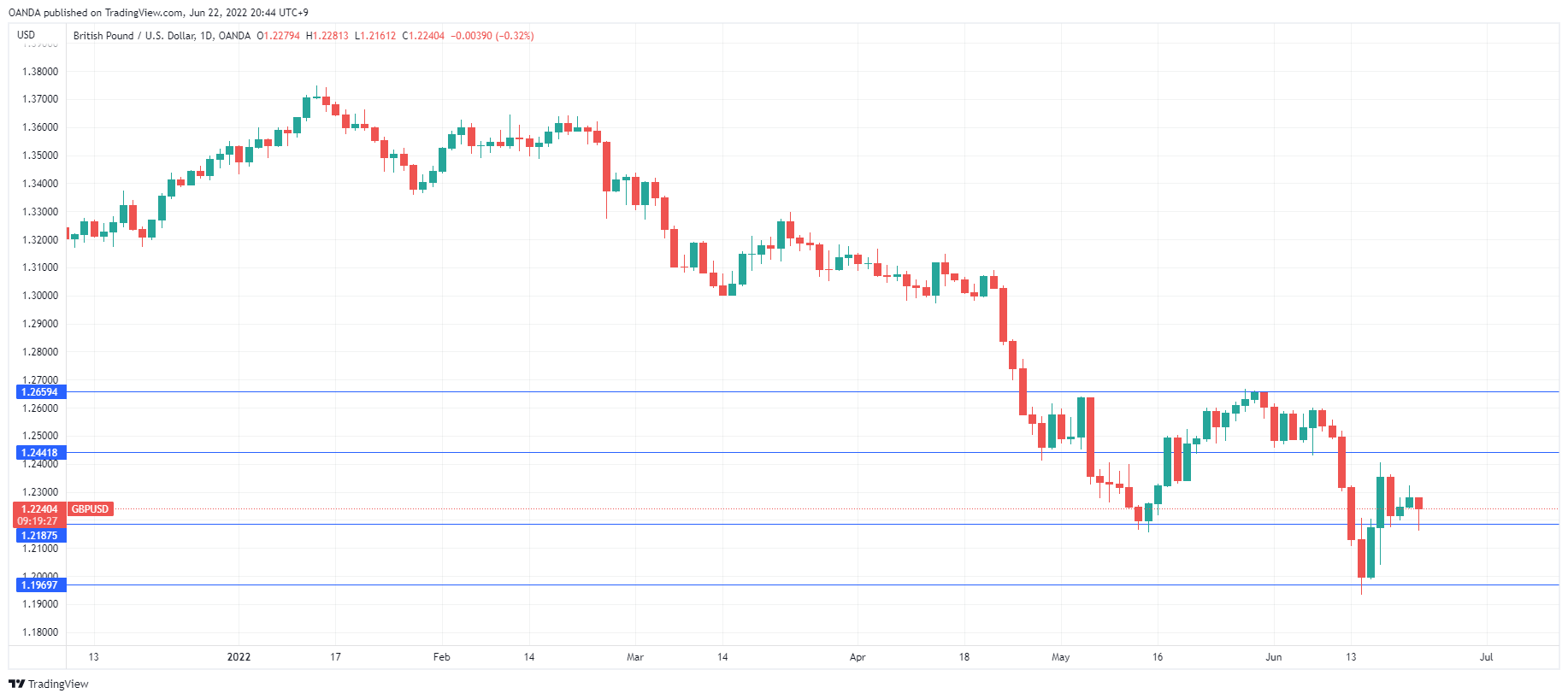
GBP/USD Technical
- GBP/USD tested support at 1.2187 earlier in the day. Next, there is support at 1.1969
- There is resistance at 1.2441 and 1.2659
Canada’s CPI Expected to Rise
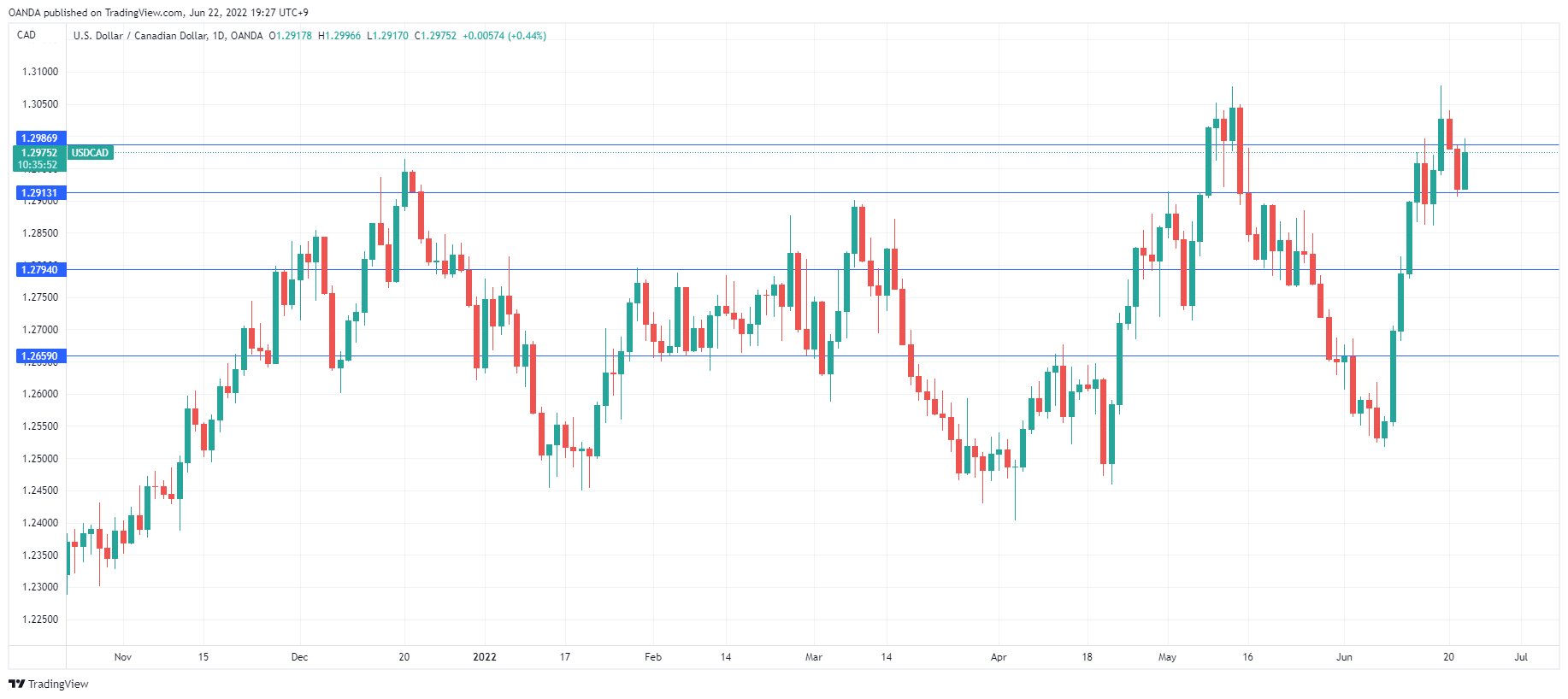
The Canadian dollar started the week with gains, but has reversed directions on Wednesday. USD/CAD is trading at 1.2978, up 0.47% on the day.
CPI expected to hit 7.4%
Canada releases the May inflation report later today, and the markets are bracing for another rise. CPI is expected to rise to 7.4%, which would be a sharp rise from the 6.8% gain in April, a 30-year high. In a sign of the times, today’s inflation report will include used car prices for the first time and give more weight to gasoline prices.
With no sign of the long-sought-after inflation peak, the Bank of Canada is under strong pressure to ratchet up its rate hikes. The BoC holds its next meeting on July 13th, and a CPI reading above 6.8% would virtually cement a massive 0.75% rate hike. The markets have priced in a 0.75% at about 80%. RBC and CIBC also expect the central bank to deliver a 0.75% increase.
The BoC has warned that it expects inflation to move higher in the near term and has signalled that it will raise rates towards the upper end of the 2%-3% neutral range. With the benchmark rate currently at 1.5%, that means that we can expect significant tightening in the second half of the year. The BoC is also looking to remain in sync with the Federal Reserve, which delivered a super-size 0.75% hike just last week.
There are no US releases on Wednesday, but there will be plenty of interest in what Fed Chair Powell has to say on Capitol Hill. The markets will be looking for clues on the direction of monetary policy. Last week, Powell said that further 0.75% hikes were unlikely, and a repeat of this stance could dampen sentiment towards the US dollar. At the same time, if Powell’s forecast for the US economy is on the pessimistic side, risk appetite could fall and send the greenback higher.
USD/CAD Technical
- USD/CAD faces resistance at 1.2894. Above, there is resistance at the round number of 1.3000
- There is support at 1.2706 and 1.2600
USD/JPY: Bulls Pausing Under New Multi-Year High Before Fresh Push Higher
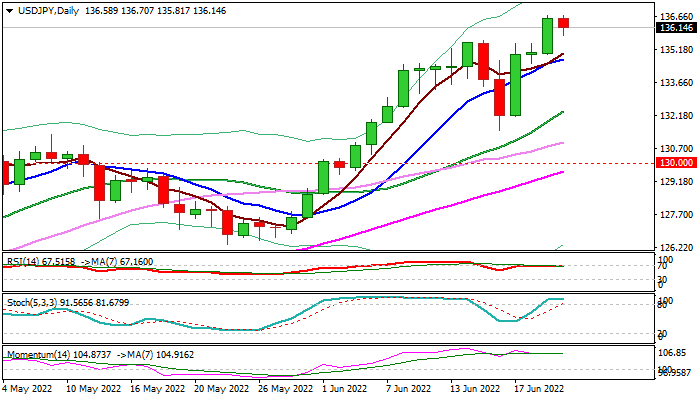
The USDJPY is taking a breather under new 24-year high on Wednesday, as overbought conditions prompt some profit-taking after the pair advanced 3.3% in past three days and traded at levels last seen in 1998.
Overall picture shows bulls fully in play, as dollar remains well supported by strong safe-haven demand, expectations for Fed to remain hawkish in coming months and weakness of its major counterpart.
Shallow dips signal positioning for fresh push higher, with former top at 135.57 and rising 10DMA (134.73) to ideally contain.
Fibonacci projections at 137.13 and 138.09 mark next target, with violation of the latter to unmask psychological 140 barrier.
Res: 136.70; 137.13; 137.61; 138.09.
Sup: 135.81; 135.57; 134.73; 134.09.
JP 225 index maintains cloudy outlook
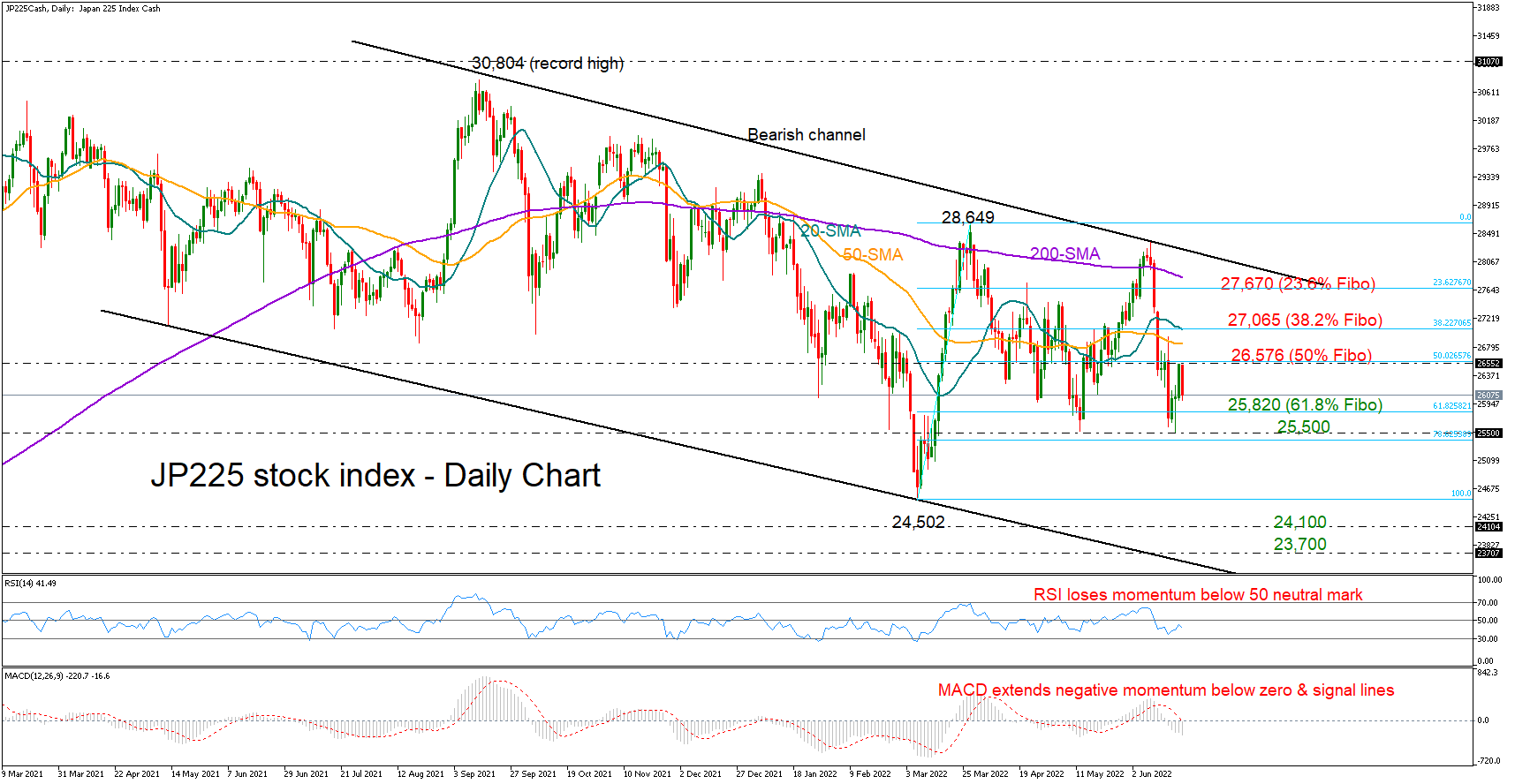
Japan’s 225 stock index (cash) got rejected near the 50% Fibonacci retracement of the 24,500 – 28,649 upleg at 26,576 soon after departing from May’s base of 25,508.
The bearish bias is still in play as the RSI is retracing its latest rebound below its 50 neutral mark, while the MACD keeps extending its negative momentum below its red signal line.
If the 61.8% Fibonacci of 25,820 gives way on the downside, the bears will push harder to escape the trap around 25,508 and pressure the price towards the March 16-month low of 24,502. Even lower, the 2020 resistance territory of 24,100 – 23,700 may attract special attention before all eyes turn to the channel’s lower boundary seen around 23,600.
On the upside, the bulls will need to clear the wall at 26,576 in order to meet the 38.2% Fibonacci level at 27,065. The 23.6% Fibonacci of 27,670 and the 200-day simple moving average (SMA) could be the next obstacles on the way up, though a decisive close above the bearish channel at 28,000 will be more meaningful, especially if the index officially violates its downtrend above the March high of 28,649.
All in all, the short-term risk for Japan’s 225 index is skewed to the downside, with traders likely looking for support within the 25,800 - 25,500 zone during the coming sessions.
UK Inflation Indicates that Bank of England is Moving Too Slow
Consumer inflation continues to gain momentum in the UK. Data for May showed that CPI accelerated to 9.1% y/y – a record among the G7 and a 40-year high. The monthly price growth rate was 0.7% compared to 2.5% and 1.1% in the previous two months. However, apart from the reversal to lower base commodity and energy prices in the last couple of weeks, there is little indication that the Bank of England can relax. Moreover, it needs to double the pace of the rate increase from 25 points at once.
Last month producer input prices rose by 2.1% and output prices by 1.6%, reaching an annual rate of 22% and 15.6%, respectively. Under these conditions, producers and retailers will continue to pass increasing costs down to consumers. Unlike in the early years after the financial crisis, retail sales and employment are strong, which allows such a shift of rising outlays to end consumers.
It could take another two months of waiting for a turning point in inflation, the CPI will reach a high base effect, and in that time, the CPI could get double-digit y/y growth rates.
In this environment, the Bank of England’s moves to raise the rate by 25 points at each meeting are not capable of curbing inflation.
Perhaps the main positive effect of this policy is the devaluation of the pound’s purchasing power and the reduction of the debt burden in real terms. However, the more obvious consequence of such policies is a drop in confidence in local financial markets and the pound, which we see with the Japanese yen at its lows against the dollar in 24 years.
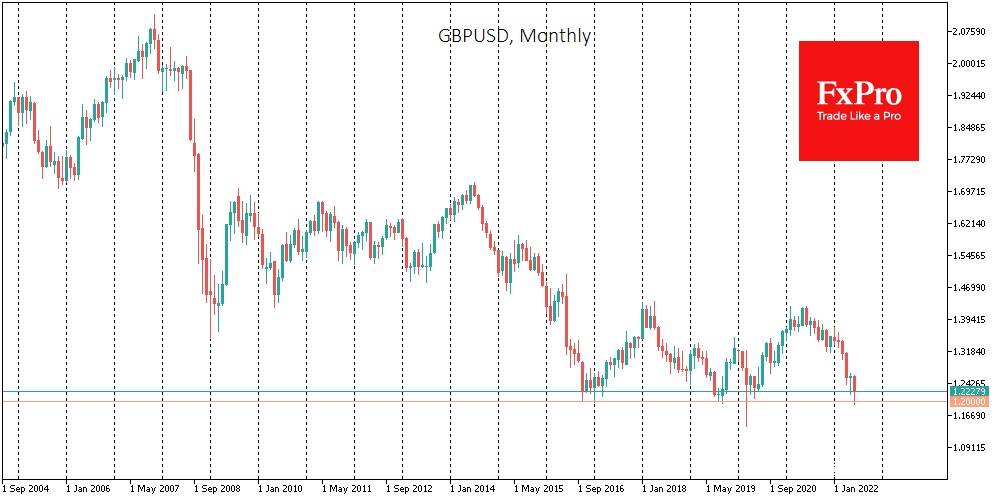
GBPUSD is now trading at 1.22 – near the psychological low of 1.2000, where it received critical support in 2017 and 2020. But that support may not survive the third test of strength due to an increasingly threatening gap between inflation and interest rates, which would devalue debt. But this is a risky policy that could undermine confidence in the financial system, which will require decisive and brutal measures for the economy to restore.
WTI Oil: Oil Price Falls Over $5 as US Biden Pushes for Lower Fuel Prices
WTI oil fell sharply on Wednesday, losing around 5.6% in Asian and early European session, following push by US President Biden to bring down soaring fuel prices, which cause a huge problem to Americans as the summer driving season started.
The measures include pressure on America’s major energy companies to drive down fuel prices as they made huge profits and a call for temporary suspension of a federal tax on gasoline.
Representatives of oil companies are set to meet President Biden tomorrow, as many already complained about measures, but the immediate response from the White House left no space for oil producers to escape from the plan.
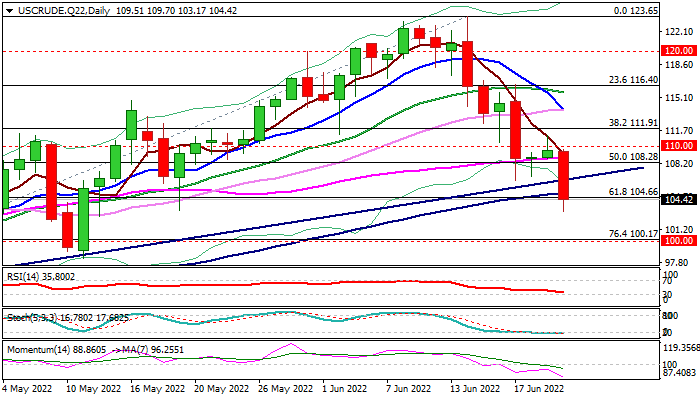
Daily chart shows a number of large bearish candles, signaling the near-term price action is in steep downtrend, which extends into the second straight week, after last week’s 12% drop that completed a reversal pattern on weekly chart.
Weak daily studies complement negative fundamentals, as bearish momentum continues to strengthen and the latest fall broke through important technical supports at: $106.55 (trendline support), $105.07 (100DMA) and $104.66 (Fibo 61.8% of $92.92/$123.65) with close below these levels to boost negative signals.
Bears could stretch towards $100 zone (Fibo 76.4% / psychological) on persisting negative sentiment, with corrective upticks on oversold conditions and profit-taking, to offer better levels to re-join bearish market.
Broken bull-trendline offers solid resistance at $106.55) which should ideally cap and guard upper pivots at $108.28 /$110.00 (broken Fibo 50% / psychological).
Res: 105.08; 105.68; 106.55; 108.28.
Sup: 103.17; 102.65; 100.17; 100.00.
ECB de Guindos: Fragmentation instruments should not interfere with monetary policy approach
ECB Vice-President Luis de Guindos said today "fragmentation is a significant worry." The central bank is " speeding up process to ready a tool against fragmentation," but the governing council has "still not discussed the details yet".
But he emphasized, "fragmentation instruments should not interfere with the overall monetary policy approach, which should be focused on fighting inflation." Also, the new tool should be different to previous PEPP, APP or OMT programs as "circumstances are not the same.