Sample Category Title
GBP/USD: Cable Remains Constructive But Downside Still Vulnerable; US Jobs Data in Focus
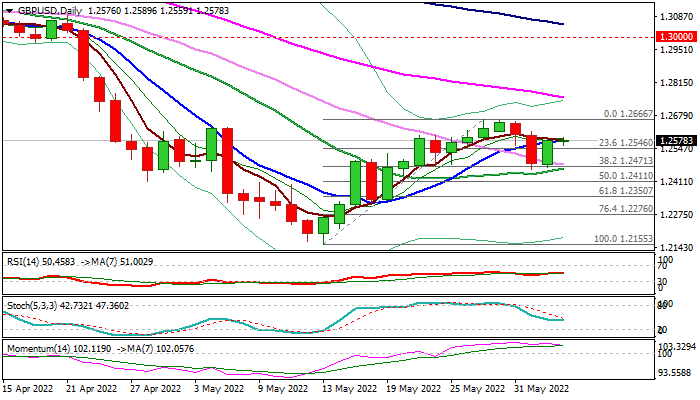
Cable is moving within a narrow range in early Friday and remains constructive after Thursday’s 0.75% advance.
Technical picture is mixed, as moving averages of 10/20/30 days are conflicting, bullish momentum is weaker and RSI neutral.
Falling daily Ichimoku clouds weighs, along with a double-top pattern forming on weekly chart and warning of recovery stall.
Near-term action is struggling at 10DMA (1.2571) which needs to be cleared to open way for full retracement of 1.2666/1.2458 pullback.
On the other side, holding below 10DMA would keep the downside vulnerable, but break of pullback’s low (1.2458), reinforced by 20DMA, would bring bears back to play.
US NFP data are key event today and expected to generate fresh direction signal.
Res: 1.2589; 1.2616; 1.2666; 1.2700
Sup: 1.2546; 1.2471; 1.2458; 1.2411
EURUSD Approaches Key Resistance ahead of US NFP Data
The price of crude oil rose even after the latest decision by OPEC and its partners pledged to boost production. They will increase production by 650k barrels a day in July and August. This is higher than the 400k barrels per day that the cartel has been hiking in the past few months. The decision came a few days after the EU agreed to impose a ban on Russian oil imports. It also came a day after Saudi Arabia said that it will be open to hike production depending on Russia’s supply. Oil also rose after the EIA published a sharp drawdown of oil inventories. They declined by more than 5 million, which was higher than the median estimate of a 1.3 million drawdown.
The US dollar retreated slightly ahead of the upcoming official jobs numbers by the Bureau of Labor Statistics. Economists expect the data to show that the country created 325k jobs in May from the previous 406k. They also see the unemployment rate falling from 3.6% to 3.5%. The most important data to watch will be wages considering that inflation has surged. On Thursday, data by ADP showed that the private sector added just 128k jobs. On the other hand, data by the BLS showed that initial jobless claims declined to 200k.
American stocks moved sideways after Jamie Dimon of JP Morgan warned that the country’s economy faced a hurricane in the coming months. He cited the ongoing inflationary pressures in the country and the slowdown in hiring. Stocks also reacted to the latest earnings and revenue guidance by Microsoft. The company said that it expects its fiscal fourth-quarter sales to be $51.94 billion and $52.4 billion. This was lower than the previous range of between $52.4 billion and $53.2 billion. The company cited the lower guidance to the strong US dollar. This means that the company’s foreign earnings will be lower when converted to the US dollar.
NAS100
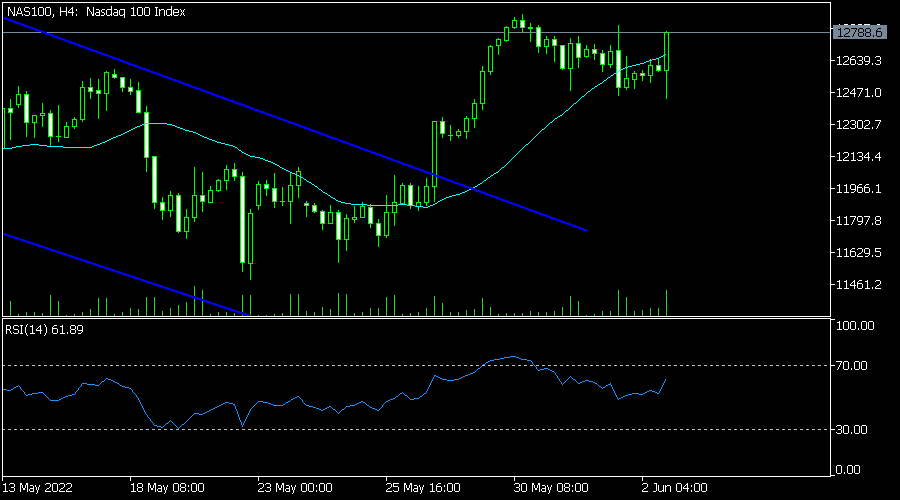
The Nasdaq 100 index rose to a high of $12,780 from this week’s low of $12,400. On the four-hour chart, the index is above the descending channel shown in blue. It managed to cross the 25-day and 50-day moving averages while the Relative Strength Index (RSI) has moved close to the overbought level. Therefore, the index will likely keep rising as bulls target the resistance at $13,000.
EURJPY
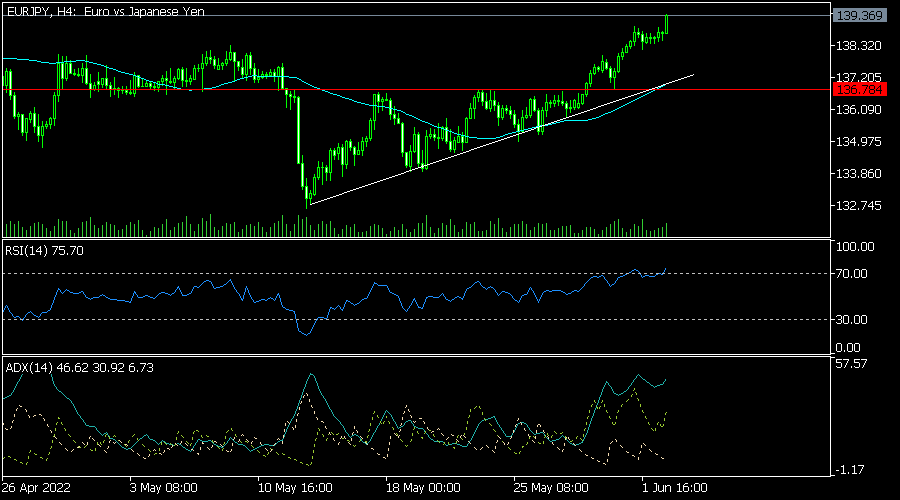
The EURJPY pair rallied to a high of 139.36 after the strong EU PPI data. It rose to the highest level since April 21st. It rose above the important resistance level at 136.78 and the ascending trendline shown in white. It also rose above the 25-day moving average while the Relative Strength Index (RSI) has moved above the overbought level. The Average Directional Index has kept rising. Therefore, the pair will likely continue rising.
EURUSD
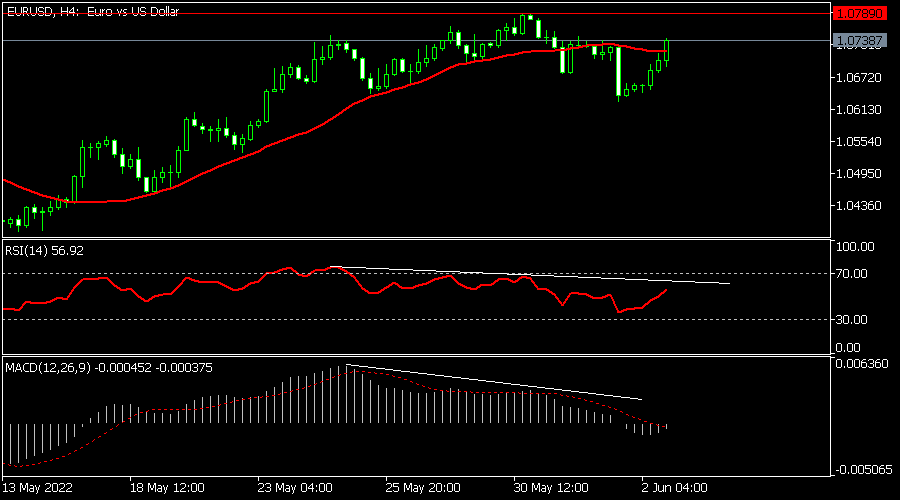
The EURUSD pair continued rising ahead of the upcoming US NFP data. It is trading at 1.0737, which is above the important support at 1.0615. The MACD has moved slightly below the neutral level while the RSI has moved above the neutral level at 50. The pair will likely keep rising ahead of the US jobs data, with the next key resistance being at 1.0790.
Eurozone retail sales dropped -1.3% mom in Apr, EU down -1.3% mom
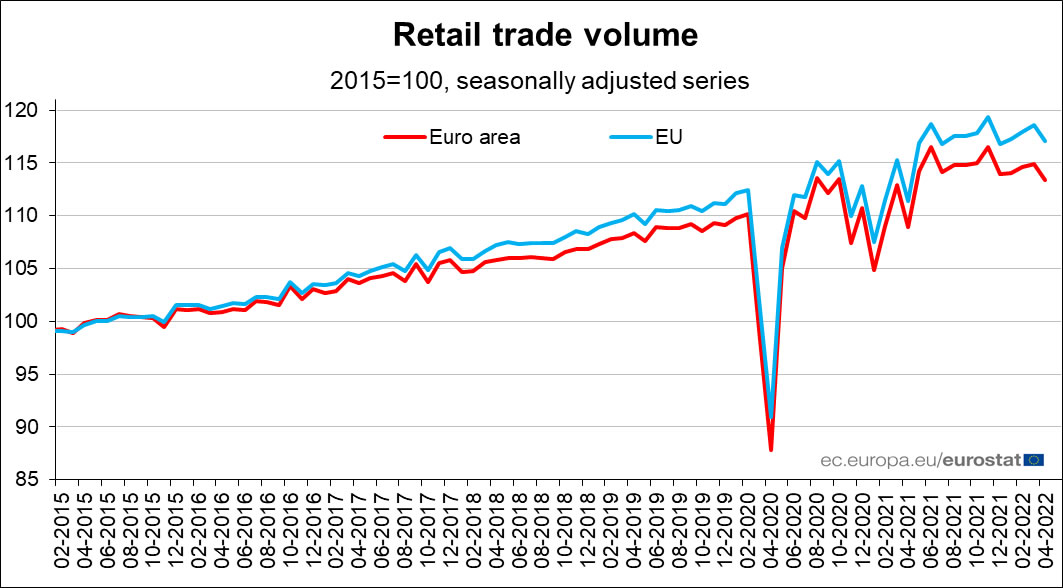
Eurozone retail sales dropped -1.3% mom in Apr, much worse than expectation of 0.3% mom rise. Volume of retail trade decreased by -2.6% for food, drinks and tobacco and by -0.7% for non-food products, while it increased by 1.9% for automotive fuels.
EU retail sales dropped -1.3% mom. Among Member States for which data are available, the largest monthly decreases in the total retail trade volume were registered in Slovenia (-7.7%), Germany (-5.4%) and Latvia (-3.9%). The highest increases were observed in Spain (+5.3%), Luxembourg (+3.7%) and Ireland (+1.9%).
Big Picture: A (Mild) Recession in Western Economies Seems Unavoidable
Key takeaways
- The war in Ukraine is contributing to the biggest commodity price shock in decades, adding to already significant inflation pressures and need for vigilant central bank tightening.
- Yet near-term economic growth will continue to be supported by pent-up demand, savings, and the re-opening of economies, benefiting especially service sector activity.
- However, substantial monetary policy tightening will increasingly weigh on economic growth, prompting a mild recession in the US around Q2 23, spilling over to other western economies and EMs later next year.
- Recovery in the Chinese economy in 23 will mitigate some of the setback, but still we expect unemployment to rise in the US and later in other western economies.
- The risk is skewed toward an earlier recession given the scale of financial tightening and erosion of purchasing power from high inflation.
Australian Economic Growth Forecasts Lowered to 4% in 2022 and 2% in 2023
Increased stress for the household sector and a major downward revision to the dwelling construction cycle have lowered our growth forecasts in 2022 from 4.5% to 4.0% and 2.5% to 2.0% in 2023. Still, 2022 is a strong year for growth, as the economy reopens and households take advantage of their high savings rates and solid balance sheets.
Following the release of the March quarter national accounts for Australia we have slightly lowered our growth forecasts for 2022 and 2023.
The 2022 growth rate is lowered from 4.5% to 4.0%; 2023 is reduced from 2.5% to 2.0%; while 2024 is lifted from 2.0% to 2.5%.
In the March quarter national accounts, we saw strong consumer spending growth of 1.5% which was largely funded by a fall in the savings rate from 13.4% to 11.4% releasing $6bn to finance the $8.7bn in additional consumer spending.
At 11.4% currently, the household savings rate remains well above the 6% “equilibrium” rate near where we expect the rate to settle by year’s end.
That fall in the savings rate is likely to release a further $15-20bn to support household spending through the year.
Overall, we expect household spending to increase by a solid 6% over the course of 2022 highlighted by 2.6% and 1.1% growth in the June and September quarters to supplement the (disrupted) 1.5% increase in the March quarter.
That is down from a forecast 6.2%. We are now expecting a more abrupt slowing in the December quarter (revised down from 0.9% to 0.7%) as the reopening effect fades; the boost from a lower savings rate ease; and house prices continue to fall.
Consumer Sentiment is likely to remain weak in the face of higher costs and rising interest rates. However, confidence in job security is likely to remain high and household balance sheets have been strengthened by the accumulation of around $265 billion in excess savings over the last two years.
Perceived job security and the balance sheet buffer will allow households to maintain spending plans at a higher level than would have been the case in the current environment of rising living costs and increases in interest rates.
As we saw in the March quarter there is considerable “opening up” momentum in the household sector despite the material disruptions from Omicron and the floods.
The June and September quarters are likely to continue to see that boost momentum lifting further in the absence of those disruptions in the March quarter.
There is still scope for considerable “catch up” – discretionary services consumption is still 12% below pre Covid levels.
The major states – NSW and Victoria – which were most impacted by lock downs will be in catch up. While nationally overall spending is 2.5% above pre Covid levels it is 5.3% above pre Covid levels outside NSW and Victoria.
However, by the December quarter, with the savings rate converging on that 6% equilibrium level and households becoming increasingly stretched by further increases in the cost of living (food; rents; energy); rising interest rates and falling house prices we anticipate that momentum in consumer spending will slow appreciably.
That lacklustre momentum will extend into 2023 with consumer spending growth likely to slow from 6% in 2022 to a below trend 2.5% in 2023.
In turn businesses who are currently generally quite upbeat will have to review their investment plans. We expect business investment growth to slow from 8% in 2022 to 4% in 2023.
Another key factor behind our downward revisions to growth in both 2022 and 2023 is the dwelling construction cycle.
Detached house dwelling approvals have been signalling a very strong cycle, but dwelling construction contracted for the second quarter in a row in the March quarter. Activity has been clearly impacted by labour / material shortages, and runaway costs.
Projects are taking longer to complete while some are being shelved. We have lowered our forecast for dwelling construction growth from 9.4% to 5.6% in 2022; and pushed some of the Home Builder related activity into 2023 but severely written down overall activity, particularly in the second half of 2023.
Supply and demand for new dwellings is expected to dry up under the weight of high costs; labour shortages; and restrained demand.
These forecasts are heavily reliant on our policy; wages; and inflation forecasts.
We have not changed those key parameters: peak in RBA cycle of 2.25% by May next year; peak to trough fall in house prices of 14% to mid 2024; inflation moving back toward the target zone by end 2023; wages growth to peak in 2023; the unemployment rate to bottom out at 3.2% by end 2022 and increasing in the second half of 2023 as demand slows and overseas migration returns to pre Covid levels by end 2024.
Eurozone PMI composite finalized at 54.8, risks skewed to downside for coming months
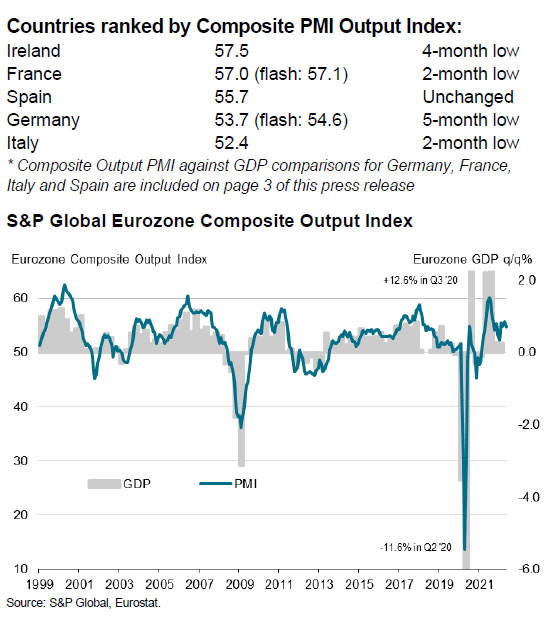
Eurozone PMI Services was finalized at 56.1 in May, down from April's 57.7. PMI Composite was finalized at 54.8, down from April's 55.8, a 4-month low. Looking at some member states, Ireland PMI composite dropped to 4-month low at 57.5. France dropped to 2-month low at 57.0. Spain was unchanged at 55.7. Germany dropped to 5-month low at 53.7. Italy dropped to 2-month low at 52.4.
Chris Williamson, Chief Business Economist at S&P Global Market Intelligence said: "Strong demand for services helped sustain a robust pace of economic growth in May, suggesting the eurozone is expanding an underlying rate equivalent to GDP growth of just over 0.5%. However, risks appear to be skewed to the downside for the coming months...
"The near-term fate of the eurozone economy will therefore depend on the extent to which a fading tailwind of pent-up demand can offset the headwinds of geopolitical uncertainty amid the Ukraine war, supply chain disruptions and the rising cost of living, the latter likely exacerbated by tightening monetary conditions."
USDCAD in a Bearish Mode ahead of NFP
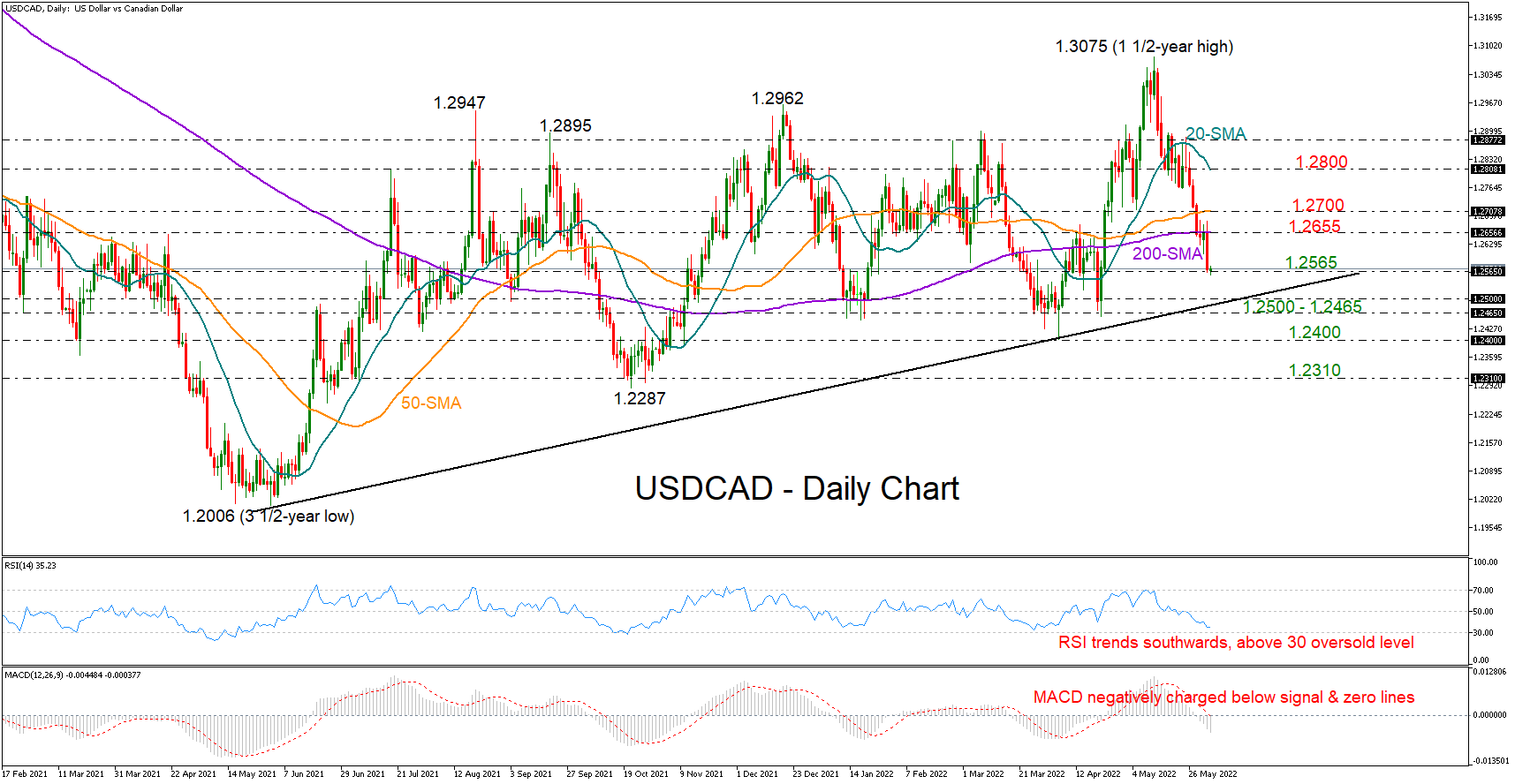
USDCAD lost the battle with the 200-day simple moving average (SMA) on Thursday and tumbled to a three-week low of 1.2556 after two days of waiting to cross above the line and the 1.2655 resistance.
The price is currently trading near a familiar constraining zone, which has been frequently limiting upside and downside moves around 1.2565 for more than a year now. Questions, however, are rising about whether it will successfully stage a meaningful rebound at this point as technical signals keep deteriorating. In momentum indicators, the RSI is clearly trending to the downside below its 50 neutral mark and is still some distance above its 30 oversold level. Similarly, the MACD remains negatively charged below its red signal and zero lines, painting a blurry picture for short-term trading too.
If the sell-off intensifies in the coming sessions, the next turning point could develop within the 1.2500 – 1.2465 region, where the tentative ascending trendline drawn from the 1.2006 bottom is also passing through. Should the bears accelerate below 1.2400, the door would open for the key 1.2310 territory.
Alternatively, a bounce on 1.2565 may see a test around the 200-day SMA at 1.2655, while slightly higher, the 50-day SMA at 1.2700 will be closely watched as well before the focus shifts to the 20-day SMA at 1.2800.
In brief, USDCAD is expected to extend its bearish cycle in the short term, likely bringing the 1.2500 mark next under the spotlight.
Daily Technical Analysis
EUR/USD
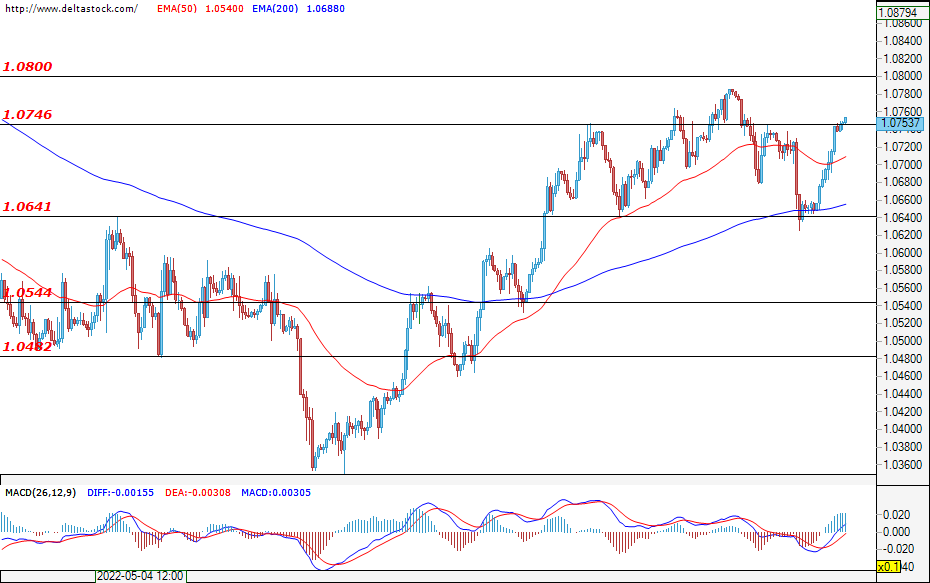
During yesterday’s trading session, the bulls found the level at 1.0640 to be a good opportunity to enter the market and we witnessed a rally that led to an increase in the value of the euro against the U.S. dollar, which led the pair towards the critical resistance at 1.0746. At the time of writing, the pair is testing this resistance zone and a confirmed breach of this level would pave the way for the pair towards the psychological level at 1.0800. In the opposite direction, in case the bears prevail, then a downward movement towards the support at 1.0641 may take place instead. However, even if the bears take control, the pair may still enter a consolidation phase in the range of 1.0641 – 1.0746. During today's session, market participants will closely follow the announcement of the retail sales data for the eurozone (09:00 GMT), as well as the non-farm payroll change data for the U.S. (12:30 GMT) and the unemployment rate change data, also for the U.S. (12:30 GMT).
USD/JPY
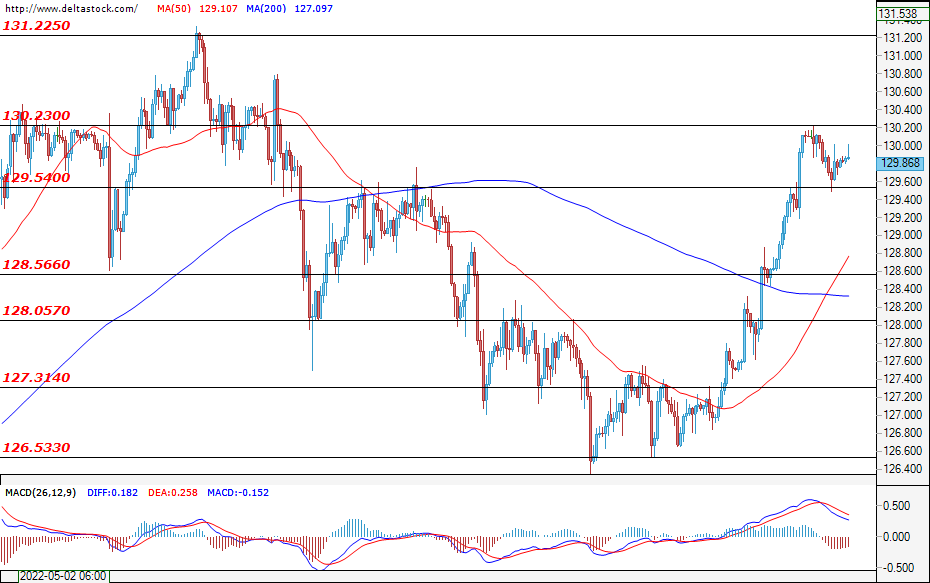
The pair is consolidating in the narrow range of 129.54 – 130.23 after the initial strong dollar rally that we witnessed since the beginning of this week. The consolidation may continue during today’s trading, but the buyers will likely be cautious because a deeper correction may develop as the Ninja may try to recover part of its recent losses before a possible resumption of the uptrend is to take place. Only a confirmed breach of the resistance at 130.23, however, would strengthen the positive expectations for a possible expansion of the upward trend. If this scenario is realised, then the next target for the bulls would be the resistance level at 131.22. In case the bears manage to violate the lower border of the range, their next target would be the support at 128.56.
GBP/USD
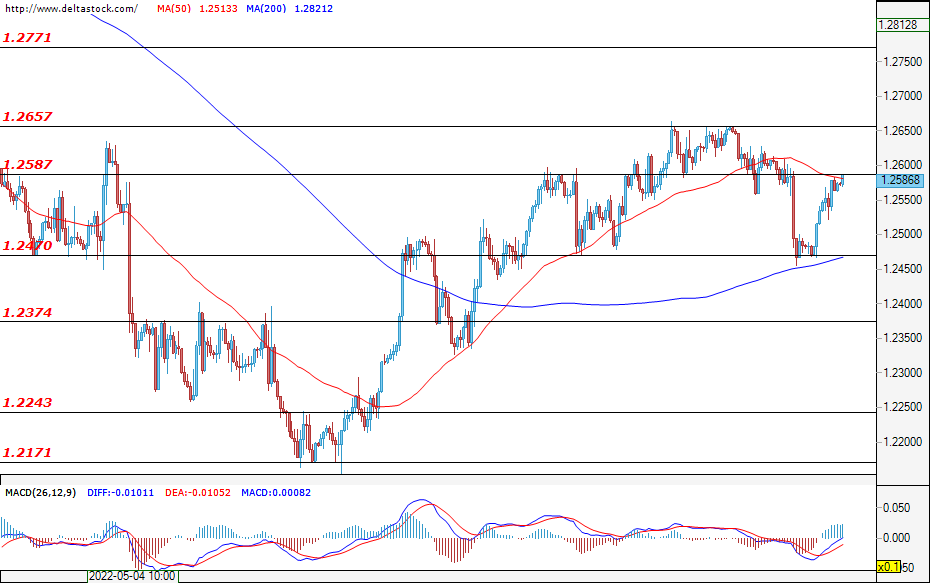
The pair successfully bounced back from the support at 1.2470 and the bulls convincingly led the pair towards a test of the resistance at 1.2587. In the early hours of today’s trading, the pair is hovering just below this level and, if they manage to overcome it, then an upward movement towards the resistance at 1.2657 is а highly possible scenario. However, if this level resists the bullish pressure, then it could be expected for the pair to remain in the range of 1.2587 – 1.2470.
EUGERMANY40
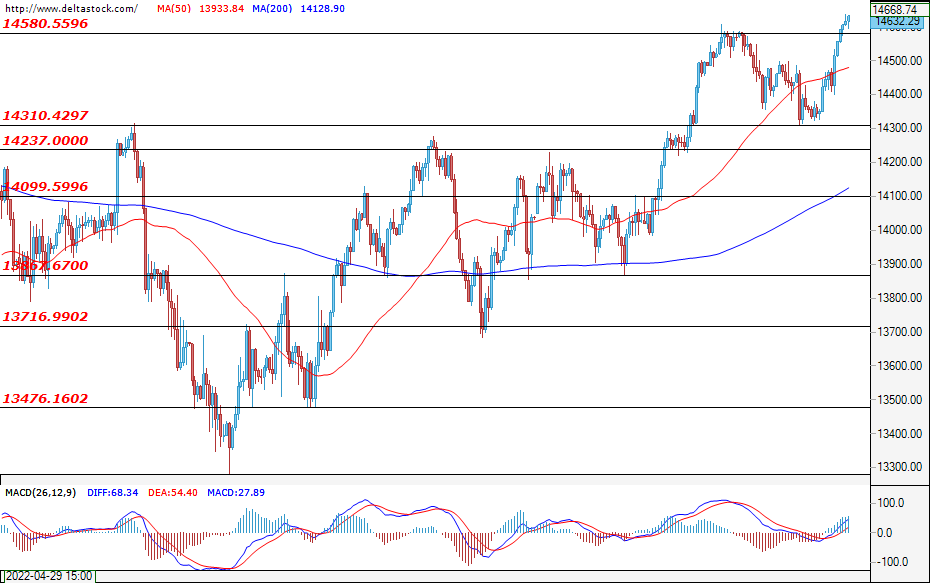
The value of the index increased by approximately 2% since the beginning of yesterday’s trading session, and the confirmed breach of the resistance at 14580 may be considered as a signal for a continuation of the upward move. If the price holds above this level, then we may expect a further appreciation towards the next resistance at 14910. In case the bullish momentum fades and the price falls below 14580, then the index may return in the range of 14580 – 14310, with a possible test of the lower border being on the map as well.
US30
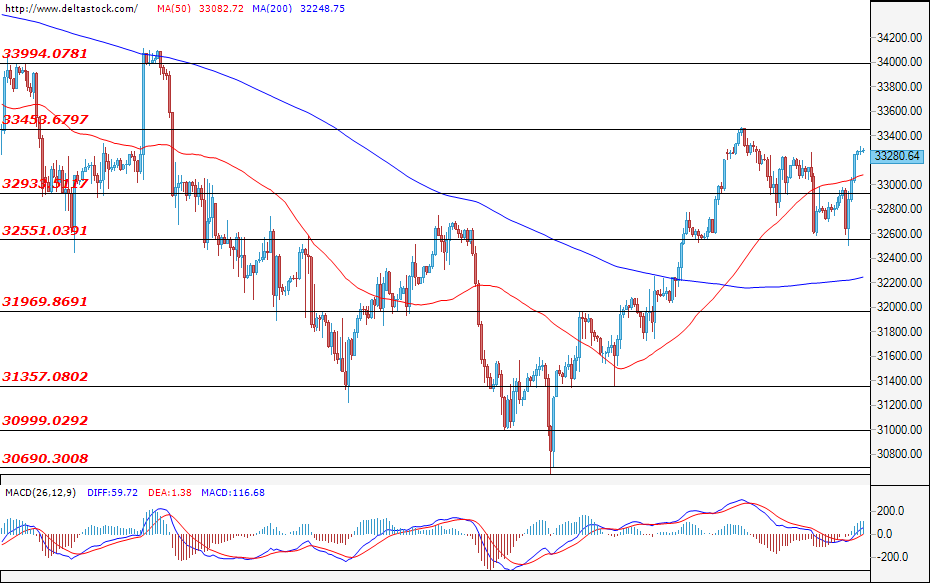
The U.S. blue-chip index gained some ground during yesterday’s trading session, but the bulls could not gain enough momentum to attack and violate the resistance at 33458, and so the consolidation phase in the range of 32551 – 33458 is still intact. The overall market outlook remains positive – for a further appreciation towards the psychological level at 34000, but only a successful violation of the upper border of the range may give the bulls a chance to attack the mentioned level.
GBP/JPY Daily Outlook
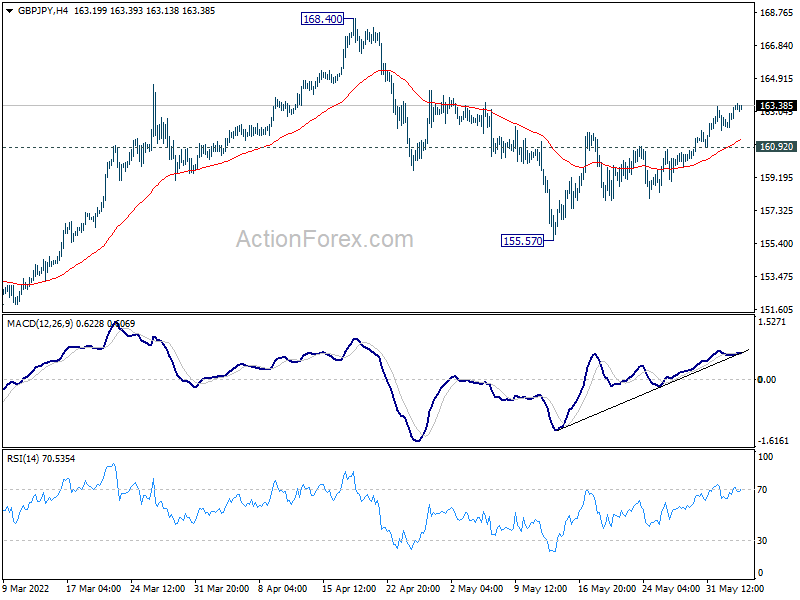
Daily Pivots: (S1) 162.49; (P) 162.96; (R1) 163.79; More...
Intraday bias in GBP/JPY remains on the upside as rebound from 155.57 is in progress to retest 168.40 high. Firm break there will resume larger up trend. On the downside, below 160.92 minor support will turn bias back to the downside for extending the correction from 168.40.
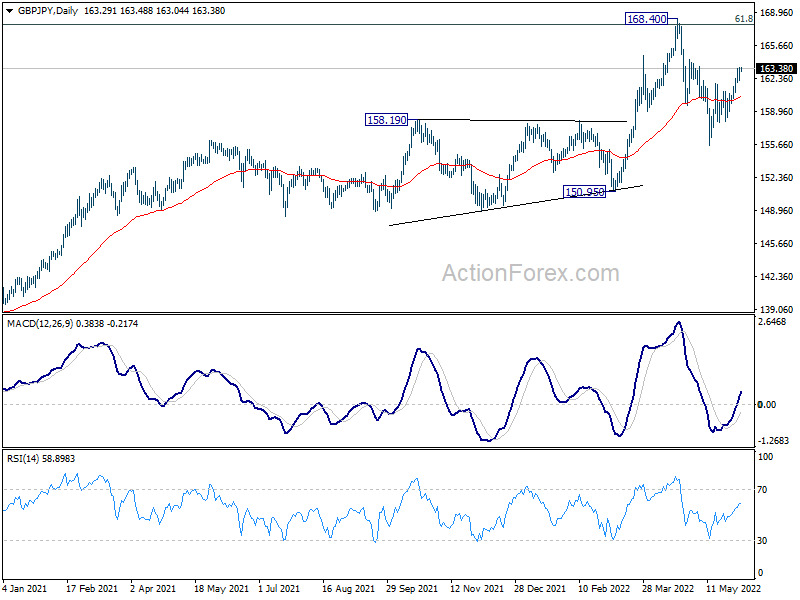
In the bigger picture, up trend from 123.94 (2020 low) is still in progress. Sustained break of 61.8% retracement of 195.86 (2015 high) to 122.75 (2016 low) at 167.93 will be a long term bullish signal, and could pave the way back to 195.86 high. This will now remain the favored case as long as 150.95 support holds, even in case of deep pull back. However, firm break of 150.95 will indicate rejection by 167.93, and bearish trend reversal.
EUR/JPY Daily Outlook
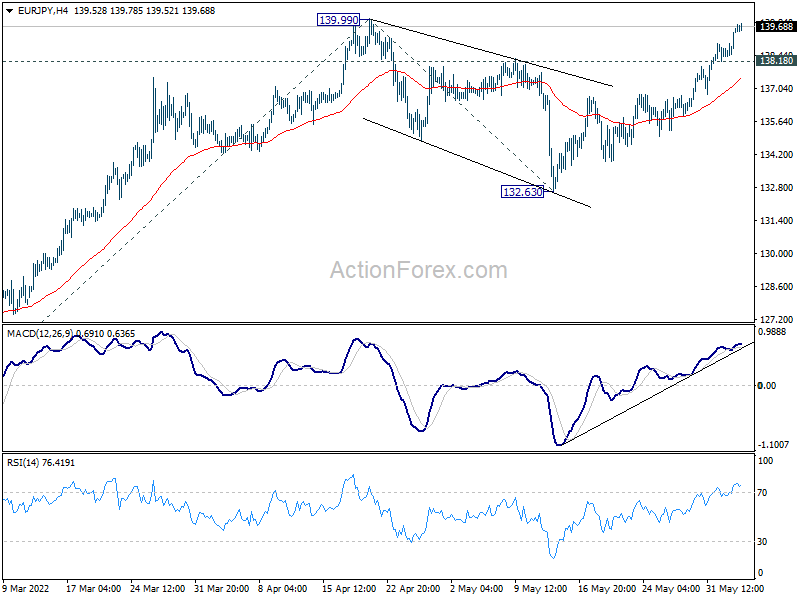
Daily Pivots: (S1) 138.80; (P) 139.20; (R1) 140.00; More....
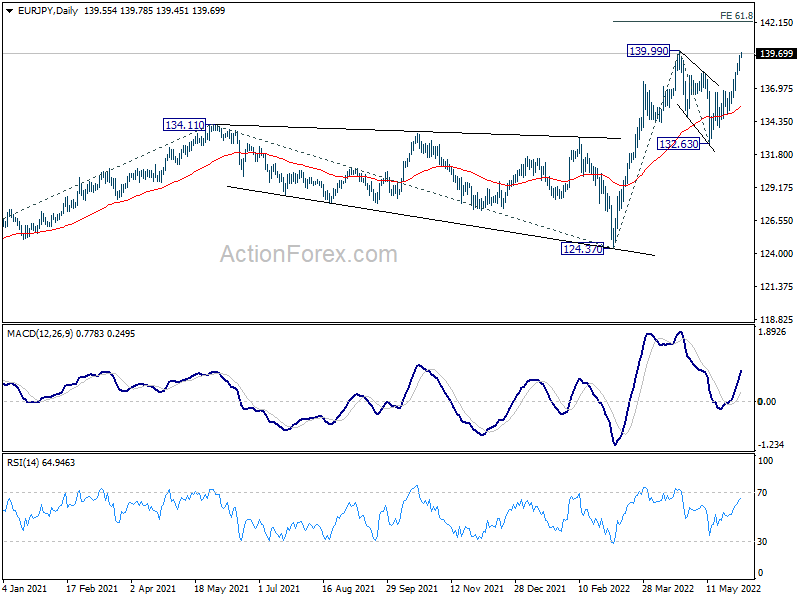
Intraday bias in EUR/JPY stays on the upside at this point. Decisive break of 139.99 resistance will confirm larger up trend resumption. Next target 61.8% projection of 124.37 to 139.99 from 132.63 at 142.28. On the downside, below 138.18 minor support will delay the bearish case and turn intraday bias again first.
In the bigger picture, up trend from 114.42 (2020 low) is in progress. Such rise is seen as the third leg of the pattern from 109.30 (2016 low). Next target will be 100% projection of 114.42 to 134.11 from 124.37 at 144.06. In any case, outlook will now remain bullish as long as 124.37 support holds, in case of deep pull back.