Sample Category Title
BoC Beaudry: Interest rate may need to go above 3%
BoC Deputy Governor Paul Beaudry said in a speech, "we noted that price pressures are broadening and inflation is much higher than we expected and likely to go higher still before easing."
"This raises the likelihood that we may need to raise the policy rate to the top end or above the neutral range to bring demand and supply into balance and keep inflation expectations well anchored," he added.
Beaudry also indicated that the neutral range, a rate that "neither stimulates nor weighs on growth", is estimated to be "between 2% and 3%"
Fed Brainard: It’s very hard to see the case for pause in Sep
Fed Vice Chair Lael Brainard told CNBC today, "right now, it's very hard to see the case for a pause... We've still got a lot of work to do to get inflation down to our 2% target." Atlanta Fed President Raphael Bostic noted earlier that a pause in September might make sense to see how the economy evolves after successive rate hikes.
"We're certainly going to do what is necessary to bring inflation back down," Brainard said. "That's our No. 1 challenge right now. We are starting from a position of strength. The economy has a lot of momentum."
Sunset Market Commentary
Markets
After three days of forceful data-driven market moves, especially on interest rate markets, it was time to take a step back and take a breather. EMU PPI remains elevated at 1.2% M/M and 37.2% Y/Y suggesting that pipeline pressures are still building. However, for once, an inflation data series didn’t surprise to the upside. In the US, net job creation as measured by the ADP survey slowed more than expected from 202 000 tot 128 000 (vs 300 expected). On the other side of the equation, weekly jobless claims fell slightly more than expected to 200k. US yields briefly dipped after ADP, but markets realized that the reality check only comes tomorrow with the official payrolls report, including wage data. With data providing little guidance, investors kept a close eye at the OPEC+ meeting in Vienna. According, to sources, OPEC+ plans to speed up the pace of its monthly output hike from 432 000 bpd to a potential hike of 648 000 in the July and August. An output hike evidently would be good news for oil consumers, including in the US and Europe. However, a decision still has to be made and even if decided there’s plenty of ‘execution risk’ as only a few OPEC countries have additional production capacity left. Brent oil this morning dropped from $116/b to the mid $112 area. However, most of this setback is already reversed intraday. Evidently, this is not enough for (interest rate) markets to anticipate that lower oil prices might contribute to a meaningful easing of inflationary pressures. The US yield curve bear steepens with yields adding up to 5 bps (30-yr). European yields continue their uptrend with German yields rising between 7.0/6.0 bps in the 2-5-y sector and 5.0/3.0 bps for the 10/30-y. After a two-day sell-off the Eurostoxx 50 regains 0.6% even as European yields continue rising. US equities are underperforming losing about 0.5% after the open. On FX markets, this week’s dollar rebound is losing momentum. the DXY index eases from the 102.55 area to currently trade just north of 102. USD/JPY is also running into resistance. An attempt to surmount the 130 barrier failed (for now). The pair currently trades in the 129.75 area. At the same time, the euro shows some resilience too, with EUR/USD trying to regain the 1.07 handle. In CE, the forint rebounds after the MNB hiked its weekly deposit rate by 0.30 bps , as expected, coming on the back of the MNB slowing the pace of its base rate hikes from 1.0% to 0.5% earlier this week.News Headlines
Swiss inflation quickened by a stronger-than-expected 0.7% m/m to be up 2.7% y/y (from 2.3%) in May. Excluding energy and food, core inflation continued its sharp uptrend to 1.75% y/y. Both are the highest readings since 2008. Compared to the euro area average (8.1%), price increases are still low for reasons including the strong Swiss franc. Nevertheless, inflation has settled above the Swiss National Bank’s 2% inflation target. SNB president Jordan (and other board members) said more than once that the central bank is ready to take on the threat of inflation if it materializes. Vice-chair Zurbruegg yesterday told Reuters the SNB will consider the persistence of high inflation at the policy meeting on June 16. Speculation is keeping the Swiss franc supported. EUR/CHF briefly fell through the upward sloping trendline following the CPI release but pared back losses to 1.026 in the meantime.
The central bank of Ukraine (NBU) jacked up interest rates by a whopping 1500 bps to 25%. It was the first meeting since the Russian invasion, which caused such psychological pressures that policy in the months after was unlikely to stabilize financial markets. Economic decision-making logics have returned, the NBU now says. Inflation is soaring (16.4% in May) and is expected to rise further. The NBU is serious in halting worsening inflation expectations that may further encourage investors to convert hryvnia savings into FX, causing imbalances in the economy. “To revive interest in hryvnia assets, their yields must exceed expected inflation rates”, and so it happened. The idea is to act bold once before cutting rates in the next meetings, provided hryvnia devaluation and inflation expectations have calmed down, a NBU deputy governor explained. The NBU fixed the hryvnia exchange rate at USD/UAH at 29.5 since the invasion.
USD/JPY Mid-Day Outlook
Daily Pivots: (S1) 129.15; (P) 129.67; (R1) 130.69; More...
Intraday bias in USD/JPY remains on the upside for 131.34 resistance. Firm break there will confirm up trend resumption. Next target is 61.8% projection of 114.40 to 131.34 from 126.35 at 136.81. On the downside, below 128.45 minor support will delay the bullish case and turn bias neutral first.
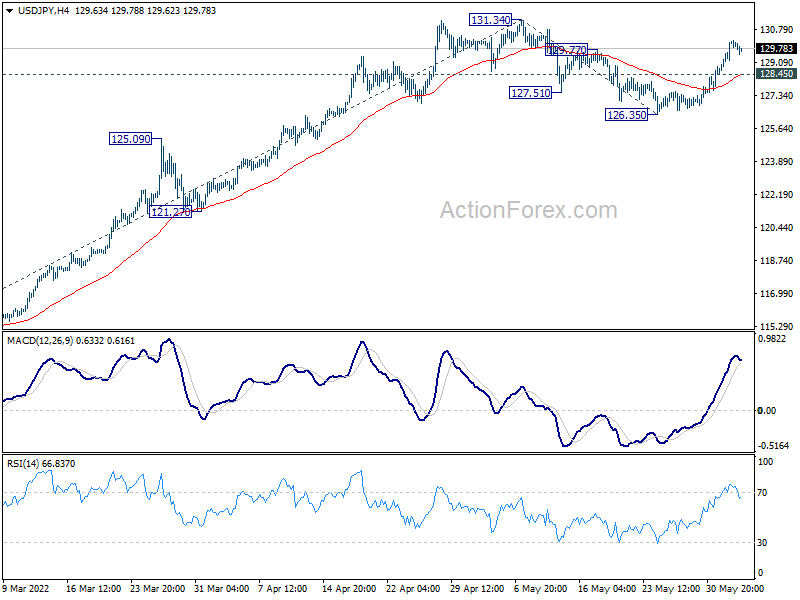
In the bigger picture, current rally is seen as part of the long term up trend form 75.56 (2011 low). Sustained trading above 61.8% projection of 75.56 (2011 low) to 125.85 (2015 high) from 98.97 at 130.04 will pave the way to 100% projection at 149.26, which is close to 147.68 (1998 high). For now, this will remain the favored case as long as 121.27 support holds.
USD/CHF Mid-Day Outlook
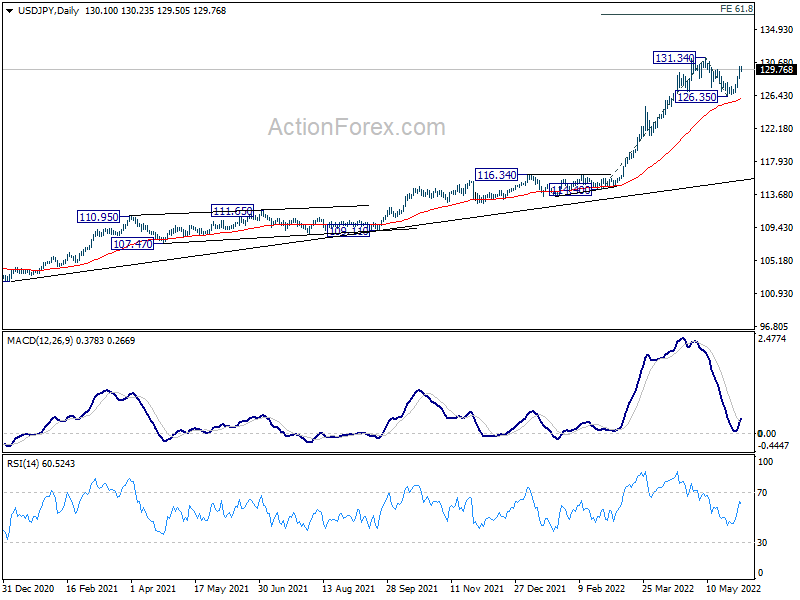
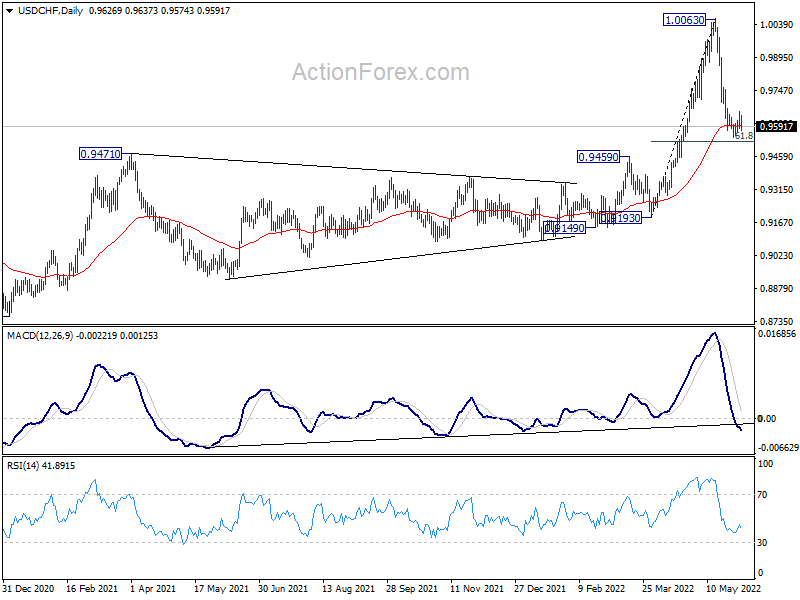
Daily Pivots: (S1) 0.9590; (P) 0.9625; (R1) 0.9665; More...
Outlook in USD/CHF remains unchanged and intraday bias stays neutral. Strong support is expected from 61.8% retracement of 0.9193 to 1.0063 at 0.9525 to complete the pull back from 1.0063. On the upside, above 0.9763 minor resistance will turn bias back to the upside for retesting 1.0063 high. However, sustained break of 0.9525 will bring deeper decline to 0.9193 support.
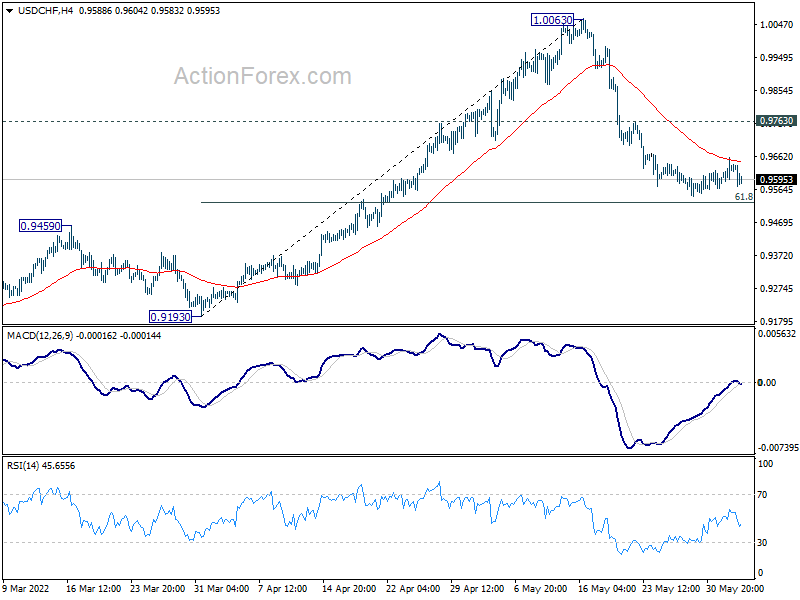
In the bigger picture, down trend from 1.0342 (2016 high) should have completed with three waves down to 0.8756 (2021 low) already. Rise from 0.8756 is likely a medium term up trend of its own. Next target is 1.0237/0342 resistance zone. This will remain the favored case as long as 0.9471 resistance turned support holds. However, sustained break of 0.9471 will extend long term range trading with another falling leg.
EUR/USD Mid-Day Outlook
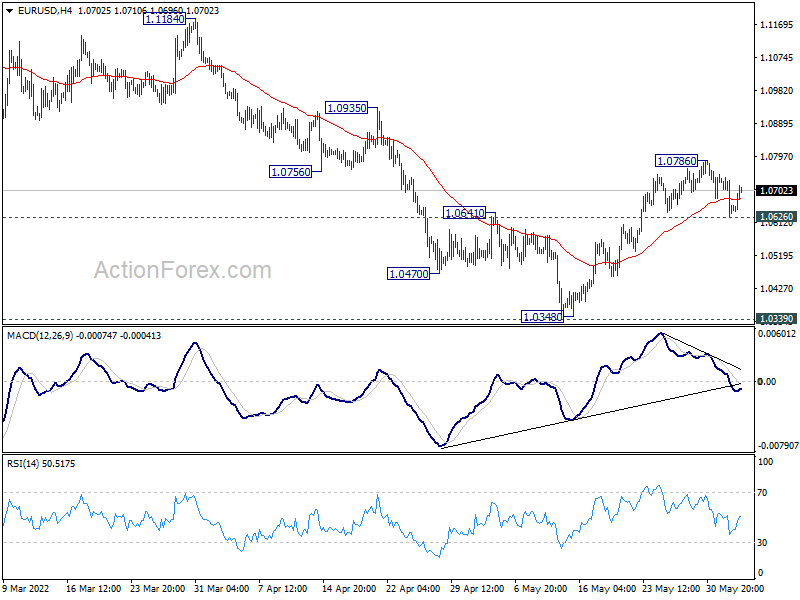
Daily Pivots: (S1) 1.0607; (P) 1.0673 (R1) 1.0719; More...
Intraday bias in EUR/USD stays neutral at this point. On the upside, break of 1.0786, and sustained trading above 55 day EMA (now at 1.0757) will target 1.0935 resistance next. On the downside, however, break of 1.0626 minor support will indicate rejection by 55 day EMA, and turn bias back to the downside for retesting 1.0348 low instead.
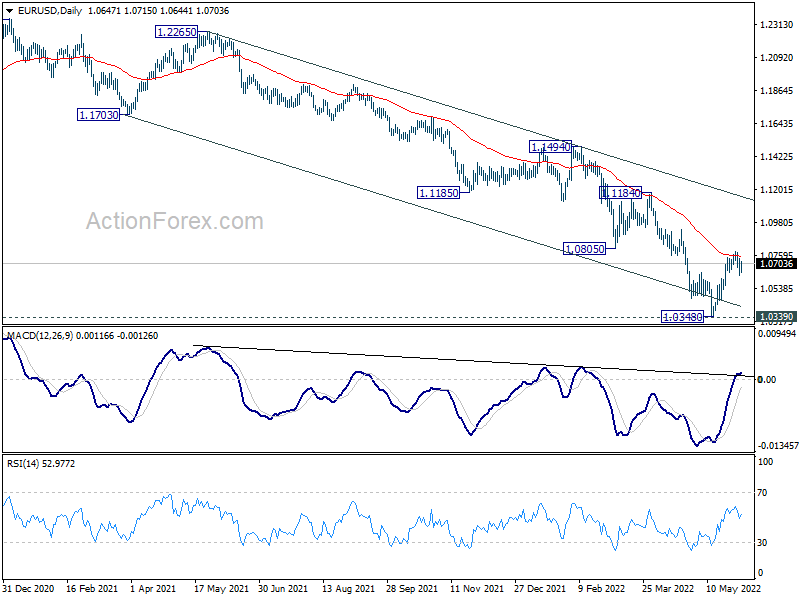
In the bigger picture, focus stays on 1.0339 long term support (2017 low). Decisive break there will resume whole down trend from 1.6039 (2008 high). Next target is 61.8% projection of 1.3993 to 1.0339 from 1.2348 at 1.0090. However, firm break of 1.0805 support turned resistance will delay this bearish case and bring medium term corrective rebound first.
Australian Dollar Higher on Solid Data
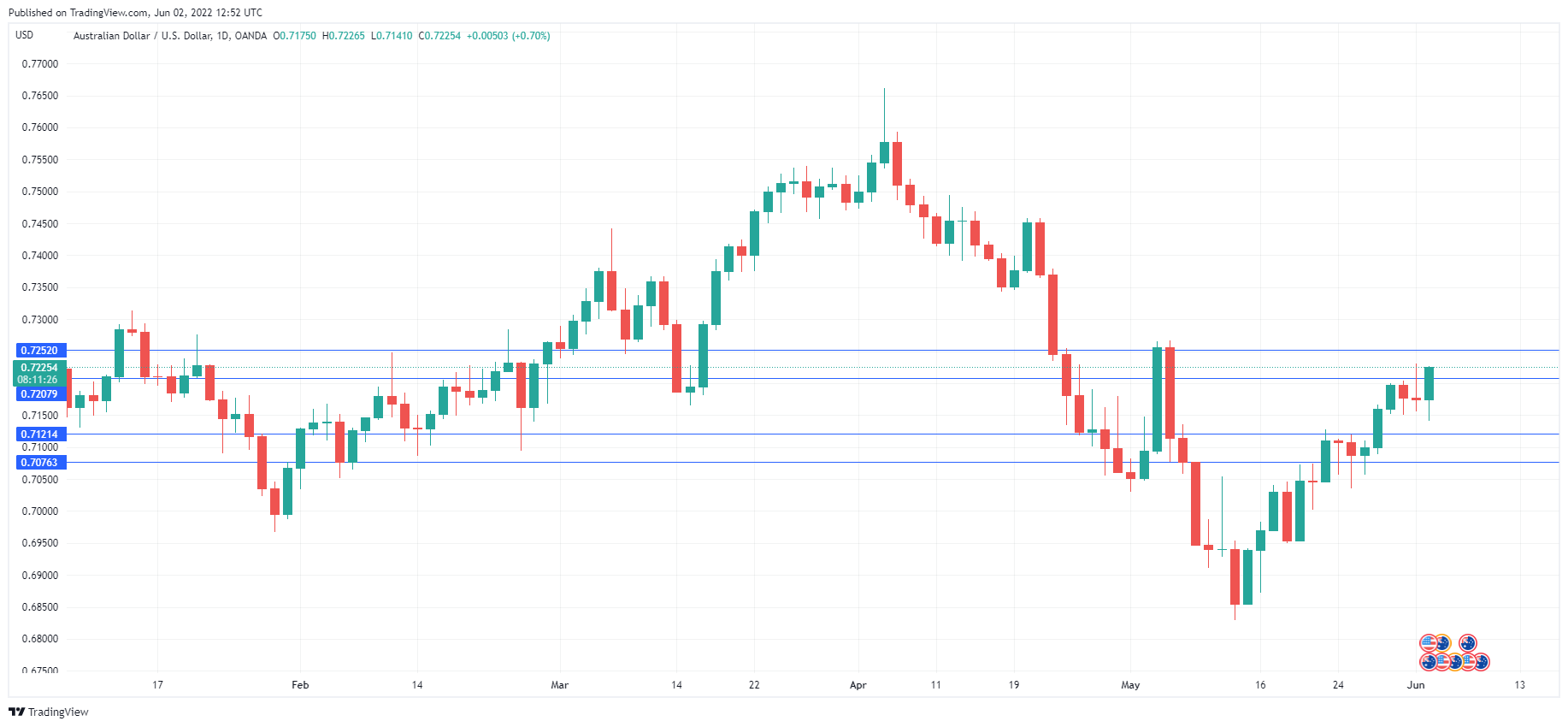
The Australian dollar is showing some jump. AUD/USD has punched above the 0.72 level today and has posted gains of 0.59%, as it trades close to 1-month highs.
Australian releases were positive, giving the Aussie a strong boost. The trade surplus widened to AUD 10.49 billion in April, up from 9.31 billion in March (AUD 9.300 billion exp.). Exports were up 1.0% and commodity prices remained strong, with a gain of 30.4%. Retail sales dipped to 0.9%, but this matched the forecast.
GDP slows but better than expected
Australia’s Q1 GDP slowed to 0.8% QoQ, after a massive 3.6% QoQ gain in Q4 of 2021. Investors were not expecting a Q4 repeat, and the first quarter reading actually outperformed, beating the estimate of 0.5%.
The whipsaw movement in GDP makes it difficult to predict the underlying strength of the economy. For the RBA, the fact that the economy is still growing means that it can continue with its rate-tightening plans. Monetary policy has not focused all that much on GDP, with the RBA concentrating on the labour market, wage growth and inflation. The RBA holds its meeting next week, and is likely to tighten by another 25-bps, which would bring the cash rate to a (still low) 0.60%. The markets are expecting the cash rate to rise as high as 3.95%, which means that the RBA plans to continue tightening into 2023.
Recent US numbers have been mostly positive, which points to a strong US economy. The week wraps up with the US nonfarm payroll release on Friday. The markets are braced for a slowdown, as the April forecast stands at 325 thousand, after a March gain of 428 thousand. With the markets keeping a close eye on surging energy and food prices and the war in Ukraine, NFP isn’t the only game in town. Still, it is one of the most important economic releases and should be treated as a market-mover.
AUD/USD Technical
- AUD/USD is testing resistance at 0.7207. Above, there is resistance at 0.7252
- There is support at 0.7121 and 0.7076
Dollar Dips Mildly after Poor ADP Job Data
Dollar weakens mildly further after worse than expected ADP job data. But selloff is limited as traders are probably cautious ahead of tomorrow's non-farm payrolls. But overall, Yen remains the worst performing one for the week. Sterling and Euro are the next weakest even though both are trying to recover some ground. Australian Dollar is staying in pole position, leading other commodity currencies higher.
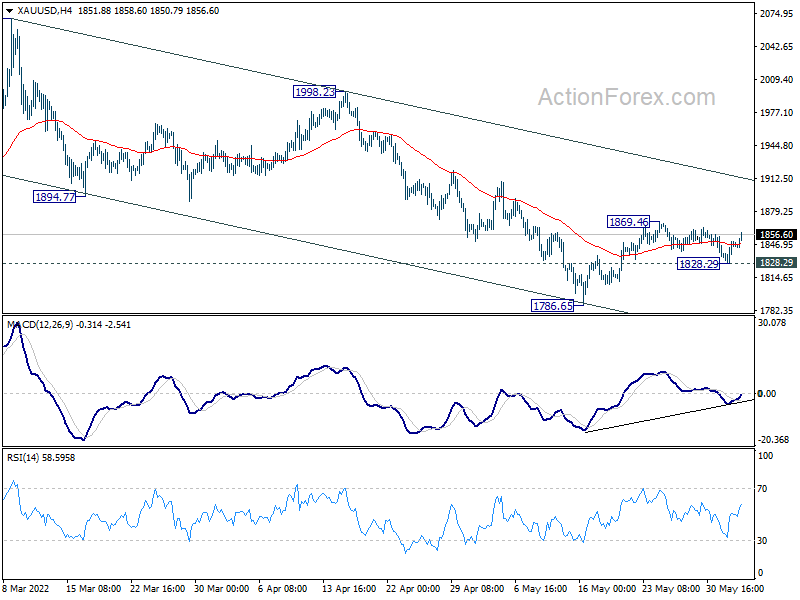
Technically, while Gold's retreat from 1869.46 was slightly deeper than expected, near term bullishness is restored by the quick rebound. Focus would be at 1869.46 resistance for the rest of the week. Firm break there will resume the rebound from 1786.65 towards channel resistance (now at 1912.89). If happens, that could be an early signal to return to selloff in Dollar.
In Europe, UK is on holiday. At the time of writing, DAX is up 0.79%. CAC is up 1.21%. Germany 10-year yield is up 0.010 at 1.198. Earlier in Asia, Nikkei dropped -0.16%. Hong Kong HSI dropped -1.00%. China Shanghai SSE rose 0.42%. Singapore Strait Times dropped -0.53%. Japan 10-year JGB yield rose 0.0093 to 0.245.
US ADP jobs rose 128k, growth rate tempered
US ADP private employment rose 128k only in May, well below expectation of 280k. By company size, small businesses jobs dropped -91k, medium businesses rose 97k, large businesses rose 122k. By sector, goods-producing jobs rose 24k, service-providing rose 104k.
"Under a backdrop of a tight labor market and elevated inflation, monthly job gains are closer to pre-pandemic levels," said Nela Richardson, chief economist, ADP. "The job growth rate of hiring has tempered across all industries, while small businesses remain a source of concern as they struggle to keep up with larger firms that have been booming as of late."
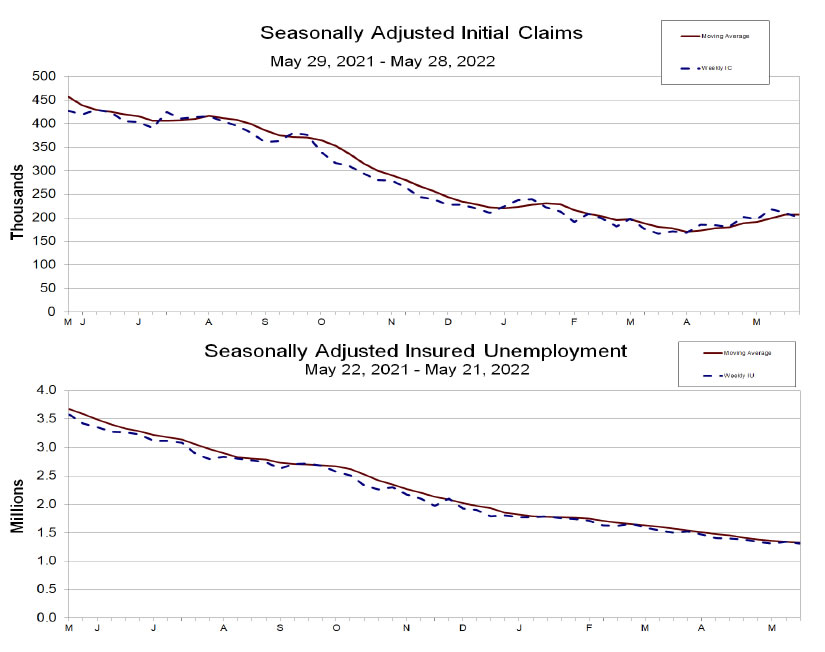
US initial claims dropped to 200k, continuing claims dropped to 1.309m
US initial jobless claims dropped -11k to 200k in the week ending May 28, slightly below expectation of 205k. Four-week moving average of initial claims dropped -500 to 206.5k.
Continuing claims dropped -34k to 1309k in the week ending May 21. That's the lowest level since December 27, 1969, when it was 1304k. Four-week moving average of continuing claims dropped -19.5k to 1327k, lowest since January 10, 1970, when it was 1310k.
ECB Villeroy: Policy normalization should be gradual but resolute
ECB Governing Council member Francois Villeroy de Galhau said in Pairs, "inflation is not only too high, but also too broad. This requires a normalization of monetary policy -- I say normalization and not tightening." He added that the normalization process should be "gradual but resolute"
"Fiscal policy will itself be further constrained by the high level of post-Covid public debt, and by the increase in interest rates," Villeroy added. "Furthermore, in the two next years, the context will be one of slower growth, or even, according to some fears, of economic stagnation."
Eurozone PPI up 1.2% mom, 37.2% yoy in Apr, EU up 1.3% mom, 37.0% yoy
Eurozone PPI rose 1.2% mom, 37.2% yoy in April, below expectation of 2.3% mom, 38.6% yoy. For the month, Industrial producer prices increased by 3.8% for intermediate goods, by 2.7% for non-durable consumer goods and by 1.0% for capital goods and durable consumer goods, while they decreased by -1.2% in the energy sector. Prices in total industry excluding energy increased by 2.6%.
EU PPI rose 1.3% mom, 37.0% yoy. The highest monthly decreases in industrial producer prices were recorded in Ireland (-16.4%), Romania (-3.2%), Portugal (-2.2%) and Italy (-0.3%). The highest increases were observed in Slovakia (+9.3%), Luxembourg (+6.0%) and Bulgaria (+4.1%).
Swiss CPI accelerated to 2.9% yoy in May, import pries up 7.4% yoy
Swiss CPI rose 0.7% mom in May, above expectation of 0.3% mom. The monthly rise was due to factors including housing rentals, heating oil and food. Core CPI rose 0.5% mom. Domestic prices rose 0.5% mom while imported prices rose 1.1% mom.
For the 12-month period, CPI accelerated from 2.5% yoy to 2.9% yoy, above expectation of 2.6% yoy. Core inflation CPI came in at 1.7% yoy. Domestic prices rose 1.5% yoy while imported prices rose 7.4% yoy.
BoJ Adachi: We should not forget strong yen led to two lost decades
BoJ board member Seiji Adachi said, "with the impact of the pandemic continuing, shifting to tighter monetary policy now would inflict huge damage to business and household activity... It's premature to move toward tighter policy."
"If the bank uses monetary policy to respond to short-term fluctuations (in exchange rates) before achieving its goal for underlying inflation, it would bring negative effects on the Japanese economy," he said.
"We should not forget that a strong yen was among factors that led to Japan's prolonged deflation and two 'lost' decades" of economic stagnation, he added.
GBP/USD Mid-Day Outlook
Daily Pivots: (S1) 1.2424; (P) 1.2520; (R1) 1.2582; More...
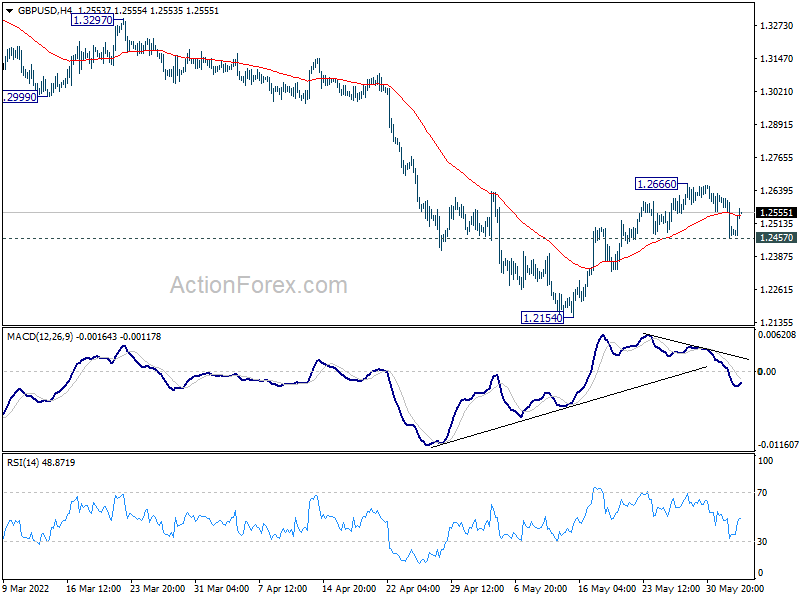
Intraday bias in GBP/USD remains neutral and outlook is unchanged. On the upside, above 1.2666 will resume the rebound from 1.2154. Sustained of 55 day EMA (now at 1.2729) will target 1.2999 support turned resistance. On the downside, though, break of 1.2457 minor support will turn bias back to the downside for retesting 1.2154 low instead.
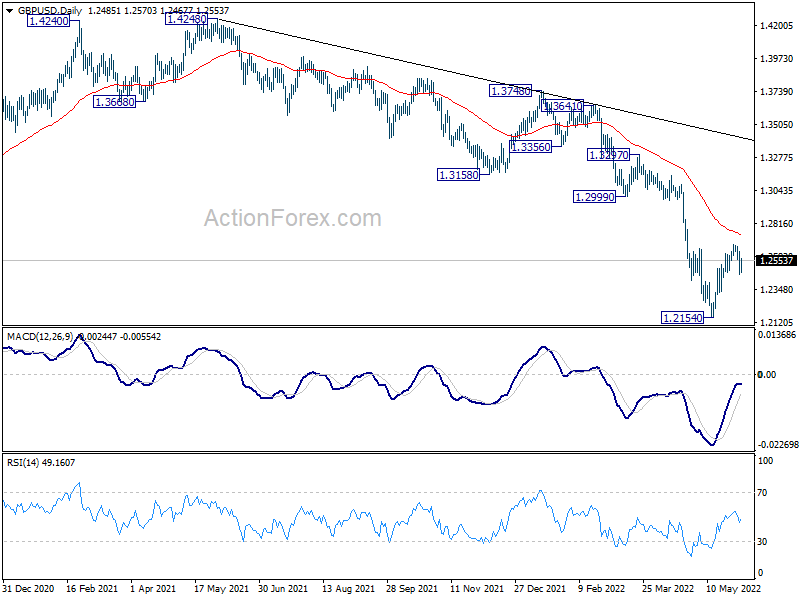
In the bigger picture, fall from 1.4248 (2018 high) could be a leg inside the pattern from 1.1409 (2020 low), or resuming the longer term down trend. Deeper decline is expected as long as 1.2999 support turned resistance holds. On resumption, next target is 1.1409 low.
Economic Indicators Update
| GMT | Ccy | Events | Actual | Forecast | Previous | Revised |
|---|---|---|---|---|---|---|
| 22:45 | NZD | Terms of Trade Index Q1 | 0.50% | 1.30% | -1.00% | -0.90% |
| 23:50 | JPY | Monetary Base Y/Y May | 4.60% | 2.30% | 6.60% | |
| 01:30 | AUD | Trade Balance (AUD) Apr | 10.50B | 9.02B | 9.31B | 9.74B |
| 06:30 | CHF | CPI M/M May | 0.70% | 0.30% | 0.40% | |
| 06:30 | CHF | CPI Y/Y May | 2.90% | 2.60% | 2.50% | |
| 09:00 | EUR | Eurozone PPI M/M Apr | 1.20% | 2.30% | 5.30% | |
| 09:00 | EUR | Eurozone PPI Y/Y Apr | 37.20% | 38.60% | 36.80% | 36.90% |
| 11:30 | USD | Challenger Job Cuts Y/Y May | -15.80% | 6.00% | ||
| 12:15 | USD | ADP Employment Change May | 128K | 280K | 247K | 202K |
| 12:30 | USD | Initial Jobless Claims (May 27) | 200K | 205K | 210K | 211K |
| 12:30 | USD | Nonfarm Productivity Q1 | -7.30% | -7.50% | -7.50% | |
| 12:30 | USD | Unit Labor Costs Q1 | 12.60% | 11.60% | 11.60% | |
| 12:30 | CAD | Building Permits M/M Apr | -0.60% | 0.50% | -9.30% | -6.30% |
| 14:00 | USD | Factory Orders M/M Apr | 0.80% | 2.20% | ||
| 14:30 | USD | Natural Gas Storage | 86B | 80B | ||
| 15:00 | USD | Crude Oil Inventories | -3.0M | -1.0M |
GBP/USD Mid-Day Outlook
Daily Pivots: (S1) 1.2424; (P) 1.2520; (R1) 1.2582; More...
Intraday bias in GBP/USD remains neutral and outlook is unchanged. On the upside, above 1.2666 will resume the rebound from 1.2154. Sustained of 55 day EMA (now at 1.2729) will target 1.2999 support turned resistance. On the downside, though, break of 1.2457 minor support will turn bias back to the downside for retesting 1.2154 low instead.
In the bigger picture, fall from 1.4248 (2018 high) could be a leg inside the pattern from 1.1409 (2020 low), or resuming the longer term down trend. Deeper decline is expected as long as 1.2999 support turned resistance holds. On resumption, next target is 1.1409 low.
US initial claims dropped to 200k, continuing claims dropped to 1.309m
US initial jobless claims dropped -11k to 200k in the week ending May 28, slightly below expectation of 205k. Four-week moving average of initial claims dropped -500 to 206.5k.
Continuing claims dropped -34k to 1309k in the week ending May 21. That's the lowest level since December 27, 1969, when it was 1304k. Four-week moving average of continuing claims dropped -19.5k to 1327k, lowest since January 10, 1970, when it was 1310k.