

Sample Category Title
Boost to OPEC Production Fails to Calm Oil Markets
Market movers today
The most important data release of the day will be the US May Jobs Report. While the ADP report released yesterday was weaker than expected, most indicators still point towards labour demand remaining at high levels. In addition, ISM Services PMI will be released in the afternoon.
On US monetary policy, Fed's Brainard speaks this evening.
The 60 second overview
New forecast for the global economy: This morning we published our new take on the global economy: Big Picture – A (mild) recession in western economies seems unavoidable, 3 June, looking at the economic prospects for the US, Chinese, euro area, UK, Japanese and emerging market economies as well as a special section on the challenges in achieving the EU green transition. Despite the high inflation eroding consumer purchasing power, economic activity will near term be supported by pent-up demand for services and significant savings. However, as the swift monetary policy tightening in western countries, notably in the US, lead to increasingly tighter financial conditions, we expect first the US economy to fall into a mild recession in Q2 next year, spilling over to the other western economies afterwards. The setback will be somewhat mitigated by solid growth in the Chinese economy supported by policy stimulus.
Increase in OPEC production fails to hold down oil prices: OPEC yesterday came about half way in meeting the market expectations. The cartel agreed to increase output more than previously planned, but did not decide on Russia's status in OPEC+ following the EU embargo announced earlier in the week. Consequently, oil prices erased part of the decline since Tuesday. On the one hand, more output from OPEC (even if the group is struggling to live up to previous pledges) will ease tight market conditions near-term. On the other hand, less spare capacity within OPEC and particularly Saudi Arabia leaves the oil market vulnerable to future supply shocks. We stick to our forecast that Brent should average USD115/bbl short-term and drop below USD100/bbl next year.
Equities: The US equity markets rose yesterday, despite higher oil prices and hawkish signals from Fed members. This morning performance in Asian markets is mixed, while US and European futures point to a higher opening.
FI: With UK out celebrating Jubilee yesterday and today, the European markets were trading mostly sideways with less volatility than what we have seen in the past couple of weeks until the afternoon. However, as US opening and Fed's Brainard saying it's too soon to say if inflation has peaked, combined with surging oil prices (following OPEC only half-way meeting expectations), resulted in intensified concerns about the current inflation pressure and sent rates sharply higher.
FX: OPEC yesterday came about half way in meeting the market expectations. Swiss inflation surprised significantly to the upside with CPI for May reaching 2.9%. DKK-EUR liquidity is set to be turned upside down in the second half of June. EUR/NOK has moved back below the 10.10 mark.
Credit: Yesterday, CDS indices were closed due to UK holiday hence levels are unchanged with iTraxx Main 1.8bp at 89.3bp and Xover at 446bp. Cash bonds performed stable during a quiet session.
Nordic macro
Norwegian unemployment has continued to fall so far this year, which is a good indication that growth is still stronger than normal and capacity utilisation is still rising. With labour shortages hitting record highs, how much further unemployment can come down will depend on the size of matching problems in the labour market. We expect the (seasonally adjusted) jobless rate to drop to 1.8% in May, which would be below Norges Bank's projection of 2.0% in the March monetary policy report.
Dude, Where’s My Oil?
The most anticipated OPEC+ meeting of the year turned out to be a damp squib in the end. OPEC+ agreed to increase output in July and August to 648,000 bpd from the previously agreed 432,000 bpd, with the increased allocation spread across all its members, including, you guessed it, Russia. Given most of OPEC can’t even meet their present targets, with only Saudi Arabia, the UAE, and possibly Iraq, having any sort of spare capacity, and with Russia under sanctions, the entire exercise was nothing more than window dressing.
It is clear which side OPEC’s bread is buttered on and you’d have to say Vladimir Putin is having a good week by his lowly standards. Progress in Eastern Ukraine, OPEC clearly not wanting to upset him, and now a Russian restriction on noble gas exports. (these are inert gases used in the production of semiconductors amongst other things) Ukraine previously produced 30% of the world’s noble gases by the way. He must be loving it when a plan comes together.
The minuscule increase in production was a sop to US President Biden but won’t change a thing in the supply/demand equation on international markets. President Biden is going to have to show up with a lot more goodies on the table during his upcoming visit to the Middle East to change that dynamic. Sabre rattling against China, and a vacuous trade agreement that provided no access to US markets, as per his recent trip to Asia, just isn’t going to cut it. To paraphrase Jerry Maguire, if you want to cut Russian and Chinese influence everywhere Joe, show me the money.
Markets clearly felt the same as oil, which had plummeted pre-meeting on hopes of a much larger increase in production, reversed all their losses. Further indignity was served up by official US Crude Inventories, which plummeted by just over 5 million barrels overnight. That saw both Brent crude and WTI finish a huge turnaround, closing around 2.0% higher on the day.
With Brent crude and WTI within shouting distance of $120.00 a barrel, that made the overnight rally by US equities even stranger things. Wall Street booked impressive gains overnight and I can only put it down to a very weak ADP Employment release, only gaining 128,000 jobs, while April Building Permits fell by 0.60% and April Factory Orders MoM for April only rose by 0.30%.
It was the ADP Employment data that did though, even though it is an appalling indicator for the US Non-Farm Payrolls. I note the JOLTs data this week still showed two jobs for every unemployed American, something Lael Brainard also noted overnight. Still, why let reality get in the way of a good story? A slowing US economy equals less Fed tightening equals lower terminal interest rates equals buy everything. The rally by Wall Street sparked a correlated risk-on rally across the rest of the markets. US yields edged lower, the US Dollar got thumped, with risk-sentiment fashionistas the Euro, Australian Dollar and New Zealand Dollar booking impressive gains. Even Bitcoin and gold rallied as they are inflation hedges, I mean deflation hedges, I mean stagflation hedges; oh, never mind.
We can take two things out of the overnight price actions. Equity markets, having been programmed to buy any dip over the last two decades thanks to the asset price backstop of global monetary policy, are looking for even the most tenuous reasoning to price the end of the bear market. Secondly, the trajectory of US interest rates is the one ring to rule them all with global markets and asset classes everywhere.
Tonight’s US Non-Farm Payroll data is expected to ease to 325,000 jobs added. A large deviation above or below that number should produce a very binary outcome for the FOMO gnomes of the stock market, and by default, be reflected in other asset classes. A high number equals Fed tightening with lots of 0.50% increases, remains on track, equals sell equities, sell currencies, buy US Dollar, sell bonds, sell gold. A low number equals less Fed tightening, buy equities, buy currencies, especially EUR, AUD, NZD, and EM, buy bonds, buy gold, and because it’s the weekend, let's buy some crypto as well. Volatility is the winner either way.
Moving out of the tail-chasing Lala land we call the US financial markets and into the real world, we see a raft of Services PMIs for May also released today. Asian releases have been a mixed bag. Australian Services PMI caught a cost-of-living sniffle as it fell to 53.2 from 56.1 previously. In contrast, Japan's Jibun PMI rose from 51.7 to 52.6 this morning as the reopening boom continues there. European Services PMIs have obvious downside risks as will India’s at 1300 SGT today as rising living costs bite.
None of that should influence the Reserve Banks of Australia and India next week, which will both hike policy rates again. Indonesia’s CPI yesterday was benign and will likely stay Bank Indonesia’s hands this month. We can pencil in another rate hike from the Bank of Korea in July for sure after South Korean inflation for May YoY blew through the topside, rising by 5.40%.
Holidays will impact trading volumes and liquidity internationally today. Mainland China, Hong Kong, and Taipei are all dragon boating. Thailand celebrates their Queen’s birthday. Meanwhile, the UK will be closed again for neighbourhood street parties to celebrate the Queen’s platinum jubilee. Congratulations Your Majesty. On Monday, most of Europe is closed for Whit Monday, with holidays also in New Zealand, South Korea, and Malaysia.
Finally, I know markets can remain irrational longer than you can stay solvent, but did I mention that oil is approaching $120.00 a barrel, and Russia now controls large swaths of the global wheat and plant oil supply, and noble gases? Just saying….
Asian equities edge higher
Overnight, soft US ADP Employment data saw Wall Street rapidly price in less Fed tightening, spurring an impressive rally on Wall Street. With Wall Street clutching at any straw for an excuse to buy, the S&P 500 jumped 1.84% higher, the Nasdaq leapt to a 2.69% gain, and the Dow Jones rallied by 1.29%. US futures have paused for breath in Asia, all three indexes are unchanged.
Asian volatility appears to be suffering a holiday impact, rising more cautiously thanks to holidays in Mainland China, Hong Kong, Taiwan, and Thailand. Japan’s Nikkei 225 has risen by 1.15%, with South Korea’s Kospi adding just 0.42%. Singapore is just 0.10% higher, with Kuala Lumpur easing by 0.25%, Jakarta gaining 0.90%, and Manila unchanged. Higher oil prices overnight may also be tempering gains in Asia.
In Australia, markets are slavishly following the US lead. The ASX 200 is 0.65% higher, while the All Ordinaries has risen by 0.80%, with New Zealand edging 0.30% higher.
European markets rallied overnight, likely on hopes that OPEC+ would ramp up oil production and with Wall Street’s climb. Oil prices closed around 2.0% higher in New York, with the OPEC+ announcement mere window dressing. That is likely to limit gains in Europe initially, especially with the UK away, weekend event risk, and much of Europe on holiday on Monday.
US Dollar loses all of its previous gains
There was a wax on, wax off feel to currency markets overnight. Soft ADP Employment data spurring a risk-on rally across asset classes as the Fed hiking outlook was tempered. The US Dollar staged a broad retreat, unwinding all its gains from the day before in the major space except for USD/JPY. Asian market volatility is being dampened by holidays across the region today, including Mainland China and Hong Kong, and the UK later today.
The dollar index tumbled by 0.78% to 101.75 overnight, an exact reversal of the rally from the day before. It is unmoved in Asia and support/resistance lies at 101.40 and 102.70. Its fate will be decided by this evening’s US Non-Farm Payrolls.
EUR/USD reversed all its previous day’s losses, rising 0.91% to 1.0750 where it remains in Asia. Resistance between 1.0770 and 1.0830 remains a formidable barrier, with support at 1.0650. Sterling reversed all its previous day’s losses, rising 0.75% to 1.2575 where it remains in Asia. It has support/resistance at 1.2460 and 1.2670. USD/JPY was almost unchanged at 129.85 as US bond yields barely moved. It remains unchanged in Asia. It has support/resistance at 129.00 and 131.30. Their fate will be decided by this evening’s US Non-Farm Payrolls.
AUD/USD staged a bullish outside reversal day overnight, making a new low before closing higher than the high of the day before, thanks to the broad-based risk-on rally after the US data. It leapt 1.27% higher to 0.7260 overnight where it remains today. AUD/USD has support at 0.7150, and the overnight rally took it above its 50/100/200-day moving averages (DMAs) between 0.7230 and 0.7255 as well. A soft Non-Farm print tonight could see AUD/USD rise to test 0.7350, with a weekly close at these levels being a bullish signal technically. Its fate will be decided by this evening’s US Non-Farm Payrolls.
Asian FX currencies booked modest gains overnight, with the rise in oil prices tempering the fast money inflows. Both the Malaysian Ringgit and Philippine Peso actually fell overnight, a result I suspect, of rising subsidy bills as oil prices climb higher. The Indonesian Rupiah has rallied 0.70% to 14,420.00 today, while the KRW and MYR have risen by 0.10%. With a swathe of holidays across the region today, and no PBOC USD/CNY fixing, Asian markets look content to watch from the sidelines as we head into US data this evening and the weekend. Their fate will be decided by this evening’s US Non-Farm Payrolls.
Oil stages spectacular reversal higher
A disappointing outcome from the OPEC+ meeting (for consumer nations), saw oil’s selloff in Asia yesterday completely reversed pus interest. Markets were disappointed when OPEC+ only agreed to hike production to 650,000 bpd for the next two months, instead of more structural increases from OPEC to cover the Russian shortfall. Things got worse for oil bears later in the season when the US Crude Inventory data posted a surprise 5.0 million barrel drawdown.
Brent crude fell as low as $112.50 a barrel intraday, before staging a spectacular reversal higher which saw it close 1.93% higher at 118.05 a barrel. WTI fell to near $111.00 a barrel intraday, before it reversed sharply higher, finishing 2.40% higher at 117.55 a barrel. The US Crude Inventory number impacts WTI more and causing the Brent premium over WTI to narrow sharply. In Asia, the swathe of holidays has torpedoed volumes and liquidity. Brent crude and WTI have seen some short-term long-covering, pushing them slightly lower to $117.45 and $116.60 a barrel respectively.
Markets have passed judgment on the OPEC+ moves unequivocally and clearly believe they will have no meaningful impact on the global supply/demand imbalance. The ferocity of the rally overnight leaves little doubt that the upside is the path of least resistance. Brent crude has resistance at $188.40, $120.00, and $124.00, with support distance at $112.50 a barrel. WTI has resistance at $117.70 and then $120.00, with now distant support at $111.25 a barrel.
Gold rises sharply on falling US Dollar
It is a measure of how powerful the risk-on rally was overnight, and how desperate markets are to price in less Fed tightening, that gold leapt 1.20% higher to $1868.50 an ounce as the US Dollar was crushed. Having probed $1874.00 in early Asian trading, it has retreated back to its starting point at $1868.50 as the morning progressed, volumes impacted by holidays in Greater China.
The chart picture shows gold is now eroding resistance at $1870.00, with the 100-DMA at $1886.00 as its next target, followed by $1900.00. there, I suspect, it will encounter heavy option-related selling initially. Support is at $1844.00, $1830.00, and then $1780.00 an ounce. I do not discount a disorderly retreat if the latter fails.
A weaker than expected US Non-Farm Payrolls number tonight should keep the less-Fed-tightening, risk-seeking party going. In that case, a test of $1900.00 is out of the question, followed by a gap higher if it breaks. However, gold bugs will know how quickly joy can turn to disappointment with gold, and a firm data print could well see the overnight gains unwound with interest. Be careful out there.
AUD/USD Daily Report
Daily Pivots: (S1) 0.7181; (P) 0.7226; (R1) 0.7310; More...
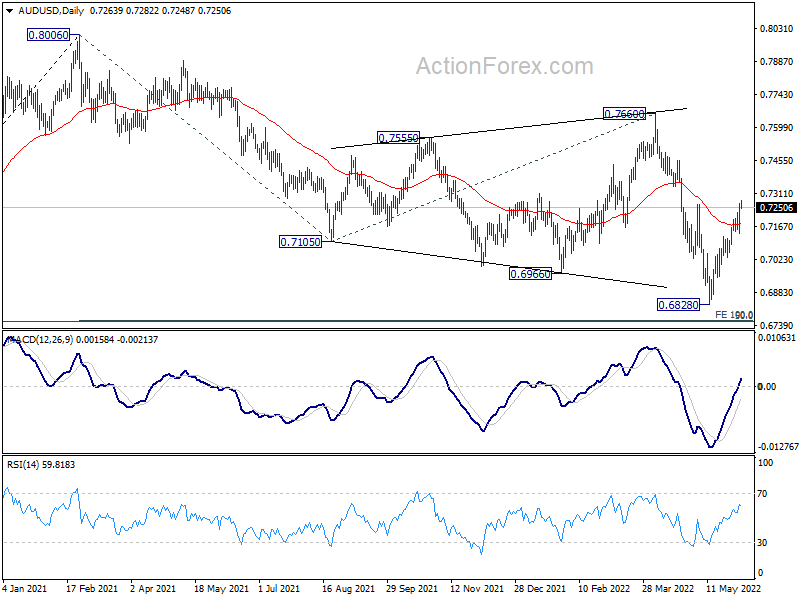
AUD/USD's rebound from 0.6828 extends further and intraday bias stays on the upside. Breach of 0.7265 resistance is a sign that whole corrective fall from 0.8006 has completed with three waves down to 0.6828. Further rise should be seen back to 0.7660 resistance next. On the downside, however, break of 0.7139 minor support will mix up the outlook and turn intraday bias neutral first.
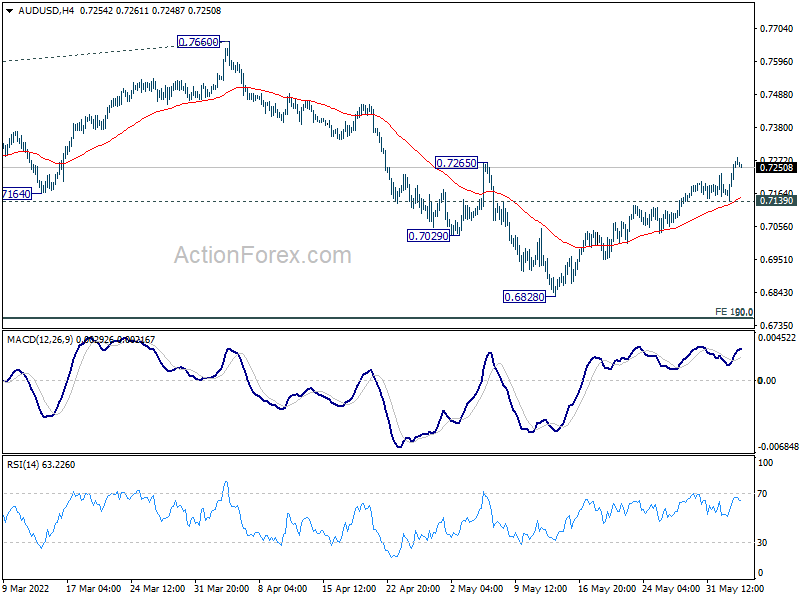
In the bigger picture, price actions from 0.8006 are seen as a corrective pattern to rise from 0.5506 (2020 low). Deeper fall could be seen to 50% retracement of 0.5506 to 0.8006 at 0.6756. This coincides with 100% projection of 0.8006 to 0.7105 from 0.7660 at 0.6760. Strong support is expected from 0.6756/60 cluster to contain downside to complete the correction. Meanwhile, firm break of 0.7660 resistance will confirm that such corrective pattern has completed, and larger up trend is ready to resume.
Yen Extending Selloff, Aussie and Loonie Strong, NFP Watched
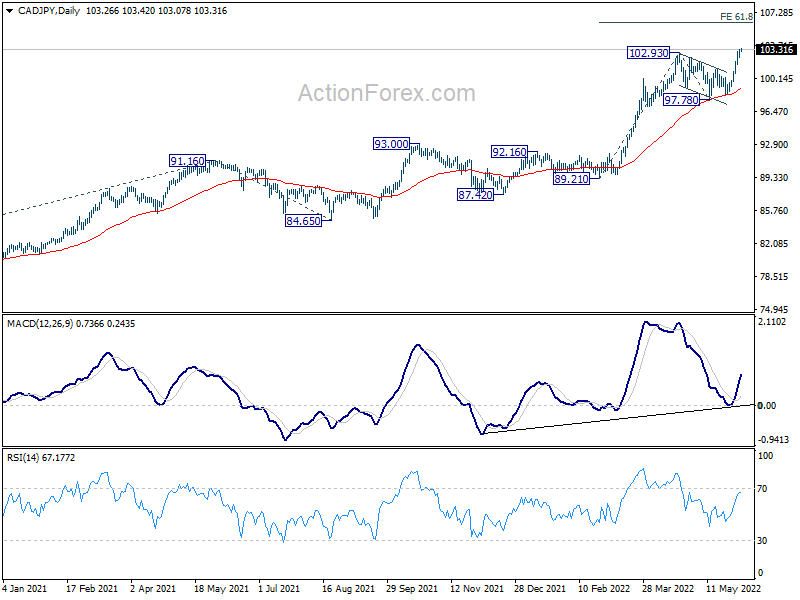
Commodity currencies remain in the driving seat for the week, with Aussie having a slight upper hand over Loonie. Both are supported by firmer risk sentiments, as well as expectations for more tightening. Yen is the runaway loser for the week and looks set to resume broad based down trend. Dollar is mixed for now, a little on the soft side, in reaction to risk sentiment. Focus will turn to non-farm payroll report today, and the reaction in the stock markets would be the main driver in FX.
Technically, CAD/JPY's break of 102.93 resistance confirms up trend resumption. Next target is 61.8% projection of 89.21 to 102.93 from 97.78 at 106.25. AUD/JPY is also making some progress by breaking 94.00 resistance. Focus will turn to 95.73 high in AUD/JPY and break will confirm up trend resumption too. Such developments, if happen, should be accompanied by extended rebound in stocks, and probably treasury yields too.
In Asia, Nikkei closed up 1.19%. Hong Kong and China are on holiday. Singapore Strait Times is up 0.13%. Japan 10-year JGB yield is down -0.0076 at 0.238. Overnight, DOW rose 1.33%. S&P 500 rose 1.84%. NADSAQ rose 2.69%. 10-year yield dropped -0.0018 to 2.913.
Fed Mester cannot conclude inflation has peaked
Cleveland Fed President Loretta Mester said yesterday, "if by the September FOMC meeting, the monthly readings on inflation provide compelling evidence that inflation is moving down, then the pace of rate increases could slow. But if inflation has failed to moderate, then a faster pace of rate increases could be necessary."
"I will need to see several months of sustained downward monthly readings of inflation. I have not seen that yet," she said, thus she could not conclude that inflation has peaked.
On the economy, Mester said, "the risk of recession has risen, but because underlying aggregate demand momentum and the demand for labor are so strong, a good case can still be made that as demand and supply come into better balance, a sharp slowdown can be avoided, with growth slowing to a trend pace this year, labor market conditions remaining healthy, and inflation moving down to a 4‑1/2 to 5‑1/2 percent range this year and declining further next year," Mester said.
Fed Brainard: It's very hard to see the case for pause in Sep
Fed Vice Chair Lael Brainard told CNBC yesterday, "right now, it's very hard to see the case for a pause… We've still got a lot of work to do to get inflation down to our 2% target." Atlanta Fed President Raphael Bostic noted earlier that a pause in September might make sense to see how the economy evolves after successive rate hikes.
"We're certainly going to do what is necessary to bring inflation back down," Brainard said. "That's our No. 1 challenge right now. We are starting from a position of strength. The economy has a lot of momentum."
BoC Beaudry: Interest rate may need to go above 3%
BoC Deputy Governor Paul Beaudry said in a speech, "we noted that price pressures are broadening and inflation is much higher than we expected and likely to go higher still before easing."
"This raises the likelihood that we may need to raise the policy rate to the top end or above the neutral range to bring demand and supply into balance and keep inflation expectations well anchored," he added.
Beaudry also indicated that the neutral range, a rate that "neither stimulates nor weighs on growth", is estimated to be "between 2% and 3%"
NASDAQ extends rebound as focus turns to NFP
US non-farm payroll employment is the main focus for today. The US economy is expected to add 325k jobs in May. Unemployment rate is expected to drop from 3.6% to 3.5%. Average hourly earnings are expected to rise another 0.4% mom. Looking at related data, ADP private jobs grew just 128k, well below expectations. ISM manufacturing employment dropped into contraction reading of 49.6. Four-week moving average of initial claims also rose notably from 188k to 206k. There is risk of downside surprise in the heading NFP number today. But wages growth would be the one that matters more.
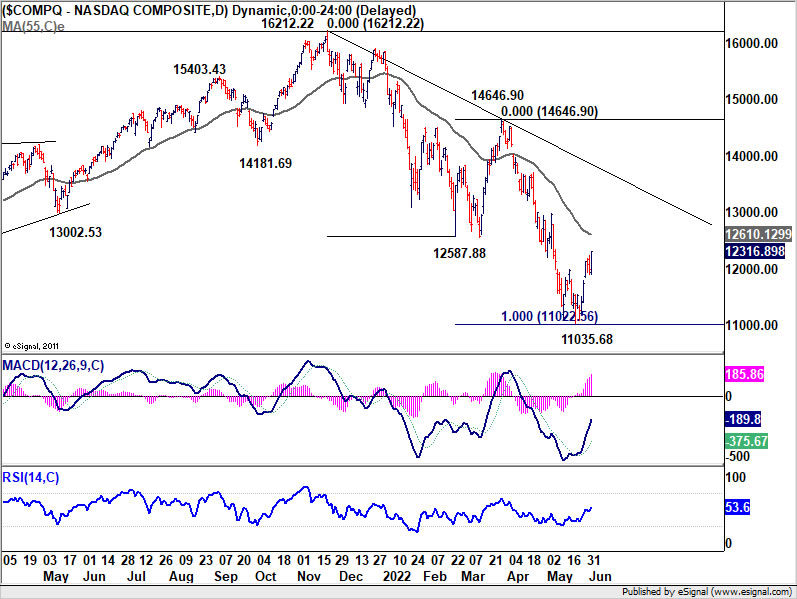
US stocks are trying to extend rebound this week, even though some Fed officials tried to talk down the prospect of a September pause in tightening. NASDAQ's rebound form 11035.68 is in progress for 55 day EMA (now at 12610.13). Sustained break there will raise the chance that whole fall from 16212.22 has completed in form of a three wave correction. Stronger rally would then be seen back towards trendline resistance at around 13800 later in the month. Such development would cap rally attempts in the greenback.
Elsewhere
Australia AiG Performance of Construction dropped sharply from 55.9 to 50.4 in may. Germany trade balance and France industrial output will be released in European session. Eurozone will release PMI services final and retail sales. Later in the day, in addition to NFP, US will also publish ISM services.
AUD/USD Daily Report
Daily Pivots: (S1) 0.7181; (P) 0.7226; (R1) 0.7310; More...
AUD/USD's rebound from 0.6828 extends further and intraday bias stays on the upside. Breach of 0.7265 resistance is a sign that whole corrective fall from 0.8006 has completed with three waves down to 0.6828. Further rise should be seen back to 0.7660 resistance next. On the downside, however, break of 0.7139 minor support will mix up the outlook and turn intraday bias neutral first.
In the bigger picture, price actions from 0.8006 are seen as a corrective pattern to rise from 0.5506 (2020 low). Deeper fall could be seen to 50% retracement of 0.5506 to 0.8006 at 0.6756. This coincides with 100% projection of 0.8006 to 0.7105 from 0.7660 at 0.6760. Strong support is expected from 0.6756/60 cluster to contain downside to complete the correction. Meanwhile, firm break of 0.7660 resistance will confirm that such corrective pattern has completed, and larger up trend is ready to resume.
Economic Indicators Update
| GMT | Ccy | Events | Actual | Forecast | Previous | Revised |
|---|---|---|---|---|---|---|
| 22:30 | AUD | AiG Performance of Construction Index May | 50.4 | 55.9 | ||
| 06:00 | EUR | Germany Trade Balance (EUR) Apr | 5.6B | 3.2B | ||
| 06:45 | EUR | France Industrial Output M/M Apr | 0.40% | -0.50% | ||
| 07:45 | EUR | Italy Services PMI May | 54.5 | 55.7 | ||
| 07:50 | EUR | France Services PMI May F | 58.4 | 58.4 | ||
| 07:55 | EUR | Germany Services PMI May F | 56.3 | 56.3 | ||
| 08:00 | EUR | Eurozone Services PMI May F | 56.3 | 56.3 | ||
| 09:00 | EUR | Eurozone Retail Sales M/M Apr | 0.30% | -0.40% | ||
| 12:30 | CAD | Labor Productivity Q/Q Q1 | -1.20% | -0.50% | ||
| 12:30 | USD | Nonfarm Payrolls May | 325K | 428K | ||
| 12:30 | USD | Unemployment Rate May | 3.50% | 3.60% | ||
| 12:30 | USD | Average Hourly Earnings M/M May | 0.40% | 0.30% | ||
| 13:45 | USD | Services PMI May F | 53.5 | 53.5 | ||
| 14:00 | USD | ISM Services PMI May | 56.7 | 57.1 |
NASDAQ extends rebound as focus turns to NFP
US non-farm payroll employment is the main focus for today. The US economy is expected to add 325k jobs in May. Unemployment rate is expected to drop from 3.6% to 3.5%. Average hourly earnings are expected to rise another 0.4% mom. Looking at related data, ADP private jobs grew just 128k, well below expectations. ISM manufacturing employment dropped into contraction reading of 49.6. Four-week moving average of initial claims also rose notably from 188k to 206k. There is risk of downside surprise in the heading NFP number today. But wages growth would be the one that matters more.
US stocks are trying to extend rebound this week, even though some Fed officials tried to talk down the prospect of a September pause in tightening. NASDAQ's rebound form 11035.68 is in progress for 55 day EMA (now at 12610.13). Sustained break there will raise the chance that whole fall from 16212.22 has completed in form of a three wave correction. Stronger rally would then be seen back towards trendline resistance at around 13800 later in the month. Such development would cap rally attempts in the greenback.
Fed Mester cannot conclude inflation has peaked
Cleveland Fed President Loretta Mester said yesterday, "if by the September FOMC meeting, the monthly readings on inflation provide compelling evidence that inflation is moving down, then the pace of rate increases could slow. But if inflation has failed to moderate, then a faster pace of rate increases could be necessary."
"I will need to see several months of sustained downward monthly readings of inflation. I have not seen that yet," she said, thus she could not conclude that inflation has peaked.
On the economy, Mester said, "the risk of recession has risen, but because underlying aggregate demand momentum and the demand for labor are so strong, a good case can still be made that as demand and supply come into better balance, a sharp slowdown can be avoided, with growth slowing to a trend pace this year, labor market conditions remaining healthy, and inflation moving down to a 41/2 to 51/2 percent range this year and declining further next year," Mester said.
Technical Outlook and Review
DXY:
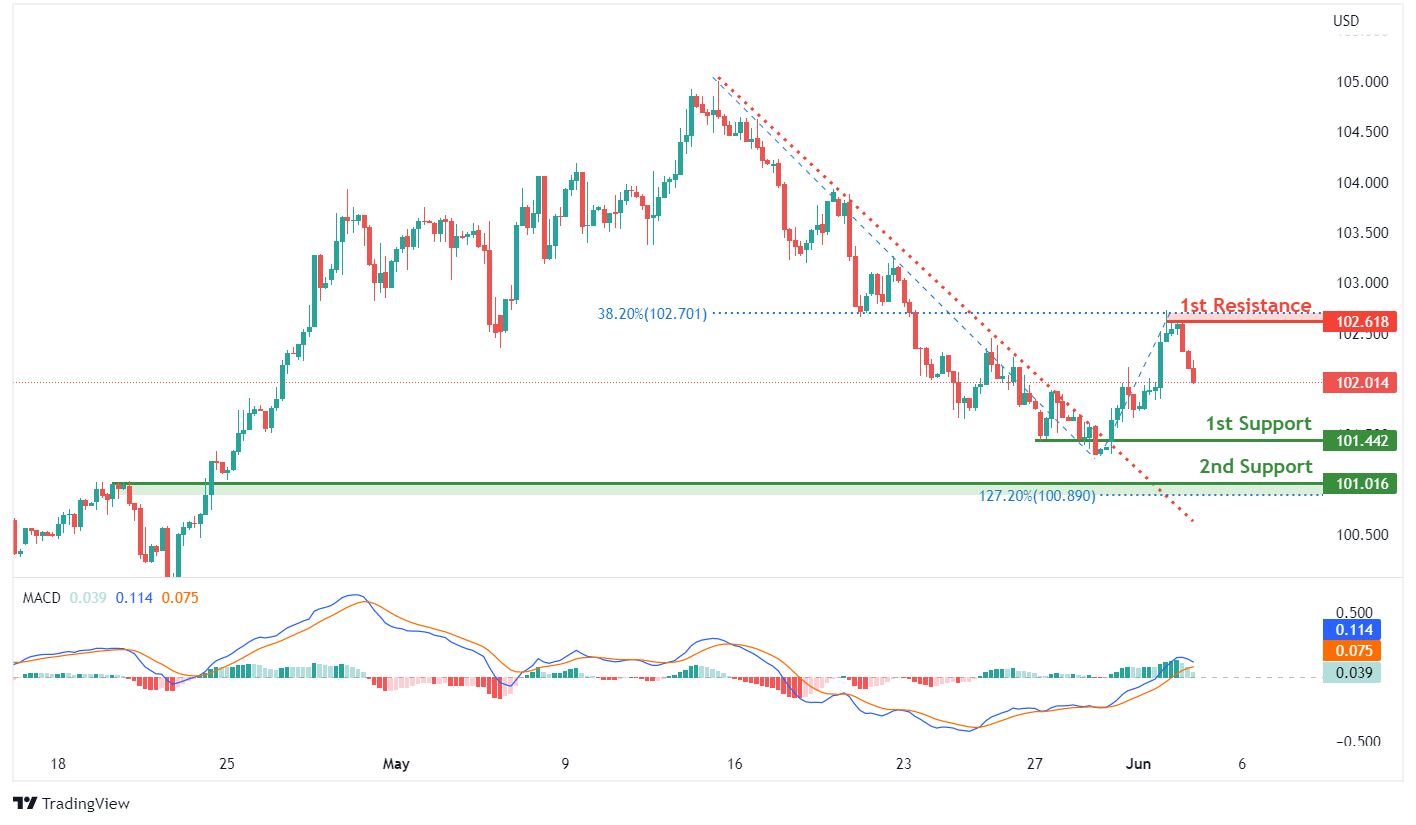
On the H4, with MACD moving in a bullish momentum and breakout from the descending trendline, we have a bullish bias that price will rise to our 1st resistance at 102.618 where the horizontal swing high resistance and 38.2% fibonacci retracement are from our 1st support at 101.442 in line with the horizontal pullback support is. Alternatively, price may break 1st support structure and head for 2nd support at 101.016 where the horizontal pullback support and 127.2% fibonacci extensions are.
Areas of consideration:
- H4 time frame, 1st resistance at 102.618
- H4 time frame, 1st support at 101.442
XAU/USD (GOLD):
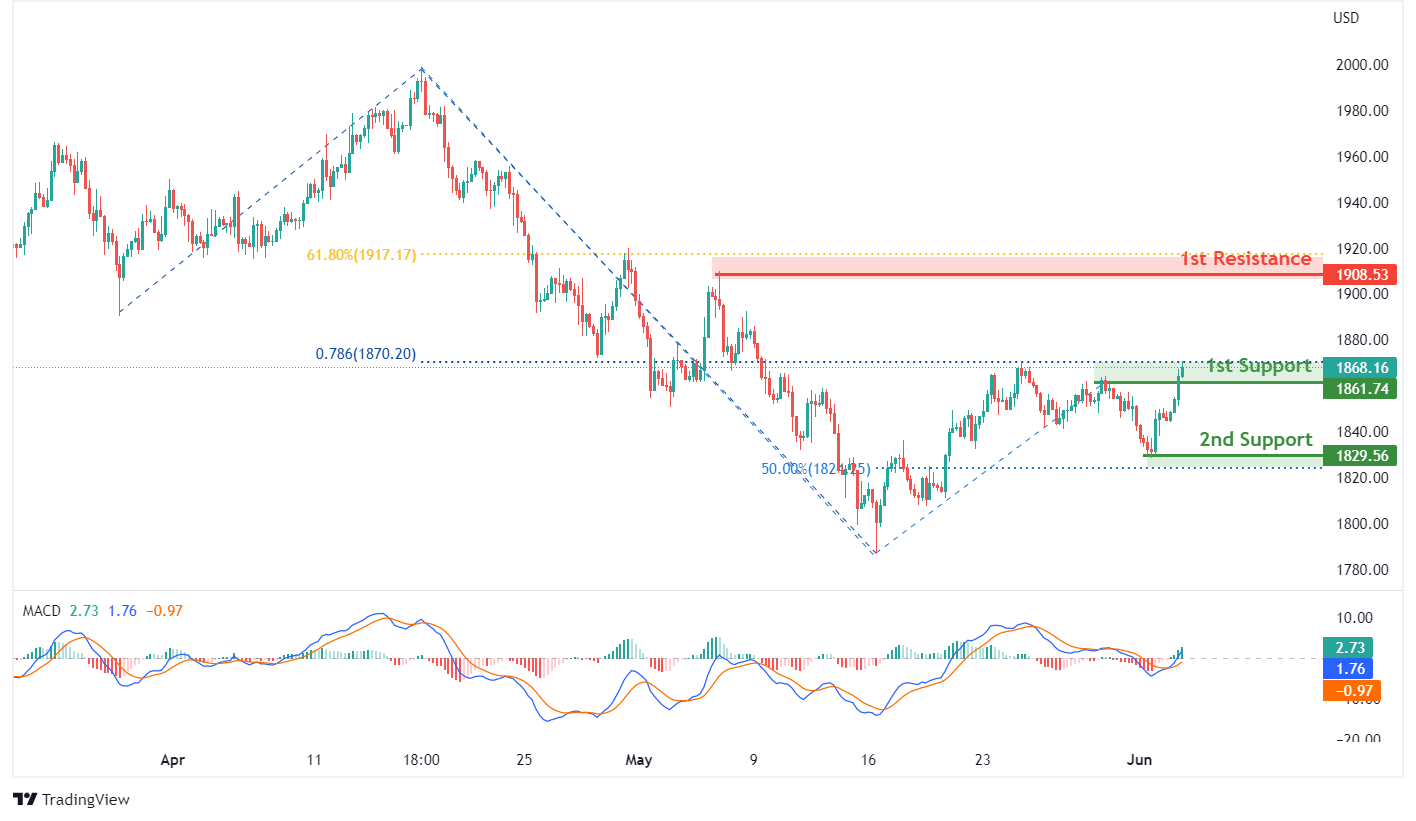
On the H4, with MACD moving in a bullish momentum, we have a bullish bias that price will rise from our 1st support at 1861.74 where the horizontal pullback resistance and 78.6% fibonacci projection to our 1st resistance at 1908.53 where the horizontal swing high resistance and 61.8% fibonacci retracement are. Alternatively, price may break 1st support structure and head for 2nd support at 1829.56 in line with swing low support and 50% fibonacci retracement.
Areas of consideration:
- H4 time frame, 1st Resistance at 1908.53
- H4 time frame, 1st Support at 1861.74
GBP/USD:
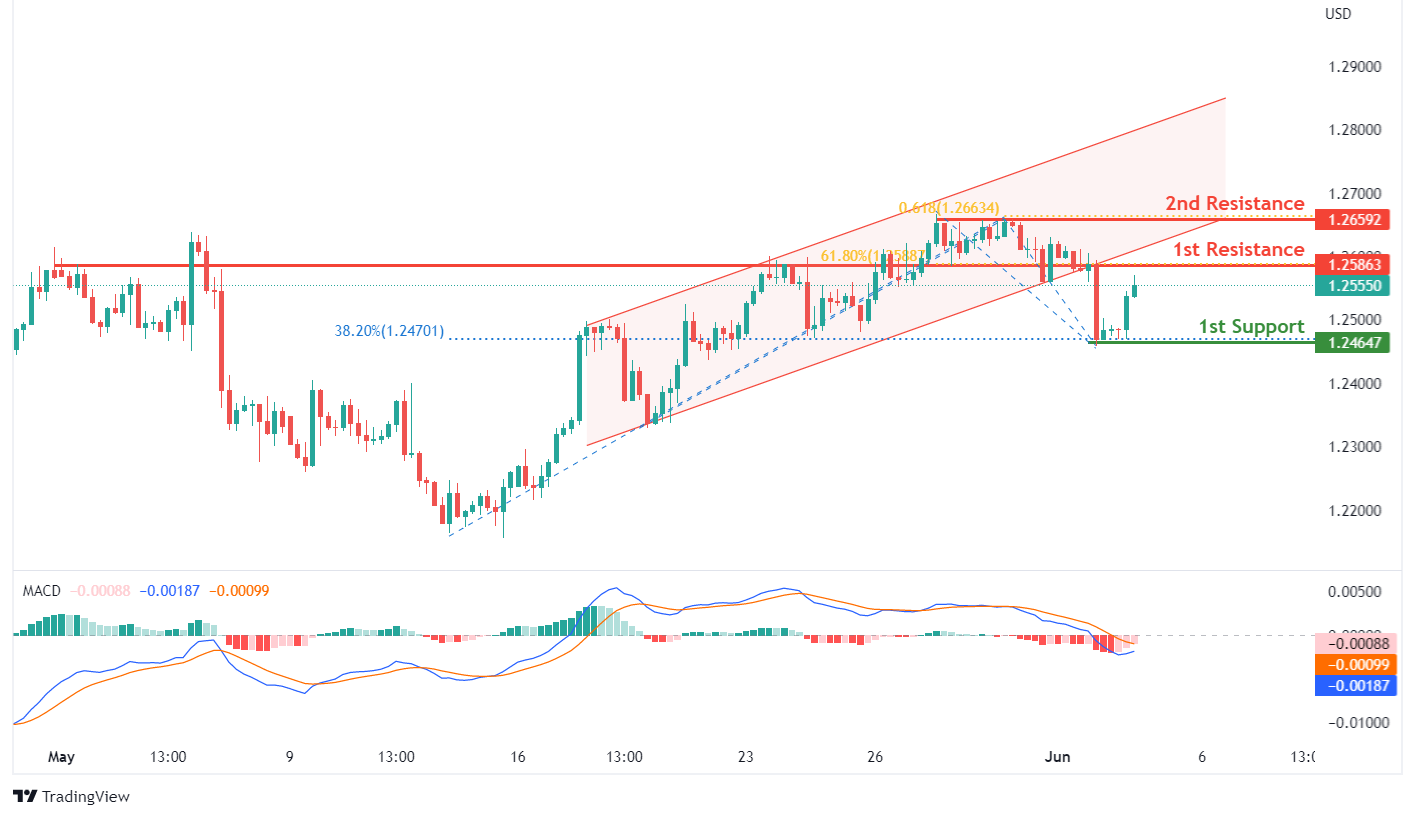
On the H4, with MACD moving in bearish momentum and price breakout from ascending channel, we have a bearish bias that price will drop from our 1st resistance at 1.25863 where the horizontal overlap resistance and 61.8% fibonacci retracement to our 1st support at 1.24647 in line with the 38.2% Fibonacci retracement and swing low support. Alternatively, price may break 1st resistance structure and head for 2nd resistance at 1.26592 where the horizontal swing high resistance and 61.8% fibonacci projection are.
Areas of consideration:
- H4 1st resistance at 1.25863
- H4 1st support at 1.24647
USD/CHF:
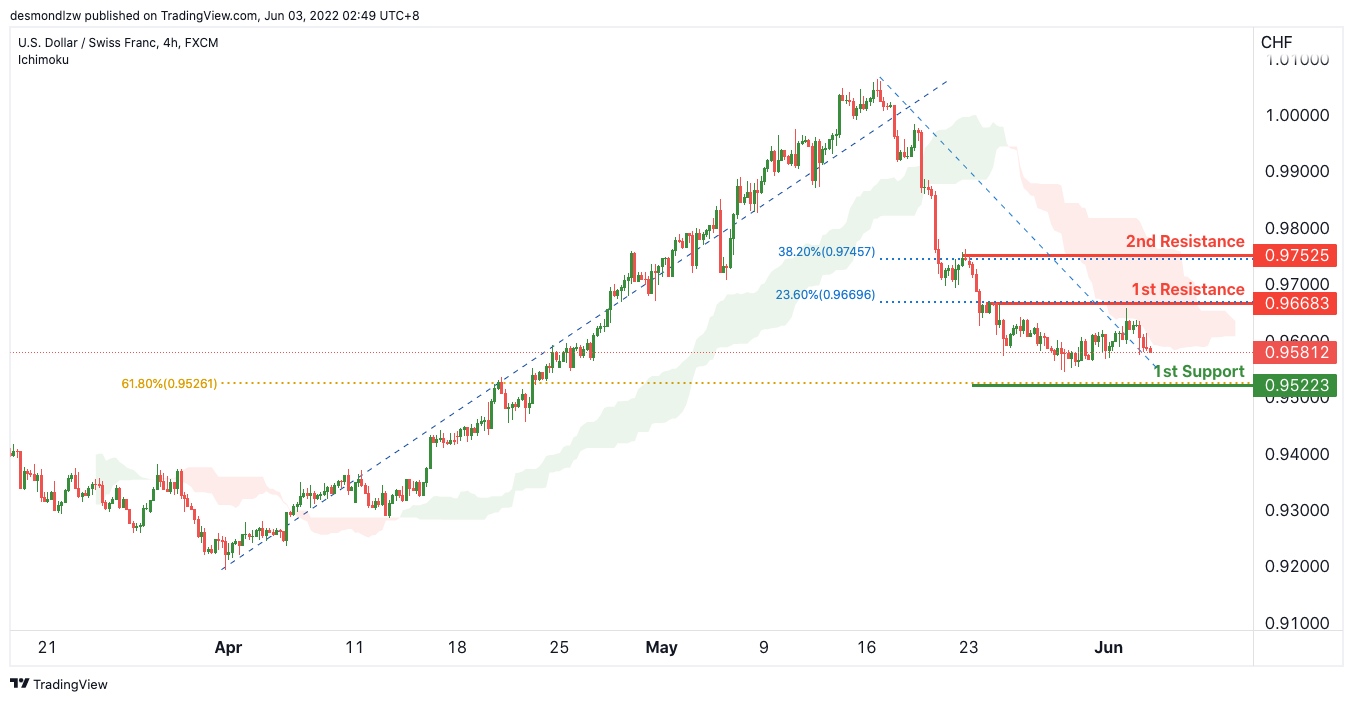
On the H4, with price moving below the ichimoku cloud, we have a bearish bias that price will drop to our 1st support at 0.95223 where the 61.8% Fibonacci retracement is from our 1st resistance at 0.96683 in line with the pullback resistance. Alternatively, price may break 1st resistance structure and head for 2nd resistance at 0.97525 where the swing high resistance is.
Areas of consideration
- 1st support level at 0.95223
- 1st resistance level at 0.96683
EUR/USD :
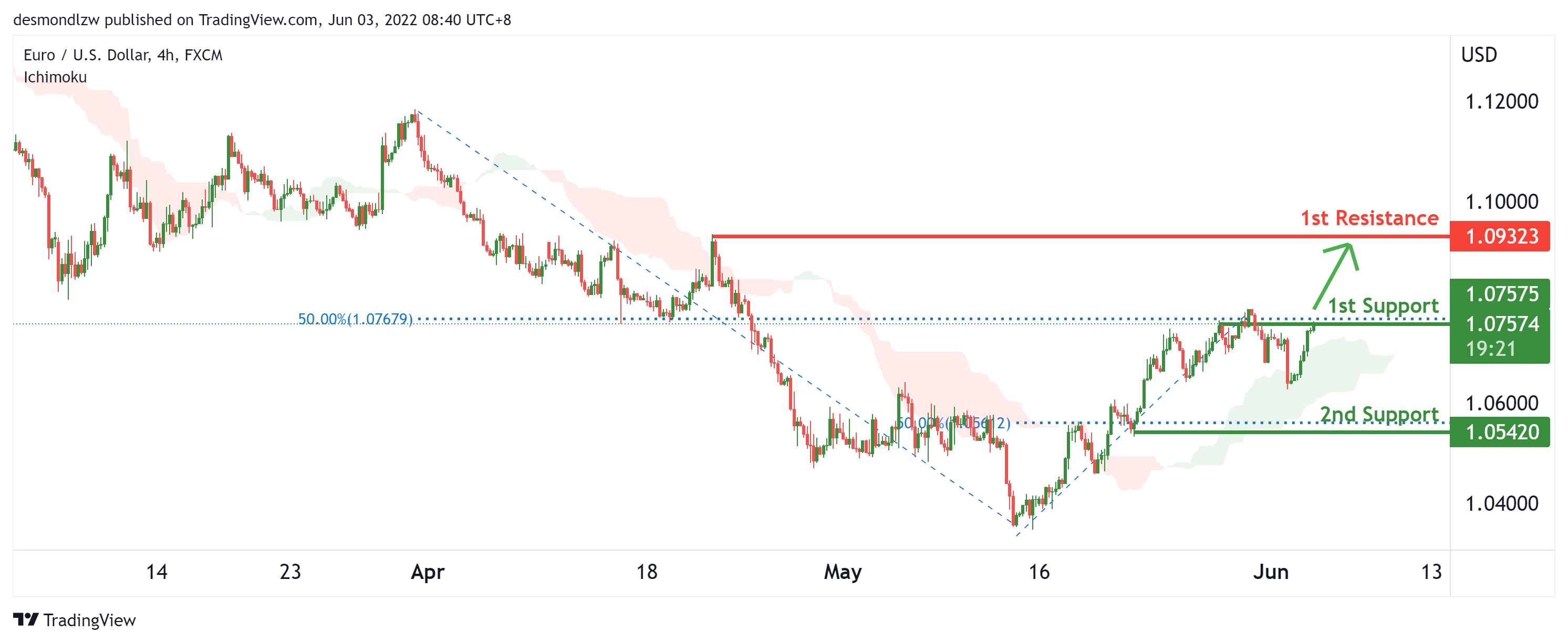
On the H4, with price moving above the ichimoku cloud, we have a bullish bias that price will rise from our 1st support at 1.0575 in line with the 50.0% fibonacci retracement to our 1st resistance at 1.09323 swing high. Alternatively, price may reverse off the 1st support and drop to 2nd support at 1.0542 in line with the 50.0% fibonacci retracement
Areas of consideration :
- H4 1st resistance at 1.09323
- H4 1st support at 1.0575
USD/JPY:
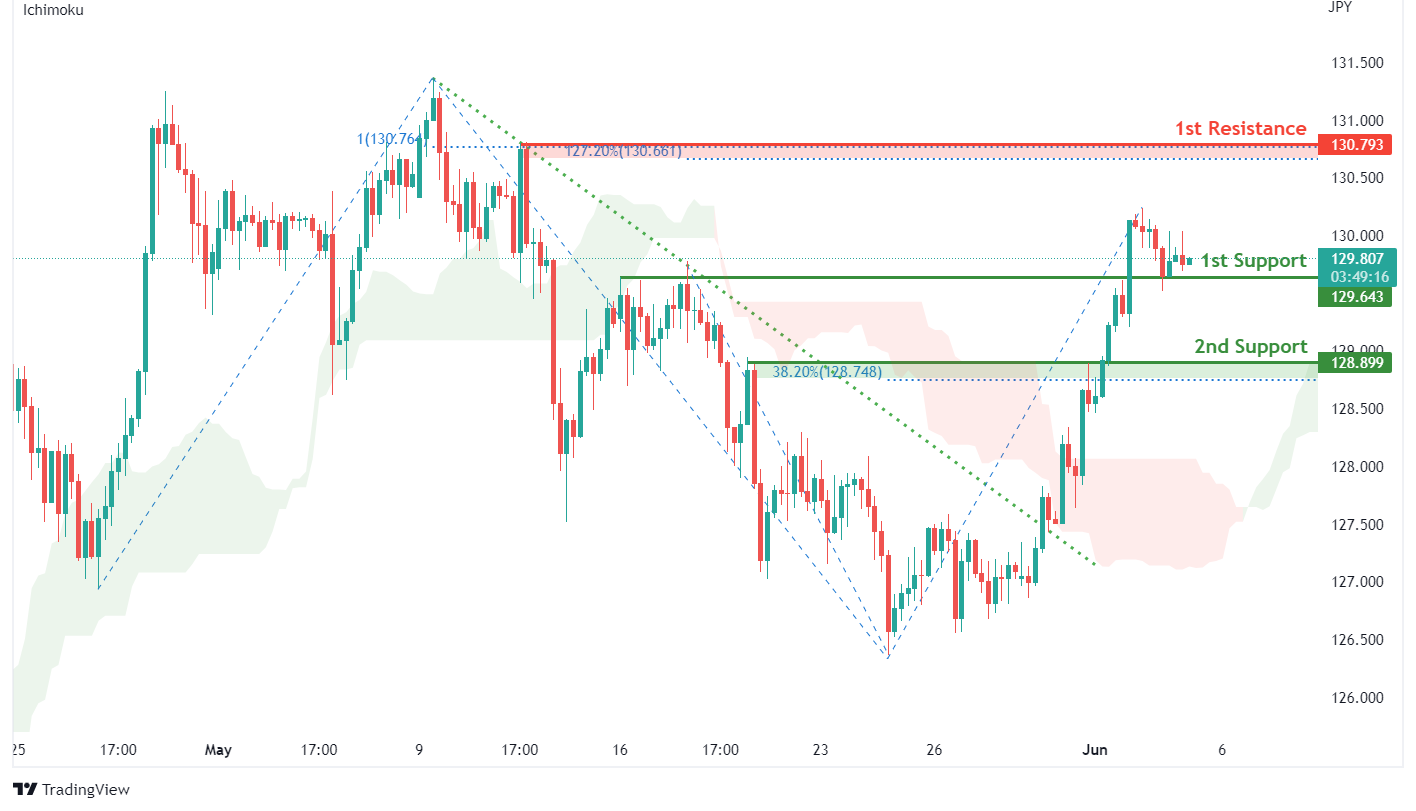
On the H4, with prices moving above the ichimoku indicator and breakout from descending trendline, we have a bullish bias that price will rise from our 1st support at 129.643 where the horizontal overlap support is to our 1st resistance at 130.793 in line with the swing high resistance, 127.2% Fibonacci extension and 100% fibonacci projection. Alternatively, price may break 1st support structure and head for 2nd support at 128.899 where the horizontal pullback support and 38.2% fibonacci retracement are.
Areas of consideration:
- H4 time frame, 1st resistance at 130.793
- H4 time frame, 1st support at 129.643
AUD/USD:
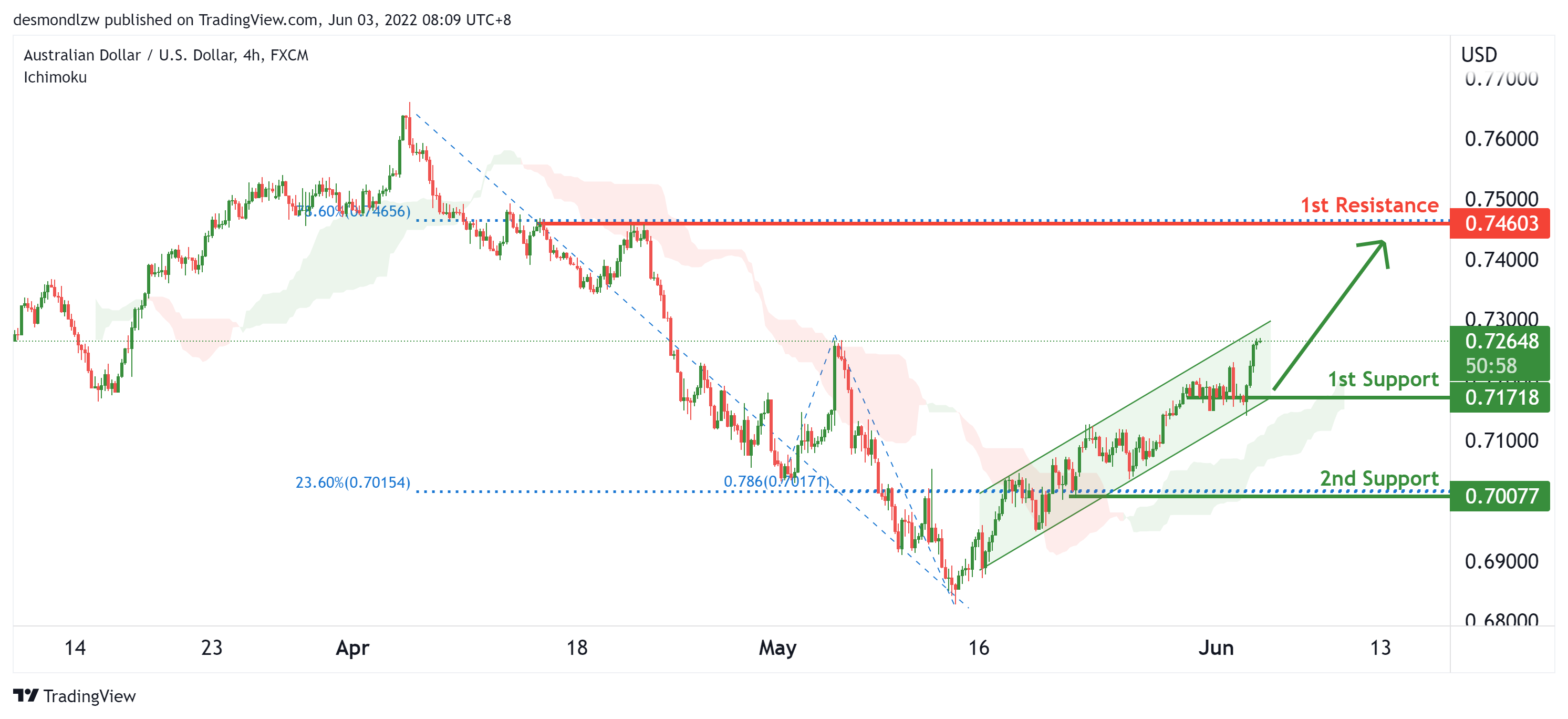
On the H4, with price moving above the ichimoku cloud and price moving within the ascending trend channel, we have a bullish bias that price will rise to our 1st resistance at 0.74603 where the swing high is in line with the 78.6% Fibonacci retracement from our 1st support at 0.71718. Alternatively, price may break 1st support structure and head for 2nd support at 0.70435 where the horizontal pullback support is, in line with the 78.6% fibonacci projection and 23.6% Fibonacci retracement.
Areas of consideration
- H4 1st resistance at 0.74603
- H4 1st support at 0.71718
NZD/USD:
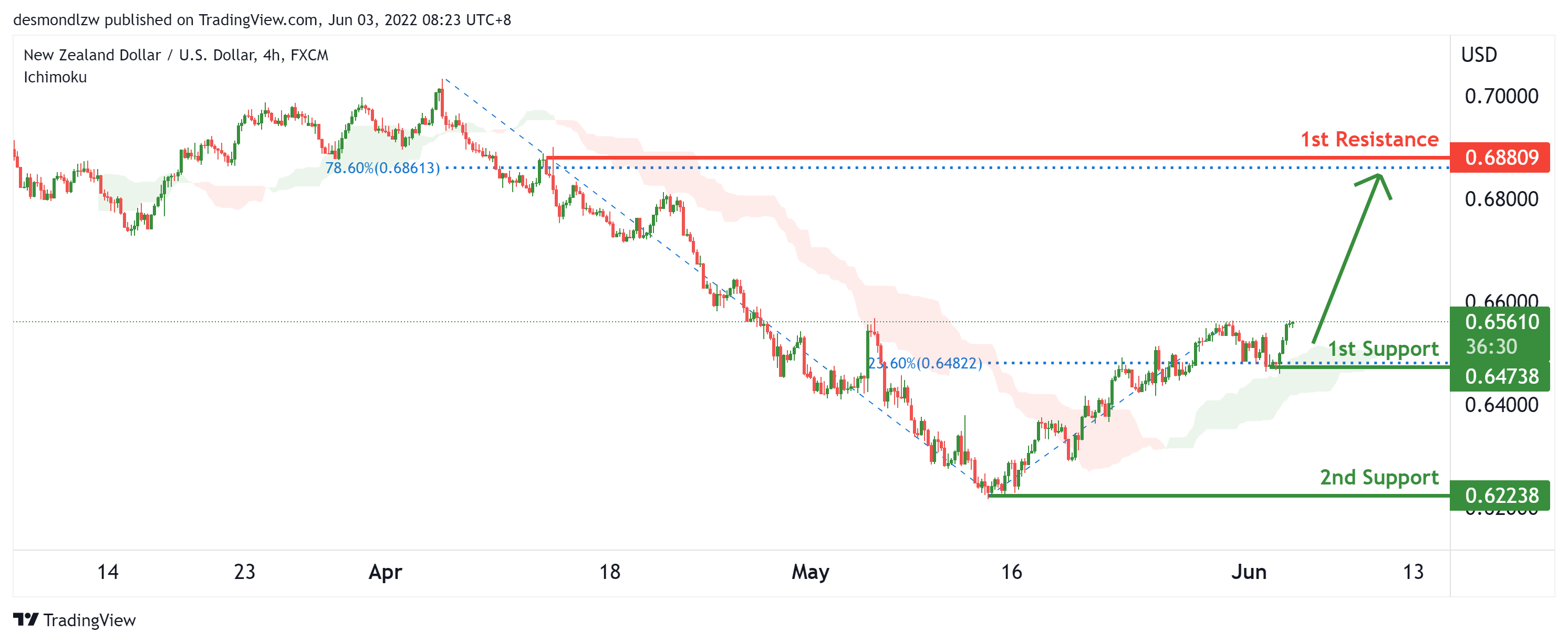
On the H4, with price moving above the ichimoku cloud, we have a bullish bias that price will rise from our 1st support at 0.64738 in line with the 23.6% fibonacci retracement to our 1st resistance at 0.68809 in line with the 78.6% fibonacci retracement. ALternatively, price may reverse off the 1st support and drop to 2nd support at 0.62238 at the swing low.
Areas of consideration:
- H4 time frame, 1st support at 0.64738
- H4 time frame, 1st resistance at 0.68809
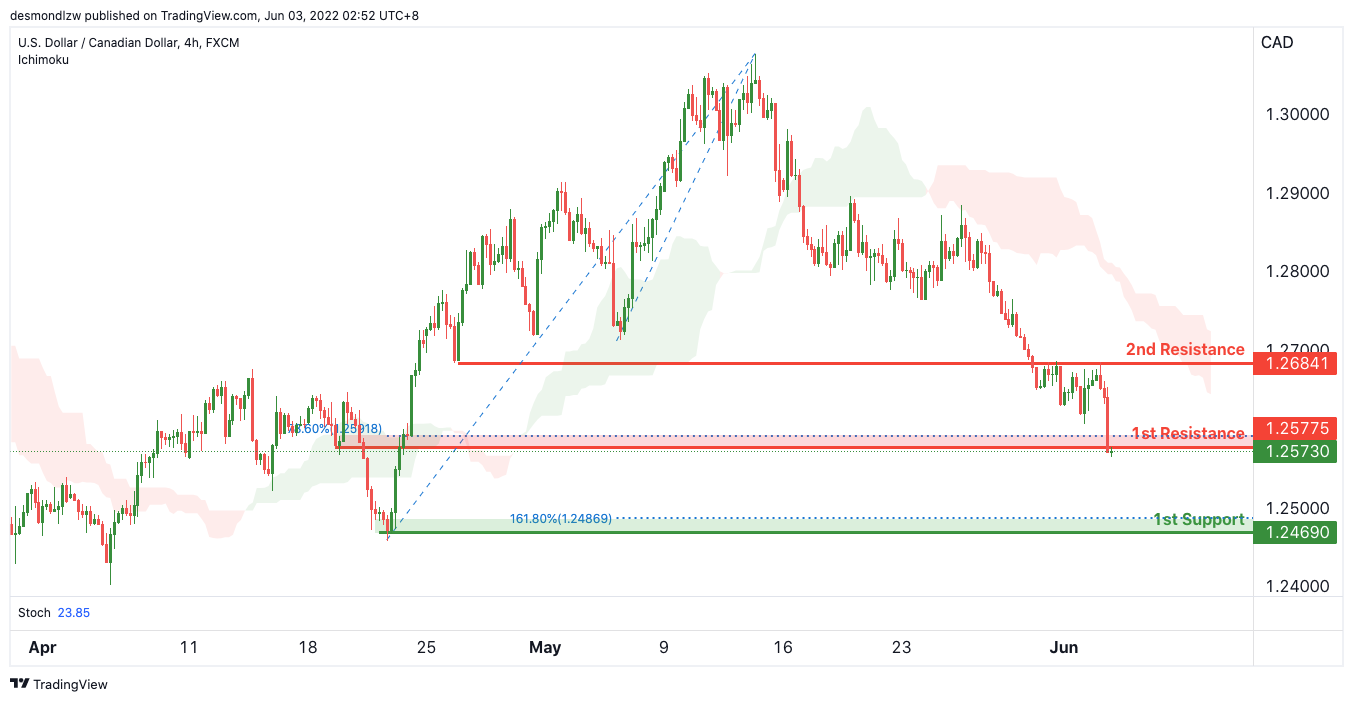
USD/CAD:
On the H4, with price moving below our ichimoku cloud and the recent break of our horizontal support level which is in line with the 28.6% fibonacci retracement level, we have a bearish bias that price will drop to our 1st support at 1.24690 in line with the horizontal swing low support and the 161.8% Fibonacci extension from our 1st resistance at 1.25775. Alternatively, price may break structure and head for our 2nd resistance at 1.26841.
Areas of consideration:
- H4 time frame, 1st resistance at 1.25775
- H4 time frame, 1st support at 1.24690
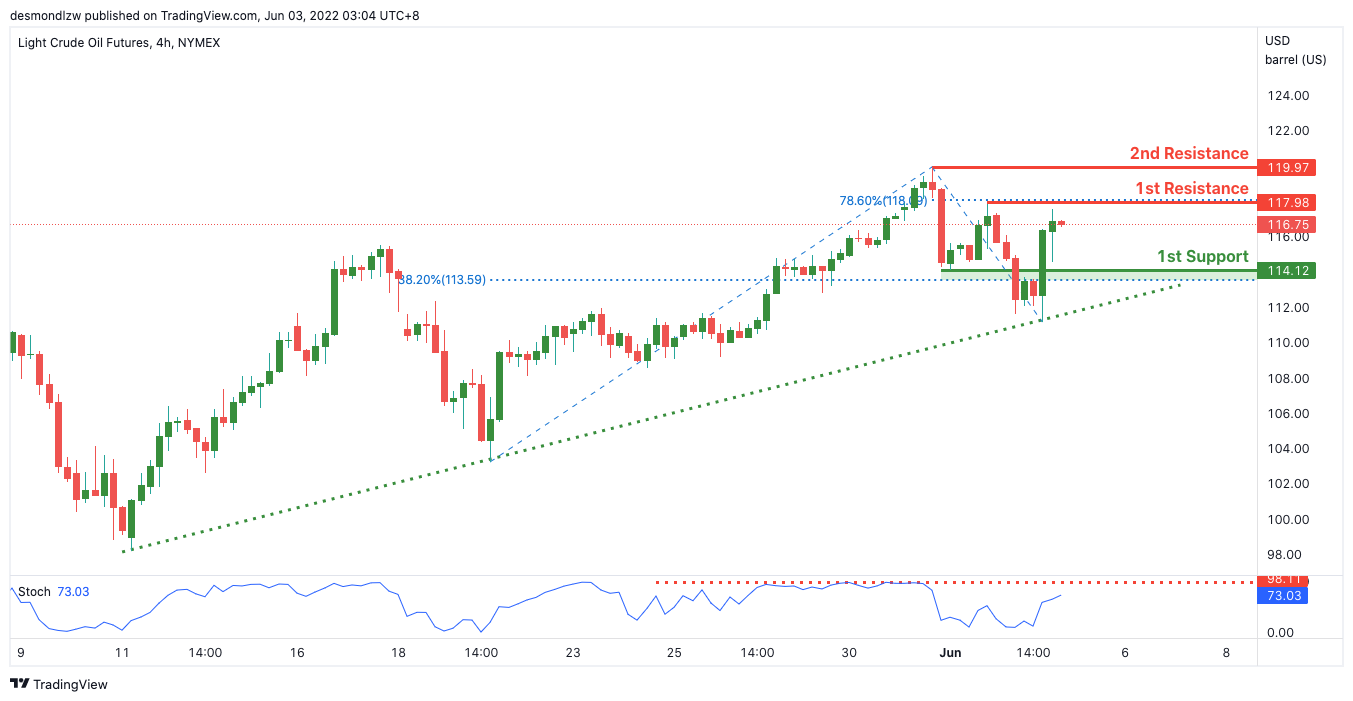
OIL:
On the H4, with price expected to reverse off the stochastics indicator, we have a bearish bias that price will drop to our 1st support at 114.12 in line with the horizontal pullback support and the 38.2% Fibonacci retracement from our 1st resistance at 117.98 in line with the 78.6% fibonacci retracement level. Alternatively, price may break structure and head for our 2nd resistance at 119.97.
Areas of consideration:
- H4 time frame, 1st resistance of 114.56
- H4 time frame, 1st support of 111.83
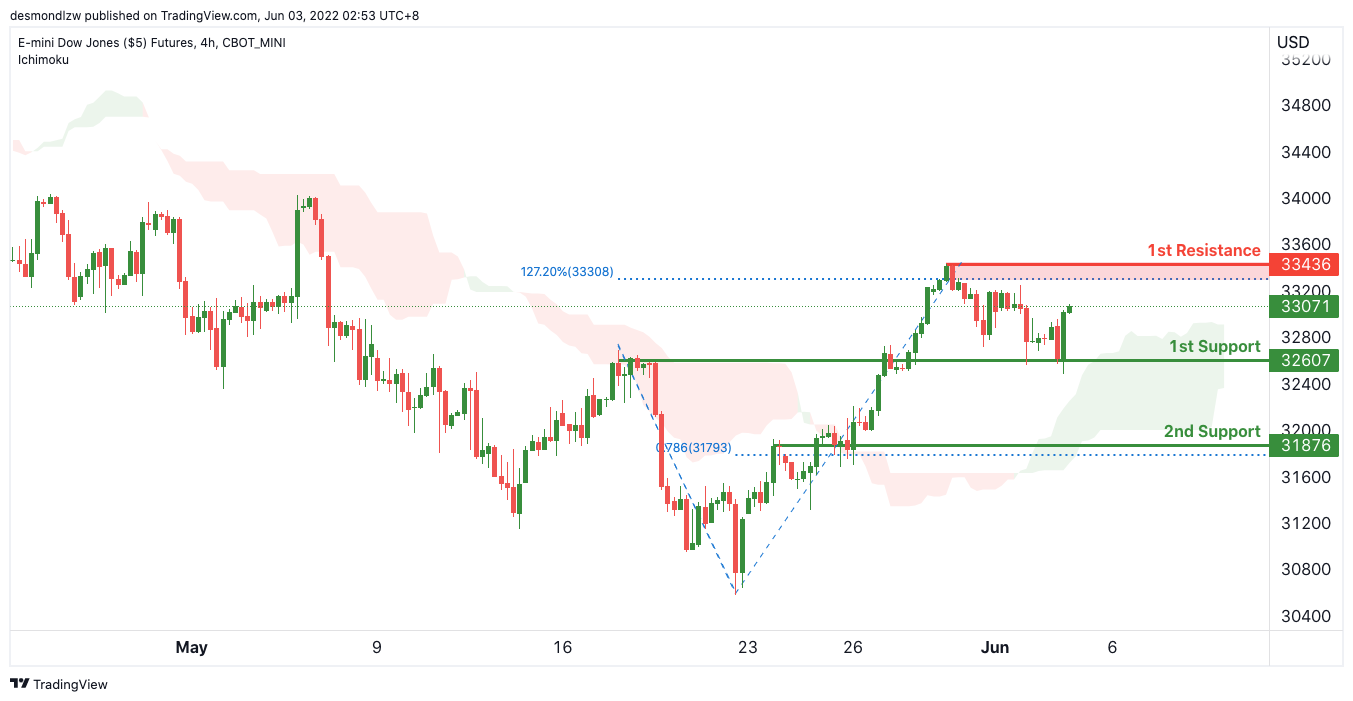
Dow Jones Industrial Average:
On the H4, with price moving above the ichimoku cloud, we have a bullish bias that price will rise from our 1st support at 32607 where the horizontal pullback support is to our 1st resistance at 33436 in line with the swing high resistance and 127.2% Fibonacci extension. Alternatively, price may break structure and head for 2nd support at 31876.
Areas of consideration :
- H4 time frame, 1st resistance at 33463
- H4 time frame, 1st support at 32607
Cliff Notes: A Robust Foundation for Continued Gains
Key insights from the week that was.
Australian GDP surprised to the upside in Q1 2022, gaining 0.8% to be 3.3% higher than a year ago. As expected, household consumption was a key support, total spending rising 1.5% in the three months to March (4.0%yr). Most notable in the detail for this sector was that discretionary spending rose 4.3% despite disruptions related to the omicron variant of COVID-19 and heavy flooding on the east coast. Also significant for the immediate outlook is that households chose to finance some of their purchases through a reduction in the savings rate from historically-elevated levels – showing confidence in their individual prospects and the economy more broadly.
Of the other sectors, public spending reported a very healthy gain of 2.6% (8.0%yr) and business investment beat expectations (1.4%; 3.6%yr). Meanwhile, despite a large pipeline of work, residential construction contracted for a second consecutive quarter (-1.0;-1.3%yr), highlighting the impact of labour and construction input shortages being seen the world over. For a full sectoral and state breakdown of the release, see our bulletin.
Providing more detail on the housing market, this week CoreLogic data confirmed that the anticipated house price correction has begun, a 0.3% decline seen across the eight major cities in May. Responding to the uncertainty, turnover continues to decline, down 12% nationally and 25-30% in Sydney and Melbourne – admittedly from high levels late last year. Dwelling approvals also continue to fall, down 2.4% in April to be 32% lower than a year ago.
International trade was also a focus for Australia this week. In Q1, Australia’s current account recorded a 12th consecutive surplus, though at 1.3% of GDP, it was materially inside of Q2 2021’s peak surplus of 4.1%. Thereafter, the April trade balance printed ahead of expectations at $10.5bn as service exports jumped 10% in the month to be 13% higher than end-2021. Note however, the level at April is still some 39% below that seen prior to the pandemic. With Australia’s border now open, further strong gains for tourism and student arrivals are expected over the coming year. Westpac continues to expect the RBA to respond to the strength in Australia’s economy and inflation risks by raising the cash rate by 40bps at their June meeting, then to a year-end rate of 1.75% and a cycle peak of 2.25% at May 2023.
Switching from real economic activity to financial transactions, the Q1 financial account again reported strong demand for Australian financial and real assets. Inbound and outbound direct investment was strong and focused on new investment decisions. Portfolio flows out of Australia also showed a bias towards long-term growth opportunities, with 61% of the Q1 gross portfolio outflow dedicated to equity investments (over the 12 months to March, the share was materially higher, circa 90%). A higher proportion of the gross portfolio inflow continues to target debt assets (50% in Q1 and 80% over the year to March). In time, the greater share of equity investment for Australian investors abroad should lead to a higher net return for Australia, particularly if capital gains are left to compound.
Moving offshore, the calendar has been relatively light to date, with the key international release of the week (the US employment report) still to come. The focus of markets has therefore been hawkish guidance from the Bank of Canada as they delivered another 50bp increase in the Bank Rate to 1.50%. An upside surprise for the US ISM manufacturing survey in May along with comments through the week from FOMC members (which continued to signal an intent to move back to neutral by end-2022) allowed the hawkish mood to transfer across to the US, the 10-year rising back above 2.90% mid-week having tested down to around 2.70% last week. We remain of the view that the FOMC will deliver 50bp increases in June and July before slowing the pace of rate hikes back to 25bp increments from September and halting the hiking cycle at 2.625% come December. By this time, in our view, US growth will have slowed to trend and inflation more than halved from its early-2022 peak (on a 6-month annualised basis).
Finally to China. At the beginning of the week, we detailed our expectations for China’s recovery from the recent COVID-zero lockdowns. Our view remains that momentum will quickly return and have a strong long-term foundation, built on quality investment, robust trade flows and, in time, a resurgent consumer. In our view, growth near authorities 5.5% target is still achievable in 2022 as long as the Q2 outcome is positive and there are no other significant outbreaks of the virus. The official May PMI outcomes were constructive for our view this week, the services PMI rebounding more than 5pts in the month and the manufacturing PMI back near 50 – this is despite the ongoing impact of the Shanghai and Beijing lockdowns and associated logistic bottlenecks through the month.
We Expect the RBA Board Will Take the Right Decision and Lift the Cash Rate by 0.4% Next Week
The Reserve Bank Board meets on June 7 next week.
Immediately following the Board's decision to raise the cash rate by 25 basis points on May 3 we argued that the correct policy decision for June 7 would be to raise the cash rate by a further 40 basis points.
By lifting the cash rate by 40 basis points from 0.35% to 0.75% the Board would be fully unwinding the emergency rate cuts we saw in 2020 during the Covid crisis.
Clearly that emergency has passed and there is no justification to maintain an extreme emergency policy stance.
We believe that the Board will make that correct decision next week.
Most analysts have and continue to predict a move of 25 basis points, partly in response to the Governor's press conference which he conducted following the decision on May 3.
He referred to going back to a "business as usual" policy process which he implied was movements of 25 basis points at the meetings.
But the Minutes of the meeting provided further insight into that statement.
The Minutes noted that the Board considered three policy options for the cash rate.
The 15 basis points option which was favoured by most analysts (including Westpac) and the market, was dismissed by the Board because policy settings were already "very stimulatory"; further rate rises would be required; and a 15 basis point increase would be inconsistent with the historical practice of changing the cash rate in increments of at least 25 basis points.
The Minutes pointed out that the case for 40 basis points "could be made given the upside risks to inflation and the current very low level of interest rates." That case remained open without any real argument against it, although "given the Board meets monthly, it would have the opportunity to review the setting of interest rates again within a relatively short period of time".
That second comment could be interpreted in two ways – no need to adopt big moves given the frequency of meetings or the decision to do "40" could be deferred to next month.
The lack of a clear argument against the 40 in May and the fact that they refer to the level of rates being "very stimulatory" supports doing more than 25 and thereby signalling the Board's commitment to achieving its inflation objectives and managing inflationary expectations.
Assistant Governor Kent emphasised at a recent Kanga News Conference (May 16) that it was the level of rates that mattered the most not the change- consistent with the comment in the minutes "current very low level of interest rates."
At his press conference the Governor referred to "business as usual".
That may have been interpreted as "25 basis point movements." However, the minutes refer to the " historical practice of changing the cash rate in increments of AT LEAST 25 basis points" (my emphasis).
I think it is reasonable to assess the Governor's "business as usual" comments as being in line with that observation and not restricting " business as usual" to 25 basis point moves.
Another key argument supporting the likely 40 basis point policy is the description of the actions of other central banks in the minutes. "Several central banks in advanced economies had indicated that they were seeking to return policy rates to a neutral setting QUICKLY (my emphasis) and may increase policy rates further thereafter."
Since that Board meeting we have seen the FOMC lift the federal funds rate by 50 basis points to 0.875%; the Bank of Canada lift its benchmark rate by 50 basis points to 1.75%; the RBNZ lift the official cash rate by 50 basis points to 2.0%; and each bank indicated that further significant increases can be expected.
All these central banks started their cycles with a 25 basis point move followed immediately (FOMC; BOC) by 50 basis points while RBNZ moved to 50's after two moves of 25 basis points.
Larger increases at the early stages of the tightening are good policy. Better to move decisively in the early stages of the cycle when it is clear rates are well below neutral than later in the cycle when there is a risk that policy moves too quickly into contractionary territory .
An early decisive move also sends a clear signal that the Bank is committed to its inflation objective and impacts inflationary expectations in the community.
The RBA has been slow to recognise that Australia has a formidable inflation challenge.
It is not appropriate to only compare Australia's CURRENT inflation rate with other countries. Inflation forecasts are just as important.
In that regard note that the RBA's current forecast for inflation by end 2022 is 4.6% (trimmed mean) and 5.9% (headline) compared to the FOMC's forecast by end 2022 (core PCE) of 4.1% and 4.3% (PCE).
Recent developments around energy prices and rents are likely to see the RBA lifting its current forecasts for inflation, although we will not see a formal update until November.
Since the May Board Meeting there have been a number of significant developments which further emphasise the need to be decisive.
Inflation
The March quarter national accounts confirmed the inflation surge we saw in the March quarter CPI report.
The most appropriate measure of domestic price pressuresthe domestic final demand implicit deflator – rose by 1.4% in the quarter – the fastest increase since the introduction of the Goods and Services Tax in 2001.
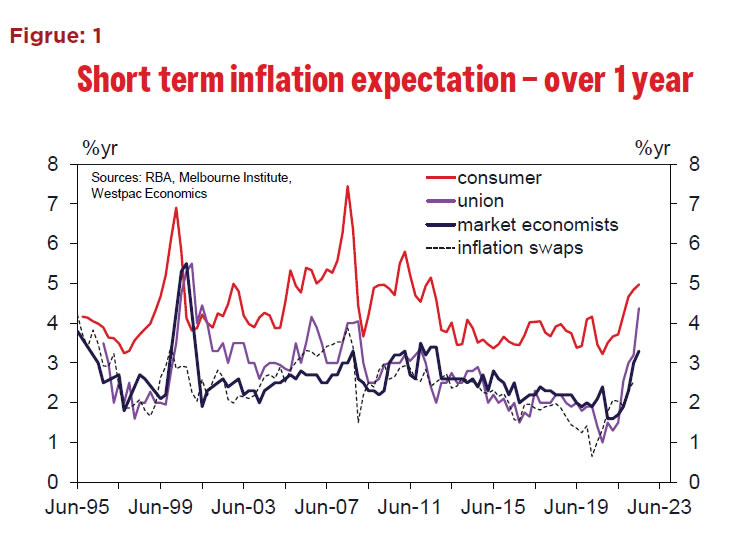
Inflationary expectations are rising quickly. The latest inflation expectations measure from the Melbourne Institute , which is followed very closely by the RBA, (Figure 1) showed that expectations of the trade unions, in particular, lifted from 3.2% to 4.3% over the last three months and are up from just 1.5% a year ago.
Employment
The April jobs report showed a fall in the unemployment rate from 4.0% to a 48 year low of 3.9% while the underemployment rate fell by 0.2% to 6.1% (the lowest level since 2008).
There were "only" 4,000 more jobs added in April but hours worked surged by 1.3% with 88,400 part time jobs being replaced by 92,400 full time jobs as workers increased their hours and "progressed" from part time to full time.
Wages
There was some market disappointment that the increase in the WPI printed 0.7% compared with market expectations of 0.8%.
Annual growth was 2.4% compared to expectations of 2.5%.
RBA now assesses the pulse of wages growth using other measures as noted in the Minutes, "more timely evidence from liaison and business surveys indicated that labour costs were rising in a tight labour market and a further pick-up was likely over the period ahead."
We also saw some interesting evidence from the WPI report that the average increase of those who received a wage increase was 3.4%, up from 2.8% in the December quarter and the fastest increase since 2013.
We also saw the "compensation per hour" data from the national accounts – the best measure of the wage pulse in the accounts, given that other measures can be affected by hours worked.
This series lifted by 2.7% for the quarter to be up by 4.9% for the year, compared with a 2% annual growth rate in the December quarter.
Conclusion
The best policy for the RBA Board will be to raise the cash rate by 40 basis points at the June Board meeting next week.
The RBA is well "behind the curve"; has seen further threatening evidence around inflation and inflationary expectations since the last meeting and needs to make a clear statement that like most developed nations Australia is facing a formidable inflation challenge which needs a stronger early response than the minimum 25 basis point gesture.
Although the Board meets more frequently than other central banks the need for a decisive move when rates are extremely stimulatory and there is a clear need to manage inflationary expectations makes a strong case for a 40 basis point decision.
Taking back the emergency cuts in 2020 would be a very important symbol of the Bank's clear intentions to address the inflation challenge.
The arguments set out above would also be consistent with a 50 basis point move. However given that the Board actively considered 40 basis points at the May meeting we think it is much more likely that the 40 basis point option will be taken.