Sample Category Title
AUD/USD Saw Brief Recovery
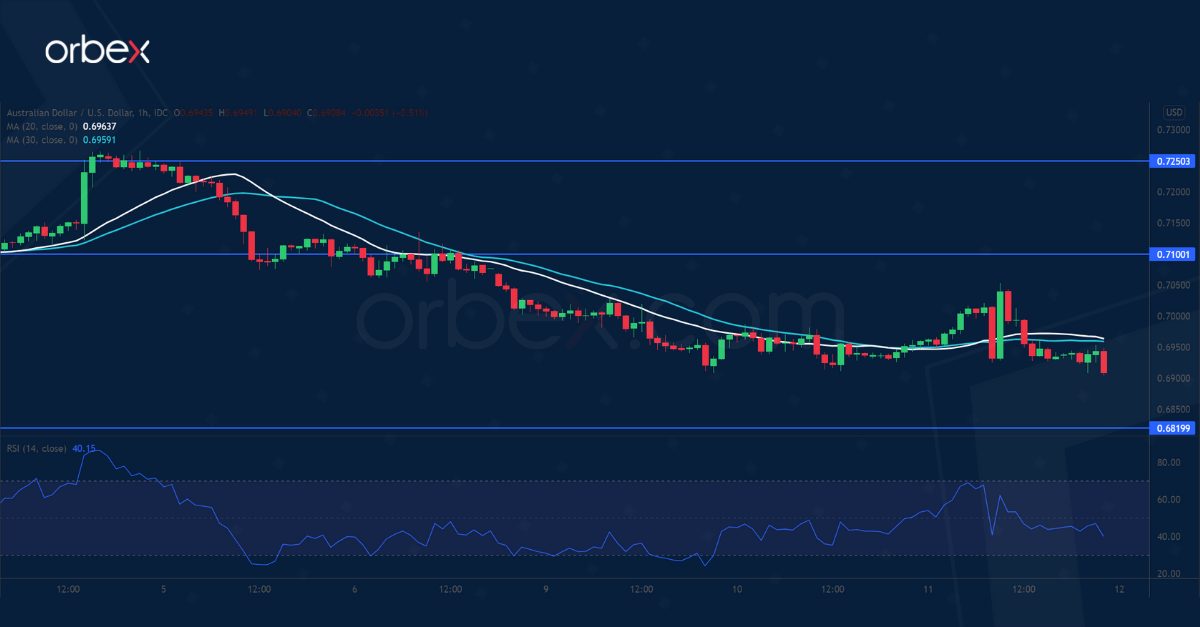
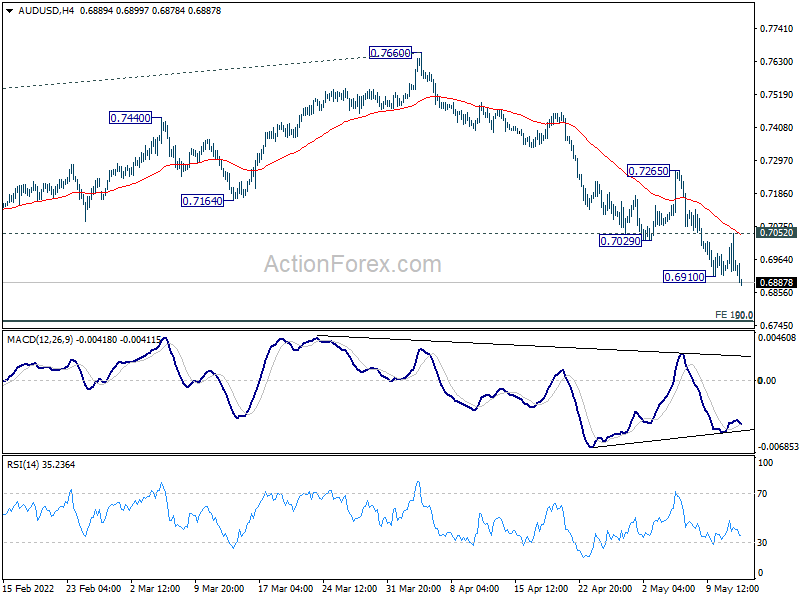
The Australian dollar struggles as Beijing vows to support its Covid-hit economy. A drop below the psychological level of 0.7000 near this year’s low may have put the Aussie on a bearish trajectory in the medium-term. On the hourly chart, the RSI’s double bottom in the oversold area may cause a limited rebound. Selling interest could be expected at 0.7100 at the origin of the latest sell-off. A drop below the intermediate support at 0.6920 would extend losses towards June 2020’s lows around 0.6820.
Core Bond Markets May Have Entered a Period of Consolidation, Correction Perhaps
Markets
US headline/core inflation for April came in at 8.3%/6.2% yesterday, defying expectations for a bigger decline from the 40-year highs. Core inflation also showed more signs of broadening and being increasingly persistent. It wasn’t the surprise reading both markets and the Fed hoped for, fueling concerns of an aggressive tightening cycle that may smother the economy.
US stocks initially clung on to the fact inflation fell nevertheless but that proved a too-weak argument in a sell-on-upticks market. The Nasdaq again underperformed (-3.18%). US bond yields soared up to 12 bps shortly after the CPI release only to end up with +2.6 bps at the front. Yields on longer tenors even turned red, losing almost 8 bps at the very long end. The 10y lost the 3% mark.
European/German yields initially joined the US move higher but here too things soon went in reverse. German Bund yields fell as much as 3.1 bps, European swap yields printed losses of more than double. This happened even as ECB’s Lagarde finally caved and hinted at a July rate hike.
In this respect, EUR/USD’s performance was disappointing. Overall risk-off even pushed the pair marginally lower to 1.0512. The trade-weighted dollar index keeps knocking on the 104 door. Sterling was long an ocean of calm yesterday but came under pressure around the time US stocks started sliding. EUR/GBP rose from 0.855 to 0.858. GBP/USD closed at 1.225, the weakest level since May 2020. Asian stocks lose 1-3% this morning on lingering inflation worries. Market news is limited. US bond yields extend their recent correction with 1.2 to 4.4 bps. Hong Kong intervened in its currency (see below). The Japanese yen outperforms. USD/JPY eases sub 130. EUR/USD is filling bids in the low 1.05 area. US PPI and jobless claims on today’s eco calendar are worth mentioning but we don’t expect them to influence markets. Yesterday’s moves on core bond markets suggest we may have entered a period of consolidation, correction perhaps, where growth worries take over from the tightening/inflation narrative. First support in the US 10y is situated at 2.83% but the crucial one is located around 2.72%. Germany’s 10y is losing the 1% support with the next reference around 0.80% (2018 top).
If uncertainty about the eco outlook indeed becomes the dominant theme, it’ll be difficult for EUR/USD to escape the gravitational pull from 1.05. Sterling extends yesterday’s losses after Q1 GDP growth came in lower than expected at 0.8% q/q while the cost-of-living crisis suggests no improvement for the coming quarters. UK Finance minister Sunak is said to provide more relief in August but that may be too little too late. EUR/GBP surpasses 0.86 resistance (Nov/Dec 2021 correction highs).
News Headlines
The Hong Kong Monetary Authority (HKMA) intervened in the currency market to prevent the HK dollar from weakening beyond the allowed USD/HKD 7.75 to 7.85 trading band. The HKMA bought HKD 1.586 bln. The peg of the Hong Kong dollar with the US dollar is under pressure due to rising US yields/interest differential between US and Hong Kong money market rates. Interventions aim to drain liquidity from the local market to raise local money market rates. It was the first time since early 2019 that HKMA had to intervene in the currency market to support the local currency. In October 2020 it last intervened to prevent the HKD from strengthening outside the allowed bond. USD/HKD still trades near 7.85. According the a report in the Financial times, Turkish authorities are raising pressure on local bank to limit corporate clients from buying foreign currency against the Turkish lira in order to prevent a further weakening of the local currency. According to the article, banks have to seek approval from the central bank for bigger amounts of FX purchases. Since the start of the year, the Turkish lira has traded relatively stable even as combination of elevated inflation (69.97% Y/Y in April) and a low policy rate (14%) leave the currency with a deeply negative real interest rate. However, over the previous days, the lira again showed tentative signs of weakening with EUR/TRY rising to 16.23, compared to levels around EUR/TRY 15.53 end last month.
The Crypto Meltdown
US inflation data didn’t print a soft-enough figure to reverse the market selloff. Inflation in the US was 8.3% in April, higher than 8.1% expected by analysts, but happily, less than 8.5% printed a month earlier. But core inflation, which excludes the most volatile food and energy prices, surged 0.6% in April from 0.3% a month earlier.
There is still hope that the 8.5% print of March was a peak, but it looks like the overheating in consumer prices won’t be easy to cool down. The producer price index is due today, and the expectation is a cool down in the US factory gate prices from 11.2% in March to 10.7% in April.
Disappointing US inflation data sent another shock wave to the US stock markets sending all major US indices tumbling on Wednesday. The S&P500 lost more than 1.5%, while Nasdaq, which is more sensitive to interest rates tumbled more than 3% and slipped below the 12K level for the first time since November 2020.
Apple and Nvidia gave back another 5% yesterday, as Amazon dived more than 3% to a two-year low.
The US dollar remained upbeat, and the dollar index returned above the 104 mark as the lower-than-expected cool down in the US inflation figure revived the Fed hawks.
The pound-dollar is testing the 1.22 this morning as the UK-European relationship is souring on the Northern Ireland headache. According to the latest news, the EU will hurry up to launch infringement procedures against the UK and to suspend the trade agreement if the British government puts forward legislation to revoke its commitment over trade with Northern Ireland. The pound bears have their eyes set on the 1.20 mark, which could be a dip in the actual selloff.
In commodities, gold rebounded from the 200-DMA, as the US 10-year yield eased despite yesterday’s higher-than-expected inflation print in the US. The yellow metal will likely remain under the pressure of the rising US yields, and the negative trend could strengthen below the 200-DMA level, which stands at about the $1840 level at the moment.
US crude, on the other hand, sees decent dip buying interest below the $100 per barrel, even with the souring prospects of a healthy global economic recovery. There is one good news on the wire, though: Covid cases in Shanghai halved this week, sparking hope that the lockdown measures could soon be over in China’s economic heart. Yet, zero Covid is hard to achieve, and the risk of a renewed lockdown is omnipresent, if the Chinese government doesn’t soften the rules, which they don’t seem to be willing to do.
The crypto meltdown
Cryptocurrencies are shaken by an overall risk selloff, and the TerraUSD’s broken peg against the dollar this week.
The Terra incident is causing an industry-based panic, as Terra is the world’s third biggest stable coin, that couldn’t hold its promise to maintain a stable value in terms of US dollars. The Terra-USD peg is mostly based on the belief that one could always exchange Luna to guarantee a $1 peg for Terra. But apparently that belief is not working anymore, and trust is a foremost ingredient in cryptocurrencies success. So, you bet, the level of stress in other cryptocurrencies is mounting. Terra’s sister coin Lune lost 94%, as Bitcoin plunged below the $30K mark yesterday. It wasn’t only Terra’s fault; a disappointing US inflation data also encouraged the selloff in Bitcoin.
With the latest crypto cataclysm, US Treasury secretary Janet Yellen is pushing for regulation. But, what the crypto industry needs right now is a returning trust, and enthusiasm regarding how the digital tokens would fit into our increasingly digitalized lives, rather than a government regulation.
UK GDP contracted -0.1% mom in Mar, up 0.8% qoq in Q1
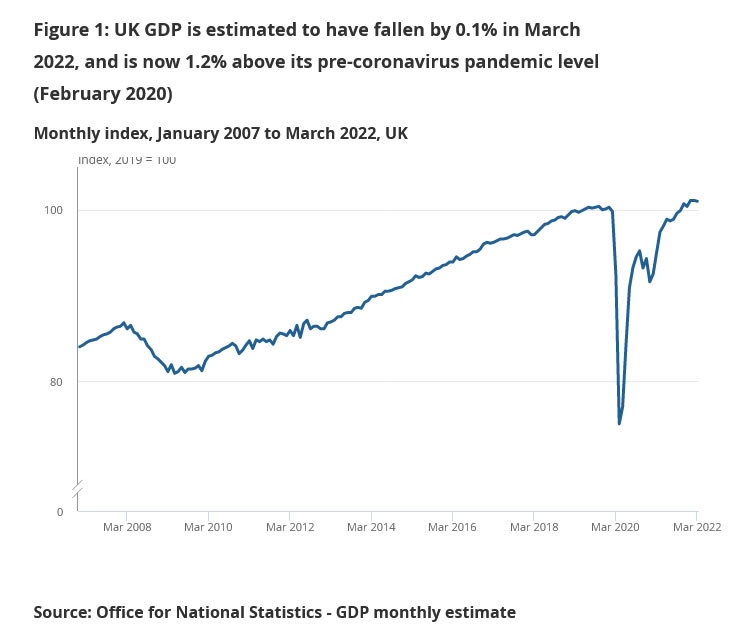
UK GDP contracted -0.1% mom in March, worse than expectation of 0.1% mom growth. That came after no growth in February (revised down from 0.1%). For the month, services dropped -0.2%. Production dropped -0.2%. Construction grew 1.7%. Monthly GDP is still 1.2% above pre-coronavirus levels, with services 1.5% above, construction 3.7% above and production -1.6% below.
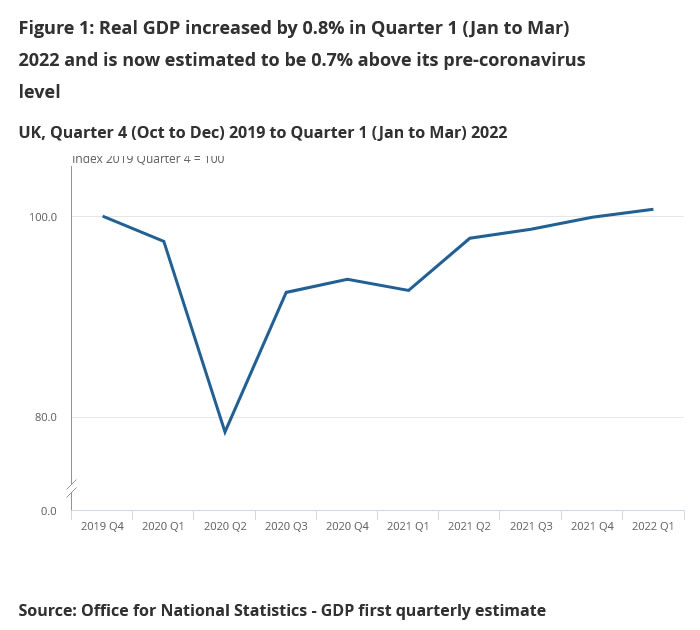
For Q1, GDP grew 0.8% qoq, below expectation of 1.0% qoq. Services rose 0.4% qoq. Production rose 1.2% qoq. Construction rose 3.8% qoq. Quarterly GDP was 0.7% above pre-coronavirus level.
Also released, manufacturing production came in at -0.2% mom, 1.9% yoy in March, versus expectation of 0.0% mom, 2.3% yoy. Industrial production was at -0.2% mom, 0.7% yoy, versus expectation of 0.1% mom, 0.4% yoy. Goods trade deficit widened to GBP -23.9B, versus expectation of GBP -18.5B.
EUR/USD Daily Outlook
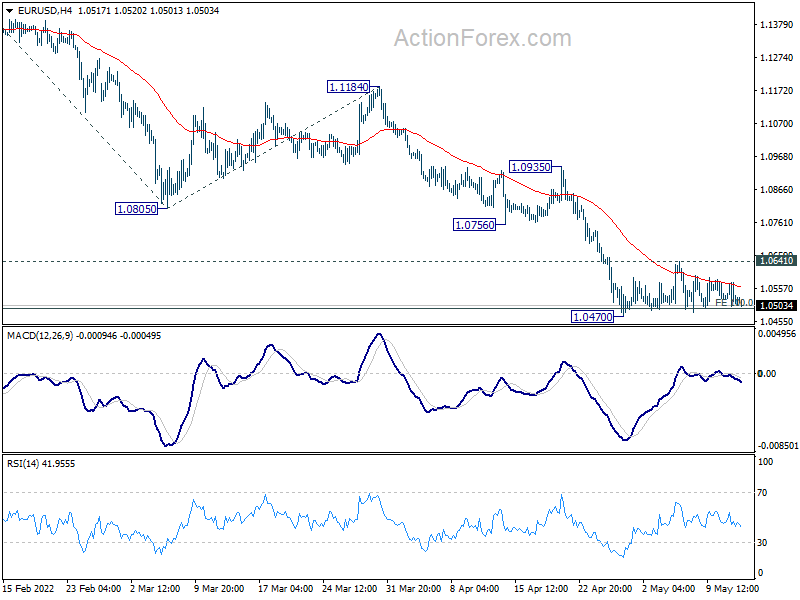
Daily Pivots: (S1) 1.0485; (P) 1.0531 (R1) 1.0560; More...
Intraday bias in EUR/USD remains neutral as range trading continues. Further decline is in favor as long as 1.0641 minor resistance holds. Break of 1.0470 will resume larger down trend to 161.8% projection of 1.1494 to 1.0805 from 1.1184 at 1.0069. On the upside, break of 1.0641 will turn bias to bring stronger rebound instead.
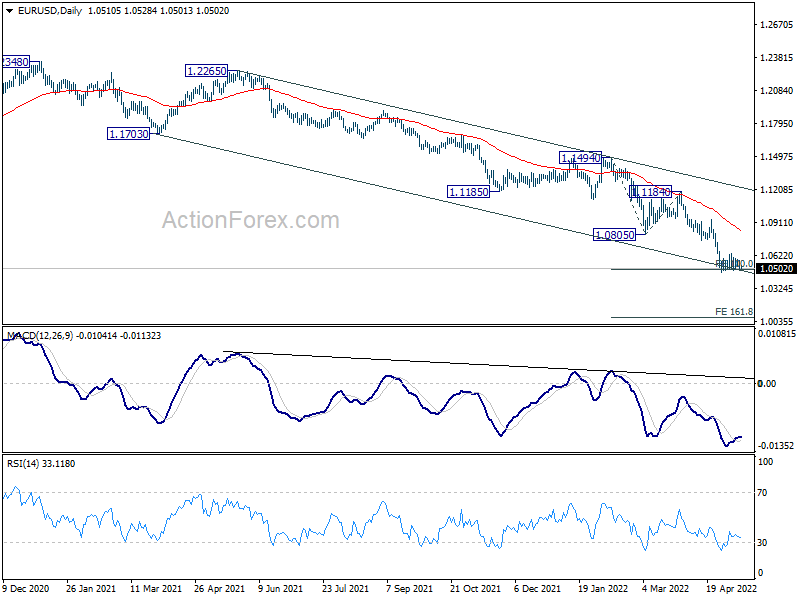
In the bigger picture, the decline from 1.2348 (2021 high) is expected to continue as long as 1.1185 support turned resistance holds. The break of 1.0635 (2020 low) now raises the chance that it's resuming long term down trend from 1.6039 (2008 high). Retest of 1.0339 (2017 low) low should be seen next. Decisive break there will confirm this bearish case.
GBP/USD Daily Outlook
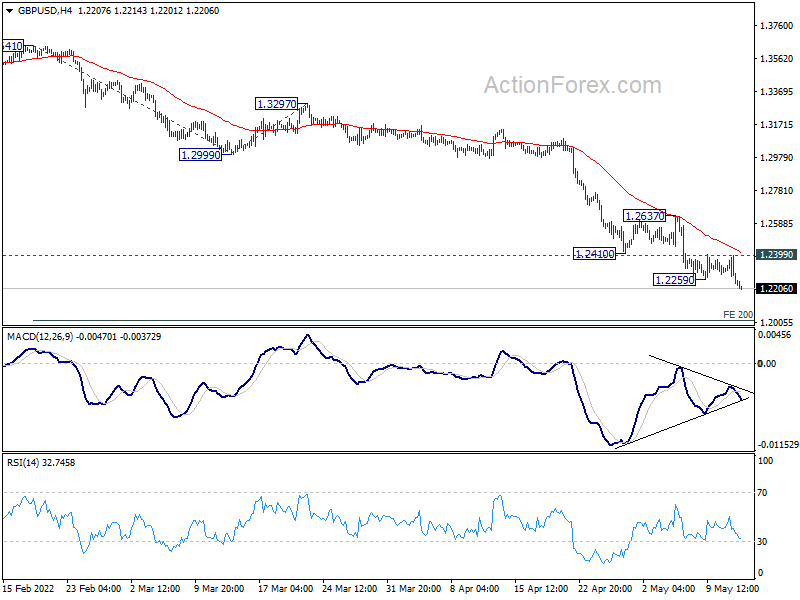
Daily Pivots: (S1) 1.2190; (P) 1.2295; (R1) 1.2352; More...
GBP/USD's decline resumed after brief consolidations and intraday bias is back on the downside. Current down trend should target 200% projection of 1.3641 to 1.2999 from 1.3297 at 1.2013 next. On the upside, above 1.2399 minor resistance will turn intraday bias neutral again. But outlook will stay bearish as long as 1.2637 resistance holds.
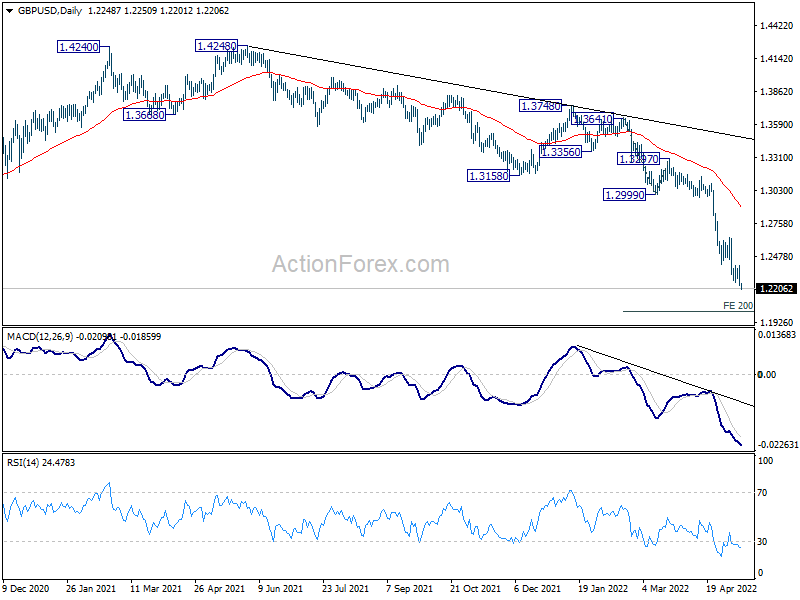
In the bigger picture, based on current momentum, fall from 1.4248 (2018 high) at least at the same degree as the rise from 1.1409 (2020 low). That is, fall from 1.4248 could be a leg inside the pattern from 1.1409, or resuming the longer term down trend. In either case, deeper decline is expected as long as 1.2999 support turned resistance holds. Next target is 1.1409 low.
USD/CHF Daily Outlook
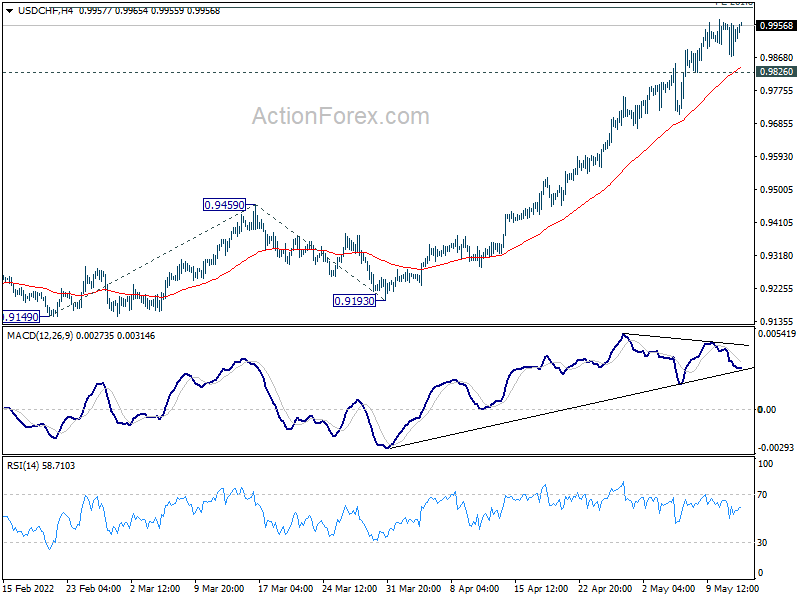
Daily Pivots: (S1) 0.9887; (P) 0.9925; (R1) 0.9979; More....
Further rally could be seen in USD/CHF for now. But considering bearish divergence condition in 4 hour MACD, upside should be limited by 261.8% projection of 0.9149 to 0.9459 from 0.9193 at 1.0005 to bring correction. On the downside, break of 0.9826 will indicate short term topping, and turn bias to the downside for pull back.
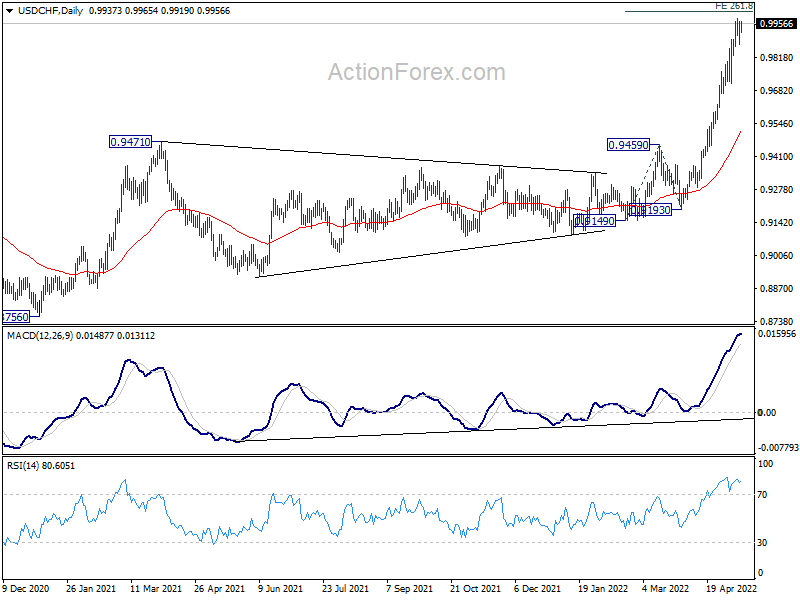
In the bigger picture, down trend from 1.0342 (2016 high) should have completed with three waves down to 0.8756 (2021 low) already. Rise from 0.8756 is likely a medium term up trend of its own. Sustained trading above 100% projection of 0.8756 to 0.9471 from 0.9149 at 0.9864 will pave the way to 161.8% projection at 1.0306, which is close to 1.0342 (2016 high). This will remain the favored case as long as 0.9459 resistance turned support holds.
USD/JPY Daily Outlook
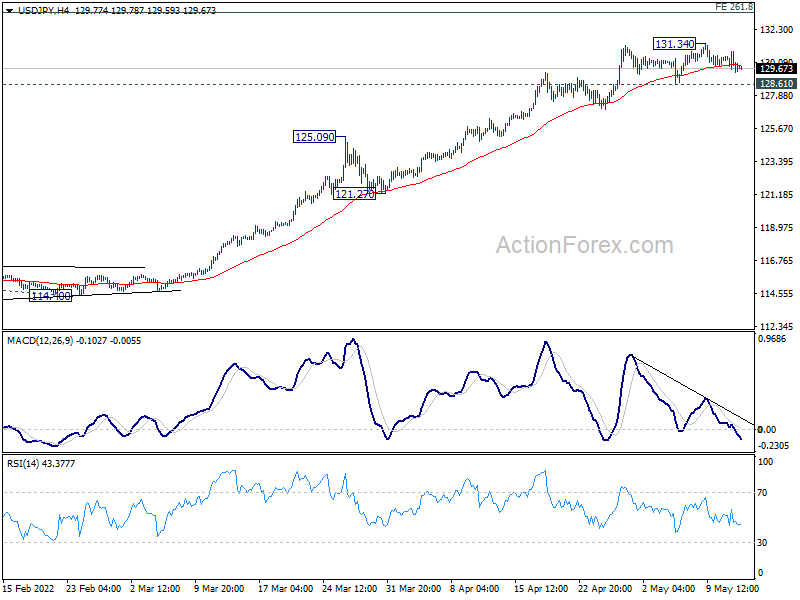
Daily Pivots: (S1) 129.35; (P) 130.08; (R1) 130.71; More...
USD/JPY is staying in consolidation from 131.34 and intraday bias remains neutral. Further rally is expected with 128.61 support intact. Above 131.34 will target 261.8% projection of 109.11 to 116.34 from 114.40 at 133.26. However, firm break of 128.61 will indicate short term topping, and turn bias to the downside for deeper pull back.
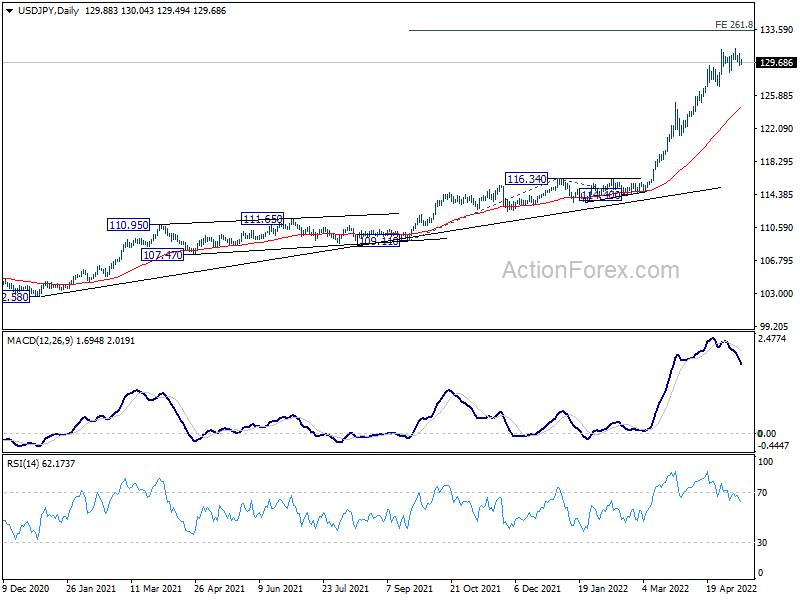
In the bigger picture, current rally is seen as part of the long term up trend form 75.56 (2011 low). Sustained trading above 61.8% projection of 75.56 (2011 low) to 125.85 (2015 high) from 98.97 at 130.04 will pave the way to 100% projection at 149.26, which is close to 147.68 (1998 high). For now, this will remain the favored case as long as 121.27 support holds.
AUD/USD Daily Report
Daily Pivots: (S1) 0.6897; (P) 0.6976; (R1) 0.7023; More...
AUD/USD's decline resumed after brief consolidations and intraday bias is back on the downside. Current fall is p[art of the decline from 0.8006 and should target 0.6756 medium term fibonacci level next. On the upside, break of 0.7052 minor resistance will turn intraday bias neutral again first. But risk will stay on the downside as long as 0.7265 resistance holds.
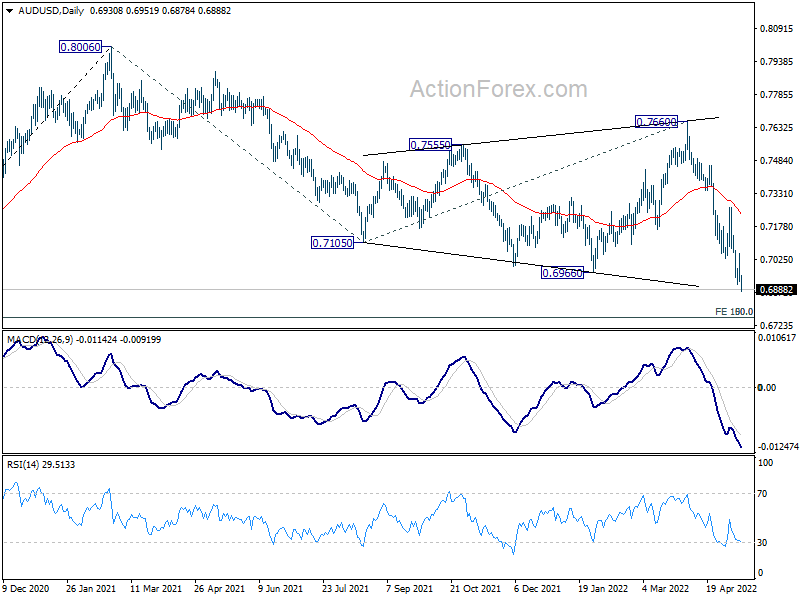
In the bigger picture, price actions from 0.8006 are seen as a corrective pattern to rise from 0.5506 (2020 low) with fall from 0.7660 as the third leg. Deeper fall should be seen to 50% retracement of 0.5506 to 0.8006 at 0.6756. This coincides with 100% projection of 0.8006 to 0.7105 from 0.7660 at 0.6760. Strong support is expected from 0.6756/60 cluster to contain downside to complete the correction. However, sustained break of 0.6756/60 would argue that AUD/USD is indeed in a medium term down trend.
USD/CAD Daily Outlook
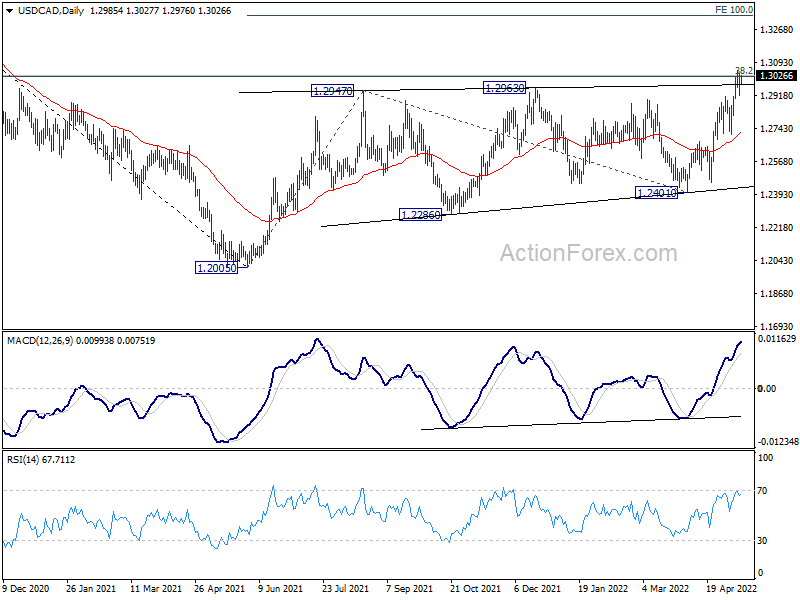
Daily Pivots: (S1) 1.2929; (P) 1.2985; (R1) 1.3048; More...
Intraday bias in USD/CAD remains neutral for consolidation below 1.3050. Further rally is expected as long as 1.2712 support holds. On the upside, Sustained break of 1.3022 fibonacci level will carry larger bullish implications. Next target will be 100% projection of 1.2005 to 1.2947 from 1.2401 at 1.3343. However, break of 1.2712 will indicate rejection by 1.3022 fibonacci level and turn bias to the downside.
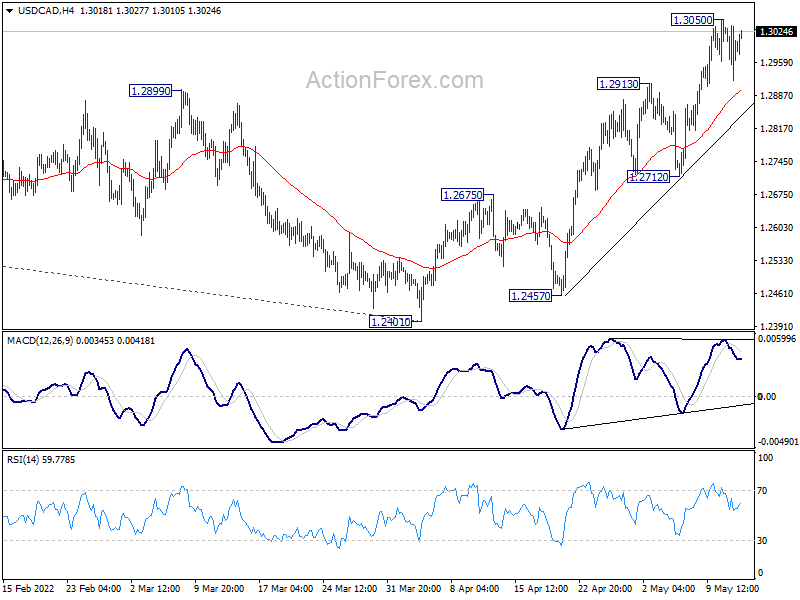
In the bigger picture, focus stays on 38.2% retracement of 1.4667 (2020 high) to 1.2005 (2021 low) at 1.3022. Sustained break there should confirm that the down trend from 1.4667 has completed after defending 1.2061 long term cluster support. Further rise would then be seen towards 61.8% retracement at 1.3650. However, rejection by 1.3022 will maintain medium term bearishness. Break of 1.2005 will resume the down trend from 1.4667 and that carries larger bearish implications too.