

Sample Category Title
The Stock Market Puts Bitcoin Back in a Downward Trend
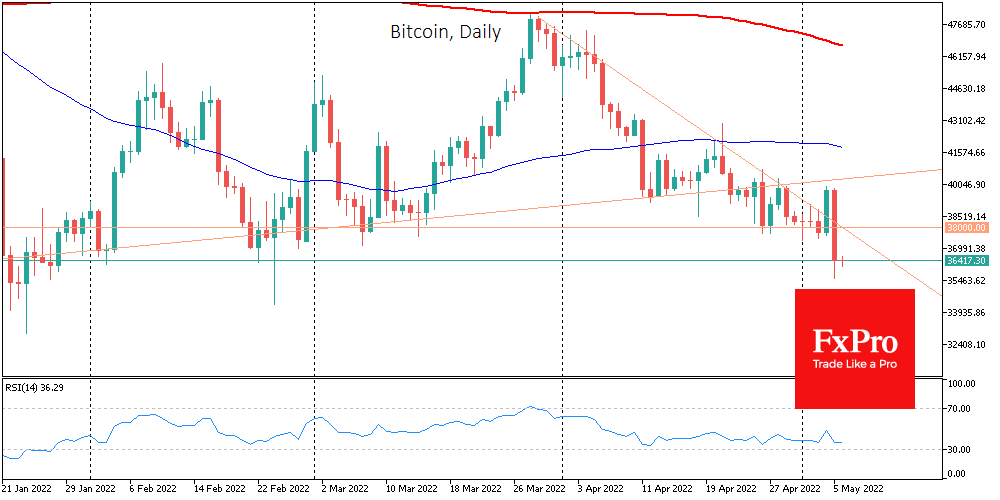
Bitcoin was down more than 10% intraday on Thursday, stabilising at $36.4K from the end of the day and losing 8.3% overnight. Ethereum lost 6.7% in the last 24 hours, while other leading altcoins in the top 10 fell from 5.6% (DogeCoin) to 14% (Avalanche).
Total cryptocurrency market capitalisation, according to CoinMarketCap, fell 7.6% overnight to $1.67 trillion. The Bitcoin Dominance Index fell 0.4% to 41.5%, as the most institutionalised coins took the brunt of the hit.
The cryptocurrency Fear and Greed Index fell 5 points to 22 by Friday and moved back into “extreme fear” status. This indicator has been hovering between the 20 and 30 levels for almost four weeks.
On Thursday, Bitcoin fell sharply in the US session, losing more than $3,000 in a few hours and closing the day at its lowest level since late January. Once again, the pressure came from the US stock and bond market, where traders were furiously pricing in a sharp tightening of the Fed’s monetary policy in June after a day’s break.
The decline in BTC was the highest in the last 3.5 months and was observed simultaneously with the sell-off in the US stock market. Expectations of increasingly steep policy tightening are draining liquidity, primarily hitting risky assets, from equities to commodities to cryptocurrencies.
With yesterday’s sharp collapse, bitcoin confirmed its downtrend in late March and returned to the area of lows at the beginning of the year.
Bitcoin’s supply in the market could increase sharply in the second half of 2022 when a plan to compensate former users of the MtGox cryptocurrency exchange will begin to be implemented. However, the purchase of BTC by algorithmic stack coin issuers could potentially offset the increase in supply, according to Coinbase.
Luna Foundation Guard (LFG), a non-profit organisation, purchased 37,863 BTC on the OTC market, worth approximately $1.5 billion. LFG was one of the top 10 bitcoin holders.
US Yields Stay Upwardly Oriented Going into US Payrolls Report
Markets
On Wednesday the Fed hiked its policy rate 50 bps and signaled more such steps to come. At the same time, chair Powell said that 75 bps steps were not on the table. This message at that time provided comfort with both bonds and equities sharply rebounding. However, 24 hours later investors came to a completely different conclusion.
US Treasuries tumbled sharply in a steepening move with yields rising from 6.1 bps (2-y) to 9.7/10.2 bps for 5/10y sector. At first sight, the moves looked a sign of doubt on the Fed’s commitment as it rejected 75 bps hikes. However, this was at odds with a remarkable rise in US real yields (10y +12.1 bps to 0.175%). Whatever, this jump in (real) yields and lingering doubts on the economy potentially moving to a stagflationary scenario triggered a sharp equity sell-off. US indices tumbled between 3.12% (Dow) and 4.99% (Nasdaq).
Losses in Europe were more modest (EuroStoxx -0.75%). European yields initially corrected lower. ECB’s Lane admitted that inflation is unlikely to revert to a below-target trend, but still advocated a gradual approach. In the meantime other MPC members continued the debate on a July rate hike. German yields later joined the rise in the US closing between 1.4% (2-y) and 9.1 bps (30-y) higher. After the close of the European markets, Austrian ECB member Holzmann formally opened the debate on a JUNE ECB rate hike and suggested such a move was a real option. For now, it’s the idea of only one MPC member, but it needs close monitoring. Several other central banks also immediately raised rates when asset purchases were halted.
On FX markets, the dollar reversed most of Wednesday’s post-Fed setback. The DXY-index again tested the cycle peak just below 104, but no break occurred. Similar picture for USD/JPY with a close at 130.20. EUR/USD dropped to the 1.05 area, but with a close at 1.0542 also avoided a test of the 1.0472 low. The dollar is holding strong, but given the extreme risk-off and the sharp rise in US (real) yields gains could have been even bigger.
The almost impossible task for a central bank to successfully manage a stagflationary environment yesterday appeared at the BoE meeting. With inflation probably still at 10%+ at the end of the year, but growth expected to shrink at that time, the BoE still reached consensus on a 25 bps rate hike. Three members voted for a 50 bps step. At the same time, other members didn’t want to flag further steps. UK yields tumbled (2-y -9.1bps). Sterling fell off a cliff. Cable tumbled from the 1.2575 area to close at 1.2362. EUR/GBP closed north of the 0.8512 resistance (0.8527).
Asian equities also endure substantial losses of 2/3% this morning with Japan the exception (+0.60%) after the WS sell-off. US yields stay upwardly oriented going into the US payrolls report. For once, we doubt the report will have a determining impact on current market dynamics. A poor report, might rekindle stagflationary risk. A strong report will only reinforce the bond market sell-off. A risk-off and higher yields in theory should support the dollar. EUR/USD 1.0472 is still within reach but the US currency over the previous days failed to break some key resistance levels.
In Europe, we look out whether other ECB members will join the ‘Holzmann-debate’ on a potential June rate hike. If so, it won’t pass unnoticed on EMU yields markets and maybe it can even take some pressure off the euro. After yesterday’s break above 0.8512, the technical picture for sterling deteriorated. EUR/GBP 0.8658/67 is next target on the charts.
News Headlines
The National Bank of Poland raised its policy rate yesterday by 75 bps, from 4.5% to 5.25%, the highest level since 2008. NBP governor Glapinski holds a press conference this afternoon. In its policy statement, the central bank vowed to take all necessary actions in order to ensure macroeconomic and financial stability, including above all to reduce the risk of inflation remaining elevated. Polish inflation surged to 12.3% Y/Y in April. In the coming quarters, inflation will remain markedly elevated. The Polish economy extended its strong run from Q4 2021 into Q1 2022. Favourable economic conditions remain in place, though a gradual slowdown might be expected. The Polish zloty lost ground after the release with EUR/PLN rising from 4.65 towards 4.70. The Polish zloty swap bucked the global trend by bull steepening yesterday. Daily yield changes ranged between -13 bps (2-yr) and +1.5 bps (30-yr). Apparently, some expected a stronger signal from the NBP in its inflation fight.
USD/CAD Daily Outlook
Daily Pivots: (S1) 1.2745; (P) 1.2806; (R1) 1.2899; More...
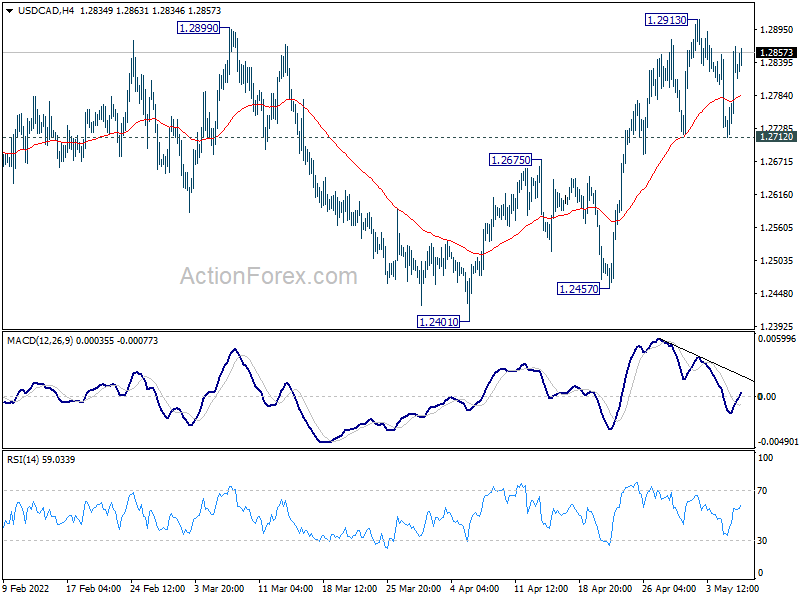
Intraday bias in USD/CAD remains neutral as it rebounded after hitting 1.2712. Further rise is still in favor. Break of 1.2913 will resume recent rally to 1.3022 fibonacci level next. Decisive break there will carry larger bullish implications. On the downside, break of 1.2712 will argue that rebound from 1.2401 has completed at 1.2913, ahead of 1.2963 resistance. Intraday bias will be back on the downside for 1.2401, to extend recent sideway trading.
In the bigger picture, focus stays on 38.2% retracement of 1.4667 (2020 high) to 1.2005 (2021 low) at 1.3022. Sustained break there should confirm that the down trend from 1.4667 has completed after defending 1.2061 long term cluster support. Further rise would then be seen towards 61.8% retracement at 1.3650. However, rejection by 1.3022 will maintain medium term bearishness. Break of 1.2005 will resume the down trend from 1.4667 and that carries larger bearish implications too.
AUD/USD Daily Report
Daily Pivots: (S1) 0.7039; (P) 0.7152; (R1) 0.7227; More...
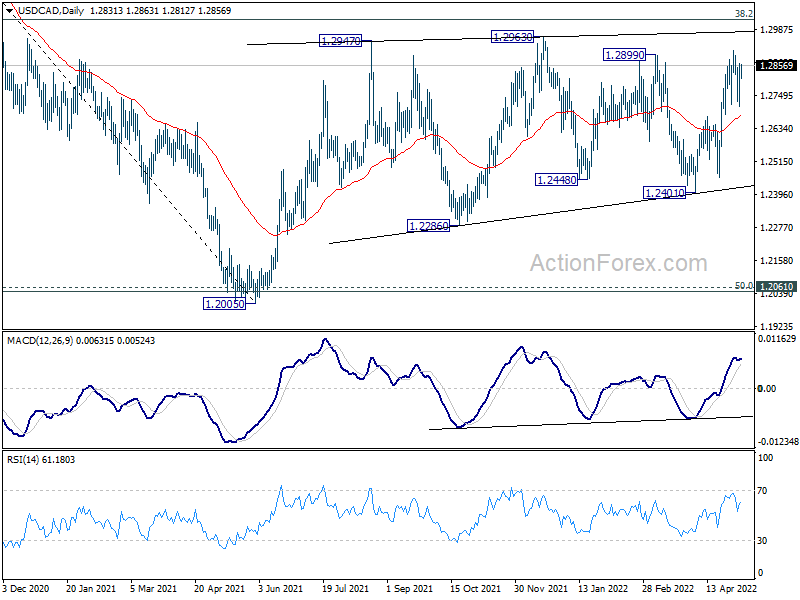
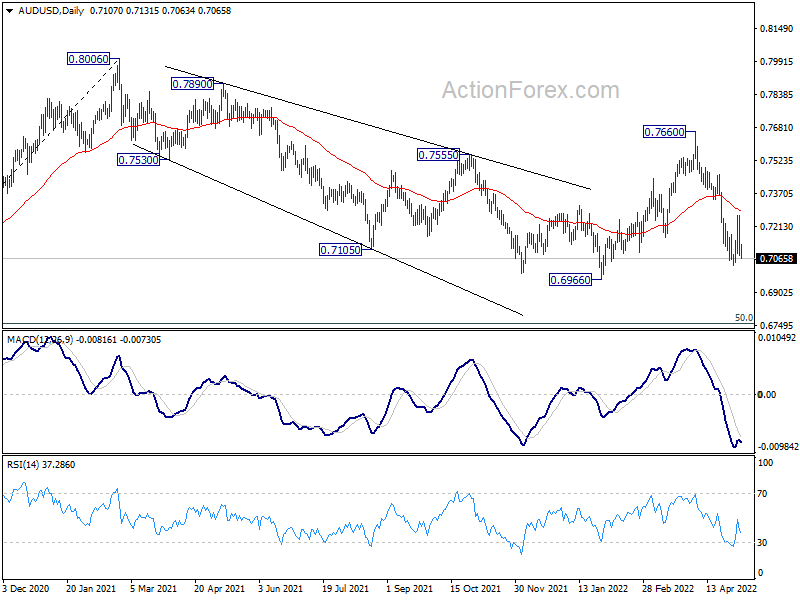
AUD/USD's rebound lost steam after hitting 0.7265 and retreats sharply. Intraday bias is turned neutral at this point. Outlook is unchanged that fall from 0.7660 is the third leg of the corrective pattern from 0.8006. On the downside, below 0.7029 will target 0.6966 low first. Firm break there will confirm this bearish case and target 0.6756 medium term fibonacci level next.
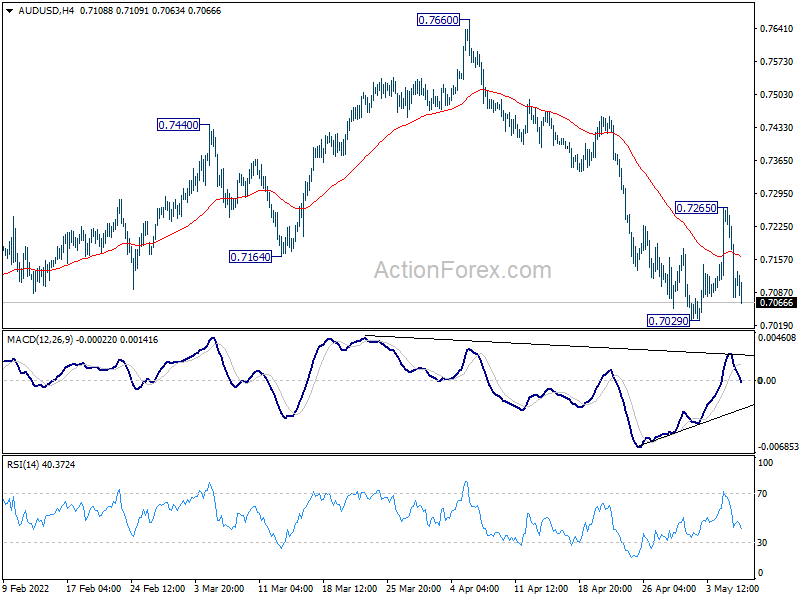
In the bigger picture, price actions from 0.8006 are seen as a corrective pattern to rise from 0.5506 (2020 low). Fall from 0.7660 should be the third leg of this pattern. Break of 0.6966 will target 50% retracement of 0.5506 to 0.8006 at 0.6756. On the upside, break of 0.7660 will revive that case that the correction has already completed at 0.6966.
EUR/USD Daily Outlook
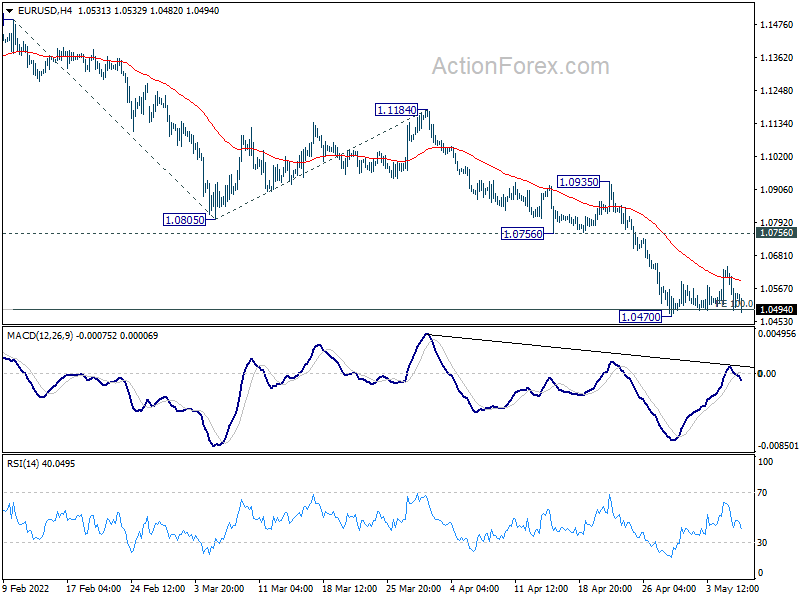
Daily Pivots: (S1) 1.0474; (P) 1.0558 (R1) 1.0623; More...
Intraday bias in EUR/USD remains neutral and outlook stays bearish with 1.0756 support turned resistance intact. On the downside, break of 1.0470 will resume larger down trend. Next target will be 161.8% projection of 1.1494 to 1.0805 from 1.1184 at 1.0069.
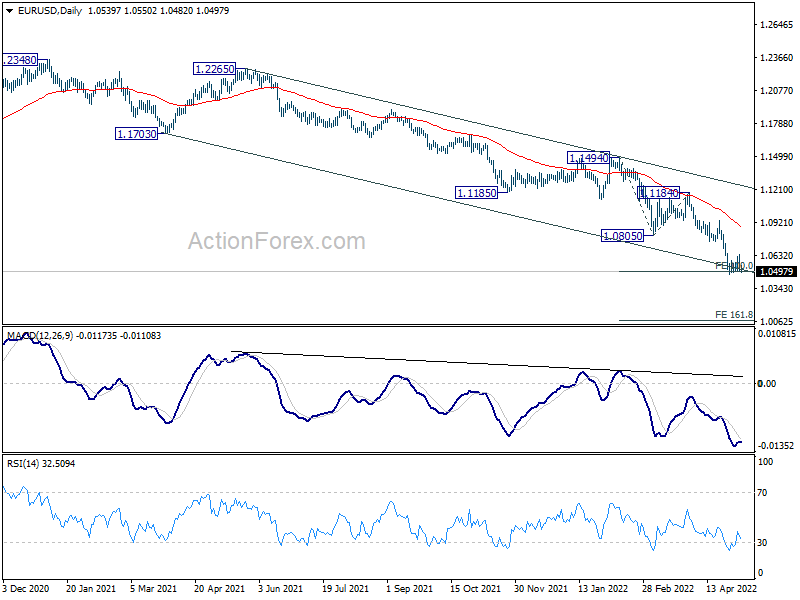
In the bigger picture, the decline from 1.2348 (2021 high) is expected to continue as long as 1.1185 support turned resistance holds. The break of 1.0635 (2020 low) now raises the chance that it's resuming long term down trend from 1.6039 (2008 high). Retest of 1.0339 (2017 low) low should be seen next. Decisive break there will confirm this bearish case.
GBP/USD Daily Outlook
Daily Pivots: (S1) 1.2242; (P) 1.2439; (R1) 1.2552; More...
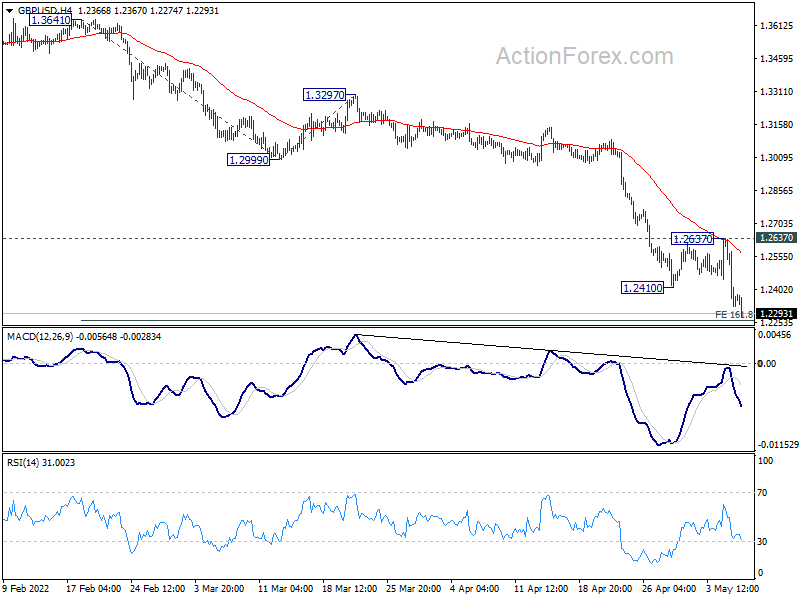
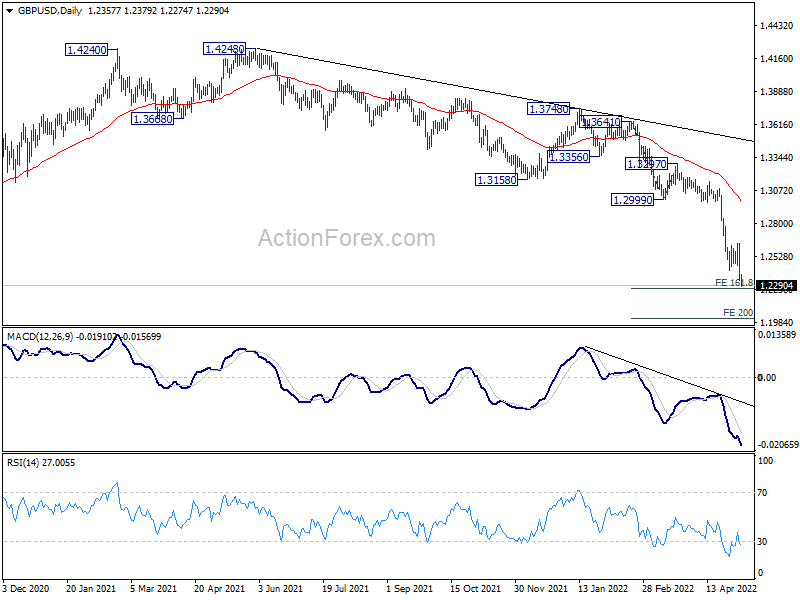
Intraday bias in GBP/USD remains on the downside for 161.8% projection of 1.3641 to 1.2999 from 1.3297 at 1.2258. Break will target 200% projection at 1.2013 next. On the upside, break of 1.2637 resistance is needed to indicate short term bottoming. Otherwise, outlook will remain bearish in case of recovery.
In the bigger picture, rise from 1.1409 (2020 low) has completed at 1.4248, ahead of 1.4376 long term resistance (2018 high). Based on current momentum, fall from 1.4248 is probably the start of a long term down trend. The break of 61.8% retracement of 2.1161 to 1.1409 at 1.2493 is affirming this bearish case too. For now, deeper decline would be seen as long as 1.3158 support turned resistance holds. Next target is 1.1409 low.
USD/CHF Daily Outlook
Daily Pivots: (S1) 0.9743; (P) 0.9817; (R1) 0.9923; More....
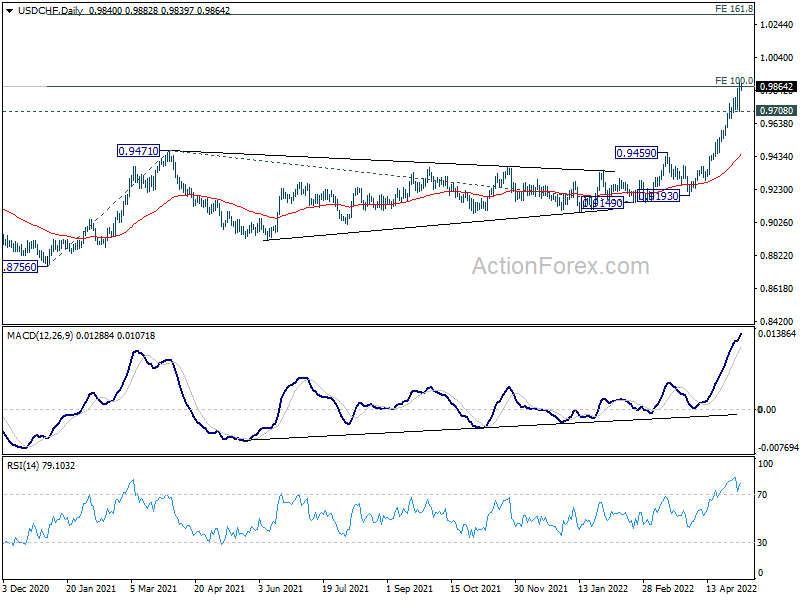
USD/CHF's rally resumed after brief retreat and intraday bias is back on the upside. Sustained trading above 0.9864 will pave the way to next target at 1.0342 high. For now, outlook will remain bullish as long as 0.9708 support holds, in case of retreat.
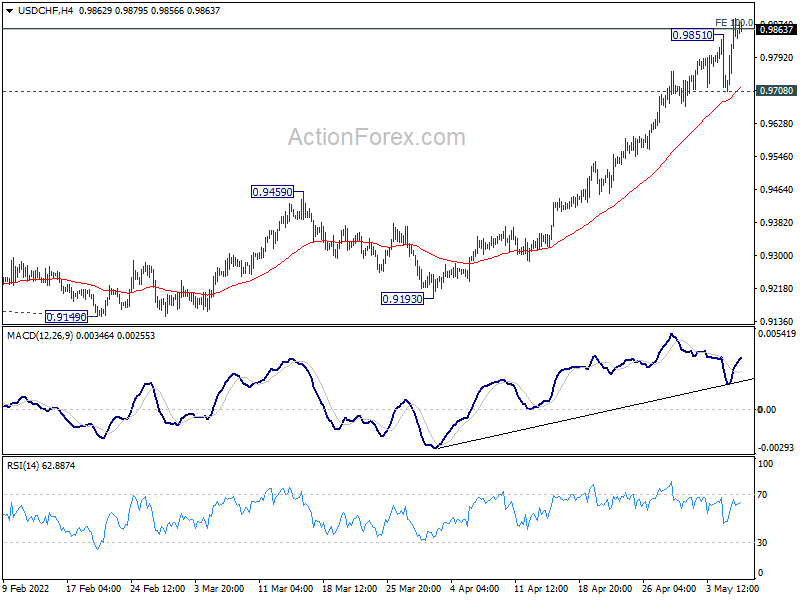
In the bigger picture, down trend from 1.0342 (2016 high) should have completed with three waves down to 0.8756 (2021 low) already. Rise from 0.8756 is likely a medium term up trend of its own. Next target is 100% projection of 0.8756 to 0.9471 from 0.9149 at 0.9864. Sustained break there will pave the way back to 1.0342 high. This will now remain the favored case as long as 0.9459 resistance turned support holds.
Elliott Wave Analysis: EUR/USD Resumes Downtrend for a Fifth Wave
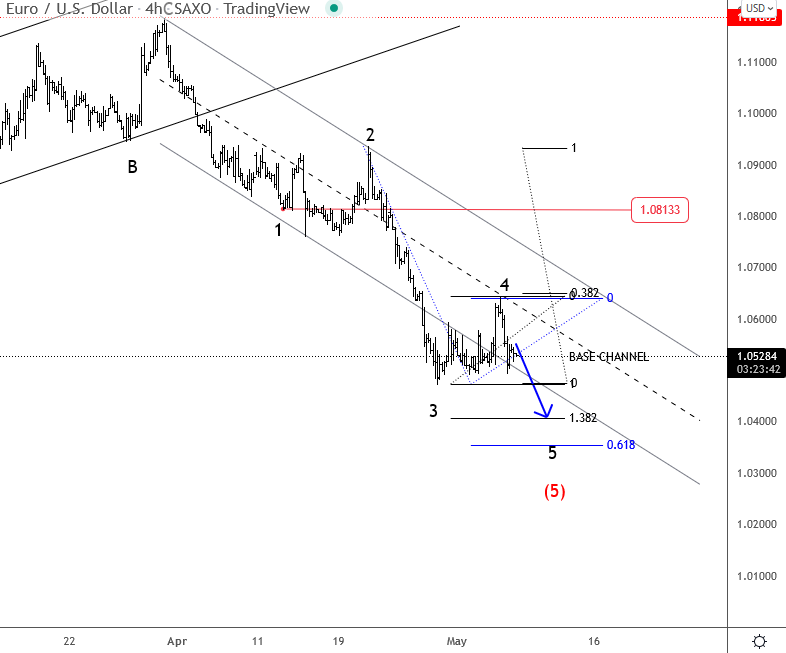
EURUSD saw some recovery on Wednesday after FOMC meeting when Powell was not as hawkish as many expected. But pair, however, is coming down again, away from 38.2% Fib retracement level that was a perfect fourth wave resistance, so the euro remains in a downtrend for now, ideally, until we see five waves down. Notice that the price is pointing even deeper now into the fifth wave, possibly to the 1.0350 Fib target area in the near term. If we are correct, then the pair may stabilize later this month but we will need a hawkish ECB for that to happen. Also, let's not forget on NFP today, data that will be tracked closely as this one should be important for further FOMC decisions regarding the interest rates.
Fed Must Make a Choice as It Can’t Boost Growth and Tame Inflation at the Same Time
The Federal Reserve (Fed) ‘magic’ didn’t last long, and the US stocks recorded the worst day of the year yesterday, after posting the biggest gains of the year the day before, under the pretext that the Fed wouldn’t raise the rates by 75bp points.
Investors realized that the Fed announced the biggest rate hike in more than 20 years, and said that there will be more 50bp hikes in the coming meetings. As such, the Fed is expected to hike rates by 50bps at least in the next two meetings.
The S&P 500 dived more than 3.5% yesterday as 95% of the companies fell, and Nasdaq fell more than 5% to close below the 13000 mark, as technology stocks were heavily hit. Apple plunged more than 5.50% yesterday, Meta lost 6.7%, while Amazon which has been shattered last week on disappointing Q1 results dived more than 7.5%. Other e-commerce giants including Etsy, eBay and Shopify added an additional layer of stress to the market warning investors that growth would be slowing due to high inflation and fading pandemic demand. And Etsy has been one of the biggest losers of the session with a 16.8% plunge, as, although the company managed to post better-than-expected revenue last quarter, the weaker than expected guidance, along with the overall moodiness in the market hit the stock price and sent it to the lowest level since June 2020.
Bitcoin didn’t resist to the risk selloff, and dived near $35500 mark for the first time since February. Even Gucci’s announcement that it would accept payments in cryptocurrencies couldn’t improve the mood.
Energy did better
Energy stocks did better than their peers yesterday, as the barrel of US crude extended gains past the $110 on the back of timid production target increase from the OPEC, and the European plans to ban the Russian oil and gas gradually to the end of the year.
Occidental Petroleum, for example, advanced 1.17%, Shell rallied 3% after posting the highest quarterly profit since 2008 thanks to the rally in oil prices, and despite an almost $4 billion charge on its planned exit from Russia, while BP and Exxon gave back some gains, but the losses were nothing compared to the index averages.
All eyes are on the US jobs data
Even though the Fed will turn a blind eye on softening jobs data in the coming months to focus on its fight against inflation, a strong NFP data could further revive the Fed hawks and the prospects of more aggressive Fed over the next couple of meetings, whereas a soft data could bring in some Fed doves.
But again, the Fed must make a choice as it can’t boost growth and tame inflation at the same time.
Wednesday’s ADP report disappointed as it printed 250’000 new private job additions versus around 400K expected by analysts, and the consensus of analyst estimates point at 400K new nonfarm job additions in April.
Wages growth will matter as higher wages mean more pressure on inflation. US wages may have grown 5.5% annually in April, with an unemployment rate seen down to 3.5% - quite a solid number that should justify the Fed not being concerned about the health of the jobs market for a while, to fight inflation.
Elsewhere
Inflation in Switzerland hit 2.5%, the European producer prices printed a scary 36% and the consumer prices in the UK advanced 7%, as the Bank of England (BoE) warned that it should progress past the 10% in the coming months. The BoE raised the interest rates for the fourth consecutive meeting, but alas, the pound dived as the fear of higher inflation, and the warning of a possible recession before the end of the year sent Cable tumbling to around 1.2350 yesterday.
Meanwhile, the EURUSD eased back below the 1.06 mark, as German factory orders plunged 4.7% in March due to the war, inflation and disrupted supply chains, while the expectation was a 1% drop. And things are about to get worse with the abandon of the Russian energy. In this respect, the ECB, which is already much less reactive to inflation than its major peers, will stay as dovish as possible and that divergence between the policy outlooks will likely continue weighing on the EURUSD. Medium term traders already have parity on their radar, and the next natural target for the bears is the 1.05 psychological level.
If you think 10% inflation is bad, read this
Turkish inflation officially hit 70% in April, and the unofficial inflation printed 156%. The lira didn’t move much against the US dollar as the exchange rate is being artificially kept steady by the officials, but the fact that the Turkish policy rate is kept at 14%, which is significantly lower than inflation (both official and unofficial) means that the pressure on the lira is growing, and the cost for Turkey to keep the lira steady against a globally appreciating US dollar is rising, hence rising the fear that Turkey may, at some point, abandon its actual monetary and FX, and FX-linked deposit policy.
Risk Sentiment Reversed
Market movers today
After the shift in risk sentiment yesterday as markets digested the Fed message, the US jobs report will be in focus today. We expect the job market continued to tighten in April, with an increase in nonfarm payrolls of around 400k and possibly a further drop in the unemployment rate to 3.5%. This should keep the pressure high on Fed to hike rates in the coming months and comments from Fed's Bullard and Waller speaking today will be scrutinized for any hints in that respect.
German industrial figures for March will likely make for a gloomy reading today, after the weak factory orders released yesterday. Waning foreign demand and supply bottlenecks have again started to weigh on German industry after the tentative rebound at the start of the year.
Riksbank releases the April 28 monetary policy minutes and markets will look for how Board members were leaning in relation to the repo rate path.
The 60 second overview
Risk sentiment: The Wednesday's FOMC-driven rally reversed course yesterday, as equities sold off broadly, yields rose and EUR/USD fell back near 1.05. In equities, the decline was led by growth sectors and Nasdaq had its worst day since June 2020, falling by almost 5%. Despite Powell's message of Fed only considering 50bp hikes in the coming meetings, markets are now back to pricing almost an 80% probability of a 75bp hike for the June meeting. We continue to expect 50bp hikes in the coming two meetings, but see risks clearly tilted towards even more aggressive tightening. In today's US jobs report, more signs of labour shortages or persistently high wage inflation could further support the rate hike speculation.
Other central banks: Yesterday's central bank meetings provided a mix of dovish and hawkish signals. Bank of England hiked rates by 25bp as expected, still signalling high inflation pressures but also highlighting clear downside risks for growth. BoE maintained its softer forward guidance from the March meeting leading to EUR/GBP rising above 0.85, but we continue to see risks tilted towards more, rather than less rate hikes. See more in Bank of England Update Review: Another rate hike but mixed signals, 5 May. As usual, Norges Bank provided little new signals from its interim meeting, policy rate will likely be hiked again in June. Among CEE central banks, the Czech National Bank hiked rates by 75bp, compared to 50bp expected by markets and consensus. In contrast, the National Bank of Poland fell short of expectations, hiking only by 75bp vs. 130bp priced in before meeting.
Equities: And just like that, US equities plunged by 4-5%. Equities came under significant pressure just at the opening bell, reversing the post-FOMC rally. All sectors were notably lower, but growth names were the standouts with tech, cars and semis slaughtered. Cyclicals underperformed defensives massively, as energy, consumer staples and utilities held up very well. Dow -3.1%, S&P500 -3.6% (still up for the week though!), Nasdaq -5.0% and Russell 2000 -4.4%. US futures are directionless this morning.
FI: A significant sell-off led by the US dominated the European market and lead to a bearish steepener. While the initial reaction to the FOMC decision on Wednesday was a dovish hike, risk sentiment changed markedly yesterday. US Treasuries ended 8bp higher on the day, after being almost 13bp higher during the session. Bunds rose 7bp to above the 1% mark. Spreads in core and semi-core tightened marginally, and widened in the periphery as the BTPs-Bund spread continues to flirt with the 200bp mark.
FX: Oil prices bounced around yesterday where another uneventful OPEC meeting. EUR/GBP rose on dovish BoE. The Powell-induced rally in risk-disposed currencies like the SEK proved short-lived.
Credit: Though credit markets opened sharply tighter following the FOMC meeting, sentiment quickly turned and credit took another leg significantly wider, with iTraxx Xover widening 19bp and Main 3bp.
Nordic macro
Sweden: In Sweden all eyes are on the Risksbank minutes. We will look into the reasoning of each of the six governors with regards to the uniform u-turn they provided (no dissenters) in the April meeting. Also, governor Skingsley gives a speech with the title: High inflation and a rising repo rate - what happens to the Riksbank's balance sheet? at noon (12 CET).
Also a variety of macro data for March is released including house price statistics from Svensk Mäklarstatistik, and central government payments for April. As we had a negative (-0,4% QoQ) BNP indicator for the first quarter in Sweden, today's data should give some more clarity on the composition of the slowdown.