Sample Category Title
EUR/USD Mid-Day Outlook
Daily Pivots: (S1) 1.0474; (P) 1.0558 (R1) 1.0623; More...
EUR/USD recovers ahead of 1.0470 support and intraday bias remains neutral at this point. Still, outlook stays bearish with 1.0756 support turned resistance intact. On the downside, break of 1.0470 will resume larger down trend. Next target will be 161.8% projection of 1.1494 to 1.0805 from 1.1184 at 1.0069.
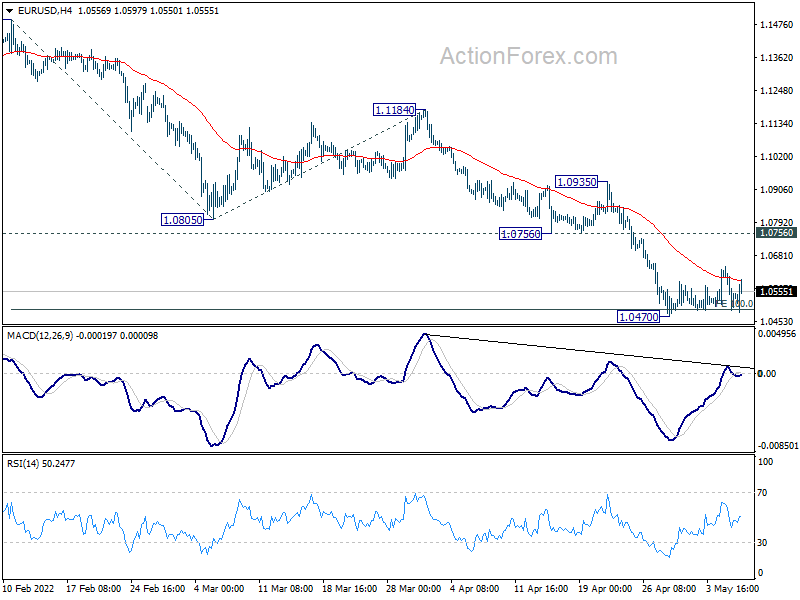
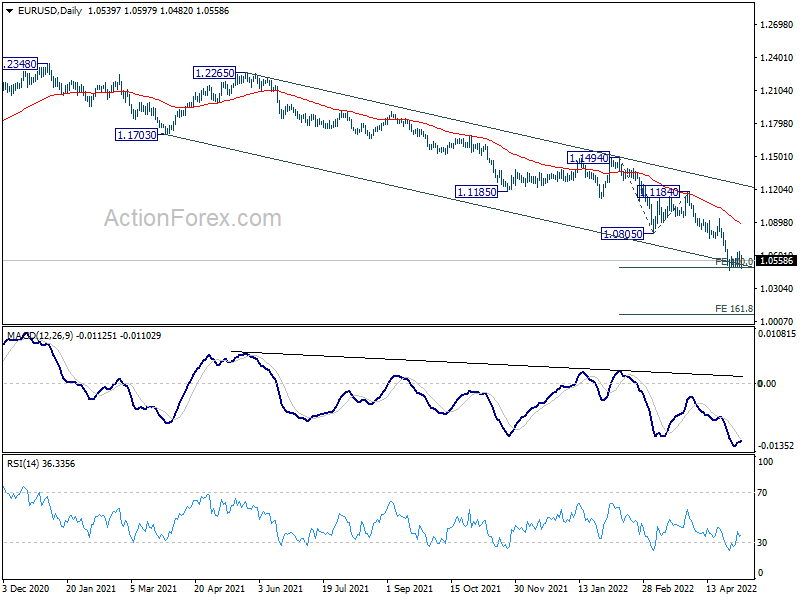
In the bigger picture, the decline from 1.2348 (2021 high) is expected to continue as long as 1.1185 support turned resistance holds. The break of 1.0635 (2020 low) now raises the chance that it's resuming long term down trend from 1.6039 (2008 high). Retest of 1.0339 (2017 low) low should be seen next. Decisive break there will confirm this bearish case.
Euro Talked Up By ECB Hawks, Dollar Shrugs NFP
Dollar turns slightly softer in early US session even though non-farm payroll report came in slightly better than expected. Yen is also weak on rising benchmark global yields. On the other hand, Euro jumps broadly as supported by hawkish comments from ECB officials. As for the week, Aussie and Euro are now the strongest ones while Sterling and Swissy are the weakest.
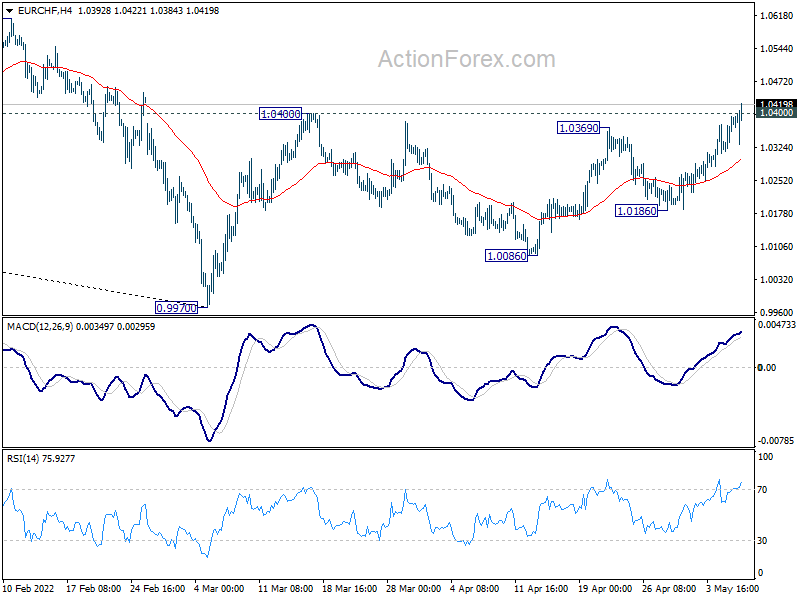
Technically, EUR/CHF finally breaks through 1.0400 resistance today, after brief set back. Rebound from 0.9970 is resuming for 1.0610 structural resistance next. The development could help lift Euro against others. In particular, EUR/GBP is on track to 0.8697 medium term fibonacci level.
In Europe, at the time of writing, FTSE is down -0.77%. DAX is down -0.92%. CAC is down -0.99%. Germany 10-year yield is up 0.038 at 1.086. Earlier in Asia, Nikkei rose 0.69%. Hong Kong HSI dropped -3.81%. China Shanghai SSE dropped -2.16%. Singapore Strait Times dropped -1.55%. Japan 10-year JGB yield rose 0.0153 to 0.230.
US non-farm payroll rose 428k in Apr, unemployment rate unchanged at 3.6%
US non-farm payroll employment rose 428k in April, slightly above expectation of 400k. Total employment was still down by -1.2m, or -0.8%, from its pre-pandemic levels.
Unemployment rate was unchanged at 3.6%, matched expectations. Number of unemployed persons was essentially unchanged at 5.9m. The numbers compared to prepandemic levels of 3.5% and 5.7m respectively. Labor force participation rate dropped -0.2% to 62.2%.
Average hourly earnings rose 0.3% mom, below expectation of 0.4% mom.
ECB Rehn: We should move relatively quickly to zero
ECB Governing Council member Olli Rehn said today, "We are almost in between a rock and a hard place so that on one hand we have to ensure that the recovery will continue. On the other hand, we have to prevent higher inflation expectations being entrenched and being reflected in the labor market."
"In other words, we have to avoid second-round effects. Therefore, in my view, we should move relatively quickly to zero and continue our gradual process of normalization of monetary policy as we have done," he continued.
"Of course, all this on the condition that Russia's war in Ukraine will not substantially escalate and intensify which could derail all the forecasts and the economic recovery."
ECB Villeroy: Reasonable to have positive rates by year end
ECB Governing Council member Francois Villeroy de Galhau said, "the three conditions of our forward guidance on interest rates are, according to my personal judgment, fulfilled. Barring unforeseen new shocks, I would think it reasonable to have entered positive territory by the end of this year."
But he's vague on the timing of the first hike, as "while I wouldn't preclude the next few Governing Council meetings, I would rather set a marker a bit further down the road." He added the ECB's push to normalize policy "will be guided by an active use of optionality and gradualism."
On asset purchases, Villeroy said "seen from today the case for continuing to press the accelerator and adding further net purchases after June is not obvious."
BoE Pill: We face risks on both sides of the economic outlook
BoE Chief Economist Huw Pill told CNBC today that "we face risks on both sides of the economic outlook." Inflation is going up to 10% because of energy and international goods prices. At the same time, there was a risk of recession.
"It's a tricky balance to seek in current difficult circumstances. And the arguments around where rates should be set in order to achieve that balance are quite finely balanced in themselves," Pill added.
Asked about what would cause the BOE to pause tightening, Pill said MPC would want to see more evidence inflation expectations and wage and price setting and momentum in economy more consistent with target. He added, "if we don't see that we will need to act further."
UK PMI construction dropped to 58.2, moving towards a more subdued recovery phase
UK PMI Construction dropped from 59.1 to 58.2 in April, above expectation of 58.0. S&P Global said new work had the weakest rise since December 2021. Total construction output expanded at slower pace. Growth projections eased to lowest since September 2020.
Tim Moore, Economics Director at S&P Global said: "The construction sector is moving towards a more subdued recovery phase as sharply rising energy and raw material costs hit client budgets. House building saw the greatest loss of momentum in April, with the latest expansion in activity the weakest since September 2021. Commercial and civil engineering work were the most resilient segments, supported by COVID-19 recovery spending and major infrastructure projects respectively."
RBA SoMP: 2022 GDP forecasts downgraded to 4.5%, CPI raised to 6%
In the Statement on Monetary Policy, RBA reiterated that a further lift in interest rates is required over the period ahead. Also, the Board will continue to closely monitor the incoming information and evolving balance of risks as it assesses the timing and extent of future interest rate increases
In the new economic projections:
- 2022 GDP growth forecast was downgraded from 5.50% to 4.50%.
- 2023 GDP growth was upgraded from 2.50% to 2.75%.
- 2022 year-end headline CPI forecast was raised form 3.25% to 6%.
- 2023 year-end CPI headline forecast was raised from 2.75% to 3.25%.
- 2022 year-end trimmed mean CPI was raised from 2.75% to 4.75%.
- 2023 year-end trimmed mean CPI was raised from 2.75% to 3.25%.
- 2022 year-end unemployment rate was unchanged at 3.75%.
- 2023 year-end unemployment rate was us lower from 3.75% to 3.50%.
Also from Australia, AiG Performance of Services Index rose from 56.2 to 57.8 in April.
EUR/USD Mid-Day Outlook
Daily Pivots: (S1) 1.0474; (P) 1.0558 (R1) 1.0623; More...
EUR/USD recovers ahead of 1.0470 support and intraday bias remains neutral at this point. Still, outlook stays bearish with 1.0756 support turned resistance intact. On the downside, break of 1.0470 will resume larger down trend. Next target will be 161.8% projection of 1.1494 to 1.0805 from 1.1184 at 1.0069.
In the bigger picture, the decline from 1.2348 (2021 high) is expected to continue as long as 1.1185 support turned resistance holds. The break of 1.0635 (2020 low) now raises the chance that it's resuming long term down trend from 1.6039 (2008 high). Retest of 1.0339 (2017 low) low should be seen next. Decisive break there will confirm this bearish case.
Economic Indicators Update
| GMT | Ccy | Events | Actual | Forecast | Previous | Revised |
|---|---|---|---|---|---|---|
| 22:30 | AUD | AiG Performance of Services Index Apr | 57.8 | 56.2 | ||
| 23:30 | JPY | Tokyo CPI Core Y/Y Apr | 1.90% | 1.80% | 0.80% | |
| 23:50 | JPY | Monetary Base Y/Y Apr | 6.60% | 8.20% | 7.90% | |
| 01:30 | AUD | RBA Monetary Policy Statement | ||||
| 05:45 | CHF | Unemployment Rate Apr | 2.20% | 2.20% | 2.20% | |
| 06:00 | EUR | Germany Industrial Production M/M Mar | -3.90% | -1.30% | 0.20% | |
| 07:00 | CHF | Foreign Currency Reserves (CHF) Apr | 926B | 911B | ||
| 08:00 | EUR | Italy Retail Sales M/M Mar | -0.50% | 0.50% | 0.70% | |
| 08:30 | GBP | Construction PMI Apr | 58.2 | 58 | 59.1 | |
| 12:30 | USD | Nonfarm Payrolls Apr | 428K | 400K | 431K | 428K |
| 12:30 | USD | Unemployment Rate Apr | 3.60% | 3.60% | 3.60% | |
| 12:30 | USD | Average Hourly Earnings M/M Apr | 0.30% | 0.40% | 0.40% | 0.50% |
| 12:30 | CAD | Net Change in Employment Apr | 15.3K | 39.5K | 72.5K | |
| 12:30 | CAD | Unemployment Rate Apr | 5.20% | 5.20% | 5.30% | |
| 14:00 | CAD | Ivey PMI Apr | 70 | 74.2 |
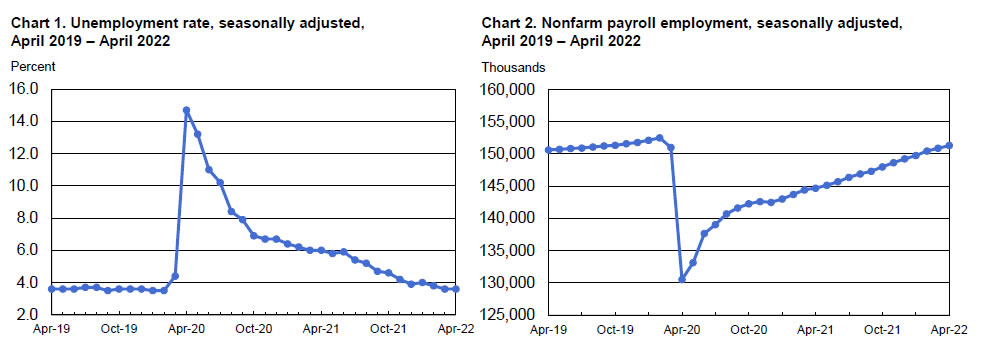
US non-farm payroll rose 428k in Apr, unemployment rate unchanged at 3.6%
US non-farm payroll employment rose 428k in April, slightly above expectation of 400k. Total employment was still down by -1.2m, or -0.8%, from its pre-pandemic levels.
Unemployment rate was unchanged at 3.6%, matched expectations. Number of unemployed persons was essentially unchanged at 5.9m. The numbers compared to prepandemic levels of 3.5% and 5.7m respectively. Labor force participation rate dropped -0.2% to 62.2%.
Average hourly earnings rose 0.3% mom, below expectation of 0.4% mom.
ECB Rehn: We should move relatively quickly to zero
ECB Governing Council member Olli Rehn said today, "We are almost in between a rock and a hard place so that on one hand we have to ensure that the recovery will continue. On the other hand, we have to prevent higher inflation expectations being entrenched and being reflected in the labor market."
"In other words, we have to avoid second-round effects. Therefore, in my view, we should move relatively quickly to zero and continue our gradual process of normalization of monetary policy as we have done," he continued.
"Of course, all this on the condition that Russia's war in Ukraine will not substantially escalate and intensify which could derail all the forecasts and the economic recovery."
BoE Pill: We face risks on both sides of the economic outlook
BoE Chief Economist Huw Pill told CNBC today that "we face risks on both sides of the economic outlook." Inflation is going up to 10% because of energy and international goods prices. At the same time, there was a risk of recession.
"It's a tricky balance to seek in current difficult circumstances. And the arguments around where rates should be set in order to achieve that balance are quite finely balanced in themselves," Pill added.
Asked about what would cause the BOE to pause tightening, Pill said MPC would want to see more evidence inflation expectations and wage and price setting and momentum in economy more consistent with target. He added, "if we don't see that we will need to act further."
USDCAD Heads for Sixth Weekly Gain ahead of Jobs Data
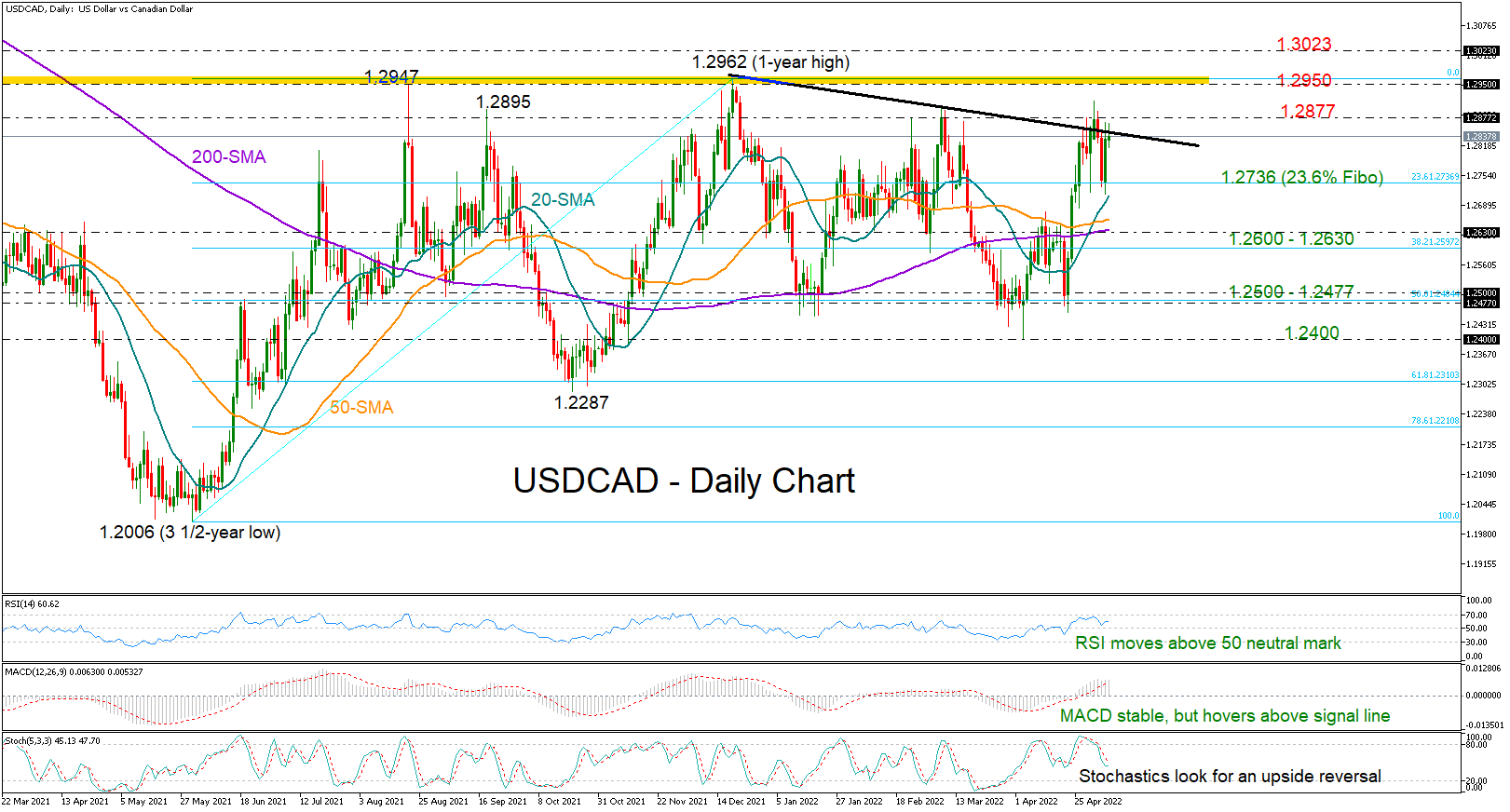
USDCAD came to the defence of the bulls on Thursday after clinging to a footing near the 23.6% Fibonacci retracement of the 1.2006 – 1.2962 upleg at 1.2736.
The price has almost reversed its weekly losses to turn neutral, refusing to abandon its five-week rally, but the 1.2850 area, which includes the downward-sloping resistance trendline from 1.2962, seems to be problematic for the pair.
Nevertheless, the momentum indicators are currently keeping the risk tilted to the upside as the RSI remains elevated comfortably within the bullish area and the MACD hovers clearly above its red signal line. Despite its recent downfall, the blue %K Stochastic line is looking for a positive crossover with the red %D line, reflecting a persisting buying presence as well.
Yet, traders may not engage in new buying activities unless the pair closes successfully above the restrictive trendline, and more importantly, above the nearby key resistance of 1.2877. If efforts prove successful, all eyes will turn to the crucial 1.2950 ceiling, where the price has stopped three times since the end of 2020. A decisive step above this tough bar could initially pause around the 38.2% Fibonacci level of the March 2020 – May 2021 downtrend at 1.3023. If not, the pair could directly ascend towards the 1.3150 barrier.
In the event of a strong rejection at 1.2850, the price could sharply shift lower to seek shelter somewhere between the 1.2736 mark and the 20-day simple moving average (SMA). Failure to rebound here could open the door for the 200-day SMA at 1.2630, while a step beneath the 1.2600 round-level could sharply squeeze the price to 1.2500 – 1.2470.
All in all, USDCAD is trading cautiously bullish in the short-term picture. A victorious escape from the crucial 1.2950 constraining zone would push the market out of the long-term range and back on an upward path.
Sterling Falls Below 1.23
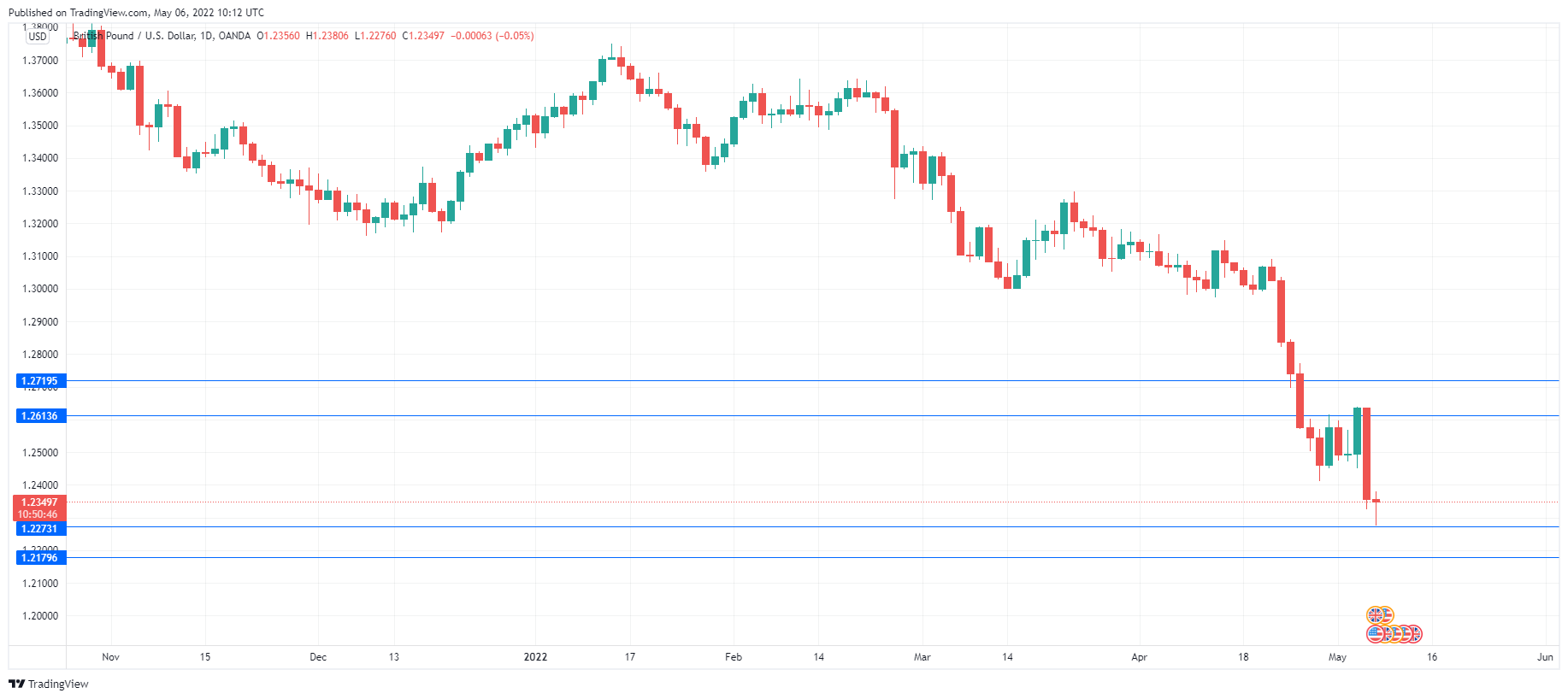
The British pound has stabilized on Friday, after sustaining huge losses a day earlier. GBP/USD is trading at 1.2342 in the European session, down 0.11%. Earlier, the currency fell to 1.2276, its lowest level since June 2020.
BoE warning chills the pound
The BoE dutifully raised interest rates at its meeting on Thursday, but the market reception was a chilly one. GBP/USD plummeted a staggering 2.21% on the day. Investors gave a thumbs-down to the grim message from the central bank, as a fourth straight rate hike in as many meetings became an afterthought.
The BoE’s growth forecast for 2022 remained at 3.75%, but it slashed the 2023 projection from 1.25% to -0.25%. At the same time, the central revised upwards its inflation forecast for Q4 to above 10%, up from 8% in an April forecast. The ‘double-whammy’ of higher rates and a deteriorating economic outlook sent the British pound reeling after the BoE meeting.
The rate decision was a 6-3 vote, with all three dissenters voting in favor of a 0.50% rate hike. This surprised the markets, which had expected an 8-1 vote. There is a deep split in the MPC, with Governor Bailey acknowledging after the meeting that an uncertain economic outlook had led to a range of views in the MPC. Such a statement can hardly be expected to instill confidence in the markets.
In its policy summary, the BoE signalled that more rate hikes are coming, and also dropped the word “modest” to describe upcoming rate hikes. Yet the markets were not impressed – the 0.25% was modest, and with the BoE warning about 10% inflation, it’s clear that it will take quite some time before rate hikes do the job and wrestle down sizzling inflation.
The US dollar initially lost ground after the Fed rate decision on Wednesday, as investors seized on Fed Chair Powell’s statement that the Fed was not considering a 0.75% rate hike. The greenback has since bounced back, as the markets digest that the Fed plans to be aggressive with further 0.50% hikes in its battle to bring down inflation.
GBP/USD Technical
- There is resistance at 1.2612 and 1.2719
- GBP/USD tested support at 1.2272 in the Asian session. Below there is support at 1.2179
UK Oil (Brent) – One More Push Prior to Advance
UK Brent Oil has been on a bullish trend since the lows of April 2020 – the start of the Covid19 pandemic. Despite the fears of UK Oil dropping in value we witnessed price climbed from 20.00 to 130.00 within the space of two years.
Ever since the highs we have been within a corrective nature in a bearish counter-trend. Nevertheless, we remain bullish on UK Oil from at least 10000 ft high.
UK Oil – Weekly time frame 5th May 2022
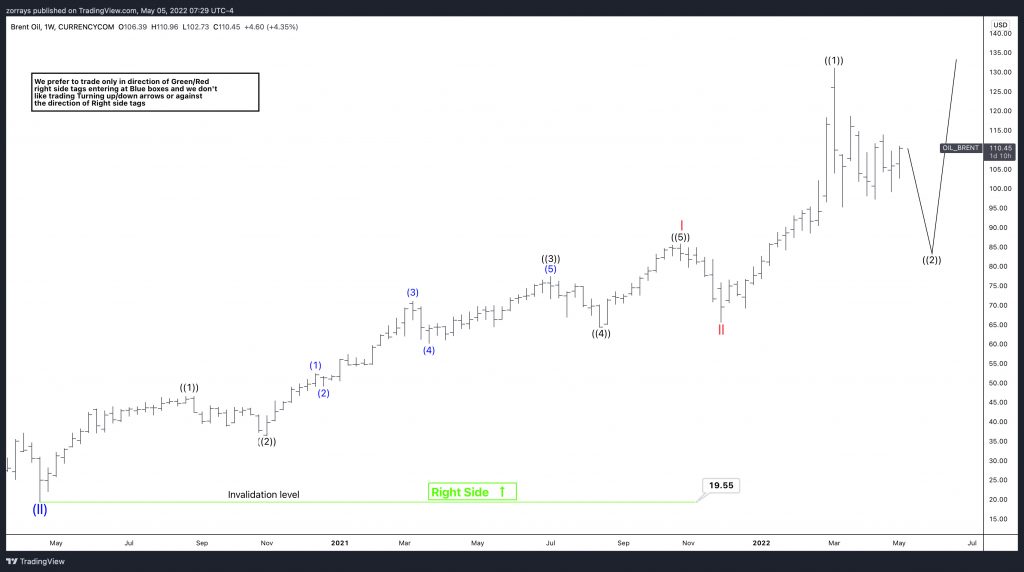
We are essentially calling for another push within that corrective cycle of wave ((2)). This would be before seeing a continuation to the upside into wave ((3)) of (II). Wave 2 corrective cycles are more price based corrections. We ideally want to see some form of a deep correction such as Zigzag or a variant of a Zigzag such as a WXY double correction.
Lets have a deeper look at how wave ((2)) is unfolding.
UK Oil – Daily time frame 5th May 2022
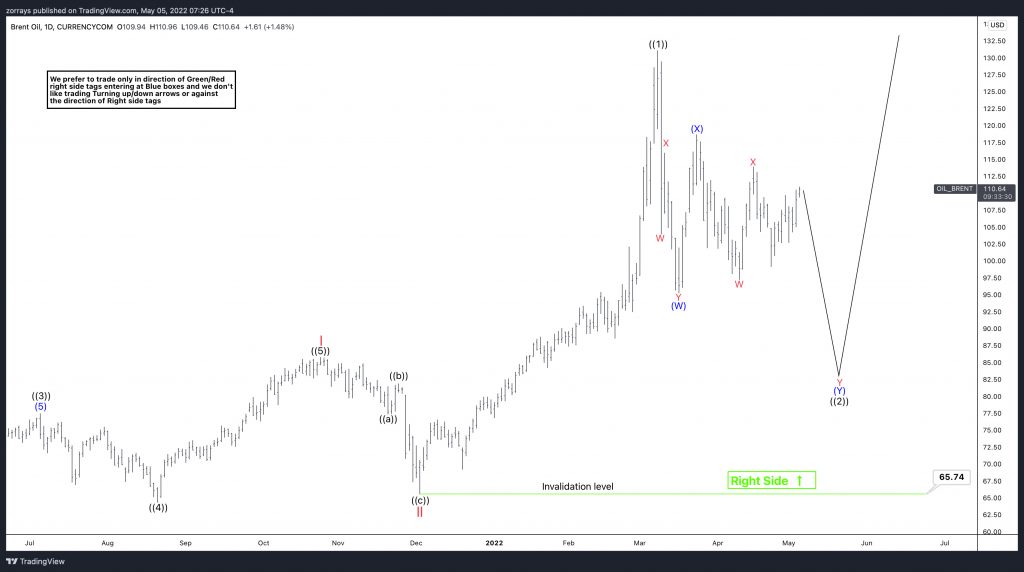
So, this is developing as a double correction which therefore means we have two corrections i.e. ZigZag joined with an (X) connector in the middle. We are calling for another low into 80.00 potentially subject to remaining above 65.74 prior to seeing the next advance into wave ((3)).
As time is going on, we can see that the market sentiment according to our count is that overall there are more appreciation left as opposed to expecting a long term depreciation within the price. UK Oil prices are expected to increase based on the war we have been witnessing between Russia and Ukraine as the United Kingdom decided to slap sanctions on Russia. We can expect further set of sanctions also pushed from the EU by the end of 2022.
USDSGD Elliott Wave : Buying The Dips At the Blue Box Area
USDSGD is another instrument that has given us trading opportunity lately . Break of November 2021 peak made bullish sequence in the cycle from the January 2021 low. The price structure is suggesting further rally within that cycle. We recommended members to avoid selling the pair at this stage while favoring the long side. Recently the pair made clear 3 waves pull back and found buyers at the blue box as we expected. In this technical blog we’re going to take a quick look at the charts of USDSGD published in members area of the website and explain the Elliott Wave structure and trading strategy.
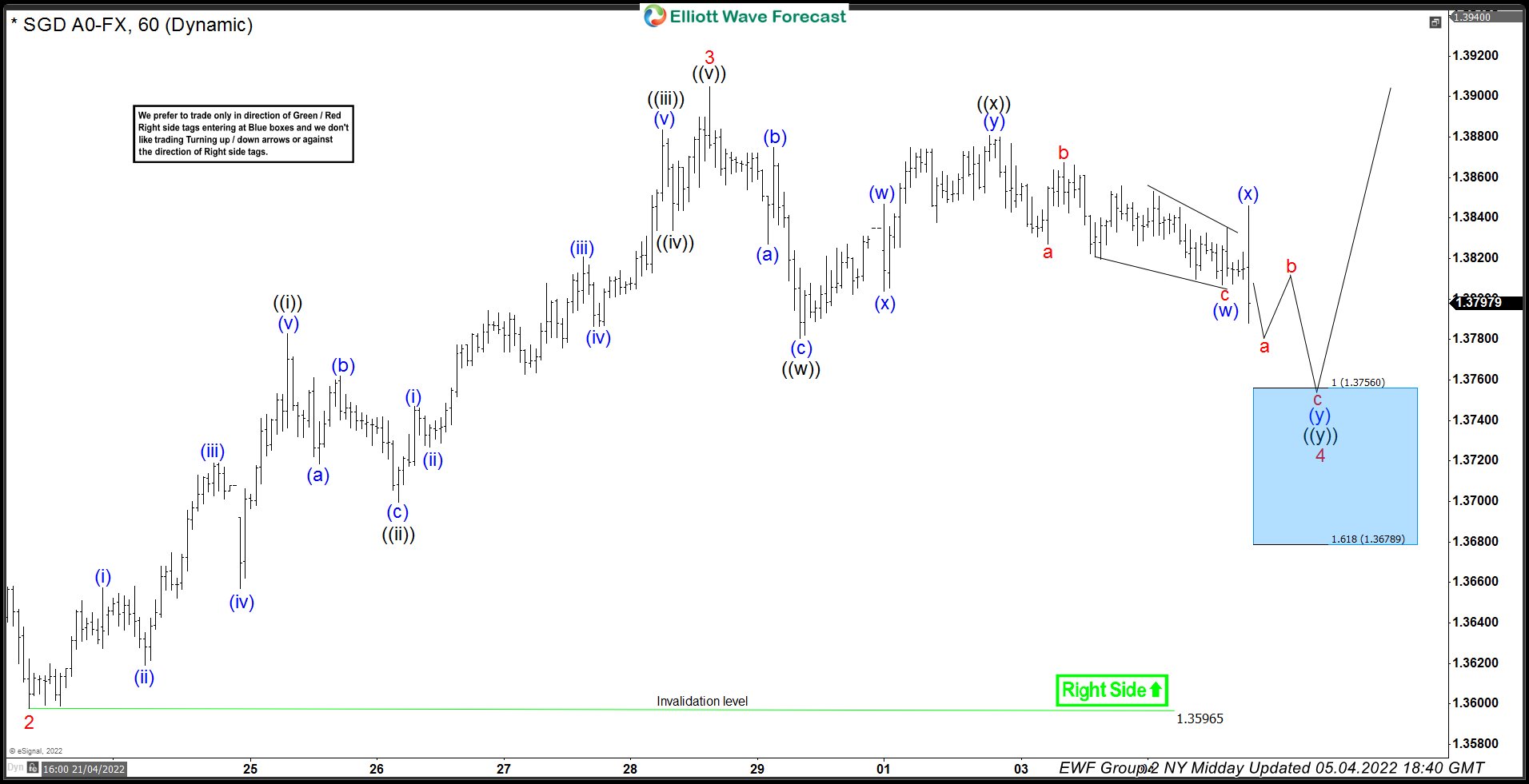
USDSGD Elliott Wave 1 Hour Chart 05.04.2022
Current view suggests USDSGD is doing 4 red pull back against the 1.35965 low. We believe correction can still be in progress. The price is showing incomplete lower low sequences in the short term cycle from ((x)) peak- 05.02 , suggesting more downside toward blue box area : 1.3756-1.3678 . As the main trend is bullish we expect buyers to appear at the blue box for 3 waves bounce at least. Strategy is the same as always, once bounce reaches 50 Fibs against the ((x)) black high, we will make long position risk free ( put SL at BE). Invalidation for the trade would be break of marked invalidation level 1.3678.
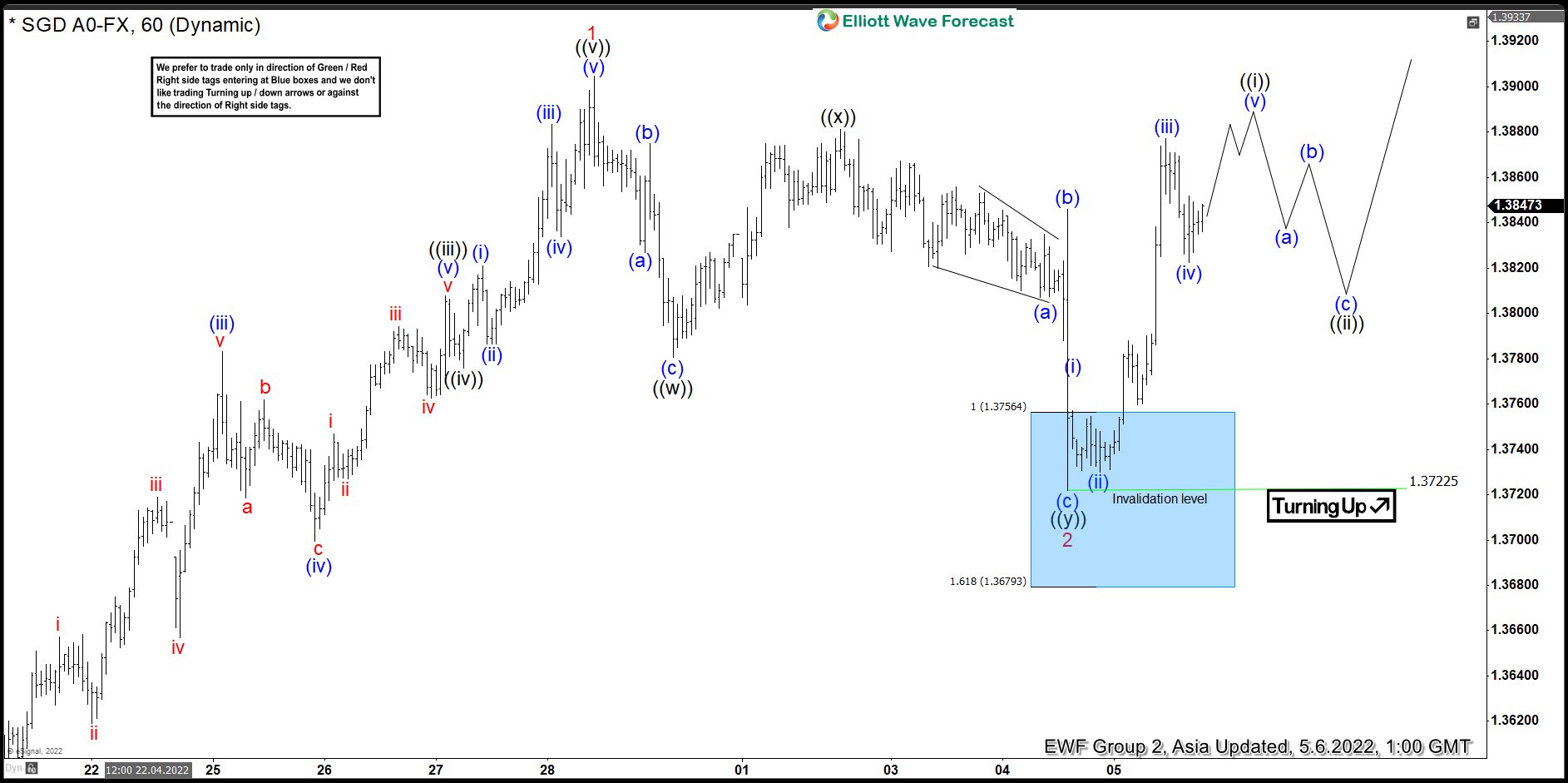
USDSGD Elliott Wave 1 Hour Chart 05.06.2022
USDSGD has found buyers at the Blue Box area and we are getting good reaction from there. Pull back made clear 7 swings and completed at 1.37225 low. The rally from the blue box reached and exceeded 50 fibs against the ((x)) connector. Consequently, members who have taken the long trades at the blue box now enjoying profits in a risk free trades. Now we would need to see break of 1 red peak in order to confirm next leg up is in progress. Once the pair breaks above 1 red peak ( 04/28), the pair will become bullish again in near term and might offer some new buying opportunities in the short term dips against the 1.37225 low.
GBP/USD: Bears Remain Firmly in Play for Extension of Post-BoE’s 2.1% Drop
Early Friday’s action is consolidating within a narrow range after Thursday’s post-BoE 2.1% fall, but sterling remains biased lower.
Fresh bearish acceleration was sparked by BoE rate hike in line with expectations but darkened outlook, as the central bank expects inflation in the UK to peak above 10% and the economy is likely heading into recession, stressing it must be very careful with further rate hikes.
The results of UK local elections showed that PM Johnson’s Conservative suffered heavy losses, particularly in London that would further hurt the sentiment and send pound lower.
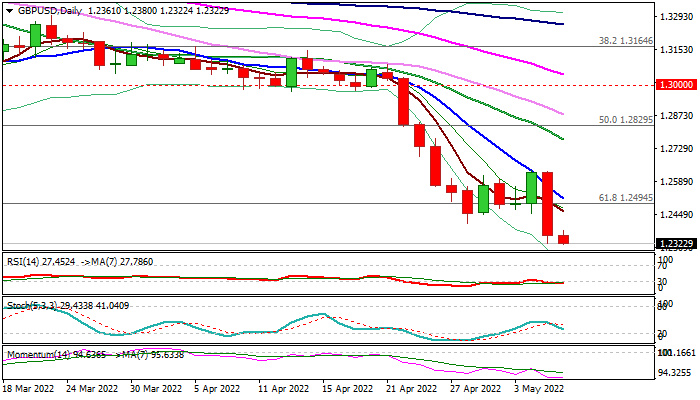
Cable hit new lowest since June 2020 in European session on Friday, in extension of previous day’s drop, which generated bearish signal on close below pivotal Fibo support at 1.2494 (61.8% of 1.1409/1.4249), which is going to be reinforced on likely weekly close below this level.
Thursday’s large bearish candle weighs on near-term action, along with strengthening negative momentum on daily chart that sets scope for push through initial support at 1.2251 (29 Jun 2020 trough) towards key levels at 1.2080/1.2000 (Fibo 76.4% / psychological).
Limited upticks are expected to provide better selling opportunities.
Res: 1.2380; 1.2411; 1.2494; 1.2516
Sup: 1.2275; 1.2251; 1.2164; 1.2080