Sample Category Title
EUR/JPY Weekly Outlook
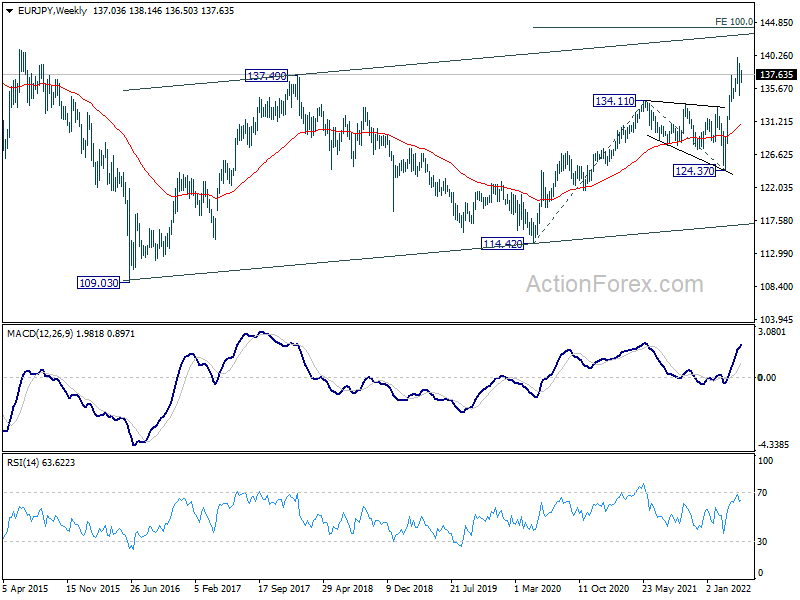
EUR/JPY stayed in consolidation from 139.99 last week and outlook is unchanged. Initial bias stays neutral this week first. In case of another decline, downside should be contained by 38.2% retracement of 124.37 to 139.99 at 134.02 to bring rebound. On the upside, firm break of 139.99 will resume larger up trend for 144.06 medium term projection level.
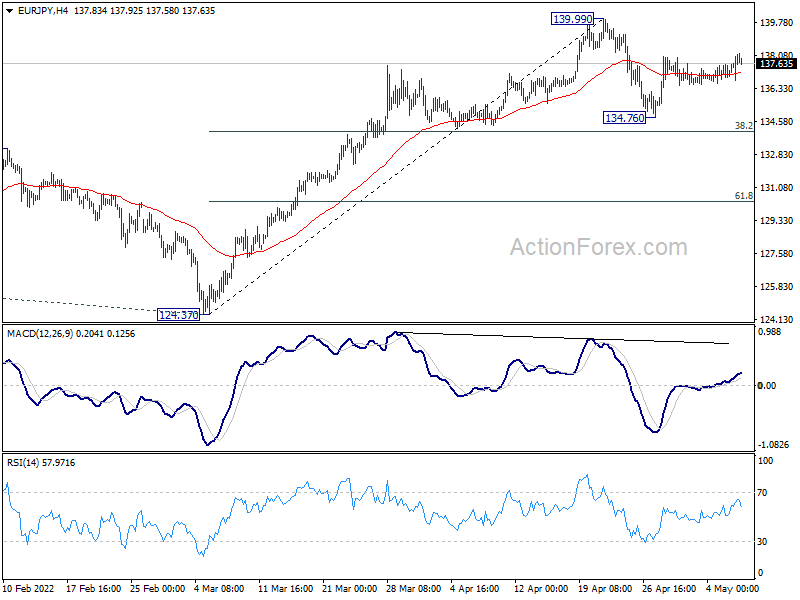
In the bigger picture, up trend from 114.42 (2020 low) is in progress. Such rise is seen as the third leg of the pattern from 109.30 (2016 low). Next target will be 100% projection of 114.42 to 134.11 from 124.37 at 144.06. In any case, outlook will now remain bullish as long as 124.37 support holds, in case of deep pull back.
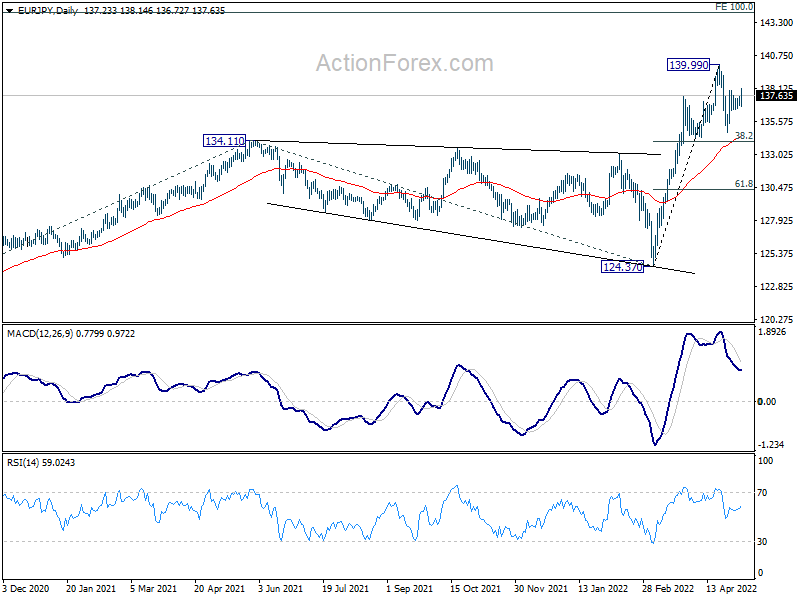
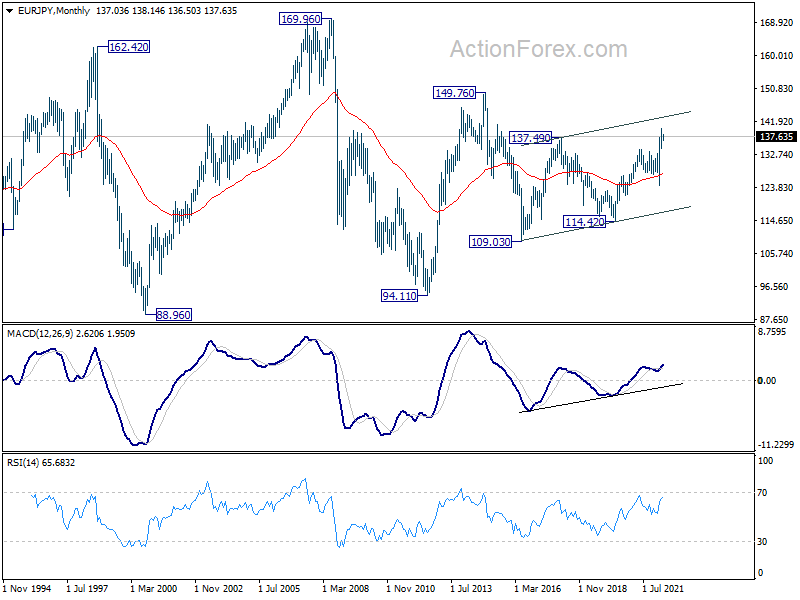
In the long term picture, focus stays on 137.49 resistance (2018 high). Sustained break there will raise the chance that whole rise from 94.11 (2012 low) is resuming through 149.76 resistance. This will be a slightly favored case for now, as long as 124.37 support holds.
EUR/GBP Weekly Outlook
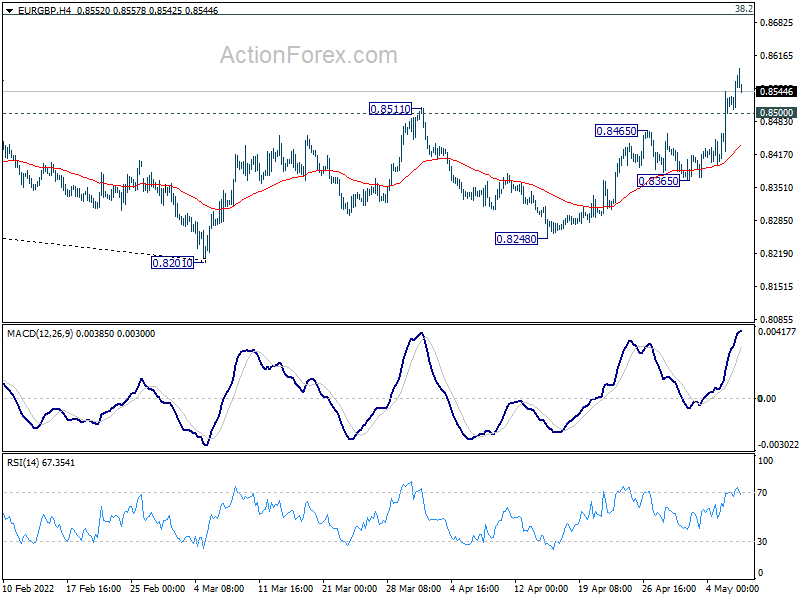
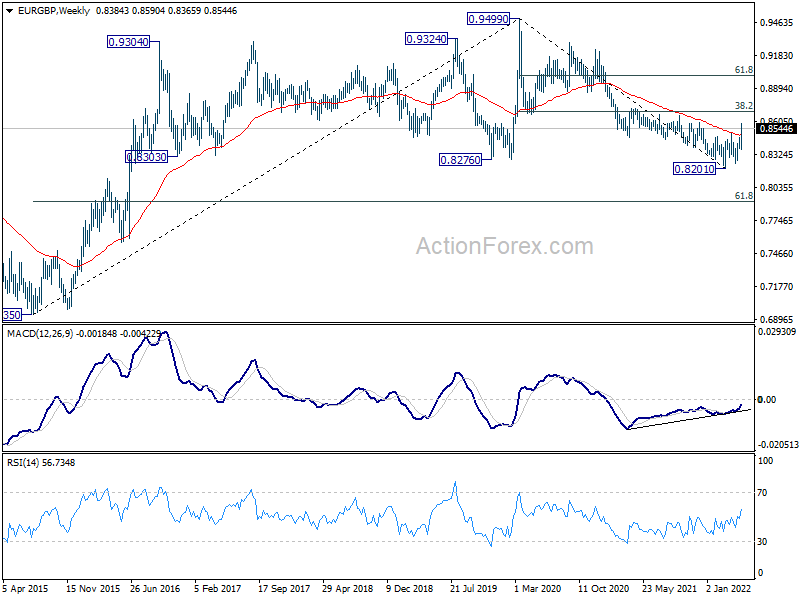
EUR/GBP's rebound from 09201 resumed by breaking through 0.8511 resistance last week. The development affirms the case that 0.8201 is a medium term bottom. Initial bias stays on the upside this week. Further rally would be seen to 0.8697 medium term fibonacci level next. On the downside, below 0.8500 minor support will turn intraday bias neutral first. But further rally will remain in favor as long as 0.8465 resistance turned support holds.
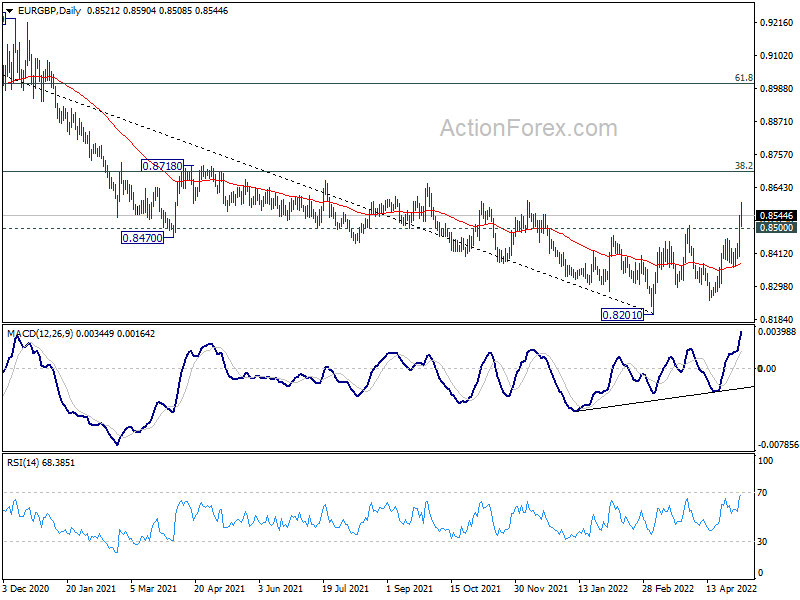
In the bigger picture, a medium term bottom could be in place at 0.8201, on bullish convergence condition in daily and weekly MACD. Rise from there could either be a correction to the down trend from 0.9499 (2020 high), or a medium term up trend itself. In either case, further rise should be seen to 38.2% retracement of 0.9499 to 0.8201 at 0.8697. Sustained break there will target 61.8% retracement at 0.9003.
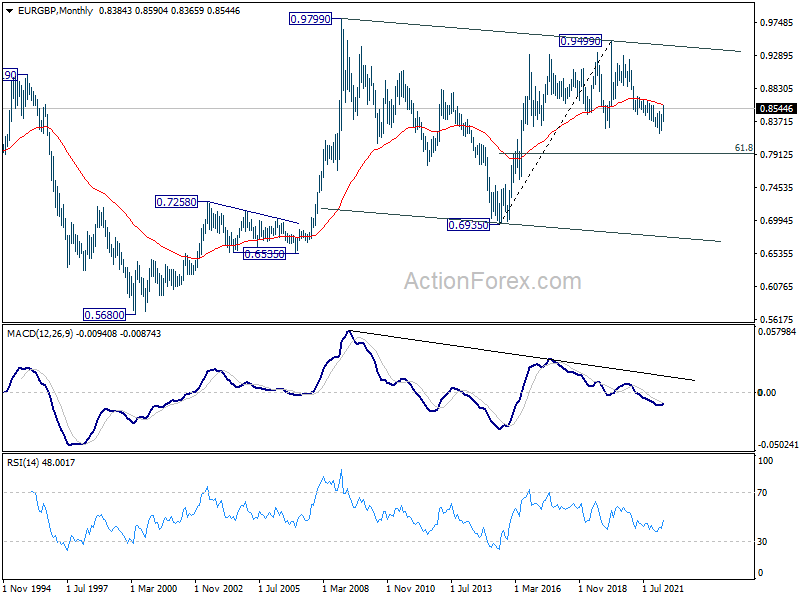
In the long term picture, current development argues that fall from 0.9499 is probably the third leg of the pattern from 0.9799 (2008 high). Sustained break of 61.8% retracement of 0.6935 to 0.9499 at 0.7917 will pave the way back to 0.6935 (2015 low) and probably below. However, sustained trading above 55 month EMA (now at 0.8606) will dampen this bearish view and bring stronger rebound.
EUR/AUD Weekly Outlook
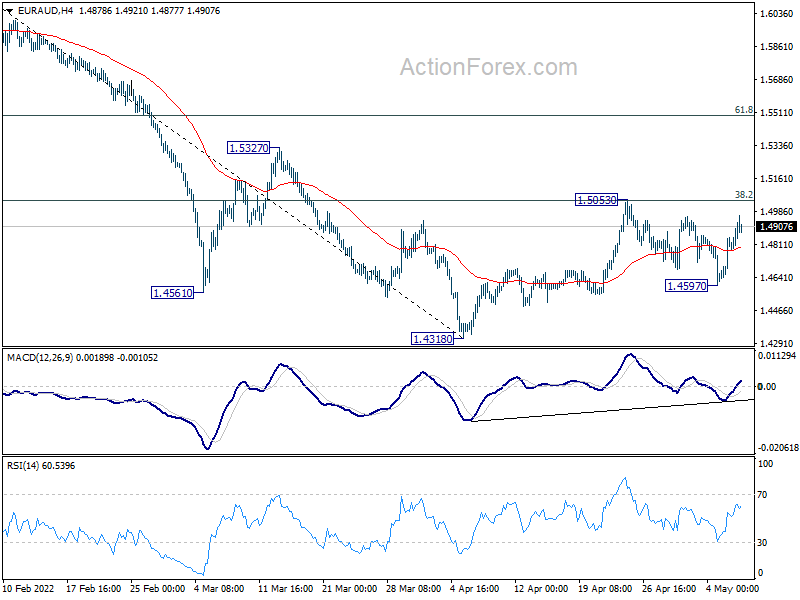
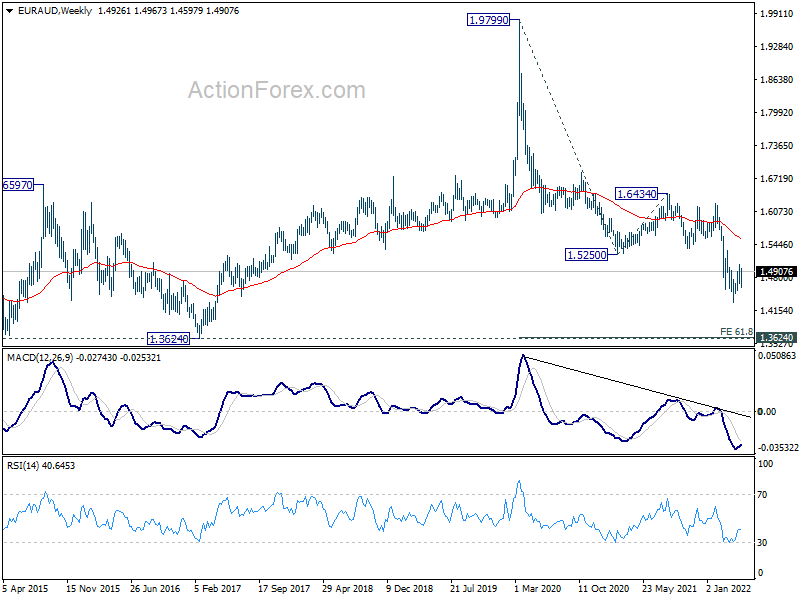
EUR/AUD dipped to 1.4597 last week but quickly recovered. Initial bias stays neutral this week first. On the upside, break of 1.5053 will resume the rebound from 1.4318, and target 61.8% retracement of 1.6223 to 1.4318 at 1.5495. On the downside, break of 1.4597 will bring retest of 1.4318 low instead.
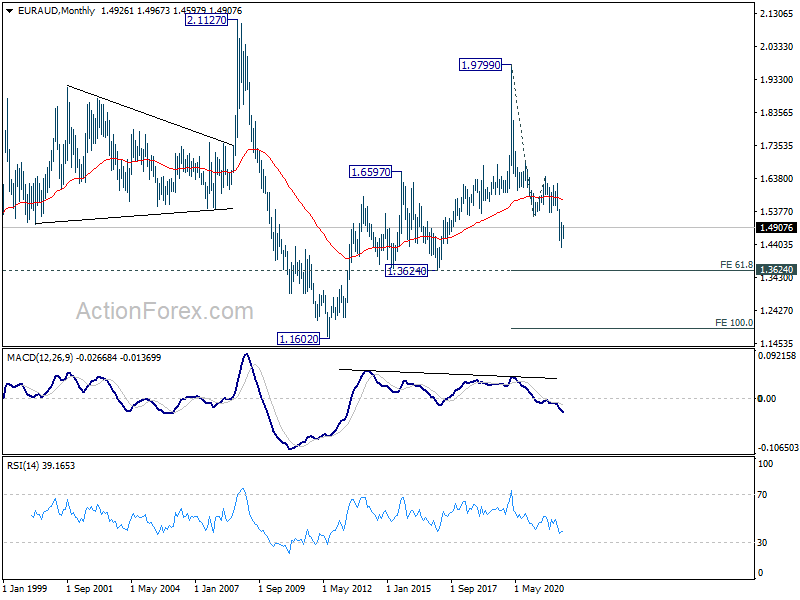
In the bigger picture, as long as 1.5354 support turned resistance holds, larger down trend form 1.9799 (2020 high) is still expected to continue. On resumption, next target is 61.8% projection of 1.9799 to 1.5250 from 1.6434 at 1.3623, which is close to 1.3624 long term support (2017 low). However, firm break of 1.5354 will indicate medium term bottoming and bring stronger rally.
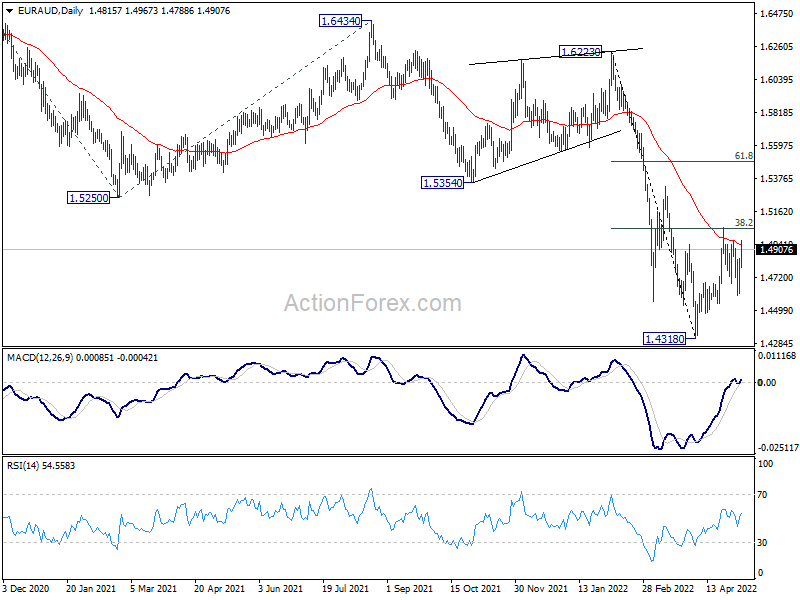
In the longer term picture, fall from 1.9799 (2020 high) is seen as the third leg of the pattern from 2.1127 (2008 high). Deeper fall should be seen to 1.3624 support. Decisive break there would pave the way back to 1.1602 (2012 low).
EUR/CHF Weekly Outlook
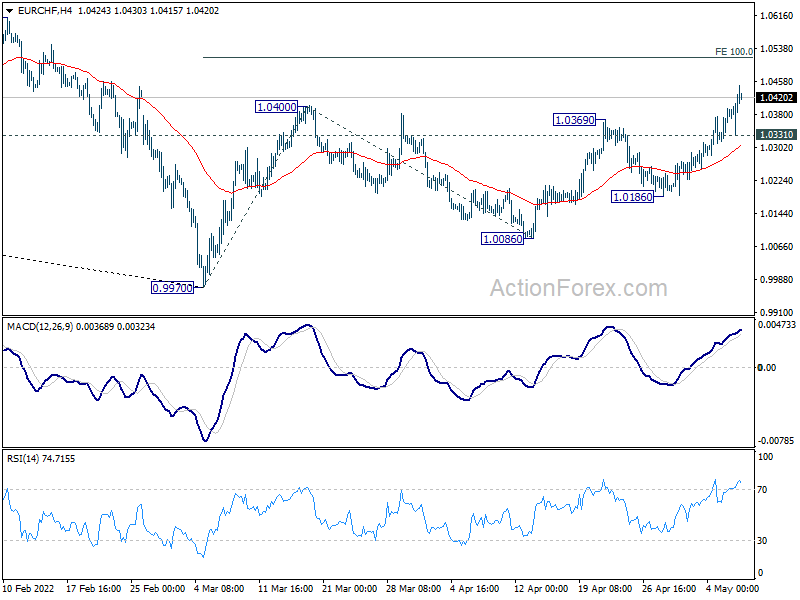
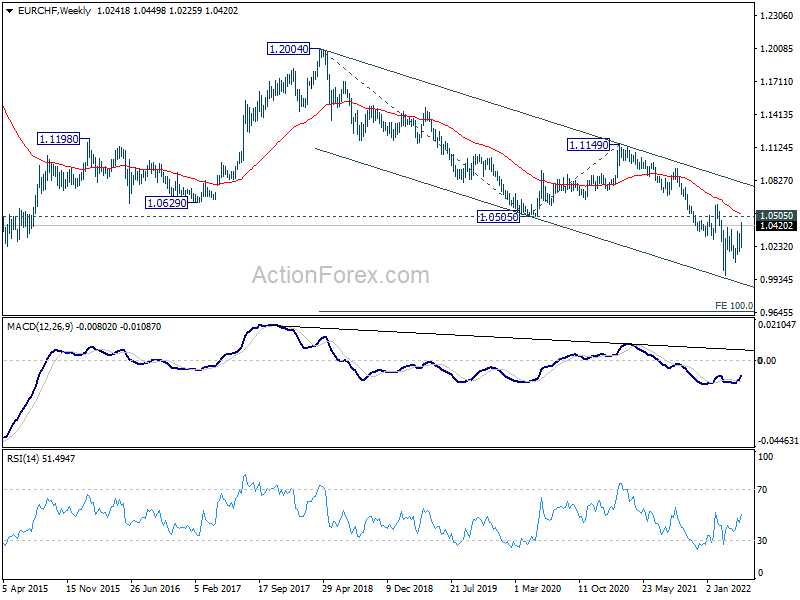
EUR/CHF rose to as high as 1.0449 last week. The break of 1.0400 resistance confirmed resumption of rise from 0.9970. Initial bias stays on the upside for 100% projection of 0.9970 to 1.0086 from 1.0400 at 1.0516 next. On the downside, below 1.0331 minor support will turn intraday bias neutral and bring consolidations first. But further rally will remain mildly in favor as long as 1.0186 support holds.
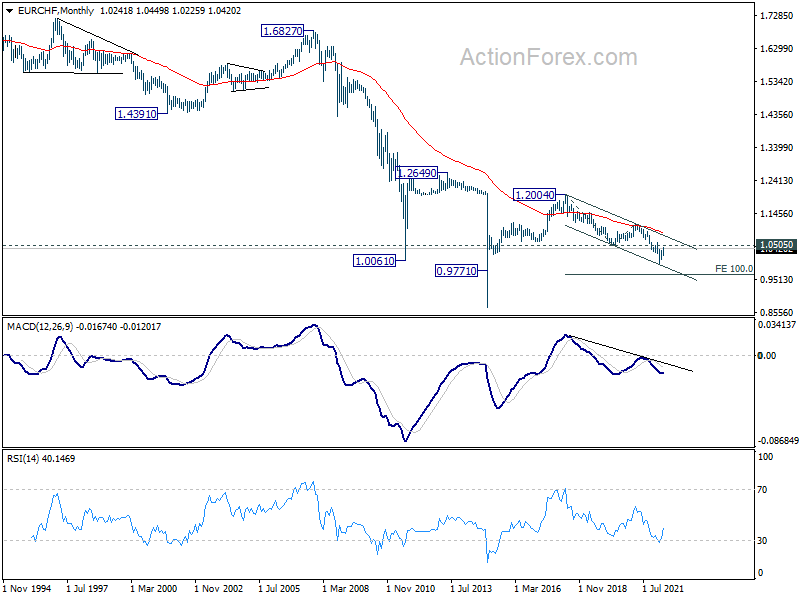
In the bigger picture, as long as 1.0505 support turned resistance (2020 low) holds, long term down trend from 1.2004 (2018 high) is expected to continue. Next target is 100% projection of 1.2004 to 1.0505 to 1.1149 at 0.9650. However, firm break of 1.0505 will suggest medium term bottoming, and bring stronger rebound towards 1.1149 structural resistance.
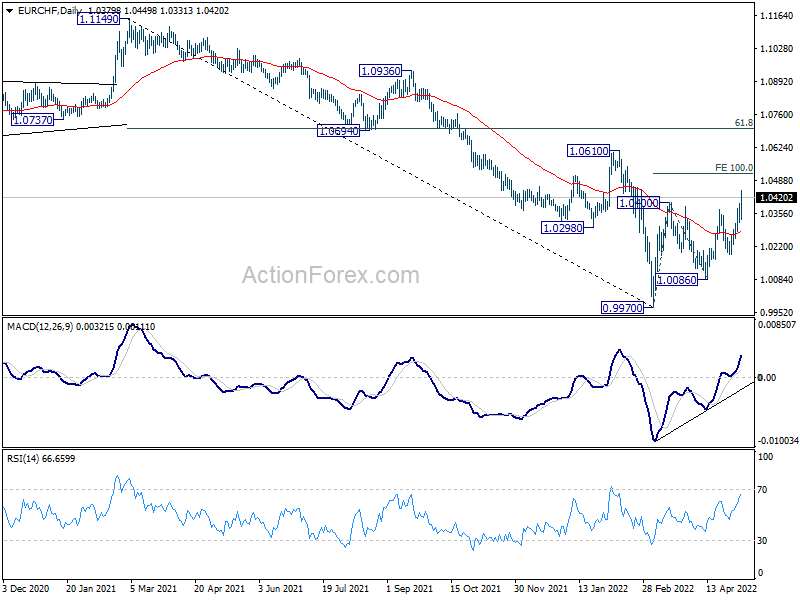
In the long term picture, capped below 55 month EMA, EUR/CHF is seen as extending the multi-decade down trend. There is no prospect of a bullish reversal until some sustained trading above the 55 month EMA (now at 1.0876).
Traders Still Betting on 75bps Hike by Fed in June, Dollar Rally Capped
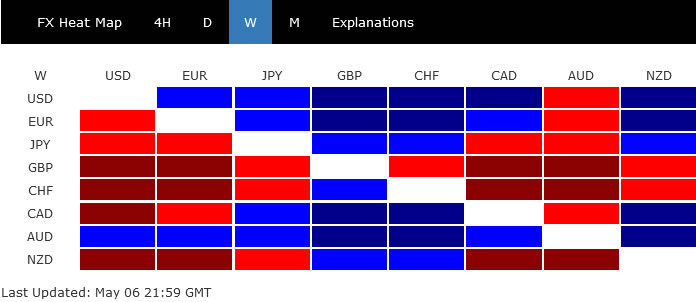
While RBA, Fed and BoE announced rate hikes last week, the impacts and reactions were rather delivered. RBA's larger than expected hike was well received and helped Aussie secured the first place, even though it pared back much gains on risk-aversion. On the other hand, BoE's announcement was considered dovish, with warning of recession, and hammered the Pound broadly lower as the worst performer. .
Reaction to Fed was mixed and volatile. But in the end, markets seemed to be still buying in the prospect of a 75bps hike next, as seen in the late selloff in stocks. Dollar followed sterling as the second strongest. But it's strength against Euro was capped by hawkish ECB comments. The greenback's rally against Yen was also capped by risk-off sentiment.
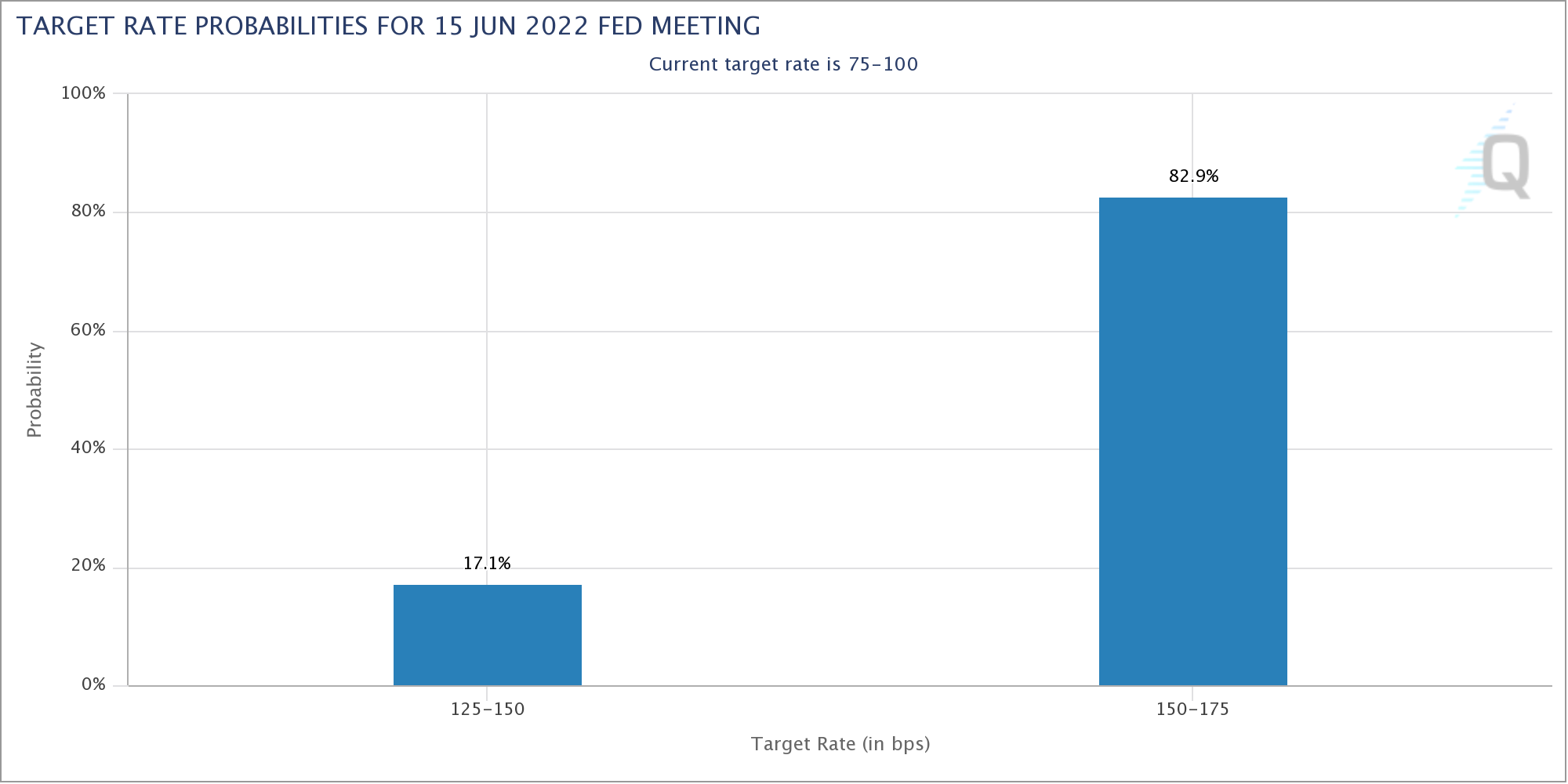
Markets still pricing in 82.9% chance of a 75bps hike at June FOMC meeting
Fed delivered the 50bps hikes as widely expected and raised federal funds rate target to 0.75-1.00%. Chair Jerome Powell shocked the markets by saying that "a 75 basis point increase is not something that the committee is actively considering," in the post meeting press conference. Such comments triggered quick adjustment in market expectations and pushed stocks higher.
Yet, investors were quick in readjusting their expectations and markets pricings which sent stocks and bonds lower again. At the end of the week, fed fund futures are still pricing in 82.9% chance of a 75bps hike in at the June 15 FOMC meeting, to 1.50-75%. Traders will continue to tune their bets based on upcoming data like this week's CPI, and comments from other Fed officials.
NASDAQ extended correction after brief recovery
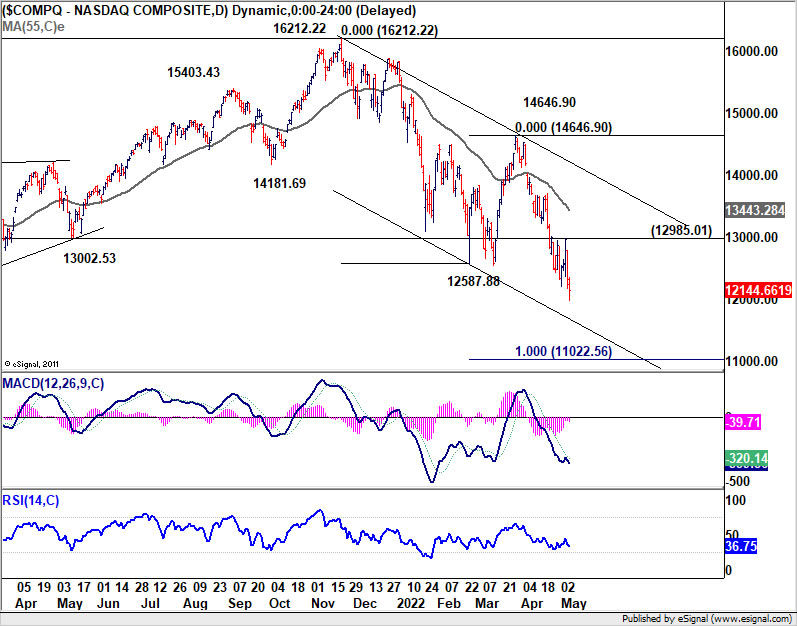
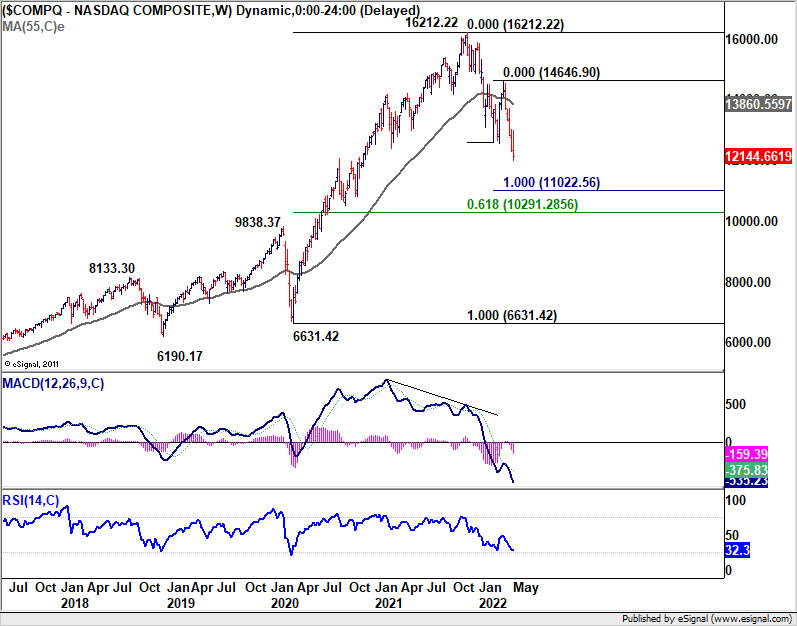
The intra-week rebound provided false hope to stock investors. NASDAQ extended the correction from 16212.22 and closed lower at 12144.66. Near term outlook stays bearish as long as 12985.01 resistance holds. Next target is 100% projection of 16212.22 to 12587.88 from 14646.90 at 11022.56.
Still, strong support is expected around this 11022.56 level, and above 61.8% retracement of 6631.42 to 16212.22 at 10291.28 to contain downside to finish the correction.
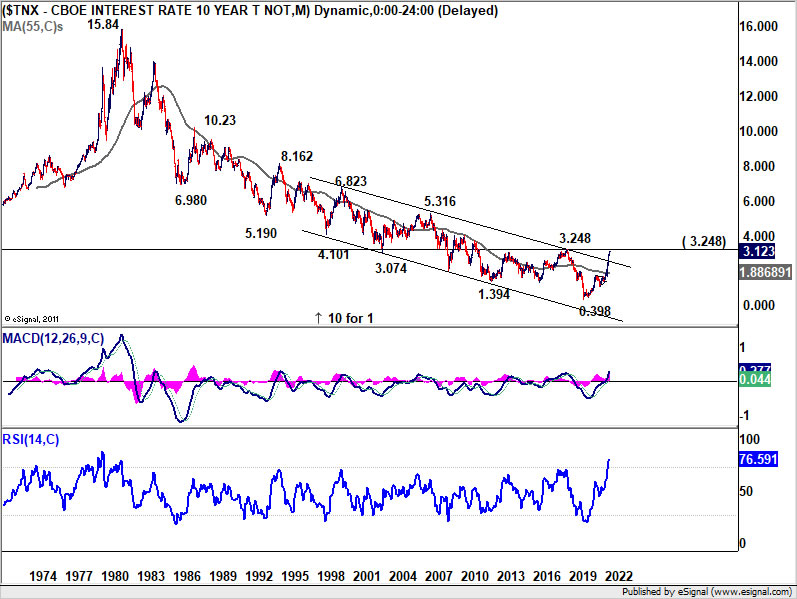
10-year yield extended up trend, closing in 3.248 key resistance
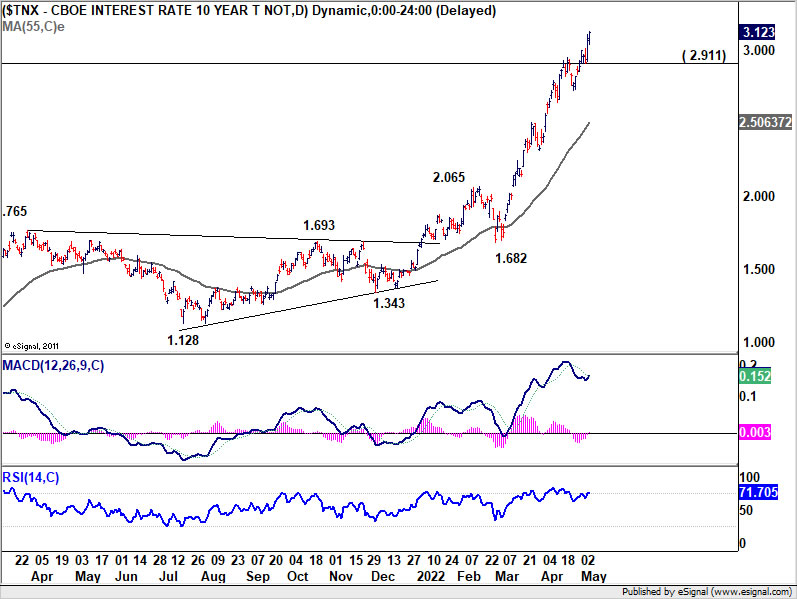
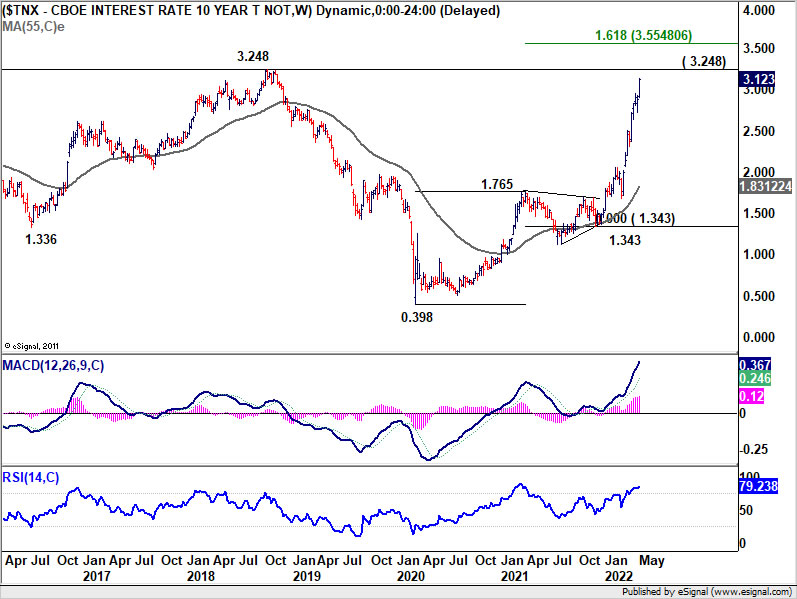
US 10-year yield continued its up trend last week and closed well above 3% handle at 3.123. Next target is 3.248 long term resistance level (2018 high). We'd stay cautious on strong resistance from there the break pull back. Break of 2.911 support level will indicate short term topping and turn into a correction phase. Nevertheless, firm break of 3.248 will target 161.8% projection of 0.398 to 1.765 from 1.343 at 3.554 next.
It should be emphasized again that sustained break of 3.248 will finally break the lower-high-lower-low pattern that started back in 1981. If could confirm the start of an era of higher yields in the long term.
Dollar index struggled to extend gain above 2017 high
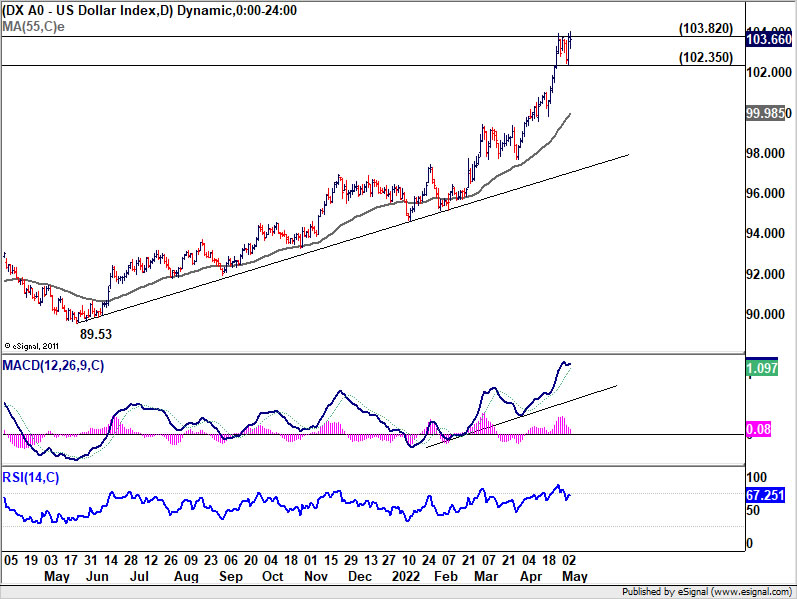
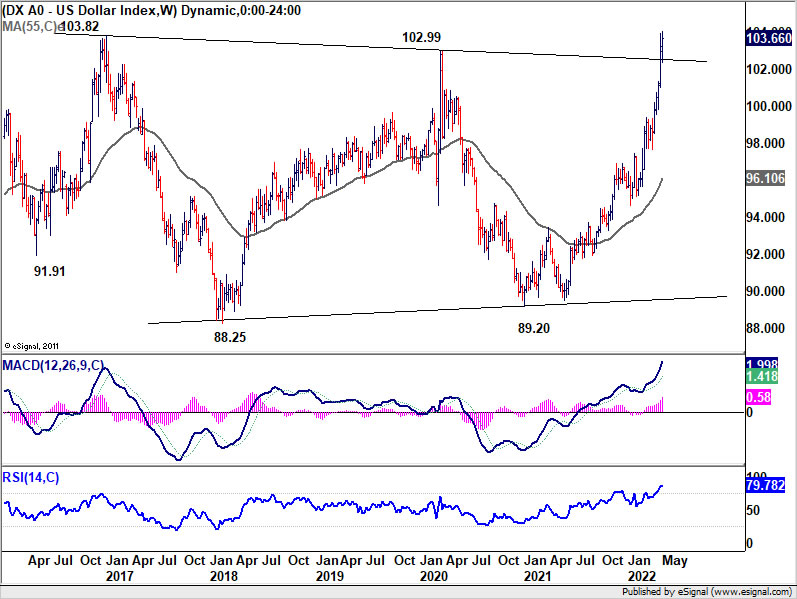
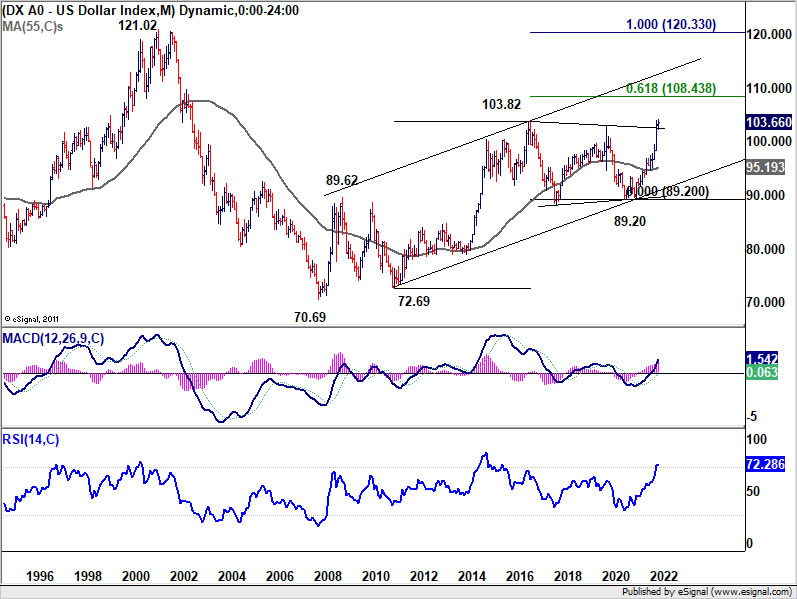
Dollar index also breached a key resistance at 103.82 (2017 high), but struggled to extend gains above there. That was a result of both resilience in Euro and Yen. Euro was firstly talked up by comments from ECB hawks. Secondly, it's lifted by buying against the weak Sterling. Thirdly, German 10-year bund yield also closed above 1% handle for the first time since 2015, closing at 1.135. On the other hand, risk aversion is providing some support to Yen.
For now, further rise is still expected in DXY as long as 102.35 support holds. Firm break of 103.82 will resume long term up trend from 70.69 (2008 low). Next medium term target is 61.8% projection of 72.69 to 103.82 from 89.20 at 108.43. However, break of 102.35 should bring near term correction first.
GBP/AUD the worst performer, but defended 1.7171 support
Sterling ended as the worst performing one even though BoE delivered the fourth 25bps rate hike as expected. The surprise was found in BoE's warning of a very "sharp slowdown" in growth ahead, even with risks of recession. On the other hand, Aussie ended as the stronger, after RBA delivered a larger than expected hike of 25bps to 0.35%. That set the stage of a possible 40bps hike to 0.75% in June.
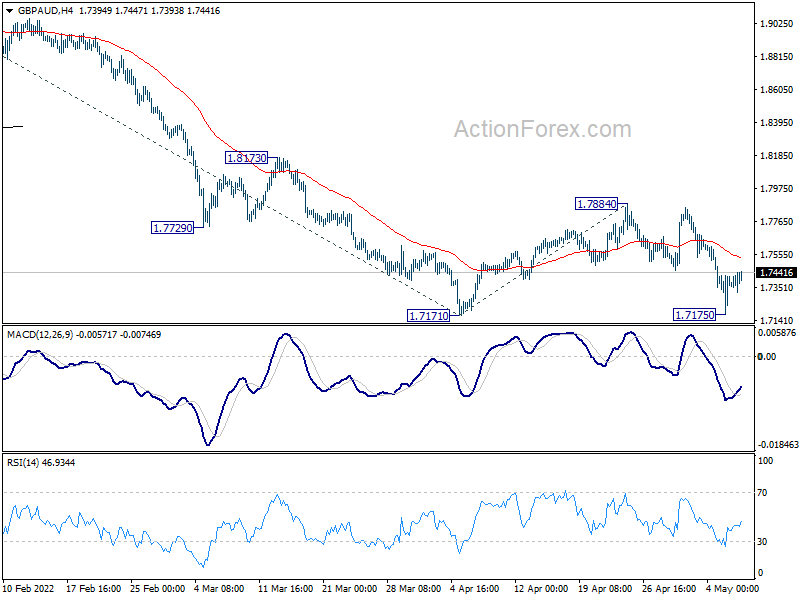
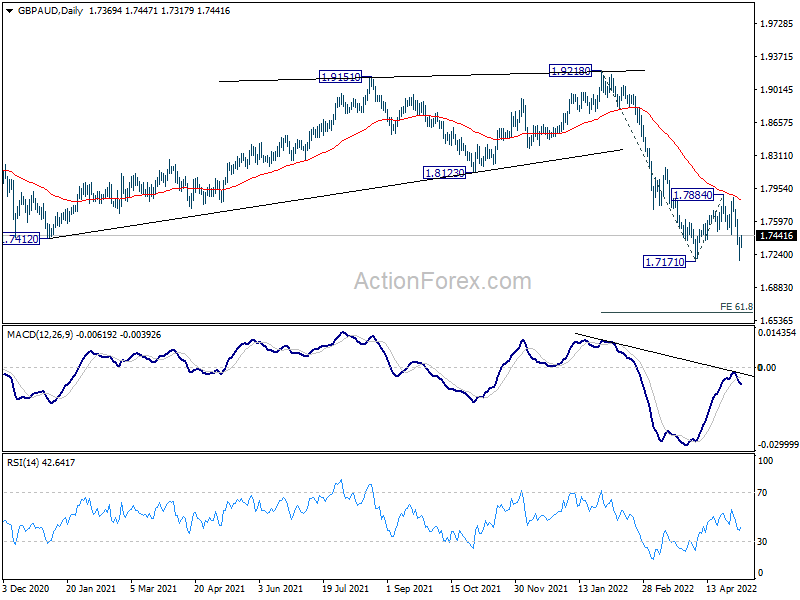
GBP/AUD, thus, ended as the biggest mover, down -2.10% for the week. However, after initial decline, it quickly recovered after just missing 1.7171 low by an inch. While outlook stays bearish with 1.7844 resistance intact, the development suggests that downside break out would only come at a slightly later stage. When that happens, next target is 61.8% projection of 1.9218 to 1.7171 from 1.7884 at 1.6619.
EUR/USD Weekly Outlook
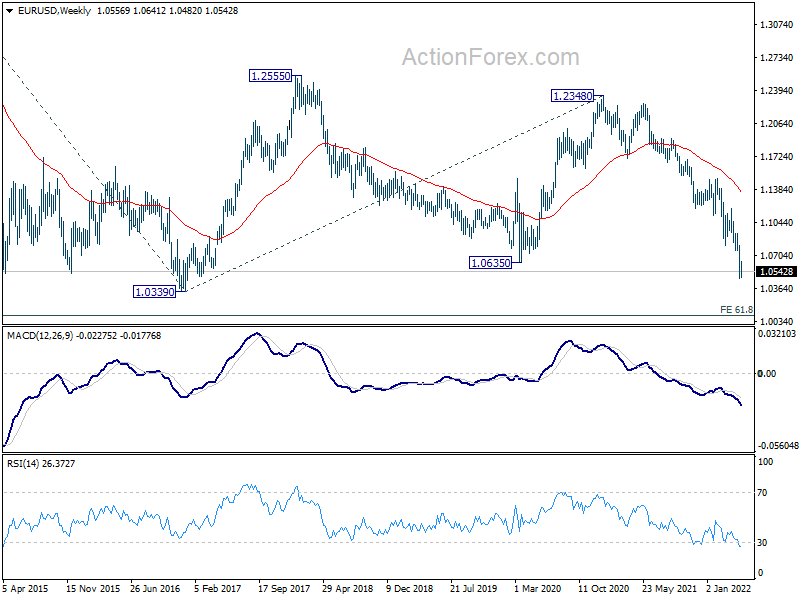
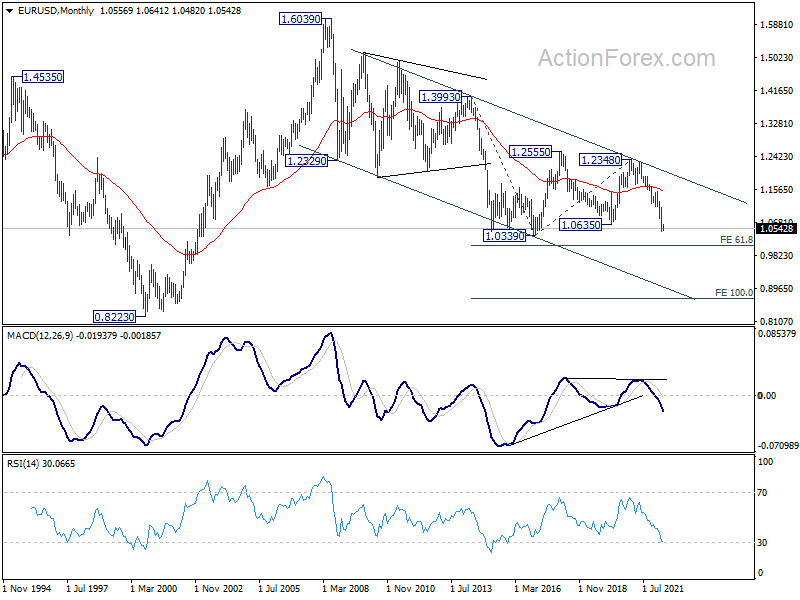
EUR/USD stayed in consolidation above 1.0470 last week and outlook is unchanged. Initial bias remains neutral this week first. In case of another recovery, upside should be limited by 1.0756 support turned resistance to bring fall resumption. On the downside, firm break of 1.0470 will resume larger down trend to 161.8% projection of 1.1494 to 1.0805 from 1.1184 at 1.0069.
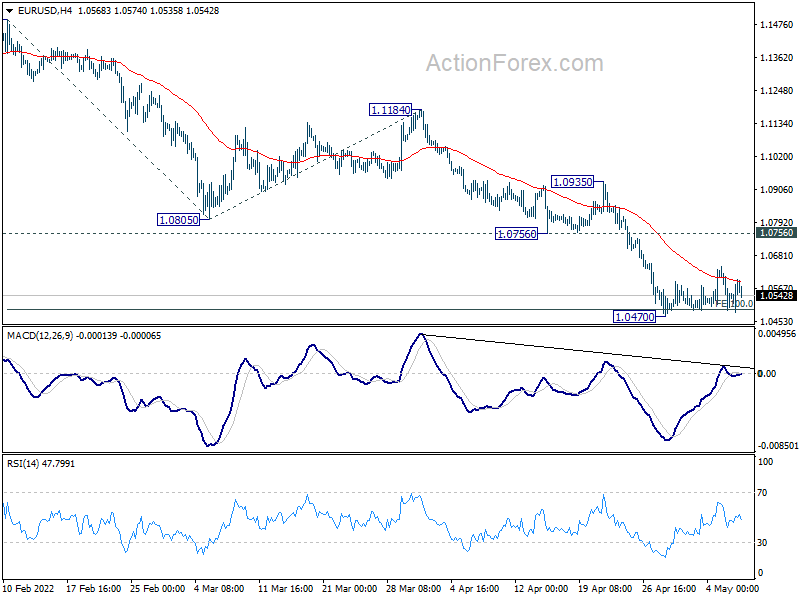
In the bigger picture, the decline from 1.2348 (2021 high) is expected to continue as long as 1.1185 support turned resistance holds. The break of 1.0635 (2020 low) now raises the chance that it's resuming long term down trend from 1.6039 (2008 high). Retest of 1.0339 (2017 low) low should be seen next. Decisive break there will confirm this bearish case.
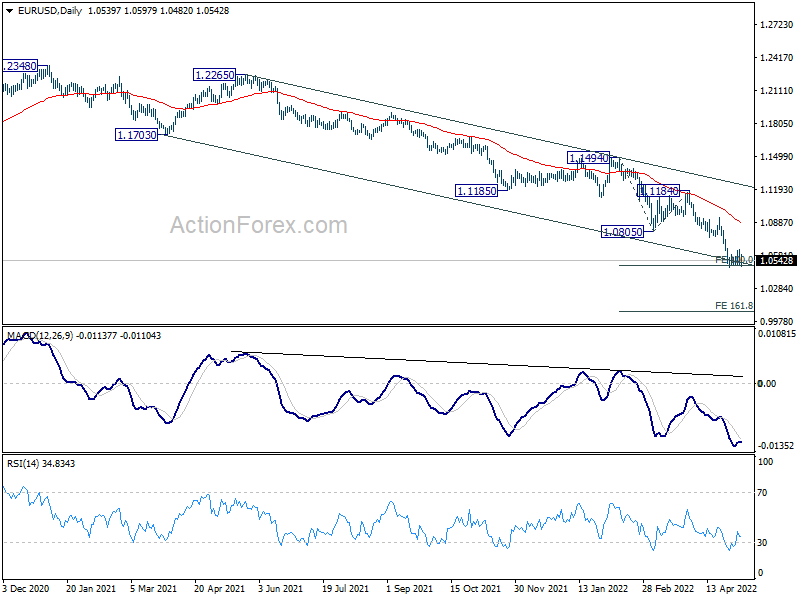
In the long term picture, current development suggests that long term down trend from 1.6039 (2008 high) is ready to resume. Break of 1.0339 will target 61.8% projection of 1.3993 to 1.0339 from 1.2348 at 1.0090. Decisive break there could bring downside acceleration towards 100% projection at 0.8694.
Summary 5/9 – 5/13
Monday, May 9, 2022
[php_everywhere instance="1"]
Tuesday, May 10, 2022
[php_everywhere instance="2"]
Wednesday, May 11, 2022
[php_everywhere instance="3"]
Thursday, May 12, 2022
[php_everywhere instance="4"]
Friday, May 13, 2022
[php_everywhere instance="5"]
The Weekly Bottom Line: Tight Corners of the Economy
U.S. Highlights
- The Fed raised the monetary policy rate by 50 basis points for the first time since 2000 and signaled more hikes of the same magnitude are in the works.
- The economy added more jobs than expected in April, but the labor market remains tight with the number of workers looking for jobs retreating.
- Supply constraints continue to create a mismatch between demand and supply. Should supply fail to improve, inflation will remain high, making the Fed’s job more difficult.
Canadian Highlights
- The Canadian 10-year bond yield broke the 3% threshold for the first time since 2011 this week.
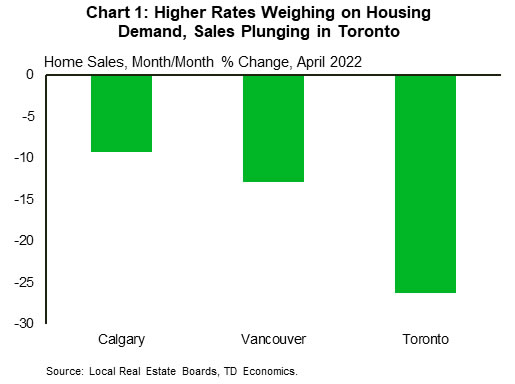
- Higher rates are weighing on housing, with early data pointing to steep April sales declines in Vancouver, Calgary, and Toronto. The latter is now on the cusp of being a buyer’s market.
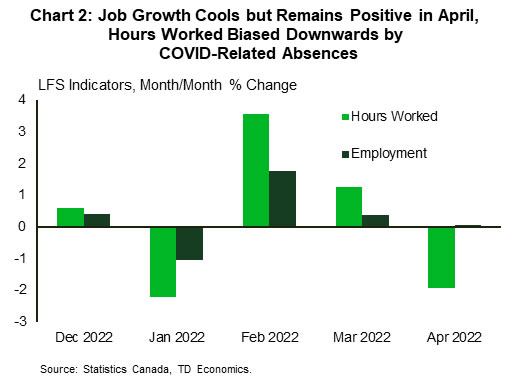
- Job growth cooled in April and hours worked fell. However, both follow big gains in Feb/March and some slowing was expected given an economy operating excess demand.
U.S. - Tight Corners of the Economy
This was a big week for the U.S. economy with a Federal Reserve interest rate decision and early macroeconomic indicators for the month of April. As widely anticipated, the Fed raised the monetary policy rate by 50 basis points for the first time since 2000. More tightening is in the works: we anticipate the central bank will hike the fed funds rate in two more 50 basis point moves at its next two meetings. A that point, we expect it to return to more gradual quarter-point adjustments (see Dollars & Sense). Chair Powell’s push back against the possibility of a larger hike was first accepted as bullish by the equity market, but the sentiment reversed quickly pushing the equity market a quarter of a percent lower and bond yields 15 bps higher for the week (at the time of writing).
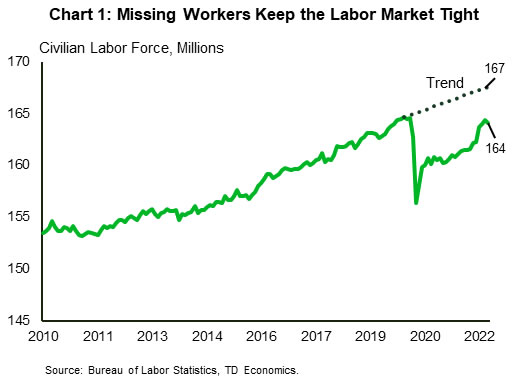
This morning’s jobs report surprised with 428k jobs added in February, according to the payrolls survey, well above 380k anticipated by forecasters. The unemployment rate, which is measured by the household survey held steady 3.6%. The labor force – a measure of people working or actively looking for work – dropped unexpectedly, pushing the participation rate down to 62.2%. As a result, an already sizeable shortfall relative to the pre-pandemic trend, expanded even further (Chart 1). Without progress on this front, the labor market will remain very tight, providing little relief for businesses already struggling to attract workers.
Meanwhile, leading business indicators – the ISM purchasing managers indexes – came in weaker than expected by the consensus, while remaining in the expansionary territory. The manufacturing sector decelerated for the second month in a row. All major subcomponents but the supplier deliveries index declined, with the largest drop in the employment index. Softness in demand is consistent with our expectation that consumers start to cut back on manufactured products in favor of services. In this context, a deceleration in the services sector was somewhat disappointing. The underlying details suggest that current business activity accelerated, but new orders and new export orders slipped. Another drag was the employment sub-index, which dropped back into the contractionary territory, likely due to “hypercompetitive” demand for workers, as suggested by one of the purchasing managers.
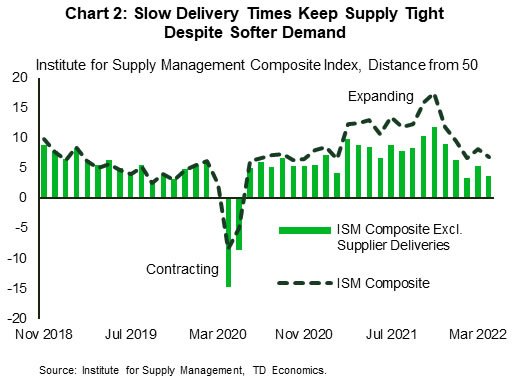
Importantly, supply constraints and challenges in logistics continue to create a mismatch between demand and supply in both sectors of the economy. Comparing to history, the supplier delivery index has been unusually strong since March of 2021, creating a wedge between this sub-component the rest of the index’s drivers (Chart 2). Another way to think about it is that delivery times remain atypically slow relative to softer demand.
Should supply fail to improve in lock steps with demand softening, inflation is likely to remain elevated. This will make it more difficult for the Fed to soften growth without crushing the economy into a recession. The good news is that the strength of consumer finances points to a softening in spending, rather than an outright retreat. This should help the Fed navigate the economy out of its tight spot.
Canada - Higher Rates Are Doing Their Job
For the housing market, the most important yield is on the 5-year Canada, which drives the pricing of many mortgage products and is hovering near 24-year highs. And, with the Bank of Canada taking their policy rate higher, rates on variable mortgages are on the rise as well. This means that there's nowhere to run, nowhere to hide for potential buyers. Affordability is rapidly eroding, and housing demand is softening.
This week brought fresh evidence that the housing market correction intensified in April (Chart 1). Home sales declined in month-on-month terms in Calgary and Vancouver but plunged nearly 30% in one month in Toronto. The latter region seems to be the real outlier here, as supply/demand conditions are now closer to favouring buyers, and average prices were down 6.4% during the month. In contrast, markets remained quite tight in Calgary and Vancouver and price growth seems to have been stronger. It's no great surprise that Toronto's market is correcting more than these other jurisdictions – this is the other side of the rapid runup in prices that had Toronto challenging for the most expensive market in all of Canada in recent months.
Of course, the Bank of Canada is not done hiking rates. Our updated forecasts see the central bank taking its policy rate to 2% in very short order before shifting to a more gradual rate hike cadence, ultimately finishing the year at 2.5%. This means that further downward pressure is in store for Canadian home sales and prices.
While the interest-sensitive housing sector is softening under the weight of higher rates, the overall economy seems to have taken a breather last month as well. This morning's jobs report showed that employment expanded by 0.1% m/m (or 15k positions), but hours worked dropped 1.9% m/m. Other details were soft, as full-time employment dropped. However, the more modest jobs gain follows a massive 409k positions being added in February and March, and the drop-in hours worked only partially retraces the large gains made during those two months (Chart 2). Moreover, some of the decline was due to COVID-19 related absences. In addition, job growth of 15k is only a touch below the long-term average and was made in the context of an economy operating in excess demand.
While the decline in hours worked throws some cold water on the Bank's forecast for a 6% annualized Q2 expansion in GDP, the jobs report is not going to knock the Bank off its tightening course. Expect a 50 bps move in June.
Week Ahead – Volatile Markets
Every asset class has been on a rollercoaster ride as investors are watching central bankers all around globe tighten monetary policy to fight inflation. Financial conditions are starting to tighten and the risks of slower growth are accelerating.
The focus for the upcoming week will naturally be a wrath of Fed speak and the latest US CPI data which is expected to show inflation decelerated sharply last month. A sharper decline with prices could vindicate Fed Chair Powell’s decision to remove a 75 basis-point rate increase at the next couple policy meetings.
A close eye will also stay on energy markets which has shown traders remain convinced that the market will remain tight given OPEC+ will stick to their gradual output increase strategy and as US production struggles to ramp up despite rising rig counts. Energy traders will continue to watch for developments with the EU nearing a Russian energy ban.
US
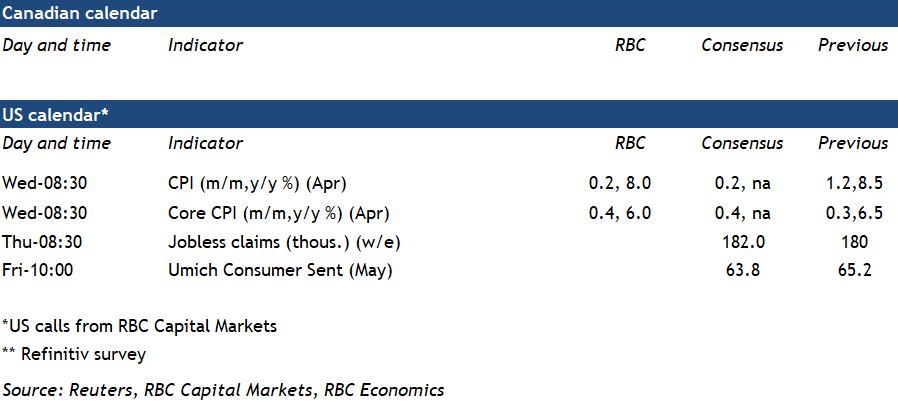
Market volatility following the FOMC decision won’t ease up anytime soon as traders will look to the next inflation report to see if policymakers made a mistake in removing even more aggressive rate hikes off the table over the next couple of meetings. The April CPI report is expected to show further signs that peak inflation is in place. The month-over-month reading is expected to decline from 1.2% to 0.2%, while the year-over-year data is forecasted to decrease from 8.5% to 8.1%.
The producer prices report comes out the next day and is also expected to show pricing pressure are moderating. On Friday, the University of Michigan Consumer Sentiment report for the month of May should show continued weakness.
The upcoming week is filled with Fed speak that could show a divide from where Fed Chair Powell stands with tightening at the June and July meetings. On Tuesday, Fed’s Williams, Barkin, Waller, Kashkari, Mester, and Bostic speak. Wednesday will have another appearance by Bostic. Thursday contains a speech from the Fed’s Daly. On Friday, Fed’s Kashkari and Mester speak.
UK
The Bank of England delivered a 0.25% rate hike at this week’s meeting. This brings the benchmark rate to 1.00%, its highest since 2009. At the same time, the BoE painted a grim economic picture at the meeting, as it revised its inflation forecast to above 10% and warned of a recession.
The UK releases GDP for Q1 on Thursday. The consensus estimate stands at 1.0% after a 1.3% gain in Q4 of 2021. A loss of momentum in the economy could mean a contraction in the second quarter, raising the likelihood of stagflation. The only new data in the GDP report will be the March figures, as January and February were already published. The estimate for March is for a flat reading, after gains of 0.1% in February and 0.8% in January.
EU
The Russia/Ukraine war and the sanctions against Russia have dampened economic activity in the eurozone. Germany, the largest economy in the bloc has been posting weak numbers as the war goes on. With the EU announcing it will end Russian energy imports by the end of the year, there are concerns that the German economy could tip into a recession.
On Tuesday Germany releases ZEW Survey Expectations, which surveys financial professionals.
Economic Sentiment is expected to decline to -42.5 in May, down from -41.0 in April.
On Friday, the Eurozone releases Industrial Production for March. The Ukraine conflict has exacerbated supply line disruptions, which is weighing on industrial production. The sharp drop in German Industrial Production (-3.9%), suggests that the Eurozone release will also show a contraction. The March estimate is -1.8%, following a gain of 0.7% in February.
Russia
Russia’s inflation has been accelerating sharply since the invasion of Ukraine. In March, CPI rose to
16.7% (YoY) and is expected to climb to 18.1% in April. The driver behind the sharp upswing has been Western sanctions, which have reduced the availability of consumer imports and key components for domestic products. CPI is expected to continue to climb in the coming months.
China
China releases its Balance of Trade on Monday and Inflation on Tuesday. Both have downside risks given the disruption to business and the collapse in property sales and sentiment due to the covid-zero policy. Restrictions continue tightening in Beijing and the covid-zero policy has become the biggest headwind to a China recovery. The government reaffirmed its commitment to the policy Friday, sending China stocks lower.
Additionally, US-listed China stocks face new delisting risk from US regulators that is weighing on Hong Kong markets especially, where most dual listings live. Negative headlines around Covid 19 or US delisting over the weekend could send China equities sharply lower into the start of the week.
USD/CNY and USD/CNH have now risen from 6.4000 to 6.7000 in just two weeks. The PBOC remains comfortable at this stage, being a back door stimulus to manufacturers. The PBOC USD/CNY fixing will be the key indicator as to whether the authorities have said Yuan depreciation has gone far enough.
India
The Reserve Bank of India sprung a surprise rate hike on markets this past week, sending the Sensex lower whilst providing some support to the INR temporarily. India’s CPI inflation release on Thursday will be this week’s key risk event. If the data comes in above expectations at 7.30%, expectations will rise of a faster more aggressive hiking cycle from the RBI which was quite hawkish in its guidance after the hike. THat will send Indian equities sharply lower once again, while possibly mollifying the impact on the INR from a rampant US Dollar.
Australia
Australia could be a correlation trade for the tier-1 PMI releases from China over the weekend. Poor China data could see the AUD and local equities pressured with most of Asia, ex-Japan closed.SImilarly, a decent showing by the China PMIs will have a positive impact.
Markets, especially currency markets, could face liquidity issues and see sharp moves if the weekend news wire is heavy as Australia and Japan will be the only two major centres open.
Most attention will be focused on Tuesday’s RBA rate decision. A 0.15% hike is fully priced by markets and the clouds from Ukraine and China are weighing heavily on AUD/USD anyway. If the RBA does not hike AUD/USD could fall sharply in the short-term. If the RBA hikes and adjusts its guidance to a more hawkish, AUD/USD could potentially see a big move higher.
New Zealand
NZ Retail Card Spending has downside risks and the Food Price Index, upside risks this week. The cost of living has become the central issue in New Zealand at the moment and a high FPI will heap pressure on the RBNZ to accelerate rate hikes as the economy starts to show signs of stress elsewhere.
NZD/USD has traded very heavy in past two weeks as investors price in a hard landing and an RBNZ behind the curve, and as risk sentiment sours internationally. NZD/USD is closing at the weeks lows and could test 0.6200 this week.
Japan
Japan releases a raft of second tier data this week. THe 10 and 30-year JGB auctions will be closely watched, if only for signs of poor cover ratio given the BOJ JGB intervention and weakening Yen.
THe centre of attention will remain the USD/JPY as the US/Japan rate differential widens. USD/JPY could well test 135.00 in the week ahead if the negative sentiment sweeping markets on Friday spills into next week. Higher oil prices will also weigh onthe Yen. We expect the noise to increase from Tokyo but little chance of USD/JPY intervention at these levels.
Singapore
No significant data. The currency remains under pressure as a proxy for China and also because the MAS meets six monthly to determine monetary policy. The next meeting will not be until October to determine if monetary policy gets tightened once again.
Markets
Oil
Crude prices are steadily rising as the EU is making progress towards its Russia oil sanctions ban. The oil market will remain tight going forward now that OPEC+ is set on delivering meager output increases and as US production struggles despite rising rig counts. The biggest uncertainty for the crude demand outlook remains the outlook for the Chinese economy. China won’t be abandoning their zero-COVID policy anytime soon and that will keep the short-term crude demand outlook vulnerable. China’s COVID situation might not be improving anytime soon and now that the data is showing the impact of business restrictions is more widespread than just to Shanghai and Beijing.
Oil will remain a volatile trade going forward with most of the fundamentals still pointing to higher prices.
Gold
Just when gold seems to be showing signs it is getting its luster back, the bond market says ‘not so fast’. Gold continues to struggle in this current environment of surging global bond yields and that might last a little while longer as some central banks for the purpose of defeating inflation might be willing to send their respective economies into a recession.
Gold’s awful few weeks of trade has seen a collapse of the $1900 level and that should prove to be key resistance now. If the bond market selloff accelerates and the dollar surges, gold could be vulnerable to a drop towards $1835 and if that does not hold, $1800 might be targeted.
Bitcoin
Confidence in crypto markets is waning after Bitcoin tumbled below the $37,000 level following the surge in global bond yields. If risk appetite does not return, Bitcoin could be vulnerable to a significant drop towards the $30,000 level. Choppy trading between $35,000 and $40,000 could be where Bitcoin settles if Wall Street does not price in much more tighter monetary policy by the Fed.
Economic Calendar
Saturday, May 7
Economic Data/Events:
- China forex reserves
Sunday, May 8
Economic Data/Events:
- Former secretary for security and chief secretary John Lee is expected to be named replacement for Hong Kong Chief Executive Carrie Lam.
- Atlanta Fed financial market conference starts
Monday, May 9
Economic Data/Events:
- US Wholesale Inventories
- President Putin expected to speak
- BOJ releases Minutes to last policy decision
- Mexico CPI
- China Trade, aggregate financing, money supply, new yuan loans
- France Trade
- Singapore foreign reserves
- Indonesia GDP, CPI, consumer confidence
- Japan cash earnings, PMI services, composite
Tuesday, May 10
Economic Data/Events:
- Fed’s Mester and Bostic speak at Atlanta Fed conference
- Fed’s Williams speaks NABE/Bundesbank symposium
- Fed’s Waller and Kashkari speak at the Economic Club of Minnesota
- Germany ZEW survey expectations
- Italy industrial production
- Italy PM Draghi visits White House
- Japan household spending
- Mexico international reserves
- New Zealand home sales, card spending
- Australia household spending, business confidence, retail sales
- Thailand consumer confidence
Wednesday, May 11
Economic Data/Events:
- US CPI
- Fed’s Bostic speaks
- China CPI, FDI
- Germany CPI
- ECB’s Knot speaks in Madrid
- Australia consumer confidence
- Japan leading index
- EIA Crude Oil Inventory Report
Thursday, May 12
Economic Data/Events:
- US PPI, initial jobless claims
- Fed’s Daly speaks in Alaska
- President Biden hosts special summit of ASEAN leaders
- USDA World Agricultural Supply/Demand report
- UK GDP
- G-7 and NATO foreign ministers meetings begin in Germany
- India CPI
- UK Industrial production
- Mexico central bank (Banxico) rate decision: Expected to raise Overnight Rate by 50bps to 7.00%
- Mexico industrial production
- Russia trade
- Japan BoP, bank lending, bankruptcies
- New Zealand food prices, net migration, inflation expectations
- Australia consumer inflation expectations
- South Africa manufacturing production
Friday, May 13
Economic Data/Events:
- US University of Michigan consumer sentiment
- Federal Reserve Bank of New York hosts “Climate Change: Implications for Macroeconomics” symposium
- France CPI
- Poland CPI
- Russia CPI and GDP
- Norway GDP
- Eurozone Industrial production
- Turkey Industrial production
- Canada existing home sales
- India trade
- Japan money stock
- New Zealand manufacturing index
- Thailand foreign reserves, forward contracts
- China medium-term lending
- RBA Bullock speaks
Sovereign Rating Updates:
- Switzerland (Fitch)
- Iceland(S&P)
Weekly Economic & Financial Commentary: ‘Til the Medicine Takes
Summary
United States: 'Til the Medicine Takes
- The latest economic data suggest supply challenges worsened in April. Delivery times lengthened, and while employers continued to add jobs at a solid pace, the supply of labor weakened. Price pressure has remained elevated as a result. The FOMC raised its federal funds rate 50 bps this week at the conclusion of its policy meeting, and the incoming data for April reinforce our expectation for another 50 bp hike in June.
- Next week: NFIB Small Business Optimism (Tues), CPI (Wed), U. of Mich. Consumer Sentiment (Fri)
International: Reserve Bank of Australia Delivers Initial Rate Hike, BoE & BCB Continue Tightening
- Faced with concerns about high inflation, multiple central banks around the world tightened monetary policy this week. Notably, the Reserve Bank of Australia (RBA) raised its Cash Rate by 25 bps to 0.35%, citing a resilient economy with inflation that has accelerated faster and higher than previously expected, as well as progress toward full employment and wage growth. The Bank of England and Brazilian Central Bank also delivered rate hikes this week.
- Next week: Mexico CPI/Banxico Rate Decision (Mon/Thu), U.K. GDP (Thu), Russia CPI (Fri)
Interest Rate Watch: The First 50 bps Rate Hike from the FOMC in 22 Years
- At the conclusion of its meeting this week, the FOMC increased the target range for the federal funds rate by 50 bps to 0.75%-1.00%. The move was widely anticipated by financial market participants, but that does not diminish the fact that it was the first 50 bps rate hike from the Federal Reserve in 22 years.
Credit Market Insights: Monetary Policy Is Impacting Mortgages, Including Refinancing
- Freddie Mac reported on Thursday that 30-year mortgage rates reached 5.27%, 17 bps higher than the previous week and the highest level since 2009. After more than a decade of sub-5.0% mortgage rates, the past few months of expectation setting and quantitative tightening have already affected the mortgage market.
Topic of the Week: Shining a Light on the Rising Economic Potential of AAPI Small Business
- In commemoration of AAPI Heritage Month and Small Business Month, we highlighted some economic contributions of the Asian American and Pacific Islander community with a focus on AAPI-owned small businesses in a recent report.
Forward Guidance: U.S. Inflation Growth Likely Eased in April But Pressure Still Broad
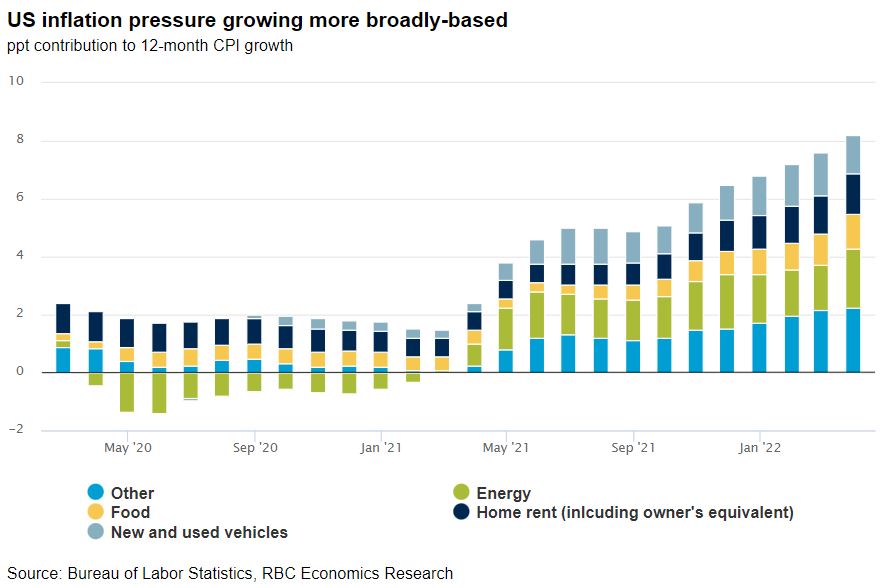
Torrid growth in the U.S. inflation rate likely slowed in April. This would mark the first decline in almost a year and come on the heels of price growth that soared to 8.5% year-over-year in March. Oil prices in April reversed part of that March surge, which was driven by Russia’s invasion of Ukraine. But prices at the pump were still much higher compared to the beginning of the year. The price for regular grade gas was $4.1 per gallon in April compared to $3.3 per gallon in January. Growth in food prices is also expected to have remained strong, as producers continue to pass on rising input, labour and transport costs to consumers. These challenges are not limited to food producers and distributors. Labour shortages (and wage pressures) in particular are widespread and expected to persist given exceptionally high demand for workers and long-run demographic headwinds that will add to the crunch.
Outside food and energy products, growth in core CPI at 0.3% in March marked the smallest increase in 6 months. The measure was slowed by a 3.8% decline in used car prices during the period. Though still elevated, those prices likely fell again in April according to early reports from the Manheim used vehicle value index. The slowdown compares to an almost 10% month over month surge in April 2021. And it should leave the used car series accounting for almost all (0.4 ppts by our count) of the expected moderation in the headline year over year CPI growth rate from March.
Still, inflation pressure remains broadly based. Further risks to global supply chains from the Russian invasion and China’s lockdowns will continue to add tailwinds to global inflation pressures. With labour markets still exceptionally tight and inflation pressures exceptionally strong, the Fed is expected to continue to act quickly to move interest rates higher. We expect another 50bp hike in June to build on the 50 bps hike (and start of QT tightening) announced earlier this week.