Sample Category Title
Week Ahead – US Inflation Might Peak, Will the Dollar Follow?
The Fed signaled that it will avoid shock-and-awe rate increases, putting more emphasis on avoiding a recession rather than vanquishing inflation. Another round of US inflation data is on tap next week and the Fed might finally get some good news, as the yearly CPI rate may have peaked. Is this the beginning of the end for the dollar’s supremacy? Maybe not.
Inflation crest
The message from the Federal Reserve this week was much softer than feared. Chairman Powell shut down speculation for 75 basis point rate increases and even opened the door for a slowdown in the pace of tightening after the summer. The plan is to raise rates by a half percentage point another couple of times, and then reassess.
Money markets were priced for an even more hawkish trajectory, so this initially inflicted some damage on the mighty US dollar. However, the reserve currency quickly got back on its feet and started steamrolling the FX market again. The Fed told investors it will play it slow, as it doesn’t want to risk a recession by slamming on the brakes too hard.
Traders concluded that by not acting with sufficient force now, the Fed will need to do even more later to tame inflation. The market-implied probability for a 75 basis point rate increase in June, which Powell effectively ruled out, currently stands around 80%. Meanwhile, Treasury yields have stormed to new highs, particularly at the longer end of the curve. That’s the bond market telling the Fed that it is committing a policy error.
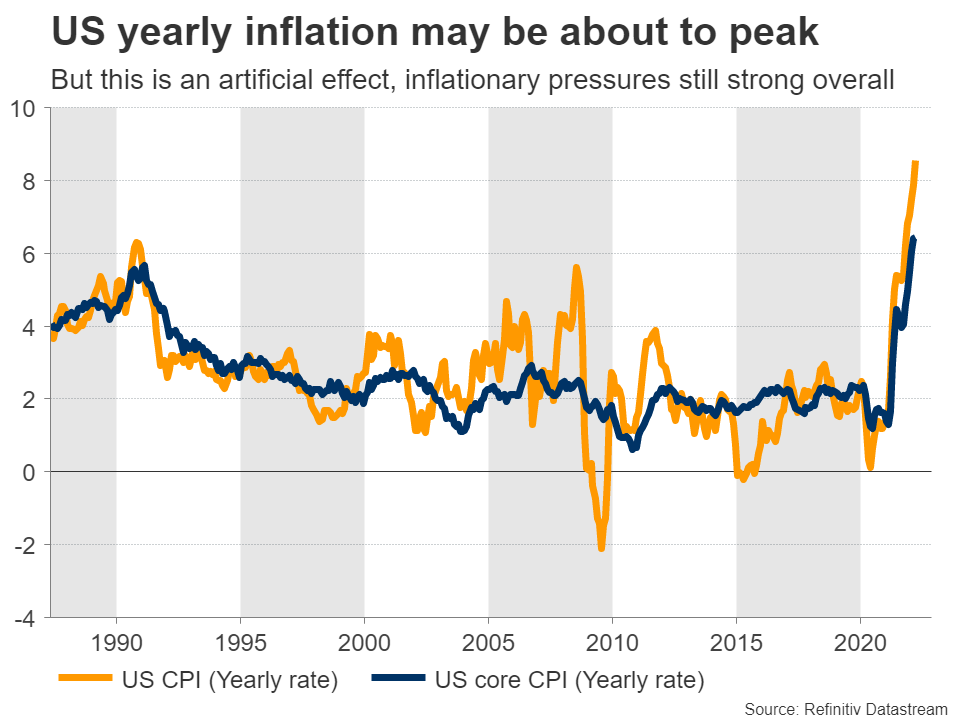
All this elevates the importance of the CPI inflation print for April, which will be released on Wednesday. Forecasts point to a monthly print of just 0.2%, which is far lower than recent months. It would be tempting therefore to believe that inflation has peaked, but this is not really the case.
Business surveys from Markit and ISM both suggest that inflationary pressures remained scorching hot in April, reaching new records in fact. Here’s the catch - this is when base effects from last year start to kick in. This period last year was when inflation really started to fire up, so as those strong monthly prints drop out of the 12-month CPI calculation, it becomes harder for the yearly rate to keep rising.
In other words, the monthly CPI forecast of just 0.2% seems like a lowball estimate from economists. However, any number below 0.9% - which is what will be dropping out of the calculation now - will still push the yearly CPI rate lower. It’s an artificial effect but it may be enough to calm some nerves around the inflation outlook.
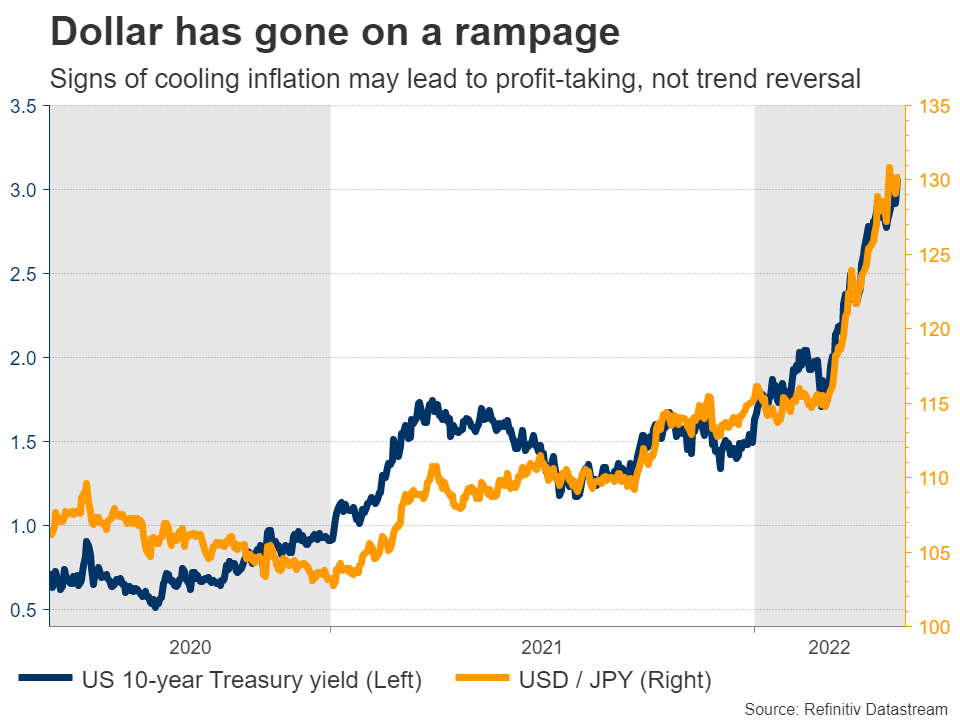
As for the dollar, it has gone on a rampage lately, demolishing everything in its path amid a perfect storm of rising US rates, risk aversion, and slowing growth in the rest of the world. If incoming data dispel some concerns about inflation and traders dial back bets for rapid-fire Fed rate increases, the dollar could take a step back, but that’s unlikely to be enough to derail the overall uptrend.
An energy crisis has brought Europe to its knees, Chinese authorities remain committed to growth-crippling lockdowns, and the Bank of Japan has sacrificed the yen by doubling down on its yield curve control strategy. Until these dynamics begin to change and growth in other regions starts to pick up, it’s difficult to envision a trend reversal in the dollar.
Sterling sinks ahead of UK GDP
In the United Kingdom, GDP stats for March and the entire first quarter are out on Thursday. The pound fell without a parachute this week after the Bank of England raised interest rates, but in a very cautious manner, opening the door for pausing the tightening cycle soon.
The overall takeaway was that downside risks around economic growth are intensifying, and the BoE is much more focused on avoiding a recession rather than fighting inflation. Markets responded by recalibrating the trajectory for UK interest rates lower, dragging Cable down to new two-years lows. The carnage in equity markets added fuel to this selloff.
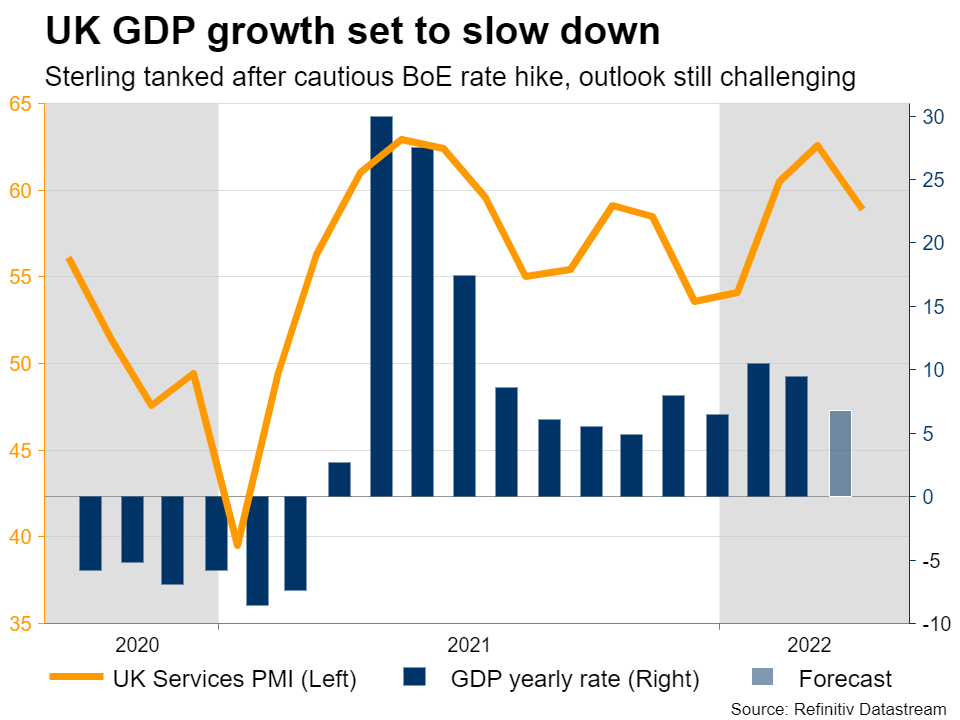
Looking ahead, money markets are still pricing in another 5 quarter-point rate increases from the BoE for this year, which may be a little too optimistic considering the growing risk of a ‘pause’. In addition, volatility in stocks tends to hurt the pound given its sensitivity to global risk appetite, so the environment ahead seems challenging.
Chinese data in focus
Crossing into China, trade data for April will hit the markets early on Monday ahead of inflation stats on Wednesday. Imports into the country imploded last month as major cities went into strict lockdowns and an even uglier print is expected this month, with imports set to fall 3% on a yearly basis.
This spells bad news for nations that rely on Chinese demand for their commodity products - most notably Australia. With the Chinese economy slowing down so dramatically, there will inevitably be some negative spillover effects on the Australian economy.
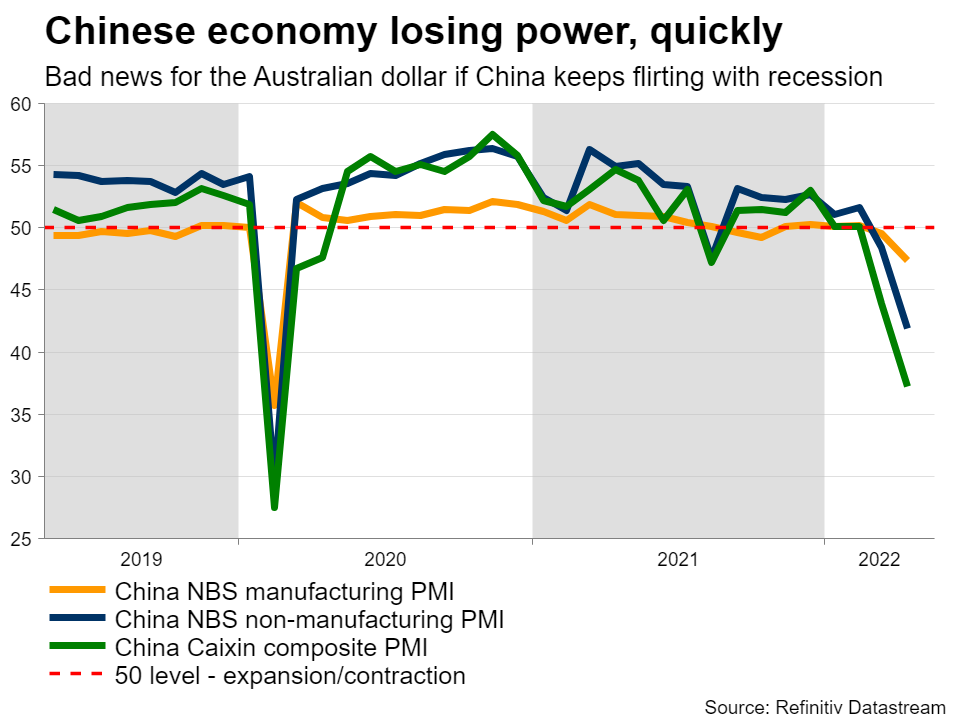
And yet, money markets are pricing in another 11 quarter-point rate hikes from the Reserve Bank of Australia this year. It would be a miracle if the RBA delivers anything close to that with China losing power, which suggests that the risks surrounding the Australian dollar remain tilted to the downside.
On a similar note, keep an eye on the Hong Kong dollar. It is currently testing the weaker band of its peg with the US dollar and local authorities will need to decide whether to defend that peg by burning through their FX reserves, or effectively abandon it. The Hong Kong economy is very weak, so following the Fed in raising interest rates is out of the question.
Weekly Focus – Hiking Season
We saw significant market jitters this week with VIX volatility starting off at a two month high. The lack of a hawkish message from the Federal Reserve (Fed) turned things around for a while only for US equities to take a big plunge on Thursday as investors largely consider Fed to be behind the curve. In London, a trading error caused a flash crash in Swedish stocks of 8% on Monday, which immediately spread to the other Nordic and European bourses. Markets quickly normalised again, though.
This was also the week where 10-year US treasuries traded through the 3%-level for the first time since 2018. Oil prices bounced to the highest level since March on the back of EU plans to phase out imports of Russian oil and US looking to start re-filling its strategic reserves. Adding further to inflation pressures, refined oil products have increased more in price than crude since the war broke out as Russia is a big exporter here.
The Fed largely did what was expected of them this week, as they hiked rates by 50bp and hinted that they will hike by 50bp again at the "next couple of meetings". Fed chair Powell communicated that the Fed is not "actively considering" a larger 75bp rate hike although he did not rule it out. We are still just at the beginning of the hiking cycle and we see risks skewed towards more aggressive tightening.
Several other central banks also hiked rates this week. Bank of England did 25bp as widely expected but removed the risk of steep rate hikes for now, as the BoE remains concerned about the growth outlook, which translated into a weaker pound. We also got hikes from the Reserve Bank of Australia and surprise 75bp hikes from both the National Bank of Poland and the Czech National Bank. The former was significantly less than priced by markets and the latter was more.
This week's economic data predominantly indicates European resilience to the war in Ukraine so far. Unemployment declined to an all-time low in March and the service sector showed a nice rebound amid reopening in April. On the other hand, the manufacturing sector is slowing down, German industrial orders and output are declining and producer price inflation increased further in March, indicating more headwinds for consumers going forward. We saw high inflation starting to take its toll on Euro area retail sales, which declined in March. Chinese PMI's plunged in April on the back of the Shanghai lockdown, a warning for the global manufacturing sector, which typically lags China by a few months. On a positive note, the outbreak seems increasingly under control.
Next week, we will look out for Russian victory day. We expect Russian president Putin will escalate his rhetoric against the West. The market reaction is uncertain and will depend on the possibility of a Russian attack on other countries. We will also follow discussions on the EU's sixth sanctions package and if agreement for a Russian oil embargo is found. In the US, April CPI data could very well mark the peak in inflation. We will focus on mom moves, though, which are still too high for the Fed to feel really comfortable.
Sunset Market Commentary
Markets
ECB’s Holzmann suggesting a June rate hike is an actual possibility during an interview yesterday evening broke the ice. The influential French ECB governor Villeroy in a speech this morning didn’t want to “preclude the next few Governing Council meetings” for a rate liftoff, implicitly leaving the option of June open. He also said that a too-weak euro would go against the inflation target. It suggests the ailing currency and its implications for inflation is getting noticed by Frankfurt. It’s time to act, sooner rather than later. Slovenian ECB governor Vasle believes so too, saying the appropriate time for a rate hike is “before the summer”. On a sidenote, ECB’s president Lagarde is due to speak in Slovenia next week. European assets in any case picked up the idea. Swap yields shot up by 9 bps. The euro rebounded from an intraday low sub 1.05 to test the 1.06 big figure. A break did not materialize though as nothing in the April US payrolls report today suggested the Fed can take it down a notch or two. It kept EUR/USD (1.058) in check via the dollar side of the equation. Sure, wages grew a less-than-expected 0.3% m/m (to be up 5.5% y/y) but it came on the back of an upward revision last month. Job creation (428k) meanwhile surpassed the bar with ease. The participation rate dropped from 62.4% to 62.2% while the unemployment rate stabilized at 3.6%. Markets expected a rise in the former and a slight decline to the 50-year (!) low by the latter. All things considered, this is still a red hot labour market begging for a cooldown. US yields quickly erased a knee-jerk move lower (on the wages data) to trade up to 5.5 bps (30y) higher, supported by real yields (+6.5 bps in the 10y). It also renewed momentum in EMU yields which were fading going in to the payrolls. Swap yields are 2.4 (2y) to 6.5 bps (10y) higher. Germany’s 10y yield extends is trip above 1% (5.2 bps). US stocks reacted negatively in futures trading to the report and open with follow-up losses of almost 2% (Nasdaq) after yesterday’s whammy. European equities slide up to 1.8% in the EuroStoxx50.
Sterling remained under pressure in the wake of the Bank of England’s messy message of tightening vs souring growth expectations. Chief economist Pill struck a hawkish note, mainly touching on upside inflation risks but it was in vain. Sterling bears eat bulls alive. EUR/GBP rises further north to 0.858 – the highest level since December ’21. Cable (GBP/USD) lost important support at 1.2495/25 yesterday and declines further to 1.233 today. Next week UK GDP Q1 numbers are due. It may well be the last decent reading for quite some time.News Headlines
Canada published its April labour market statistics. Momentum in the Canadian labour market eased after impressive job growth in March and February. Net employment rose 15.3k vs 40k expected. The unemployment rate declined from 5.3% to 5.2%, the lowest since 1976. However, the participation rate declined slightly to 64.3%. A lack of available employees might have been in play. The average hourly wage rate also disappointed at 3.4% from 3.7%. Last month the Bank of Canada raised its policy rate by 50 bps to 1.0% and started reducing its balance sheet to arrest inflation that moved well above the 2.0% target (6.7%). Aside from external factors, the BoC said the domestic economy is moving into excess demand, with the tight labour market causing further wage increases. Today’s data probably won’t change the BoC’s assessment, allowing it to continue with hikes of 50 bps (or more) at the next policy meeting on June 1. The Canadian dollar recently suffered from the risk-off and a stabilization in some commodity prices and lost further ground after the release. USD/CAD trades near 1.287.
According to a Czech news website, Czech central bank board member Ales Michl is likely to be appointed as the new CNB governor to replace Jiri Rusnok. His term will end on June 30. The CNB governor has to be appointed by the Czech president, Zeman. For now there is no official confirmation. Michl is an ultra-dove within the Czech MPC and was opposed the aggressive hiking campaign as he considers most of the inflation as external in nature. The koruna declined after the headlines appeared. EUR/CZK rose from 24.55 around noon to currently trade near 24.8.
GBPAUD’s Bounce Near 4¼-Year Low Level Struggles
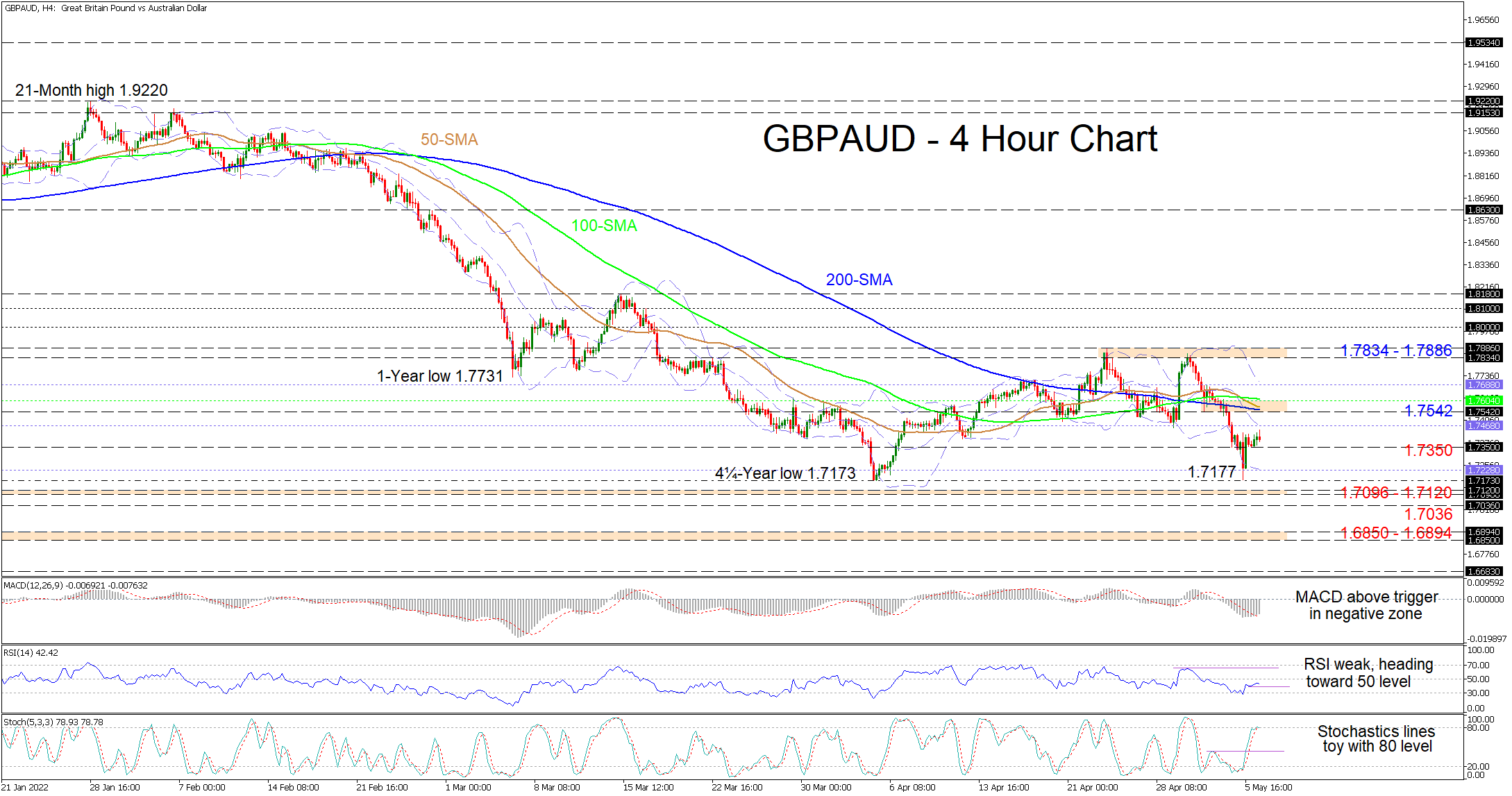
GBPAUD’s recent bullish impetus from the early April 4¼-year low region has run out of steam just beneath the mid-Bollinger band at 1.7468. The longer-term 100- and 200-period simple moving averages (SMAs) are suggesting that the negative bearing has softened, while the downward pointing 50-period SMA is reflecting that buyers have yet to gain the upper hand.
The short-term oscillators are implying that negative momentum has weakened to a degree, but it is difficult for positive sentiment to take hold when the directional picture is tilting to the downside. Currently, the MACD is improving in the negative region over its red trigger line, while the RSI is finding difficulty to reach the 50 threshold. Moreover, the stochastic %K and %D lines are flirting with the 80 level, failing to definitively pilot into overbought territory.
In the negative scenario, a dip back beneath the immediate 1.7350 obstacle could cheer sellers to eye the lower Bollinger band at 1.7228 and the sturdy multi-year bottom of 1.7173. From here, if profound selling interest unfolds, overwhelming the more than four-year trough and the 1.7096-1.7120 support band - moulded by the lows of January 2018 and November 2017 - the bears may snag around the 1.7036 barrier. However, if downside pressures remain heavy, the price could then target the 1.6850-1.6894 key support boundary, which began to take shape back in the last months of 2017.
Otherwise, if the price pushes off the 1.7350 support, resistance could commence from the mid-Bollinger band at 1.7468 before buyers challenge the tough resistance section between the 1.7542 obstacle and the 100-period SMA at 1.7604. Conquering this hurdle, the bulls may then aim for the falling upper Bollinger band at 1.7688 prior to shifting their focus toward the 1.7834-1.7886 resistance ceiling, involving the now highs of April and May.
Summarizing, GBPAUD is sustaining a neutral-to-bearish bias beneath the 1.7834-1.7886 boundary. A dive in the pair below 1.7173, which extends past the 1.7096-1.7120 obstacle, could upgrade negative momentum. Yet, for a positive vibe to begin to return, the price would need to initially climb above the converged SMAs.
US Employment Growth Remains Strong in April
The U.S. economy added 428k jobs in April, coming in well above the consensus forecast of 380k. As of April, total payroll employment remains 0.8% below February 2020 levels. Downward revisions subtracted 39k jobs from the two prior months.
Employment gains were widespread, with leisure and hospitality (78k) seeing the biggest gains on the month – though employment in this sector still remains 8.5% below pre-pandemic levels. Education & health care (59k), transportation & warehousing (52k), retail & wholesale trade (51k), professional & business services (41k), and financial activities (35k) all had strong gains on the month. Hiring in goods producing (66k) industries was largely concentrated in manufacturing (55k). Government (22k) hiring was also strong in April.
The unemployment rate held steady at 3.6%, as both the labor force (-363k) and number of people employed (-353k) fell by roughly the same amount. As a result, the participation rate declined by 0.2 percentage points to 62.2%.
Average hourly earnings rose 0.3% month-on-month (m/m), which was up 5.5% on a year-on-year – though it slowed slightly from the 5.6% y/y recorded in March.
Key Implications
The pace of hiring remained robust in April, exactly matching March's strong tally. At this point, the biggest factor preventing an even stronger pace of hiring stems from the lack of labor supply. This was perhaps the most disappointing element of April's employment report, as the pool of available workers unexpectedly declined.
Cutting the labor force data by age offers some insight into the labor supply issues. To date, the 25-34 age cohort has been one of the slowest to recover and still remains 1.8% (560k) below pre-pandemic levels, with losses equally split between males and females. This is likely due to the fact that this age group would include many young parents who are still struggling to find childcare. The other cohort to have lagged considerably is the 55+, as the pandemic has likely knocked many of these workers into an early retirement. Lingering health and safety concerns may also be playing some role in why this cohort has been slower to recover.
While growth in hourly earnings remains strong, the average American is still struggling to see their wage keep pace with inflation. This has led many to seek full-time employment – resulting in the number of those that are part-time for economic reasons to have recently fallen to levels not seen since the early-2000s.
This morning's report should help assuage some of the recent fears that the economy is slowing. With the labor market still running hot and inflation at multi-decade highs, we expect the Fed to continue to move aggressively on raising rates over the coming months.
Canada’s Labour Market Takes a Breather in April
The Canadian labour market gained 15k positions in April, with full-time employment down -31k and part-time employment up 47k.
The unemployment rate dropped by 0.1 percentage points, to 5.2%. The participation rate was little changed at 65.3%.
By industry, Statistics Canada noted that "employment was virtually unchanged in both the goods-producing and services-producing sectors in April," but highlighted gains in professional, scientific and technical services, as well as public administration. On the negative side, losses were noted in retail trade and construction.
On a geographic basis, the report noted employment gains in New Brunswick (+6.7k), Nova Scotia (+5.9k), Newfoundland and Labrador (+2.5k), and Alberta (+16k). Conversely, there was a decline in employment in Quebec (-27k) and effectively flat employment in Ontario.
Lastly, total hours worked declined 1.9% month-on-month and wages were up 3.3% year-on-year.
Key Implications
Given that more than 400 thousand jobs were gained over the previous two months, labour market momentum was poised to slow. This should be expected. With the unemployment rate at 5.2%, the economy is at full employment. This means it will be harder and harder to produce the kind of outsized job gains witnessed in recent months.
Going forward, we are looking for more modest job gains, which should keep the unemployment rate in the low 5% range. The drop in hours worked should bounce back, given that about 9% of workers were absent due to illness (the impact of the sixth covid wave). With the job market remaining very tight, wages should also accelerate. Overall, the key for the economy is to hold on to the job gains achieved so far. More modest employment reports are a tribute to the Canadian economy's recent success.
USD/JPY: Firm Break of 130 Zone to Add to Bullish Outlook for Retest of 20-Year High
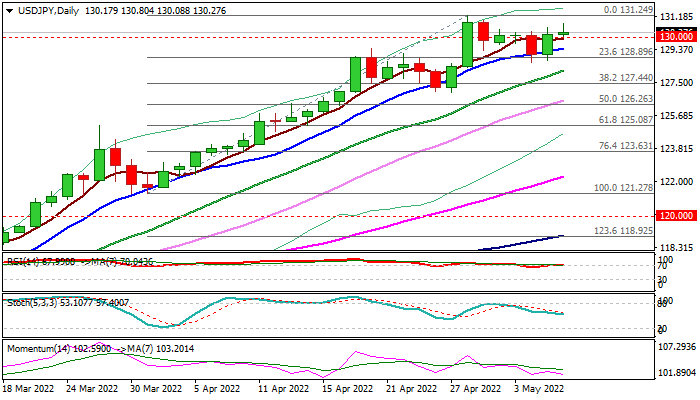
The USDJPY returned to bullish mode, after shallow pullback from new 20-year high found firm ground at 129 zone, contained by rising 10DMA and Fibo 23.6% of 121.27/131.24 upleg.
Bulls are establishing above 130 level, but need weekly close above here to confirm bullish signal, after last week’s spike to 131.24 was short-lived and failed to register close above 130.
Thursday’s rebound left a double-bottom and formed bullish engulfing pattern that underpins near-term action and adds to positive signals.
However, traders remain cautious despite the dollar regained traction, awaiting fresh signals from the US labor report, while daily studies show weakening bullish momentum, which warns bulls may lose steam on renewed probe through 120 pivot.
Near-term action is expected to keep bullish bias above rising 10DMA (129.42) with sustained break above 130.00 and 130.65 (Fibo 76.4% of 147.68/75.55) to open way for retest of new peak at 131.24 and unmask 2002 peak at 135.16.
Res: 130.47; 130.65; 130.80; 131.24
Sup: 130.00; 129.42; 128.89; 128.62
USD/JPY Mid-Day Outlook
Daily Pivots: (S1) 129.79; (P) 130.04; (R1) 130.38; More...
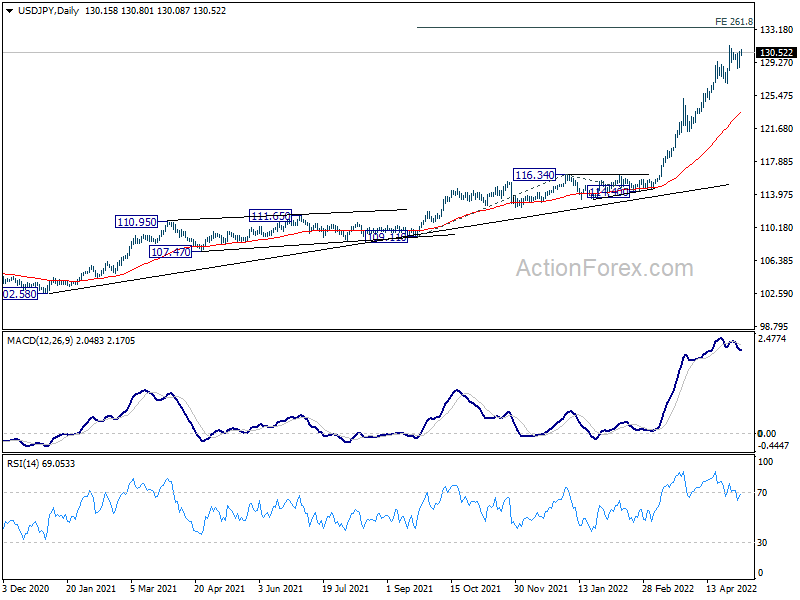
Intraday bias in USD/JPY remains neutral at this point. Also, near term outlook stays bullish with 126.91 support intact and further rally is expected. On the upside, break of 131.24 will resume recent up trend to 261.8% projection of 109.11 to 116.34 from 114.40 at 133.26. However, considering bearish divergence condition in 4 hour MACD, break of 126.91 will confirm short term topping and turn bias back to the downside for 121.27/125.09 support zone.
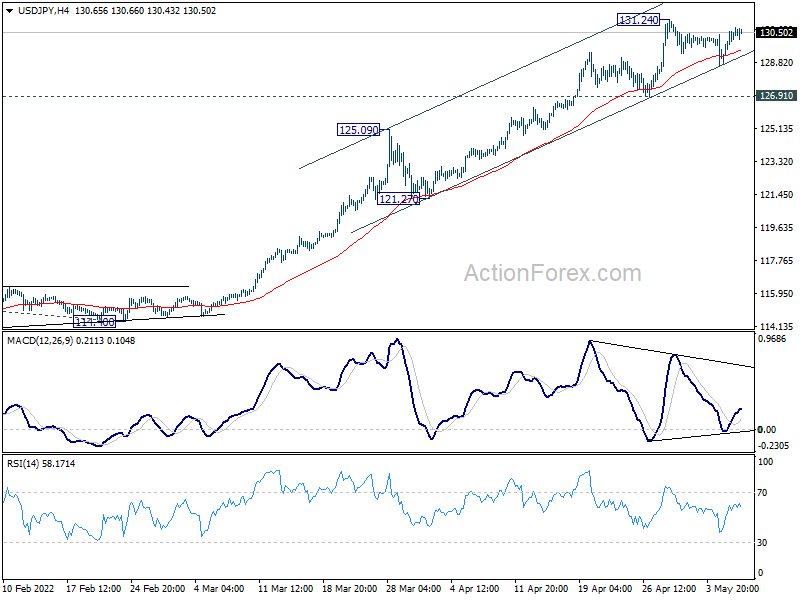
In the bigger picture, current rally is seen as part of the long term up trend form 75.56 (2011 low). Sustained trading above 61.8% projection of 75.56 (2011 low) to 125.85 (2015 high) from 98.97 at 130.04 will pave the way to 100% projection at 149.26, which is close to 147.68 (1998 high). For now, this will remain the favored case as long as 121.27 support holds.
USD/CHF Mid-Day Outlook
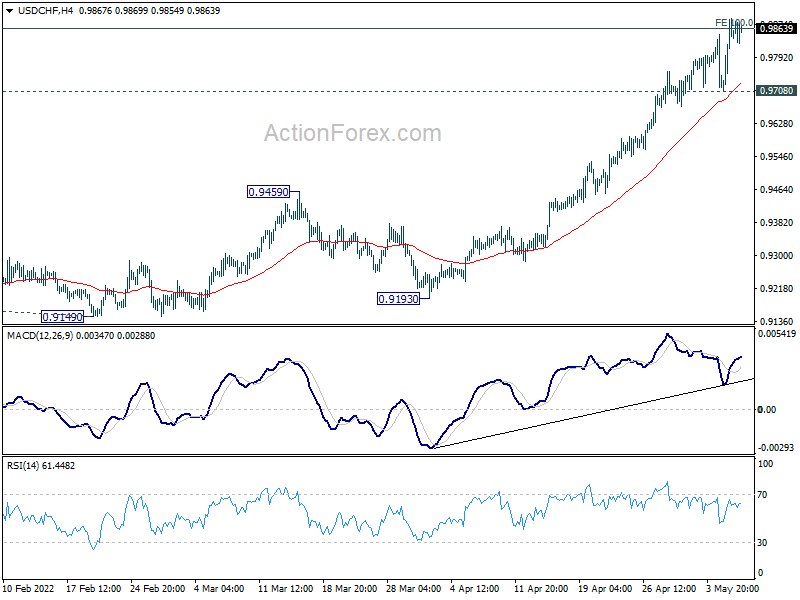
Daily Pivots: (S1) 0.9743; (P) 0.9817; (R1) 0.9923; More....
Intraday bias in USD/CHF remains on the upside at this point. Sustained trading above 0.9864 will pave the way to next target at 1.0342 high. For now, outlook will remain bullish as long as 0.9708 support holds, in case of retreat.
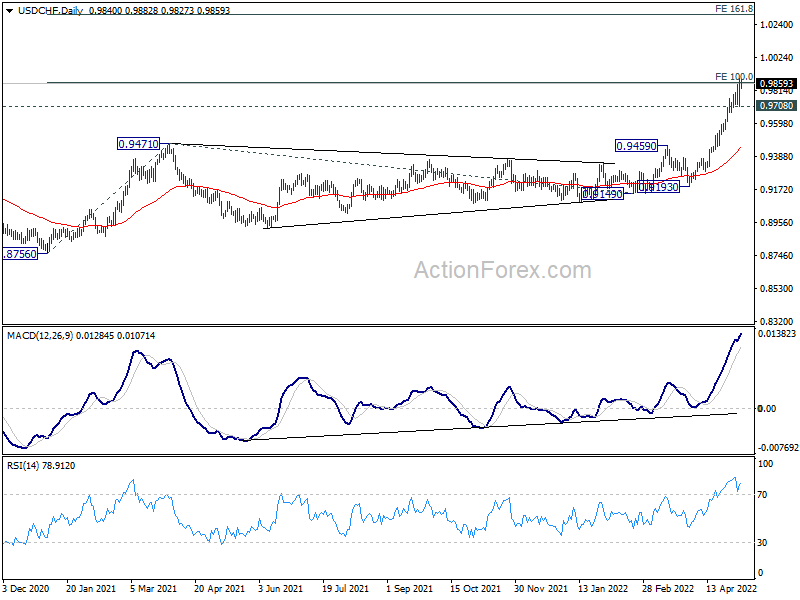
In the bigger picture, down trend from 1.0342 (2016 high) should have completed with three waves down to 0.8756 (2021 low) already. Rise from 0.8756 is likely a medium term up trend of its own. Next target is 100% projection of 0.8756 to 0.9471 from 0.9149 at 0.9864. Sustained break there will pave the way back to 1.0342 high. This will now remain the favored case as long as 0.9459 resistance turned support holds.
GBP/USD Mid-Day Outlook
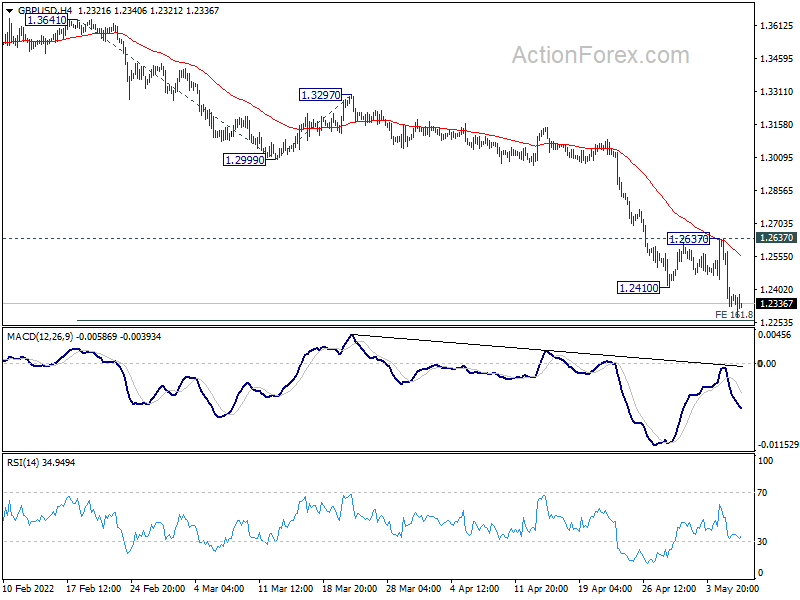
Daily Pivots: (S1) 1.2242; (P) 1.2439; (R1) 1.2552; More...
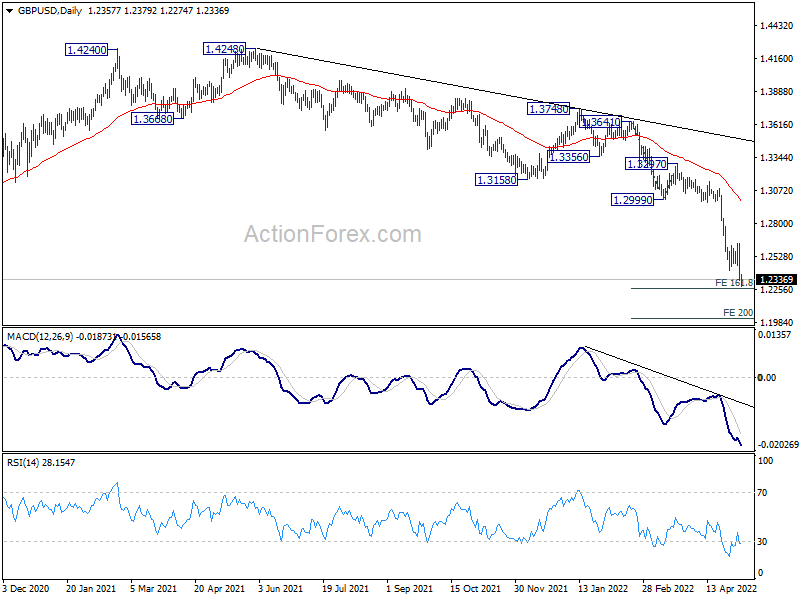
Intraday bias in GBP/USD stays on the downside at this point. Firm break of 161.8% projection of 1.3641 to 1.2999 from 1.3297 at 1.2258 will target 200% projection at 1.2013 next. On the upside, break of 1.2637 resistance is needed to indicate short term bottoming. Otherwise, outlook will remain bearish in case of recovery.
In the bigger picture, rise from 1.1409 (2020 low) has completed at 1.4248, ahead of 1.4376 long term resistance (2018 high). Based on current momentum, fall from 1.4248 is probably the start of a long term down trend. The break of 61.8% retracement of 2.1161 to 1.1409 at 1.2493 is affirming this bearish case too. For now, deeper decline would be seen as long as 1.3158 support turned resistance holds. Next target is 1.1409 low.