Sample Category Title
USD/JPY Mid-Day Outlook
Daily Pivots: (S1) 114.89; (P) 115.13; (R1) 115.35; More...
Intraday bias in USD/JPY remains neutral for the moment as range trading continues. Overall, consolidation pattern from 116.34 is still extending. On the upside, break of 115.68 will resume the rebound from 113.46 to retest 116.34 high first. On the downside, break of 114.14 should extend the consolidation with another falling leg through 113.46 support.

In the bigger picture, no change in the view that rise from 102.58 is the third leg of the up trend from 101.18 (2020 low). Such rally should target a test on 118.65 (2016 high). Sustained break there will pave the way to 120.85 (2015 high) and raise the chance of long term up trend resumption. This will remain the favored case as long as 55 week EMA (now at 111.21) holds.

USD/CAD Mid-Day Outlook
Daily Pivots: (S1) 1.2633; (P) 1.2694; (R1) 1.2731; More...
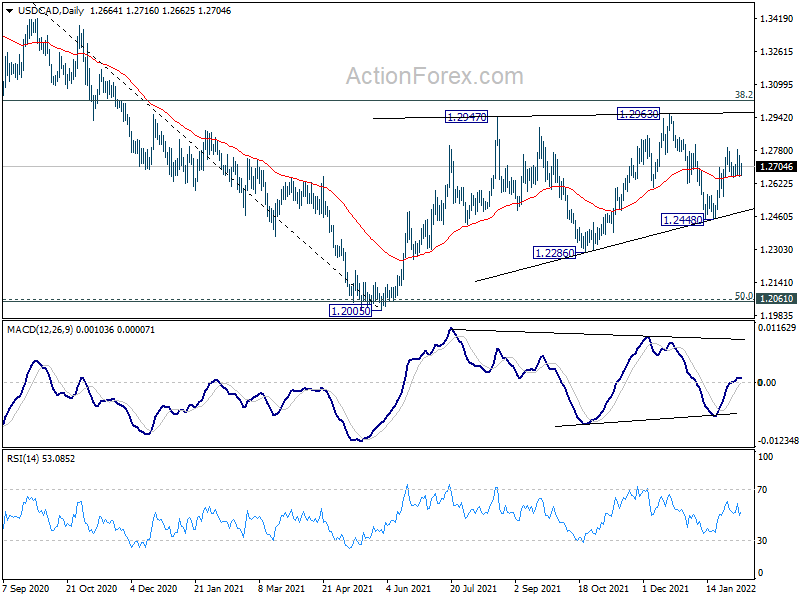
USD/CAD recovers mildly but stays in range of 1.2648/2795. Intraday bias remains neutral for the moment. With 1.2648 minor support intact, further rise is mildly in favor. On the upside, break of 1.2795 will resume the rally from 1.2448 to 1.2963 resistance next. However, break of 1.2648 will turn bias back to the downside for 1.2448 support instead.
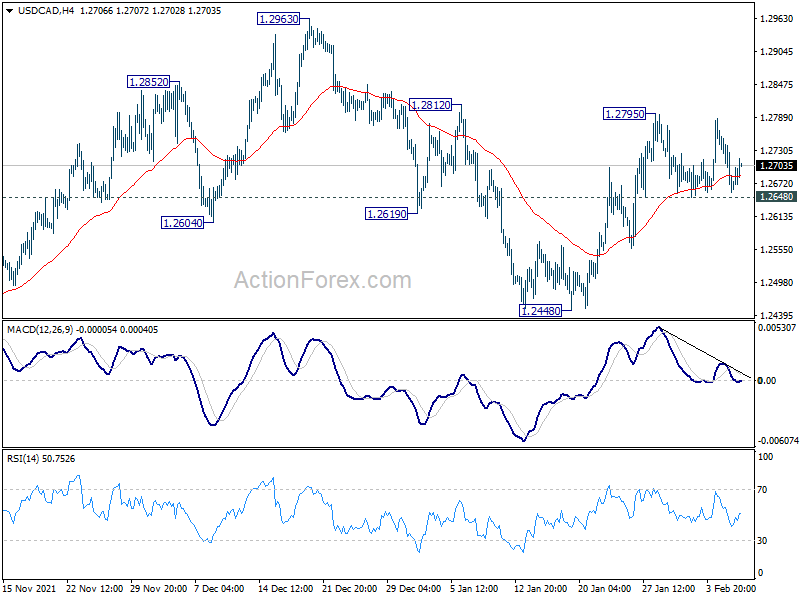
In the bigger picture, focus stays on 38.2% retracement of 1.4667 (2020 high) to 1.2005 (2021 low) at 1.3022. Sustained break there should confirm that the down trend from 1.4667 has completed after defending 1.2061 long term cluster support. Further rise would then be seen towards 61.8% retracement at 1.3650. However, rejection by 1.3022 will maintain medium term bearishness. Break of 1.2005 will resume the down trend from 1.4667 and that carries larger bearish implications too.
Canadian Dollar Dips With Oil Prices, Dollar Mildly Firmer
Canadian Dollar is currently the weakest one for today, following the pull back in oil prices. Japanese Yen is following as European and US yields are apparently trying to outpace benchmark JGB yield again. On the other hand, Aussie is trading slightly firmer, together with Kiwi and Dollar. Euro is paring some of the post-ECB gains, but the retreats are relatively shallow so far.
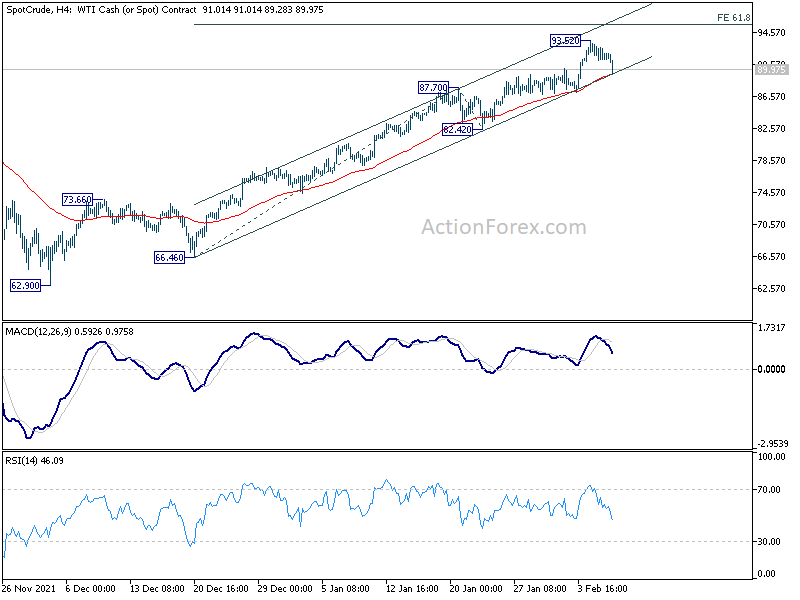
Technically, WTI crude oil is now pressing 4 hour 55 EMA (now at 89.20), which is close to the short term channel support. Sustained break there will argue that it's already in correction to rise from 66.46 or even that from 62.90. In such case, deeper pull back would be seen back to 82.42/87.70 to set up the base for rebound. If happens, Canadian Dollar could be dragged further down.
In Europe, at the time of writing, FTSE is up 0.10%. DAX is down -0.03%. CAC is up 0.23%. Germany 10-year yield is up 0.022 at 0.249. Earlier in Asia, Nikkei rose 0.13%. Hong Kong HSI dropped -1.02%. China Shanghai SSE rose 0.67%. Singapore Strait Times rose 1.05%. Japan 10-year JGB yield rose 0.0079 to 0.208.
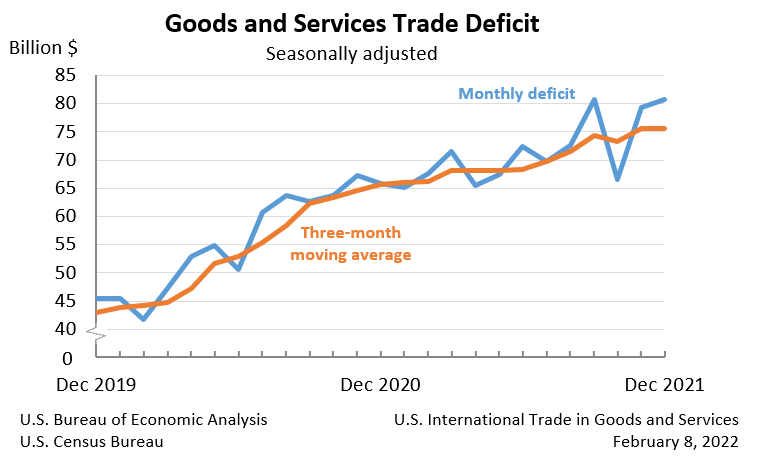
US trade deficit up slightly to USD 80.7B, deficit with China widened
US exports of goods and services rose 1.5% to USD 228.1B in December. Imports rose 1.6% mom to USD 308.9B. Trade deficit came in at USD 80.7B, smaller than expectation of USD 83.0B.
The deficit with China increased USD 6.0B to USD 34.1B. Exports decreased USD 2.2B to USD 11.8B and imports increased USD 3.8B to USD 45.9B.
The deficit with the European Union decreased USD 3.0B to USD 16.3 B in December. Exports increased USD 0.7B to USD 25.1B and imports decreased USD 2.4B to USD 41.4B.
Canada imports rose 3.7% in December while exports dropped -0.9%. Merchandise trade balance returned to a deficit position of CAD 137m.
ECB de Cos: Uncertainty around inflation very high due to geopolitical risks
ECB Governing Council member Pablo Hernandez de Cos said "risks to inflation are tilted to the upside in the short term." Recent data on Recent data on inflation has shown surprising upwards trends both in headline inflation and core inflation. He added, that the level of uncertainty around inflation is very high also due to geopolitical risks.
De Cos emphasized that more than ever it is necessary to keep all options open on monetary policy. But for now, ECB policymakers are sticking to the sequencing, starting first with tapering, before raising interest rate.
He added, that the next move on monetary policy is clear but will be gradual and depend on data.
Australia NAB business confidence rose to 3 in Jan, strong recovery expected
Australia NAB business confidence rose from -12 to 3 in January, turned positive. Business conditions, however, dropped from 8 to 3. Looking at some details, trading conditions dropped from 14 to 7. Profitability conditions dropped from 10 to 2. Employment conditions dropped from 2 to -1 and turned negative.
"Overall, the January survey shows significant disruption to business activity from the spread of the Omicron variant, albeit impacts on businesses were less severe than in past outbreaks,"said NAB Group Chief Economist Alan Oster. "However, we continue to expect a strong recovery as case numbers come down."
RBNZ Orr: An innovative approach needed to support a more efficient and resilient cash system
RBNZ is currently commencing Central Bank Digital Currency (CBDC) proof-of-concept design work, which is a "multi-stage and multi-year effort". The consultation on an issues paper Future of Money – Cash System Redesign, which closes on March 7, received 190 submissions so far.
Governor Adrian Orr said in a speech, "we must decide how best to use of digital technology to modernize central bank money, while we continue to ensure cash remains an option for those who need it. An innovative approach is needed to support a more efficient and resilient cash system, and the changes required are potentially far reaching".
"The technology exists now to implement a CBDC, but it needs to be well designed. At a basic hygiene level, a CBDC must be user-friendly, resilient to cyber and other operational risks, and enable privacy. These features promote widespread trust and use."
USD/CAD Mid-Day Outlook
Daily Pivots: (S1) 1.2633; (P) 1.2694; (R1) 1.2731; More...
USD/CAD recovers mildly but stays in range of 1.2648/2795. Intraday bias remains neutral for the moment. With 1.2648 minor support intact, further rise is mildly in favor. On the upside, break of 1.2795 will resume the rally from 1.2448 to 1.2963 resistance next. However, break of 1.2648 will turn bias back to the downside for 1.2448 support instead.
In the bigger picture, focus stays on 38.2% retracement of 1.4667 (2020 high) to 1.2005 (2021 low) at 1.3022. Sustained break there should confirm that the down trend from 1.4667 has completed after defending 1.2061 long term cluster support. Further rise would then be seen towards 61.8% retracement at 1.3650. However, rejection by 1.3022 will maintain medium term bearishness. Break of 1.2005 will resume the down trend from 1.4667 and that carries larger bearish implications too.
Economic Indicators Update
| GMT | Ccy | Events | Actual | Forecast | Previous | Revised |
|---|---|---|---|---|---|---|
| 23:30 | JPY | Labor Cash Earnings Y/Y Dec | -0.20% | 0.90% | 0.80% | |
| 23:30 | JPY | Household Spending Y/Y Dec | -0.20% | 0.30% | -1.30% | |
| 23:50 | JPY | Bank Lending Y/Y Jan | 0.60% | 0.80% | 0.60% | |
| 23:50 | JPY | Current Account (JPY) Dec | 0.79T | 1.16T | 1.37T | |
| 00:30 | AUD | NAB Business Confidence Jan | 3 | -12 | ||
| 00:30 | AUD | NAB Business Conditions Jan | 3 | 8 | ||
| 05:00 | JPY | Eco Watchers Survey: Current Jan | 37.9 | 49.3 | 56.4 | |
| 07:45 | EUR | France Trade Balance (EUR) Dec | -11.3B | -9.1B | -9.7B | -9.8B |
| 09:00 | EUR | Italy Retail Sales M/M Dec | 0.90% | 0.30% | -0.40% | |
| 11:00 | USD | NFIB Business Optimism Index Jan | 97.1 | 97.7 | 98.9 | |
| 13:30 | USD | Trade Balance (USD) Dec | -80.7B | -83.0B | -80.2B | -79.3B |
| 13:30 | CAD | Trade Balance (CAD) Dec | -0.1B | 3.6B | 3.1B |
US trade deficit up slightly to USD 80.7B, deficit with China widened
US exports of goods and services rose 1.5% to USD 228.1B in December. Imports rose 1.6% mom to USD 308.9B. Trade deficit came in at USD 80.7B, smaller than expectation of USD 83.0B.
The deficit with China increased USD 6.0B to USD 34.1B. Exports decreased USD 2.2B to USD 11.8B and imports increased USD 3.8B to USD 45.9B.
The deficit with the European Union decreased USD 3.0B to USD 16.3 B in December. Exports increased USD 0.7B to USD 25.1B and imports decreased USD 2.4B to USD 41.4B.
Yields Elevated But Dollar Struggles to Hold on to Minor Gains
US stock futures shaky and hawkish ECB’s Lagarde backtracks
Market nerves are lingering at the start of this week as long echoed components like supply disruptions, inevitable hot employment and wage growth, are clearly revealing strong developments in price pressures, which has had global central bank action shift up a gear in one way or another.
The market feeling is that central banks have been nudged on to the wagon of, be vigilant, flexible and ready to pounce on inflation if it starts to seriously run away, especially if persistent baby steps in economies continue to unfold.
Although the dollar index ticked slightly higher in the Asian session, the greenback’s dominance in the forex arena is just not there with the dollar index currently at 95.50 after struggling to hold onto earlier traction, while the US stock futures, which are dipping a tad, are suggesting sentiment remains sluggish.
The US 2-year yield is at 1.315% and the longer-term 10-year is standing at a whopping 1.93% but were unable to prod the reserve currency beyond its intraday high.
Nonetheless, in spite of expectations that the Fed will bring tighter policy against soaring inflation, market drivers remain scarce ahead of US CPI data on Thursday, where a hot inflation result is expected to fuel fresh volatility in the markets.
Across the Atlantic
ECB President Lagarde may have kept dollar gains muted after the surprise hawkish tone of comments in last week’s meeting. ECB’s Lagarde mentioned that the pace of net asset purchases will be discussed and decided in the March meeting and that the ECB will refrain from hiking until net bond purchases end.
The unexpected hawkish tone came about after the governing council reiterated concern about high inflation data, which has, to a degree fuelled tightening and elevated pricing odds of a hike in 2022, despite softening attempts from ECB’s Lagarde, throwing in the old narrative that energy costs are still part of why inflation is hot.
Yesterday, President Lagarde before the European Parliament’s Economic and Monetary Affairs Committee said inflation remains elevated, but it will not force them to act quickly. Another attempt to soften the ripples from last week failed to convince markets, which continue to price in more aggressive policy shifts that may keep the euro buoyant moving ahead. The euro is now retesting the $1.1400 handle after recouping around 70% of its intraday range. However, the euro is likely to remain supported as ECB tightening expectations remain high.
Nonetheless, the aftershocks from last week as we said may still be weighing slightly on the dollar ahead of Thursdays US inflation data. The pound is neutral at $1.3535, back to levels where its Asian session began after a minor push higher to $1.3563. Thus, the EURGBP pair bounced back to 0.8437 sterling per euro, recapturing more than 50% of previous losses from the Eastern trading start.
Oil falls below $90 while global demand remains high
WTI oil futures recent pullback from the more than 7-year high of $93.15 has tested the $89.00 per barrel mark and appears to exhibit a bearish outlook today after a calmer tone about the Ukraine tensions situation.
The Canadian dollar has weakened along with the dive in oil prices. The loonie is at C$1.2710 after bouncing from a key support at $1.2650.
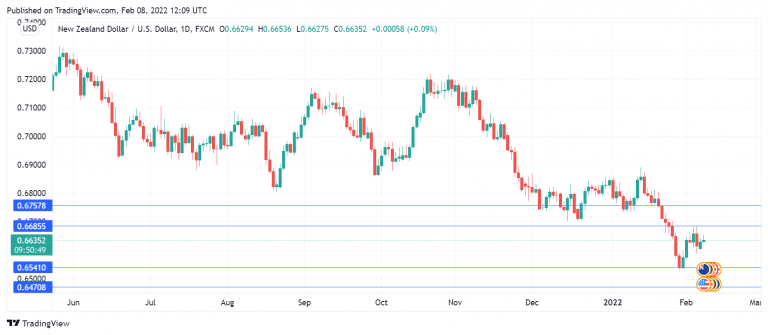
The antipodeans are bearish but are fighting back, holding near yesterday highs. The aussie is at $0.7115 and the kiwi is at $0.6629.
At 02:00 GMT New Zealand’s inflation expectations for the first quarter will be released.
Bitcoin’s Bullish Pattern
On Monday, Bitcoin rose 5.5%, ending the day around $44,100. Ethereum added 5%, and other leading altcoins from the top ten also showed growing dynamics: from 4% (Solana) to 18.5% (XRP).
The total capitalization of the crypto market increased by 5.5% over the day to $2.10 trillion. The Bitcoin dominance index has not changed, remaining at 39.2%. The Bitcoin chart continues to paint a bullish picture. With the price at $45K on Tuesday morning, BTCUSD is trading above the 50-day moving average just above the mid-January pivot area and above the down channel resistance level. At the same time, the RSI on the daily charts has not yet entered the overbought area, leaving room for further growth.
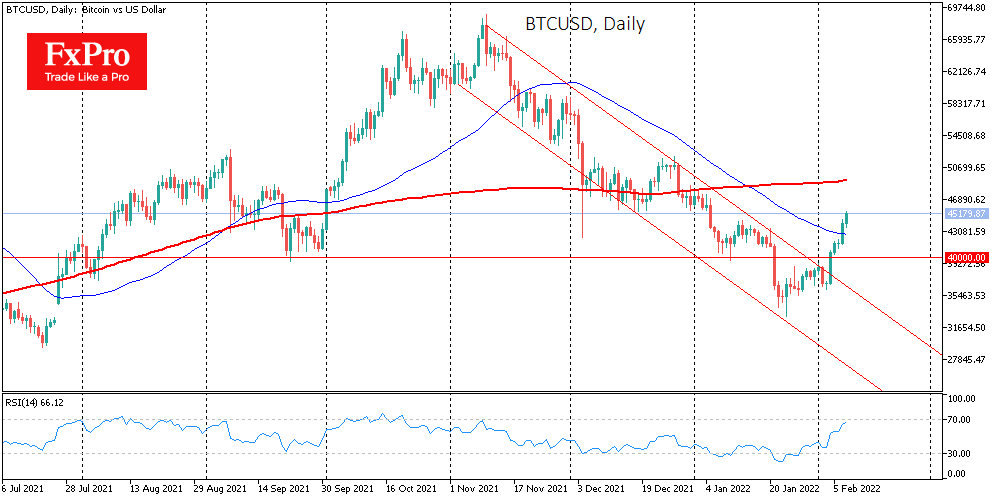
The same can be said about the entire cryptocurrency market, where the fear and greed index has reached a neutral point of 48 and is still far from the greed area. The next target for the bulls looks to be $48K, the December support area in December. Further targets are $49-50K, where the 200-day moving average and significant round level are concentrated.
The XRP token soared amid reports of a significant approach to the resolution of Ripple’s legal dispute with the US Securities and Exchange Commission (SEC).
Cryptocurrencies briefly stopped responding to movements in US stock indices, which started the week with a decline. The purchases probably included retail investors, who were driven by the desire not to miss the beginning of the market growth (FOMO). However, their buying potential is unlikely to be enough if stock indicators intensify their decline and large institutional investors come into play, wishing to resume profit-taking.
KPMG, one of the world’s largest auditors, has added Bitcoin and Ethereum to its Canadian division’s corporate reserves. This is the firm’s first direct investment in cryptocurrencies.
Meanwhile, at the end of 2021, Tesla received a loss of $ 101 million from a decrease in the cost of previously purchased bitcoins, which it spent $ 1.5 billion on. Previously, Elon Musk called the decision to acquire BTC as a reserve asset quite risky.
NZD Flat ahead of Inflation Expectations
It has been a quiet start to the week for the New Zealand dollar. This week’s economic calendar is light, with no New Zealand data on Tuesday. We could see NZD/USD show some movement on Wednesday, with the release of New Zealand Inflation Expectations on Wednesday.
New Zealand could face wage inflation spiral
New Zealand is experiencing surging inflation, which has hit 30-year highs. CPI climbed 1.4% q/q in Q4 2021, which put inflation at 5.9% y/y, its highest level since 1990. This is causing a headache for the government, and Prime Minister Ardern meekly argued that “we are not alone in experiencing high rates of inflation”.
That may be factually correct, but it won’t impress consumers who are seeing the cost of living jump. While wages have gone up, they are lagging behind the pace of inflation, which will likely lead to workers pushing for higher wages and salaries, which will set in motion a wage inflation spiral.
New Zealand Inflation Expectations has been steadily rising. The Q2 2020 release came in at 1.24%, but more than doubled in Q4 2021, to 2.96%, and likely will push above 3% for Q1 2022. The RBNZ closely monitors this event, as inflation expectations can manifest into real inflation.
High inflation remains a primary concern for the RBNZ, which will have to keep raising rates to combat high inflation. The central bank implemented back-to-back rate hikes of 0.25% over the past two meetings and is widely expected to raise by another 0.25% at the February 23rd meeting, which would raise the Cash Rate to 1.00%. The RBNZ is planning to raise rates incrementally into 2023 but will have to monitor economic data to ensure that the economy can withstand higher rates.
NZD/USD Technical
- NZD/USD has support at 0.6472 and 0.6402
- 0.6670 is a weak resistance line, followed by 0.6798
Higher Yields Start to Bite but Stocks Fight Back, Dollar Edges Up
- Bond yields climb to fresh highs as inflation and tighter policy fears grip markets
- Equities nevertheless perk up globally but Wall Street on shaky ground
- Dollar regains front foot, oil prices pressured by optimism around US-Iran talks
Sentiment improves despite surging yields
Long-term borrowing costs continued to head north on Tuesday, rising in just about every territory on growing expectations that no country will be spared from the greatest inflation shock the world has faced in decades. As central banks abandon the transitory inflation narrative one by one, markets are grappling with the prospect of an end to the era of easy money and the steepest hike in interest rates since before the financial crisis.
Although the inflation story has been running for some time now, what’s rattled the markets this time is the relentless rally in government bond yields since the start of the year. In the US, the benchmark 10-year Treasury yield briefly spiked to 1.96% earlier today and it’s only a matter of time before it hits 2.0% - a level that is seen as a key test for Wall Street bulls.
In Europe, the German 10-year bund yield has reached 0.25%, while Italian yields are flirting with the danger zone as their spread with German bunds is widening again. Australian and New Zealand yields just shot up to around two-year highs and Japan’s 10-year yield is approaching the Bank of Japan’s upper 0.25% threshold of its yield curve target.
Nevertheless, although there’s plenty of jitters to go around, there’s no big panic just yet among investors. With consumption holding up for now, wages on the rise, corporate earnings still healthy and economically punitive Covid restrictions being lifted in most places, it might be too soon for the doom and gloom to set in as the major central banks start raising interest rates.
Equities stay upbeat for now
Stocks in Europe got off to a solid start on Tuesday, extending their gains into a second day, led by London’s FTSE 100, which hit its highest since January 2020. Strong earnings and higher commodity prices are lifting stocks in Europe and Asia.
Even China’s CSI 300 managed to sharply pare its losses, having earlier dipped on news that Washington has added 33 new Chinese entities to its “unverified” list that require tighter export controls for US firms wishing to trade with those companies.
However, the mood on Wall Street remained muted and tech stocks came under pressure again. The latest jump in yields has really started to cap gains while exacerbating any selloff, particularly in the tech sector. But there were a few bright spots on Monday such as airlines and financials, and the Dow Jones bucked the negative trend of the S&P 500 and Nasdaq to finish the session flat.
US futures were higher today but lacked clear direction, something which is likely to only come from Thursday’s latest consumer price index.
Dollar recovers some positive traction, euro slips
Meanwhile, the US dollar was advancing on Tuesday, helped by higher Treasury yields and a pullback in the euro and yen. The dollar index was last up about 0.25%.
Having only just reclaimed the $1.14 handle, the euro is struggling to hold on to it as ECB President Christine Lagarde tried to play down the prospect of aggressive monetary tightening. Speaking in the European Parliament on Monday, Lagarde said it’s likely “current price pressures will subside before becoming entrenched".
Oil takes a hit from progress in Iran nuclear talks
In commodities, oil prices slid for a second day, with WTI futures dropping below $90 a barrel during European trading. Brent crude was down too, plunging about 2%.
Whilst there’s no immediate danger to oil’s bullish structure, the unexpected developments in the Iran nuclear saga have taken markets a bit by surprise. The US has restored a sanctions waiver to Iran that would permit cooperation with other countries on civilian nuclear projects following indirect talks between the two sides. Direct talks will resume today, and further progress could prove to be an even more notable drag on the commodity.
Gold prices were down too, though only marginally, as the increased diplomatic effort in recent days to de-escalate tensions on the Ukrainian border has brought geopolitical risks back to the fore, making some investors nervous, boosting the yellow metal’s safe haven appeal.
Euro Dips to 1.14, Lagarde Shifts Gears
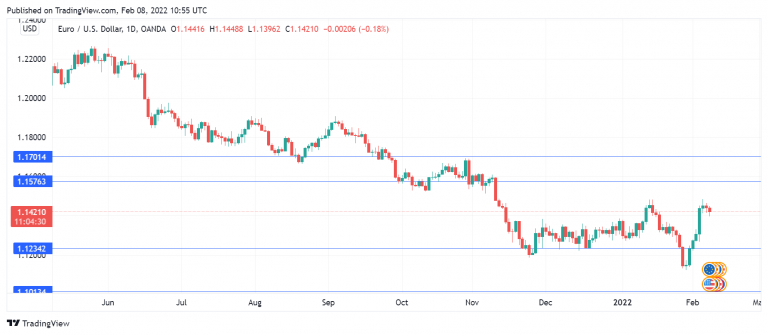
The euro is slightly lower on Tuesday, after little movement on Monday. In the European session, EUR/USD is trading at 1.1409, down 0.28% on the day. It’s a light day on the economic calendar, with no tier-1 releases out of the US or the eurozone.
ECB President Christine Lagarde sounded dovish when she testified before a EU parliamentary hearing on Monday. This was in contrast to her remarks after last week’s ECB meeting which sent the euro soaring. Was this a case of damage control, or is the dovish Lagarde back in the saddle? Lagarde told lawmakers that inflation is expected to ease lower and stabilize around 2%, which is the bank’s target. She acknowledged that inflation risks were tilted to the upside, but clearly she hasn’t abandoned the view that high inflation is transitory.
Lagarde reiterated that a rate hike would only come after QE had ended, and her message was that there is no need for any substantial tightening, since inflation will fall. The markets don’t appear to be buying it, as investors have priced in about 50 basis points of rate hikes in 2022.
Another Lagarde sceptic is Klaas Knot, governor of the Dutch central bank and member of the ECB governing council. Knot has stated publicly that inflation will hover at 4 per cent for most of this year, and has urged the ECB to quickly wrap up QE and raise rates in the fourth quarter. On Monday, the Societe Generale bank stated in a note today that it expected the ECB to wrap up QE in mid-year and projected a rate hike in the second half.
With eurozone CPI hitting 5.1% in January, Lagarde will come under increasing fire to accelerate QE if inflation does not show signs of easing in the coming months.
- 1.1437, a monthly resistance line, is under pressure. Above, there is resistance at 1.1577
- There is support at 1.1233 and 1.1014
EURGBP Bears Take the Upper Hand Again
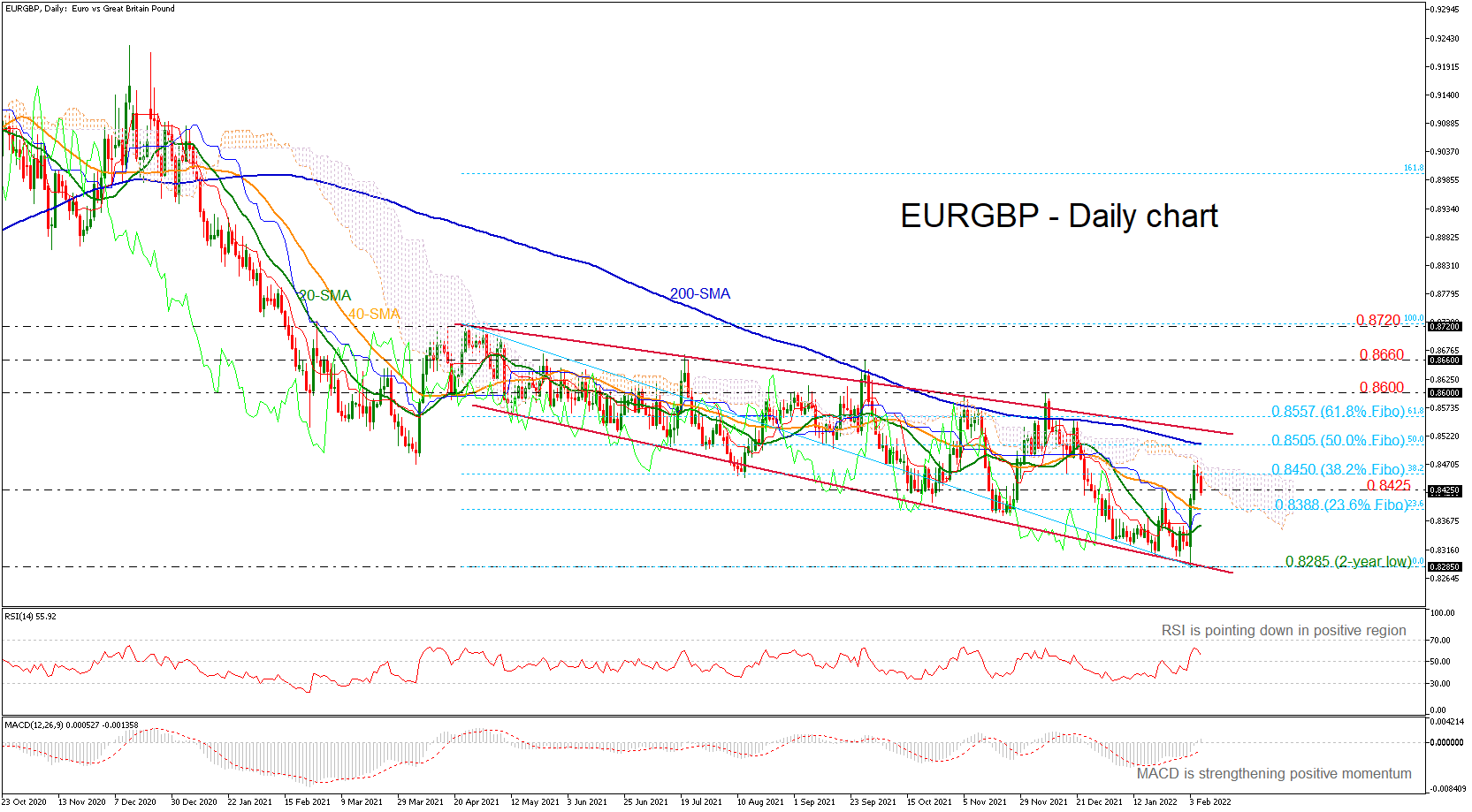
EURGBP opened the week on a negative note, keeping its footing around the Ichimoku cloud and the 0.8400 handle. Trend signals remain daunting as the price continues to trade comfortably below its 200-day simple moving average (SMA), which proved to be a tough resistance area.
As regards the market momentum, some pessimism seems to be building and a downside correction may be looming as the RSI is sloping down in the positive territory, while the MACD is moving with weak momentum around its zero area.
Should the bears dominate, driving the price below the 0.8425 level, the spotlight will shift to the crucial 23.6% Fibonacci retracement level of the down leg from 0.8720 to 0.8285 at 0.8388, where any step lower will put the pair in a bearish move in the medium-term picture. The long-term outlook will also face a deterioration if the decline extends below the 0.8285 mark.
In the event the bulls take control, the 38.2% Fibonacci of 0.8450 where the restrictive Ichimoku cloud is currently hovering, will come first into view. A violation at this point may see another challenging battle around the 200-day SMA, which coincides with the 50.0% Fibonacci of 0.8505. If buyers claim that zone this time, the descending line near 0.8530 could immediately add some downside pressure, deterring a continuation towards the 61.8% Fibonacci of 0.8557.
In brief, EURGBP continues to face negative trend signals, and only a confirmation above the downtrend line may change this view in the long- and short-term timeframes.