Sample Category Title
Sterling Rises as UK Inflation Jumps
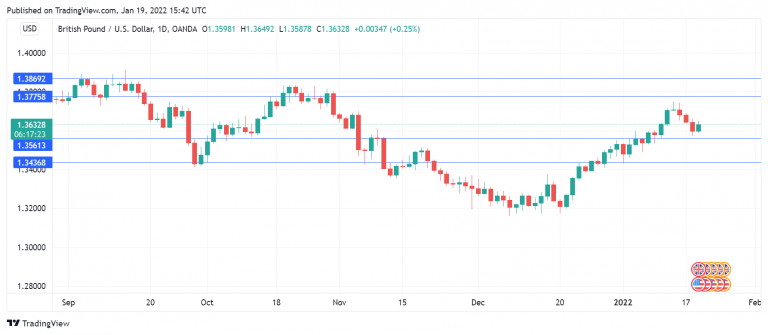
The British pound is in positive territory after falling for three straight days. GBP/USD has pushed above the 1.36 line and is trading at 1.3635 in the North American session, up 0.27% on the day.
UK inflation hits 30-year high
Anyone reading the news has seen plenty of headlines screaming “US inflation hits 30-year high!”. Well, now it’s the turn of the UK to share that unflattering stat, much to the chagrin of policymakers. December CPI rose to 5.4% y/y, up from 5.1% in the previous reading. This marked CPI’s highest level since 1992. Inflation continues to rise due to higher energy costs, strong consumer demand and supply chain disruptions.
Surging inflation forced the Fed to scramble into action and announce a tightening in policy, and the key question is whether the Bank of England respond with another interest rate increase, after a moderate hike of 15 bps to 0.25% in December. At that meeting, the BoE surprised the markets, which had expected the bank to stand pat until early in the New Year. The BoE defended the hike by saying that underlying inflationary pressures necessitated a move. Based on that logic, another hike in February would be a no-brainer, as UK inflation continues to rise. However, given that the BoE has pulled a fast one on the markets over the past two meetings, market participants would do well to display caution ahead of the BoE meeting and not assume that a rate hike is a done deal.
US Treasury rates continue to press upwards. After punching past 1.80% on Tuesday, a 2-year high, the 10-year rate has climbed to 1.90% earlier today before dipping to 1.85%. The 10-year rate hasn’t been above the symbolic 2% level since July 2019, but it looks poised to climb above that line shortly. The jump in US yields is reflective of market concerns that the Fed will accelerate its tightening. Most analysts are projecting three or four rate hikes in 2022, but Jamie Dimon, CEO of JP Morgan, made headlines last week when he projected the Fed would hike six or seven times this year.
GBP/USD Technical Analysis
- 1.3560 is under pressure in support. Below, there is support at 1.3438
- GBP/USD faces resistance at 1.3776 and 1.3870
Gold resumes rebound, targeting 1861 next
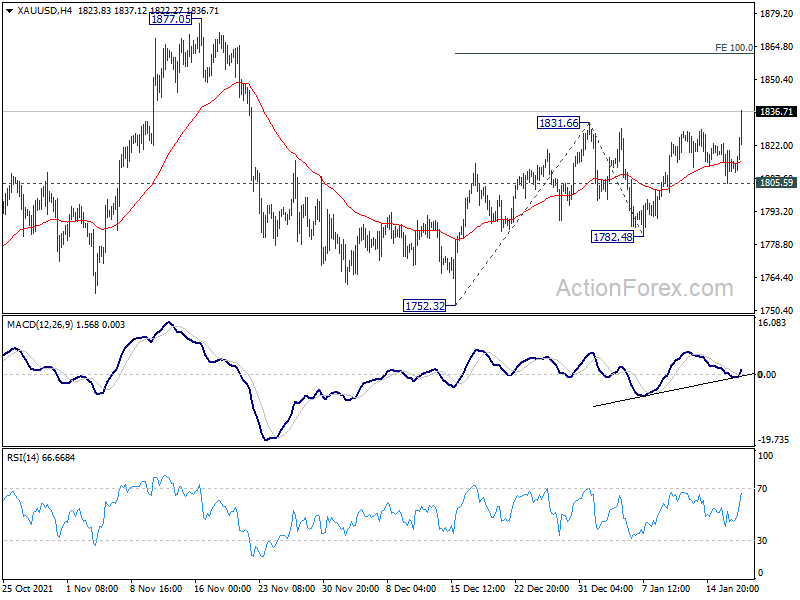
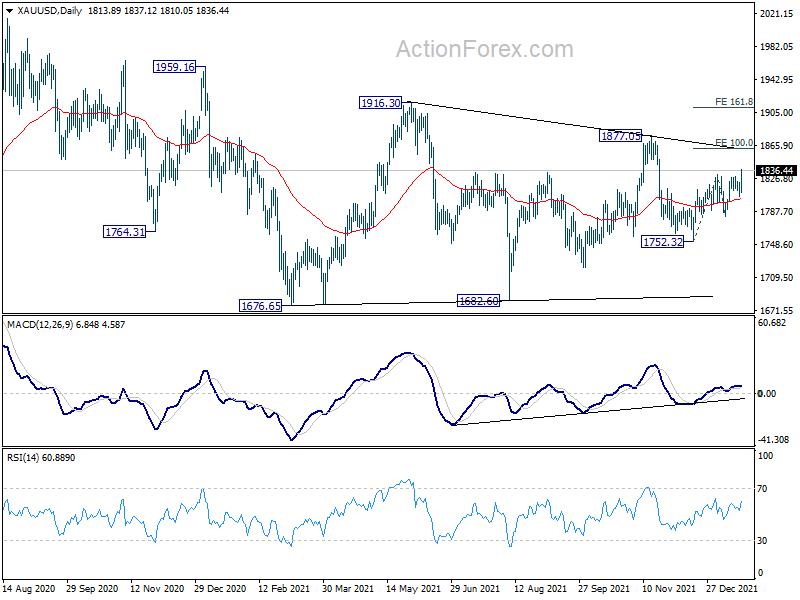
Lagging behind Silver a little bit, Gold also resumes rebound from 1752.32 by breaking through 1831.66 and hits as high as 1837.12 so far. Further rally should now be seen as long as 1805.59 support holds. Next target is 100% projection of 1752.32 to 1831.66 from 1782.48 at 1861.82.
But the main question is whether it's ready to break out from the medium term range set at 1676.65. We'll monitor the reaction to 1861.82. Sustained break there could trigger upside acceleration through 1877.05 to 161.8% projection at 1910.85, and set the stage for breakout. However, rejection by 1861.82, or failure to even hit it, will keep medium term outlook neutral for more sideway trading.
BoE Bailey: Higher inflation could restrain demand in the economy
BoE Governor Andrew Bailey told the parliament's Treasury Committee, that higher inflation could hit demand and employment, eventually bring prices down.
"This a hard thing to say ... but if you get pressure on cost of living, pressure on real earnings, that will tend to restrain demand in the economy... and that could lead to an output gap opening up, and it could eventually of course lead to higher unemployment and that would bring inflation down," he said.
"I don't want to suggest that ... were we to consider it necessary, we don't have to take any action in terms of the Bank of England's action on interest rates. We would obviously judge that ourselves. But there is another channel there which would weaken demand in the economy," he added.
It Finally Happened: German 10y Yield Turned Positive
Markets
It finally happened: the German 10y yield turned positive for the first time since April 2019. For six hours. The most important European benchmark rate gapped at the open to 0.004% in a catch-up move with a late-session US yield sprint. After hitting an intraday high of 0.02%, yield gains slowly evaporated as the European session evolved. It is currently trading at an, admittedly barely, negative 0.008%. Symbolic/technical breaks like these usually have to meet with swift follow-through price action in order to get confirmation but that’s not the case yet. Bunds nevertheless underperform USTs. The German curve bear steepens with changes ranging from +0.6 bps (2y) over +1.2 bps (10y) too +2.3 bps (30y). Peripheral spreads vs. the German 10 year widen slightly, with Greece (+2 bps) underperforming peers for a second day. US yields fall 1.4 bps (2y) to 0.8 bps (10y), bull flattening the curve after a hefty two-day selloff. With calm returning to the (US) bond market, equities caught a break as well. European stocks advance about 1%. In the US, the tech-heavy Nasdaq outperforms with gains of 0.9%. Oil prices extend gains for a fourth day. Brent ($88.04/barrel) is closing in on the $90 barrier. The International Energy Agency said the oil market looks tighter than earlier thought as omicron is having less impact on overall demand than initially feared. Adding to recent price increases, was Tuesday’s attack on oil-exporter UAE infrastructure as well as an explosion that day that temporarily knocked out an important crude pipeline running from Iraq to Turkey.
It’s relatively quiet on the major FX markets. The dollar is under marginal selling pressure, providing EUR/USD an opportunity to recover some of yesterday’s sharp losses. The pair is currently changing hands at 1.134, slightly up from 1.132. USD/JPY and the trade-weighted DXY hover near yesterday’s closing price around 114.50 and 95.62 respectively. The Norwegian krone is leading the major FX scoreboard thanks to oil. EUR/NOK eases to 9.93. Central European currencies were visibly relieved after a few tougher days on strong core bond increases and dollar strength. The forint takes the lead over regional peers, sending EUR/HUF down to 355.77. EUR/CZK declines (CZK strengthens) to 24.31, just shy of the previous 2020 lows around 24.25. The zloty is also returning to recent highs against the euro of EUR/PLN 4.52. Sterling is having a good day, not caring one single bit about UK prime minister Johnson’s uncertain political fate. Instead, inflation in December again turned out to be higher than expected and pushed money markets for the first time to fully price in a back-to-back rate hike on February 3 by the Bank of England. The headline figure rose from 5.1% y/y to 5.4%, the fastest pace since 1992. Core inflation unexpectedly quickened from 4% to a three-decade high of 4.2%. EUR/GBP is hitting a new 2-year low at 0.8318. 0.8277 serves as solid support.
News Headlines
Canadian headline expected fell by 0.1% on a monthly basis, but rose as expected from 4.7% Y/Y to 4.8% Y/Y in December, the highest reading since 1991. The Bank of Canada’s preferred core inflation gauge, the trimmed mean, unexpectedly accelerated from 3.4% Y/Y to 3.7% Y/Y. The Bank of Canada has a 2% inflation target surrounded by a 1% tolerance band. Over the past months, the BoC gradually reduced its net asset purchases to zero. Consensus expected the governor Macklem and his colleagues to start a tightening cycle in March/April, but an outside risk opened up that already conduct a first rate hike at next week’s policy meeting. Canadian money markets discount a total of 5 25 bps rate hikes this year. The loonie continues outperforming today. The oil price rally also delivered a significant push in the back of late. USD/CAD trades near the sell-off lows below 1.25. EUR/CAD set a minor new cycle low below 1.4164, the lowest level since early 2017.
Canada: Inflation Ticks Up to 4.8% in December, Led by Higher Goods Prices
Consumer price inflation ticked up to 4.8% year-on-year (y/y) in December, in line with market expectations. Energy prices slowed to 21.2% (from 26.4% in November), but excluding energy, prices picked up noticeably, to 3.8% (from 3.3 in November).
Food price growth accelerated again, hitting 5.2% y/y (from 4.4% in November). Shelter prices also eclipsed the 5% mark, hitting 5.4% (from 4.8%) as insurance costs accelerated. Clothing price inflation continued to bounce back, increasing to 1.1% (from 0.7%). Recreation, reading & education, and tobacco & alcohol saw a slower rate of price growth in December.
Seasonally adjusted, month-on-month prices were up 0.3%, in line with price growth in November. Prices gains were led by shelter (+0.5%), food (+0.4%), and household operations and furnishings (+0.2%). Clothing and footwear (-0.7%) and transportation prices (-0.3%) fell in December, while the remaining categories were flat on the month.
All three of the Bank of Canada's core inflation metrics picked up in December. CPI-trim remained rose to 3.7% (from 3.4%), CPI-median to 3.0% (from 2.8%), and CPI-common measure to 2.1% (from 2.0%).
Key Implications
As it is everywhere, inflation remains hot in Canada. Many of the sources of upward pressure on prices in Canada are global, reflecting the mismatch between strong demand for goods and the hobbled ability of the global economy to supply them.
The one exception to the global nature of the current inflationary environment, is housing inflation, which is both domestically driven and, outside of increased incidents of extreme weather driving up insurance prices, directly related to the Bank of Canada's policy stance. There are good reasons beyond its direct impact on consumer price inflation to pay attention to a frothy housing market. High household debt adds financial vulnerabilities that that may challenge the future ability of monetary policy to maintain price stability.
Given the strength in the labour market and the challenges faced by employers in filling positions, the economy is operating at or near its productive potential. As noted in the Bank of Canada's Business Outlook Survey, these are increasingly becoming imbedded in expectations. Inflation is likely to come down over the next year, but getting it there will require tighter financial conditions and rate hikes by the Bank of Canada. The process is likely to begin this year but bringing inflation back to 2% is likely to be a multiyear project.
GBP/USD Outlook: Sterling Bounces on Rising Expectations for Another Rate Hike as Inflation Hits
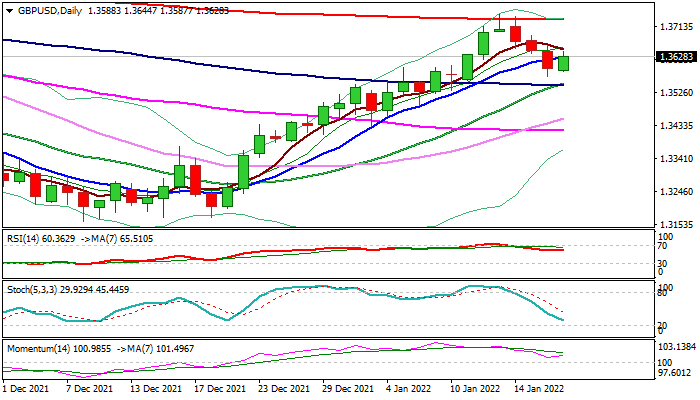
Cable regained traction and bounced on Wednesday, signaling an end of three-day pullback, sparked by a double rejection at 200DMA (1.3733) last week.
Pound was boosted by UK CPI data which showed that inflation in Britain continued to rise and hit the highest level in nearly 30 years in December, offsetting policymakers’ general view of transitory process and boosting hopes for another BoE’s rate hike on Feb 3 monetary policy meeting.
On the other side, political turmoil in Britain over a series of lockdown parties in Downing Street, which caused strong revolt by lawmakers, resulting in demands for PM Johnson’s resignation, so far did not have strong negative impact on the currency, but may undermine pound’s performance.
Daily studies remain constructive and support scenario of an end of shallow correction, as 14-day momentum remains in the positive territory and turned north, while formation of 20/100DMA bull-cross and thick daily cloud underpin the action.
Today’s close above cracked 10DMA (1.3627) would generate initial positive signal, with close above 1.3660 (Tuesday’s high / Fibo 50% of 1.3748/1.3572 pullback) to complete bullish engulfing pattern and boost positive signals.
Res: 1.3660; 1.3681; 1.3707; 1.3733.
Sup: 1.3614; 1.3572; 1.3546; 1.3498.
EUR/USD Mid-Day Outlook
Daily Pivots: (S1) 1.1288; (P) 1.1355; (R1) 1.1394; More...
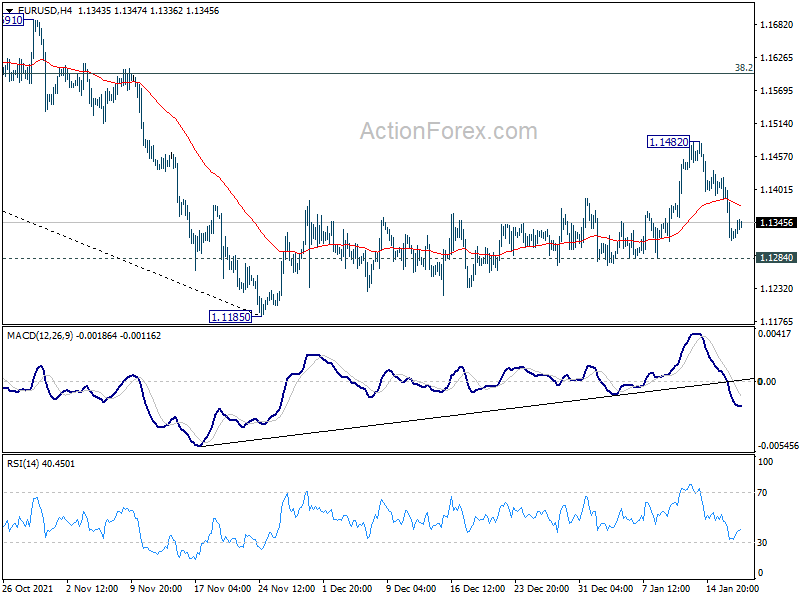
Intraday bias in EUR/USD remains neutral first. Outlook is unchanged that rebound from 1.1185 is seen as corrective move. Break of 1.1284 will argue that larger down trend from 1.2348 is ready to resume. Intraday bias will be back on the downside for retesting 1.1185 low first. Also, in case of another rise, upside should be limited by 38.2% retracement of 1.2265 to 1.1185 at 1.1598 eventually.
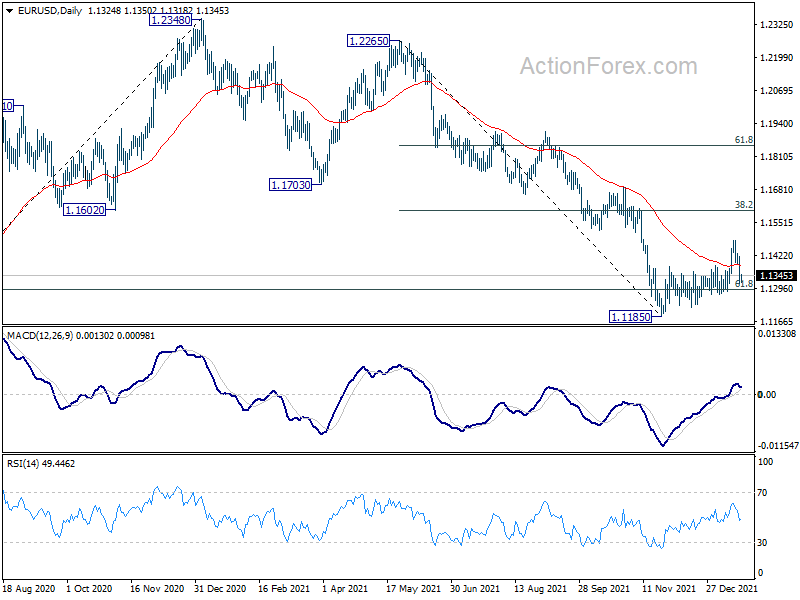
In the bigger picture, there are various ways of interpreting the fall from 1.2348 (2021 high). It could be a correction to rise from 1.0635 (2020 low), the fourth leg of a sideway pattern from 1.0339 (2017 low), or resuming long term down trend. In any case, outlook will now stay bearish as long as 1.1703 support turned resistance holds. Sustained break of 61.8% retracement of 1.0635 to 1.2348 at 1.1289 would pave the way back to 1.0635.
GBP/USD Mid-Day Outlook
Daily Pivots: (S1) 1.3561; (P) 1.3611; (R1) 1.3650; More...
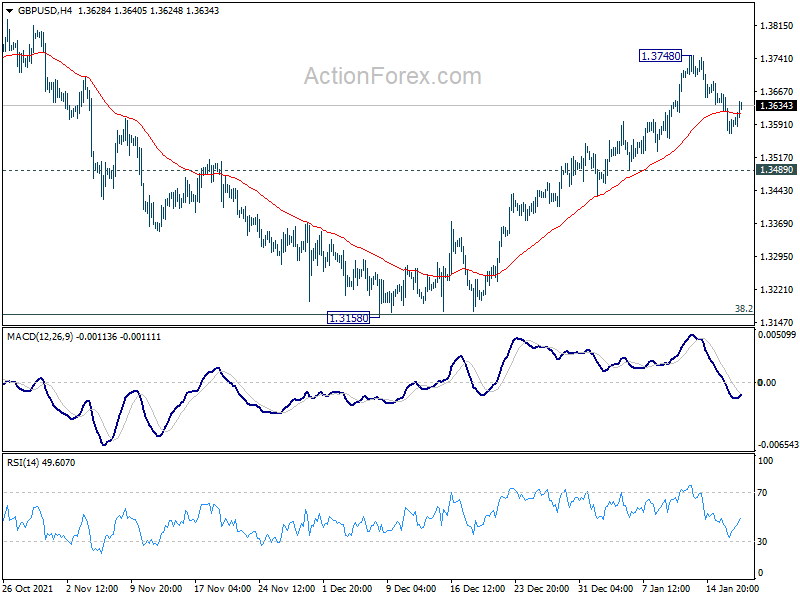
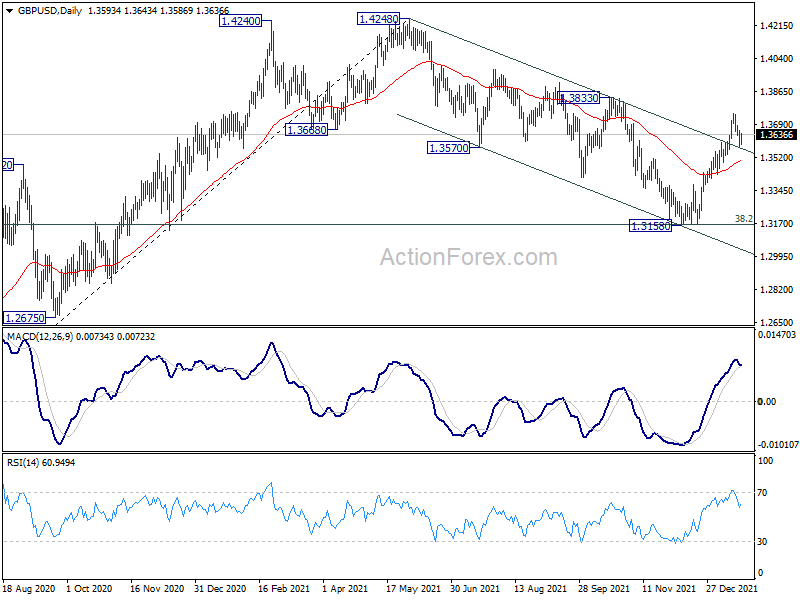
Intraday bias in GBP/USD remains neutral for the moment. While deeper fall cannot be ruled out, downside of retreat should be contained by 1.3489 support to bring another rally. As noted before, corrective fall from 1.4282 should have completed with three waves down to 1.3158, after hitting 1.3164 medium term fibonacci level. Above 1.3748 will target 1.3833 first. Sustained break of 1.3833 will pave the way back to retest 1.4248 high.
In the bigger picture, strong support was seen from 38.2% retracement of 1.1409 to 1.4248 at 1.3164. The development suggests that up trend from 1.1409 (2020 low) is still in progress. On resumption, next target will be 38.2% retracement of 2.1161 to 1.1409 at 1.5134. Nevertheless sustained break of 1.3164 will argue that whole rise from 1.1409 has completed and bring deeper fall to 61.8% retracement at 1.2493.
USD/CHF Mid-Day Outlook
Daily Pivots: (S1) 0.9144; (P) 0.9161; (R1) 0.9191; More....
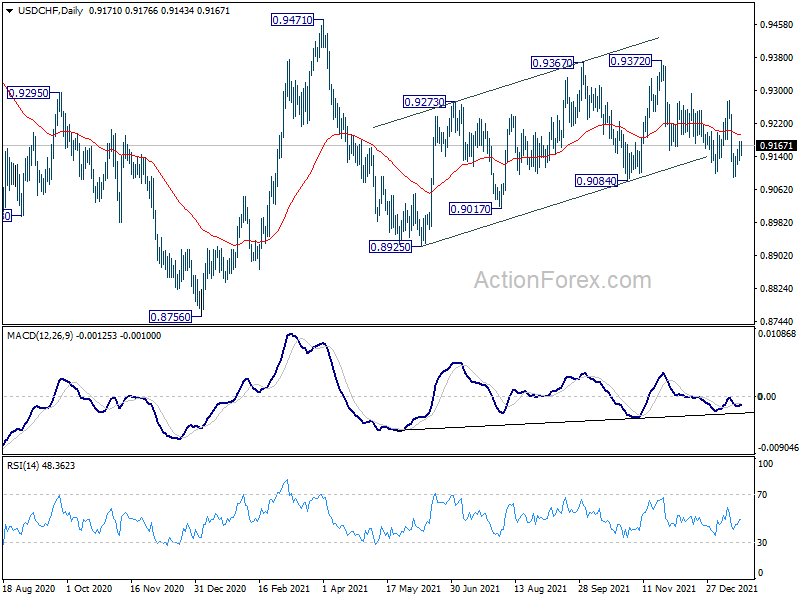
USD/CHF is staying in consolidation from 0.9090 and intraday bias remains neutral first. On the downside, firm break of 0.9084 support will argue that choppy rise from 0.8925 has completed. Fall from 0.9471 might be ready to resuming. Further decline would be seen back to 0.8925 support first. On the upside, above 0.9276 will target 0.9372 resistance instead.
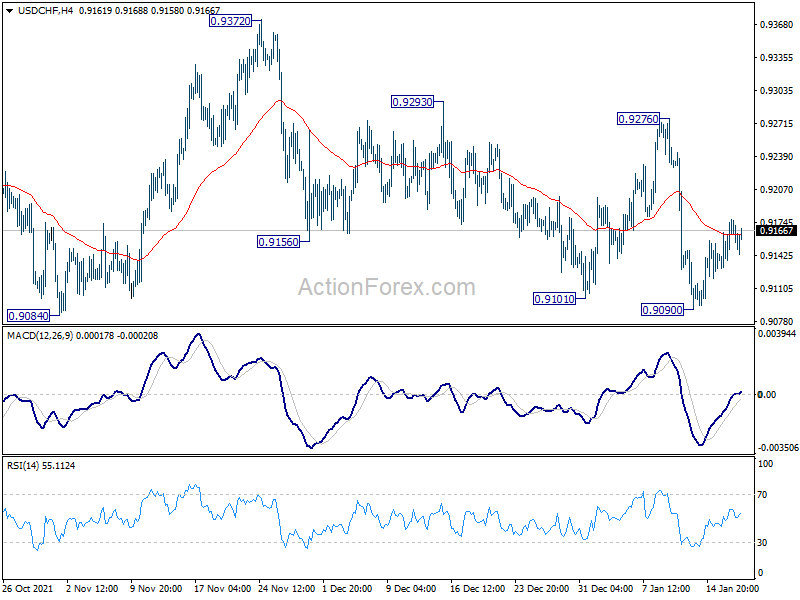
In the bigger picture, the corrective structure of the rebound from 0.8925 argues that fall from 0.9471 is not complete yet. It could either be the second leg of pattern from 0.8756 (2021 low), or resuming larger down trend from 1.0237 (2018 high). We'd pay attention to the downside momentum and assess the odds later. But for now, medium term outlook will be neutral at best as long as 0.9471 resistance holds.