Sample Category Title
HK HSI jumps after PBoC rate cut, heading back to 26k
China's PBoC cut the one year loan prime rate by 10 bps to 3.70%. The second rate cut since April 2020 following December's. Five-year loan prime rate was lowered by 5bps to 4.60%, first cut since April 2020. Along with the rate cuts, PBoC also injected more liquidity to the markets by offering CNY 700B of one-year loans, exceeding the CNY 500B maturing.
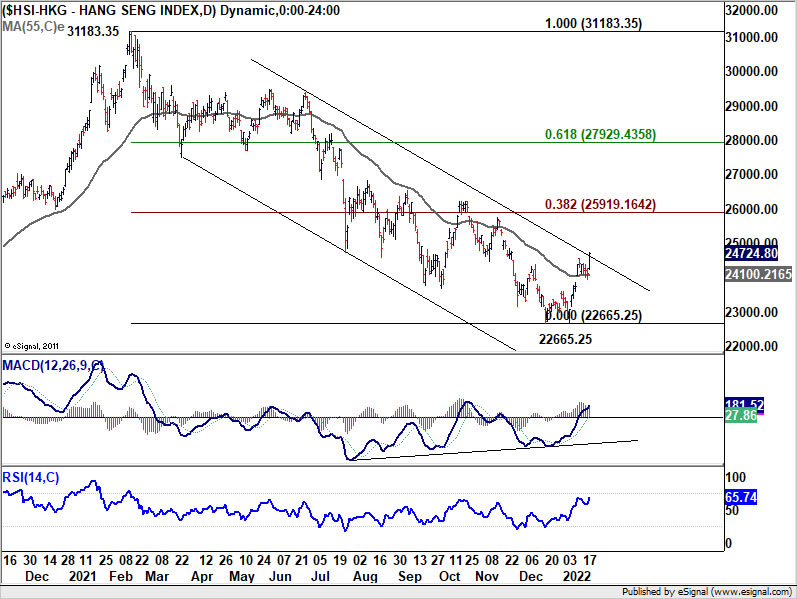
Hong Kong HSI responds positively to the news and it's trading up 2.5% at the time of writing. Resumption of the rise from 22655.25 after notably support from 55 day EMA is a bullish sign, along with bullish convergence condition in daily MACD. Current rise should at least be correcting the down trend from 31183.35, with prospect of even reversing it. Further rally is now in favor back to 38.2% retracement of 31183.35 to 22665.25 at 25919.16, which is close to 26k handle.
AUD/NZD soars, setting up long term up trend?
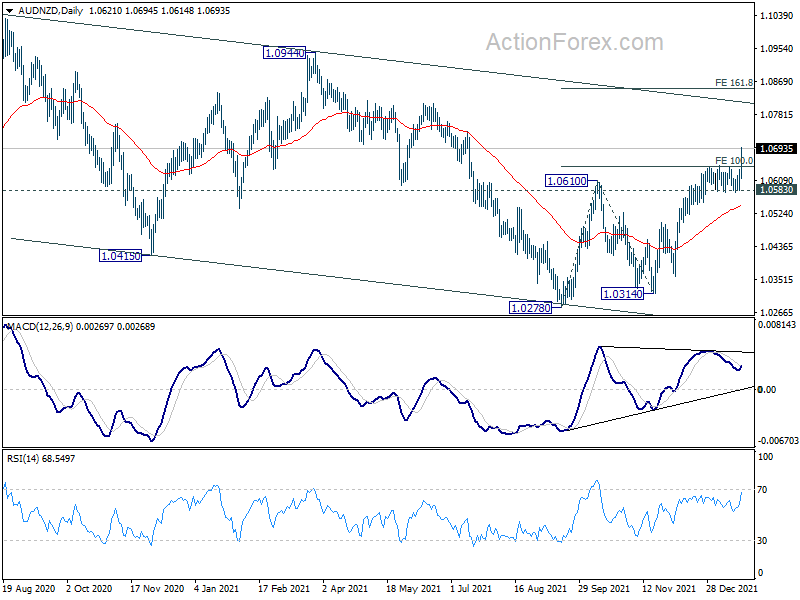
AUD/NZD soars in response to much better than expected Australia job data, and heightened expectation of RBA rate hike this year. The strong break of 100% projection of 1.0278 to 1.0610 from 1.0314 at 1.0646 is seen as a sign of upside acceleration. Further rally is now expected as long as 1.0583 support holds. Next target is 161.8% projection at 1.0851.
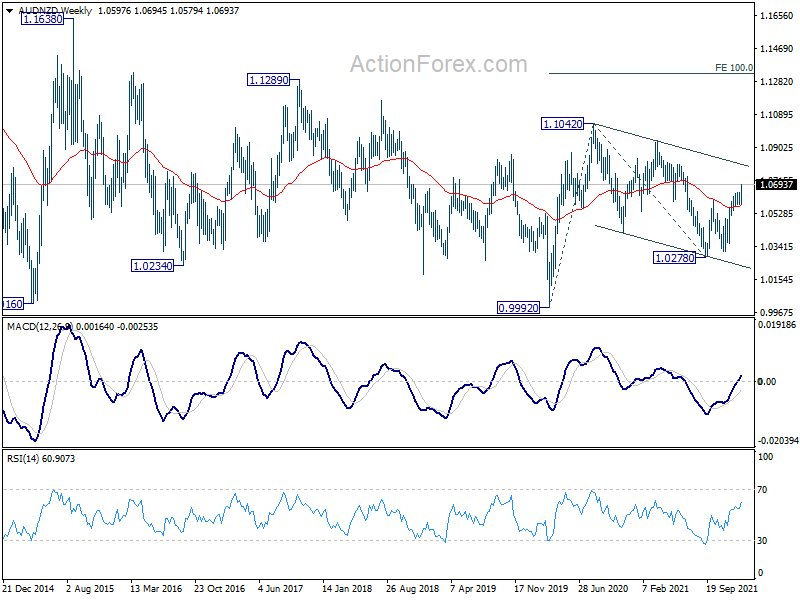
The bigger question now is whether the medium term fall from 1.1042 has completed as a corrective pattern, with three waves down to 1.0278. Break above above mentioned 1.0851 resistance will add credence to this bullish case. That would also argue that rise from 1.2078 is developing into a long term up trend, resuming the move from 2019 low at 0.9992 through 1.1042.
Australia unemployment rate dropped to 4.2%, lowest since 2008
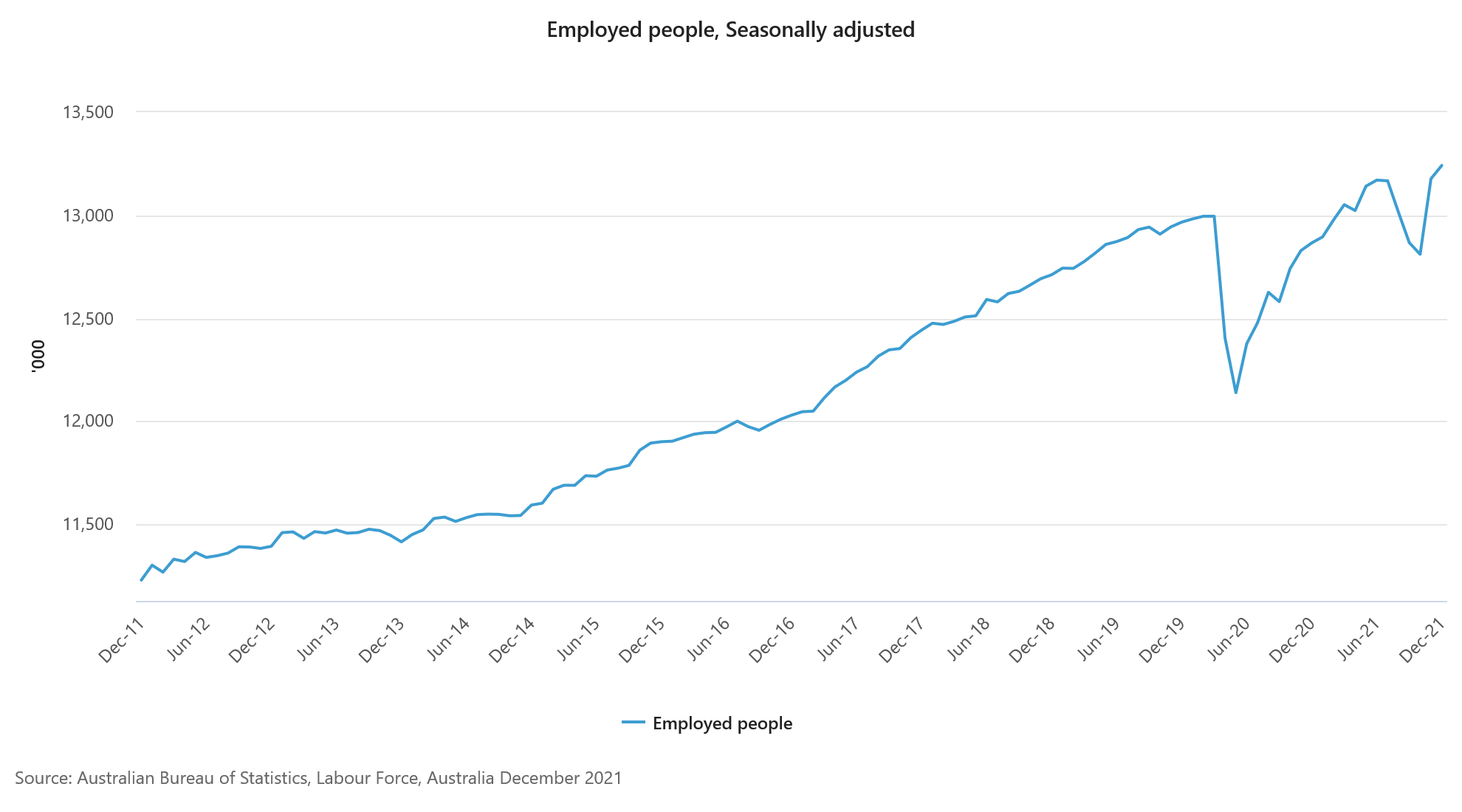
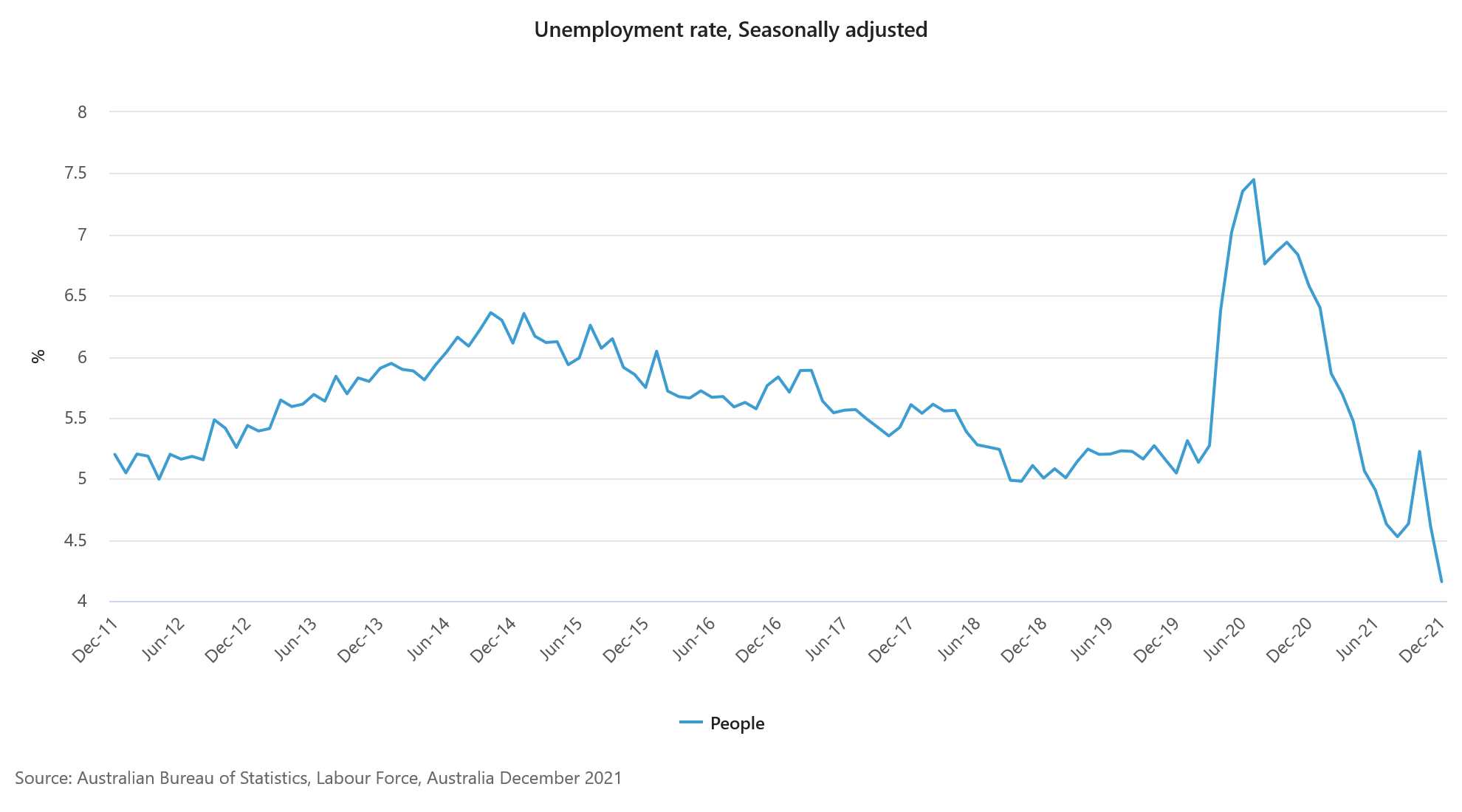
Australia employment grew 64.8k in December to 13.242m, well above expectation of 30.0k. Full time jobs rose 41.5k while part-time jobs rose 23.3k. Unemployment rate dropped from 4.6% to 4.2%, better than expectation of 4.5%. That's also the lowest rate since August 2008. Participation rate was unchanged at 66.1%. Hours worked rose 1.0% or 18.2m hours.
Bjorn Jarvis, head of labour statistics at the ABS, said: "The latest data shows further recovery in employment following the large 366,000 increase in November. This provides an indication of the state of the labour market in the first two weeks of December, before the large increase in COVID cases later in the month."
"This is the lowest unemployment rate since August 2008, just before the start of the Global Financial Crisis and Lehman Brothers collapse, when it was 4.0 per cent. This is also close to the lowest unemployment rate in the monthly series – February 2008 – and for a rate below 4.0 we need to look back to the 1970's when the survey was quarterly," Javis added.
Canada: Rate Hikes Close, But Not Quite Yet
Summary
- The Canadian economy enjoyed a solid rebound in late 2021, though with the Omicron variant leading to a renewed increase in COVID cases, some uncertainties have re-emerged. A temporary soft patch seems likely in early 2022, especially with Ontario and some other Canadian provinces having re-imposed some COVID-related restrictions over the past several weeks.
- Thus even as Canadian inflation remains elevated, we do not expect an imminent Bank of Canada rate hike at the January monetary policy meeting. Instead, our view remains for an initial 25 bps rate hike increase in April, and a cumulative 75 bps of rate increases this year.
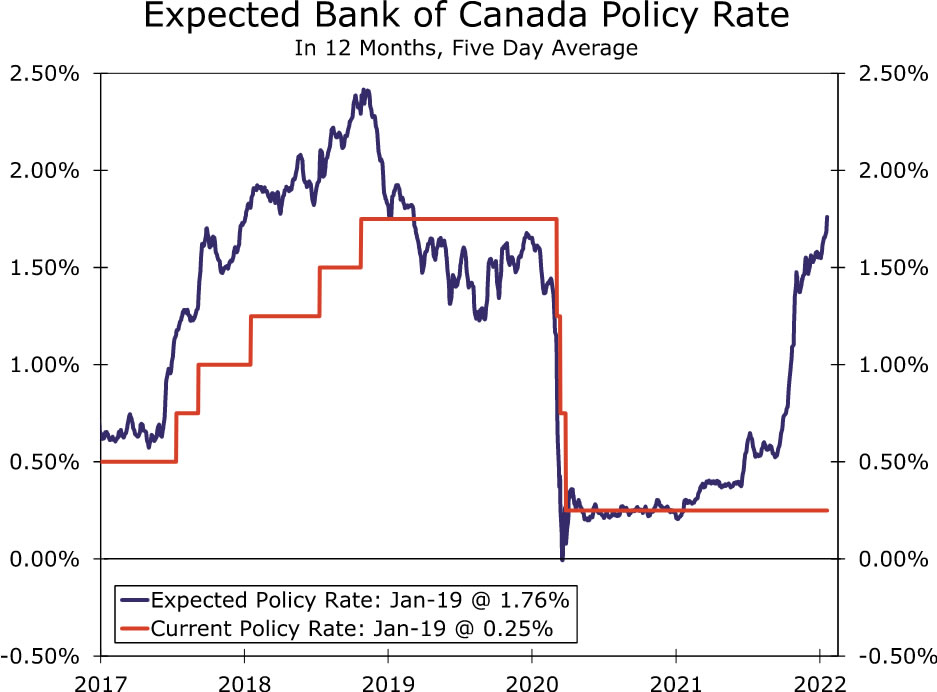
- Our outlook for Bank of Canada rate hikes over the next 12 months is more conservative than priced in by market participants, which envisage a cumulative 152 bps of rate increase over that period. Considering the aggressive market expectations for Bank of Canada policy, and the prospect of relatively rapid tightening (at least by international standards) from the Federal Reserve in 2022, we still expect the Canadian dollar to show renewed weakness versus the greenback as the year progresses.
Canadian Economy Solid in Late 2021, Could be Softer in Early 2022
After a bumpy path earlier in 2021, the Canadian economy enjoyed a solid rebound late last year. The recovery was highlighted by strong labor market trends, with seven consecutive months of job gains, including a 54,700 increase in employment for December. The unemployment rate fell almost two percentage points over the second half of last year, to 5.9%.
However, it was not just the labor market that showed sturdy trends, with retail sales, manufacturing sales, and overall GDP registering solid gains. In terms of the most recent figures, October GDP rose 0.8% month-over-month, October retail sales rose 1.6%, and manufacturing sales rose 2.6%. With respect to the overall economy, Q3 GDP grew 5.4% quarter-over-quarter annualized in Q3, and the consensus forecast is for a similar sized gain in Q4.
Still even with Canada's rebound, it's not clear that will lead to immediate rate hikes from the Bank of Canada (BoC). At the December monetary policy announcement, after the sizable Q3 GDP increase was already known, the central bank said:
"The Governing Council judges that in view of ongoing excess capacity, the economy continues to require considerable monetary policy support. We remain committed to holding the policy interest rate at the effective lower bound until economic slack is absorbed so that the 2 percent inflation target is sustainably achieved. In the Bank's October projection, this happens sometime in the middle quarters of 2022."
The Bank of Canada also point to some uncertainties surrounding the Omicron variant. From a global perspective, the central bank said the "..new Omicron COVID-19 variant has prompted a tightening of travel restrictions in many countries...and has injected renewed uncertainty", while with respect to Canadian specific developments the BoC said the "devastating floods in British Columbia and uncertainties arising from the Omicron variant could weigh on growth by compounding supply chain disruptions and reducing demand for some services."
Rising Inflation to Prompt Rising Interest Rates by April
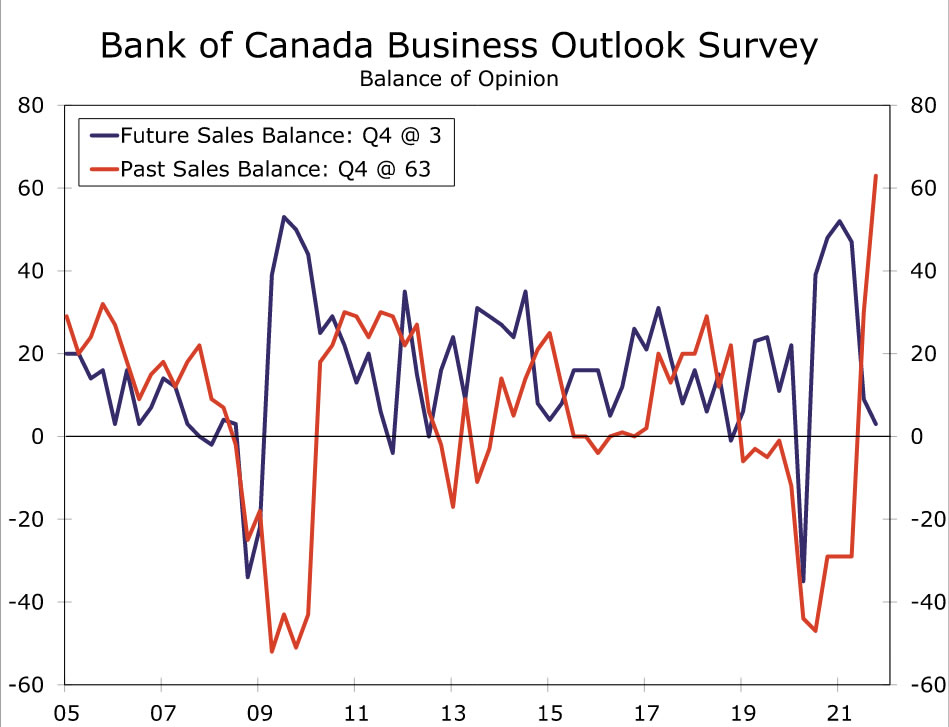
Some of these concerns or uncertainties are perhaps borne out by the Bank of Canada's latest Business Outlook Survey. Within that survey the Past Sales Balance rose to +63 in Q4, reflecting the strength seen late last year. However, the Future Sales Balance fell further to +3, highlighting the possibility of a soft patch for the economy early in 2022. We would also note that some COVID-related restrictions went back into place in Ontario in early January, including a work-from-home order, stricter limit on indoor gatherings, a shift to remote learning for schools, and closure for some businesses including gyms, theaters and restaurants. Restrictions have been imposed in some other provinces as well.
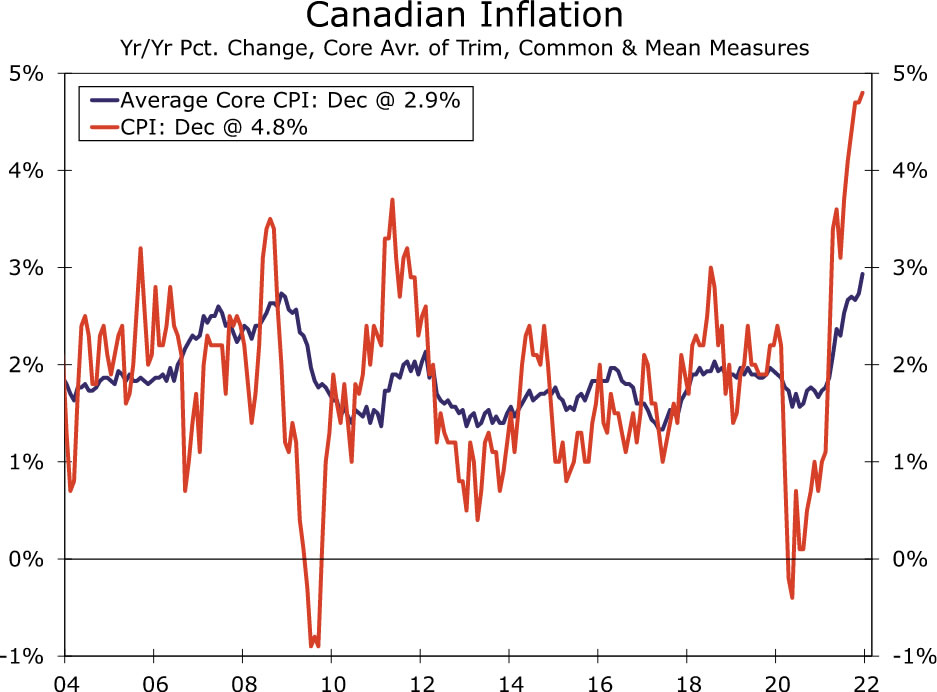
Thus even as inflation continues to move higher, with the December CPI edging up to 4.7% year-over-year and the average of the core inflation measures firming to 2.9%, we do not expect an imminent rate increase at the Bank of Canada January monetary policy announcement. Indeed, with the central bank perhaps wanting to monitor the impact (or perhaps lack of impact) from the Omicron variant in the coming months, our view remains the Bank of Canada will deliver an initial rate increase at its April monetary policy meeting, which would also be broadly consistent with the timing for which it anticipates slack within the economy will be absorbed. Our outlook for a 25 bps rate hike by April is more conservative than current market pricing, which anticipates 52 bps of rate increase during the next three months. Indeed, more broadly we forecast 75 bps of rate increase from the Bank of Canada over the next 12 months, compared to the 152 bps of rate increase anticipated by market participants. Thus even though there are some positive factors for the Canadian dollar, including a recent rise in oil prices, considering the aggressive market expectations for Bank of Canada policy, and the prospect of relatively rapid tightening (at least by international standards) from the Federal Reserve in 2022, we still expect the Canadian dollar to show renewed weakness versus the greenback as the year progresses.
RBA to Begin Tightening in August Despite Omicron Shaving Growth in 2022 from 6.4% to 5.5%
In this note we set out some changes to our interest rate forecasts.
In addition, we also assess the impact on economic growth of the omicron variant.
Omicron is forecast to have its major impact on the economy in January through a contraction in consumer spending. Thereafter we expect a solid bounce back in the later stages of the March quarter and in the June and September quarters.
Westpac Economics is now forecasting growth for 2021 and 2022 of 3.2% and 5.5%, respectively. That is revised from the pre-omicron profile of 2.8% and 6.4%, with a net reduction of 0.5%.
We do not see that correction as having a significant impact on jobs growth or wages/inflation.
Changes to the outlook for interest rates
We have not changed our call for the first hike in the overnight cash rate by the RBA since June 2021 when we were early to challenge the "not till 2024" consensus.
Our "target" then was a first hike at the February Board meeting in 2023.
Developments since then have now prompted us to bring forward that tightening date to the meeting on August 2, 2022.
We now expect one hike of 15 basis points in August to be followed by a further hike of 25 basis points in October.
The full extent of the cycle and expected timing of subsequent moves is discussed below.
This revised timing for the first move is still well short of market pricing which is for the first hike to occur in June.
We understand that the Governor has firmly indicated that he does not expect to be raising rates until very late 2023 or 2024 and that this expectation is entirely consistent with the Bank's current economic forecasts.
Those forecasts, which will be refreshed and possibly changed for the February 1 Board meeting, indicate that underlying inflation will print 2.25% by the end of 2022 and 2.5% by the end of 2023.
Wages growth is expected to reach 2.5% in 2022 lifting to 3% in 2023.
If these forecasts prove to be accurate then the "late 2023/2024" guidance will be appropriate.
But we have quite different forecasts for: inflation; wages growth and the unemployment rate.
We expect that underlying inflation (trimmed mean) will reach 2.4% in 2021 and lift to 2.6% in March 2022 and 2.9% in June 2022.
This will mean that by the time of the August meeting the Board will have observed three consecutive quarters in which annual underlying inflation has achieved or exceeded its target (around the mid-point of the 2-3% range).
Wages growth will be slower to reach the RBA's "target" of 3% but whereas achieving the inflation target is a hard condition for any policy change, acceptance that wage growth has consistently lifted towards a speed we have not seen since 2014 should be sufficient to satisfy the Bank that the necessary conditions for a rate increase have been achieved.
We expect quarterly growth in the Wage Price Index to increase from 0.6% in the September quarter to 0.7% in the December quarter, to be followed by 0.8% in the March quarter.
The very low 0.4% result in the June quarter of 2021 means the actual Wage Price Index will still show annual growth of 2.75% for the year to March (the most recent dt available for the August meeting) but the increasing momentum will be clear once the six- month annualised pace reaches the 3% target.
If the Board sees the 3% wages growth as a hard target it may opt to delay the hike until the September Board meeting when the low 0.4% will drop out of the annual rate allowing it to reach the annual pace of 3%.
When assessing the outlook for wages, the Board will also rely on its own liaison work and high frequency measures of wage pressures. Even though the most recent reports from the Bank on its liaison points to a 2.5% pace for wages growth, we expect the picture to change quickly by the middle of 2022.
An example of the emerging evidence in the higher frequency data is the weekly payrolls report which shows a 9% lift in the total wage bill over the year to 19 December 2021 – with payrolls rising 3.2% over the same period this means average wage rose by 5.6%yr. This measure is impacted by bonuses paid, hours worked and changes in the composition of the work force, all of which are excluded from the Wage Price Index measure, but the sharp increase in this annual growth measure in recent months certainly bears consideration.
We accept that there is high inertia in the enterprise agreements (around 38% weighting in the Wage Price Index) and minimum wages/awards (around 21%) but expect that there will be a number of aspects of the WPI that will indicate stronger pressures than the headline print – the individual agreement component (around 37%) should be seeing gains running at around 0.9% a quarter and should be seen as a reliable lead indicator for enterprise agreements (note that the individual agreement component lifted by 1.1% in the September quarter partly boosted by seasonality and some 'catch up' from the very weak June quarter).
We expect that the National Wage case in April, a month before the likely date of the federal election, will also result in the government supporting a more generous settlement than has been the case in the recent past, potentially boosting award and the minimum wages by around 3%.
We are more optimistic about the unemployment rate than the Bank's latest forecasts. Currently the Bank expects the unemployment rate to reach 4.25% by end 2022 and 4.5% by the month of June 2022 – our same forecasts are 3.8% and 4.1% respectively.
The Board would probably view around 4% as full employment – an objective the Bank does not expect to achieve until end 2023 but which we expect by June 2022.
The path of the tightening cycle
Back in June last year we targeted a terminal RBA cash rate of 1.25%.
That related to the peak debt servicing ratio for the household sector we observed in previous cycles in 2009-10 and in 2018 (the latter stemming from macro-prudential measures rather than official rate tightening). But that forecast last June was in the context of a more benign inflation profile than we now expect. We now think the RBA will need to venture into mildly contractionary policy settings to address any inflation/wages risks.
While the concept of the household debt servicing ratio as a constraint to rates is attractive it is by no means an exact measure – the income distribution of those holding the debt; the exact mix between fixed and floating rate terms and between interest only and amortising loans complicates estimates.
There is also the likelihood that, over the long run, interest rates in Australia and the US are unlikely to settle too far out of alignment.
For these reasons we have lifted the terminal rate to 1.75% from the 1.25% we estimated back in June.
The exact profile for rate rises would be 40 basis points in 2022; 100 basis points in 2023; with one final move of 25 basis points in early 2024.
The last example of an RBA tightening cycle was in 2009 /10 and saw six 25 basis point moves over the course of seven meetings between November 2009 and May 2010.
That was at a time when the RBA assessed neutral as being well above the 3% starting point and argued that it was important to move quickly away from the emergency settings associated with the GFC.
While the motive to move away from emergency settings will be the same, it is likely that there is more uncertainty around the exact level of neutral and the moves will be somewhat more cautious than we saw in 2009/10.
That said, central banks are also cautious about getting too far 'behind the curve' since that only increases the risks that policy will have to move further into contractionary territory than would be the case if policy had been tightened in a timely fashion.
For example, there is one view amongst some analysts that despite achieving its objectives, the RBA would remain on hold for an extended period, unnecessarily getting behind the curve and probably having to eventually move much more quickly risking an overshoot.
International issues
The FOMC has signalled that it is likely to begin tightening at its March meeting – ahead of our previous call that the tightening would begin in June – due to the rapid improvement in conditions in the labour market and a more sustained rise in inflation than had been assessed earlier in 2021.
The intention of the FOMC now appears to be to move more quickly to rein in an inflation rate that is now running a touch above 7%.
That would imply four rather than three hikes by the FOMC in 2022 – effectively adding the March move to our already expected three moves from June.
Th key for global markets is whether inflation in the US can be brought back to the 2-2.5% range during 2023 to allow the FOMC to settle rates at around neutral rather than be obliged to push heavily into contractionary territory.
That remains our call and is consistent with a 1.875% terminal rate in this cycle (up from 1.625%)
After four moves in 2022 the three additional 0.25% moves are likely to occur in 2023, providing the RBA with the comforting signal that the federal funds rate can settle around, or slightly above, the neutral level.
The risk for markets globally is that inflation does not settle back in 2023 into the 2-2.5% range forcing the FOMC to push into contractionary policy settings and precluding the FOMC from easing policy rates in the event of a major market meltdown.
The AUD and Bond rates
Our key near term AUD forecast is for a low point in the AUD of USD0.70 by mid-2022.
While we have a more urgent tightening cycle from the RBA we have also lifted the pace of rate hikes by the FOMC.
From the end 2022 we are expecting a further five RBA hikes through 2023 and 2024 compared to only three from the FOMC. That will support our call for a rising AUD through the second half of 2022 and 2023.
Note that relative to our earlier forecasts, the negative margin between the terminal cash rates for RBA and FOMC has narrowed from 40 basis points to 12.5 basis points, providing further support for our rising AUD view from mid- 2022.
We maintain our call that due to the sensitivity of the Australian economy to excessive levels of household debt the terminal rate can settle slightly below the FOMC rate.
All last year our forecasts for the long bond rates in both Australia and the US (key targets of 2.3% by end 2022) were heavily 'out of the money' as markets priced in a benign outlook for bond rates.
That has recently changed significantly with the AUD bond rate around 2%.( up from 1.5% in late 2021).
The higher terminal rates for RBA and FOMC now support slightly higher bond rate peaks, reaching 2.5% rather than the previous 2.3% by end 2022.
These relatively benign rates are consistent with our current expectations that inflation can settle around central banks' targets allowing terminal rates to hold near neutral.
Omicron and economic growth
The omicron wave is denting economic activity in the opening quarter of 2022, centred largely on the consumer. The dramatic surge in cases locally looks to be driving a pull- back in consumer spending with widespread reports of disruptions to production and distribution networks as employees required to isolate are unable to work. We expect this to result in a hit to hours worked and a run-down of inventories, which is a drag on growth. A temporary soft spot in business confidence is also likely to see some delays to business investment, largely around equipment spending.
Westpac Economics is now forecasting growth for 2021 and 2022 of 3.2% and 5.5%, respectively. That is revised from the pre-omicron profile of 2.8% and 6.4%, with a net reduction of 0.5%.
It is worth noting that in the lead-up to the omicron outbreak, the economy was rebounding during the December quarter 2021 more quickly than previously anticipated. Retail sales were particularly strong in the month of November, surging 7.3% and building on a strong 4.9% gain in October. This has led to an upgrade to our Q4 GDP growth forecast, from 2.2% to 2.6%, led by a 1ppt upward revision to consumer spending.
More recent data from our Westpac Card Tracker, based on weekly credit and debit card activity to January 15, points to a material weakening in spending since late December. Indeed, the tracker data suggests total consumer spending is likely to be down close to 3% for the January month. While some improvement on the COVID front is likely to see activity improve, particularly as we move into February, this is now expected to leave total consumer spending flat for the March quarter. This is compared to what would otherwise have been a continuation of the strong gains seen in the December quarter. The resilience of consumer sentiment in January is one promising sign that the consumer may revive quickly once the COVID situation stabilises.
With consumer spending stalled in the March quarter, and inventories subtracting an expected 0.3ppts in the period, overall GDP is also expected to be flat in the opening quarter of 2022. At this stage, we anticipate that disruptions to construction activity for the quarter will be minimal – with the sector largely on summer holiday early in January, and with some normalisation in movement and activity envisaged over the remainder of the quarter.
The quarterly GDP profile for 2022 is now expected to be: 0.0%; 2.6%; 2.0% and 0.8%.
For the 2022, consumer spending is expected to expand by 7.6%, lowered from 9.4% previously. This comes from both the upward revision to 2021 and the omicron disruptions in 2022.
Business investment gains have been pared back somewhat in 2022, but to a still strong pace, at a revised 7.8%, lowered from 8.5% pre omicron. This factors in equipment spending growth of 10.5%, trimmed from 12% previously. The hit to business confidence from omicron is likely to be short lived, as was the case with delta, with firms quickly refocusing on strong underlying demand and tight capacity, as well as generous tax concessions.
As noted above, inventories are run-down in the March quarter, due to labour shortages disrupting production and distribution. A stabilisation of inventories is anticipated in the June quarter, followed by some rebuilding of stock levels in the September quarter.
On the trade side, import growth for 2022 is pared back to reflect the downward revisions to demand, lowered by 1.3ppts to a still brisk 12.6%. Note that as much of the disruption to consumer spending is around domestic services, which limits the hit to imports. Export growth has also been trimmed, at the margin, by around 0.5% to 8.3%, to reflect those supply disruptions in the March quarter, with a partial catch-up over the following quarters.
The risks
One important risk to this rate and growth view is a further rise in COVID infections and hospitalisations near term or further out as the effectiveness of boosters and post-infection immunity wears off – the latter likely to be around mid-2022 when winter will be upon us and the virus tends to spread more freely (although evidence from the severe northern winters is not entirely relevant for Australia's mild winters).
Importantly, the RBA along with other central banks, has come to look through COVID disruptions.
The line the RBA used around the delta lockdowns was that it would "delay but not derail" the recovery. That may mean that our timing for the first move turns out to be too early but the cycle would not be abandoned.
Further complicating this issue is that while another wave will impact activity as we are now seeing in January its implication for the nominal economy is less clear and we know that the RBA's concern in recent cycles has been the weakness in the nominal economy.
Despite the sudden shift to lock downs last year, the RBA continued its tapering program, although it did delay consideration of a further taper by three months.
Increasing wage pressures and tightening labour markets are important preconditions for these forecasts. The opening of international borders will ease some of the labour shortages but is unlikely to be a smooth process.
Inflation and wage pressures result from an imbalance between demand and supply. The opening of borders will lift demand as well as increasing supply while the demand offset from Australians travelling abroad is likely to be minimal as Australian travellers remain cautious about overseas health risks, including the quality of overseas health systems.
Conclusion
Our forecast revisions reflect a much faster lift in inflation and wages growth than envisaged last June.
While we have shaved our growth rate in 2022 due to the omicron-related contraction in consumer spending in January we do not see that as being significant for our wages/inflation/ employment profile.
The FOMC has now acknowledged that the conditions for a tightening of policy have arrived and, while less urgent, we think the RBA will do the same by August.
The approach we have used in this process is to recognize when our forecasts are different to the RBA; assume our forecasts will be correct; and predict how the central bank will react to a new reality.
Australia Labour Force – The boom in November was echoed in December
Unemployment fell to 4.2%, we did not expected to see it that low till May.
The very solid update in November has been followed by a sound gain December highlighting a labour market continues to significantly outperforming expectations.
The December Labour Force Survey reported a solid 64.8k/0.5% gain in employment, stronger that Westpac’s +30k but on par with market expectations of +60k.
Recovery in NSW and Vic continued to have a large influence on the national figures, with employment in these two states increasing by 32k and 25k respectively. Their employment is back around where it was May having fallen 250k and 145k during the lockdowns.”
Total employment is well above where it was back in June 2021, pre the latest round of lockdowns, and now has a clear upwards trend.
The report continues the story of solid gains in full-time employment with a 41.5k/0.5% lift by this group but part-time workers did not miss out with a 23.3k/0.6% gain. In the year full-time employment is up 4.1% while part-time employment is up 0.5%.
Hours worked gained a solid 1.0% continuing the recent trend of hours worked outperform the gains in employment suggesting economic activity was continuing to grow to this point in time.
The reference period was the two weeks to 18th December so it misses the impact of the Omicron outbreak.
Given the growth in hours worked it should be no surprise that underemployment has also continued to fall, down 0.9ppt to 6.65%, the lowest level of underemployment since November 2008. This is significant as we find underemployment a more power explanator for wages growth than unemployment.
What was surprising is we did not jump in workers returning to the labour force. At just +2.5k this saw the participation rate flat at 66.1%. Flat participation is why there was an outsized fall in the unemployment rate to 4.2% from 4.6%. We have not expected the unemployment rate to hit 4.2% May this year. It is also the lowest rate since August 2008, just before the GFC.
Underutilisation, that is unemployment plus underemployment, fell from 12.1% to 10.8% the lowest level since November 2008.
It is worth noting that for the last three months, the ABS estimate of the working age population contracted slightly again. The closure of the international borders are still biting and it will be interesting see where this goes in 2022 as the borders reopen.
The ABS noted that the easing of restrictions in NSW and Vic had a large influence on the national figures, with employment in the two states increasing by 180k and 141k. Employment in those states is only 52k and 4k (respectively) below May, having fallen by 250k and 145k during the lockdowns.
While the focus is on NSW and Vic it would be remiss not to mention the other states. Employment gained 6.5k in Qld but fell -0.7k in WA -1.9k in SA and -1.0k in Tas. In terms of unemployment, it fell from 4.6% to 4.0% in NSW, 4.7% to 4.2% in Vic, down just 0.1ppt in Qld to 4.7%, down to 3.4% from 3.8% in WA and down from 4.6% to 3.9% in SA.
Crude Oil Price Extends Rally Above $85
Key Highlights
- Crude oil price started a fresh increase above the $80.00 resistance.
- A key bullish trend line is forming with support near $83.50 on the 4-hours chart of XTI/USD.
- EUR/USD declined to 1.1310, and GBP/USD found support near 1.3565.
- Gold price remained well bid above the $1,800 support zone.
Crude Oil Price Technical Analysis
This week, crude oil price started a major increase above the $82.50 resistance against the US Dollar. It broke many hurdles near $83.00 and $84.20 to move into a positive zone.
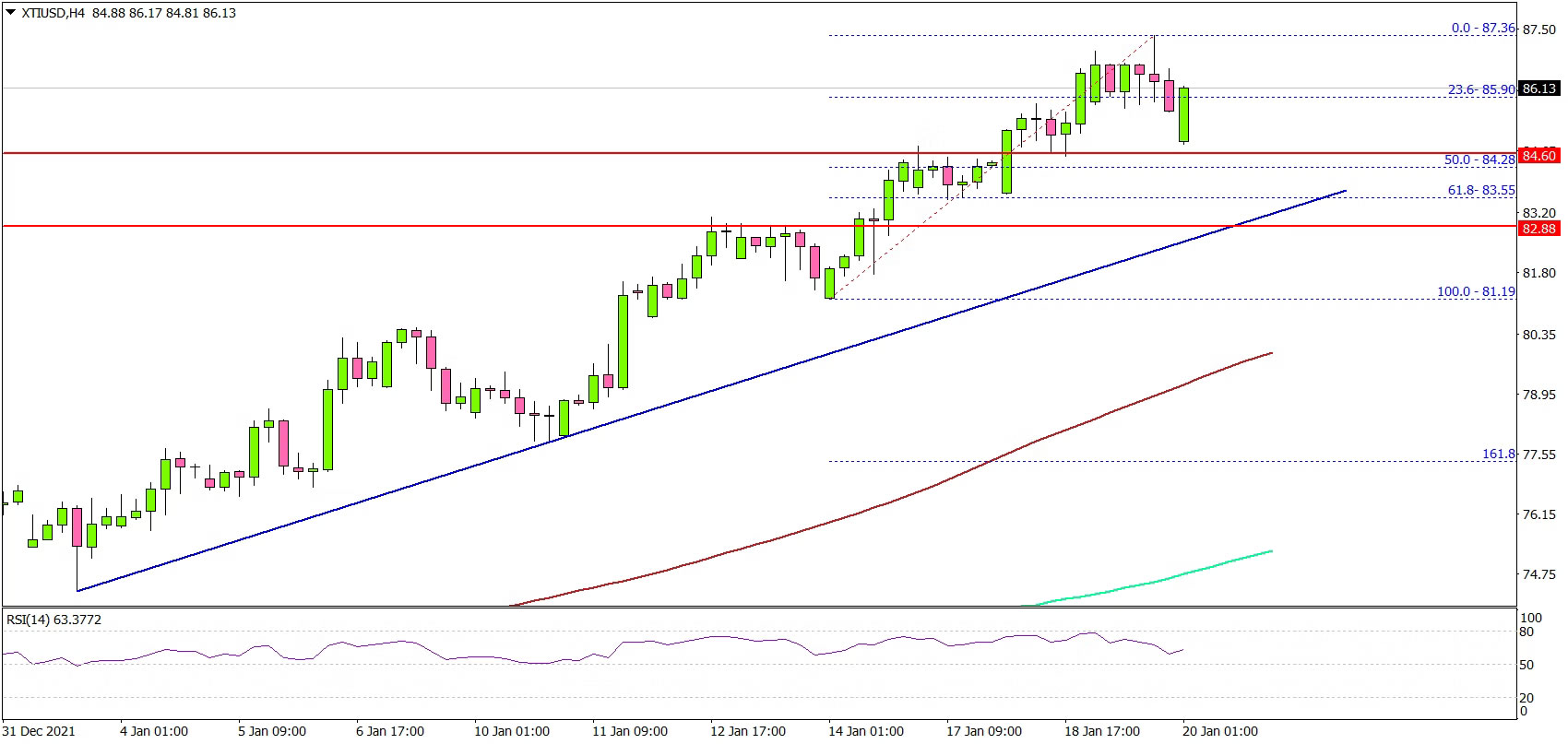
Looking at the 4-hours chart of XTI/USD, the price gained pace above the $85.00 level. The price settled well above the $85.00 level, the 100 simple moving average (4-hours, red) and the 200 simple moving average (4-hours, green).
The bulls pushed the price above the $86.50 level. If the bulls remain in action, the price could rise towards the $88.00 level. The next major resistance is near $90.00, where the bears might take a stand.
An immediate support on the downside is near the $85.50 level. The first major support is near $84.50. There is also a key bullish trend line forming with support near $83.50 on the same chart.
Any more losses could open the doors for a move towards the $82.20 support. In the stated case, there is also a risk of a move towards the $81.50 level.
Looking at EUR/USD, the pair declined heavily below the 1.1380 level, but the bulls were active above 1.1300. Besides, GBP/USD also started a fresh increase from the 1.3565 zone.
Economic Releases to Watch Today
- Euro Zone CPI for Dec 2021 (YoY) - Forecast +5%, versus +5% previous.
- Euro Zone CPI for Dec 2021 (MoM) - Forecast +0.4%, versus +0.4% previous.
- US Initial Jobless Claims - Forecast 220K, versus 230K previous.
- US Existing Home Sales for Dec 2021 (MoM) - Forecast +0.8%, versus +1.9% previous.
Gold Jumps on Inflation Worries
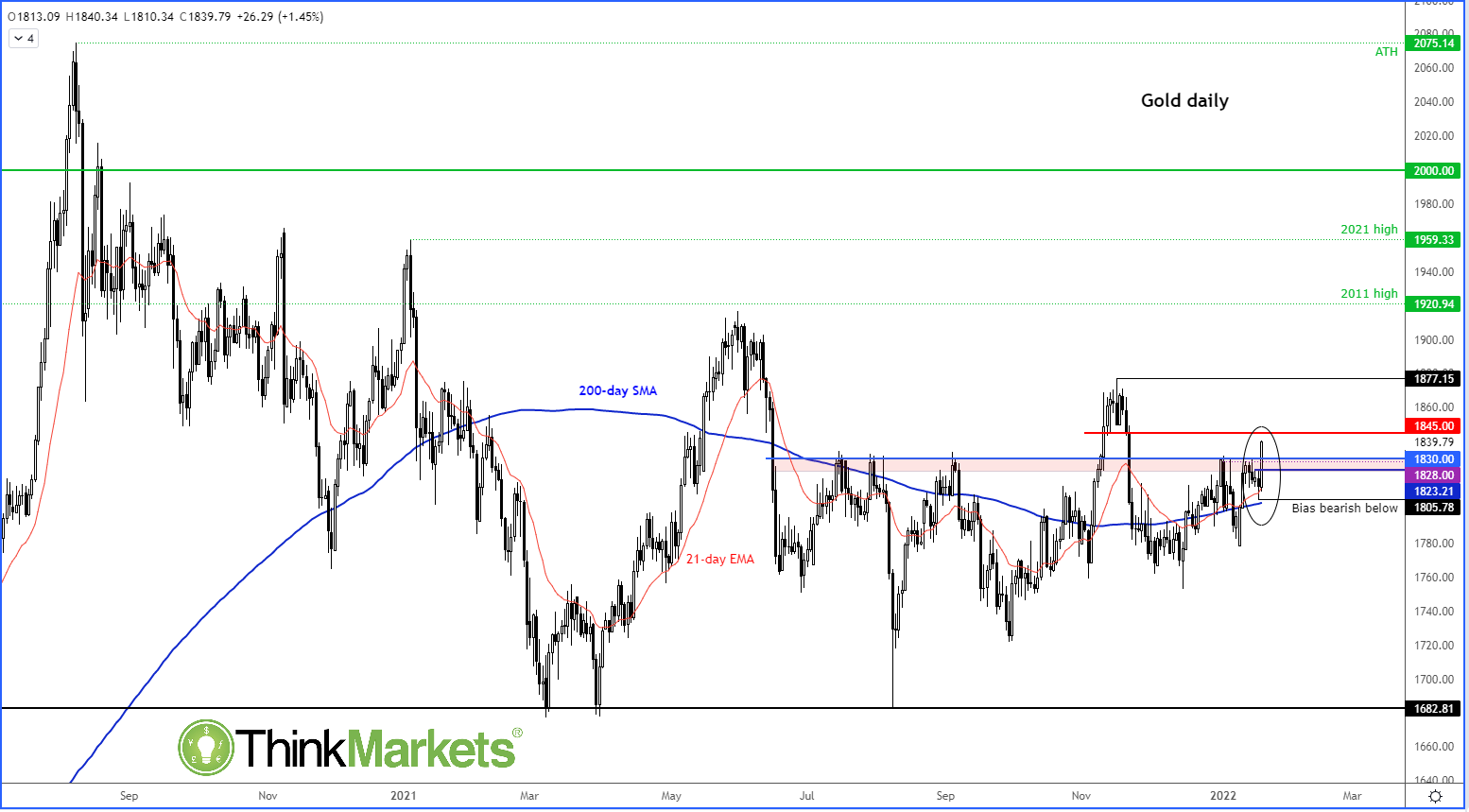
When gold rises, usually it is because of a weaker dollar. Although the Dollar Index did pull back a little today, it was still comfortably above the low of 94.60ish it hit earlier this month. Yet, gold not only surged to a fresh high on the year it also reached its best level since November. Since November, yields have been rising across the globe. Thus, gold has been able to ignore this as well.
So, what is going on and can gold hold its breakout?
Well, to me, it looks like gold investors are responding to two factors.
First, there is some level of haven flows supporting the metal as investors sell expensive technology stocks and seek refuge in the metal.
More to the point, gold is finally responding to high levels of inflation around the world. Eurozone CPI reached an all-time high of 5% in December and today we saw the UK consumer inflation surged to 5.4% in December, the fastest pace since 1992. Even hotter, US CPI has reached a 39-year high at 7%, no less. With crude oil climbing towards $90 and UK consumers facing a jump in utility bills that's due to hit in April, inflation is likely to rise even higher.
Rising levels of inflation are squeezing households and at the same time increase pressure on major central banks to raise interest rates more aggressively. The net result would be decreased economic activity, which is why we have seen certain sectors of the stock market perform so poorly this year.
It remains to be seen whether the latest breakout attempt by gold can be held, but now there are more compelling reasons why the bulls might hold their ground. Key support is now the area between $1828 and $1830, which was previously acting as resistance. Short-term resistance is seen around $1845, but given the big breakout we may see that level break.
Gold Wave Analysis
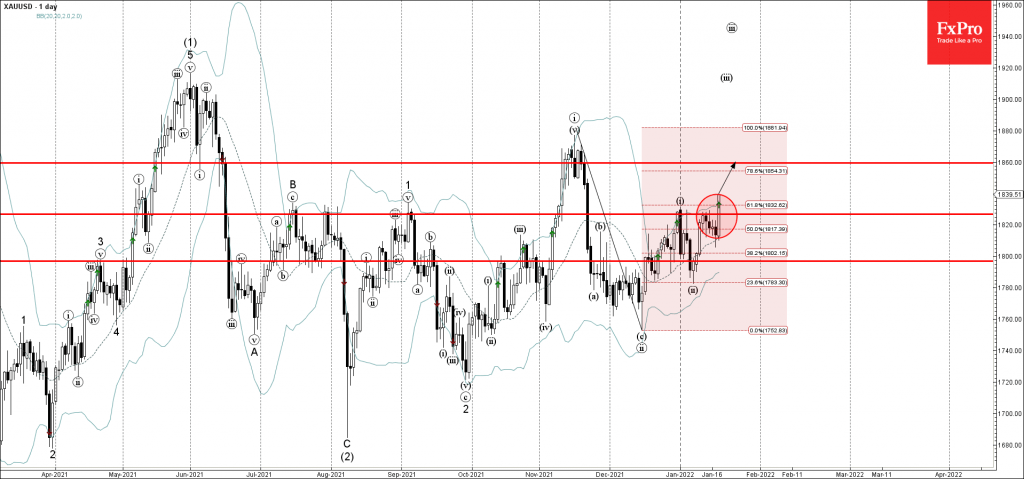
- Gold broke resistance level 1825.00
- Likely to rise to resistance level 1860.00
Gold continues to rise after the earlier breakout of the resistance level 1825.00 (top of the previous impulse wave (i)), intersecting with the 61.8% Fibonacci correction of the earlier downward correction from November.
The breakout of the resistance level 1825.00 continues the active impulse waves (iii) and iii.
Gold can be expected to rise further toward the next resistance level 1860.00 (which has been reversing the pair from the middle of December).
EURCAD Wave Analysis
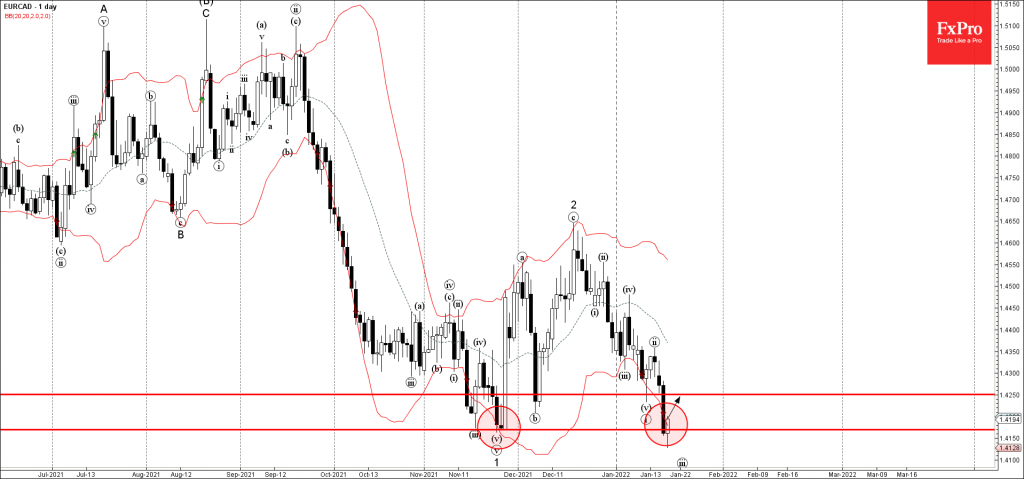
- EURCAD reversed from key support level 1.4170
- Likely to rise to resistance level 1.4250
EURCAD recently reversed up from the key support level 1.4170 (previous Double Bottom from November), – strengthened by the lower daily Bollinger Band.
The upward reversal from the support level 1.4170 stopped the previous sharp downward impulse waves (iii) and 3.
EURCAD can be expected to rise further toward the next resistance level 1.4250 (former support which stopped the previous impulse wave (i)).