Sample Category Title
USD/JPY Mid-Day Outlook
Daily Pivots: (S1) 114.34; (P) 114.70; (R1) 114.95; More...
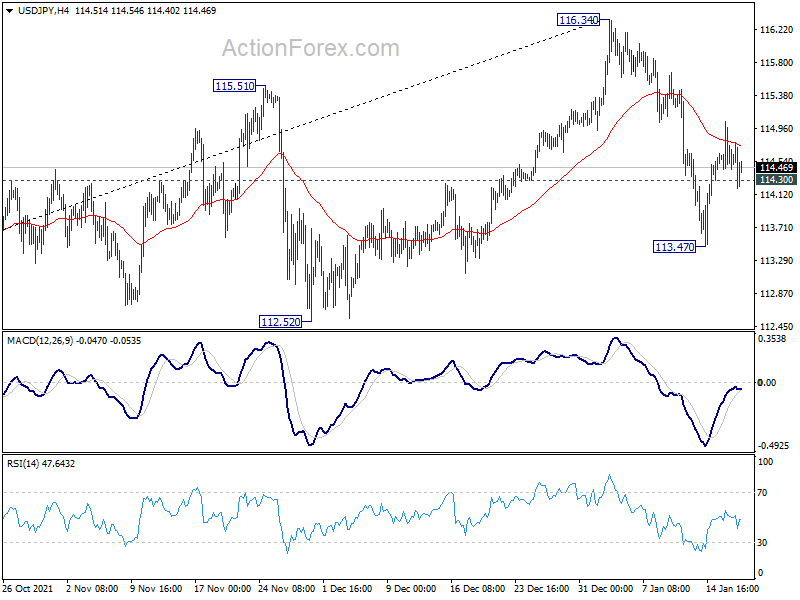
The break of 114.30 minor support suggests that recovery from 113.47 has completed at 115.05. Intraday bias is back on the downside for 113.47. Break will target 112.52 structural support. Considering bearish divergence condition in in daily MACD, further break of 112.52 will confirm that it's already in correction to the up trend from 102.58. Deeper decline would be seen to 38.2% retracement of 102.58 to 116.34 at 111.08. On the upside, break of 115.05 will resume the rebound from 113.47. But we'd not expect a break of 116.34 high even in this case.
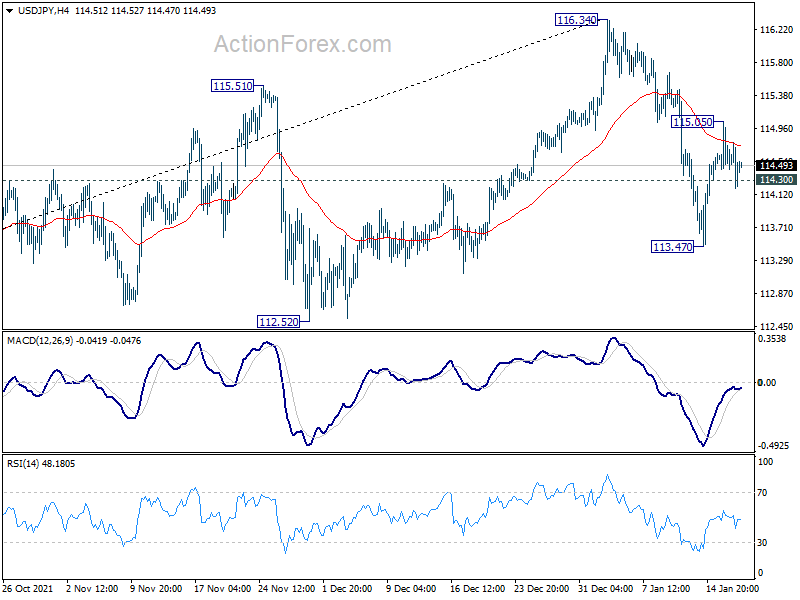
In the bigger picture, no change in the view that rise from 102.58 is the third leg of the up trend from 101.18 (2020 low). Such rally should target a test on 118.65 (2016 high). Sustained break there will pave the way to 120.85 (2015 high) and raise the chance of long term up trend resumption. However, firm break of 112.52 support will dampen this bullish case and we'll assess the outlook based on subsequent price actions later.
USD/CAD Mid-Day Outlook
Daily Pivots: (S1) 1.2478; (P) 1.2521; (R1) 1.2556; More...
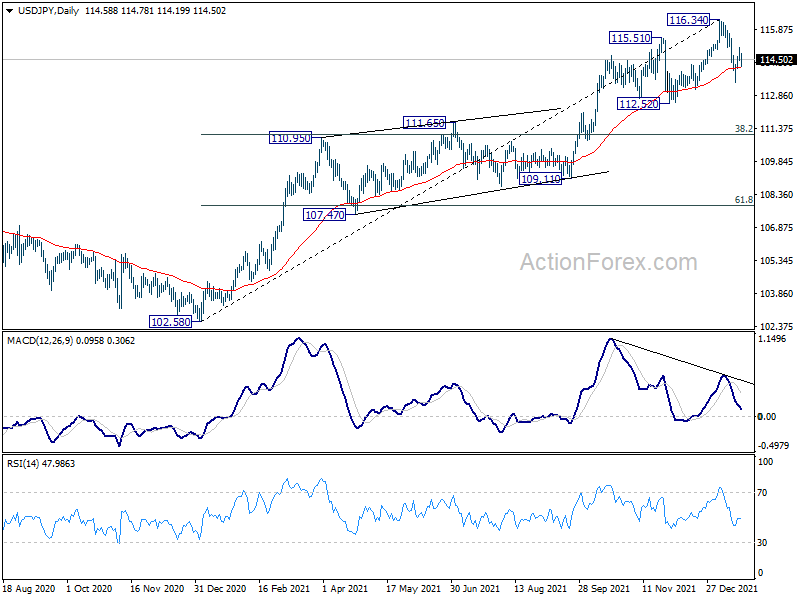
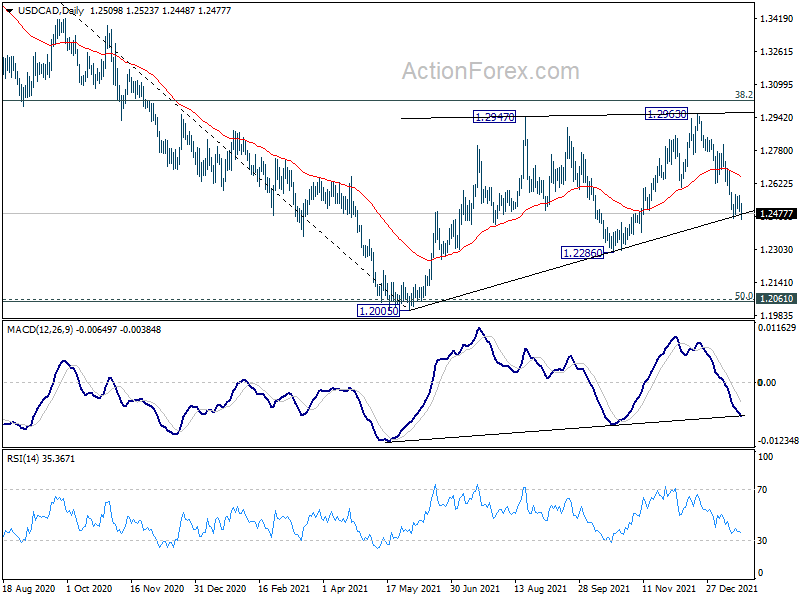
USD/CAD's fall from 1.2963 resumes by breaking 1.2452 and intraday bias is back on the downside. Current development argues that whole pattern from 1.2005 has completed with three waves to 1.2963. Below Further decline would be seen to 1.2286 support, possibly further to retest 1.2005 low. Nevertheless, on the upside, break of 1.2569 minor resistance will indicate short term bottoming and turn bias back to the upside for stronger rebound.
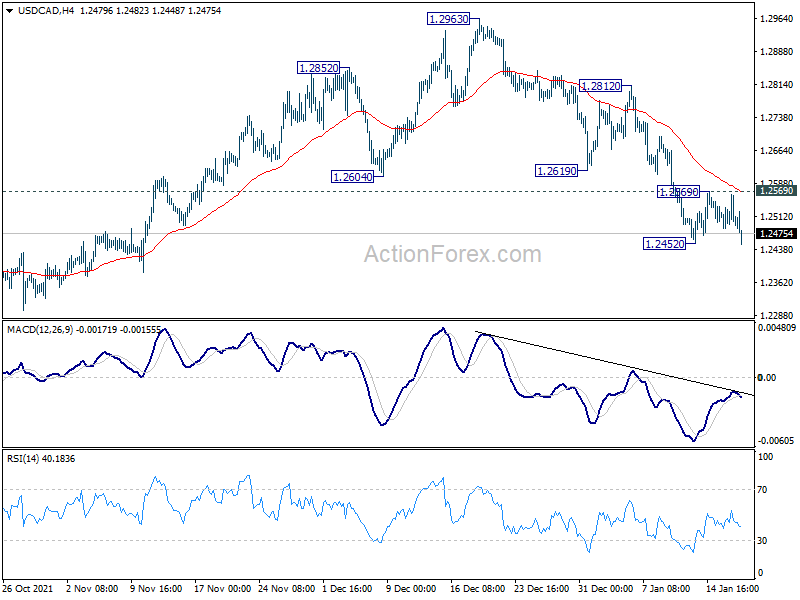
In the bigger picture, focus will be on 38.2% retracement of 1.4667 (2020 high) to 1.2005 (2021 low) at 1.3022. Sustained break there should confirm that the down trend from 1.4667 has completed after defending 1.2061 long term cluster support. Further rise would then be seen towards 61.8% retracement at 1.3650. However, rejection by 1.3022 will maintain medium term bearishness. Break of 1.2005 will resume the down trend form 1.4667 and that carries larger bearish implications too.
CAD Rises after Strong CPI, Dollar Retreats
Canadian Dollar jumps higher again after data should consumer inflation rose further to multi-decade high. On the other hand, Dollar is paring some gains as stock markets are trying to recover. As for the week so far, Euro remains the worst performing one. Sterling is next and will look into BoE Governor Andrew Bailey's comments. Yen and Swiss Franc are mixed for now.
Technically, USD/JPY's breach of 114.30 minor support suggests that recovery from 113.47 is finished. Deeper fall could be seen to this support. We'll see if greenback's weakness would be displayed in other Dollar pairs. Or, Yen is staging a more broad-based recovery with GBP/JPY breaking through 154.86 minor support.
In Europe, at the time of writing, FTSE is up 0.61%. DAX is up 0.69%. CAC is up 0.93%. Germany 10-year yield is up 0.0078 at -0.008. Earlier in Asia, Nikkei dropped -2.80%. Hong Kong HSI rose 0.06%. China Shanghai SSE dropped -0.33%. Singapore Strait Times rose 0.12%. Japan 10-year JGB yield dropped -0.0148 to 0.137.
Canada CPI rose to 4.8% yoy in Dec, highest since 1991
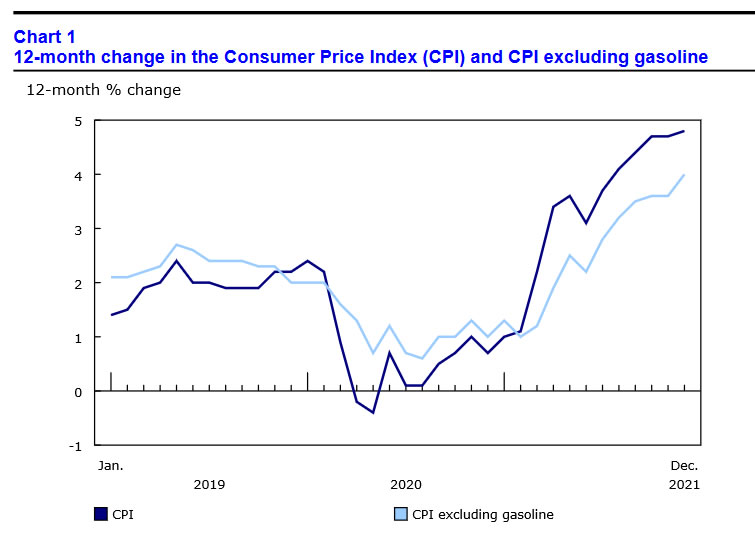
Canada CPI ticked up from 4.7% yoy to 4.8% yoy in December above expectation of 4.7% yoy. That's the highest level since September 1991. Excluding gasoline, CPI rose 4.0% yoy. On monthly basis, CPI dropped -0.1% mom, first decline since December 2020, in response to lower demand due to Omicron.
CPI common rose from 2.0% yoy to 2.1% yoy matched expectations. CPI median rose from 2.8% yoy to 3.0% yoy, above expectation of 2.9% yoy. CPI trimmed jumped from 3.4% yoy to 3.7% yoy, above expectation of 3.4% yoy.
Also from Canada, wholesales sales rose 3.5% mom in November versus expectation of 2.8% mom.
From the US, housing starts rose to 1.7m annualized in December while building permits rose to 1.8m annualized.
UK CPI accelerated to 5.4% yoy in Dec, core CPI rose to 4.2% yoy
UK CPI accelerated to 5.4% yoy in December, up from 5.1%, above expectation of 5.2% yoy. This is the highest reading since record began in 1997. CPI core rose to 4.2% yoy, up from 4.0% yoy, above expectation of 4.0% yoy.
Also released, PPI input came in at -0.2% mom, 13.5% yoy, versus expectation of 0.7% mom, 13.7% yoy. PPI output was at 0.3% mom, 0.6% yoy, versus expectation of 0.6% mom, 9.4% yoy. PPI output core was at 0.5% mom, 8.7% yoy, versus expectation of 0.8% mom, 8.6% yoy.
Australia consumer sentiment dropped to 102.2 in Jan, cautiously pessimistic on economic conditions
Australia Westpac-MI consumer sentiment index dropped from 104.3 to 102.2 in January. The -2% decline was much better than the -5.2% fall during the first month of the delta outbreak in New South Wales, the -6.1% drop in Victoria's second wave in 2020, not to mention the epic -17.7% collapse in early 2020.
The 'economic conditions, next 12 months' sub-index dropped -9.6% from 104.9 to 94.8, a swing from "cautious optimism to cautious pessimism". 55% of respondents, an outright majority, expected mortgage interest rates to rise over the next 12 months. Unemployment Expectations Index increased by 8.2% to 112.7, marking a significant deterioration.
RBA would make a decision on the bond purchases program at the February 1 meeting. Westpac expects the central bank to choose to "scale back rather than full wind down, in response to the sudden emergence of Omicron. But that would depend on the upcoming employment and inflation data.
Silver resumes rebound from 21.39, targeting 23.90 first
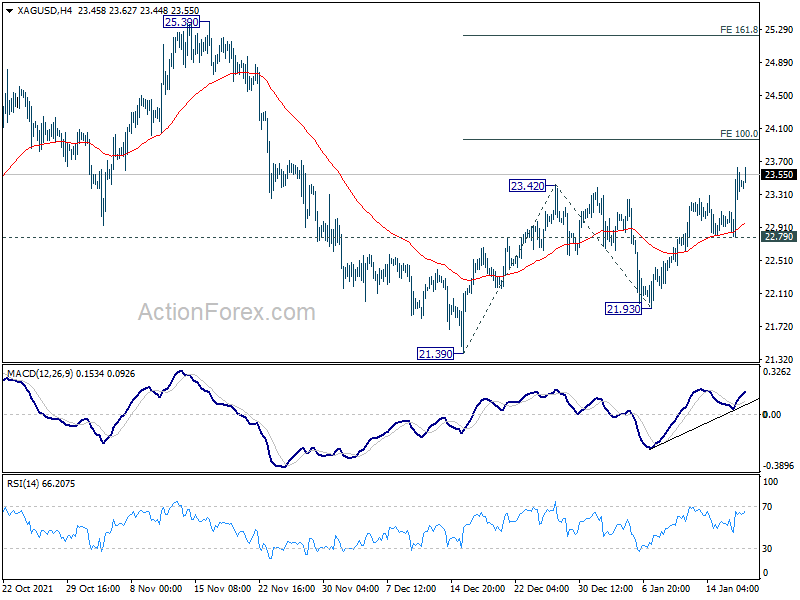
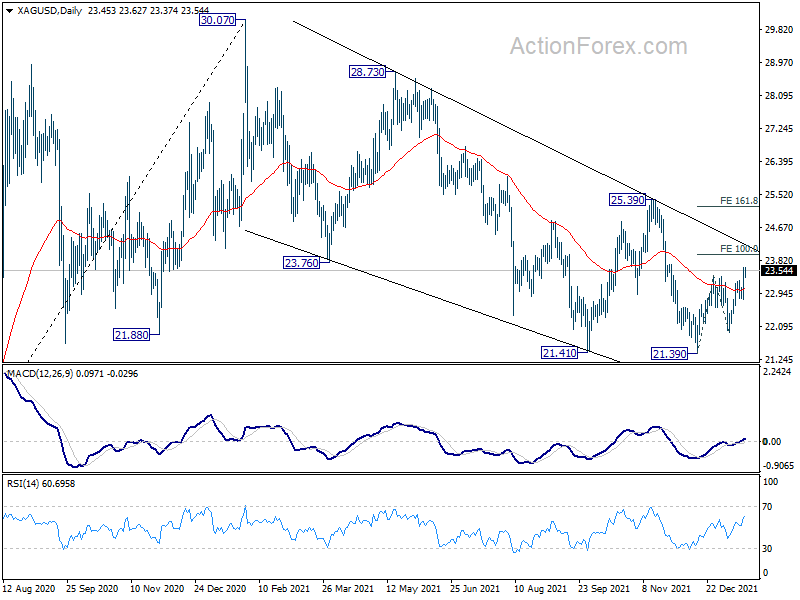
Silver's rebound from 21.39 resumed by breaking through 23.42 and hitting as high as 23.63 so far. Further rise is now in favor as long as 22.79 support holds. Next target is 100% projection of 21.39 to 23.42 from 21.93 at 23.90.
The main question is still on whether corrective pattern from 30.07 has completed as a five-wave descending triangle at 21.39. Break of 23.90 projection level will affirm the bullish case. Upside acceleration could then follow to 161.8% projection at 25.21, which is close to 25.39.
However, rejection by 21.39 will keep the rebound from 21.39 corrective and maintain medium term bearishness.
USD/CAD Mid-Day Outlook
Daily Pivots: (S1) 1.2478; (P) 1.2521; (R1) 1.2556; More...
USD/CAD's fall from 1.2963 resumes by breaking 1.2452 and intraday bias is back on the downside. Current development argues that whole pattern from 1.2005 has completed with three waves to 1.2963. Below Further decline would be seen to 1.2286 support, possibly further to retest 1.2005 low. Nevertheless, on the upside, break of 1.2569 minor resistance will indicate short term bottoming and turn bias back to the upside for stronger rebound.
In the bigger picture, focus will be on 38.2% retracement of 1.4667 (2020 high) to 1.2005 (2021 low) at 1.3022. Sustained break there should confirm that the down trend from 1.4667 has completed after defending 1.2061 long term cluster support. Further rise would then be seen towards 61.8% retracement at 1.3650. However, rejection by 1.3022 will maintain medium term bearishness. Break of 1.2005 will resume the down trend form 1.4667 and that carries larger bearish implications too.
Economic Indicators Update
| GMT | Ccy | Events | Actual | Forecast | Previous | Revised |
|---|---|---|---|---|---|---|
| 07:00 | EUR | Germany CPI M/M Dec F | 0.50% | 0.50% | 0.50% | |
| 07:00 | EUR | Germany CPI Y/Y Dec F | 5.30% | 5.30% | 5.30% | |
| 07:00 | GBP | CPI M/M Dec | 0.50% | 0.30% | 0.70% | |
| 07:00 | GBP | CPI Y/Y Dec | 5.40% | 5.20% | 5.10% | |
| 07:00 | GBP | Core CPI Y/Y Dec | 4.20% | 4.00% | 4.00% | |
| 07:00 | GBP | PPI Input M/M Dec | -0.20% | 0.70% | 1.00% | 1.50% |
| 07:00 | GBP | PPI Input Y/Y Dec | 13.50% | 13.70% | 14.30% | 15.20% |
| 07:00 | GBP | PPI Output M/M Dec | 0.30% | 0.60% | 0.90% | 1.00% |
| 07:00 | GBP | PPI Output Y/Y Dec | 9.30% | 9.40% | 9.10% | 9.30% |
| 07:00 | GBP | PPI Core Output M/M Dec | 0.50% | 0.80% | 0.80% | |
| 07:00 | GBP | PPI Core Output Y/Y Dec | 8.70% | 8.60% | 7.90% | 8.20% |
| 09:00 | EUR | Eurozone Current Account (EUR) Oct | 23.6B | 20.3B | 18.1B | 19.4B |
| 13:30 | USD | Housing Starts Dec | 1.70M | 1.65M | 1.68M | |
| 13:30 | USD | Building Permits Dec | 1.87M | 1.71M | 1.71M | |
| 13:30 | CAD | Wholesale Sales M/M Nov | 3.50% | 2.80% | 1.40% | |
| 13:30 | CAD | CPI M/M Dec | -0.10% | 0.20% | 0.20% | |
| 13:30 | CAD | CPI Y/Y Dec | 4.80% | 4.70% | 4.70% | |
| 13:30 | CAD | CPI Common Y/Y Dec | 2.10% | 2.10% | 2.00% | |
| 13:30 | CAD | CPI Median Y/Y Dec | 3.00% | 2.90% | 2.80% | |
| 13:30 | CAD | CPI Trimmed Y/Y Dec | 3.70% | 3.40% | 3.40% |
Stocks Fail to Recover, Dollar Remains Resilient
Elevated yields favour dollar, Canadian inflation in spotlight
Primary market focus remains centred around the Fed and how it will tackle inflation, with market participants juggling the premise of how many rate hikes will unfold this year. Expectations almost ‘guarantee’ three hikes but the dollar’s recent gains have been fuelled by rising treasury yields, which have supported the dollar index around the 95.60 mark. US stock futures are somewhat finding their feet after the correction, while the 10-year treasury yield has hit 1.84%.
The yen is holding around the 114.50 level per dollar, while gold ticks marginally higher to $1,818 /oz.
UK inflation at highest level since 1992, euro lags despite pickup in growth
Realistically the ECB will stick to its guns in jumping onto the rate train, set to the timeline of early 2023. That said, should persisting inflationary pressures and supply shortages weigh on economic growth in the eurozone, which has recently gained some momentum, bets of a hike could increasingly poke at markets.
The euro has failed to sustain recent headways, and should the dollar continue to lead, the common currency could remain subdued for a while longer (currently at $1.1335). EURGBP has slid close to the 0.8300 mark as the euro lags the better performing pound, which is also holding up better against the king dollar.
The pound improved to $1.3640 after ending 2021 with unexpected stronger yearly inflation data of 5.4% in December, higher than November’s 5.1%, and beating estimates. The core component also rose from November at 4.0% to 4.2% in December with consumers paying a 7.5% increase in goods on a yearly basis in December, the most since 1991.
The stronger inflation data in the UK today - mainly around soft consumables - has improved the odds that the Bank of England is most likely to proceed with raising interest rates in February, as this has underpinned pressure households are currently facing. Households are encountering increases in everyday goods, while improvements in wages lag, and ministers are considering ways to soften another blow, estimated to hit households in April, that being a surge in utility bills.
Later today at 14:15 GMT Governor Bailey is due to speak regarding the BoE Financial Stability Report before the Treasury Select Committee, in London.
Oil uptrend intact and loonie stout ahead of CPI data
WTI futures are around $86.30 per barrel, above seven-year highs. Supply disruptions, production gaps on OPEC+ side, shrinking stockpiles and robust demand may be the perfect recipe to underpin oil further.
Canada’s inflation figures will be released today at 13:30 GMT and are likely to provide a clearer picture in relation to whether the Bank of Canada will cement a rate hike next Wednesday. The Canadian economy is very strong even though it is confronted with elevated inflation and supply shortages. Stronger inflation figures could strengthen the loonie, sending the pair to test the C$1.2450.
US building permits and new housing starts are due at 13:30 GMT, while BoE Governor Bailey is due to speak at 14:15 GMT.
Canada CPI rose to 4.8% yoy in Dec, highest since 1991
Canada CPI ticked up from 4.7% yoy to 4.8% yoy in December above expectation of 4.7% yoy. That's the highest level since September 1991. Excluding gasoline, CPI rose 4.0% yoy. On monthly basis, CPI dropped -0.1% mom, first decline since December 2020, in response to lower demand due to Omicron.
CPI common rose from 2.0% yoy to 2.1% yoy matched expectations. CPI median rose from 2.8% yoy to 3.0% yoy, above expectation of 2.9% yoy. CPI trimmed jumped from 3.4% yoy to 3.7% yoy, above expectation of 3.4% yoy.
Temporary Reprieve
Equity markets are recovering some of yesterday's losses but anxiety and uncertainty continue to dominate after a disappointing start to earnings season.
Inflation and interest rate concerns are going nowhere soon and with traders now increasingly considering the possibility of hikes larger than 25 basis points, the possibility of more pain in stock markets is very real.
The idea that we could go from rock bottom rates and enormous bond-buying to rapid tapering, 50 basis point hikes, and earlier balance sheet reduction is quite alarming. We're talking about markets that have become very accustomed to extensive support from central banks and very gentle unwinding when appropriate. This is quite a shock to the system.
And so far earnings season is not providing investors the comfort they were hoping for. Significant compensation increases and lower trading revenues hurt JP Morgan and Goldman Sachs, and higher wage demands are likely to be a common theme throughout the next few weeks which will put a dampener on the bottom line and not alleviate concerns about persistent and widespread price pressures.
UK inflation jumps again ahead of Bailey appearance
The CPI data from the UK this morning compounded inflation concerns, hitting a 30-year high and once again surpassing expectations in the process. And it's highly unlikely we're seeing the peak, with that potentially coming around April when the cap on energy tariffs is lifted considerably to reflect higher wholesale prices. Other aspects will also contribute to higher levels of inflation at the start of the second quarter, at which point we may have a better idea of how fast it will then decline.
Of course, the Bank of England can't just turn a blind eye until then. The MPC may be willing to overlook transitory inflationary pressures but the rise in CPI has proven to be neither temporary nor tolerable. Instead, it's become more widespread and the central bank is being forced to act and may do so again next month after raising interest rates for the first time since the pandemic in December. A few more hikes after that are also priced in for this year but if pressures continue to mount, traders may begin to speculate about the possibility of larger hikes, as we've seen starting in the US.
All of this should make Andrew Bailey's appearance before the Treasury Select Committee later today all the more interesting. The central bank has warned of higher inflation and possible interest rate hikes for months but delayed doing so after initial hints ahead of the November meeting. Given what's happened since, the decision looks all the more strange. Of course, it's easy to say that with 20/20 hindsight.
Oil gathering momentum as $100 oil looks increasingly likely
Oil prices are continuing to climb on Wednesday and find themselves only a little shy of $90 a barrel. This happened as IEA confirmed that the market looks tighter than previously anticipated as a result of stronger demand, despite omicron, and the inability of OPEC+ to hit its monthly increased production targets. This imbalance has led to surging prices which will further pressure households and businesses already fighting high inflation.
What's more, not only does the rally not appear to be losing steam, it may have even generated fresh momentum. While $90 could have triggered some profit-taking and a minor cooling of prices, this suggests they'll see no reprieve and we could realistically see $100 oil soon.
Can gold break higher as traders speculate about more rate hikes
Gold is marginally higher again after the easing over the course of the last week. The yellow metal is continuing to struggle around $1,833 which has been a surprisingly strong level of resistance over the last six months. But support is returning after it came close to $1,800 so a break to the upside remains a strong possibility.
Given the calls for even more rate hikes this year than markets are pricing in, not to mention larger individual increases than we've seen for many years, perhaps we are seeing some inflation hedging from traders that don't think central banks are doing enough to bring price pressures down.
Consolidation continues
Bitcoin appears to have gotten lost in the noise of the last few weeks. It's not falling too hard despite risk assets getting pummelled but it's not recovering to any great extent either. Instead, it's floating between support at $40,000 and resistance around $45,000 and showing no signs of breaking either at this point.
Canadian Dollar Falls Below 1.25
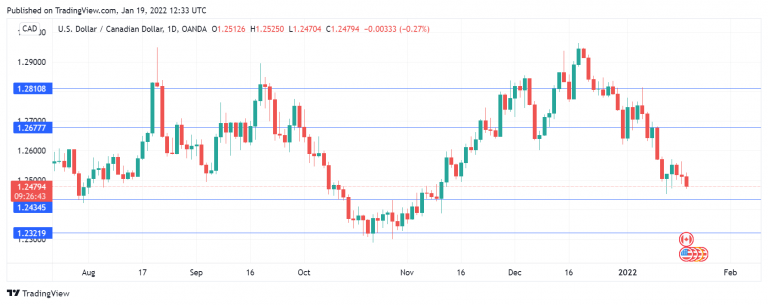
The Canadian dollar continues to push higher and USD/CAD has dropped below the symbolic 1.25 line. The pair is currently trading at 1.2476 and is close to 1.2553, its lowest level since November 10th.
US Treasury rates continue to move higher. After punching past 1.80% on Tuesday, a 2-year high, the 10-year rate has climbed to 1.90%. The 10-year rate hasn’t been above the symbolic 2% level since July 2019, but it looks poised to climb above that line shortly. The jump in US yields is reflective of market concerns that the Fed will accelerate its tightening. Last week, FOMC member Patrick Harker said that the Fed could raise rates three or four times this year. That was not big news, but the markets paid attention when JP Mogan’s CEO Jamie Dimon weighed in and stated that the Fed might hike six or seven times. Higher yields should provide a boost for the US dollar.
Will Canada CPI be a market-mover?
Canada will release CPI data for December later in the day. The headline reading is expected in at 4.8%, while core CPI is forecast at 3.5%. These inflation readings will be carefully monitored by the BoC and could be a market-mover for the Canadian dollar. If the inflation reports prove to be a big miss, the Canadian dollar could lose ground, as expectations that the BoC will raise rates next week would ease. Conversely, strong reading will provide support for the bank to raise rates next week, which is bullish for the Canadian dollar.
Oil prices are a key driver for the Canadian dollar, and the recent jump in oil prices has helped boost the currency, with USD/CAD falling by 1.33% in January. With geopolitical tensions rising in the Persian Gulf and Ukraine, oil could head closer towards the USD 100 level, which would be great news for the Canadian dollar.
USD/CAD Technical
- USD/CAD is testing support at 1.2513. Below, there is support at 1.2396
- There is resistance at 1.2762 and 1.2879
Equities Under Fire, Dollar Shines as Yields Soar
- Stocks remain under pressure as traders position for Fed hikes
- Dollar outperforms, yen benefits from risk aversion, euro hammered
- Oil prices keep going, Canadian inflation stats in the spotlight
All about the Fed
Bets that the Fed will take a sledgehammer to crush inflationary pressures continue to escalate. More than four rate increases are now priced in for this year, which means traders have started to entertain the idea of either a fifth increase or a ‘double’ hike of 50 basis points to shock markets and pummel inflation expectations back down.
This has translated into a mighty rally in US Treasury yields, which have powered higher to eclipse pre-pandemic levels with a little help from surging energy prices. It is really the breakneck speed of this move that has taken many investors by storm.
Once the bond market starts to ring alarm bells, that fills the stock market with fear. That’s because many players aren’t willing to take on the risk or stomach the volatility of stocks if bonds start paying a positive return. Higher yields also make it more difficult to justify pricey valuations, hence why the purge usually begins with the riskiest companies.
As such, it is the tech sector that has suffered the most damage, with the Nasdaq losing 2.6% yesterday and futures pointing to another bloody nose today. The battle could be decided around the 200-day moving average, a barrier the index has never violated during the pandemic recovery.
Dollar shines, euro takes a hit
The FX market has pretty much stuck to the script of risk aversion this week. The dollar is leading the pack as rate differentials continue to widen in its favor and nervous traders look for shelter in the reserve currency. And while rising yields are usually anathema for the yen, that hasn’t played out this time, with its safe-haven qualities outshining its rate disadvantage.
Instead, the biggest loser has been the euro. Even though European yields have also joined the global rally, with the German 10-year turning positive today for the first time since 2019, American yields are rising much faster. That has clipped euro/dollar’s wings.
The bad news is that there’s more scope for losses. Money markets are currently pricing in 20 basis points of ECB rate increases by year-end, which seems rather unrealistic given the gloomy growth prospects in the euro area, even if inflation has fired up.
Oil stays elevated, loonie awaits inflation test
Elsewhere, oil prices remain elevated near multi-year highs, benefiting from a combination of supply concerns and demand hopes. An explosion in a pipeline running from Iraq to Turkey was the latest episode in a series of production disruptions lately, while on the demand side, there are growing hopes the pandemic might be downgraded to an endemic soon.
As for today, British inflation data have already been released and showed another acceleration in price pressures. That has almost sealed the deal for a Bank of England rate increase next month, which is currently priced in with a 95% probability. And yet sterling has been unable to capitalize, mirroring the sour mood in equity markets instead.
The spotlight will fall on the Canadian dollar later today as the nation’s latest inflation numbers could either lead traders to fully price in a Bank of Canada rate hike for next week, or turn the event into a coin toss.
Finally, the earnings season will fire up with Bank of America, Morgan Stanley, Procter & Gamble, and ASML Holdings reporting their quarterly results.
Gold Shackled in a Neutral Trajectory as Driving Forces Fade
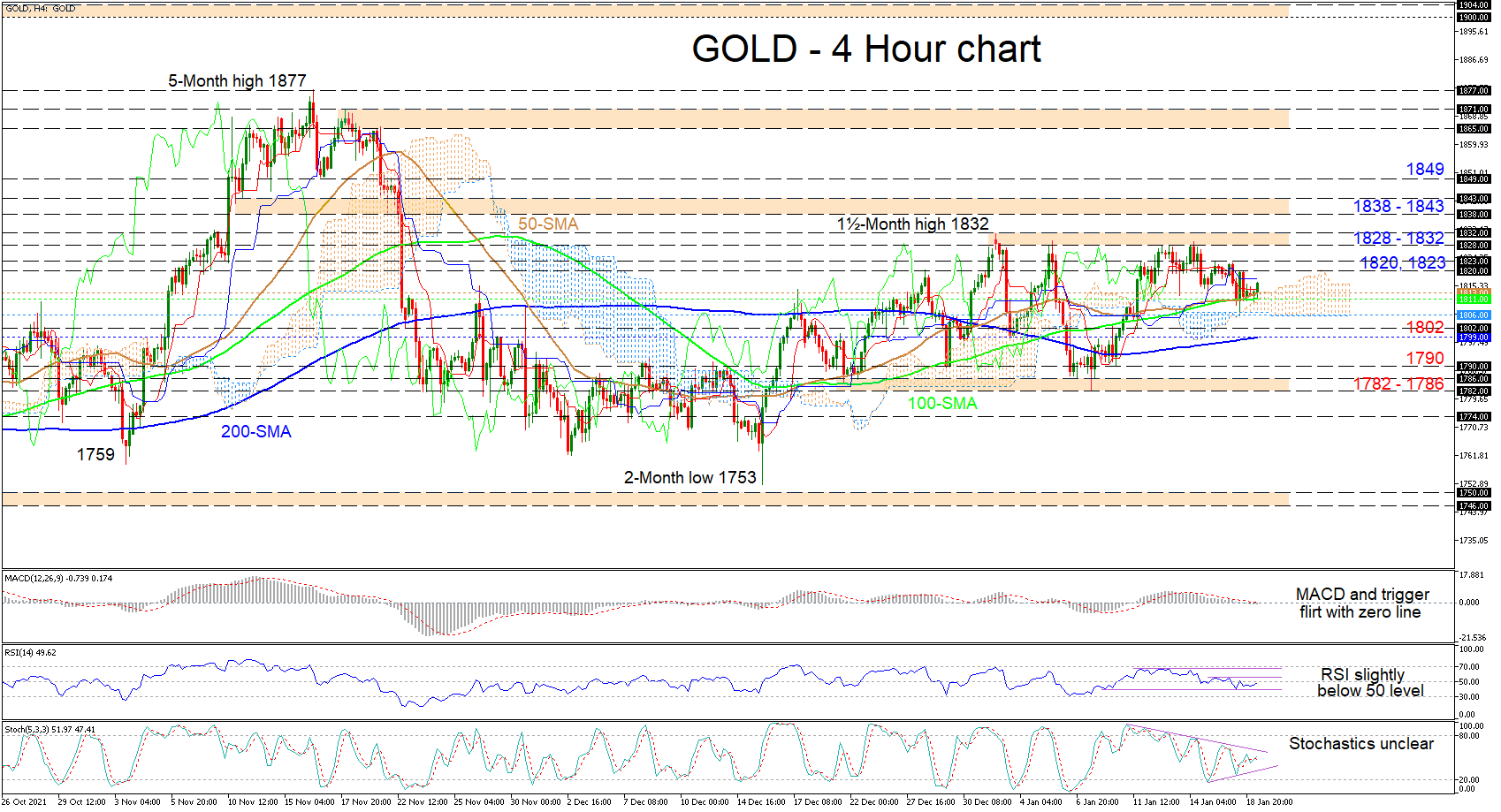
Gold has fairly flatlined around the Ichimoku clouds’ upper band, where the 50- and 100-period simple moving averages (SMAs) are also residing. Directional momentum seems to have dried up even though the SMAs are endorsing a modest upside bearing.
The Ichimoku lines are indicating the absence of directing impetus, while the short-term oscillators are not suggesting any clear price preference in the precious metal. Momentum is lacking, something also being demonstrated by the MACD and red trigger line, which are both toying with the zero threshold. The RSI is slightly underneath the 50 level and is showing weakness in directional momentum. The consolidating stochastic lines are currently not reflecting a commanding price direction.
In the positive scenario, initial upside hindrance could develop around the nearby 1,820 and 1,823 highs. Efforts to improve further may then be opposed by the 1,828-1,832 resistance ceiling. If the bulls successfully overstep this obstacle, they may meet the 1,838-1,843 resistance border before pursuing the 1,849 barrier.
Otherwise, for the price to steer lower, sellers would need to overpower the immediate support zone from the 50-period SMA at 1,813 until the cloud’s lower surface at 1,806, an area which encompasses the 100-period SMA, the recent low and the cloud. Should the bears take the lead, the next support section could evolve between the 1,802 barrier and the 200-period SMA at 1,799. Sinking further, the 1,790 obstacle may come into play before the 1,782-1,786 base draws traders’ attention.
Summarizing, gold is sustaining a neutral bias between the lower limit of 1,782-1,786 and the upper limit 1,828-1,832. A break of these boundaries could fuel a clearer price direction.
NZD Rises as US Dollar Rally Pauses
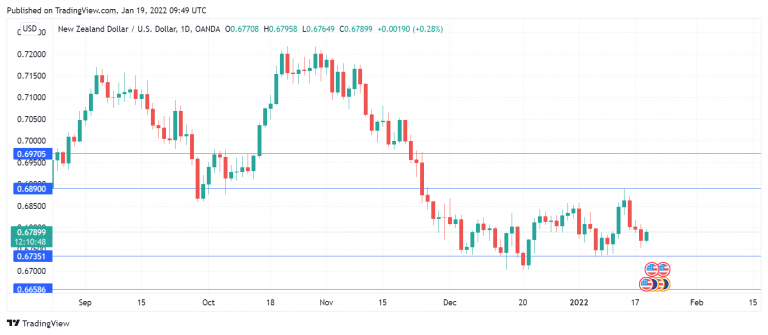
After falling over 1% since late last week, the New Zealand dollar is in positive territory on Wednesday. NZD/USD is trading at 0.6785 in the European session, up 0.19% on the day.
ANZ says RBNZ to hike up to 3%
The RBNZ has embarked on a series of incremental interest rate hikes, starting with two hikes of 25 bps in the fourth quarter of 2021, bringing the current rate to 0.75%. How far will the bank go? The ANZ Bank had projected in October that the rates would reach 2% by April 2023, but now says that rates will reach 3% by that date. ANZ wrote that this updated forecast is not due to stronger growth, but rather surging inflation and the tight labour market. ANZ noted that inflation is galloping above 5%, as is inflation expectations, which means that an OCR of 3% would be “modest”. If more analysts adopt this view, expectations of higher interest rates should boost the New Zealand dollar.
Omicron continues to cause headaches for the New Zealand government. The number of Omicron cases remains quite low, but the country has imposed tight border controls to combat the virus. The government is now closing its border to New Zealand citizens and is trying to boost the vaccination rates. Still, it’s doubtful that the country can keep Omicron at bay, and a spike in cases could lead to renewed lockdowns which would hamper economic growth.
US Treasury rates continue to creep higher. After punching past 1.80% on Tuesday, a 2-year high, the 10-year rate has climbed to 1.89%. The 2% level, which is psychologically significant, is within striking distance. Higher US bonds, a reflection of market worries about accelerated Fed tightening, have boosted the US dollar against most of the major currencies.
NZD/USD Technical
- NZD/USD is putting pressure on resistance at 0.6912. Next, there is resistance at 0.6967
- 0.6844 is providing support. Below, there is support at 0.6721