

Sample Category Title
EUR/CHF Daily Outlook
Daily Pivots: (S1) 0.9235; (P) 0.9252; (R1) 0.9263; More....
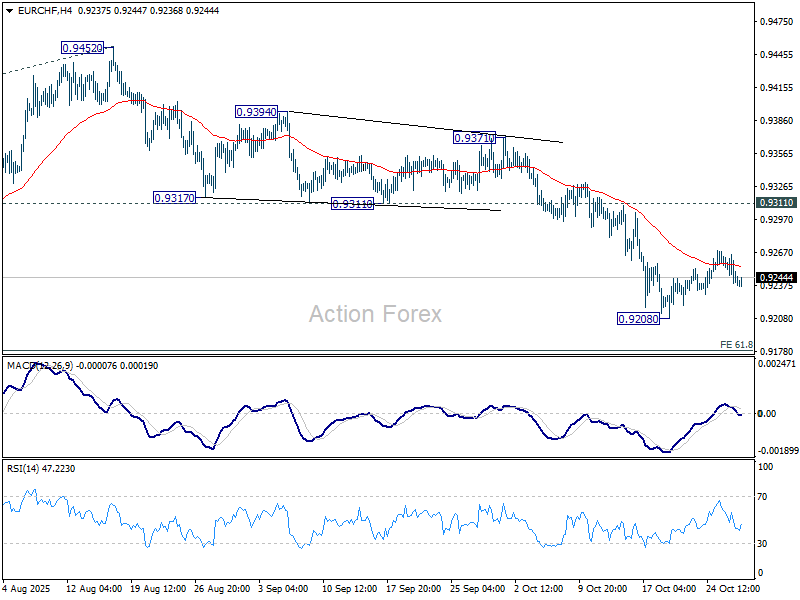
Intraday bias in EUR/CHF remains neutral and more consolidations could still be seen above 0.9208 support. Upside should be limited below 0.9311 support turned resistance. On the downside, break of 0.9204/8 will confirm larger down trend resumption. Next target is 61.8% projection of 0.9660 to 0.9218 from 0.9452 at 0.9179. Firm break there will target 100% projection at 0.9010.
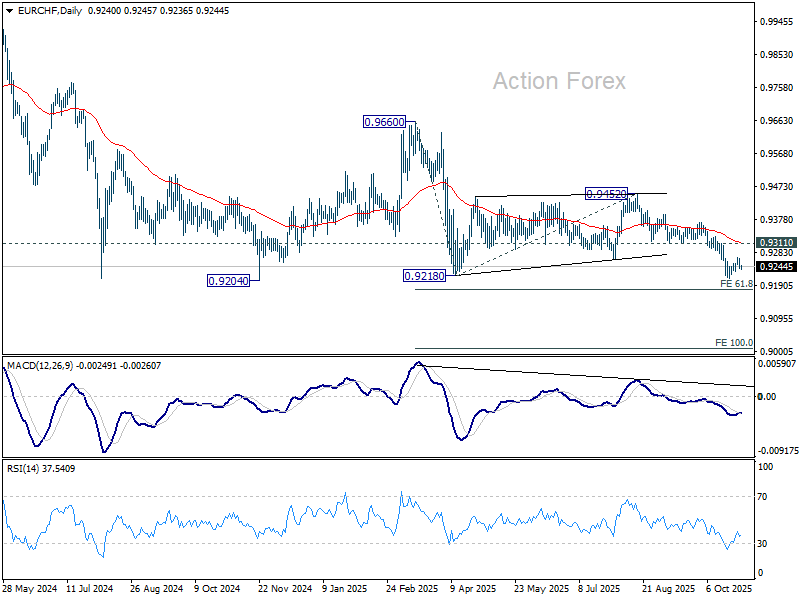
In the bigger picture, outlook remains bearish with EUR/CHF staying well inside long term falling channel after multiple rejection by 55 W EMA (now at 0.9385). Firm break of 0.9204 will resume the whole down trend from 1.2004 (2018 high). Next target is 61.8% projection of 1.1149 to 0.9407 from 0.9928 at 0.8851. Break of 0.9452 resistance is needed to be the first sign of medium term bottoming.
FOMC Meeting Takes Centre Stage
In focus today
The main event today will be the FOMC's rate decision, where we and the broad market consensus expect a 25bp cut. With no new projections, all eyes will be on Powell's forward guidance, which we expect to remain vague. While markets price in a high likelihood of another cut in December, we do not expect the Fed to pre-commit at this stage. We expect the Fed to end QT for US Treasury holdings but continue QT for MBS. Read more in Reading the Markets USD, 28 October. Note that in Europe, the rate decision comes one hour earlier than usual (19CET/20EET) due to the US daylight savings time.
In Norway, private consumption has seen a solid uplift this year, as expected given high real wage growth, low unemployment and some tailwind from lower mortgage rates. Fundamentals should continue to support private consumption, but current data suggests a moderate decline of around 0.3% in September.
In Sweden, the GDP-indicator for September and Q3 should, as usual, be interpreted with caution. Consensus expectations for Q3 stand at +0.7% q/q and +1.6% y/y. Following an improvement in Q2, the economy appears to be trending upward after a long period of sideways development.
Overnight, US President Trump and Chinese President Xi are set to meet on the sidelines of the APEC Summit in South Korea. The agenda is packed, given recent escalations including China's export controls on rare earths and Trump's tariff threats. We expect the two leaders to strike a deal to ease tensions, however, failure to reach an agreement could trigger a negative reaction in risk markets.
Overnight, the Bank of Japan (BoJ) meets to decide on the next steps in policy normalisation. With Abenomics loyalist Sanae Takaichi now leading the government and recent spending and wage data showing weakness, we expect the BoJ to take a cautious stance and leave the policy rate unchanged. However, we still see solid arguments for further tightening and anticipate a potential rate hike at the December meeting.
Economic and market news
What happened yesterday
In the euro area, the ECB's Bank Lending Survey showed a slight, unexpected tightening of credit standards for firms in Q3 due to higher risk perceptions. Firm loan demand remains weak, while household demand grew strongly. Overall, the survey supports the view that monetary easing policies are still feeding through to bank lending, but the pace of transmission appears slower, with broadly stable loan demand and a slight tightening of supply.
In the US, consumer confidence improved modestly in October, rising to 94.6 (cons: 93.2). The report was mixed, with a slight improvement in the assessment of the current situation, though consumer confidence remains on a declining trend overall. Future expectations continued to weaken, reflecting persistent uncertainty.
In China's more detailed communiqué on its upcoming 2026-2030 Five-Year Plan, the focus is on boosting consumption and shifting to a domestic demand-driven economy. Compared to the initial communiqué, which used softer language, this update signals a stronger emphasis on consumption as a key driver of economic growth.
In Sweden, the Riksbank Business Survey showed a weaker-than-expected assessment of the current economic situation and outlook for Sweden. Pricing plans have dropped sharply, but the impact of the upcoming VAT cut on food remains unclear. Here, it will be interesting to see the NIER survey on Thursday, which is more granular on a sector level.
Equities: Equities were slightly higher yesterday on the surface, however beneath that we saw that the "only" reason for a green day was due to Mag7 (up about 1.3%). Otherwise, it was day with sour risk sentiment. Only 21% of the S&P500 ended with a positive return yesterday yet it ended 0.23% up. Thus, if we exclude the Mag7, the S&P493 was down -0.6%. Looking at the tech index, it was a semi-conductor driven rally, not least also due to Nvidia's Jensen Huang dismissing concerns over an AI bubble and also Nvidia broadening its scope with them taking a USD1bn equity stake in Nokia. Russel2000 was down 0.6%, with Dow Jones up 0.3% and Nasdaq 0.8%. Stoxx 600 down -0.2%. Overnight, the sentiment continued in Asia. The indices are up (Nikkei +1.9% and Shenzen +0.5%), but largely focused on tech.
FI and FX: EUR/USD continues to trade in the mid-1.16-1.17 range, moving towards 1.1630 overnight, as markets await today's FOMC meeting. A 25bp cut looks all but certain, with attention shifting to whether the Fed signals an end to QT and to Powell's tone at the press conference. Fixed income markets were in wait-and-see mode yesterday with European and US yields ending the day broadly unchanged. EUR/SEK continues to trade in the lower end of the long-held 10.90-11-10 range, but we continue to favour the upside tactically in EUR/SEK. Similarly, we maintain our bullish EUR/NOK view.
Who Needs Data When Nvidia is Out Announcing Deals?
At yesterday’s GTC conference, Nvidia CEO Jensen Huang unveiled a fresh round of partnerships with Nokia, Palantir, Uber, and the US Department of Energy.
Nvidia will team up with the DoE to build seven AI supercomputers — meaning a lot of chips heading to the government.
Nvidia also plans to invest $1 billion in Nokia to help transform the Finnish networking company into an AI-driven firm. Nokia, in turn, will use Nvidia chips to accelerate its 5G and 6G software development, while Nvidia will explore Nokia’s data-center strategy for its own AI infrastructure. There’s some circularity in the arrangement, but also tangible revenue potential for both companies — and investors liked what they heard: Nokia shares jumped 24%, hitting their highest level since 2010.
Nvidia also announced a collaboration with Palantir on government and industrial AI applications and customizable AI agents. According to reports, Nvidia has already booked around $500 billion worth of Blackwell and Rubin chip sales for 2025–26, and further deals with Samsung and Hyundai are expected later this week.
No surprise then that Jensen Huang insists there’s no bubble in sight. Nvidia shares soared 5%, passing the $200 mark for the first time. The S&P 500 edged to another all-time high, led by tech, while the Nasdaq 100 rose 0.74% — also supported by a 2% gain in Microsoft after it reportedly received a 27% ownership stake in OpenAI, positioning the AI startup to transition into a for-profit company.
So, you heard it — move on, there’s no bubble to see here!
Big Tech earnings remain in the center stage today with Microsoft, Meta and Alphabet reporting Q3 results after the bell. At current price levels and valuations, there’s little room for missteps — whether on earnings, spending plans or guidance. Skeptics have been calling for a broad sell-off for at least more than a year, arguing that AI revenues aren’t growing fast enough. That day may eventually come, but for three years running, Big Tech has consistently met and beaten expectations. And given the scale of deals and capex we’re seeing, it’s hard to swim against the tide — at least in Nvidia’s case. Whether AI investments generate revenue immediately or not, Big Tech has the cash to spend on Nvidia’s chips. And they are spending.
One minor setback came from ASM International, whose Q3 orders missed expectations due to weaker demand from major clients including TSMC, Intel, and Samsung. But will that discourage AI bulls from buying more? Hardly.
Of course, AI needs energy, and nuclear has re-emerged as the form of clean power best suited to meet those needs — since solar and wind can’t run the machines 24/7. Big Tech and the US government are now rolling out nuclear partnerships almost daily. The Global X Uranium ETF jumped another 8% yesterday, reaching its highest level since 2011 — a parabolic move that mirrors AI’s own hunger for energy.
And if anything, yesterday’s rally could still get a bit of sugar coating if the Federal Reserve (Fed) sounds sufficiently dovish later today. In the absence of fresh data, policymakers are effectively acting half-blind, but the market widely expects a 25-basis-point rate cut and possibly an end to quantitative tightening (QT), as much of the pandemic-era liquidity has now evaporated. Some even expect the Fed to announce an immediate end to QT today — which would certainly lift market sentiment: the more liquidity, the more fuel for assets. And with roughly $7.5 trillion parked in US money market funds, lower rates could push investors toward riskier corners of the market.
The US dollar remains under pressure. Although it was slightly better bid in Asia, a dovish Fed statement could renew selling. Still, the downside looks limited for the greenback, given how unappealing the major alternatives currently are:
- Japanese yen: Little appetite amid talk of a softer Bank of Japan (BoJ) stance, which could push the USDJPY toward the 155–160 range by year-end.
- Euro: Confidence remains shaky amid ongoing French political turmoil and fears of another government collapse.
- Sterling: Investors are cautious ahead of the Autumn Budget, and yesterday’s BRC inflation report showed the sharpest drop in food prices since the pandemic, largely due to falling sugar prices — a boost for Bank of England (BoE) doves.
So, the dollar’s stabilization — despite a looming US government shutdown — owes more to a lack of alternatives than genuine demand. A dovish Fed could change that today, though any rebound in major peers will likely be limited and may even present opportunities to fade rallies against the dollar, given how much Fed dovishness is already priced in.
As for gold, its recent slide could find support near $3’800 per ounce, just above the 23.6% Fibonacci retracement of its two-year rally.
So I’ll leave it here for today — and let Powell and the earnings do the talking for the rest of the day.
USD/CAD Daily Outlook
Daily Pivots: (S1) 1.3918; (P) 1.3962; (R1) 1.3989; More...
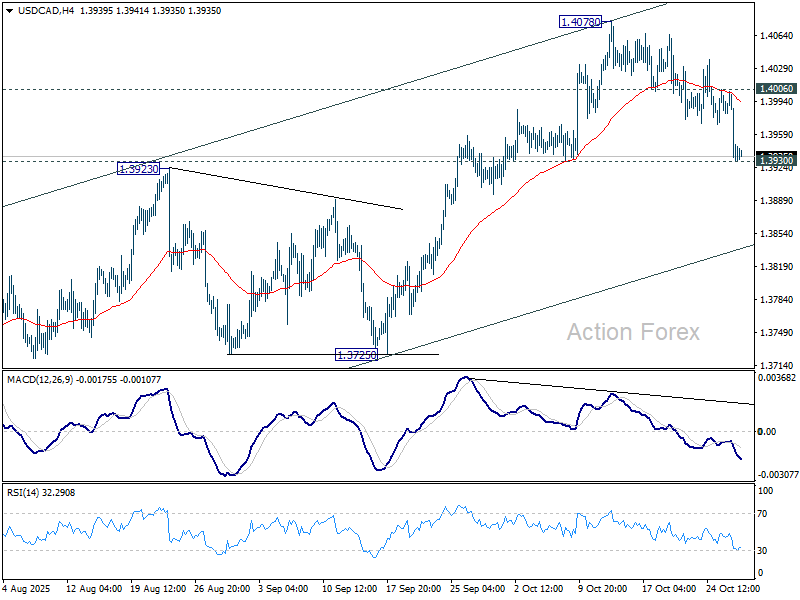
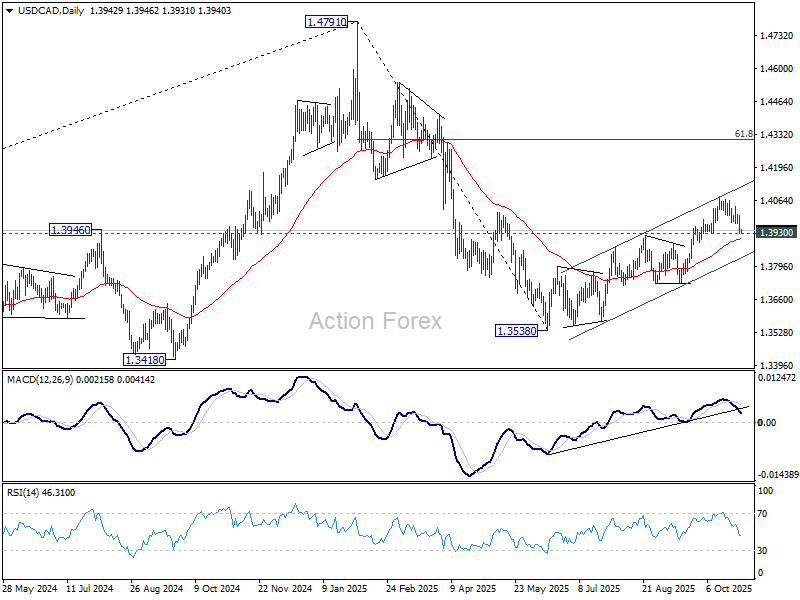
USD/CAD's fall from 1.4078 accelerated lower, but it's still staying above 1.3930 support. Intraday bias remains neutral first. On the upside, break of 1.4006 will indicate that the pullback has completed. Intraday bias will be back on the upside for 1.4078 and above to resume the rally from 1.3538. However, decisive break of 1.3930 will be the first sign of bearish reversal, and bring deeper fall to channel support (now at 1.3835).
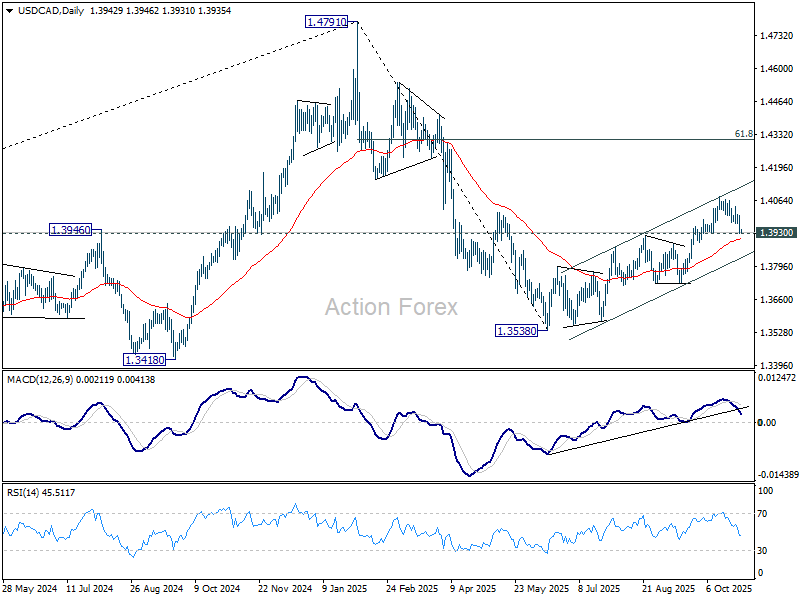
In the bigger picture, price actions from 1.4791 medium term top is likely just unfolding as a correction to up trend from 1.2005 (2021 low). Based on current momentum, rise from 1.3538 is the second leg, and a third leg should follow before up trend resumption. That is, range trading is set to extend for the medium term. For now, this will remain the favored case as long as 1.3725 support holds.
AUD/USD Daily Report
Daily Pivots: (S1) 0.6556; (P) 0.6574; (R1) 0.6602; More...
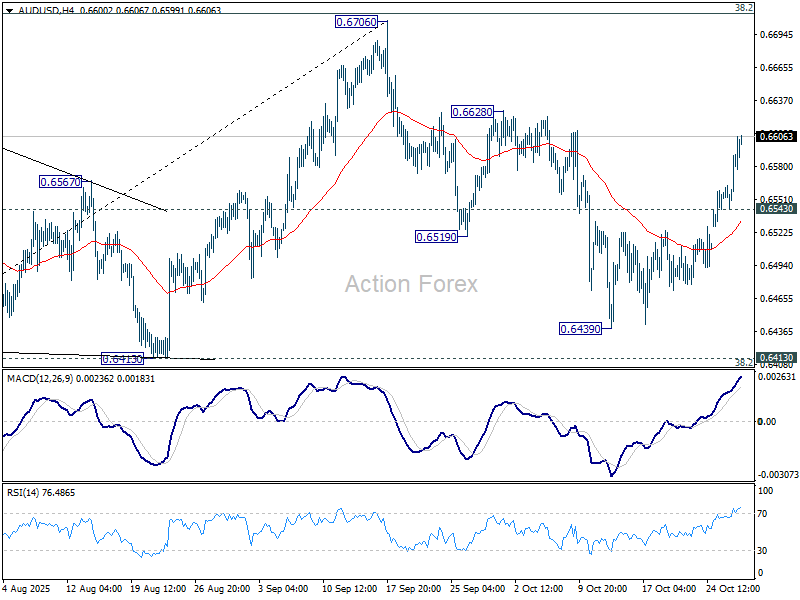
Intraday bias in AUD/USD remains on the upside at this point. As noted before, corrective fall from 0.6706 should have completed with three waves to 0.6439. Further rise should be seen to retest 0.6706 high next. On the downside, below 0.6543 minor support will turn intraday bias neutral first.
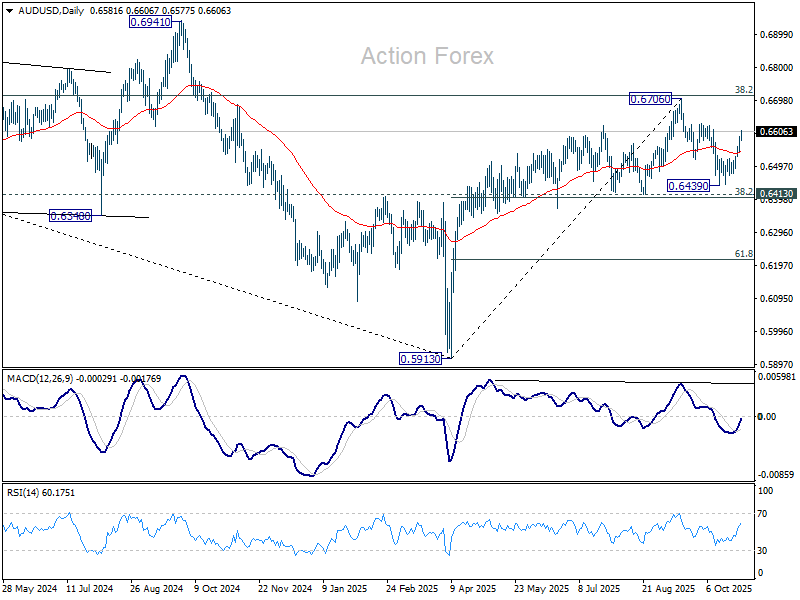
In the bigger picture, there is no clear sign that down trend from 0.8006 (2021 high) has completed. Rebound from 0.5913 is seen as a corrective move. Outlook will remain bearish as long as 38.2% retracement of 0.8006 to 0.5913 at 0.6713 holds. Nevertheless, considering bullish convergence condition in W MACD, sustained break of 0.6713 will be a strong sign of bullish trend reversal, and pave the way to 0.6941 structural resistance for confirmation.
USD/JPY Daily Outlook
Daily Pivots: (S1) 151.61; (P) 152.26; (R1) 152.75; More...
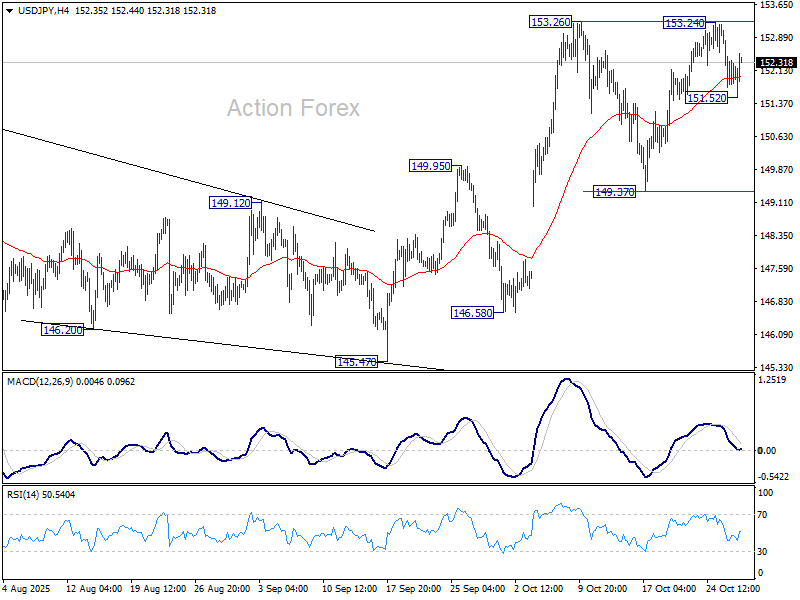
USD/JPY recovered after breaching 55 4H EMA (now at 151.99), and intraday bias is turned neutral. On the upside, firm break of 153.24 will resume larger rally from 139.87. On the downside, break of 151.52 and sustained trading below 55 4H EMA will indicate that corrective pattern from 153.26 is extending with the third leg, and target 149.37 support next.
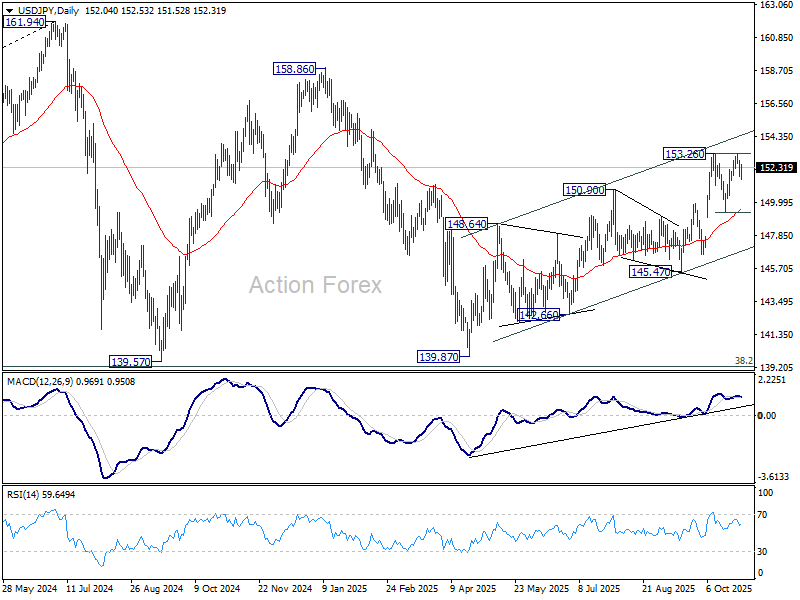
In the bigger picture, current development suggests that corrective pattern from 161.94 (2024 high) has completed with three waves at 139.87. Larger up trend from 102.58 (2021 low) could be ready to resume through 161.94 high. On the downside, break of 145.47 support will dampen this bullish view and extend the corrective pattern with another falling leg.
USD/CHF Daily Outlook
Daily Pivots: (S1) 0.7917; (P) 0.7942; (R1) 0.7959; More…
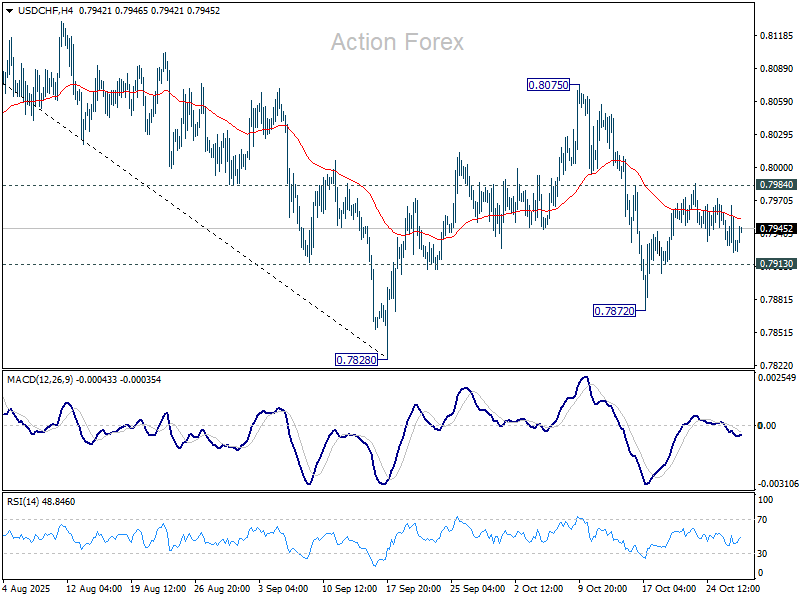
Range trading continues in USD/CHF and intraday bias stays neutral at this point. On the downside, below 0.7913 will turn bias to the downside for 0.7872 support, and then 0.7828 low. However, firm break of 0.7984 will suggest that corrective pattern from 0.7828 is extending with another rising leg, and target 0.8075 again.
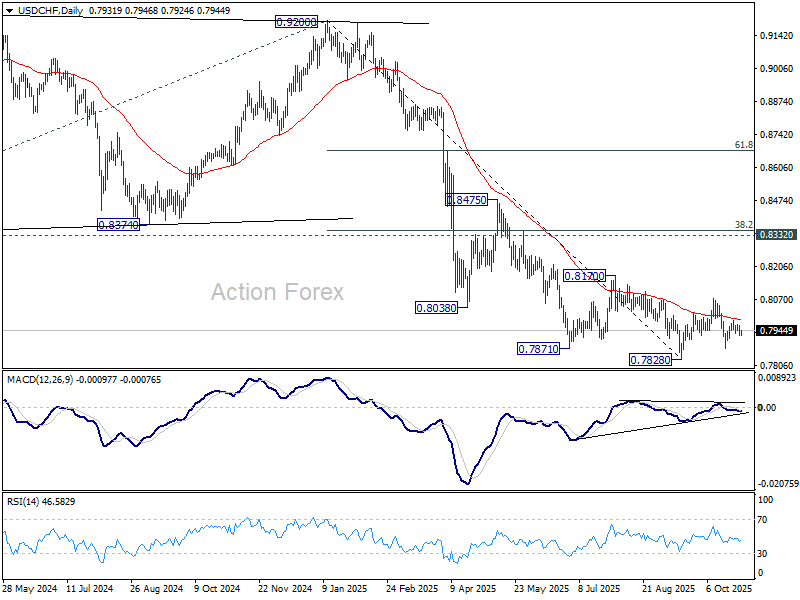
In the bigger picture, long term down trend from 1.0342 (2017 high) is still in progress. Next target is 100% projection of 1.0146 (2022 high) to 0.8332 from 0.9200 at 0.7382. In any case, outlook will stay bearish as long as 0.8332 support turned resistance holds (2023 low).
EUR/USD Daily Outlook
Daily Pivots: (S1) 1.1628; (P) 1.1648; (R1) 1.1672; More…
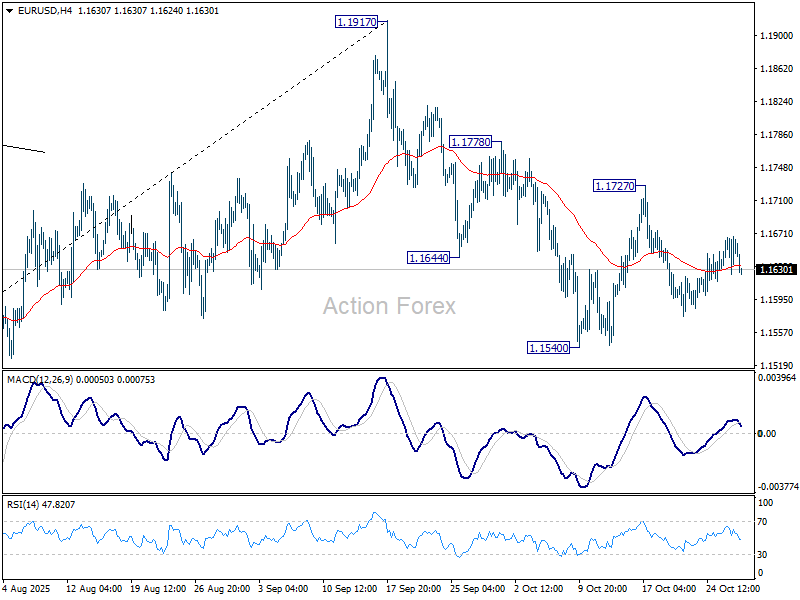
Range trading continues in EUR/USD and intraday remains neutral for the moment. On the downside, below 1.1540 will resume the fall from 1.1917 and target 1.1390 support, or even further to 38.2% retracement of 1.0176 to 1.1917 at 1.1252. On the upside, though, break of 1.1727 resistance will turn bias back to the upside for 1.1778, and then retest of 1.1917 high instead.
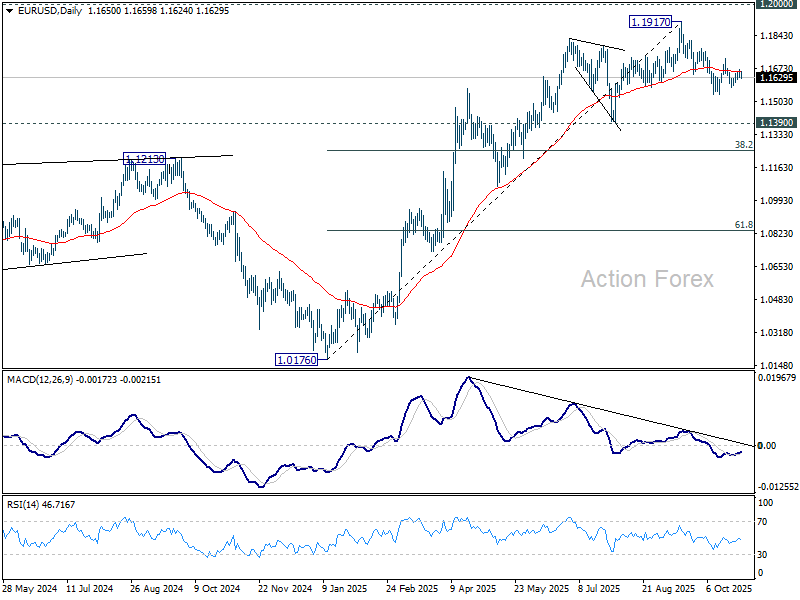
In the bigger picture, considering bearish divergence condition in D MACD, a medium term top is likely in place at 1.1917, just ahead of 1.2 key psychological level. As long as 55 W EMA (now at 1.1301) holds, the up trend from 0.9534 (2022 low) is still expected to continue. Decisive break of 1.2000 will carry larger bullish implications. However, sustained trading below 55 W EMA will argue that rise from 0.9534 has completed as a three wave corrective bounce, and keep outlook bearish.
GBP/USD Daily Outlook
Daily Pivots: (S1) 1.3223; (P) 1.3297; (R1) 1.3345; More...
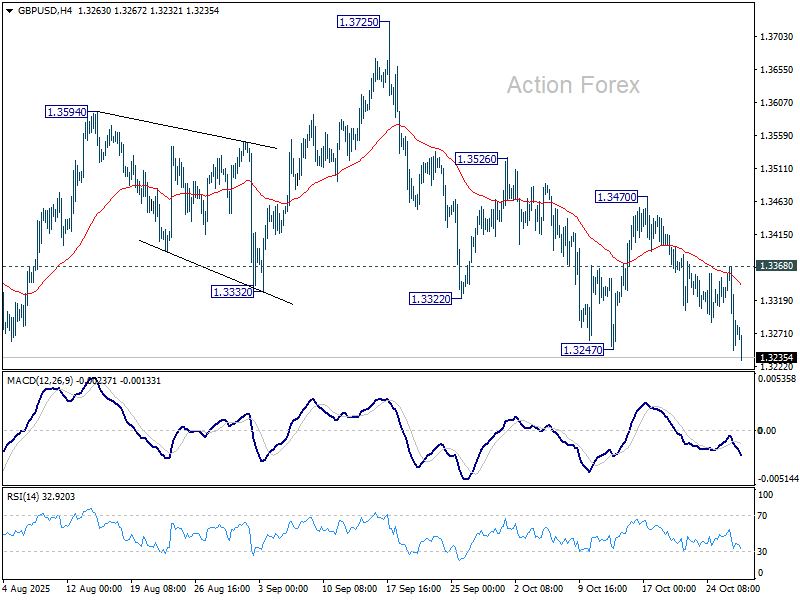
GBP/USD's fall from 1.3725 resumed by breaking through 1.3247 support today. Intraday bias is now on the downside for 1.3140 cluster (38.2% retracement of 1.2099 to 1.3787 at 1.3142). Strong support is expected there to contain downside to complete the corrective pattern from 1.3787. On the upside, above 1.3368 minor resistance will turn intraday bias neutral first. However, decisive break of 1.3140/2 will complete a double top pattern (1.3787/3725) and turn near term outlook bearish.
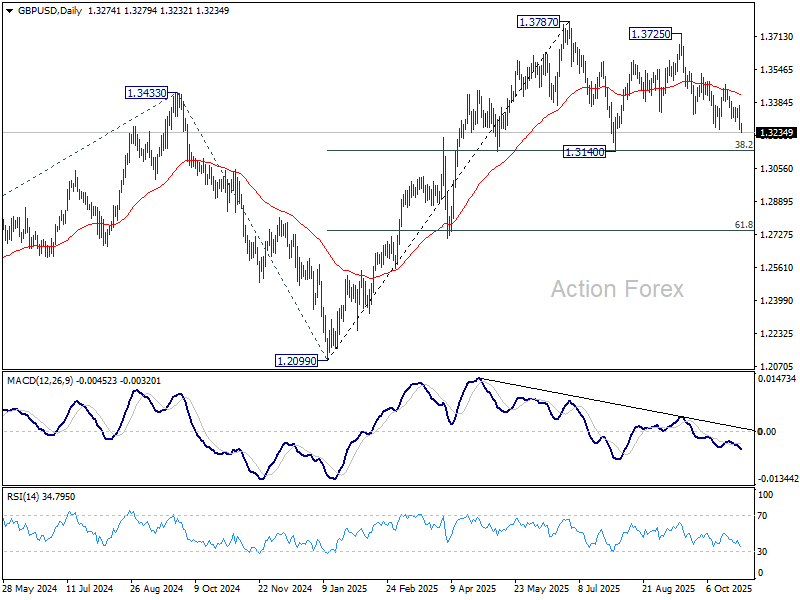
In the bigger picture, rise from 1.0351 (2022 low) is still seen as a corrective move. Further rally could be seen to 61.8% projection of 1.0351 to 1.3433 (2024 high) from 1.2099 (2025 low) at 1.4004. But strong resistance could emerge from 1.4248 (2021 high) to limit upside. Sustained break of 55 W EMA (now at 1.3191) will argue that a medium term top has already formed and bring deeper fall back to 1.2099.
Volatility Surges as Central Bank Bonanza Starts; BoC and Fed to Cut Today
Volatility picked up sharply as markets entered the first leg of a two-day central bank bonanza, with the BoC and the Fed set to announce policy decisions today, followed by the BoJ and European ECB tomorrow. Traders are bracing for a flurry of rate moves, guidance shifts, and potential surprises that could set the tone for global markets into November.
Aussie leads the weekly performance chart, bolstered by today’s stronger-than-expected CPI report that forced traders to rapidly unwind bets on a near-term RBA rate cut. The stronger inflation pulse, coupled with firmer activity data, reinforced the case for the RBA to hold rates steady for an extended period.
That view gained further traction after CBA became a major domestic bank to call for no more rate cuts in the current cycle. The bank’s economists emphasized that the RBA would need to see a “material” rise in unemployment and softer inflation before considering renewed easing.
Commodity-linked peers also benefited. Kiwi and Loonie advanced in tandem, buoyed by firm risk appetite as Wall Street hit new highs. Optimism that the U.S.–China tariff truce will be extended past November helped sustain the global equity rally, with DOW, S&P 500, and NASDAQ all closing at record levels overnight.
Meanwhile, Yen saw renewed buying interest after U.S. Treasury Secretary Scott Bessent voiced support for Japan’s monetary independence, urging Prime Minister Sanae Takaichi’s new government to allow the BoJ to decide its policy direction without political pressure. The remarks were widely interpreted as a signal that Washington would not object to a potential BoJ rate hike in coming months. Still, Yen’s strength failed to offset the broader strength in risk and commodity currencies. Yen is sitting mid-table along with Swiss Franc.
At the weaker end of the spectrum, Sterling remains under heavy pressure amid renewed fiscal worries. Reports of a GBP 20B deterioration in the UK’s public finances have dented confidence in Chancellor Rachel Reeves’ upcoming budget plans. Dollar is the second weakest major as traders await tonight’s Fed decision, where a 25bps cut is fully priced in, followed by Euro which rounds out the top three.
Focus now turns squarely to the BoC and Fed announcements later today. Both are expected to cut interest rates by 25bps, but forward guidance will be crucial. The BoC is likely nearing the end of its easing cycle, while the Fed’s tone will shape expectations for an additional cut in December.
In Asia, at the time of writing, Nikkei is up 2.21% at new record. Hong Kong is on holiday. China Shanghai SSE is up 0.41%. Singapore Strait Times is down -0.22%. Japan 10-year JGB yield is up 0.015 at 1.655. Overnight, DOW rose 0.34%. S&P 500 rose 0.23%. NASDAQ rose 0.80%. 10-year yield fell -0.014 to 3.983.
USD/CAD break or hold? 1.3930 support tested ahead of BoC–Fed double cuts
Global attention turns to North America today, with both the BoC and the Fed expected to deliver 25bps rate cuts. The BoC’s decision will come first at 13:45 GMT, followed by the Fed’s announcement later at 18:00 GMT.
The BoC’s overnight rate is widely expected to fall to 2.25%, reflecting the bank’s persistent concern about growth despite recent resilience in jobs and inflation data. Policymakers remain uneasy about the impact of U.S. tariffs and weak domestic demand, even as headline inflation overshoots target. For Governor Tiff Macklem and his team, the near-term goal remains cushioning the economy without reigniting price pressures.
Most analysts expect today’s cut to be the final one of this cycle, with the BoC likely to enter a prolonged pause. A Reuters poll showed 21 of 34 economists forecasting rates at 2.25% by the end of 2026, implying stability for an extended period. Only eight respondents saw further easing to 2.00% or below.
Still, the balance of risks leans dovish, as agreed by most, and a terminal rate at 2.00% is a real possibility. Growth remains soft, exports are vulnerable to trade restrictions, and business confidence has yet to rebound. Policymakers are likely to leave the door open for further cuts without explicitly signaling another move.
Attention will then shift to the Fed, which is widely expected to lower the federal funds rate to 3.75–4.00%. Futures markets also price in a 90% probability of another 25bps cut in December, taking the target range to 3.50–3.75%.
However, the 2026 policy path remains clouded by diverging risks — inflation could reaccelerate if tariffs bite harder, even as the labor market shows signs of fatigue. A recent Reuters survey reflected this uncertainty, showing economists split seven ways on where rates might stand by the end of next year — anywhere between 2.25%–2.50% and 3.75%–4.00%.
The debate has been complicated further by speculation over who will replace Chair Jerome Powell when his term ends in May. Treasury Secretary Scott Bessent confirmed earlier this week that the shortlist includes Fed Governors Christopher Waller and Michelle Bowman, National Economic Council Director Kevin Hassett, former Fed Governor Kevin Warsh, and BlackRock executive Rick Rieder, all representing slightly different shades of monetary philosophy.
Given that backdrop, Powell is unlikely to make any firm commitments on policy beyond today’s meeting. Markets will instead look to the December Summary of Economic Projections and updated dot plot for clarity on the 2026 rate path.
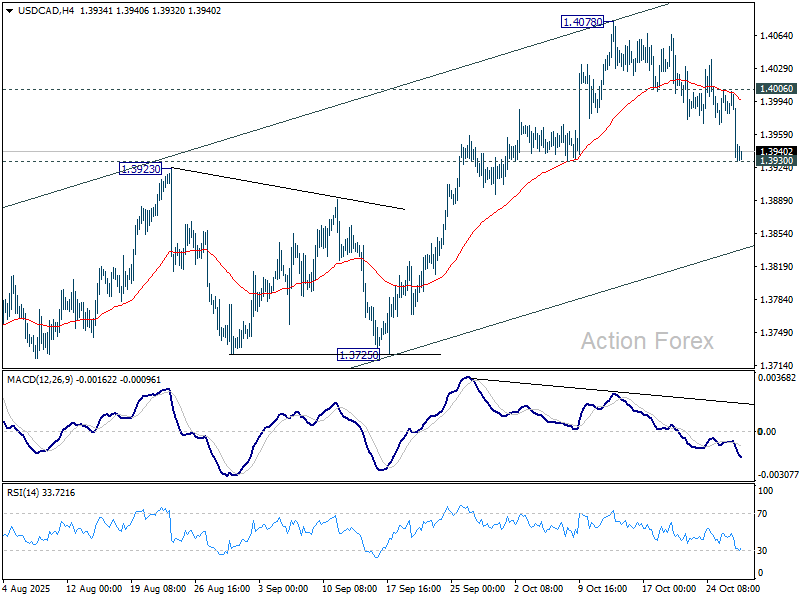
In the currency markets, USD/CAD has weakened sharply just ahead of the twin policy events, hovering just above 1.3930 support after yesterday’s selloff. A rebound from current levels would keep the broader uptrend from 1.3538 intact, with a break above 1.4006 suggesting the rally’s resumption through 1.4078.
Conversely, decisive break below 1.3930 would signal that the advance has likely topped, opening the way for a deeper pullback toward the channel floor near 1.3829, where the next key directional cue will emerge.
Australia inflation shock: CPI surges to 3.2%, core re-accelerates
Australia’s inflation surprised sharply to the upside in Q3, reigniting concerns that price pressures are proving stickier than expected. Headline CPI jumped 1.3% qoq, accelerating from 0.7% in Q2 and beating expectations of 1.1% — marking the strongest quarterly increase since Q1 2023. The Australian Bureau of Statistics said the largest contributor was a 9.0% rise in electricity costs, which alone drove much of the headline surge.
On an annual basis, CPI rose to 3.2% yoy, sharply higher than the previous 2.1% yoy and above forecasts of 3.0%. That marks the fastest pace of annual inflation since Q2 2024. Electricity costs were again the main driver, soaring 23.6% from a year earlier despite targeted government relief measures.
Core inflation was equally strong. Trimmed mean CPI — the RBA’s preferred measure — rose 1.0% qoq, up from 0.7% and above expectations of 0.8%. Annually, core inflation accelerated to 3.0% yoy from 2.7%, underlining persistent price pressures across utilities and essential services, exceeding the RBA’s 2–3% target range again. This marks the first uptick in the trimmed mean since Q4 2022, confirming that underlying price momentum remains firm.
The data strengthen the case for the RBA to delay or even reconsider rate-cut expectations for the near term.
Aussie soars, Sterling slumps, GBP/AUD confirms medium term bearish turn
Aussie surged sharply on after the hotter-than-expected inflation print shattered hopes for a RBA rate cut next week. Crucially, the upside surprise wasn’t confined to energy-driven headline gains. The broad-based acceleration in core inflation confirmed that price pressures have become more entrenched.
RBA Governor Michele Bullock had warned earlier this week that any 0.9% or higher quarterly increase in the trimmed mean would constitute a “material miss.” The 1.0% outcome squarely fits that definition, virtually guaranteeing the central bank will keep rates unchanged at next week’s policy meeting. With economic activity showing tentative signs of recovery, the balance of risks has shifted decisively toward fewer rate cuts over the next year.
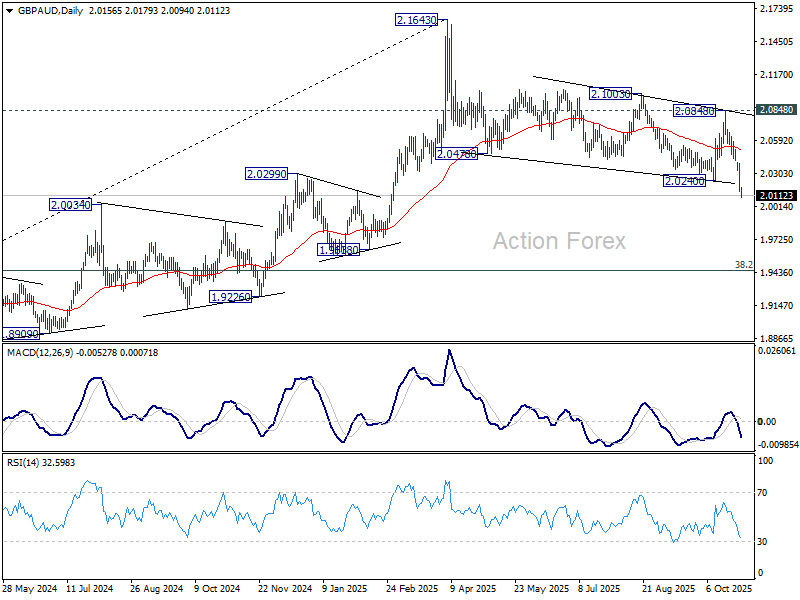
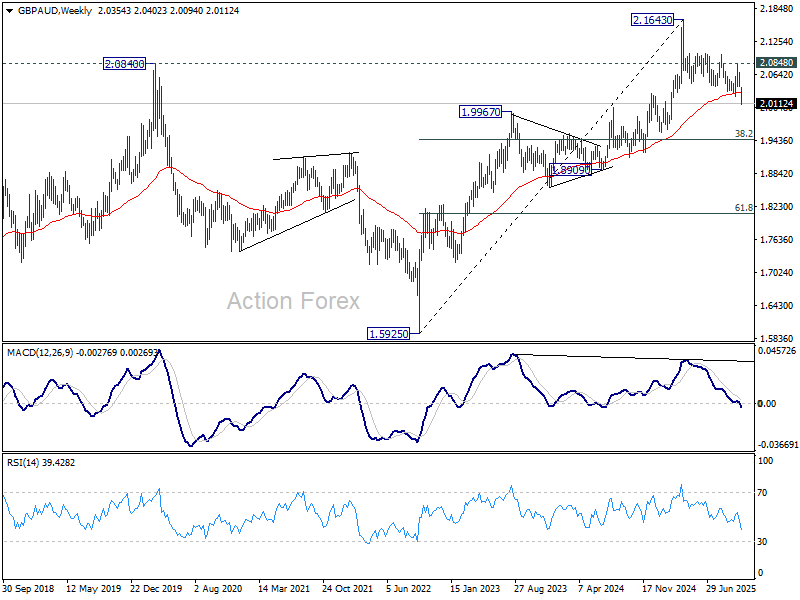
In the currency markets, Aussie’s rally coincided with broad-based weakness in the British pound, which remains weighed down by fiscal concerns following reports of a worsening UK budget shortfall. As a result, GBP/AUD has become the week’s standout mover for now, falling more than 1.5% to its lowest levels in months.
Technically, GBP/AUD's break of 2.0240 support confirms resumption of the decline from 2.1643. More importantly, the decisive break below the 55 W EMA (now at 2.0309) reinforces a bearish bias, confirming a medium-term top at 2.1643 under bearish MACD divergence conditions.
The fall from 2.1643 high is viewed as at least correcting the entire rise from 1.5925 (2022 low), with scope to even reversing the whole move.
In either case, as long as 2.0858 resistance holds, the outlook remains bearish with the next target at 38.2% retracement of 1.5925 to 2.1643 at 1.9459.
GBP/USD Daily Outlook
Daily Pivots: (S1) 1.3223; (P) 1.3297; (R1) 1.3345; More...
GBP/USD's fall from 1.3725 resumed by breaking through 1.3247 support today. Intraday bias is now on the downside for 1.3140 cluster (38.2% retracement of 1.2099 to 1.3787 at 1.3142). Strong support is expected there to contain downside to complete the corrective pattern from 1.3787. On the upside, above 1.3368 minor resistance will turn intraday bias neutral first. However, decisive break of 1.3140/2 will complete a double top pattern (1.3787/3725) and turn near term outlook bearish.
In the bigger picture, rise from 1.0351 (2022 low) is still seen as a corrective move. Further rally could be seen to 61.8% projection of 1.0351 to 1.3433 (2024 high) from 1.2099 (2025 low) at 1.4004. But strong resistance could emerge from 1.4248 (2021 high) to limit upside. Sustained break of 55 W EMA (now at 1.3191) will argue that a medium term top has already formed and bring deeper fall back to 1.2099.