Sample Category Title
Eco Data 7/25/19
[php_everywhere instance="1"]
Oil Rises on Trade Hopes and Large US Drawdown
Oil prices rose after release of weekly crude data showing a 10.8 million barrel drawdown. The news that the US will be sending a team to reopen trade talks with China next week had already pushed crude higher.
The prolonged trade war between the US and China has been a major factor putting downward pressure on global growth and signs of a possible agreement are positive for oil. Energy demand has been forecasted lower by think-tanks if the two largest economies don’t reach an agreement on trade.
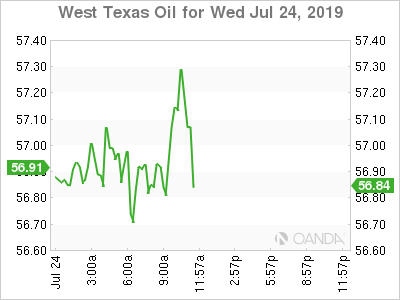
West Texas Intermediate and Brent rose more than 1 percent on Tuesday as White House Adviser Kudlow confirmed the delegation traveling to China. The API inventories hinted at a large drawdown in crude with prices gaining on Wednesday by more than 1 percent after the official Energy Information Administration (EIA) data was released.
Concerns about Middle East tensions are keeping oil prices supported as Iran has warned about the presence of naval ships out of the Persian Gulf.
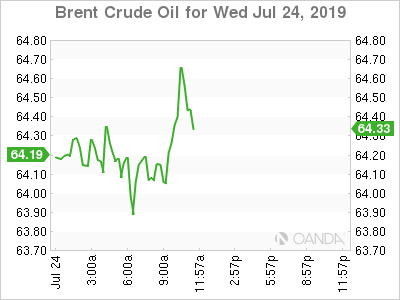
The rise of US production to the point the US is now a net exporter has reduced the impact of geopolitical supply disruptions but crude is not immune to disruptions in one of the largest shipping routes in the world.
A third of oil transported by sea passing through the Strait of Hormuz.
UK PM Johnson: Don’t forget the extra lubricaiton of GBP 39B in no-deal Brexit
Boris Johnson is formally appointed by Queen Elizabeth II as UK Prime Minister today. In the remarks outside 10 Downing Street, he said to "fulfil the repeated promises of parliament to the people and come out of the EU on October 31, no ifs or buts."
On the possibility of no-deal Brexit, he emphasized "don't forget that in the event of a no-deal outcome we will have that extra lubrication of the 39 billion pounds."
MARKET WRAP: Boris Becomes Prime Minister, Caterpillar and Boeing Disappoints
*Euro area manufacturing data missed expectations and the ECB is likely to be more dovish tomorrow. *Gold and crude maintained their gains.
Stocks
- The S&P 500 Index failed to gain strength as both Caterpillar and Boeing came with disappointed numbers. As of 15:22 London time, the index was down by 0.16%.
- The Stoxx Europe 600 Index maintained its gains and increased by 0.04%.
- The UK FTSE 100 index didn’t show more optimism as the new Prime Minister takes control of Brexit. The index declined 0.71%
Currencies
- The Dollar Spot Index broke its four days of gain and fell by 0.08%.
- The Euro fell below the level of 1.12 and traded at 1.1143 ahead of the critical ECB monetary policy decision.
- The British pound rose 0.43% to 1.2494 and made a high of 1.2522.
- The Japanese yen moved higher by 0.11% to 108.05.
Bonds
- The Yield on 10-year Treasuries dropped by three basis point to 2.04%.
- Britain’s 10-year yield declined seven basis point to 0.68%.
Commodities
- West Texas Intermediate crude soared due to the crude inventory data. It rose 1.23% to $57.52 a barrel.
- Gold price continued to move higher, still trading in a flag pattern on a daily time frame. It rose 0.1% to 1423.
Oil inventory dropped -10.8m barrels, WTI rises mildly
US commercial crude oil inventories dropped sharply by -10.8m barrels in the week ending July 19, much larger than expectation of -4.2m barrels. At 445.0m barrels, crude oil inventories are about 2% above the five year average for this time of year. Full release here. WTI oil strengthens just mildly after release.
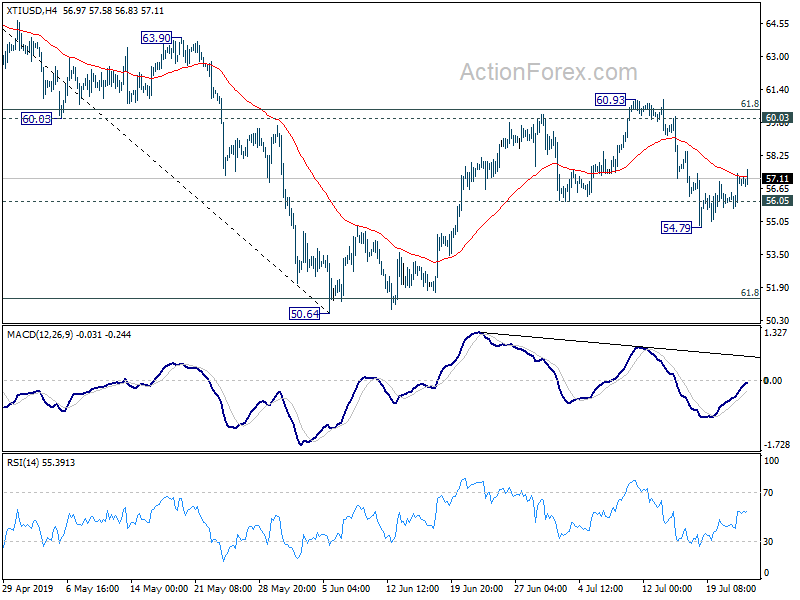
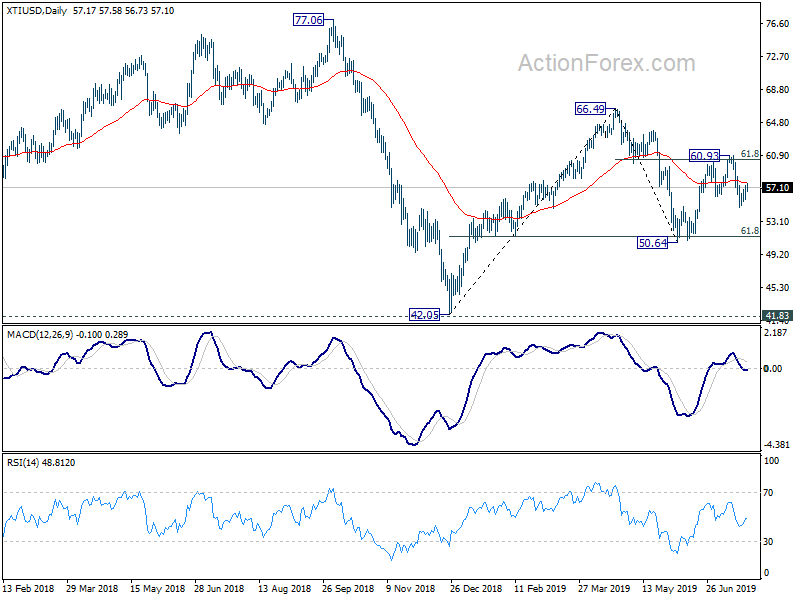
WTI's fall to 54.79 was deeper than expected and broke 56.05 support. For now price actions from 60.93 are seen as correcting the rise from 50.64 to 60.69. Such correction should extend further for a while. Hence, current recovery from 54.79 should be limited below 60.93. Another fall through 54.79 is in favor but should be contained well above 50.64 low.
US GDP Data May Dampen Rate-Cut Bets, Lift Dollar
The first estimate of US GDP for Q2 is due at 12:30 GMT on Friday, and may be crucial in shaping the narrative over how deep the Fed will cut rates next week. While a 25 basis points (bp) cut is certain, markets also assign a ~20% chance for a ‘double’ cut of 50bp, which seems excessive. Hence, the dollar may have room to recover for now, if these aggressive bets are scaled back.
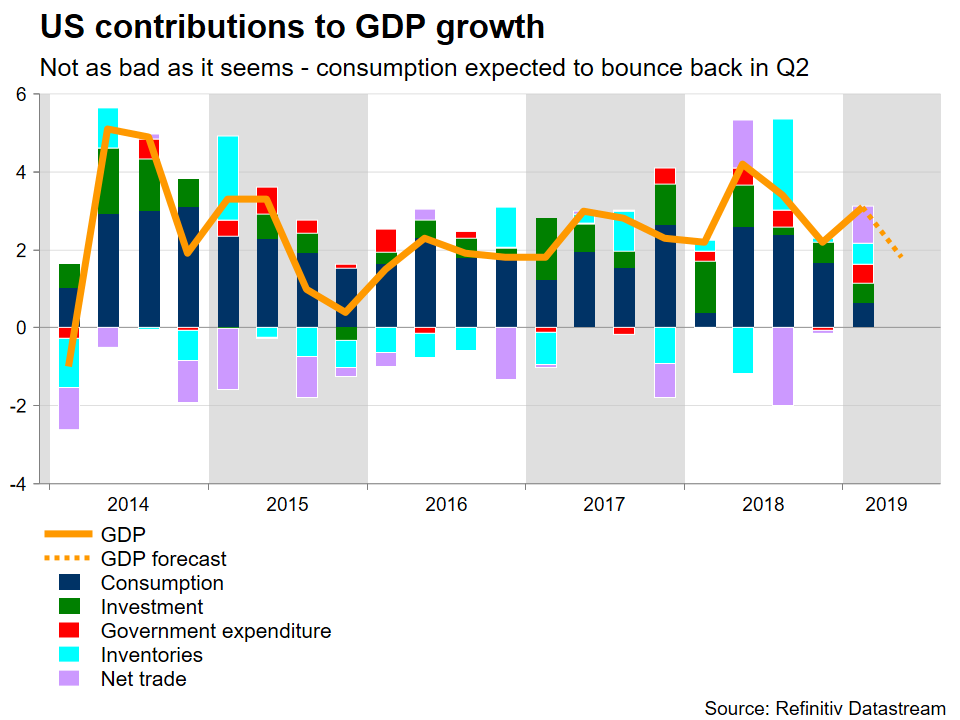
The US economy likely grew at a slower pace in the second quarter, with forecasts pointing to an annualized GDP growth of 1.8%, from 3.1% in Q1. Yet the situation isn’t as worrisome as it seems. Much of the strength in Q1 was owed to firms accumulating inventories, which usually means weaker growth in subsequent quarters as companies unwind those inventories.
In fact, even though overall growth may slow, domestic demand likely strengthened thanks to robust consumer spending in Q2, which is encouraging since consumption accounts for nearly 70% of the economy. In other words, the upcoming data are expected to show that the most important contributor to growth – the consumer – is back in the driver’s seat, even if the headline GDP rate is not as impressive as Q1.
The point is that the US economy doesn’t seem to be in dire need of monetary stimulus, even though the Fed has committed to cutting rates next week. To be fair, policymakers have acknowledged that the domestic economy is in good shape, but still think a rate cut is needed as protection from a darkening global outlook and the uncertainty caused by trade tensions. From this point of view, a ‘preventive’ rate cut makes sense.
What makes less sense though, are the persistent market expectations for a ‘double’ cut of 50bp in July. First and foremost, it seems unreasonable for the Fed to use so much of the rate ammunition it fought so hard to accumulate in recent years, without the economy being in trouble.
Second, there’s little support for such action. Even St. Louis Fed President James Bullard, who voted for an immediate rate cut in June and was opposed to raising rates last year, recently said he would like to cut only by 25bp in July, not by 50. He is arguably the most dovish member on the Committee, so if he is against it, there’s almost no scope for such an aggressive move.
As for the market reaction, since more easing is priced in than the Fed is likely to deliver, this generates an upside risk for the dollar over the coming week. This repricing could occur on the GDP data, if they are solid enough to finally dispel expectations for a 50bp move.
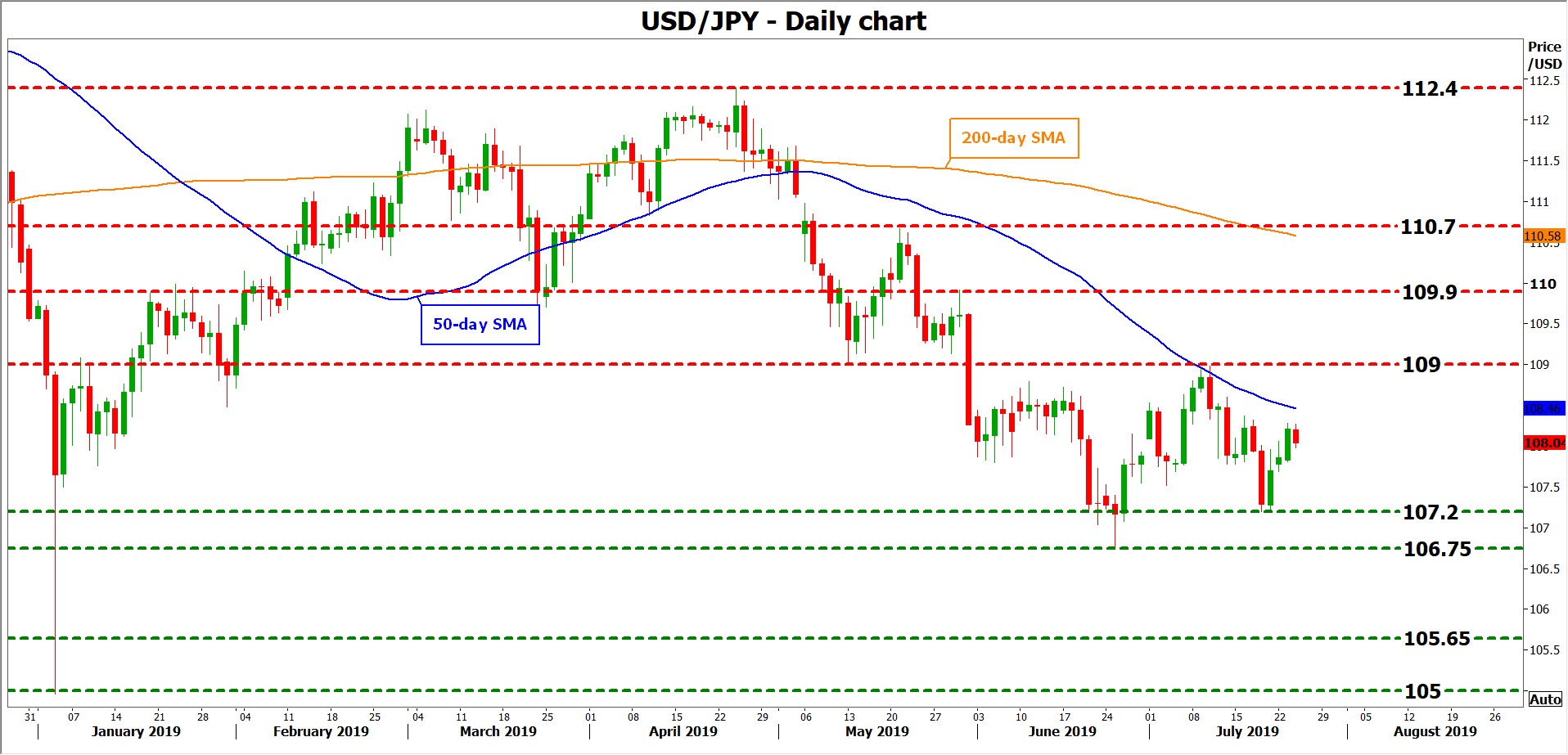
Taking a technical look at dollar/yen, initial resistance to advances may be met near the 109.00 handle, with an upside break turning the focus to 109.90, the May 30 high.
On the flipside, another wave of declines could stall around 107.20. If the bears pierce below that, the June lows at 106.75 may be the next obstacle.
WTI Oil Outlook: Upbeat Crude Inventories Could Boost Oil Price for Break above 200DMA
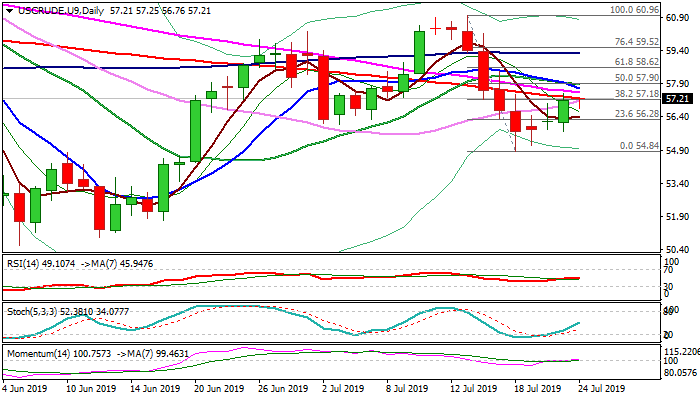
WTI oil price is holding within tight range under Tuesday's recovery high at $57.46 on Wednesday, with falling 200DMA ($57.23) continuing to cap for the second consecutive day. WTI contract advanced 1.7% in late Tuesday's trading, after API report showed unexpected fall in crude stocks by 11 million barrels in the week to 19 July, against expectations for 4 million barrels draw and previous week's draw of 1.4 million barrels. Rising tensions in the Middle East added to positive tone this week. Oil price is gaining bullish momentum that underpins the action for eventual break above key barriers at $57.18/23 (Fibo 38.2% of $60.96/$54.84/200DMA) that would general strong signal for extension of recovery leg from $54.84 (18 July low) and expose next strong barrier at $57.63 (daily cloud top/Fibo 61.8%). Market is waiting for release of US EIA crude inventories report (consensus for 4 million barrels fall in crude stocks vs previous week's fall at 3.1 million barrels), with stronger than expected draw expected to inflate oil price. Disappointing numbers, on the other side, could soften bullish tone and keep the price under 200DMA that would result in fresh weakness.
Res: 57.23; 57.49; 57.87; 58.62
Sup: 56.76; 56.29; 55.72; 55.07
US PMI manufacturing dropped to 118-mth low, disappointing start to Q3
US PMI manufacturing dropped to 50.0 in July, down from 50.6, missed expectation of 51.0. That's the lowest level in 118 months. PMI services, however, rose to 52.2, up from 51.5, beat expectation of 51.8. PMI composite rose to 51.6, up from 51.5, a 3-month high.
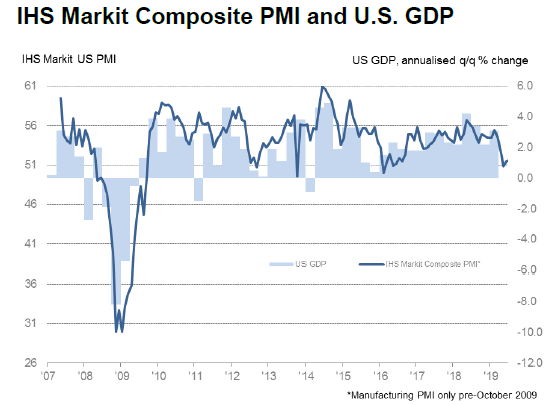
Commenting on the flash PMI data, Chris Williamson, Chief Business Economist at IHS Markit said:
"The survey data indicated that the economy started the third quarter on a disappointingly soft footing. The PMIs for manufacturing and services collectively point to annualized GDP growth of just 1.6%, up only very marginally from a lacklustre 1.5% indicated by the survey in the second quarter.
"The overall picture of modest growth conceals a two-speed economy, with steady service sector growth masking a deepening downturn in the manufacturing sector. The survey's gauge of factory production has slumped to its lowest since August 2009, and indicates that manufacturing output is falling at a quarterly rate of over 1%, led by an increasing rate of loss of export sales.
"The survey's employment gauge has meanwhile fallen to a level consistent with 130,000 jobs being added in July, down from an average of 200,000, in the first quarter and 150,000 in the second quarter, as firm became increasingly cautious in relation to hiring. Manufacturers are shedding workers at the fastest rate since 2009 and service sector job creation is now down to its lowest since April 2017.
"Future prospects have also darkened to the gloomiest since comparable data were first available in 2012, suggesting that companies may look to tighten their belts further in coming months, dampening spending, investment and jobs growth. Geopolitical worries, trade wars and increasingly widespread expectations of slower economic growth at home and internationally have all pulled business optimism lower."
Sunset Market Commentary
Markets
Another batch of dreadful July EMU PMI’s, especially in the manufacturing sector, triggered a general flight to global (but not only) core bonds today. The German Bund outperformed US Treasuries with money markets increasing bets on additional ECB easing in the near future, which is expected to be announced (at the very least) tomorrow. Germany’s yield curve bull flattens with changes varying from -1 bp (2-yr) to -4 bps (30-yr). The 10-yr yield is currently trading at -0.385% (-3 bps) and closes in on its all-time low of -0.409% in early July. The European periphery also profits from much anticipated ECB easing with spreads declining. Greece’s 10y yield hit a new record low, spreads narrow 3 bps. Italy (-7 bps) outperforms, drawing additional support from Lega’s Salvini saying the government “will go ahead” and the country’s Treasury canceling an August auction, citing large cash availability. The Italian 10y yield slips to the lowest level since October 2016. US yields decline around 2.7 bps across the curve.
EUR/USD fell below the 1.1180 support yesterday as investors prepared for a soft ECB at tomorrow’s policy meeting. This morning, the EMU PMI’s printed again much weaker than expected, with especially the poor performance of the (German) manufacturing sector signaling a difficult road ahead for the European economy in the second half of the year. Core European yields and the euro nosedived. EUR/USD filled bids below 1.1130, but the key 1.1100/10 range bottom was left intact. USD yields also declined in lockstep with the decline of German yields. A negative equity sentiment due to some negative earnings surprises (both in Europe and the US) also reduced interest rate support for the dollar. EUR/USD is changing hands in the 1.1145 area. So, poor EMU data are leaving their traces on the euro, but the damage could have been worse. USD/JPY eases slightly and is trading near the 108 big figure. In an interview, US Treasury secretary Mnuchin indicated that he is not going to advocate a weak USD policy in the near term and that he still believes in ‘a strong dollar that signifies a strong US economy’. This official confirmation of the US ‘strong dollar policy’ had only limited impact on trading.
The sterling rebound that started yesterday, continued today. The move was mainly technical in nature. Sterling shorts apparently took some further profit and adapted positioning as the event of the nomination of the new UK PM was out of the way. Markets are now awaiting who will occupy the key positions in the new government. At least for now, the UK PM didn’t give any concrete hints on how he intends to solve Brexit. Overnight comments from BoE’s Haldane maybe also supported sterling as he indicated to be very cautious on easing policy in the current environment. Cable rebounded from the 1.2425 area to revisit the 1.25 area. EUR/GBP dropped lower in the 0.89 big figure (currently 0.8930 area). At least of now, FX markets don’t position for a high profile escalation of Brexit related uncertainty anytime soon.
News Headlines
Euro zone July PMI’s disappointed with manufacturing confidence slipping to 46.4 (a 7-yr low) and even to a very poor 43.1 in Germany. New businesses, output and employment all declined. The services sector showed more resilience and stabilized at 53.3 (55.4 in Germany). At current levels, IHS Markit sees growth slowing from 0.2 QoQ in Q2 to 0.1% in Q3.
China has given five companies approval to buy up to 3 million tons of US soybeans without retaliatory import tariffs. The exemption is considered a gesture of goodwill towards the US which could be granted again depending on how trade talks progress. A US delegation meets Chinese counterparts on Tuesday.
EURCHF Creates Fresh 2-Year Low; Bears Have the Upper Hand
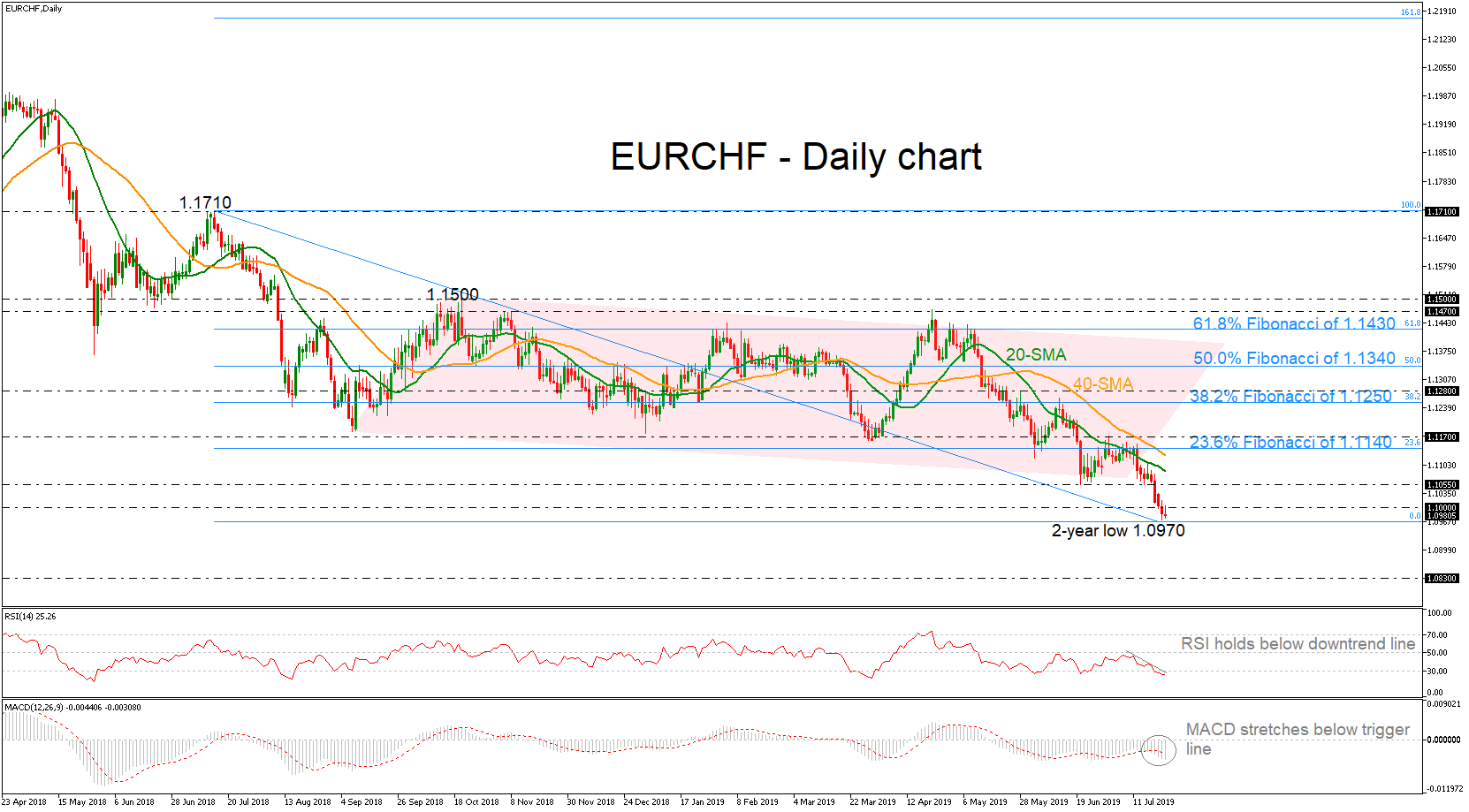
EURCHF has been creating an aggressive downward rally over the last four days, posting a fresh two-year low around 1.0970. Also, the price has broken the long-term sideways channel, indicating sharper negative structure.
The bearish move is confirmed by the technical indicators in the daily timeframe. The RSI is holding in the oversold territory and is pointing south, while the MACD is stretching its downside movement below trigger line.
Should weakness extend below the two-year low, support to further declines could be initially detected near the 1.0830 low, registered on June 2017. In case of sharper downfall, the price could retest the troughs from February 2017 near 1.0630.
In the alternative scenario, the pair should overcome the 1.1000 psychological mark to meet the 1.1055 former key support level. Clearing this zone and the short-term moving averages could rest around the 23.6% Fibonacci retracement level of the downleg from 1.1710 to 1.0970 at 1.1140.
All in all, EURCHF maintains bearish both in the short and the long-term timeframe.