

Sample Category Title
ECB to stand pat but set the stage for Sept easing, some previews
ECB rate decision is the major focus today. It's widely expected to keep monetary policy unchanged for now. That is, main refinancing, marginal lending and deposit facility rates will be held unchanged at 0.00%, 0.25% and -0.40% respectively. Nevertheless, president Mario Draghi should provide explicit dovishness in the press conference that set the stage for policy easing in September. In particular, focuses will be on issues including rate floor, restart of QE, and emphasis on "symmetric" inflation target.
Suggested readings:
- ECB To Guide On More Stimulus
- ECB Preview – Expecting Change in Forward Guidance and Hints on QE Resumption and Tiering
- ECB Preview: Warming Up For Draghi's Grande Finale
- Slow Growth, Low Inflation: What's the ECB to Do?
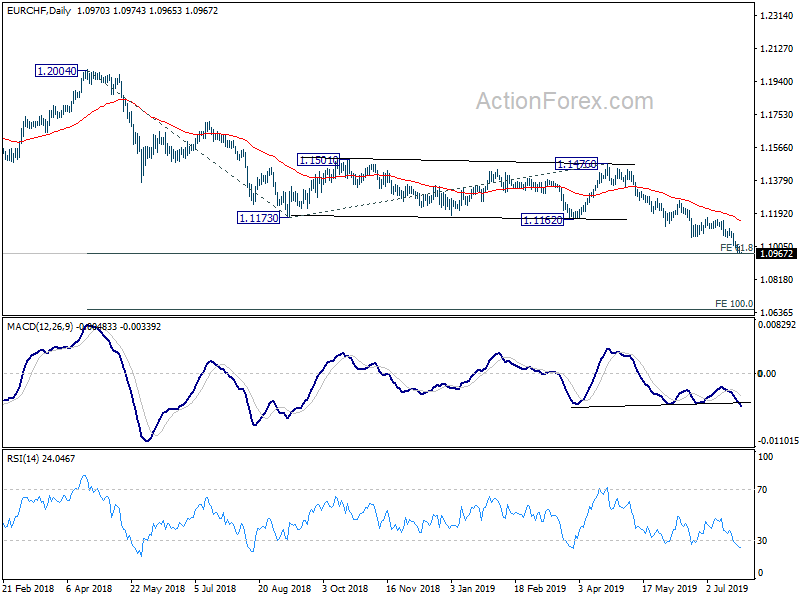
Euro is currently among the weakest ones for the week on dovish ECB expectations. EUR/CHF is now pressing 61.8% projection of 1.2004 to 1.1173 from 1.1476 at 1.0962. Sustained break there will likely bring downside acceleration to 100% projection at 1.0645 next.
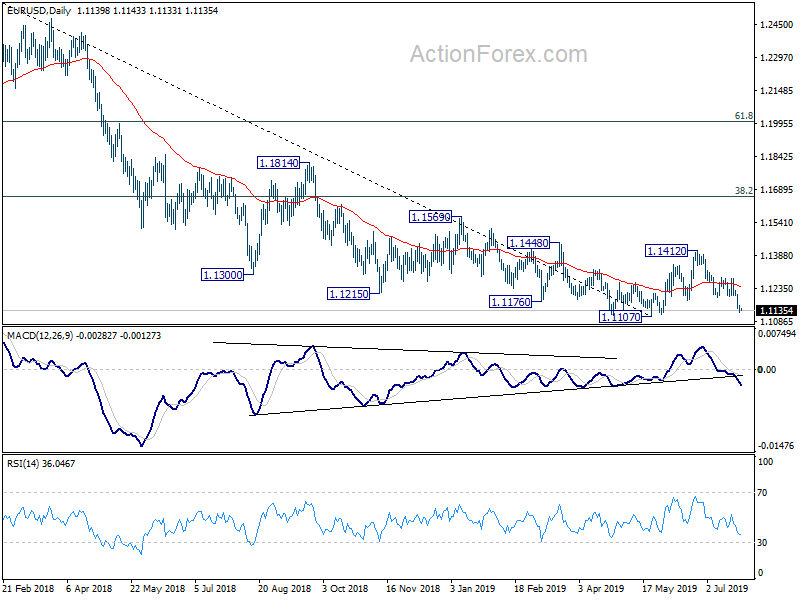
EUR/USD is set to take on 1.1107 low. For, we're not expecting a solid break there yet. However, the pair is starting build up downside momentum, as seen in daily MACD. Firm break of 1.1107 would resume the down trend from 1.2555.
RBA Lowe: Prepared to provide additional easing, extended period of low interest rates expected
In a speech delivered today, RBA Governor Philip Lowe reiterated the dovish stance that, "the Board is prepared to provide additional support by easing monetary policy further." At the same time, "whether or not further monetary easing is needed, it is reasonable to expect an extended period of low interest rates."
Lowe also noted, "on current projections, it will be some time before inflation is comfortably back within the target range". And, it's "highly unlikely that we will be contemplating higher interest rates until we are confident that inflation will return to around the midpoint of the target range."
He also defended current inflation target a said it has "stood the test of time". He warned that lowering the target could "hardly seems a good way to build long-term credibility". " Lowe said. "Shifting the goal posts could also entrench a low inflation mindset." Thus, "this brings me back to the question: is inflation targeting still appropriate? The short answer is yes." And, " the evidence does not support the idea that a change to our inflation target would deliver better economic outcomes than achieved by our current flexible inflation target," he noted.
Johnson: Ports, banks, factories, businesses ready for no-deal Brexit
New UK Prime Minister Boris Johnson executed a "brutal", as some described, cabinet reshuffle after taking the top job. 18 of 29 ministers were dumped out. Instead, some Brexit hardliners are brought into the cabinet. New cabinet include Sajid Javid as chancellor of the exchequer, Dominic Raab as foreign secretary and first secretary of state, Priti Patel as home secretary, Michael Gove as chancellor of the Duchy of Lancaster, Liz Truss as international trade secretary, etc.
Johnson also said, "the doubters, the doomsters, the gloomsters -- they are going to get it wrong again. We are going to fulfill the repeated promises of Parliament to the people and come out of the EU on Oct. 31, no ifs or buts, and we will do a new deal, a better deal."
He added, "We can do a deal without checks at the Irish border. It is of course vital at the same time that we prepare for the remote possibility that Brussels refuses any further to negotiate and we are forced to come out with no deal."
He also insisted the economy is ready for no-deal. "The ports will be ready, the banks will be ready, the factories will be ready, business will be ready," he said. "The British people have had enough of waiting.
Aussie At 2-Week Low On RBA Comments
RBA's Lowe prepared to ease further
In a speech titled 'Inflation Targeting and Economic Welfare' late this morning, RBA Governor Lowe said that he would be willing to ease policy further if needed, adding that no rate hike would be considered until inflation is within the intended target range, which could be some time. He said it was reasonable to expect an 'extended period' of low rates.
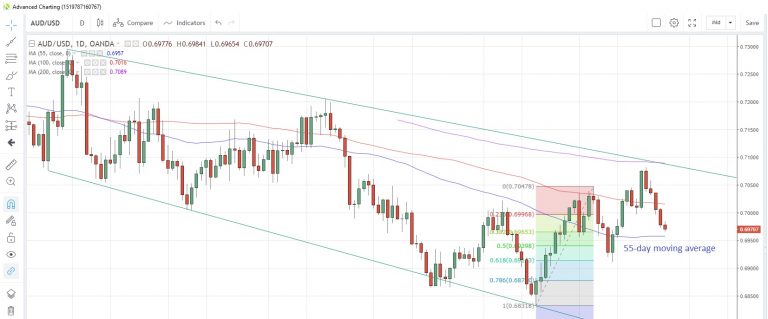
AUD/USD slid to the lowest level in two weeks after the comments, while AUD/JPY hit the lowest since July 11. AUD/USD is approaching the 55-day moving average at 0.6957.
AUD/USD Daily Chart
Equities continue higher
Asia carried on where America left off yesterday by pushing US indices either to, or close to, record levels. Wall Street indices rose between 0.11% and 0.15% with the SPX500 index climbing to within a whisker of a new record high. China shares gained 0.58% and even Hong Kong shares managed a 0.14% advance.
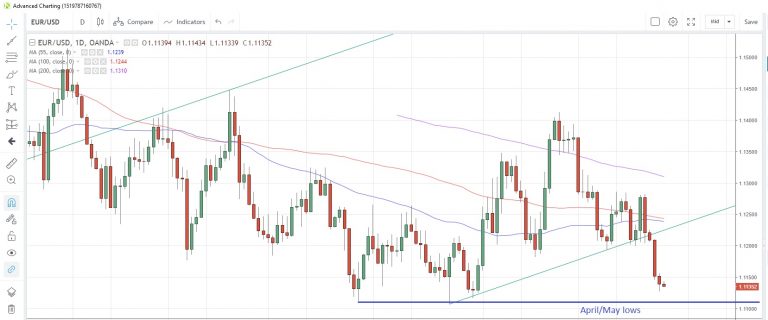
Currency markets were more mixed, with the Euro still feeling downward pressure ahead of the ECB rate meeting later today. EUR/USD fell 0.04% to 1.1134 and is approaching the April/May lows of 1.1111 and 1.1107, respectively. AUD/USD slid 0.14% to 0.6967 after Lowe's comments (see below) while GBP/USD slid 0.09% to 1.2472.
EUR/USD Daily Chart
Will they or won't they?
The major event today is undoubtedly the ECB rate meeting, with most believing the statement and subsequent press conference will contain a dovish bias. The only uncertainty is whether the Bank will actually trim rates today or at the September meeting. According to Bloomberg calculations, market pricing implies a 39% probability of a 10bps cut today which, while not high enough to almost guarantee a cut, is still relatively high. Looking at the September meeting, the odds jump to 62% for a 10bps cut. Bear in mind that Draghi leaves his office at the end of October.
With market positioning invariably bearish ahead of the meeting, there could be a growing tail risk that the level of dovishness displayed by Mr. Draghi and company may not meet these expectations and a sharp reversal of pricing in bond and FX markets could follow. That's a risk worth taking note of.
German sentiment surveys on tap
Aside from the ECB meeting, Germany has the IFO surveys for July to focus on. The expectations index is seen falling to 94.0 from 94.2, the current assessment index to 100.4 from 100.8 and the business climate index is expected to fall to 97.1 from 97.4. Given the weak performance by the flash PMIs yesterday, the downside for all these readings could be vulnerable.
On the US front, durable goods orders for June are seen rebounding to +0.7% from -1.3% the previous month, while the good trade deficit for the same month is expected to improve to -$72.4 billion from -$75.1 billion.
RBNZ: OCR Limbo… How LowCan It Go?
- We previously forecast that the RBNZ would cut the OCR in August, citing global concerns.
- We now expect that the RBNZ will cut the OCR in both August and November.
- There is some risk the RBNZ could deliver the cuts more rapidly, in August and September, depending on how weak the labour market gets.
- The domestic economy has clearly slowed further than anticipated.
- Low business confidence is translating into slower hiring, and the forestry downturn could cause job losses.
- The recent rise in the exchange rate will also bother the RBNZ.
- If we are correct, retail fixed interest rates are going to fall even further.
- Lower mortgage rates will strengthen our call for a housing market upturn over the year ahead.
On 21 June we forecast that the Reserve Bank would cut the OCR to 1.25% at the August Monetary Policy Statement. Our focus at the time was on the slowing global economy and the increasing likelihood of the United States’ Federal Reserve cutting interest rates.
Today we are going further, and this time the reasons are domestic rather than global.
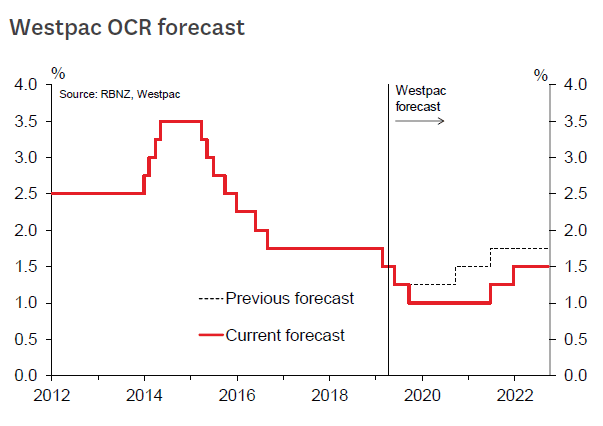
We now expect that the Reserve Bank will cut the OCR in August and again in November, taking the OCR to an all-time low of 1%. And the risk to our new call is skewed towards earlier and/or more aggressive cuts – there is a possibility that the RBNZ could cut the OCR in September, and even a possibility that the OCR could drop below 1%.
A slowdown in the New Zealand economy has been in train for almost two years now, and was well forecast by us. The wind down of the Canterbury rebuild and slowing house price growth were predictable, and caused the slowdown in GDP growth that we anticipated. But we previously expected that the economy would be picking up by mid- 2019, on the back of fiscal stimulus and lower interest rates. Instead, recent data suggests that New Zealand economic growth has remained slow.
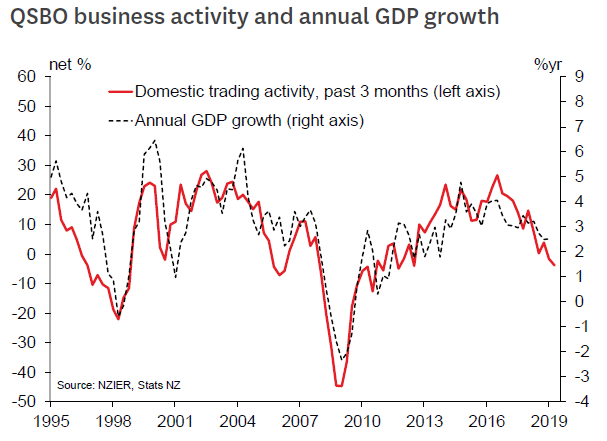
The June Quarterly Survey of Business Opinion, published in early July, showed that business confidence had fallen to a ten-year low, despite the recent cancellation of capital gains tax. Businesses reported activity levels consistent with slow economic growth, and fewer firms said they were hiring. Firms remain caught between rising costs – often government-imposed, such as the minimum wage hike – and an inability to pass through price increases for their products. This is squeezing profits. Expected profitability in the survey dropped to its lowest since the GFC.
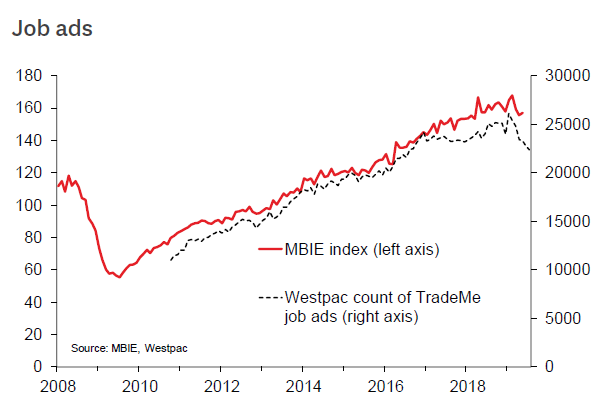
In addition to survey data, we are now seeing harder evidence that low business confidence is affecting the labour market. The official government series of job ads flatlined from November last year, and has actually fallen in the past couple of months. Our own count of job ads listed on TradeMe has fallen far more sharply. This is tentative data, so we are not ready to hang our hats on it just yet, but it suggests that unemployment could rise over the quarters ahead.
Electronic card transaction data has shown that consumer spending was basically flat in the June quarter. This matches the anecdotes we are hearing from businesses, as well as other second- and third-tier data, suggesting that domestic economic conditions remain slow despite the large doses of fiscal and monetary stimulus that have been administered recently. We still expect government spending and low interest rates to generate a pickup in GDP growth, but it has not come through yet (more on that later).
The tone of recent data prompted us to downgrade our GDP forecasts in early July. We now expect quarterly GDP growth to remain in the 0.4% to 0.6% range over the June and September quarters. We expect construction to continue growing at its current extremely strong pace, but other areas of the economy will be more subdued. Our forecast is for annual GDP growth to fall to 2%, which is only a sliver higher than the rate of population growth.
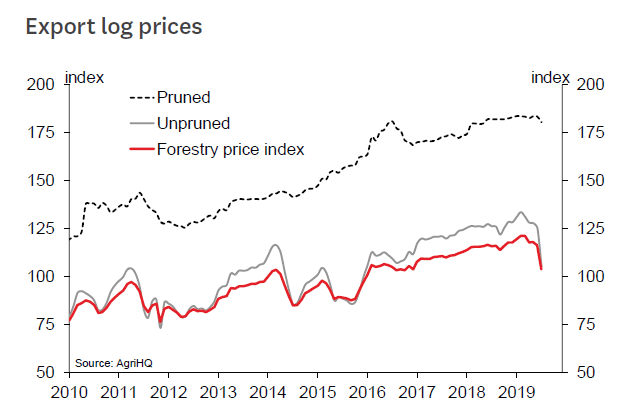
In addition to weak domestic economic growth, we are now seeing the first cracks emerge in the previously-robust export sector. Some sectors are still booming, but dairy auction prices fell 8% over May and June, prompting us to lower our farmgate milk price forecast to $6.90/kg (previously $7.20). And over the past month, there has been a 25% drop in export log prices. Forestry accounts for only 9% of our merchandise exports, but it is disproportionately important for the economic cycle due to its impact on employment. When log prices drop, forest owners often stop harvesting, with an immediate impact on employment and on the health of forestry contracting businesses. After the last log price downturn, in 2014, employment in the industry fell by 700 jobs. Other workers went onto reduced hours (and presumably reduced incomes). And of course, work for businesses involved in transporting forestry products and other related industries dried up, with an unknown impact on employment. This time could be similar.
To cap it all off, the trade-weighted exchange rate has risen about 3% over the past month, and is now about 1.5% higher than the forecast that underpinned the RBNZ’s May OCR decision. A higher exchange rate, if sustained, will compound the emerging concerns for some exporters and will suppress inflation by making imported products cheaper.
How the Reserve Bank will respond
The Reserve Bank will be well aware of these recent developments. Importantly, recent experience is that the new Reserve Bank Monetary Policy Committee has been activist and responsive to signs of slowing growth. We think they will respond to these latest signs of weakness by cutting the OCR in August, and stating that they might cut the OCR further, depending on the data. We expect that the RBNZ’s published forecasts will show the OCR dropping to 1.1%, implying a good chance (but not a certainty) of another cut. Such commentary would be more dovish than the May MPS, which shied away from providing forward guidance on the OCR.
Most likely, the RBNZ will reduce the OCR again in November, when the Monetary Policy Committee has the benefit of the full quarterly analysis undertaken by Bank staff. However, there is a chance that they could act even sooner, at the September OCR Review. One possible catalyst to an earlier OCR cut could be adverse news on the labour market. If the RBNZ does cut in September due to rising unemployment, then there is a chance that they could go even further by cutting the OCR to 0.75% in November. However, at this stage we view earlier or more aggressive OCR cuts as a risk scenario – our central forecast is an OCR low of 1% delivered in November.
How the economy will respond
We have been pointing out for some time that lowering interest rates will have consequences for asset markets, particularly house prices. In May we predicted that nationwide annual house price inflation would accelerate from 2% now to 7% over the year ahead, partly due to the mortgage rate declines already seen.
Recent data supports our view. Over the past two months, we estimate that seasonally adjusted housing market turnover has risen 10%. Brisker house sales are a reliable sign of price rises to come. Meanwhile, New Zealand appears to be in the grip of a “search for yield” investment environment more generally. Growth in bank deposits has been weak, as people have been turned off by low interest rates. Meanwhile, share market prices have risen very sharply, particularly for dividend-paying stocks, and we have heard anecdotes that fund managers are seeing an influx of investment funds. We think investors seeking yield will soon turn to the slower-moving housing market.
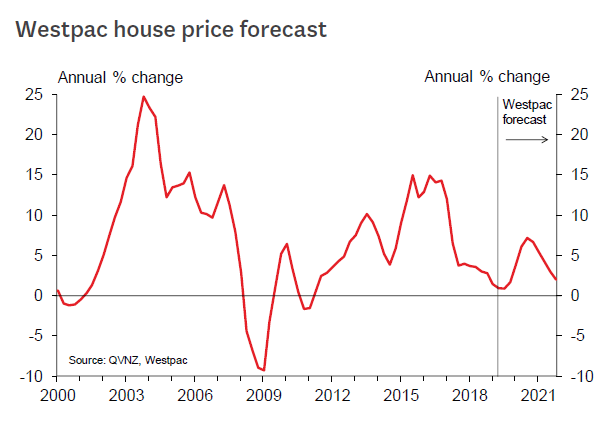
We will reassess our house price forecasts we when release our next Economic Overview in August. However, if we are right about the Reserve Bank cutting the OCR to 1% this year, then we can expect even lower fixed mortgage rates. That could prompt us to upgrade our house price forecast.
Rising house prices will tend to stimulate more consumer spending. On top of that, we are still expecting the large doses of government spending that have been administered over the past two Budgets to stimulate the economy. True, there has been little impact from the fiscal stimulus to date, but that is probably just a matter of timing – it always takes a new government time to get the wheels of the bureaucracy turning in the direction it wants.
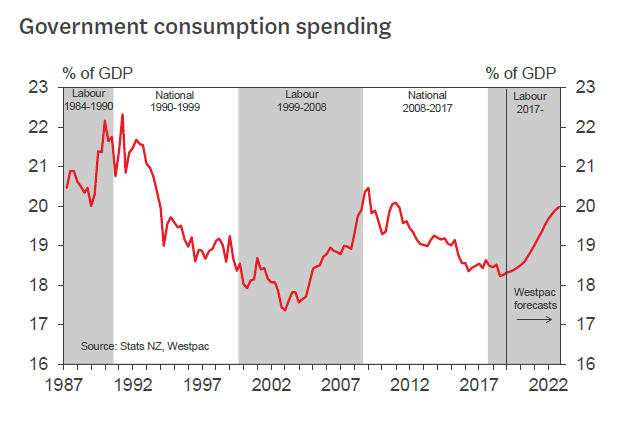
On the back of this monetary and fiscal stimulus, we expect economic growth to recover over the year ahead. This would preclude further OCR cuts in 2020. Indeed, we expect the Reserve Bank will be slowly hiking the OCR again in the early 2020s, although our tentative start date for OCR hikes is now mid-2021. That is later than previously forecast, because interest rates are going to have to stay low for longer than previously thought in order for the Reserve Bank to achieve its inflation and employment targets 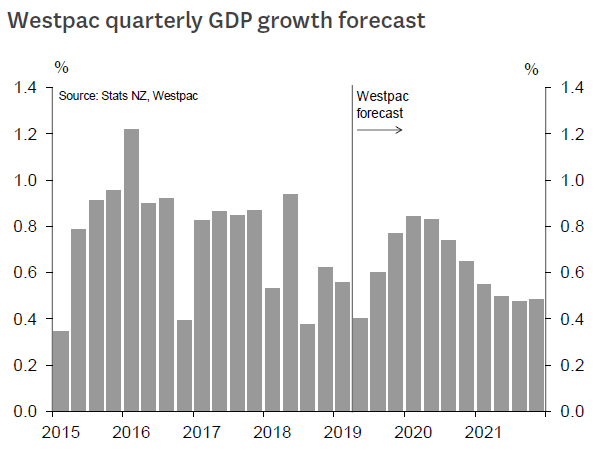
USD/CAD Canadian Dollar Fell As Dollar Surges On Global Growth Concerns
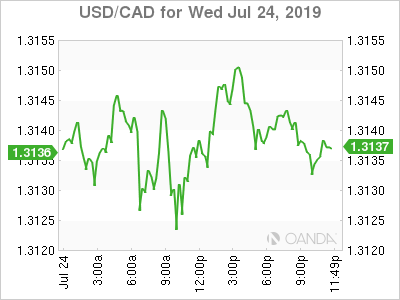
The Canadian dollar traded lower versus the US dollar on Wednesday. The greenback has risen all week and stands higher against all major pairs. The soft PMI data in Europe triggered a bout of dollar buying as global growth lacks traction. The IMF downgraded global growth, but upgraded the US.
The Fed is expected to make a preemptive rate cut, while the ECB could be forced to go deeper into negative rate territory to avoid a recession. The Bank of Canada (BoC) could be pulled into action sooner rather than later if economic indicators don’t improve. At the moment the BoC enjoys some breathing room, but that could quickly evaporate if weaker data starts coming in.
Oil prices continue to be pressured downwards by low growth expectations. The US will send a team to talk trade in China next week, but energy demand has been hit as the prolonged trade war between the two largest economies does not seem close to a deal.
Central banks are ready to once again retake the spotlight in a sequel to 2008 when they shackled volatility with a coordinated slashing interest rates to near zero. The main issue facing policy makers is that now some of their actions did not bear the expected fruit and economies lie near recession despite exhausting their monetary policy toolkit.
Equity markets continue a record run on the back of lower rates, and even the mighty Fed which hiked four times in 2018 is now ready to admit defeat and walk back its monetary policy with a rate cut in July.
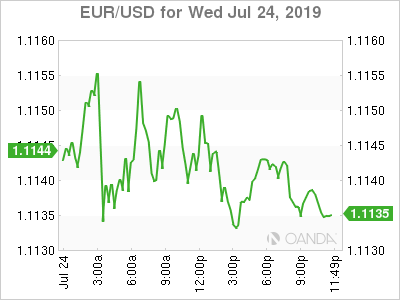
The prolonged trade war between US and China could be near a mutual agreement as the US delegation flies to China next week, but investors have been here before and this time more details will be needed before a big reaction is felt.
OIL
Oil prices fell on Wednesday despite the Energy Information Administration (EIA) weekly crude inventory data confirming the API numbers and showing a large drawdown last week. Weather related disruptions could have influenced the 10.8 million barrel drop in crude stocks and with crews returning to work it looks to be a temporary drop in supply.
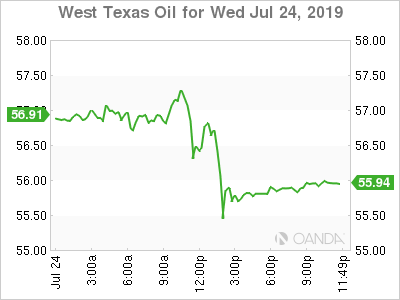
Concerns about Middle East tensions are keeping oil prices supported as Iran has warned about the presence of naval ships out of the Persian Gulf.
The rise of US production to the point the US is now a net exporter has reduced the impact of geopolitical supply disruptions but crude is not immune to disruptions in one of the largest shipping routes in the world.
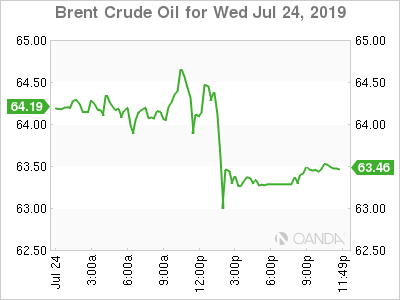
A third of oil transported by sea passing through the Strait of Hormuz.
Global growth concerns are driving energy prices lower as forecasts keep getting downgraded even as the US will be sending a trade team to China next week. US Treasury Secretary Mnuchin has already tempered expectations by saying there are still many issues to resolve.
The prolonged trade war between the US and China has been a major factor putting downward pressure on global growth and signs of a possible agreement are positive for oil.
GOLD
Gold rose 0.27 percent on Wednesday ahead of the European Central Bank (ECB) meeting later today. The yellow metal is trading at $1,424 as central banks have turned dovish with their fingers ready to trigger lower rates and other monetary policy tools to stimulate their respective economies. The ECB is not likely to act this week but the soft European PMI data, will validate a rate cut deeper into negative in the near term.
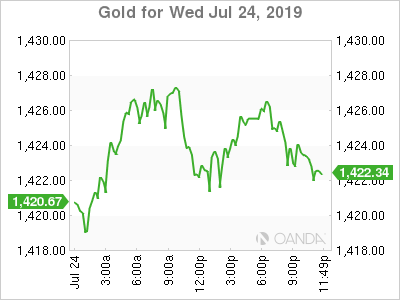
Gold has been bid as a safe haven and with the US-China trade talks moving along, but with an uncertain outcome as well as Boris Johnson as the newly stated Prime Minister of the UK, there will be plenty geopolitical risk for investors to seek refuge in the metal.
The gold rally will be vulnerable to the rhetoric of central banks, as their actions have for the most part have been priced into the asset. The ECB is likely to hold, with a future cut, while the Fed is heavily anticipated to slash its benchmark rate on July 31.
BITCOIN
The leading cryptocurrency tried to break above the $10,000 dollar price level, but did not gather enough traction as comments from US Treasury Secretary Mnuchin knocked it back to around the $9,672 level. Mnuchin said that he wouldn’t be talking about bitcoin in six years, which seems harsh specially since the Trump administration has been so adamant in depreciating the US dollar.
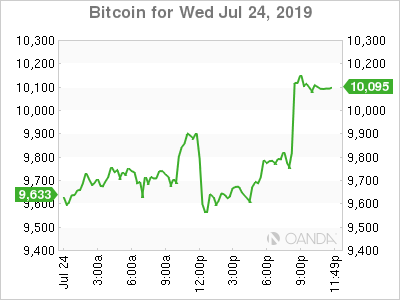
A lower dollar, would give rise to other investment alternatives like Bitcoin to flourish as central banks around the world once again pursue easing monetary policy.
GBP
The pound rose on Wednesday as the reality of Boris Johnson as Prime Minister set in and the euro was under fire for underperforming PMI data. The ECB will need to act sooner rather than later on rates, leaving the BoE and the pound an edge against the single currency.
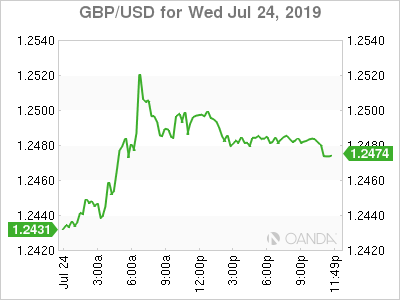
The ghost of no-deal Brexit will hang around the GBP as Johnson assembles his cabinet, but the market is still giving him the benefit of the doubt when he says there is too much pessimism against Brexit at home and abroad. Maybe he will be the one to inject optimism into this messy and drawn out divorce.
Market Morning Briefing: Dollar Index Could Head Towards 98.0-98.50
STOCKS
Global equities remain mixed. Market seems to be turning cautious ahead of the key central bank meetings. The European Central Bank meeting is due today and the US Federal Reserve meeting is scheduled next week on July 31. The Dow can consolidate in the near term. DAX is heading towards a key resistance. Nikkei has just broken above its key resistance and looks bullish in the near term. Shanghai seems to lack strength and is vulnerable to decline again. Sensex and Nifty have declined below their key supports and are bearish to fall further.
Dow (27269.97, -79.22, -0.29%) can consolidate between 27000 and 27500 for some time. As mentioned yesterday, it has to rise past 27500 to gain bullish momentum. Else, it will continue to remain vulnerable to break below 27000 and fall to 26600.
DAX (12522.89, +32.15, +0.26%) is bullish to test 12600. Inability to breach 12600 can drag it lower to 12400 levels again in the coming weeks.
Nikkei (21770.70, +61.13, +0.28%) has risen above the key resistance level of 21750. If it manages to sustain above 21750 a rise to 22000 and 22200 can be seen in the coming days.
Shanghai (2919.70, -3.58, -0.12%), though is managing to sustain above 2900 seems to lack strength. As mentioned yesterday, it has to surpass 2950 to gain bullish momentum. While below 2950 it is vulnerable to break 2900 again and fall to 2850. We will have to wait and see.
Sensex (37847.65, -135.09, -0.36%) had declined below 37900 and is bearish to test 37500 and even 37000 on the downside in the coming days.
Nifty (11271.30, -59.75, -0.53%) has broken below 11300 and can now test 11100-11000 on the downside in the coming days.
COMMODITIES
The EIA weekly inventory data reported a draw of 10.835 mln barrels for the week ended 19th July. But this has not much affected the Crude prices indicating that the draw of this figure was priced in after the release of a similar figure yesterday by the API.
Brent (63.34) and Nymex WTI (56.09) are slightly lower today but have some scope of testing resistances near 62 and 54 before falling off from there in the medium term.
Gold (1423.70) has been stuck near 1420 for the last 2-3 sessions. On the daily candles there is scope for a fall towards 1400 in the near term and looks more likely. On the contrary a short bounce from here if seen May take it back towards 1440 (looks less likely)
Silver (16.58) has risen to test resistance near 16.60 from where a rejection is possible that could push prices back towards 16.00.
The Gold-Silver ratio (85.87) is trading near trend support and could soon rise in the near term towards 90-95 levels. This could indicate that the recent outperformance of Silver could come to a pause.
Copper (2.7090) has risen slightly contrary to our expectation of a fall. Although in the longer run there is scope of falling towards 2.68/66, on the daily candles we see a short term support near 2.70 which could produce a short bounce towards 2.78 in the near term before resuming the fall later on. A bounce from current levels would negate a test of 2.68 on the downside.
FOREX
Overall currency pairs look mixed. The US Dollar continues to remain strong. Euro could test crucial support near 1.11 from where it can rise back in the near term. Aussie, Yen, Yuan and Pound could strengthen a bit. Rupee is likely to remain stable near 69 level. Markets await the ECB meeting due today which could trigger some movement in the Euro.
Dollar Index (97.72) could head towards 98.0-98.50 from where a rejection is possible that could push the index back towards 97.0-96.5 in the medium term. Immediate view is bullish for Dollar Index with near term resistance coming up near 98.50.
Euro (1.1135) is coming down as suggested and could rise from 1.1125-1.1100 in the near term. Note that 1.11 is an important support.
Dollar-Yen (108.14) is stable and while immediate resistance near 108.50 holds, a short dip is possible towards 107.50 on the daily candles. Near term could see some consolidation within 107.50-108.50 before the currency pair moves up sharply in the longer run.
Euro-Yen (120.43) has crucial supports coming up near 120 and 119 from where a bounce back towards 122-123 looks likely. Only on a sustained break below 118.82, we would consider an indication of medium term bearishness and revisit our current view. Till then, a possible bounce back is possible from anywhere between 118.82-120 region in the near term.
Aussie (0.6980) is stable while Pound (1.2480) has risen slightly. Aussie has support at 0.6950 from where a short term bounce to 0.705-0.710 is possible in the near term before again coming back to current levels. Pound on the other hand could be capped near 1.250 on the upside while there is scope of falling towards 1.2350 in the near term.
USDCNY (6.8747) has been trading in a very narrow range and is unable to move above 6.90 just now. While 6.90 holds, we could see an eventual fall in the currency pair that could take it down towards 6.85-6.80.
USDINR (68.9850) continues to hover around 69 yesterday. Unless a fall below 68.90 is seen and sustains, we keep chances of testing 69.25 intact from where a sharp pull back is possible towards 69.0 and lower in the longer run.
INTEREST RATES
The US Treasury yields have dipped again and can continue to trade subdued ahead of the Federal Reserve meeting next week. The German yields keep our bearish view intact as all eyes are on the European Central Bank (ECB) meeting today. Market will be looking for any kind of stimulus from the ECB today which if it happens can drag the yields further lower. The Indian 10Yr GoI can dip further as the news on the government’s first tranche of Foreign Sovereign Bond sale might continue to weigh on it.
The bounce in the US Treasury yields witnessed on Tuesday was short-lived. The yields have dipped again across tenors yesterday. The 2Yr (1.81%) and 5Yr (1.81%) were down 2 bps each while the 10Yr (2.05%) and 30Yr (2.58%) were down 3 bps each. The 10Yr has to surpass 2.10% to turn the outlook positive. While below 2.10%, a dip to 2% is possible. The 30Yr has failed to sustain above 2.60% and can test 2.53% on the downside.
The German yields dipped across tenors. The 2Yr (-0.80%), 5Yr (-0.70%) and the 10Yr (-0.38%) were down 2 bps each while the 30Yr (0.20%) dipped little sharply by 4 bps. Our bearish view is intact. The 2Yr can test -0.85% and the 10Yr can dip to -0.40% in the near term.
The 10Yr GoI (6.4373%) can remain subdued and test 6.40% and 6.35% on the downside. The region between 6.50% and 6.55% can restrict the upside at the moment.
US Crude Oil Inventory Slumped Last Week
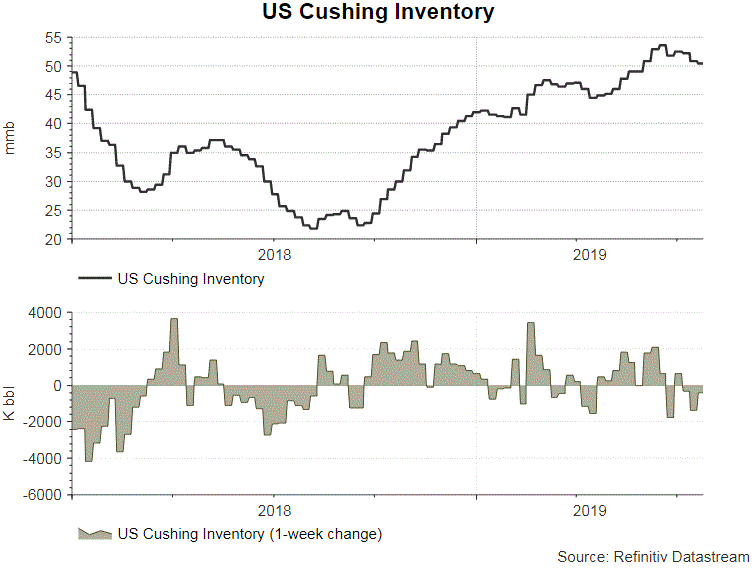
The report from the US Energy Information Administration (EIA) shows that total crude oil and petroleum products (ex. SPR) stocks fell -6.687 mmb to 1308.54 mmb in the week ended July 19. Crude oil inventory slumped -10.84 mmb to 445.04 mmb (consensus: -4.01 mmb). Inventories fell in 4 out of 5 PADDs. Stockpile in PADD3 (Gulf Coast) alone sank 7.94 mmb during the week. Cushing stock slipped -0.43 mmb to 50.4 mmb. Utilization rate dropped -1.3 percentage point to 93.1% while crude production slipped -0.7M bpd to 11.3M bpd for the week. Crude oil imports added +0.2M bpd to 7.03M bpd in the week.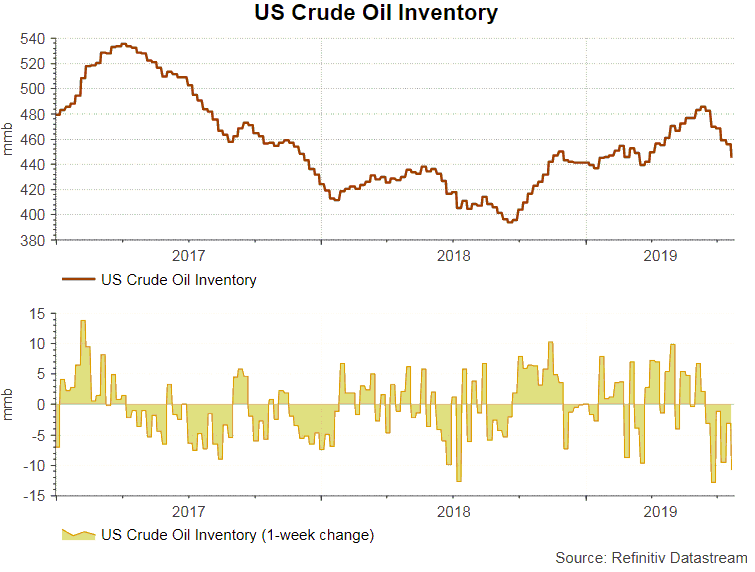
 Concerning refined oil product inventories, gasoline inventory dropped -0.23 mmb to 232.53 mmb as demand gained +4.98% to 9.67M bpd. The market had anticipated a -0.73 mmb decrease in stockpile. Production added +2.37% to 10.09 bpd while imports jumped +15.61% to 0.99M bpd during the week. Distillate inventory gained +0.61 mmb to 136.82 mmb. Demand rose +19.61% to 4.26M bpd. The market had anticipated a +0.5 mmb increase in inventory. Production dropped -2.65% to 5.22M bpd while imports slumped -20.45% to 0.11M bpd during the week.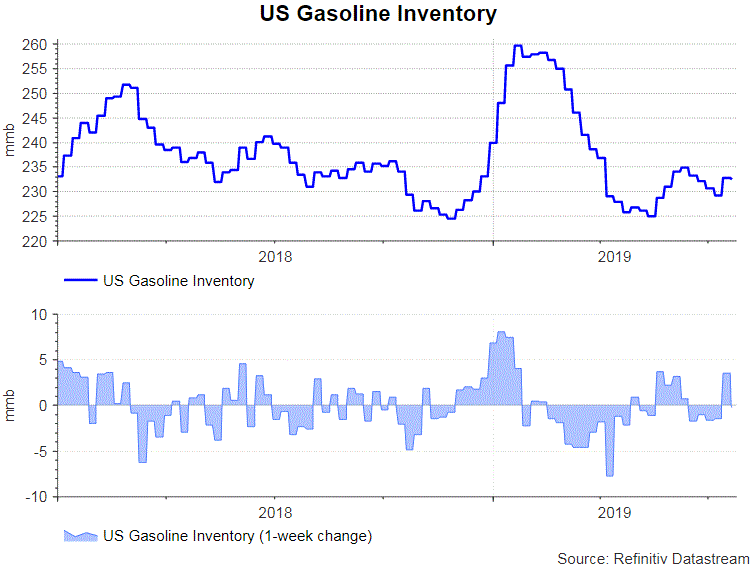
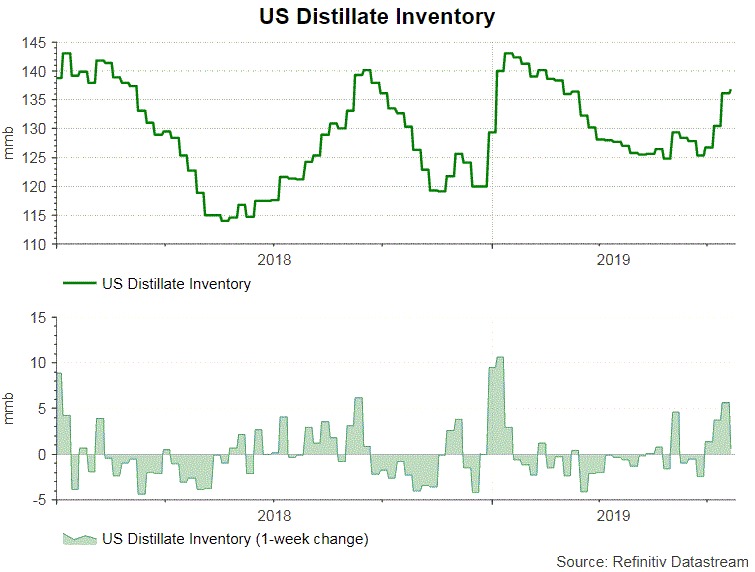 Released after market close on Thursday, the industry- sponsored API estimated that crude oil inventory slumped -10.96 mmb during the week. For refined oil products, gasoline stockpile increased +4.44 mmb while distillate gained +1.42 mmb.
Crude Oil Price Could Struggle To Surpass $58.00
Key Highlights
- Crude oil price topped near $60.80 and declined sharply below $57.00 against the US dollar.
- A bearish trend is forming with resistance near $57.80 on the 4-hours chart of XTI/USD.
- The US Manufacturing PMI in July 2019 (Prelim) declined from 50.6 to 50.0.
- The US Durable Goods Orders in June 2019 could increase 0.7%, better than the last -1.3%.
Crude Oil Price Technical Analysis
After struggling to clear the $60.80 resistance, crude oil price started a fresh decrease against the US Dollar. The price broke the $60.00 and $58.00 support levels to enter a short term bearish zone.
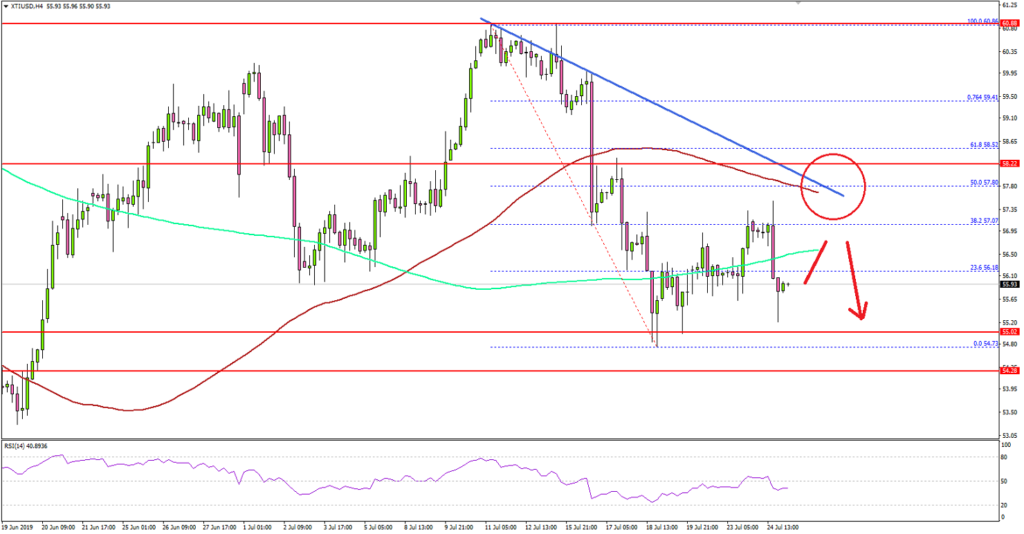
Looking at the 4-hours chart of XTI/USD, the price declined sharply below the $58.00 and $56.00 support levels. There was also a close below $58.00 and 100 (red) simple moving average (4-hours).
Finally, the price spiked below the $55.00 support and traded as low as $54.73. Recently, the price started an upside correction above $56.00 plus the 23.6% Fib retracement level of the decline from $60.86 to $54.73.
However, there is a crucial resistance forming on the upside near the $57.80 and $58.00 levels. Moreover, there is a bearish trend forming with resistance near $57.80 on the same chart. The trend line also coincides with the 50% Fib retracement level of the decline from $60.86 to $54.73.
Therefore, the price is likely to struggle near the $57.80 and $58.00 resistance levels. If there is an upside break and close above $58.00, the price could climb back towards $60.00.
Conversely, the price might decline again below $56.00 if it fails to climb above the $58.00 resistance in the coming sessions.
Fundamentally, the US Manufacturing Purchasing Managers Index (PMI) for July 2019 (Prelim) was released by the Markit Economics. The market was looking for an increase from 50.6 to 51.0.
The actual result very disappointing as the PMI declined to 50.0 (118-month low) and failed to post a decent expansion. Moreover, the Flash U.S. Manufacturing Output Index came in at 48.9, down from 51.2 (119-month low).
The report by the Statistics Canada added:
Service sector companies recorded the strongest rise in business activity since April. This helped to offset a downturn in manufacturing production in July. Although only marginal, the reduction in output across the goods producing sector was the sharpest for almost ten years.
Looking at major pairs, EUR/USD and GBP/USD recovered slightly, but remained in a bearish zone.
Economic Releases to Watch Today
- German IFO Business Climate Index for July 2019 – Forecast 97.1, versus 97.4 previous.
- ECB Interest Rate Decision – Forecast 0%, versus 0% previous.
- US Initial Jobless Claims – Forecast 218K, versus 216K previous.
- US Durable Goods Orders for June 2019 – Forecast +0.7% versus -1.3% previous.
Daily Markets Broadcast
Wall Street mixed amid soft data and disappointing earnings
The NAS100 and SPX500 indices both rose yesterday despite weak economic data, but the US30 index declined amid disappointing earnings. News that North Korean had fired two projectiles didn’t appear to dent risk appetite. ECB rate meeting today is expected to hold a dovish bias.
US30USD Daily Chart
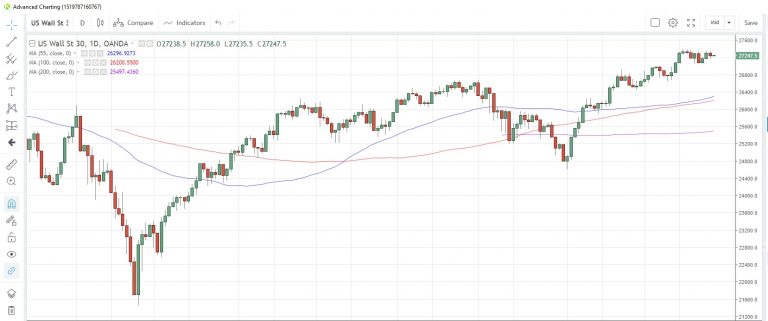
The US30 index fell for the first time in three days yesterday, weighed down by disappointing earnings from Boeing and Caterpillar
The 100-day moving average at 26,200 and the 55-day average at 26,296 continue to track each other higher
The US Markit flash manufacturing PMI slid to 50.0 in July, the weakest reading since September 2009. US durable goods orders are expected to rise 0.7% in June, a turnaround from May’s 1.3% decline.
DE30EUR Daily Chart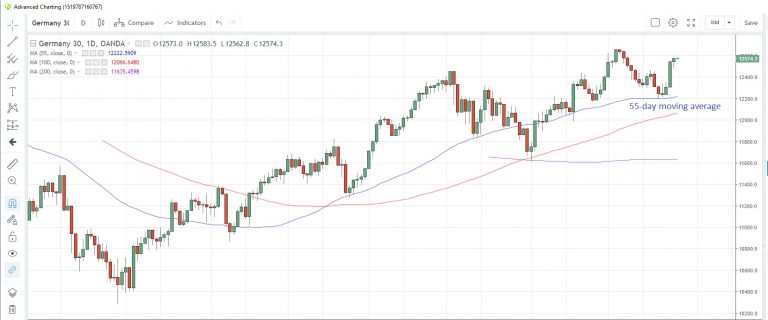
The Germany30 rose for a third straight day yesterday amid hopes that the ECB will announce additional easing measures at today’s rate meeting
The index is above the 55-day moving average at 12,222 and looks to be heading toward the 11-month high struck earlier this month
Germany’s IFO sentiment indices are all expected to show declines in July, the latest surveys of economists show. Markets are pricing in a 39% probability of a 10bps cut at today’s ECB meeting.
WTICOUSD Daily Chart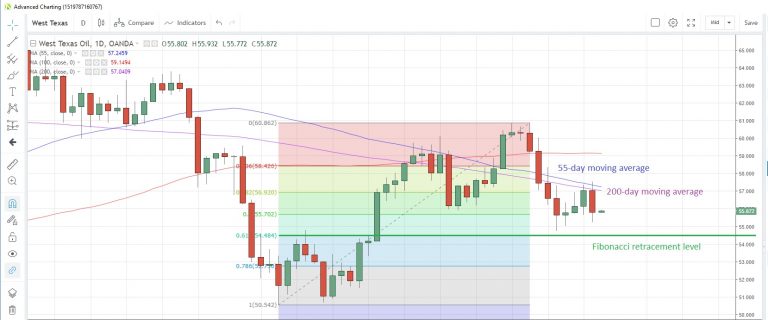
Crude oil prices fell the most in just over a week yesterday, unable to hold on to early gains after weekly data showed a strong drawdown from US stockpiles
WTI failed to breach resistance on a closing basis at the 200-day moving average of $57.12 and the 55-day moving average at $57.35
EIA data showed a drop in inventories of 10.8m barrels, much more than the 4m expected. OPEC members Saudi Arabia and Kuwait discussed resuming production in the Saudi-Kuwait neutral zone which had been halted more than four years ago, removing about 500,000 barrels per day from global supply.