Sample Category Title
France PMIs: Softer growth in July dents hopes of swift recovery to long-run rate
Franc PMI manufacturing dropped to 50.0 in July, down from 51.9, missed expectation of 51.6. PMI services dropped to 52.2, down from 52.9, missed expectation of 52.8. PMI Composite dropped to 51.7, down from 52.7.
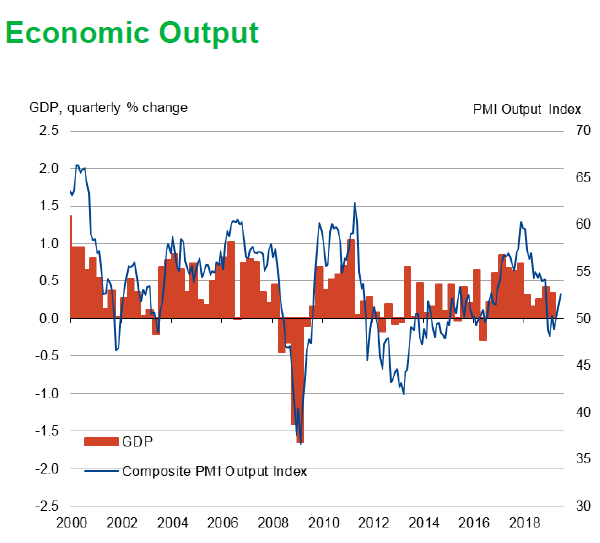
Commenting on the Flash PMI data, Eliot Kerr, Economist at IHS Markit said:
"Following a seven-month high in June, growth of the French private sector eased at the start of the third quarter. The slowdown was driven by softer new order growth, as sales at manufacturers slipped back into contraction territory at a time of ongoing geopolitical tensions.
"Notably, the rate of expansion in overall business activity remains historically subdued and far weaker than the averages registered during 2017 and 2018. Moreover, softer growth in July dents hopes of a swift recovery to the long-run rate, which were beginning to materialise after June's solid performance."
EUR/USD Outlook: Bears Approach Key 1.11 Support Zone After Weak EU Data Ahead Of ECB
The Euro fell to new two-month low on Wednesday, hit by significant miss of PMI data from EU, Germany and France, which added to negative outlook on expectations of ECB rate cut on Thursday.
Extension of Tuesday's strong fall (the pair was down 0.5% for the day, in the second biggest daily fall in July) came closer to key 1.11 support zone.
ECB is in focus, with wide expectations for 10 basis points cut, but traders also look for more dovish tone from the central bank that would leave the door open for further cut in September.
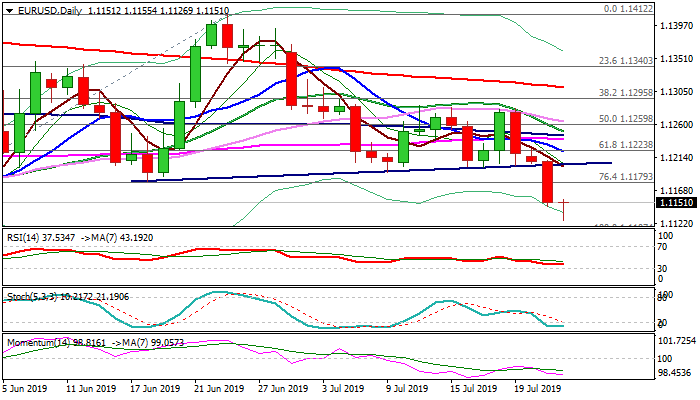
Such scenario would increase risk of break below 1.11 zone (2019 low lays at 1.1107) which would spark fresh extension of downtrend from 1.1412 (25 June high).
Strong bearish momentum and daily MA's in full bearish setup, support the notion, with additional negative signals being generated on completion of H&S pattern on daily chart and close below Fibo 76.4% of 1.1107/1.1412 ascend (1.1179).
Bears might stay on hold ahead of 1.11 zone supports on deeply oversold conditions, but could be also squeezed if the ECB's tone is less dovish than expected.
Broken supports at 1.1280 zone now mark initial resistances, followed by broken neckline (1.1205), break of which would sideline bears.
Res: 1.1155, 1.1180, 1.1205, 1.1222
Sup: 1.1126, 1.1116, 1.1107, 1.1050
Trade Talk Boost Fades Quickly
US futures are paring gains made on Tuesday on the back of reports that US trade representatives will head to China for talks on Monday.
The news is undoubtedly positive for sentiment in the markets but unfortunately, we've got excited about this before which may partly explain why the spike in stocks was so short-lived. Any agreement is still likely to take some time and so investors remain reliant on the Fed to support markets with rate cuts this year.
It's quite incredible that expectations for a 50 basis point cut at this meeting is still so high, around 20%, given how eager the New York Fed was to clarify John Williams' comments last week and how Bullard indicated that he supported only cutting by 25. As arguably the most dovish voter, that should have sent a very strong message but as ever, the Fed and the markets don't appear on the same page.
We're also into earnings season now so investors are perhaps more focused on second quarter results and companies outlook in this uncertain and gloomy environment. Company results have been quite good so far but the bar was set very low heading into the season so we shouldn't celebrate too much.
Euro slides on woeful PMI reports
The eurozone manufacturing sector is clearly going through a very challenging period as highlighted by this morning's PMI data, which showed activity contracting at its fastest rate in more than six years, led by Germany which posted its worst reading since the global financial crisis. Unfortunately, this is no blip, this is a continuation of a very worrying trend that has weighed on the euro and contributed to the view that the ECB needs to reverse course and provide more stimulus.
These are timely releases ahead of tomorrow's rate decision, although they are unlikely to be bad enough to force through a rate cut just yet. The ECB is expected to reserve that pleasure for September when it will release new economic forecasts, although even that seems a slightly odd decision, coming at Mario Draghi's final meeting. The euro is under pressure again this morning and is looking to test this year's lows against the dollar.
EIA report eyed after modest response to API drawdown
Oil prices are creeping higher again on Wednesday but given the inventory number we saw on Tuesday from API, it's perhaps surprising to see that it's not higher. Should EIA report something similar today then perhaps we may see more of a reaction, especially as expectations for today's number was initially only a draw of 4.2 million barrels, well short of the 11 million reported by API.
Gold higher but running out of steam
Gold is trading a little higher today but has been volatile early in the European session. Reports that trade talks will resume initially benefited the dollar on Tuesday, weighing in turn on gold but both have reversed course today in early volatile trade. Gold remains a little off its highs still and may struggle to gather too much upward momentum in the near-term. Of course, longer term, the environment is perfect for gold but it has been on a great run and looks to have run out of steam.
EURUSD 1.1110 In Focus
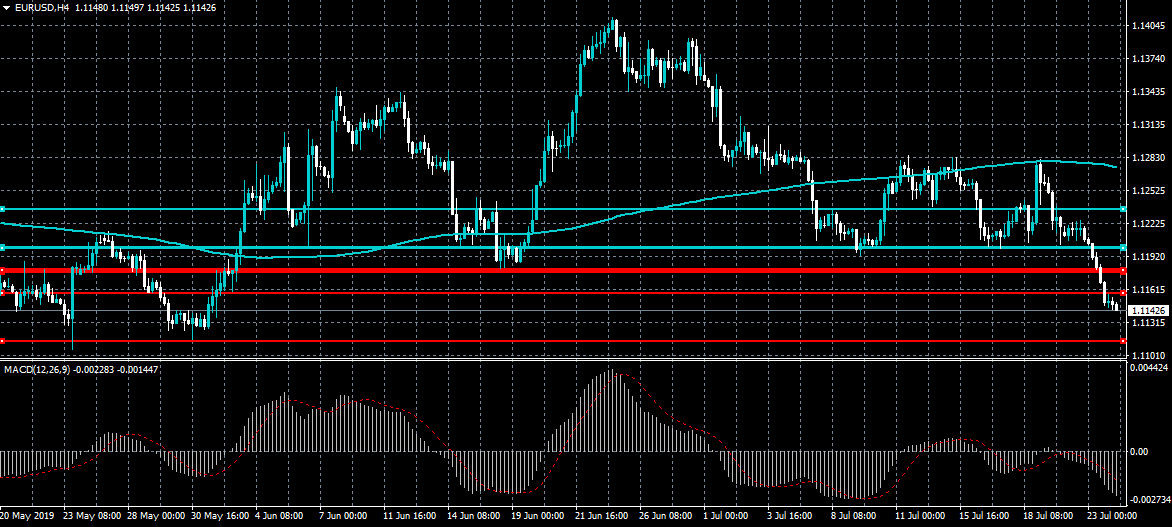
The euro has continued to slip lower against the US dollar during the European trading session, following more weak monthly PMI data from the French and German economies. The 1.1110 support level will soon come into focus if we see a sustained break below the 1.1130 level. EURUSD bulls need weaker than expected PMI data from the United States later today to move price back above the 1.1160 level.
The EURUSD pair is heavily bearish while trading below the 1.1140 level, key support is found at the 1.1110 and 1.1050 levels.
If the EURUSD pair trades above the 1.1140 level, bulls could test back towards the 1.1160 and 1.1180 levels.
USDJPY 107.77 The Level To Watch
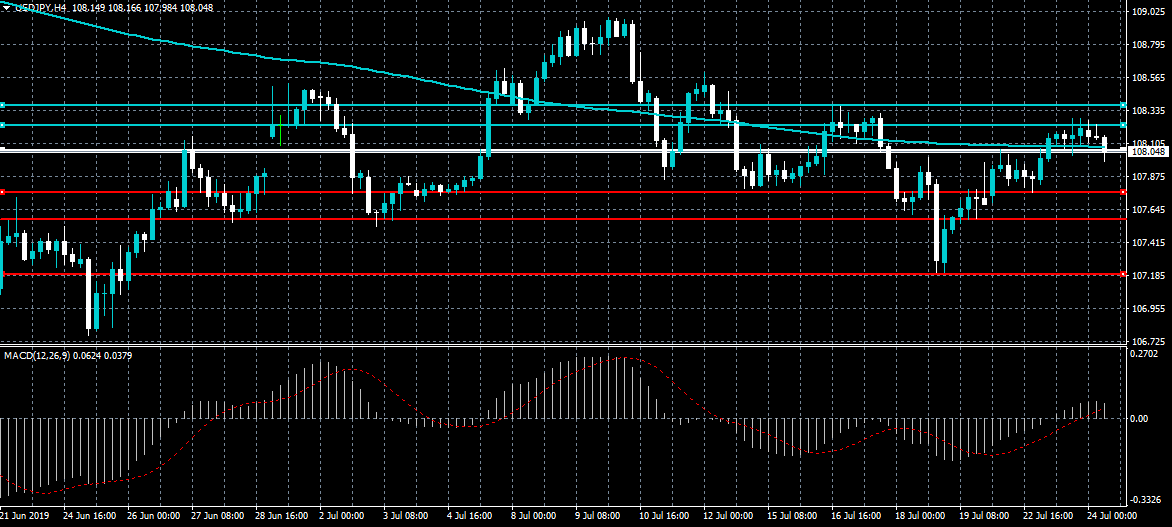
The US dollar is testing back towards the 108.00 level against the Japanese yen as bulls continue to struggle with the 108.20 resistance area. USDJPY sellers may test back towards the pairs weekly pivot point, at 107.77, if sellers hold price below the 108.00 level. The 107.60 level is the main support zone if sellers do start to take back control of the USDJPY below its weekly pivot.
The USDJPY pair is only bearish while trading below the 108.00 level, key support is found at the 107.77 and 107.60 levels.
The USDJPY pair is bullish while trading above the 108.00 level, key technical resistance is found at the 108.23 and 108.37 levels.
The EURO Has Updated Two-Month Lows
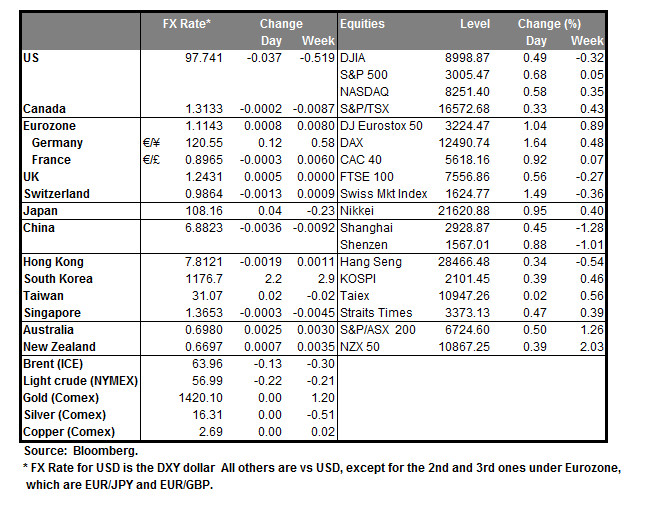
The US dollar is strengthening against a basket of major currencies despite weak economic data. So, existing home sales counted to only 5.27M in July instead of the forecasted value of 5.35M. The US dollar index (#DX) closed in the positive zone (+0.49%). Euro's decline supports the US currency. Thus, the euro has reached two-month lows before the ECB meeting. Financial market participants expect the ECB to give signals for lowering interest rates at tomorrow's meeting.
UK Prime Minister, Theresa May, is resigning today due to the victory of Boris Johnson in the election of the Conservative Party leader. Thus, from today, Johnson will become the 77th Prime Minister of the UK. It should be recalled that the official is a supporter of the "hard" Brexit and most likely wants the UK to exit the EU before October 31. At the same time, some members of the Conservative Party are ready to oppose Johnson and his Brexit position. It is not yet known whether the official will be able to enlist the support of the majority in the House of Commons and avoid no-deal Brexit. Otherwise, his opponents will act against him.
The "black gold" prices show positive dynamics. At the moment, futures for the WTI crude oil are testing the mark of $57.10 per barrel. At 17:30 (GMT+3:00) weekly crude oil inventories will be published in the US.
Market Indicators
- Yesterday, the bullish sentiment was observed in the US stock markets: #SPY (+0.72%), #DIA (+0.63%), #QQQ (+0.65%).
- The 10-year US government bonds yield is at 2.05-2.06%.
The news feed for 2019.07.24:
- A number of indicators on economic activity in Germany and the Eurozone at 10:30 (GMT+3:00) and 11:00 (GMT+3:00), respectively;
- New home sales in the US at 17:30 (GMT+3:00).
The IMF Provides Its Global Economic Review
The international monetary fund cut its forecast for global growth to 3.2% for 2019 and to 3.5% for 2020. The fund named weakening inflation and softening economic activity along with trade tensions as the biggest barriers currently. They noted that even though we are not in a recession risks are increasing. Interesting was the fact that it increased US growth expectations to 2.6% for 2019 but kept a lower figure steady at 1.9% for 2020. On the opposite side, Europe is forecasted to remain at 1.3% in 2019 and expected to increase to 1.6% in 2020. The fund also made reference to the tariffs the US threatened to enact on Chinese goods giving the matter significant importance as it brakes economic investment and removes supply chains reducing the probabilities of economic growth. Furthermore, Brexit uncertainty, European economic weakening, geopolitical tensions from the Middle East are all subjects that limit growth.
Boris Johnson the new UK PM
Boris Johnson won the leadership of the Conservative Party on Tuesday which makes him the new PM. Johnson aims to negotiate a new Brexit deal with the EU to soften the process. However, if Europeans refuse to renegotiate, he has promised to leave on the agreed date of October the 31st 2019, whatever the case. Johnsons approach towards Brexit could create great volatility for the GBP. The pound has fallen sharply in recent weeks on concerns about a "no-deal" Brexit, and stands near $1.24, around its lowest level for two years. Among the most significant reactions of the news release, Goldman Sachs raised its probability of a no-deal Brexit to 20% from 15% while EU negotiator Michel Barnier said they are looking forward to working with the new PM to achieve an orderly Brexit. Many fear that PM Johnson’s view to drop out of the EU with a deal or without, could put London in a very difficult position. At the same time Johnson is putting a lot of pressure on the EU, as they may have to change their approach to handle the situation.
EURGBP 4 Hour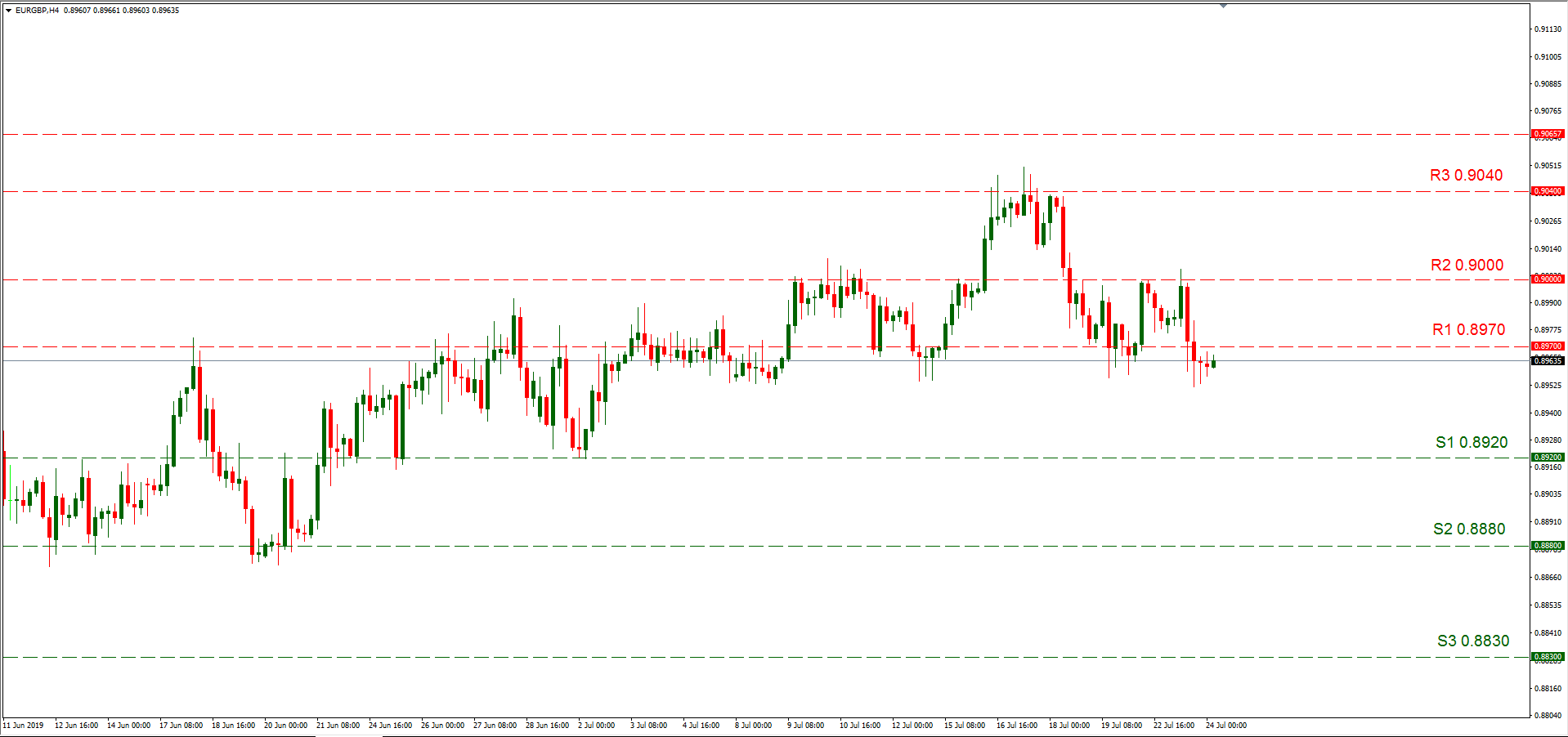
Support: 0.8920 (S1), 0.8880 (S2), 0.8830 (S3)
Resistance: 0.8970 (R1), 0.9000 (R2), 0.9040 (R3)
XAUUSD 4 hour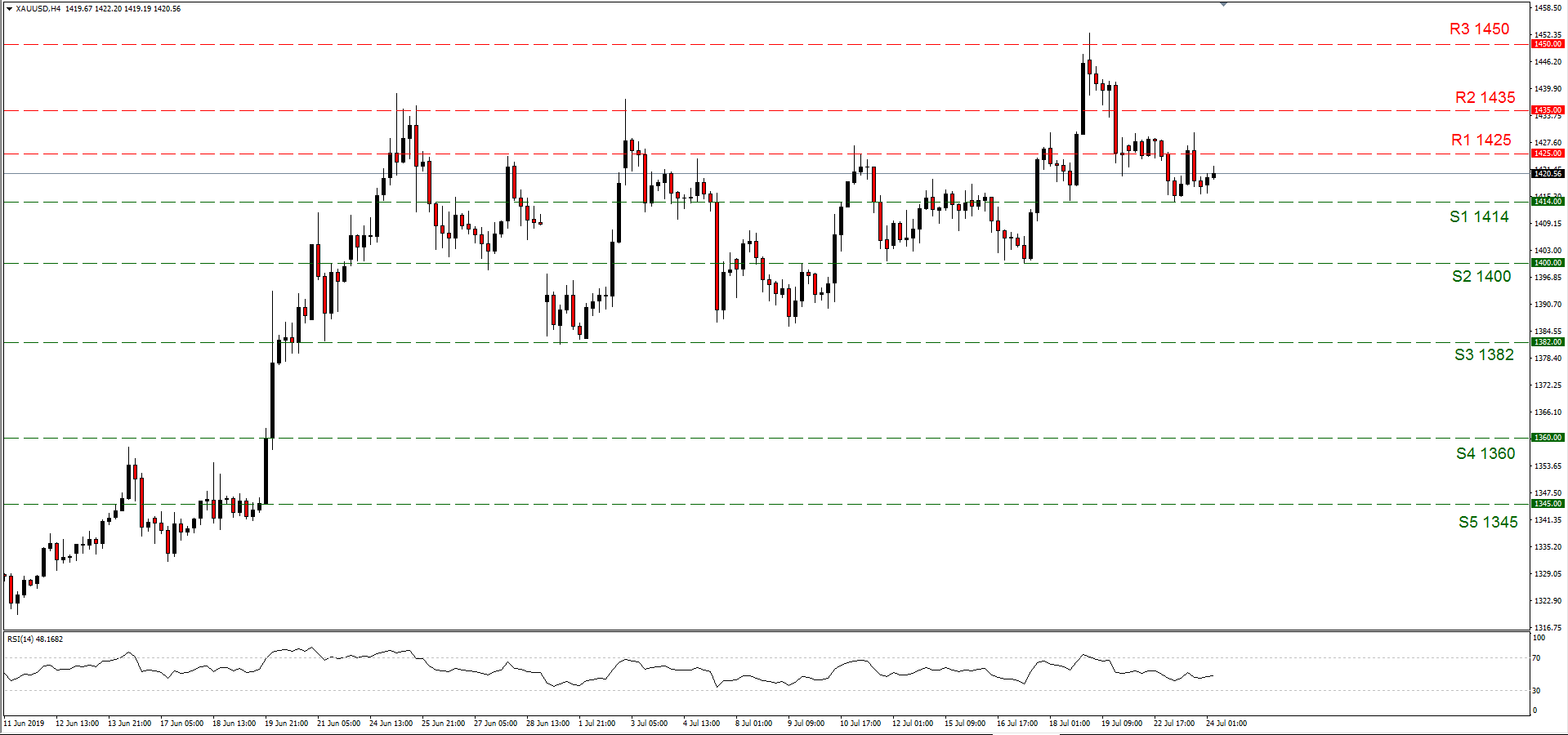
Support: 1414 (S1), 1400 (S2), 1382 (S3)
Resistance: 1425 (R1), 1435 (R2), 1450 (R3)
Special Report: Is Geopolitical Tensions Really Helping Oil Price?
Crude oil price has traded mostly in a range of $51- 61 for the past two months and for the fourth consecutive day, the price has been trading in an upward direction. The recent momentum in the oil price is due to the two main reasons: firstly, the drop in the U.S. crude oil inventory data which has made investors believe that the supply is well managed and the chances of oil glut forming again are minuscule. Finally, there is an optimism on the resumption of the face to face trade negotiations between the U.S. and China. Remember demand always plays an important role, if it is strong, it can take care of extra supply itself, but if there is a weakness, even a small supply can start to look like a glut.
So, the question is what is the impact of heightened geopolitical tension?
Well the answer is in the forward contracts. We need to focus on the gap between Brent crude’s front-month and the following month (second month) contracts. Currently, this gap is 8c/bbl. In simple terms, the backwardation of the curve is the smallest since March. The below chart shows the spread between the current month and forward month for Brent crude, and it is no way closer to the levels which we experienced in late December last year when Trump actually started to disrupt things in the Middle East.
In addition to this, we also have the International Monetary Fund who hasn’t painted an optimistic picture- it has notched down the global growth forecast from its previous estimates.
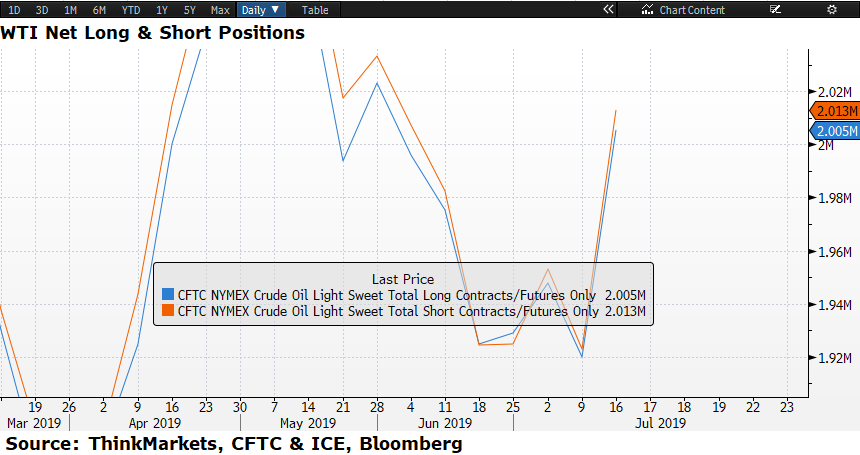
As for the speculators positions, the CFTC and ICE data shows that there was an increase in the bearish percentage, the bullish sentiment dropped by -0.4% and overall net short positions increased by 7784. The chart below shows total net long and net short positions.
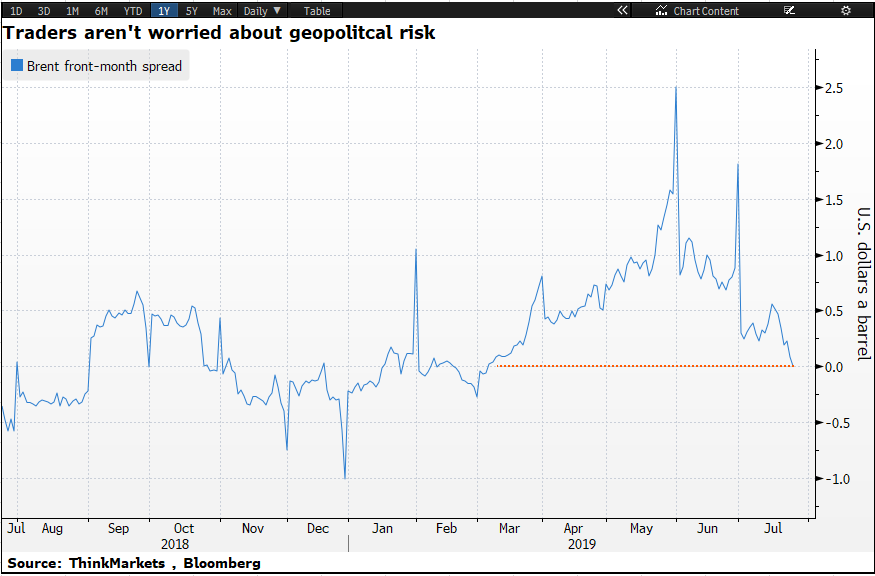
To conclude, it seems like traders are less worried about the geopolitical tensions and more focused on the supply data and the on going trade negotiations between China and the U.S.
EUR/JPY Breakout Occurs
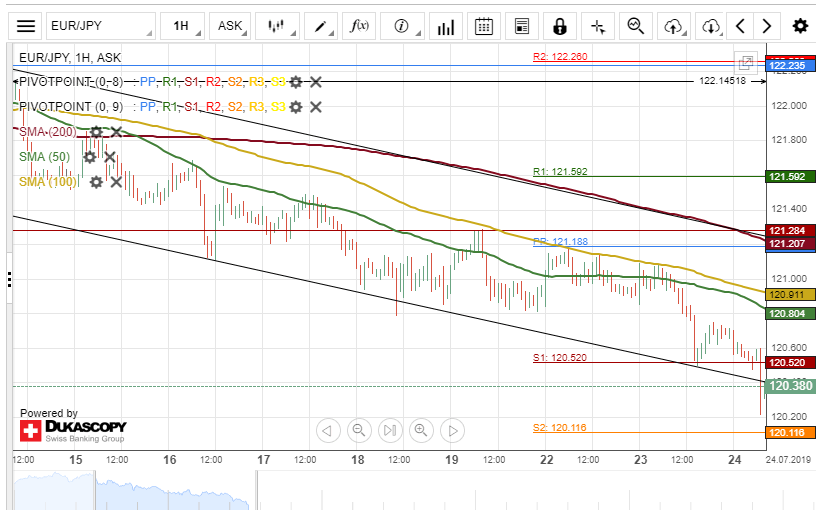
The common European currency has depreciated about 82 base points against the Japanese Yen since Tuesday's session. The currency pair breached the lower boundary of a descending channel pattern during the first part of Wednesday's trading session.
Given that a breakout had occurred, it is likely that the EUR/JPY exchange rate could continue its downward movement today. The potential target will be near the monthly S2 at 119.83.
If the support level formed by the monthly S2 holds, a possible upside reversal could occur during the following trading session.
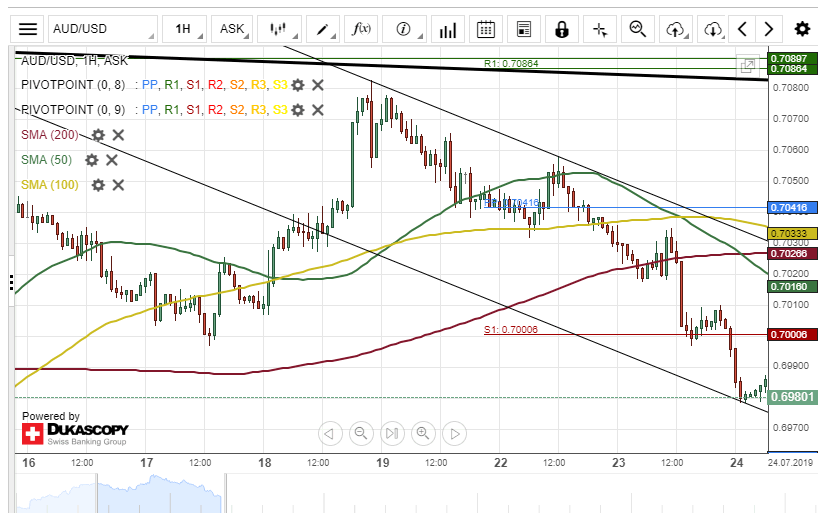
AUD/USD Sets For Breakout
During yesterday's trading session, the Australian Dollar depreciated about 51 base points against the US Dollar. The currency pair dashed through the weekly S1 at 0.7000.
Currently, the exchange rate is trading near the bottom border of a descending channel pattern at 0.6979 and could be set for a breakout.
f this breakout occurs, a decline towards the weekly and the monthly support levels at 0.6961 could be expected.
If the junior descending channel holds, a brief retracement is likely to occur during the following trading session.