

Sample Category Title
USD/JPY Mid-Day Outlook
Daily Pivots: (S1) 107.94; (P) 108.11; (R1) 108.40; More...
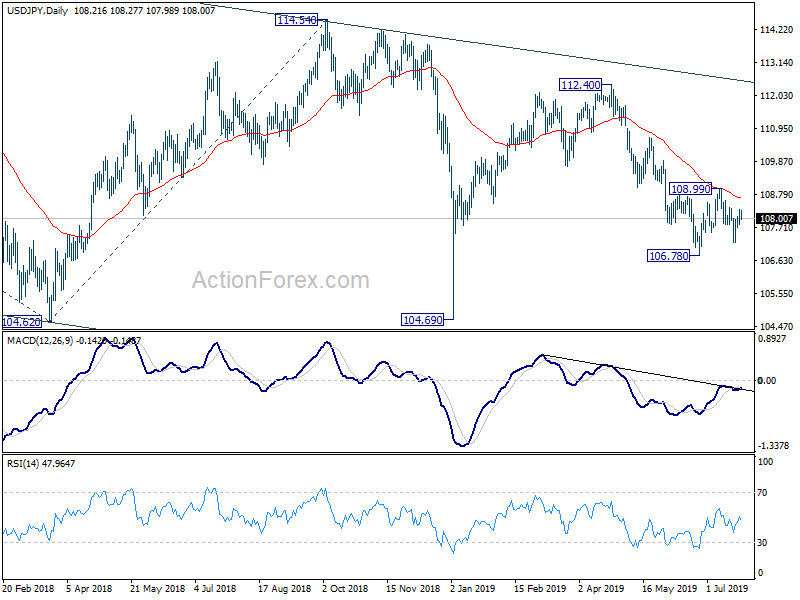
No change in USD/JPY's outlook and intraday bias remains neutral first. On the upside, break of 108.37 will extend the rebound from 106.78 with another rise, possibly through 108.99 resistance. On the downside, break of 107.21 will resume the fall from 108.99 to 106.78 low. Decisive break there will resume whole decline from 112.40.
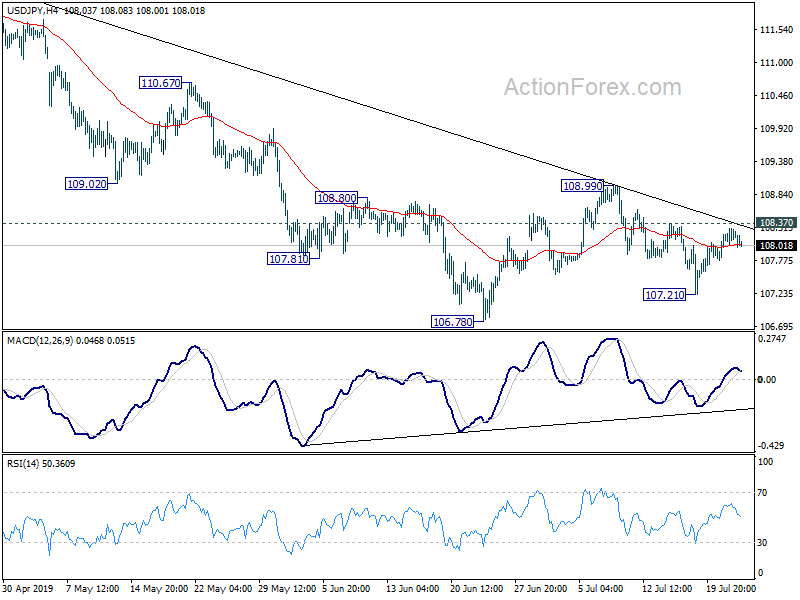
In the bigger picture, decline from 118.65 (Dec 2016) is still in progress, with the pair staying inside long term falling channel. Break of 104.62 will target 100% projection of 118.65 to 104.62 from 114.54 at 100.51. For now, we'd expect strong support above 98.97 (2016 low) to contain downside to bring rebound. In any case, break of 112.40 is needed to the first serious sign of medium term bullishness. Otherwise, further decline will remain in favor in case of rebound.
USD/CHF Mid-Day Outlook
Daily Pivots: (S1) 0.9826; (P) 0.9843; (R1) 0.9870; More...
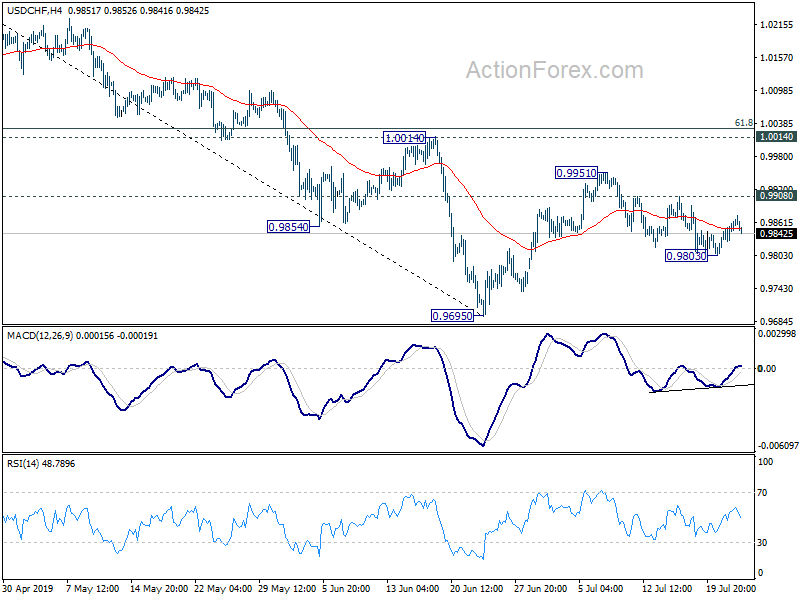
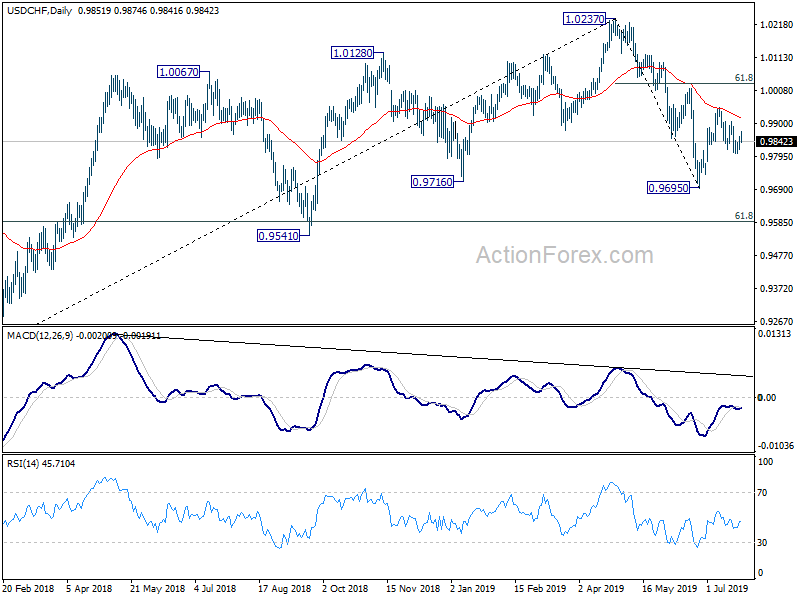
Intraday bias in USD/CHF remains neutral for the moment. Further decline is in favor with 0.9908 resistance intact. Below 0.9803 will extend the fall from 0.9951 to retest 0.9695 low. On the upside, break of 0.9908 resistance would resume the rebound from 0.9695, through 0.9951, to 1.0014 resistance.
In the bigger picture, up trend from 0.9186 (2018 low) should have completed at 1.0237 already. Deeper decline would be seen to 61.8% retracement of 0.9186 to 1.0237 at 0.9587 and below. For now, USD/CHF is seen as in long term range pattern between 0.9186 and 1.0342. Hence, we'd pay attention to bottoming signal below 0.9587. However, sustained break of 1.0014 will revive medium term bullishness and turn focus back to 1.0237 high.
EUR/USD Mid-Day Outlook
Daily Pivots: (S1) 1.1128; (P) 1.1169; (R1) 1.1192; More...
EUR/USD's fall from 1.1412 is still in progress and intraday bias remains on the downside for 1.1107 low. At this point, we're not expecting a break there yet. Thus, focus will be on bottoming signals around 1.1107. On the upside, break of 1.1193 support turned resistance will turn intraday bias remains neutral first. But break of 1.1282 resistance is needed to signal completion of fall from 1.1412. Otherwise, further decline is in favor even in case of recovery.
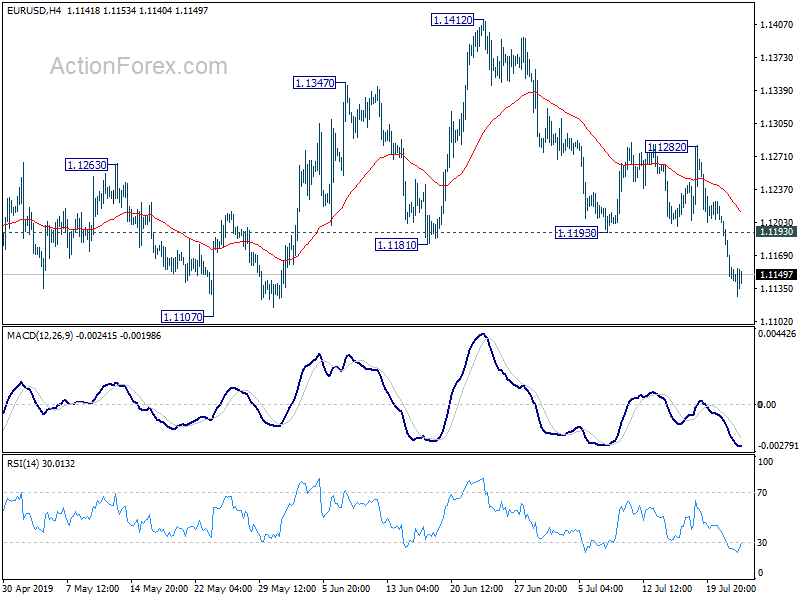
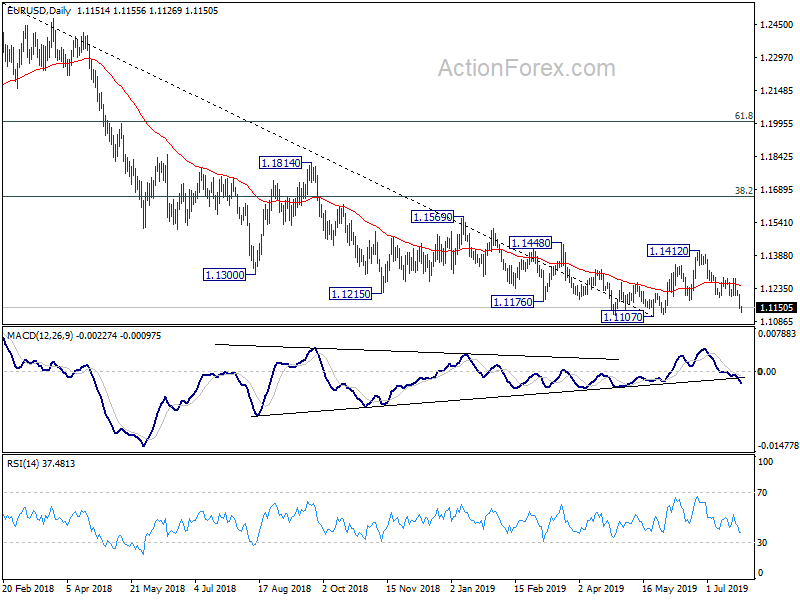
In the bigger picture, on the one hand, 1.1107 is seen as a medium term bottom on bullish convergence condition in weekly MACD. On the other hand, rejection by 55 week EMA retains medium term bearishness. Outlook stays neutral for now. On the downside, break of 1.1107 will resume the down trend from 1.2555 (2018 high) to 78.6% retracement of 1.0339 to 1.2555 at 1.0813. Meanwhile, break of 1.1412 will resume the rebound to 38.2% retracement of 1.2555 to 1.1107 at 1.1660.
GBP/USD Mid-Day Outlook
Daily Pivots: (S1) 1.2411; (P) 1.2447; (R1) 1.2475; More....
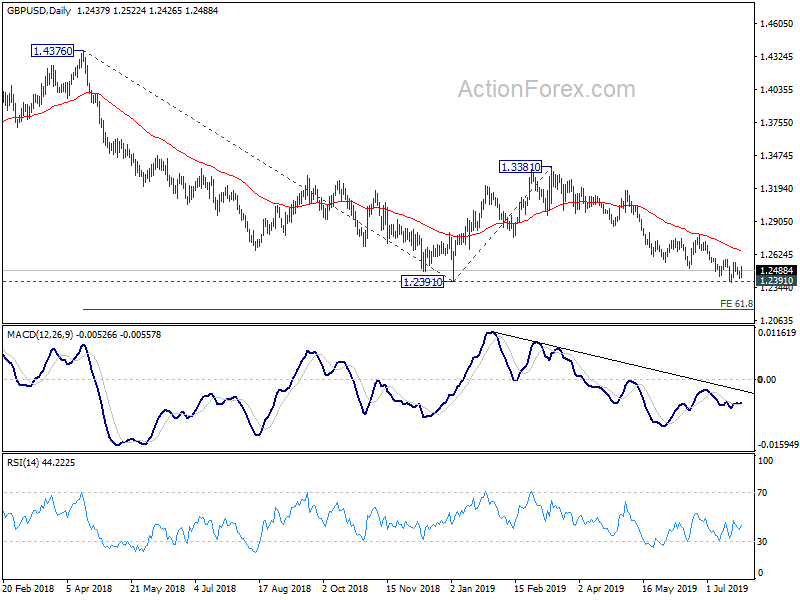
GBP/USD rebounds strongly today but stays inside range of 1.2382/2579. Intraday bias remains neutral first. With 1.2579 resistance intact, further decline is still in favor. On the downside, sustained break of 1.2391 key support will resume larger down trend for 61.8% projection of 1.4376 to 1.2391 from 1.3381 at 1.2154 next. Though, break of 1.2579 will indicate short term bottoming and bring stronger rebound back to 1.2783 resistance. In this case, consolidation from 1.2391 would extend with another rise, towards 1.3381 resistance, before completion.
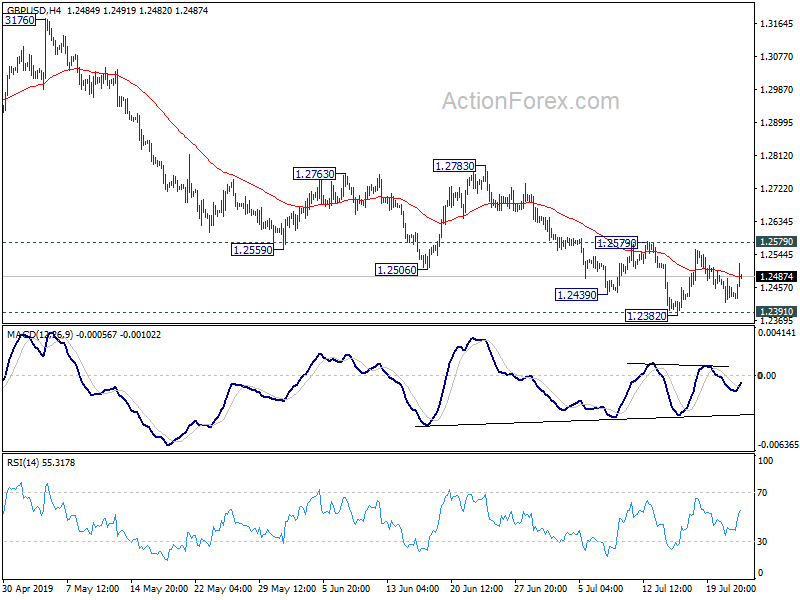
In the bigger picture, down trend from 1.4376 (2018 high) is still in progress. Break of 1.2391 would target a test on 1.1946 long term bottom (2016 low). For now, we don't expect a firm break there yet. Hence, focus will be on bottoming signal as it approaches 1.1946. In any case, medium term outlook will stay bearish as long as 1.3381 resistance holds, in case of strong rebound.
EUR/GBP Mid-Day Outlook
Daily Pivots: (S1) 0.8944; (P) 0.8974; (R1) 0.8996; More...
EUR/GBP drops sharply to as low as 0.8935 so far today. The strong break of 0.8954 support confirms short term topping. Fall from 0.9051 is seen as corrective rise from 0.8489. Intraday bias is back on the downside for 55 day EMA (now at 0.8891) and then 38.2% retracement of 0.8489 to 0.9051 at 0.8836. On the upside, above 0.8954 will turn intraday bias first. But deeper pull back would remain in favor as long as 0.9051 resistance holds.
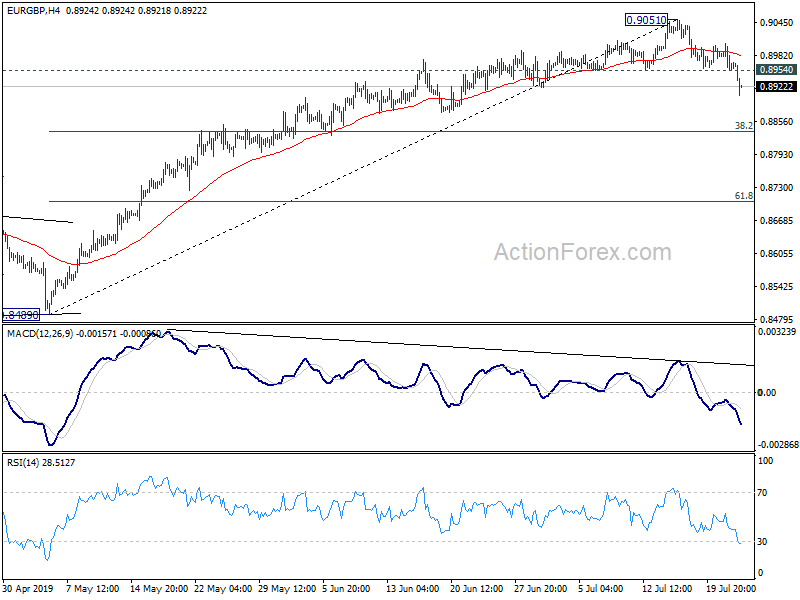
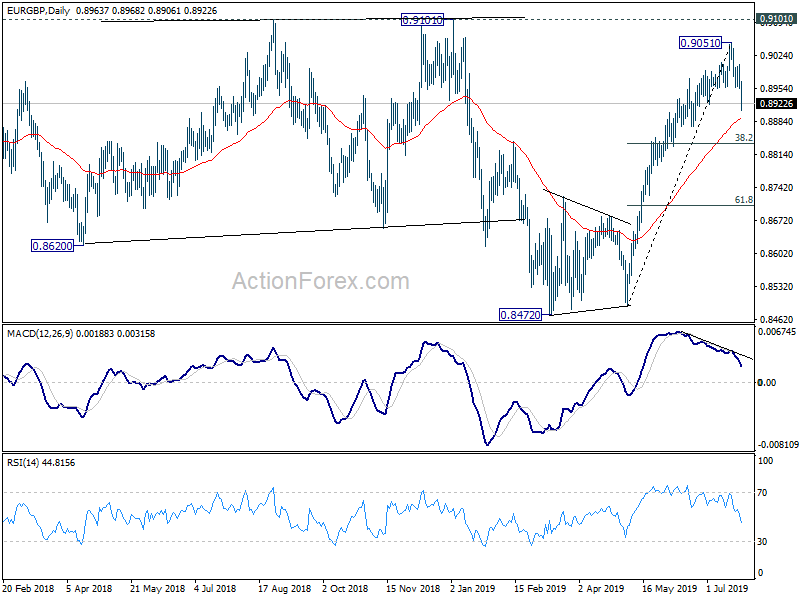
In the bigger picture, medium term decline from 0.9305 (2017 high) is seen as a corrective move. No change in this view. Current development argues that it might have completed with three waves down to 0.8472, just ahead of 38.2% retracement of 0.6935 (2015 low) to 0.9306 at 0.8400, after hitting 55 month EMA (now at 0.8545). Decisive break of 0.9101 resistance will confirm this bullish case. However, firm break of 55 week EMA (now at 0.8805) would possibly extend the correction another another fall to below 0.8472 before completion.
Euro Dives as PMIs Solidify Case for ECB Easing
Euro tumbles sharply today as poor PMI data solidifies the case for ECB easing ahead. The central bank is not expected to act tomorrow yet, but some form of indications would likely be provided by President Mario Draghi, on what stimulus would be adopted. For now, Australian Dollar is even weaker as poor PMI data, with weak employment, argues for more RBA rate cut too.
On the other hand, Sterling is the strongest one for today, partly helped by free fall in EUR/GBP. Also, the Pound continues to digest the impact of Boris Johnson as UK Prime Minister. Yen is the second strongest one. Dollar is mixed even though next week's US-China trade meeting in Shanghai is confirmed.
Technically, EUR/GBP's strong break of 0.8954 confirms short term topping at 0.9501. The cross is now in a corrective phase which could dip below 55 day EMA at 0.8889. AUD/JPY is heading back to 75.13 support. Break will confirm completion of recent corrective recovery from 73.93 and bring retest of this low.
In Europe, currently, FTSE is down -0.82%. DAX is up 0.31%. CAC is down -0.43%. German 10-year yield is down -0.0318 at -0.383. Earlier in Asia, Nikkei rose 0.41%. Hong Kong HSI rose 0.20%. China Shanghai SSE rose 0.80%. Singapore Strait Times dropped -0.14%. Japan 10-year JGB yield dropped -0.0002 to -0.148.
US Mnuchin confirms to travel to Shanghai for trade negotiations next week
US Treasury Secretary Steven Mnuchin confirmed to CNBC that he will travel to China for a trade meeting with Trade Representative Robert Lighthizer next week. Mnuchin noted "there are a lot of issues" but he expected another meeting would follow in Washington afterwards. And, "hopefully we'll continue to progress".
The two-day meeting that starts on Tuesday will be held in Shanghai. Mnuchin noted the symbolism of the location, the Shanghai Communique of 1972 was considered an important step in normalizing relations between the U.S. and China.
Eurozone PMIs: Economy relapsed, GDP growth to slow further to 0.1% in Q3
Eurozone PMI manufacturing dropped to 46.4 in July, down from 47.6 and missed expectation of 47.6. That's also the lowest level in 79 months. PMI services dropped to 53.3, down from 53.6, matched expectations. PMI Composite dropped to 51.5, down from 52.2, a 3-month low.
Chris Williamson, Chief Business Economist at IHS Markit said: "The eurozone economy relapsed in July, with the PMI giving up the gains seen in May and June to signal one of the weakest expansions seen over the past six years. The pace of GDP growth looks set to weaken from the 0.2% rate indicated for the second quarter closer to 0.1% in the third quarter."
"The manufacturing sector has become an increasing cause for concern.... The more domestically-focused service sector remained the main driver of expansion, though even here the rate of growth has slowed, likely in part due to signs of weaker labour market trends. Hiring was close to a three-year low in July."
"With growth slowing, job creation fading and price pressures having fallen markedly compared to earlier in the year, the survey will give added impetus to calls for more aggressive stimulus from the ECB."
Also from Eurozone, M3 money supply growth slowed to 4.5% yoy in June, missed expectation of 4.6% yoy. From UK, BBA mortgage approvals rose to 42.7k in June, but missed expectation of 42.9k.
Germany PMI manufacturing dropped to 84-mth low, from bad to worse
Germany PMI manufacturing dropped to 43.1 in July, down from 45.0 and missed expectation of 45.2. That's also the lowest level in 84 months. PMI services dropped to 55.4, down from 55.8, beat expectation of 55.2, a 2-month low. PMI Composite dropped to 51.4, down from 52.6, a 4-month low.
Phil Smith, Principal Economist at IHS Markit said: "The health of German manufacturing went from bad to worse in July, according to the flash PMI data, raising the risk of the euro area's largest member state entering a mild technical recession... "In a further sign of the slowdown in new orders and gloomier outlook affecting firms' hiring decisions, July's flash data showed employment rising at the slowest rate for over four years, with factory job losses accelerating."
France PMIs: Softer growth in July dents hopes of swift recovery to long-run rate
Franc PMI manufacturing dropped to 50.0 in July, down from 51.9, missed expectation of 51.6. PMI services dropped to 52.2, down from 52.9, missed expectation of 52.8. PMI Composite dropped to 51.7, down from 52.7.
Eliot Kerr, Economist at IHS Markit said: "Notably, the rate of expansion in overall business activity remains historically subdued and far weaker than the averages registered during 2017 and 2018. Moreover, softer growth in July dents hopes of a swift recovery to the long-run rate, which were beginning to materialise after June's solid performance."
Australia PMI composite dropped to 51.8, sharp fall in employment
Australia CBA PMI manufacturing dropped to 51.4 in July, down from 52.0. PMI services dropped to 51.9, down from 52.6. PMI composite dropped to 51.8, down from 52.5. CBA noted that "Slower growth fed through to staffing levels, which decreased for the first time in three months." More importantly, employment decreased for the greatest extent since the survey began in May 2016. Reduction in jobs were centered of service sector.
CBA Senior Economist, Belinda Allen said: "Overall the "flash" PMI does suggest business activity should continue to expand in Q3... The sharp fall in employment intentions underlines the importance of the tax cuts now filtering into the economy and calls for more policy stimulus via infrastructure spending and microeconomic reform. Input costs continued to lift and is worth watching if businesses can pass it on, we could see some impact on consumer inflation over 2H 2019 and into 2020".
Japan PMIs: Fastest expansion in 7 months on services, but manufacturing sector's plight continued
Japan PMI manufacturing improved to 49.6 in July, up from 49.3, but missed expectation of 49.7. PMI services rose to 52.3, up from 51.9. PMI composite rose to 51.2, up from 50.8.
Joe Hayes, Economist at IHS Markit, noted, "overall private sector output expanded at the fastest pace in seven months on the back of faster growth in services activity". "The manufacturing sector's plight continued, however, where production was cut in July for the seventh successive month. "
Also, "weak demand from China remained a key factor behind sluggish demand for Japanese goods. Heightened frictions between Japan and South Korea also add downside risk to the manufacturing supply chain in Japan, creating additional slack that services may once again have to compensate for."
EUR/GBP Mid-Day Outlook
Daily Pivots: (S1) 0.8944; (P) 0.8974; (R1) 0.8996; More...
EUR/GBP drops sharply to as low as 0.8935 so far today. The strong break of 0.8954 support confirms short term topping. Fall from 0.9051 is seen as corrective rise from 0.8489. Intraday bias is back on the downside for 55 day EMA (now at 0.8891) and then 38.2% retracement of 0.8489 to 0.9051 at 0.8836. On the upside, above 0.8954 will turn intraday bias first. But deeper pull back would remain in favor as long as 0.9051 resistance holds.
In the bigger picture, medium term decline from 0.9305 (2017 high) is seen as a corrective move. No change in this view. Current development argues that it might have completed with three waves down to 0.8472, just ahead of 38.2% retracement of 0.6935 (2015 low) to 0.9306 at 0.8400, after hitting 55 month EMA (now at 0.8545). Decisive break of 0.9101 resistance will confirm this bullish case. However, firm break of 55 week EMA (now at 0.8805) would possibly extend the correction another another fall to below 0.8472 before completion.
Economic Indicators Update
| GMT | Ccy | Events | Actual | Forecast | Previous | Revised |
|---|---|---|---|---|---|---|
| 22:45 | NZD | Trade Balance Jun | 365M | 100M | 264M | 175M |
| 23:00 | AUD | CBA PMI Manufacturing Jul P | 51.4 | 52 | ||
| 23:00 | AUD | CBA PMI Services Jul P | 51.9 | 52.6 | ||
| 0:30 | JPY | PMI Manufacturing Jul P | 49.6 | 49.7 | 49.3 | |
| 7:15 | EUR | France Manufacturing PMI Jul P | 50 | 51.6 | 51.9 | |
| 7:15 | EUR | France Services PMI Jul P | 52.2 | 52.8 | 52.9 | |
| 7:30 | EUR | Germany Manufacturing PMI Jul P | 43.1 | 45.2 | 45 | |
| 7:30 | EUR | Germany Services PMI Jul P | 55.4 | 55.2 | 55.8 | |
| 8:00 | EUR | Eurozone Manufacturing PMI Jul P | 46.4 | 47.6 | 47.6 | |
| 8:00 | EUR | Eurozone Services PMI Jul P | 53.3 | 53.3 | 53.6 | |
| 8:00 | EUR | Eurozone M3 Money Supply Y/Y Jun | 4.50% | 4.60% | 4.80% | |
| 8:30 | GBP | BBA Loans for House Purchase Jun | 42.7K | 42.9K | 42.4K | |
| 13:45 | USD | Manufacturing PMI Jul P | 51 | 50.6 | ||
| 13:45 | USD | Services PMI Jul P | 51.8 | 51.5 | ||
| 14:00 | USD | New Home Sales Jun | 659K | 626K | ||
| 14:30 | USD | Crude Oil Inventories | -3.1M |
US Mnuchin confirms to travel to Shanghai for trade negotiations next week
US Treasury Secretary Steven Mnuchin confirmed to CNBC that he will travel to China for a trade meeting with Trade Representative Robert Lighthizer next week. Mnuchin noted "there are a lot of issues" but he expected another meeting would follow in Washington afterwards. And, "hopefully we'll continue to progress".
The two-day meeting that starts on Tuesday will be held in Shanghai. Mnuchin noted the symbolism of the location, the Shanghai Communique of 1972 was considered an important step in normalizing relations between the U.S. and China.
US Open – Boeing and Caterpillar Disappoint; Oil Steady ahead of EIA, Gold Awaits Easing Signals
Today could be the day the bears take control. After what was a very hot start to earnings season, investors got a cold bucket of ice poured over themselves as the DOJ opened a probe on techs biggest stars and industrial earnings from Boeing and Caterpillar disappointed immensely. The US stock market is still the best game in town and while a pullback could occur, traders will return as the prospects of the Fed’s easing cycle will provide longer term support for risky assets.
Boeing saw sales collapse 35% and the 737 Max crisis appears, which is now in its fifth month appears to be going nowhere anytime soon. While shares initially tanked, investors bought the dip as many analysts did not include the $5.6 billion accounting charge in their estimates.
Caterpillar is starting to show signs of weakness and after a couple quarters of raising guidance, they adjusted their earnings growth to the lower end of their forecast. A slowdown in the Permian Basin is also starting to effect Caterpillar and that could be a sign we could see the velocity of US crude production slow down.
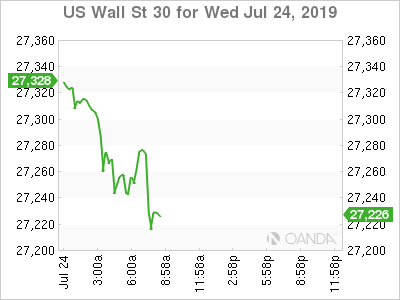
The Dow fell 0.4% following the poor industrial earnings reports.
The US Justice Department sent their eyes on big tech and this will be a story that may weigh on Facebook, Apple, Amazon and Alphabet throughout earnings season. Are the tech giants too big for government to kill? They might not get killed but they will need to spend time and money on an onslaught of investigations and be vulnerable if government makes an example of one them.
Oil
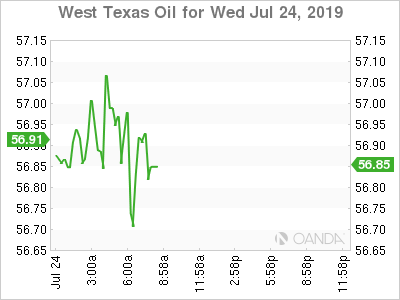
Energy traders are scratching their head to as why oil is not higher, after the API report showed a massive 11 million barrel draw, Iran maintained their hard stance that they will not negotiate with the Trump administration, the dollar is softer and trade optimism should help ease some global demand concerns. It appears oil markets are getting fatigue from the falling US stockpile story. If today’s EIA report confirms another draw, that will mark the six straight weeks of falling stockpiles. The demand story is still weighing on crude and today’s terrible PMI data from Europe is probably keeping the energy rally under control.
Demand will likely get some solid footing on promises of stimulus from the ECB this week and the Fed’s commitment to an easing cycle at the end of the month.
Gold
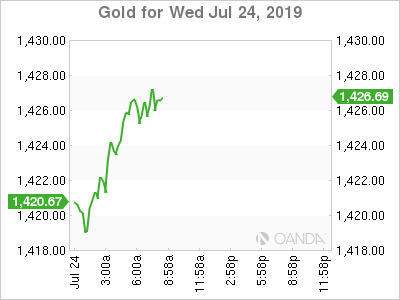
Gold continues to wait for the FOMC event. A rate cut is priced in, but the Fed’s commitment to doing whatever it can to prevent deflation will allow them to signal more cuts and that will benefit the yellow metal tremendously.
Eurozone PMIs: Economy relapsed, GDP growth to slow further to 0.1% in Q3
Eurozone PMI manufacturing dropped to 46.4 in July, down from 47.6 and missed expectation of 47.6. That's also the lowest level in 79 months. PMI services dropped to 53.3, down from 53.6, matched expectations. PMI Composite dropped to 51.5, down from 52.2, a 3-month low.
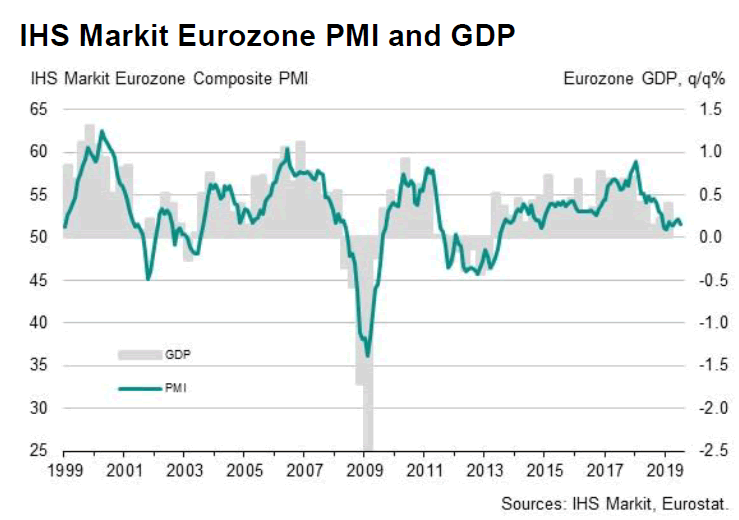
Commenting on the flash PMI data, Chris Williamson, Chief Business Economist at IHS Markit said:
"The eurozone economy relapsed in July, with the PMI giving up the gains seen in May and June to signal one of the weakest expansions seen over the past six years. The pace of GDP growth looks set to weaken from the 0.2% rate indicated for the second quarter closer to 0.1% in the third quarter.
"The manufacturing sector has become an increasing cause for concern. Geopolitical worries, Brexit, growing trade frictions and the deteriorating performance of the autos sector in particular has pushed manufacturing into a deeper downturn with the survey indicative of the goods-producing sector contracting at a quarterly rate of approximately 1%.
"The more domestically-focused service sector remained the main driver of expansion, though even here the rate of growth has slowed, likely in part due to signs of weaker labour market trends. Hiring was close to a three-year low in July.
"Germany has been especially hard hit by the manufacturing and autos sector downturns, and is at risk of GDP contracting marginally in the third quarter. France appears more robust, albeit with growth likely to ease slightly from 0.3% to 0.25% in the third quarter.
"With growth slowing, job creation fading and price pressures having fallen markedly compared to earlier in the year, the survey will give added impetus to calls for more aggressive stimulus from the ECB."
Germany PMI manufacturing dropped to 84-mth low, from bad to worse
Germany PMI manufacturing dropped to 43.1 in July, down from 45.0 and missed expectation of 45.2. That's also the lowest level in 84 months. PMI services dropped to 55.4, down from 55.8, beat expectation of 55.2, a 2-month low. PMI Composite dropped to 51.4, down from 52.6, a 4-month low.
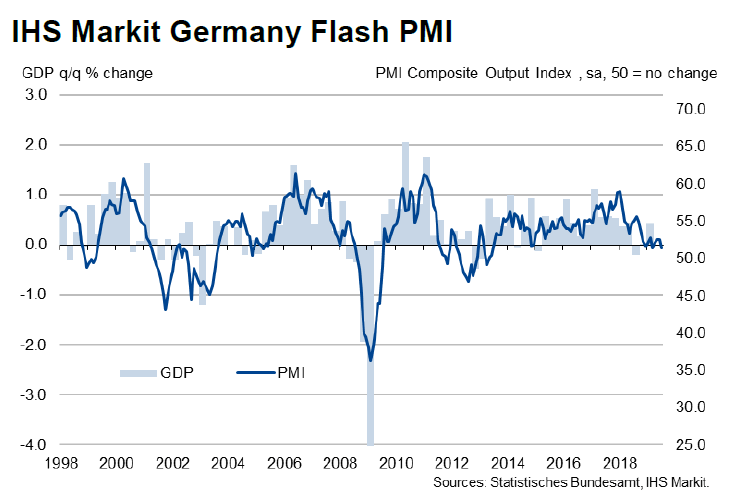
Commenting on the flash PMI data, Phil Smith, Principal Economist at IHS Markit said:
"The health of German manufacturing went from bad to worse in July, according to the flash PMI data, raising the risk of the euro area's largest member state entering a mild technical recession.
"The performance from Germany's goods producers in July is the worst recorded by the survey in seven years, with the renewed weakness mainly stemming from an accelerated drop in export orders – the most marked seen in over a decade.
"Still solid growth in the service sector means that the German economy is just about keeping its head above water for now, but even here there are signs of increased worries among companies as optimism hit a three-and-a-half year low.
"In a further sign of the slowdown in new orders and gloomier outlook affecting firms' hiring decisions, July's flash data showed employment rising at the slowest rate for over four years, with factory job losses accelerating."