Sample Category Title
Japan PMIs: Fastest expansion in 7 months on services, but manufacturing sector’s plight continued
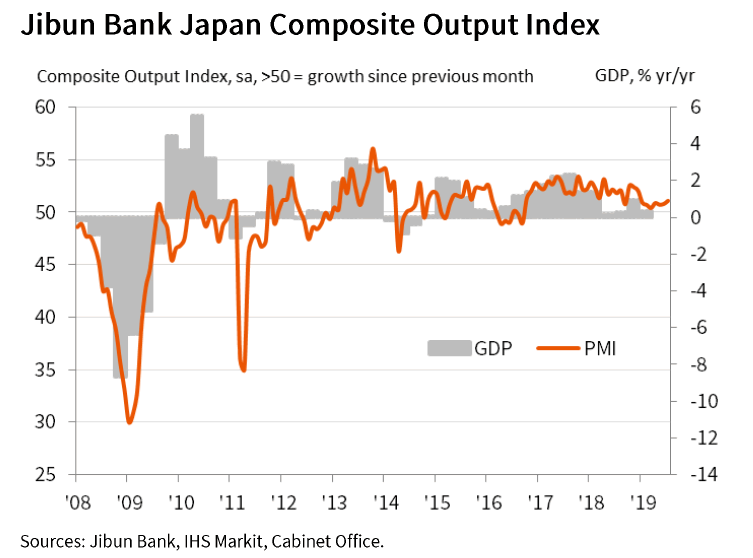
Japan PMI manufacturing improved to 49.6 in July, up from 49.3, but missed expectation of 49.7. PMI services rose to 52.3, up from 51.9. PMI composite rose to 51.2, up from 50.8.
Commenting on the latest survey results, Joe Hayes, Economist at IHS Markit, said:
"Trends witnessed in the Japanese private sector so far in 2019 were more-or-less maintained at the start of the third quarter. Composite 'flash' data for Japan show a modest improvement in private business output in July, with consumption of services supporting the economy, as it has done in the year-to-date. Overall private sector output expanded at the fastest pace in seven months on the back of faster growth in services activity.
"The manufacturing sector's plight continued, however, where production was cut in July for the seventh successive month. Weak demand from China remained a key factor behind sluggish demand for Japanese goods. Heightened frictions between Japan and South Korea also add downside risk to the manufacturing supply chain in Japan, creating additional slack that services may once again have to compensate for."
Market Morning Briefing: Dollar Index Has Risen Above 97.60
STOCKS
The news on the US-China trade talks setting to re-start next week has given a boost to the equities. The US and the European indices have risen overnight and the Asians are trading in green. The Dow and the DAX can move further higher in the near term. The positive sentiment might help the Indian indices, the Sensex and Nifty to sustain above their crucial supports and move higher in the coming sessions.
Dow (27349.19, +177.29, +0.65%) has bounced. The support at 27000 is holding well. However a strong rise past 27500 is needed to gain fresh momentum. While below 27500, a sideways consolidation between 27000 and 27500 can be seen for some time.
Contrary to our expectation, DAX (12490.74, +201.34, +1.64%) has surged above 12400 and has negated our expected fall to 12100-12000. While above 12350, the outlook is positive now to test 12600 in the near term.
Nikkei (21727.60, +106.72, +0.49%) has risen further and is heading towards the key resistance level of 21750. As mentioned yesterday, a strong rise past 21750 will boost the bullish momentum and take Nikkei further higher to 22000 and 22200. Inability to breach 21750 can drag it to 21300-21250 again.
Shanghai (2929.06, +29.11, +1.00%) has bounced above 2900 again. But it has to surpass 2950 to turn the outlook bullish. While below 2950, it broader picture look weak for it to decline below 2900 again and test 2850 or even lower levels.
Sensex (37982.74, -48.39, -0.13%) is holding above its key support level of 37900. While above 37900, a bounce to 38350-38500 is possible in the coming sessions. But need to remain cautious as a break below 37900 will open doors for 37000 on the downside.
Nifty (11331.05, -15.15, -0.13%) is holding above 11300 but has to rise past 11400 to ease the downside pressure and test 11500 on the upside. Nifty will come under renewed pressure on a break below 11300 in which case a fall to 11000 is possible.
COMMODITIES
Crude prices could see a rise in the near term while Copper looks bearish. Gold and Silver could have some scope of rising in the very near term but that is likely to be short lived as the medium term looks bearish. Strength in the US Dollar (refer forex section below) could push Gold and Silver down in the near term.
The API inventory data reported a draw of 10.96 mln barrels for the week ended 19th July pulling up Crude prices for the day. The EIA Crude stock inventory data is due today and the market expects a decline by 4.4 mln barrels for the week ended 19th July. Such a decline if seen could continue to keep Crude prices at higher levels over the next 2-3 sessions.
Brent (64.15) and Nymex WTI (57.07) have risen and could trade higher over the next 2-3 sessions. Brent could rise towards 65-66 while WTI could test resistance near 58-60 in the very near term. Looking at the weekly and 3-day charts, Brent and WTI has been rising from supports near 62 and 54 respectively and may now move up for sometime before pausing. Near term looks bullish.
Gold (1420.40) has held well below 1460 and has been fluctuating in the broad 1380-1460 region. Currently trading near crucial levels, if the gold prices fall below 1420/10 and sustains, it could indicate that a near term top could be in place and that the gold prices could fall in the medium term.
Silver (16.48) has horizontal near term support near 16.20 and seems to be holding well just now. However the rise is short lived and the prices could soon decline as 16.60 could prove to be a strong resistance as seen on the longer term charts taking down prices towards 16.0-15.75 eventually.
Copper (2.7045) has been sharply coming off in line with our expectation. A test of 2.68-2.66 looks likely in the near term. View remains bearish for the coming sessions.
FOREX
US Dollar looks strong for the near term indicating weakness setting in for the major currencies including some of the EM currencies. Aussie, Pound and Euro looks bearish while Dollar-Yen could rise towards near term resistance. Dollar-Rupee has some room on the upside while Yuan could see some weakness too within the broad sideways range.
Dollar Index (97.75) has risen above 97.60 and looks strongly bullish for the near term. If the index sustains above 97.50/60, it could move higher towards 98.50 in the near term. View is bullish above 97.50.
Euro (1.1143) has moved down in line with our expectation and could test 1.1125-1.1100 on the downside while the Dollar Index targets 98.50 on the upside. The break below 1.12 is significant indicating a bearish Euro for the near term.
Dollar-Yen (108.17) could move higher to test immediate resistance at 108.50. Thereafter, it could either come off towards 108.0-107.5 or move up to test 109. We would watch price action near 108.50.
Euro-Yen (120.54) has broken clearly below 121 but could get some support near the Jan’19 low of 118.82. This would be crucial levels to watch and a bounce or break on either side from 118.82 would be crucial decider of further direction in the longer run. Immediate view is bearish towards 118.82 while we would wait to get more clarity on the medium term direction.
Aussie (0.6979) and Pound (1.2432) are sharply down on fresh Dollar strength. Aussie could come down towards 0.6950-0.6900 in the near term while Pound could target 1.2350 before bouncing from there.
USDCNY (6.8818) is likely to rise towards 6.90 in the near term While there is immediate support on the daily candles, the par is stuck in between the 6.90-6.85 region in the longer term charts and indicates some consolidation within this broad range for the medium term.
USDINR (68.95) could not sustain the break above 69 yesterday. With the sharp rise in the US Dollar overnight, it would be important to see if the Dollar Rupee moves higher today targeting a test of 69.10/15 during the day. Eventual test of 69.25 still looks possible in the near term.
INTEREST RATES
The US Treasury yields have bounced yesterday and might see some upticks in the near-term as against our view to dip further. The German yields keep our bearish view intact and can fall further. The outcome of the European Central Bank (ECB) meeting tomorrow will need a watch which could influence the yield movement. The Indian 10Yr GoI is bullish in the near-term and can move further up from current levels.
The US 2Yr (1.83%) and 5Yr (1.83%) Treasury yields were up 1 bps and 2 bps respectively. The 10Yr (2.08%) was up 3 bps and the 30 Yr (2.61%) was up 4 bps yesterday. It will have to be seen if the yields can sustain higher which will then negate the dip that we have been expecting over the last few days. The 10Yr can gain momentum to target 2.15% and 2.20% if it breaks above 2.10%. The 30Yr can rise to 2.65% while above 2.60%.
The German yields continue to fall in line with our expectation. The 2Yr (-0.79%) was down 3 bps while the 5Yr (-0.68%), 10Yr (-0.36%) and the 30Yr (0.24%) yields were down 2 bps each. The bearish view is intact. As expected the 2Yr is heading towards -0.85% and the 10 Yr can test 0.40% in the near-term.
The 10Yr GoI (6.4648%) has risen above 6.45%. The yield is gaining strength slowly and keeps our bullish view intact to test 6.50%-6.55% on the upside in the near term.
US Kudlow hopeful on China trade talks, Perdue reveals new farmer aids
White House economic adviser Larry Kudlow indicated yesterday that US trade team could travel to China to restart trade negotiations. Meanwhile, China could re-start agricultural purchases soon. He said, "as I read it, it looks like there will be a trip to China and we expect, we hope strongly that China will very soon start buying agriculture products, No. 1 as part of an overall deal and No. 2 as a goodwill gesture."
Kudlow also sounded positive and added, "I wouldn't be surprised if we saw a lot of positive news on that coming up... I'm going to strike a note of hopefulness." However, Commerce Secretary Wilbur Ross sounded more cautious and said "I'm not aware that the gate has opened to any significant degree."
Separately, Agriculture Secretary Sonny Perdue announced new aid package to help farms hurt by Trump's trade war with China. The government will pay a minimum of USD 15 per acre to farmers. He said, "we're anticipating right now three tranches; probably 50 percent ... or minimum there of $15 an acre initially." The second and third tranches would be dependant on market conditions.
RBA to Cut Cash Rate to 0.75% in October & to 0.50% in February
To complement the rate cut we expect in February next year the RBA might consider a package of policies that would enhance the impact of the rate cut. However our rate forecasts are not contingent on that development.
We are bringing forward the timing of our forecast for the next cut in the overnight cash rate by the RBA from November to October.
By October, we expect that the path of the unemployment rate will be sufficiently contrary to the RBA's plans that they will have appropriate justification to ease policy a little earlier than we had previously expected.
We recognise that September is also likely to be a "live" meeting but expect the Board will wait for more data, such as the June quarter national accounts, before moving again.
We are also revising down our terminal rate forecast from the 0.75% we forecast on May 24 to 0.50%. We expect the move from 0.75% to 0.50% to occur in February next year.
Developments since our last forecast change on May 24
Since we announced the 0.75% target terminal rate on May 24 a number of factors have strengthened the case for an even lower terminal rate.
The AUD is providing less support than expected. At the time of our May 24 forecast, markets had not priced in the prospect of a 0.75% terminal rate by year's end. We expected that as markets moved in that direction the AUD would adjust accordingly. Markets have indeed moved to price in that move but the AUD has actually appreciated from USD0.692 to USD 0.702, partly due to the higher terms of trade and the prospect of a lower US federal funds rate.
We expect that the near term boost to demand from the higher terms of trade will be limited by a cautious response from both the private and public sectors.
Since May 24 we have also moved to forecast an easing cycle from the Federal Reserve. Lower rates globally are largely the result of the concern from the Federal Reserve and other central banks around world growth and deteriorating global trade.
Some data releases since May 24 have also highlighted downside risks for demand, wages and the labour market. In particular we have been surprised by the response of consumer sentiment to the rate cuts in June/July, having fallen by nearly 5%. Furthermore, our measure of unemployment expectations has also deteriorated markedly.
Our forecasts of inflation and unemployment emphasise the extent of the challenge faced by the RBA in boosting demand and wages and reaching their own targets. We expect that the RBA will eventually see only one more rate cut, in October, as being an insufficient response.
RBA's challenge around its forecasts
In its Statement on Monetary Policy (SMP), which will be released on August 9, the RBA is expected to lower its growth forecast for 2019 from 2.75% to 2.50% but retain its current forecast for growth in 2020 to be at trend 2.75%.
On inflation we expect that following the print of the June quarter Consumer Price Index on July 31 the Bank will have to lower its forecast for underlying inflation (trimmed mean) from 1.75% in 2019 to 1.50% and from 2.00% to 1.75% in 2020.
In the August SMP, forecasts for December 2021 will be released and the RBA's trimmed mean forecast is expected to lift to 2%. The RBA will be signalling an eventual return to the 2-3% target band although the journey will take a year longer.
The real difficulty will come with the unemployment rate where the actual for June has just printed 5.24% compared to the RBA's forecast of 5.0% in May. In May the RBA was only able to forecast that the unemployment rate would hold steady at 5.0% in both the remainder of 2019 and 2020. That was essentially because it was only prepared to forecast trend growth in 2019 and 2020. A fair rule of thumb is that the unemployment rate can only be credibly forecast to fall if growth is expected to be above trend.
Note that the forecasts in May assumed market pricing which at the time had discounted two 25 bp rate cuts by year's end. Accordingly the August forecasts cannot be significantly lifted as a result of the rate cuts that have already occurred. However, the cuts have come earlier than expected by the market at the time of the May forecasts and it is now discounting a further cut by year's end. Those factors provide some further market support for the RBA's August forecasts.
The unemployment forecast is going to challenge the RBA Governor given his stated desire to drive the unemployment rate down to 4.5%.
Westpac's own forecast for the unemployment rate by end 2019 is 5.4%. A range of our leading indicators - the Westpac Jobs Index and the Westpac Index of Unemployment Expectations - signal a continuation of the current slowdown in employment growth over the remainder of 2019 and into 2020.
With the unemployment rate holding or drifting higher there seems little justification to delay the cut to 0.75% to November. We expect an October move while recognising that September will be a "live" meeting.
This is a relatively minor adjustment to Westpac's forecast released on May 24, when we were the first in the market to forecast a cash rate below 1.0%.
At the time we signalled downside risks to that terminal rate but chose to stick with 0.75% partly due to uncertainty about the effectiveness of any cuts below 0.75%.
The response by the banks to the move in the cash rate to 0.75% will be an indicator to the RBA of the likely effectiveness of any further cuts.
An alternative approach to maximise the impact of a rate cut
However, there may be a way in which the RBA could ensure an effective response of a cut to 0.50%.
When the Bank of England cut the Bank Rate from 0.50% to 0.25% following the Brexit vote in June 2016, it supported the economy through a four pronged strategy. This was highlighted by the Bank Rate cut being accompanied by the Term Funding Scheme, a form of policy designed to "encourage banks to pass on cuts in Bank Rate to customers" (boost household demand). The Term Funding Scheme allowed banks (and building societies) to borrow from the Bank of England on a secured basis (subject to appropriate haircuts) at the new Bank Rate.
In supporting the package, The Bank of England noted that:
"Evidence from a number of economies suggests that, as the level of interest rates set by the central bank becomes lower, the extent to which further cuts are passed on by commercial banks and building societies to other interest rates in the economy decreases, making monetary policy less effective… The potential difficulty, from a monetary policy transmission perspective, arises when interest rates are close to zero because it is likely to be difficult for banks and building societies to reduce deposit rates much further. This constraint means that lenders may then face a choice between reducing the pass through of lower official rates to those they charge on loans — in particular rates on new loans — or a period of lower profitability, which, were it to persist, could reduce the supply of lending."
(Bank of England Quarterly Bulletin, 2018 Q4)
Adopting a package of instruments, alongside a cut in the Bank Rate, ensured the effectiveness of the rate cut (in time, 24 bps of cuts in the variable mortgage rate followed the 25 bp cut in the Bank Rate) and avoided the confidence drag from adopting an "emergency measure" later on, such as a term lending program or asset purchase facility in isolation.
Banks found that the alternative costs of funding - wholesale and term retail funding - were considerably more expensive (around 70bps) than the drawdown costs of the program.
Important to choose a package best suited to the Australian Financial System
The point is that the combination of a rate cut and a financial package appears to have been quite effective in maximising the impact of the cut. The details of any domestic package, of course, would need to be best suited to the Australian financial system. Alternatively, the market's response to the move to 0.75% might be sufficiently encouraging for the RBA to make the cut to 0.50% without any supporting package.
At a public forum on July 23rd, I asked the RBA Assistant Governor (Financial Markets) Kent about prospects for other RBA policies to support demand in addition to rate cuts. He indicated that the RBA was unlikely to adopt unconventional policy measures, although he was clear that the RBA had considered a number of policies that had been implemented elsewhere in the world from the perspective of what would be most effective in the Australian financial system.
Consequently in the near term there seems little prospect of the RBA adopting a package of policies which would support the effectiveness of its interest rate policies.
Our forecast is that the RBA will cut the cash rate to 0.50% in February. It may be prepared to link the move with a package of other policies, most appropriate for the Australian financial system, that would result in an effective reduction in the mortgage and business interest rates to ensure effective pass through of the rate cut.
However, we emphasise that the rate cut we envisage in February is not conditional on an associated package of other policies.
USD/CAD Canadian Dollar Lower As Debt Ceiling And Trade Hopes Gives Greenback A Boost
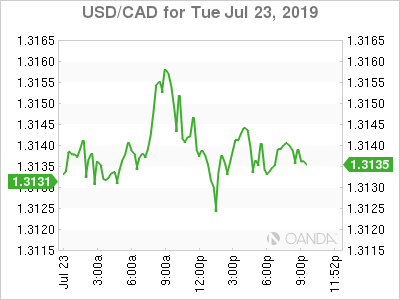
The Canadian dollar lost 0.18 percent versus the US dollar on Tuesday. The loonie had a lively session being up against the USD at one point threatening to break below 1.3120, but as trade optimism swept through the market with the news of a US trade delegation to visit China next week and political stability after the debt ceiling deal agreement there was no stopping the greenback.
Wholesale data disappointed yesterday and if more economic fundamentals show signs of deterioration it will put more pressure on the Bank of Canada (BoC) to join the Fed in switching from devilish rhetoric to dovish actions with a rate cut later this year.
The US dollar rose across the board against major pairs after the US made it official that trade representative Lighthizer will travel to China for another round of talks. The US currency appreciated after a new round of trade optimism swept through the market, with equities also rising on the news.
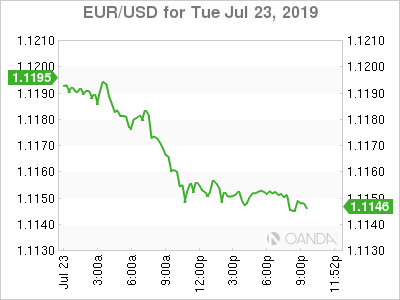
The IMF downgraded global growth today, but even in defeat the US dollar managed to snatch victory as the fund upgraded US growth to 2.6 percent. The Fed’s decision to lower interest rates, plays a big part as the market awaits the July 31 Federal Open Market Committee (FOMC) meeting.
OIL
Oil prices rose ahead of the release of weekly crude data on the back of the news that the US will be sending a team to reopen trade talks with China next week. The prolonged trade war between the US and China has been a major factor putting downward pressure on global growth. Energy demand has been forecasted lower by think-tanks if the two largest economies don’t reach an agreement on trade.
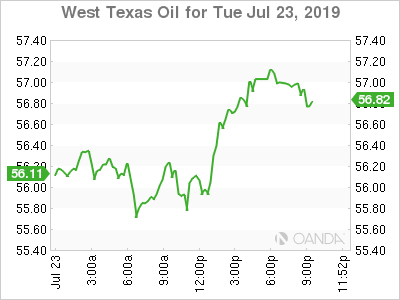
West Texas Intermediate and Brent rose more than 1 percent on Tuesday as White House Adviser Kudlow confirmed the delegation traveling to China.
Concerns about Middle East tensions had receded, awaiting US weekly crude inventory data. The rise of US production to the point the US is now a net exporter has reduced the impact of geopolitical supply disruptions.
GOLD
Gold lost 0.64 percent on Tuesday as trade hopes rose with the new round of talks between the US and China. Middle Eastern concerns have eased, leaving only Brexit anxiety as the main reason for demand for gold as a safe haven.
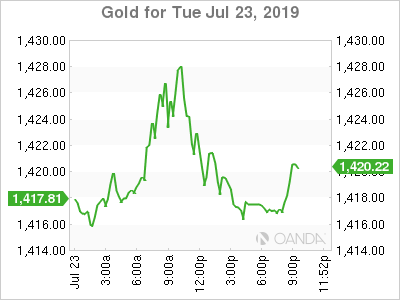
The Fed is heavily anticipated to lower the benchmark interest rate by 25 basis points on July 31, but over performing data has put a big question mark on how deep the central bank will be willing to slash rates. Lower rates around the globe as major central banks are once again singing a dovish tune, are easing the pressure on gold, but for the moment as trade hopes rise and Middle East tensions soften the yellow metal is trading lower.
Eco Data 7/24/19
[php_everywhere instance="1"]
US: Existing Home Sales Pull Back in June
- Existing home sales fell by 1.7% to 5.27 million units (annualized) in June. The headline print came in below market expectations, which called for a milder decline of only 0.4% m/m. On a positive note, sales in the month prior were revised up 0.4% to 5.36 million.
- Both single-family (-1.5% or -70k) and condo/co-op (-3.3% or -20k) fell in the month.
- Activity was mixed across the regions, with existing home sales falling by about 3.5% both in the South (-80k) and West (-40k), while improving by roughly 1.5% in the Northeast (+10k) and Midwest (+20k).
- The number of homes available for sale increased to a seasonally unadjusted 1.93 million units from 1.91 million in May, which is unchanged from a year ago. At the current sales rate, unsold inventory is at a 4.4-month supply, up from 4.3 months in both the month prior and June of last year.
- Median existing home prices in June and in the second quarter as a whole were up 4.3% from year ago levels, which marks a mild acceleration from the 3.8% print in the first quarter. First-time buyers made up 35% of sales in June, up from 32% the month prior and 31% in June last year.
Key Implications
- A soft pending home sales tally in April had already tempered expectations, but the fact that activity still came in well below consensus makes this yet another disappointing housing report.
- Looking past the monthly volatility, the sales trend that has developed in the last several months appears more promising. Contrary to 2018 when activity fell in each of the four quarters, sales are on a more solid path presently, with gains averaging 5% annualized in the first two quarters of 2019. The increased participation of first-time buyers in June marks another light positive touch.
- There is good reason to believe that this trend will continue as demand receives a boost from lower mortgage rates, which have already fallen some 100 basis points since the end of 2018. The supply side however, remains a constraint. With inventory still near historically-low levels, expected gains are likely to remain moderate in nature. In addition, the demand/supply mix is likely to continue providing some support to prices, which accelerated mildly in the second quarter.
USD/CAD Mid-Day Outlook
Daily Pivots: (S1) 1.3067; (P) 1.3093; (R1) 1.3146; More....
USD/CAD's break of 1.3143 resistance suggests short term bottoming at 1.3016, after drawing support from 1.3052/68 cluster support. Intraday bias is turned back to the upside for stronger rebound to 55 day EMA (now at 1.3218). For now, further rise will remain in favor in the near term as long as 1.3016 support holds, in case of retreat.

In the bigger picture, decisive break of 1.3068 cluster support (38.2% retracement of 1.2061 to 1.3664 at 1.3052) will confirm completion of up trend from 1.2061 (2017 low). Further fall should be seen to 61.8% retracement at 1.2673 next. On the upside, sustained break of 61.8% retracement of 1.4689 (2016 high) to 1.2061 at 1.3685, is needed to confirm resumption of up trend from 1.2061 (2017 low). Otherwise, risk will stay on the downside.

EUR/JPY Mid-Day Outlook
Daily Pivots: (S1) 120.75; (P) 120.96; (R1) 121.12; More....
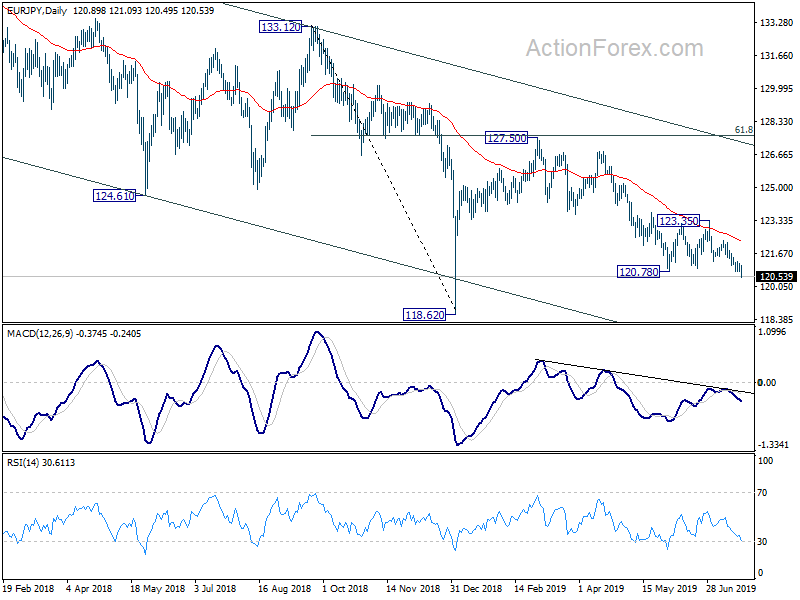
EUR/JPY's break of 120.78 support confirms resumption of fall from 127.50. Intraday bias is back on the downside for retesting 118.62 low. Break will resume medium term down trend. On the upside, break of 121.31 resistance is needed to indicate short term bottoming. Otherwise, outlook will remain bearish in case of recovery.
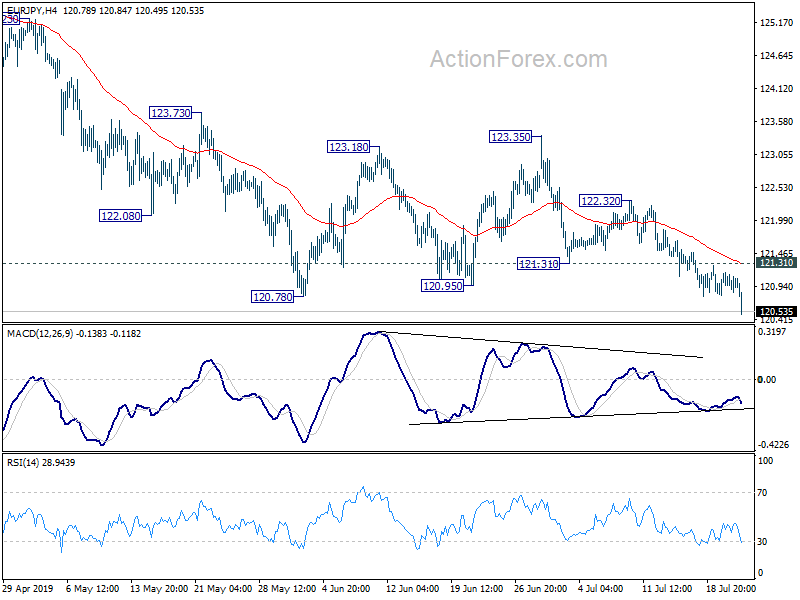
In the bigger picture, down trend from 137.49 is still in progress with the cross staying inside long term falling channel. Break of 118.62 will extend the fall to 109.48 (2016 low). On the upside, break of 127.50 resistance is needed to be the first sign of medium term reversal. Otherwise, outlook will remain bearish in case of strong rebound.
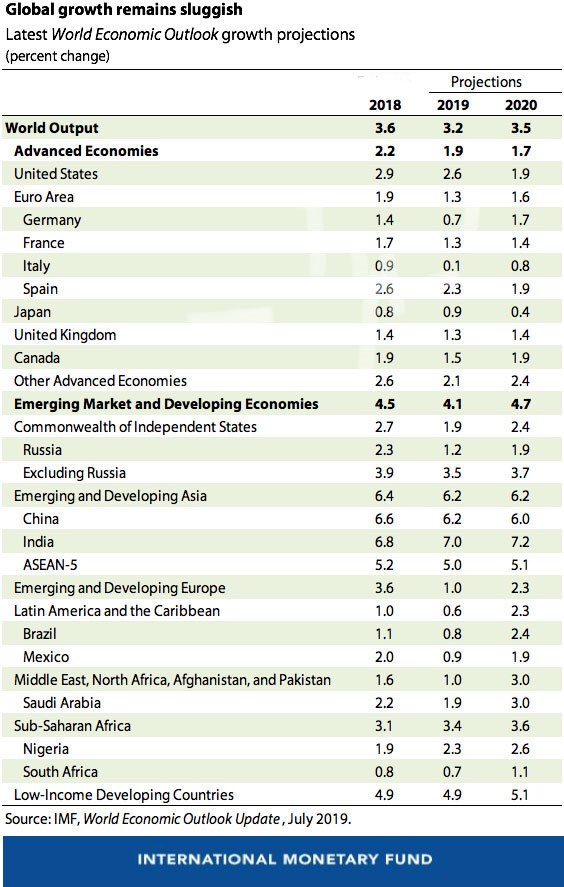
IMF: Global growth sluggish and precarious on some self-inflicted reasons
IMF downgrades global growth forecasts to 3.2% in 2019 and 3.5% in 202, down from April projections of 3.3% and 3.6% respectively. The revision for 2019 reflects "negative surprises for growth in emerging market and developing economies that offset positive surprises in some advanced economies".
The report added, "global growth is sluggish and precarious but it does not have to be this way because some of this is self-inflicted". "Dynamism in the global economy is being weighed down by prolonged policy uncertainty as trade tensions remain heightened despite the recent US-China trade truce, technology tensions have erupted threatening global technology supply chains, and the prospects of a no-deal Brexit have increased."
IMF also urged monetary policy to remain "accommodative", especially "where inflation is softening below target". Though, it should accompanied by "sound trade policies". Fiscal policy should "balance growth, equity and sustainability concerns". Also, " the need for greater global cooperation is ever urgent", including resolving trade and technology tensions, climate change, international taxation, corruption, cybersecurity, and digital payment technology.
Looking at some details:
- US growth in 2019 revised up by 0.3% to 2.6%.
- US growth in 2020 unchanged at 1.9%.
- Eurozone growth in 2019 unchanged at 1.3%.
- Eurozone growth in 2020 revised up by 0.1% to 1.6%.
- Germany growth in 2019 revised down by -0.1% to 0.7%.
- Germany growth in 2020 revised up by 0.3% to 1.7%.
- UK growth in 2019 revised up by 0.1% to 1.3%.
- UK growth in 2020 unchanged at 1.4%.
- Japan growth in 2019 revised down by -0.1% to 0.9%.
- Japan growth in 2020 revised down -0.1% to 0.4%.
- China growth in 2019 revised down by -0.1% to 6.2%.
- China growth in 2020 revised down by -0.1% to 6.0%.