Sample Category Title
IMF sees Eurozone facing prolonged period of anemic growth and inflation
IMF forecasts Eurozone growth to slow to 1.3% in 2019, then rebound to 1.6% in 2020. Inflation is forecast to be at 1.3% in 201 and remain far off ECB's 2% target at least until 2022. it urged that ECB's monetary policy stimulus was "vital" as Eurozone was facing "a prolonged period of anemic growth and inflation". And, "the undershooting of the inflation objective calls for prolonged monetary accommodation."
IMF expected more monetary easing could be necessary if inflation expectations worsen. However, it also raised doubt on the idea of tiered deposit rate in case of more monetary easing. It said "a regime of tiering... would have a very small impact on aggregate bank profitability and a questionable impact on credit conditions."
Fed Barkin: We have a look of time before July FOMC meeting
In a Bloomberg interview, Richmond Fed President Thomas Barkin rejected the idea that a July rate cut is a done deal. He emphasized "we have a lot of time left before the meeting, we'll see what happens."
For now, he said the economy was not heading to a recession. He added "I actually still feel pretty good about the economy... I don't see any issues on the consumer side of the house".
Though, risks to outlook is "a little more tilted to the downside" for fragile business confidence. Indicators for second-quarter growth are less strong.
Trump confirms there is no agricultural purchase from China yet
Trump complains with his tweet that China is "letting us down" for not buying agricultural products from the US yet. But he added "hopefully they will start soon". Separately, White House economic adviser Larry Kudlow also said today that he expected China to start purchasing farm products soon.
It's unsure how "soon" China will start the purchase. But comments from both Trump and Kudlow confirmed that the purchase hasn't even started yet even though trade teams on both sides have resumed communications.
It's reported earlier that China is linking the purchases to lift of Huawei's sanctions. That is, if China won't start the purchases if Xi is unhappy with how the restrictions in supplying US tech products to Huawei are removed. It seems that the communications between the trade team haven't enter into something of substance yet.
https://twitter.com/realDonaldTrump/status/1149318492711264257
CPI: Core Inflation Rebounds, But Fed Still Concerned
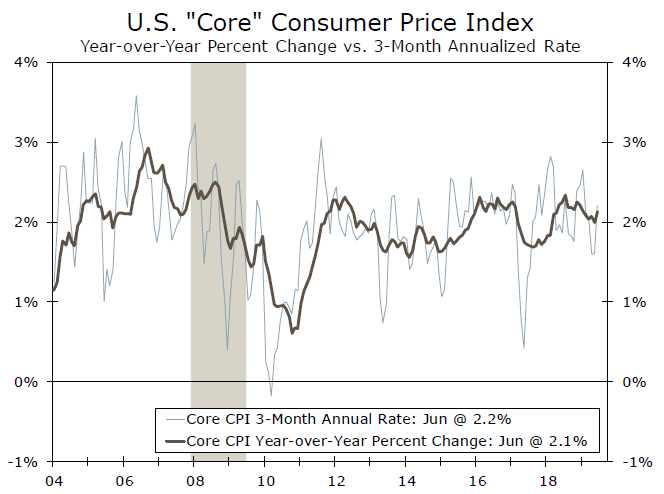
CPI rose 0.1%, driven by a 0.3% jump in core prices. The core's gain makes up for some exaggerated weakness in recent months. Inflation is getting back on track to meet the Fed's target, but not fast enough.
Core Inflation Leaps in June
Overall inflation remained tame in June. The Consumer Price Index increased just 0.1% for a second straight month, sending the year-over-year rate down to 1.6%.
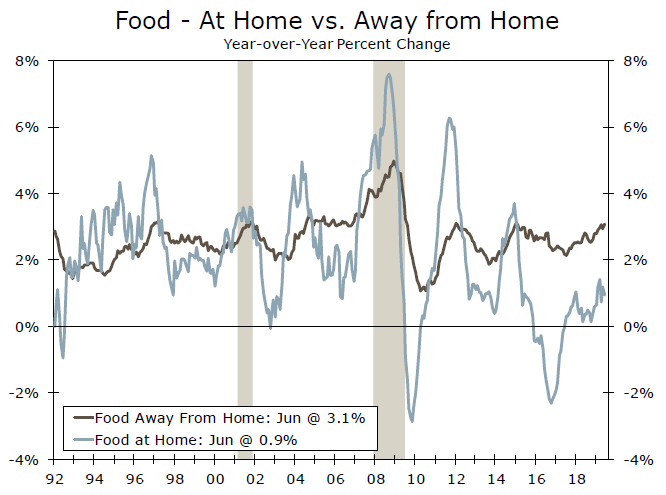
Energy prices were a drag on the headline as gasoline prices posted an unusually steep decline for this time of year. Food inflation also eased up, at least at the grocery store, with prices for food at home falling 0.2%. The cost of eating out, however, picked up in June and continues to gradually strengthen on trend. Over the past year, prices for food away from home are up 3.1%, which matches this cycle's top rate (top chart).
After a string of subdued readings, core inflation bolted back in June. Prices for goods and services rose 0.3% (0.29% before rounding), ending a four-month run of 0.1% gains. The increase reflects payback for undue softness in recent months, rather than the start of a sharp pickup in the trend. For example, apparel prices jumped 1.1% after falling 2.8% between March and May following the introduction of a new collection procedure for a major department store. Used vehicle prices jumped 1.6% after declining more than 1% in each of the past two months, despite a turnaround in auction prices according to other sources.
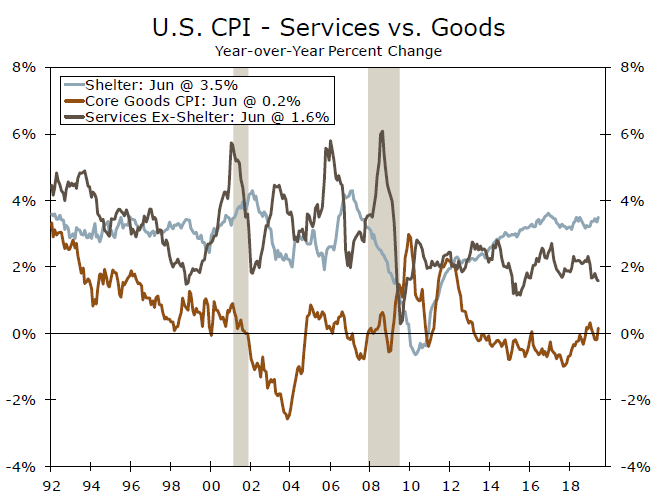
Elsewhere, gains in core inflation looked more in line with recent trends. Core services prices rose 0.3% on the back of continued strength in shelter inflation (middle chart). Low vacancies in the apartment market and new construction skewed toward high-end units have pushed rental prices up nearly 4% over the past year, while owner-occupied housing costs have risen 3.4%. Medical care inflation has also picked up in recent months, while transport services inflation, including airfare, has been more subdued. Fed Losing Patience on Inflation
Today's report is consistent with inflation climbing back toward the FOMC's target in the coming months (bottom chart). But Fed officials are increasingly concerned about the generalized weakness in inflation that has persisted this expansion. Although it is starting to get back on track, Fed officials have grown impatient over the time it is taking inflation to return to target on a sustained basis. Declining inflation expectations suggest a more arduous road ahead in getting there. Consumers' long-term inflation expectations are at a historic low, while market-based measures have moved lower over the past year. The minutes of the June FOMC meeting released yesterday showed "many" officials thought inflation expectations might already be below levels consistent with the Fed's goal, with "a few" thinking that warranted more policy support in the "near term." We continue to look for the FOMC to cut the fed funds rate 25 bps at its meeting later this month, in no small part due to the cumulative weakness in inflation.
Fed Chair Powell’s testimony, Day 2, live stream
https://www.youtube.com/watch?v=iSRfoBp_Fq0
EURNZD Touches 200-Day SMA; Next Support at 1.68
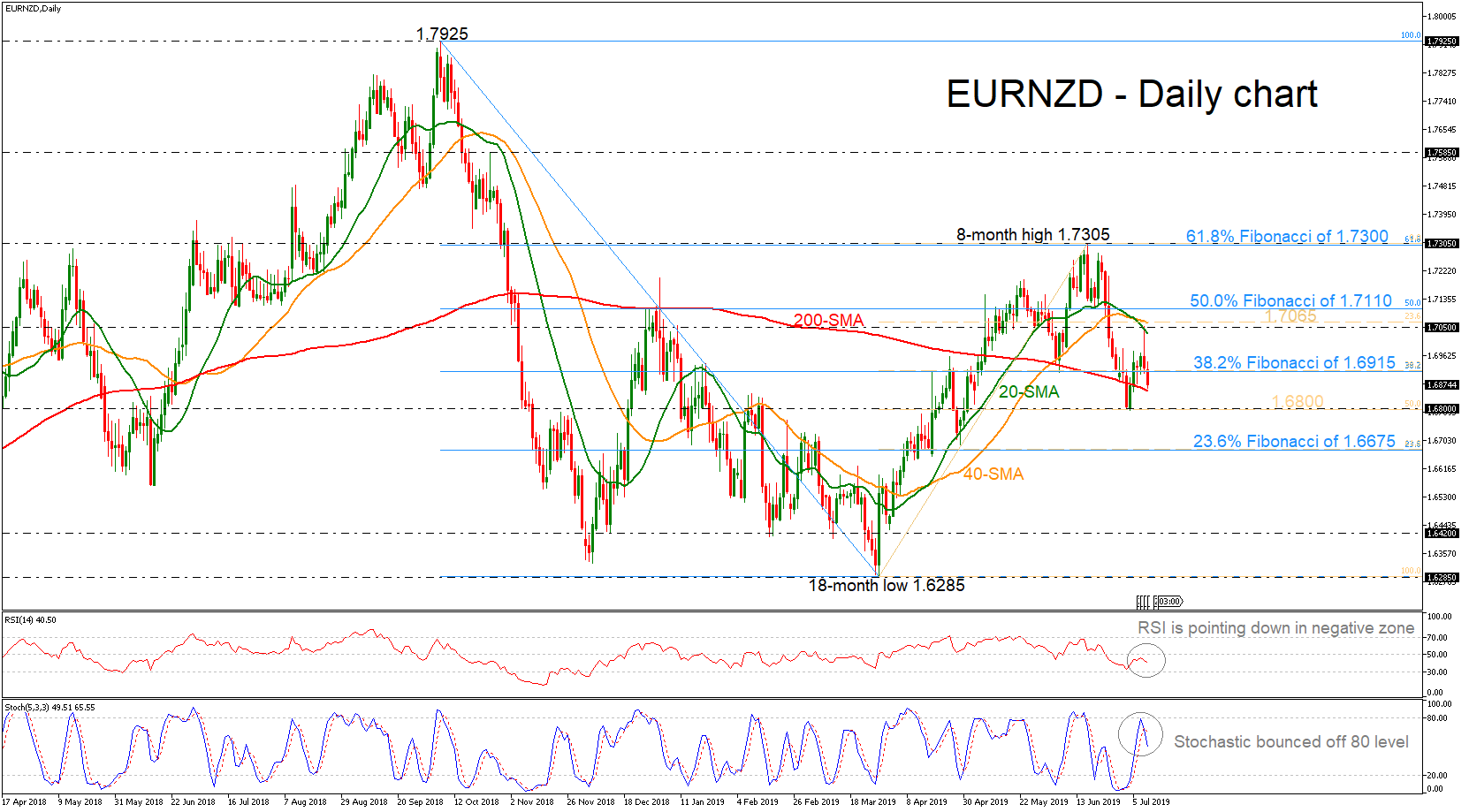
EURNZD has been declining considerably since yesterday, after the bounce off the 23.6% Fibonacci retracement level of the upward rally from the 18-month low of 1.6285 to the eight-month high of 1.7305 near 1.7050. The pair is ready to touch the 200-day simple moving average (SMA) and a possible upside correction is expected in the short-term.
From the technical point of view, the RSI is sloping down below the 50 level, confirming the recent momentum on price, while the stochastic oscillator found strong resistance at the 80 level and fell aggressively.
Should the price close comfortably below the 200-day SMA, immediate support is coming from the 50.0% Fibonacci mark of the upleg near at the 1.6800 psychological mark. If there is a tumble below this level, it could open the way for a retest of the 61.8% Fibo of the upleg, which overlaps with the 23.6% Fibo of the downward wave from 1.7925 – 1.6285 near 1.6675.
Alternatively, a successful climb above the 38.2% Fibo of the downleg at 1.6915 would drive the pair until the 1.7050 resistance near the short-term moving averages. More advances could hit the 50.0% Fibo of the downfall near 1.7110.
In brief, EURNZD is in a sell-off mode between the short-term and the long-term SMAs. A slip beneath the 200-SMA could open the door for more declines, shifting the bias to neutral, while a run above 1.7300 could rekindle the medium-term buying interest.
US: Core Inflation Perks Up in June
- For the second consecutive month, CPI prices rose 0.1% (month-on-month) in June, firmer than market expectations for no change. Headline inflation decelerated to 1.6% year-on-year (y/y) owing to a drop in energy prices.
- Core prices rose 0.3% m/m, also a bit better than expected. The move ends a streak of four consecutive months of mediocre 0.1% monthly growth. As a result, 12-month change firmed to 2.1% in June from 2.0% in May.
- The pickup in core inflation reflected a firming in core goods prices (+0.4% m/m), and core services inflation (+0.3% m/m).
- The price of housing services rose 0.3% m/m in June, bouncing back from a weak 0.1% gain in May. This was the strongest contributor to the move higher in core inflation in the month. Apparel prices also posted a strong gain (+1.1% m/m). Medical care inflation remained solid (+0.3% m/m). Transportation prices fell 0.7% in the month, building on May's 0.3% decline.
Key Implications
- Headline inflation may have dipped lower in June due to energy prices, but the real story was in the firming in core goods and services. The move suggests that the Fed's preferred core inflation measure, core PCE, may show signs of firming as well in June.
- From the Fed's perspective, the domestic economic data is holding up, with core PCE inflation looking to make progress toward its 2% target in early 2020. Still, as affirmed both in the FOMC minutes and Chair Powell's testimony, the crosscurrents of weaker global growth and risks has spurred the Fed to take out insurance by cutting rates at its meeting the end of this month. Nevertheless, as long as the domestic data continues to hold up, the number of cuts will prove to be fewer than markets are anticipating.
EUR/USD Mid-Day Outlook
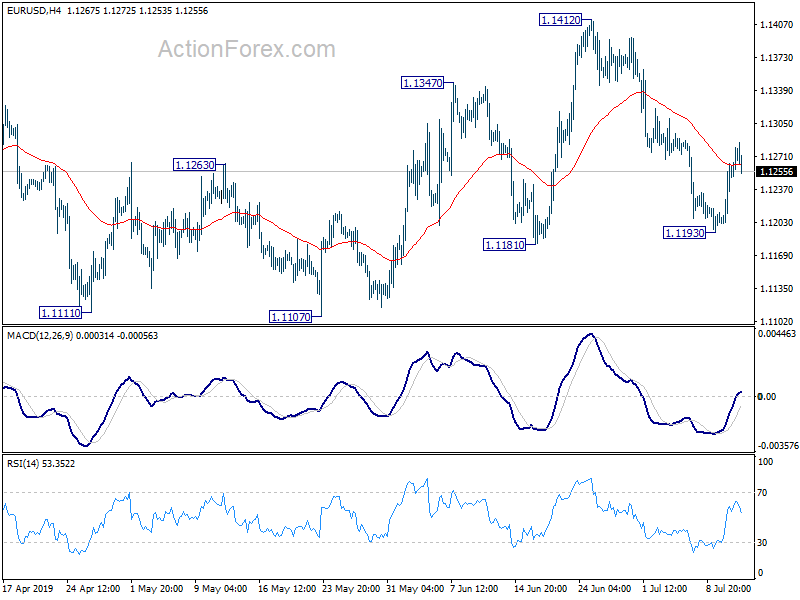
Daily Pivots: (S1) 1.1213; (P) 1.1239; (R1) 1.1275; More...
Intraday bias in EUR/USD remaps mildly on the upside for retesting 1.1412. Break will resume the whole rebound from 1.1107. On the downside, break of 1.1193 will turn bias back to the downside to retest 1.1107 low instead.
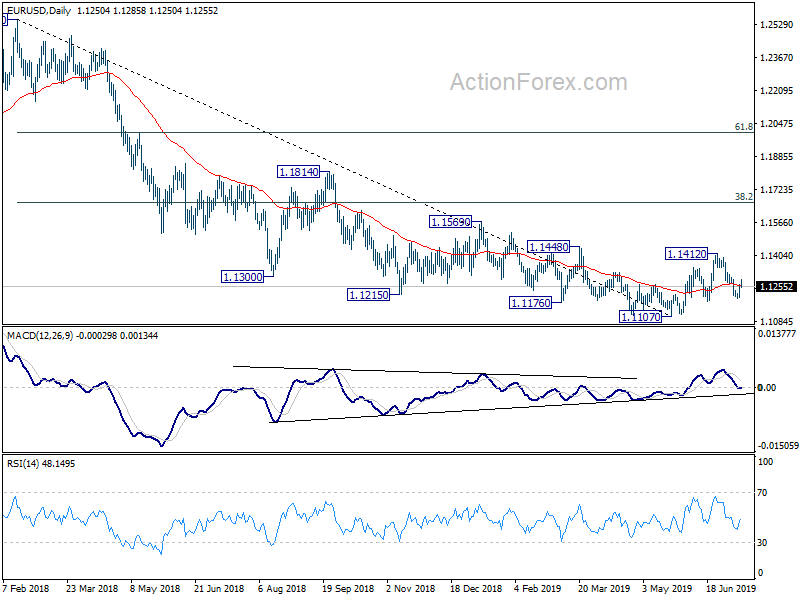
In the bigger picture, bullish convergence condition in daily and weekly MACD suggests that 1.1107 is a medium term bottom. However, rejection by 55 EMA retains medium term bearish. Outlook will be neutral for now. On the downside, break of 1.1107 will resume the down trend from 1.2555 (2018 high) to 78.6% retracement of 1.0339 to 1.2555 at 1.0813. Meanwhile, break of 1.1412 will resume the rebound to 38.2% retracement of 1.2555 to 1.1107 at 1.1660.
GBP/USD Mid-Day Outlook
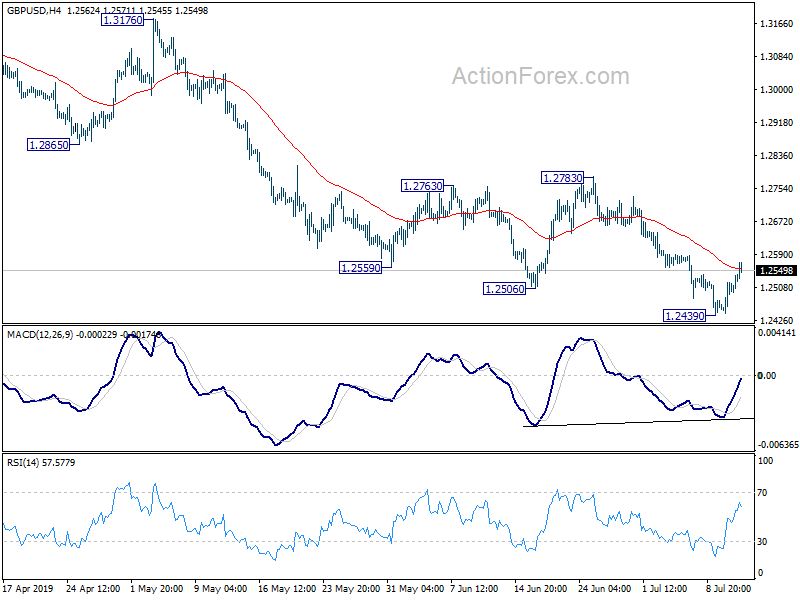
Daily Pivots: (S1) 1.2459; (P) 1.2490; (R1) 1.2536; More....
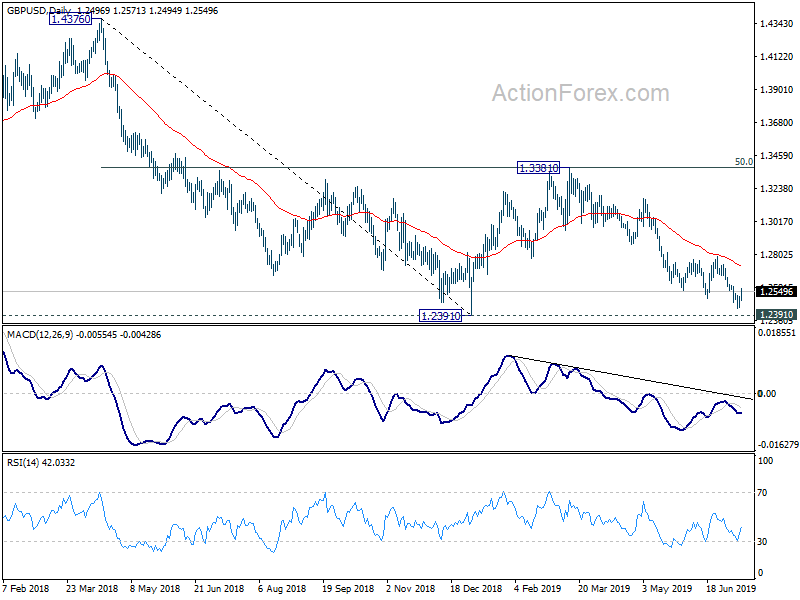
GBP/USD's recovery from 1.2439 extends today and could rise further. But upside should be limited well below 1.2783 resistance to bring fall resumption. On the downside, break of 1.2439 would resume the decline from 1.3381 to retest 1.2391 low. Firm break there will resume larger down trend.
In the bigger picture, down trend from 1.4376 (2018 high) is still in progress. Break of 1.2391 would target a test on 1.1946 long term bottom (2016 low). For now, we don't expect a firm break there yet. Hence, focus will be on bottoming signal as it approaches 1.1946. In any case, medium term outlook will stay bearish as long as 1.3381 resistance holds, in case of strong rebound.
USD/JPY Mid-Day Outlook
Daily Pivots: (S1) 108.22; (P) 108.60; (R1) 108.86; More...
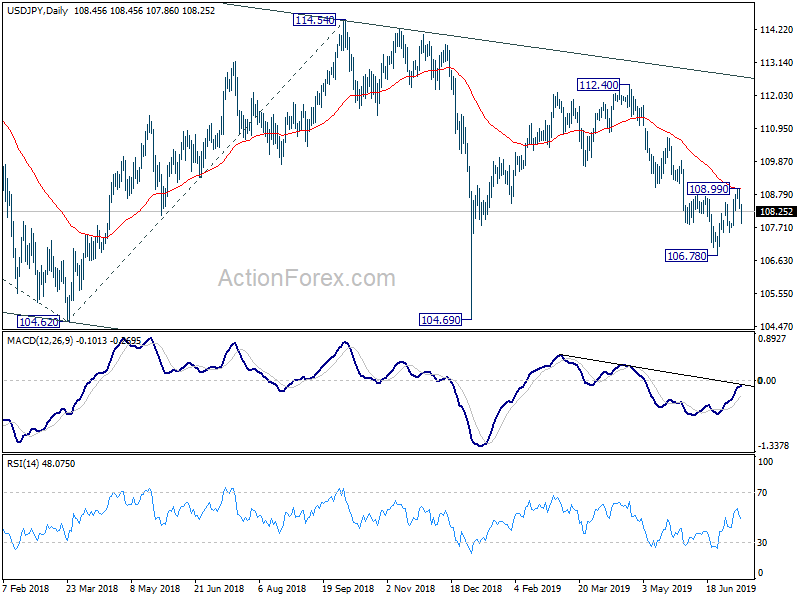
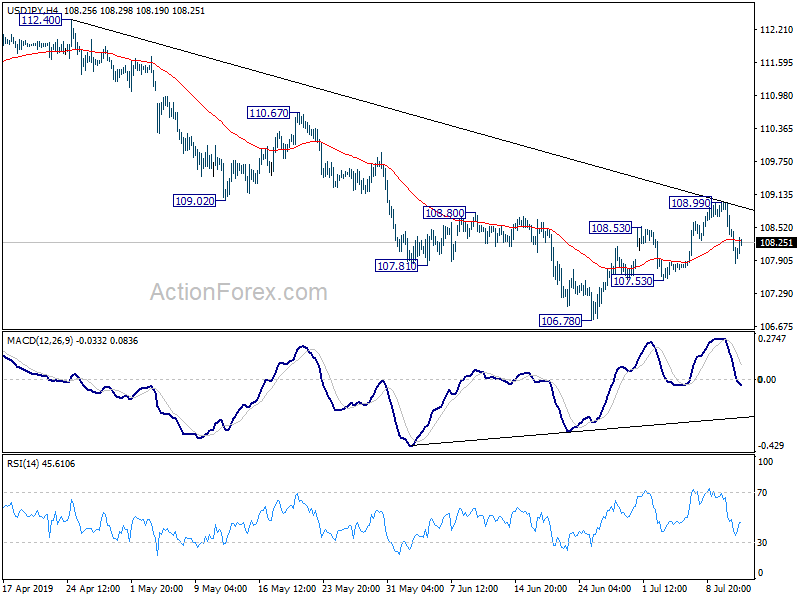
At this point, intraday bias in USD/JPY remains mildly on the downside for 107.53 support. Rebound from 106.78 could have completed at 108.99, after rejection by 55 day EMA. Break of 107.53 will likely send USD/JPY through 106.78 to resume the decline from 112.40. For now, near term outlook will remain bearish as long as 108.99 resistance holds.
In the bigger picture, decline from 118.65 (Dec 2016) is still in progress, with the pair staying inside long term falling channel. Break of 104.62 will target 100% projection of 118.65 to 104.62 from 114.54 at 100.51. For now, we'd expect strong support above 98.97 (2016 low) to contain downside to bring rebound. In any case, break of 112.40 is needed to the first serious sign of medium term bullishness. Otherwise, further decline will remain in favor in case of rebound.