

Sample Category Title
Powell Day 2, Gold Eases on US Data beat, Oil Higher on Hurricane Risk, Bitcoin Slumps
Inflation appears to have stabilized and this will put a wrench in some Fed rate cut bet forecasts. With wage pressure not delivering a powerful effect on inflation, we should still see day two of Fed Chair Powell’s testimony keep the rate cut expectations in place for the July 30-31st meeting. Moderate inflation, growing global uncertainties, and a strong labor market will support the argument for only a 25-basis point rate cut at the end of the month. Calls for a 50-basis rate cut will require the July 26th advance reading of second quarter GDP to fall well below the 2.0% analysts’ expectations.
Jobless claims also had its best reading in 12-weeks, surprising many analysts who thought we would see a strong rise as automakers close up assembly plants for annual retooling.
Treasury yields popped on the better than expected core consumer inflation and jobless claims data, while the dollar was unable to muster up a meaningful rebound. Markets appear convinced Powell will not deliver any surprises today.
ECB
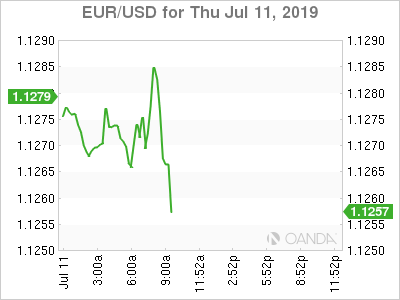
The euro held onto its gains against the dollar as ECB minutes for the June 5-6th meeting highlighted policy makers are ready to deliver more stimulus as the debate begins on how to use adjust their current tools. Some called for TLTRO III to be more aggressive in supporting the economy, reminding markets that all tools will be used if we see a greater downturn in the eurozone economy. ECB rate cuts expectations pared slightly following the policy minutes release.
The euro could see further gains here as market participants see the Fed possibly embarking on a much more aggressive rate cut trajectory than the ECB. Over the next 12 months, markets could see the Fed delivering 100 basis points in rate cuts while the ECB may only deliver half of that total. The common currency is also benefiting from slightly higher revisions with German EU-harmonized inflation readings.
Oil
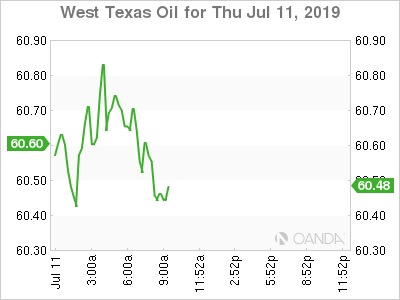
Crude prices are higher after UK Navy was needed to ensure the safe passage of a BP tanker through the Persian Gulf. What makes this escalation so important is that is the first time that a Western warship almost engaged in a military conflict with Iran. The incident does not bode well for nuclear talks between the Iran and the Europe and likely provides more ammunition for President Trump to deliver more sanctions on Iran and seek UK support in abandoning the 2015 nuclear deal.
West Texas Intermediate crude’s break of the $60 a barrel level was also supported on reduced production expectations from Gulf of Mexico operators as many platforms are being shutdown ahead of a tropical storm that could become a hurricane. Energy traders now have to price reduction output as operators have shut down 32% of the gulf’s oil output and 18% of its natural gas production.
Oil could see further bullish momentum on the larger than expected declines with inventory data, escalation tensions in the Persian Gulf and reduce production from the Gulf of Mexico as hurricane season picks up.
Gold
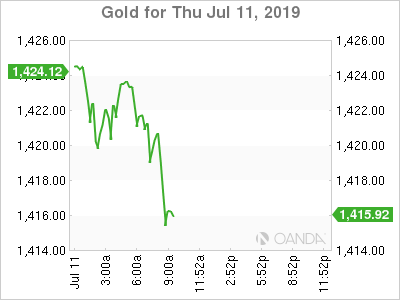
Gold prices appear to be in overbought territory and we could see some consolidation here as markets have already heavily priced in the beginning of the Fed’s easing cycle and the growing expectations the other major central banks will be delivering additional stimulus. The better than expected US labor and inflation data put a big dent in today’s rally. A pullback will be welcomed by bullion bulls, with $1,380 an ounce level providing major support.
Bitcoin
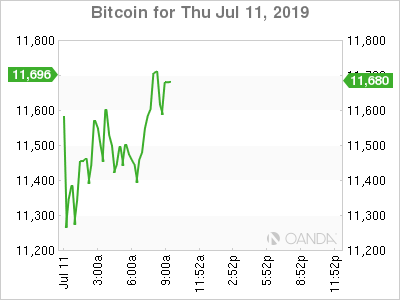
Bitcoin is shouldering Fed Chair Jerome Powell’s serious concerns about Facebook’s planned digital currency Libra. Libra was expected to be the springboard for other cryptocurrencies to emerge but it seems we will see a tougher road ahead for digital coins. Powell’s concern on Libra’s financial stability, privacy, money laundering, and consumer protection have been plaguing Bitcoin for years.
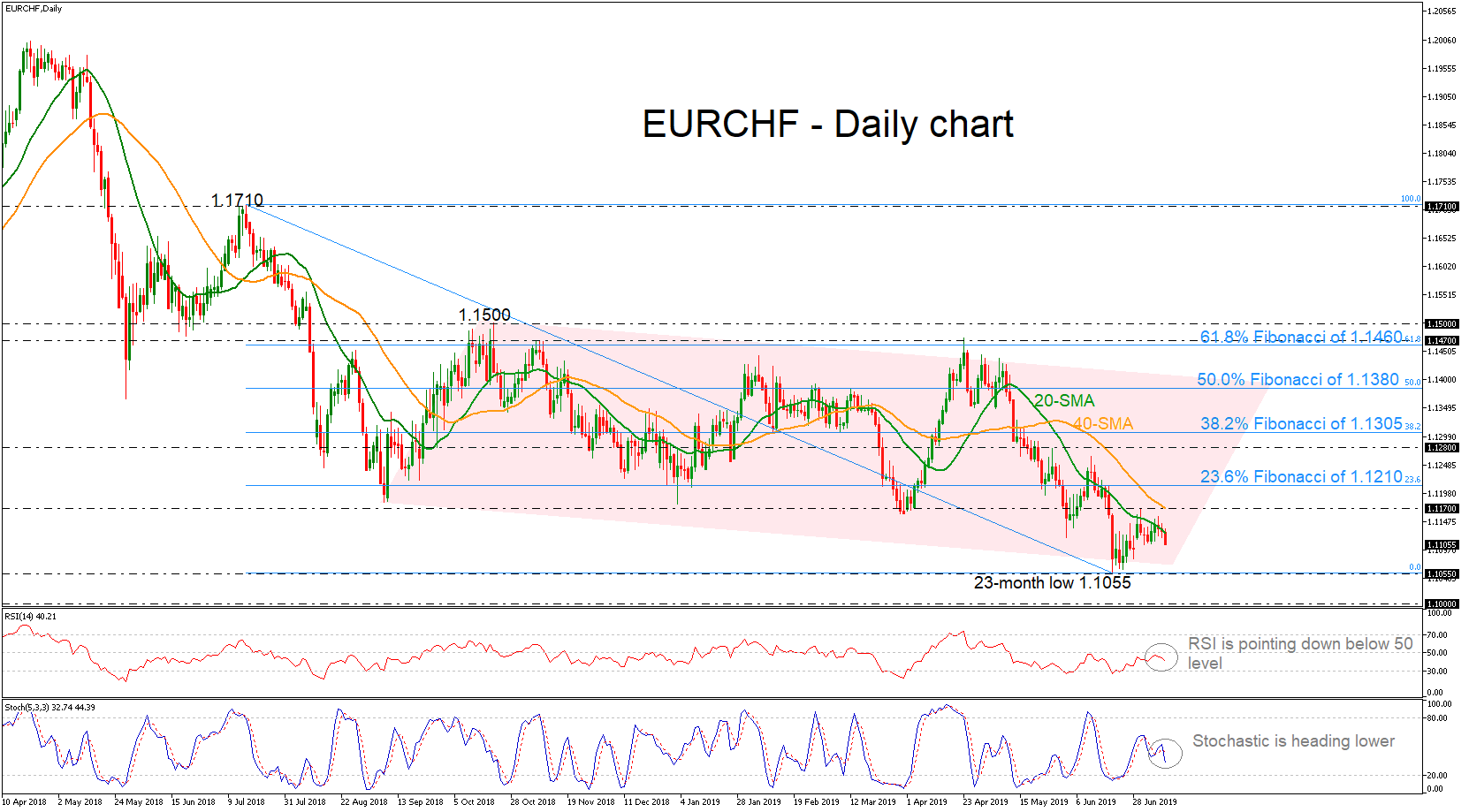
EURCHF Declines Around 1.1100; Holds in Descending Channel
EURCHF is moving lower near 1.1100, remaining below both its 20- and 40-day simple moving averages (SMAs) as well as beneath the 1.1170 resistance. The bigger picture still seems negative as the price has been developing in a descending channel since September 2018.
Short-term momentum oscillators concur, with the RSI holding below 50 and pointing lower, and the stochastic completed a bearish cross within the %K and %D lines in the daily timeframe.
More downside pressures could meet support near the almost two-year low of 1.1055, defined by the low on June 20, with a downside break opening the door for the 1.1000 significant handle, taken from the inside swing top on May 2017. This could endorse the scenario for stronger bearish structure.
On the flipside, a rebound may stall near the neighborhood of 1.1170, which coincides with the 40-SMA and at the 23.6% Fibonacci retracement level of the downleg from 1.1710 to 1.1055 near 1.1210.
In brief, some further losses shouldn’t be ruled out in the immediate term, but as long as the price remains in the downward sloping channel, the broader outlook is negative.
Latest Inflation Numbers Won’t Change Fed’s Calculus in July
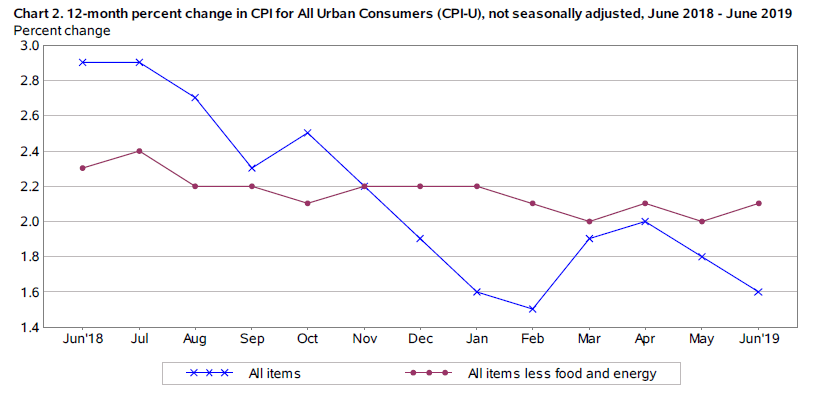
- Headline CPI dipped to 1.6% y/y in June
- Lower energy prices accounted for most of the decline
- Core CPI ticked up to 2.1% y/y (consensus 2.0%)
If last Friday’s strong payroll report and a pause in the US-China trade war post-G20 didn’t change the Fed’s thinking on a July cut, we doubt today’s modest upside surprise on core inflation will do the job. This marks the 16th consecutive month of core CPI at or above 2%, but softer core PCE inflation (favoured by the Fed) still had Powell saying, “inflation pressures remain muted” yesterday. The rest of his testimony also leaned dovish, bolstering market expectations for a rate cut later this month. It looks like the Fed is going to introduce a bit of accommodation to offset the negative impact of trade tensions and slowing global growth on the US economy. The fact that PCE inflation has consistently undershot the Fed’s 2% objective allows the central bank that flexibility, and today’s slightly firmer CPI report won’t change its calculus.
USD/CHF Mid-Day Outlook
Daily Pivots: (S1) 0.9875; (P) 0.9909; (R1) 0.9929; More...
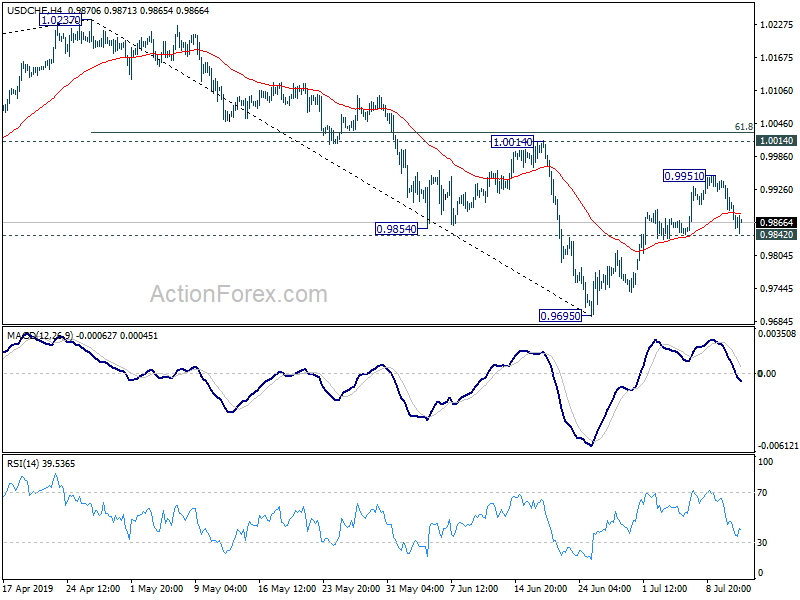
Intraday bias in USD/CHF remains neutral with focus on 0.9842 minor support. Break will indicate that rebound from 0.9695 has completed at 0.9951. In this case, intraday bias will be turned back to the downside for retesting 0.9695 low. On the upside, above 0.9951 will target 1.0014. But upside could be limited by 61.8% retracement of 1.0237 to 0.9695 at 1.0030.
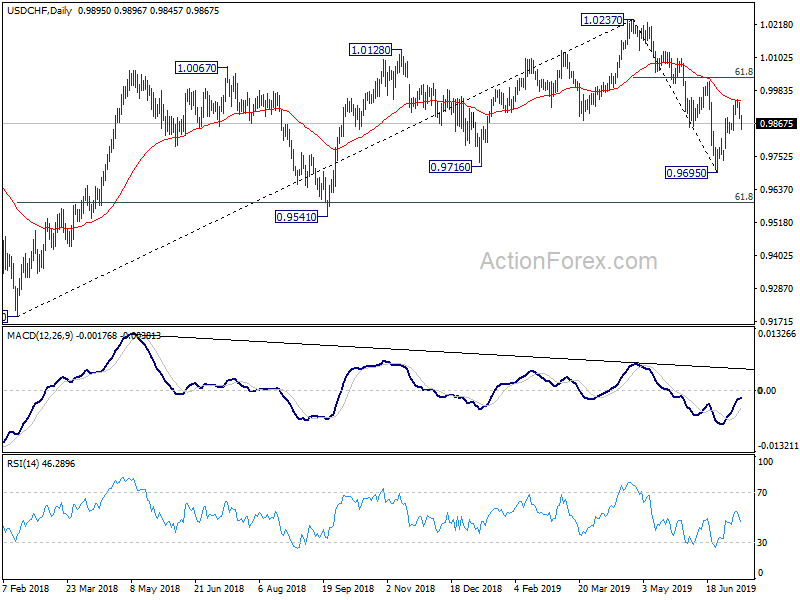
In the bigger picture, current development suggests that up trend from 0.9186 (2018 low) has completed at 1.0237 already. Deeper decline would be seen to 61.8% retracement of 0.9186 to 1.0237 at 0.9587 and below. For now, USD/CHF is seen as in long term range pattern between 0.9186 and 1.0342. Hence, we'd pay attention to bottoming signal below 0.9587. However, sustained break of 1.0014 will revive medium term bullishness and turn focus back to 1.0237 high.
Dollar Selloff Halts after Core CPI Acceleration, Not Sign of Rebound Yet
Dollar remains the weakest one for today even though selloff somewhat stabilized in early US session. Stronger than expected core CPI is providing some support to the greenback, together with job data. However, the question remains on whether Fed will deliver the "insurance" rate cut this month, due to continuous uncertainties or deterioration in outlook. Judging from Fed chair Jerome Powell's comments yesterday, it seems Fed will act on the first cause. Though, it's still quite a long way to go, with retail sales data next week and Q2 GDP the week after.
Staying in the currency markets, Canadian Dollar is currently the second weakest for today. The lack of selling in USD/CAD through 1.3037 temporary low is a sign of indetermination in CAD bulls. Euro is the third weakest as ECB minutes reaffirmed that it's ready to act to lift inflation. On the other hand, New Zealand Dollar is the strongest one for now, followed by Sterling.
Technically, 1.3037 in USD/CAD will remain a key focus and firm break there will carry medium term bearish implications. Break of 0.9842 in USD/CHF should indicate completion of recent rebound and align bearish Dollar outlook with other pairs. EUR/GBP and GBP/JPY will be two focuses for the rest of the session with late surge in the Pound. Break of 0.8954 minor support in EUR/GBP will be an early sign of short term reversal in the cross. Deeper fall could then be seen to 0.8872 support next. Break of 136.28 minor resistance in GBP/JPY would bring stronger rebound back towards 137.78 resistance.
In Europe, FTSE is currently down -0.13%. DAX is down -0.18%. CAC is up 0.08%. German 10-year yield is up 0.041 at -0.262, holding well above -0.3 handle now. Earlier in Asia, Nikkei rose 0.51%. Hong Kong HSI rose 0.81%. China Shanghai SSE rose 0.08%. Singapore Strait Times rose 0.30%. Japan 10-year JGB yield dropped -0.0138 to -0.139.
US core CPI accelerated to 2.1%, large monthly rise of 0.3% since 2018
US headline CPI slowed to 1.6% yoy in June, down from 1.8% yoy, matched expectations. But that was mainly due to a drag from energy price index, which dropped -3.4% yoy. On the other hand, CPI core accelerated to 2.1% yoy, up from 2.0% yoy, beat expectation of 2.0% yoy. Also, over the month, CPI core rose 0.3% mom, largest monthly rise since January 2018.
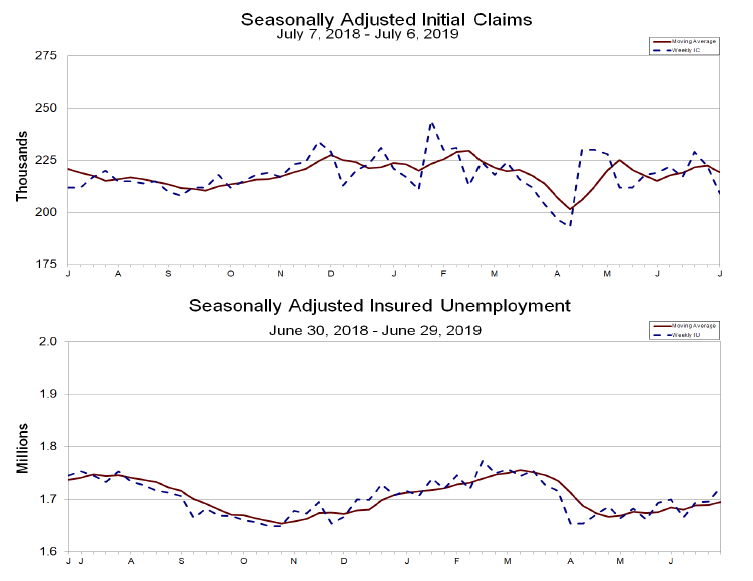
Also from US, initial jobless claims dropped -13k to 209k in the week ending July 6, below expectation of 221k. Four week moving average of initial claims dropped -3.25k to 219.25k. Continuing claims rose 27k to 1.723m in the week ending June 29. Four-week moving average of continuing claims rose 5.75k to 1.695m.
Released earlier, German CPI was finalized at 1.6% yoy in June, unrevised. Japan tertiary industry index dropped -0.2% mom in May, below expectation of -0.1% mom. Australia home loans was flat in May, better than expectation of -1.0% mom. Consumer inflation expectations rose slowed to 3.2% in July. UK RICS house price balance improved to -1 in June.
ECB accounts: Broad agreement that update of monetary policy stance was called for
Accounts of the ECB monetary policy meeting in June showed there was "broad agreement" that "update of the monetary policy stance was called for", due to "prolongation of uncertainties" and the implications for inflation outlook. And inflation was still projected to reach "only 1.6%" in 2021, which was seen to remain "some distance away" from the 2% target. Thus, it's considered "important" to "demonstration" ECB's "determination to act".
Also, there was "broad agreement" on adjusting the calendar based component of the forward guidance to keeping rates at present levels "at least through the first half of 2020"; reiterating the guidance on reinvestment; and thirdly, to set interest rate of TTRO II equal to average MRO rate plus 10bps.
BoE: UK banking system remains strong to endure Brexit
In the Financial Stability Report, BoE warned that "increased Brexit uncertainties have put additional downward pressure on UK forward interest rates and led to a decline in the sterling exchange rate and an underperformance of UK-focused equities." However, "the UK banking system remains strong enough to continue to lend through the wide range of UK economic and financial shocks that could be associated with Brexit."
Governor Mark Carney also noted that that material risks of economic disruption remain from no-deal Brexit. And, major financial institutions have done what's necessary for Brexit. However, he warned that "we can't fully insulate ourselves from spillovers from Europe where there still are some things to be done."
Globally, risks to outlook have increased during the first half of the year. BoE said "rising trade tensions have resulted in declining business confidence and pose material downside risks to global output growth." And, "the impact of these risks would be amplified by continued material underlying vulnerabilities."
China MOFCOM urges US to remove restrictions on Huawei for healthy trade and economic relations
In a regular press conference, China's Ministry of Commerce Gao Feng urged the US to remove restriction on Huawei and other Chinese companies, to clear the path for healthy and stable development of Sino-US economic and trade relations. He also urged the US to truly implement such commitments
Additionally, he noted that "trade teams from both sides, according to the consensus reached at Osaka by leaders from both countries, will restart economic and trade negotiations on the basis of equality and mutual respect". Also, "China believes that both sides can find a way to resolve the issue if each other's reasonable concerns are taken into consideration through a dialogue of equals, he added.
USD/CHF Mid-Day Outlook
Daily Pivots: (S1) 0.9875; (P) 0.9909; (R1) 0.9929; More...
Intraday bias in USD/CHF remains neutral with focus on 0.9842 minor support. Break will indicate that rebound from 0.9695 has completed at 0.9951. In this case, intraday bias will be turned back to the downside for retesting 0.9695 low. On the upside, above 0.9951 will target 1.0014. But upside could be limited by 61.8% retracement of 1.0237 to 0.9695 at 1.0030.
In the bigger picture, current development suggests that up trend from 0.9186 (2018 low) has completed at 1.0237 already. Deeper decline would be seen to 61.8% retracement of 0.9186 to 1.0237 at 0.9587 and below. For now, USD/CHF is seen as in long term range pattern between 0.9186 and 1.0342. Hence, we'd pay attention to bottoming signal below 0.9587. However, sustained break of 1.0014 will revive medium term bullishness and turn focus back to 1.0237 high.
Economic Indicators Update
| GMT | Ccy | Events | Actual | Forecast | Previous | Revised |
|---|---|---|---|---|---|---|
| 23:01 | GBP | RICS House Price Balance Jun | -1.00% | -12.00% | -10.00% | -9.00% |
| 01:00 | AUD | Consumer Inflation Expectation Jul | 3.20% | 3.30% | ||
| 01:30 | AUD | Home Loans M/M May | 0.00% | -1.00% | -1.10% | -0.90% |
| 04:30 | JPY | Tertiary Industry Index M/M May | -0.20% | -0.10% | 0.80% | |
| 06:00 | EUR | German CPI M/M Jun F | 0.30% | 0.30% | 0.30% | |
| 06:00 | EUR | German CPI Y/Y Jun F | 1.60% | 1.60% | 1.60% | |
| 09:30 | GBP | BoE Financial Stability Report | ||||
| 11:30 | EUR | ECB Monetary Policy Meeting Accounts | ||||
| 12:30 | CAD | New Housing Price Index M/M May | -0.10% | 0.10% | 0.00% | |
| 12:30 | USD | CPI M/M Jun | 0.10% | 0.00% | 0.10% | |
| 12:30 | USD | CPI Y/Y Jun | 1.60% | 1.60% | 1.80% | |
| 12:30 | USD | CPI Core M/M Jun | 0.30% | 0.20% | 0.10% | |
| 12:30 | USD | CPI Core Y/Y Jun | 2.10% | 2.00% | 2.00% | |
| 12:30 | USD | Initial Jobless Claims (JUL 6) | 209K | 221k | 221k | 222K |
| 14:00 | USD | Fed Chair Powell Testimony | ||||
| 14:30 | USD | Natural Gas Storage | 71B | 89B |
US core CPI accelerated to 2.1%, large monthly rise of 0.3% since 2018
US headline CPI slowed to 1.6% yoy in June, down from 1.8% yoy, matched expectations. But that was mainly due to a drag from energy price index, which dropped -3.4% yoy.
On the other hand, CPI core accelerated to 2.1% yoy, up from 2.0% yoy, beat expectation of 2.0% yoy. Also, over the month, CPI core rose 0.3% mom, largest monthly rise since January 2018.
US initial jobless claims dropped -13k to 209k
US initial jobless claims dropped -13k to 209k in the week ending July 6, below expectation of 221k. Four week moving average of initial claims dropped -3.25k to 219.25k.
Continuing claims rose 27k to 1.723m in the week ending June 29. Four-week moving average of continuing claims rose 5.75k to 1.695m.
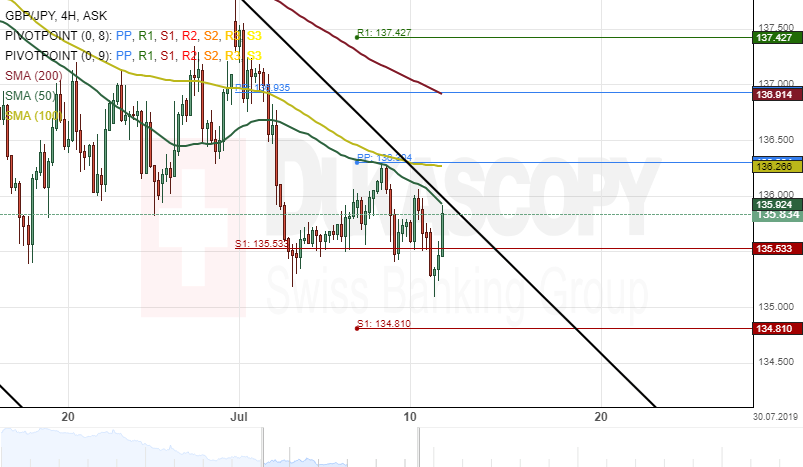
GBP/JPY 4H Chart: Pressure By 50– And 100-Hour SMAs
The GBP/JPY currency pair has continued to edge lower after the pair reversed from the upper boundary of a descending channel pattern at 137.77. The British Pound has depreciated about 1.92% in value since July 1.
Everything being equal, it is likely that the exchange rate will continue its movement in the descending channel pattern during the following trading sessions. The potential target will be at 133.98.
However, a support level formed by the weekly S1 at 134.81 could provide support for the currency exchange rate in the nearest future
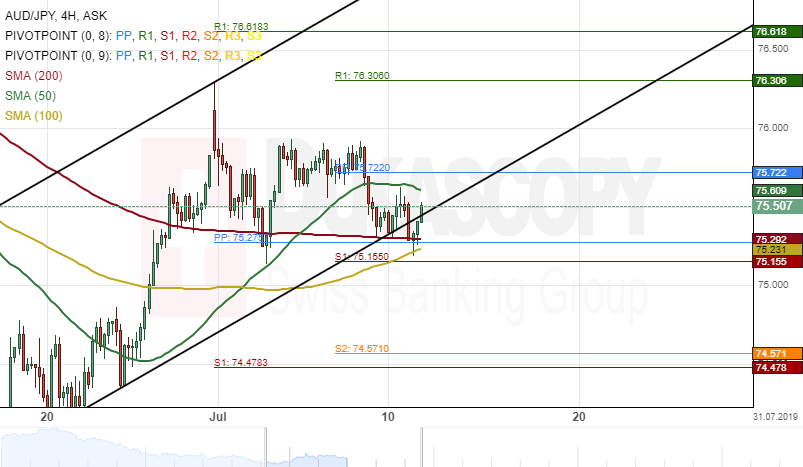
AUD/JPY 4H Chart: Breaches Channel Pattern
The Australian Dollar versus the Japanese Yen depreciated about 0.95% in value during last week's trading sessions. The currency pair breached the bottom border of an ascending channel at 75.29 during the Asian session on Thursday.
The exchange rate tested a support cluster formed by the combination of the 100– and 200-hour SMAs and the weekly and monthly PPs at 75.21 during the morning hours of today's trading session.
If this support cluster holds, a surge towards the weekly R1 at 76.30 could be the target for bullish traders next week.
However, if the pair passes the cluster as mentioned above, a decline towards the swing low at 74.57 could be expected in the short term.
ECB accounts: Broad agreement that update of monetary policy stance was called for
Account of the ECB monetary policy meeting in June showed there was "broad agreement" that "update of the monetary policy stance was called for", due to "prolongation of uncertainties" and the implications for inflation outlook. And inflation was still projected to reach "only 1.6%" in 2021, which was seen to remain "some distance away" from the 2% target. Thus, it's considered "important" to "demonstration" ECB's "determination to act".
Also, there was "broad agreement" on adjusting the calendar based component of the forward guidance to keeping rates at present levels "at least through the first half of 2020"; reiterating the guidance on reinvestment; and thirdly, to set interest rate of TTRO II equal to average MRO rate plus 10bps.