Sample Category Title
Commodities Weekly: Metals Pressured By Fed Uncertainty
The strong US payroll report for June raised doubts about the Fed’s easing outlook, boosting the dollar to multi-week highs to the detriment of precious and industrial metals.
Precious metals
GOLD is back below the $1,400 handle again after the strong nonfarm payroll data on Friday suggested the US economy might be doing just fine. The firmer US dollar on the back of higher yields hurt sentiment for gold, and the metal looks poised for its fourth daily drop in a row today.
Central banks continue to buy gold with the Peoples Bank of China revealing yesterday that it had increased its gold reserves for a seventh straight month in June, adding 10.3 million tons in the month. Poland had also said last week that it had more than doubled its gold reserves between 2018 and 2019. India hiked the import duty on gold to 12.5% from 10% in its 2019 budget last week.
Speculative investors increased net long positions for a fifth week to July 2, according to the latest CFTC data, driving them to the highest since September 2016.
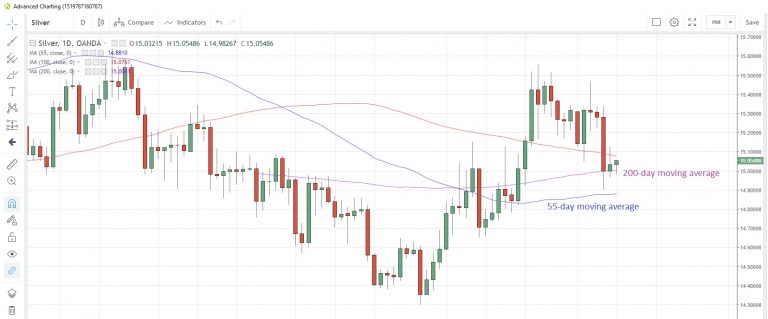
SILVER remains unfavoured versus gold, and is facing the prospect of a close below the 200-day moving average at 15.0039 for the first time since June 17. Speculative investors have turned net bearish in their positioning for the first time in five weeks, data to July 2 show. However, as at last Friday, physical silver holdings with exchange-traded funds were at the highest since November last year.
As mentioned above, silver is flirting with the 200-day moving average, with the 55-day moving average at 14.88 the next possible support point below. The gold/silver (Mint) ratio is hovering near record highs struck earlier this month.
Silver Daily Chart
PLATINUM holdings with exchange-traded funds increased by about 61,000 tons last week, according to a Bloomberg report, while speculative accounts increased their net long positions for a second week to July 2, and they are now at the highest since May 21, the latest data snapshot from CFTC shows.
Platinum is now at 809.62 as the 55-day moving average at 829.15 traded below the 200-day moving average at 830.39 yesterday for the first time since March 25. This crossover is often interpreted as a medium term bearish signal.
PALLADIUM looks poised to extend the decline from 3-1/2 month highs to a second day today as it plays victim to a resurgent US dollar. Speculative investors appeared to be correctly positioned for the last run higher, having been net buyers for a sixth straight week to July 2. Investors are most bullish on palladium since the week of March 26. Exchange-traded funds trimmed their physical palladium holdings by 8,600 troy ounces last week, Bloomberg reported.
Base metals
COPPER posted the biggest weekly drop since May last week, snapping a three-week winning streak, and the decline seems to be extending into this week. With the global demand outlook uncertain, copper stocks at warehouses tracked by the London Metal Exchange were at the highest since June 2018 last Friday, while China reported that its output had increased by 15% to 728,300 tons in June from a month earlier.
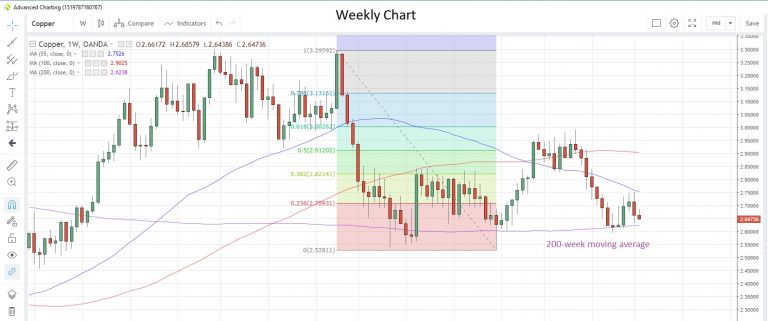
Speculative investors remain bearish, increasing net short positions for a second straight week in the week to July 2, latest CFTC data show. Copper is edging toward the 200-week moving average support at 2.6238, which has held on a closing basis since September last year.
Copper Weekly Chart
Energy
CRUDE OIL is struggling to maintain last month’s gains, despite the extension of production cuts into 2020 by OPEC and its allies, as the demand outlook remains uncertain. A smaller-than-expected drawdown of US stockpiles last week is also adding to supply pressures, though Middle East tensions could offer some support to prices.
Russia’s Energy Minister has calculated that the extension to the OPEC+ deal to next year would deliver about 3.5 trillion rubles ($54.6 billion) to the 2019/20 budget.
NATURAL GAS posted the biggest one-day gain since January 14 on Friday after the latest weather forecasts were released. Heatwave temperatures are expected across the US for the July 13-17 period and this prompted buying of the commodity.
Weekly gas stockpiles data to July 5 will be released on Thursday, and are expected to show an increase of 94 billion cubic meters (bcm), up from 89 bcm the previous week.
Speculative investors trimmed their net short positions for the first time in five weeks in the week to July 2, according to CFTC data. Investors have been net bearish on the commodity since February, though prices have trade in a narrow 2.90-2.45 range since then.
Agriculturals
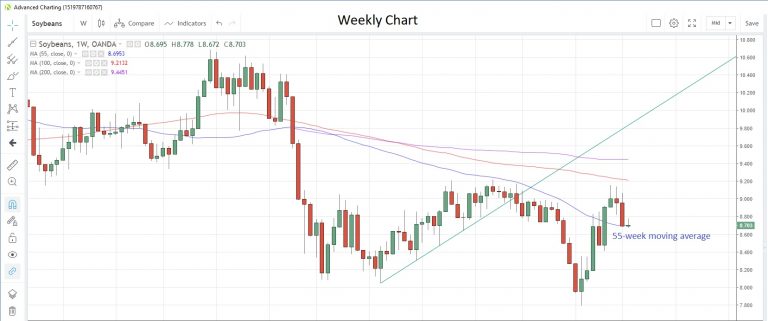
SOYBEANS continue in consolidation mode after the May-June rally, having fallen for a second consecutive week last week. It is now one year since China imposed the last import tariffs on US soybeans, and prices since then have seen some volatility but are now just 0.14% lower than the start of July 2018. Soybean prices are currently at 8.708, hovering above the 55-week moving average at 8.6954, which has supported prices on a closing basis since early-June.
Soybeans Weekly Chart
Latest US weather patterns are producing some crop-friendly rains in the growing areas, which could improve supply. Speculative accounts turned net bullish on soybeans for the first time since February, CFTC data to July 2 show.
CORN looks poised to break a four-day rising streak that took the commodity to the high for this month. Hot and dry US weather had threatened corn crops, which drove the rally but speculative investors had turned net sellers for the first time in nine weeks in the week to July 2, pulling net long positions from a 13 month high.
A US Department of Agriculture (USDA) report published Friday estimated that Brazil’s corn output could rise 25% to a record high 101 million tons in the current season.
SUGAR prices have been confined to a relatively tight range for the past two weeks with no particular trend or direction apparent. There is still a hefty global supply glut, which will likely keep a lid on prices in the near future.
To combat sugar overproduction in India, producers in Maharashtra have asked for permission from the central government to convert the sugar surplus to ethanol. Meanwhile, last month the USDA predicted that Nigeria’s sugar imports will increase by 20,000 tons in the 2019-20 season, a 1% increase from the previous one.
Speculative investors’ positioning turned net long for the first time since the week of April 23 as they remained net buyers for the fifth week in a row, according to CFTC data.
Speculative accounts were also net buyers of WHEAT for the ninth consecutive week in the latest reporting week. Net longs are now at the highest since September 2018.
GBP/USD Could Accelerate Losses Below 1.2450
Key Highlights
- The British Pound declined sharply after it broke the 1.2600 support against the US Dollar.
- GBP/USD formed a couple of bearish continuation patterns on the 4-hours chart.
- There could be sharp losses if the pair fails to stay above 1.2480 or 1.2450.
- The Swiss Unemployment Rate in June 2019 (MoM) is likely to remain at 2.4%.
GBPUSD Technical Analysis
After struggling to stay above 1.2750, the British Pound started a major decline against the US Dollar. The GBP/USD pair broke a couple of important supports such as 1.2640 and 1.2600 to enter a bearish zone.
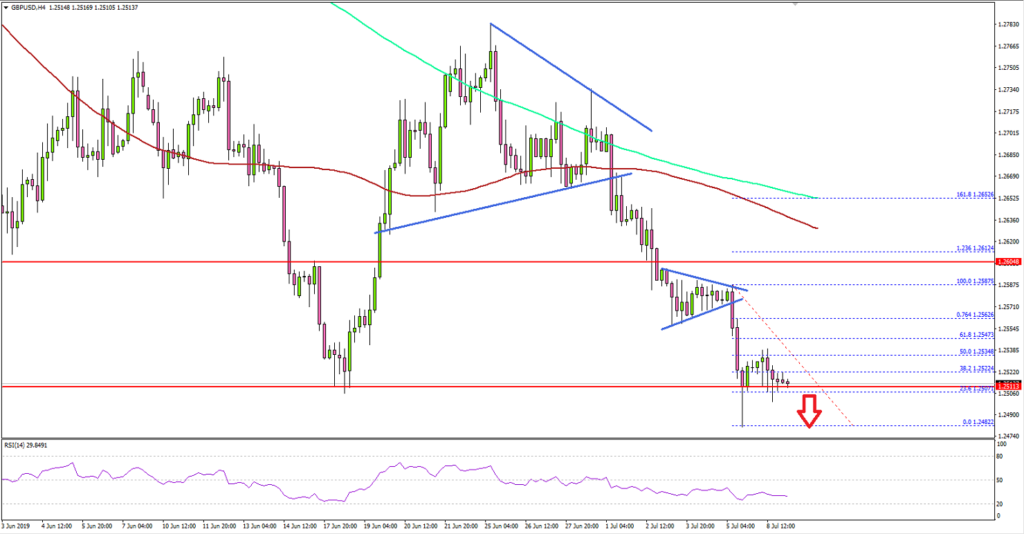
Looking at the 4-hours chart, the pair settled below the key 1.2600 support plus the 100 simple moving average (red, 4-hours). It even broke the 1.2560 support level and spiked below the last swing low near 1.2510.
During the decline, the pair formed below a couple of bearish continuation patterns on the same chart. Finally, the pair traded towards the 1.2480 level and recently corrected higher. It recovered above the 1.2510 level, but struggled to break the 1.2540 resistance.
GBP/USD failed near the 50% Fib retracement level of the downward move from the 1.2587 high to 1.2482 low. The current price action is bearish, with a declining 200 simple moving average (green, 4-hours).
Therefore, there is a risk of more losses below the 1.2480 level. The next key support is at 1.2450, below which the pair could slide towards the 1.2410 level.
Conversely, to start a decent recover, the pair must break the 1.2540 resistance. The next major resistance for the bulls could be near the 1.2580-1.2600 area.
Overall, EUR/USD and GBP/USD are currently trading with a bearish zone and they could continue to slide in the near term.
Economic Releases to Watch Today
- US JOLTS Job Openings May 2019 – Forecast 7.479M, versus 7.449M previous.
- Swiss Unemployment Rate June 2019 – Forecast 2.4%, versus previous 2.4%.
Market Morning Briefing: Pound Is Continuing To Hold Above 1.25 But Is Not Gaining Strength
STOCKS
Equities continue to remain subdued. However, the price action since Friday indicates that the market lacks strong selling interest. This keeps the broader bullish view intact on equities. Global indices like the Dow and DAX can consolidate for some time and then are likely to resume their uptrend. Shanghai is coming closer to a key support which we expect to hold and trigger a reversal. On the domestic front, the Sensex and Nifty have declined below their key supports and are vulnerable for further fall.
The dip in the Dow (26806.14, -115.98, -0.43%) is not showing momentum. Though a test of 26600-26500 is possible in the near term, the broader view remains bullish. As mentioned yesterday, Dow can consolidate between 26500 and 27000 for some time before a fresh rally to 27200-27500 is seen.
DAX (12543.51, -25.02, -0.20%) has support at 12450 which can limit the downside. It can consolidate between 12450 and 12650 for some time. The bias is bullish to see a break above 12650 and rise to 12800-13000 in the coming weeks.
Nikkei (21587.95, +53.60, +0.25%) has bounce after testing 21500 and can consolidate between 21500 and 21750 as mentioned yesterday. A rise to 21700-21750 is likely now while it remains above 21500. A breakout on either side of 21500 or 21750 will decide the next move.
Contrary to our expectation Shanghai (2925.16, -8.2, -0.28%) has declined further below 2950. However a strong support is coming up at 2900 which may halt the current fall and trigger a bounce to 2950 and 3000 in the coming days.
Sensex (38720.57, -792.82, -2.01%) and Nifty (11558.60, -252.55, -2.14%) tumbled over 2 per cent yesterday breaking below their crucial support levels of 39000 and 11800 respectively. The outlook is bearish. Nifty can fall to 11500-11470 while below 11635 in the near term. Sensex on the other hand can test 38100 on the downside while it remains below 39100 in the coming days.
COMMODITIES
Strong dollar continues to weigh on commodities. Gold has come-off and can test a crucial support in the coming sessions. Silver looks mixed. Copper is range bound with a bullish bias. Oil looks weak and can dip in the near term within its broad sideways range.
The resistance at 1410 mentioned yesterday is holding well on Gold (1393). A test of 1380 looks likely in the near term. As mentioned yesterday, the level of 1380 is a crucial support, a break below which will confirm a double top reversal pattern on the daily chart.
Silver (15.01) oscillates around 15. The immediate outlook is mixed. It has equal chances for either a rise to 15.20 or fall to 14.75 from current levels.
Copper (2.66) is stuck between 2.63 and 2.69 over the last few days. While above 2.64, the bias is bullish to see a break and rise above 2.69 targeting 2.72-2.73 on the upside.
Brent (63.92) has come-off after testing 65 yesterday. The near-term outlook is mixed. Brent can trade sideways between 62 and 65 for some time. While below 65, the possibility is high for it to decline towards 62.
Nymex WTI (57.49) spiked to 58.46 and has come-off from there. While below 58, WTI can fall to 56.5 and 56 in the coming sessions.
FOREX
Dollar is retaining its strength and has room to rise further. Major currencies look weak. Euro, Pound, Yen and Aussie have declined on the back of strong dollar and looks vulnerable for further fall. The broader strength in the dollar can keep the rupee weak in the near term.
Dollar Index (97.42) has inched further higher and keeps the bullish view intact to test 97.80 and 98. A break above 97.50 will trigger this rise.
As expected, Euro (1.1210) has dipped to test 1.12. The near-term view is negative for it to break 1.12 and fall to 1.1175 and 1.1150. Even a revisit of 1.11 levels cannot be ruled out now. Resistance is at 1.1250.
Dollar-Yen (108.87) has risen further and keeps our bullish view intact for a test of 109. It can test 109.20 on the upside and then a pull-back to 108.80 is possible.
Euro-Yen (122) remains mixed within its 121-123.5 sideways range. Within this range the possibility is high of it to move up to 123-123.5 in the coming sessions.
Aussie (0.6960) is heading towards the crucial support level of 0.6950 as expected. Though an intermediate bounce to 0.6975 from 0.6950 is possible. the broader bias is negative for it to break 0.6950 and fall to 0.6900 eventually.
Pound (1.2512) is continuing to hold above 1.25 but is not gaining strength. The outlook is bearish for it break 1.25 and fall to 1.2350 in the coming days. Resistances are at 1.2550 and 1.2600.
USDCNY (6.8857) has come-off from its high near 6.8950. The resistance around 6.90 seems to be holding well. A break below 6.88 can drag it to 6.86 and 6.85 in the coming sessions. Broadly, the pair is retaining its 6.83-6.90 sideways range.
As expected, the Dollar-Rupee (68.6625) bounced towards 68.80 yesterday. A break A break above 68.80 can take it further higher towards 69 in the near term. We expect the Dollar-Rupee to remain range bound between 68.30 and 68.80 (narrow) or 68.30-69 (broad) for some time before we see a fresh fall to our preferred level of 68.
INTEREST RATES
Yields sustain higher. The US Federal Reserve Chairman Jerome Powell's testimony on Wednesday and Thursday will be watched closely by the market to get hints on the rate cut front. The outcome of this event could influence the yield movement for the rest of the week.
The US 2Yr (1.88%), 5Yr (1.85%) and 10Yr (2.04%) yields were up yesterday while the 30Yr (2.52%) was marginally lower. The view remains the same. The yields can move higher/consolidate in the near term before the overall downtrend resumes. The 10Yr has room to test 2.08%-2.10% on the upside in the near-term while it remains above 2%. Similarly, the 5Yr can rise to 1.88%-1.90% in the near term.
The German yields remained stable at the near-end while the far end has dipped slightly. The 2Yr and 5Yr yields were stable at -0.75% and -0.63%. The 10Yr and 30Yr were down 1 bps each and are trading at -0.37% and 0.23%. Yields on the near end have room to move higher in the near-term. The 5Yr can move up to -0.60% and the 10Yr can test -0.30% on the upside.
The 10Yr GOI (6.5621%) tumbled to test the 6.60%-6.55% support zone again yesterday. As mentioned yesterday, the current fall can halt around 6.55%. The 10Yr GoI is likely to reverse higher from around 6.55% and rise to 7.0% and 7.10% in the coming weeks.
Daily Markets Broadcast
Caution rules Wall Street
US indices edged lower for a second day yesterday as investors mulled possible outcomes from Fed Chairman Powell’s testimony later this week. Deutsche Bank shares came under pressure after the restructuring announcement. Oil prices eased back from one week highs.
US30USD Daily Chart
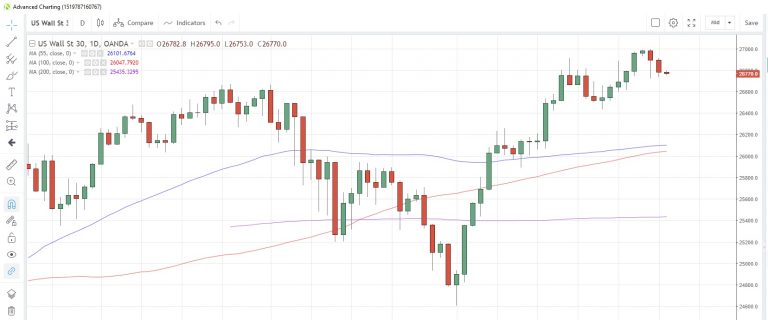
The US30 index fell for a second day yesterday and in early trading looks to be extending those losses into today
The 100-day moving average at 26,048 is edging closer to the 55-day average at 26,101, and they could possibly cross over later this week
Fedspeakers are out in force today with Powell, Bullard, Quarles and Bostic all on tap ahead of Chairman Powell’s semi-annual testimony on Wednesday/Thursday. There are no major data releases scheduled for today.
DE30EUR Daily Chart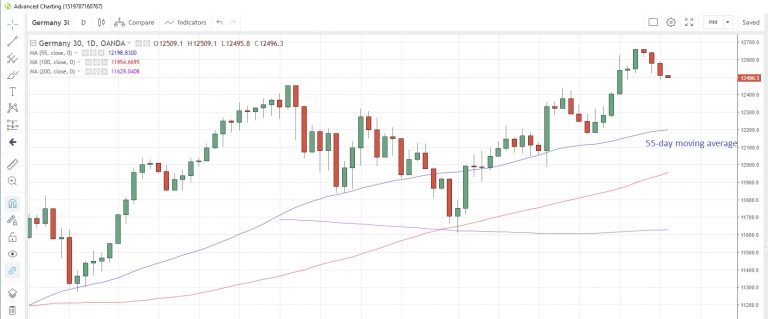
The Germany30 index fell for a third day yesterday with Deutsche Bank under pressure following the announcement of its restructuring plans
The index touched the lowest in almost a week and is falling toward the 55-day moving average at 12,199
Germany’s industrial production fell 3.7% y/y in May, echoing the weakness in factory orders released earlier. There are no data releases scheduled for today.
WTICOUSD Daily Chart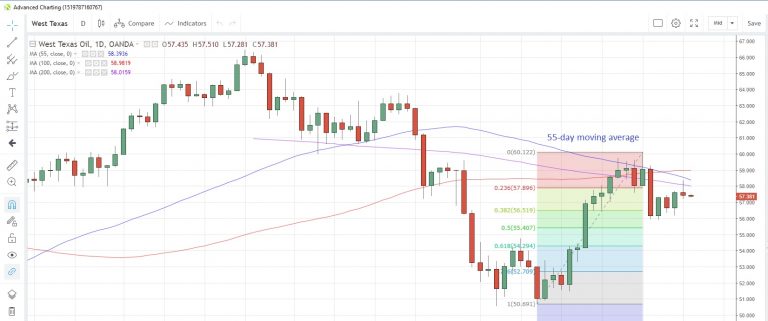
WTI retreated from near one-week highs to close lower yesterday as the global demand outlook remained weak
The index is still holding below the 55-day moving average at $58.39. The CFD has only had one close above it since May 21
Weekly crude oil stockpiles data to July 5 from the American Petroleum Institute are due today. Last week saw a drawdown of five million barrels.
USD/CAD Canadian Dollar Lower Ahead Of Fed Rhetoric
The Canadian dollar is down 0.10 percent versus the dollar on Monday. The loonie started the week on the wrong foot versus the greenback after diverging jobs report on Friday. Canada lost 2,200 jobs in June, while the US added a massive 224,000 positions to rebound from the disappointing May report.
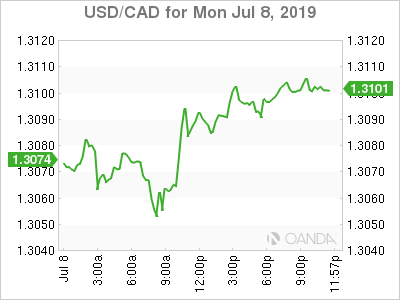
The Bank of Canada (BoC) is expected to keep the benchmark interest rate unchanged at 1.75 percent on Wednesday, and later in the day the Fed will release the notes from its June FOMC meeting. The market anticipated a rate cut later in the month from the Fed and will keep the loonie as one of the strongest G10 currencies.
OIL – Oil Lower But Eyes Turn to Middle East on Supply Concerns
Oil prices were set for a deeper loss on Monday as the US dollar got back its mojo after Fed rate cut expectations are cooling after a massive jobs gain on Friday.
A stronger dollar and a lower drawdown last week are putting downward pressure on crude prices. Tensions in the Middle East gave prices a boost as the UK confiscated an Iranian oil tanker headed to Syria violating EU sanctions.
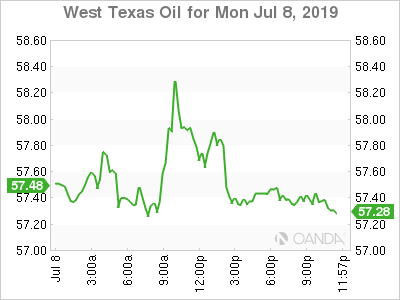
Supply disruptions could be on the rise as Iran is on a collision course with the EU after the US pulled out of the Nuclear deal could get worse if the Strait of Hormuz is closed. 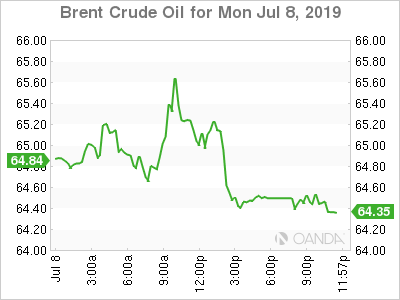
The prolonged trade war between China and the US does not seem to be nearing a resolution, and it will keep being a negative factor for crude prices as it impacts global growth forecasts.
GOLD – Gold Lower as Fed to Final World on Dollar
Gold lost 0.16 percent on Monday after the market is walking back some of the pricing around the number of Fed rate cuts this year. The monster NFP jobs gain in June has traders second guessing just how hard and fast the central bank will reduce its benchmark rate after hiking four times in 2018.
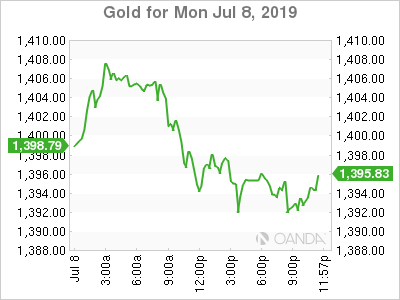
Pressure from the White House cannot be ignored as Fed Chair Powell will hold center stage this week with a scheduled speech and two testimonies. Fed speakers will be out in force with the main highlight to be the Federal Open Market Committee (FOMC) notes from the June meeting.
Dovish rhetoric is expected, and anything less could spark a Dollar rally as the greenback has been on the back foot ever since the Fed telegraphed its rate cut intentions.
Gold remains above $1,400 and even the dollar regaining its mojo could not be enough to drive investors away from the yellow metal as Middle East tensions are hitting higher levels of uncertainty and with the election of a new conservative leader in the UK, Brexit turmoil will once again hit the market.
STOCKS – Equities Under Pressure from Stronger Dollar
The stock market registered a day of losses ahead of what Fed Chair Powell will have to say this week. The head of the US central bank is scheduled to speak in Boston on Tuesday, and back to back testimonies in Washington. Fed speakers and the minutes of the June FOMC meeting will put pressure on equities at the same time earnings are starting to trickle in.
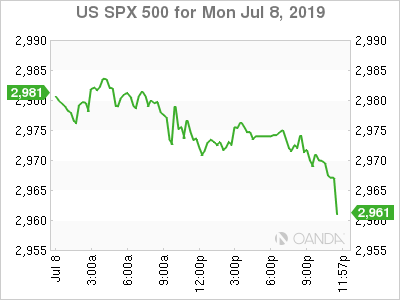
Equities have been on a record pace ahead of the NFP report on Friday. The better than expected job rebound is forcing the market to rethink its pricing on the number of rate cuts. Three was the group-think forecast, now moving down to two, but always with an eye on the US-China trade war and its possible negative impact on US growth.
FX – Dollar Higher on Jobs Boost Awaits Fed Rhetoric and Notes from FOMC
The US dollar was higher against major pairs on Monday still trading on the US jobs boost from Friday’s better than expected NFP report. The monster rebound is putting into question how many times the Fed must cut its benchmark interest rate to keep the forward momentum of the economy going.
Fed member Bullard had already cautioned the market from a 50-basis cut, and considering he was the lone voter in favor of a rate cut in June it will be interesting to see what other members consider an appropriate response when the FOMC meeting minutes are published on Wednesday.
The dollar will be extremely sensitive to what members of the central bank have to say this week and what get release on Wednesday.
The Malaysian ringgit is lower against the dollar ahead of a week heavy with US Central bank rhetoric. The Fed is expected to cut in July, but further rate cuts are being put into question by the strong reaction of the US job market. Meanwhile, Malaysia is expected to keep its overnight policy rate unchanged when the Bank Negara Malaysia meets on Tuesday.
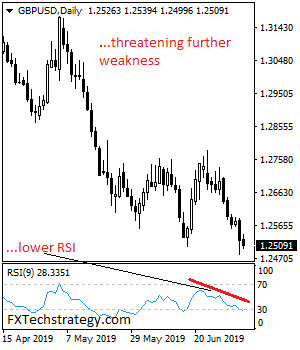
GBPUSD Declines Envisaged Towards 1.2522 Level
GBPUSD decline envisaged towards 1.2522 level as we expect more weakness to occur in the days ahead. Support comes in at 1.2500 with a turn below that level shifting focus to the 1.2450 level. Further down, support resides at the 1.2400 level where a break will turn attention to the 1.2350 level. Further down, support lies at the 1.2300 level. On the upside, resistance stands at the 1.2550 with a turn above here allowing for additional strength to build up towards the 1.2600 level. Further out, resistance stands at the 1.2650 level followed by the 1.2700 level. On the whole, GBPUSD retains its downside pressure short term.
Eco Data 7/9/19
[php_everywhere instance="1"]
BoC Meeting: Staying Neutral in a Dovish World
The Bank of Canada (BoC) is expected to stand pat when it wraps up its policy meeting at 14:00 GMT on Wednesday. Given the streak of strong data, policymakers could maintain a relatively sanguine tone, highlighting that rates are unlikely to be cut or raised anytime soon. With other major central banks preparing to ease, a neutral BoC would argue for a stronger loonie overall.
The Canadian economy has been performing better than most other developed nations lately. The labor market is tight, wages have picked up substantially, inflation is slightly above the BoC’s target, and economic growth likely rebounded materially in Q2. Meanwhile, companies are optimistic as was highlighted by the BoC’s most recent business survey, the housing market has stabilized, and trade tensions seem set to quiet down for now as the US-China talks resume.
Putting everything together, there’s no real case for the BoC to even consider cutting rates in the coming months, in contrast to most other major central banks like the Fed and ECB, which are preparing to add stimulus. Investors agree, with money markets pointing to a mere 20% probability for a BoC cut this year. It therefore seems likely that BoC policy will diverge from that of other economies, which argues for a stronger Canadian dollar, particularly against the currencies of nations that may slash rates the most – like the US.
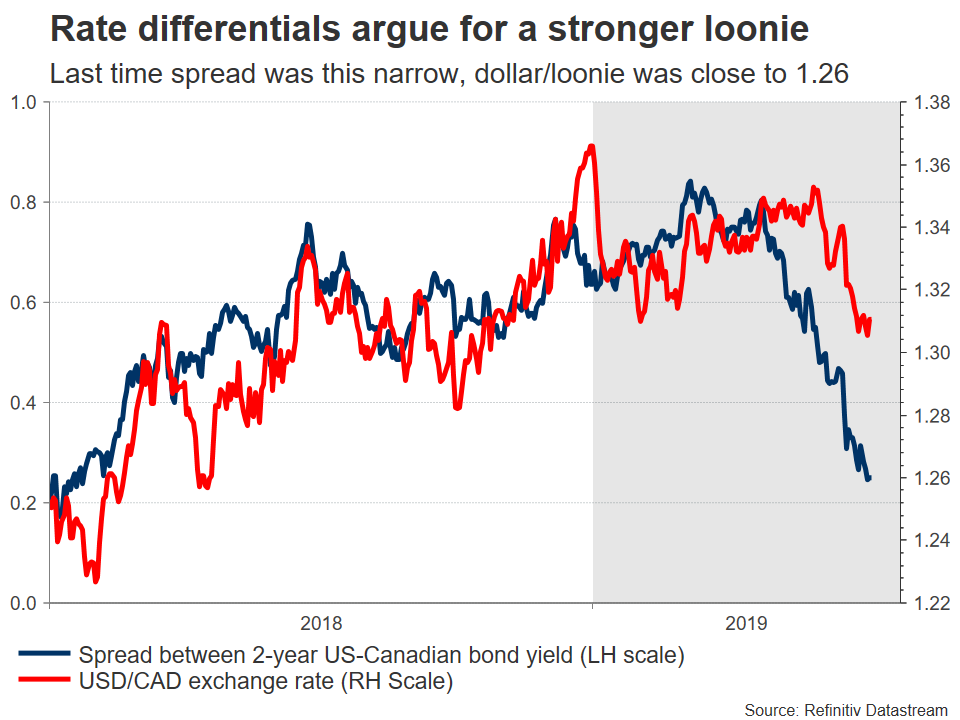
Perhaps the biggest argument for the BoC to tilt dovish in the future, besides potential weakness in incoming data, is the exchange rate itself. An appreciating loonie would push down on the prices of imports, making it harder for inflation to rise, so the BoC will probably try to avoid that route – either by signaling that cuts are possible or by actually cutting rates at some point. That said, the currency has to gain significantly before this becomes a problem that the BoC must tackle.
The other wildcard in this narrative is trade. Things may have calmed down for now, but a ‘ceasefire’ is very different from real progress, especially considering that Washington and Beijing are still far apart on some big issues. The bottom line is that if tensions escalate again, that could also cause the BoC to join the chorus of dovish central banks, eroding some of the loonie’s appeal.
In the shorter-term though, there may not be much that can stand in the loonie’s way higher, as both above-mentioned risks are mainly issues for the medium term. In fact, the loonie is already the best-performing major currency this year, up by 4.3% against the dollar and by 6.5% versus the euro.
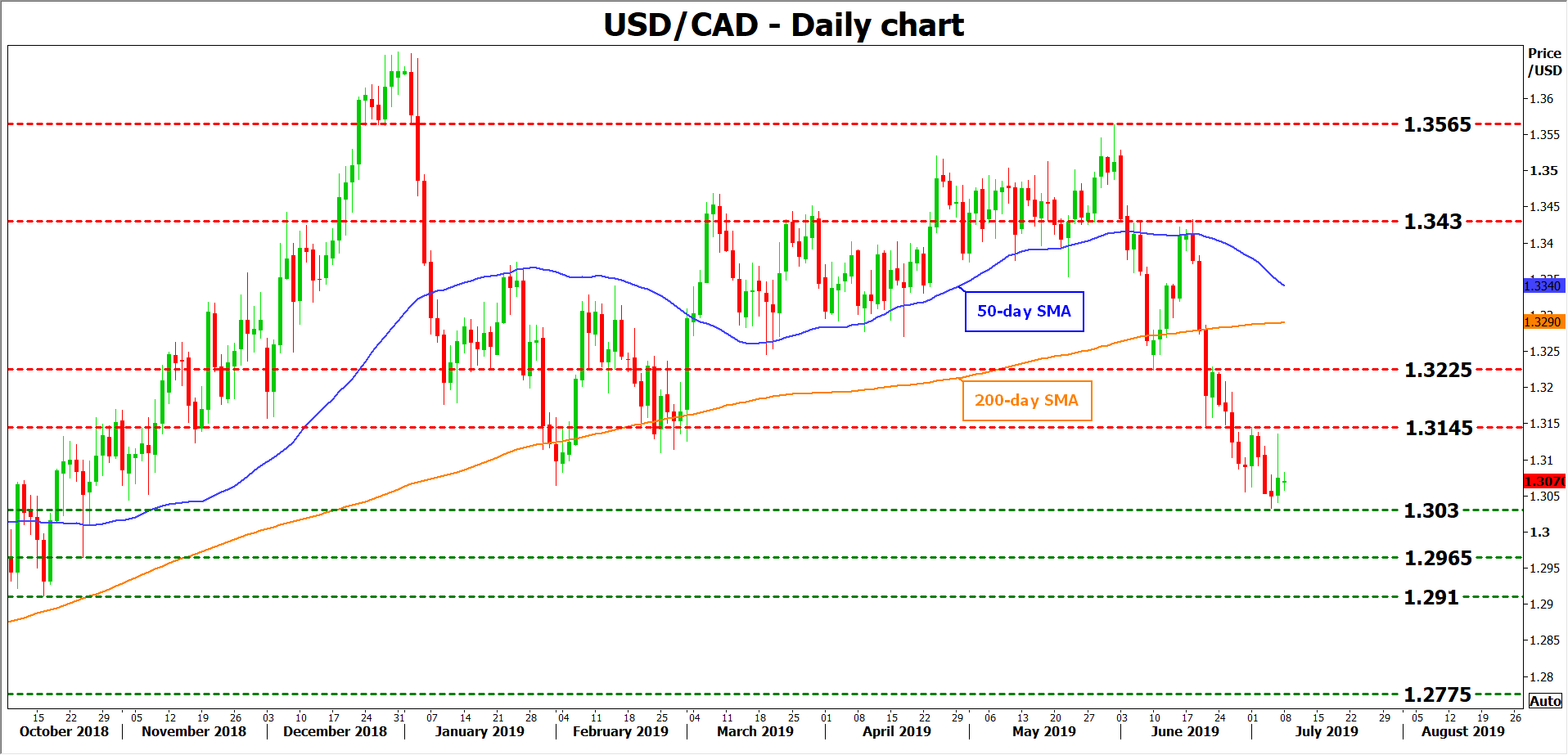
Looking at the technical picture of dollar/loonie, a potential break below 1.3030 – perhaps on a ‘confident’ BoC – could see the pair challenge 1.2965 hurdle, the October 24 low.
On the upside, if the BoC places more emphasis on the external risks rather than the strong data, resistance to advances may be found near 1.3145, the July 1 high. Even higher, attention would turn to the support-turned-resistance area of 1.3225.
Finally, note that Governor Poloz will hold a press conference after the meeting and any noteworthy comments could impact the loonie as well. On the dollar side of the equation, Fed Chairman Powell will testify before Congress at the same time (14:00 GMT), while the minutes from the latest Fed meeting will be released a few hours later (18:00 GMT).
USD/TRY Outlook: Lira’s Positive Sentiment Soured after CBRT Governor Fired
The Turkish lira was the top loser in Asian session as the pair opened with strong gap higher (nearly 15 figures) on Monday, on announcement that Turkish President Erdogan fired the Governor of Turkish Central Bank on Saturday that The President and CB Governor clashed over the interest rates as President Erdogan supports lower interest rates, while the central bank did not follow the instruction and further tightened rate policy, in attempts to fight double-digit inflation.
The lira remains very vulnerable, as the latest negative news add to existing fears over weakening economy and rising uncertainty over political crisis with the USA which may end in economic sanctions on Turkey.
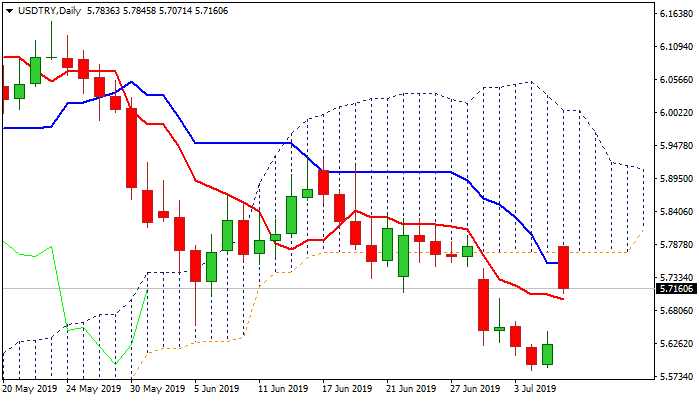
The USDTRY bounced from key supports (provided by 200DMA and Fibo 61.8% support at 5.58/57 zone, which were under strong pressure, with signs for eventual break lower) that sidelined hopes of further lira's strength for the time being.
Daily indicators turned north (momentum is rising and stochastic/RSI emerged from oversold territory) supporting reversal scenario. The upside is expected to remain in focus as long as today's gap stays unfilled, with narrowing daily cloud, which is about to twist next week, also expected to attract bulls.
Close above daily Tenkan-sen (5.6983) is needed to generate initial bullish signal, with extension through cracked Kijun-Sen (5.7568) and daily cloud base (5.7736) needed to confirm and expose key barriers at 5.8300/60 zone (20/25 June lower platform/Fibo 38.2% of 6.2444/5.5828 descend).
Focus turns towards CBRT's policy meeting on 25 July, with changes in the bank's leadership, increasing expectations for possible start of easing monetary policy.
Res: 5.7568; 5.7736; 5.8300; 5.8365
Sup: 5.7071; 5.6983; 5.6575; 5.5889
CAD strong ahead of BoC, a look at EUR/CAD & CAD/JPY
Canadian Dollar strengthens broadly today, partly helped by rebound in oil price. And probably more importantly, BoC is widely expected to keep interest rate unchanged at 1.75% this week. Recent data showed much resilience in the economy, offering the central bank more room to take a wait and see mode and assess the economic developments. While the upcoming statement could be similar to prior meeting, there is also room for BoC to turn more "neutral". Suggested reading: BOC Preview – Not Following Fed's Footstep
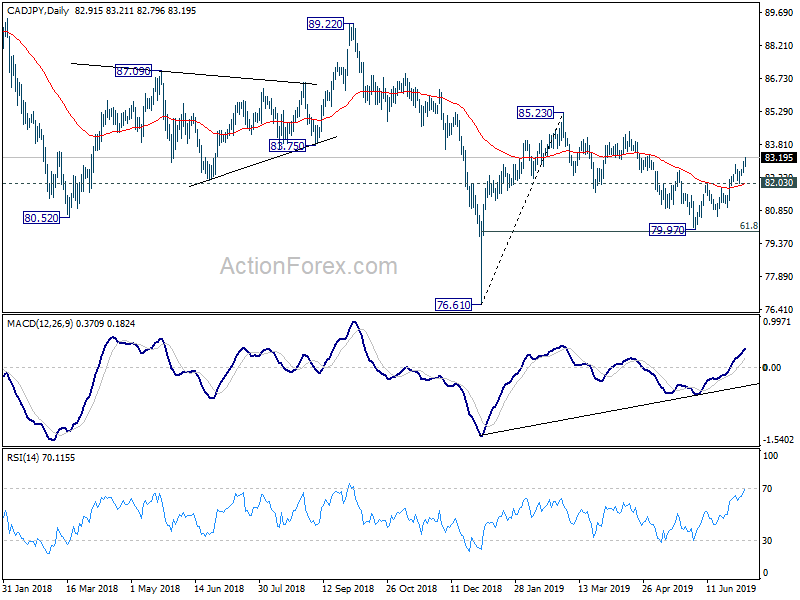
CAD/JPY's rise from 79.97 extended further to as high as 83.21 so far today. The strong support from 55 day EMA affirmed near term bullishness. Corrective fall from 85.23 should have completed at 79.97, just ahead of 61.8% retracement of 76.61 to 85.23 at 79.90. Near term outlook will stay bullish as long as 82.03 support holds. CAD/JPY have a test on 85.23 resistance next.
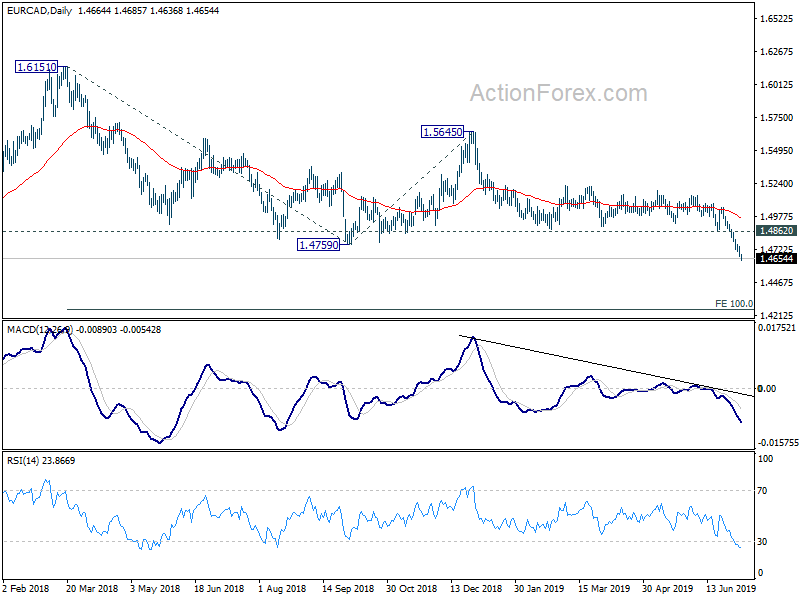
EUR/CAD is also extending the medium term down trend from 1.6151 as hits as low as 1.4636 so far today. As long as 1.4862 support turned resistance holds. The cross should target medium term projection level at 100% projection of 1.6151 to 1.4759 from 1.5645 at 1.4253.