Sample Category Title
Sunset Market Commentary
Markets
Today’s trading session won’t reach the history books. Core bonds eke out small gains in low-volume action. The Bund started on a solid footing following disappointing German industrial production numbers, but rapidly returned to flipflopping near opening levels. The US Note future shows the same undecisive trading pattern. The empty eco calendar doesn’t help. Key events later this week include FOMC/ECB Minutes, Fed chair Powell’s semi-annual testimony in front of Congress and US CPI data. ECB Coeuré voiced a similar easing bias as ECB Villeroy over the weekend. The German yield curve flattens with yield changes varying between +0.3 bps (2-yr) and -1.5 bps (30-yr). The US yield curve flattens as well with yields up to 2.1 bps (30-yr) lower. 10-yr yield spreads vs Germany are nearly unchanged with Greece slightly outperforming (-4 bps) following this weekend’s parliamentary election win of the opposition New Democracy party. They campaigned on a programme of lower taxes and bigger spending to boost Greek economic growth.
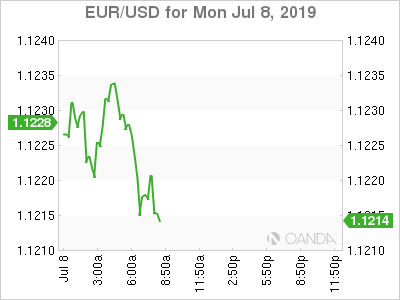
The dollar extended its recent rebound last Friday as solid US payrolls questioned market speculation on aggressive Fed easing in the near future. During the weekend, US president Trump stepped up his pressure on the Fed to counterbalance easing of other major central banks in order to remove a competitive disadvantage for the US economy/companies. However, for now, the dollar hardly suffers from Trump’s attacks on Fed independence. Sentiment was risk-off in Asia, supporting the USD-bid. EUR/USD hovered in a tight range in the lower half of the 1.12 big figure in Asia and early in Europe. A shy EUR/USD up-tick was blocked by comments from ECB Coeuré. He reiterated other ECB comments of late that both further rate cuts or additional bond buying are possible if needed. However, also this move had no strong legs. EUR/USD is trading in the 1.1220/25 area. The broader USD bid is also visible in USD/JPY. The pair rebounded back to the 108.50/60 area even as risk sentiment stays fragile.
The EUR/GBP cross rate simply didn’t go anywhere today. The pair was locked in a tight range roughly between 0.8955 and 0.8975. Investors await next steps in the Brexit saga as members of the UK conservative party are voting to choose a new PM. For now, there are few indications on what tactics expected winner Boris Johnson will put in place once appointed. Sterling is holding near recent lows against the euro and dollar, with EUR/USD currently at 0.8960 and cable trading in the low 1.25 area.
News Headlines
France’s central bank manufacturing sentiment index (95) dropped to the lowest level in six years in June. The Bank of France said its set of indicators now point at an economic expansion of only 0.2% in 2019 Q2 (vs. 0.3% in May) after rising 0.3% in the first quarter.
ECB board member Coeuré reiterated that loose monetary policy is needed now “more than ever” and kept further rate cuts and QE on the table. ECB’s Villeroy in another interview said the ECB is determined to act if necessary but suggested there’s no need to rush into decisions already this month.
Merkel’s protégé Kramp-Karrenbauer said the ECB should give thoughts to curb the duration of its low interest rate policy because of the “problematic effects” for people with savings deposits, “including many in Germany”. She added that with current low yields capital is flowing out of Europe.
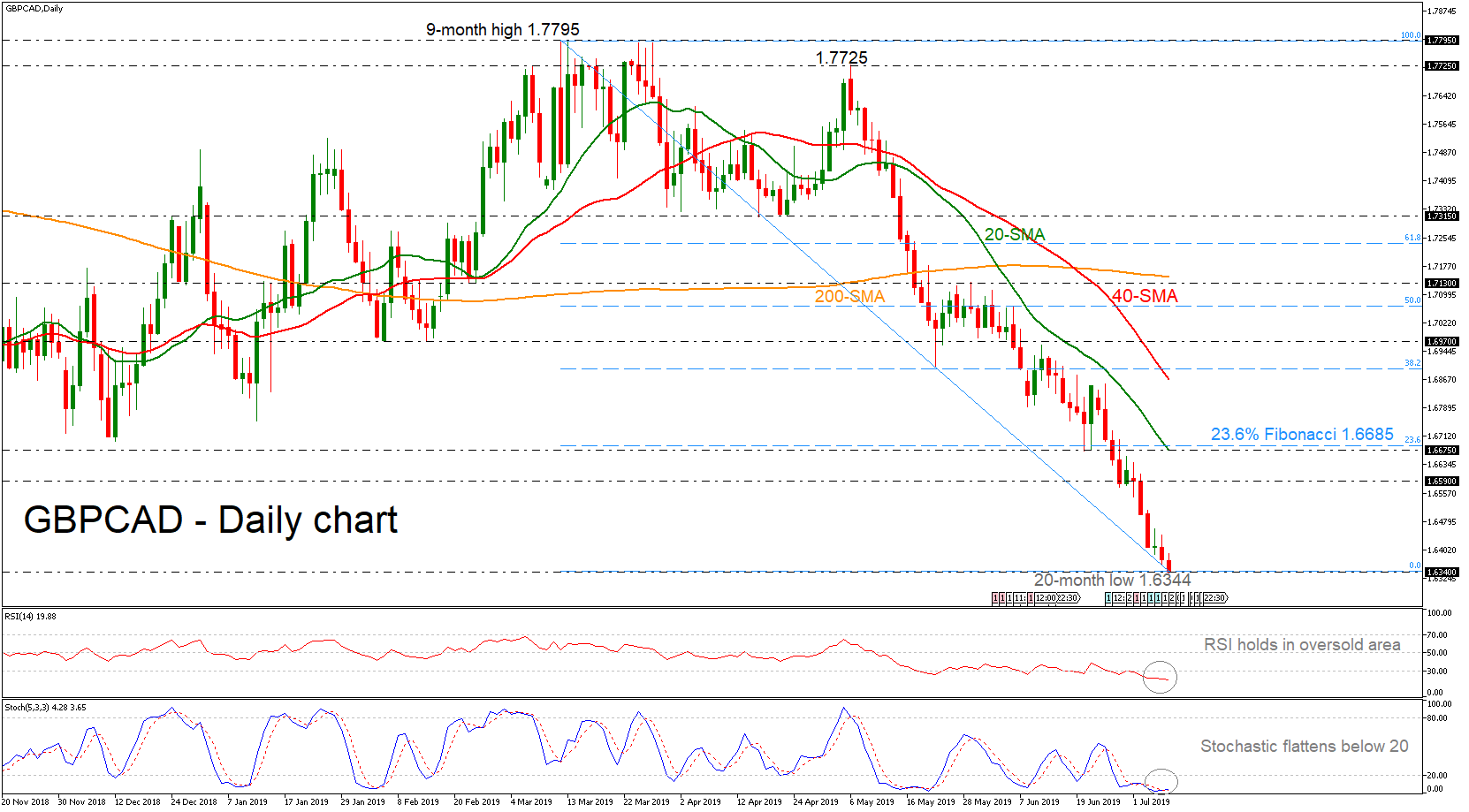
GBPCAD Reaches New 20-Month Low; Strongly Negative
GBPCAD is currently recording a new 20-month low near 1.6344 as it is plummeting over the last couple of months. The momentum indicators are still developing in oversold levels. The RSI, which has been moving below its 30 level over the last month is pointing down, while the stochastic oscillator is looking for a bullish cross below the 20 level.
If the price decreases further and falling below today’s low, the 1.6200 psychological level, taken from the high on September 2017, could attract traders’ attention as there is no significant obstacle before that barrier.
On the other side, if the market edges higher, resistance should come from the 1.6590 hurdle, reached on September 2018. Should the price overcome this level, the spotlight will shift to the 20-day simple moving average (SMA), currently at 1.6675, and the 23.6% Fibonacci mark of the downfall from 1.7795 to 1.6340, near 1.6685.
Overall, GBPCAD has been underperforming and the bearish phase remains in play especially as the pair continue to trade near multi-month lows.
USD/JPY Mid-Day Outlook
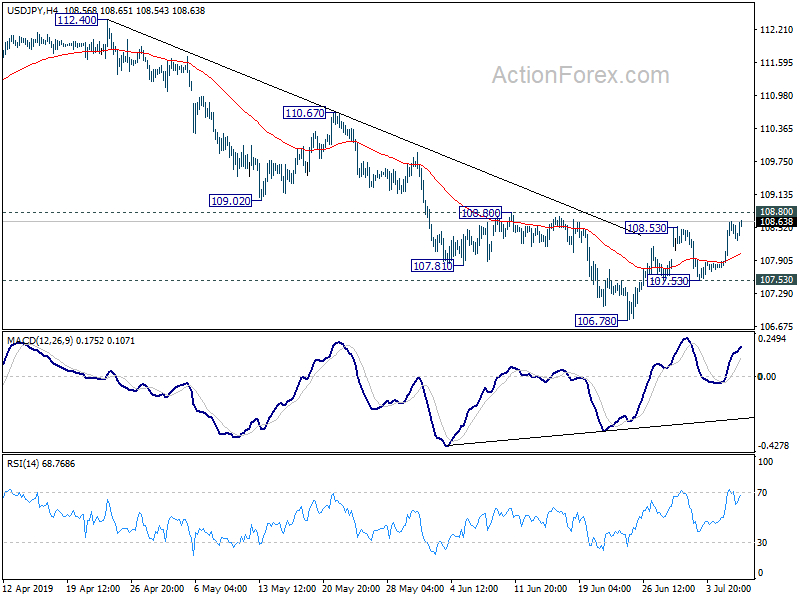
Daily Pivots: (S1) 107.95; (P) 108.30; (R1) 108.81; More...
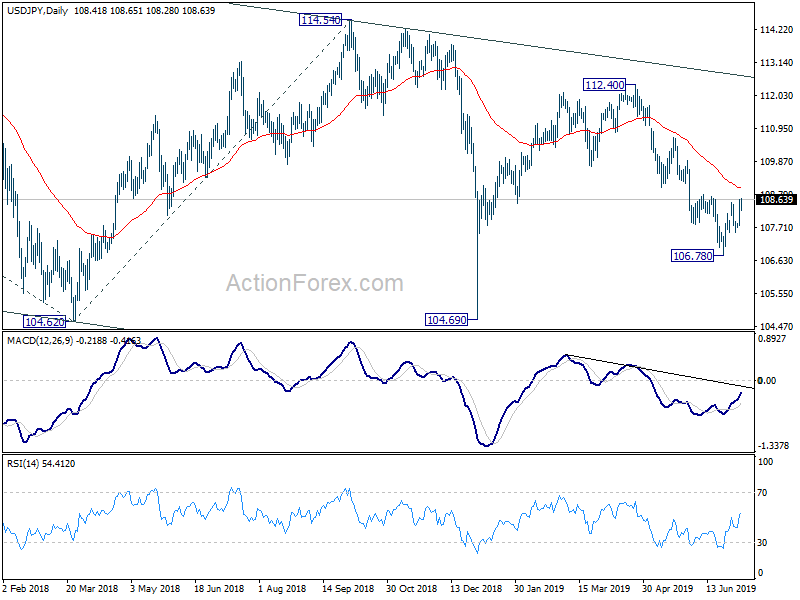
No change in USD/JPY's outlook. Intraday bias remains mildly on the upside with focus on 108.80 resistance. Firm break there will confirm short term bottoming at 106.78. Further rise should then been seen to 110.67 resistance next. On the downside, break of 107.53 will turn bias to the downside for retesting 106.78 low.
In the bigger picture, decline from 118.65 (Dec 2016) is still in progress, with the pair staying inside long term falling channel. Break of 104.62 will target 100% projection of 118.65 to 104.62 from 114.54 at 100.51. For now, we'd expect strong support above 98.97 (2016 low) to contain downside to bring rebound. In any case, break of 112.40 is needed to the first serious sign of medium term bullishness. Otherwise, further decline will remain in favor in case of rebound.
USD/CHF Mid-Day Outlook
Daily Pivots: (S1) 0.9865; (P) 0.9898; (R1) 0.9952; More...
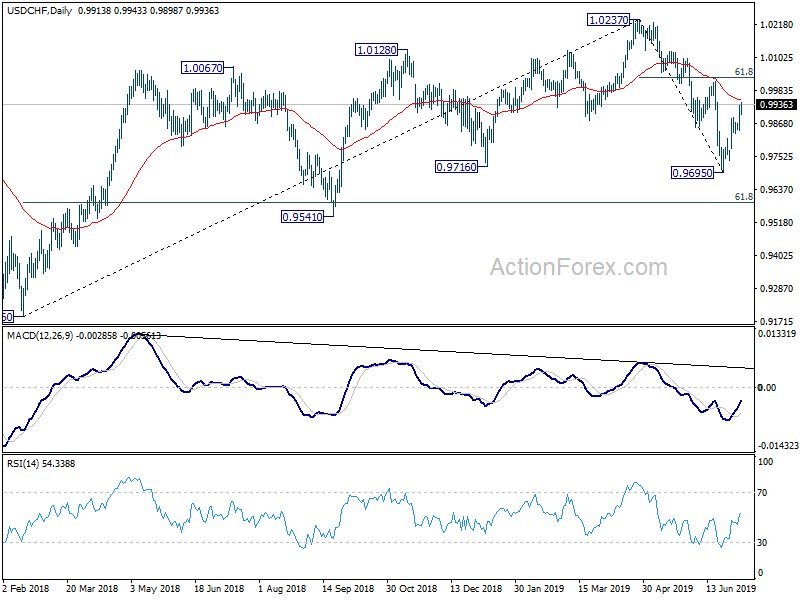
Intraday bias in USD/CHF remains mildly on the upside for the moment. Current rebound from 0.9695 would target 1.0014 resistance. Upside could be limited by 61.8% retracement of 1.0237 to 0.9695 at 1.0030. On the downside, below 0.9842 minor support will turn bias back to the downside for retesting 0.9695 low instead. However, sustained break of 1.0030 will pave the way back to retest 1.0237 high.
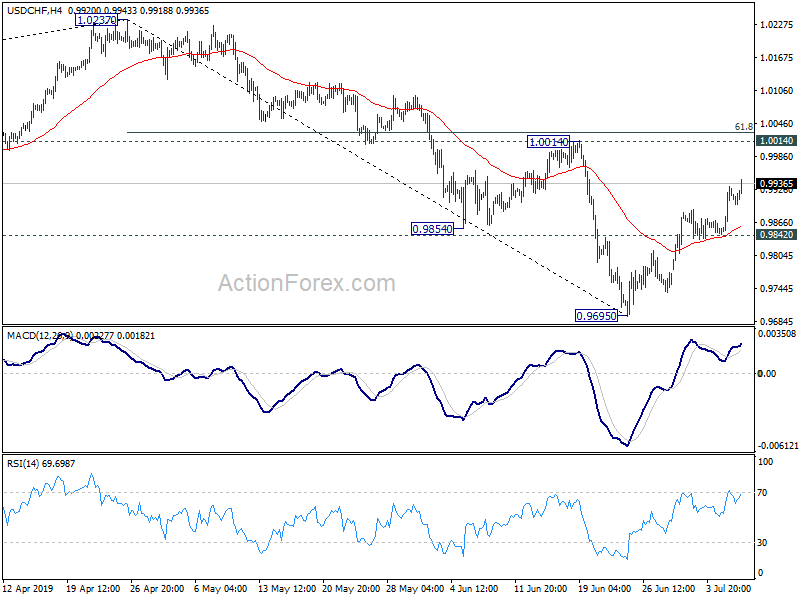
In the bigger picture, current development suggests that up trend from 0.9186 (2018 low) has completed at 1.0237 already. Deeper decline would be seen to 61.8% retracement of 0.9186 to 1.0237 at 0.9587 and below. For now, USD/CHF is seen as in long term range pattern between 0.9186 and 1.0342. Hence, we'd pay attention to bottoming signal below 0.9587. However, sustained break of 1.0014 will revive medium term bullishness and turn focus back to 1.0237 high.
GBP/USD Mid-Day Outlook
Daily Pivots: (S1) 1.2476; (P) 1.2532; (R1) 1.2583; More....
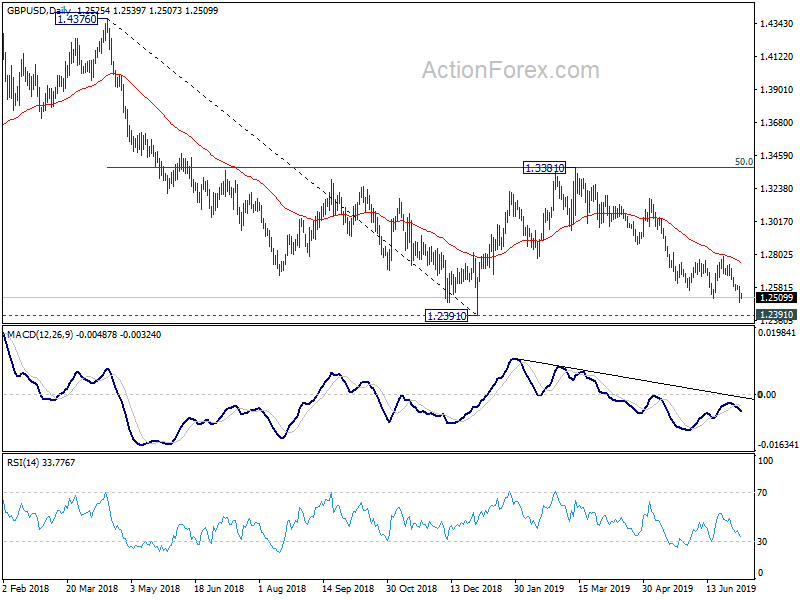
Outlook in GBP/USD remains unchanged and intraday bias stays on the downside. Current decline from 1.3381 is in progress for 1.2391 low. Firm break there will resume larger down trend. On the upside, above 1.2587 minor resistance will turn intraday bias neutral first. But near term outlook will stay bearish as long as 1.2783 resistance holds.
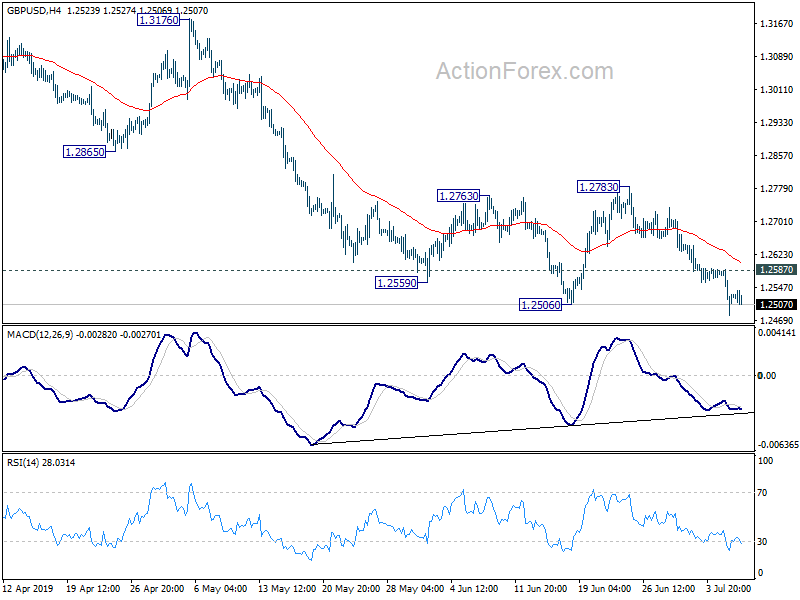
In the bigger picture, down trend from 1.4376 (2018 high) is still in progress. Break of 1.2391 would target a test on 1.1946 long term bottom (2016 low). For now, we don't expect a firm break there yet. Hence, focus will be on bottoming signal as it approaches 1.1946. In any case, medium term outlook will stay bearish as long as 1.3381 resistance holds, in case of strong rebound.
EUR/USD Mid-Day Outlook
Daily Pivots: (S1) 1.1193; (P) 1.1240; (R1) 1.1274; More...
No change in EUR/USD's outlook and intraday bias remains on the downside for the moment. Corrective recovery from 1.1107 should have completed way earlier than expected at 1.1412. Firm break of 1.1181 support will confirm this bearish case and target retest of 1.1107 low. On the upside, above 1.1287 minor resistance will turn intraday bias back to the upside for 1.1412 instead.
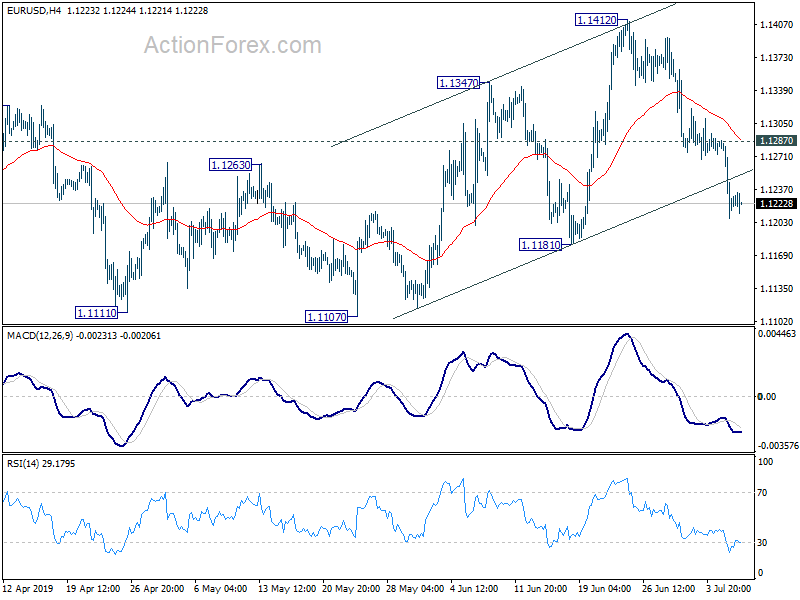
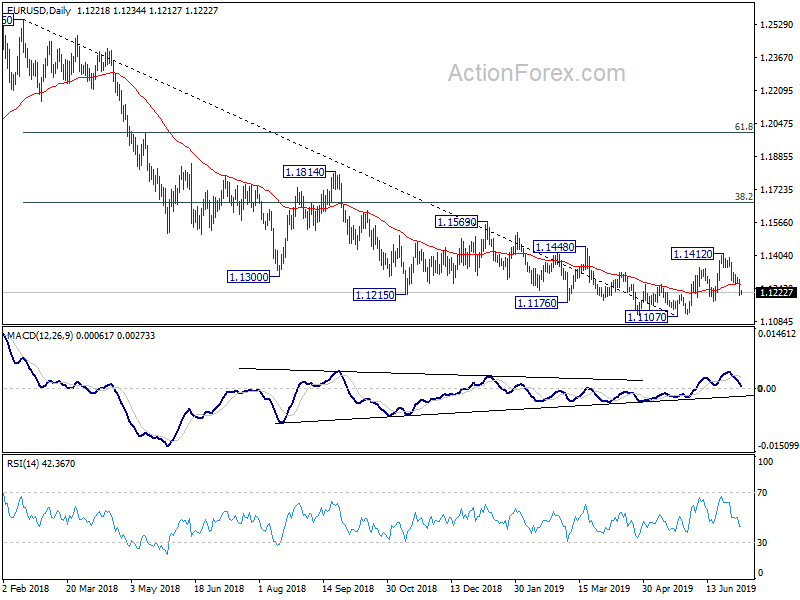
In the bigger picture, bullish convergence condition in daily and weekly MACD suggests that 1.1107 is a medium term bottom. However, rejection by 55 EMA retains medium term bearish. Outlook will be neutral for now. On the downside, break of 1.1107 will resume the down trend from 1.2555 (2018 high) to 78.6% retracement of 1.0339 to 1.2555 at 1.0813. Meanwhile, break of 1.1412 will resume the rebound to 38.2% retracement of 1.2555 to 1.1107 at 1.1660.
Euro Lower on Deteriorated Eurozone Investor Confidence
Euro trades broadly lower today as investor confidence deteriorated further despite slightly easing US-China trade tensions. German 10-year yield also weakens again following weaker investor sentiments, as German lender Deutsche Bank AG started its most aggressive restructuring and layoff. Sterling and Yen are also among the weakest ones. On the other hand, New Zealand Dollar is leading commodity currencies higher.
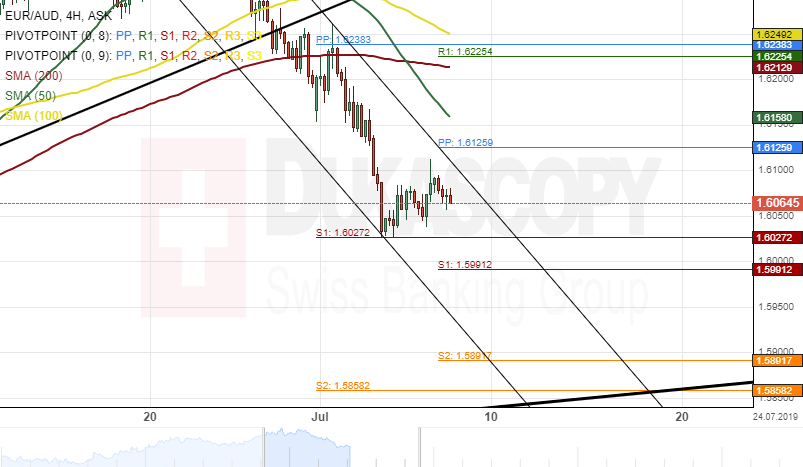
Technically, though, trading is rather subdued as most pairs and crosses are bounded in tight range. For now, further rise is mildly in Dollar in general, except versus Canadian. USD/CAD's recovery failed 1.3145 minor resistance and is eyeing 1.3037 low again. With resilience in commodity currencies, EUR/AUD is looking at 1.6025 temporary low for resuming recent fall from 1.6448. EUR/CAD's decline is on track for medium term projection level at 100% projection of 1.6151 to 1.4759 from 1.5645 at 1.4253.
In Europe, currently, FTSE is down -0.06%. DAX is down -0.34%. CAC is down -0.24%. German 10-year yield is down -0.009 at -0.371. Earlier in Asia, Nikkei dropped -0.98%. Hong Kong HSI dropped -1.54%. China Shanghai SSE dropped -2.58%. Singapore Strait Times dropped -0.97%. Japan 10-year JGB yield rose 0.126 to -0.15.
Eurozone Sentix investor confidence dropped to -5.8, lowest since 2014, Germany even worse
Eurozone Sentix Economic Index dropped to -5.8 in June, down from -3.3 and missed expectation of 0.2. It's also the lowest level since November 2014. Current Situation Index dropped from 6.0 to 1.8, lowest since February 2015. Expectations Index also dropped from -12.3 to -13.0, lowest since February 2019.
Sentix noted that after the supposed de-escalation signals in US-China trade war at G20, there was "great hope that the downward trend in the economy could be stopped". But, investors are "not blinded by the rising share prices" as expectations show no upward reaction to the news. It warned, "without resilient negotiation results, it will be difficult for investors worldwide to develop a different perspective."
For Germany, Overall Economic Index dropped from -0.7 to -4.8, lowest since November 2009. Current Situation Index dropped from 13.5 to 7.0, lowest since April 2010. Expectations Index dropped from -14.0 to -16.0, lowest since February 2019.
Sentix said "things are even worse for the German economy". "The high dependence on exports and the Chinese sales market is increasingly becoming a burden and the customs dispute hovers like a sword of Damocles over the former model boy of the Euro region." Also, the automotive industry is "simply not emerging from the crisis".
German trade surplus widened to EUR 20.6B, industrial production rose 0.3%
German foreign trade surplus widened to EUR 20.6B in May. On calendar and seasonally adjusted terms, trade surplus widened to EUR 18.7B. Exports rose 1.1% mom, 4.5% yoy to EUR 113.9B. Imports dropped -0.5% mom, 4.9% yoy to EUR 93.4B.
Industrial production rose 0.3% mom in May, matched expectations. Production in industry excluding energy and construction was up by 0.9%. Outside industry, energy production was down by -.2% in May 2019 and the production in construction decreased by -2.4%.
BoJ: All nine regions expanding or recovering, but uncertainties heightened
In the quarterly Regional Economic Report, BoJ kept assessment of all nine regions unchanged. All nine regions reported that their economy had been "either expanding or recovering". Domestic demand had "continued on an uptrend", with a virtuous cycle from income to spending operating in both the corporate and household sectors. But, exports and production had been affected by the "slowdown in overseas economies".
Also, while the assessments were overall unchanged, "a somewhat increasing number of firms were pointing to heightening uncertainties over the outlook for overseas economies and their impacts, reflecting, for example, the U.S.-China trade friction."
Governor Haruhiko Kuroda told the central bank's regional branch managers that inflation is still expected to pick up gradually to 2% target. The economy is expected to continue expanding moderately as a trend, even though it's affected by overseas slowdown. But still, BoJ would maintain easing for as long as needed to hit stable target.
Kuroda reiterated that short- and long-term interest rate will be kept at current very low levels for extended period, "at least through around spring 2020". Also, monetary base will continue to expand, and QQE will be maintained under the yield curve control framework. Also, Kuroda pledged that "the BOJ will make necessary policy adjustments to sustain the economy's momentum towards achieving its inflation target."
Released from Japan, machine orders dropped sharply by -7.8% mom in May versus expectation of -3.7% mom. Current account surplus narrowed to JPY 1.31T versus expectation of JPY 1.24T.
EUR/USD Mid-Day Outlook
Daily Pivots: (S1) 1.1193; (P) 1.1240; (R1) 1.1274; More...
No change in EUR/USD's outlook and intraday bias remains on the downside for the moment. Corrective recovery from 1.1107 should have completed way earlier than expected at 1.1412. Firm break of 1.1181 support will confirm this bearish case and target retest of 1.1107 low. On the upside, above 1.1287 minor resistance will turn intraday bias back to the upside for 1.1412 instead.
In the bigger picture, bullish convergence condition in daily and weekly MACD suggests that 1.1107 is a medium term bottom. However, rejection by 55 EMA retains medium term bearish. Outlook will be neutral for now. On the downside, break of 1.1107 will resume the down trend from 1.2555 (2018 high) to 78.6% retracement of 1.0339 to 1.2555 at 1.0813. Meanwhile, break of 1.1412 will resume the rebound to 38.2% retracement of 1.2555 to 1.1107 at 1.1660
Economic Indicators Update
| GMT | Ccy | Events | Actual | Forecast | Previous | Revised |
|---|---|---|---|---|---|---|
| 23:50 | JPY | Current Account (JPY) May P | 1.31T | 1.24T | 1.60T | |
| 23:50 | JPY | Machine Orders M/M May | -7.80% | -3.70% | 5.20% | |
| 5:00 | JPY | Eco Watchers Survey Current Jun | 44 | 43.8 | 44.1 | |
| 6:00 | EUR | German Industrial Production M/M May | 0.30% | 0.30% | -1.90% | -2.00% |
| 6:00 | EUR | German Trade Balance (EUR) May | 18.7B | 16.8B | 17.0B | 16.9B |
| 8:30 | EUR | Eurozone Sentix Investor Confidence Jul | -5.8 | 0.2 | -3.3 | |
| 19:00 | USD | Consumer Credit (USD) May | 15.2B | 17.5B |
Soft Start to Trading Week; Greece Elections, Erdogan Fires CB Head, Deutsche Bank Restart, Oil Struggles, Gold Higher
Global equities are quietly softer across the board on softer than expected German data, follow through on Friday’s falling Fed rate cut blues, and a plethora or regional stories that added to the risk-off tone. Deutsche Bank’s mixed review on their radical overhaul, Erdogan’s sacking of his central bank chief, uncertainty on how quickly Iran will raise their nuclear enrichment program, and Morgan Stanley’s downgrade of investment guidance on global stocks are keeping markets in the red.
US stocks markets will likely struggle to rebound until we hear from Fed chair Powell’s testimony to Congress on Wednesday. Markets are still confident the Fed will cut rates at the end of the month, but the strong labor market have many doubting the Fed will signal more rate cuts will come following a small 25 basis point cut at the end of July FOMC meeting.
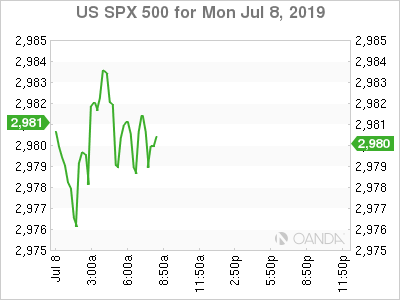
Financial markets are also waiting for a significant update on the trade front between the Chinese and Americans. If we do not see a meeting setup in Washington DC or Beijing soon, markets will grow nervous that a final deal will get pushed to next year and that uncertainty will derail fourth quarter earnings forecasts. Markets appear convinced the largest four central banks will be pumping up markets, but earnings season could see drastic fourth quarter forecasts downgrades if we don’t have more optimism on the trade front.
Greece
The populist movement is leaving Athens as Greece’s center-right New Democracy party leader Kyriakos Mitsotakis will become prime minister on Monday. The 51-year-old Mitsotakis victory shows markets that Greece is going back to supporting the main stream party. Outgoing Prime Minister Tsipras helped Greece get out of deep austerity measures that crippled the economy in 2015, but now with the economy in recovery mode, Greece is looking for someone deliver more market friendly measures.
Mitsotakis won an outright majority in the snap general election. His business-friendly approach which will likely see him try to reduce taxes and privatize services in the country. He will likely seek to renegotiate budget surplus terms with the EU and that should be the beginning of a new struggle that ultimately should be positive for the Greek economy.
Lira
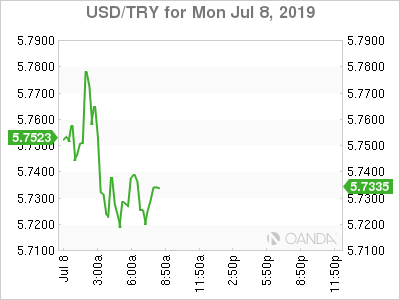
President Erdogan dismissal of Murat Cetinkaya, the head at the Turkish central bank (CBRT) was due to happen after central bank chief policy decisions disagreed that higher interest rates cause inflation. It is clear that central bank independence does not exist in Turkey and the lira will suffer. The Turkish president wants a low-interest rate policy put in place and the market has already priced in a major cut for its next policy meeting on July 25th. Before the firing the CBRT’s stance was to keep policy steady in the current tightening cycle as inflation continues to remain three times above their target.
Erdogan is under growing pressure after losing the rerun mayoral race in Istanbul. Turkey’s recession is being blamed on Erdogan, who made the push for increased bank lending and public spending, only supporting a temporary relief in the economy. The political stimulus effects have faded, and the falling lira have dealt a strong blow to the Turkish economy.
The lira is off the lows following the sacking, but that could be temporary, as many analysts view rate cuts as not enough to jump start the Turkey’s economy. Skepticism is also very high on the Erdogan’s appointment of Deputy Gov Murat Uysal. Banks that could see their Turkish assets struggle include Unicredit, BBVA, BNP Paribas and HSBC.
Deutsche Bank
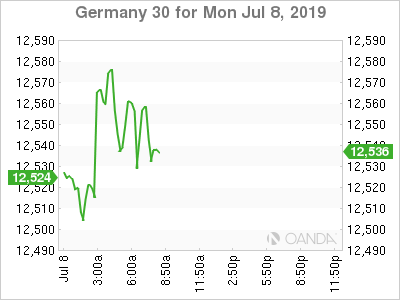
Deutsche Bank’s fifth restructuring program in four years will see the departure of the equities and trading business and a drastic reduction in costs which include the 18,000 layoffs by 2022. An overhaul, removal of the equities business, like this has not been attempted before and abandoning the global business to become a German bank only is not getting a strong vote of confidence on Monday.
Oil
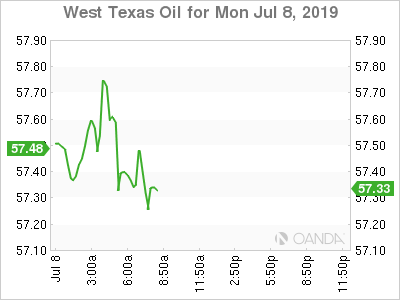
Crude prices are struggling to stabilize even as Iran signals they will breach the levels of uranium enrichment under the 2015 nuclear accord. While the situation remains tense in the Middle East, crude is not surging as Europe and Iran are communicating and optimism is growing that we could see Europe deliver some relief to Tehran’s economy in exchange for upholding the nuclear accord. Crude is also looking heavy as the global demand picture remains ugly following softer than expected German industrial production data.
The main event for financial markets this week is the Fed’s Powell testimony to Congress this week. Investors who are calling for a massive start to the easing cycle are nervous the blockbuster jobs report could have the Fed possibly wait till September. If Fed fund futures start to price in a growing risk that we will not see a cut this month, the dollar could rally, bring down commodity prices down across the board.
Gold
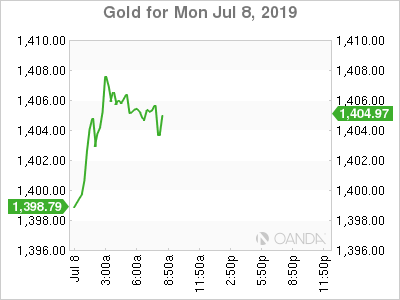
Gold is rising on softer than expected industrial production data from Germany, growing concern we will see major downgrades with fourth quarter outlooks this upcoming earnings season and nervousness Powell will not be dovish enough this week. With peak summer upon Wall Street, markets are likely to see lower volumes until we get to big events.
Bitcoin
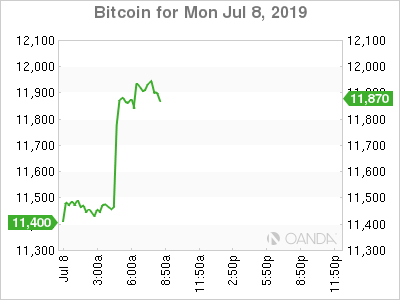
Bitcoin remains stuck in the $11,000 to $12,000 range as the rally that stemmed from the revival in retail and institutional interest has run its course. Mainstream commerce is a lengthy project that eventually will provide consistent demand for cryptocurrencies, but for now we could see a little exhaustion in the crypto news space.
UK 100 Index Decreases Below 11-Month High
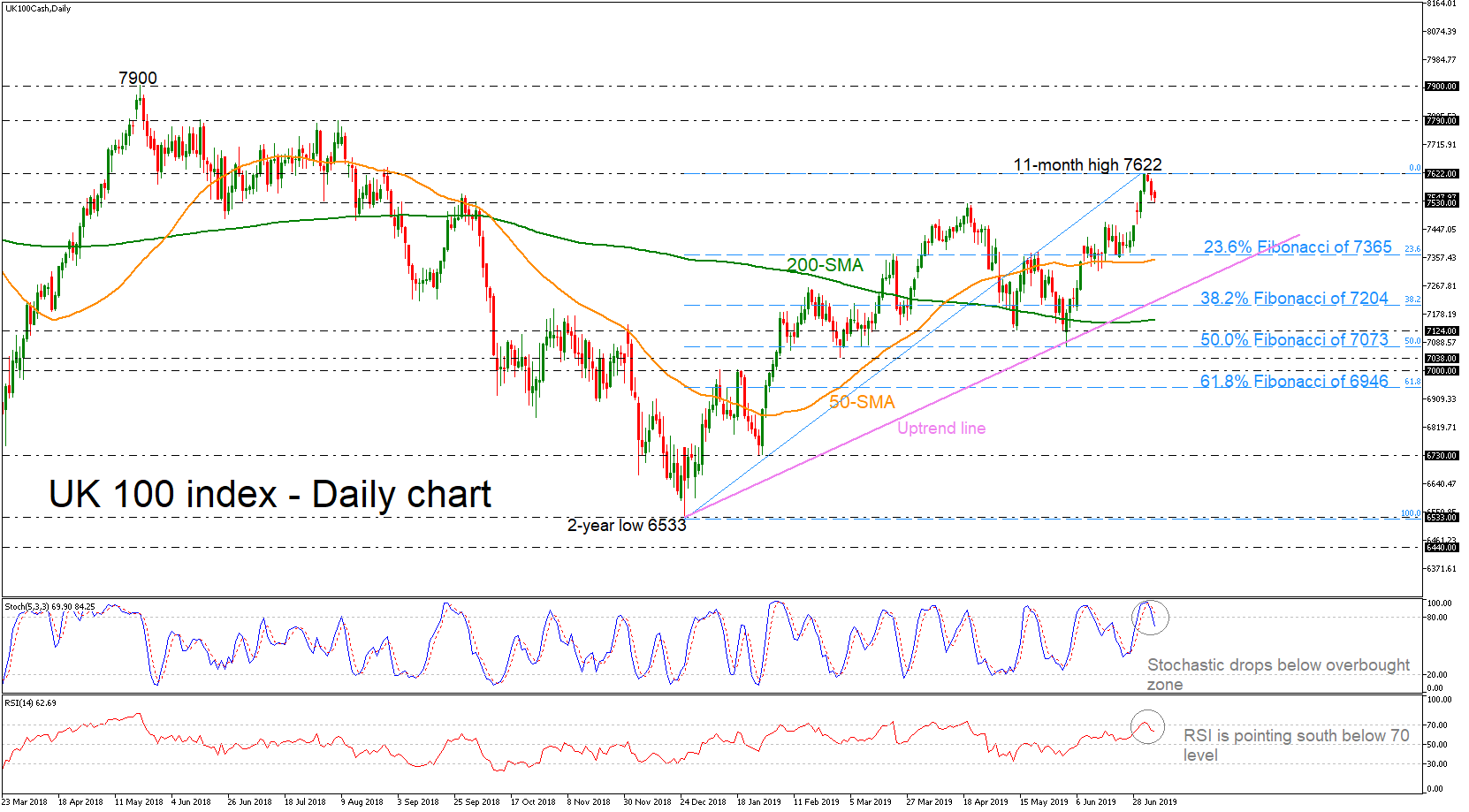
The UK 100 stock index (FTSE 100) has advanced considerably towards a fresh 11-month high of 7622, however, during the last couple of days is retreating, testing the 7530 support level. The stochastic oscillator is confirming this short-term view, as it is heading south below the overbought territory. Also, the RSI is pointing down following the bounce off the 70 level in the previous sessions.
In case of a bearish correction the market might revisit the 23.6% Fibonacci level of the upleg from 6533 to 7622 around 7365, which stands near the 50-day simple moving average (SMA). More declines could meet the 38.2% Fibonacci of 7204, around the long-term ascending trend line.
In the alternative scenario, if the price manages to extend the bullish action and surpasses successfully the 11-month high, resistance would come from the 7790 barrier, taken from the high on August 2018. Further up, the index could rest around the 7900 resistance area, identified by the high on May 2018.
Overall, a jump above the recent multi-month high could confirm the near-term bullish tendency in the daily chart.
EUR/AUD 4H Chart: Narrow Descending Channel
The EUR/AUD currency pair has been trading in a narrow descending channel pattern since June 21. The Euro has fallen about 2.40% in value during the last two weeks.
The monthly S1 at 1.6027 was providing support for the exchange rate during the morning hours of Monday's trading session.
If the support level holds, a surge towards the resistance cluster formed by the combination of the weekly and the monthly pivot points at 1.6254 could be the target for bullish traders this week.
However, if the support line does not hold, the currency exchange rate will continue its downside movement during the following trading sessions.