Sample Category Title
King Dollar’s Reign Could End on Powell’s Testimony and Trade War Progress
How big will the punch bowl be this time around? Financial markets are convinced the Fed is set to commence on an easing cycle this summer, but if we see Fed Fund futures price in only two rate cuts this year, US stocks will struggle to make fresh highs and the highly anticipated dollar reversal may not come to fruition. Friday’s blockbuster US non-farm payroll report tentatively derailed stock and equity bullish plans. The needle was moved from a slight lean towards 3 rate cuts to two cuts. The dollar’s broad gains accompanied a surge with US Treasury yields and a pullback in stocks.
The focus will now shift to incremental updates on the trade front and a plethora of Fed speak and the Minutes to last month’s decision. US inflation data will be released but other indications do not point for a significant surprise rise. The release of China’s trade figures will show how resilient their economy was during the tensest moments in the trade war. With the PBOC waiting to stimulate their economy, we could see dismal data support earlier action. Regarding trade, we will need to see meaningful updates or scheduled trips to DC or Beijing to support optimism that both sides are closing the gap. A wrath of Fed speak will see investors search for clues if the Fed waiver on its signal for a July rate cut.
- Powell testifies on Semiannual Monetary Policy Report
- Trade War impact on Chinese Trade and Inflation data
- German Industrial Production could fuel contraction bets
Euro
Stimulus bets from the ECB may grow if we continue to see a trend of softer than expected data out of Germany. The brewing trade war between the US and Europe will likely to continue to weigh on car manufacturers, with Germany bearing the brunt of the troubles. Industrial production on a monthly basis is expected to rebound, but following a very disappointing factory orders reading, we should not be surprised if the German data comes in softer.
If we see Lagarde become the ECB Chief, we could see fiscal stimulus expectations rise, which should be very positive for both growth and the euro. Draghi’s ECB has stated they are in no rush to deliver a rate cut this month, but if the data continues to show significant slowdowns, a 20 basis-point cut could happen this month.
CAD
The Bank of Canada (BOC) is widely expected to keep rates steady, with only one economist calling for a 25-basis point cut. Monetary policy is expected to remain on hold for the rest of the year, as the recent data has been surprisingly better than expected, not counting Friday’s cool labor market number. Employment has been on a tear, with the first half being the best start since 2002.
Oil
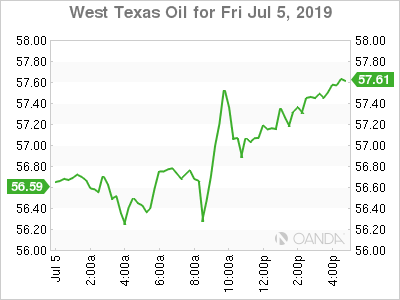
The crude selloff that stemmed from global slowdown concerns appears to be fully priced in. West Texas Intermediate crude may find key support from the mid-$50-barrel area. Oil got a boost on an improving outlook for demand on a surprising robust US nonfarm payroll report. Fresh stimulus bets are still strong for the Fed to deliver a rate cut at the end of July and for the other big three banks, the PBOC, ECB and BOJ, to remain active in delivering additional stimulus.
If we do see US and China come through with scheduling face-to-face talks, we could see markets again to price in further optimism we could see a deal done this year. Global demand would get a reprieve if China and US could finalize a trade deal.
Geopolitical risks are also keeping a bid in place for oil as Iran continues to increase their nuclear activities. Up until now, most of Europe has been trying to negotiate with Tehran, but if Iran continues to with their nuclear agenda, we could see deeper international sanctions that could completely cripple Iran’s economy.
Gold
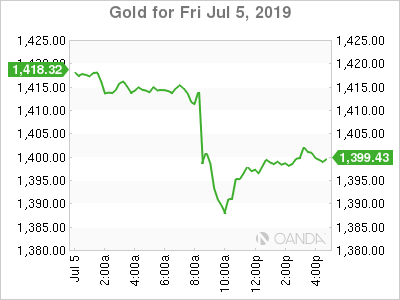
Gold lost some of its mojo after a robust nonfarm payroll report eased up dovish bets on the Fed. The overall outlook for bullion is still looking bright as gold ETF inflows appears insuppressible. Robust demand for the yellow metal will continue to be supported on the backdrop of expectations of fresh stimulus to be released by the four largest central banks.
Bitcoin
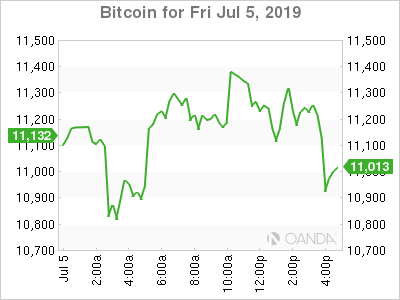
The cryptocurrency markets have been on a mission to deliver wide range interest that will attract retail, institutional and mainstream commerce interest over the past several weeks. With social media giant Facebook entering the digital coin space, all coins have benefited on renewed interest. Bitcoin remains the bellwether that has yet to be threatened by other altcoins and we should not be surprised if it eventually makes a complete recovery of the $16,000 plummet that started at the end of 2017.
Monday, July 8th
- CNY Trade Balance
- 2:00am ET EUR Germany Industrial Production m/m
- 2:00am ET EUR Germany Trade Balance
- 4:30am ET EUR Sentix Investor Confidence
- 9:30pm ET AUD NAB Business Confidence
Tuesday, July 9th
- 6:00am ET USD NFIB Small Business Optimism
- 7:00am ET MXN CPI m/m
- 8:15am ET CAD Housing Starts
- 7:50pm ET JPY PPI y/y
- 9:30pm ET CNY CPI and PPI data
Wednesday, July 10th
- 2:00am ET NOK Norway CPI m/m
- 2:45am ET EUR France Industrial Production m/m
- 4:30am ET GBP GDP m/m
- 4:30am ET GBP Industrial and Manufacturing Production data
- 10:00am ET CAD BOC Interest Rate Decision
- 10:30am ET DOE US Crude Oil Inventories
- 7:50pm ET JPY Core Machine Orders m/m
Thursday, July 11 th
- 2:00am ET EUR Germany CPI y/y
- 2:45am ET EUR France CPI m/m
- 3:00am ET CZK CPI m/m
- 3:30am ET SEK CPI m/m
- 8:30am ET USD CPI m/m
- 8:30am ET USD Initial Jobless Claims
- 6:30pm ET NZD Manufacturing PMI
Friday, July 12th
- 12:30am ET JPY Revised Industrial Production m/m
- 3:00am ET TRY Turkey Industrial Production m/m
- 5:00am ET EUR Industrial Production m/m
- 8:30am ET USD PPI m/m
Forward Guidance: BoC to Weigh Up Domestic Resilience, External Risks
We look for the Bank of Canada to strike a relatively neutral tone at next week’s meeting, deviating from policymakers at the US Fed and ECB that have turned increasingly dovish. Governing Council is likely to highlight signs of domestic resilience that offset growing trade risks and, for now, obviate the need to for a more accommodative policy stance—even with the Fed widely expected to lower rates.
Data since the BoC’s May 29 meeting have been plenty supportive. March and April GDP reports, on balance, showed a broadly-based pickup in economic activity following a winter slump. The energy sector is showing clear signs of recovery, and another key headwind—a slowdown in housing—is beginning to ease. We continue to track GDP growth of 2.2% in Q2, about 1 ppt above the BoC’s last forecast. The latest trade figures, which showed a surprising (and rare) surplus, suggest a decent contribution from net exports in the quarter. That might be difficult to sustain going forward—a number of one-offs helped boost exports in May, and the external environment is hardly supportive—but overall the BoC has plenty of evidence that the economy is recovering from its recent “detour”.
Inflation data should also keep the BoC from sounding too dovish. Headline inflation picked up to 2.4% in May and the BoC’s core measures ticked up to 2.1% on average, matching the fastest rate this cycle. Canada’s labour market remains in ship-shape notwithstanding a modest dip in hiring in June. And low unemployment is helping to push wage growth gradually higher, even if the current pace remains underwhelming.
Balancing positive domestic data flow, the BoC is likely to note signs of slowing global growth and rising trade risks. On the former, the BoC’s forecast for global growth is already conservative and we don’t think they will materially revise those projections lower. On the latter, we’ve seen a further increase in Canada-China trade tensions but the bigger worry, a spat between the US and China, has changed very little since the bank’s last meeting. The BoC’s latest Business Outlook Survey showed surprising resilience in business sentiment even amid growing trade risks meaning Canadian firms aren’t panicking about global headwinds, and we think neither will the BoC.
Wednesday’s BoC meeting is likely to be overshadowed (even north of the border) by Fed Chair Powell’s Semi-annual Monetary Policy Report to the Congress (or “Humphrey Hawkins” testimony). If Powell is disinclined to lower rates in July, this would arguably be his best (and perhaps last) opportunity to push back against market pricing that overwhelmingly favours a 25 basis point cut (and even some odds of a 50 bp move). So unless he gives a clear signal that policymakers want to see more data before pre-emptively lowering rates, markets will continue to expect a July cut—making it difficult for the Fed to not follow through.
Hiring Rebounds, But Fed Cut Still Likely Later This Month
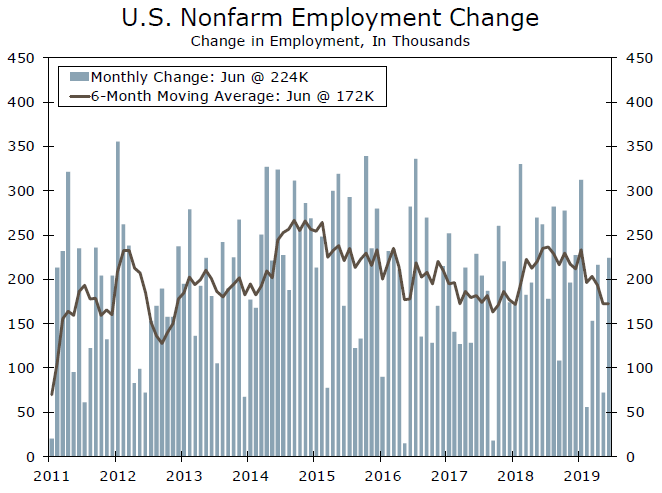
Hiring rebounded in June, with employers adding 224K new jobs. The pace of improvement in the labor market, however, has cooled. With wage growth still not threatening inflation, the Fed will still likely cut rates in July.
Unemployment and Wage Growth Stuck in Recent Range
After giving markets and Fed officials alike a scare in May, hiring got back on track in June. Employers added 224K new jobs, which pushed the three-month average up to 171K from 147K. The rebound confirms that the jobs market is hardly crumbling, but there were a number of signs that the pace of labor market tightening has cooled.
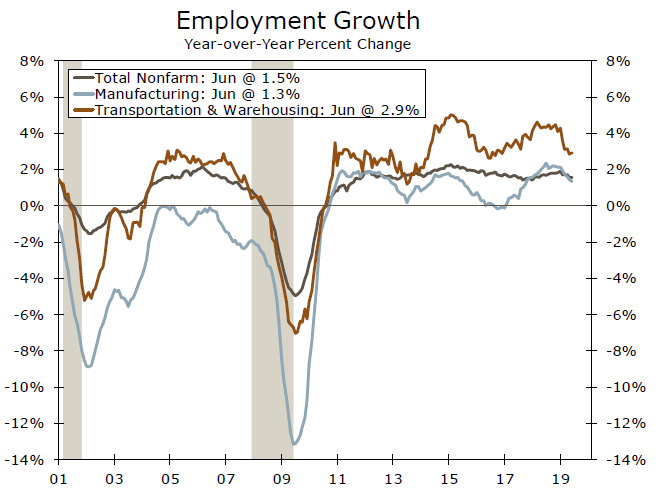
Through the first half of the year, employers added an average of 172K jobs per month, down from 211K the prior six months. Trade-related headwinds appear to have seeped into hiring here at home. Although the manufacturing and transportation & warehousing sectors posted solid gains in June (up 17K and 24K respectively), hiring has slowed on trend. Roughly half the downshift in job growth in H1:19 from H2:18 can be traced to these two sectors, even though together they account for only about 12% of employment.
More domestic-oriented sectors are holding up better, however. Education & health services payrolls rose 61K in June and have strengthened over the first half of the year. Construction, professional & business and local government hiring were also standouts in June.
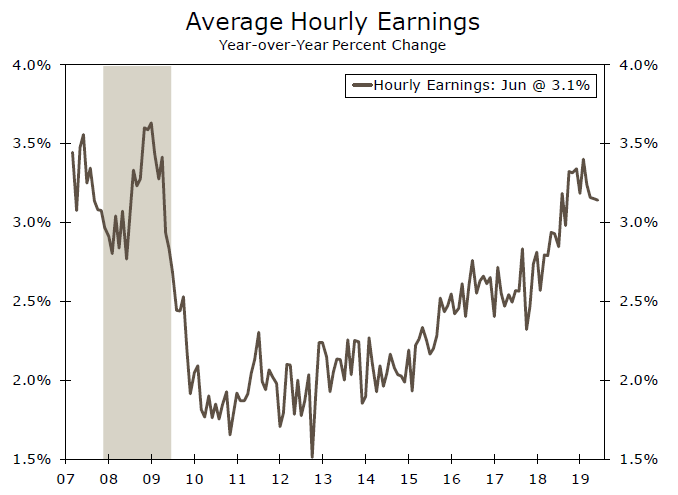
The unemployment rate edged back up to 3.7%. The uptick was driven by an increase in labor force participation, but leaves the jobless rate within the 3.6-4.0% range that has prevailed for more than a year now. Wage growth also came in a touch weaker than expected in June, 0.2%, and kept the year-ago change at 3.1%. At that pace, there is still little threat to inflation because productivity growth has kept unit labor costs comfortably below 2%.
Second Half Outlook: Moderation in Store
As we head into the second half of 2019, we expect the trend in hiring to settle back below 200K. Underlying that forecast is the assumption that a resolution of the trade dispute between the United States and China remains a ways off. While we do not expect further escalation, the ongoing nature of negotiations prolongs the uncertainty surrounding future trading relations. That uncertainty is likely to weigh most heavily on investment spending, but hiring is unlikely to be completely unscathed. Surveys on hiring plans and job openings have softened in recent months, suggesting businesses are already planning more moderate additions. While the trend in jobless claims has not really picked up, it is also no longer falling.
We look for businesses to add around 155K jobs per month in the second half of the year. That pace should be sufficient to keep the unemployment rate around 3.6% and wages rising a little over 3%. However, with labor market slack no longer clearly diminishing and inflation continuing to fall short of 2%, we expect the FOMC to guard against the slowdown and cut the fed funds rate 25 bps when it meets at the end of this month.
Australian Dollar: Iron Ore and Rates Remain Key Now and for the Outlook
We look for AUD/USD to fall to USD0.68 in late-2019, then USD0.66 in early-2020.
The Australian dollar has again held to a tight range this month. High and rising commodity prices provided support, but it was hard for the bulls to get too carried away as a further rate cut was delivered by the RBA and the domestic outlook remained dour. We remain of the view that the AUD will move lower to USD0.68 in late-2019, then to USD0.66 in early-2020.
Starting with commodity prices, from USD99/t at the time of our June Market Outlook (11 June), 62%fe iron ore has since rallied to near USD125/t. This has occurred as a result of both demand and supply-side factors.
On the supply side, a recovery in Brazilian supply after the Vale disaster of early 2019 is still proving difficult. Meanwhile, Chinese demand for high-grade iron ore imports has remained strong as Chinese steel production continues to shift to efficient smelters on the coast.
The above developments are clearly positives for the Australian dollar. Yet at USD0.7023, our currency is currently only modestly higher than its 11 June level of USD0.6960.
In part, this is likely due to the recent strength in iron ore being seen as temporary. Supply disruptions will be worked through in time, and while China has increased investment in response to the slowdown in growth, the stimulus to date has been measured and by no means consistent with the beginnings of a new ‘super-cycle’. While our forecast profile for iron ore from September 2019 (now USD110/t versus USD97/t in June) to March 2020 (now USD95/t versus USD92/t in June) has been raised, each of these figures is below current spot. As we roll forward then, support for the AUD from iron ore should abate, then reverse.
This trend should further aid the Australian dollar’s move lower, an outcome we expect to principally come as a result of the state of our domestic economy and the willingness of the RBA to continue to ease.
Cutting for a second consecutive month in July and remaining open to further easing (even with the cash rate at a new historic low of 1.00%) signals that the RBA is committed to doing all it can to strengthen the Australian economy.
The issue for the RBA with respect to the currency is that, until now, US rate cut expectations have neutralised the RBA’s impact on the Australian dollar. This is true both of the June/ July cuts as well as the market’s pricing of a third cut, which we see in November.
In pricing more than 100bps of cuts in total for the US (75bps by year end), we believe that the market has materially overstated the scale of the policy response necessary from the FOMC. US business investment has certainly slowed, and risks clearly remain over the outlook. But presently, US unemployment remains at record lows and a robust consumer is still supporting above-trend GDP growth overall.
This is not to say that the FOMC will not act at all. Recognising that confidence can be fickle late in an economic cycle and given global uncertainties, we believe there is cause for the FOMC to cut by 25bps in July and likely follow-up that move with another cut in October or December, depending on the data flow. But this pair of cuts should be seen as a fine-tuning exercise to insure GDP growth is sustained at or above trend rather than a full cycle of cuts to fight-off the risk of recession.
In stark contrast to the US, Australia finds itself experiencing growth materially below trend, principally as a result of a weak consumer, and with significant questions over the efficacy of policy from this point forward. As a result, while Westpac and the market’s core expectation is for one more cut, risks are heavily skewed to the downside. A further cut to 0.50% and the use of extraordinary policy tools are real possibilities.
Given the relative economic expectation of Australia against the US, along with our view on commodities, we believe that the Australian dollar will underperform the US dollar trend in the coming six months, supporting a move down to USD0.68. And thereafter that, as the US dollar trend turns, the Australian dollar will take another leg lower in early-2020 to USD0.66.
In terms of upside for the Australian dollar, apart from another iron ore surprise in the very near term, the risks look to be marginal. One point to watch however is the stance of fiscal policy. While we don’t see the Government’s tax plan as a game changer, a large infrastructure investment drive could support the economy and reduce the RBA’s need to act, thereby supporting the Australian dollar.
Cliff Notes: Significant Policy Easing Keeps Proving Necessary
Key insights from the week that was.
This week has brought a double policy benefit to Australia in the form of a cut in the cash rate from the RBA and the passage of the Federal Government’s tax plan. Data has however highlighted that such support remains a necessity.
In justifying their decision to cut for a second time in as many months to a new historic low of 1.00%, the RBA again focused on Australia’s labour market and the need for it to strengthen. Unemployment and underemployment both remain well above the levels the RBA see as consistent with full employment. Hence, if wages growth is to accelerate, GDP growth must rise back to trend or above and labour market slack be reduced.
While the RBA looks set to hold onto their expectation of trend growth in 2020 for now, by November we believe they will have to revise this forecast down and, in doing so, will justify another cut. As highlighted by Chief Economist Bill Evans, the risk to this view is that two rather than one cut is necessary by year end, and subsequently that the RBA may have to investigate the other policy options available to it.
Data released for Australia the week highlight the need for further support for our economy. Retail sales rose a disappointing 0.1% in May to be essentially unchanged over two months. In the detail, there was evidence of declining wealth restricting large discretionary purchases, though evidence of a wealth effect for smaller purchases was mixed.
While house prices declines look to have come to an end in Sydney and Melbourne, falls were seen elsewhere in June. Even for Sydney and Melbourne, the base case is only for flat prices or small gains, hence wealth considerations could continue to affect consumption for some time. Weak house prices are also likely to keep a lid on approvals and residential construction hence. While dwelling approvals beat the consensus expectation in May, the detail was weak, with only the volatile high-rise component showing strength.
Thankfully, support for the economy is also set to come from the Federal Government, following passage of their three-stage tax package through Parliament. We do not see this package as a game changer for consumption given it first comes as a rebate and subsequent tax cuts come with a considerable delay. However, in combination with RBA rate cuts, the tax measures should at least stabilise growth, laying a foundation from which a hoped-for acceleration in infrastructure investment could drive growth back to trend.
Shifting our gaze offshore, last weekend’s G20 brought the market what it had hoped for and a little more, with President Trump suspending a threat to broaden the array of goods that US tariffs apply to; agreeing to new negotiations with China; and also walking back the restrictions imposed on Huawei. Our assessment of the implications for China can be found in the July edition of Market Outlook, along with an updated read on the US economy, Europe and global currency markets.
On the US, the point to highlight here is that market participants have been unwilling to let go of their call for the FOMC to, at the very least, cut the federal funds rate by 25bps at its July meeting. While we see no immediate need for the FOMC to act based on the data to hand, to ‘get ahead of the curve’ and for the sake of confidence, we now see July as the most appropriate date for the Committee’s first cut. After that, another cut is to follow in the December quarter, as data and risks dictate.
In Europe, a decision was finally made on political leadership nominations almost six weeks after the May European Parliament election. For the first time, women will hold the two most powerful positions in Europe – Christine Lagarde will head the ECB, and Ursula von der Leyen the European Commission.
Lagarde’s appointment is reassuring to many given her successful political career and tenure as Managing Director of the IMF during the European debt crisis. The decision on von der Leyen is slightly more contentious given her mixed track record as German Defence minister. Her immediate task will be to take over from Juncker in handling the dispute with the Italian government around budget prudence for which, at least for now, tensions have eased after the EU decided against implementing disciplinary measures this week – the 10 year BTP-Bund spread falling back to just over 200bps as a result.
Elliott Wave Update: Bulls Can Slow Down On USD/CHF!
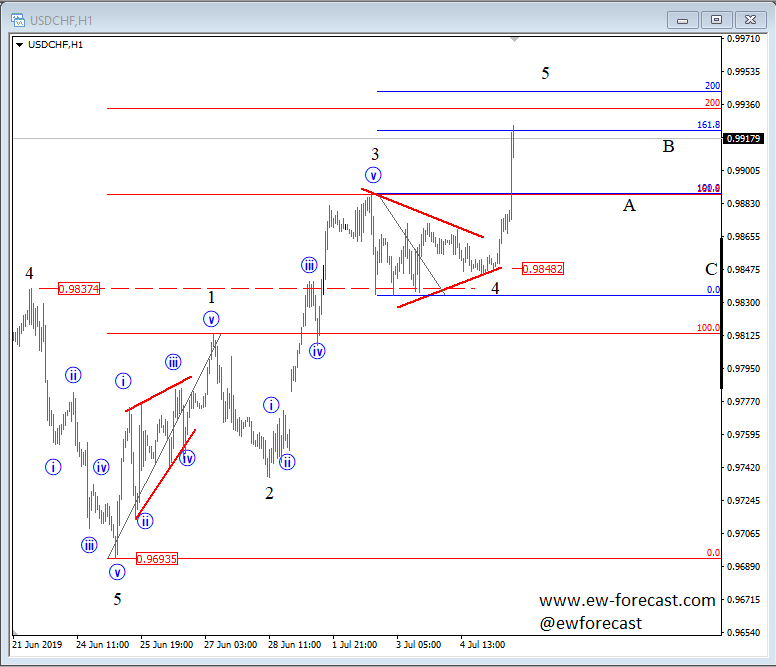
USDCHF is recovering in a fifth wave, like EURUSD, however into the opposite direction. We are observing a five-wave rise in progress, with a possible top, and resistance for the fifth wave being seen near the Fibonacci ratio of 161.8/200.0 (0.992/0.995 region). Despite current firm rally, be aware that once a five-wave movement fully develops, that is when a contra-trend reaction may follow, an A-B-C towards the 0.9848 minimum target.
USDCHF, 1h
Weekly Focus: Will the Central Bank Reveal its Latest Easing Cards?
Market movers ahead
- The latest Fed and ECB meeting minutes will be scrutinised for signs of the next steps in their monetary policy easing.
- China will be in focus on a potential restart of US-China trade talks and any comments on this.
- The euro area Q2 GDP flash report could be bad news for the market.
- US core inflation expected to remain unchanged.
- Nordic inflation numbers are likely to point in different directions (Sweden's core drop, Norway's core climb and Denmark's headline remain broadly unchanged).
Weekly wrap-up
- Despite the trade ceasefire between the US and China, big obstacles remain in reaching a deal that satisfies both sides and we still expect a rocky path ahead.
- Christine Lagarde was surprisingly nominated as the next ECB president but this does not change our expectation of a sizeable easing package in September.
- Tensions between the US and Iran continue to build, posing a danger to Middle East stability.
- Macroeconomic numbers continue to paint a sombre picture of the global economy.
The Week Ahead – BoC Meeting Eyed As Loonie Rallies, UK And Chinese Data In Focus Amid Slowdown Fears
Economic releases will be somewhat sparser in the coming week but there will be several key data to keep an eye on as well as central bank activity that could shape expectations of future monetary policy. The Bank of Canada meets for its latest policy decision and will probably resist making a dovish tilt, while the minutes of the Federal Reserve's and the European Central Bank's last policy meetings will be watched for clues on their upcoming decisions later this month.
Chinese exports probably fell back in June
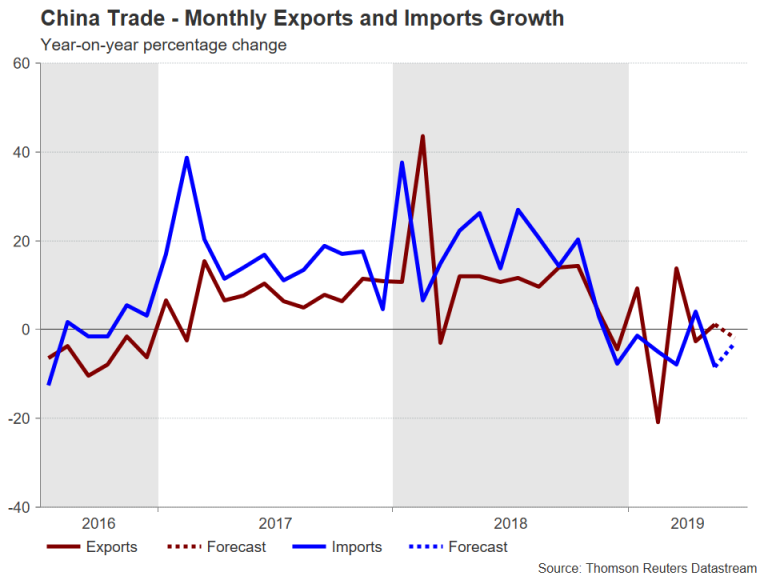
As US and Chinese officials make preparations to restart trade talks, trade numbers out of China on Friday will come under the spotlight amid signs the world's second largest economy may require further stimulus to stave off a deep slowdown. Chinese exports unexpectedly rose by 1.1% year-on-year in May, though this was mostly due to the frontloading of shipments from the latest round of tariffs imposed by the United States. They are forecast to have declined by 2% y/y in June. A bigger drop would accentuate worries about the economy and add to calls for more policy easing.
Another indication of the strength of the Chinese economy will come from June producer prices due on Wednesday. The producer price index is forecast to fall to just 0.2% y/y, suggesting weak demand for factory goods and raw materials. The consumer price index will also be released on Wednesday.
A disappointing set of figures could pressure the yuan a little but not so much the Australian dollar – often seen as a better liquid proxy for the yuan as China is the main destination for Australian exports. The aussie has been benefiting from higher iron ore prices and narrowing negative spreads between Australian and US yields so is likely to hold firm unless China's trade stats cause a major deterioration in risk sentiment.
Machinery orders coming up in Japan
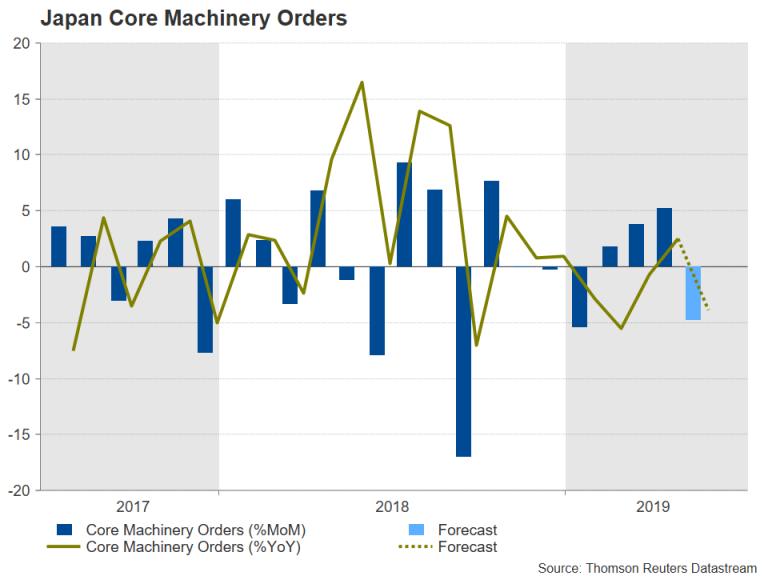
Machinery orders will be the main release in Japan, which will kick off the week on Monday. Despite the ongoing trade uncertainty and weakening overseas demand, Japanese machinery orders were up for the third straight month in April. Industrial production has also steadied after plunging in January. The final reading for industrial output in May is out on Friday and before that, corporate goods prices will be viewed on Wednesday.
The not-so-gloomy economic picture in Japan probably explains why the Bank of Japan is not in any hurry yet to join its counterparts in signalling looser policy. One area of concern, though, for the BoJ is the deterioration in earnings, which have been falling throughout 2019. The May figure is out on Tuesday and another annual drop would not bode well for consumer demand, hence, growth.
But until the BoJ sends out explicit signals of policy easing, the yen will likely continue to appreciate against its peers as most other central banks move towards or have moved in cutting rates.
Will ECB minutes pave way for rate cut?
Apart from industrial output numbers, the European calendar will be relatively light next week, putting the focus on the ECB's June meeting minutes. At the start of the week, the market's attention will fall on the German economy as industrial output and trade data will be released on Monday. The Eurozone-wide industrial production figures will follow on Friday.
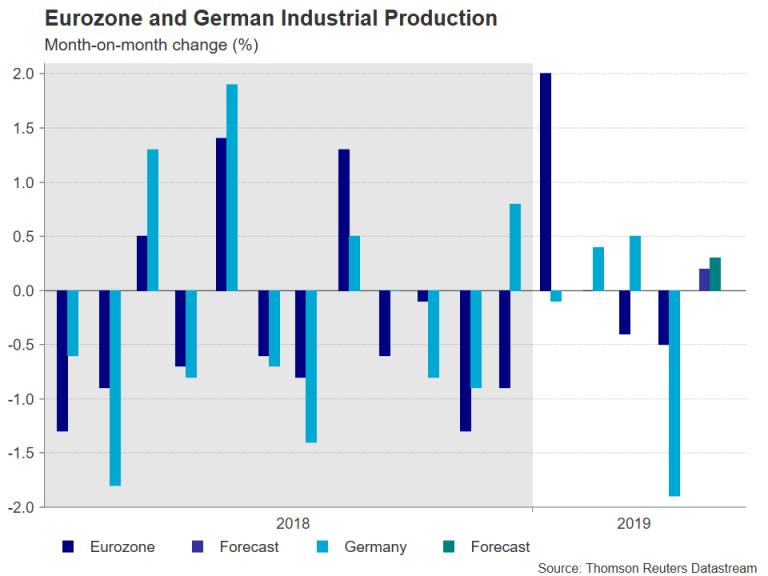
The bloc's manufacturing sector, particularly Germany's, continues to struggle as trade tensions weigh on business investment and disrupt global supply chains. And with the Trump administration seeking to expand the trade fight to more countries, including the European Union, instead of looking to end it, the Eurozone's outlook has grown dimmer. This has forced the ECB to rethink its policy normalization plans as inflation has also moderated.
At the June meeting, the ECB refrained from adopting a clear loosening bias even though President Draghi did say some members raised the possibility of a rate cut. The account of that meeting, to be published on Thursday, should throw some insight into those discussions. Although there have been several signals since the June meeting, including from Draghi himself, that additional stimulus may be on the cards, a dovish account could still pressure the euro, which this week slipped back below $1.13 on declining Eurozone bond yields.
UK May data could point to Q2 contraction
The UK's growth outlook is not looking any better either lately and the economy probably underperformed its European partners in the second quarter as the Brexit extension has only prolonged the period of uncertainty for British businesses. UK GDP shrank by 0.4% month-on-month in April and data due on Wednesday is forecast to show GDP recovering by 0.3% in May. Both industrial and manufacturing output also slumped in April as firms sought to run down the large stockpiles they built in the prior month. In May, they're expected to have rebounded by 1.5% and 2.5% m/m, respectively.
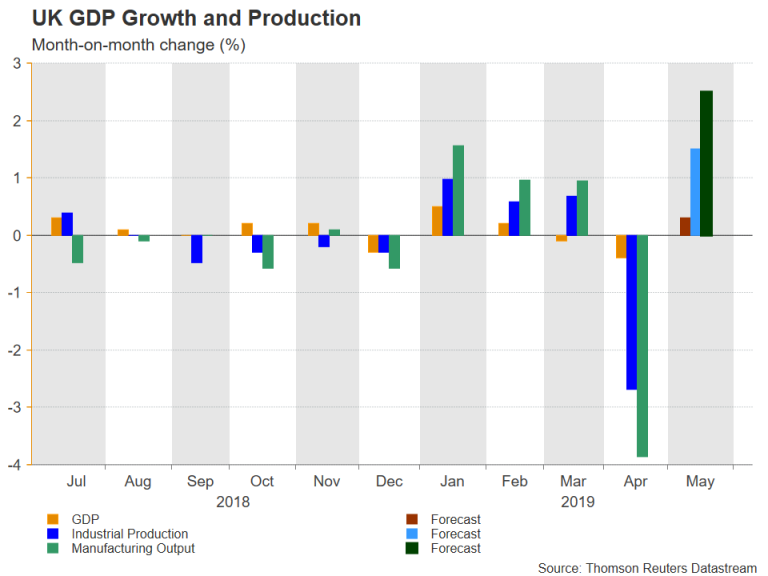
If the numbers indicate the UK economy likely contracted in the second quarter, this would further hinder the Bank of England's intension to raise interest rates in the next 12 months even if there is a smooth Brexit. Markets already think the next move will be down, having priced a more than 50% probability of a cut by December.
Sterling could struggle to hold above key support at the $1.25 level if next week's releases further raise the odds of a BoE rate cut by year end.
FOMC minutes and June CPI to be US highlights
As investors digest the mixed data on the US economy from the past week, attention will move onto the latest consumer and producer prices, as well as the minutes of the Fed's June policy meeting. The 12-month CPI rate, out on Thursday, is expected to have dropped by 0.1 percentage points to 1.7% in June. Producer prices for the same month will follow on Friday.
While the CPI numbers are not anticipated to be of much significance to investors' pricing of a rate reduction by the Fed at the end of this month, weaker-than-expected figures would only reinforce the view that the US central bank will ease policy and this would keep the US dollar on the backfoot.
More important for the dollar, though, will be Wednesday's FOMC minutes of the June meeting. The June dot plot chart saw a major shift in FOMC members' forecasts of the rate path, but the median projection was for rates to stay on hold for the rest of 2019. The minutes could reveal how close 9 of the 17 FOMC members who didn't predict a rate cut were to changing their inclination.
Bank of Canada to stand pat
Things have perked up lately for the Canadian economy as inflation has overshot expectations and GDP growth has accelerated. Higher oil prices have also improved Canada's growth prospects as well as the Canadian dollar's. Normally, the Bank of Canada would not have hesitated to hike rates under such conditions. However, with the global economy slowing down and other central banks switching to a dovish stance, the BoC will probably decide to hold monetary policy steady for the time being.
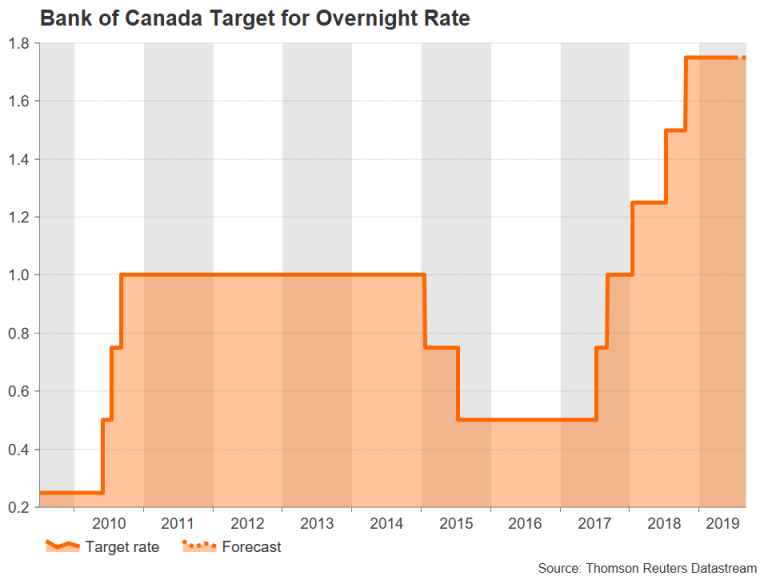
The Bank is widely anticipated to keep rates at 1.75% at it's meeting on Wednesday and futures markets see only about a 20% probability of lower rates by December. With the Bank's announcement statement not expected to give much away, investors will be looking at Stephen Poloz's press conference and the quarterly Monetary Policy Report for more clues on what direction the BoC will take in the coming months.
In the meantime, the greenback's declining yield advantage has driven the loonie to eight-month highs as interest rates in the US could soon fall below those in Canada.
Sunset Market Commentary
Markets
The recent global bond rally took a breather today. Both German Bunds and the US Treasuries held an downward bias. After the recent steep increase, markets readied for some profit-taking going into the June US payrolls even though risk sentiment was shaky. The move down accelerated after June payrolls’ growth rebounded more than markets had anticipated. Other details of the report also helped to dismiss the doubts that arose on the health of the labour market since the May payrolls release. Inflationary pressures from rising wages still remain muted, leaving the path for a July rate cut wide open. Markets did scale back bets on a 50 bps rate cut though. US yields rose. The curve shifted north with yield changes varying from 9.1 bps (2-yr) to 8.4 bps (10-yr). German yields followed in lockstep although the rise stayed limited. The 2-yr yield increases 1.4 bps at the time of writing. The 10-yr yield bounced of resistance at -0.40% this morning and adds 4 bps. Peripheral spreads end the week widening. Greece and Italy add 3 bps, Portugal (+5 bps) underperforms.
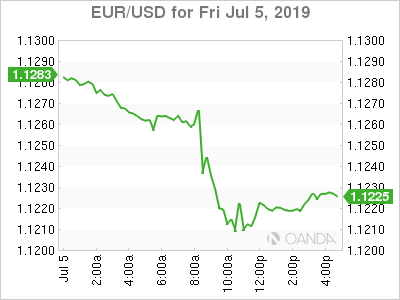
The dollar was in rather good shape this morning as trading restated after the 4th of July holiday and as (US) investors prepared for the key US payrolls report. EUR/USD drifted lower in the 1.12 big figure. Admittedly, very poor German factory orders maybe weighted on the euro too. However, broad-based USD strength was also visible in the likes of USD/JPY. The pair returned north of 108, even as global equities traded in negative territory. The dollar rebound was support by a tentative rise in US yields. Job growth was strong (224k) but wages disappointed (3.1%) and the unemployment rate rose from 3.6 to 3.7%.The summarize, the US labour report was strong, but some details were a bit mixed. Other indictors might give a different picture, but at least this report supports the case for a 25 bp July rate cut, rather than a 50 bp cut. At first, there was some hesitation, but finally US yields extended their intraday rise. The dollar also profited, but gains are quite modest. EUR/USD trades currently in the 1.1230 area. USD/JPY outperforms and is changing hands in the 108.50 area.
Sterling remained in the defensive today as the campaign battle between the two contenders become PM continued. Almost every day, other potential issues/side-effects related to Brexit come to the forefront. Yesterday Boris Johnson tried to downplay the risk of (a no-deal) Brexit splitting the UK union. The issue isn’t new but only illustrates the multiple possible side-effects of Brexit that need to be addressed at some point. Several conservative MP’s also still try to find a way to block a no-deal Brexit. Sterling remained on the defensive today. Cable slipped lower in the 1.25 big figure. This was mainly due to intraday USD strength. Even so, the key 1.25 support area is coming within reach. EUR/GBP (0.8975 area) held near recent top, even as the euro wasn’t in a good shape overall.
News Headlines
US net job growth reaccelerated in June to 224 000, from a meagre 72 000 in May indicating that the US labour market is still in good shape. However, other details in the report painted a more mixed picture. Wage growth again disappointed at 0.2% M/M and 3.1% Y/Y. The jobless rate rose from 3.6% to 3.7%, but this was due to a rise in the workforce, which as such should be considered a positive.
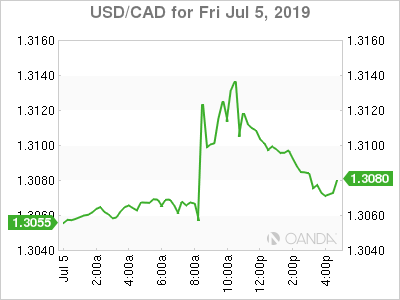
The June Canadian job report disappointed, registering a net job loss of -2 200 vs. a rise of 9 900 expected after two strong months. The job losses were solely on the account of part time employment. Hourly wages accelerated to 3.6% yoy, the fastest pace since June 2018. The participation rate stabilized at 65.7%. The loonie lost ground to about USD/CAD 1.31.
EUR/USD Outlook: Euro Falls to Two-Week Low and Risks Further Weakness after Robust NFP Data
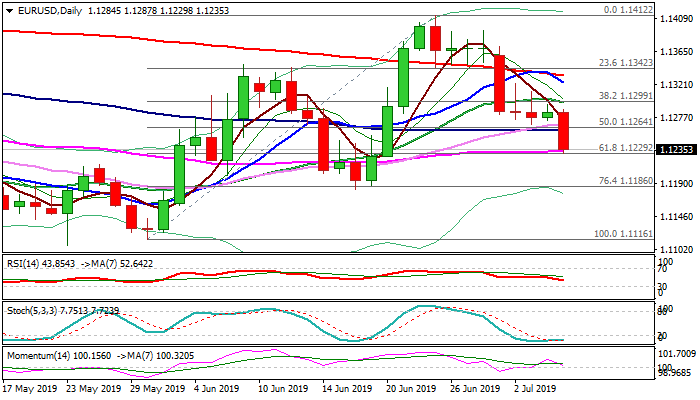
The Euro fell to the lowest levels in two weeks after robust US NFP data showed stronger than expected rise in June (224K vs 160K f/c and downward revised May result to 72K from 75K). Strong jobs data inflated dollar, despite lower than expected earnings (0.2% vs 0.3% f/c) as expectations for 0.5% rate Fed rate cut in July dropped significantly after data. Fresh weakness found footstep at key supports at 1.1232/29 (55DMA/Fibo 61.8% of 1.1116/1.1412 ascend, but risk of further acceleration lower on break here exists, as Euro's sentiment soured as larger bears off 1.1412 top extended after three-day consolidation above daily cloud top. Sustained break lower would open way towards next key supports at 1.1180 zone (18 June trough/daily cloud base). The pair is also on track for the biggest weekly loss since the first week of March, with formation of Evening Doji Star reversal pattern on weekly chart, adding to negative outlook.
Res: 1.1259; 1.1268; 1.1297; 1.1311
Sup: 1.1225; 1.1181; 1.1160; 1.1116